




Abstract
Political parties increasingly rely on self-regulation to promote ethical standards in office. The adoption of ethics self-regulation and its ability to induce change is likely to be a function of the responses from politicians and voters. Without external enforcement mechanisms, compliance requires support from legislators. In turn, if voters perceive self-regulation as cheap talk, officials have fewer incentives to acquiesce. The extent to which such efforts are rewarded by voters and supported by elected officials remains an open question. We examine this question in a paired conjoint experiment with elected officials and voters in Portugal and Spain. The results show that politicians support (and voters reward) financial disclosures, lobbying registries, and sanctions for MPs involved in corruption cases. Voters also reward term limits, and the effects are not moderated by ideological agreement. The findings suggest that parties can benefit from promoting transparency reforms and are not penalized by experimentation.
In 2015, the Spanish Socialist Workers’ Party (PSOE) required all party candidates in large municipalities to publicly declare their assets before the election. According to Maria Veracruz, a senior party member, the initiative resulted from the party’s growing disconnect from voters: “[f]aced with so much democratic backslide, there is only room for openness, exemplarity, and transparency.” 1 This initiative is part of a broader trend. Following successive corruption scandals and the rise of anti-establishment parties, party leaders across Europe have started proposing self-regulation measures to promote transparency and reinforce ethical standards internally (de Sousa et al., 2023).
Ethics self-regulation can take a variety of forms. Parties can adopt internal codes of conduct, create disciplinary bodies or logs of activities with interest groups, impose financial disclosure rules, and even impose term limits. We know very little, however, about which of such measures, if any, are rewarded by voters. Similarly, whether voters’ views on these issues are congruent with those of elected officials remains unclear.
The likelihood of such reforms being adopted and their potential to effectively promote ethical conduct is likely to hinge on the response to those questions. Since self-regulation does not benefit from external enforcement mechanisms, it is unlikely to produce sustained changes in ethical conduct without some degree of support and acquiescence from officeholders (May 2005). The performance of transparency reforms is contingent upon political actors’ willingness to comply (Honig et al. 2022). When members of an organization agree with a set of rules, formal or informal regulatory measures reinforce their position on the issue. However, when these members disagree with such rules, they will be less likely to recognize the potentially harmful effects of rule violation (Gilliland and Manning 2002). Anti-corruption reforms can have deleterious consequences if they generate backlash from established political elites (Klašnja and Pop-Eleches, 2022). Hence, the position of politicians on ethics self-regulation is likely to matter for compliance.
Conversely, the public response to ethics self-regulation may also influence the effectiveness of these reforms. Historically, self-regulation in different sectors is driven by reputational incentives (Bunea, 2018; Yue and Ingram, 2012). If voters reward a specific self-regulation reform, office-seeking party leaders have additional incentives to expand and enforce it, either to increase party reputation in this domain or to avoid electoral punishment for unfulfilled promises. Evidence shows that regulation is responsive to public opinion (Giger and Klüver 2016; but see Miller et al. 2018). However, initiatives that voters deem inefficient or mere window dressing are unlikely to positively affect institutional trust (Anderson et al. 2005).
Therefore, how politicians and voters respond to different self-regulation initiatives by political parties is a crucial question. We study such responses by embedding a conjoint experiment in (1) a survey of Members of Parliament (MPs) and local elected officials in Portugal and Spain and (2) a nationally representative survey of Portuguese voters. This paired design allows us to study the preferences of voters and elected officials and how they differ.
We asked voters and politicians to evaluate a series of hypothetical parties that varied along four common instruments of self-regulation: position on term limits, financial disclosure rules, lobbying registries, and formal sanctions for public officials involved in corruption scandals. This experimental design allows us to isolate the marginal causal effect of each instrument on different outcomes. The analyses provide four main findings. First, political elites jointly support (and voters reward) most types of self-regulation. Second, while all reforms have moderate effects on evaluations, introducing sanctions for legislators involved in corruption cases produces the largest effects for both voters and legislators. Third, term limits are the only domain in which legislators and voters respond differently. Voters reward parties that impose term limits but do not distinguish between rules imposed by the current leadership and those embedded in party statutes. In contrast, the effects among legislators are smaller and indistinguishable from zero. Finally, we show that ideological proximity to a party does not meaningfully affect voters’ responses to self-regulation measures.
Our study makes three main contributions. First, it advances our knowledge of the prospects of anti-corruption campaigns by shedding light on mass and elite views toward a set of reforms that has received scant attention in the literature (de Sousa et al., 2023). The results reveal that both voters and legislators support ethics self-regulation by political parties. This is especially true of instruments that enhance accountability, either by allowing voters to make more informed decisions or by ensuring that politicians engaged in wrongdoing are effectively sanctioned. Second, the study provides concrete steps for party leaders to promote transparency within their parties. Intergovernmental organizations responsible for establishing guidelines for political party regulation, such as the Venice Commission or the Organization for Security and Co-operation in Europe, can also benefit from the evidence reported here. Third, the results suggest that despite the risks associated with the introduction of term limits, voters remain supportive of them as an anti-corruption instrument. This finding reveals a gap between the growing body of research revealing the negative externalities of term limits and public perceptions.
Corruption and political parties
Corruption corrodes public trust in political institutions (Morris and Klesner 2010). According to UN Secretary-General António Guterres, corruption “breeds disillusion with Government and governance and is often at the root of political dysfunction and social disunity” (UN, 2018). Public perceptions of political parties have been particularly affected by corruption scandals (Zmerli and Newton 2017: 113).
Parties play a central role in the democratic process: they select candidates, run for office, and shape policy. They are co-responsible for the quality of political leadership and the pool of candidates running for office, both in terms of their political skills and their ethical posture. If citizens believe parties are acting contrary to the principles underpinning democratic governance or are not fulfilling the “political integration functions” expected from them, they are less likely to trust political parties and support the political system as a whole (Anderson et al. 2005). In short, if people believe parties are “corrupt institutions run by self-interested and power-hungry politicians” (Ceka 2013), they are likely to feel disillusioned about politics and either withdraw from public life or seek alternative ways to express their discontent, such as by voting for anti-system parties (Pop-Eleches, 2010).
In recent years, a growing disconnect between voters and political parties, along with the rise of the anti-establishment vote (De Vries and Hobolt 2020), has motivated party leaders to pursue regulation to promote transparency and ethical standards in public office (Dávid-Barrett 2015). Parties can either set ethical standards collectively in parliament or internally. Meta regulation through the adoption of dedicated legislation often involves the establishment of a non-majoritarian body empowered to define norms of conduct and to oversee their observance. However, these regulatory regimes often create minimum standards given the difficulty of reaching agreements across parties with diverse internal structures (Tonhäeuser and Stavenes 2020).
The reluctance to create externally enforced legal standards, along with the desire to stand out electorally from their competitors, has led party leaders to complement meta-regulation with internal reforms. Parties play an important educational and socialization function in democracies (Levitsky and Ziblatt 2018). They not only construct and preserve collective identities; they also discipline members’ behavior where necessary (Della Porta, 2001). Ethics self-regulation can thus serve as a guardrail against populist and anti-establishment movements. In the next section we describe different types of self-regulation measures and how voters and legislators may respond to them.
How can parties promote transparency and ethical conduct?
Recent studies, including the Party Ethics Self-Regulation (PESR) database, have shown that the broader trend of political ethics self-regulation, now widely adopted by parliaments and executives, has reached political parties, particularly in Europe.The Party Ethics Self-Regulation (PESR) database reveals that over one third of the 200 European parties coded have adopted codes of conduct and more than half of them created internal bodies that are responsible for dealing with disciplinary matters (de Sousa et al., 2023). In Spain, for instance, all parties with parliamentary representation have codes of conduct. In Portugal, such instruments are scarcer, but several party leaders, during their mandate, to adopt ad hoc integrity rules for the party candidates.
Ethics self-regulation can take multiple forms, including abstract norms, written codes and standards of conduct, as well as more concrete measures regulating information disclosure, legislative behavior, or candidate selection. At times, rules are not coded, but result from the initiative of certain leaders, who impose ad hoc integrity measures, as explained below. We identified four concrete measures that have been adopted in party efforts and other political institutions to promote transparency and ethical conduct: (1) term limits, (2) financial disclosures, (3) logs of activities with interest groups, and (4) formal sanctions for legislators involved in corruption scandals. Investigating whether each measure can effectively promote ethical conduct is beyond the scope of the current study. We instead assess whether voters reward (and whether political elites are willing to support) these initiatives, which are pre-conditions for any party reform to be sustained. Finally, we consider the degree to which different levels of institutionalization of these reforms may influence how voters and politicians perceive them. The rest of this section describes each instrument in turn.
Term limits
Term limits influence legislative behavior in different ways. One strand of the literature suggests that imposing term limits would ensure that legislators are less entrenched in office, are more responsive to constituency preferences, and have fewer opportunities to develop corruption networks (Carey et al. 2006; Caress and Kunioka 2012; Petracca 1993; Smart and Sturm 2013). These potential benefits are based on the recognition that more experienced politicians are better equipped to leverage their position for personal gain (Bauhr and Charron 2021; Klašnja 2015). This claim has inspired the Italian Five Star Movement to impose term limits for all candidates running in its party lists. 2
Other scholars highlight the potential drawbacks of term limits. Imposing term limits can lead to weaker incentives for legislators to act on behalf of voters and to a greater reliance on interest groups to compensate for the lack of legislative expertise (Masket and Shor 2015; Olson and Rogowski 2020). There is evidence from Brazil that term-limited mayors are more likely to engage in corruption (Ferraz and Finan 2011). Others see term limits mainly as a populist solution driven by anti-elite sentiment (Cain and Levin 1999). Tsur (2021) describes the trade-off between becoming an effective policymaker and an effective embezzler and concludes that term limits increase the frequency of corruption cases but reduce the expected cost per incident. International organizations that promote institutional reform share similar views. Transparency International and the Venice Commission, an advisory body of the Council of Europe, defend the introduction of term limits in executive positions highly exposed to corruption risks, but not necessarily for MPs (Transparency International 2011; Venice Commission 2018).
Despite the lack of consensus in the literature, the prevailing view in public discourse is that term limits can reduce corruption by forcing more entrenched legislators out of office; public support for term limits is high (Stein et al. 2002) and largely driven by political distrust (Karp 1995), which reaches comparatively high levels in countries such as Portugal and Spain. In fact, in the Portuguese case, in the early 2010s, the (then) leader of the Socialist Party decided not to allow mayors with more than three terms to ran for any local elections on the behalf of the party, despite the ambiguity of the law that set some limits.
Therefore, we expect voters to reward parties that introduce term limits for public office. Elected officials, in turn, may be less supportive of term limits for at least two different reasons. First, term limits constrain legislators’ ability to achieve their policy and office goals. Second, legislators are more familiar with the policymaking process and, therefore, may be better equipped than the general public to recognize the costs of removing reelection incentives and limiting the ability of elected officials to develop policy expertise. For these reasons, we expect politicians to be less supportive of introducing term limits than the general public.
Financial statements
Parties can also promote ethical standards by requiring all candidates on their lists to provide financial statements or asset declarations. Efforts to promote transparency in political campaigns can influence legislators’ retirement decisions and electoral outcomes (Weschle 2021a; Wood 2021; Wood and Grose 2021). Although some types of interests may not be deemed incompatible with office, they may constitute a real or potential conflict with the office holder’s concrete activities (Weschle 2021b). Financial statements also expose suspicious shifts in wealth accumulation among incumbents (Chauchard et al. 2019). Consistent with this view, anti-corruption reforms in countries like Portugal and Chile demand asset declaration from Presidential candidates and, in Spain in 2015, the leader of PSOE decided to publish asset declarations of the party’s candidates ahead of the general election.
Financial statements and asset declarations released prior to an election (instead of afterwards) allow voters to make more informed decisions. Moreover, they allow party leaders to exclude from the lists any candidates who do not comply, an enforcement mechanism that is likely to make the reform more effective (Honig et al. 2022). Hence, we expect voters to reward parties’ efforts to pro-actively disclose information about the candidates on their lists, especially when this is done before an election. Legislators, in turn, are unlikely to object to this measure. Unlike other self-regulation reforms like term limits, financial statements represent a residual cost to legislators that is unlikely to outweigh the potential electoral benefits of demonstrating a commitment to transparency.
Disclosure of lobbying activities
Parties can also encourage transparency in the law-making process and mitigate risks of conflict of interest and undue influence. As part of the policymaking process, legislators regularly interact with lobbyists and interest groups. While organized interests play an important role in providing the expertise required for efficient policymaking, they can also create distortions in political representation and opportunities for corruption (Giger and Klüver 2016; Schlozman et al. 2012; Pereira 2021). While parliaments around the world have imposed a variety of rules to regulate these interactions, they remain a black box in many countries, with informal channels often prevailing. Portugal and Spain are no exception (Lisi and Muñoz Marquez 2019).
Recent trends in lobbying regulation have gone beyond introducing comprehensive registers of lobbyists to include detailed information on who sought to influence ongoing or prospective bills. These attempts to create a ‘legislative footprint’ often require cabinet members, legislators, regulators, and senior public officials to publish information on their meetings and interactions with interest groups including agendas, minutes, and any supporting documentation related to a draft legislative or policy proposal. This transparency mechanism is not only designed to shed light on interest groups’ influence over decision-makers, but also to ensure that all citizens have a fair chance to provide input into the policymaking process and that public interest is safeguarded. While few lobbying regimes have successfully incorporated this mechanism, some political parties and representatives have voluntarily provided proxies of legislative footprints, with varying degrees of data quality and disclosure frequency.
Public perceptions of undue influence from interest groups are a common source of resentment among voters; populist parties leverage this concern to mobilize support. Initiatives that promote transparency in lobbying activities mitigate the principal—agent problem by giving politicians less leeway to deviate from voter preferences (Flavin 2015). Voters value opportunities to (re)gain control of the policymaking process. Consistent with this view, prior work shows that transparency reduces perceptions of corruption and improves perceptions of fairness and accountability in decision-making (De Fine Licht et al. 2014; Kanol 2018). Hence, we expect voters to reward party efforts to regulate their interactions with interest groups.
It is less clear how politicians will respond to self-regulation of lobbying activities. Time-constrained politicians often rely on the expertise of outside actors to help them make informed decisions. This exchange often requires trust that is built over time in repeated interactions (Hall and Deardoff 2006). Transparency in negotiations can also change the behavior of participants and create obstacles to compromise (Cross 2013). However, repeated interactions can suggest undue influence from specific groups. A public log of interactions with lobbyists encourages public officials to avoid relying on the same set of trusted sources. Politicians who oppose an initiative to promote transparency over who has influenced a certain piece of legislation risk signalling that they have something to hide from voters, and therefore may be pressed to support it. In addition to this integrity concern, there is also an outcome-based incentive to voluntary disclosure of meetings with interest groups and professional lobbyists. By publicizing contributions to the draft legislation or the political process, decision-makers signal that they are open and willing to receive inputs from a wider and more representative group of stakeholders. On the other hand, if a public log of interactions with lobbyists encourages public officials to avoid relying on the same set of trusted sources, it can increase the costs of acquiring information.
Sanctions for corruption accusations
Political parties can also promote self-regulation by stipulating specific sanctions for legislators involved in corruption scandals in their codes of conduct. Cases of corruption involving concrete office holders affect public trust in political institutions (Ares and Hernández 2017; Bowler and Karp 2004. These spillover effects are often facilitated by the failure of other political actors, including members of the same party, to respond promptly. Political parties have some leeway to limit the extent to which corruption cases undermine the legitimacy of political institutions. By formalizing the type of sanctions or penalties for members of the party involved in corruption cases, parties can promote transparency and limit spillover effects to the reputation of the party as a whole (Maier 2011). In 2005, the leader of the Portuguese Social-Democrats refuse to support two candidates of his party who were indicted for corruption offences, which force them to run as “independents”.
We expect both voters and legislators to support sanctions for officials accused of corruption. For voters, such sanctions represent a commitment by the party to raise its ethical standards, especially if it is not implemented in response to a specific case. Legislators, in turn, are likely to acquiesce. Disciplinary penalties are a common tool for party leaders to control the behavior of MPs in parliamentary systems and only rarely lead to public dissent (Kam 2009).
The list of instruments considered here is not meant to be exhaustive. Instead, we identified reforms that parsimoniously cover the domains of party intervention that most often raise ethical questions in established democracies: candidate selection, interactions with organized interests, the role of money in politics, and the internal management of party members who hold public office. In the conclusion we discuss how the evidence reported here may extrapolate to other measures of self-regulation.
Costly signals
Finally, we posit that reforms that signal a more costly commitment from parties are rewarded more, regardless of the attribute being regulated (Schnakenberg and Turner 2019). We consider two features of reform design: (1) the level of institutionalization, and (2) the timing of reform implementation.
First, we distinguish between self-regulation measures that are implemented as ad hoc measures imposed by the current leadership and rules that are inscribed in the party bylaws. We expect respondents to perceive the latter as more effective than ad hoc measures, as they reflect a stronger commitment to change the status quo. Second, we distinguish between information disclosure rules to be implemented before or after an election. Information provided prior to the election signals a stronger commitment to transparency; we therefore expect voters and politicians to evaluate it more positively.
Empirical strategy
We test our predictions in two conjoint experiments embedded in (1) a survey of elected officials in Portugal and Spain and (2) a representative survey of Portuguese voters. 3 This paired design allows us to compare how political elites and voters respond to parties’ efforts to introduce different types of ethical self-regulation measures. In this section, we describe the context in which the two studies were conducted and the extent to which the findings should apply to other contexts. We then introduce the paired conjoint design and discuss its suitability in the context of this study.
Study context and generalizability
Portugal and Spain have party-centric electoral institutions. They use closed lists in both national legislative and European Parliament elections, with regional districts for the former and single multi-member constituencies for the latter. Local elections also employ closed lists in both countries, with the exception of very small municipalities in Spain (which use open lists). Parties monopolize parliamentary representation in both countries. While independent (non-partisan) lists have been allowed since 2013 for local elections in Portugal, they received less than 6% of the vote in the most recent elections. Finally, despite gradual changes to promote inclusiveness, candidate selection in both countries remains comparatively centralized (Jaime-Castillo et al. 2018). We expect the results obtained here to generalize to other party-centric systems in Europe.
The self-regulation measures considered in our study have been part of the public debate in both countries. Term limits for mayors have been debated in Portugal since the mid-1980s, when the Democratic Renewal Party presented the first draft bill in parliament. 4 Extending term limits to other public local and national offices has been debated since the adoption of term limits for mayors in 2005. 5 The Social Democratic Party has recently updated its constitutional review proposal to include extending term limits to MPs 6 .
Portuguese legislators have also been discussing the introduction of a lobbying regime. Following a presidential veto of a previous proposal, three new draft bills have been presented and discussed in parliament. 7 After an aggregated version of the three proposals was approved at the committee level, the two major political parties postponed the plenary vote on the final bill indefinitely. Following these events, the Socialist Party approved an integrity pledge for the 2022 election, which required party candidates to formally renounce “any activity of interest representation before public entities (lobbying).” Potential candidates from the party had to sign the integrity pledge to make it onto the electoral lists.
Growing concern with transparency and accountability has also led to the discussion of reforms to shed light on the patrimony, wealth, and interests of candidates, elected officials, and political appointees. Asset and interest disclosure obligations tend to be more common after an election, while in office (to identify possible discrepancies), or when leaving office. Some countries have extended these declaratory obligations to candidates for nomination or election. Spain’s main center-left party (PSOE) has required candidates to share financial statements with the party’s ethical commission since 2015. Portugal has required presidential candidates to disclose their income, assets, and interests since 2019. 8 Some parties have discussed voluntarily extending this obligation to all candidates, but no formal measure has been introduced.
Our study focuses on two contexts where corruption is a highly salient issue. It is possible that in contexts where corruption is less salient voters and politicians respond differently to self-regulation. However, existing scholarship suggests otherwise. Studies conducted in the United States reveal that legislated transparency measures can mitigate the negative effects of campaign money on trust (Sances 2013) and citizens seem to reward candidates that embrace in campaign finance transparency (Wood 2022). In turn, voters in countries like Germany or the United Kingdom also respond positively to lobbying disclosures (Kanol 2018; Klüver et al. 2023).
Hence, our study speaks directly to a variety of self-regulation measures that are currently under consideration in different European countries. We believe the findings can be informative to party leaders and policymakers in other established democracies with party-centric systems and in contexts where the salience of corruption varies.
Mass and elite surveys
We administered two original surveys (Table A1 provides descriptive information about the sampling strategy adopted in each survey). 9 The first is an original survey of Portuguese and Spanish politicians, direct at Portuguese MPs, members of the European Parliament, local elected officials (mayors and presidents of municipal assemblies), as well as to Spanish MPs and senators who were in office during the study period (October 2020—February 2021). The survey was conducted online, in response to personalized e-mails to the politicians’ official addresses (n = 1401), and included the conjoint experiment described in detail in the next section (see the Appendix for further details). We collected 195 valid responses, for a response rate of 14%. 10
Demographic characteristics of participants in elite survey versus the population of portuguese and spanish MPs.
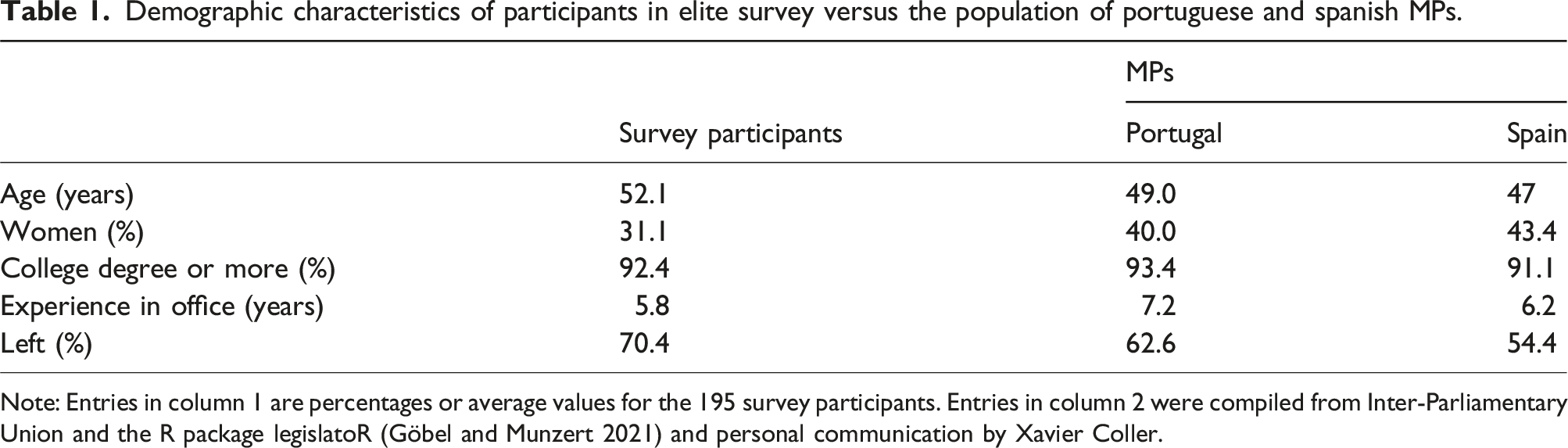
Note: Entries in column 1 are percentages or average values for the 195 survey participants. Entries in column 2 were compiled from Inter-Parliamentary Union and the R package legislatoR (Göbel and Munzert 2021) and personal communication by Xavier Coller.
The second study is an in-person household CAPI survey conducted in Portugal near a representative sample of residents 18 years and older between December 2020 and April 2021 (n = 1020). Respondents were selected by quotas (age and gender), and sampling points were randomly selected within strata defined by NUTSII regions (seven regions nationally) and size of locality (five categories). The survey included the conjoint experiment described in he next section. The response rate (AAPOR RR1) was 30.1%. This is close to the “gold standard” benchmark provided by the European Social Survey Round 9 (conducted in 2018), which had a 34.9% response rate in Portugal. Appendix Table A2 reports the demographic characteristics of the subjects in the mass survey.
Measuring elite and voter responses to self-regulation
Party self-regulation efforts are often introduced as part of broader reforms in response to poor election results or corruption scandals. These contextual factors are likely to influence how different actors respond to the new measures. Hence, observational data is likely to produce biased estimates of the effects of individual instruments. To isolate the causal effects of these measures, we need to ensure that these different factors are not confounding our estimates.
Conjoint analyses, in which subjects are asked to choose between two hypothetical profiles with randomized characteristics, are an effective way to identify our causal effects of interest (Hainmueller et al. 2015). This approach allows us to isolate the effect of individual measures in this multidimensional context. It also mitigates social desirability bias, since respondents do not have to directly state their views on any particular attribute (Horiuchi et al. 2020). The topic of ethics in public office is prone to social desirability bias, and this feature of the design reduces the risk that respondents will not state their true preferences.
Party attributes and values manipulated in elite and mass surveys.
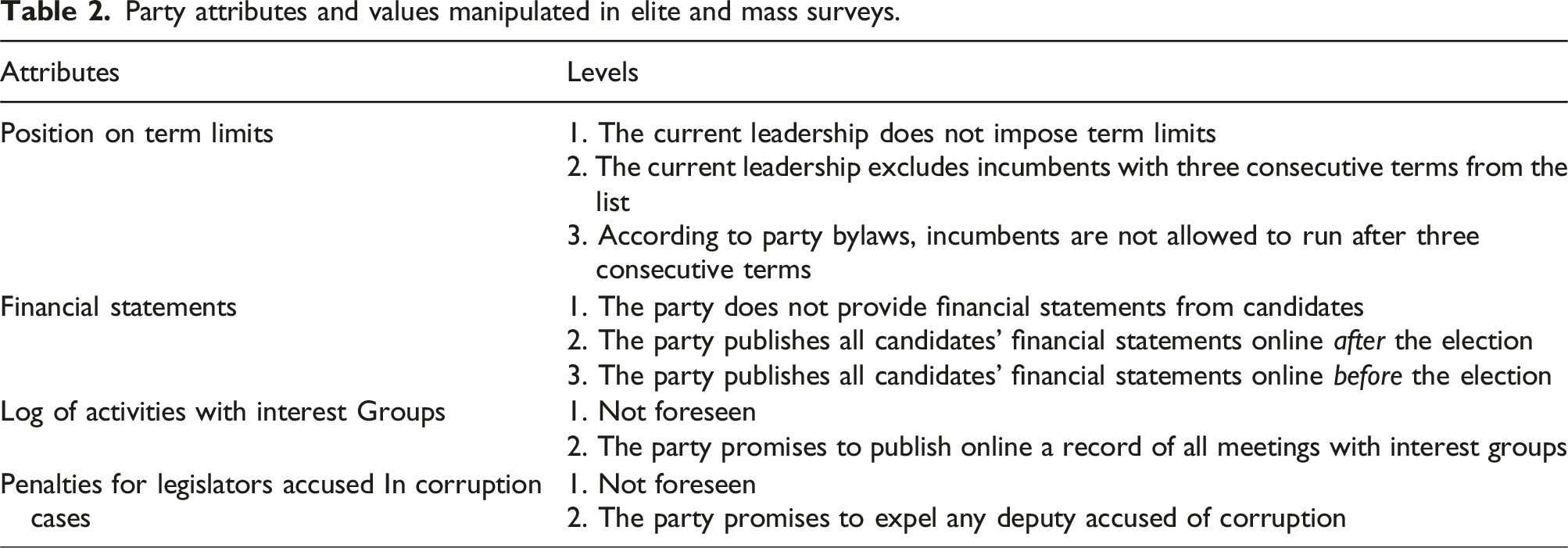
After seeing a pair of profiles, both samples were asked which of the two hypothetical parties they would be more likely to support. We use this outcome to capture how legislators and voters respond to the various self-regulation measures included in the profiles. While the outcome represents a hypothetical choice, prior research shows that expressed choices in conjoint experiments appropriately capture respondents’ relevant preferences and reflect real-world behavior (Hainmueller et al. 2015; but see Incerti 2020). In the mass sample, we manipulated two additional attributes: (1) the ideological position of the parties (left, center, or right) and (2) the party leader’s gender (female or male). We include these additional attributes to create more realistic profiles and explore moderating effects by ideological agreement, as discussed below. To account for differences in the sample sizes between the two surveys, political elites repeated this task four times while voters repeated the task twice.
To test the response of voters and legislators to each family of self-regulation instruments, we estimate equations using ordinary least squares with standard errors clustered at the respondent level. The unit of analysis is a party profile, and the outcome is a binary indicator that takes a value of 1 if the party was chosen, and 0 otherwise. We regress this outcome on the full set of party attributes, leaving one level in each attribute as reference point. The estimates reported below are the Average Marginal Component Effect (AMCE) of the randomly assigned treatments on party support. This effect corresponds to the marginal effect of each self-regulation measure, averaged over the joint distribution of all the attributes.
The estimates represent the marginal effects of each attribute value on the probability of supporting a party, relative to the reference category in that attribute.
Results
We present the results of the study in three steps. First, we document how elected officials respond to party self-regulation. These reforms directly affect politicians as either office holders or party candidates. Without their support, self-regulation is unlikely to induce sustained changes in ethical conduct. In a second step, we test how voters perceive and reward each specific reform. Finally, we explore whether ideological proximity can serve as a substitute for ethical standards among voters.
Politicians’ response to ethics self-regulation
Figure 1 summarizes the main results of the study for office holders in Portugal and Spain.
12
The figure displays the effects of different attribute values on the probability of selecting the party, relative to the reference category in that attribute (identified as dots without confidence intervals). We interpret these estimates as a measure of support for each individual instrument of self-regulation. Elected officials’ responses to party self-regulation efforts. Note: Values represent the difference in office holders’ propensity to support a hypothetical party based on its position on four dimensions of self-regulation. Lines are 95% confidence intervals estimated using standard errors clustered by respondent. Estimates are based on linear regressions reported in Appendix Table B1.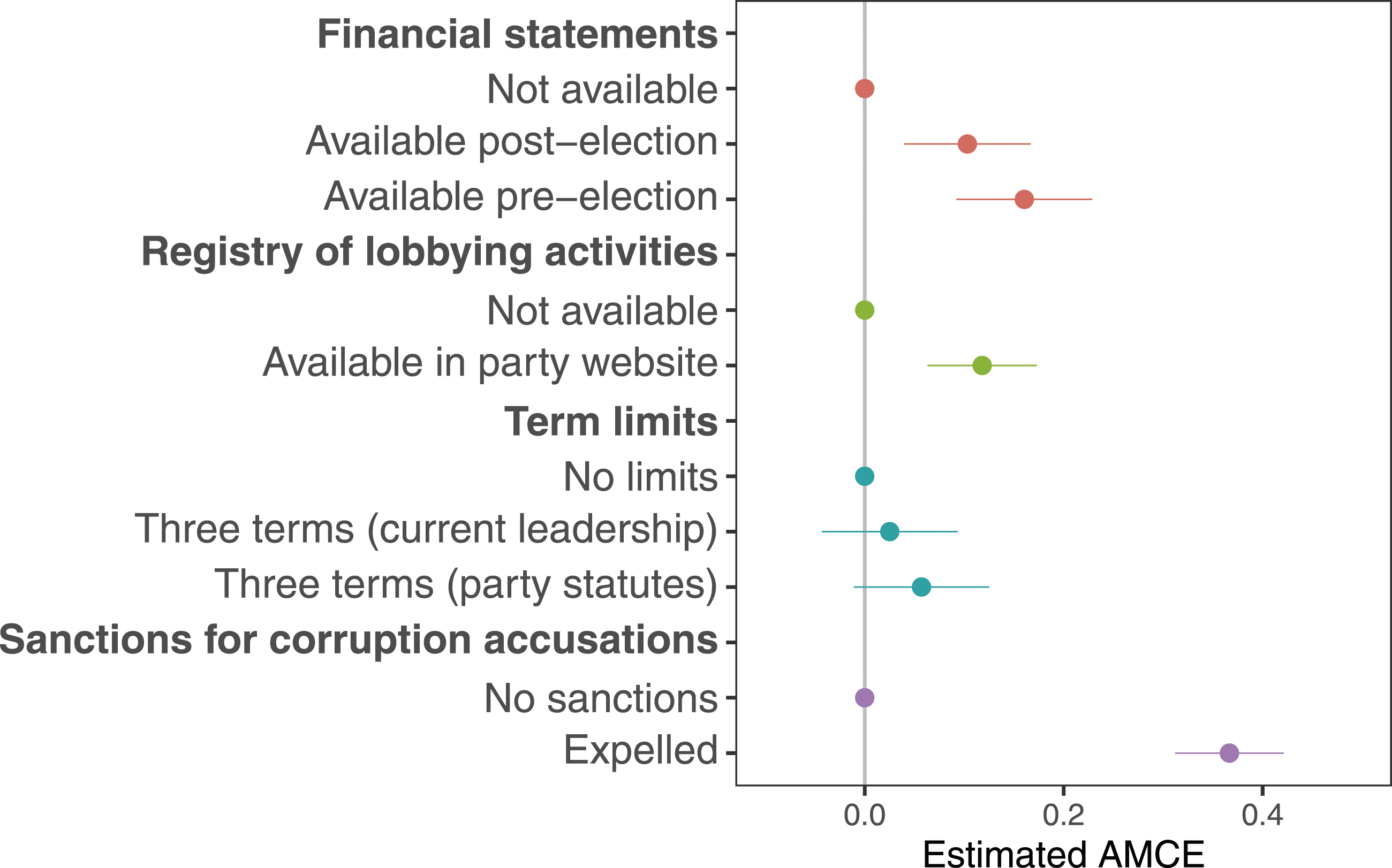
The results are consistent with our main predictions. Legislators are more likely to support parties that provide financial statements from their candidates, particularly prior to an election. The effects are moderately large. On average, office holders are 16.0 percentage points (s.e. = 0.03) more likely to support parties that make financial statements available prior to elections, relative to a similar hypothetical party that does not provide such information. The effects of making financial statements available after an election are smaller but also distinguishable from zero (10.3 points; p-value of difference in means = 0.06). We also find evidence that legislators support disclosing lobbying activities (11.8 points; s.e. = 0.03).
However, legislators did not support the introduction of term limits. Term limits inscribed in party statutes are perceived more positively than those imposed ad hoc by the current leadership, but the differences are small and indistinguishable from zero at conventional levels of statistical significance (estimate = 0.05; s.e. = 0.03). These patterns could be interpreted as representing politicians’ fears that their positions are at risk, or as a recognition of the potential negative consequences of term limits (Tsur 2021). However, if concerns about maintaining their position fully accounted for these patterns, we should not observe that office holders discriminate between term limits imposed by the current leadership versus inscribed in party statutes. Hence, we speculate that egocentric office goals cannot fully account for these results.
Office holders strongly support sanctioning legislators accused of corruption (estimate = 0.37; s.e. = 0.03). This self-regulation measure receives by far the greatest support from legislators. Since the study does not directly observe respondents’ preferences regarding individual attributes, we can be more confident that social desirability bias cannot fully explain the patterns we uncover (Horiuchi et al. 2020).
Ideological self-placement moderates how officials respond to self-regulation, although the evidence is mainly suggestive. As reported in Figure 2, Portuguese and Spanish right-wing politicians in the study are relatively less supportive of information disclosure reforms: logs of lobbying activities (difference in AMCES = −0.12; p-value = .11) and the publication of candidates’ asset declarations (−0.9; p-value = .28). On the other hand, right-wing officials in the study are relatively more supportive of the introduction of term limits (difference in AMCEs = 0.16; p-value = .09). We discuss possible interpretations for these findings in the conclusion. Elected officials’ responses to party self-regulation efforts by left-right ideological self-placement. Note: Values represent the difference in office holders’ propensity to support a hypothetical party based on its position on four dimensions of self-regulation, by respondents’ left-right self-placement. Lines are 95% confidence intervals estimated using standard errors clustered by respondent.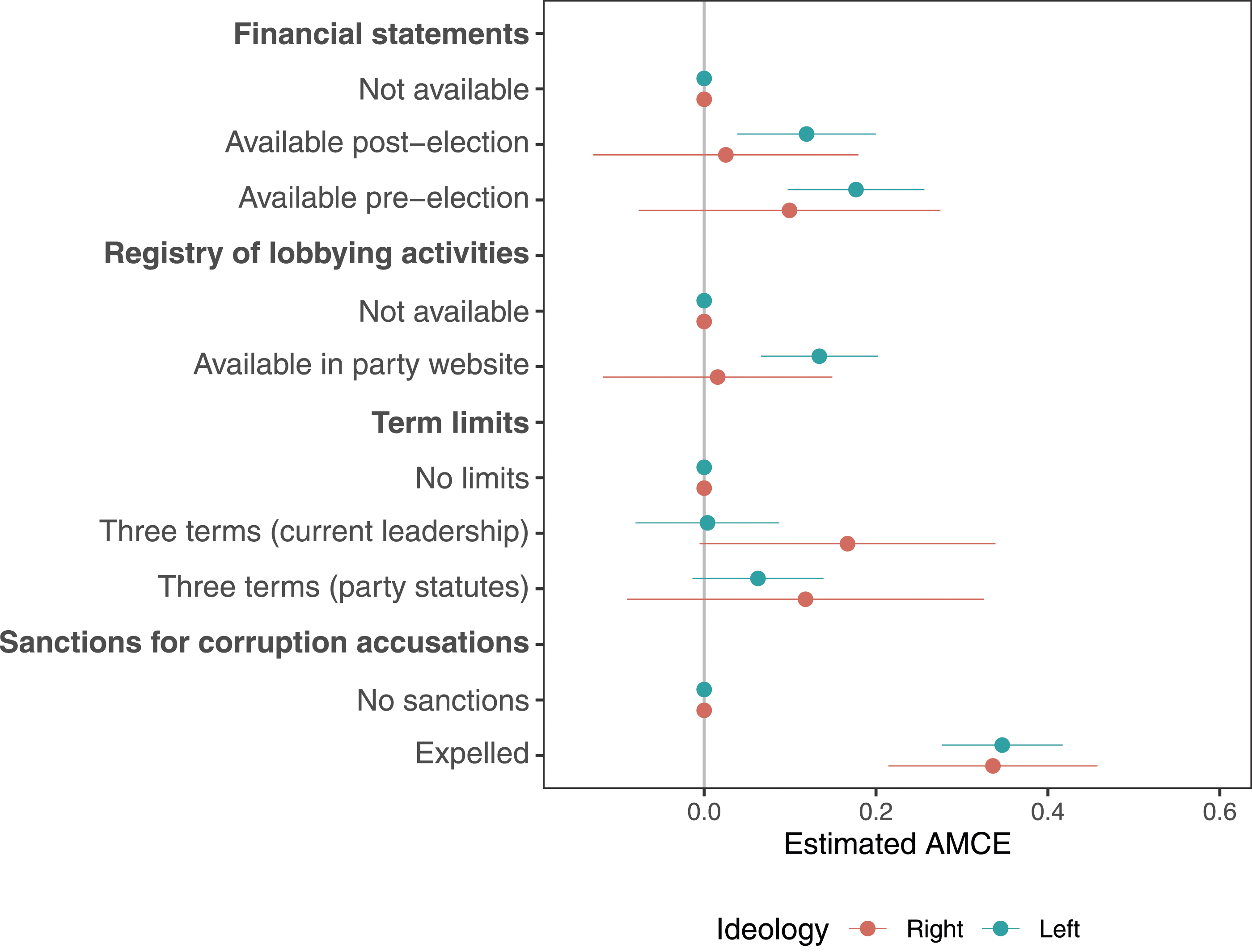
Do voters reward self-regulation?
Figure 3 illustrates how voters respond to the same set of self-regulation efforts to promote ethical conduct. The results are broadly consistent with the patterns observed for office holders. Voters reward parties that publish candidates’ financial statements, and are nearly twice as likely to do so when this information is provided before an election: 12.4 points (p Voters’ response to party self-regulation efforts. Note: Values represent the difference in voters’ propensity to support a hypothetical party based on its position on four dimensions of self-regulation. Lines are 95% confidence intervals estimated using standard errors clustered by respondent. Estimates are based on linear regressions reported in Appendix Table B2.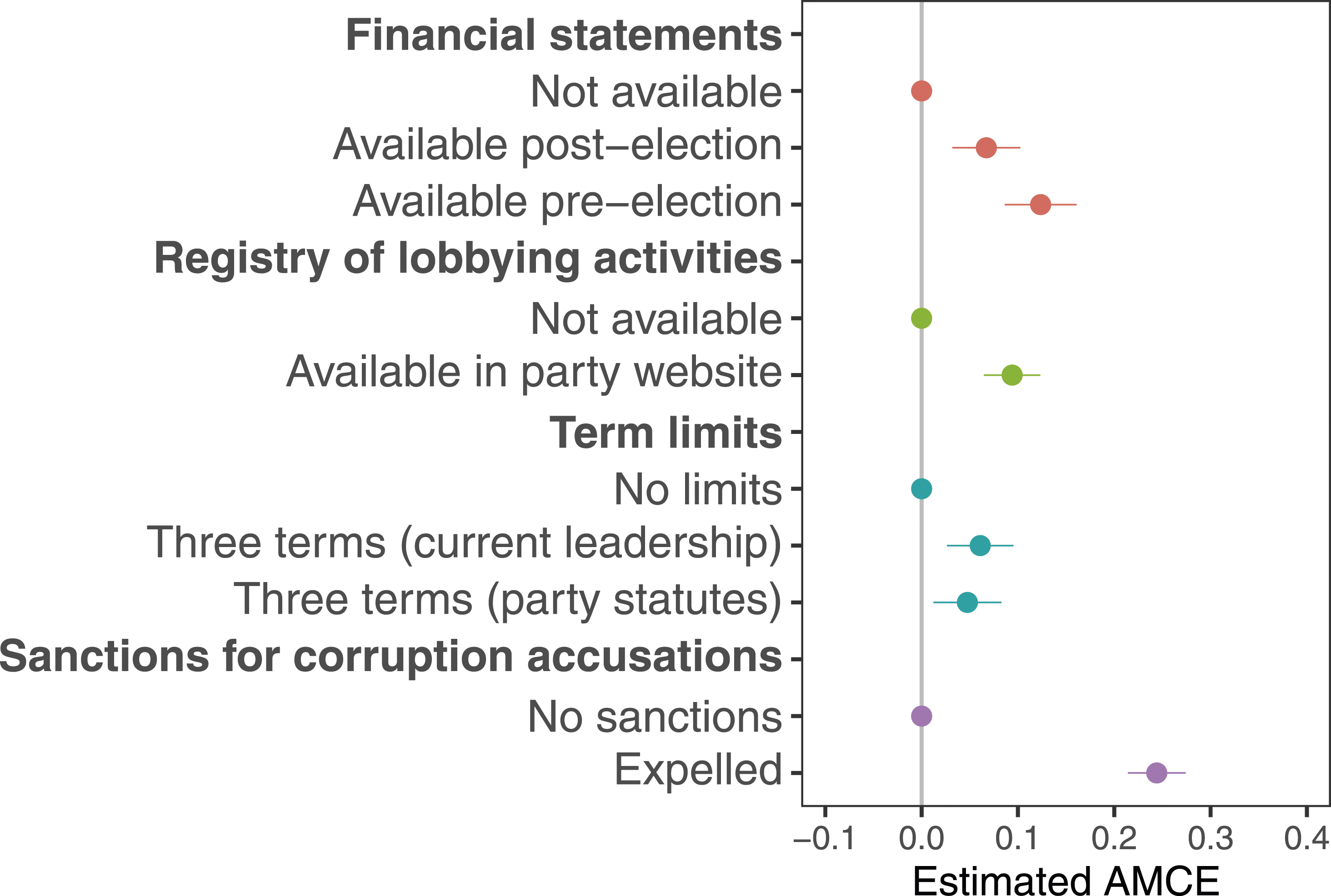
The main substantive difference between elected officials and voters is their responses to the introduction of term limits in party lists. Voters reward the introduction of term limits for incumbents after three consecutive terms, either when introduced ad hoc by the current party leadership (0.06; s.e. = 0.018) or when inscribed in the party bylaws (0.04; s.e = 0.018). This result differs from the pattern observed among legislators in two ways. First, Portuguese and Spanish legislators were less likely to reward the introduction of term limits in a party; the effects are indistinguishable from zero (p-values of 0.47 and 0.11, respectively; see Figure 1 above). Second, voters did not reward reforms inscribed in the party statutes more than ad hoc solutions proposed by the current leadership. The point estimates are actually larger for the latter, although this difference is small and unreliable (0.01; p-value of difference in coefficients = 0.45).
Finally, voters reward party leaders who commit to expel office holders involved in corruption cases. As in the elite sample, transparency about the sanctions adopted in response to corruption scandals produces the largest effect on party support (0.24; s.e. = 0.02).
The extent to which these results have behavioral consequences remains an open question. We levarage PSOE’s 2015 financial disclosures to provide a preliminary response to this question. PSOE required candidates from all municipalities with more than 20,000 inhabitants to disclose financial statements before the 2015 election. We use a difference-in-discontinuities design around this population threshold to test for differences in PSOE’s performance in municipalities right above and right below the cutoff (Eggers et al. 2018). We note that this is a hard test of this prediction since voters may have been influenced by the party’s decision even if they lived in municipalities below the threshold. PSOE’s decision was novel and attracted considerable media attention at the time. Moreover, the population threshold does not correspond to a sharp discontinuity since candidates below the threshold could still voluntarily disclose financial assets during the campaign. Still, the results suggest that the self-regulation initiative had a positive effect on the performance of the party. PSOE’s performance right above the threshold was 4.8 points higher than right below the threshold (see Table B4). The estimate is not precisely estimated given the small number of municipalities close to the threshold (N = 45; SE = 6.0). Still, relative to PSOE’s nationwide performance in 2015 (−2.8 points, relative to 2011), it represents a meaningful difference.
Ideological agreement does not moderate the effects of self-regulation efforts
So far, the analysis of voters’ responses to self-regulation measures has kept partisan and ideological considerations constant. However, voters do not evaluate party efforts in a vacuum. Party attachments and ideological agreement between voters and a given party may moderate how individuals respond to the efforts of party leaders to promote transparency and ethical conduct. Prior work documents copartisan biases in voters’ propensity to punish corrupt politicians (Anduiza et al., 2013; Solaz et al., 2019; but see Ares and Hernández 2017; Klašnja et al. 2021). Furthermore, a growing experimental literature has shown that voters’ reaction to measures impinging on important democratic principles depends on their political or ideological alignment with the party that endorses them (Graham and Svolik 2020; Simonovits et al. 2022). This suggests the possibility that that the effect of self-regulation measures on evaluations of parties might be contingent upon voters’ ideological congruence with them.
To test this exploratory hypothesis, we re-estimated the models in Figure 3 distinguishing between ideologically aligned or dealigned parties. 13 The mass survey included a question of left—right self-placement on a 7-point scale. We combined this measure with the hypothetical parties’ randomly assigned ideological position (left/center/right) in the experiment to distinguish between ideologically aligned/dealigned profiles.
Figure 4 does not provide consistent evidence to support the moderating effect of ideological agreement. The effects of disclosing financial information about candidates, registering lobbying activities or sanctioning legislators accused of corruption (relative to the baselines) are virtually the same for ideologically aligned and dealigned voters. The only exception is in the introduction of term limits where voters are slightly less likely to reward dealigned parties, although the difference is small and indistinguishable from zero. Together, the findings suggest that ideological agreement is not a reliable substitute for ethics self-regulation. Voters reward parties across the ideological spectrum that promote transparency and ethical conduct.
14
Voters’ response to party self-regulation efforts, by ideological agreement between the voter and the party. Note: Values on the left panel are differences in voters’ propensity to support a hypothetical party based on their position on four dimensions of self-regulation, by ideological alignment (conditional AMCEs). Lines are 95% confidence intervals estimated using standard errors clustered by respondent. Estimates are based on linear regressions reported in Appendix Table B3. Values on the right panel are estimated differences in AMCEs.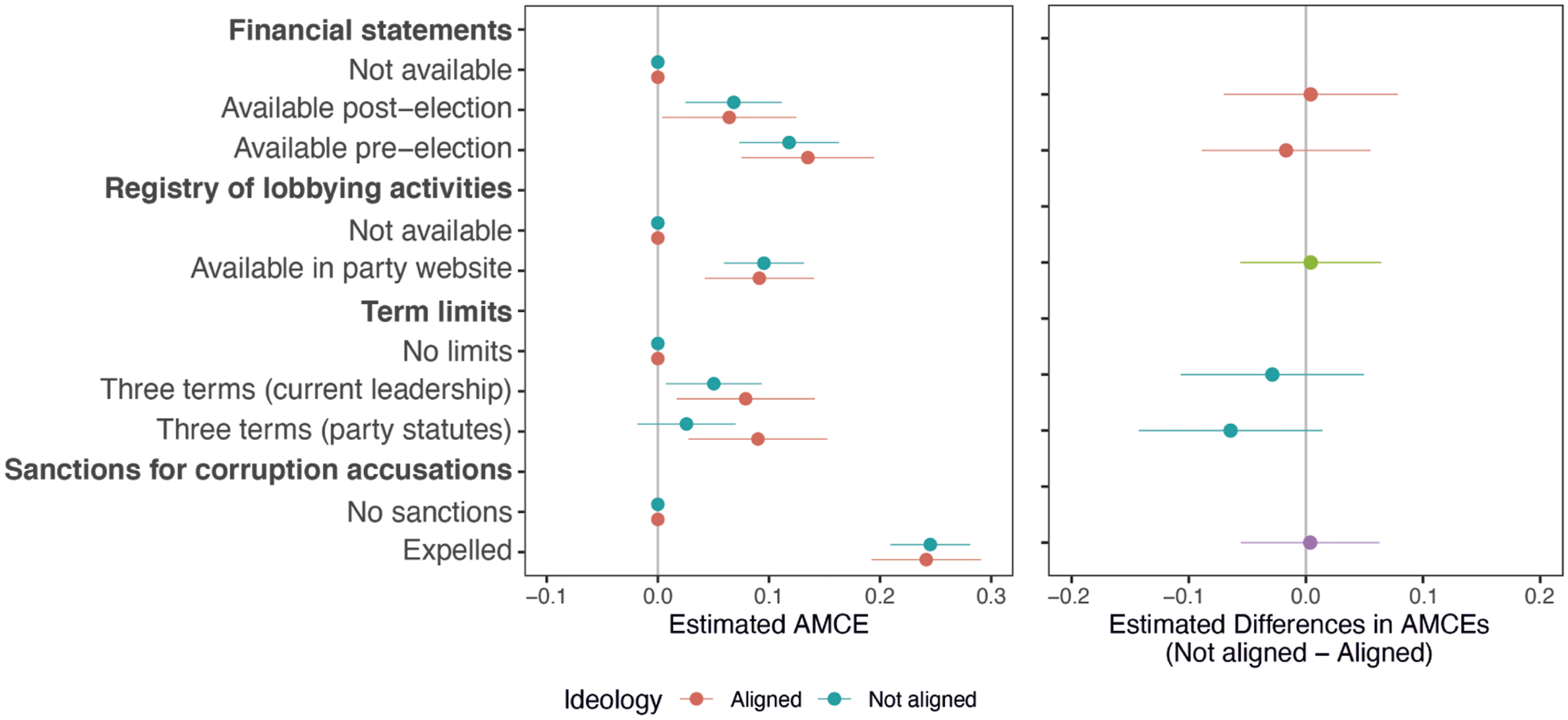
Conclusion
We report the results of two original experiments designed to study how politicians and voters assess political parties’ efforts to promote transparency and ethical conduct. We find remarkable similarities in how political elites and voters respond to different instruments of self-regulation, but also a few relevant differences. Among voters, we find, as expected, support for term limits, financial statements, registering lobbying activities, and sanctions for corruption. Elected officials, however, support all measures considered except term limits for party lists.
We find suggestive evidence for ideological heterogeneity in legislators’ response to self-regulation. Right-wing officials are less likely to support transparency measures that promote information disclosure and more likely to support the introduction of term limits. A possible interpretation of these findings is that right-leaning officials tend to come from more affluent backgrounds and face higher risks of public backlash from the publication of financial statements like assets declarations. Alternatively, it is possible that right-leaning officials simply deem transparency policies as inefficient. Future scholarship would benefit from delving into these different possible explanations.
We also show that financial statements published after an election are rewarded less than those released before an election, when voters can more easily act on that information. Finally, we explored whether citizens support term limits that are formally enforced by party bylaws more than those that depend on decisions from the current party leadership. We find no evidence that public support for term limits is contingent upon the formalization of such rules. This result suggests that parties can benefit from experimenting with different transparency reforms and without having to commit to more structural reforms.
The many areas of agreement between the political actors directly affected by these reforms (politicians) and their principals in the chain of delegation (voters) suggest that self-regulation can be a promising strategy to promote ethical conduct and restore public trust in political parties. We believe these findings can be informative to party leaders interested in promoting internal reforms in other party-centric established democracies. Although the analyses rely on a convenience elite sample, the consistency of the findings between the representative sample of voters and the elite sample, as well as among Portuguese and Spanish public officials (Figure B1), suggests that severe bias in the estimates due to sample selection is unlikely. It is also possible that public and elite responses vary in context where corruption is a less salient issue.
The response to the introduction of term limits after three consecutive terms also has important implications. This finding indicates that voters do not discriminate between ad hoc measures adopted by the current leadership and more structured reforms reflected in party statutes. This suggests that parties can experiment with new measures of internal control, and postpone more structural reformism, without affecting the perceived credibility of the initiative.
That said, the study findings are restricted in a number of important ways. First, as stated from the onset, we did not attempt to estimate directly how intra-party reforms affect transparency and ethical conduct. We instead sought to identify two important conditions for reforms that do not rely on external oversight to be effective. As more parties adopt such regulations, future scholarship can build on these results to better understand the conditions under which self-regulation is effective. Second, we relied on a small subset of salient self-regulation efforts. While we sought to select reforms that cover a broad range of areas, the results may not extrapolate to any given transparency reform. The paired design adopted here can serve as a template to study responses to different self-regulation efforts. Third, while our empirical strategy reduces concerns of social desirability bias, conjoint analyses are unable to rule out response biases entirely. For instance, sensitivity biases arising from self-image concerns can partially explain responses to conjoint analyses, although the magnitude of these biases is usually smaller (
Supplemental Material
Supplemental Material - Politicians Support (and Voters Reward) Intra-Party Reforms to Promote Transparency
Supplemental Material for Politicians Support (and Voters Reward) Intra-Party Reforms to Promote Transparency by Miguel M Pereira, Susana Coroado, Luis de Sousa, and Pedro C Magalhães in Party Politics.
Footnotes
Declaration of conflicting interests
The author(s) declared no potential conflicts of interest with respect to the research, authorship, and/or publication of this article.
Funding
The author(s) disclosed receipt of the following financial support for the research, authorship, and/or publication of this article: This work was funded by the Portuguese Foundation for Science and Technology (PTDC/CPO-CPO/28316/2017), Fundação Francisco Manuel dos Santos.

Supplemental Material
Supplemental material for this article is available online.
Notes
Author biographies
References
Supplementary Material
Please find the following supplemental material available below.
For Open Access articles published under a Creative Commons License, all supplemental material carries the same license as the article it is associated with.
For non-Open Access articles published, all supplemental material carries a non-exclusive license, and permission requests for re-use of supplemental material or any part of supplemental material shall be sent directly to the copyright owner as specified in the copyright notice associated with the article.
