




Abstract
As Europe’s parties realign around a new, transnational cleavage, this article turns back to a historical case in which national identity conflicts also coincided with profound economic transformation: multinational and industrializing Imperial Austria. While Austria is an important case for Lipset and Rokkan’s classic cleavage theory, they overlooked the long evolution of its party system pre-WWI. This paper introduces the Habsburg Manifesto Dataset (HMD), demonstrating its usefulness by tracking the formation of Imperial Austrian party system cleavages under universal manhood suffrage. Based on the qualitative content analysis of historical electoral manifestos, HMD measures the policy offers and group appeals made by Imperial Austria’s German and Czech parties. This allows testing Lipset and Rokkan’s claims by applying contemporary methodologies to a case that was effectively excluded from their original analysis. Doing so reveals a surprising degree of structure: parties consistently combined issue and group claims around center-periphery, class, and state-church cleavages.
Introduction
In representative democracies, parties translate “societal heterogeneity” into “represented heterogeneity” (Franzmann, 2011). In line with this idea, Lipset and Rokkan’s (1967b) cleavage theory of party system formation offered a highly influential account of how conflicts among social groups in democratizing Europe came to be represented by political parties. The process whereby these parties forged stable connections with their emerging constituencies involved the formation of both group identities and group interests. Once these connections had stabilized, however, party politics scholars began to neglect identity politics, focusing predominantly on contestation over interests (cf. Thau, 2019: 79). 1 They had good reason to do so: post-WWII West European party systems had stabilized to the degree that Lipset and Rokkan themselves described them as “frozen”. Parties and voters knew well which party represented which societal group. Simultaneously, the class cleavage dominated political contestation to the extent that an exclusive focus on a single economic dimension seemed not only parsimonious modeling, but an empirically valid generalization about party politics.
This is now rapidly changing. Globalization, de-industrialization and immigration have upset the stability of Western European party systems, as cultural conflicts between national and supranational (European or cosmopolitan) identities became central to political contestation. Parties’ constituencies are becoming increasingly unclear, as illustrated by radical right parties abandoning their “winning formula” (Kitschelt and McGann, 1995) in favor of leftist economic and social policy (Lefkofridi and Michel, 2017). With parties and voters connecting material interests to national and class identities in novel ways, an increasing number of scholars have turned once again to questions of cleavage formation (Bornschier et al., 2021; Hooghe and Marks, 2018; Kriesi et al., 2008).
At a time when European party systems are undergoing this profound transformation, this paper travels back to the original moment of cleavage formation, the early days of mass democratic politics. To this aim, the case of Imperial Austria, a multinational empire that introduced universal manhood suffrage during a period of rapid industrialization is extremely illuminating. The current disruption of labor markets through de-industrialization and automation coincides with voters renegotiating the meaning and boundaries of national identity, in the face of mass migration and European integration (Gallego and Kurer, 2022). Such simultaneous economic and identity conflicts were well known to voters and political elites in Imperial Austria, who contended with both the birth of nationalism in a society that lacked a linguistic majority and the transformation of class conflict through rapid industrialization. The modernization of Austrian society also challenged the established role of the Catholic church, through the rise of secular ideologies, such as liberalism and socialism, and transformed the relationship between traditional rural and modern urban society. Simultaneously, the introduction of universal manhood suffrage gave political parties an opportunity to shape new mass constituencies by combining policy offers with appeals to old and new forms of socioeconomic, national, and religious identity.
Our analysis of this case draws on our novel Habsburg Manifesto Dataset (HMD), thereby demonstrating the potential of applying modern methodologies to historical elections. The HMD was created through the computer assisted qualitative content analysis of the party manifestos published by nearly all of the dozens of Czech and German parties that ran in the 1897, 1900/1901, 1907, and/or 1911 legislative elections. 2 These manifestos include both party programs (PPs, longer documents which were published irregularly) and electoral announcements (EAs, shorter documents which were printed in newspapers in the weeks preceding an election). Of the four elections studied here, the first two followed the 1896 electoral reform, under which representatives were elected from 72 newly created districts through universal manhood suffrage, alongside 353 elected by four socio-economic curiae using restricted suffrage. (Only elections to the 72 “5th Curia” seats are considered in our analysis.) In 1907, parliament was expanded to 516 seats, now elected entirely through universal manhood suffrage. The original coding scheme we used to analyze party documents advances party manifesto coding as a methodology in three respects: first, it was designed for the purpose of analyzing historical elections; second, it identifies both the policy offers and the identity appeals parties made; and third, it applies that method specifically to EAs in newspapers (under the assumption that these appealed more directly to constituents in a given election year than PPs).
Here we draw on that dataset to track parties’ policy and group claims along Lipset and Rokkan’s (1967b) four cleavages. Our analyses reveal a high degree of structure in the early days of mass political contestation. Parties consistently combined policy offers and identity appeals along center-periphery, class, state-church and, to some extent, urban-rural cleavages. Admittedly, this approach only examines the party system cleavages, as the absence of mass survey data for these historical elections doesn’t allow us to directly observe their relationship to social cleavages. However, there is little doubt that class, linguistic, and religious divisions existed within Imperial Austrian society, while other research indicates that Austrian social groups responded to party appeals (Howe et al., 2022).
By applying contemporary methodologies to a historical case, we re-assess the explanatory potential of cleavage theory and illuminate parallels between societies undergoing rapid economic and cultural change in different historical contexts. The HMD also allows us to assess the emergence of party competition in a new electorate. Furthermore, it illuminates the long-term trajectory of political representation and contestation in CE Europe, since many of the peoples of that region voted for the first time under Habsburg rule. Lastly, the data add to very recent research that assesses parties’ representative claims in terms of policy and group appeals, as well as how parties link the two (e.g., Dolinsky, 2022; Horn et al., 2020; Huber, 2022; Thau, 2019).
The paper is structured as follows: Section 2 provides background information on Imperial Austria’s social structure and political institutions and evaluates Lipset and Rokkan’s (1967b) analysis of the Austrian case. Section 3 introduces the HMD, which tracks parties’ policy offers and group appeals over four elections. Drawing on that dataset, Section 4 analyzes cleavage formation in Imperial Austria between 1897 and 1911. Finally, Section 5 summarizes our findings and assesses their implications for future research into cleavage (re-)formation in Europe.
Lipset and Rokkan’s ahistorical historicism: party system formation in democratizing Imperial Austria
The parties analyzed here competed in elections to the Reichsrat, the central legislature for the “Western” half of the Austro-Hungarian Monarchy (here “Imperial Austria”). Imperial Austria encompassed present-day Austria, along with all or part of present-day Croatia, Czechia, Italy, Poland, Romania, Slovenia, and Ukraine. In simple terms, Austria-Hungary, the final form taken by the centuries-old Habsburg realm, can be viewed as two constitutional monarchies, each of which had its own legislature, parties, and electorate, but which shared a dynastic line of succession and several joint institutions. In Austria, the lower house of the Reichsrat, the Abgeordnetenhaus (“House of Representatives”) shared decision-making powers with the hereditary upper house (the Herrenhaus or “House of Lords”) and with the emperor. It nonetheless was capable both of significant positive legislative activity and of blocking fundamental constitutional and policy change.
What makes Imperial Austria especially interesting is that, unlike Hungary, which maintained a highly restricted suffrage, it introduced universal manhood suffrage in the decades preceding WWI. Following Austria-Hungary’s establishment through the 1867 Ausgleich (“compromise”), the Austrian lower house had been elected by four exclusive, socio-economic curiae (the great landowners, the chambers of commerce, etc.). The 1896 electoral reform, however, added a fifth curia, with its own set of territorial districts, whose additional 72 seats were elected through universal manhood suffrage. A decade later, the 1907 electoral reform replaced the curial system with a 516-seat legislature elected entirely through universal manhood suffrage. Both the 5th Curia and the post-1907 electoral system used an absolute majority runoff formula in single-member districts (excepting Eastern Galicia which, after 1907, used a variant of the absolute majority runoff rule in 36 two-member districts). The analysis below therefore draws on the results of four elections: two in the 5th Curia (1897 and 1900/1901) and two after the full introduction of universal manhood suffrage (1907 and 1911).
Lipset and Rokkan analyze Austria’s party system as part of their general account of cleavage formation in Western Europe. Their model posits that Europe’s national and industrial revolutions each gave rise to two cleavages that fundamentally structured mid-20th century party competition. The national revolution created the center-periphery cleavage, which pits the dominant culture of the center against those of ethnic, linguistic and religious minorities on the periphery, and the state-church cleavage, which reflects conflict between the centralizing, standardizing state and the church’s historical privileges. The industrial revolution led to the emergence of the urban-rural cleavage, which mirrored the conflict between landed aristocrats and industrial entrepreneurs, and a class cleavage rooted in the “conflict between owners and employers on the one side and tenants, laborers, and workers on the other” (Lipset and Rokkan, 1967a: 14).
The interaction between these two revolutions resulted in eight different patterns of political alliances. Austria is the sole example of a Type VII party system, one that entered the “early phases of the industrial revolution” with the central core controlling the state and engaged in a nation-state building project allied with the Roman Catholic church and landed interests (1967a: 37). This alliance faced opposition from an alliance between peripheral groups and urban commercial and industrial entrepreneurs. Being the sole example of a Type VII party system, Austria is clearly an important case for Lipset and Rokkan. Although it didn’t receive a dedicated chapter (1967b), it is referred to repeatedly throughout that volume, especially in the introduction and in contrast to its fellow Catholic country, Spain (1967b: 22, 24, 34, 37, 45–46, 48–49, 51, 161, 200, 203, 244, 249).
A fundamental, methodological flaw in Lipset and Rokkan’s treatment of the Austrian case is that they base it entirely on political developments after WWI. This is a striking weakness in a work that forcefully argues that present-day political patterns are deeply rooted in specific historical conjunctures (1967a: 2–3, 13–26). Apart from briefly acknowledging the collapse of the multinational Habsburg Monarchy (1967a: 41), the analysis throughout the volume draws on the standard “three Lager” account of the Austrian First Republic (1919–1934), an overwhelmingly German-speaking polity whose party politics were divided between two large Catholic conservative and socialist camps (“Lager”), along with one small nationalist one (Lipset and Rokkan, 1967a: 22, 34, 48–49; Doggan, 1967: 161; Linz, 1967: 200, 244).
To a great extent, the limited Imperial Austrian political historiography available at the time explains this gap in Lipset and Rokkan’s data. 3 Nonetheless, the extensive information now available about pre-WWI Austrian elections suggests two more specific problems with Lipset and Rokkan’s analysis. First, their choice of 1917 as the “critical juncture” at which the owner-worker cleavage emerges is puzzling, given that the Social Democrats played a central role in the establishment of universal manhood suffrage in Imperial Austria, as in many other 19th century European countries. Certainly, the Bolshevik revolution had a significant effect on European party politics; however, the capitalist class cleavage had already emerged and redefined the structure of European party competition decades earlier.
Second, Lipset and Rokkan’s (1967a: 51) claim that “the three-Lager constellation established itself [in Austria] very early in the mobilization process, and [that] the party system changed astoundingly little from the Empire to the First Republic, and from the First to the Second” does not withstand historical scrutiny. In 1907, for example, dozens of electoral parties representing ten different nationalities won seats. Neither these, nor the nineteen legislative clubs that formed post-election, break down neatly into three Lager (k.k. statistische Centralkommission, 1908: LXXXIV). Furthermore, although the three Lager thesis does accurately describe Austria’s interwar party system, that system wasn’t merely an extension of Imperial Austria’s German party subsystem, since a wide variety of German parties were successful only in regions that later were excluded from the Austrian First Republic (Howe et al., Forthcoming 2023a). The Monarchy’s breakup into several successor states involved an unprecedented historical disruption. An elaborate party system was already firmly in place before WWI; an important outcome of that war was new international borders that cut across it. Our purpose here is to determine what kinds of cleavages, if any, characterized that earlier system. Future research might more carefully investigate whether the three Lager thesis actually applies to the pre-WWI German party subsystem (following Luft’s (2012) social-structural analysis of segmentation among pre-war Czech parties), as well as the degree to which non-German parties carried over into the other successor states, none of which are analyzed by Lipset and Rokkan.
Fortunately, the richer historical data now available allow us to directly assess Imperial Austria’s party system cleavages. Importantly, the Habsburg Monarchy already existed before the historical conjunctures that are central to Lipset and Rokkan’s analysis (the French and Industrial Revolutions). Directly examining elections in Imperial Austria, instead of those in the Austrian First Republic, therefore allows us to consider the impact the two revolutions had on politics within an established state, while avoiding the later, contingent impact of its dissolution.
The elections analyzed here postdate the onset of the national and industrial revolutions. Imperial Austria was a rapidly industrializing society, making possible the emergence of the urban-rural and modern class cleavages. Urbanization was accompanied by new challenges to the Church in a largely Roman Catholic society, as exemplified by the abolition, in 1870, of the Concordat of 1855, which had granted the Church great autonomy, as well as a dominant role in education and in marriage law. Simultaneously, it was highly diverse linguistically, making possible nationalist mobilization predominantly along linguistic lines. Specifically, the Imperial Austrian government recognized eight nationalities (Nationalitäten or Volkstämme), defined in terms of the „language of everyday use” that citizens declared on the decennial census: Czechs, Germans, Italians, Poles, Romanians, Serbo-Croatians, Slovenes, and Ukrainians. 4 The electoral reforms themselves challenged German political dominance. As of 1907, each district had a clear linguistic majority and each group received a share of districts roughly proportional to its population. This was part of an ongoing trend towards greater linguistic proportionality in legislative representation, public employment, and education (Howe et al., 2023b: Ch.2).
Our dataset focuses on parties campaigning in Czech and German. Several advantages arise from limiting party selection to these two groups. First, speakers of Czech and German were approximately 2/3 of the population and they constituted linguistic majorities in 340 SMDs (65.9%) after 1907. Therefore, our analysis comprises those groups competing for the overwhelming majority of legislative seats. Second, Czechs and Germans were, along with Italians, the most industrialized of the Monarchy’s linguistic sub-populations but retained a large agricultural sector. This allows us to observe whether the urban-rural and modern class cleavages were important in Imperial Austrian elections. Finally, focusing on these two groups greatly simplifies the task of assessing the center-periphery cleavage. Although German-language parties ran in most of Imperial Austria’s seventeen provinces, Czechs, by contrast, were a political presence only in Moravia, Bohemia, and Silesia, all of which had a significant German population. Leaving aside Silesia’s small Polish population, this means that we are concerned with nationalist conflict between only two groups. Given the conceptual difficulties of the nationalism cleavage discussed below - and considering the complex patterns of cooperation and conflict found among, for example, German gentiles, Jews, Poles, Romanians, and Ukrainians in Bukovina - this simplifies our task greatly.
It should be emphasized that these were very much modern, mass elections. Voter participation was very high, especially after 1907. In the provinces considered here, first-round turnout in the 1907 election ranged from 70.8% in Carniola to 95.3% in Silesia (k.k. statistische Centralkommission, 1908: VIII, Tafel VII). 5 Voter mobilization was made possible through the rise of the mass political press and the rapid distribution of party newspapers through an expansive railroad network. The Czech- and German-language press also addressed populations with near-universal literacy (Howe et al., 2022).
Mapping parties’ policy and group appeals with the Habsburg Manifesto data set
Our assessment of cleavage formation in Imperial Austria draws on the Habsburg Manifesto Dataset (Appendix A). The HMD includes longer PPs (published between 1868 and 1911) and shorter EAs (published between 1896 and 1911). Parties published EAs in their own or in ideologically allied newspapers in order to mobilize voters. Here we use the EAs for 1897 and 1900/1901 (5th Curia only) and for 1907 and 1911. These provide the clearest indicator of parties’ campaign strategies, since PPs were published much less frequently. The HMD covers all of Imperial Austria’s Czech and German parties, as well as the Social Democrats, a multinational federation which appealed to the working classes and which published its manifestos in multiple languages. It therefore includes the two parties that benefitted the most from suffrage extension, the German Christian Socials and the Social Democrats, who combined held the majority of seats after 1907. The resulting sample covers nearly every party that won seats from districts with significant Czech or German populations. The sample of electoral announcements for 1907, for example, covers candidates who won 316 of the 340 seats (92.9%) elected from Czech or German districts. The sample for 1911 covers 283 such seats (83.2%). As a rule, the missing parties were very small and should have a minimal impact on our findings (Appendix B).
We created the HMD through computer assisted qualitative content analysis, working with a team of student coders who were native speakers of Czech and German. We developed the coding scheme by iterating deductive and inductive rounds of trial coding (Fereday and Muir-Cochrane, 2006), ensuring sensitivity to the historical context. This yielded a set of 36 policy categories and 58 group categories, each with positive and negative sub-categories for coding the direction of statements. The coding unit was the natural sentence. Each sentence was coded only according to its first policy claim and a residual code (‘Junk’) was applied to sentences containing no policy claim. The sum of all policy codes therefore gives the total number of coding units per document. For identity categories, we allowed multiple codes per sentence, since one policy offer could address multiple social groups (Appendix A). 6
Whereas coding parties’ policy stances is established practice in the field of party politics (e.g., Kriesi et al., 2012; Volkens et al., 2018), our coding scheme is novel in that it also incorporates group categories (cf. Dolinsky 2022; Horn et al., 2020; Huber, 2022; Thau, 2019). For example, parties might appeal positively to “Czechs,” and “workers” while demanding “language rights,” and “social security” to benefit those two groups.
Empirical analysis: cleavage formation in Imperial Austria
The current understanding of “cleavage” derives from Bartolini and Mair (2007 [1990]), as summarized by Bornschier (2009: 2): [A] political division must comprise three elements to constitute a cleavage: (1) A social-structural element, such as class, religious denomination, status, or education, (2) an element of collective identity of this social group, and (3) an organizational manifestation in the form of collective action or a durable organization of the social groups concerned.
The HMD’s assessment of organized parties’ election campaigns in terms of both policy offers and group appeals corresponds with this conception.
Assessing cleavage formation requires determining the core political conflicts. In doing so, we strive to remain as little influenced by prior theoretical knowledge as possible. We therefore analyze Imperial Austrian cleavage formation in three steps. First, we assess what the four elections were about (Section 4.1). Which issues and social groups did Czech and German parties mention most prominently in their messages to voters? In a second step, we investigate parties’ policy positions and group appeals along these cleavages across all four elections (Section 4.2). We then measure the politicization of the cleavages (Section 4.3). Our findings are consistent with the hypothesis that parties organized interests and identities in such a way as to create the same dominant party system cleavages across all four elections.
Assessing the salience of policy issues and group identities
What were the elections about? We begin by determining

Three most salient issues and groups by election (party system salience, seat shares as weights).

Note: The issues in this table are the actual coding categories, some of which (e.g., nationalism) are broader than others (e.g., language rights). Later in the article, we group the more specific categories into broader policy dimensions.
The salience of group identity claims bolsters the impression that nationalism (“Czechs” and “Germans”) and class conflict (“workers” and “socialists”) were the most prominent divides. There was also a pronounced emphasis on the church-state cleavage (“clericals” being among the most mentioned groups in three of the four elections). Given that our coding scheme comprises 36 policy and 50 group categories, the coherence and stability in what parties talked about across four elections spanning fourteen years is noteworthy.
We further corroborated our system-level assessment of average salience by looking at the three most salient issues and groups for each party individually (Appendix B1). All analyses converge on the core finding that these three cleavages defined Imperial Austrian political competition. This is all the more impressive, given that: (1) we took a partly inductive approach to developing our coding scheme; (2) the deductive part derived from contemporary classifications in the field of party politics and not from cleavage theory; and (3) the research assistants were not primed to think about Lipset and Rokkan before coding.
Our analysis of policy offers and group appeals provides only weak evidence of an urban-rural cleavage, relative to the other three. The possibility remains that this apparent non-finding resulted from our specific methodological choices, in particular, our focus on Czech and German parties. First, the urban-rural cleavage might have been more pronounced among Imperial Austria’s remaining, more rural peoples. Second, the German agrarian movement, centered in Bohemia, did not develop partisan newspapers to the extent of its Czech counterparts and the other German parties (Höbelt, 2006: 1868–1869) but may have made appeals to German agricultural interests in other venues. Third, agricultural policy was discussed extensively in Czech PPs, but not in the EAs on which we based this analysis. Fourth, our category for coding policy claims about cooperatives does not distinguish between agricultural and others kinds of cooperatives, potentially overlooking distinct urban and rural policy interests. Fifth, the numerous ”farmers positive” claims we identified suggest that rural identities might have been strong but lacked a defined urban counterpart. Finally, Christian Socials and some nationalist parties did appeal to farmers, merchants, and craftspeople simultaneously. The actual strength of the urban-rural cleavage therefore remains an area for future research.
Mapping parties’ policy positions and group appeals along three cleavages over four elections
Having discovered, through salience analysis, that parties fought these early mass elections primarily over nationalism, class conflict, and cultural values, we now assess German and Czech parties’ policy positions and group appeals along these three cleavages. Dimensions emerge when parties bundle issues so that their positions across those policies correlate (Robertson, 2006: 168). Similarly, we expect that parties also bundle group appeals that correspond to the three cleavages suggested by the preceding analysis. This comes closest to the traditional approach to cleavages, which views parties as representing both interests and identities. Two examples illustrate this: The Young Czech Party fights for the unity of the nation, for the lofty meaning of the Czech homeland as a common asset of the nation, and for the further continuance of Prague as the head of the kingdom (Národní listy, 1897). (coded as “Nationalism, positive”, “Czechs, positive”) We call for strong social policy for the protection of workers (Deutsche Volkspartei, 1967 [1896]). (coded as “Social security, positive”, “workers, positive”)

Measuring parties’ positions on three cleavages.
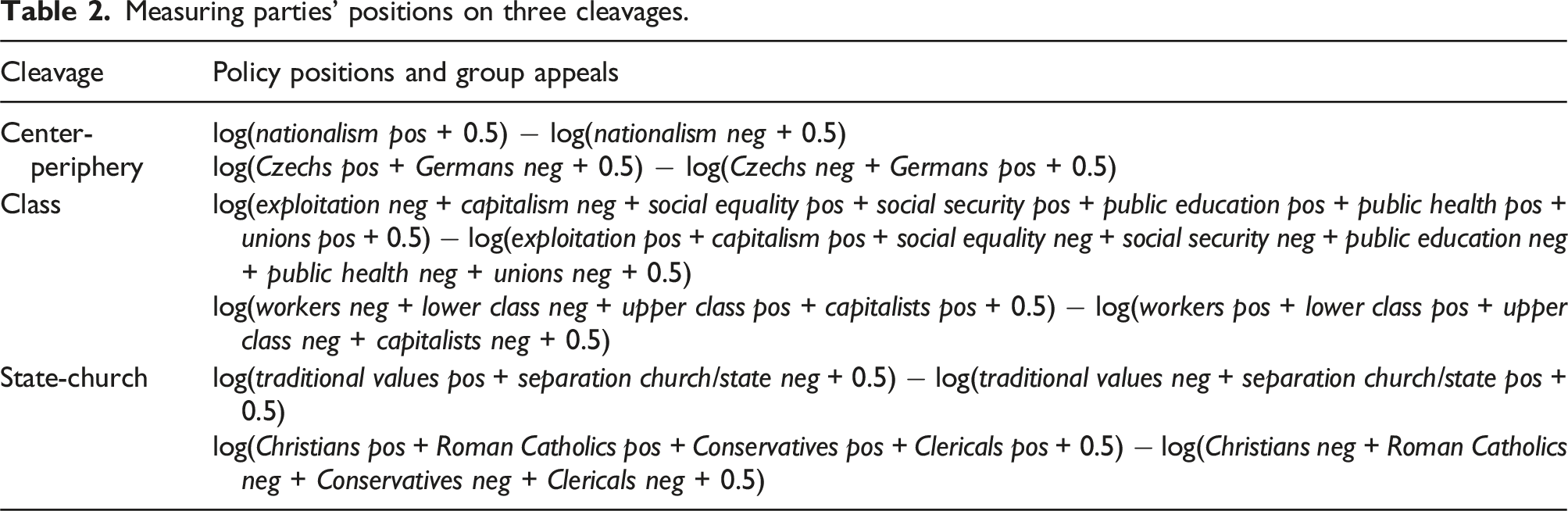
The logit function takes into account that the marginal effect of each additional claim made about the same issue or group in the same manifesto decreases (Lowe et al., 2011: 130). 8 In instances where the HMD includes multiple EAs for a single party in a given election, we averaged salience and position calculations across documents.
While the operationalization of the class and state-church cleavage are straightforward, the center-periphery cleavage requires additional explanation. Lipset and Rokkan’s (1967b) account of that cleavage has value as a generalization about a broad European historical pattern, in which the early modern state centralization led to conflicts between core and peripheral cultures. However, nationalist politics are by their nature multi-dimensional. For one thing, rarely is there only one peripheral culture. This often leads to complex patterns of conflict and cooperation among the center and the various peripheries. Poles in Austrian Galicia, for example, found the imperial government to be a useful ally in maintaining their political dominance over that province’s Ukrainian population. For another, center-periphery politics can involve a diverse array of policy approaches, ranging from opposing nationalism in principle to embracing group rights and autonomy to outright secession or irredentism.
Here, we avoid much of this complexity through our exclusive focus on Czechs and Germans. Nevertheless, the parties representing these two groups pursued highly different nationalist projects. Some German nationalists aimed to ensure German dominance in Imperial Austria, others strove to unite the German speaking provinces with Imperial Germany, thereby playing a role akin to that of peripheral nationalists challenging their host states’ territorial integrity. Similarly, whereas some Czech nationalists wanted to strengthen the political systems’ multinational character and secure greater group rights, others aspired to eventual independence for the Czech lands. Simultaneously, Czech and German nationalists agreed that nationalism should structure politics, while Social Democrats opposed nationalism altogether. To ensure comparability when measuring the German and Czech nationalist challenges, we therefore focus on parties’ positions on “nationalism”, excluding other, more specific nationalist policy claims.
To check the empirical validity of our theoretical conceptualization of these cleavages, we calculated Cronbach’s alpha (Appendix B2). Additionally, we identified the group categories related to these cleavages and confirmed our expectation that these group appeals covaried with the relevant issue positions. Parties indeed bundled their policy positions and group appeals into the cleavages Lipset and Rokkan postulated.
In what follows, we provide two-dimensional plots that map parties’ policy positions and group appeals along the three identified cleavages. For each election, results are displayed for all parties that won at least one seat and for whom we could locate an electoral announcement. The size of the circles in Figures 1 and 3 indicates parties’ shares of seats won in the 5th Curia (1897 and 1900/1901), respectively the entire lower house (1907 and 1910). Parties’ policy positions and group appeals on the center-periphery cleavage, 1897–1911. Notes: Czeagr = Czech Agrarians, Czecatnat = Czech Catholic Nationals, Czenatsoc = Czech National Socialists, Czeradstarig = Czech Radical States Rights Party, Oldcze = Old Czechs, Youcze = Young Czechs, Gerchrsoc = German Christian Socials, Gercon = German Conservatives, Gernat = German Nationals, Gerpeo = German people’s party, Gerpro = German Progressives, Gerrad = German Radicals, Pangersch = Pan-Germans, Socdem = Social Democrats. Size of circles represents parties’ seat share.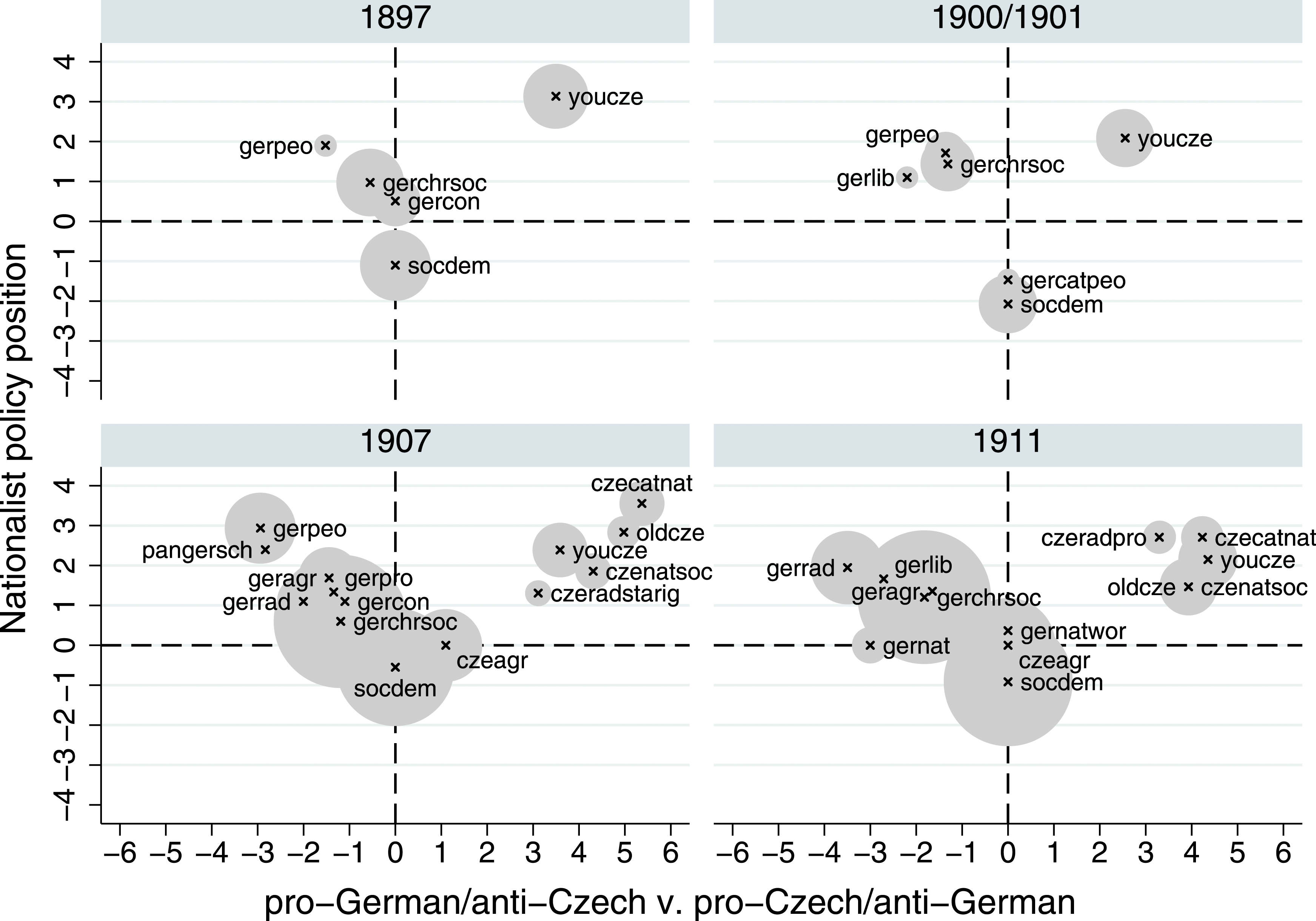
Some caution is required in comparing the findings for the two earlier with those of the two later elections, since they took place under different electoral systems. In particular, pre-1907 districts were larger and more demographically heterogenous, whereas post-1907 districts were smaller, overwhelmingly either urban or rural, and each dominated by a linguistic majority. Parties therefore faced different patterns of competition under each system.
With that caveat in mind, Figure 1 shows how competition along the center-periphery cleavage developed between 1897 and 1911. Positive values on the Y-axis indicate that parties embraced nationalism as a general policy, whereas negative values indicate parties that were anti-nationalist, e.g., the multinational Social Democrats. Parties with more positive appeals to Czechs and negative appeals to Germans have positions with positive values on the X-axis and vice versa. Figure 1 reveals how the center-periphery conflict became more polarized over time, as the Czech nationalists in particular tended to make more positive appeals to Czechs and more negative claims about Germans. Although the German Christians Socials had an almost neutral policy position on the center-periphery policy dimension, they increasingly made positive appeals to Germans and some negative claims about Czechs. The Social Democrats didn’t make any national group appeals, except in 1901, when it referred to both groups positively.
Next, Figure 2 maps parties’ policy positions and group appeals on the class cleavage. Parties’ policy positions corresponding with a contemporary understanding of left appear lower on the Y-axis. These parties embraced social equality and fought class-based exploitation. Parties making more positive appeals to workers and the lower class and negative claims about capitalists and the upper class have negative values on the X-axis. Parties’ policy positions and group appeals on the class cleavage, 1897–1911. Notes: Czeagr = Czech Agrarians, Czecatnat = Czech Catholic Nationals, Czenatsoc = Czech National Socialists, Czeradstarig = Czech Radical States Rights Party, Oldcze = Old Czechs, Youcze = Young Czechs, Gerchrsoc = German Christian Socials, Gercon = German Conservatives, Gernat = German Nationals, Gerpeo = German people’s party, Gerpro = German Progressives, Gerrad = German Radicals, Pangersch = Pan-Germans, Socdem = Social Democrats. Size of circles represents parties’ seat share.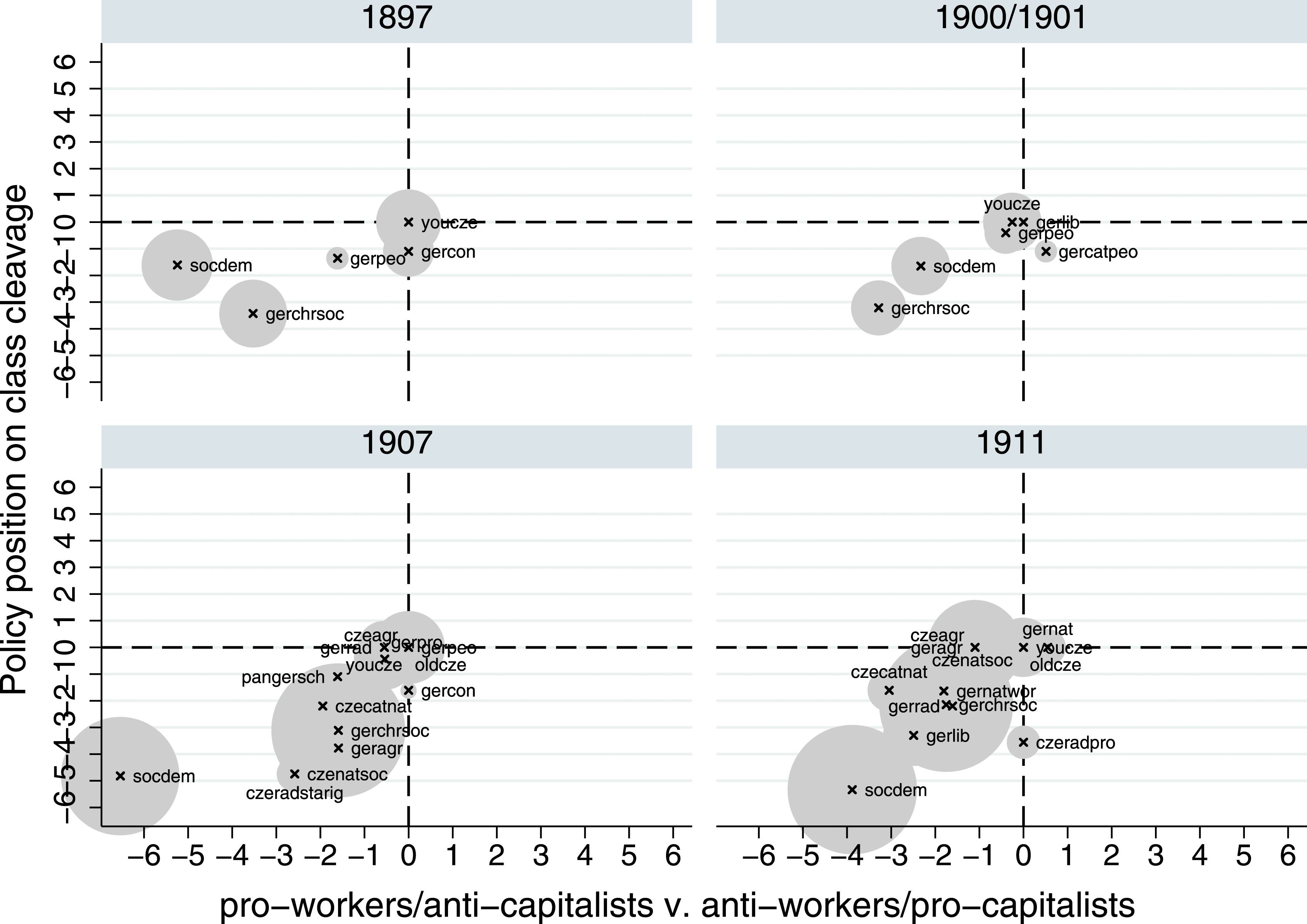
Several observations are of interest. In elections after 1907, parties had the most disparate positions on the class cleavage; however, not one party adopted a clear counter-position to the leftist Social Democrats. For parties at the time, the class conflict was not an actual conflict so much as a debate over just how much should be done for workers. In particular, in 1907 and 1911 the Social Democrats made consistently leftist policy offers. The nationalist parties, by contrast, varied somewhat in the extremism of their nationalist policy offers, while also seeking to attract a mass electorate by experimenting with moderately leftist economic positions. Finally, it is striking that the German Christian Socials were somewhat to the left of the Social Democrats on social policy in the first two elections, although this changes markedly after 1907.
The Social Democrats made the most positive appeals to workers and the lower class and negative appeals to capitalists and the upper class especially in 1907 and 1911. With the combination of strongly leftist group appeals and a leftist social policy offer, the Social Democrats clearly set them apart from the other parties on the class cleavage.
Finally, Figure 3 presents parties’ policy positions and group appeals related to the state-church cleavage. Lower values on the Y-axis indicate that parties had more progressive and secular agendas, whereas higher values point to more traditional and religious values. Meanwhile, parties that made more positive claims about Christians, Roman Catholics, conservatives, and clericals appear further to the right on the X-axis. Parties’ policy positions and group appeals on the state-church cleavage, 1897–1911. Notes: Czeagr = Czech Agrarians, Czecatnat = Czech Catholic Nationals, Czenatsoc = Czech National Socialists, Czeradstarig = Czech Radical States Rights Party, Oldcze = Old Czechs, Youcze = Young Czechs, Gerchrsoc = German Christian Socials, Gercon = German Conservatives, Gernat = German Nationals, Gerpeo = German people’s party, Gerpro = German Progressives, Gerrad = German Radicals, Pangersch = Pan-Germans, Socdem = Social Democrats. Size of circles represents parties’ seat share.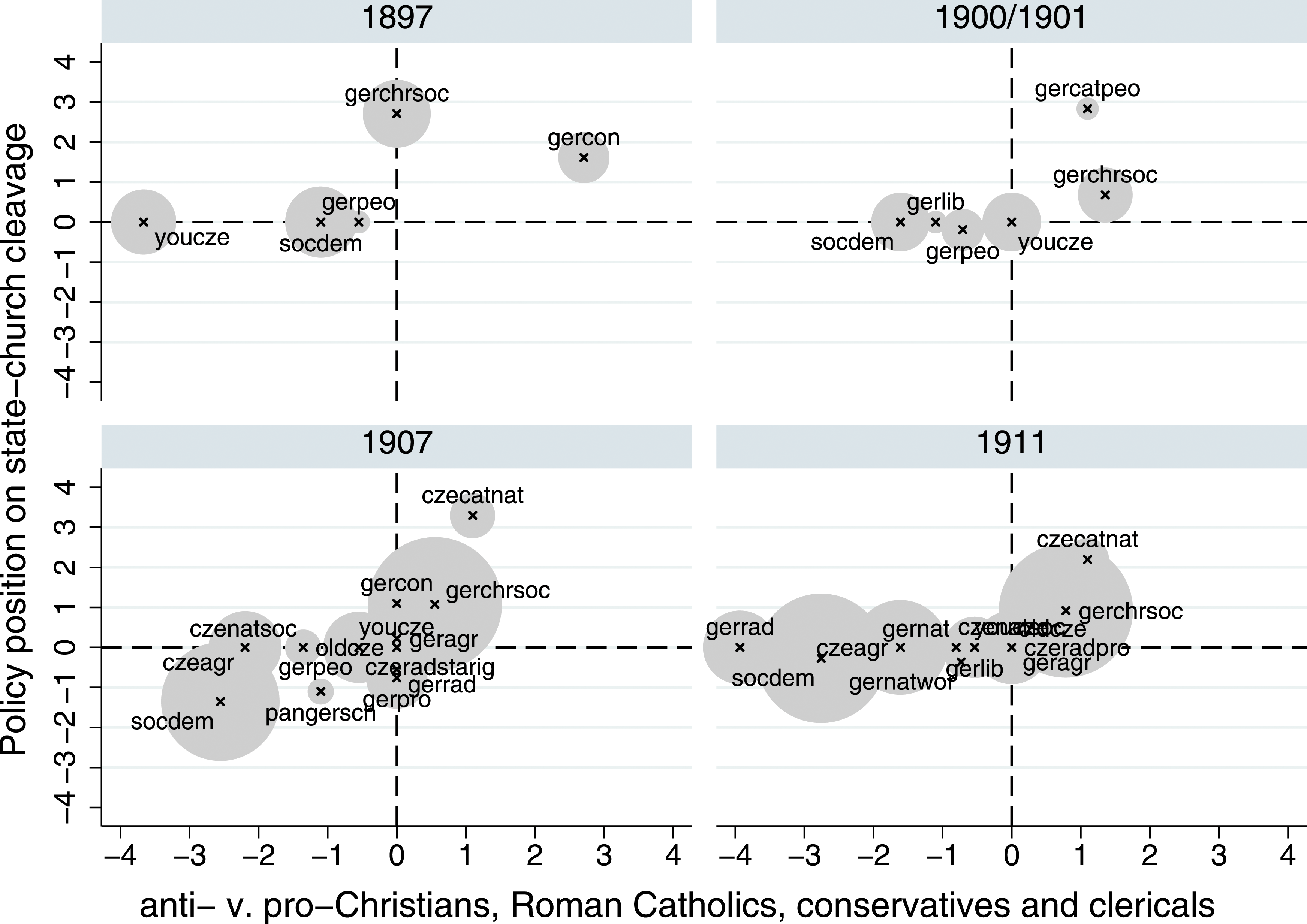
Figure 3 shows that on the policy dimension of the state-church cleavage, the explicitly Christian/Catholic parties tend to be more pro-religion, the other parties less so. The socialists and national-liberal parties seem to have avoided taking a strong anti-religious stance in the first two elections. In 1907, polarization increases both in terms of parties’ policy positions and group appeals. Contestation appears to be driven by the two large parties, the Social Democrats and the Christen Socials, who pursued clearly opposing stances on this cleavage.
The politicization of the three cleavages
In a final step, we assess the politicization of the three cleavages. According to the established understanding, politicization increases the more political actors emphasize an issue or dimension and the more polarized their positions become (Hutter and Kriesi, 2022). We measure politicization as the product of salience and polarization, weighted by parties’ seat shares. Specifically, salience is given by: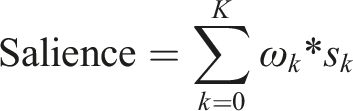
To measure polarisation, we rely on Taylor and Herman’s (1971) index of polarisation, using the following formula: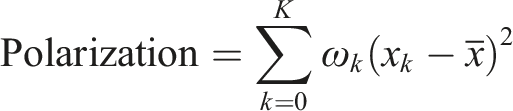
Following our calculations, the class cleavage was the most politicized in 1897 and 1907. Class polarization in those years was driven by group appeals more than by policy. By contrast, the center-periphery cleavage was the most politicized in 1900/01 and 1911. This was driven more by policy in 1900/1901 and more by group appeals in 1911. In all elections, the nationalist policy category was the most salient (cf. Appendix Table B.3).
Conclusion
This article has introduced the Habsburg Manifesto Dataset, the first fine-grained measurement of Imperial Austrian parties’ policy offers and group appeals to make use of contemporary content analysis methods. The HMD dataset advances our understanding of the historical evolution of CE European party systems in particular and the role of policy offers and group appeals in party politics more generally. In doing so, it contributes to the recent “historical turn” in democratization studies (Capoccia and Ziblatt, 2010). Furthermore, it builds on ongoing efforts to systematically analyze the content of party manifestos (Dolinsky, 2022; Horn et al., 2020; Huber 2022; Thau, 2019), by adopting existing coding schemes to the issues raised in historical elections and by coding parties’ claims about group identities as well as issues. It thereby provides an empirical counterpart to the constructivist turn in the political theory of representation, which increasingly has viewed representation as a dynamic of claim-making and claim-acceptance (Disch, 2021; Phillips, 1998; Saward, 2010; cf. Damhuis, 2020). Finally, it addresses the growing interest in continuity and change in European party systems (e.g., Helms et al., 2019; Haughton and Deegan-Krause 2020).
The HMD’s research applications are demonstrated by analyzing the Czech and German subset of the parties that ran in late Imperial Austria’s newly created mass constituencies, so as to determine whether Lipset and Rokkan’s “missing case” fits their model of West European cleavage formation. Our analysis reveals that it did. Parties’ claims map onto Lipset’s and Rokkan’s (1967b) center-periphery cleavage, class cleavage, and state-church cleavage, while there is weaker evidence of an urban-rural cleavage. Given that Lipset and Rokkan did not directly examine elections in Habsburg Austria, this provides independent confirmation of their general findings. Furthermore, the great diversity among Imperial Austria’s German parties also calls for a reevaluation of the influential “three Lager thesis” of Austrian politics seeing as the breakup of the Monarchy disrupted a much more complex party system (Howe et al., 2023a). Such a reevaluation would require a closer examination of the Germans’ social structure and civic associations, along the lines of Luft’s (2012) analysis of the five Czech Lager.
Our empirical analysis also reveals the degree to which each issue dimension was politicized, with class conflict and nationalism alternating as the dominant dimension. This brief analysis is of interest in its own right, especially since a similar alternation characterizes present-day European party systems (Bartolini and Mair, 1990 [2007]; Bartolini, 2000; Kriesi et al., 2008; Bornschier et al., 2021; Hooghe and Marks, 2018; Levy, 1988: 185–204). Bridging historical and contemporary cases can allow us to better assess how the interaction between structure and choice explains the formation and persistence of party system cleavages.
One important caveat regarding our findings is that we exclude parties representing the Monarchy’s more rural lands and peoples. This issue can eventually be addressed by applying our coding scheme to manifestos published in Croatian, Italian, Polish, Romanian, Serbian, Slovene, and Ukrainian. 9 In the meantime, the names of the parties that campaigned in those languages suggest that nationalism would not lose its salience, were they included. It also seems plausible that religion would increase in importance, as would the urban-rural division. In short, it is likely that an assessment of Imperial Austria’s entire party system would still confirm Lipset and Rokkan’s model.
The HMD coding scheme encompasses a wide range of policy areas (foreign policy; the political system; economics, social policy and education; religion and morality; nationality) and types of group identity (civic; class; national; religious; territorial; ideological; gender; age). The dataset itself resulted from applying that coding scheme to an ideologically diverse set of historical parties, including a great variety of socialists, liberals, nationalists, clericals, conservatives, and agrarians. Its methodology also lends itself to the future comparative study of other historical cases. It therefore offers numerous new areas for researchers to explore: how political parties formulate policy platforms; how they invoke identity in order to co-create their constituencies; and how these choices impact their electoral success in a variety of electoral and demographic contexts. Recent work on how nationalist parties win workers’ votes represents only one such possibility (Howe et al., 2022).
Supplemental Material
Supplemental Material Lipset and Rokkan’s missing case: Introducing the Habsburg Manifesto Dataset
Supplemental Material for Lipset and Rokkan’s missing case: Introducing the Habsburg Manifesto dataset by Edina Szöcsik, Christina Isabel Zuber and Philip J Howe in Party Politics
Footnotes
Acknowledgements
We would like to express our heartfelt thanks to our research assistants, Karel Boruvka, Yelda Grönlund, Romy Hansum, Teuta Kallco, Stefan Kebekus, Michaela Křiklánova, Maximilian Kutzner, Tomáš Marik, and Johanna Washington, whose help in collecting and preparing data, and in analyzing party documents, was crucial. We would also like to thank Jakub Beneš for advising us on the history of the Czech Social Democrats; Pavel Cibulka for providing several crucial Czech party documents; Daniel E. Miller for assistance with Czech translations, and for advice regarding the Czech parties; David Attewell, Silja Häusermann, Liesbet Hooghe, Hanspeter Kriesi, Gary Marks, Mayaan Mor and Jan Rovny, as well as the reviewers at Party Politics for very helpful comments on earlier versions of this manuscript.
Declaration of conflicting interests
The author(s) declared no potential conflicts of interest with respect to the research, authorship, and/or publication of this article.
Funding
The author(s) disclosed receipt of the following financial support for the research, authorship, and/or publication of this article: This work was supported by the Zukunftskolleg, University of Konstanz; Matching Fund, University of Basel and Ausschuss für Forschungsfragen, University of Konstanz.

Supplemental Material
Supplemental material for this article is available online.
Notes
Author biographies
References
Supplementary Material
Please find the following supplemental material available below.
For Open Access articles published under a Creative Commons License, all supplemental material carries the same license as the article it is associated with.
For non-Open Access articles published, all supplemental material carries a non-exclusive license, and permission requests for re-use of supplemental material or any part of supplemental material shall be sent directly to the copyright owner as specified in the copyright notice associated with the article.
