




Abstract
While policy appeals receive the bulk of scholars’ attention, recent studies show that group appeals are prevalent in parties' election campaign materials to voters over time. Yet, few studies to date focus on group appeals as a distinct concept, and little data is available to support longitudinal and cross-national examinations. Aiming to better understand group-based appeals’ role in political processes, this article introduces new and unique data using a concise definition of group appeals, contributing to this growing literature. The Parties’ Group Appeals Dataset (PGAD) provides text-as-data from manual analyses of 69 parties' names, 249 manifestos, and 2772 print campaign advertisements in Israel and the Netherlands between 1977 and 2015, offering one of the first opportunities to compare parties' group appeals over time, between countries, and across communication channels.
As part of the democratic "rules of the game," parties compete in periodic elections during which they make many appeals to voters. For example, in 1977, the Israeli DMC party stated that it would act to implement both in law and daily life equal rights for women. In 1998, the Dutch CDA pledged better care for the elderly and the disabled. In 2019 the UK Conservative Party stated its commitment to empowering people with disabilities, and, in 2021, the German Green Party championed the rights of workers. While most scholars examine this party behavior as policy appeals, recent studies distinguish policy from group appeals (Dolinsky, 2021; Huber, 2021; Stückelberger, 2019; Thau, 2019), the former indicating party support (or opposition) of some policy (Dolezal et al., 2014), and the later referring to the specific social groups mentioned in these appeals (Thau, 2019). Arguably, parties appeal to social groups because collective identities continually influence voter behavior and party politics (Achen and Bartels, 2016; Campbell et al., 1960; Heath, 2015; Heinisch and Werner, 2019; Lipset and Rokkan, 1967), with recent studies finding these appeals to be prevalent in parties’ campaign materials (Huber, 2021; Stückelberger, 2019; Thau, 2019).
Yet, our understanding of group appeals is still very limited for two main reasons. First, only a few recent studies define group appeals as a distinct concept. In Thau (2019), group-based appeals are “explicit statements that link some political party to some category of people… involve(ing) a party associating or dissociating itself (or another party) with a particular category like workers, young people or women” (18). And in Stückelberger (2019), group appeals are “parties’ or candidates’ explicit stated support or criticism of group categories” (45). Locating these appeals within a party competition framework and understanding them as part of parties' electoral strategies (also see: Huber, 2021), both scholars follow previous works that examine appeals to groups in generalized political competition (Dickson and Scheve, 2006; Horn et al., 2021; Howe et al., 2022; Stoll, 2010) or as appeals to specific social groups (Domke and Coe, 2008; Evans and Tilley, 2017; McIlwain and Caliendo, 2011), but do not define group appeals as a distinct concept. Other related studies examine parties’ generalized targeting strategies during election campaigns (Hersh and Schaffner, 2013; Rhodes and Johnson, 2015), as well as gender-based (Holman et al., 2015; Kam et al., 2017), or ethnicity-based targeting (Nteta and Schaffner, 2013; Valenzuela and Michelson, 2016), but these too do not define group appeals as a distinct concept. Without a clear and distinct definition of group appeals, it is hard to assess whether the varied studies that reference “group appeals” or “appeals to groups” are observing the same phenomenon, and what is its’ scope. This diminishes our ability to properly recognize such appeals in parties’ communication to voters, restricting our understanding of this aspect of party behavior and of how it may interact with and influence other political processes. Moreover, the two existing definitions by Thau (2019) and Stückelberger (2019) remain, to my mind, insufficiently clear in their conceptual boundries and are too expansive in their approach to what constitutes a social group, affecting the extent of our understanding of this phenomenon in the real world.
Second, existing data on group appeals, even those which rely on a distinct definition of the concept, are limited in their empirical scope. Current studies use either longitudinal but single-country data (Huber, 2021 (Austria); Thau, 2018 (Denmark), 2019 (the UK)), or cross-national but time-limited data (Stückelberger, 2019 (Switzerland, Germany, the Netherlands)). No current data allow for a cross-national and longitudinal analysis of group appeals, restricting our understanding of this aspect of parties’ behavior over time and space.
Addressing these two gaps, this article contributes to the growing literature on group appeals. I propose a new definition and specify its conceptual and operationalizational boundaries to provide greater analytical clarity and improve our understanding of group appeals. I also introduce new cross-country and longitudinal data based on that definition, derived from The Parties' Group Appeals Dataset (PGAD). Relying on manual text analyses of 69 parties' names, 249 manifestos, and 2772 print campaign advertisements in Israel (IL) and the Netherlands (NL) between 1977 and 2015, 1 the PGAD offers the first current opportunity to compare group appeals between countries over time. While the PGAD particularly illuminates group appeals in multiparty systems using proportional representation, the data show similarities with Thau’s (2019) longitudinal analysis of UK parties, suggesting that specific institutional settings do not constrain observed patterns.
Revising the group appeals concept
“Group appeals,” and “appeals to groups” have been subject to numerous previous studies, as surveyed in the introduction. However, only recently scholars have begun to provide distinct definitions to the concept of group appeals, most notably in Thau (2019), and Stückelberger (2019). While these studies are important contributions to the effort to examine this aspect of party behavior, the conceptual boundaries of their definitions are, as I argue below, not sufficiently clear. Moreover, these studies’ approach to what constitutes a social group is too broad, affecting the extent of our understanding of this phenomenon in the real world.
To address these issues, I propose a new, concise, and simple definition of group appeals as explicitly stated support of some social group category(ies) (Dolinsky, 2021), purposefully differentiating between explicit and implicit appeals, and only focusing on the former. This departs from both existing definitions which, so I argue, conflate explicit and implicit group-based appeals despite referencing explicit statements as an overall feature of the appeal. What is then the difference between explicit and implicit appeals?
Explicit group-based appeals are direct and specific mentions of social groups in parties' names (Chandra, 2011), or parties' stated affiliation/support of particular social groups (Huber, 2021; Stückelberger, 2019; Thau, 2019). Implicit group-based appeals are more subtle and subject to interpretations of the intended audience(s), and include, among others, using languages/dialects of specific groups (Chandra, 2011); gaining endorsement from organizations representing certain groups (McDermott, 2006); using symbols/images particular to social groups (Mendelberg, 2001), and/or stating distance/opposition to social groups (Stückelberger, 2019; Thau, 2019). The last example is particularly illustrative: when parties state support of some religious group (i.e. positive appeals), say Catholics, it stands to reason that they are explicitly appealing to Catholics. But, when parties state opposition to the same religious group (i.e. negative appeals), they are not appealing to Catholics. So which social group are they appealing to? Prior experience or knowledge may suggest that the answer is Protestants, and we can think of other “easy” connections like observing that Donald Trump mainly appeals to White People although he does not explicitly say so 2 or infer that parties proposing improvements to child-care policies are invariably appealing to women.
While the importance and relevance of implicit (negative) appeals for our understanding party behavior is not in doubt, observing that implicit appeals require of an extra interpretive step that explicit appeals do not, justifies the distinction between the two (Dolinsky, 2021).
Conceptual innovation entails analytical clarity and requires proper differentiation between elements of greater umbrella concepts. My proposed definition provides that, allowing for an in-depth examination of one type of group-based appeals to continue developing this area of research and increase our understanding of party behavior.
While my proposed definition is narrower than existing ones by only focusing on one type of group-based appeals, the operationalization I propose expands on both Thau’s (2019) and Stückelberger’s (2019) approaches by including both mentions of social groups in party names and parties' stated affiliation/support of particular social groups Dolinsky, 2021. Such explicit appeals are the most readily available and commonly used group-based appeals. Statements are found in various communication channels, including manifestos, print and broadcast ads, rallies, and debates, addressing various groups. Parties' names (should) appear in all party communication forms and is the only appeal form allowed even on the ballot.
To further clarify the boundaries of the group appeals concept, I also depart from existing definitions by using a narrow understanding of social groups that clusters people by ascriptive and innate socio-demographic characteristics. These include ethnicity, race, gender, age, territory, religion, class, and nationality, recognizing that some of these categories may be more porous than others. Previous studies include many more generalized groupings like Unions, The Nation, Banks (Thau, 2019), Smokers, Car Drivers, Politicians (Huber, 2021), Firms, Volunteers, and Silent Majority (Stückelberger, 2019), stretching conceptual boundaries and affecting our ability to properly distinguish which real-world phenomenon we are examining.
The new dataset
The PGAD was constructed by manually coding parties' names, manifestos, and print campaign ads. Using multiple sources aimed at a more robust dataset that would facilitate a comprehensive and comparative assessment of group appeals over time, between countries, and across communication channels. The PGAD provides 269 party-year data points on group appeals with single parties in each election as the unit of observation.
The data cover all 69 parties that gained seats in 24 Israeli and Dutch general elections between 1977 and 2015. 3 The two countries are long-standing, stable parliamentary democracies that share nearly identical proportional representation electoral systems with single, national-wide constituencies, and feature complex societies composed of multiple minorities. Additionally, with 5.79 and 4.83 average effective number of parties during the covered period (respectively), 4 the Israeli and Dutch party systems are similarly structured, providing fertile ground to capture variation in group appeals’ extent among parties in multiparty systems. These commonalities are important because the Dutch party system is similar to those of multiple Western European countries (Stückelberger, 2019) and, unlike Israel, is often included in comparative party research. Additionally, while some prior analysis of Dutch parties’ group appeals exists (Stückelberger, 2019), it is time-limited, and to date, no prior analysis of Israeli parties’ group appeals has been published. The PGAD is thus particularly useful in analyzing group appeals in multiparty systems and can serve future comparisons with other Western European countries while also expanding available data beyond this classic setting.
Materials
Party names were coded as part of the operationalization of group appeals. Constituting perhaps the easiest direct appeal, they reveal parties’ explicit championing of social group interests (Chandra, 2011) and are the most visible aspect of parties' communication with voters. In total, 69 full party names were coded (IL = 44, NL = 25).
Manifestos are natural sources for studying group appeals as authoritative, direct, and unfiltered communication of party preferences drafted by parties themselves. Also, parties usually publish manifestos before each general election in a single document representing parties as a whole, making them the most comprehensive account of parties' appeals (Stückelberger, 2019). In total, 249 manifestos were coded (IL = 129, NL = 120), constituting all available data.
Using multiple print ads (posters, flyers, pamphlets, leaflets, stickers, and newspaper ads) is advantageous due to their historical availability. Also, like manifestos, ads are produced by parties themselves as direct, unfiltered communication to voters. In total, 2772 print ads were coded (IL = 2022, NL = 750). The disparity in ad numbers between the countries results from material availability and the linguistic features of the respective parties’ campaigns. In the Netherlands, most materials were in Dutch, with up to 10 ads coded per party per election. In Israel, many materials were multilingual, an important aspect of the larger project (Dolinsky, 2021). Up to 10 ads in Hebrew only were coded per party per election, as well as all ads using only languages other than Hebrew, increasing the overall number of coded ads. 5 But, as the discussion below shows, this disparity does not substantively affect the observed patterns in the data.
Manifestos were treated as single units, coding all textual parts except headings, statistics, table of contents, and introductory remarks. Since multiple ads were coded per party-election observation, a two-stage approach ensured a balanced treatment of manifestos and ads. First, each ad was coded excluding charts, tables, images, and symbols. Then, the resultant coding was pooled together into a group appeals coding for each party’s set of ads, now treated as a single unit. Moreover, and inspired by Chandra’s (2011) use of different statements to evaluate parties’ group association, the PGAD coded the following mutually exclusive instances of group appeals: 1) Explicit supportive mention of a social group(s).
Examples: LIKUD’s 2015 manifesto included the following excerpt, "Preparing plans for Jews from France and other Western countries to move to Israel…" and therefore coded as making a group appeal to Jewish Immigrants and Jewish Immigrants from France. RATZ’s 1988 newspaper ad was coded as making an appeal to women for stating: "She [the party leader] said that she’d fight for our equality as women-and she stood by her word." 2) Explicitly stated all-encompassing supportive mentions of social group(s), e.g. "we are the workers’ party;" "we are an immigrants' party."
Example: HADASH’s 1984 newspaper ad was coded as an appeal to Jews and Arabs for stating "HADASH The only Jewish-Arab list that had stood the test…" 3) Explicitly mentioned social group(s) as those whose interests are important or more important than any other group.
Example: IFI’s (Israel for Immigrants) 2003 pamphlet was coded as an appeal to Olim (immigrants) for stating: "Yisrael B'Aliya is the only party that truly cares about Olim... And Natan Sharansky… is willing to go to extraordinary lengths on behalf of Olim." 6
Each social group’s unique mention was coded once for each statement type so a given group could appear in each manifesto and each ad set up to three times. While treating manifestos and ad sets as single units diminishes the depth of the data, it provides some control over the possible effect of variation in manifestos and ads’ relative length, both within and across countries. This assumes that within single-unit documents, whether long or short, it is reasonable to expect at least one reference to groups to which parties wanted to appeal. Thus, albeit limited in some respects, the PGAD sheds valuable cross-national and longitudinal light on parties’ group appeals, and future iterations of the dataset would be able to process materials in greater detail, providing more fine-grained accounts of group appeals.
Groups
Appeals to individual group categories.
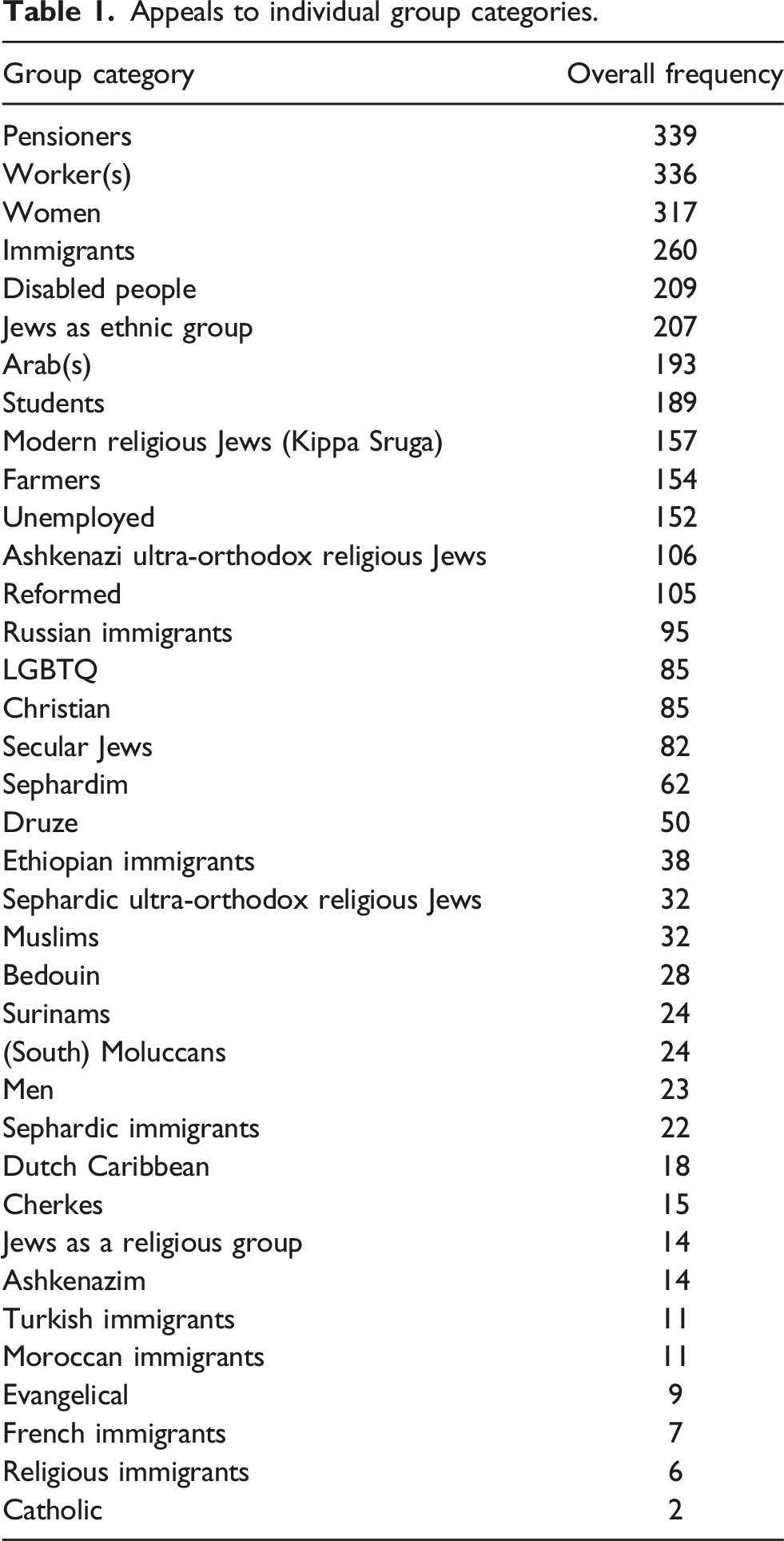
Several other group categories, like Unemployed, collapse terms with similar meanings: "unemployed," "those without a job," and "those not employed," as do Pensioners, LGBTQ, and Students, as was appropriate. Religious, ethnic, and immigrant groups were not collapsed because their would-be components were deemed necessary as separate categories for the project (Dolinsky, 2021) and appear as such in parties' materials. Religious groups were divided by denomination (except for Muslims because this separation did not appear in the texts). Accounting for immigration origin, I distinguished Immigrants in general (a category mentioned by parties in both countries and is easily generalizable) from immigrant groups like, for example, Russians, Religious, Sephardic, and Turkish. This was particularly important in Israel because the country experienced large immigration waves creating distinct group categories and I applied the same to Dutch materials to maintain consistency.
Reliability
The manual coding used an English-language codebook. Being a native Hebrew speaker and fluent in English, I coded all materials in those languages. I also coded all Israeli materials in other languages with the help of translators except those in Arabic, which were coded by an Arabic native-speaker fluent in English and Hebrew. A native Dutch-speaker fluent in English coded materials in Dutch. Intercoder reliability tests for each possible supportive statement in both manifestos and ads indicate that group appeals were identified reliably, with an average Krippendorff’s alpha of 0.75 between country materials (Lacy et al., 2015). 7
Group appeals: Structure and content
Overview of group appeals.

The disparity in the number of sampled ads between the countries did not result in large differences in coded appeals, and the ratio of appeals per ad is actually lower in the Netherlands (512 appeals in 750 ads) than in Israel (735 appeals in 2022 ads). That appeals in manifestos are about 35% greater than in ads may be explained by the former’s usually comprehensive nature compared to the latter, despite controlling for relative length by treating manifestos and ad sets as single units.
Given the early stages of research on group appeals as a distinct concept, finding at least some group appeals in the materials of nearly all PGAD’s 269 party observations is valuable, showing that this theoretical concept captures party behavior and contributes to our comparative understanding of it. In manifestos, only one observation, OMETZ in 1984 (IL) did not mention any social groups, and for six observations manifestos were unavailable. 8 In ads, 15 party observations did not mention any social groups, 9 and for two observations ads were unavailable. 10 While this is a larger share compared with manifestos, it represents only about five percent of the data. Eleven of 25 Dutch parties (44%) and 17 of 44 Israeli parties (about 35%) mention social groups in their names. The Israeli HAAVODA, AM EHAD, and SHINUI are particularly interesting because all three parties changed their official full names during the covered period and therefore were coded as both having included groups in their name (1977–1981, 1992–2013; 1999; 2003, respectively) and not (1984–1988; 2003; 1981–1988, respectively). The low number of appeals in party names is reasonably explained by noting that while parties' names appear on all campaign materials, they were not coded in manifestos or ads to avoid over-coding. Thus, each party name, usually short anyway, was coded only once per party-year observation.
The structure of group appeals
Figure 1 plots the frequency, range, and concentration of appeals for all party observations with yearly party-level averages and Loess fit lines to assist with the analysis. The top panels show some increase in frequency, with party-level averages rising from 11 (1977) to 13 (2015) in Israel and from 12 (1977) to 13 (2012) in the Netherlands. Table 3 also shows a positive and statistically significant (p < 0.05) relationship, albeit small, between appeals’ frequency and election year. This is similar to Thau’s (2019) longitudinal analysis of UK parties, although the upward trend there is more pronounced. A possible explanation for this difference is Thau’s (2019) sentence-by-sentence approach to coding which significantly increases the number of text units, and, perhaps more importantly, that many more group categories were included in the analysis (96 versus the 37 coded here), inflating the overall number of observations. That the PGAD observations move in the same direction is encouraging, suggesting that even when relying on a narrower approach to what constitutes a social group, parties across countries behave similarly. Frequency, range, and concentration of group appeals over time. Top panels: total number of appeals by party. Middle panels: average number of mentioned group categories. Bottom panels: average effective number of groups. Rhombus: party-level average pet election year. Solid line: Loess fit trend. Predicting group appeals in the overall data using OLS regression. Note: *p < 0.05; **p < 0.01; ***p < 0.001. Standard errors in parentheses.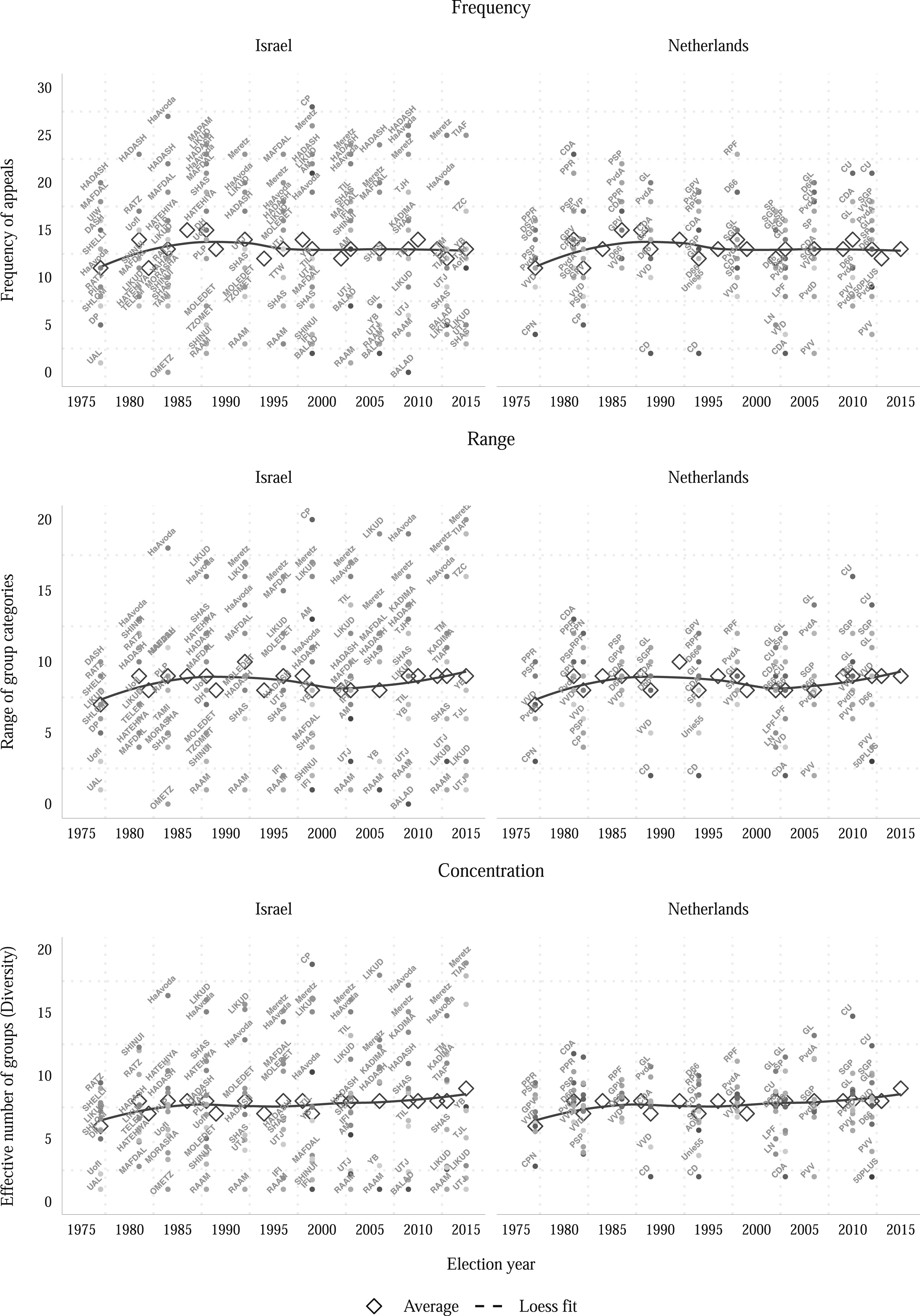
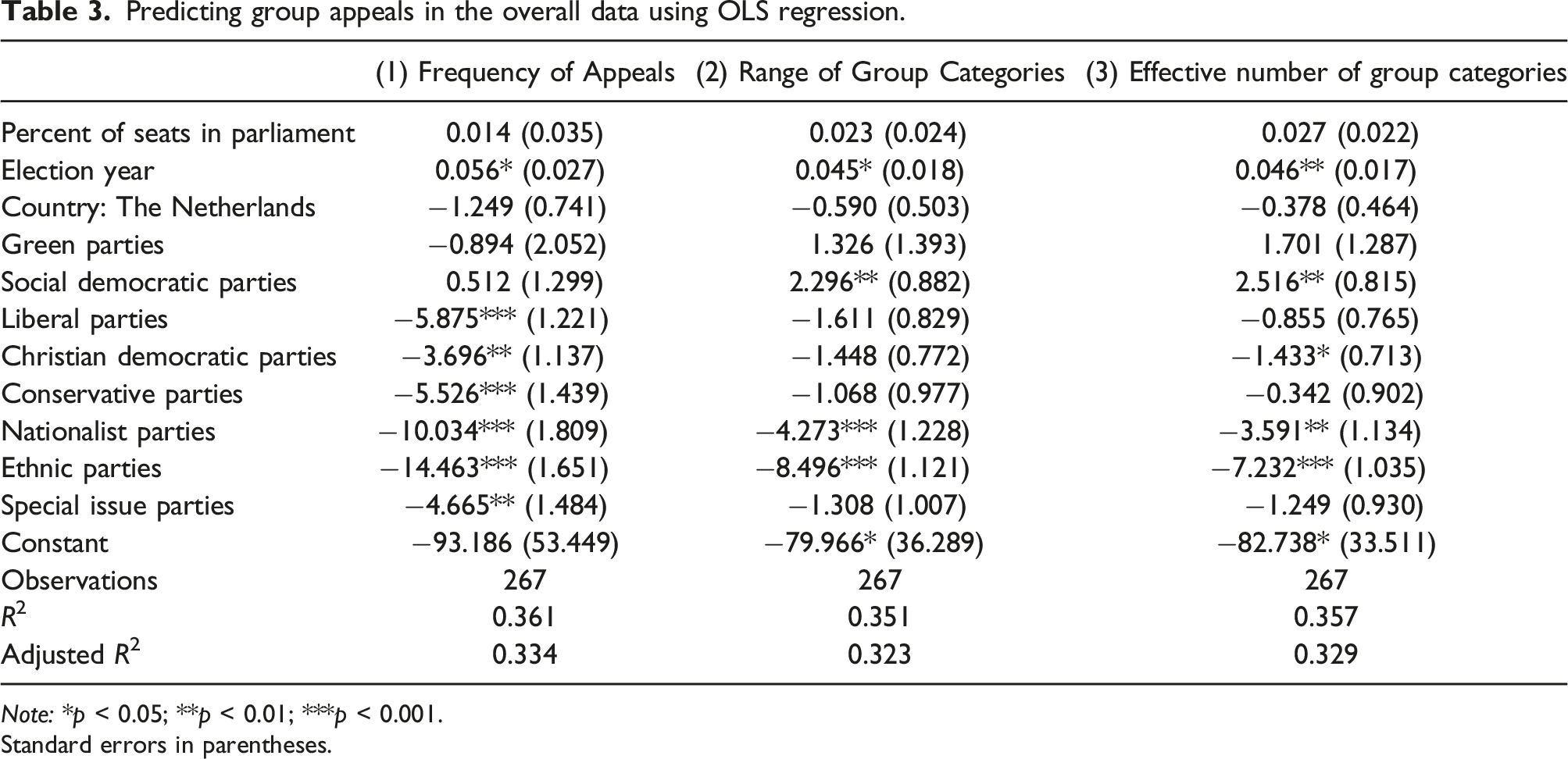
Comparing appeals across countries visually, Israeli parties’ appeals seem more frequent than Dutch parties’ appeals, with Table 3 also showing a negative relationship between appeals’ frequency and country: Dutch parties make fewer appeals than Israeli parties (coefficient of −1.25). However, the relationship is not statistically significant so we cannot be confident that parties’ group appeals differ across countries. This fits with the data showing that yearly party-level averages ranging from 11 to 15 are similar between the countries. The only exception is the 2003 Dutch election that averages 10 appeals per party, which could be explained by the substantially truncated nature of the overall election campaign that year which took place only eight months after the previous Dutch general election. But, while Thau’s (2019) finding of a strong correlation between manifesto size and number of appeals would support this explanation, this may be influenced by the author’s sentence-by-sentence approach to coding and use of nearly three times as many group categories as in the PGAD. Moreover, as the average of 12 appeals per party in the 2002 Dutch elections was not that different compared with 2003, and as an additional t-test found that the differences in country-year means are not statistically significant, it is reasonable to think that there is no between-country variation in appeals’ structure. 11 This suggests that parties across countries behave similarly when making group appeals. One caveat is that while the PGAD’s treatment of manifestos and ad sets as single units provides some control over the possible influence of document length, more fine-grained data are nevertheless needed to further explore this question. Future iterations of the dataset will contribute to this effort.
The middle panels in Figure 1 show that no party appeals to all groups, and that the range of appeals—the number of unique group categories mentioned—also increases over time. The average per-party number of unique group categories rose from seven in the 1970s to nine in the 2010s (with similar in-country trends), and the coefficient in Table 3 is positive and statistically significant. Finally, the bottom panels in Figure 1 show the effective number of mentioned groups based on Shannon’s H concentration measure. Unlike range, this measure accounts for levels of attention to unique group categories, with larger scores indicating increased diversity—more groups are mentioned with less attention to each. 12 As the data show, diversity also increased over time from an average of six effective number of groups in the 1970s to nine in the 2010s, and the coefficient in Table 3 is positive and statistically significant. Looking at country differences, the increase is greater in Israel (six to nine) than in the Netherlands (seven to eight) but as Table 3 shows, the coefficient is the smallest among the models and in any case not statistically significant. Moreover, these observed patterns for both range and concentration are similar to Thau’s (2019) findings in the UK, further indicating that parties across systems behave similarly regarding group appeals.
Figure 2 visualizes relationships between appeals’ frequency, range, and concentration, and party size, and party family. Following common understandings of the connection between party size and other party behavior, I expect party size and group appeals to be positively related. Larger “catch-all” parties appealing to broader population segments would make more extensive group appeals, while smaller parties focusing on more specific population segments would make more limited group appeals. However, the data do not support this expectation. Measuring party size as percent of seats in parliament, I find very small and not statistically significnat coefficients across the models. Two-tailed OLS regression of relationships between appeals’ frequency, range, and concentration, and party size (percent of seats in parliament) and party family (factor variable with socialist or other left parties as base). N: 267.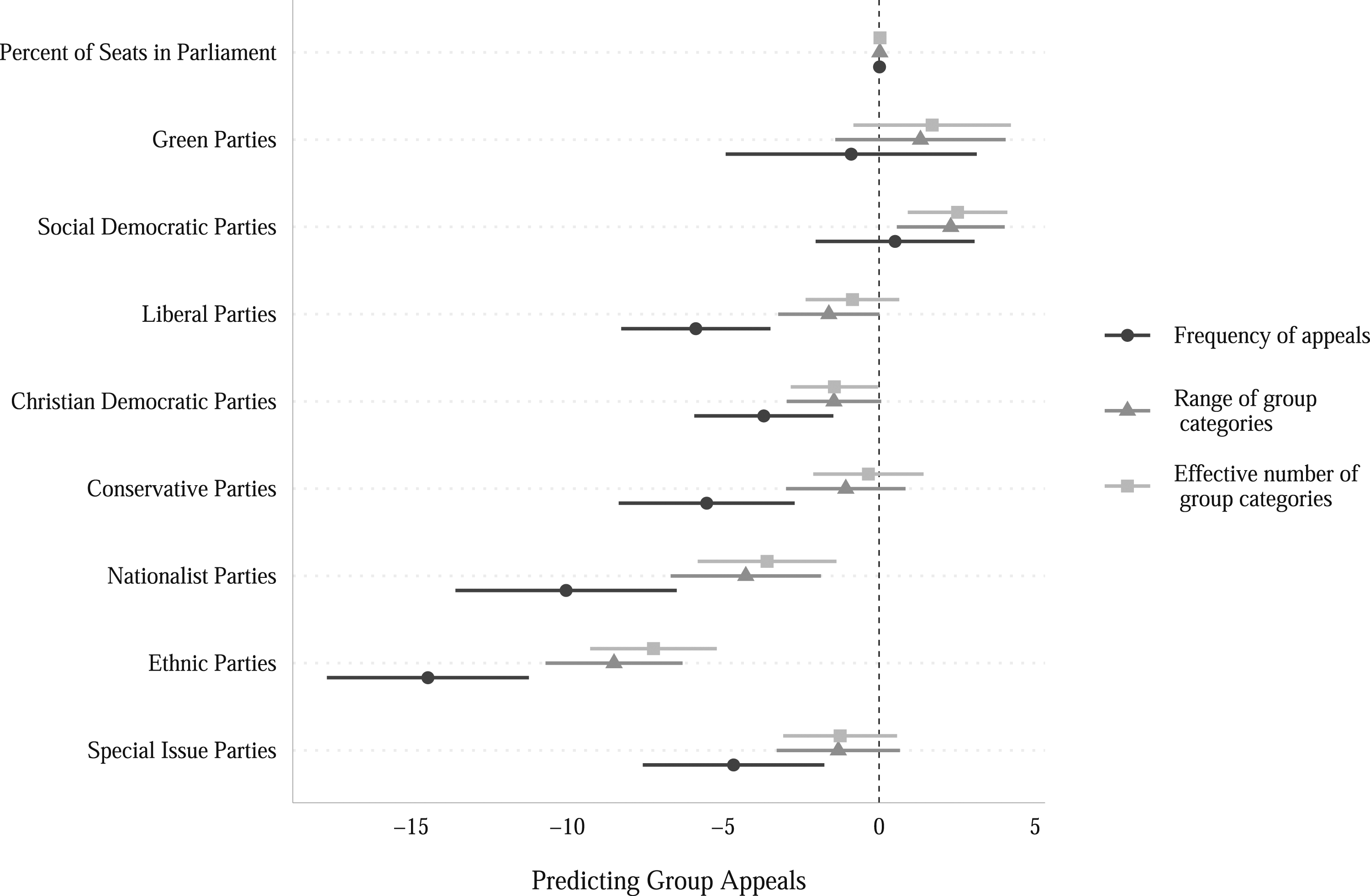
Examining the relationship between group appeals and party family, I expect left-wing parties to make more extensive appeals than right-wing parties. This is based on Caramani et al.’s (2014) argument that represeting social groups is more important for MPs from left-wing party families than for MPs from right-wing party families because of the egalitarian versus individualistic bases of left-right ideologies. Left-wing parties conceive politics as an inclusive enterprise, expanding ideas of equality from economic groups (classic redistributive politics) to identity groups based on gender, sexual orientation, ethnicity, etc. (Celis et al., 2016; Phillips, 1999). Right-wing parties, especially liberal and radical right, on the other hand, rely on individualist and nationalist ideologies, viewing society as unitary rather than group-based (Caramani et al., 2014). Grossmann and Hopkins (2016) similarly argue that in the US, Democrats (party and voters) focus attention on groups, forming coalitions and cooperation between different parts of society while Republicans (party and voters) are driven by ideological considerations irrespective of social groups. Using MARPOR’s party families (PARFAM) variable (Volkens et al., 2018) as a factor with Socialist and other Left Parties as the base category, 13 the data generally support this expectation. While not all coefficients are statistically significant, right-wing parties indeed tend to make more limited group appeals than left-wing parties.
The content of group appeals
I examine group appeals’ content using individual-level social group categories and five larger categories—Economic (ECO), Identity Politics (IP), Religion (REL), Ethnic (ETH), and Life Cycle (LC),
14
revealing interesting patterns. To start, Figure 3 shows the relative frequency of appeals to individual group categories as a percent of overall appeals. Focusing on categories with at least one percent, the group appealed-to most is Pensioners (9.65%), an interesting observation given that little attention has been paid to this group in party appeals and political representation (although it has received increased attention in other areas of political science e.g. Binstock, 2006; Davidson, 2014; Otjes and Krouwel, 2018). Removing the two parties specifically appealing to the elderly—GIL (IL) and 50PLUS (NL)—decreases this relative frequency only a little to 9.29%. And while Pensioners shifts from first to the second-most appealed-to group, it still constitutes a significant proportion of appeals even among non-special parties. Overall, and with 5.3% of appeals to Students, LC groups constitute 15.03% of appeals. Relative frequency of appeals to individual group categories in the overall data.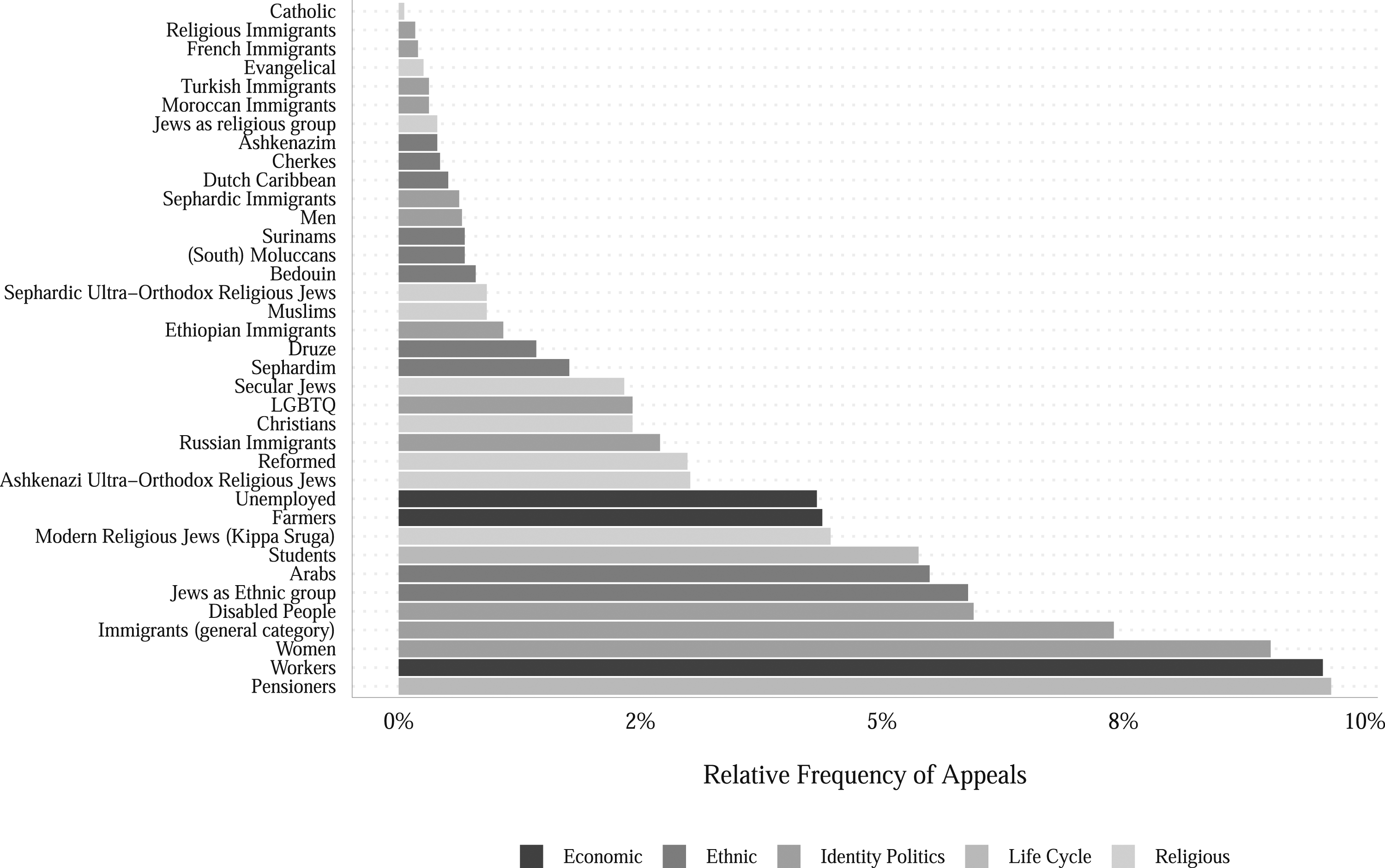
The second-most appealed-to group is Workers (9.56%). Together with Farmers (4.38%) and Unemployed (4.33%), 18.27% of appeals are to ECON groups, suggesting the continued importance of these groups to parties' appeals (Phillips, 1999). The three other categories in the top five are IP groups: Women (9.02%), Immigrants as general category (7.4%), and Disabled People (5.95%). With remaining groups under this umbrella category, 15 IP groups constitute nearly one-third of appeals (30.86%), showcasing their centrality (Caramani et al., 2014). The two other umbrella categories—ETH and REL—constitute 18.08 and 17.76% of all appeals, respectively. The latter indicates the continued importance of "traditional" groups, and the former shows that ethnic groups are significant to group appeals. While this is primarily driven by Israeli parties (where ethnic groups constitute nearly 30% of appeals), they are also made by Dutch parties (about 4% of appeals), highlighting that Israeli parties’ appeals are not unique. Overall, these findings are similar to, and different from, existing work. In Thau (2019), the groups most appealed-to are Women (IP), Families (LC), Businesses (ECON), The Nation, and Young People (LC). Pensioners are in 8th place, Disabled People in 11th, Workers in 12th, and Immigrants are in 40th. In Stückelberger (2019), the groups most appealed-to are Families (LC), Large Employers (ECON), Immigrants (IP), Young People (LC), and Other. Women are in 11th place, Elderly People (Pensioners) in 12th, Disabled People in 16th, and Workers in 27th (plus Employees in 8th place). Some differences in specific group categories invariably result from the differences in coding schemes and approach taken to what constitutes a social group. But the similarities, especially when looking at umbrella categories, are encouraging, further suggesting that parties across countries behave similarly when making group appeals.
Figure 4 shows the frequency of appeals to the larger group categories for all party observations in the dataset. For all five group categories, the trends are non-linear and fluctuate over time. Pearson’s correlation analysis found a positive and statistically significant coefficient (0.254, p < 0.000) between appeals to LC groups and election year, indicating an increase over time. For the other larger group categories, although coefficients for IP (0.019) and REL (0.005) are also positive, neither are statistically significant, not are the negative coefficients for ETH (−0.050) and ECON groups (−0.079). While these findings are in line with previous research on the rise in the importance of identity politics groups and decline in the importance of economic groups, substantial conclusions cannot be drawn because the results are not statistically significant. Frequency of appeals to large group categories by party observation over time. Rhombus: Average overall party-level number of appeals per election year. Solid line: Loess fit trend.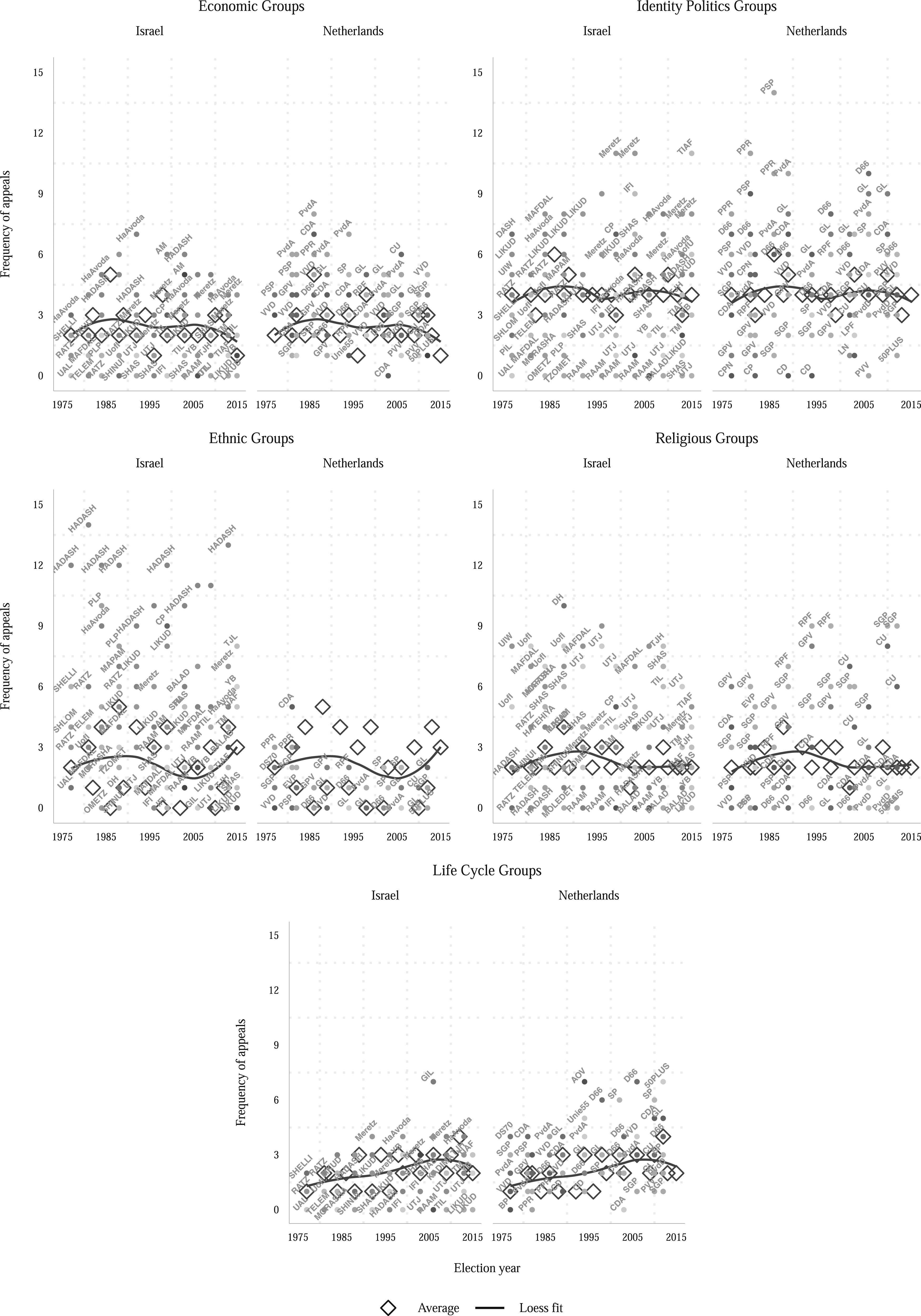
Group appeals across communication channels
Finally, I examine group appeals in manifestos, ads, and party names, comparing the communication channels. In manifestos, five of 247 observations (2%) scored one (most-limited appeal), and one party scored 20 (most-extensive appeal), with a mean of 8.5. In ads, 20 of 249 observations (8%) scored one, and one party scored 16. The mean of 5.1 is about 40% lower than in manifestos. As illustrated in Figure 5, the distribution of appeals in ads skews to the left, most parties making only limited appeals. Comparing means for the 63 parties with sufficient data shows that for nearly 80% of parties, appeals in manifestos are more extensive than in ads. Distribution of group appeals in manifestos (N: 2106) and ads (N: 1265).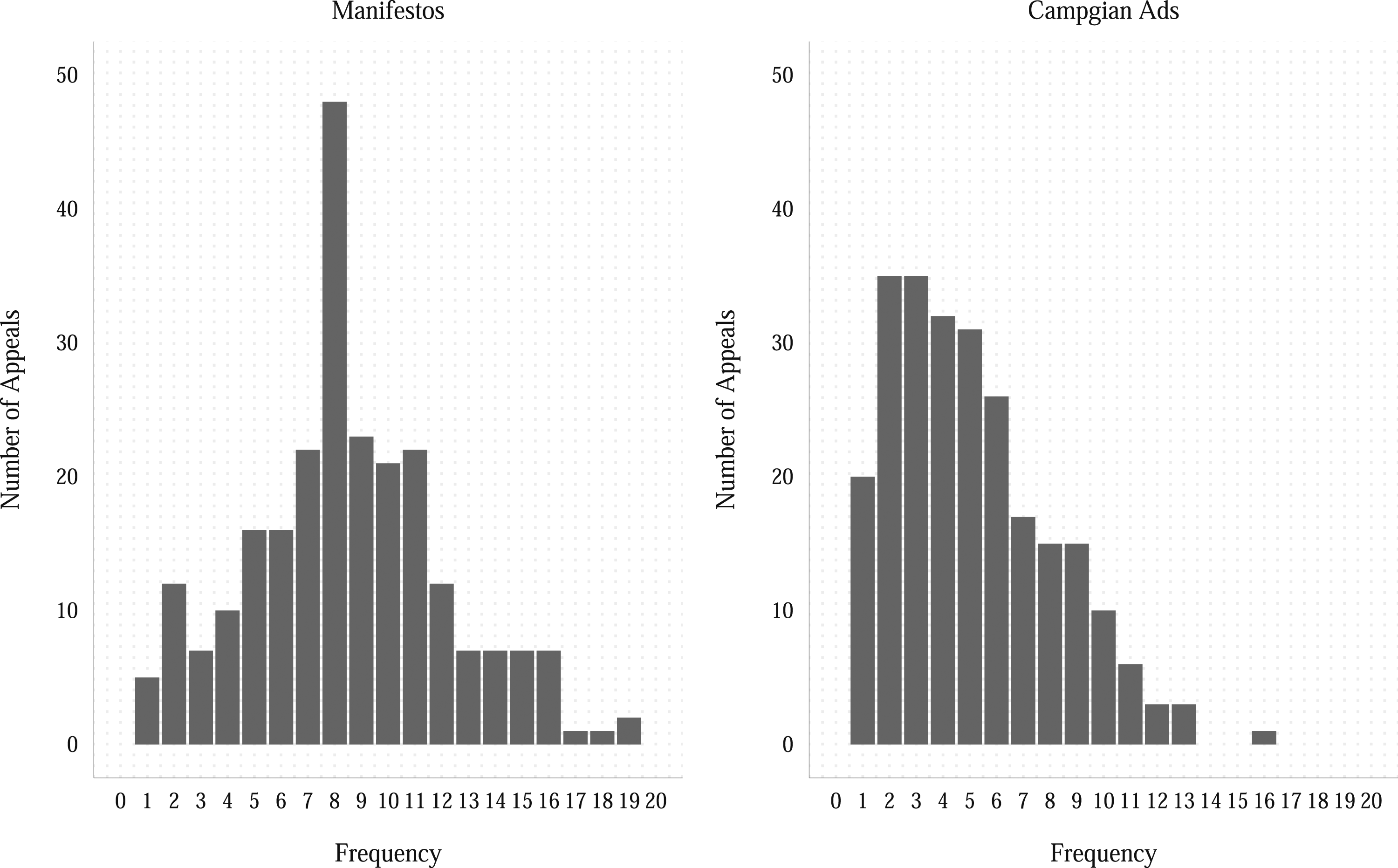
Furthermore, Pearson’s correlation analysis found a positive relationship between appeals in manifestos and ads in the overall data: coefficient = 0.29 (p < 0.00), with similar country coefficients: 0.32 (p < 0.00) in Israel and 0.3 (p < 0.00) in the Netherlands. These correlations are moderate, but they indicate that some relationship exists between the communication channels overall. At the party level, however, such relationships are rare. For the 41 parties with sufficient data, only two coefficients are statistically significant at p < 0.05: the Dutch LPF (1.000), and the Israeli TIAF (1.000), both parties with only two data points. 16 These findings suggest that appeals differ between the communication channels.
Figure 6 further supports this observation, visualizing results of OLS regression analyses by communication channel (full results in tables A2 and A3 in Online Appendix A). Examining party size, coefficients across the models—frequency, range, and concentration of appeals—are similarly small and not statistically significant, the same as in the overall data. However, for party family, appeals differ between manifestos and ads. Focusing on statistically significant results, Liberal Parties, for example, make fewer group appeals in ads than in manifestos compared to Socialist and Other Left Parties (the base category in this factor variable), while the opposite is true for Christian Democratic, Nationalist, and Ethnic parties. The range and concentration of Nationalist and Ethnic parties’ appeals is also smaller in manifestos than in ads, compared to Socialist and Other Left Parties’. These findings suggest that parties use the communication channels differently when making appeals, but these are merely first insights. As few current studies examine the content of print campaign ads (for group appeals or otherwise), further data and analyses are needed to provide more insight into these patterns. Two-tailed OLS regression of relationships between appeals’ frequency, range, and concentration, and party size (percent of seats in parliament) and party family (factor variable with socialist or other left parties as base) by communication channel.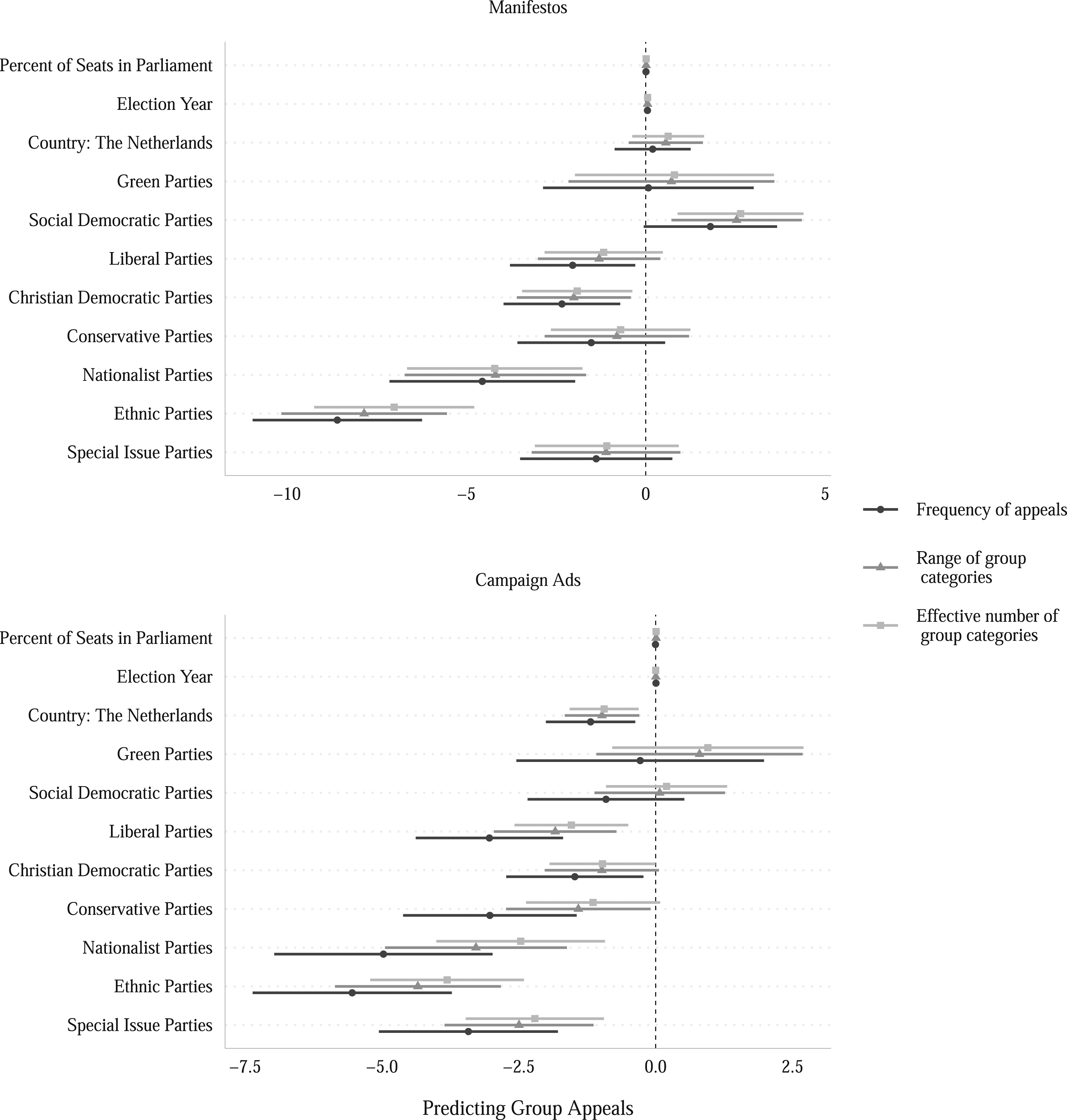
Figure 7 also compares the relative frequency of appeals to individual group categories between the communication channels.
17
Like in the overall data, the three groups most appealed-to are Pensioners, Workers, and Women, but each group constitutes a 15–20% higher proportion of appeals in ads than in manifestos. Moreover, the balance of appeals differs among the umbrella categories. Appeals to ECON, IP, and LC groups constitute a larger share of appeals in manifestos than in ad: 20% vs 15.5%, 33% vs 30.8%, and 15.8% vs 15.1%, respectively. The reverse is true for appeals to ETH and REL groups: 17.8% vs 18.2%, and 13.5% vs 20.5%, respectively. These observations further indicate that parties use the communication channels differently, especially in appealing to "traditional" groups like ECON and REL, emphasizing the importance of expanding our toolkits in analyzing party behavior. Relative frequency of appeals by individual group categories, manifestos versus ads.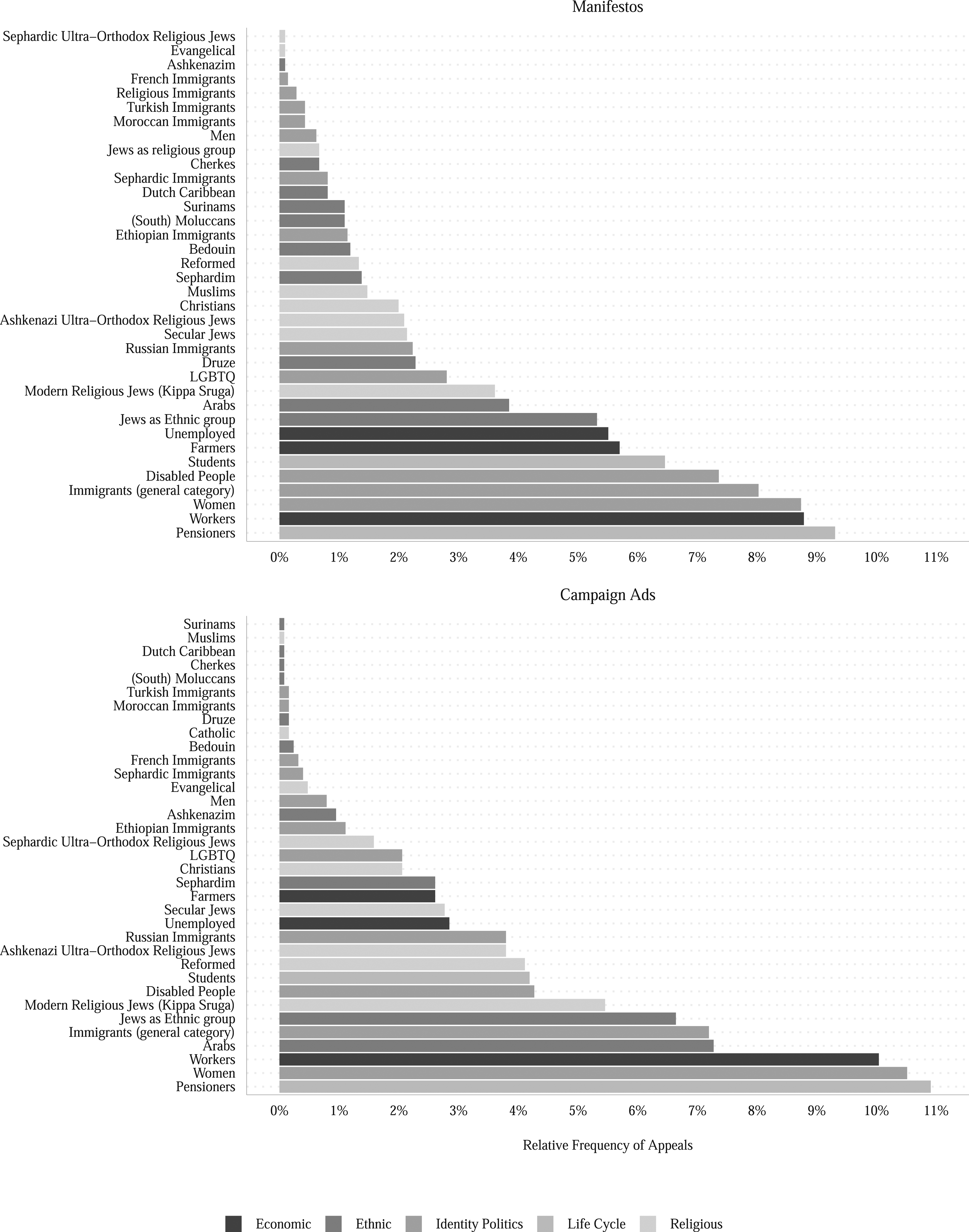
Figure 8 shows the relative frequency of appeals to the 12 group categories mentioned in parties’ names. Nearly 60% of appeals are to REL groups: Reformed (17.6%), Christian (12%), Evangelical (0.7%), Ashkenazi-Ultra-Orthodox Religious Jews (9.9%), Modern Religious Jews (8.5%), Sephardic-Ultra-Orthodox Religious Jews (7%), and Secular Jews (1.4%). The significant weight of these groups in parties’ names indicates this communication channel’s value for conveying appeals to them. While the particular groups are primarily country-specific, neither country’s parties are unique in appealing to REL groups. Only two group categories appear in the names of parties from both countries: Pensioners (3.5% in total), and Workers with 17% in total split equally between IL and NL. Finding Workers, an ECON group, to be the second-most appealed-to group in parties’ names with about a fifth of appeals, combined with the nearly 60% of appeals being made to REL groups, may be attributed to remnants of historical class- and denominationally-based representative relationships between parties and social groups (Duverger, 1954). The PGAD data show that at least in their names, parties continue to focus appeals on these groups. The third-most appealed-to group is an Ethnic category—Arabs (14%), which, together with appeals to Jews as Ethnic group (7.7%), also constitute about a fifth of appeals, all by Israeli parties. These data correspond to previous findings of ethnic parties using their names to convey their affiliation with social groups (Chandra, 2011). Lastly, Farmers (0.7% of appeals) appear only in Dutch parties’ names (0.7% of appeals) as in Israel there has not been a “farmers” party, appeals to this group historically made by catch-all parties like HAAVODA and LIKUD. Relative frequency of appeals to individual group categories in party names (N: 142).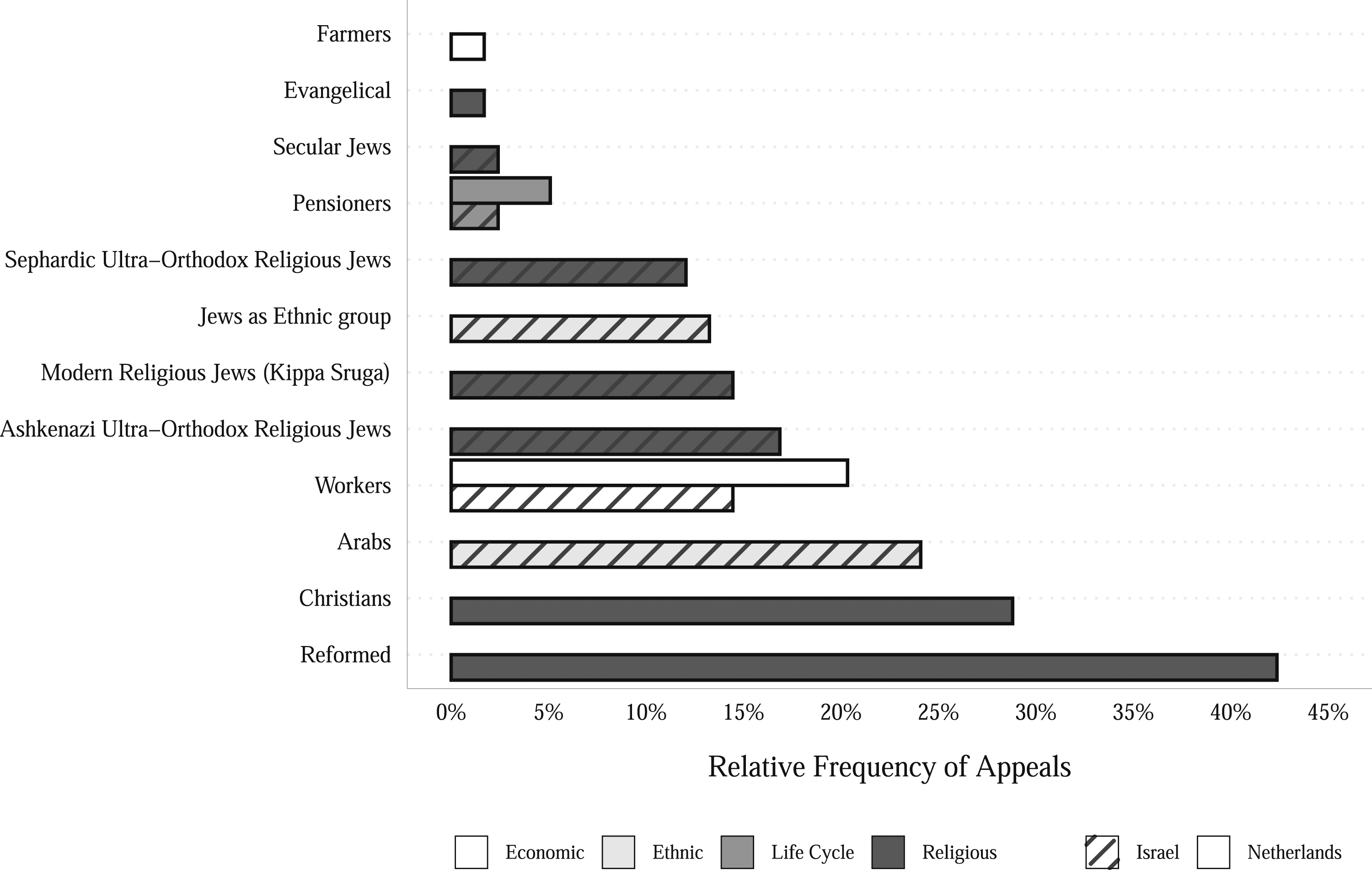
Conclusion
This article joins the most recent efforts to systematically define and measure group appeals as a distinct concept (Huber, 2021; Stückelberger, 2019; Thau, 2019), and makes two primary contributions. First, it provides a concise and simple definition of group appeals, clearly delimiting conceptual boundaries by focusing only on explicit group-based appeals and relying on a narrow understanding of what constitutes a social group category. This approach increases analytical clarity, allowing us to be more confident in assessing parties’ appeals as we examine whom parties themselves designate explicitly as their intended audience.
Second, this article provides new and unique cross-national and longitudinal data on group appeals covering 69 parties in 24 general elections in Israel and the Netherlands between 1977 and 2015. Moreover, the PGAD is one of the first to systematically combine parties' names, manifestos, and print campaign ads over time, expanding our understanding of party behavior. Especially, the data illuminate parties’ group appeals in proportional, multi-party systems, while at the same time, the observed similarities with previous findings on group appeals of UK parties (Thau, 2019) suggest that observations are generalizable beyond particular institutional settings. The data show that parties have been making group appeals consistently over time. While the overall frequency of these appeals has been quite stable over the observed period, the number of social group categories expanded over time, influencing the level of attention parties’ pay to each group (concentration of appeals). Thus, at the very least, the data indicate that social groups have not declined in their relevance to parties’ appeals. Examining appeals to particular group categories also shows that appeals to Life Cycle groups (Pensioners prominent among them) have increased over time, but that patterns in appeals to other specific group categories are inconclusive. Moreover, the data show that parties’ use of the communication channels differs, indicating that some parties’ appeals in campaign ads focus on fewer groups than in appeals in manifestos. Thus, the PGAD provides valuable insight into parties’ group appeals over time and space, contributing to our understanding of how parties relate to social groups and appeal to them during election campaigns.
The PGAD has at least two main limitations. First, it only covers two countries, albeit over an extended period and across communication channels. While findings here are similar to those of previous studies, our comparative knowledge is still lacking, and more data are required to better understand this phenomenon. Future iterations of the PGAD, as well as other efforts to collect data on group appeals, will contribute to this endeavor. Second, the PGAD only focuses on one form of group-based appeals excluding others like negative statements, use of symbols and images, and more. Expanding datasets to include such other forms of group-based appeals will improve our understanding of the scope of parties’ “group orientation”: the more forms used to appeal to given groups, the greater parties’ representative intent. Examining negative appeals will also reveal parties’ representative intent of groups vis-à-vis other groups.
Finally, in addition to future studies continuing to expand existing data, the current PGAD has several potential uses for research. For example, in Dolinsky, 2021, group appeals are treated as representational claims, which is only the first step in the process of political representation. To evaluate whether political representation results from these claims and its quality, we must follow the representational chain and examine whether audiences accept or reject these claims. Historically, this can be done using large survey datasets like the European Social Survey and Eurobarometer that provide extensive data on voters' demographics and party preferences as proxies. This would assume that if parties appeal to a social group, say Arabs or Disabled People, and people of these groups support this party more than other parties, we could infer that these social groups accept this party’s claim to represent them, similar to Heinisch and Werner’s (2019) study. The PGAD can also be used to examine the relationship between group appeals and ministerial portfolio allocations, specifically, whether group appeals influence the ministerial portfolios parties get in the coalition government. Theoretically, I would expect parties with limited group appeals to demand portfolios to best enable them to deliver for the particular social group they claim to represent. Such studies would increase our understanding of parties' considerations in coalition negotiations by adding group appeals to the policy and size motivations previously shown to drive parties to seek their portfolios (Bäck et al., 2011; Ecker and Meyer, 2019).
Supplemental Material
Supplemental Material -Parties’ group appeals across time, countries, and communication channels—examining appeals to social groups via the Parties’ Group Appeals Dataset
Supplemental Material for Parties’ group appeals across time, countries, and communication channels—examining appeals to social groups via the Parties’ Group Appeals Dataset by Alona O Dolinsky in Party Politics
Footnotes
Acknowledgements
I am grateful to all funders, archival support staff, and my two research assistants—Thérèse Abu-Mrad and Kas Nagelhout—who were instrumental to this project. I also thank Richard S. Katz, Tristan Klingelhöfer, Petia Kostadinova, the participants of the UCD SPIRe Comparative Politics Seminar, and all others who read drafts of this article for their valuable feedback. All remaining mistakes are my own.
Declaration of Conflicting Interests
The author(s) declared no potential conflicts of interest with respect to the research, authorship, and/or publication of this article.
Funding
The author(s) disclosed receipt of the following financial support for the research, authorship, and/or publication of this article: This work was supported by the The Warren E. Miller Fund in Electoral Politics, American Political Science Association Centennial Center (Grant number: 1980198); the Leonard and Helen R. Stulman Jewish Studies Program Graduate Research Award (Spring 2018, Fall 2018), Johns Hopkins University; and the Department of Political Science, Johns Hopkins University (Research grant, Fall 2019).

Supplemental Material
Supplemental material for this article is available online.
Notes
Author biography
References
Supplementary Material
Please find the following supplemental material available below.
For Open Access articles published under a Creative Commons License, all supplemental material carries the same license as the article it is associated with.
For non-Open Access articles published, all supplemental material carries a non-exclusive license, and permission requests for re-use of supplemental material or any part of supplemental material shall be sent directly to the copyright owner as specified in the copyright notice associated with the article.
