



Abstract
The article focuses on the supply-side of protest activity in Latin America in the post-neoliberal era. It argues that parties’ cohesive voting in Congress under different power constellations and parties’ voter-linkage strategies create institutional conditions of power collusion, inter-branch stalemate, or party erosion that delineates political terrain for social mobilization. First, the firm control of a single party or coalition over the executive and legislature with cohesive voting of party members in line with party leadership denotes power collusion and incites underrepresented actors to protest. Second, the dislocation in the executive-legislative relations (either with party members voting against the president’s proposals in a majority government or with cohesive opposition bloc(s) acting against the president’s will in a minority government) leads to policy immobilism and pushes legislative parties to ignite popular discontent. Third, more programmatic party linkages increase the degree of party institutionalization and predictability about policy commitment and mitigate struggles in extra-electoral arenas. The theoretical argument is tested with a battery of statistical tests that lend credence to the institutional explanations of mass mobilization. This is corroborated with empirical cases that show the plausibility of the statistical findings in particular contexts.
Introduction
The severe economic and hyperinflation crises that hit all Latin American countries in the 1980s forced ruling elites to follow the “Washington Consensus” prescription that involved the implementation of bold stabilization and deregulation measures (Smith, 1994; Potter 2007: 10). The enactment of neoliberal policies went in tandem with the democratization process 1 and the return of the military to its barracks. There was a wide belief that the return of democracy put an end to the historic class-based mobilization that formed the bedrock of the military coups in the 1960s and 1970s. The “double movement” to economic neoliberalism and electoral democracy raised expectations about the de-mobilization and de-politicization of the traditional popular sectors and asserted the dominance of pro-market forces who extorted erstwhile distributional conflict (Kurtz 2004; Murillo 2004: 104–8; Roberts 2002; Roberts 2013; Teichman 2001; Corrales, 2000; Remmer 2003: 35). At the turn of the 21st century, however, massive social protests erupted in the region against the market-oriented policies –such as the anti-privatization revolt in Arequipa (Peru), the Piquetero protests in Argentina, and the “water war” in Cochabamba (Bolivia). Additionally, variants of leftist parties that campaigned on either anti-neoliberal economic programs or more pragmatic and “friendly” neoliberal platforms assumed power –such as the Movement Toward Socialism (MAS) in Bolivia, the Fifth Republic Movement (MVR) in Venezuela, the Labor Party (PT) in Brazil, and the Broad Front (FA) in Uruguay. The upsurge of mass mobilization and the ascent of leftist forces to office gave way to political dissidents and ideological conflicts –that were not possible during the heyday of the “Washington consensus”– to reshape party systems and competitive alignments in much of the region (Arce 2008; Silva 2009).
Moreover, the outbreak of anti-neoliberal protests and the electoral triumph of the leftist candidates pushed scholars to revisit the thesis of the demobilization outcome in the neoliberal era and pulled the debates in the opposite direction. The scholarly debates create the impression that neoliberal policies in a more open and permissible democratic environment incite underprivileged groups always and everywhere to rebel (Kurtz and Lauretig 2022: 969). However, economic “liberalization does not create homogeneous interests or insecurities among subaltern groups, and neither does it generate a uniform response” (Roberts 2008: 337). While countries like Ecuador, Bolivia, Venezuela, and Argentina were riven by massive protest movements, contentious politics remains muted or localized in much of the region. Furthermore, democratic openness and permissible political opportunity structure (POS) do not fully explain the variations and the timing of the mobilization record after the third wave cascaded the region in the late 1970s and early 1980s. Scholarly writings focus primarily on highly contentious cases where the left outsiders assumed office and mobilized social constituents to introduce radical changes to socio-economic policies. But the same political opportunity of the ascent of a left outsider to office in Paraguay under Fernando Lugo’s reign (2008–2012) did not incite mass mobilization against the existing socio-economic conditions, nor did his impeachment create an opportunity for street activism. In addition, social actors who acquiesced to the market policies in Chile in the early 1990s mobilized against the same socio-economic policies more than two decades after the return of democracy in 1990, paving the way for a new far-left coalition (the Approve Dignity –Apruebo Dignidad –AD) to win the presidential elections in December 2021 (Hatab 2022).
In fact, both mobilization and demobilization are thus prevalent amidst the same structural conditions of neoliberal economies and open democratic opportunities. What accounts for the varied record of the mass protests in the post-neoliberal era? Why did the same economic model engender protests in some countries and acquiescence in others? And why did the initiation of the neoliberal policies produce compliance in the beginning and trigger contention at later stages?
A close inspection of protest mobilization after the enactment of stabilization and structural adjustment policies has to take into consideration the institutional dynamics including the uneven distributional conflicts and politics of coalition-building that varied from one reform area to another and affect distinct repertoires of contention (Schneider 2004). The article argues that fluid collective protests are not automatically galvanized in response to the immediate shift in economic and development policies amidst a conducive democratic environment. The implementation of “shock therapy” and liberalization policies occurred amidst the hyperinflation crisis and did not coincide with a regime crisis. Market-oriented policies, however, involved changes in the balance of power between state institutions, reshaped coalition politics, and gave rise to new political actors over time. At the turn of the 21st century, the balance of forces between the executive and the legislature tilted in favour of the latter. While the executive decree powers enabled the initiation of the reform package without partisan resistance in the 1980s, the legislature asserted its prominence in later stages with shifting partisan coalitions that sustained or blocked the executive’s policy agenda.
Furthermore, the shift to market-oriented policies in Latin America brought about different levels of social and distributional conflict and pushed erstwhile parties to diversify and modify their societal linkages. Labour-based parties replaced corporatist class linkages with clientelism, and other political parties programmatically repositioned themselves by making a sudden shift to the right to base their linkages to electorates on policy commitments. Re-establishing the linkage portfolio of political parties has been an indispensable adaptive strategy to pre-empt representation crisis and institutional decay of existing parties, and to ward off the dissociation of voters and extra-systemic mobilization (Levitsky 2005; Roberts 2015). Therefore, the composition of the legislature, the role of parties in government, the interbranch relations, and the institutional and representative capacity of political parties have implications for the proclivity of the system to collective mobilization. A few studies to date have attributed rates of contention to institutional factors and, more especially, they have not discerned the effect of specific party configurations on protest activity.
The argument and methods
Political parties are the primary basis for organizing support or opposition to government policies in the legislature, which have significant consequences for societal reactions to these policies (Aldrich 1995). Parties thus provide access to power centers by “taking positions on issues rending a society, putting order into what would otherwise be a cacophony of dissonant conflicts, [and] reducing the information costs” to participate in politics (Hagopian 1998: 101). At one end, opposition parties or breakaway factions of the ruling party may align with social claimants or well-organized social sectors to bolster their bargaining position on the policy-making agenda in congress. Cohesive party members vote in congress either in line with party leadership or with other members of their party determines the parameters of the interbranch relations and demarcates the boundaries of legislative parties’ actions and social actors’ reactions that thwart or abet protest activity. At the other end, institutional weaknesses of political party and its failure to respond programmatically to voters’ demands propel social contenders to act reactively and ask tenaciously for policy and political changes. Party programmatic linkages to social constituents mark party strength or erosion as well as the quality of party representation in power centers that push social actors to articulate demands either through electoral channels or extra-systemic mobilization.
I argue that party’s cohesive voting under different institutional configurations and representative strength in congress shape or close political opportunity for collective protests. First, a firm control of a single party or coalition over the executive and legislature with cohesive voting of party members in congress denotes power collusion and closes off opportunity for elite defection or interbranch stalemate. Over time, disgruntled and underrepresented actors resort to extra-systemic politics to articulate their grievances. Second, the dislocation in the executive-legislative relations (either with party members voting against party leadership proposals in a majority government or with cohesive opposition bloc(s) acting against the president’s will in a minority government) leads to institutional gridlock and pushes legislative parties to tap into or ignite popular discontent and mobilize wide swathes of social constituents against government policy. Third, more programmatic (less clientelistic) linkages of party members push voters to focus on policy changes in electoral cycles and the long-term effects of policies, instead of acting on short-term material rewards.
Theorizing the effect of party’s cohesive voting and representative quality on social mobilizations in Latin America contributes to the debates about cross-countries variation in mobilization records in the post-neoliberal period. It pivots the focus away from the macro-structural economic variables and the mechanical language of the POS and spotlights, instead, the supply side of the meso-institutional setting of protest mobilization.
The article constructs a panel dataset of 16 Latin American countries between 1985 and 2010 to uncover institutional mechanisms that account for different forms of protest activity that varied in degree and intensity across countries. I include violent riots and peaceful demonstrations and define contentious action as the mobilization of considerable numbers of groups and individuals to vocalize opposition to the national government. 2 As (Moseley 2018: 195) aptly noted: “Not all repertoires are created equal— peaceful street demonstrations … are distinct from organized lootings of grocery stores. [It is analytically useful to investigate] whether or not institutional [factors] exert the same type of influence on peaceful demonstrations as they do on more confrontational [and] violent tactics in different Latin American regimes”.
Latin American cases also exhibit a high degree of similarity. The diffusion effect swept across the region in the early 1980s and almost the entire region experienced the dual transition to a market economy and democracy. The instantaneous political and economic transition brought about changes in partisan coalition and reshaped party linkages over a time span of two decades. Between the 1990s and 2000s, some party systems collapsed wholesale (e.g., Venezuela, Bolivia, Peru, Ecuador, Colombia, Guatemala), or gradually eroded with a disappearance of old competitive parties (e.g., Argentina, Cost Rica), or markedly remoulded with new competitive parties or coalitions succeeded in assuming office (Uruguay, Brazil, Chile). Moreover, all Latin American countries have presidential systems wherein the executive is elected independently from the legislature and thus the two branches are “veto players” whose agreements are required for policy making (Tsebelis, 1995). Separate elections, and perhaps independent tenure of the two branches, result in different partisan groups controlling the two branches that enable the legislature to constitute a veto gate in the policy-making process (Shugart and Haggard, 2001, 64).
I thus examine the effect of the dual transition to democratic rule and market economy on variations in collective protests across the region from the mid-1980s through 2010 (given the availability of the data on economic liberalization). I use a battery of statistical Random Effect Negative Binomial (RENB) tests to examine the effect of parties’ cohesive voting in the legislature under different power constellations and parties’ linkage strategies to voters on the expected counts of riots and demonstrations. The statistical results lend credence to the theory outlined here. Parties’ legislative cohesion affects the likelihood of riots occurrences, but it is not a strong predictor of peaceful demonstrations counts. Furthermore, more programmatic linkages of party members thwart riots and demonstration activity and confine social struggles to institutional arenas.
Next, I review the extant literature on the structural and institutional causes of protest mobilization critiquing the broad conceptual range of the Political Opportunity Structure (POS) and the scant focus on party configurations. The second section develops a theoretical framework that puts causal weight on party’s cohesive voting and institutionalized linkages and their implications for opportunities of collective mobilization. Third, the article dwells on the quantitative analysis and the main findings. Finally, the article concludes by highlighting the possible generalizability of the theoretical assertions to other regions and pointing at potential avenues for future research to investigate the demand-side of protest activity.
The broad conceptual range of political opportunity structure
A large corpus of literature that investigated the resurgence of mass mobilization in the region produced some case-oriented studies or conducted longitudinal and cross-national statistical analysis to examine the combined effect of neoliberal reforms and democratic politics on contentious outcomes. 3 The quantitative (Arce and Bellinger 2007; Bellinger and Arce 2011: 699, 700) and qualitative studies (e.g., Arce 2008; López-Maya 2002; Wolff 2007; Almeida 2007; Escobar and Alvarez 1992; Etchemendy and Collier 2007; Bombal 2003; Philip and Panizza 2011) base the analysis on the structural language of favorable POS 4 that shapes contentious trajectories (Eisinger, 1973; McAdam et al., 2001: 66).
The logic of POS poses two main difficulties in appraising rigorous theoretical assertions for two theoretical reasons: First, the language of political opportunity offers a mechanistic understanding of social protests. By suggesting that social protests flourish during favorable opportunities and decline in times of less favorable opportunities, the POS scholarship falls into a trap of tautological causal explanations. The analytical possibility of “missed opportunity” offers a way out for scholars to investigate demobilization in democratic settings without developing a robust approach to the political opportunity that enables scholars to probe mobilizing possibilities ex ante during the absence of mobilization (Amenta and Halfmann, 2012: 228).
In the face of bourgeoning critiques to the concept of POS, McAdam et al. (2001) limited the analysis to four main mechanisms based on the degree of openness of the political system, stability of political alignments, presence of elite defection, and state repressive capacity. The four listed elements, however, remain overly general and are hard to discern before claimants take advantage of them and undertake observable actions (Meyer and Minkoff, 2004). For example, how do we know whether elite allies are available for potential protestors to align with them before the surge of protests? And why does the same condition of permissible political environment produce political compliance rather than rebellion in some contexts?
Second, the dichotomous perception of the opening and closing of opportunities offers a static account and hardly bears on the political context in dynamic and strategic terms. The very essence of contentious action is about how aggrieved or underrepresented players influence the political arena through extra-systemic mode of participation. A stream in the available literature responded to this critique and anchored the study of contention in “political process” model to offer a more dynamic and interactive explanation of mobilization. Some studies pivot the focus to the micro-mobilization context, expanding on the literature of resource mobilization theory (McCarthy and Zald, 1973). This trend offers a thorough examination of the available associational space and community organizations that impinged on the mobilizing capacity of different indigenous and local groups in less solid democratic contexts with flawed electoral institutions (Yashar, 2005; Moseley 2015; Boulding 2010).
Other studies examine poor institutional qualities and electoral competition alongside actors’ perceptions to gauge the propensity of actors to participate in street protests at national and sub-national levels (Moseley 2018; Boulding 2010; Arce and Mangonnet, 2012; Levitsky 2005). Combining institutional characteristics and individual-level data, these studies unravel mechanisms by which actors choose between institutionalized and non-institutionalized means as an alternative way to channel their distrust and dissatisfaction (Machado et al., 2011). Although these studies offer building blocks for POS (limiting its conceptual range to the institutional domain) and resource mobilization traditions, they tend to limit the analysis to either the organizational solution to the collective action problem that transforms existing discontent into actual contentious behavior or to the political corrosion of institutional deficiencies that push aggrieved sectors to use non-conventional tactics of political participation. Nonetheless, the simple association between institutional weaknesses and transformation of grievances into street protests overlooks conditions under which interactions at the meso-institutional level among actors, opponents, and allies (inside and outside power centers) produce diverse outcomes. That is, why institutional calamity at one time stimulates representation crisis and episodes of contention, and at other times mitigates protest activity.
Recent trends in the available literature made great strides in narrowing down the focus on political institutions and highlighting the role of political parties and their ideological positions in fueling or limiting protest mobilization. Some studies emphasize the irreducible role of political parties to the representative function and further probe parties’ –especially on the left of the political spectrum– propensity to foment protests and align with social movements (Goodwin 2001; Goldstone 2003; Van Dyke 2003). A few other writings draw on societal linkages of political parties as a manifestation of the institutional strength or weakness and the quality of institutional representation that affect the tendency to protest. In these studies, clientelism is an indicator of institutional weakness and makes actors more prone to normalize non-institutionalized tactics (Machado et al., 2011; Moseley 2018). These studies, however, did not offer rigorous statistical tests to this theoretical claim nor did they expand the analysis beyond a few numbers of cases peppered with episodes of contention. Moreover, they lumped all clientelistic linkages together in one category, eliminating variations in the scope of coverage that signal the monitoring and control capacity of political parties. Difficulties to parse out direct mechanisms of party linkages and their consequences for street activism do not offer rigorously extensive empirical tests for the competing and alternative explanations of the effect of clientelism on protest activity.
In a similar vein, a few studies attributed contentious records to specific party configurations, nor has much research dealt with the degree of contention. Although some writings probed the positive correlation between the “effective number of parties” and protest activity (Arce 2010), the large effective number of parties may also work in the opposite direction and facilitate coalition-building, and thus offer institutionalized channels to opposition groups to cooperate and defuse collective protests (Roberts 2013; Lupu 2015). The strategic interaction between parties and government, thereby, sets the parameters of social contention and creates space for claimants to launch extra-systemic campaigns since protest mobilization is heavily conditioned by the operation of political institutions and the presence of veto players in the system.
The article develops an argument that echoes the institutional trend in the existing literature, but it sets contentious action in motion, highlighting how parties’ voting patterns in congress under different power configurations and their institutional linkages shape or curtail opportunities of extra-systemic participation. The article thus disaggregates ‘political opportunity’ into concrete interactive actions and reactions between different players with ends and means in specific strategic arenas. First, cohesive voting behavior in congress shows how it affects the possibilities of power collusion and/or institutional stalemate with the executive, which structures social action. Second, party’s institutionalized linkages to voters affect predictability levels about policy commitment and certainty degrees about political representation and/or policy responsiveness, which demarcate boundaries of disruptive networks. That is, party’s cohesive voting and institutional strength (or lack thereof) in the legislative arena creates institutional conditions of power collusion, inter-branch stalemate, and party erosion that delineates political terrain for protest mobilization.
Institutional foundation of political (de-)mobilization: party collusion, inter-branch dislocation, or party erosion
Cohesive party members vote in Congress either in line with party leadership or with other members of their party under three sets of power constellation (single-party/coalition control, majority, and minority government) determines the number of veto players in the system, and creates conditions of power collusion or interbranch stalemate that predispose the system to or immunize it against extra-systemic mobilization. Moreover, party’s strategies of connecting electorates to policy-making centers (on a spectrum ranging from mere clientelistic bonds and provision of particularistic and excludable private goods to programmatic commitment and extensive provision of universalistic and non-excludable public goods) determine means of demand-making that intensify or mitigate political conflicts in extra-legislative arenas (Lawson 1980; Morgan 2011; Mainwaring and Torcal 2006).
Parties’ voting strategies and linkage portfolios, therefore, permit the formation of a priori explanations for the propensity of the system to social mobilization. The discussion in this section suggests three hypotheses that will be statistically examined in the following section: Hypothesis 1: collusion among party members in a single-party government activates disenfranchised and adversarial factions in society to participate in protest mobilization. Hypothesis 2: the dislocation in executive-legislative relations in a majority or minority government leads to policy immobilism and incites social opposition to resist the government’s policy agenda. Hypothesis 3: more programmatic ties of party members increase predictability about policy commitment, decrease uncertainty about political representation, and dampen extra-systemic mobilization.
There is a methodological caveat here of potential endogeneity problem as legislators may defect from the ruling coalition or break with their party’s line or the executive’s program as a strategic response to street protests (instead of instigating the protests in the first place). Difficulties to offer a rigorous examination of the elite’s strategic behavior and motivation of voting may not solve this problem. But I deal with legislative voting and linkage strategies that yield power collusion, inter-branch conflict, or party erosion as independent variables to measure congruent policy positions and institutional ties to voters inside the legislature under different power configurations and societal linkages.
Party monopoly and power collusion
A single-party or coalition control over the two branches of government over a long time sets conditions for collusion in power. Interests outside the ruling party or stable ruling coalition may be effectively ignored. Power monopoly, therefore, reduces the number of veto players in the system, or activates what Tseblis calls the “absorption rule” (Tsebelis, 1995; Tsebelis, 2000), by eliminating the “dual legitimacy” between the executive and legislature in the presidential systems and by jettisoning dissimilarity of policy positions between legislative majority party(ies) and the executive. The two branches represent one congruent and cohesive player, which decreases chances for policy divergence between them, diminishes the distance between the presidential decree and congressional approval, and pushes ruling elites to defend the status quo (by increasing barriers for outsiders to get admitted to the polity).
A close symbiosis between parties and the state, therefore, eliminates ideological differentiation and sets the stage for a cartel party. When political parties dilute programmatic differences and operate as a cartel that acts cohesively and enjoys procedural advantages in the legislative process, the collusion in power increases the probability of capricious policy change, limits competition and conflict between political groups, and closes off the polity to oppositional voices. With the monopoly of power and absence of electoral uncertainty, the cartel party would converge on agreed goals with no fear of being removed from office by voters as a major incentive for politicians to be responsive to the citizenry, and the political goals become more ‘self-referential’ and policy-making becomes ‘profession’ as such with no attempts to introduce social or comprehensive reforms (Katz and Mair 1995: 19, 22).
Power collusion, therefore, limits the possibility of intraorganizational dissent, minimizes the consequences of inter-party competition, and protects the party from electoral defeat by possibly placing entry barriers in the path of new parties trying to enter the system. In theory, these political dynamics close off the political opportunity for protest and foreclose elite defection or interbranch conflict which disincentivize unrepresented constituencies to put claims on government. However, partisan monopoly over power centers and dilution of ideological distinctions deepen the representation crisis and activate adversarial factions in society to challenge routine institutional politics through non-conventional means (Lupu 2014).
The ability of the colluded parties to prevent new political forces from emerging to represent shifts in the distribution of voters’ preferences over policy space is contingent on the party’s adaptive capacity to prevent the de-alignment of voters with the emergence of large free-floating and uncommitted constituencies susceptible of the existing parties. In effect, power collusion stimulates further reactions and sows the seeds of further evolution of the system. “By operating as a cartel, by attempting to ensure that there are no clear ‘winner’ and ‘loser’ among the established alternatives … the cartel parties are often unwittingly providing precisely the ammunition with which the new protestors can [break ties with the parties, and] wage their wars [to shape the policy agenda]” (Katz and Mair 1995: 24). The implications of breaking the monopoly of power for state-society relations depend on the ideological proclivity of the newly emerging political actors and their ability to restructure relations to society along either populist appeal or new institutionalized bonds. While the former offers space for the articulation of anti-establishment demands from disenfranchised sectors, the latter provides institutionalized channels of participation and political expression (e.g., electoral campaign volunteerism).
In contexts such as Chile (1990–2010), for instance, the firm control of the Concertación over the two branches (and its collaborative mode of interaction with the right opposition due to the super-majority quorum required to pass significant policy changes) reduced the number of veto players in the system, eliminated differences in policy positions, and blocked off the institutional political arena to radical opposition. Surprisingly, however, the collusive path of the cartel coalition led to the eruption of student protests in 2006. The Concertación parliament dismissed the proposal for educational reform in 2005 and cohered with the right opposition to hinder the promulgation of any law that pursued far-reaching economic changes. 5 As a consequence, hundreds of thousands of secondary school students (the Pingüino movement) organized mass protests to denounce the conservative policy position of the center-left coalition in congress (Donoso, 2013). Power collusion, ultimately, pushed unrepresented sectors (students, labor unions, and popular organizations) to launch a protest campaign amidst a “closed” political opportunity structure. But the adaptability strategy of the center-left parties by shifting competitive alignments and devising new policy areas stalled the emergence of a radical political alternative until Boric reached power in 2022 against the backdrop of the “social break” of 2019 (Hatab 2022).
Interbranch stalemate and dislocated power relations
If two different partisan groups control the two branches, the president’s “legislative contingent” is a crucial determinant for interbranch bargaining. In a minority government, a wide range of interests must necessarily be accommodated for policy enactment. Divided party control not only increases the number of veto gates in the system, but it also widens the distance on key policy positions and increases the probability of “legislative activism” to even force the head of the executive out of office (Martínez 2015: 43; Martínez, 2020; Hochstetler, 2006: 402–404). Divided government, however, does not necessarily produce interbranch conflict. A minority government may either invest in building a legislative coalition for stable policy-making over the long run or lean towards the core area in the policy space that does not need formal allies or effective use of veto power. In this case, a minority government functions as a majority government and, thereby, decreases policy distance between the two veto players.
However, constitutions in several Latin American countries provide the ruling government with a significant series of agenda-setting and legislative powers: such as prioritizing government bills, counting abstention in favor of government bills, allowing the government to introduce amendments at any point of the floor debates, and giving the president the right to veto legislative bills –either through line-item or package veto (Cox and Morgenstern, 2001: 172; Morgenstern and Nacif, 2002; Shugart and Mainwaring, 1997; Mainwaring 1993; Jones 2012). A credible commitment of both branches to cooperation is crucial to preempt interbranch conflicts and to converge on a particular policy agenda. If the executive refuses to bargain with a recalcitrant Congress and the legislators act cohesively to hedge against the president’s veto authority (especially if a qualified majority is needed to override it), institutional gridlock will most likely expedite the dislocation of state-society relations, by giving leeway for legislators to play a reactive role and mobilize social opposition to enable negotiation with the president over policy issues or even to remove her from office. Ecuador (1984–2005), for example, represented a case of extreme “multiparty presidentialism” with no stable allies in Congress that decreased incentives for interbranch collaboration. The norm of clandestine coalition building, that emerged from the late 1970s through the mid-1990s in what became known as “ghost coalitions”, enabled presidents to achieve considerable legislative contingent (Levitsky, 2005). Although opposition parties remained publicly vocal against the government, they routinely supported the executive’s legislative agenda (in exchange for government largess and other discretionary resources). The terms of informal interbranch bargains, however, became largely contested and increasingly difficult to enforce in the mid-1990s (Acosta, 2006: 82). The intense executive-legislative conflicts stimulated massive social protests that unseated three presidents (Abdalá Bucram in 1995-96, Jamil Mahuad, 1998-2000, and Lucio Gutiérrez, 2003-05) before the end of their mandate (Pérez-Liñán, 2007: 162–156; Corrales, 2000: 273–275).
In a similar vein, the conflictual relationship between party members and party leadership in a majority government produces dislocation in the executive-ruling party relations and makes a majority government function as a minority one. If a ruling party/coalition fails to deliver a stable policy position and votes against the executive initiative in Congress, it increases the number of veto players in polity and increases the proclivity for stalemate and “policy immobilism”. Likewise, if a president “neglects” her party and overrules the legislature (Corrales, 2000) by putting into effect her veto power to provide the government with a shield against the party’s attacks in the legislature, the confrontation with the ruling party may strip the president of her “legislative shield” (Pérez-Liñán 2007), divide the ruling party/coalition, and push legislators of the ruling party/coalition to act as a veto player against the chief executive. In its endeavor to leverage its legislative position over policy-making and impose its policy agenda against the president’s will, the ruling party may incite extra-parliamentary mobilization to align its “electoral verdicts” with “the content of public policy agenda” and to advocate policy commitments it has campaigned on before winning electoral mandate (Roberts, 2013: 1432).
For example, Paraguay (1993–2003) and Venezuela (1988–1997) represent examples of majority governments with a conflictual relationship with the ruling party. Juan Carlos Wasmosy’s policies in Paraguay between 1993 and 1998 divided the Colorado party and created double front opposition: the traditionalist civilians who refused market reform policies, and the military sector of the party that refused to subordinate the military to the executive. The tension between the party and the president encouraged the Landless Peasants (Movimiento de los Campesinos Sin Tierra) to organize land occupation and large marches to Asunción to ask for land appropriation (Corrales, 2000: 141). Also, in 2003 under Raúl Cubas’s reign, the president’s decision to release General Lino Oviedo fomented divisions inside the party and stiffened the opposition of the party’s legislators. The Colorados in the legislature (except the Oviedistas faction) pushed for impeachment proposal and the eruption of massive pro and anti-impeachment protests enticed peasant unions and militant peasantry groups to join the pro-impeachment camp and ask for debt relief, access to credit, and better conditions for cotton production (Pérez-Liñán, 2007: 109–111). Also in Venezuela, the hostile relationship between the Democratic Action party (AD) and Andrés Pérez in 1989 gave rise to the wave of looting, riots, and protests (known as the Caracazo). Pérez bypassed the party in the policy-making process. The party, in turn, refused to grant the president special powers to handle the economic crisis and scrutinized (even shelved) government bills in Congress. The AD legislators sided with the opposition parties in the legislature to keep the executive from formulating economic policies. The centrifugal tendencies between the party and the president stripped the executive of its legislative contingent and fomented massive protests against the president’s economic program (Corrales, 2000: 129–132; Silva, 2009: Ch. 7).
Taken together, institutional gridlock is highly likely in much of the region as presidents lack a parliamentary majority. And the separate origins of executive and legislative powers in Latin America’s presidential systems incentivize “presidentialized parties” to operate in two distinct arenas which subsequently results in internal rifts and ambiguous programmatic positions inside the legislature (Samuels and Shugart, 2010). The presence of cohesive opposition(s) or splinters in Congress with conflictual relationship with the executive may thus offer political interlocutors to disaffected sectors in society to draw existing reservoirs of grievances into organized collective action.
Party linkage strategy and party erosion
There are three main classifications of party linkages to voters: clientelism, mixed clientelism or incorporation of major corporatist interests, and programmatic. The clientelistic links embed social actors in vertical/asymmetric (albeit reciprocal) power relations. Patrons-clients’ relations are predicated on provision of excludable private goods, and clients offer conditional support to these parties in exchange for personal material rewards (Auyero, 2000; Calvo and Murillo, 2004; Magaloni et al., 2007). The mixed clientelistic ties bear similarities to the clientelistic category but they involve provision of collective public goods and incorporation of major societal interests (Kitschelt and Wilkinson, 2007). Finally, the programmatic representation entails provision of universalistic public goods and binds supporters through ideological commitment or policy responsiveness (Kitschelt, 2000; Burgess, 2003).
Although programmatic ties offer social actors a chance to shape policy in a non-reactive manner through participation in electoral campaigns and party activities which decreases the probability of extra-systemic mobilization, the effect of clientelism on contentious dynamics is far from straightforward. While some scholarly works argue that clientelistic ties push social constituents to normalize non-institutionalized tactics of participation, others maintain that clientelistic deals give way to “self-enforcing group equilibrium of compliance” (Auyero, 2000). For example, the Peronsit Party (PJ) in Argentina and the Revolutionary Institutional Party (PRI) in Mexico invested in disproportionate clientelistic funds to hedge their electoral rift after breaking ties with labor (as the essential pillar of their core constituencies), which helped both parties to remain electorally viable.
Overstating the effect of clientele networks on political compliance is not unassailable. The presence of extensive clientelistic parties offers viable platforms for voters to participate through party networks and discourages splinters to mobilize dissents in extra-electoral arenas. Clientelistic party linkages have thus conditional effect on protest deactivation, depending on two main factors: first, the organization of clientelistic parties and identifiability of competitive blocs of parties. Unravelling clientelistic networks may encourage dissident elites or alternative parties to capitalize on issue-based or well-organized constituencies to stage social activism and remould clientelistic bonds to their advantage (Amenta and Halfmann, 2012: 10–11). For example, the Colorados and the Blancos in Uruguay have long embedded social constituents into patronage and clientelistic networks. The emergence of the leftist Broad Front or Frente Amplio as a third competitor developed new roots in society, redefined positions on a wide set of socio-economic issues, and mobilized organized constituents and disenchanted sectors for the Front’s electoral platform (Luna, 2021: Ch. 2). To the contrary, the erosion of the three established parties in Bolivia (the National Revolutionary Movement -MNR, the Revolutionary Left Movement -MIR, the Nationalist Democratic Action -AND) and the dismantling of their clientelistic ties, especially in rural areas, gave way to Evo Morales’s Movement to Socialism (MSA) to mobilize a wide gamut of indigenous people and marginalized groups for radical social, economic, and cultural issues that paved the way for Morales to reach power in 2005 (Silva, 2009: Ch. 5).
Second, the ability and continuity to control access to state resources and distribute largess to extensive clientele networks to glue them together and mitigate extra-systemic participation. Oligopolistic conditions increase barriers to defectors or new opposition actors to crowd out traditional patrons and draw on their organized electoral constituencies. Consequently, clients are likely to comply with prevailing clientelist pacts. For example, in Venezuela, the nationalization of the quasi-privatized state-owned oil company (PDVSA) gave Hugo Chávez financial autonomy to remould the existing clientelistic networks of the two traditional parties (COPIE and the Democratic Action-AD) and use them to his advantage through the formation of Bolivarian Circles, Communal Council, Land Committees, and Social Missions Programs that were used to mobilize his supporters against intransigent opponents (Hetland, 2017; Hawkins and Hansen, 2006). On the contrary, the decentralization program of the late 1980s in Colombia gradually eroded the rural basis and fiscal autonomy of the traditional Liberal and Conservative parties, which dissolved the bonds between local politicians and national elites. Office-seeking and ambitious politicians no longer relied on old parties to gain access to patronage networks as decentralization –coupled with access to finance from the drug cartels– fragmented clientelistic networks and gave local politicians access to alternative financial resources that are not controlled by national elites. This enabled Álvaro Urib to mobilize the organized constituencies for his all-out military offensive program against leftist guerrilla groups in the presidential race of 2002 and ensured his triumph (Dierolf et al., 2018).
In sum, extrapolating contentious dynamics from certain institutional determinants requires a dual focus on the parties’ cohesion in the legislature and its implications for inter-branch power dynamics and parties’ linkage strategies with social constituents and their implications for protest defusion. 6
Measurement and the quantitative analysis
In this section, I apply RENB to statistically test the effect of party’s voting cohesion under different power constellations and party linkages on the probable occurrence of contentious events. I used two forms of collective protests as the key dependent variable: riots and demonstrations. Banks’ counts data
7
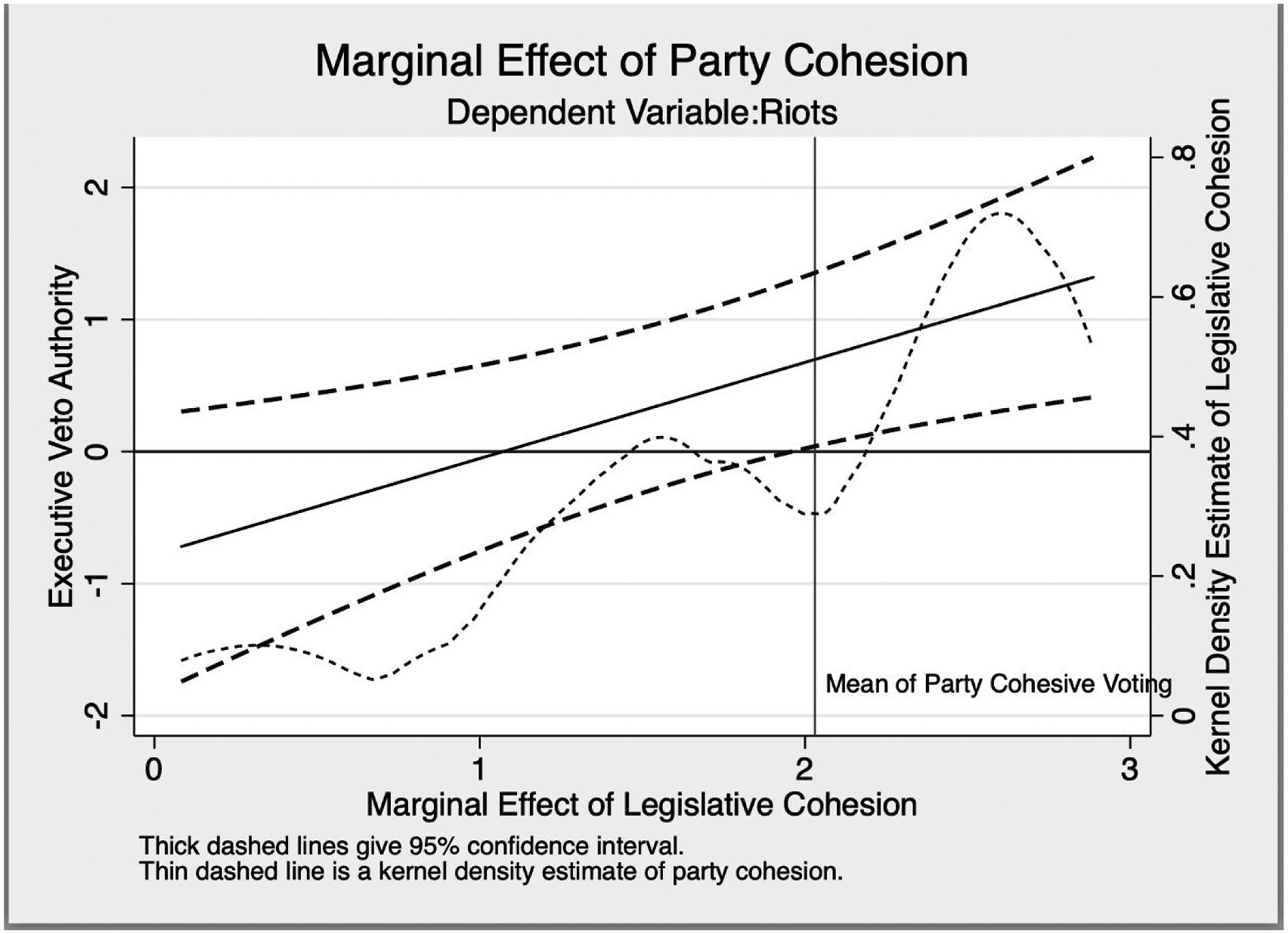
codes major political riots and anti-government demonstrations that gather more than 100 citizens. Riots involve violent events that deploy “confrontational tactics” including the use of physical forces and illegal land occupations in the countryside and “profoundly” affect decision-making and governments’ policies at national levels. Anti-government demonstrations cover events that use less confrontational tactics, such as peaceful gatherings or provincial roadblocks in rural and urban areas to voice opposition to government policies or authority. And the measurement excludes demonstrations of “a distinctly anti-foreign nature” (Banks, 2011). Figures 1 and 2 in the appendix illustrate variations across Latin American countries in the riots and demonstrations counts from 1980 through 2010. Marginal effect of party cohesion on power collusion and riots. Marginal effect of party cohesion on the interbranch conflict.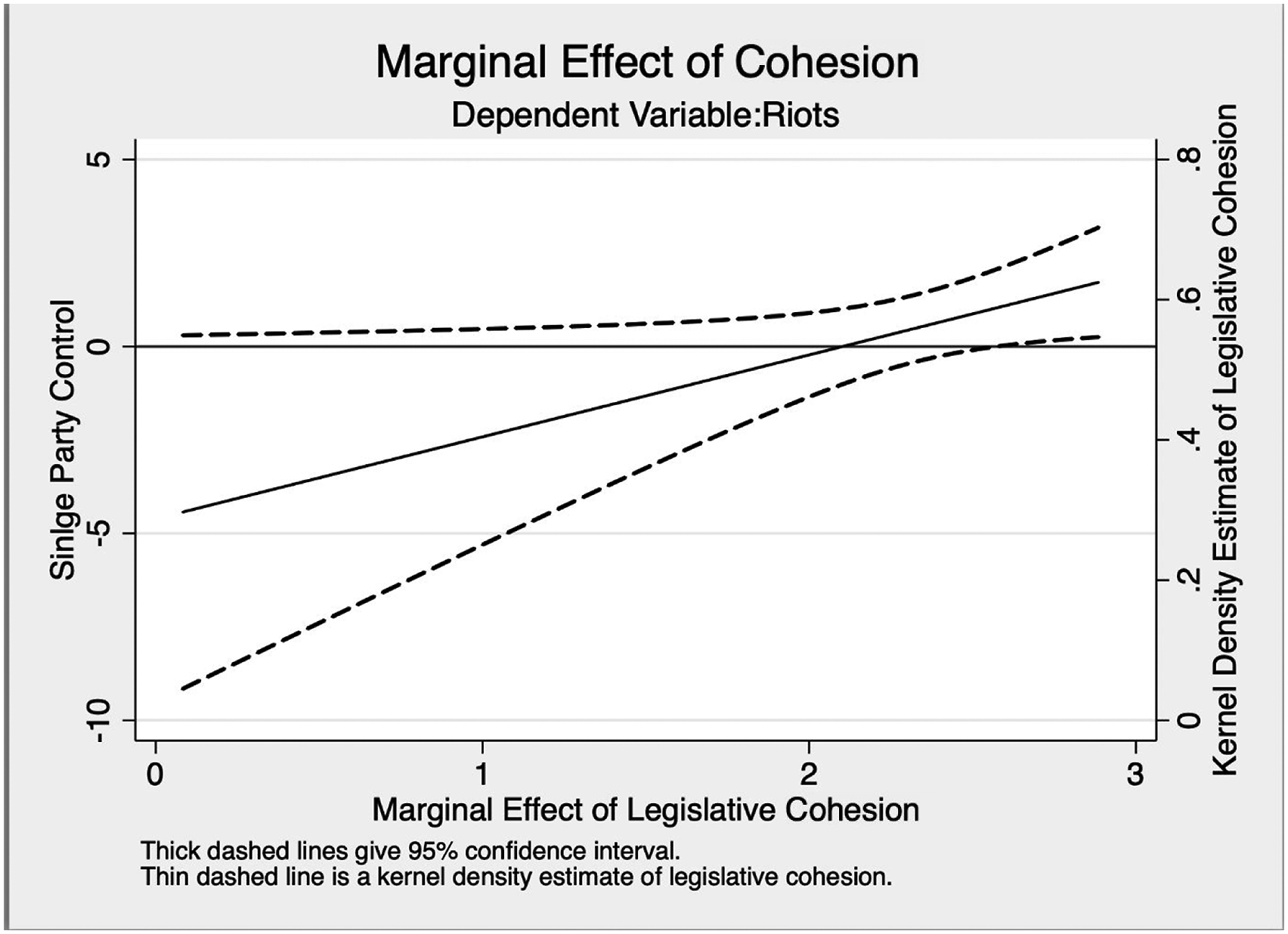
The independent variables
I draw on Varieties of Democracy –V-Dem– data (Coppedge et al., 2017) to gauge the key independent variables: party’s cohesive voting in the legislature that yields the collusive and dislocated power configurations, and party’s linkage strategies. The question phrasing of the variables is shown in Table 1 in the appendix.
The control variables
Since the theory proposed here disputes any simple association between neoliberal democracies and the eruption of protests across the region, the models control for the interaction term between the neoliberal reform index and regime type. I use Lora’s updated index (STRUCREFINDEX) as a simple average of the reform indexes in five areas (trade (TRADEINDEX), finance (FININDEX), tax (TAXINDEX), privatization (PRIVINDEX), and labor policies (LABORINDEX) in a range from 0 to 1 (Lora, 2012). I also use the disaggregated indexes in the five areas to test whether specific economic policies drive more popular responses than others. The source of regime type is Polity IV measures (DEMPOLITY) that range from −10 (authoritarianism) to 10 (democracy). I use the institutional measures of democracy of the Polity IV project as they provide the closest match to the conceptualization of the POS in terms of the openness of competition and dynamic relationship between the executive and legislature (Marshall, 2017).
The models also control for governments’ economic performance and social grievances measured by log values of inflation rate (LOGINFLATION), unemployment rate (LOGUNEMPLOYMENT), the GDP per capita (LOGGDP) (taken from the World Bank’s World Development Indicators-WDI, 2005), and income inequality (LOGINCINEQ) (gleaned from the University of Texas Inequality Project; UTIP- UNIDO, 2008). Additionally, the models control for the ideological position of the government party on the political spectrum (GOVLEFT) (Cruz et al., 2016) and the number of new parties (NEWPART) (Nohlen, 2005) to control for the effect of the party system volatility on instigating protests. Presidential scandal (PRSCAN) is used as a proxy for corruption and its effect on fueling street mobilization (from Pérez-Liñán, 2021). Finally, the models control for demographic characteristics of the populations that ignite or obstruct protests. The models control for ethnic diversity (ETHNICDIV) (from De Ferranti et al., 2004) as societies with a high percentage of different ethnic compositions are prone to indigenous mobilization, and the log value of the population size (LOGPOP) (from the WDI, 2005); as the dependent variable measures count events that include at least 100 individuals and big countries are more likely to have greater participation than smaller ones.
The main findings
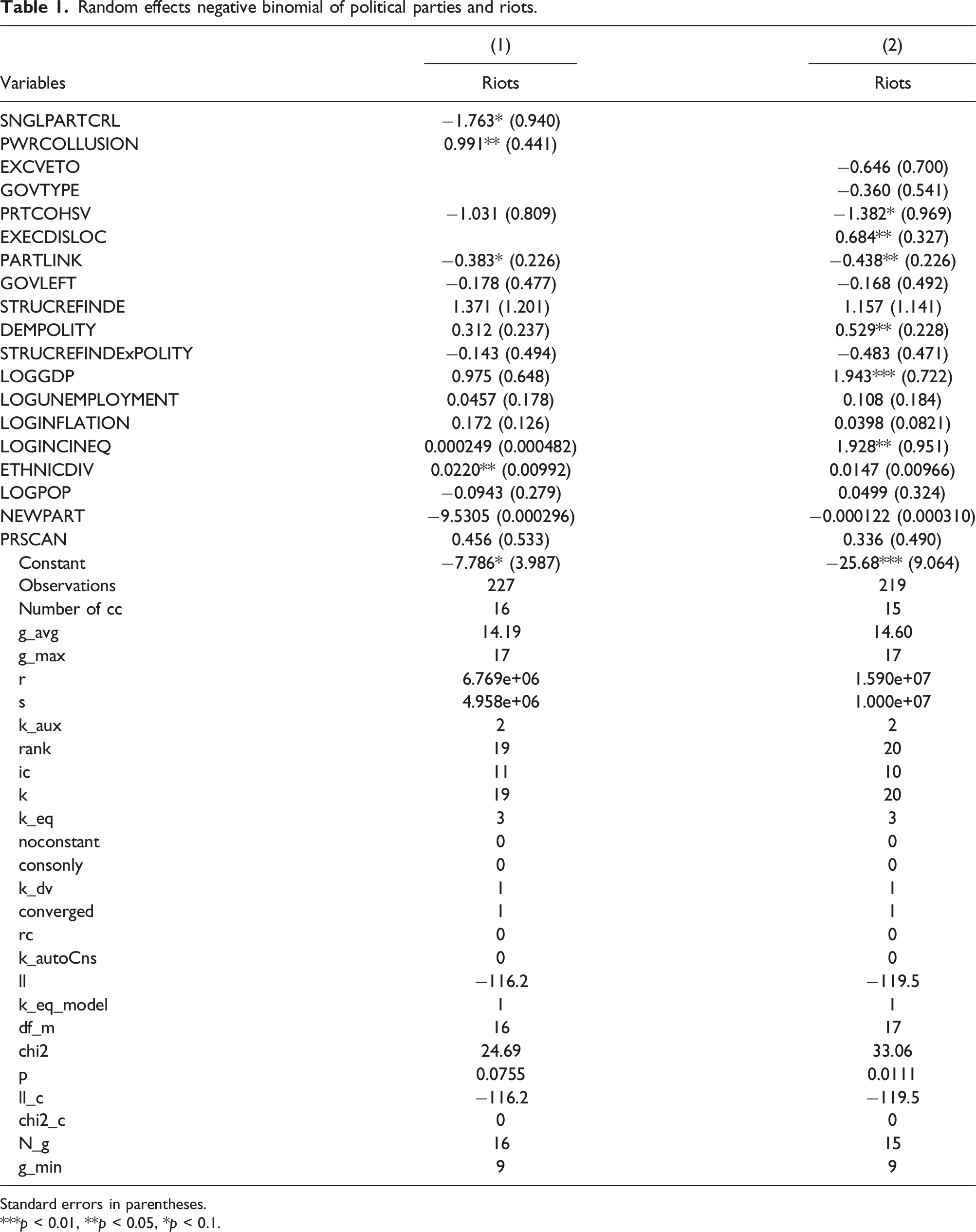
Random effects negative binomial of political parties and riots.
Standard errors in parentheses.
***p < 0.01, **p < 0.05, *p < 0.1.
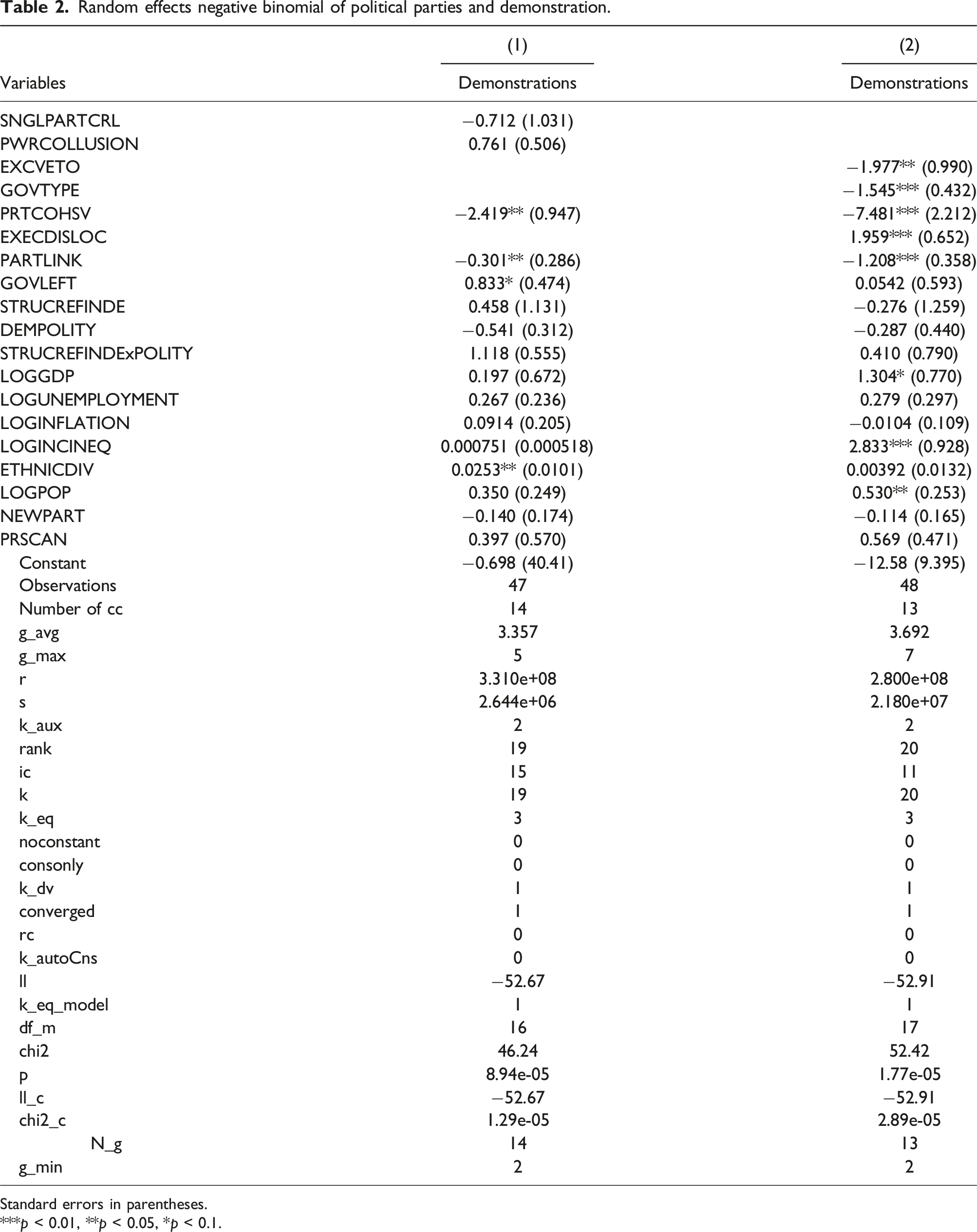
Random effects negative binomial of political parties and demonstration.
Standard errors in parentheses.
***p < 0.01, **p < 0.05, *p < 0.1.
Riots
The findings in Table 1 go along with the predictions of the theory. Parties cohesive voting operates intricately under different power constellations. In line with the theory, model 1 shows that single party/coalition control over the two branches of the government decreases the probability of riots occurrence at the 90% confidence level. But the monopoly over power by a single coalition at specific levels of parties’ legislative cohesion increases the probability of riots at the 95% confidence level. As the single-party control and parties’ cohesion alone have a significant negative effect on riots, the interaction effect is conditional on the other covariates in count models. A graphical presentation of the interaction term illustrates the magnitude of the estimated interaction effect of legislative cohesion on power collusion and riots in non-linear models.
Figure 1 illustrates the marginal effect of power collusion at different levels of parties’ legislative cohesion. The statistically significant area where the two-confidence intervals above the zero determines the conditions under which power collusion has a significant effect on the riots events (Brambor et al., 2006: 76). As it is predicted in the theory section, the figure shows that power collusion increases the probability of riots occurrence only at the highest levels of parties’ cohesion (almost close to the three endpoint, i.e., over nearly 5% of the range of legislative cohesion). When parties collude in power and eliminate policy and/or ideological options, policy convergence and party cohesion at some point –that perhaps marked endogenous or exogenous crisis or voting on important bills– push provocateurs to ignite aggrieved sectors to create political opportunity for violent protests. The outbreak of the student movement in Chile in 2006 amidst a ‘closed’ polity structure is a prominent case of party collusion that ignited violent mobilization (with the ruling center-left coalition acting as a cartel party and assuming a conservative position with regards to education reform bill).
Model 2 further shows that the dislocation in executive-legislative relations increases the probability of riots occurrence at the 95% confidence level. Government type alone (majority or divided) has no significant correlation with the probability of riots occurrence and party cohesion alone without a conflictual relationship with the chief executive decreases the probability of riots at the 90% confidence level. The interbranch conflict (with the president using the veto power and congressional party(-ies) hedging against the president’s will) is thus the crux of the matter. As aforementioned in the theory section, a majority government will technically function like a divided government with the dislocation in the executive-ruling party relations (marked by the deployment of the presidential veto or the voting cohesion of the legislative party against the party leadership to override the veto or overturn her policy proposal as it happened between the AD and Andrés Pérez (1989–93) in Venezuela that gave way to the Caracazo revolt). Similarly, a divided government may effectively operate as a majority government by cooperating with opposition parties in Congress or aligning itself with the core policy areas that do not require formal allies or effective use of veto power (as it occurred with the secret coalition in Ecuador during the 1980s to pass important economic bills and thwart social resistance). Parties’ cohesive voting, therefore, is the crucial factor to unpack the mechanisms by which cartel party instigate protests, and majority or minority governments cause institutional impasse.
Figure 2 illustrates how higher levels of legislative cohesion condition the positive effect of the institutional stalemate on the likelihood of riots occurrence. There is a discernable effect of executive veto authority over nearly 5% of the range of legislative cohesion.
Also, in line with the theory, programmatic and more extensive clientelistic ties are likely to decrease the riots events. That is, the higher the score on the four-point scale of parties’ linkages, the lower the probability of riots occurrence at the 90 and 95% confidence level. Last but not least, the models in Table 1 show that some controls (democratic openness, higher levels of GDP per capita, and income inequality) are strong predictors for the probable increase in riots counts. Similarly, highly divided ethnic societies are inclined to violent collective mobilization. Interestingly, the models provide no statistical support to the effect of the general reform index of the neoliberal policies at higher levels of democratic openness on the likelihood of riots occurrence.
Demonstrations
I ran the same RENB regression to expect the probability of demonstrations counts. The findings in Table 2 show the main results. The conflictual relationship with the executive branch is a significant predictor for the likelihood of demonstrations events at the 99% confidence level, but conditions of party collusion are not a significant predictor. Also, party linkages of “mixed local collective and policy programmatic” –the highest on the four-point scale– consistently decrease demonstrations counts in the two models at 95 and 99% confidence level. Likewise, social grievances of income inequality and ethnic divisions are significant predictors of the probable count of demonstrations.
Robustness check
I ran the same regression and used another control for the party system institutionalization that gauges the numbers of political parties for national-level office that have permanent organizations to carry out party activities outside of the election season (NATPARTORG) (Coppedge et al., 2017). The main results for the riots count hold as models 1 and 2 in Table 2 in the Appendix show. The findings for the demonstrations count also hold and are still less robust under the institutional setting of party collusion (as models 1 and 2 show in Table 4 in the Appendix). The findings also offer strong evidence for the effect of programmatic party linkages and extensive clientelistic coverage on defusing both forms of protest activity. I also ran the same regression on the disaggregated indexes of the five reform areas (trade, finance, tax, privatization, and labor market). Models 1 through 10 in Table 3 (in the appendix) confirm the main results of the conditional effect of cohesive voting inside the legislative arena under different power configurations on the probability of riots occurrence. Under institutional conditions of power collusion and interbranch gridlock, parties’ cohesive voting consistently increases the likelihood of riots count (although the key independent variables are less robust with the labor market reform area –as reflected in models 9 and 10). The results of parties’ programmatic commitment and extensive clientelistic coverage hold and consistently decrease the likelihood of riots counts in all the models at the 99 and 95% confidence level. Additionally, high GDP per capita, income inequality, and ethnic fractionalization are strong predictors of the increasing probability of violent riots.
Interestingly, trade and labor reform areas show conflicting signs: While the interaction term between trade and democracy (in model 2) –under interbranch conflictual relations– increases the likelihood of riots, labor reform and democracy (in models 9 and 10) decreases the likelihood of riots counts. Figures 3 and 4 (appendix) illustrate the marginal effect of trade and labor market liberalization at different levels of democratic openness on the probability of riots occurrences. The results go in line with the fact that different reform areas corresponded to various realms of coalition politics. Several ruling parties jettisoned the inward-oriented economic policies and carried on with some neoliberal reforms, most notably trade liberalization and “flexibilization” of labor contracts, by changing coalitional politics and reducing union members in their parties’ legislative bloc. Trade liberalization did not systematically engender social resistance from traditionally active trade unions. Trade unions in diverse sectors, in Venezuela and Argentina for example, followed mixed strategies between militancy and restraints that depended on several factors such as unions’ monopoly of representation and the existence of partisan competition that subsequently hinged on unions’ bargaining leverage and the success of their strategies to pressure national governments (Murillo, 2004). 8 Table 5 in the Appendix shows the results of the same model specifications on the demonstration count. Party’s strategic voting under different power constellations is not a strong predictor for demonstrations in all the reform areas. Party programmatic and extensive clientelistic linkage, however, is a strong predictor and consistently decreases the likelihood of demonstration counts.
Second, I ran a battery of robustness tests using different measures of neoliberal policies. In Tables 6 and 7 in the Appendix, I used different measures of neoliberal reform policies and ran the same regressions on riots and demonstrations. I used the general reform index (GRIN) from Morley et al. (1999) as updated by Escaith and Paunovic (2004). The indexes range from 0 and 1 and I relied on the indexes in five reform areas that gained great push in the second half of the 1980s and through the 2000s: trade (TRIN), capital account (CALIN), fiscal reform (FRIN), tax (TAX) and privatization (PIN). The results offer additional evidence for the robust effect of the institutional variables on the likelihood of riots occurrences and caution against any easy associations between neoliberal and democratic openness and protest mobilization. In addition, the same institutional variables still do not have a significant effect on the expected counts of demonstrations, and party’s programmatic and extensive clientelistic linkages systematically decrease the likelihood of the expected counts of both riots and demonstrations.
Finally, I added a first lag of the riots and demonstrations events to serve as a proxy for “framing” politics and to capture the temporal dependence of protest action as well as to remove any potential serial correlation in the series. As Tables 8 and 9 (Appendix) show, the institutional variables are significant predictors of the likelihood of riots occurrences and less robust for the demonstrations counts. The variables (lriots and ldemonstrations) are not statistically significant, indicating that the temporal clustering of protest events could not be explained by the development of an interpretative frame of the first lag of protest events. Protest activity could take several years to accumulate repertoires and lay the groundwork for subsequent contentious cycles.
Conclusion
The study of the relationship between neoliberalism and protest mobilization in Latin America has been a perennial theme in the literature for roughly two decades. Political regimes had to demobilize labor sectors to do away with the old developmental-statist model. This, however, neither obstructed protests from erupting nor did it prevent public sector employees and workers from participating in other forms of protests.
The article shows how protest mobilization cannot be explained as a mechanical reaction to the shift in the macro-economic policies nor the permissible opportunities of democratic openness. Static structural accounts do not offer a plausible answer to the political quietness and technocratic predominance that prevailed for nearly a decade after the “dual” transition to neoliberal market economies and democratic politics.
Protest mobilization, however, can be better analyzed by examining: first, parties’ cohesion that determines the number of the veto gates, delineates the interbranch relations, and triggers or intensifies resistance from the aggrieved social sector, second, the parties’ linkage strategies to voters that thwart or abet dissidents to mobilize in extra-electoral arenas. The theoretical framework offers a priori explanations about the effect of the meso-institutional level on the propensity of the system to protest activity.
The statistical analysis lends sufficient support to the significant association between parties’ cohesive voting and institutionalized linkages along programmatic or extensive clientelistic commitments on one hand, and mobilization record on the other. But the findings also show that the same institutional incentives of power collusion and inter-branch conflict are less robust for peaceful demonstrations. Latent provocateurs may create opportunity or seize at institutional impasse to stage aggressive campaigns against the government. Protestors in low-intensity demonstrations, however, seem to be motivated primarily by voicing opposition to government policies and/or articulating socio-economic grievances.
Taken together, protest mobilization is fluid, happens in waves, and differs in intensity depending on the interests involved and the organization of these interests. The article, however, focuses on the supply-side of mobilization that does not examine actors’ strategic choices, cognition, and motivations. Existing public opinion surveys do not survey the same respondents to construct multi-level panel datasets that include individual-level data alongside institutional variables. Future research may triangulate quantitative findings with qualitative analysis of case studies to probe the demand-side of street protests that first, demonstrates the plausibility of these causal mechanisms through a systematic cross-national comparative design, second, examines actors’ attitudes and responses to politicians’ strategic bargaining, and third, interrogates the impact of changes in party-society linkages on forms of political participation.
Finally, the rare effect of cohesive voting in Congress under single-party/coalition control on the likelihood of protests has theoretical implications for other regions. The results may resonate with the massive protests that erupted in East Europe in 1989 and the Arab region in 2010–2011 in contexts of liberalized autocracies to overthrow the one-dominant party systems and push for democratic transition. Protests spilled over into the streets amidst not only unfavorable or “closed” opportunity structures but also repressive and threatening conditions. Tilly (1978) introduced a negative side to the concept of POS by pinpointing a curvilinear relationship between contexts and protests: Contention is most likely to occur in contexts with either high opportunities or high “threats”. “Threat” is thus often used as the flip side of the “opportunity” concept. Both concepts of “high threat” and “closed” opportunity, however, obstruct a more nuanced understanding of specific institutional configurations wherein political parties must factor into the analysis to investigate conditions under which power collusion and party cohesion under single-party control may spur protests. Zeroing in on the institutional setting of party’s behavior pivots the focus away from the language of both POS and dysfunctional institutions as triggers of street activism and brings out the role of party’s strategic interactions (with the leadership or other party members) in shaping or curtailing opportunities for protests.
Supplemental Material
Supplemental Material - Institutional incentives and contentious politics in post-Neoliberal era in Latin America (1985–2010)
Supplemental Material for Institutional incentives and contentious politics in post-Neoliberal era in Latin America (1985–2010) by Shimaa Hatab in Party Politics
Footnotes
Declaration of conflicting interests
The author(s) declared no potential conflicts of interest with respect to the research, authorship, and/or publication of this article.
Funding
The author(s) received no financial support for the research, authorship, and/or publication of this article.

Supplemental Material
Supplemental material for this article is available online.
Notes
Author biography
References
Supplementary Material
Please find the following supplemental material available below.
For Open Access articles published under a Creative Commons License, all supplemental material carries the same license as the article it is associated with.
For non-Open Access articles published, all supplemental material carries a non-exclusive license, and permission requests for re-use of supplemental material or any part of supplemental material shall be sent directly to the copyright owner as specified in the copyright notice associated with the article.
