



Abstract
The organisation of populist radical right parties significantly shapes their long-term electoral success. Within this party family, great organisational variation can be found, with the “Alternative for Germany” (AfD) representing a least-likely case: in terms of candidate selection (CS), it ranks much higher on democracy scales than the other Bundestag parties. This paper explores the reasons for this high level of intra-party democracy (IPD) by focusing on three explanatory dimensions: ideology, institutionalisation, and party unity. Methodologically, we apply multivariate analyses of representative quantitative data collected among AfD members in CS prior to the 2017 federal election. The results show that high political dissatisfaction and low levels of institutionalisation are important drivers of inclusive CS procedures. Overall, the article provides a deeper understanding of the underlying attitudes for the AfD’s inclusive IPD, and offers substantial theoretical and empirical implications for future research.
Introduction
Populist radical right (PRR) parties are anything but new. While their ideological and strategic characteristics have been well researched, their organisation often remains a “black box.” This is surprising as the PRR parties’ organisation is a key factor of their long-term success (De Lange and Art, 2011; Heinisch and Mazzoleni, 2016). The lack of research can be attributed to various conceptual, theoretical, and methodological challenges (Art, 2018; Castelli Gattinara, 2020). Recent studies have increasingly tried to overcome these and take up the perspectives of PRR actors, for example, by interviewing them when in government (Albertazzi and McDonnell, 2015; Paxton and Peace, 2021) or focusing on the role of supporter organisations (Bolleyer and Bytzek, 2013; Van Kessel and Albertazzi, 2021). In contrast, the PRR parties’ internal decision-making and direct-democratic inclusion of their members often remains opaque.
This also applies to the “Alternative for Germany” (AfD), one of the most successful young PRR parties in Europe in electoral terms. While we know much about the party’s electoral rise (Heinze, 2022) and ideological transformation from a rather Eurosceptic to a fully-fledged PRR party (Arzheimer, 2019), its organisation remains puzzling. Unlike previous far-right parties in Germany (e.g., DVU, NPD or Republicans), the AfD succeeded in building strong party branches with a solid membership base in all 16 federal states (Heinze and Weisskircher, 2021). Thereby, the party established a relatively complex organisation with a collective leadership at the top and direct-democratic instruments. Specifically, the AfD shows a high degree of internal participation in candidate selection (CS) (Höhne, 2021; Koschmieder, 2015; Reiser, 2018) and policy formulation (Kamenova, 2021). In international comparison, too, this makes the AfD a least-likely case: PRR parties are usually characterised by strong centralisation, personalised leadership, and limited meaningful participation of party members in decision-making processes (Betz, 1998; Heinisch and Mazzoleni, 2016). In contrast, the AfD has embraced a high level of intra-party democracy (IPD), usually found in green or left-wing parties (Poguntke et al., 2016). As one of the first PRR parties to do so, it could thus attract participatory involvement from the far-right movement spectrum. We need to address this puzzle to understand the AfD’s (long-term) appeal and revisit the usual organisational trajectories of PRR parties.
This paper explores the reasons for the AfD’s strong internal democracy, as measured by members’ perceptions of how inclusive CS procedures should be. We focus on three explanatory dimensions: (D1) populist ideology, (D2) party institutionalisation, and (D3) party unity. Populism is understood as “a thin-centered ideology that considers society to be ultimately separated into two homogeneous and antagonistic groups, ‘the pure people’ versus ‘the corrupt elite’” (Mudde, 2007: 23). We assume that a high inclusion of members in intra-party decisions is part of the populist self-understanding of representing the will of “the people” and the strong anti-establishment critique (D1). However, IPD is not found in all right-wing populist parties (e.g., PVV), nor is it limited to this party family (see, e.g., Greens or New Left Parties, especially in their early years). It therefore seems crucial to also look at the AfD’s level of organisational institutionalisation (De Lange and Art, 2011). Institutionalisation includes the routinisation of internal processes, which should initially be low in a new party. As informal norms, collective identities and trust among members need time to be constructed, we assume that new parties with a participatory claim tend to support a high level of inclusive IPD (D2). Similarly, if a (newer) party is characterised by strong fragmentation and low internal cohesion, it is likely to prefer strong inclusion of its members to legitimise decisions and avoid party split (D3).
We test our hypotheses using quantitative data from the research project #BuKa2017, collected among official AfD gatekeepers at Bundestag nomination meetings. We compare their attitudes with those of the other six parties elected to the Bundestag in 2017 (NAll = 7,923, NAfD = 1,100) to contextualise our empirical observations on the AfD. Our large-scale data is a survey of party members who attended nomination meetings in randomly selected district and state level party branches. They are representative for active members who are engaged in CS. Drawing on this data, we employ multivariate ordinal regression analyses to study the relationship between our three explanatory dimensions and members’ preferences for inclusive IPD.
Our findings confirm a link between low trust in representative democracy and low satisfaction with the way parliament works on the one hand and preferences for more inclusive CS procedures on the other hand. Furthermore, the AfD’s low institutionalisation is a predictor of the members’ support of inclusive IPD. Overall, our paper sheds light on AfD members’ attitudes and motivations towards internal decision-making – a very rare opportunity given the available data in populism research – and opens another facet of the “black box” of a young PRR party organisation. Our results point to the importance of IPD for the Far Right’s broader mobilisation and the complex relationship towards (representative) democracy, which call for further research, especially on PRR parties' mainstreaming strategies.
Intra-party democracy in the populist radical right
In recent years, IPD has experienced an enormous upswing. While many parties implemented organisational reforms, research has focused on conceptualising IPD (Borz and Janda, 2020; Von dem Berge and Poguntke, 2017), exploring the origins and causes of party democratisation (Cross and Katz, 2013; Gerbaudo, 2021) as well as its implications (Cross and Pruysers, 2019; Hopkin, 2001). In contrast, we know little about the role of IPD for the PRR party family.
A key element of IPD is the inclusion level of party members in internal decision-making. Cross and Katz (2013: 10) argue that “the ultimate questions remain to what extent, how and in which aspects of party life the members are able to control what their party does.” There are different rules and practices on how parties decide on policy issues, personnel and organisational questions. Von dem Berge and Poguntke (2017: 137–138) distinguish between plebiscitary and assembly-based IPD. In the former, ideally all members are directly involved and decide by majority (e.g., membership ballots, referendums). In the latter, delegates make decisions based on consensus, with party-specific power issues and representation claims playing an important role in the negotiation process. Rahat and Shapira (2017) also emphasise the high relevance of IPD for political parties, politics in general, and society. They propose an additive index with five dimensions (participation, representation, competition, responsiveness, transparency), allowing for trade-offs between them.
To evaluate the quality of IPD, scholars usually examine CS as a key decision-making process. Studying it means observing an important internal process of political parties (Hazan and Rahat, 2010; Norris and Lovenduski, 1995). Conceptually, recruitment research differentiates the CS process into a first stage with a more informal decision-making process and a second or final stage, namely the official party gathering (Hazan and Rahat, 2010; Höhne, 2013). Accordingly, this paper examines the decision-making processes at the final stage. This is the (visible) playground for formal gatekeepers, while the pre-decision arena is dominated by informal gatekeepers, conceptualised as steering agent (Aylott and Bolin, 2017).
In the PRR party family, IPD is often neglected. While some of their organisations are less centralised than in the early years, IPD is still not a typical feature. In one of the earliest works, Betz (1998: 9) found that most parties “display a highly centralized organizational structure, with decisions being made at the top by a relatively circumscribed circle of party activists and transmitted to the bottom.” Many early PRR parties such as the Front National and the Austrian Freedom Party were strongly centralised (Heinisch and Mazzoleni, 2016), with some extreme examples such as New Democracy in Sweden or One Nation Australia (Bolleyer and Bytzek, 2017). Centralisation was usually accompanied by a small, powerful circle of leadership. These PRR organisational characteristics were seen as an anti-model to the bureaucratised hierarchical organisation of mainstream parties based on delegates’ democracy and to the “grassroots-democratic” organisation of the Greens and New Left Parties (Frankland, 2020: 43). Although some PRR parties now deviate from the “standard model,” for example, by including their members at the local level, such as the Italian Lega or the SVP (Albertazzi and McDonnell, 2015; Van Kessel and Albertazzi, 2021), the inclusion level of IPD is still limited: decision-making is largely in the hands of the party leadership and meaningful membership participation is rare.
The AfD is a least-likely case in this regard: unlike many other PRR parties, it grants its members strong participation rights in decision-making processes. The AfD's level of IPD is also unique in the German context: although German party law prescribes a certain level of IPD for all parties, this does not always translate into practice. For instance, the federal party conference is the most important formal body for all parties, deciding on all fundamental organisational and programmatic issues. Parties can choose between delegate and member gathering. While all established parties usually hold their federal and state party conferences as delegate assemblies, the AfD relies most strongly on general meetings, in which all party members can participate (especially at the subnational level, but also at the national level until 2016; Heinze and Weisskircher, 2021). In contrast, previous far-right parties in Germany, such as the entrepreneurial DVU, were also highly centralised (Holtmann, 2002).
In its CS, the AfD demonstrates grassroots democracy. Based on meeting observations with a quantitative focus, Höhne (2021) found that in the 2017 federal election, the AfD scored higher than the other six Bundestag parties along three dimensions of IPD. First, it was the most competitive party for list positions (apart from a few top candidates, almost every place was fiercely contested). Second, it had the highest inclusion rate of its members at both district and state level, and third, it had the most intense nomination-related communication (i.e., members discussed the most questions and statements at list gatherings). These comparative findings are not altered by the fact, known from other parties, that members’ opportunities for participation at party conferences were sometimes limited, for example, by the party leadership’s influence on the agenda or its arbitrary interventions (Koschmieder, 2015; Reiser, 2018).
Moreover, the AfD’s policy-making is highly inclusive. Based on observations of party meetings and interviews with its members, Kamenova (2021) found a high degree of internal participation and deliberation by members in the AfD’s policy formulation process and only limited involvement of the leadership in terms of consultation and logistical organisation. While, for example, a smaller share of party activists is involved in the preparation of the drafts in expert committees, all members can participate in the final stage through online surveys and party conventions. She concludes that AfD members cherish the party’s democratic deliberation and direct participation – even if they are dissatisfied with outcomes of policy debates. Although her study provides valuable insights into the AfD’s internal processes, it lacks a systematic comparison with the IPD scores of the other German parties.
Even beyond Germany, these new findings challenge established results of comparative research on party organisation. Poguntke et al. (2016: 672) argued that IPD in its assembly-based component is highest among Greens and lowest among the Far Right, while Social Democrats, Liberals, Left Socialists and Conservatives are in between (for Radical Left and Green parties, see also Rihoux, 2016; Tsakatika and Lisi, 2013). A similar picture emerges when focusing on the plebiscitary component of IPD: here, the Social Democrats rank highest and the Far Right second lowest, ahead of the left Socialists, but still well below average (Poguntke et al., 2016: 672). These results confirm higher levels of assembly-based IPD components than plebiscitary ones for the Far Right, although the latter could be used to legitimate the leadership’s policies. Poguntke et al. (2016: 669) also confirmed the “typical” PRR party organisation in terms of leadership strength, emphasising that the Far Right gives their leaders most formal power. Again, the AfD seems to be an outlier with regard to its grassroots democracy and other organisational aspects such as its collective leadership.
So far, no study investigates the reasons for the AfD’s pronounced inclusive IPD. We seek to tackle this research gap for four reasons. First, IPD procedures influence the party’s long-term electoral appeal: a high level of internal participation may enable the party “to respond effectively to political opportunities and constraints and to establish itself permanently in the political arena” (Kamenova, 2021: 488–489). Second, IPD can enhance the PRR party’s ability to recruit capable candidates and leaders (Art, 2011). By organising intra-party affairs inclusively, PRR parties credibly present themselves as “true democrats” and distance themselves from the “corrupt elite.” Accordingly, and thirdly, the analysis of AfD members’ attitudes and motivations towards IPD contributes to a more nuanced debate on whether populism is more of a corrective or a threat to (representative) democracy (Akkerman, 2003; Canovan, 1999; Taggart, 2004). Finally, we seek to understand how populism influences party organisations by integrating political discontent into it – both aspects usually omitted from the literature (e.g., in the otherwise comprehensive volume by Oswald, 2022). Since the AfD’s IPD functions as a mechanism to constructively deal with members’ dissatisfaction with representative democracy (Höhne, 2018), it may even strengthen political satisfaction and institutionalise trust in the political system in the long run.
Theses on what drives IPD within the AfD: ideology, institutionalisation, party unity
In our analysis, we shed light on party members’ attitudes towards inclusion and seek to understand why IPD “may vary across parties but also within parties” (Borz and Janda, 2020: 5). Since parties are no uniform actors, we need to examine IPD from a more internal perspective, as demanded by Scarrow (2021). To obtain a fine-grained view of our dependent variable, we analyse preferences for different CS procedures. These are nominations by primaries, general meetings, delegate meetings, and party boards. Thereby, the first category is a party-external category as the most inclusive procedure (primaries), and the other three categories are party-internal, with the last one being the most exclusive. We argue that party members’ attitudes on this item reflect their overall support for IPD. Figure 1 shows a strong correlation between the attitudinal level (a strong tendency to prefer the inclusive general meeting and reject the exclusive delegate assembly) and the behavioural level (strong effective inclusion) for the AfD. Support for inclusive or exclusive CS and measured inclusion ratios (from Höhne, 2021), by parties. Note: effective inclusion represents attending members in percent of all members of a party branch; larger dots represent AfD.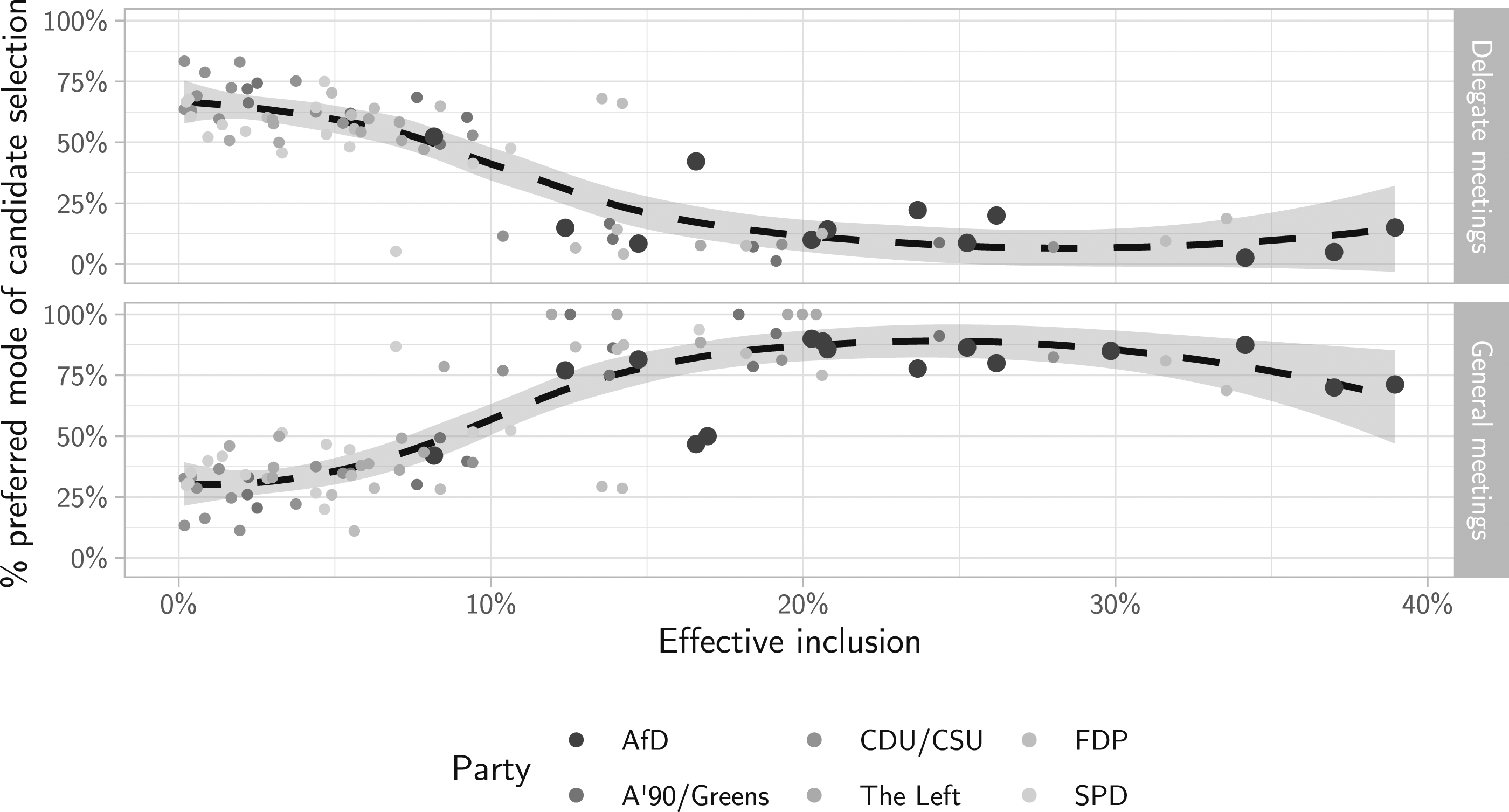
To explain the AfD’s inclusive IPD (demand), we focus on three party-level dimensions in the final decision arena: the populist ideology (D1), a low level of institutionalisation (D2), and a lack of party unity (D3).
First, (D1) party ideology is crucial for understanding party behaviour and organisation (Downs 1957; Strøm, 1990). Populist parties are not anti-democratic per se, but usually attack liberal democracy and its intermediary forms of organisation. They often employ a strong anti-establishment critique (vis-à-vis the “old parties”) and call for “more (direct) democracy” (Akkerman, 2003; Canovan, 1999; Taggart, 2004). While much research focuses on effects of populism on party competition, less work is done on the relationship between populist ideology and party organisation. One exception is the study by Watts and Bale (2019), which shows how populism shapes intra-party politics: using the case of the British Labour Party under Jeremy Corbyn, the authors demonstrate how its membership is constructed as a virtuous and homogeneous “people” and opposed to the apparently corrupt “elite” of the Labour Party caucus. They show how intra-party populism poses a threat to representative party democracy by delegitimising MPs and arguing that the grassroot members should have greater influence in policy-making and CS.
So far, we know little about how populism is reflected in members’ attitudes (and not only in party leaders’ behaviour; see Watts and Bale, 2019). The same is the case with anti-establishment contestation, which can go beyond populism (Pytlas, 2022). Parties may use such messages to contest ‘politics as usual’ (as pursued by the current ‘illegitimate’ elites) by promising to fundamentally change formal-representative politics. To revive a ‘true’ way of making politics, they may criticise how politics is currently practiced (e.g., in parliament) and portray themselves as fundamentally distinct. Among other things, parties may use such messages to strategically broaden their mobilisation potential (Pytlas, 2022: 4).
Following these studies, we assume that members who do not trust in representative democracy should oppose ideas of representation within their own party and promote inclusive CS procedures. In the case of the AfD, a previous study indicates that its members are much more dissatisfied with representative democracy than the other Bundestag parties (Höhne, 2018). Similarly, members who demonstrate political dissatisfaction with the functioning of parliament – and thus an anti-establishment attitude –, might see inclusive CS procedures as a first step towards introducing new democratic instruments on system level. Both, political trust, and political satisfaction are classical elements in political culture research for measuring support for a political system and its institutions (Easton, 1975).
Second, (D2) party institutionalisation could influence the support for IPD. Huntington (1968: 12) defines institutionalisation as “the process by which organizations and procedures acquire value and stability.” While the conceptual approaches to specify institutionalisation vary (for an overview see Harmel et al., 2019; Randall and Svåsand, 2002), scholars emphasise the role of value infusion and routinisation as core dimensions (Bolleyer and Ruth-Lovell, 2019; Levitsky, 1998; Panebianco, 1988). Value infusion describes the process by which party actors “acquire an identification with and commitment to the party which transcend more instrumental or self-interested incentives for involvement” (Randall and Svåsand, 2002: 13). This includes the extent to which party members identify with their party (Mader and Steiner, 2019: 203). Routinisation refers to the “process by which internal rules and patterns of behavior become regularized and entrenched” (Bolleyer, 2013: 55). If the level of routinisation is high, “party actors follow certain formal or informal rules during intra-organizational processes” (Mader and Steiner, 2019: 203). Previous studies point to the relevance of institutionalisation for (new) parties’ electoral persistence (Bolleyer and Bytzek, 2017; Harmel and Svåsand, 1993; Weissenbach and Bukow, 2019) and intra-party preference homogeneity (Mader and Steiner, 2019). However, the link between party institutionalisation and support for IPD remains unclear.
In the following, we argue that a low level of party institutionalisation can explain the call for inclusive CS procedures. Thereby, we take up a key component of party institutionalisation: time (Harmel et al., 2019: 9). Both, value infusion and routinisation cannot be developed overnight – sometimes it takes years or even decades to build informal norms and collective identities (De Lange and Art, 2011: 1232). The AfD is still a young party without government responsibility. This could be a precondition for higher democracy levels in internal party processes (Bolin et al., 2017: 165–166). To analyse the institutionalisation dimensions, we break it down for the personal level and look at members’ experiences within the party. We expect members to support inclusive CS procedures to ensure that their individual views are included in internal decision-making.
Closely related to these arguments are the concepts of social trust and social capital, which can impact the support for inclusive IPD procedures. In general, trust among individuals can be built through a variety of factors, such as interpersonal interaction and confidence (Welch et al., 2005). In political parties, this may develop not only with time but also with commitment. The more intense members are involved in their party, the better they should know each other, their motivations and behaviour, fostering trust in cooperation and delegation. For the intra-party delegation in the European Parliament, for example, Chiou et al. (2020) demonstrate that loyalty to the transnational party leadership – and therefore trust – is the key factor in the selection process of individual legislators participating in negotiations that take place behind closed doors. We expect that members who invest more time in party work develop a higher level of shared values, interests and identities and therefore entrust their vote to representative bodies of their party.
Third, (D3) party unity is crucial for understanding party behaviour and internal dynamics (Stecker, 2015). Although the relationship between party unity and IPD has already been studied at the party-level, the findings are ambivalent (Scarrow, 2021). On the one hand, a lack of party unity can drive IPD: when parties are divided into groups that are likely to suffer from low levels of mutual trust, a lack of internal problem-solving mechanism can lead to considerable internal turmoil (Kemahlioglu et al., 2009). For example, losing factions may undermine the winners’ strategies and policies, or even threaten to leave the party. To avoid such situations, conflicting factions may seek procedures that make it difficult for the losing factions not to support the result. Party primaries may be such a mechanism, enjoying high democratic legitimacy among the public and the media (Sandri and Seddone, 2015). IPD can help to pacify conflicts if all groups feel represented, all members can participate and accept majority rule.
On the other hand, party-wide ballots can also threaten unity, for example, by publicising and escalating internal conflict (Scarrow, 2021). They can “diminish shared values by producing less homogenous candidate slates, and by intensifying disputes over party priorities. They can erode loyalty by encouraging supporters to participate in intra-party contests in which choices necessarily are made without the guidance of a party label. They can encourage dissent by requiring would be candidates and party leaders to differentiate themselves from their party colleagues” (Scarrow, 2021: 43). Losers of intra-party elections are less likely to remain engaged in their party, and more likely to be dissatisfied with their membership (Cross and Pruysers, 2019). IPD therefore poses a particular risk for fragmented parties, as it can intensify existing conflicts.
As for members’ attitudes toward IPD, the relationship is even more ambiguous. In general, party elites should prefer delegation if they believe that the respective outcomes will be more in line with their preferences than the outcomes of grassroots decisions. When choosing between different electoral systems, for instance, political elites anticipate the (varying) effects of different electoral rules and choose the one to their advantage (Boix, 1999). In the context of policy-seeking, party members who believe that they share (almost) identical policy preferences are more likely to trust in delegation than to demand more control (Müller, 2000). The same is likely to be true for the perceived distance from party ideology: if members feel that they hold similar positions to their party, their need for inclusive IPD should be lower. Both a high perceived ideological distance between members and a high actual distance between members and party can indicate a low level of party unity.
Data and descriptive findings
The empirical basis of this paper are quantitative data from the research project #BuKa2017 in the run-up to the Bundestag election in September 2017. The data was collected nationwide between September 2016 and July 2017 by small teams at randomly selected nomination gatherings of AfD, Alliance 90/The Greens, CDU, CSU, FDP, The Left, and SPD. At the state level, 48 list nomination meetings were sampled. Since the German federal state consists of 16 states, the dataset includes eight of 16 list nominations of each party. At the district level, 90 CSs were chosen across all parties, of which 14 (out of 15 per party) could be realised for the AfD. Twenty of the AfD nomination gatherings were general meetings, while two at the state level were delegate assemblies. For this analysis, CDU and CSU are grouped together as CDU/CSU, since the sister parties do not compete with each other. The Appendix provides an overview of the selected meetings by party and state (Figure A) and summary statistics (Table A).
It was challenging to gain access to AfD meetings. Each selected party branch had to be asked for permission beforehand, and not all allowed the surveying of their members. In these instances, substitute cases were randomly sampled. All party members who participated in the nomination of candidates received paper questionnaires. They were surveyed as official gatekeepers. The questionnaires were distributed at the beginning of the meeting, usually while the meeting’s chairperson was introducing the study, and collected at its end. A total of 2,804 AfD members were surveyed. 1,100 returned the questionnaire, 153 of them in district associations and 947 in state level organisations. The response rate for AfD members was a remarkable 39.2%.
Our hypotheses consist of one dependent variable and several explanatory variables, which are operationalised as follows. The AfD members’ support for IPD is measured by their preferences for different CS procedures. The dependent variable focuses on the preferred level of selectorate inclusion and thus on a crucial element of IPD. We asked: “There are different procedures for nominating candidates. Which would be the best method in your opinion, regardless of legal issues?” Possible answers on an ordinal four-point-scale were: “the citizens eligible to vote,” “all members of my party at a general meeting,” “the elected members of my party at a delegate assembly,” and “the responsible party executive.” The answer “all citizens” would be the most inclusive and “party executive” the most exclusive. Since only seven AfD members chose the most exclusive item, we omitted it from our multivariate analyses and reconstructed the dependent variable trichotomously.
Compared to the other parties, AfD members most often opted for the most inclusive option (see Figure 2). However, their approval of party-external primary is only about four percentage points higher than among members of all parties (4.5% approval in district elections). Remarkably, about 70.6% of AfD respondents support general meetings. This is the highest value for this option, followed by a distance of 19.6 percentage points to the second highest value measured for the Greens. Moreover, fewer AfD members support the more inclusive general meetings in the more centralised arena of the state level (69.1%) than in the decentralised arena of the district level (80.8%) – presumably for practical reasons. Gatekeepers’ preferences across parties. Note: nomination preferences as share of respondents in all parties. Percentages do not sum to 100% due to rounding.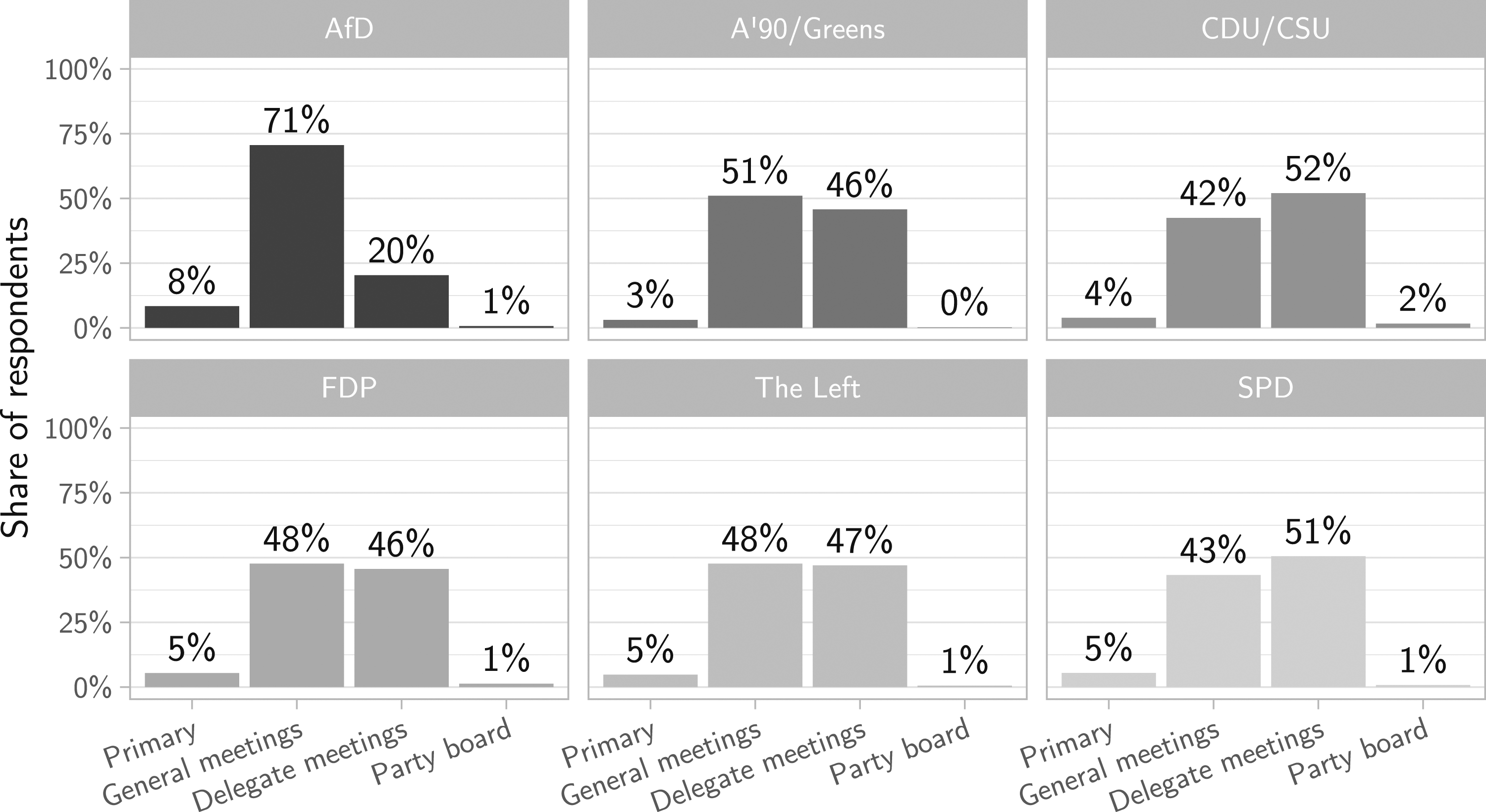
Figure B in the Appendix plots the distribution of the dependent variable at the district and state level. Since the distribution of responses varied more between the item “inclusion vs. exclusion” (especially between party-external primaries and party-internal general meetings) and less between the item “decentralization vs. centralization,” we neglect the latter in our regressions. This also reflects the fact that district and state level arenas are strongly linked in the German CS (Detterbeck, 2016). A district nomination is a necessary condition for an upper list position. In line with the distinction between preliminary and final decision arena, our paper examines the latter, which is much more important in the AfD’s “competitive-oriented IPD” than in the other Bundestag parties (Höhne, 2021).
To gain insights into our first explanatory dimension, (D1) party ideology, members were asked about trust in German representative democracy: “How much faith do you have in general in the representative democracy of the Federal Republic of Germany?” Possible answers were: “very high trust,” “high trust,” “low trust,” and “no trust at all.” Moreover, we asked how satisfied they are with the way the German Bundestag works, with four answer categories to choose from: “very satisfied,” “satisfied,” “less satisfied,” and “not satisfied.” Party specific means and 95% confidence intervals for both variables, within groups of the dependent variable can be found in Figure C in the Appendix.
As it is rarely possible to directly measure the degree of (D2) party institutionalisation, we asked for the members’ duration of AfD membership in years. Furthermore, we measured their involvement by asking how much time they regularly spend on party work. 1 Figure D in the Appendix plots estimated means for both membership duration and party engagement, within groups of the dependent variable.
To capture (D3) party unity, we measured the distance between members’ self-positioning on the left-right axis and their perceived place of the AfD on the same scale. As the value for the party’s position was subtracted from members’ self-placement, positive values mean that individuals see the party as ideologically left of them, while negative values mean the opposite. Figure 3 displays means and 95% confidence intervals for the two placements (left) and the estimated difference between the two placements (right) within the groups of the dependent variable. For the actual difference between the ideological positions of the members, we calculated the Mahalanobis (1930) distance between the party means and the members’ position in the three-dimensional space of three variables: their self-placement on the left-right axis (see above), a question about the preferred involvement of politics in economy, and a question about whether the state should prioritise the maintenance of law and order over the free development of different lifestyles.
2
The distribution of individual-level distances within the groups of the dependent variable is displayed in Figure E in the Appendix. Perceived ideological distance between AfD and its members. Note: estimated means and 95% confidence intervals for self- and party-placement on the left-right scale (left panel) and difference between placements (right panel) within groups of nomination preferences.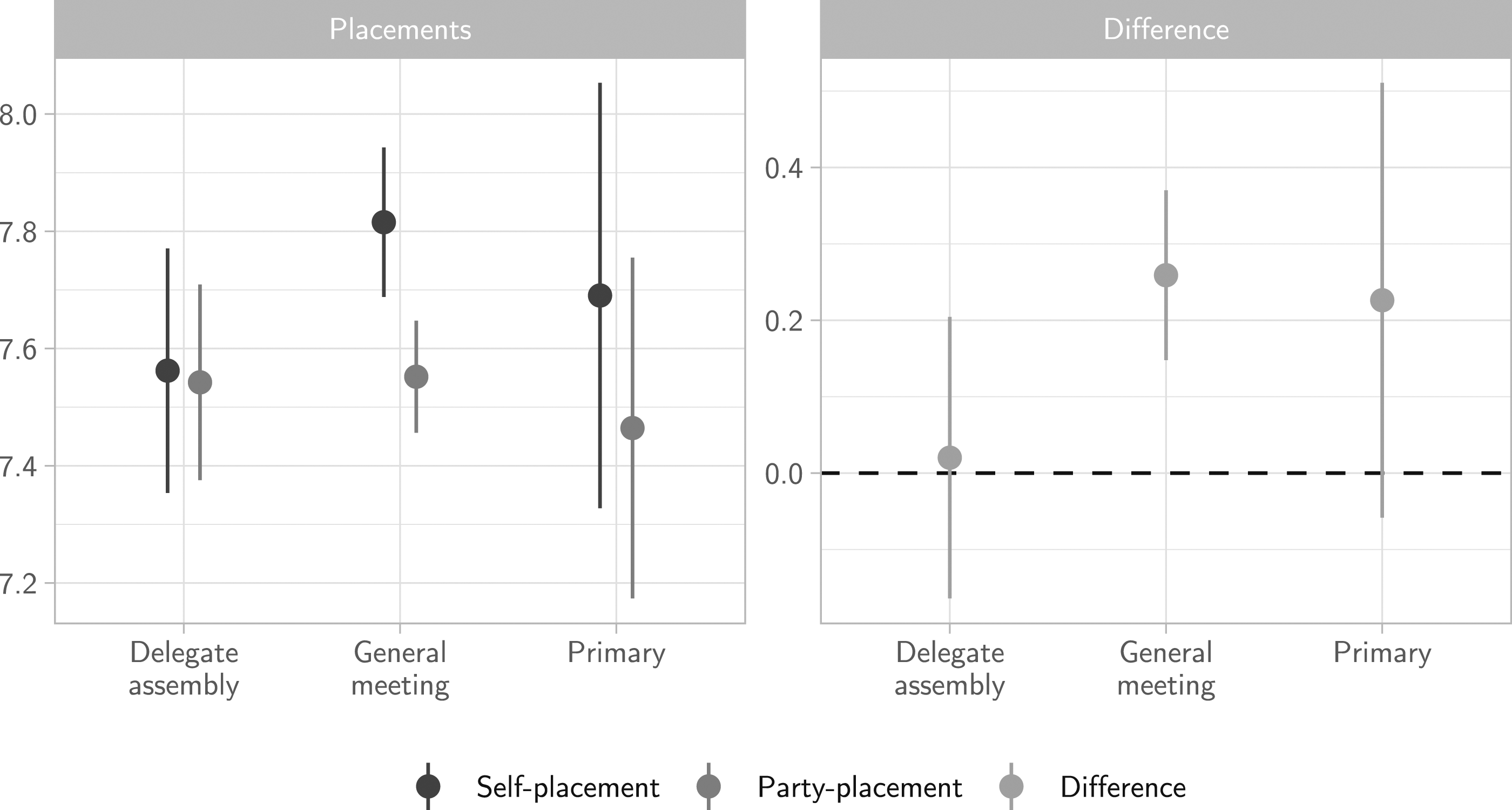
Multivariate results
To gauge the association between preferences for inclusive IPD and our operationalised explanation dimensions, we estimate a series of ordinal logistic regression models, each with three response categories on the dependent variable (see Figure 2). 3 We report all coefficients in terms of odds ratios. In the models that estimate the association between ideology and members’ preferences, we control for education, gender, occupation (whether they work in a political job), duration of party membership, and multivariate distance from other party members as proxies for D2 and D3. In the models estimating the association of the D2 variables and members’ preferences, we control for gender, multivariate distance from party (D3 proxy), and trust in democracy (D1 proxy). In the models that estimate the association between party unity (D3) and the dependent variable, we hold education, trust in democracy and duration of party membership constant.
Based on the estimates in Figure 4, we can confirm our Hypotheses 1 and 2. A one unit increase in trust in democracy is associated with a 27% decrease in the odds of favouring more inclusive IPD, and a one unit increase in satisfaction with parliament is associated with a 23% decrease in the odds of favouring more inclusive IPD. Similarly for the other parties, the association between political satisfaction and IPD preferences is negative and statistically significant. Cross-party comparison of IPD determinants. Note: displayed are the ordinal logistic regression coefficients and 95% confidence intervals for the determinants labelled above, across parties and in terms of odds ratios. Models were estimated as described above, only using observations from the respective parties. Note the changing-axis across the panels. A regression table for the AfD estimates as well as predicted probabilities can be found in the Appendix (Table B and Figure G). The models displayed correspond to models (1) through (6) in Table B from top left to bottom right in Figure 4 e.g., the model displayed in the top right panel of Figure 4 can be found in column (3) of Table B.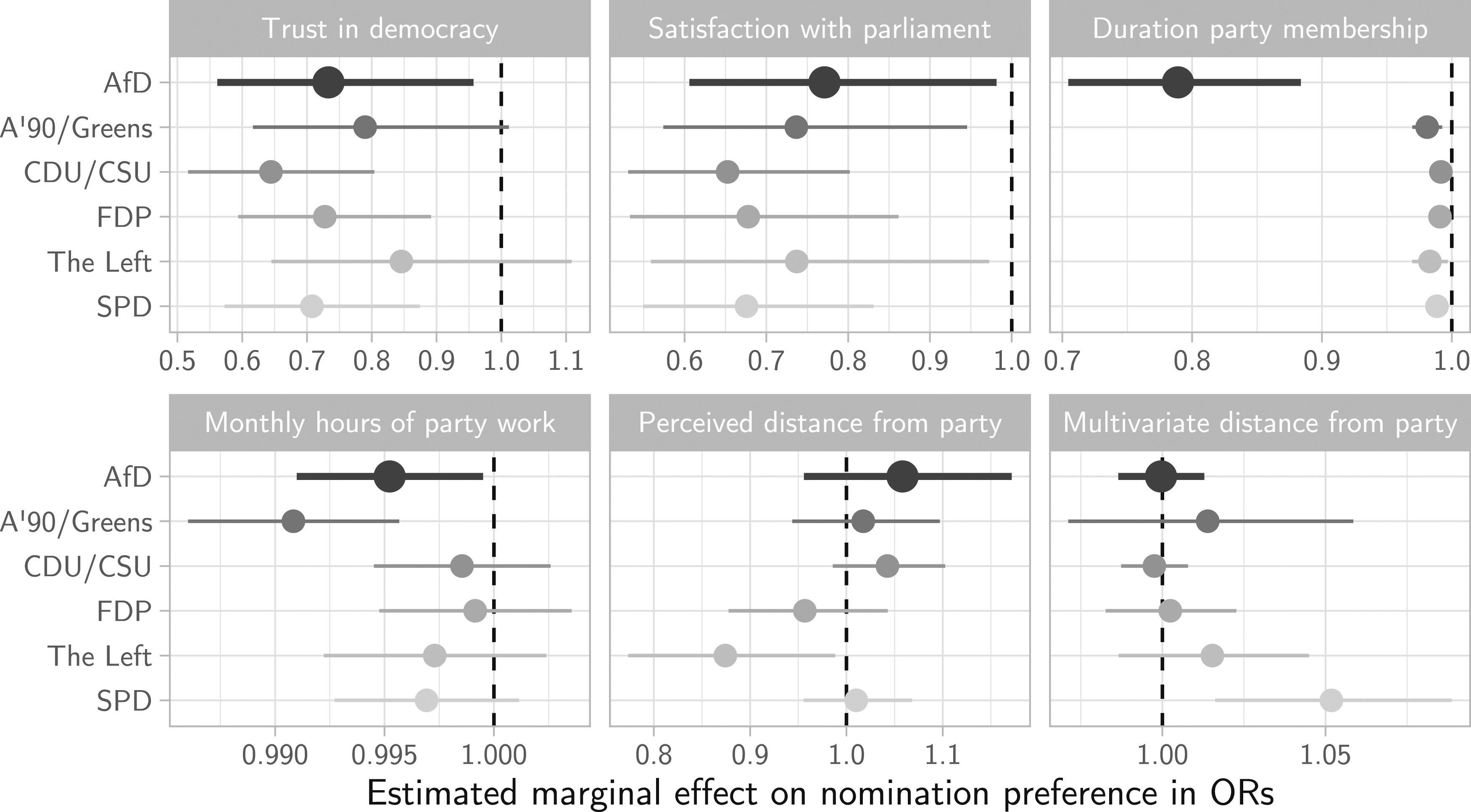
Conversely, the AfD is a clear outlier among parties in the institutionalisation Hypothesis 3. For its members, the estimated partial relationship between duration of their membership and preferences for inclusive IPD is negative and statistically significant. A one year increase in party membership is associated with a 21% drop in the odds of supporting more inclusive forms of IPD. 4 While this association is negative for all parties, it is much smaller for the other parties. We can thus confirm our Hypothesis 3: the longer members are in the AfD, the more they reject inclusive CS procedures.
The associations between intra-party participation and preferences for inclusive IPD are close to zero for all parties. For AfD members, the estimated partial relationship between monthly hours of party work and members’ preferences is negative and statistically significant, albeit very close to zero. An increase of 1 hour of party work per month is associated with a 0.5% drop in the odds of supporting broader selectorates. This points to our institutionalisation Hypothesis 4: the stronger AfD members are involved in their party, the more likely they are to reject inclusive CS procedures.
Finally, (low) party unity – as measured and implemented in this article – is no significant predictor of preferences for more inclusive IPD. AfD members who perceive a gap in left-right placement between themselves and their party are no more supportive of inclusive forms of IPD than those who see themselves aligned with their party. This pattern is mostly consistent across parties. Moreover, the multivariate distance to other party members is not statistically related with support for inclusive IPD in the AfD. Accordingly, Hypotheses 5 and 6 must be rejected.
Discussion
Our analysis has provided a deeper understanding of the underlying member attitudes for the AfD’s inclusive IPD. In accordance with our expectations, our results show that low trust in representative democracy and low satisfaction with the way parliament works are moderately associated with preferences for inclusive CS procedures across all Bundestag parties. However, this is particularly relevant for the AfD, as most of its members are much more politically dissatisfied and less trusting than members of the other parties. It also helps to understand why the AfD mobilises around anti-establishment frames, while presenting itself as the “true democrats.” Beyond dissatisfaction, we believe that populist attitudes are key determinants in supporting inclusive IPD. The latter emancipates rank-and-file members by allowing them to keep the party elite at bay and to have their views directly incorporated into the party’s decision-making – features of democratic systems typically favoured by populists. A robust measure of populist attitudes (e.g., Akkerman et al., 2014) would allow researchers to test this thesis comprehensively, but we lack such data.
Furthermore, we argued that members do not yet have much experience in the AfD and thus do not yet trust their fellow members enough to rely on delegation. Instead, we find evidence for a sizeable relationship between AfD members’ intra-party engagement as functionaries and their shrinking support for inclusive CS procedures. This relationship is robust – and gains in magnitude – when controlling for the AfD federal chairs, under whom members joined (see Figure H in the Appendix). At the end of our data collection, the AfD was about four years old, and its institutionalisation was still ongoing (Frankland, 2020; Mader and Steiner, 2019). Nevertheless, fundamental ideological and strategic questions were already settled in 2015. These included a clear shift to the Far Right, after which around 2,000 to 3,000 “moderate” or economic-oriented members left (Heinze and Weisskircher, 2021). With our data, we thus make valid statements about members who remained in the party afterwards. We assume that (informal) working routines and collective identities have further solidified since 2017, and the desire for inclusive IPD could be decreased. This may also be supported by the new option of a single party leadership (instead of collective leadership), as introduced in June 2022.
Finally, low party unity – as we could indirectly measure here – was not associated with preferences for more inclusive IPD. Members who perceived themselves as ideologically more distant from the AfD, or who are actually more distanced from other members, were not more supportive of inclusive CS procedures. This may be understood in the context of the AfD’s ideological and strategic development, which was already relatively consolidated in 2017 (Arzheimer, 2019). While some disputes flared up afterwards, they were less fundamental and more likely to lead to party resignations of “moderate” members such as former party chair Meuthen in 2022. This underlines our assumption that IPD can moderate internal conflicts (Cross and Pruysers, 2019; Scarrow, 2021).
In sum, high political dissatisfaction, and low institutionalisation as operationalised for the member dimension are influential factors for the AfD members’ attitudes towards inclusive IPD, other than (low) party unity. To test the long-term effect of members’ preferences for IPD, we would need longitudinal data. However, we are not optimistic that the AfD – now under surveillance by the German domestic intelligence services – will allow empirical research within its ranks in the future.
Conclusion
In this article, we shed light on AfD members’ attitudes towards inclusive CS procedures by providing empirical evidence of the relationship between these attitudes and three explanatory dimensions. We followed Gauja’s (2013: 127) recommendation to measure IPD with a combination of quantitative indicators, as already applied by Höhne (2021), and “attitudinal surveys” as party membership data. Our findings are crucial for understanding democratically organised PRR parties, which are mostly overlooked in party research due to a lack of valid data. Based on our large-scale data set on attitudes of party members in the 2017 Bundestag CS, the results show that high political dissatisfaction and low levels of party engagement are the most important drivers of the AfD’s inclusive IPD. These findings have important implications for future research.
Overall, our paper provides unique insights into the AfD’s internal attitudinal life, systematically compared with all other German parties represented in the Bundestag. With our representative active member data, we have further opened the “black box” of a young PRR party. Our data was collected after 2015, when its course to the Far Right was already set, so we could make statements about attitudes of members who have remained in the radicalised AfD. Our findings confirm that AfD members have less trust in representative democracy and are less satisfied with the way parliament works than members of other parties, which goes hand in hand with attitudinal support of inclusive IPD.
Members who are highly dissatisfied – as measured by trust in representative democracy and satisfaction with the way parliament works – or have less experience in the AfD (in years) and work less (in hours) have stronger preferences for inclusive CS procedures. We argued that it takes time and commitment to adapt (informal) working routines and build collective identities, which are key to developing trust in delegation. In contrast, party unity – as measured here – was not explanatory. We found no association between members who perceived an ideological divide between themselves and the AfD as a collective actor or other members and support for inclusive CS procedures.
These findings point to new research perspectives. Future studies should examine the relationship between institutionalisation and IPD in PRR parties more closely and in comparative as well as longitudinal perspective. This includes analysing other cases in different settings to see to what extent the AfD is an outlier or a pioneer for the decision-making of PRR parties. Corresponding questions are: how and why do PRR parties organise and establish (which type of) IPD in different institutional and political-cultural contexts? What (other) factors shape IPD, which are beyond the focus of our paper?
Future studies should also monitor the AfD’s ongoing development, although data collection within the radicalising party is becoming even more difficult. They should examine how IPD (demands) of PRR parties fit into their general understanding of democracy. PRR attacks on liberal democracy become more various, e.g., by women in their front ranks. It is conceivable that PRR parties use IPD as a tool to mobilise, become mainstreamed, and eventually reshape representative democracy with a weak intermediary sector but a strong plebiscitary character.
Supplemental Material
Supplemental Material - What drives the intra-party democracy of the “Alternative for Germany”: Populist ideology, low institutionalisation or lacking party unity?
Supplemental Material for What drives the intra-party democracy of the “Alternative for Germany”: Populist ideology, low institutionalisation or lacking party unity? by Anna-Sophie Heinze, Benjamin Höhne, and Felix Wortmann Callejón in Party Politics
Footnotes
Declaration of conflicting interests
The author(s) declared no potential conflicts of interest with respect to the research, authorship, and/or publication of this article.
Funding
The author(s) disclosed receipt of the following financial support for the research, authorship, and/or publication of this article: This work based on the study #BuKa2017 which was funded by the Foundation for Science and Democracy.

Supplemental Material
Supplemental material for this article is available online.
Notes
Author biographies
References
Supplementary Material
Please find the following supplemental material available below.
For Open Access articles published under a Creative Commons License, all supplemental material carries the same license as the article it is associated with.
For non-Open Access articles published, all supplemental material carries a non-exclusive license, and permission requests for re-use of supplemental material or any part of supplemental material shall be sent directly to the copyright owner as specified in the copyright notice associated with the article.
