



Abstract
Personalization refers to a shift over time in attention and/or power from collective actors to individuals. I focus on personalization in voting behavior, measured by the use of preference voting in flexible list-PR systems. I will argue that in a multi-level context this kind of personalization can take place at different policy levels, which could influence each other. In local elections, voters can be attracted by the mayor and/or other local figureheads, but also by the national party leader and/or national politicians figuring on the local list. Therefore, scholars should not only focus on the number and importance of people to which personalization applies (‘person level’ of personalization), but also on how processes at one policy level impact on other policy levels (‘territorial level’ of personalization). By combining literature on intra-party competition and personalization on the one hand, and on electoral patterns in multi-level states on the other, I engage in a conceptual discussion about the nature of personalization. I add empirical evidence to this conceptual discussion by analyzing preference voting patterns in local elections in Flanders (Belgium). As such, we gain more insights in the remarkable decline of preference voting that took place there.
Introduction
Several politicians and observers in Western countries are convinced that politics has become increasingly focused on individual politicians the last few decades. This evolution is labelled ‘personalization’, which refers to a shift over time in attention and/or power from collective actors (such as parties) to individual politicians (Karvonen, 2010; McAllister, 2007). Although personalization is typically considered a core and undisputable trend in contemporary politics, scientific evidence on this topic is divided (Wauters et al., 2018).
This ambiguous empirical evidence is partially due to conceptual disagreement, as personalization is a broad and diffuse concept with several subdimensions (Balmas et al., 2014; Rahat and Sheafer, 2007; Van Aelst et al., 2012). First of all, personalization might take place in different arenas (or loci), such as in parties, the electorate, the media, or electoral rules (Van Aelst et al., 2012; Pedersen and Raha,t 2019; Aarts and Blais, 2011; Cross and Blais, 2012). A second distinction is about the character of personalization (Pedersen and Rahat, 2019): it could focus on either individual politicians in general or on their private life (‘individualization’ vs ‘privatization’), and on positive features highlighting virtues of individual politicians or on negative features used to attack politicians from the other side (‘positive’ versus ‘negative’ personalization). A third distinction is based on the level of personalization: it either involves politicians in general (‘decentralized personalization’) or just a handful of top politicians, typically party leaders and prime ministers (‘centralized personalization’) (Balmas et al., 2014; Wauters et al., 2018). These different dimensions are important as personalisation according to different dimensions can occur simultaneously, apart from each other, or not at all. This article also relates to the concept of intra-party competition. As outlined in the introduction of this symposium, intra-party competition is a multi-faceted phenomenon. I focus here on one kind of actor, i.e. voters, in the electoral stage.
In this article, I engage in the conceptual discussion around personalization. More in particular, I will argue that in a multi-level context, personalization can take place at different policy levels, which could have an impact on each other. I find inspiration in the literature on the ‘multi-level election perspective’, that states that campaign behaviour and voting behaviour at one policy level is influenced by elections and politicians at another policy level (Schakel and Romanova, 2021). Therefore, researchers analyzing personalization should not only focus on the number and importance of people to which the process of personalization applies (which I call the ‘person level’ of personalization), but also at which policy level it takes place, and how processes at one policy level have an impact on other policy levels. I propose to distinguish between the ‘territorial level’ of personalization, which refers in my conception to the policy level on which politicians are mainly active, and the ‘person level’ of personalization, which maintains the old distinction between centralized and decentralized personalization.
I demonstrate the usefulness of this new concept by applying it to one specific case, i.e. the use of preference votes in Flanders (Belgium). In Belgium’s flexible PR-list system, voters have the choice between casting a list vote (for the party) or one or more preference votes (for candidates on the same party list). Preference votes are generally considered a good indicator to measure personalization of voting behavior (Karvonen, 2010; Wauters et al., 2018). Despite claims of an increasing personalization of politics (Poguntke and Webb, 2007; McAllister, 2007), the percentage of voters that is casting a preference vote has been declining in recent elections in Flanders/Belgium. I will focus on the local elections by analyzing the evolution in the use of preference votes in every municipality in Flanders from 2006 until 2018, which involves in total 4749 lists over these three elections.
This paper starts with a discussion of the concepts of the ‘multi-level election perspective’ and of personalization and its different sub-dimensions. Then, I develop my central argument about the ‘territorial level’ of personalization as a new important dimension to understand personalization in a multi-level context. Next, I test this explanation by conducting an analysis on the decline of preference votes in Belgium’s flexible list PR-system. My results show that the conceptual distinction between the different types of personalization is helpful in explaining the decline in preference voting at the local level. There is no general decline in all types of personalization, but decentralized personalization at the local level has especially declined, while centralized personalization at the local level and national personalization have stimulated list voting when no mayor or MP was on the candidate list.
Multi-level election perspective
The so-called ‘multi-level election perspective’ posits that in a multi-level context, election outcomes at one policy level cannot be fully understood without taking into account the possibility of horizontal and vertical spill-over effects from electoral arenas at other policy levels (Golder et al., 2017). Two types of possible effects can be distinguished: vertical and horizontal effects (Schakel and Romanova, 2021). Vertical spill-over effects are about the relationship between evolutions at a higher territorial level and a lower one, e.g. between local and national elections, or between national and European elections (Schakel and Romanova, 2021). They could function top-down, e.g. national elections influencing regional elections, or bottom-up, e.g. local elections influencing national elections. Horizontal spill-over, which is less pertinent for my analysis here, happens when developments in one electoral arena impact on electoral outcomes in another electoral arena of the same policy level, e.g. electoral evolutions in one region affecting evolutions in another region (Caramani, 2004).
The vertical dimension of the ‘multi-level election perspective’, which will be further elaborated here, can be linked to two theoretical approaches: the theory on second-order elections, and the theory on coattails (Schakel and Romanova, 2021). The literature on second-order elections (Reif and Schmitt, 1980; Marsh, 1998) argues that voters usually pay less attention to either regional, local or European elections than to national elections because there is less at stake. They use their vote at these elections to protest against (or to support) the government (or parties) at the national level. In other words, votes for elections at other policy levels than the national one, are mainly used to send a signal to politicians, parties and policy at the national level.
Secondly, the literature on coattails has initially focused on how elections at one policy level have an impact on other kinds of elections at the same policy level. The typical example is the impact of presidential elections on parliamentary elections of the same policy level (Borges and Lloyd, 2016). On the ‘tails of the coat’ of a successful presidential candidate, candidates for the parliamentary elections of the same party can gain votes more easily. More recently, it has been argued that this argument can also be applied to a multi-level context: successful candidates at national elections can also have an impact on their party’s fate in elections at other policy levels (Schakel and Romanova, 2021; Borges and Lloyd, 2016). Voters use the qualities and/or positions of well-known national candidates as an information shortcut to gauge qualities and/or positions of less well-known politicians of the same party at other policy levels (Lupia, 1994; McDermott, 2009). Evidently, local or supra-national candidates belonging to a party with a popular national candidate benefit electorally more than candidates without such a national candidate in their party ranks.
The two theoretical approaches discussed above posit that the national level is the most important one, which has spill-over effects on elections at other policy levels in terms of the stakes guiding the vote choice (second-order elections) and the figureheads used as a shortcut to evaluate qualities and/or positions of less well-known candidates or of the party as a whole (coattails). While these approaches (and especially the latter one) focus on the effect of one election on another, we are here mainly interested in what happens when politicians from the national level participate to elections at another level. This supposes the possibility of dual-mandate holding (or at least dual-candidacy) at the national and the local level, which is common practice in many European countries including Belgium, France, Finland, Sweden, Spain, Portugal, Germany, Slovenia and Hungary (Navarro, 2013).
My focus is thus on elections at one policy level, i.e. the local level, rather than on the link between elections at different policy levels. I investigate how national politicians impact on voting behaviour in elections at the local level. A national mandate in local elections could be considered as a ‘personal vote earning attribute’ (PVEA), i.e. a personal trait of a candidate that yield him/her more votes (Shugart et al., 2005; Put et al., 2020). MPs have in general higher levels of media visibility, political experience, campaign resources and name recognition than local candidates, which result in more votes (Put et al., 2015; Van de Voorde, 2019).
There is yet another difference with the approaches discussed above: I do not focus on the effect on vote shares of local parties or politicians, but on the kind of (preference) voting behaviour that voters adopt: voting for a candidate or for a party list (see Table 1). This brings us to the personalization literature. As indicated above, this literature has been largely blind to a multi-level context, and to spill-over effects from one policy level to another. Apart from the analysis of Helboe Pedersen and Vanheerde-Hudson (2019) who consider constituency (i.e. local) orientation of national MPs as a form of personalization, the relationship between personalization at different policy levels has been underexposed. While the analysis of Helboe Pedersen and Vanheerde-Hudson (2019) was focused on the behaviour of MPs, I concentrate on behaviour of voters in local elections, and more in particular to what extent they make use of a preference votes (instead of a list vote), which is a straightforward indicator to measure personalization (Karvonen, 2010; Wauters et al., 2018). In the next section, I explain the dimensions of personalization and propose a new approach incorporating the multi-level aspect into this framework.
Personalization in a multi-level context
Personalization refers to a shift over time in attention and/or power from collective actors (such as parties and institutions) to individuals (Karvonen, 2010; Cross et al., 2018; Rahat and Kenig, 2018; Rahat and Sheafer, 2007). There are some good reasons to expect a trend of personalization over time: the socio-economic and technological modernization of society, the diminishing relevance of classic social structures based on class or religion, the decline of party membership and the increased impact of (social) media (Karvonen, 2010; Rahat and Sheafer, 2007).
Although it is often stated that personalization is a core and undisputable trend in contemporary politics, studies are divided between those who prove that politics has been personalized over the last decades (Garzia, 2012; Renwick and Pilet, 2016; McAllister, 2007), and those demonstrating that there is no clear evidence of such a universal evolution (Aarts et al., 2011; Karvonen, 2010; Kriesi, 2012; Marino et al., 2022). These contradictory results could be linked to the fact that personalization is a broad concept covering a wide variety of practices and evolutions. A distinction can be made between the arena, the level and the character of personalization (Pedersen and Rahat, 2019). This distinction is important, as it might be that personalization occurs for one dimension but not for another, making it difficult to make a general assessment of the level of personalization.
As for the arena (or locus) of personalization, different arenas in which personalization could take place can be distinguished: media, parliament, parties, institutional rules, and electoral behaviour (Balmas et al., 2014; Van Aelst et al., 2012). It could refer to behaviour of either voters or politicians (Pedersen and Rahat 2019; Rahat and Sheafer, 2007). I will focus here on electoral behaviour of voters.
Secondly, the character of personalization distinguishing between individualization and privatization (Van Aelst et al., 2012), and between positive and negative personalization (Pedersen and Rahat, 2019; Garzia and Ferreira da Silva, 2021; Pruysers and Cross, 2018) is less relevant for our purposes here.
The final distinction is made by the level of personalization. This distinction refers to the number and importance of people the process of personalization applies to: either politicians in general, including also backbenchers for instance (‘decentralized personalization’) or a handful of top politicians, typically party leaders and prime ministers (‘centralized personalization’) (Balmas et al., 2014; Wauters et al., 2018). Here again, these two dimensions could occur simultaneously, one at the time, not at all, or they could, as Wauters et al. (2018) demonstrated, hinder each other.
I posit here that in a multi-level context, the ‘level’ of personalization could refer to yet another aspect. In a context of voting behaviour in local elections, ‘centralized personalization’ could refer (just as in the context of national elections) to the national party leader, but also to the local party leader (the incumbent mayor, or the head of the list in a municipality). Following the ‘coattails’ literature (see above), personalization at a higher policy level can have repercussions on other (lower) policy levels. Therefore, in my view, the ‘level’ of personalization is more than ‘centralized’ versus ‘decentralized’ personalization (Pedersen and Rahat, 2019). I propose to use the term ‘person level’ for these phenomena, and to reserve the term ‘territorial level’ for the distinction between ‘national personalization’ versus ‘local personalization’. This brings us to four combinations of personalization: centralized national personalization (national party leader), decentralized national personalization (MPs, prominent national party figures), centralized local personalization (local party leader or (candidate) mayor) and decentralized local personalization (local candidates) (see Table 2).
As it is not always easy to disentangle ‘centralized national personalization’ from ‘decentralized national personalization’ and as the number of observations of ‘centralized national personalization’ (induced by national party leaders) is low, I merge these two categories into one, i.e. ‘national personalization’. I assume that MPs could influence the use of preference voting in two respects: they could stimulate preference voting based on their popularity when they are on the list (in their own municipality), but they could also discourage preference voting, just like party leaders when they are not on the list (in other municipalities than their own) inciting a list vote as surrogate for a vote for them personally. As such, national personalization (popularity of national figures) could negatively impact local personalization (use of preference voting). I will develop hypotheses about this, but first I have to introduce preference voting.
Preference voting in flexible list PR-systems
Based on the electoral formula, electoral systems can be divided into three broad groups: majoritarian systems, systems of proportional representation (PR) and mixed systems (Farrell, 2011; Reilly et al., 2005). In list PR-systems 1 , the aim is to provide equivalence between the share of votes of parties and their share of seats in parliament. In list PR-systems, seats are first distributed among parties. How these seats are then divided between candidates of the same party, is another crucial question. There are three possible variations: an open list PR-system in which seats are entirely distributed based on preference votes, a closed list PR-system in which seats are entirely distributed according to a list order determined by the party, and a flexible list PR-system which combines elements of both open and close list systems (Carey and Shugart, 1995).
Precisely flexible list PR-systems are the major focus of our attention here. More in particular, I will focus on Belgium’s flexible system, in which voters have the choice between casting a list vote (for the party) or one or more preference votes (for candidates on the same party list). A similar system is used in countries like the Czech Republic, Slovakia, and Denmark. Voters can cast as many preference votes as there are candidates on a party list. All candidates reaching the eligibility number on the basis of their preference votes automatically obtain one of the party seats. In general, however, only a handful of candidates reach that number. For all other candidates, list votes are added to their preference votes until they reach the eligibility number. Here, the order of the list is followed: the first candidate receives as much list votes as needed to reach the eligibility number, then the second candidate, and so on. If all list votes are exhausted and if not all seats for the list are yet assigned, then (and only then) the remaining seats go to the candidates with the largest number of preference votes. In that case, candidates are elected on the basis of their preference votes only, and ‘jump over’ higher listed candidates. This only happens sporadically in national elections, but is common practice in local elections (Put et al., 2014; Wauters et al., 2020).
The extent to which the order of the candidate list is decisive depends upon the number of list votes. If voters make extensively use of the possibility of preference voting, then there are not many list votes to distribute and hence, the list order is less decisive. In this situation, the electoral system resembles an open list PR-system. If, on the contrary, not many voters cast a preference vote, the number of list votes is high and the list order highly decisive. This looks like a closed list PR-system (Crisp et al., 2012).
Apart from the formal role that preference votes play in the distribution of seats among party candidates (see above), they are relevant for yet two other reasons.
First, even if candidates are not elected, they still can benefit from obtaining many preference votes. It has been demonstrated that candidates with many preference votes have a higher chance to appear again on the candidate lists at the next elections (on a high list position) (André et al., 2017).
Our approach situated in the ‘multi-level election perspective’ approaches.

Conceptual framework on multi-level personalization in an electoral context.

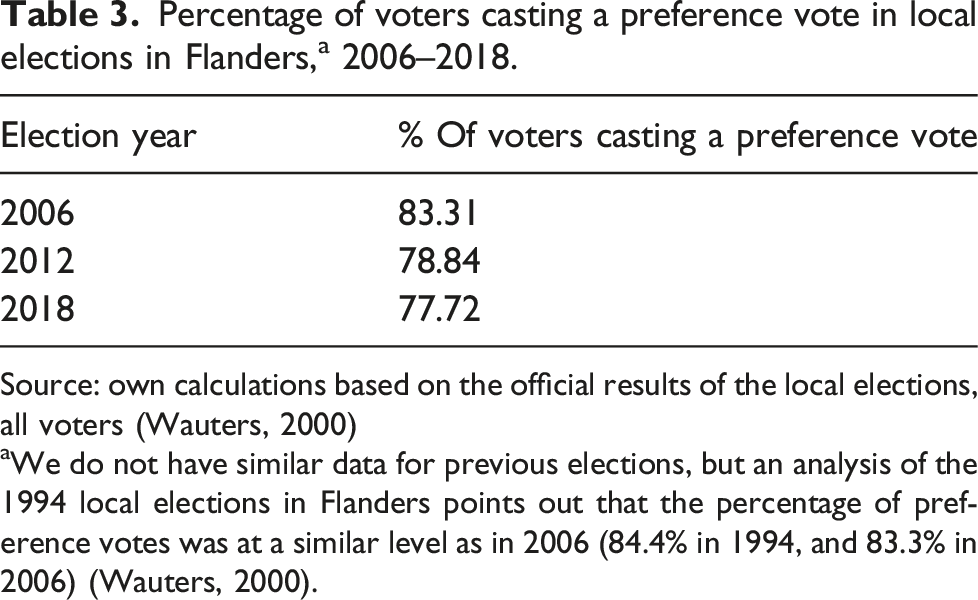
Percentage of voters casting a preference vote in local elections in Flanders, a 2006–2018.
Source: own calculations based on the official results of the local elections, all voters (Wauters, 2000)
aWe do not have similar data for previous elections, but an analysis of the 1994 local elections in Flanders points out that the percentage of preference votes was at a similar level as in 2006 (84.4% in 1994, and 83.3% in 2006) (Wauters, 2000).
As an explanation, I can point to a similar evolution at the national level. Indeed, also for recent parliamentary elections in Belgium, the share of preference voting has decreased. This has been explained by distinguishing between centralized and decentralized personalization (Wauters et al., 2018). The analysis demonstrated that in electoral districts where the party leader is a candidate, the share of casted preference votes increased, while in the other districts (where other candidates are on top of the list), this share declined (Wauters et al., 2018). Voters cast a vote for the party leader when (s)he is a candidate in their district (‘centralized personalization’). If they are living in another district, however, they cast a list vote, as a sort of surrogate vote for the leader who is not on the ballot list in their district. Consequently, the share of preference votes in these districts decreases (‘decentralized de-personalisation).
For local elections, this explanation is less easy to apply, however. Local elections are held in one single electoral district per municipality, so negative effects on preference voting by a local leader elsewhere could not occur. And if there would be a negative effect of the personalization around the national party leader, then we can expect this effect to occur in all municipalities but one. But as outlined above, I believe that by bringing in the multi-level dimension, according to which national politicians (also including MPs) impact on voting behaviour in local elections, and by combining the ‘person level’ (centralized-decentralized) and ‘territorial level’ (national-level) of personalisation, new insights can be gained. National MPs could stimulate preference voting when they are on the list (in their own municipality), but they could also discourage preference voting when they are not on the list inciting a list vote as surrogate for a vote for them personally.
This brings us to the central research question of this paper: Why is there a decline in the use of preference voting at the local level? And what is the role of different forms of personalization in this perspective? Based on the reasoning developed above, I have two hypotheses:
The decline in the use of preference voting at the local level is caused by a decline in local decentralized personalization
The decline in the use of preference voting at the local level is caused by an increase in national personalization
Methodology
This paper studies the dynamics of preference voting in the local elections of Flanders, a region in the northern part of Belgium. Flanders consists of 300 municipalities. Every municipality holds its local elections every 6 years except for some special cases, such as Herstappe and Zuienkerke (who did not hold an election in respectively 2012 and 2018, because only one party presented a list of candidates). This paper focuses on three consecutive local elections, namely, 2006, 2012 and 2018. In order to keep the data consistent over time, Herstappe and Zuienkerke are excluded. In 2018, there were a handful mergers of municipalities: 15 municipalities merged into seven new merged municipalities. Because we have data on all these municipalities (albeit for 2018 only on a higher level together with the municipalities they merged with), I decided to keep all these municipalities in our sample. For 2018, I take for every (old) municipality the share of preference votes in the new, merged municipality.
For each of the elections in the research period, I calculated the percentage of casted preference votes per party per municipality. We have 1,467 party lists from the 2006 local elections, 1,658 from the 2012 elections and 1,624 from the 2018 elections in our research population, which counts in total 4,749 party lists.
I first conduct a descriptive analysis, in which I distinguish between three types of ballots (and corresponding voters): voters casting a list vote (which is the opposite of voters casting one or more preference votes, presented in Table 3 above), voters casting a preference vote for the head of list (capturing ‘centralized local personalization’) and voters casting one or more preference votes for candidates lower down the list (which refers to ‘decentralized local personalization’). As voters can cast multiple preference votes in local elections in Flanders, this categorization needs some further explanation: ‘voters casting a vote for other candidates’ are voters who vote only for candidates lower down the list (and thus not for the head of list), while voters casting a preference vote for the head of list evidently fall in the category ‘voters casting a preference vote for the head of list’ even when in addition they have casted a vote for other candidates on the same party list.
In order to test the effect of national politicians, I additionally run linear regressions with the three types of voting ballots as dependent variables, and with the presence of a national MP as independent variable. Given the small number of national party leaders (six or seven depending on the delineation, which means that less than 0.5% of all lists have a national party leader), I focus on lists with MPs (which generally also include national party leaders) to capture ‘national personalization.’ Respectively 160, 155 and 155 party lists comprised at least one national MP in the local elections of respectively 2006, 2012 and 2018. I included MPs from both the national and the regional parliament, who are elected in the same (provincial) electoral districts. In order to keep the number of observations high enough, no further sub-analyses, distinguishing between for instance national and regional MPs, were conducted. This approach is in line with earlier studies on preference voting in local elections (Put et al., 2015).
I add to these analyses a number of control variables that have proven to affect the use of preference voting. First of all, I add a variable indicating whether or not the incumbent mayor was on the list (Put and Maddens, 2015). Next, since established parties with many well-known figures attract more preference votes than newer parties (Wauters et al., 2020), I also add party dummies, allowing to control for the rise of new parties (such as N-VA). Finally, some specific factors for preference voting are added: population density (more preference voting in rural areas), population size (more preference voting in smaller municipalities), electronic voting (more preference voting if electronic voting instead of voting by paper and pencil is used), and number of parties (more preference voting if the number of parties is limited) (Wauters et al., 2012).
Results
Descriptive analysis of trends in preference voting
I will start with a descriptive analysis of the evolution of the use of preference votes, distinguishing between three kinds of voting ballots: those with list votes, those with preference votes for the head of list, and those with preference votes for candidates lower down the list.
Figure 1 clearly shows that voting ballots with a preference vote for the head of list, and ballots with preference votes for other candidates outnumber voting ballots with list votes. While the former two categories each count separately about 40% of all ballots, ballots with list votes only amount to 20% or less of all ballots. Percentage of voters casting a preference vote in local elections, 2006–2018.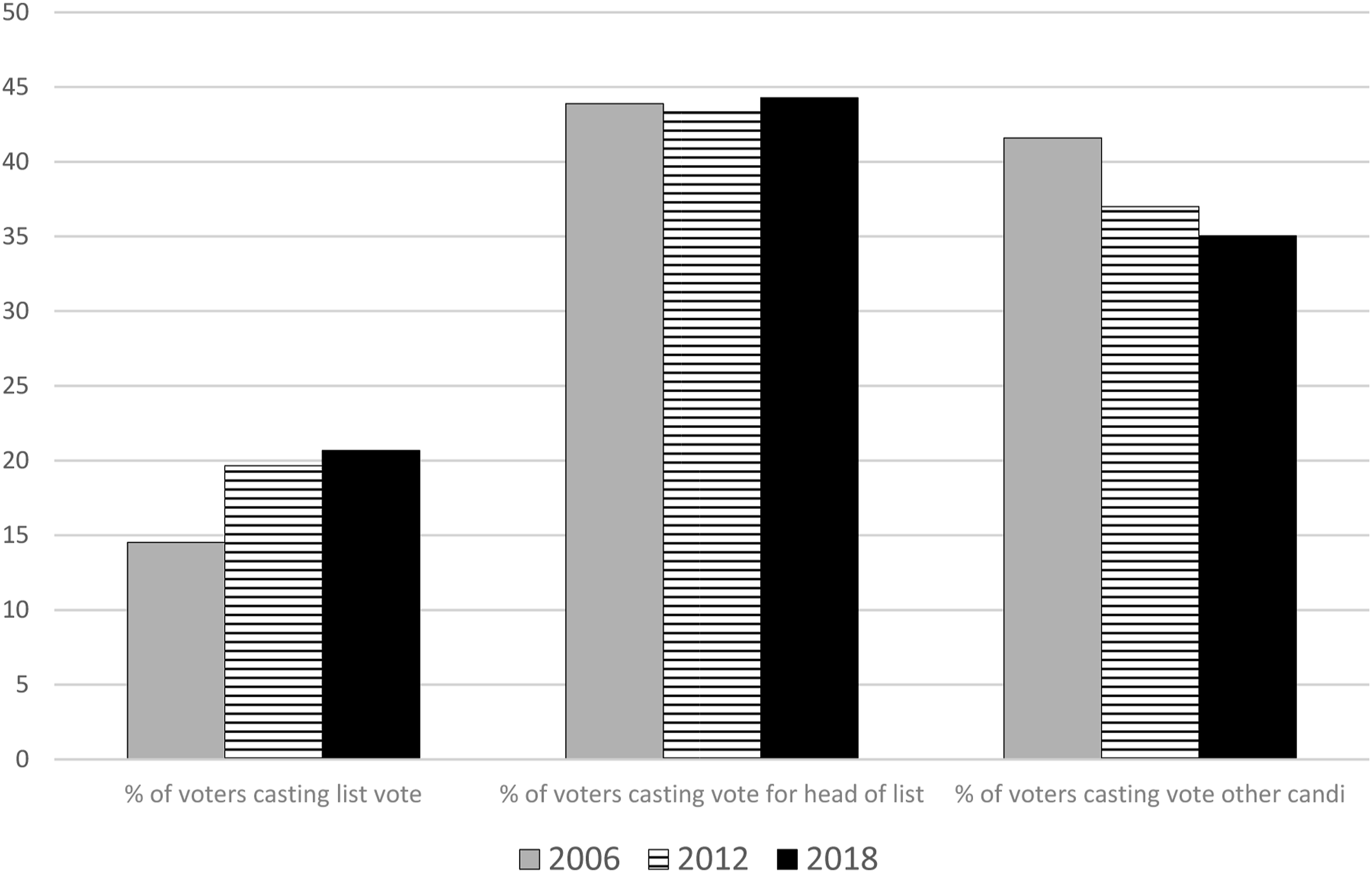
At the same time, Figure 1 also gives nice insights on the evolution over time. I already knew that the percentage of list votes (the inverse of the general percentage of preference votes reported in Table 3) has increased from about 14% in 2006 to more than 20% in 2018. The distinction between the kind of preference votes points us to possible explanations for the rise in list votes. The percentage of ballots with a preference for the head of list have remained quite stable over time: 43.89% in 2006 hardly differs from 44.28% in 2018. Conversely, for the percentage of ballots containing preference votes for other candidates, a marked decline can be noted. Whereas in 2006 still about 42% of all ballots contained a preference for these rank and file candidates, this percentage was only 35% in 2018 anymore. If we translate this in personalization terms, it seems that the general decline in preference voting is rather due to (local) decentralized personalization (or the lack of it) than to (local) centralized personalization (that remained remarkably stable). As such, H1 is confirmed.
Explanatory analyses of preference voting
Up to now, the focus in this empirical analysis has been mainly on explanations based on personalization at the local level. But as indicated above, I expect also the national level to have an impact on preference voting in local elections (H2). In this part, I will test whether the presence of national or regional MPs has an impact, and whether a change over time has taken place.
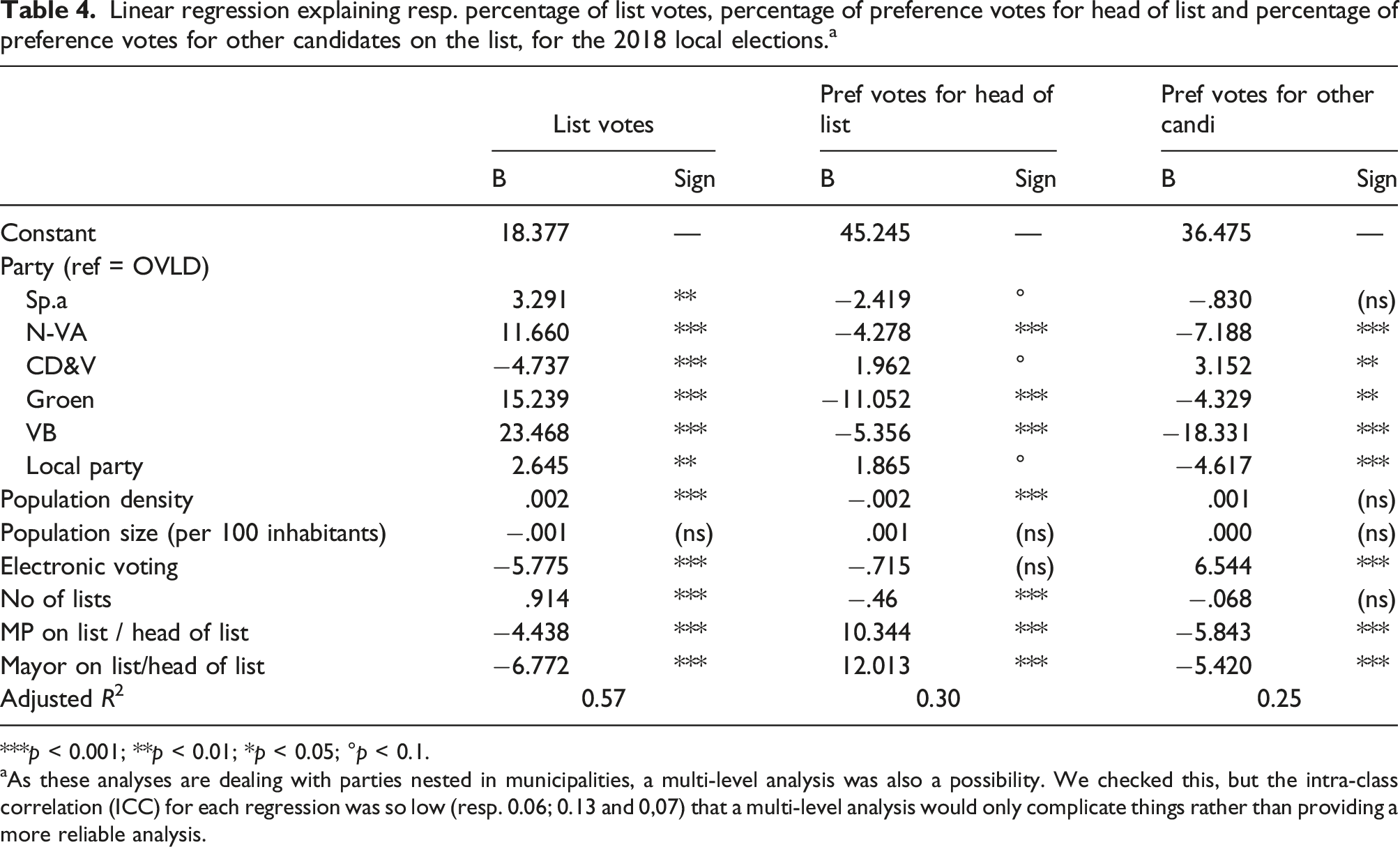
Linear regression explaining resp. percentage of list votes, percentage of preference votes for head of list and percentage of preference votes for other candidates on the list, for the 2018 local elections. a
***p < 0.001; **p < 0.01; *p < 0.05; °p < 0.1.
aAs these analyses are dealing with parties nested in municipalities, a multi-level analysis was also a possibility. We checked this, but the intra-class correlation (ICC) for each regression was so low (resp. 0.06; 0.13 and 0,07) that a multi-level analysis would only complicate things rather than providing a more reliable analysis.
For the analysis of the two different types of preference votes (columns 3 and 4, and 5 and 6 in Table 4), I refined the variable to a variable indicating whether or not an MP was head of list, since it matters here which position on the list the MP occupies (head of list or not) 2 . Here again, we find significant effects: when an MP is on top of the list, the percentage of voters casting a preference vote for this top candidate is 10 percentage points larger (compared to party lists without an MP). Conversely, the percentage of voters for other candidates than the head of list is significantly lower for party lists with an MP as head of list (compared to party lists without MP on top). This proves that national actors (MPs in this case) have an impact on the use of preference votes in local elections. This is not an entirely new finding (Put et al., 2015), but it is striking to note that their presence could both have positive effects (on the general use of preference votes and on preference voting for heads of list) as well as negative effects (on preference voting for other candidates than the head of list).
This is only one part of the story. The central argument I tried to make (see above) is that there has taken place an evolution over time: I hypothesize that the influence of national MPs has become stronger over time.
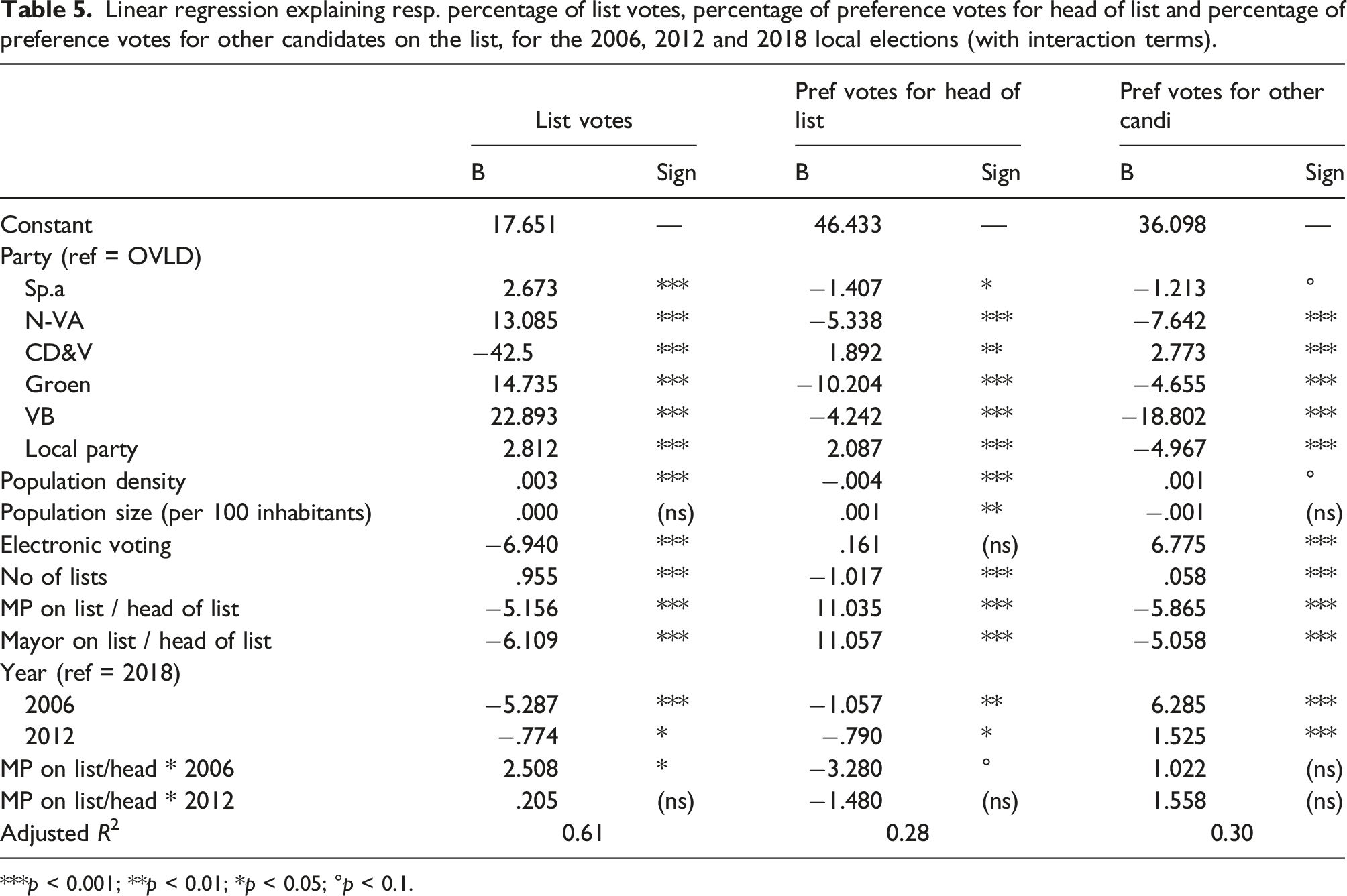
Linear regression explaining resp. percentage of list votes, percentage of preference votes for head of list and percentage of preference votes for other candidates on the list, for the 2006, 2012 and 2018 local elections (with interaction terms).
***p < 0.001; **p < 0.01; *p < 0.05; °p < 0.1.
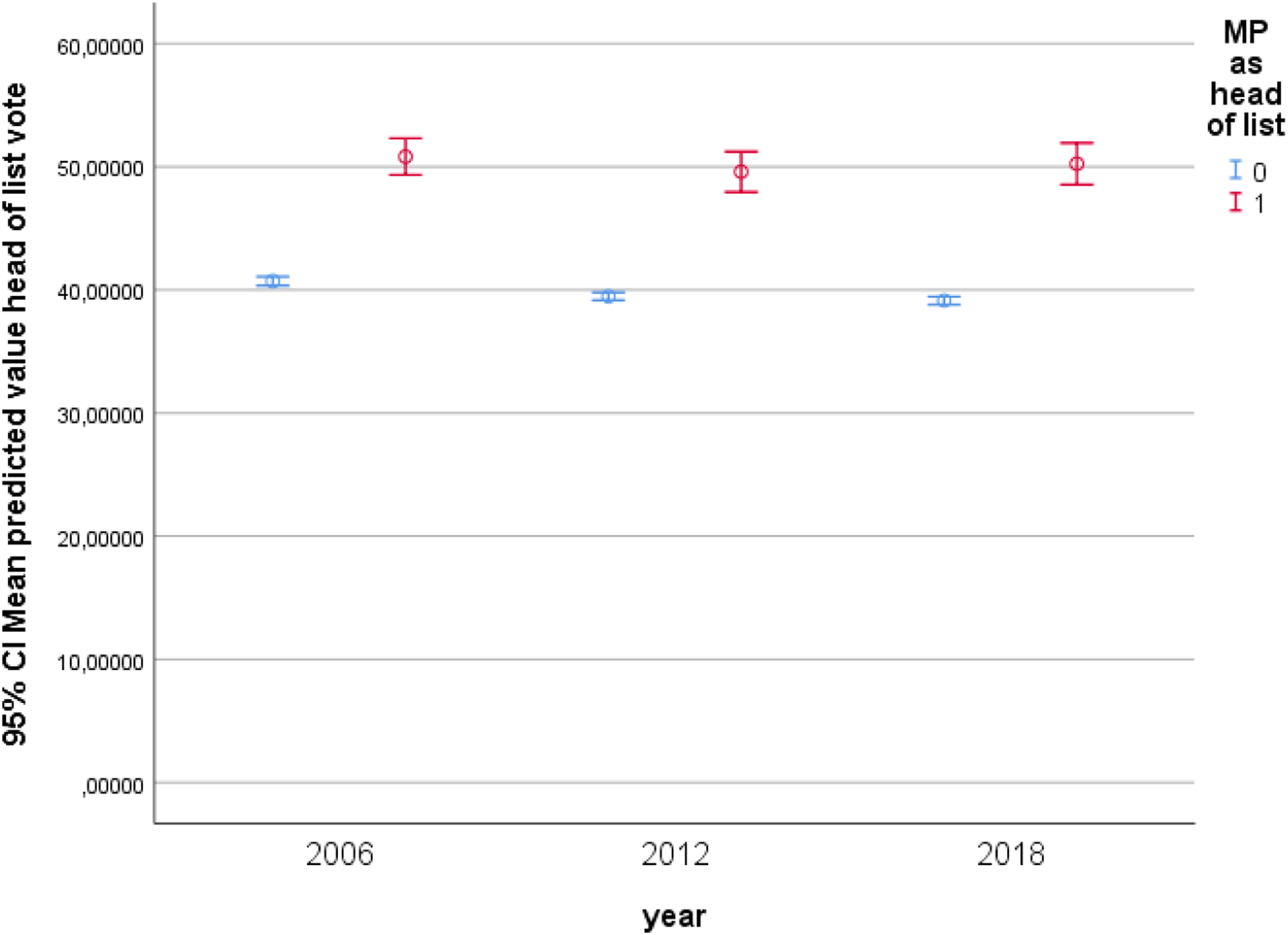
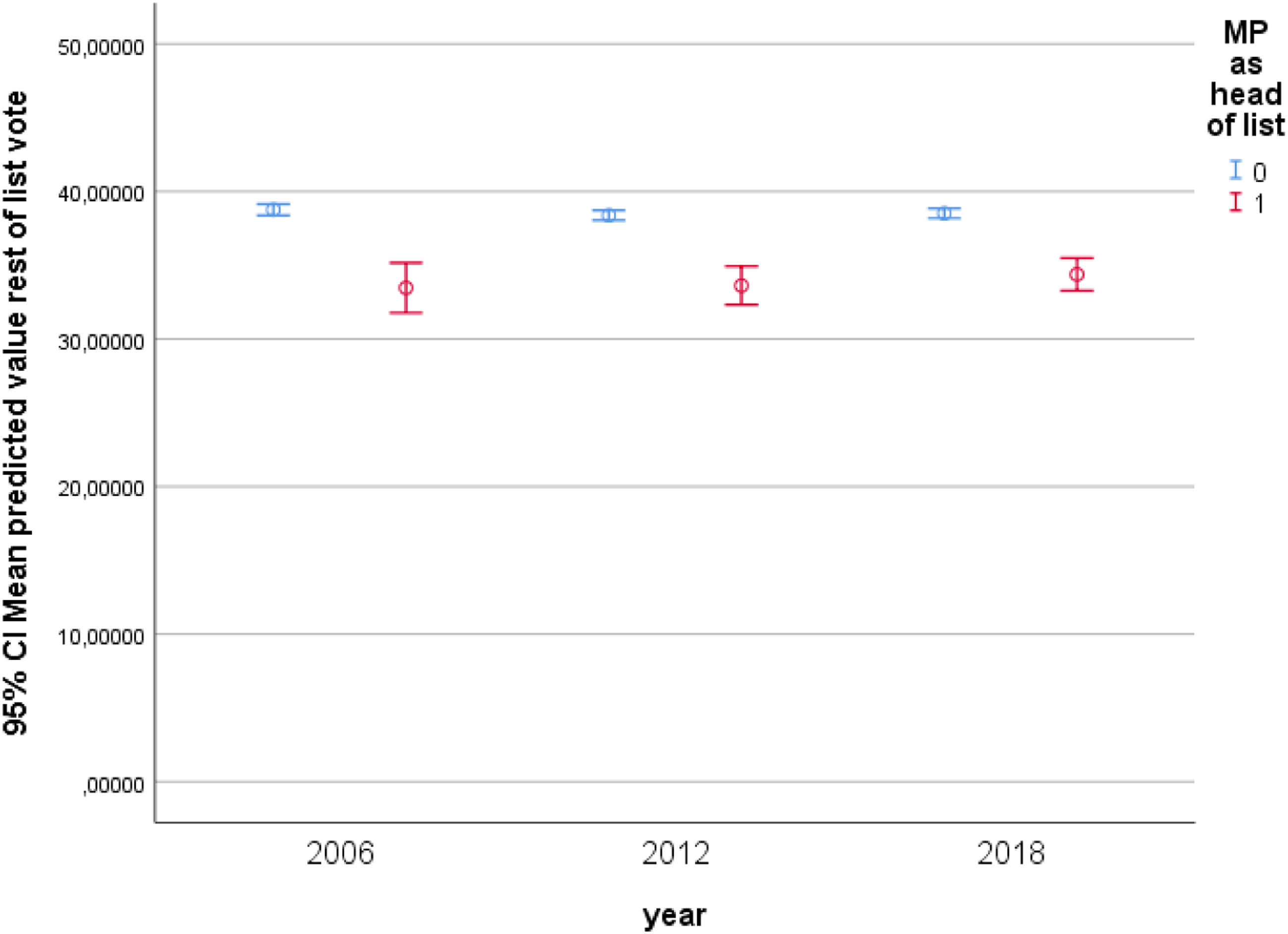
Both for the percentage of list votes and the percentage of votes cast for the head of list (columns 1–4 in Table 5), significant interaction effects can be noted, but only for the 2006 elections. The negative effect of MPs on list votes was less strong in 2006 (positive interaction term), and the positive effect on preference votes for the head of list was less strong in 2006 (negative interaction term). This suggests that the effect of national personalization (presence of a national MP on a local list) has increased over time. We should make two nuances, however. First, my results only show a significant difference between the situation in 2006 and that in 2018, and not between 2012 and 2018. Apparently, the evolution has either taken place earlier in time (end of the first decade of 2000) or needs time to fully realize its potential. Secondly, no significant differences over time could be noted for preference votes for candidates lower down the list. The negative effect over time (as illustrated in Figure 1) could be explained not so much by national personalization, but by local centralized personalization. Additional analyses (not in table) indeed show that the negative effect of mayors as head of list on the propensity to cast a list vote for other candidates becomes stronger over time.
Below, I plot the interaction terms for each of the three dependent variables I investigate.
Figures 2 and 3 clearly demonstrate that the effect of the presence of an MP becomes stronger over time. The gap between the confidence interval of having an MP on (top of) the list versus not having an MP on (top of) the list grows election after election. For the percentage of preference votes for other candidates than the head of list, the gap remains more or less constant through time, when it comes to the effect of national MPs (Figure 4). Earlier in this article, however, I demonstrated that the evolution of this kind of preference votes could be linked to increasing preference voting for (local) heads of lists. Plot of interaction terms MP on list and election year; for percentage of list votes. Plot of interaction terms MP as head of list and election year; for percentage of preference votes for head of list. Plot of interaction terms MP as head of list and election year; for percentage of preference votes for other candidates than the head of list.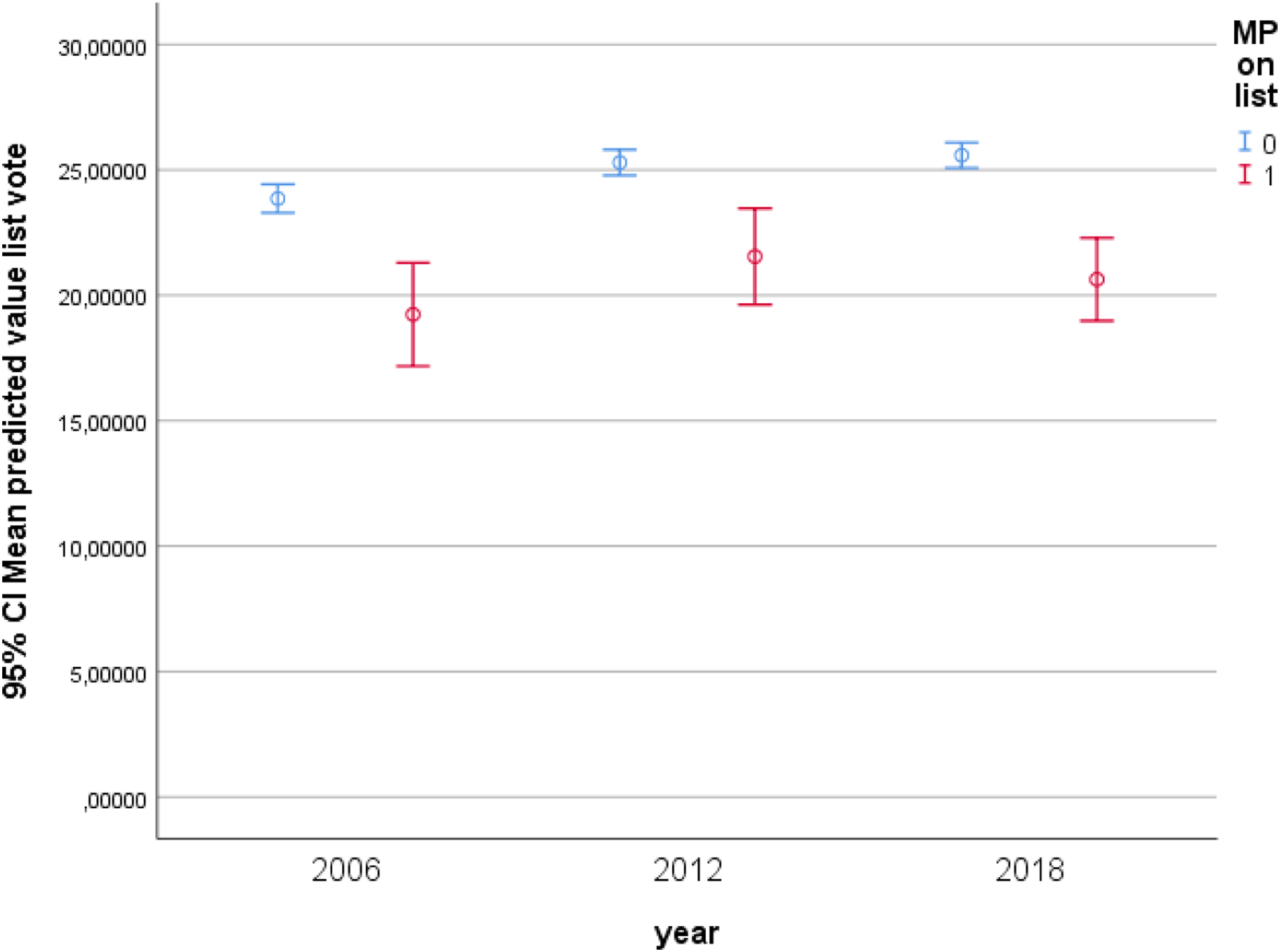
Conclusion
In this paper, I introduced a multi-level election perspective in relation to personalization of voting behavior. I argue that in a multi-level context, personalization at a higher policy level (national figureheads) can have repercussions on other (lower) policy levels (local elections), while at the same time, also personalization at the lower policy level itself (around the mayor for instance) could have an impact. I propose to use the term ‘person level’ to distinguish between ‘centralized’ versus ‘decentralized’ personalization (Balmas et al., 2014), and to reserve the term ‘territorial level’ for the distinction between ‘national personalization’ versus ‘local personalization’. This brings us to four combinations of personalization: centralized national personalization (national party leader), decentralized national personalization (MPs, prominent national party figures), centralized local personalization (local party leader or (candidate) mayor) and decentralized local personalization (local candidates).
This newly developed framework can be applied to different types of personalization. It appeared to be especially useful here to explain the remarkable decline in preference voting in local elections in Flanders. In countries using a flexible list-PR system, the share of casted preference votes is generally considered to be a good indicator of personalization. Remarkably, we see a clear decline from 2006 until 2018. I have formulated and tested two main explanations (related to personalization in a multi-level context) for this overall decline in preference voting.
First, not all kinds of preference voting ballots have declined in number. While the percentage of ballots containing a preference for the head of list has remained constant over time, we could note a clear decline in the percentage of ballots with only preference votes for candidates lower on the list. We witness a de-personalization of candidates lower down the list (‘local decentralized de-personalization’)
Second, I have also demonstrated that national figureheads have an impact on the use of preference votes at the local level. When national MPs are on the (head of the) list, the percentage of list votes and the percentage of preference votes for other candidates than the head of list is lower, while the percentage of preference votes for the head of list is higher. Moreover, I have demonstrated that this effect becomes stronger over time. If an MP is on the list, voters increasingly cast a preference vote for that MP (who is often at the head of the list) and not for other candidates. If the MP is not on the list, voters increasingly cast a list vote, as a surrogate for the national figureheads of the party not present on the candidate lists in that particular municipality.
Besides conceptual relevance for personalization studies, these findings have also repercussions for the literature on intra-party competition. My study re-confirms the status of a national mandate as ‘personal vote earning attribute’ (PVEA) in local elections, i.e. a personal trait of a candidate that yields him/her more votes (Shugart et al., 2005; Put et al., 2020). And it points us to the fact that intra-party competition is not only between fellow partisans on the same candidate list, but that it also could involve (national) politicians who are not on the list. As such it opens intra-party competition to an additional range of fellow partisans often overlooked in previous studies. This is especially the case in flexible list-PR systems where several options are possible to indicate a preference for candidates, also casting a list vote when one prefers someone who is not on the list.
Future research on local elections in other contexts and countries should further elaborate and test the interaction between the different kinds of personalization. Moreover, I have investigated only three consecutive elections in one particular region, more cases are needed to strengthen the generalizability of my findings. Following the ‘multi-level election perspective’, also interactions between other policy levels than the national and the local one could be relevant for personalization trends. These include for instance interactions between the national and the European level, or between the national and the regional level. Finally, apart from electoral personalization, the ‘multi-level election perspective’ could also be used to investigate questions about other kinds of personalization, such as the (increased) prominence of national politicians in local electoral campaigns or the (increased) attention for national politicians in local newspapers.
Footnotes
Declaration of conflicting interests
The author(s) declared no potential conflicts of interest with respect to the research, authorship, and/or publication of this article.
Funding
The author(s) received no financial support for the research, authorship, and/or publication of this article.
