




Abstract
This paper presents a three-dimensional approach to party political conflict at the local level, drawing from an anti-elitism dimension, the left-right dimension and a localism dimension. More than 4500 parties participating in the 2014 and 2018 Dutch municipal elections are placed on these dimensions on the basis of their manifestos using quantitative textual analysis. A three-pronged approach is used to justify this three-dimensional model. The three dimensions are shown to be empirically distinctive. They are revealed to reflect meaningful differences between parties that are also visible in their names; and finally, these dimensions are shown to predict participation in local executive coalitions.
Introduction
Party politics at the local level is often overlooked by political scientists. Therefore, the field can say little about typical party politics questions at the local level. An important tool in the tool box of political scientists is dimensions to map the interaction, cooperation and conflict between political parties (e.g. Kriesi et al., 2006). This article examines the importance of three lines of conflict at the local level in the Netherlands: the left-right dimension, which also characterizes political conflict at the national level (Mair 2007); the division between anti-elitist parties and other parties, which is of increasing importance at the national level (Meijers and Zaslove 2021); and the difference between parties that are strongly occupied with specific local issues and those who address local politics from a more general perspective (Åberg and Ahlberger 2015). Mapping the political conflict allows one to see whether local politics characterized by the same conflicts as the national level or are there dimensions specific to local politics. The main question is to what extent is party political conflict characterized by the left-right dimension, and differences in anti-elitism and localism?
Tree prongs.

This paper is based on a large data collection project: the Netherlands Local Manifesto Project (NLMP), which sought to collect the election manifestos from all parties participating in the Dutch local elections in 2014 and 2018. This is, to my knowledge, the largest collection of local election manifestos in the world (see Gross and Jankowski 2020 for the second largest attempt with 800 manifestos from 74 municipalities). With 4649 political texts, it is a huge treasure trove of data. It is only surpassed by the corpus of the (national comparative) Manifesto Project (with 4656 documents). This data set allows one to examine all local party politics in a single country without the need for sampling that characterizes the existing studies of local manifestos (Debus and Gross 2016). The Netherlands has a highly fractionalized political system (also at the local level) this makes it a likely case to find meaningful differences in party programs.
This paper offers four important innovations to the existing literature on the dimensions of political conflict at the local level. Firstly, most of the literature at the local level focuses on local councilors and how they place themselves on the left-right dimensions (e.g. Egner et al., 2013). Those studies are focused on the legislative arena, this study examines the electoral arena. There is a difference between the “poetry” of campaigning and the “prose” of governing, in the words of New York Mayor Mario Cuomo.
Secondly, the study of manifestos allows one to see collective positioning instead of individual positioning. There is a difference between how politicians position themselves individually and the positions they agree on collectively, for instance politicians may distrust the national level personally (see e.g. Angenendt 2018) that does not mean that their party uses anti-elite rhetoric to mobilize voters.
Thirdly, compared to the existing study of local manifestos by Gross and Jankowski (2020), this study offers a significant innovation: by examining whether the patterns of party-politicization are visible in smaller and more rural municipalities where one may believe politics is less politicized.
Finally, this paper examines patterns of coalition formation in these municipalities. It is important to note here that the goal of this paper is not to offer a definitive model of coalition formation in Dutch municipalities but rather to show what one can learn from the use of these dimensions about the likelihood of a party entering a coalition. Yet, this paper contributes in two ways. Firstly, it tests established theories in a larger number of cases than previous studies (Glasgow and Golder 2015). Specifically, this study offers one of the largest tests of coalition formation theories at the local level to date (see Gross, 2021 for the second largest analysis). Secondly, it adds two new factors to this literature: anti-elitism and localism. Localism is a specifically local feature that represent the notion that politics should be oriented at solving the local problems with common sense. Anti-elitism represents an element that has not been rigorously tested in the contemporary coalition formation literature.
All in all, this paper contributes to the literature on local party politics, the literature on the dimensionality of party competition and the literature on coalition formation.
The rest of this paper is structured in a different way from a standard theory-methods-results division. This paper goes through this cycle three times for distinctiveness, validity and utility. The first section introduces the three different dimensions and discuss their conceptual distinctiveness. It will also discuss how these dimensions are constructed and their empirical distinctiveness. The second section examines the validity of these measures by discussing what kinds of parties might score higher or lower on these items and checking whether they actually do. The third section examines the utility of these measures. This will present and test hypotheses about which dimensions predict coalition participation. The final section draws a conclusion about the relevance of these three dimensions for local politics and sketches an agenda for further research.
Three dimensions
The first step in this paper is to identify a number of dimensions that could play a role at the local level, explain how these dimensions are constructed on the basis of political texts and examine their empirical distinctiveness.
Conceptual distinctiveness
This section examines three possible dimensions that could play a role in local politics: the left-right dimension, which has long been the dominant dimension at the national level; the anti-elitism dimension, which has recently gained importance at the national level; and the localism dimension, which might play a special role at the local level.
Left-right dimension
There can be no doubt that left-right orientations play a central role in political science (Mair 2007). It is used in cross-comparative research, as a kind of political Esperanto (Laponce 1981). The left-right is often conceived of as a superissue that orders the views of citizens on a whole range of issues (Inglehart and Klingemann 1976). Given this broad scope, left and right are associated with a whole range of concepts: the left is associated with social change towards to greater political, social and economic equality in many different realms and the right is associated with resisting change towards this (Lipset et al., 1954). The left is also associated with environmental protection, secularism and multiculturalism and the right with economic growth, religious values and patriotism. There is a lively debate to what extent a single left-right dimension suffices to understand national politics and whether more dimensions are necessary to model the political space (De Vries 2018; Kriesi et al., 2006; Pellikaan et al., 2018; Van der Brug and Van Spanje 2009; Otjes 2018a). Multiple policy-related dimensions may be valid and useful. This paper will examine the general left-right dimension. Whether a single dimension suffices to differentiate between the policy positions of parties and to predict their behaviour will be examined by testing the validity and utility of these measures.
The extent to which ideology matters for local politics is a matter of some debate. There is a pervasive image that local politics is more depoliticized and less ideological than national politics (Boogers et al., 2018; Navarro et al., 2018). Yet in many Western countries, local executives face difficult environmental questions related to land use and social-economic questions related to the level of local taxes and the quality of public services. The partisanship of local officeholders has been correlated with different policy outcomes (De Benedictis-Kessner and Warshaw 2016).
Anti-elitism
In the last 30 years, populist politics has become more important on both sides of the Atlantic. Populism is a thin-centered ideology that consists of three claims (Mudde 2007): firstly, that people addressed by populism are virtuous and unified; secondly, that their will should serve as the basis of government policy; and thirdly, that the ruling elite is corrupt, operates as one bloc and deprives the people of the rightful place to rule. All in all, populism is a complex concept (Meijers and Zaslove 2021). For reasons of parsimony, it may be more useful to focus on one of these elements for this paper; anti-elitism is employed as the facet of populism to focus on. Anti-elitism is conceptually and empirically distinct from populism (Meijers and Zaslove 2021; Otjes 2018a). Populist parties combine anti-elitism with a pro-people attitude. Yet, parties can also be anti-elitist and not consider the will of a supposedly homogenous people as the best basis for policy. Consider, for example, an independent local party which represents a small formerly independent village that has been merged with a larger municipality. The party may be strongly opposed to the local executive as it neglects the needs of the village and only looks out for the interest of the larger city. It may move into a more anti-elitist direction and argue that the governing parties are corrupt and are no longer in touch with what ordinary citizens wants. Yet, such a party might be opposed to the notion that it would be best if local policies are determined by the majority of citizens in the entire municipality. In that case, the needs of the smaller village would be overruled by the needs of the city. This shows that anti-elitism does not per definition involve populism.
Localism
A specific element of local politics is ‘localism’, that is the extent to which parties are oriented towards the specific needs of the local community (Copus and Wingfield 2014; Schakel and Jeffery 2013, Åberg and Ahlberger 2015). Localism may be of particular importance for municipal politics where national parties compete with politicians unaffiliated with national parties, such independent local parties. Localism may be stronger in defence of the interest of a local community with its own idiosyncrasies that may be amalgamated into a larger municipality (Åberg and Ahlberger 2015; Janssen and Korsten 2003). Localism is associated where solving the problems of the local community may offer a more pragmatic way of doing politics than the polarized, ideological politics at the national level (Boogers et al., 2007).
Case selection and data collection
This research differs from previous research on the programs of political parties in municipalities. All these studies focus on the programs of a specific sample of municipalities. These selections are limited to region or to municipality size, or based on random sampling (Ashworth 2000; Debus and Gross 2016; Van de Voorde et al., 2018). This study focuses on all parties in all municipalities in one single country. While the scope of this study is limited in it examines a single country, this study throws a wider net than previous studies.
This article examines all the manifestos of all Dutch political parties than ran in municipal elections between 2013 and 2018. The Netherlands is a densely populated, decentralized unitary state. Because of continual amalgamation, the number on Dutch municipalities declines nearly every year. At the start of 2014, the Netherlands had 403 municipalities. At the start of 2019, this had been reduced to 355. Municipalities in the Netherlands are comparatively large, in 2014 the average municipality had 41,760 inhabitants, by 2018 this had increased to 45,213 inhabitants. The largest municipality (Amsterdam) had 854,047 inhabitants in 2018. The smallest municipality, the island Schiermonnikoog, had 932 inhabitants in 2018. Despite these differences in size the basic institutional characteristics (electoral system, parliamentary system of government, responsibilities) are the same in every municipality. In the context of the Dutch decentralized unitary state, municipalities are given responsibilities over the physical domain (spatial planning, housing, transport), the social domain (elderly care, youthcare and the income and participation of long-term unemployed) and on matters of safety. Like many European countries, the Netherlands use party-list representation in local elections (Van der Kolk 2007). In general, municipal elections in the Netherlands are held every 4 years in March. An exception to this is newly formed (amalgamated) municipalities. These hold elections in November before the amalgamation. 1 Election manifestos were collected for all municipalities participating in the March 2014 and March 2018 elections. 2 Practically, all parties fielding a list of candidates also have an election manifesto. All in all, 743 municipal elections are included here.
The Netherlands have a highly pluralistic multiparty system which is also reflected at the local level. On average eight parties take part in municipal elections in each municipality. Often these are the Christian-Democrats, the Labour Party and the Liberal Party, but they are often also joined by Independent Local Parties (ILPs). These are parties that contest elections in only one municipality and that are not part of, formed by or organizationally related to parties contesting elections in other municipalities or at the regional, national or European level. In the Netherlands, when taken together they have been the largest ‘political family’ in municipal councils since 2010. They are also important players in local politics in Germany, Austria and Belgium (Angenendt 2021; Otjes 2018b). In the 2014 municipal elections, these independent local parties got 28% of the vote, which is double the percentage of what the largest national party, the Christian-Democratic Appeal, got in that election. In 2018 these parties got 29% of the vote, more than double the percentage of the Liberal Party, the largest national party in that election. The average local council has two different independent local parties in their midst. As they are not part of national parties, one cannot simply assume that they take a particular position on the left-right dimension, employ or refrain from anti-elitist or localist rhetoric. Therefore, examining the placement of these parties is a good way to validate new measures and, more importantly, gives one insight into how these parties operate politically.
Because of the multi-party nature of Dutch local politics, coalition government is ubiquitous. Every municipality has a coalition of at least two parties that governs it. Even if a party gets an absolute majority in a municipality, as the CDA did in 2014 and 2018 in Tubbergen, they formed a multiparty coalition. Local executives are indirectly elected by the local council. Members of local executives cannot be a member of the local council.
Dutch municipalities with their high party-political diversity, low number, large size and indirectly elected local executives cannot be argued to be ‘representative’ for all municipalities in Europe. When thinking about the comparative value, the extreme diversity of the Dutch political system makes it a likely case to find substantive differences in the programs of parties. The political system is relatively similar to Danish, Swedish, Finnish, Norwegian and Belgian municipalities.
Collected manifestos.
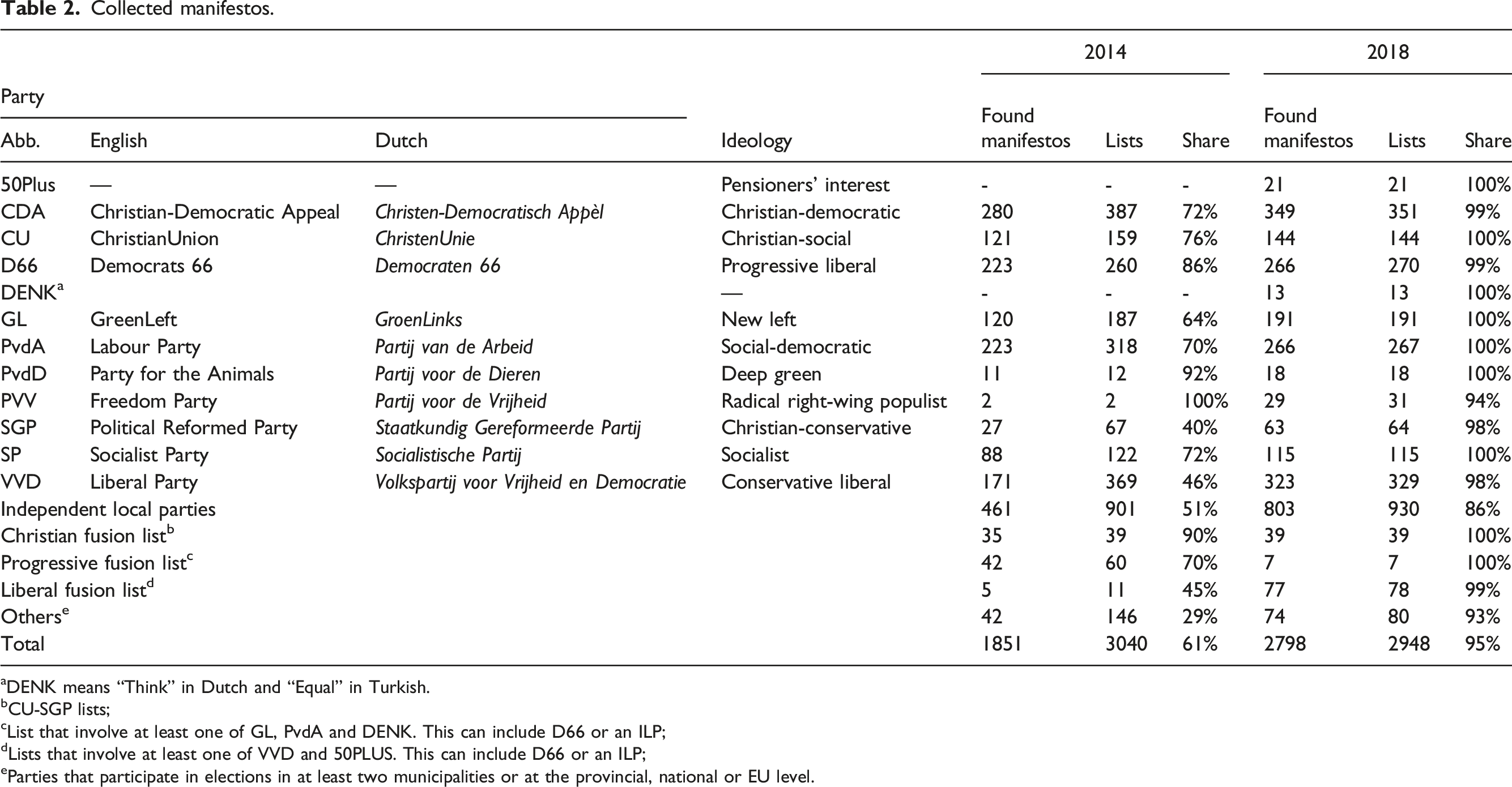
aDENK means “Think” in Dutch and “Equal” in Turkish.
bCU-SGP lists;
cList that involve at least one of GL, PvdA and DENK. This can include D66 or an ILP;
dLists that involve at least one of VVD and 50PLUS. This can include D66 or an ILP;
eParties that participate in elections in at least two municipalities or at the provincial, national or EU level.
Measuring three dimensions
This article places political parties in a political space based on their program. Quantitative, automated techniques are used for this as the programs of all local parties and branches of national parties that participated in the municipal elections in 2014 and 2018 are examined.
These manifestos were analyzed using quantitative, automated techniques. This means that text is treated as a bag-of-words: texts are collections of words that provide information about the position of the author of the text (Laver et al., 2003). The central assumption is that parties with similar views use similar words. The R-module Quanteda is employed for the analysis (Benoit et al., 2018). Manifestos have on average 5910 words. This is 4550 for independent local parties and 6418 for branches of national parties (difference significant at the 0.01-level). Based on the theory section above, three aspects of local programs are of particular interest: the left-right position, localism and anti-elitism.
Programmatic similarity
One might worry that the manifestos of branches of national parties are not unique. These may be structured or even copied verbatim from some template or model program provided by the party’s headquarters (see e.g. Van de Voorde et al., 2018). To assess this, the absolute difference between the word use in a manifesto of a given branch and the word use in the manifestos of all the other branches of that party is calculated. Mathematically:


Where wordi,p is the number of occurrences of a given word in a manifesto of a party branch p and wordi,q is the number of occurrences of a given word in a manifesto of a party branch q. Formula 3 compares Wi,p, the share of all words in a given manifesto that wordi to Vi,p the share of all words in all other branches of the same party except for branch p. It takes all these absolute differences together. This sum is divided by two so it is bounded by zero (all the words in a given manifesto are the same as the words in all the other manifestos of branches of that party) and one (all the words in a given manifesto are not used at all in the other manifestos of branches of that party).
Difference measures.
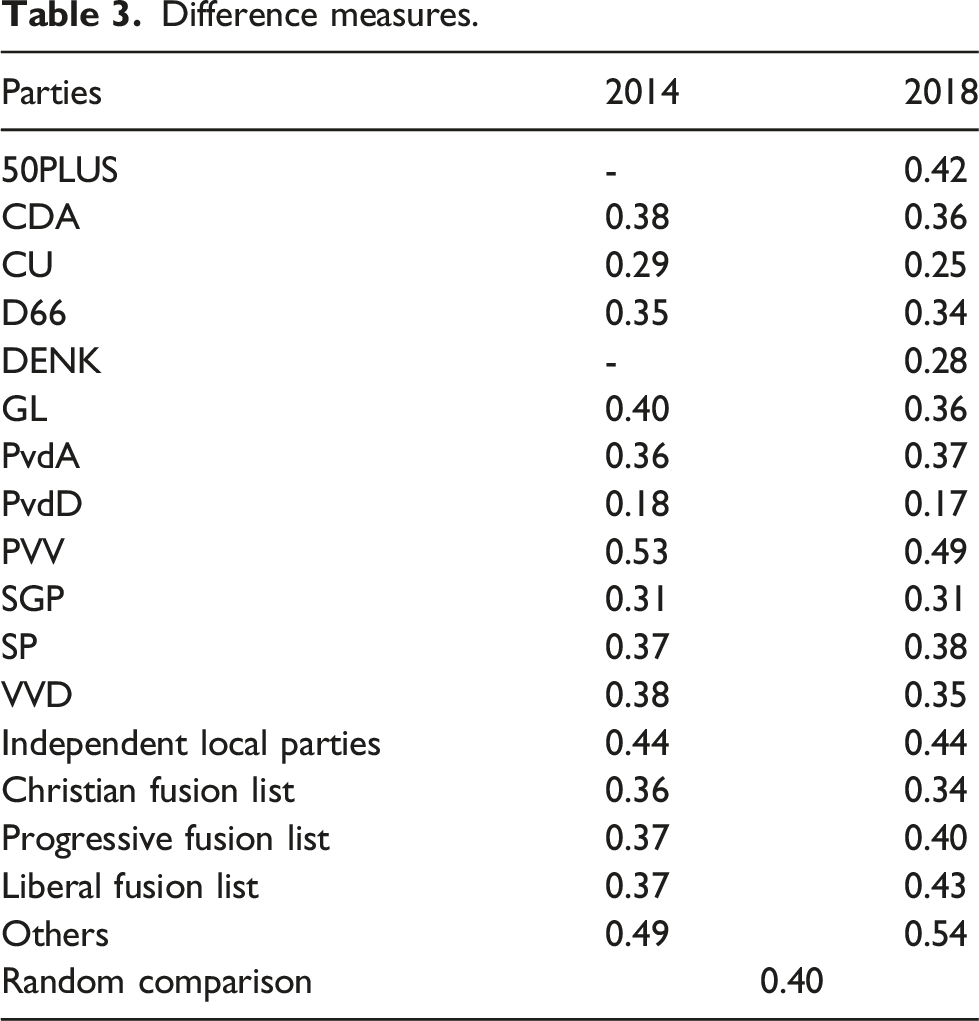
Table 3 shows an average difference score of 0.44 for the independent local parties, 0.40 for the random comparison and around 0.50 for others. That means that because manifestos are all written in the same language (using similar common words) and concern municipal policies which they discuss in similar words, they score just below half of the dimension of completely similar (zero) and completely different (one).
On the other side, there is the Party for the Animals. For this party, it is known that branches made a lot of use of model manifestos. They have a score of 0.17. The other parties score on average around 0.35. They score in between pure chaos and strong coordination. This is not strange given that branches share the same ideology and may use some level of coordination.
The Party for the Animals is the only party where one can see clear signs of coordination. It is important to note here that it is a relatively small share of the manifestos (29 out of 4649 or less than 1% of manifestos). In the Supplementary Appendix, measures are presented where their manifestos are prevented from biasing the results.
Measuring the left-right position
The left-right dimension plays an important role in the way political scientists approach politics at the national level. In order to examine to what extent the left-right dimension can be applied to the local level, this political conflict is imposed deductively on the local level.
The left-right positions of independent local parties and branches are measured on the basis of Wordscores (Laver et al., 2003). For a technical explanation, see Lowe (2008). In non-technical terms, Wordscores is an algorithm that estimates policy positions by comparing two sets of political texts (Laver et al., 2003). The policy positions of the first set are (assumed to be) known. These are “reference texts”. These texts are assigned positions on the basis of an external source. The positions of the second set, the “virgin texts”, are not known. These will be estimated on the basis of the word use in the two texts. For each word in the reference texts one can calculate the probability that given that word, one is reading a particular reference text. Because the policy positions of the different reference texts are known, one can also calculate a “word score” for each word. This is the policy position of a text, given that one only knows this specific word. On the basis of the word scores of each word in a text one can infer the policy positions of that text: each word gives a little bit of information about the position of the virgin text. The more the word use in a virgin text resembles the word use in a reference text, the more likely it is that the policy position reflected in the reference text is similar to the policy position in the virgin text.
In the paper, I follow the application of word scores to local manifestos by Gross (see Debus and Gross, 2016; Gross and Debus, 2018; Gross and Jankowski 2020). As reference text, I use the national manifestos of political parties, I assign these the left-right positions of the national parties from the closest Chapel Hill Expert Schakel and Jeffery, 2013 for 2014 and 2019 for 2017 (Polk et al., 2017). These specifically refer to the position of the party leadership. In Supplementary Appendixes S2, I also present an alternative approach: in this alternative measure, the words in all local manifestos of the national parties from the 2014 and 2018 municipal elections (the entire “bag of words”) are used as reference texts (cf. Mickler 2017). Both methods have drawbacks. The drawback of using national manifestos is that these talk about national issues using the terms common in national politics. Local manifestos may use specific words to refer to their local competences. The drawback of using local bags of words is that this is based on the unproven assumption that the average position of local branches of a party is the position of the national party. Supplementary Appendix S2 also examines alternative operationalizations including limiting the analysis to manifestos with at least 1000 words, removing reference texts that are comparatively short or overly similar and imputing missing manifesto with older or newer manifestos of the same party branch or independent local party, and eliminating outliers.
The transformation proposed by Martin and Vanberg (2008) is employed to make the distribution of parties placed based on Wordscores more similar to the input data. However, their distribution remains problematic (Lowe, 2008). For this reason, more value should be attached to the relative left-right positions than to the absolute left-right positions.
Measuring anti-elitism
To measure the anti-elitist character of a party, this paper builds on the work of Pauwels (2011), who developed a list of words to measure the populist character of a party, which almost exclusively concern anti-elitism (see Supplementary Appendix S3). The measure reflects the permillage of all words from a program that are in this anti-elitist dictionary. In that way, both the localism measure and the anti-elitism measure have a similar numeric range. This means that anti-elitist words are about an order of magnitude less common than localist words.
Measuring localism
Descriptives and correlations.
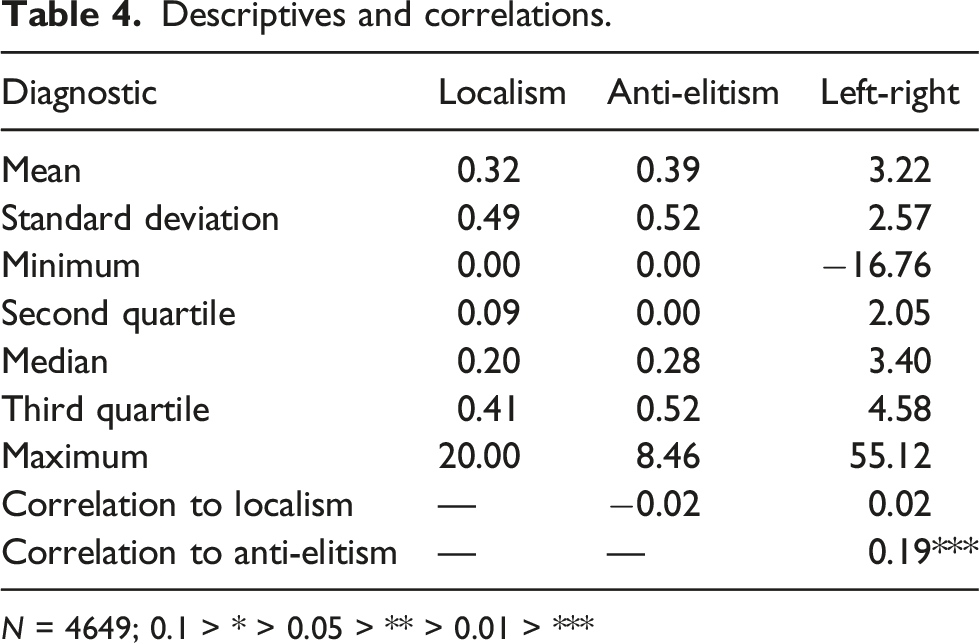
N = 4649; 0.1 > * > 0.05 > ** > 0.01 > ***
Correlations to assess distinctiveness
The first prong of this paper’s approach is assessing the extent to which the different indicators pick up on different variance. The correlations are shown in Table 4. Both correlations with localism are statistically not significant. The correlation between anti-elitism and left-right positions is significant but its strength is negligible. Anti-elitism is slightly more prevalent on the right side of the political spectrum. All in all, these negligible correlations indicate that these measures are independent from each other. 6 This means that they meet the criterion of distinctiveness described above.
Validity
The second criterion examined is “validity”, meaning the extent to which the measure picks up on what is supposed to pick up on. The measures are tested by examining to what extent differences between groups of parties that one can identify on different grounds are reflected in them.
Differences between parties
In order to assess the validity of the measurement, this section will look at independent local parties. As one cannot assume their position on the basis of their national party, it is particularly useful to see whether there are meaningful differences between them and national parties and between subgroups in this family in particular. The following section will formulate three expectations about different groups of parties and the extent to which they differ on the three dimensions.
Differences on the left-right dimension
Dutch independent local parties often claim that what matters in local politics cannot be captured by the left-right dimension (Boogers et al., 2007): they show that a large segment of representatives of local parties cannot position their party on a general left-right dimension. When they do, independent local parties position themselves all over this dimension. This pattern is also confirmed in international research on local parties (Åberg and Ahlberger 2015; Copus and Wingfield, 2014). Local parties are likely to be more spread all over the left-right dimension. 1. Left-right profile hypothesis: The variance of independent local parties on the left-right dimension is greater than the mean variance of branches of specific national parties.
There may be some method to this madness: a number of independent local parties subscribe specifically to national ideologies (Boogers et al., 2007): there are progressive ILPs, which are likely close to the social-democratic Labour Party; there are Christian ILPs, which are likely close to the Christian-Democratic Appeal; there are ILPs for seniors, which are likely close to the national pensioners’ party; and there are liberal ILPs, which are likely close to the Liberal Party.
Independent local parties and anti-elitism
At the local level, anti-elitism can be found in independent local parties without ties to national parties. Their founders are often motivated by dissatisfaction with the local political elite, the dominance of national parties or their way of doing politics and (Boogers and Voerman 2010). In international research, local parties are often characterized as protest parties (Aars and Ringkjøb 2005). Their members show higher levels of distrust in national politics than other citizens do (Angenendt 2018). In the electoral campaign, these parties use an anti-elitist message to appeal to the voters (Boogers et al., 2007). This anti-elitist message also connects with their voters who have less faith in politics than other voters (Otjes, 2018b). All in all, anti-elitism is likely to be stronger among independent local parties than among the branches of national parties. 2. Anti-elitist profile hypothesis: Independent local parties score higher on anti-elitism than national parties.
Independent local parties and localism
Independent local parties often claim to have a localist orientation: as independent local political parties they hold that they represent the specific needs of the local community, unconstrained by the ideologies of national political parties (Åberg and Ahlberger 2015; Boogers and Voerman 2010). Local parties often say that they represent the general interest of a municipality, while national parties in their view only represent the interests of a certain segment of the population (Boogers et al., 2007). As Åberg and Ahlberger (2015, p.817) put it succinctly: “the business of municipal parties is the locality”. The needs of the local community can take many forms: in some specific cases, these independent local parties are founded to save a local hospital, to improve the traffic congestion in their town or to oppose the expansion of industrial areas (Bottom and Crow 2011). 3. Localist profile hypothesis: Independent local parties score higher on localism than national parties.
Using names to identify clusters
The nature of independent local parties is not just reflected in their manifestos but also in their names. In order to test the validity of the three measures, it might be useful to examine differences between different kinds of parties. These are identified on the basis of their names. To test this, one needs a classification of local parties. This article takes inspiration of the approach of Boogers et al. (2007). Commonly used words in party names (see Supplementary Appendix S4) are used to assign categories to the various parties. A number of names can indicate a localist character of a party, such as referring to the municipal interest. There are also names that can indicate a protest character (referring to values such as ‘democracy' and ‘transparency'). In addition, there are local parties that are aligned with ‘national’ political ideologies. There are liberal local parties, Christian local parties and progressive local parties (including greens). One can also identify parties that focus on specific interest such as those of the elderly or the youth.
T-tests are used to examine differences between national party branches and independent local parties in localism and anti-elitism. An F-test is used to test the variance on the left-right dimension. In this case, independent local parties are compared the mean variance of the different branches of national parties. The actual distribution of independent local parties and a simulated distribution for the average variance of national parties are examined. This simulation is bootstrapped 1000 times.
Using name clusters to assess validity
F-Test.
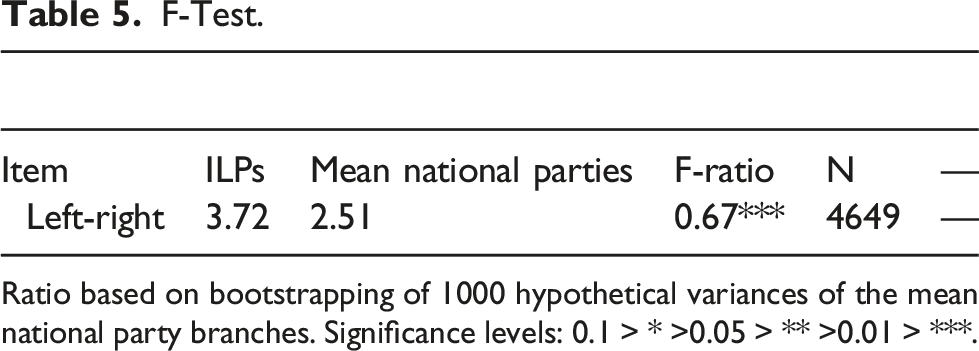
Ratio based on bootstrapping of 1000 hypothetical variances of the mean national party branches. Significance levels: 0.1 > * >0.05 > ** >0.01 > ***.
Figure 1 shows the average left-right placement of party branches per party, fusion lists per type, independent local parties as a whole and different kinds of independent local party. The parties follow an intuitive order, with the Party for the Animals, GL, SP and PvdA on the left, followed by D66, CU and CDA close to the centre and VVD, SGP and PVV further to the right. Independent local parties as a whole are just right of centre on the left-right dimension, in between social-liberal D66 and the Christian-Democratic Appeal. Progressive ILPs are located close to the social-democratic Labour Party. Seniors’ ILPs are located close to the national pensioners’ party 50PLUS. Liberal ILPs stand close to the right-wing Liberal Party. Christian ILPs stand close to the CDA. All in all, these ILPs are close to the positions one would expect on the left-right dimension, given the positions of other parties. Left-right positions among different clusters of parties. Estimates with 90% confidence intervals; upward pointing triangles are national party branches, circle is independent local parties as a group, downward pointing triangles are subfamilies of ILPs; dashed line is mean of the entire sample.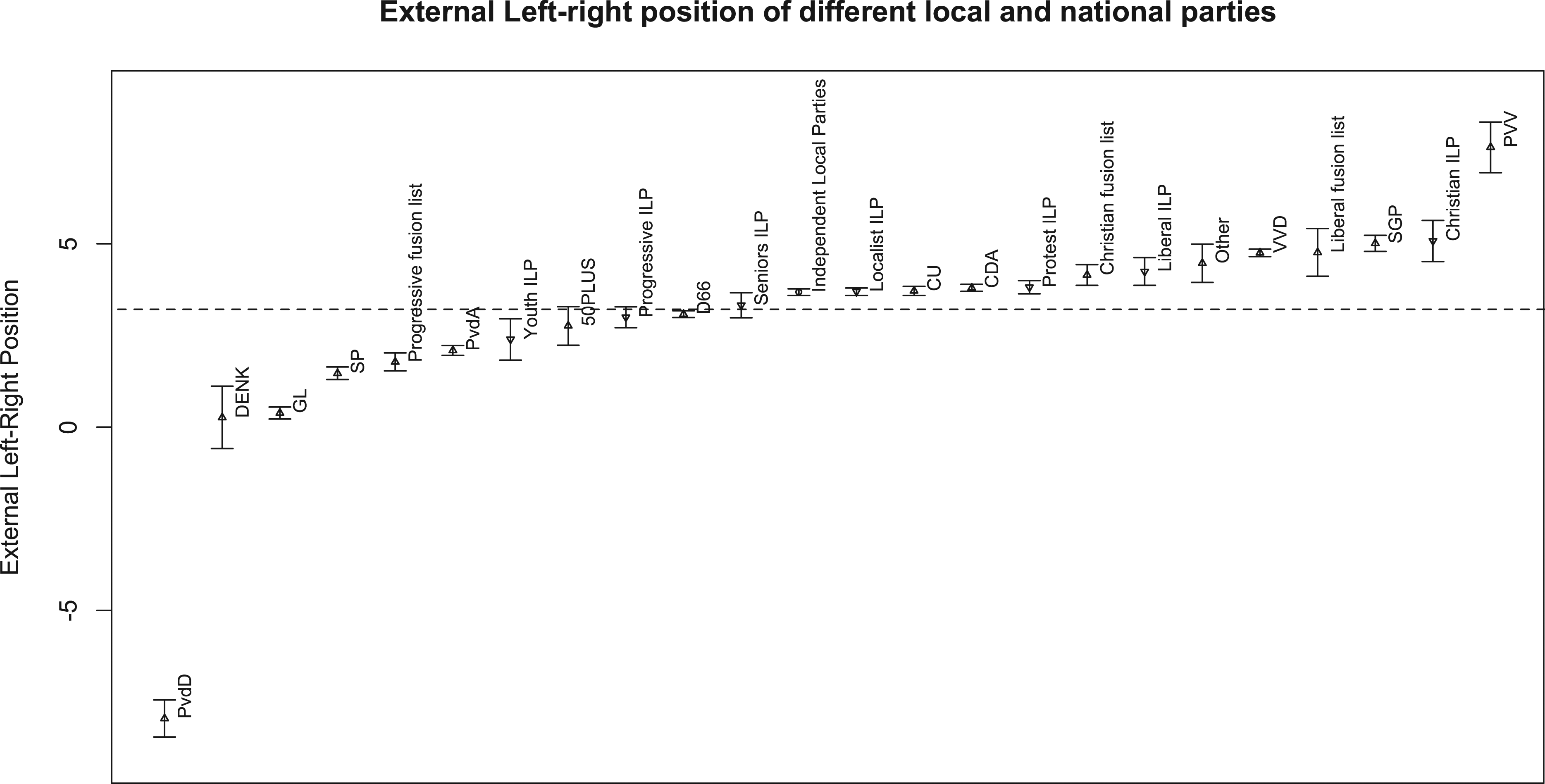
T-tests.
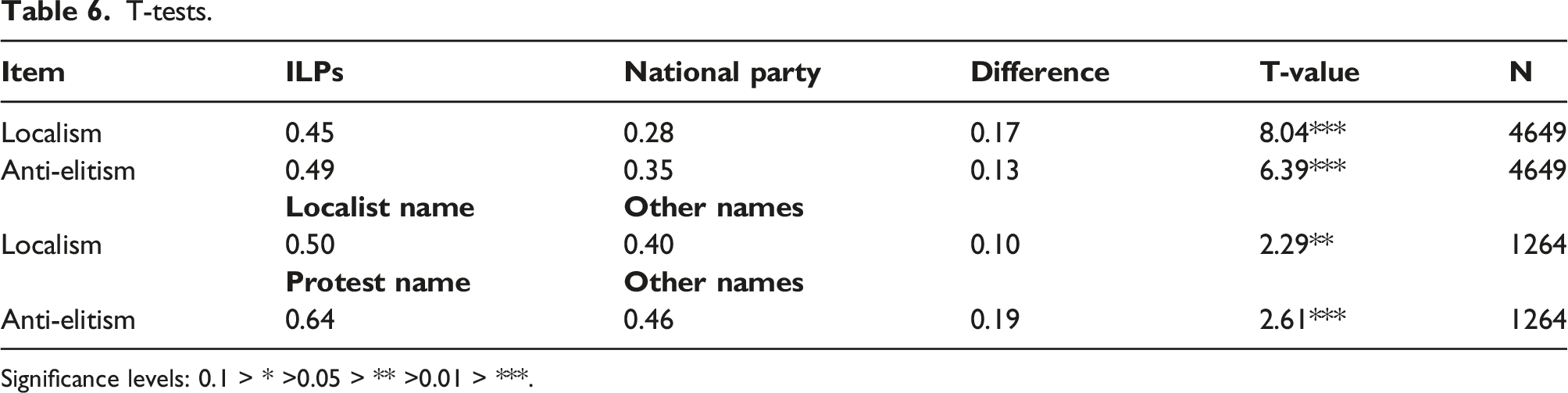
Significance levels: 0.1 > * >0.05 > ** >0.01 > ***.
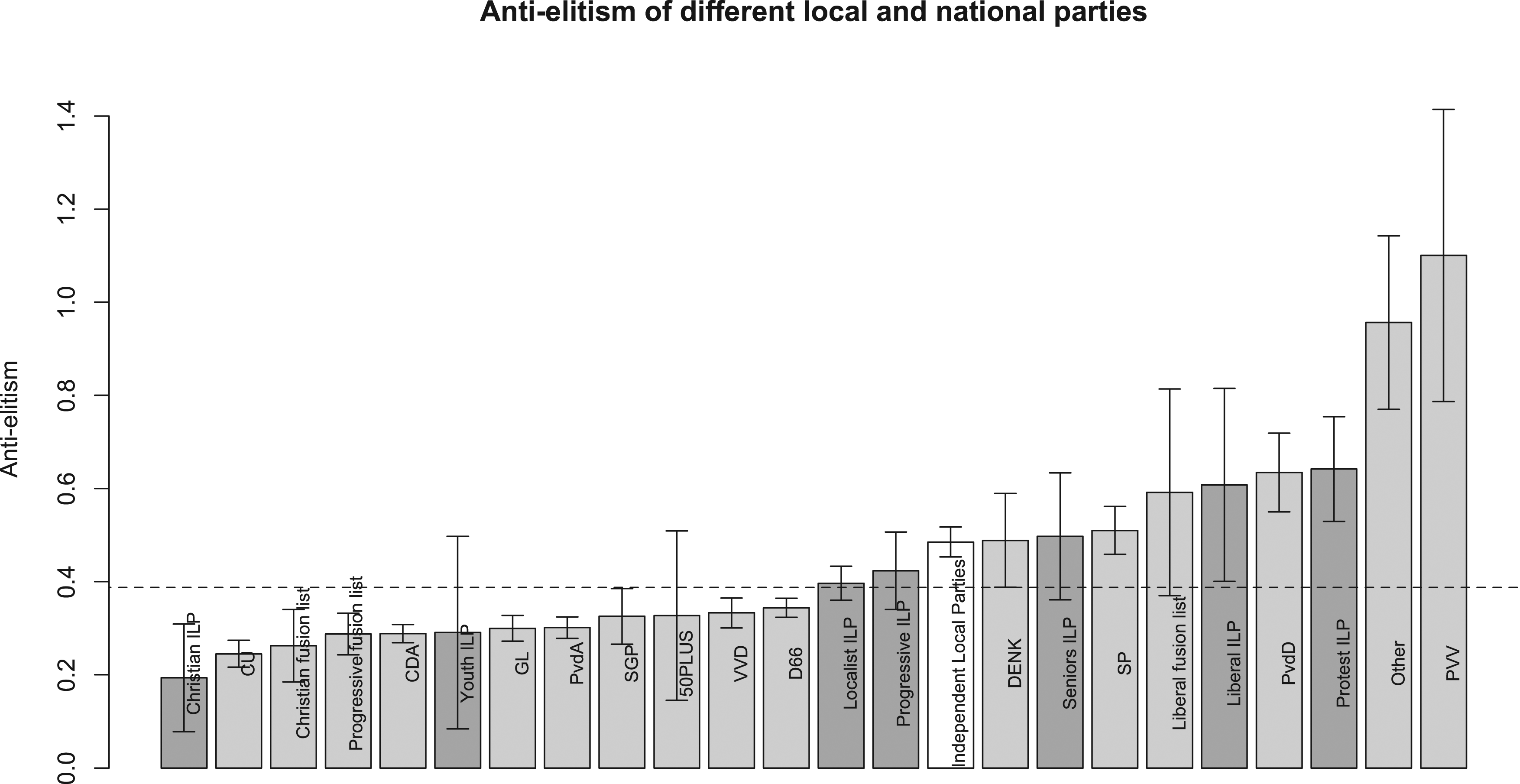
Anti-elitism among different clusters of parties. Estimates with 90% confidence intervals, light grey are national party branches, white is ILPs as a group, dark grey are subfamilies of ILPs; dashed line is mean of the entire sample.
When it comes to localism one can see a clear difference between independent local parties and national parties. On average 45 out 10,000 words in a manifesto of an independent local party refer to local features. This is 28 for national parties. This supports the localist profile hypothesis. Within the family of independent local parties, parties with names that clearly refer to their localist inclinations have a more localist program: on average 50 out of 10,000 words in a manifesto of such a localist party refer to places in the municipality, while this is 40 for other independent local parties. Figure 3 shows that the top five most localist parties includes four kinds of local parties (localist, liberal, protest and progressive) and one national party, the CDA. Localism among different clusters of parties. Estimates with 90% confidence intervals, light grey are national party branches, white is ILPs as a group, dark grey are subfamilies of ILPs; dashed line is mean of the entire sample.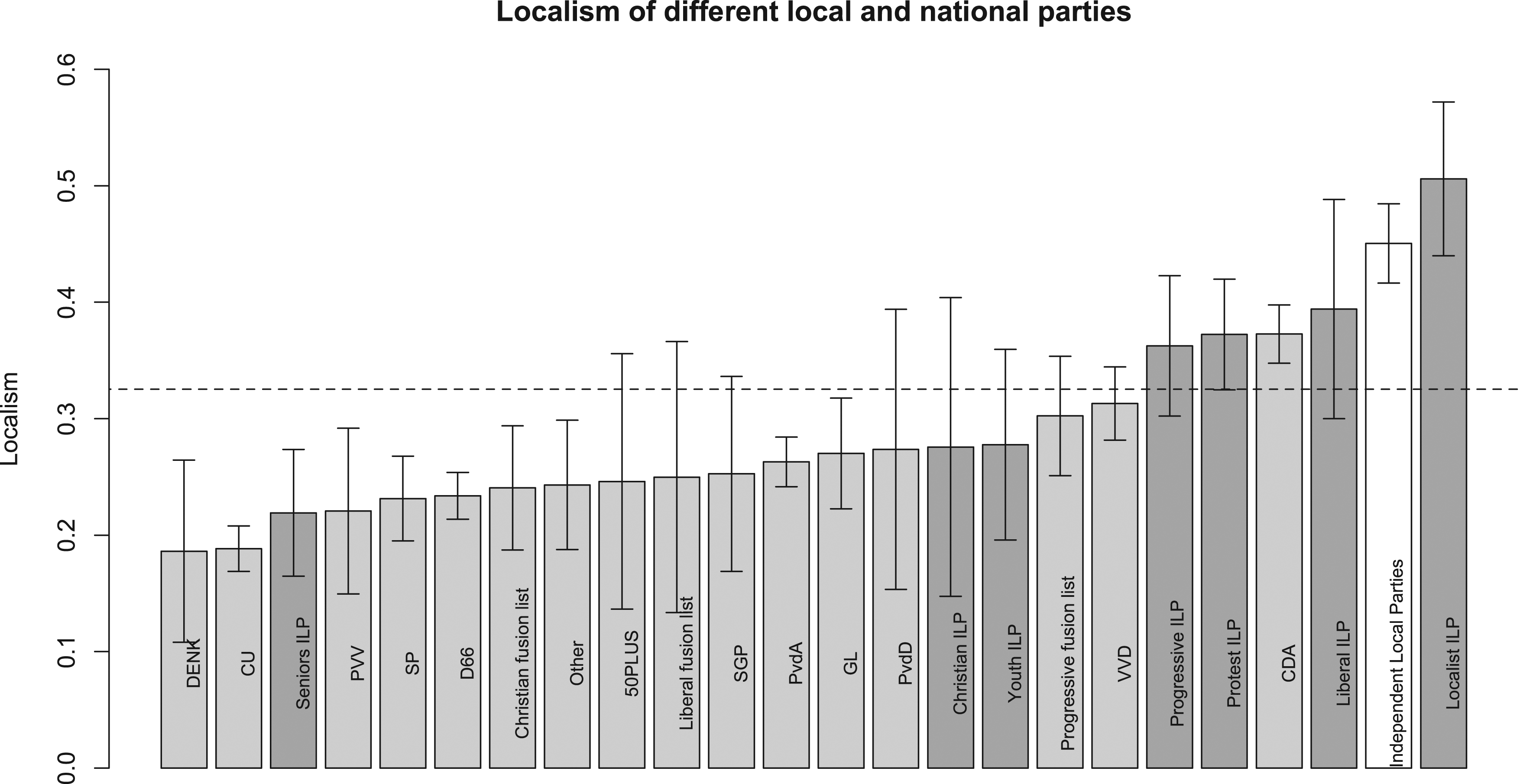
All in all, these three dimensions pick up meaningfully on differences between independent local and national parties and within this broader group of independent local parties. This means that these items meet the criterion ‘validity’.
Utility
While it is clear that these items pick up on differences between parties, the utility of a measure lies in its predictive value. Are these items associated with specific outcomes? In this case, are specific ideological profiles associated with coalition participation?
Predictors of coalition formation
Specifically, three expectations are formulated as to what kind of parties are more likely to enter local coalitions. One should to note here that the purpose of this article is not to offer a complete and comprehensive explanation of which parties end up in coalitions in Dutch municipalities, but rather to test the usefulness of these dimensions for predicting the chance that a party enters a coalition.
The left-right dimension as a predictor of coalition formation
It is well established in the research on national coalition formations that ideological closeness is an important factor in coalition formation (Budge and Laver 1993). Ideologically close parties are more likely to cooperate because the policy they can agree on is more likely to be close to their own preferences. Given the importance of the median party for policy-making, it seems reasonable that the closer a party is to the median party, the more likely it is to enter a coalition (Warwick 1996). One reason for this may be that the median party operates as a formateur deciding who is welcome in government and who is not. But even if the median party has less control over the process, parties closer to the median are likely to enter government, as they have more options to form a coalition than parties further away from the median. 4. Left-right coalition hypothesis: Parties that are closer to the median party on the left-right dimension are more likely to enter the government coalition.
Anti-elitism as a predictor of coalition formation
Anti-elitist parties are less likely to enter governing coalitions. There are two mechanisms behind this: firstly, anti-elitist parties are less likely to want to cooperate and strike deals with established parties due to their anti-elitist views. Secondly, anti-elitist parties are more likely to be blocked from governing coalitions by established parties because of their anti-elitist rhetoric. At the national level “populist radical right government participation remains a rarity in Western Europe” (Mudde 2013: p.4, but see Taggart and Pirro 2021). Populist radical right parties with anti-system views are often treated as pariah parties and blocked from access to government by a cordon sanitaire (Geys et al., 2006; Martin and Stevenson 2001). 5. Anti-elitist coalition hypothesis: Parties with an anti-elitist orientation are less likely to enter government.
Localism as a predictor of coalition formation
Localism is a focus on the needs and the autonomy of the municipality. It reflects the idea that every municipal community has a clearly defined general interest. This goes hand in hand with the notion that existing party ideologies are irrelevant at the local level and that politics should be oriented at solving the local problems with common sense (Boogers et al., 2007). This makes localist parties likely to avoid ideological zealotry and to be more pragmatic. A localist party might be an easy coalition partner as they can be convinced to join a coalition with concrete steps instead of ideological utopias. 6. Localist coalition hypothesis: Parties with a localist orientation are more likely to enter government.
Modelling coalition participation
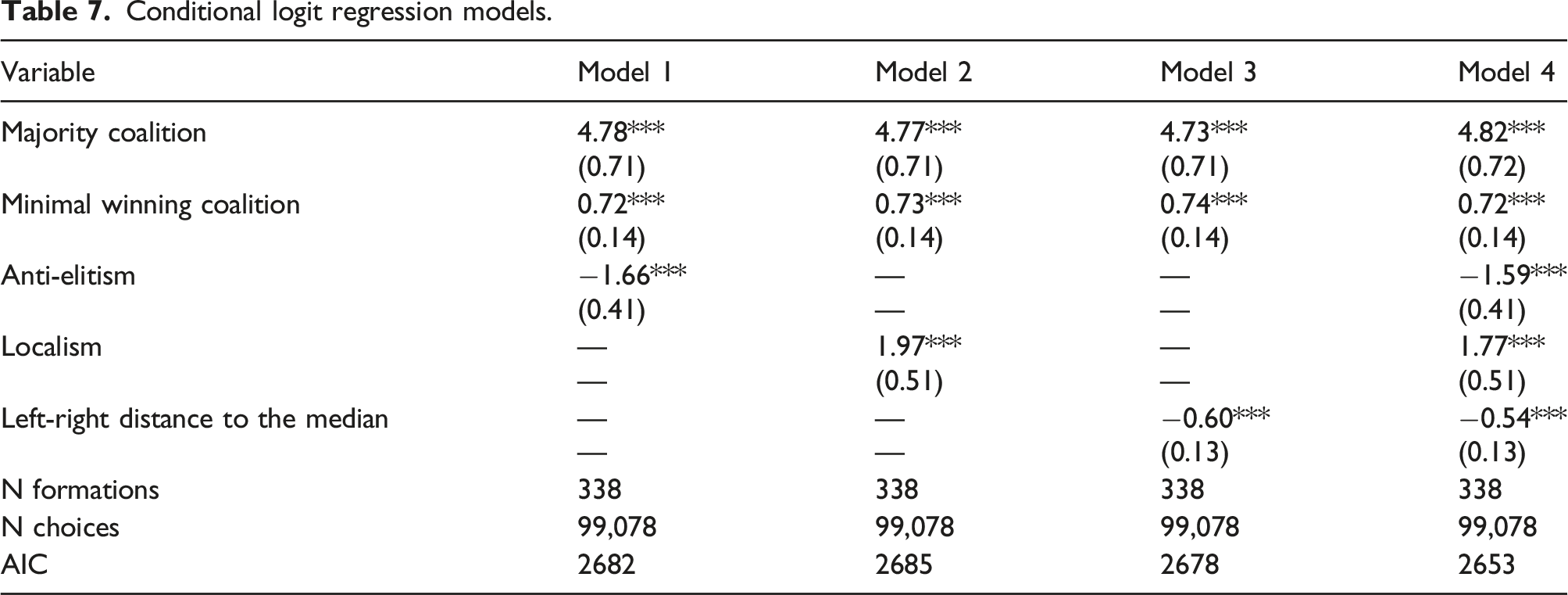
While historically, people have studied local coalition formation by examining whether party x does or does not end up in the local coalition (e.g. Warwick 1996), recent contributions to the literature emphasize that one has to study the composition of the entire coalition (Glasgow and Golder, 2015; Glasgow et al., 2012). There are two reasons for this: firstly, the chance of one party entering a coalition is not independent of the chance of another party entering the coalition. In the end the formation of a coalition depends upon the agreement of all parties in that coalition. Secondly, characteristics of the government matter. For instance, minimal-winning coalitions are more likely to be formed than either minority or oversized coalitions. One can have a very ideologically coherent coalition, if it does not have a majority, it is unlikely to be formed. Glasgow and Golder (2015) proposes that a conditional logit model where one examines which of all hypothetical coalition is actually formed addresses these two issues. It has been applied successfully to municipal coalition formation by Gross, (2021). The key assumption of the model is that the probability of a party entering a coalition does not depend on characteristics of the party, but rather on the characteristics of the potential coalition as a whole. Therefore, one should look at the characteristics of all possible coalitions and see which one is selected. Conditional Logit Regression is used to analyze the likelihood of a particular coalition being formed. In each municipality*year dyad, every coalition of parties with seats in the council, that is mathematically possible, is listed. Out of these possible choices, one coalition is actually formed. That one has value one, the others have value zero. The goal here is specifically not to offer a comprehensive model of coalition participation at the local level, but to illustrate how programmatic differences are reflected in differences in coalition participation.
One can examine the characteristics of these coalitions. What is relevant is whether they command a majority in the municipal council as those are more likely to form. Minimal winning coalitions are also more likely to be formed than minority coalitions or oversized coalitions. Substantially relevant is the ideological composition of the coalition. The (unweighted) average anti-elitism of the coalition parties and the average localism of the coalition parties is calculated. For the left-right dimension, the distance to the seat-weighted median on the left-right dimension is examined. So, for every council, the seat-weighted median on the left-right dimension is calculated. Subsequently, for every party the difference between their own left-right position and this median is calculated. Note that in this approach a lack of information on one party in the council can lead to missing values for all parties in that municipalities. 7 This severely reduces the N of this measure. In order to increase the number of cases, if a manifesto is missing in a particular year, for the analyses in the paper, it is replaced by the value of the manifesto from the previous or the next election. In the paper, 338 formations with a total of 99,078 possible options are analysed. In Supplementary Appendix S5, a number of additional approaches to deal with the problem of missing cases are employed. Those analyses have another N.
The coalition participation is drawn from coalition agreements from 2014 and 2018, which are collected by the Open State Foundation. 8 If these coalition agreements do no list the parties that are signatory of the document, this was obtained from media. If the media did not report this, the composition from the local executive was obtained from the website of the municipality or other online sources. To test the robustness of the results, logistic regressions with standard errors clustered at the municipality*year level are employed using left-right ideology, anti-elitism and localism as predictors in Supplementary Appendix S6. These analyses are restricted to parties that won at least one seat in a local council. Supplementary Appendix S7 looks at the effect of the inclusion of seats in that analysis.
Predicting coalition participation
Conditional logit regression models.
Conclusion
This paper presented a three-pronged approach to assess which dimensions structure political conflict at the local level. Three dimensions were employed: the left-right dimension that characterizes national politics, the anti-elitism dimension that plays an increasingly prominent role in politics at the national level; and a localism dimension which specifically relates to local politics. There is ample evidence for the distinctiveness, external validity and utility of these three dimensions. They are not even moderately correlated to each other (distinctiveness). They reflect meaningful differences between different groups of parties (both between national party branches and independent local parties and within different clusters of independent local parties). The higher level of localism and anti-elitism among independent local parties conforms to the hypotheses. In terms of variance on the left-right dimension, they show less consistency than national parties, although that may depend on the method of text analysis. The differences in the manifestos are also reflected in differences in coalition participation, with localist parties joining these coalitions more often, and anti-elitist parties and parties further from the median joining them less often; these results are in line with the three hypotheses on coalition participation.
These results show that anti-elitism, localism and the left-right dimension are useful tools for understanding local politics in the Netherlands. Of course, one cannot say definitively that these dimensions describe the complete political landscape. More precise tools may be useful to chart more specific differences between political parties, but these three offer a promising toolbox for future research. So far, these differences have been used to look at the outcomes of local coalition formation in the Netherlands. In future research, the importance of these ideological factors can be contrasted to other factors such as prior coalition experience. These studies may also examine the relative importance of these factors smaller and larger municipalities. This paper focused on parties. This ignores the nesting of the parties in municipalities. Differences between municipalities are left unaddressed in this paper. Supplementary Appendix S8 briefly explores the political differences between municipalities of different sizes. This shows that in smaller municipalities politics is less politicized and less ideological. The causes and consequences of this are left to further study.
Future studies can also examine whether these differences can be used to predict other elements of party behaviour at the local level, such as the use of parliamentary tools by local council groups. These three dimensions may also travel to other systems. Once local manifestos are collected, these dimensions can be applied on them, since the tools are not language-dependent (or in the case of the Pauwels’ dictionary, dictionaries in other languages are available). Future research may want to examine the relevance of these dimensions for other forms of behaviour and in other national contexts.
Supplemental Material
Supplemental material - Local political space: Localism, the left-right dimension and anti-elitism
Supplemental material for Local political space: Localism, the left-right dimension and anti-elitism by Simon Otjes in Journal of Party Politics
Footnotes
Acknowledgements
The author would like to express his sincere gratitude to following people: firstly to Joes de Natris and Maarten Allers from the Centre on Local Government Economics and Gerrit Voerman from the Documentation Centre Dutch Political Parties of Groningen University for their cooperation in the Netherlands Local Manifesto Project; Secondly, to Julien van Ostaaijen, Martin Gross, Rick van Well, Tom Louwerse, the attendants of the workshop on local government of the 2019 Dutch-Flemish political science conference and the October 2021 Lunch Seminar of the Institute of Political Science of Leiden University, the editor of this journal and the anonymous peer reviewers for their insightful comments and suggestions; Thirdly to Erik van Gameren and Titia Ketelaar of the NRC, Renée van Oss of Necker van Naem, and ProDemos for sharing manifestos that they had in their collections; Fourthly, to Daan van Gulik, Dennis Oudman, Jeroen Hoving, Jochem Duinhof, Julia van Aart, Lydia Reinders, Milan Mulder Milou Peters, Sander Jenissen and Svenne Groeneweg for their work collecting the manifestos; Fifthly, to Geodienst of Groningen University and Harmen van der Veer for their assistance with the geographic data; Finally, to Niki Haringsma for his excellent editorial assitance.
Declaration of conflicting interests
The author(s) declared no potential conflicts of interest with respect to the research, authorship, and/or publication of this article.
Funding
The author(s) disclosed receipt of the following financial support for the research, authorship, and/or publication of this article: This work was supported by the Ministerie van Binnenlandse Zaken en Koninkrijksrelaties.

Notes
Author Biography
References
Supplementary Material
Please find the following supplemental material available below.
For Open Access articles published under a Creative Commons License, all supplemental material carries the same license as the article it is associated with.
For non-Open Access articles published, all supplemental material carries a non-exclusive license, and permission requests for re-use of supplemental material or any part of supplemental material shall be sent directly to the copyright owner as specified in the copyright notice associated with the article.
