




Abstract
The Netherlands Local Manifesto Project (NLMP) collects manifestos of parties running in local elections in the Netherlands. It is not just the largest collection of party manifestos running in local elections in the world, but actually is the largest collection of party manifestos globally. This article introduces the NLMP: we briefly introduce the specificities of local government in the Netherlands. We then explain the structure of the data set and how it was collected. We illustrate its utility by looking at a simple example analysis that can be performed with it, examining the length of election manifestos in municipalities of different sizes. We conclude by sketching a broader research agenda.
Introduction
The study of election manifestos is a key theme in research about elections and parties around the world. Through the systematic analysis of election manifestos, researchers can answer important questions about competition in elections, behaviour in legislatures and cooperation in governments. However, nearly all of this research focuses on the national level. This is the result of methodological nationalism (Jeffery and Wincott 2010). To address this research gap, political science has witnessed an increase in research on manifestos from the subnational level in recent years. This research, however, is mostly focused on the regional level (e.g., Clark and Bennie 2018). The study of manifestos from the local, municipal level is still a blind spot in the comparative political science literature. These local manifestos do exist, but so far, only a few political scientists have collected a substantive number of them for systematic analysis (Agasoster 2001; Ashworth 2000; Broekema et al., 2021; De Natris, 2024; Gross and Jankowski 2020; Otjes 2024; Van de Voorde et al., 2018). The Netherlands Local Manifesto Project (NLMP) forms an important innovation in this field. It seeks to address this lacuna by offering a data set of all election manifestos from all municipalities in a 12-year period for a single country (the Netherlands). It brings together more than 7000 manifestos. The data set has manifestos for 83% of the parties running in municipal elections between 2014 and 2022. This is –to our knowledge– the largest set of election manifestos in the world.
For the study of local election competition, local manifestos are of particular importance. Manifestos are of course studied at the national level as well, but here authors can also rely on party placement by experts or on surveys of party elites (e.g., MP surveys). Expert surveys are not available at the local level. Methodological nationalism, the neglect of local party politics by political scientists, makes it impossible to do this: the pool of specialists in local government is insufficient to base estimates for specific municipal parties on. One might perhaps reach out to journalists. Yet, the state of local media is such that not even every municipality has one journalist devoted to the business of politics in that municipality (Wadbring and Bergström 2017). An alternative approach might be to use elite surveys (e.g., surveys of municipal councilors). Yet, after years of overgrazing this common pool resource the response rates, for instance, in the Netherlands are abysmal: the response rate of recent national survey of Dutch councillors sponsored by the Ministry of Home Affairs and Kingdom Relations and endorsed by the Dutch Association of Municipal Councillors was less than 20% (Van der Kolk and Vollaard, 2024). All in all, a collection of local manifestos is of the utmost importance to study patterns of party competition and cooperation at the local level.
In this research note, we discuss the motivation for building this dataset, the case of local government in the Netherlands and how the data set was put together. We also illustrate the utility of dataset by identifying a number of predictors of manifesto length. Examining manifesto length is not just a nice, simple illustration of the utility of data set. Manifesto length is particularly relevant for reliably and validly estimating policy positions or issue salience from political texts (Benoit et al., 2009; Dandoy and Acurio, 2023; Volkens, 2003). That means that understanding which factors contribute to manifestos being shorter is an important step prior to more substantive research into patterns of local party competition and cooperation. A final section concludes.
Motivation
Election manifestos still form the central public document reflecting a party’s comprehensive policy agenda. They have a number of important functions (Eder et al., 2017): the first function is informing citizens about party positions. They contain the most important policy positions of a party on what they see as the main issues in the election. Though not many citizens directly read these manifestos cover to cover, the positions from these manifestos do reach them: through the party’s flyers and social media posts, journalistic summaries of these documents and voting advice applications. Manifestos thus play an important role in party competition, as parties use them to contrast their own positions to the positions taken by other parties in their manifestos. They are not only important for prospective voting though: as parties commit themselves to specific policies in their manifesto, the media and citizens can use them to assess to what extent parties were able to implement their promises during the legislative period. The second function is the role election manifestos play inside of parties. This is the official position that the party meeting agreed on. They unify the party, more than the high-minded oratory of individual politicians. The process of manifesto writing is a process of consensus-building: the party meeting where the document is adopted is often preceded by working sessions of party members, meetings with outside interest groups and extensive review sessions with sitting politicians. The third function is in the formation of new executive coalitions. The parties negotiating to form a governing coalition do so with their manifestos on the table (Otjes and Willumsen, 2025). They seek to realize these in the coalition negotiations. The choice about which parties will form a coalition, what the coalition agreement will look like and which portfolios in the executive parties will claim will reflect the preferences of parties as stated in their election manifestos.
Given these important functions, it is not surprising that election manifestos are among the central data sources in the study of political parties. Researchers use election manifestos to determine the policy positions that political parties take and the priorities they attached to specific policy issues. The research group variously known as the Manifesto Project, the Manifesto Research Group and the Comparative Manifesto Project has collected an impressive data set, which has become a crucial part of the infrastructure of comparative political science. As of August 2025, they have 5151 manifestos in their data set from 1387 parties, 856 elections in 67 countries since 1945 (Lehmann et al., 2024). The Regional Manifestos Project (Alonso et al., 2013; Cabeza et al., 2017) followed in the footsteps by collecting regional-level manifestos in Italy, Spain, and the United Kingdom.
So far, local election manifestos are mostly overlooked. Yet municipal politics has increased in importance in recent decades. Many European countries have decentralized responsibilities to municipalities (Ladner et al., 2019). Municipalities have become pivotal pillars of the public sector dealing with complex policy problems that have a considerable impact on people’s everyday lives (Hajnal 2014). Local governments play an important role in providing public safety and social services, levying taxes and determining land use. In some countries, like the Netherlands, Denmark and Finland, the distribution of responsibilities and resources has an hourglass shape (Binnema and Vollaard 2021), with regions having little responsibilities and limited budgets, wedged between national and municipal governments that wield more power and resources. An assumption underpinning these decentralization is that local governments are better able cater to the needs of local communities (Oates 1972). Yet, in the study of local congruence the positions or priorities of politicians and parties are typically inferred from their partisanship (e.g., Tausanovitch and Warshaw 2014). Understanding local party politics is substantively important given their responsibilities over the everyday lives of many citizens and it is of increasing importance given the growth in municipal responsibilities in many countries. We do not know whether local party politics follows the logic of national or regional politics or whether it has its own logic. The study of local politics too often is founded on “all kinds of impressions which are based on little empirical evidence” (Peters and Castenmiller 2018: p.223). Reflecting the notion that there is “no Republican or Democratic way to clean the road” (LaGuardia cited in Garrett 1961: 274), much of the literature emphasizes that local politics is depoliticized, focused on consensus and the pragmatically solving problems (Barber 2013; Navarro et al., 2018). Yet, there are sufficient cases where researcher find “political overdrive, too much politicization […] sharp contrasts” (Voermans et al., 2014). To understand the level of politicization in local government, it is important to obtain a comprehensive, comparable, and fine-grained collection of local manifestos (see also Reuse 2025).
We believe that the study of local party politics also comes with scientific benefits: “going local” circumvents “the many variables, small N″ problem that characterizes comparative political science (Lijphart 1971). Studying local government offers a wealth of cases and data (Haider-Markel 2014): municipalities offer far more diversity and variance than is available at the national or the regional level. There are municipalities with fewer than a thousand inhabitants and municipalities that have more inhabitants than some sovereign nations. This offers far more variance to test existing theories about the role of manifestos in party politics (e.g., Green-Pedersen 2019).
The lack of studies of local manifestos has a practical reason: The collection of election manifestos of a significant share of municipalities in a country is labour-intensive. The analysis of these manifestos requires a quantitative, computer-assisted methodology. Scholars like Van de Voorde et al. (2018) have handcoded samples of local election manifestos. In the last decades, there has been a revolution in the study of political texts, enabling the analysis of large text-based corpora. Studies like Gross and Jankowski (2020) and Otjes (2024) show that these methods are an ideal fit for the study of local election manifestos.
Case of the Netherlands
The Netherlands Local Manifesto Project differs from previous research on the manifestos of political parties at the local level. These studies focus on the manifestos of a limited sample of municipalities. These samples are limited to specific regions, to municipalities of a specific size, or random sampling (Ashworth 2000; Debus and Gross, 2016; Gross and Jankowski, 2020; Van de Voorde et al., 2018). The NLMP focuses on the manifestos of all parties in all municipalities in a single country. Though the scope of this project is limited in that it focuses a single country, the NLMP throws a wider net than earlier collection projects.
The NLMP examines all the manifestos of all Dutch political parties than ran in municipal elections between 2013 and 2022. The Netherlands is a densely populated, decentralized unitary state (Andeweg et al., 2020). Because of continual amalgamation, the number of Dutch municipalities declines nearly every year (Allers et al., 2021). At the start of 2014, the Netherlands had 403 municipalities. By the end of 2022, this had been reduced to 344. Municipalities in the Netherlands are comparatively large: in 2022 the average municipality had 51,136 inhabitants. The largest municipality (Amsterdam) had 903,399 inhabitants, while the smallest municipality, the island Schiermonnikoog, had only 944 inhabitants. Despite these differences in size, the basic institutional characteristics are the same in every municipality (De Blok et al., 2024). The Dutch decentralized unitary state has been describes as an ‘hourglass’ (Binnema and Vollaard 2021) with the central and the municipal level having most policy making responsibilities: Municipalities are assigned responsibilities over the physical domain (spatial planning, housing, transport), the social domain (elderly care, youth care and the income and participation of long-term unemployed) and on matters of safety. Like many European countries, the Netherlands use party-list proportional representation in local elections (Van de Voorde et al., 2018). In general, municipal elections in the Netherlands are held every 4 years in March, except in newly formed (amalgamated) municipalities. 1 A specific feature of Dutch local government is that who is mayor is appointed by the central government through a non-partisan selection process (Schaap et al., 2009). This incentivizes party-based instead of person-based electoral competition.
The Netherlands have a highly pluralistic multiparty system, which is also reflected at the local level. On average eight parties take part in municipal elections in each municipality. Mostly, these are the Christian-Democrats, the Liberal Party and the Labour Party. They are often also joined by Independent Local Parties (ILPs). These are parties that contest elections in only one municipality and that are not part of, formed by or organizationally related to parties contesting elections in other municipalities or at the regional, national or European level (Otjes 2018, 2020). They come in two organizational forms: the most common is a local association that is independent from any party active at a higher level, that set up a list for the elections. Such independent local parties are not registered with the national election council but only with the central municipal election board. Less common is to submit a “blank list” that lacks any party identification, but it is simply a list of candidates. These are submitted by these candidates without the need to register of a party name. Even in the smallest municipalities, the share of votes of independent local parties is, on average, 38% (see Appendix A3 for details). The Labour Party often runs on progressive joint lists with the GreenLeft or the social-liberal D66, which also run independently in many municipalities, as does the left-wing populist Socialist Party. The Christian-social ChristianUnion and the Christian-conservative Christian Political Reformed Party also run in a number of municipalities, either independently or on a Christian joint list. Six other nationally active parties and the Frisian National Party (that is only active in one province) also run at the municipal level. In practice, nearly all parties fielding a list of candidates also have an election manifesto.
Municipal characteristics in European countries.
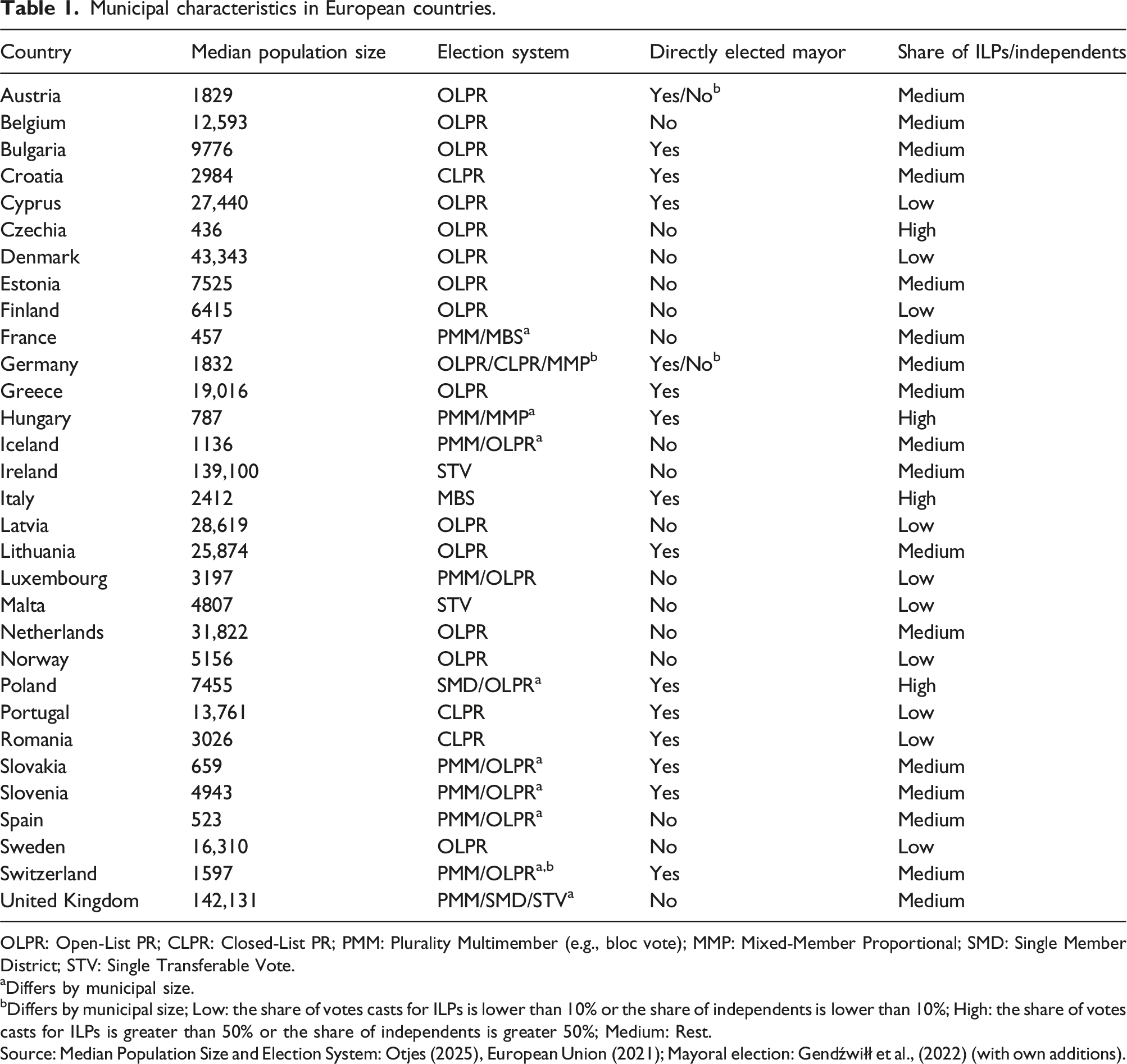
OLPR: Open-List PR; CLPR: Closed-List PR; PMM: Plurality Multimember (e.g., bloc vote); MMP: Mixed-Member Proportional; SMD: Single Member District; STV: Single Transferable Vote.
aDiffers by municipal size.
bDiffers by municipal size; Low: the share of votes casts for ILPs is lower than 10% or the share of independents is lower than 10%; High: the share of votes casts for ILPs is greater than 50% or the share of independents is greater 50%; Medium: Rest.
Source: Median Population Size and Election System: Otjes (2025), European Union (2021); Mayoral election: Gendźwiłł et al., (2022) (with own additions).
With its relatively large municipalities, the use of list PR, the absence of directly elected mayors and a significant share of independent (local) candidates, the Netherlands is most comparable to Belgium and Estonia, and to a lesser extent to Spain, Czechia and Iceland (where municipalities are much smaller) and Latvia, Denmark, Sweden, Finland and Norway and Luxembourg (where the party system is more nationalized). We believe, however, that the Netherlands has greater value for the literature on comparative local government: the absence of directly elected mayors, the relatively large municipalities and the party-list system makes the Dutch local government a likely arena to observe party-based competition (as opposed to personalist competition). This, in combination with the extreme diversity of the Dutch political system, makes it a likely case to find substantive differences in the manifestos of parties.
Data set
Collected manifestos.
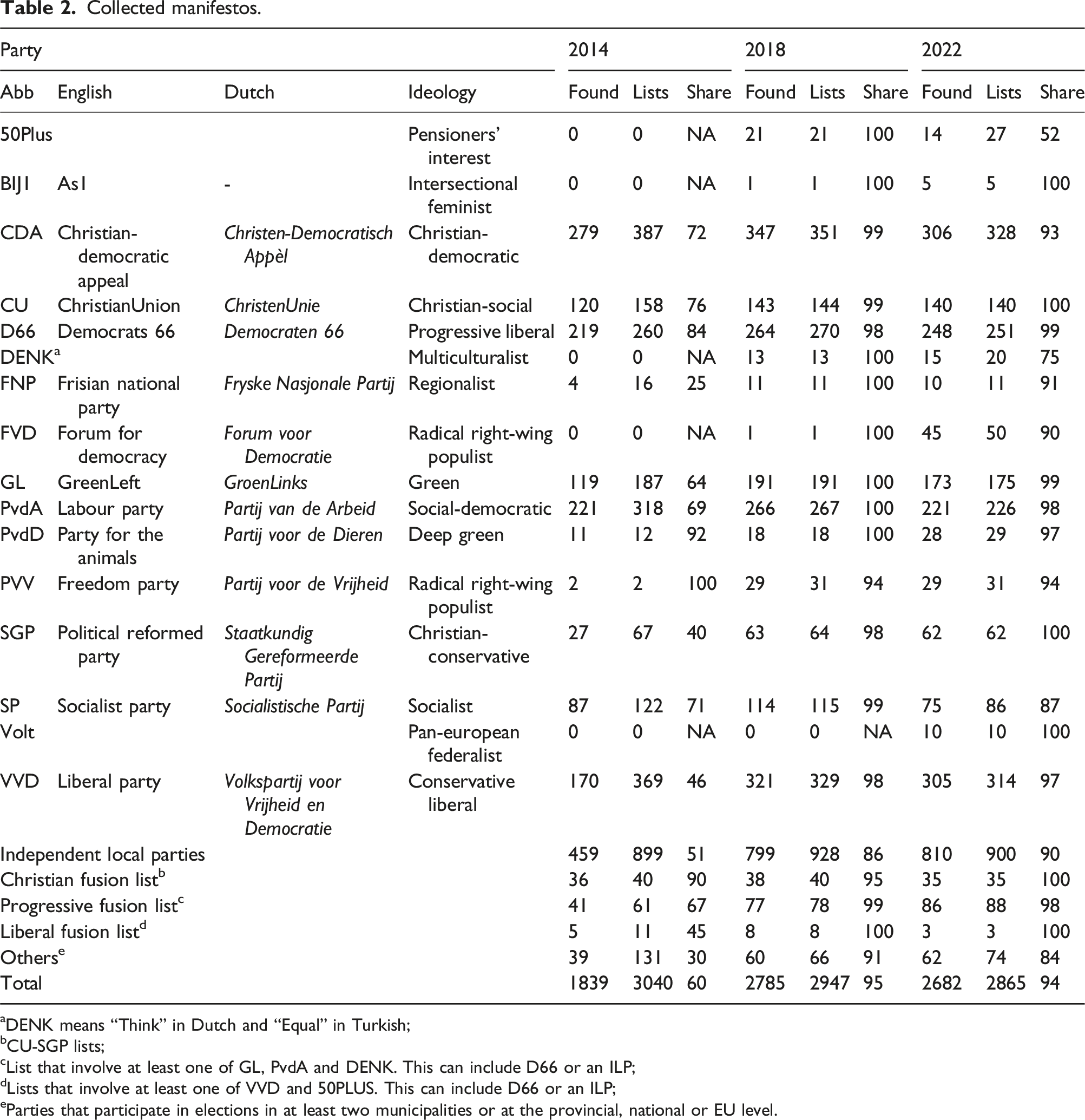
aDENK means “Think” in Dutch and “Equal” in Turkish;
bCU-SGP lists;
cList that involve at least one of GL, PvdA and DENK. This can include D66 or an ILP;
dLists that involve at least one of VVD and 50PLUS. This can include D66 or an ILP;
eParties that participate in elections in at least two municipalities or at the provincial, national or EU level.
Illustration
We illustrate the usefulness of our data set by analysing the length of manifestos. The length of manifestos is important: the information one can obtain from an analysis of election manifestos depends on their length (Volkens, 2003): longer programs provide more detailed information about policy positions (Benoit et al., 2009). Many approaches of the analysis of manifestos look at the share of a manifesto devoted to an issue, the exact same page of text in a manifesto of 10 pages signals 10 times more salience than that page of text in a manifesto of one hundred pages (Dandoy and Acurio, 2023). All in all, manifesto length has important implications for the extent to which positions can be reliably or validly estimated from texts. Yet, the literature about the length of manifestos is very small (Dandoy and Acurio, 2023). Therefore, it is important to understand what drives manifesto length. These issues are, as we detail below, particularly relevant at the local level, because here manifestos can be quite short.
Expectations
As an illustration of our data set, we look at a limited number of variables that might be correlated with manifesto length: population size, population density, being an independent local party and year.
A widely shared notion in political science research is that larger communities face more complex societies than smaller ones (Dahl and Tufte 1973; Denters et al., 2014; Veenendaal 2015). This idea can be traced back to classical authors like Aristotle (1981) and Rousseau (1762). In larger communities, there are (likely) more diverse population groups, differing interests, and weaker social cohesion (Baldersheim and Rose, 2010; Gerring and Veenendaal, 2020; Skoog and Karlsson, 2018). The weaker social cohesion means that there will be fewer non-political solutions to societal issues. With a weaker civil society, politics has a larger role to play. Additionally, societal problems such as homelessness (Lee et al., 2003), crime (Lee et al., 2017), and poverty (Teitz and Chapple, 1998) are more prevalent in large cities. We also know that politics in smaller communities tends to have a more informal character (Veenendaal 2015): Politicians and citizens are more likely to know each other (Oliver, 2012) and citizens are more likely to contact a politician (Schwarz, 2002; Verba and Nie, 1972). In smaller polities social structures tend to be more dense and therefore personal connections between politicians and citizens and overlapping social roles are more common (Corbett 2015; Dahl and Tufte 1973; Denters et al., 2014; Gerring and Veenendaal, 2020). Due to direct contacts and social interconnectivity, political processes more often occur outside formal political channels (Veenendaal, 2015). This undermines the need for detailed policy programs. We therefore expect that parties in larger subnational polities, parties write longer manifestos (Dandoy and Acurio, 2023). Like other patterns related to polity size (Taagepera 1972), we expect the relationship to be non-linear. The effects of municipal size are likely strongest when comparing small to medium-sized municipalities, with diminishing differences between medium-sized and large municipalities. 1. Population size hypothesis: the more populous the municipality, the longer the manifesto.
An important element of municipal politics is in the so-called physical domain: zoning, housing and transport. These issues become more difficult to resolve if population density is greater: as space becomes scarcer, finding room for new roads, houses and parks become more difficult. This is likely to reflect in longer manifestos as more complex solutions are necessary to ensure livable municipality. 2. Population density hypothesis: the denser the municipality, the longer the manifesto.
Dandoy and Acurio (2023) propose that regional parties have longer manifestos in subnational elections than national parties, because their core ideology is focused on the subnational level of government and parties specialize their campaign discourse on the core policy level. If their policy expertise is focused on one locality, their manifestos should reflect that focus. In contrast, where it comes independent local parties in the Netherlands, Otjes (2018) note that they are not subsidized nationally, lack a national organization for policy development and do not benefit from a national network to share best practices. Therefore, they may have less resources to draw on when writing manifesto, which may result in shorter manifestos. 3. Independent Local Party hypothesis: independent local parties write shorter manifestos.
Methods & analysis
We can easily obtain the word count from the texts in our corpus. We specifically examine a cleaned data set, where we have removed basically everything that is likely not to be a word: many of the manifestos that we found contain a large number of non-textual elements, such as for instance URLs or the bullets from lists in the manifesto that we eliminate. Figure 1 provides an overview of the length of manifestos. The shortest manifesto is just three words: the independent local party Trefzeker Hapert (Accurate Hapert) just had the word “you” (which in Dutch is just the letter “U”). The longest manifesto is more than 23,397 words for the independent local party of Hart voor Den Haag/Groep De Mos (Heart for The Hague/Group De Mos). Histogram of the length of manifestos.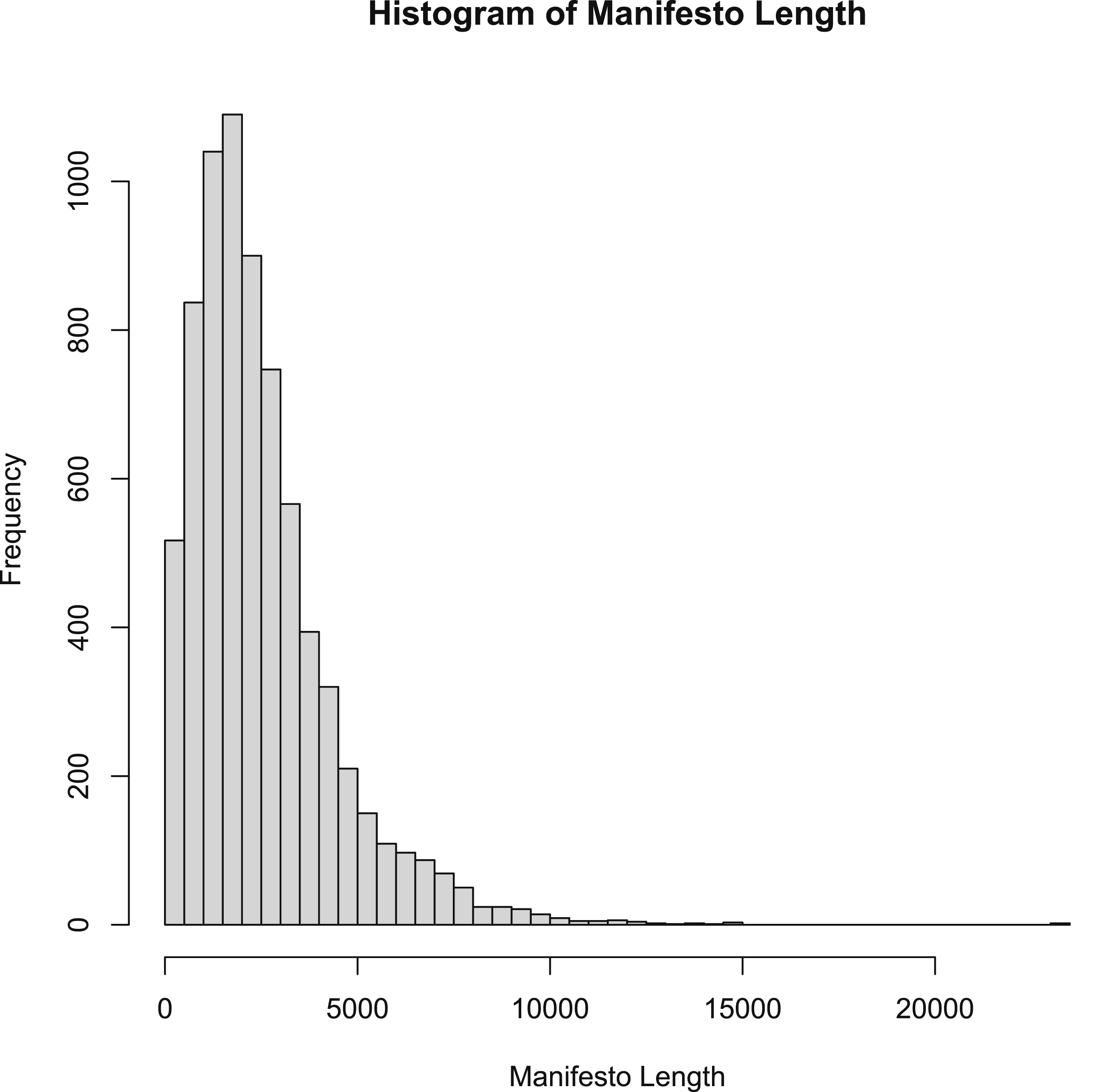
We use the population in January to predict the length of manifestos. 5 We obtained this data from the Central Bureau of Statistics (2025). To account for the lopsided distribution and a diminishing marginal effect, we look at logged population size in the main text. In Appendix A4, we show that models with logged population consistently have a markedly lower AIC than models with just population size. This suggests that the former has stronger predictive lower. We use the same CBS data for population density. The NLMP data set has a categorical variable about the type of party it is, which we can use to make a simple binary for independent local parties. We control for the year of the manifesto. Since the Second World War, the length of manifestos has greatly increased (Green-Pedersen 2019), making time a “crucial factor” (Dandoy and Acurio, 2023). Since our data set covers a much smaller period (of 8 years), we do not expect a dramatic increase, but we control for the possibility nonetheless. The year variable may also pick up on other changes over time, such as the decentralization of responsibilities to the municipal level.
We run multilevel negative binomial regressions with observations clustered by the municipality*election level. We use negative binomial regressions because the data is overdispersed. 6 All variables are normalized to fall between 0 and 1 to ensure model convergence.
Multilevel negative binomial regression model.
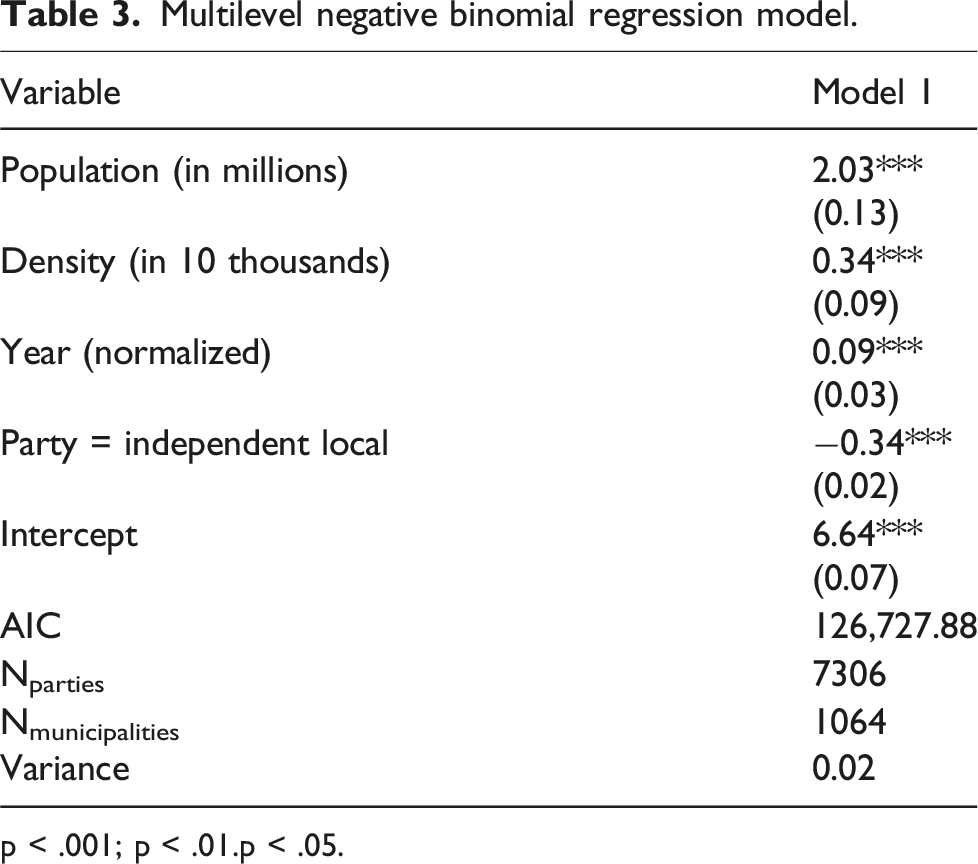
p < .001; p < .01.p < .05.
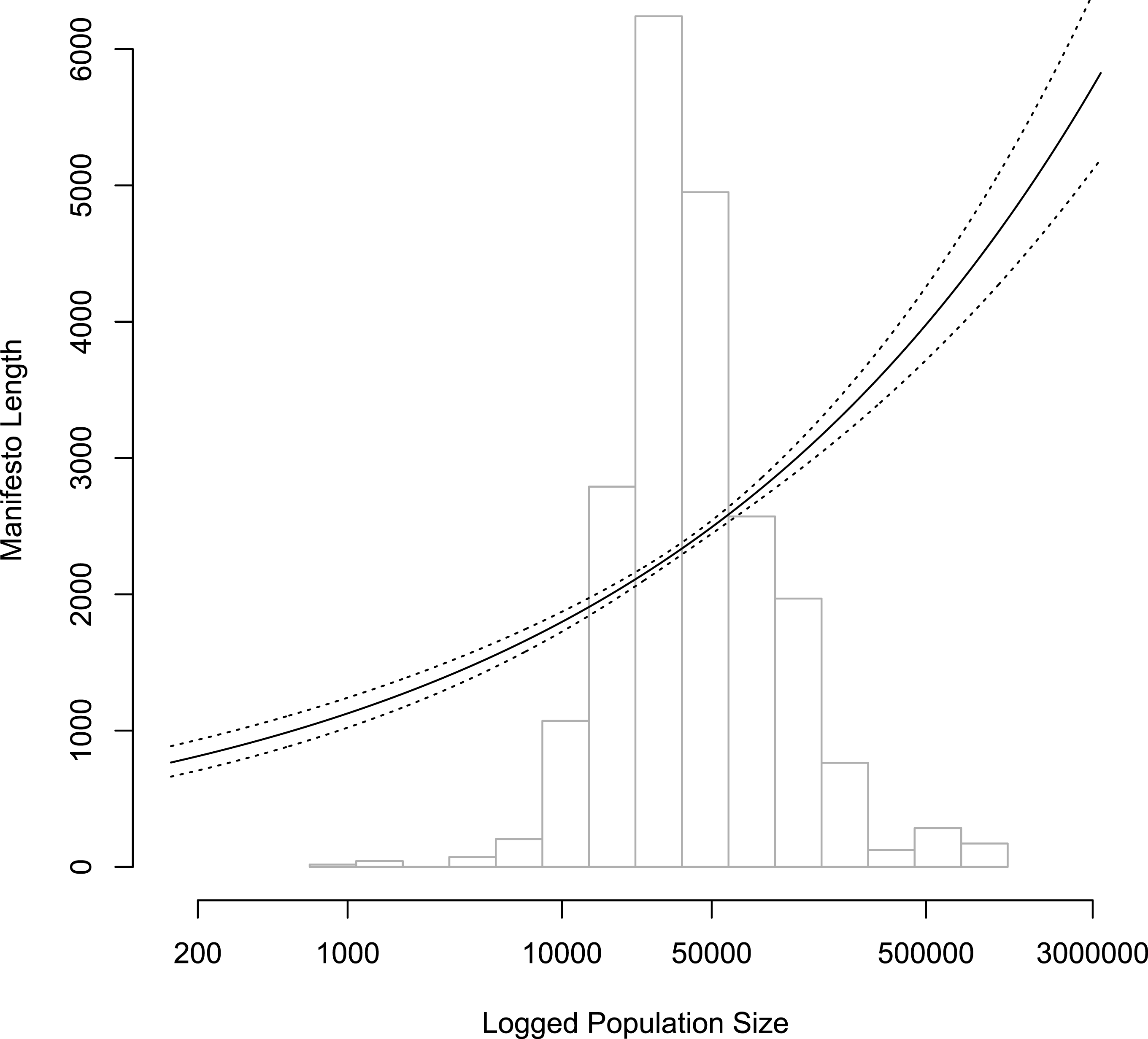
Population Size and Manifesto Length. Estimate with 95% confidence interval. Based on Model 1 in Table 3. Note that values in x-axis reflect non-logged values.
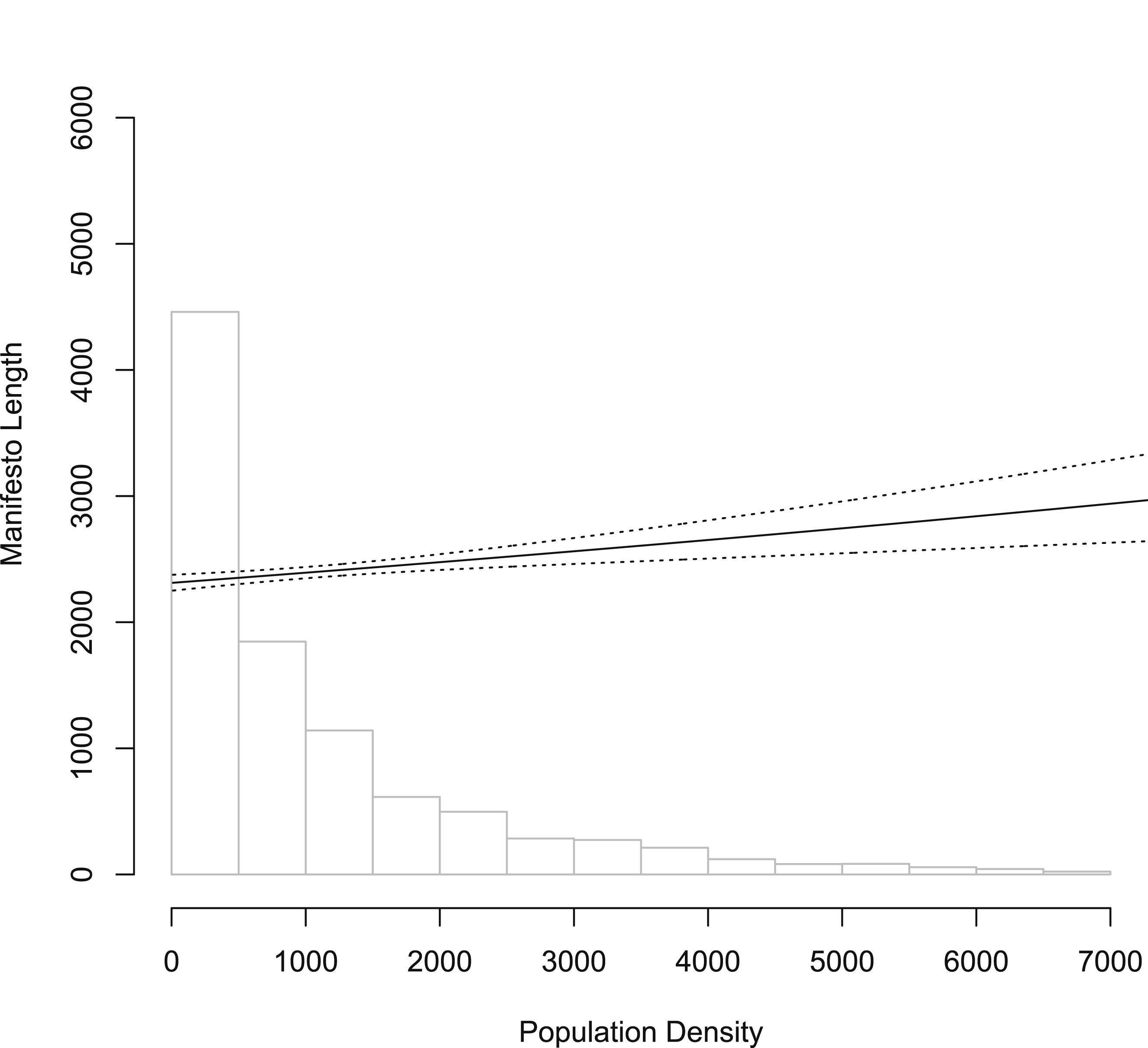
Population Density and Manifesto Length. Estimate with 95% confidence interval. Based on Model 1 in Table 3.
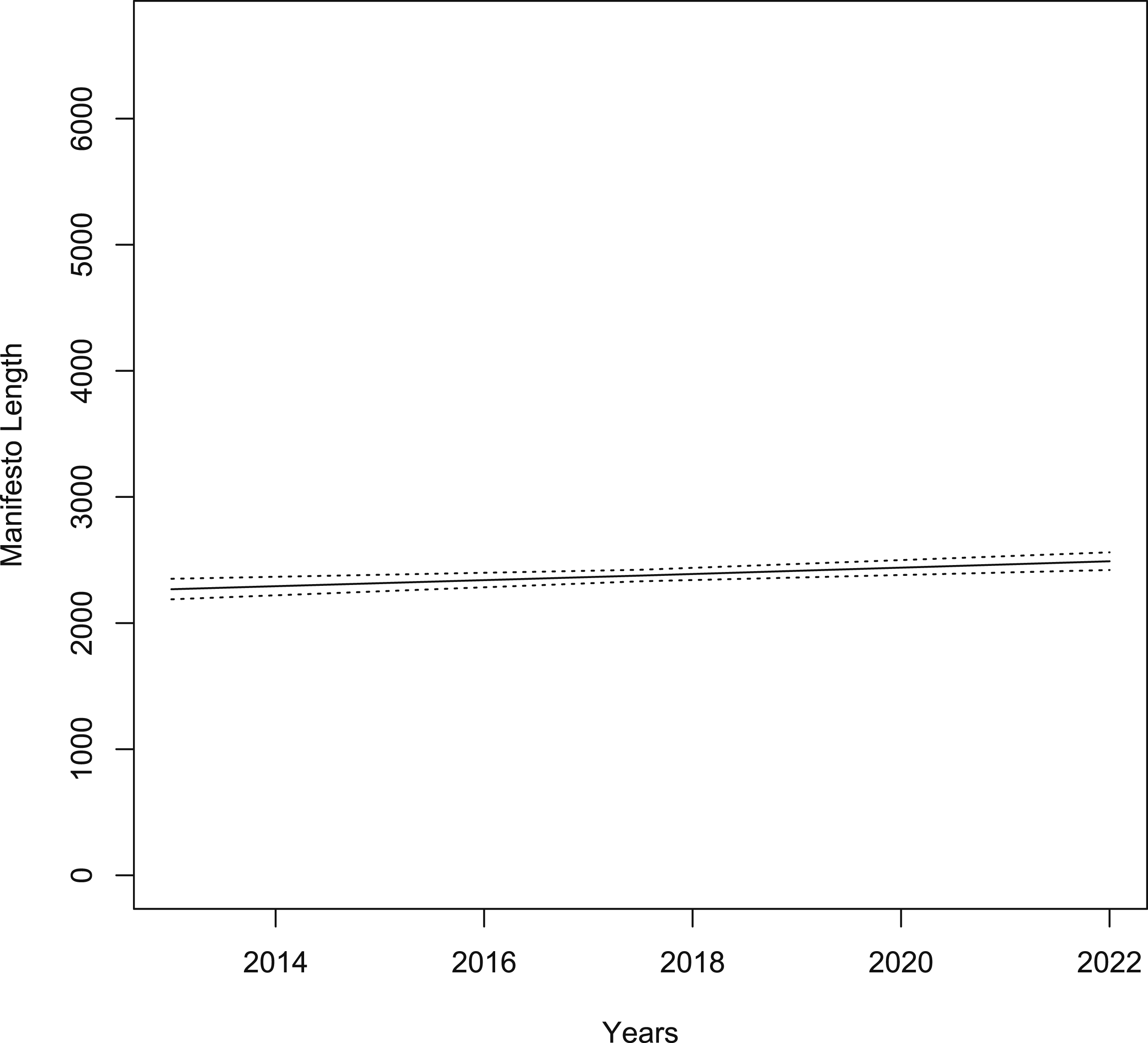
Year and Manifesto Length. Estimate with 95% confidence interval. Based on Model 1 in Table 3.
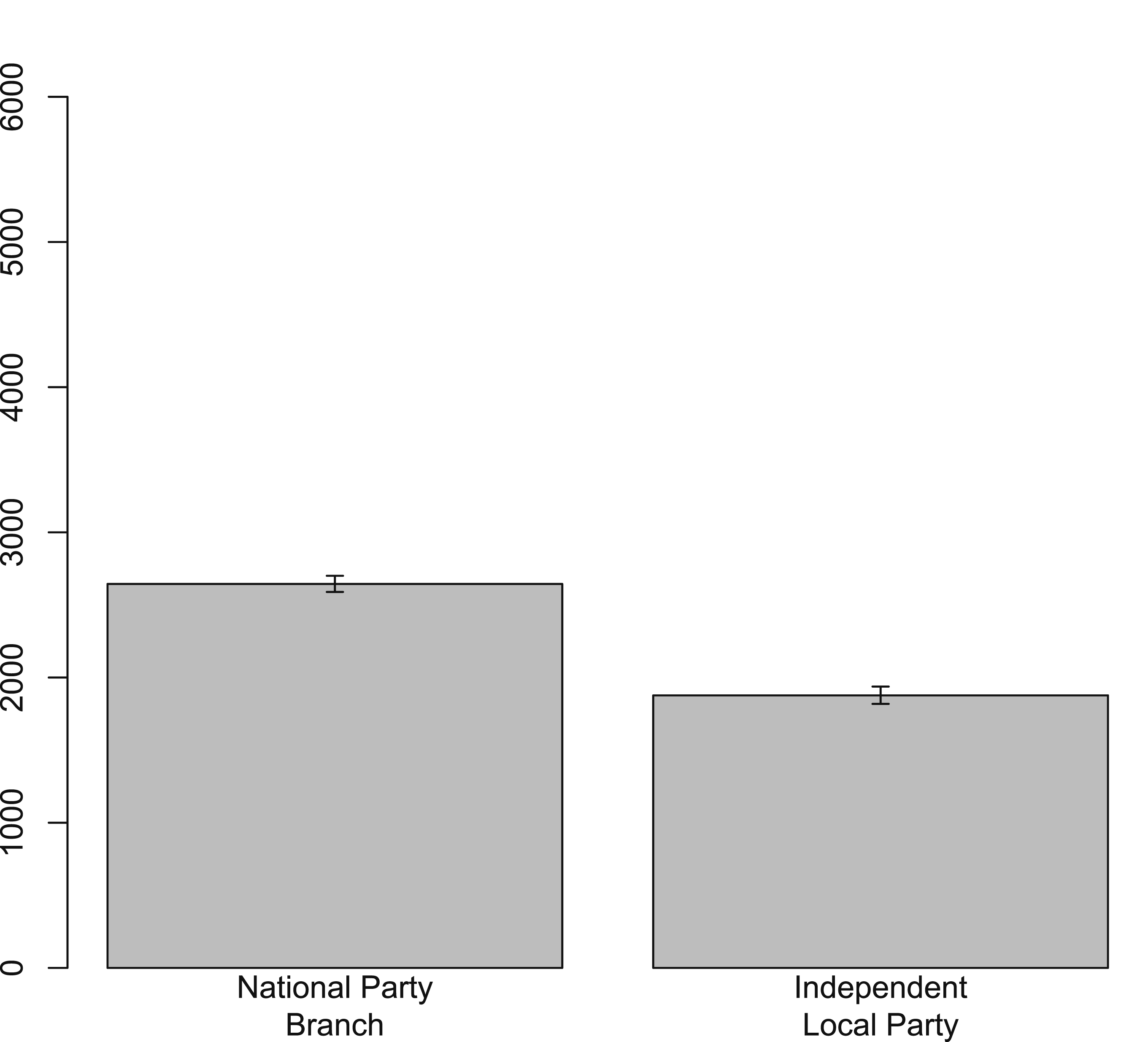
Party Type and Manifesto Length. Estimate with 95% confidence interval. Based on Model 1 in Table 3.
We next turn to population density, with the expectation that more dense municipalities have more complex zoning issues requiring longer manifestos. As Figure 3, shows the effect of population density is smaller than for population size. In the least dense municipality (Schiermonnikoog again) the average manifesto is estimated to be above 2300 words. In the densest municipality (The Hague), the average manifesto is estimated to be just over 2900 words. Increasing the population density by 1000 inhabitants per square kilometer increases the length of the manifesto by more than three percentage points. This supports the Population density hypothesis.
Finally, we look at independent local parties with the expectation that independent local parties have fewer resources in writing their manifestos. We also see a marked difference between party types in Figure 5: the average manifesto of a branch of a national party is just over 2600 words. The average branch of the independent local parties writes a manifesto that is 30 percent shorter: just below 1900 words. This supports the Independent local party hypothesis.
We then turn to year, our control variable, with the expectation that growth in manifesto length since the 1950s is a secular trend. The effect of year is relativel small as is eviden from Figure 4: in 2023, the average manifesto is estimated to be almost 2300 words and in 2022 it is just below 2500 words.
In the Appendix A4 we present a number of additional analyses: looking at the explanatory factors separately, using (non-logged) population size, examining as possible effects of crime levels, welfare and debt levels, and using a non-multilevel model. We find that both individually and when including additional controls or specifying the model differently, predictors behave the same ways as they do in the combined model. We find that the AIC for logged population size is between 144 and 178 points lower than the AIC for actual population size (already beyond 10 points difference there is no evidence that the model with higher AIC has more explanatory power (Burnham and Anderson 2004)). The alternative explanations (welfare, debt, crime) do not have a consistently significant effect in the same direction between models that use the actual or the logged population numbers.
Conclusion
To our knowledge, the Netherlands Local Manifesto Project is the largest collection of local election manifestos in the world. It is even the largest collection of election manifestos in the world. We believe that it is a very promising data set that can be used to explore party politics, local government and the intersection between the two with unprecedented detail. It can be used to examine the priorities of political parties at the local level, their policy position and the kind of language that they use.
At this point in time, the automated analysis of political texts is undergoing something of a small revolution: we have the established bag-of-words approaches such as WordScores for positions (Laver et al., 2003) and Latent Dirichlet Analysis for categorical classification (Blei et al., 2001), whose applications to political texts are now more than two decades old. BERT models instead use text embeddings. These can be used for categorical classification as well (González-Carvajal and Garrido-Merchán 2020). Finally, we have the new reasoning large-language-models which have been used for text classification as well, both for ideological position (Le Mens and Gallego 2025; O'Hagan and Schein 2023) and for issue categories (Gunes and Florczak 2023). Following the lead of other data collection enterprises, such as Turner-Zwinkels’ et al. (2022) Parliaments Day-by-Day Dataset, we specifically offer the actual texts to other researchers. This allows researchers to apply the methods relevant to their own research questions and based on their own epistemological assumptions to these texts. This could allow for promising research: future research could classify parties at the local level on ideological dimensions, such as the left-right dimension. One might also study to what extent parties at the local level favour regional cooperation or the decentralization of responsibilities or seek to mobilize voters by emphasizing centre-periphery dynamics (Alonso et al., 2013). Taking a more multidimensional approach to ideology, one might also construct dimensions tapping into the cultural division between cosmopolitans and nationalists, the moral division between conservative and progressives, the division between the economic left (provision of public goods) and right (low taxes), or the division between parties that prioritize environmental protection over economic growth and those that have opposite priorities. Future research could also classify the texts into issue categories to examine for instance to what extent local election manifestos deal with issues that municipal responsibilities or whether they also engage with issues where the regional or national government is responsible. One could also classify the text into categories of the Comparative Agenda Project. One could use such categorization for instance to examine what drives patterns of attention in local election manifestos (see De Natris 2024): what municipality-specific, party-specific and year-specific conditions drive some parties to emphasize some issues over others. Perhaps this data on issue priorities could also be connected to data about the use of written questions on specific issues, to see whether parties follow up their programmatic priorities in municipal councils (Otjes et al., 2023). Or the data on positions could be connected to data about voting patterns in municipal councils to see whether votes reflect ideological differences between parties (Vos et al., 2024).
Supplemental Material
Supplemental material - The Netherlands local manifesto project. Infrastructure for studying local party politics
Supplemental material for The Netherlands local manifesto project. Infrastructure for studying local party politics by Simon Otjes, Joes de Natris, Marijn Nagtzaam in Party Politics.
Footnotes
Declaration of conflicting interests
The authors declared no potential conflicts of interest with respect to the research, authorship, and/or publication of this article.
Funding
The authors disclosed receipt of the following financial support for the research, authorship, and/or publication of this article: This project was funded in part by funding from the Dutch Ministry of Home Affairs and Kingdom Relations and by an XS grant for Simon Otjes from the Dutch Science Council (406.XS.01.002).

Data Availability Statement
The dataset and replication data is available on the Harvard Dataverse at https://dataverse.harvard.edu/dataset.xhtml?persistentId=doi:10.7910/DVN/CGT3JI
Supplemental Material
Supplemental material for this article is available online.
Notes
Author biographies
References
Supplementary Material
Please find the following supplemental material available below.
For Open Access articles published under a Creative Commons License, all supplemental material carries the same license as the article it is associated with.
For non-Open Access articles published, all supplemental material carries a non-exclusive license, and permission requests for re-use of supplemental material or any part of supplemental material shall be sent directly to the copyright owner as specified in the copyright notice associated with the article.
