




Abstract
We explain the referendums on British membership of the European Communities and European Union from a principal–agent perspective between the Prime Minister and the rank-and-file. We show that announcing a referendum on the Prime Minister’s membership proposal helps the incumbent party to win the general election when the rank-and-file is divided on the terms of membership. When the Prime Minister overcomes the rank-and-file’s mistrust of her effectiveness in negotiating new membership terms with other member states, the voters are more likely to follow her proposal. However, when intra-party controversies reveal principal–agent problems, the initially uninformed voters can learn about the dysfunctionality of the terms and are more likely to reject the Prime Minister’s proposal.
1. Introduction
Research on the British vote to leave the European Union (EU) has emphasized the increasing economic (Colantone and Stanig, 2018), societal (Hobolt, 2016), and cultural (Inglehart and Norris, 2016) division of British voters. This demand-side perspective explains the British decision to leave the EU as a result of electoral polarization, which creates “a tension between functional pressures for integration and nationalist resistance that is part of a wider divide across Europe” (Hooghe and Marks, 2019: 1123). In addition to this demand-side explanation, our research attempts to draw attention to a supply-side mechanism from a complicated policy-making process in the British Westminster model. This process begins with the Prime Minister’s announcement of a referendum on the membership terms, which the Prime Minister promises to renegotiate after the general election. The party may, in turn, support the Prime Minister’s referendum announcement that promotes electoral success. Given electoral success, the Prime Minister can make efforts to renegotiate new terms, from which the party infers the Prime Minister’s negotiation effectiveness. The party can support or criticize the Prime Minister’s proposal on the new terms, on which the voters finally decide in the membership referendum.
Compared with demand-side explanations, our analysis does not posit that the economic, societal, and cultural division among British voters have changed between the announcement of the membership referendum by Harold Wilson in 1973 and David Cameron 40 years later. Neither the Labour Party in the 1970s nor the Conservatives in the 2010s were united on their view of the functionality of the British membership terms. Because both parties were divided on specific terms, Harold Wilson and David Cameron announced to delegate the membership decision to the voters. They promised to hold a referendum on their membership proposal after negotiations of the more specific membership terms. Both surprisingly won the general election and started to renegotiate the terms with the other member states: Harold Wilson with the six founding members and David Cameron with 27. After the negotiations with the six members, the Labour party was convinced of Harold Wilson’s effectiveness and supported his membership proposal, while David Cameron’s Conservative Party remained skeptical and revealed information about his ineffectiveness to the voters by their criticism of the new terms.
In the British Westminster model, which unites rather than separates policy-making power and authority in the hands of the Prime Minister, the reason for the delegation of an important policy decision from the party to the voters can only be partly explained by opportunistic office-seeking behavior of the Prime Minister, which postfunctionalism calls a Mephistophelean pact for winning the general election. 1 In addition to office-seeking behavior, we argue that the principal–agent relationship on the membership terms between the policy-seeking rank-and-file and the Prime Minister is a crucial component for understanding the referendum announcement and membership decision. While the Prime Minister and the rank-and-file can gain electoral support from the referendum proposal, the voters may learn afterwards from the revelation of intra-party policy conflict about the ineffectiveness of the Prime Minister in renegotiating functional membership terms.
Our analysis identifies a specific policy-making mechanism from the complex delegation and negotiation process on British membership. First, the Prime Minister’s dependence on the rank-and-file, which has been strengthened to foster intra-party democracy, promotes the delegation of policies to the voters, on which the party is internally divided. Second, although this delegation may calm down intra-party policy conflict before a general election, it only overcomes this policy conflict under the condition of an effective Prime Minister who is able to negotiate more functional membership terms for the United Kingdom. Independent from the referendum outcome, our analysis suggests that the final evaluation of this historical decision is not an easy task because the Prime Minister’s effectiveness is determined at least by two factors: her own efforts and the other member states’ willingness to offer concessions. We show that the Prime Minister’s efforts are a function of the likelihood of intra-party scrutiny of her effectiveness and the uncertainty about the median voter. The former will increase the efforts made by the Prime Minister, while the latter will decrease the efforts. The other member states’ willingness to make concessions is determined by the credibility of the partnership and the heterogeneity of their interests. Although a higher credibility of the partnership promotes their cooperation willingness, a higher heterogeneity of national interests among the other member states reduces the likelihood of concessions.
2. Remain or leave: why referendums?
2.1. Westminster model versus direct democracy
Why did the British Prime Minister David Cameron, whose office entails the highest degree of policy-making autonomy in parliamentary democracies, announce to delegate the decision on British membership of the EU to the voters? This decision of the British Prime Minister, who announced to negotiate new membership terms with the other member states and to let the people decide on his membership proposal, has been welcomed by the voters. However, after winning the 2015 general election, the voters rejected in the 2016 referendum the Prime Minister’s proposal to remain. A few months after the voters had decided to leave the EU, David Cameron resigned. His Conservative Party lost the parliamentary majority in June 2017 after the new Prime Minister, Theresa May, called for a general election to find more support for negotiating the terms of leaving the EU.
The case of Prime Minister David Cameron recalls the referendum announcement by Prime Minister Harold Wilson at the beginning of the 1970s. Harold Wilson promised to delegate the decision on British membership of the European Communities (EC) to the voters after having negotiated new membership terms. Similar to the Conservative Party of David Cameron, the Labour Party of Harold Wilson has been ideologically divided on the terms of membership but surprisingly won the 1974 general election. After winning the general election and negotiating new terms, both David Cameron and Harold Wilson declared that the Prime Minister and his cabinet would campaign for a “remain” vote. However, compared with the referendum in 2016, the voters decided in favor of the British EC membership in 1975. With a high 64% turnout and 67% in favor, the voters supported the remain proposal of Harold Wilson, whereas 52% of the voters with a turnout of 72% rejected the remain proposal of David Cameron.
For scholars of comparative politics, the Prime Ministers’ announcement of a membership referendum is difficult to classify because the British Westminster model unites rather than separates executive and legislative powers in the hands of the Prime Minister. In this model of parliamentary democracy, the Prime Minister enjoys an extraordinary governmental monopoly and the power to autonomously implement policies in parliament when the rank-and-file controls the parliamentary majority in the Lower House (Bagehot, 1867). Neither the Upper House of Lords nor the courts establish checks and balances on the governmental monopoly of the Prime Minister who directs both the executive and the legislature (Lijphart, 1984). 2 Only when a parliamentary majority passes a motion of no confidence, or refuses to pass important bills such as those concerning the budget, the Prime Minister has to choose between resigning so that another Prime Minister can be appointed, and seeking a parliamentary dissolution so that a new general election may be held in order to re-confirm or deny the Prime Minister’s mandate.
2.2. Intra-party conflict and referendum announcement
Except for British EC and EU membership, referendums are very rare but politically important policy-making events in the British Westminster model, which can terminate office-holding of Prime Ministers and result in dissolution of parliament. 3 Similar to the classification difficulties in comparative politics, the literature on referendums cannot provide a satisfactory answer as the reason for delegating this important policy decision to the voters is not policy stability. This is because neither EC nor EU membership establishes an additional veto player, which constrains the Prime Minister’s governmental monopoly (Hug and Tsebelis, 2002). By contrast, because the European Communities Act (1972) gave priority to European laws over British laws, it allows the British government to implement European laws without parliamentary approval. Owing to their distinct innovation in constitutional practice, interaction of party politics and governmental procedures, as well as their unintended consequences, the referendum announcements on British membership are difficult to understand (Butler and Kitzinger, 1996; Butler and Ranney, 1978).
On closer inspection, the terms of membership raised ideological policy controversies among the rank-and-file. Those intra-party controversies made it difficult, if not impossible, for the Prime Ministers to find a compromise solution on British membership that could be approved by the rank-and-file in parliament before the general election. The Labour Party had historically feared the consequences of EC membership, such as the large differentials between the high price of food under the Common Agricultural Policy and the low prices prevalent in Commonwealth markets, as well as the loss of both economic sovereignty and the freedom of governments to engage in socialist industrial policies. The Conservative Party traditionally criticized the role of the supranational organs, such as the European Court of Justice, the European Commission, and the European Parliament with their dogma of “an ever closer union.” Similar to the Labour Party in the 1970s, the Conservatives also criticized the infiltration and exploitation of the British welfare system by migration.
Both Prime Ministers accordingly announced before the general election to negotiate new membership terms and to hold a referendum on their membership proposal. Both surprisingly won the general election, negotiated new terms, and suspended the constitutional convention of cabinet collective responsibility, which allowed the cabinet members to publicly campaign against each other on the Prime Minister’s proposal. Although in both cases only seven cabinet members were against the Prime Ministers’ proposal to remain, the rank-and-file of the Conservative Party heavily criticized David Cameron’s effectiveness in negotiating the new terms. 4 We show that this criticism can explain why David Cameron’s membership proposal has been rejected, while Harold Wilson’s found the support of the voters.
3. Membership game
To understand why Harold Wilson and David Cameron delegated the decision on membership from the party to the voters in the first place, but succeeded differently in convincing the voters of their proposal in the second place, we investigate the relationship between the Prime Minister and the rank-and-file from a principal–agent perspective. We assume that the Prime Minister is the agent of the rank-and-file, who has the agenda-setting power to announce a referendum on her membership proposal and can influence the functionality of the specific terms by spending efforts in negotiations with the other member states. Our model follows the framework of Caillaud and Tirole (1999), which analyzes platform making as a conflict between the party leader and the rank-and-file. In this framework, the rank-and-file is generally more concerned about the ideological content of the platform’s policies than the office-seeking leadership. However, when the leadership proposes a platform with some unobserved efforts to improve the quality of the platform, the rank-and-file can use intra-party scrutiny to infer the leadership’s effectiveness and may criticize the platform proposal (Izzo, 2019). In the presence of observable disagreement between the leadership and the rank-and-rile, the uninformed voters can update their beliefs about the quality of the platform proposal.
Compared with Caillaud and Tirole (1999), we focus on the referendum on a membership proposal, which the Prime Minister makes after winning the general election and renegotiating the specific membership terms. When the Prime Minister succeeds in negotiating new membership terms in favor of the United Kingdom, we call this a functional membership proposal; otherwise, the membership proposal is considered as dysfunctional for the United Kingdom. We assume that neither the rank-and-file nor the voters know the (dys)functionality of the new terms. 5 The Prime Minister, who announces before the general election to improve the terms in negotiations with the other member states, enjoys an informational advantage about the functionality of the new terms. Compared with the voters, the rank-and-file can reduce informational deficits by scrutinizing the efforts of the Prime Minister, and thereby infer the Prime Minister’s effectiveness in the negotiations of the new terms. If the rank-and-file mistrusts the Prime Minister’s effectiveness, the voters, who care about functionality, can learn about dysfunctionality by observing the controversies between the Prime Minister and the rank-and-file.
3.1. Setup of the game
We investigate the decision on British membership as a strategic principal–agent game under uncertainty. The game consists of the referendum announcement on a proposal of the Prime Minister who promises to renegotiate favorable membership terms, the reaction of the rank-and-file to the Prime Minister’s effectiveness in those negotiations (
3.1.1. Functionality of membership
Regarding British membership, functionality means effectiveness of the Prime Minister in negotiating “favorable terms” with the other member states, which promise benefits from changes of the status quo. Following the paradox of weakness, the Prime Minister can increase her effectiveness in negotiations with the other member states when she can credibly claim that her hands are tied domestically (Putnam, 1988). While this strategy usually advantages negotiators to maintain the status quo (Hug and König, 2002), Prime Ministers Harold Wilson and David Cameron promised to change the status quo in favor of their country over the other member states. Substantively, the Prime Ministers announced to change the status quo toward more anti-integrationist positions of the rank-and-file of their parties.
The implications of changes of the status quo and the effectiveness of the Prime Ministers in negotiating new terms are uncertain. Such uncertainty is likely to exist in particular for the voters who have to decide about the Prime Minister’s membership proposal. Although the voters may have prior beliefs on membership, they have difficulties in evaluating the implications of the terms when interest groups, parties, and their elites advocate different scenarios with contradicting calculations of costs and benefits. Furthermore, when the parties are internally divided and their members send different messages about the implications of the terms, the voters can hardly follow partisan cues. The more a party is internally divided, the less capable is the party to disseminate credible information on the implications of changes of the status quo to the voters (Bernauer and Bräuninger, 2009; Druckman, 1996; Greene and Haber, 2015). Under these circumstances, the voters have difficulties in aligning with the party because the informative value of the party’s cues largely depends on their cohesiveness (Brader et al., 2013; Gabel and Scheve, 2007).
We assume that these uncertainty conditions existed for the British voters in the 1975 and 2016 referendums. We distinguish between (perceived) benefits of the voters from dysfunctional terms (
3.1.2. Effectiveness of Prime Minister
The Prime Minister’s payoff comes from the probability of being reelected and her costs of making efforts to improve the membership terms. The Prime Minister can choose to make an effort
As the voters prefer being directly involved in decision making (Bogdanor, 1994; Morel, 1993; Smith, 1976), we assume that the reelection probability of the Prime Minister increases through announcing a referendum due to the higher legitimacy of the membership decision (Butler and Ranney, 1978; De Vreese, 2007), and the extra “democratic component” that is added to the British Westminster model with little history of direct democracy (Mendelsohn and Cutler, 2000). However, neither the rank-and-file nor the voters know the functionality of the new terms. Compared with the voters, the rank-and-file can scrutinize the efforts of the Prime Minister and infer her negotiation effectiveness in having improved the terms, which also depends on the other member states’ willingness to offer concessions.
3.1.3. Mistrust and intra-party checks and balances
Similar to the Prime Minister, we assume that the rank-and-file receives a payoff
After winning the general election, the Prime Minister can spend efforts in negotiating new terms, and then she makes a membership proposal for the referendum. The more policy-seeking the rank-and-file is, the higher relative policy losses it expects when the terms differ from their ideological positions, which are captured by
3.1.4. Uninformed voters
The voters are usually uninformed about the policy implications of their choices and tend to free-ride in gathering information (Palfrey and Rosenthal, 1985). Accordingly, we assume that the voters have only a prior belief on membership but are uninformed about the (dys)functional implications of the new terms. To reduce their informational deficits, the voters can only draw inferences from the interactions between the Prime Minister and the rank-and-file. The voters can counterfactually conclude that the rank-and-file, who has supported the Prime Minister’s referendum announcement, would never criticize her negotiation effectiveness when the new terms are functional. Such criticism may reveal the principal–agent problems between the Prime Minister and the rank-and-file who mistrusts the office-seeking Prime Minister, scrutinizes the Prime Minister’s efforts, and eventually criticizes her negotiation effectiveness.
Let
In this policy-making process, uncertainty about the median voter exists. Because the median voter can learn about the Prime Minister’s membership proposal when the rank-and-file scrutinizes and criticizes the Prime Minister’s effectiveness, the location of the median voter may change in the referendum. In our model, the uncertainty about the location of the median voter is captured by
3.1.5. Timing
The timing of the membership game is as follows.
The Prime Minister decides whether or not to announce a referendum that delegates the membership decision to the voters.
The voters observe the announcement of the referendum and cast their votes in the general election.
After winning the general election, the Prime Minister chooses an effort
The rank-and-file scrutinizes the efforts of the Prime Minister and decides whether to approve or criticize (disapprove) the effectiveness of the Prime Minister.
The voters observe the intra-party interaction between the Prime Minister and the rank-and-file and cast their votes in the referendum.
Following the timing of the membership game, we expect the payoff of the voters to result from both the Prime Minister’s announcement of a referendum and the information delivered by intra-party interaction through the scrutiny by the rank-and-file. At the first stage of the game where the voters have no information about the functionality of the Prime Minister’s membership proposal, the referendum announcement already increases the voters’ payoff because they will be more directly involved in decision making. At the fourth stage, the rank-and-file’s scrutiny activities may reveal information about the Prime Minister’s effectiveness. Based on the observable mistrust of the rank-and-file against the Prime Minister’s effectiveness, the voters may gather additional information to evaluate whether the Prime Minister’s membership proposal is dysfunctional.
The payoff of the voters decreases when the Prime Minister’s proposal is viewed as dysfunctional. Although the voters’ attitudes also matter after the referendum as a defeat of the Prime Minister’s membership proposal may lead to resignation of the Prime Minister and a new general election, our analysis of the principal–agent relationship focuses on the stages where more information can be revealed through the interaction between the Prime Minister and the rank-and-file. Because the Prime Minister and the rank-and-file receive electoral benefits from announcing a referendum, we make the following assumptions.
Ceteris paribus, because the voters enjoy direct participation in decision making, we expect that the probability of winning the general election is higher with announcing a referendum. Therefore, we make the following assumption.
This assumption corresponds to the observation that the Prime Ministers’ parties (surprisingly) won the general election after the announcement of an EC/EU membership referendum. As we expect
We further assume that the costs of the Prime Minister’s efforts from negotiating a fully functional membership are lower than the marginal payoff from reelection.
Detailed payoffs are formulated in the following analytical section.
4. Analytical results
The solution concept is pure strategy perfect Bayesian equilibrium, which is characterized by the rank-and-file’s inference of the Prime Minister’s effectiveness and the voters’ beliefs about the functionality of the Prime Minister’s membership proposal. We distinguish between a scenario of moderate mistrust and that of high mistrust of the rank-and-file. In the equilibrium analyses, we focus on the decisions of the Prime Minister and the rank-and-file, namely (i) choice of referendum announcement
4.1. Belief updating
We start by analyzing how the rank-and-file and the voters update their prior beliefs. We denote the expected functionality perceived by the rank-and-file
We distinguish between two scenarios: (i) the rank-and-file approves the Prime Minister’s effectiveness as long as it does not discover dysfunctionality, and (ii) the rank-and-file approves the Prime Minister’s effectiveness if and only if it discovers that the new terms are functional. We call the first scenario moderate mistrust and the second high mistrust.
In the first scenario, when the rank-and-file disapproves the Prime Minister’s effectiveness, the voters conclude that the proposal is dysfunctional. Therefore, they update their belief

where the denominator calculates the expected probability of not having discovered a dysfunctional proposal by the rank-and-file.
In the second scenario, when the rank-and-file approves the Prime Minister’s effectiveness, the voters conclude that the proposal is functional and, therefore,

In both scenarios, the rank-and-file’s evaluation of the Prime Minister’s effectiveness conveys information about the functionality of the membership proposal to the uninformed voters.
4.2. Referendum announcement
The voters reward the announcement of a referendum and can also learn about the (dys)functionality of the membership proposal. We continue to specify under which conditions the Prime Minister will announce a referendum. To do so, we check first the sanctioning mechanism of the voters.
This lemma is based on Assumption 1 and the fact that
This proposition implies that when the rank-and-file’s costs of intra-party decision making exceed the marginal probability of reelection with a dysfunctional membership, announcing a referendum is the dominant strategy for the Prime Minister. In other words, the mistrust between the Prime Minister and the rank-and-file will motivate the Prime Minister to announce a referendum in order to externalize the costs of intra-party decision making. This result also indicates that a strategic decision of the Prime Minister regarding the referendum announcement can facilitate coordination of a divided rank-and-file, who is unable to reach a compromise solution in intra-party decision making (Dewan and Myatt, 2012).
Figure 1 shows the corresponding equilibrium conditions of the referendum announcement, which follows from comparing the rank-and-file’s ideological costs
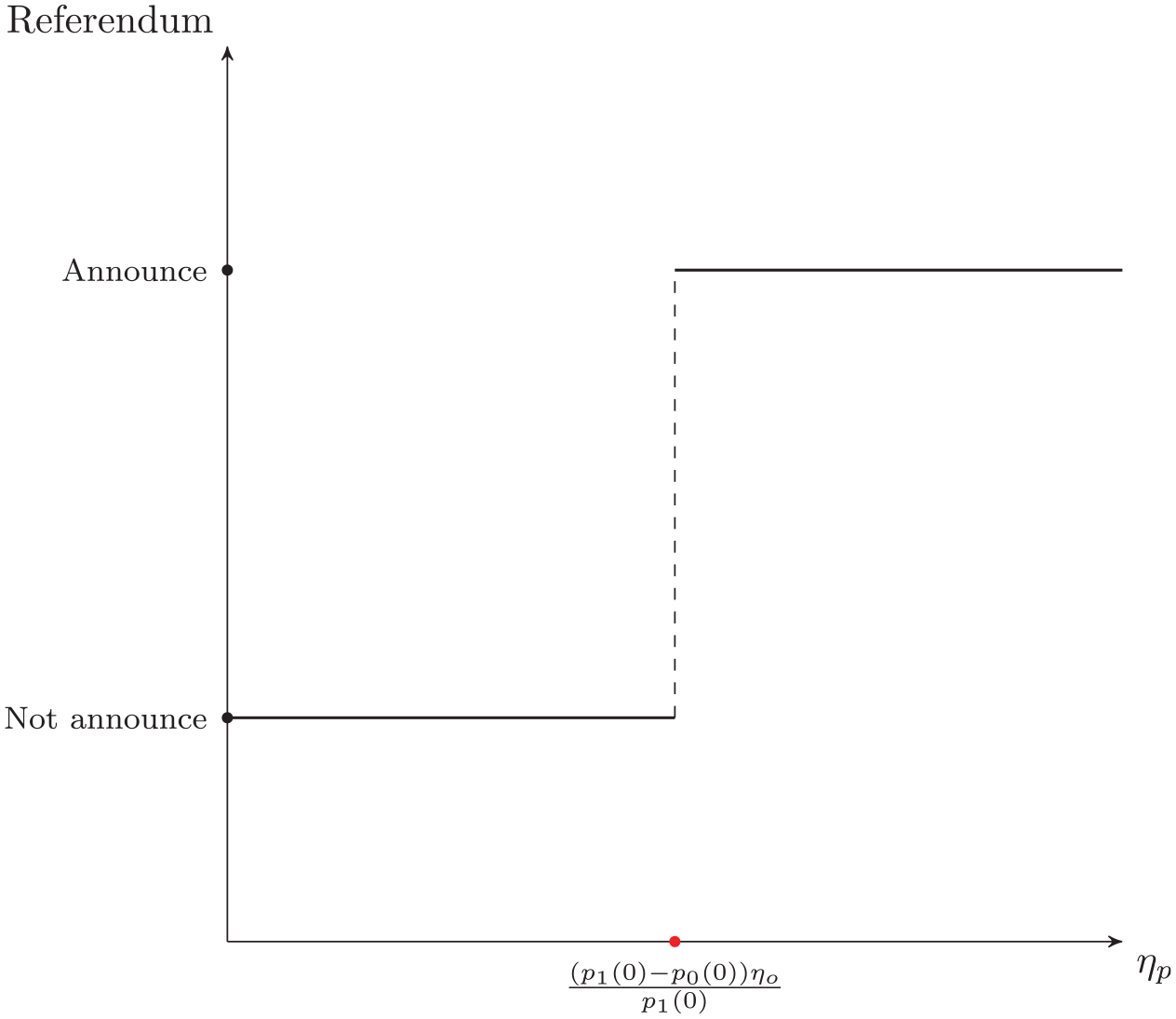
Equilibrium conditions of referendum announcement.
Following Caillaud and Tirole (1999), the proof is simple: suppose the Prime Minister does not announce a referendum and the rank-and-file makes an intra-party decision on membership. In this case, the Prime Minister would not make any efforts to improve the functionality of the terms. As the voters suffer losses from both being excluded from decision making and no efforts for improving functionality, they will sanction the Prime Minister and the rank-and-file with the lowest possible reelection chance (
4.3. Moderate mistrust
Although the different composition of utilities of the Prime Minister and the rank-and-file constitutes their principal–agent relationship, the rank-and-file has discretion to decide whether the efforts made by the Prime Minister are effective. In situations with moderate mistrust, the belief in the Prime Minister’s effectiveness is relatively high. Accordingly, the rank-and-file approves a functional membership proposal as long as it does not discover dysfunctionality of the new terms from probabilistic intra-party scrutiny.
We begin by analyzing the rank-and-file’s decision to approve the Prime Minister’s effectiveness. According to Equation (1), in case of approval, the voters update their belief on the functionality of the membership proposal by
Based on Proposition 1, without announcing a referendum, the Prime Minister will make no effort in equilibrium to improve the membership terms. The voters also know that the reelection probability is, in this case,

Similar to Proposition 1, this condition reflects the dominating ideological costs of the rank-and-file over the marginal electoral gains. Subsequently, we have the following result.
Figure 2 plots the equilibrium conditions from Proposition 2, where the dashed lines indicate mixed strategies. Because the space of approval as the dominant strategy is constrained by the difference between
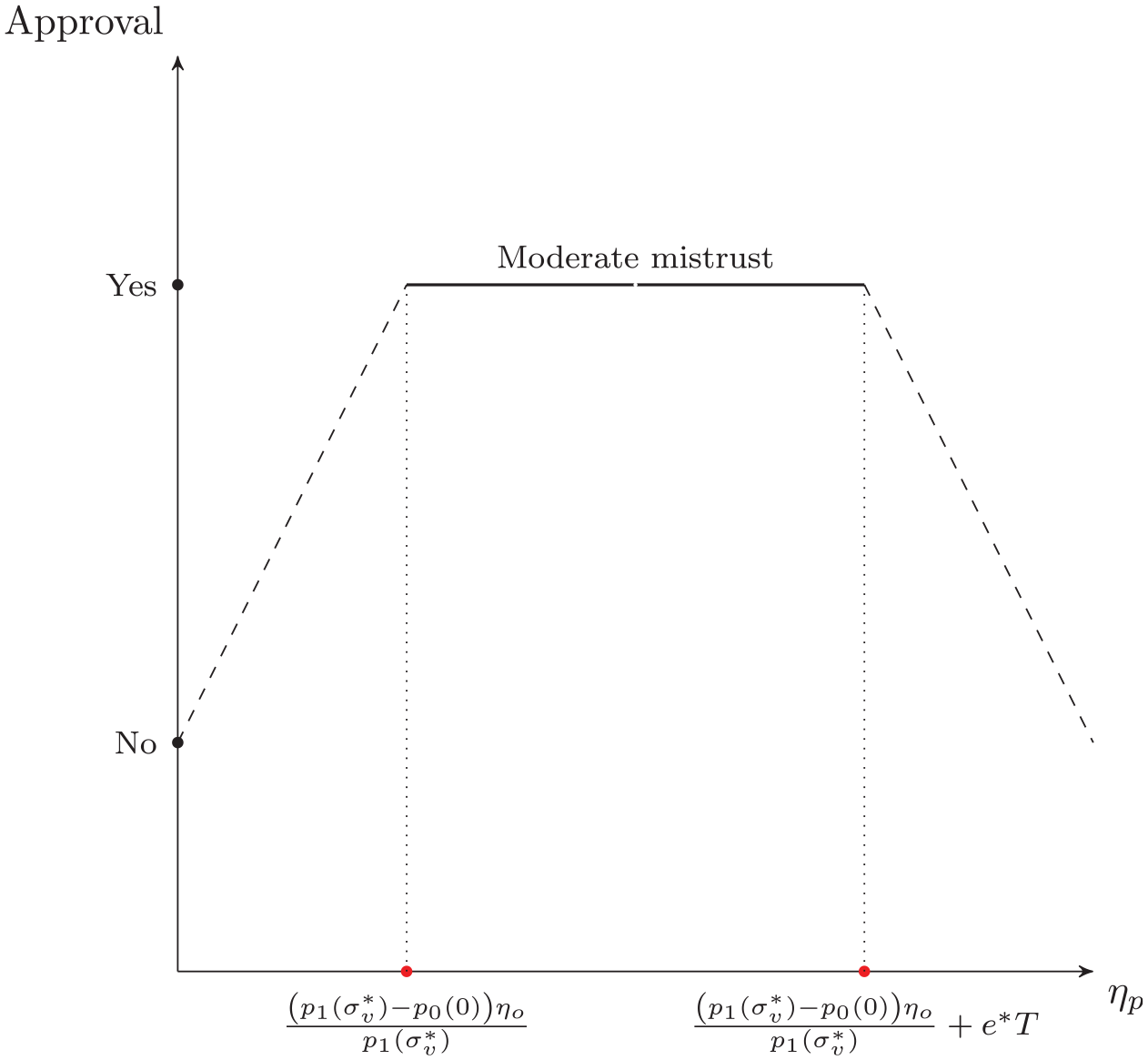
Equilibrium conditions of approval by the rank-and-file with moderate mistrust.
4.4. High mistrust
In situations of high mistrust, the rank-and-file imposes more intra-party scrutiny on the Prime Minister’s effectiveness. It approves the effectiveness of the Prime Minister only if the rank-and-file concludes that the new terms are functional. Compared with the case of moderate mistrust, the voters update their belief in a different way. According to Equation (2), the voters will regard the membership proposal as dysfunctional as soon as the rank-and-file calls the Prime Minister’s effectiveness into question. When the rank-and-file approves effectiveness, the voters believe in a functional proposal
In case of disapproval, the utility of the rank-and-file is
Figure 3 depicts the equilibrium conditions from Proposition 3. When the ideological costs of delegating the membership decision to the voters are high, the rank-and-file is likely to disapprove the effectiveness of the Prime Minister. We can also observe that with increasing voters’ confidence about functionality
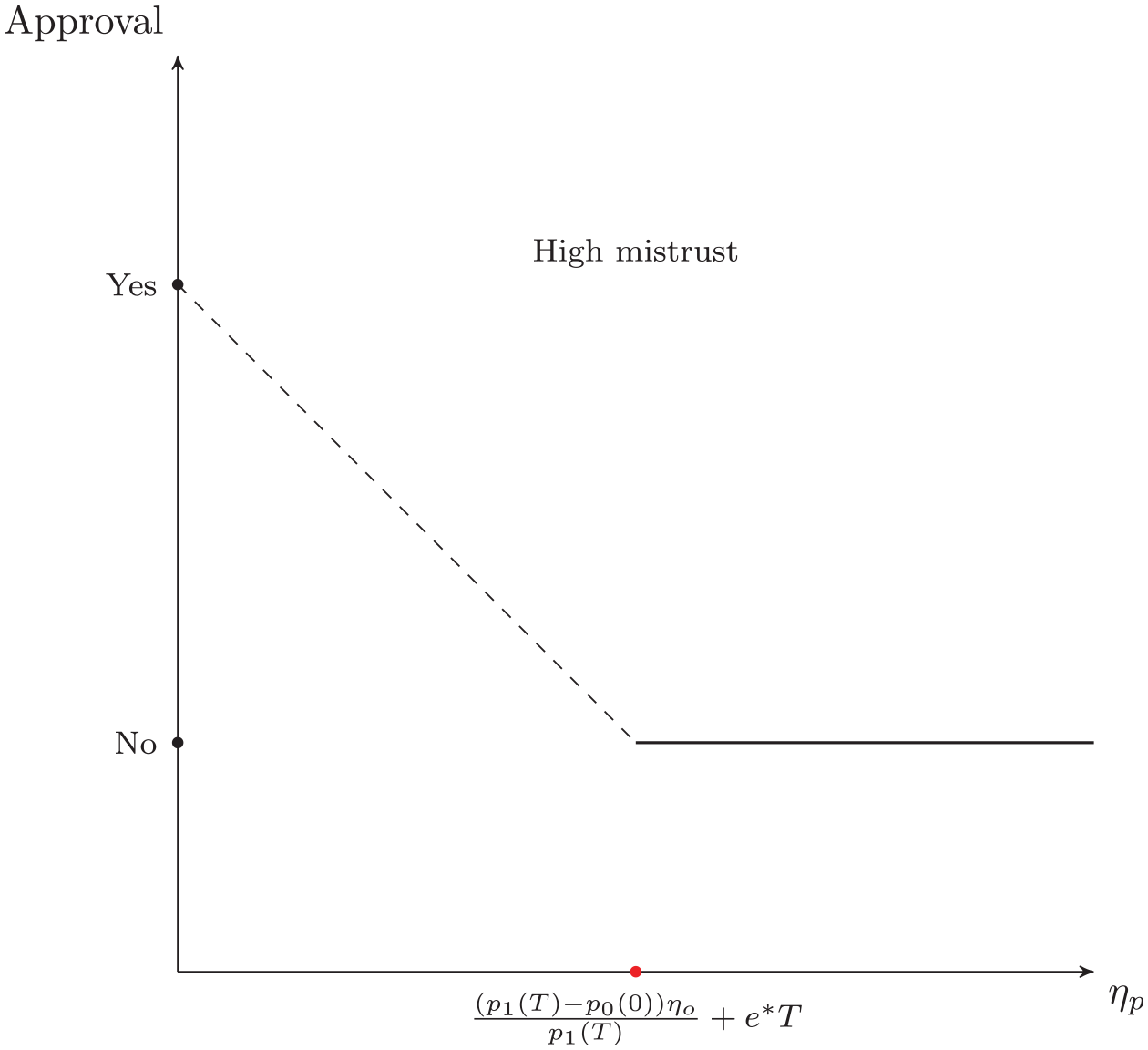
Equilibrium conditions of approval by the rank-and-file with high mistrust.
4.5. Strategic efforts of the Prime Minister
By now, we have examined the equilibrium decisions of the rank-and-file by considering the Prime Minister’s efforts
In situations of moderate mistrust, the Prime Minister has an electoral payoff

When we assume that
On the one hand, it is easier and, thus, less costly for the Prime Minister to spend little efforts when the voters are more confident on functionality; on the other hand, the Prime Minister attempts to avoid intra-party scrutiny with potential criticism of her effectiveness.
In situations of high mistrust, the payoff difference between announcing and not announcing a referendum is

Similar to Lemma 2, the efforts
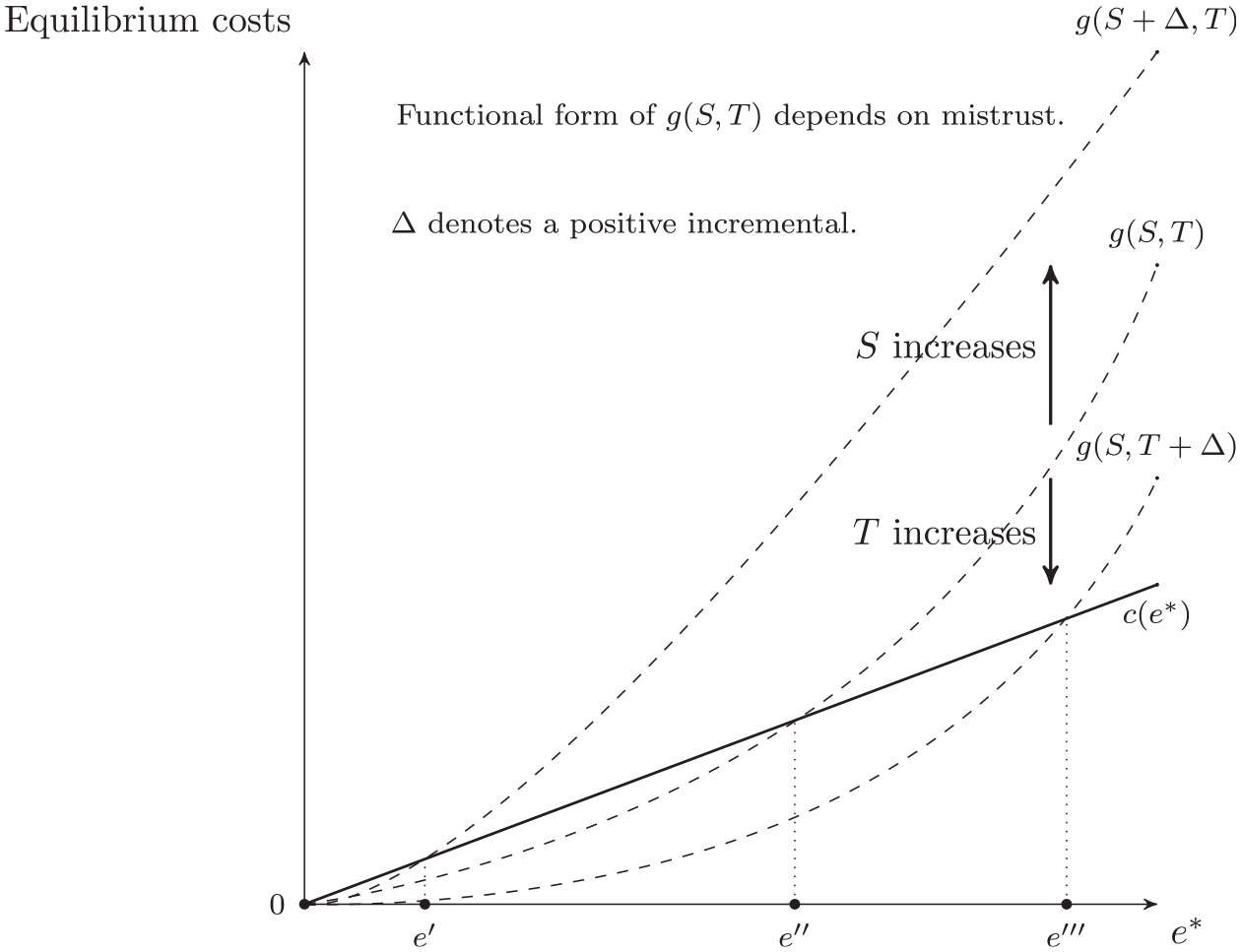
Equilibrium conditions of Prime Minister’s efforts.
Because
While delegating the membership decision to the voters through a referendum announcement induces ideological costs to the rank-and-file, the rank-and-file benefits from more functional terms due to the payoff component
4.6 Uncertainty about the median voter
Proposition 4 assumes that, ceteris paribus, the median voter prefers a referendum on membership and that the ideological position of the electoral median voter corresponds to the position of the referendum median voter. However, uncertainty may exist about the location of the referendum median voter at the final stage of the game, which affects both the reelection chances and, thus, the payoff and efforts of the Prime Minister. We capture this uncertainty by
When mistrust is moderate, the reelection likelihood without announcing a referendum is constrained according to Proposition 2 (

With higher uncertainty
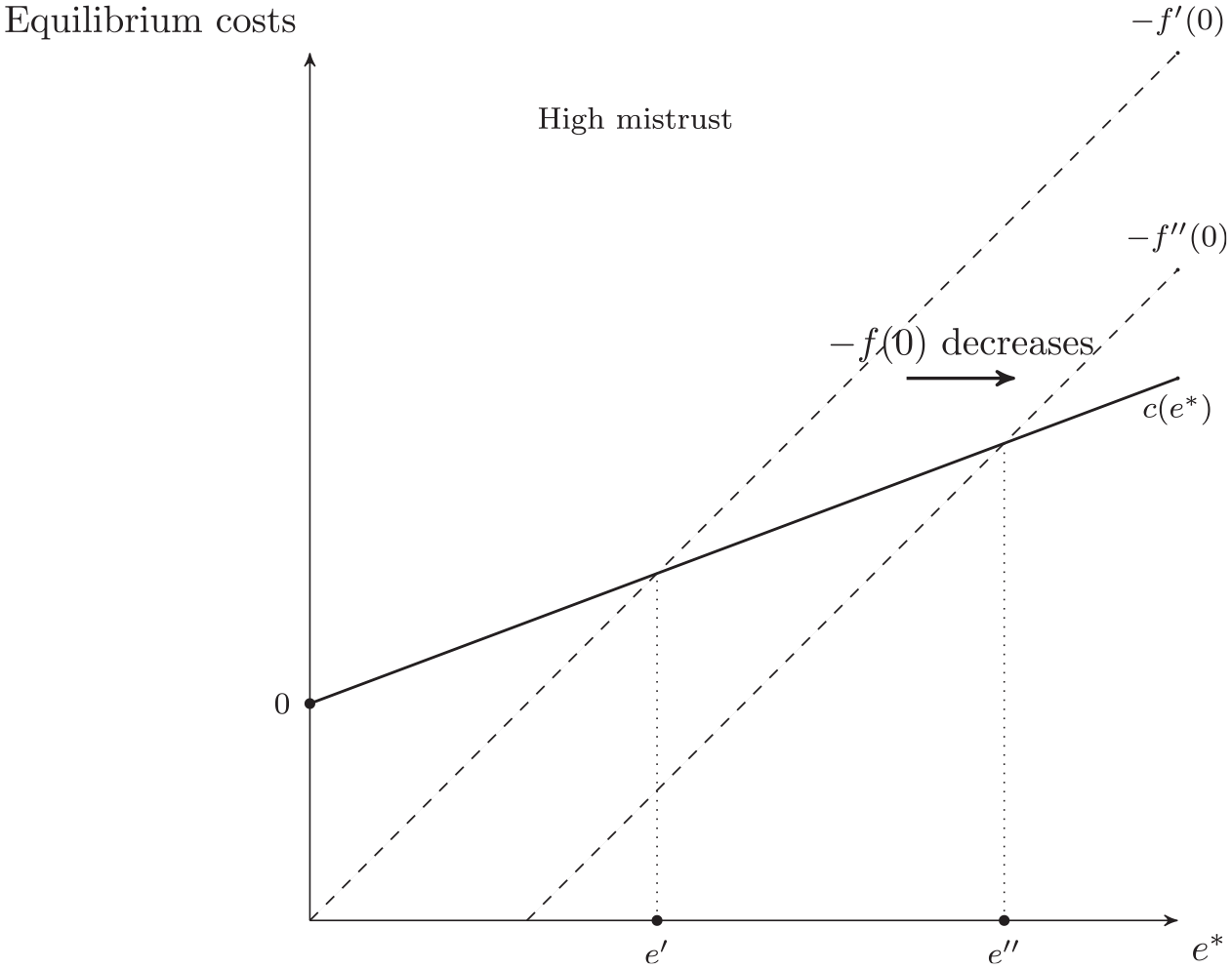
Equilibrium conditions of Prime Minister’s efforts with uncertainty about the median voter.
Accordingly, we have the following proposition.
Proposition 5 implies that in case of high mistrust, the uncertainty about the location of the median voter is crucial for the efforts of the Prime Minister. When uncertainty increases, the Prime Minister’s incentives to make further efforts for functional terms decrease. This reduced effort has negative implications for the payoff of the voters and the rank-and-file.
4.7. Summary
Before concluding, we summarize our findings in Table 1. When the principal–agent problems between the Prime Minister and the rank-and-file are negligible, the rank-and-file has little mistrust of the Prime Minister’s effectiveness. In this case, the Prime Minister will not announce a referendum and prefer to find an intra-party compromise solution among the rank-and-file. However, this decision has pros and cons. On the one hand, intra-party decision making does not generate the electoral benefits from the voters’ participation in decision making. On the other hand, the principal–agent problems are less likely to be revealed, which consequently increases electoral support for the intra-party membership decision. Overall, the decision of a referendum announcement depends on both the relative value of electoral benefits from announcing a referendum and the amount of principal–agent problems between the Prime Minister and the rank-and-file. Our analysis further suggests that when membership is decided internally, the rank-and-file is unlikely to implement intra-party scrutiny, which will reduce the incentives of the Prime Minister to spend efforts in improving the terms of membership.
Summary of the equilibrium behavior in the membership game
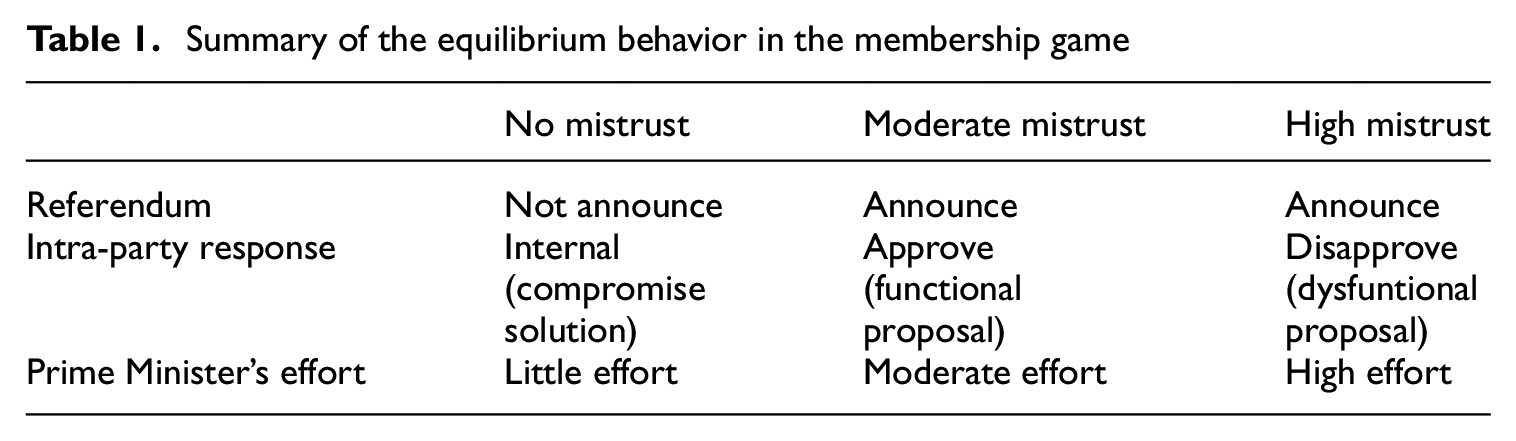
When the principal–agent problems between the Prime Minister and the rank-and-file become more severe, the Prime Minister will announce a referendum on her membership proposal and the rank-and-file is more likely to mistrust the Prime Minister’s effectiveness. In situations with moderate mistrust, the rank-and-file criticizes the Prime Minister’s effectiveness if and only if it knows that the new terms are dysfunctional; otherwise, the rank-and-file will approve the proposal without criticism. However, when mistrust is high, the rank-and-file approves the effectiveness if and only if it knows that the new terms are functional. Knowing the response of the rank-and-file, the Prime Minister adjusts her efforts accordingly.
Hence, the situation of high mistrust has also pros and cons. The Prime Minister will spend more efforts in the face of high mistrust compared with situations of moderate mistrust. However, the voters are more likely to learn about the dysfunctionality of the proposal from the interaction between the Prime Minister and the rank-and-file as mistrust increases. This also increases the uncertainty about the referendum median voter, which reduces the payoff of the efforts made by the Prime Minister. Accordingly, the Prime Minister will reduce her efforts in effectively negotiating functional terms in situations of high mistrust. This consequently increases the likelihood that the voters will reject her membership remain proposal.
In summary, our analysis shows that the initially uninformed voters are likely to support the Prime Minister and the rank-and-file in the general election because they prefer to make the membership decision by themselves. However, the more the voters learn about the dysfunctionality of the terms, the more likely they are to reject the Prime Minister’s remain proposal. Furthermore, the more the rank-and-file mistrusts the Prime Minister’s effectiveness, the more it will criticize the new terms and, thus, inform the voters about their dysfunctionality.
As the Prime Minister’s effectiveness depends on both the other’s willingness to offer concessions and the Prime Minister’s efforts to improve the terms, our results imply that the rank-and-file of Harold Wilson was less concerned about the Prime Minister’s effectiveness than the rank-and-file of David Cameron. Following this logic, Prime Minister Theresa May could have lost the parliamentary majority in the 2017 general election, because she did not announce the holding of a referendum on her non-membership terms, while the rank-and-file was not convinced by her effectiveness and rejected herproposal to leave the EU several times in parliament.
5. Conclusion
Within the British Westminster model, the delegation of the British membership decision via referendums to the voters is particularly puzzling. Our analysis draws attention to the principal–agent problems between the Prime Minister and the rank-and-file, which increase with the mistrust of the rank-and-file on the Prime Minister’s effectiveness in her negotiations of favorable membership terms. Our analysis demonstrates that announcing a referendum is the dominant strategy for an office-seeking Prime Minister and her rank-and-file to win the general election. Both Harold Wilson and David Cameron pursued this strategy, and their parties surprisingly won the general election.
When this strategy promotes electoral chances of the Prime Minister and the rank-and-file, the follow-up question is why referendums are seldom announced in the British Westminster model. To answer this question, we distinguished between a functional and a dysfunctional membership proposal of the Prime Minister. A functional proposal improves the British membership terms, while the latter reduces the general welfare of the country. Under uncertainty, our analysis posits that the Prime Minister, who has negotiated the new terms, has an informational advantage on their functionality. In addition, we note that the rank-and-file, who shares the office-seeking incentives with the Prime Minister to win the general election, may mistrust the effectiveness of the Prime Minister because it is also policy-seeking. Accordingly, referendums are only announced when the principal–agent problems between the Prime Minister and the rank-and-file become severe and consequently reduce the chances of winning the general election. This is the case for important ideological policies, such as British EC and EU membership, which raised fundamental intra-party conflicts.
This does not mean that the strategy to announce a referendum is always beneficial for the Prime Minister and the rank-and-file. Announcing a referendum helps to win the general election, but may only postpone the revelation of the principal–agent problems between the Prime Minister and the rank-and-file. After winning the general election, the Prime Minister can spend efforts in improving the terms of membership. Compared with the voters, who are uninformed about the functionality of the new terms, the rank-and-file can scrutinize the efforts of the Prime Minister to infer her effectiveness. After scrutiny, the rank-and-file of Harold Wilson approved the effectiveness, while the rank-and-file of David Cameron criticized the new terms. By modeling the informational role of the rank-and-file to the voters, we show that intra-party scrutiny makes a functional proposal more likely and a dysfunctional proposal more unlikely to find the approval of the voters.
Our model suggests that with more information available to the rank-and-file and the voters about the functionality of the membership proposal, the Prime Minister will become less opportunistic and make more efforts in negotiating new terms in favor of the United Kingdom. Harold Wilson succeeded in convincing the rank-and-file and the voters about the membership proposal. This may also imply the opposite, namely that Prime Minister David Cameron may have made fewer efforts and, thus, provoked high mistrust by the rank-and-file of the Prime Minister’s effectiveness. However, the effectiveness of the Prime Minister not only depends on her own efforts, but also on the willingness of the other member states to make concessions, which will improve the British status quo of membership. It thus remains an open question whether the inferred effectiveness of David Cameron suffered from too little efforts or too few concessions of other member states. Compared with Harold Wilson, David Cameron negotiated with 27 member states, which pursued quite heterogeneous interests on the membership terms.
We believe that our membership game, which we have applied to the cases of British EC and EU membership, is also applicable to other situations, in which referendums can be used to overcome the principal–agent problems between the leadership and the rank-and-file. These principal–agent problems are likely to exist when the utilities of the principal and the agent differ. This is the source of the principal’s mistrust against the agent, who is usually endorsed with an informational advantage and discretionary power. On the one hand, our analysis demonstrates that mistrust between the agent and the principal can motivate both players to delegate decision making to an ill-informed third party; on the other hand, the principal will try to reduce the informational deficit and scrutinize the activities of the agent, which may also reveal information about the (dys)functionality of proposals to the (uniformed) third party. However, when the agent does not announce a referendum on her proposal, as in the case of Prime Minister Boris Johnson, the uninformed voters may be finally confronted with dysfunctional terms about British “non-membership” through internal decision making of the Conservative Party.
Footnotes
Appendix A. Proof of Lemmas and Propositions
Appendix B. Summary of Notations
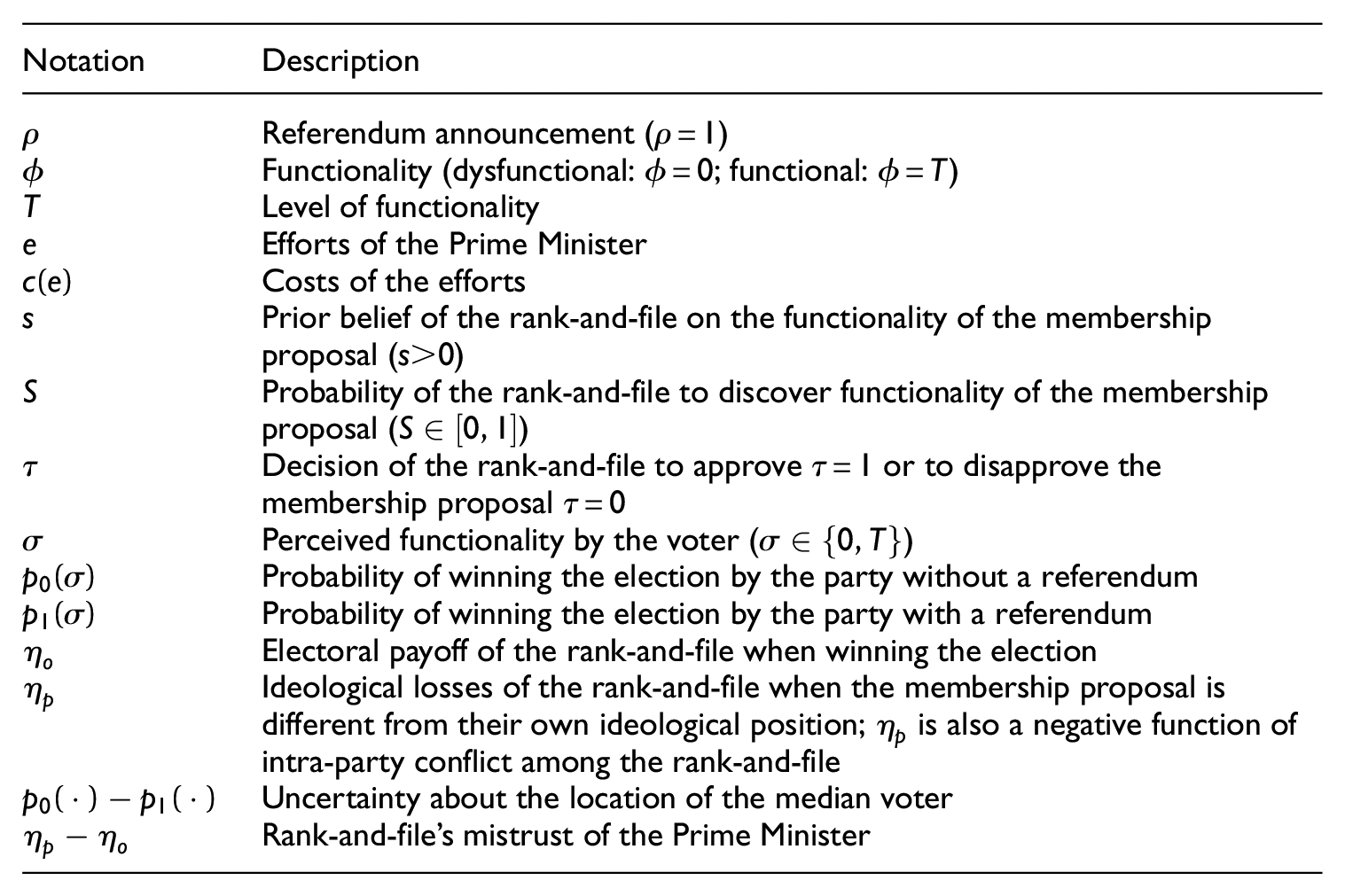
| Notation | Description |
|---|---|
| Referendum announcement ( ) | |
| Functionality (dysfunctional: ; functional: ) | |
| Level of functionality | |
| Efforts of the Prime Minister | |
| Costs of the efforts | |
| Prior belief of the rank-and-file on the functionality of the membership proposal ( ) | |
| Probability of the rank-and-file to discover functionality of the membership proposal ( ) | |
| Decision of the rank-and-file to approve or to disapprove the membership proposal | |
| Perceived functionality by the voter ( ) | |
| Probability of winning the election by the party without a referendum | |
| Probability of winning the election by the party with a referendum | |
| Electoral payoff of the rank-and-file when winning the election | |
| Ideological losses of the rank-and-file when the membership proposal is different from their own ideological position; is also a negative function of intra-party conflict among the rank-and-file | |
| Uncertainty about the location of the median voter | |
| Rank-and-file’s mistrust of the Prime Minister |
Acknowledgements
An earlier version of this paper has been presented at the EPSA Virtual Conference 2020.
Declaration of conflicting interests
The author(s) declared no potential conflicts of interest with respect to the research, authorship, and/or publication of this article.
Funding
The author(s) disclosed receipt of the following financial support for the research, authorship, and/or publication of this article: This work was supported by the Collaborative Research Center “Political Economy of Reforms” (SFB 884 Project C1: Legislative Reforms and Party Competition), which is funded by the German Research Foundation (grant number 139943784).
