




Abstract
European radical right parties (RRPs) have recently experienced strong electoral success and have strengthened their positions within the European Parliament. While their Eurosceptic positions are well documented in the literature, the fact that most RRPs refer not only to their nations but to Europe in general in order to ground their nationalist visions remains understudied. We investigate this issue by analyzing the discourses of MEPs from 24 radical right parties in the 8th legislature of the European Parliament (2014–2019). Relying on a vast corpus (36,413 speeches) and using quantitative text analysis, this research sheds light on the various notions of Europe that are used by radical right MEPs. We find evidence of three visions of Europe: as a civilization; as an ethno-religious community; and as a liberal society. The use and preferences for these visions vary according to ideological positions, strategies and national contexts.
Introduction
Nationalist claims are a cornerstone of radical right ideology. While each radical right party (RRP) might depict a different threat, they tend to unite against any phenomenon perceived as endangering sovereignty and ethnic homogeneity, whether it be foreign influence, globalization, European integration, migration, or multiculturalism. The electoral successes of RRPs over the last decade have propelled both the parties and their nationalist leaders to the forefront of politics across the globe (Brubaker, 2017; Halikiopoulou, 2019; Mudde, 2016; Rydgren, 2017). In Europe, one remarkable feature of RRPs is their sense of a pan-European alliance—despite their vocal Euroscepticism. Although they emphasize national sovereignty, the ‘true' characteristics of their national populations, and perceived threats to their national values, representatives of European RRPs also refer to a supranational, “European” community and/or identity that is allegedly at risk due to the same forces that threaten individual nations—migration, foreign actors, globalization, and even European institutions (Brubaker, 2017; Caiani and Weisskircher, 2022; Glencross, 2020).
Pan-Europeanism is hardly new. We can trace it back to the Classical period, and we find it too in the writings of authors such as Rousseau and Voltaire. The idea of a common European identity has been often entangled with notions of civilizational and/or racial superiority, as well as imperialism and colonialism (Cattani, 2017; d’Appollonia, 2009). However, in contrast to previous periods, the European Union (EU) now offers a political arena in which to voice these ideas—that is, RRPs can claim that common foes are threatening not only each individual European nation, but also their shared soil, people, and way of life. They might even promote a common identity with political connotations (that is, a Euronationalism), using particular features or markers to distinguish ‘true Europeans' from ‘others'. In other words, within the EU, RRPs often embrace a European framework for their nationalist arguments.
This article analyzes the commonalities and variations found in the discourse of RRPs in the supranational political arena: the European Parliament. Our results show that even if a common picture of Europe emerges from this discourse, it is a relatively fragmented one. Most RRPs develop their nationalist arguments within a European framework, with the most common approaches being a religious Euronationalism and, to a lesser extent, a civilizational Euronationalism. Some parties also rely on civic Euronationalism, mostly to stand against the current EU and integration.
The article is structured as follows. First, we present the theoretical framework, elaborating on three ideal types of Euronationalism, each of which emphasizes different aspects of European culture and shared identity. Second, we present the data and methodology. Third, we present an analysis of speeches by Members of European Parliament (MEPs) from 2014 to 2019 and draw conclusions.
A shared European Nation – or a Europe of Nations?
The literature on Euronationalism traces the concept from Classical antiquity to the interwar and post-WWII period (Cattani, 2017; Hobson, 2012). Eventually, Euronationalism divided into two distinct ideologies, an anti-national European nationalism and a pro-national European nationalism (d’Appollonia, 2009). The first is rooted in cosmopolitan and liberal values, a clear commitment to pacifism and a rejection of state nationalisms, and a sense that Europe was fated to play a particular international role. This Euronationalism is still often grounded in longstanding beliefs about the cultural superiority of Europe over ‘others', where ‘others' are often defined in religious and ethnic terms, especially by right-wing parties (Brubaker, 2017; d’Appollonia, 2009; Goldberg, 2006). The second type, pro-national European nationalism, is less common and envisions Europe as an overarching entity protecting national groups and minority groups from state repression. Europe is thus conceptualized as a political entity serving its constituent national members.
RRPs have been the most vocal opponents to European political integration (Ivaldi, 2018; Mudde, 2007; Vasilopoulou, 2011). However, such positions have not prevented the recent Europeanization of their activities, as well as inter-party links among them (see for instance Almeida, 2010; Brack, 2018; Kantola, 2021; McDonell and Werner, 2019; Zúquete, 2015). Some parties, such as the short-lived Identity, Tradition, Sovereignty group (6th EP legislature) or the Identity and Democracy group (8th EP legislature), even refer to European heritage, traditions, Christian values, and civilization (Almeida 2010; Bieber 2019; De Cesari et al., 2019; Glencross, 2020). Beyond the studies of these groups, our understanding of the European turn in nationalist discourses and its uses by RRPs remains limited. Going beyond generic definitions of Europe and nations, how do RRPs define the European community, and do their visions have common characteristics? The present article aims to extend the comparison of different parties beyond their electoral strategies to analyze their ideological stances and establish whether they share common vision(s) of Europe.
Scholars have identified a number of areas and forms in which an overarching ‘proto-national’ European identity and community can be expressed, ranging from the intellectual debates (e.g. Cattani, 2017) to its political manifestations, particularly but not exclusively among far-right groups (Brubaker, 2017; Halikiopoulou, 2019) or even among Eurosceptics themselves (De Cesari et al., 2019; Glencross, 2020) and, of course, its relation with European integration processes (d’Appollonia, 2009; Glencross, 2020; Krzyzanowski and Oberhuber, 2007) among many other topics. Building on this scholarship, we have identified three ideal types of Euronationalism, each focusing on the main features, membership, extension, and ‘otherness' of the European community: 1. The civilizational vision, where Europe is seen as a large entity composed of many groups, each with its own characteristics but sharing common historical trends in terms of culture, literacy, the arts, and scientific and technical knowledge. This provides European nations with a ‘common supremacy' in relation to other peoples and civilizations abroad. The argument can also be developed in terms of historical and socio-political superiority (i.e., Empires), but it always has cultural superiority as a basis.
In terms of membership, from this perspective, Europe is not (in principle) a closed community, as ‘others' can integrate by learning and immersion. As its influence and values extend well beyond the ‘core’ European soil, the territorial limits of the community might not be very fixed. Therefore, the real ‘others' are those who reject the basic values that define European civilization, regardless of where they are. 2. The ethno-religious vision, where Europe is seen as a collective with shared ethnic, religious, and historical elements including, but not limited to, Caucasian ethnicities, Christianity, and/or Greco-Latin roots, traditions, and festivities. The more radical versions will also portray Europe as the natural homeland of a certain ‘race’ (white, Aryan, etc.), sometimes referred to using washed-down terms such as ‘peoples’ or ‘natives’, with shared phenotypes, traditions, and religion. This vision also implies a much stricter territorial definition of the community, typically encompassing Northern and most continental Europe; however, some areas e.g. the Eastern limits of it might be a matter of internal debates.
From this perspective, either ‘others' are seen as intrinsically non-assimilable, because ethnic roots are essential and unchangeable, or assimilation is seen to demand a significant effort, including letting go of previous identities. That said, some ‘others' are perceived as more assimilable, particularly if they belong to co-ethnicities abroad and display European ethnic traits. 3. The liberal vision, where Europe is seen as the champion of values including, but not limited to, human rights, equality under the law, secularism, tolerance, individual freedom (freedom of speech and religion in particular), and gender equality, together with more modern developments like LGBTQI + rights. Membership is, in principle, open to any individual or community who accepts such values; and ‘the Other' is someone who rejects them, based on traditionalism, religion, or something else – either in Europe itself or abroad.
RRPs are characterized by anti-cosmopolitan, nationalist, sovereigntist, and anti-immigrant stances (see among others Kitschelt, 2007; Mudde, 2007; Rovny, 2013). If a vision of overarching European identity is to be found in their discourse, we thus expect it to be based primarily on the second ideal type described above, in line with existing studies (e.g. Caiani and Weisskircher, 2022; Elgenius and Rydgren, 2018; Halikiopoulou 2019; Vasilopoulou, 2011). However, scholars have found that RRPs also use allegedly liberal arguments to advance their agendas, particularly against migrants and the institutions of the European Union (Halikiopoulou et al., 2013; Lorimer, 2020; Simonsen and Bonikowski, 2020). We therefore expect the third ideal type to be possibly present in the data.
Additionally, the EU is an evolving community, built through successive enlargements. The specific discourse on enlargement has thus been articulated around categories mentioned above (who belongs to the community, and should get access to the club, and who does not) (Sjursen and Smith, 2018; Zielonka, 2007). Depending on the ideal types of Euronationalism, we expect the justification for enlargement (or opposition to) to be based on said shared cultural values, ethnic traits or religious beliefs, political values.
Methodology
Case selection and data collection
To analyze the discourse of RRPs on the European community, we have used the interventions of MEPs in plenary sessions during the 8th legislature of the European Parliament (2014–2019). The European Parliament provides an appropriate arena for parties to frame their nationalist arguments with reference to Europe, as it is supranational by nature, and more protected from voters’ attention than national parliaments. That said, we acknowledge that RRPs might feel compelled to frame their argument with reference to Europe in order to make them more socially acceptable in the supranational setting. We focus on the 2014–2019 legislature because more RRPs were represented there than at any other time in the Parliament’s history.
The data consists in MEPs’ interventions in plenary sessions (279 plenary sessions) from 2014 to 2019, available on the European Parliament website, 1 retrieved via web scrapping techniques and translated into English using the official automated translation service provided by the European Commission (e-translation – Connecting Europe). 2 About 5% of the initial sample (2014–2019 plenary minutes) had to be excluded due to technical issues (for example, PDFs not readable, errors in translation due to mistakes in the original files), but these were randomly spread over the period. Finally, to limit the analysis to substantive speeches, only speeches of 50 words and more were selected. A case has 137 words on average, thus allowing us to choose the full speech as our unit of analysis.
Number of cases by party.
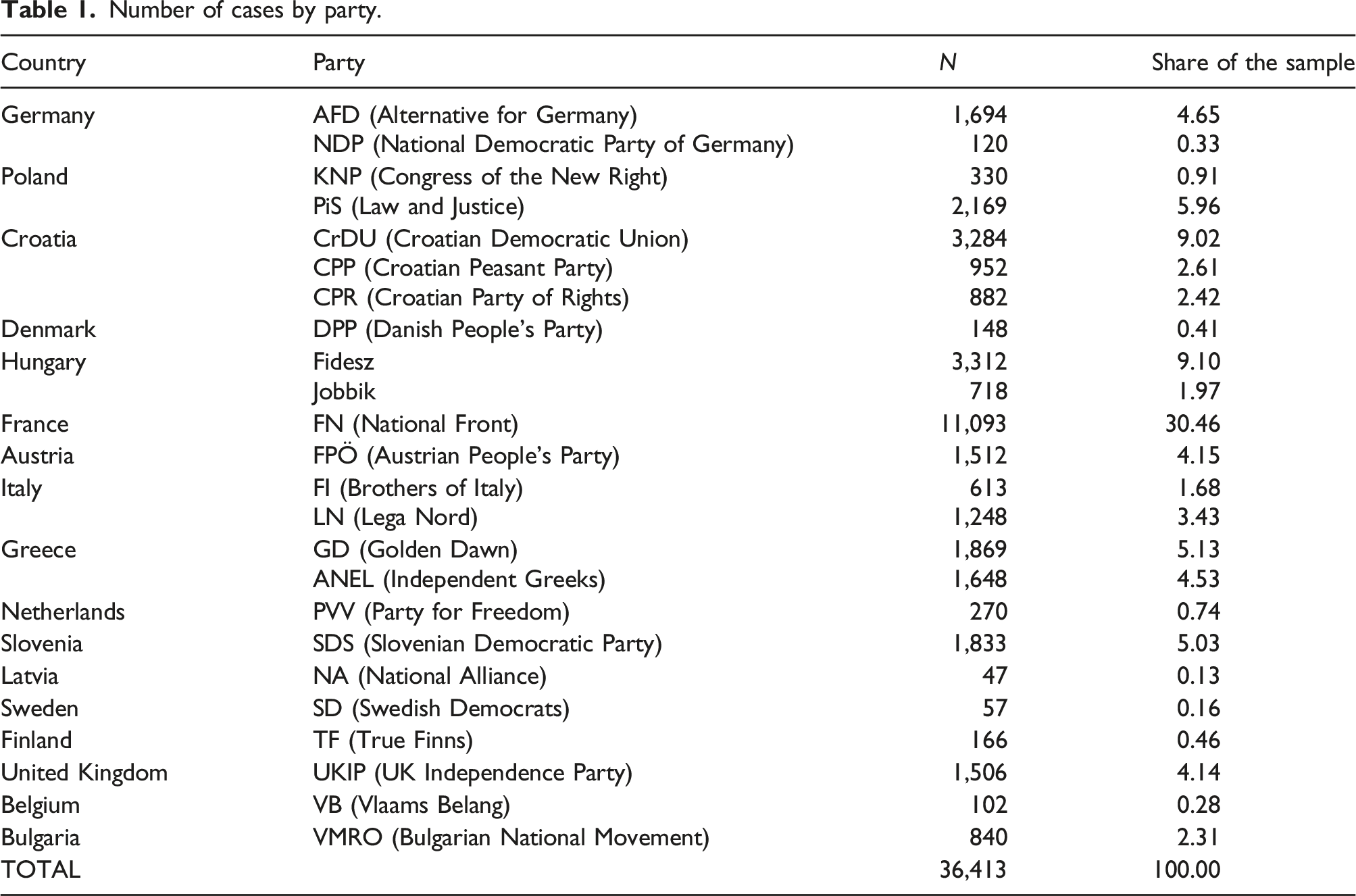
The large disparity in the number of speeches per party is explained by the speaking time rules (parties seating as independent members have less), and by each party’s share of seats. French National Front (FN) account for 30% of all speeches in the sample (N = 11,093), as they won 24.8% of the votes in the 2014 European election (24 MEPs). At the other extreme, contributions from the Latvian National Alliance account for 0.13% of all speeches (N = 47) (the party got 17.6% of the votes and one of the eight Latvian seats). Because European political groups are highly volatile from one legislature to the next, especially on the radical right, and because they are not ideologically congruent, we have organized our cases according to national party rather than European party or group. This explains why, for instance, even if the Italian Five Star Movement is part of the EFDD, like UKIP, it is not included in the present study, as it does not qualify as a radical right party and does not meet our operationalized selection criteria.
Methodology
The literature on discourse analysis and corpus linguistic is mostly divided between corpus-based and corpus-driven approaches, while acknowledging that the line, in practice, is fuzzy (for a summary of debates see among others: Baker and Egbert, 2019; Rheindorf, 2019). We conducted a dictionary-based text analysis, using lexicometric quantitative analysis with Wordstat 8 (QDA-miner). We investigated the ways in which different parties talk about the European community and the extent to which the three ideal types conceptualized above can be found in their speeches, using a data-reduction method (principal component analysis) with Stata, supported by in-depth qualitative analysis with keywords in context (Daigneault and Pétry, 2017). While this corpus-driven analysis allows us to establish if ideal-types are indeed present in RRP discourses, the process of dictionary building (as explained below) and the principal component analysis allow to account for the richness of the corpus and to make sure meanings are not imposed over the data (PCA being a descriptive and not a predictive analysis).
To build the dictionary, we first relied on Automated Topic Modelling (ATM) to uncover the most frequent themes present in the data, while minimizing researchers’ biais (Rheindorf, 2019). Performed with R on all speeches, the ATM produced 30 topics (see Figure 7 in Appendix), most of which deal with procedure and specific policy areas (such as trade, single market, security, economy, migration, and so on). We added categories relating to nationalism, and to ways of defining the community and its specific traits: ethnicity, religion, culture, civilization, and values. The dictionary was then improved based on the analysis of the data, leading us to include new keywords. The usual text-preparation process was applied to the corpus before running the dictionary: the exclusion of ancillary words (such as adverbs, determinants, etc.) and automated lemmatization (the reduction of different forms of the same word, such as past tenses and plurals) allowed us to reduce 5,555,309 words to 35,680 word forms (Leimdorfer and Salem, 1995).
Table A2 in the Appendix provides the reader with the list of categories and their distribution across the cases (our full dictionary is available on request). In its final form, the dictionary includes 20 main categories that cover 99.4% of processed words (54% of the total words were excluded, being ancillary words or speech markers). POLITICS encompasses categories of actors such as the EU, member states, parties, and procedure-related matters. POLICY includes the different policy areas. These two categories are not of first interest for the analysis but are included to reflect the content of the corpus. The remaining 18 categories (here after ‘categories of interest’) are divided into four groups. The first three focus on the three visions of community, conceptualized in the previous section: civilizational (CULTURE-HERITAGE, CIVILIZATION, EUROPEAN CIVILIZATION), ethno-religious (RELIGION, ETHNICITY, EUROPEAN CHRISTIANITY, CONTINENT), and liberal (VALUES, DEMOCRACY, EUROPEAN DEMOCRACY). The fourth category includes lexical fields related to the community in a broad manner, encompassing terms that can be related to the concept of nation (NATION) and to the community in its various forms, both directly, as with references to SOCIETY, THE PEOPLE, CITIZENSHIP, 5 and IDENTITY, and indirectly, as with the category DANGER (generally used to underline a threat to the community). As a community is also defined through its frontiers, we pay specific attention to a sub-category included in the “policy” category: ENLARGEMENT, to analyse how the different ideal types are mobilized in connection to it.
Analysis: RRPs and European communities
Assessing whether RRPs refer to Europe as a community
When we applied the dictionary to the full sample (36,413 cases), POLITICS was present in 99% of the cases, and POLICY in 95%. This is not surprising given the legislative nature of the arena. The 18 categories of interest are present in our sample to extents that vary greatly from one category to the next. In total, when we sum up all the categories that deal with “community” (both national and European), and how to define and protect it, they are present in 80% of the sample. Not all sub-categories speak directly of a European community—some deal exclusively with national communities—but they are studied in relation one to the other to illustrate how parties conceptualize nationhood within a European framework. Community and people, whether at a national level or a pan-European one, are at the core of this discourse.
RRPs thus evidently use the European legislative arena to talk about the community. However, when we look at the figures for each individual party, it is clear that they do not focus on community to the same extent—that is, they do not all spend the same amount of their speaking time referring to community. Most of the parties (18 out of 24) talk about community, either national or European, about 20–30% of the time. 6 For the neo-fascist Fratelli d’Italia (FI), the SDS (Slovenian Democratic Party), and the Austrian FPÖ, categories related to community are only present in 15% of the cases. The highest shares, over 30% of the cases, are found among the German neo-Nazi NDP, the Dutch PVV, and the Belgian Vlaams Belang (VB). For many RRPs, “community” is seen as endangered. The lexical field concerning threat (DANGER) appears in 20% of the total cases. Individually, most parties use it in 5–6% of their cases (except for the NDP and AfD, who rely on “danger” in only in 4% of their sample).
The three definitions of community are present, respectively, in 5.8% of the cases (civilizational definition, including categories related to civilization, culture and heritage, and the European continent), 6.2% of the cases (ethno-religious definition, including categories related to ethnicity and religion), and 18% of the cases (liberal definition, including categories related to democracy, rights, and values). The fact that the liberal definition appears most frequently comes as a surprise, as all parties in the sample are strongly nationalist, and definitions of nation for core nationalist groups are generally grounded in ethno-religious or cultural traits, and almost all of them are strongly Eurosceptic. However, at this stage of the analysis, the categories do not allow us to disentangle the definitions of the national community from those of the European community, or to make sense of perspectives claiming, for instance, that the EU is infringing upon national democracy.
Assessing the congruence of ideal types across parties, and their meaning
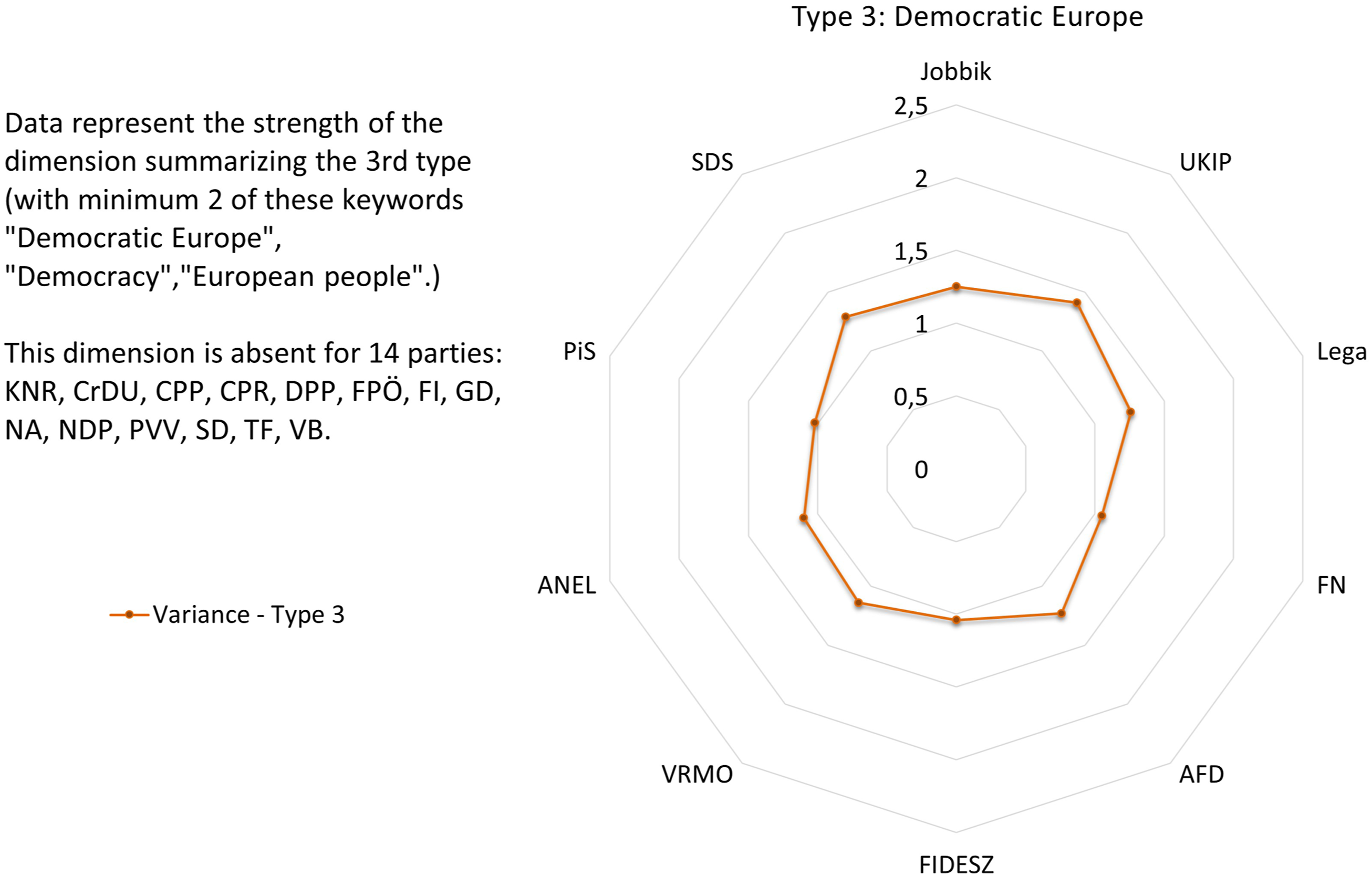
To assess the extent to which each party relies on the three ideal types, we conducted a principal component analysis (PCA) to empirically test their conceptualization of civilizational (ideal type 1), ethno-religious (ideal type 2), and liberal (ideal type 3) community at the European level. All categories of interest were included in the analysis, which was run by party to account for the large variation in each party’s total number of speeches. PCA is a data reduction method that displays, in this case, the frequency of each keyword in the dataset in a two-dimensional space, and also provides the distance between each pair of keywords, thus allowing us to see which keywords appear frequently together. When keywords are often used together (in the same speech), they score in the same dimension. Only factors with an eigenvalue above one and loadings above 0.3 were considered, and to increase the readability of the results, we present here only the results after rotation (varimax). The PCA explained more than 50% of the variance (measured with Rho indicator). Figures 1–3 below summarize the results by displaying the variance, explained by the dimension in question (after rotation), for each party.
7
Type 1: European civilization. Type 2: Christian Europe. Type 3: Democratic Europe.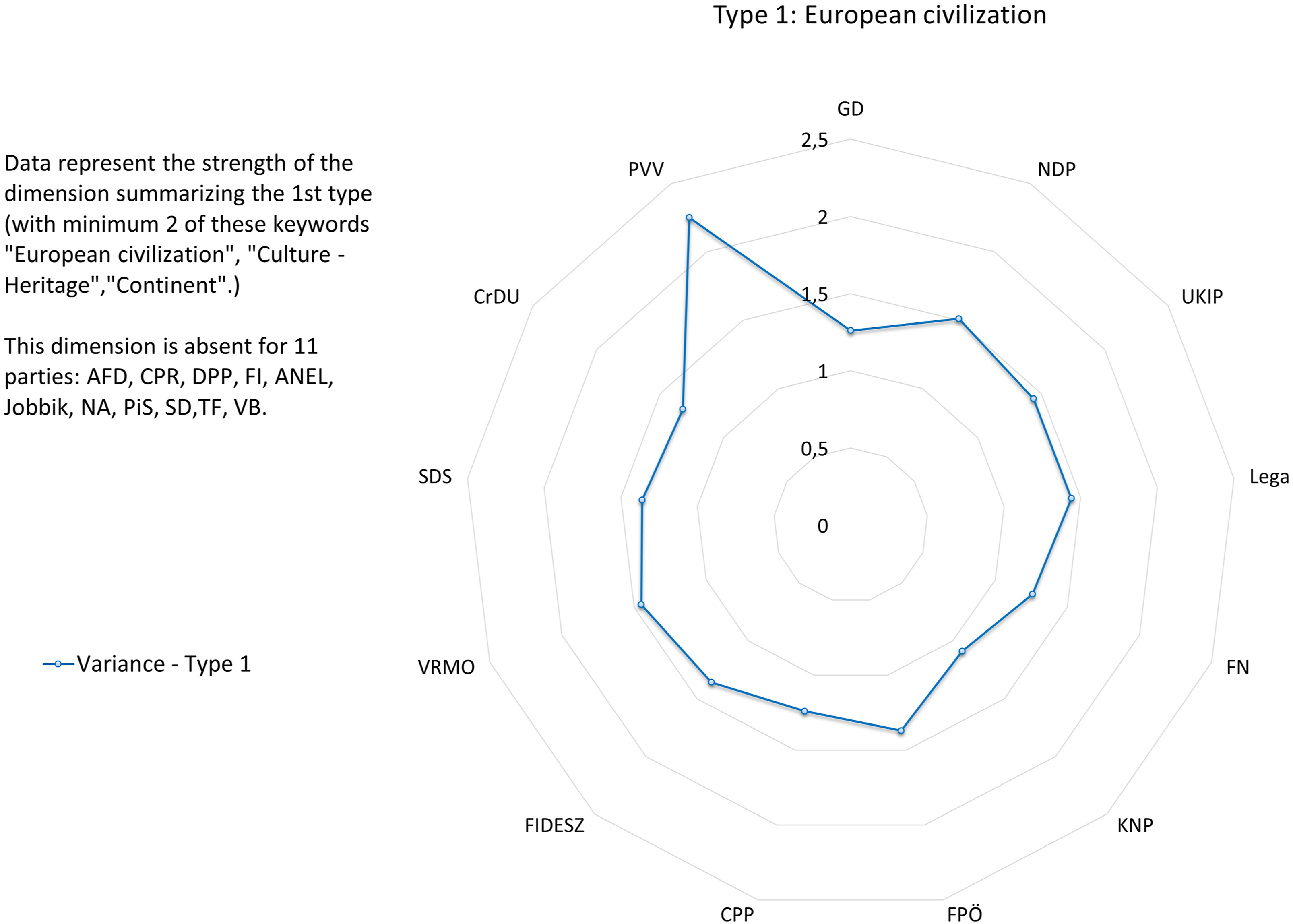
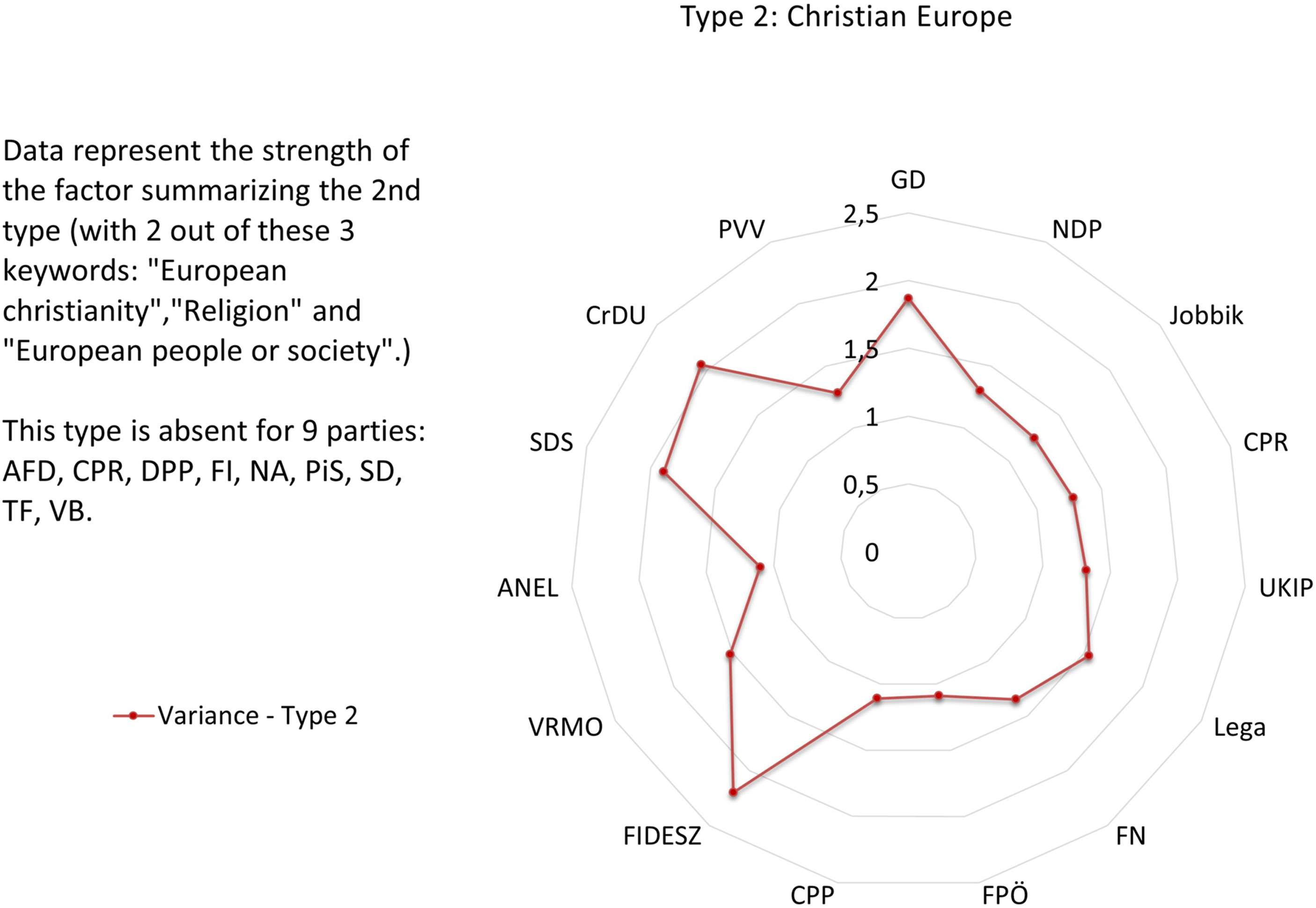
At least one definition of community is present in each party sample. We have focused first on the parties that have the clearest definition of the European community. The dimension found most often among all parties involves the religious definition of Europe (labelled “Christian Europe,” Figure 2 above). For 15 parties, there is a common community defined through its Christian identity. The dimension includes either direct mentions (with expressions such as “Christian Europe”) or a combination of RELIGION/CHRISTIANITY and mentions of EUROPEAN PEOPLE or EUROPEAN SOCIETY. This definition appears most clearly in the samples from Fidesz (value of 2.2) and the Croatian Democratic Union (2.08), followed by the SDS (1.87) and Golden Dawn (1.93). For the rest of the parties (PVV, NDP, Jobbik, CPR, UKIP, Lega, FN, FPÖ, CPP, VRMO, and ANEL), the value varies between 1.1 and 1.5. When PCA is performed for the whole sample, this definition is the first dimension found, with a value of 1.63.
The ethnic dimension of the ethno-religious ideal type is not explicitly present, except in the case of the CPR, whose samples include one mention of Indo-European heritage (CPR, case #38,770). In most cases, MEPs focus on the religious aspect, referring to Christianity as a common root, with its own culture and natural territory that must be preserved against migration and terrorism (implicitly or explicitly linked to Islam): Terrorists are highly effective at using our vulnerability …to show hatred towards Western values. Today, Europe is simply pointing to its Christian roots as being a sign of their identity, and the peoples and states without a sense of identity are an easy target for those who want to impose another identity by force. (CPP, #8661).
Mentions of Europe as a continent (“our continent”) show that this space is understood as a collective environment to be preserved from invasion–that is, from migration: “The threats against our continent are increasing. Terrorism poses a threat to our people and our values.” (FN, #3182).
This link is present on a few occasions where FPÖ and Golden Dawn speak of enlargement. In the case of FPÖ, the threat of “Islamic radicalization” and consequential home-terrorism are used as an argument against the accession of Western Balkans (FPÖ, #36734). Golden Down strongly advocates against Turkey’s accession, based on first and foremost the threat of Greek borders (in relation to the situation in Northern Cyprus), but also in reference to ethnic and cultural differences: “Turkey has nothing to do with a cultural and ethnic context with Europe. Its accession to the EU will function as a fifth column.” (GD, #7755).
What we conceptualized as an ethno-religious community for RRPs, then, is in reality a religious one, defined through Christianity, and very often opposed to Islam and secularism. In some cases, the community is not only European, but wider, with reference to “Christian brothers” in Syria and Iraq: History has shown that the atheist dictatorship can only be defeated by joining forces. …[T]he fight against Islamic fundamentalism,(…) should lead to the emergence of a Christian Europe and a community of belief through the humanitarian disaster in Iraq, bringing together Christians in Syria, and all persecuted Christians.” (Fidesz, #3302)
While the ethno-religious definition appears broadly across our sample, the civilizational definition of Europe is present for 13 parties, most of them exhibiting a value between 1.3 and 1.5 (Golden Dawn, NDP, UKIP, Lega, FN, KNP, CPP, Fidesz, VRMO, SDS, and CrDU), with PVV and SDS scoring higher than 2. On this dimension, we found at least two of the following keywords: EUROPEAN CIVILIZATION, CULTURE-HERITAGE, CONTINENT. For these parties, Europe is a community with a specific culture and way of living, grounded in a shared history and inherited values and traditions. Some MEPs mention Western civilization and culture as a common ground, often to be defended against migration (Lega, FN, Fidesz), and as something to preserve and celebrate among younger generations (FPÖ). Some parties also refer to the Roman Empire and Latin civilization (CPR, FN, PVV). Common European civilization in this context thus refers to a glorious past that links European nations together and is today endangered by the European Union’s migration policy.
While the “culture” that RRPs refer to is not systematically defined by specific traits, most parties evoke common ground that forms a civilization, exists in a specific space (the European continent), and needs to be defended, both from external groups like migrants, especially those from the Muslim faith, and from left-wing political forces: On the other hand, there is a dazzling European civilization and a concert of instincts which create the need for close cooperation among the nations of the Boreal continent, even beyond Western Europe. (FN, #39951) I want to talk to you about the sustainability of society and culture, which are undoubtedly under pressure. From outside through the migration of large groups of people mainly from Muslim countries who have nothing in common with our culture, who do not want to adapt (…). But also from inside. (…) [L]eft-wing parties want to demolish as much culture and identity as possible from society. (...). The survival of our Western society, (…), based on Judaeo-Christian and humanist inheritance. (PVV, #39677)
Not all parties go so far as to refer to a common European people. FN, UKIP, and DPP, while sometimes referring to “European women” or “European civilization,” do not see these common grounds as conferring any legitimacy to the EU as a political project: In reality, the EU has no foreign policy, it is not a state and does not have to become a state, although it does have a legal personality, due to the lack of a single European people. Europe is a rich continent of 28 nations. (DPP, #13746)
When these parties refer to a European people, it is done so as a criticism. Any European people is seen as a false construction and as posing a threat to national democracies and communities.
The third ideal type, which defines the European community by its liberal values (including protection of minorities, freedom, and democracy), is present in the samples from 9 out of 24 parties: UKIP, FN, AfD, Fidesz, Jobbik, Lega, PiS, SDS, ANEL, and VRMO, with values ranging from 1 to 1.5. This dimension summarises keywords related to DEMOCRATIC EUROPE and mentions of DEMOCRACY with a European component (EUROPEAN PEOPLE or EUROPEAN SOCIETY). While we initially conceptualized this third ideal type as the liberal one, analysis showed that RRPs seize primarily on its democratic aspect, hence the label we have attributed to it. 8 Nevertheless, we see a great deal of variety in this third type. Three visions of a “Democratic Europe” emerge.
First, democratic values are used to define the present European community in opposition to other regions or periods. But this approach varies within our sample. Eastern and Central European parties (Fidesz, Jobbik, SDS, CPR, CrDU) 9 often use references to the past and to Communist regimes or the Cold War to underline the (potential) democratic nature of Europe today and to ground foreign policy arguments related to China, Russia, or Ukraine. It is also used in relation to enlargement, to establish who does and does not belong to this community defined through rule of law and human rights. AfD, Fidesz, CrDU, DPP and VB in particular mobilize the liberal repertoire to address enlargement to the Western Balkans and Turkey, with references to “the values of fundamental human rights, the rule of law, democracy, freedom and human dignity” (Fidesz, #8695), to “a democratic, constitutional, free and diverse society in Europe” (AfD, #595), and to “the Union’s freedom and other values” (CrDU, #2594).
Two parties, SDS and CrDU, look beyond democracy and define the community in terms of human rights and tolerance. They use this vision to anchor their respective countries, Croatia and Slovenia, in the envisioned European community: The rise of extremist ideologies represents the greatest threat to democracy, is a threat to the people of the European Union, our way of life, the values and freedoms on which the European Union is founded. (…) Each of us is responsible for combating intolerance, xenophobia, and anti-Semitism. (SDS, #4432)
While both parties score 8.3 on the nationalism and GAL-TAN dimensions, they are the least extreme parties in the sample, and are generally characterized by conservative but pro-European stances. Accordingly, they frame Europe as a community sharing values, history, and a destiny.
Two other parties, the Swedish Democrats and VRMO, refer to a “democratic Europe” in its full meaning, as a political community that could become a reality, though they often emphasize that the current approach should be improved: I support (…) the need for a more democratic Europe, but in order to do so we need to be closer to our citizens. I believe that the path adopted for a more centralized Europe, or, in other words, the federalist idea of the European Union, is wrong.” (VRMO, #36581)
By contrast, in the second sub-category, parties link the DEMOCRACY repertoire to the EU in order to underline the EU’s lack of legitimacy vis-à-vis the nation state. In these cases, EUROPEAN PEOPLE and DEMOCRATIC EUROPE are used only as counterviews to strengthen the grounds for democracy on a national scale. “Democratic Europe” is thus understood as an intergovernmental setting, with independent nation states, defended by MEPs who see themselves as champions of freedom and democracy. This strategy is mostly used by FN and UKIP, calling for “A return to the democratic Europe of the states!” (FN, #3839), moving “away from a Totalitarian Europe” (FN, #44442), to build a “free democratic Europe made up of nation states which take their own decisions. (UKIP, #1689)
This dimension is thus closely linked to the repertoires of NATION and SOVEREIGNTY, with parties arguing that collective decision-making is endangering independent member states and infringing on national democracies. In the case of FN, which is the party that speaks the most about enlargement, 10 enlargement is referred to as a project for European elites in Brussels, pushed forward against the wish of the peoples, and portrayed as an enterprise of expansion, relying on false democratic pretences, with parallels to authoritarian regimes, comparing the EU to a “Leviathan” (FN#4491), with a “euro-federalist ideology of an enlargement of the EU without any limit.” (FN, #22062).
Moreover, MEPs from FN, UKIP, PiS, Jobbik, and ANEL refer to a “European democracy” in a negative or even ironic way, emphasizing the difference between the (inexistant) “European people” and sovereign “European peoples,” plural (FN, #28; UKIP, #25).
Some parties go one step further and directly compare the EU to the Soviet Union or Nazi regime, drawing a parallel between debates over the rule of law in Poland and the Soviet Union’s imperialist take over Poland for instance: I listen to all of this, especially the first speeches, and I feel like I am at the heart of the Central Committee of the Communist Party of the Soviet Union: exactly the same phraseology (...) The same was said in the Soviet Union (…) Europe is based on the Goebbel’s model (…). All newspapers speak the same throughout Europe. (KNP, #36588) Turning the EU into a Soviet-style empire will not avert its inevitable end, and it’s already showing widening cracks. (PVV, #37525)
Finally, as displayed in Figure 4 below, a few parties rely on a mixed definition of community, using the civilizational repertoire (ideal type 1), but conceptualizing it in a religious (ideal type 2) or political (ideal type 3) way. AfD, DPP, PiS, and VB refer to a European Christian civilization, to be defended against secularism (often related to far-left opponents) and Islam (very often linked to migration and terrorism). These cases are thus close variations on ideal type 2. In a similar way, CPR, DPP, AfD, SD, NA, Fi, PiS, and VB sometimes define European civilization in relation to its democratic features, where democratic values are more than simply a political regime. As in the case of dimension three above, different parties refer to this dimension to different ends. For example, similar to RRP nationalist stances at the national level (Halikiopoulou et al., 2013), the repertoire of ideal type 3 (liberal and civic type) is also used to frame nationalist ideas in a way that seems more acceptable in an institutional arena such as the European Parliament. These traits can then be used to differentiate the European civilization from ‘others', especially in connection to enlargement and candidate countries like Turkey. Mixed definitions of the community.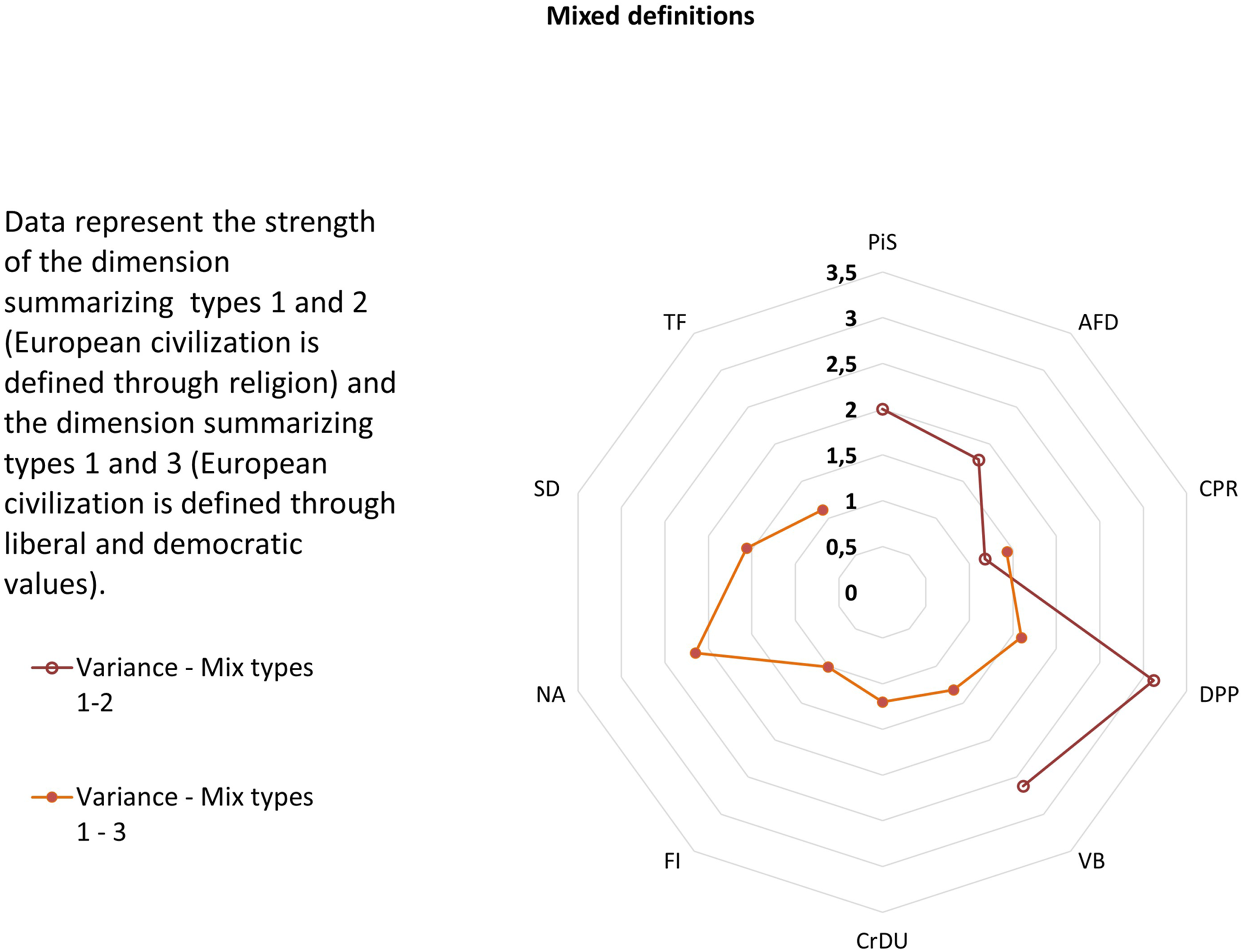
Conclusion
By analyzing the discourses of radical right MEPs, we were able to distinguish three types of Euronationalism. It is important to note that these three approaches are not mutually exclusive; in fact, they frequently appear together in a single speech or case, even as one predominates. Our findings showed that most parties (15 out of 24) put forward a religious definition of the European community. The idea of a Christian Europe is the most common vehicle for RRP nationalism. Fidesz, FN, CrDU, SDS, Golden Dawn, and Lega in particular conceptualize Europe with specific reference to its Judeo-Christian heritage, and with a clearly exclusionary attitude towards both the Islamic world and non-European immigrants. This attitude is expressed in terms of a fundamental opposition and is strongly correlated with security considerations (such as terrorism and other threats to public safety). This “hard Euro-ethnic” approach (the closest that any of the parties gets to a Euronationalism of the “ethnic” type) also appears occasionally in the discourses of the other parties, but in a more nuanced way.
Meanwhile, some parties—but fewer—including PVV, and to a lesser extent VRMO, UKIP, NDP, FPÖ, CPP, and Lega, underline the common cultural, historical, and even civilizational features of Europe, which are to be defended against ‘the Other', and stress the need to preserve Europe’s “social cohesion.” This civilizational Euronationalism might be perceived as less radical and xenophobicand thus more acceptable to broader audiences. It can be used by either ‘soft’ or ‘equivocal’ Eurosceptic parties (Heinisch and Werner, 2019) to advance their agendas, both within and beyond the European Parliament. In addition, “civilization” is a broad enough concept that it can be linked with ethno-religious arguments as well as liberal values. Indeed, all parties with a clear goal of governing (either being in government or by being close to governing), use democratic references to grounds their stances in terms of European ethnic, religious, or cultural homogeneity: these include Fidesz, FN, UKIP, AfD, PiS, SDS, and Lega.
Finally, several RRPs voice ideas about a pan-European identity grounded in shared values and above all democratic features. However, they are not speaking of a real civic Euronationalism. Rather, this “democratic” vision is used in three ways. First, parties denounce the undemocratic dimension of the EU, contrasting it with national democracies. RRPs that have taken a strong Eurosceptic stance as part of their electoral strategy, such as UKIP and FN, rely in particular on this argument. This first use has been widely mobilized outside of the parliamentary arena to frame political discontent with the EU over the past two decades. Participating in the constraining dissensus, this argument has been used by Eurosceptic parties to new integration steps based on the argument of popular sovereignty, democratic deficit and citizens’ dissatisfaction with decision-making at the European level (Hooghe and Marks, 2019; McDonnell and Werner, 2019). Second, references to a democratic and liberal Europe are used to distinguish Europe from other countries—Muslim countries in general and Turkey specifically—which are conceptualized as enemies and outsiders. As previous researchers have shown (Brubaker, 2017; d’Appollonia, 2009; Goldberg, 2006), liberal arguments are used in a confrontational and quasi-ethnic way to position ‘the Other' as uncivilized or as a threat to the freedoms and rights of the European citizens. And finally, RRPs use democratic values to define the European community in opposition to their political opponents or previous regimes (left-wing parties, Russia, communist regimes).
To conclude, our research clearly shows that RRPs use a European framework to ground their nationalist arguments. While the civilizational and religious definitions of the European community are the most common in the discourse of right-wing MEPs, these definitions remain diverse and, as expected, do not supplant the importance of a national community. Their emphasis on the characteristics of European society, on the contrary, can be seen either as providing a shield for national societies, or as a strategic way of presenting more contentious arguments. Given this variety, the present analysis is limited in terms of depth. To overcome this, triangulation would be the way forward (Rheindorf, 2019:6), through, first, varying the method, for instance narrowing the sample to a smaller selection and to present qualitative case studies of these three types of Euronationalism. Such approach would allow to analyse how the different visions of Europe relate to each other in an intertextual fashion. Second, the present analysis could be complemented with additional data to investigate the influence of context. It would also be fruitful to study RRP’s uses of “Europe” outside the rather sheltered arena of the European Parliament, such as during European electoral campaigns.
Supplemental Material
Supplemental Material - Being European, the nationalist way: Europe in the discourse of radical right parties
Supplemental Material for Being European, the nationalist way: Europe in the discourse of radical right parties by Laurie Beaudonnet and Henio Hoyo Prohuber in Party Politics
Supplemental Material
Supplemental Material - Being European, the nationalist way: Europe in the discourse of radical right parties
Supplemental Material for Being European, the nationalist way: Europe in the discourse of radical right parties by Laurie Beaudonnet and Henio Hoyo Prohuber in Party Politics
Footnotes
Acknowledgements
The authors wish to thank Nadja Momcilovic, Yani Kartalis, Mariana Sato, and Khaoula El Khalil for their research assistance in data collection.
Declaration of conflicting interests
The author(s) declared no potential conflicts of interest with respect to the research, authorship, and/or publication of this article.
Funding
The author(s) disclosed receipt of the following financial support for the research, authorship, and/or publication of this article: This work benefited from the financial support of the Jean Monnet Chair Euroscope (Jean Monnet actions, Erasmus + program, grand number: 565331-EPP-1-2015-1-CA-EPPJMO-CHAIR); the Center for Study of Democratic Citizenship (Regroupement stratégique du FRQS, grant number: 203856), and the University of Monterrey (UDEM, departmental funding).

Supplemental Material
Supplemental material for this article is available online.
Notes
Author biographies
References
Supplementary Material
Please find the following supplemental material available below.
For Open Access articles published under a Creative Commons License, all supplemental material carries the same license as the article it is associated with.
For non-Open Access articles published, all supplemental material carries a non-exclusive license, and permission requests for re-use of supplemental material or any part of supplemental material shall be sent directly to the copyright owner as specified in the copyright notice associated with the article.
