



Abstract
Why do members of parliament retire? In most parliamentary systems, a substantial number of MPs decide, before every election, not to run again. Though the decision to leave politics is essentially personal, a broader look at a large sample of MPs can reveal the existence of structural factors such as an uneven playing field or other sources of discrimination that could explain why certain individuals stay while others leave. A survey of the current literature indicates that the empirical work on this topic is almost exclusively focused on the US Congress. There is thus a need to conduct more research in other contexts to generate a more general explanation of why MPs leave politics on their own terms. The current literature suggests that the decision to leave could be explained by a complex combination of variables that are personal, partisan, and contextual. The purpose of this article is to better understand why sitting MPs decide not to run for re-election in parliamentary systems, focusing on three Westminster systems: Australia, Canada, and New Zealand since 1945. Various factors play a role, but our results suggest that as time passes, parliamentarians simply become less prone to seeking reelection.
Introduction
A member who voluntarily resigns makes the “choice to remove oneself from the pursuit of further service within a legislature” (Hjelmar, et al., 2010: 402–403). This decision might seem at first sight surprising. Why retire rather than run for another term to maximize the chances of gaining potential influence or maintaining one’s position (and potentially earnings)? This decision raises important questions about contextual factors affecting propensity to retire as well as individuals’ motivations to quit or not. This question is important for the quality of representative democracy as the volume of retirements can affect parliamentary work. A low turnover (with few retirements and defeats) can generate a disconnect with citizens, while a high turnover entails the presence of too many inexperienced legislators unable to respond adequately to citizens’ concerns (Byrne and Theakston, 2016; Krupnikov and Shipan, 2018) and/or leave the executive power unchecked.
The multiplicity of issues raised by these individual decisions give an idea of the complexity of this phenomenon, and this is observed by the diverse nature of studies on the topic. However, no consensus seems to emerge from this research. As we will see, the retirement of Members of Parliament (MPs) is studied from rival approaches that communicate very little with each other. In addition, few comparative studies have been conducted. In other words, we do not have a comprehensive and comparative model to explain why parliamentarians seek reelection. This study about the retirement of Australian, Canadian, and New Zealand PMs has thus three objectives. First, it provides a fresh look at the issue by assessing the relevance of the multiple explanatory factors that have been identified in prior research. Secondly, it analyzes MPs retirement in Westminster systems, but still makes space for comparison between electoral systems in terms of voting rules and term length. Thirdly, it contributes to the literature with additional and novel comparative analysis to enrich the scientific debate surrounding MPs’ retirement.
Our conclusions can seem at first disappointing. It happens that MPs tend to not run in an election more as they grow older and/or more experienced. Other factors play a role at the margins, but our results suggest that as time passes, parliamentarians simply become less prone to seek reelection. Still, it is important to kee in mind that an overwhelming majority of MPs seek reelection. In this article, we first cover a large but unfortunately unstructured scientific literature on why MPs leave politics. We then estimate a series of statistical models to test the relationships between a series of potential factors and the likelihood to seek reelection. We then conclude by a general assessment on the current state of knowledge on this topic.
Why do MPs leave politics?
Though MPs’ retirement has attracted the attention of many political scientists, the literature, essentially focused on the American case, gives little space to recent developments in Westminster type systems. Retirement appears as a complex phenomenon influenced by a combination of personal, partisan, and contextual variables. We begin here with a presentation of four approaches: (1) job dissatisfaction, (2) electoral vulnerability, (3) ambition and opportunity structure, and (4) the adverse economic context.
Job dissatisfaction
A first approach to explain MPs retirement is job dissatisfaction. The MP is often perceived by the public as a privileged person, with a very enviable position. However, it is sometimes far from reality. This is what the “no fun” argument authors argue, a line of reasoning instigated by the research of Frantzich (1978) and Cooper and West (1981). Sometimes “exhausting”, sometimes “frustrating”, parliamentary work can be judged to be unsatisfactory, and lead to the conclusion that retirement is a better option (Atkinson and Docherty, 1992).
The workload, the difficulty of reconciling political and family life, the pressures from public and media, or even illness can make a member’s mandate an exhausting exercise, to the point that retirement is seen as the only possible way out of a “horrendous life” (Roberts, 2015: 2–10; Theakston and Honeyman, 2007). Children of politicians “wrote to Santa Claus asking for his departure from politics as a Christmas present” (Weller and Fraser, 1987: 82) or a woman’s concern about the deterioration of her politician husband’s health (Roberts, 2015: 10) are among the many examples that testify to the difficulty of political life. The common aspiration of MPs and ministers to sacrifice for the public interest increases family pressures, affects the member’s stress and health, until retirement is deemed desirable (Blair and Henry, 1981; Docherty, 2001; Fisher and Herrick, 2002; Heinsohn and Freitag, 2012; Theakston and Honeyman, 2007; Weinberg et al., 1999).
Family pressure also appears to be a determining factor in women’s decision to retire. While research so far there are specific barriers to enter politics (see for example Fox and Lawless, 2010; Shaw, 2006; Vanlangenakker et al., 2013, 2011), there is now evidence that it is easier for women to get out of it, particularly because of the difficult balance between work and family life. The studies highlight the higher level of conflict between private and public responsibilities among young women. Mothers are underrepresented relative to fathers in parliament because they feel their household responsibilities are more important (Campbell and Childs, 2014; Silbermann, 2015; Johansson Sevä and Oun, 2019; Joshi and Goehrung, 2021; McKay, 2011; Melanee and Bittner, 2017). This phenomenon could be explained by the grueling nature of the political agenda outside regular business hours (Campbell and Childs, 2014; McKay, 2011; Palmieri, 2018). An existing parliamentary culture largely dominated by men would ultimately encourage women MPs to retire more than their male colleagues. Our first hypothesis is thus that women MPs are less likely to seek reelection (H1). As we discussed later, we are also interested in the gendered differences that condition other relationships between individual-level factors and the decision to seek reelection. We will come back to that later. Also related to the demanding nature of a political career, we test whether older parliamentarians are less likely to seek reelection (H2).
The frustration that the parliamentary function can provide may also create incentives to retire early. As Clarke and Price (1980) have pointed out when referring to parliamentarians before taking office: “expectations, albeit frequently vague, of performing constituency service and related representational tasks are widespread” (Clarke and Price, 1980: 186). Ignorance or misperception of their future function lead to disillusionment and retirement (Clarke and Price, 1980: 604, see also: Atkinson and Docherty, 1992: 306; Kerby and Blidook, 2011: 622).
Related to disappointed expectations is a feeling of uselessness. Not being able to influence public policy can be frustrating and lead to retirement (Baumann, 2012; Moore and Hibbing, 1998; Matthews, 1984). In this regard, Lawless and Theriault (2005) have shown in the American context that women are more concerned by this type of frustration because of the inequality of career prospects. Men would be more motivated to maintain their position while women were more interested in influencing public policy in a specific area (Lawless and Theriault, 2005: 585). Ideology also comes into play. Indeed, several American studies (Murakami, 2009; Livingston and Sally Friedman, 1993; Frantzich, 1978), but also a recent one which focuses on Canada and the United Kingdom (Raymond and Overby, 2019), demonstrate that Conservatives would be more inclined to retire than their more progressive counterparts. The literature also mentions the impact of being from a minor party, mostly in United States (Bernstein and Wolak 2002; Box-Steffensmeier and Jones 1997; Brace 1985; Gilmour and Rothstein 1993; Livingston and Friedman 1993; Mezey, 1970; see also this recent research on Turkey: Yildirim and Overby (2019)). However, being from minor parties may not be as critical in explaining retirement in multi-party systems or in coalition governments, even if the empirical evidence is scarce on this topic. In a nutshell, lack of resources, both human, material, and financial, can be a source of frustration and induce retirement. The degree of professionalization of legislatures and more precisely the level of remuneration or pension benefits appear as important incentives to remain in office (Berkman, 1994; Bernstein and Wolak 2002; Berry et al., 2000; Clarke et al., 1999; Fisher and Herrick 2002; Hall and Van Houweling 1995; Heinsohn, 2014; Hibbing, 1982a; Maestas et al., 2006; Masthay and Overby, 2017; Pinar, 2014; Squire, 1988). Though there are a lot of potential explanations found in the literature, we decide here to focus on the political and material benefits of seating with a government party. We thus test whether members of a government party are more likely to seek reelection (H3).
Electoral vulnerability
Several authors have argued that electoral vulnerability may induce members to retire. According to this approach, the importance of the financial and human costs of an election campaign could dissuade the electorally weakest from running (Fukumoto, 2009; Highton, 2011: 432; Livingston and Friedman, 1993; MacKenzie, 2009: 281; Stone et al., 2010: 179; Wolak, 2007). Dominated by American research, we draw from these works several sources of electoral vulnerability likely to shape the decision to retire.
Especially strong in the United States, the incumbent advantage undeniably favors reelection and thus reduces the likelihood of retirement. Conversely, MPs with few terms have the disadvantage of having less experience and fewer resources. This makes them more electorally vulnerable, which increases the probability of their retirement (Atkinson and Docherty, 1992; MacKenzie, 2009: 281; Stone et al., 2010: 180). Studies of the incumbent effect are less numerous for Westminster type systems but have produced similar findings (Banducci and Karp, 1994; Kendall and Rekkas, 2012; Krashinsky, 1991, Krashinsky and Milne, 1985; Smith, 2013: 167). We thus have a fourth hypothesis to test: Having won the previous election with a more comfortable lead makes it more likely to seek reelection (H4). We also test whether a longer tenure in parliament makes it more likely to seek reelection (H5).
Electoral vulnerability can also be caused by institutional factors. It is because “voting rules could affect seat safety” (Habel: 2008: 471), that the electoral system and the redistribution of districts appear as vulnerability factors. Being more competitive and less secure for reelection than majority systems, some research has shown that the proportional system makes MPs more vulnerable (Carey et al., 2000; Habel, 2008; Heinsohn, 2014; Matland and Studlar, 2004). However, while these studies demonstrate a significant relationship between the electoral system and electoral vulnerability, the only empirical research that tested a causal link between electoral system and retirement was made in the United States by Habel (2008), with the example of a ballot change in the state of Illinois. The three countries under study in this article vary to a certain extent in terms of electoral rules. We only look at lower legislative chambers here. Canada is a single-member plurality (SMP) system with potentially five-year mandates (though four years is the norm). New Zealand made use of the same SMP system until the mid-1990s when it changed to a mixed system. Electoral mandates are shorter there than in Canada with elections every three years at the maximum. Australia also has shorter parliaments than Canada (also three years) but makes use of a different voting rule: instant-runoff voting. When we considered Canada, Australia, and New-Zealand pre-reform, we have three countries with majoritarian systems, though Australia has a voting system that slightly reduces electoral distortion. Moreover, electoral cycles are shorter in Australia and New Zealand. Our hypothesis here is that there will be more parliamentarians not seeking reelection in Canada than in New Zealand, and in New Zealand than in Australia (H6). The justification is that Canada has longer parliamentary terms than the two others, making parliamentary fatigue more likely after each mandate. New Zealand (pre-1996) should see fewer departure than Australia since its electoral system was then less forgiving for competitive challengers than the instant-runoff used by its neighbour.
Ambition and opportunity structure
A third approach to explain MPs’ retirement is that of ambition and opportunity structure. Because “politics thrive on the hope of preferment and the drive for office” (Schlesinger, 1966 : 1), the existence or not of career opportunities can stimulate MPs’ ambition and thus influence their decision to retire, such as, for example, for a higher position. Schlesinger (1966) was the instigator of this approach and drew the attention of political scientists to his concept of “progressive ambition”, defined as the search for more attractive positions. Some authors see parliamentarians as an “ambitious crowd” (Borchert, 2011: 118) where almost all of them have an ambition to climb in the hierarchy (Bailer and Ohmura, 2017; Borchert, 2011; Rohde, 1979; Squire, 1988), while others argue, on the contrary, that ambition considerably varies among MPs (Herrick et Moore, 1993; Hoyland, et al., 2017; Moncrief, 1999). Despite this divergence, the authors agree on the importance of the opportunity structure on the choice of retirement (Kiewiet and Zeng 1993: 928, see also: (Till Heinsohn, 2014): 480; Mezey, 1970: 564; Matthews, 1984: 554; Shepherd and You, 2020; Butcher, 2020). Whether external or internal to the Assembly, the existence of these post opportunities with higher financial or political benefits may have an impact on the retirement decision.
Upward movements in presidential and bicameral systems have been studied thoroughly (Brace, 1984; Herrick and Moore, 1993; Maestas et al., 2006; Rohde, 1979). As for parliamentary systems, the existence or absence of opportunities in the Assembly is decisive to understand the retirement decision. For example, the degree of institutionalization is frequently seen as an advantage that motivates MPs not to retire (Squire, 1988: 727). Conversely, the lack of standards governing the promotion offer, such as those based on seniority, may represent an important factor of retirement ((Heinsohn, 2014): 482, see also: Matland and Studler, 2004; Kernell, 2008; Squire, 1988; Loewenberg and Patterson 1979). In this regard, we notice that the House of Commons of Canada appears in the literature as the prototype of the assembly that offers the least career opportunities to its parliamentarians. Kerby and Blidook (2011) argue that this largely explains the high rate of departure in the Canadian Parliament. Moncrief (1998) also demonstrates, from a comparative analysis of Canadian provincial assemblies, that the rate of retirement varies according to the internal opportunity structure of the legislature.
On the other hand, the literature on ministers’ departure is fairly recent and the reason for their retirement is still debated (Berlinski et al., 2009; Dewan and David 2008; Dowding and Dumont, 2008; Huber and Martinez-Gallardo, 2008). Nevertheless, this literature lays out several avenues for reflection. First of all, the strategic reasons that can lead a chief executive to remove someone from the cabinet and thus push him to retire: sack a minister for their poor performance, unpopularity or involvement in a scandal (Dewan and Dowding, 2005; Dowding and Taek, 1998; Kam and Indridason, 2005; Kristinsson, 2009; Kerby, 2011); redirect government responsibility to a minister and sack him in the hope of gaining popularity (Dewan and Dowding, 2005); removing a minister who poses a threat to the maintenance of his power (Huber and Martinez-Gallardo, 2008; Kam and Indridason, 2005; Shevchenko, 2005). These tragic events can push unhappy senior figures toward the door. It should be also noted that, in addition to the discretionary power of the chief executive, there is also the personal will of the minister to leave office. This decision may be motivated by several factors such as: the existence of a more attractive position (Barrie and Gibbins, 1989; Dowding and Dumont, 2009; Dandoy and Dumont, 2010), the desire to embarrass the Prime Minister and strengthen his own party in coalition governments (Dowding and Dumont, 2008), the presence of deep ideological or political disagreements (Dowding and Taek, 1998; Huber and Martinez-Gallardo, 2008). Another factor related to the MPs’ opportunity structure is career ceiling. Defined as the moment when a career stagnates despite length of service (Theriault, 1998: 419), career ceiling is considered by several authors as a source of frustration that facilitates the retirement decision. This is the case for MPs who have had a prolonged career and hold a low position (Lawless and Richard, 2005: 429). In this regard, age (see H2) is an important factor, since ambition evolves with age: the older the Member, the less likely he is to be promoted, and therefore the greater the risk that he will reach his career ceiling and thus retire (Allen, 2013; Hain, 1974; Kiewiet and Zeng, 1993; Weller and Fraser, 1987).
Finally, elected officials may also have the ambition to pursue a post-parliamentary career in the private or public sector. Although the effect of this ambition is not measured in our study, it nevertheless seems important to recall the existence of the phenomenon of revolving doors and the influence that this can have on the decision to retire (Baturo and Arlow, 2018; Claessen et al., 2021; Freund and Bendel, 2016). Elected officials can indeed be interested to more attractive jobs outside politics. For example, several factors can influence a transition from a career as an MP for a job in the private sector, such as the expertise acquired in certain committees, the professional network, ideology, etc. (Würfel, 2017). But even if several studies have already shown that some elected officials turn to the private sector (Baturo and Mikhaylov, 2016; 2018), the idea that elected officials are systematically attracted to it should be put into perspective (Byrne and Theakston, 2016). First, the labor market is not as favorable as one might imagine. MPs may indeed be perceived as lacking useful skills or experience, especially those who do not have a pre-parliamentarian career in a particular area. The phenomenon of revolving doors is a reality and the ambition of elected officials to run for other more attractive positions than those of Parliament is important to consider in the potential causes of retirement. We unfortunately do not have the necessary data to test empirically the career alternatives offered to parliamentarians. However, and following the potential correlation between ideology and the decision to seek reelection, we test whether Conservative parliamentarians are less likely to seek reelection than their Progressive (Liberal and Labour) colleagues (H7).
The political and economic context
Politicians can also “behave strategically and will run or not run based on the prevailing political climate” (Banducci and Karp, 1994: 3). Scandals and poor economic conditions represent contexts conducive to the strategic retirement of MPs. The Watergate scandal (1974) and the House banking scandal (1992) in the United States (Banducci and Karp, 1994; Schansberg, 1994), the Expenses Scandal of the 2009 British House of Commons (Byrne and Theakston, 2016; Larcinese and Sircar, 2017: 79) are some examples of scandals known to have been followed by a very high MP retirement rate. These studies show that scandals and the resulting media and political pressure irresistibly increase the electoral vulnerability of the person or persons responsible, and strongly encourages the retirement decision (Larcinese and Sircar, 2017). Moreover, “adverse economic conditions will cause some citizens to vote against incumbent candidates” (Ray, 1976: 433), and the electoral vulnerability that would result from this context would also induce MPs to leave (Brady, et al., 1999; Clarke et al., 1999; MacKenzie, 2009; Wolak, 2007).
Yet, the relevant literature on the impact of context is complicated. First, if the scandal can be a relevant explanatory factor, it only seems to work in certain circumstances: being only episodic, the scandal can hardly help us explain the phenomenon of MPs retirement over time. Secondly, in the literature, poor economic conditions are very rarely considered as a factor of primary importance in explaining retirement. Finally, the debate remains on who suffers the most from this context of poor economic health: the entirety of deputies or only those of the ruling party? (Berry et al., 2000; Jacobson, 1989; Hibbing and Alford, 1981). After a thorough look at the literature, we test whether harder macroeconomic contexts make parliamentarians on the government side of the aisle less likely to seek reelection than their counterparts in the opposition (H8).
Situating the cases
A thorough look at the literature suggests that research on the American case dominates, and more specifically research based on the electoral vulnerability perspective. Studies that focus on ambition and job dissatisfaction are more frequent in Westminster systems. The choice of a comparative study of Australia, Canada, and New Zealand provides us with some leverage here. There also seems to be is a lack of comparative studies of MP retirement. The only exceptions we could find are the work on gender and retirement of Vanlangenakker, et al., (2013) with the example of the regional parliaments of Catalonia, Saxony, Scotland, Flanders and Wallonia, the work on turnover by Heinsohn (2014) with the German regional parliaments, and those of Matland and Studlar (2004) on 25 industrialized countries. There are two other comparative studies on the theme of ambition and frustration, with the cases of the United Kingdom and Germany, conducted by Frankland (1977), and Moncrief (1998) on the structure of opportunities in Canadian provincial assemblies. There is thus room for additional comparative work to question the conclusions of the American literature. We opt here for three Westminster parliaments. We also only focus on their lower chambers, since the end of the Second World War. Australia, Canada and New Zealand (pre-reform) are not a representative sample of whole population of parliamentary systems. First, they make (or made) use of plurality electoral rules, a dying breed of electoral rules. They are also stable democracies that did not go through either political coups, invasions, or civil wars. These two characteristics make them, ironically, very interesting cases for our research question. The plurality rules with geographically delimited single member districts indeed give a maximum of agency to MPs to evaluate whether it is a good idea to leave politics on their own terms. They know their electoral contexts well and we can measure the benefits and the costs quite easily, much more than in proportional systems. The fact that these three countries are stable democracies is also an advantage. We have a long series of interrupted elections, under constant electoral rules. This is a major advantage compared to other work who have focused on a few elections at best.
Data collection
We include in our analysis parliamentarians who were active in Australia, Canada, and New Zealand legislative assemblies (lower houses) from the first election post 1945 to the last parliament that ended prior to 2020 under majoritarian electoral rules. That means our dataset covers Australia and Canada until 2019, and New Zealand until 1993. The first mandate of these parliamentarians is the one that begins with a general election. Those elected in by-elections are thus only included once they have run in a subsequent general election. We also exclude the last mandates of parliamentarians who die in office. It is indeed impossible to find out how their career would have evolved otherwise. An MPs is considered to have sought reelection if he/she runs in the following election as an incumbent. Our dataset includes 898 parliamentarians from Australia, 2418 from Canada, and 369 from New Zealand. Canada has a much larger lower chamber than Australia and New Zealand but Australia and New Zealand have shorter parliamentary mandates, meaning that it is arguably easier for their members to accumulate successive mandates but also that they have more occasions to leave.
We have collected individual, partisan, and contextual data for each parliamentarian. Individual and partisan data originated from official records found on parliaments’ websites, in the Constituency-Level Elections Archive (CLEA) 1 , the dataset provided by Semra Sevi on Canadian elections (http://semrasevi.com), official biographical records from legislative assemblies’ websites, and OECD economic data. Our unit of analysis is the parliamentary mandate. That means an individual is in our dataset multiple times if he/she had been elected in a general election more than once.
Statistical analysis
Summary statistics.
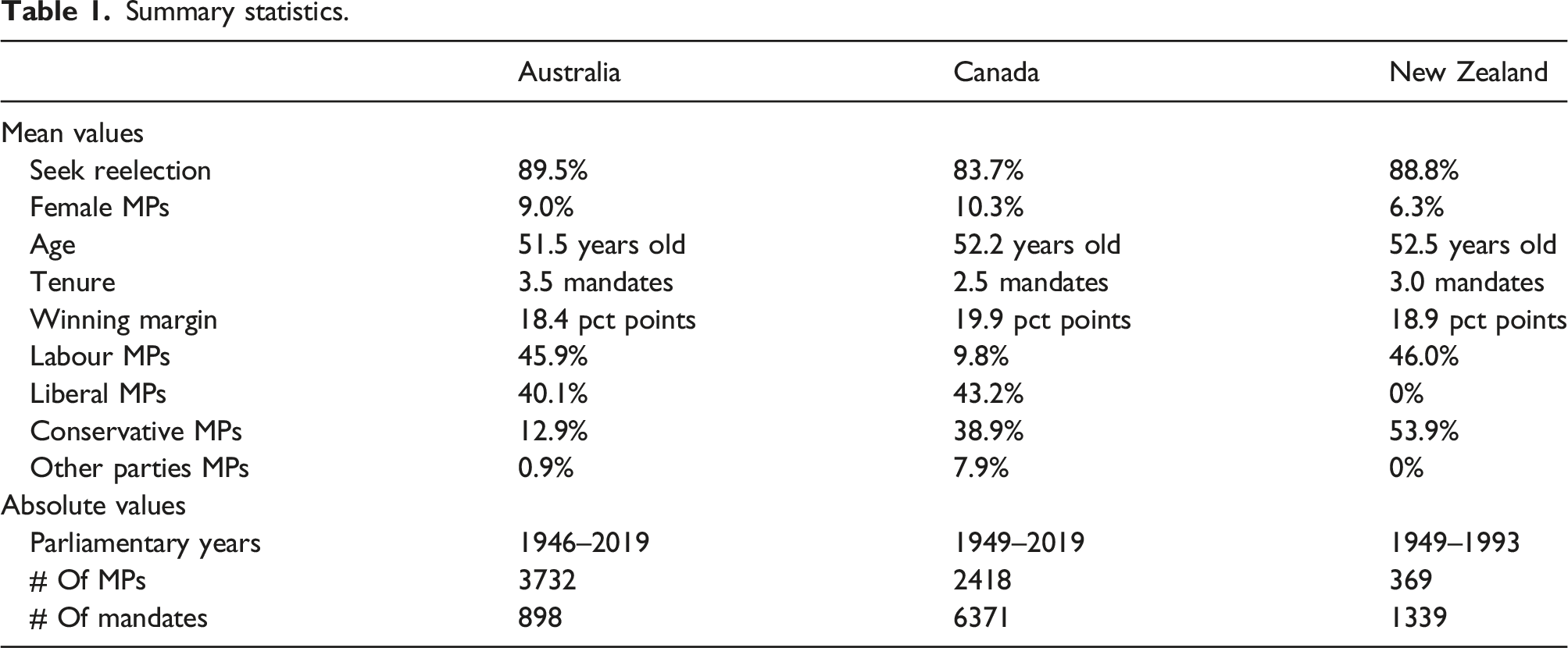
We have regrouped MPs’ mandates within four partisan families at the time of their election. There are the Conservative parties (Australia’s National, Country and Katter’s parties, Canada’s Progressive-Conservative, Conservative, Alliance, and Reform parties, and New Zealand’s National and Social Credit parties), the Liberal parties (Australia’s and Canada’s Liberals), Labour parties (Australia’s Labour, Canada’s CCF and New Democratic Party, and New Zealand’s Labour and New Labour) and a last family that includes other parties (Greens, Regionalists, etc.). The proportions of mandates in each of the four partisan families vary substantially. There is for example no Liberal MP’s mandate in New Zealand and there is 7.9% of mandates held by MPs who are neither Labour, Liberal of Conservative in Canada. This is mainly due to the presence of regional parties in that country. The most common partisan affiliation in Australia is Labour (45.7%), in Canada it is Liberal (43.2%), and in New Zealand it is Conservative (52.9%).
Random-effect GLS models to predict who seek reelection.
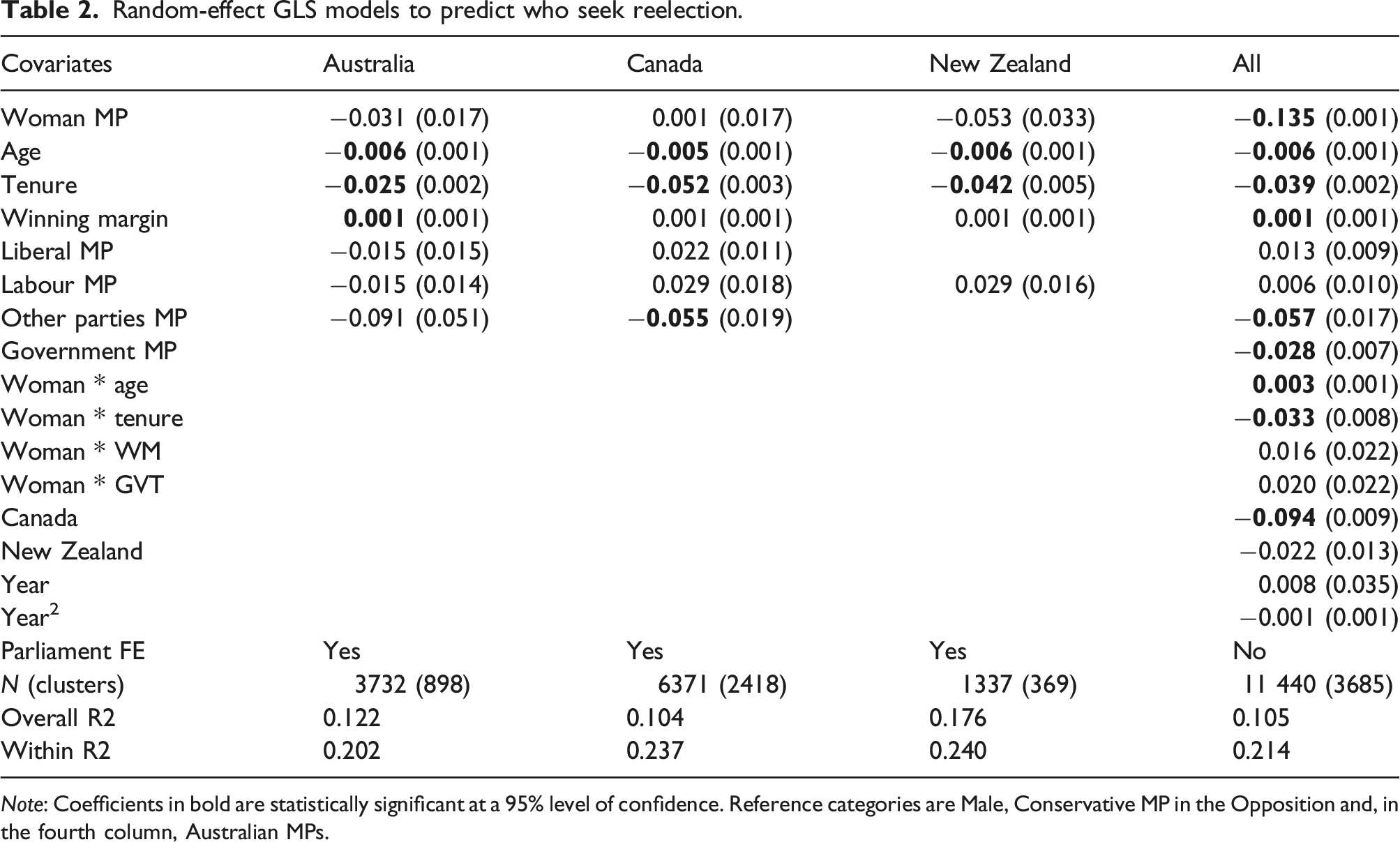
Note: Coefficients in bold are statistically significant at a 95% level of confidence. Reference categories are Male, Conservative MP in the Opposition and, in the fourth column, Australian MPs.
Our first hypothesis states that women should be less likely to seek reelection. We do find support for this hypothesis only in the pooled model. Canada seems to be the deviant case here. Still, we can confirm that women MPs are less likely to seek reelection (−13.5%) The second hypothesis states that older parliamentarians should be less likely to seek relection. We find strong and systematic support for this hypothesis in all our cases. Each additional year of age is associated (in the pooled model) with a reduction in the likelihood of seeking reelection of .6% for male parliamentarians. The relationship is statistically weaker for women (−.3%) but still different from zero. We clearly find support for our second hypothesis here. The third and last hypothesis related to job dissatisfaction states that MPs sitting on the government bench should be more likely to seek reelection. In the pooled model, we find the opposite (−2.8%). There is also no statistically significant gendered difference.
We now move to the three hypotheses related to electoral vulnerability. Hypothesis four stated that having won the previous election by a better margin should increase the likelihood to run again. We find extremely mild support for this hypothesis. The relationship is quite small for male MPs as an extra ten-point lead is associated with a meagre increase of 1% in the likelihood to run again. The relationship is twice as important (but still close to trivial) for women and the gendered difference is statistically significant. What about the benefits of incumbency, most notably of a longer tenure? We find in all three countries and in the pooled model a strong and negative association between the number of mandates already completed and the decision to seek reelection among men (−3.9% per mandate in the pooled model). This is controlling for the age of parliamentarians. This surprising result goes against our expectations. The relationship is even stronger among women who sees a decrease of 7.3% in the likelihood of seeking reelection for each additional mandate. What about the consequences of electoral fatigue? We were expecting more departure in Canada, followed by New Zealand and Australia. This is what we find as Canadians MPs are 9.4% less likely to seek reelection than their Australian counterparts. The difference is at 2.2% between New Zealand and Australia but does not reach statistical significance. Our sixth hypothesis is partly confirmed.
We have one hypothesis related to ambition and opportunity structure. Our hypothesis states that MPs with partisan affiliation on the Left or the Centre-Left should be more prone to stay and seek reelection. It is indeed the case if we only look at coefficients as Labour MPs (+0.6%) and Liberal MPs (+1.3%) are more likely to run again than their Conservative counterparts. However, these relationships are not statistically significant. Our seventh hypothesis cannot be confirmed.
Our last hypothesis states that government party MPs should be more sensitive to the economic context than their colleagues from the opposition. We use unemployment rate in the twelve months prior to the election as a proxy for economic hardship. The economic context does not vary within each electoral cohort. Adding this covariate in our individual-level models would thus be problematic. Therefore, we aggregate our outcome variable to compute the percentage of MPs seeking reelection. For each election/country, we calculate a proportion for government MPs and for opposition MPs. Unemployment rates are also only available starting in 1957 in Canada and in 1969 in Australia.
OLS model to predict the percentage of MPs who seek reelection.
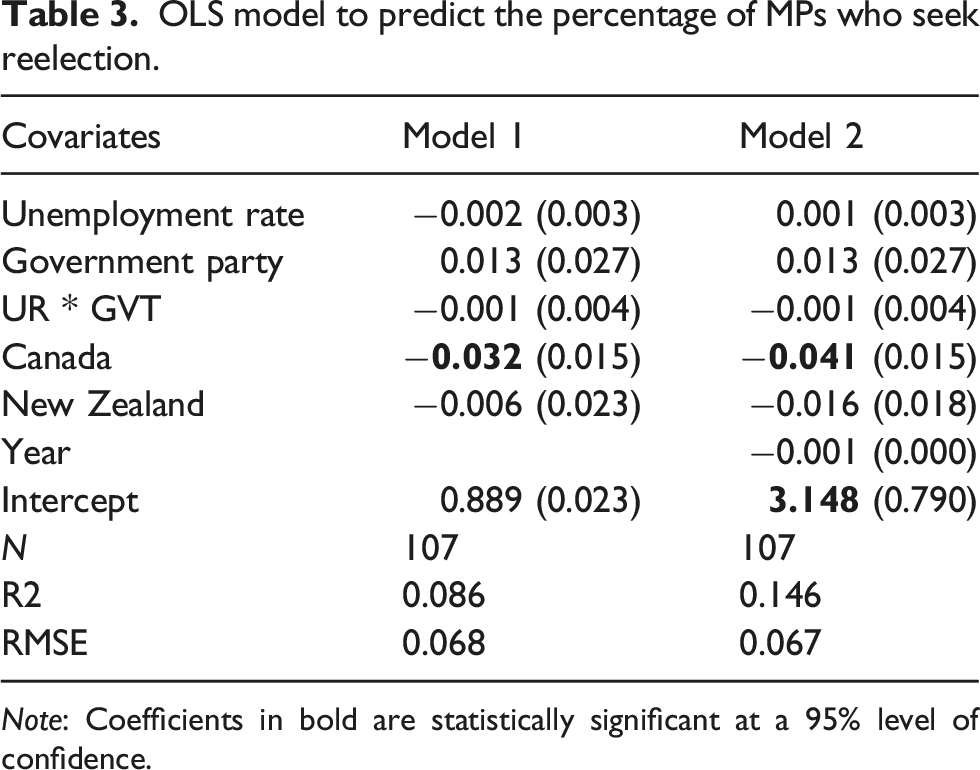
Note: Coefficients in bold are statistically significant at a 95% level of confidence.
Discussion
Our comparative analysis of MPs’ decision seek reelection in Canada, Australia, and New Zealand provides a fresh comparative perspective on crucial strategic calculus incumbents face near the end of their mandate. We remedy the lack of consensus in the scientific literature by developing a series of multivariate models that attempt to overcome the distinction between the different competing approaches of (1) job dissatisfaction, (2) electoral vulnerability, (3) ambition and opportunity structure, and (4) the political and economic context.
We performed country-specific and pooled multivariate analyses to test eight hypotheses drawn from the literature. Results are ambiguous at best on five of our eight hypotheses. In fact, if there is one general conclusion we should draw from our results, it is that the decision to seek reelection is (1) heavily dependent on purely individual factors, and (2) idiosyncratic. In a nutshell, age and tenure are much more important than partisan, electoral or economic factors. Moreover, if we look at both overall and within R2, we notice that despite a quite comprehensive model, there is still a lot of variance unexplained. Some unobserved factors (ambition, family situations, intra-caucus dynamics) could explained part of the picture, but it remains more realistic to assume we will never be able to understand – in a comparative perspective – the complete mechanism at play.
These empirical results might seem disappointing at first. They do contribute, however, to our understanding of parliamentarians’ behaviour. We do acknowledge that parliamentary careers are, by definition, unique. There are as many stories as there are individuals, and elections. Still, it remains useful to provide a comprehensive multivariate model with comparable cases to better understand what we know and what we think we know. Moreover, this comparative analysis suggests that the findings observed in the United States cannot be generalized. Vulnerability and ambition do not seem to matter as much as what has been observed in that country. Perhaps political careers in most parliamentary systems are more similar than what we would imagine to other jobs. At the end, people often retire because they feel their time has passed and they want to move on their own terms.
Footnotes
Declaration of conflicting interests
The author(s) declared no potential conflicts of interest with respect to the research, authorship, and/or publication of this article.
Funding
The author(s) received no financial support for the research, authorship, and/or publication of this article.
