




Abstract
Responding to the crisis of democracy, legislatures worldwide are developing new participatory mechanisms to promote parliamentary engagement and provide additional opportunities for citizens to influence policymaking. Yet despite the prevalence of such initiatives, little is known about whether political elites are receptive to public input. This article addresses this important gap, presenting original research that examines the e-petition system in the United Kingdom’s national legislature. It demonstrates significant apathy – on occasion, antipathy – on the part of Westminster’s elected MPs. In particular, it reveals concerns that parliamentary e-petitions risk undermining the relationship between MPs and their constituents; inundating the parliamentary agenda with immediate, but not necessarily important, issues; and exacerbating misunderstandings of the parliamentary process. More broadly, political elites remain sceptical about the capacity of parliamentary e-petitions to address the democratic divide, with a widespread sense that e-petitions often amplify the voices of those who already shout the loudest.
Keywords
Responding to what is widely regarded as a crisis of democracy (e.g. Dalton, 2004; Norris, 2011), legislatures worldwide are developing new participatory mechanisms to promote greater engagement with representative institutions and to provide additional opportunities for citizens to influence policymaking. Perhaps the most popular innovation is the parliamentary e-petition, and a burgeoning body of scholarship has provided important insights concerning the scale of use (Escher and Riehm, 2017; Puschmann et al., 2017), the petitioner experience ((Bochel, 2016; Carman, 2010; Leston-Bandeira, 2019; Wright, 2012), and the extent that petitioning bridges the democratic divide (Asher et al., 2019; Åström et al., 2017; Carman, 2014; Linder and Riehm, 2011). Nonetheless, relatively little is known about whether political elites are listening to petitioners. Indeed, and more broadly, there is a significant lacuna regarding the impact of such new forms of ‘between-election’ (Esaiasson and Narud, 2013) participation on political responsiveness (notable exceptions include Font et al., 2018; Goodin and Dryzek, 2006; Johnson, 2015). This gap matters, because the success of participatory reforms requires citizens to regard such tools as efficacious ((Hooghe and Marien, 2014; Ulbig, 2008). However, unless political elites pay attention to new channels of citizen ‘voice’ and listen to what citizens say, there is a significant risk that public cynicism will be exacerbated rather than ameliorated (Fung, 2015; Ulbig, 2008).
This article directly addresses this important gap by examining the extent that political elites engage with and value new forms of ‘between-election’ political participation and presents the results of original research examining the jointly owned e-petition system of the UK House of Commons and HM Government. Established in 2015, Westminster’s e-petition system has captured the public imagination, with thousands of e-petitions published annually, signed by millions of unique users (House of Commons Library, 2019), and is widely regarded as one of the most successful mechanisms to promote public engagement with parliament in legislatures worldwide (see Bochel, 2019; Leston-Bandeira, 2019). However, this research shifts the analytical focus from the experience of petitioners to the perceptions of parliament’s political elites (i.e. elected MPs), and through a series of interviews and surveys conducted with MPs and parliamentary officials at Westminster between 2018 and 2019, it provides key insights concerning the ‘value’ ascribed to e-petitions. The research reveals that while MPs acknowledge that e-petitions can strengthen the relationship between Parliament – as an institution – and the public, they privilege their personal relationships with constituents and regard direct one-to-one engagement as the most effective means for constituents to be heard. The research also reveals concerns regarding the extent that parliamentary e-petitions have inflated public expectations of policy change, which dovetails with wider concerns about ‘political literacy’. In turn, while the role of e-petitions in fostering ‘between-election’ participation is acknowledged, significant concerns about the democratic divide persist, and there is a widespread sense that e-petitions often amplify the voices of those who already shout the loudest.
Through this analysis, the article makes three key contributions. First, specifically, by undertaking a systematic analysis of the perceptions of elected MPs, it builds on the observations of previous studies (e.g. Bochel, 2013, 2019; Leston-Bandeira, 2019; Wright, 2012, 2016) to provide empirical evidence of the extent that the e-petition system provides a ‘linking mechanism’ between the public and the Parliament. Second, in doing so, it contributes to an emergent body of work that unpacks the normative assumptions used to advocate participatory democracy by examining whether political elites – that is, ‘those authorised to make collective decisions’ (Hendriks and Lees-Marshment, 2019: 1) – are receptive to public input (e.g. Font et al., 2018; Johnson, 2015). Third, and more broadly, it responds to calls for a greater understanding of the consequences of direct public participation for representative institutions (e.g. Fung, 2015; Goodin and Dryzek, 2006; Nabatchi and Blomgren Amsler, 2014). To develop these strands, the article proceeds as follows. It commences by bringing together these strands of literature to demonstrate the necessity of focusing on political elites’ perceptions of new forms of ‘between-election’ participation and to locate Westminster’s parliamentary e-petition system against this wider backdrop. It then details the research design and reports the results. The article concludes by locating these findings within debates about the mediating role of political elites and sets out an important future research agenda regarding the capacity of citizens to inform policymaking via non-electoral participatory mechanisms.
Participation, parliamentary e-petitions, and the gatekeeping role of political elites
Against a backdrop of declining public trust and democratic satisfaction, petitions have emerged as a popular channel of participation in legislatures worldwide, with online systems being adopted by supranational (e.g. Böhle and Riehm, 2013), national (e.g. Escher and Riehm, 2017; Lee et al., 2014; Leston-Bandeira, 2019), regional (e.g. Bochel, 2016; Carman, 2010, 2014), and municipal authorities (e.g. Åström et al., 2017; Bochel and Bochel, 2017). Indeed, e-petition systems now exist in almost all European countries (Böhle and Riehm, 2013; Schmitter and Trechsel, 2004). Distinct from ‘non-institutionalised’ platforms such as Avaaz.org, MoveOn.org, and Change.org (see Karpf, 2017; Vromen, 2016 for a wider discussion), parliamentary e-petitions are formally embedded within the representative institution, provide signatories with direct access to the institution, and typically require a formal response from the institution if certain conditions are satisfied (Linder and Riehm, 2011). As such, parliamentary e-petitions are regarded as a form of ‘advocacy democracy’, enabling ‘members of the public to raise issues or propose policies to the parliament while the scrutiny and decision-making functions are reserved to the parliament itself’ (Carman, 2010: 735). In addition to what can be regarded as ‘inward-facing’ functions of institutional access and policy influence, parliamentary e-petition systems have also been constituted as an important channel of ‘outward-facing’ parliamentary engagement and democratic participation. This reflects a broader ‘pursuit of legitimacy’ (Leston-Bandeira, 2014) via ‘democratic renewal’ (Hendriks and Kay, 2017) on the part of legislatures worldwide and parliamentary e-petition systems often combining the informative and educative dimensions of ‘outreach’ with the more active and participatory dimensions of ‘engagement’ (see Leston-Bandeira, 2014, 2016).
Advances in digital technology have also contributed to the popularity of parliamentary e-petitions, ‘providing an opportunity for larger numbers of citizens to make their voices heard in a relatively easy and cost-effective manner’ (Bochel and Bochel, 2017: 686; see also Asher et al., 2019, for an analysis of Twitter conversations about parliamentary e-petitions). Indeed, for the host institution, parliamentary e-petitions provide an opportunity to engage in what has been described elsewhere as ‘digital listening’, with analytics (e.g. number of signatories) providing a useful channel of ‘passive democratic feedback’ (Karpf, 2012). More broadly, the affordances of digital technology have provided opportunities ‘to democratize representation by making it a more direct relationship’ (Coleman, 2005: 178), with the ‘the dialogical, interactive features of the internet’ offering ‘the possibility for citizens and their elected representatives to bridge traditional political distances’ (Firmstone and Coleman, 2015: 681). Parliamentary e-petitions are therefore part of a burgeoning range of e-democracy initiatives intended to expand or deepen the participatory ‘reach’ of political institutions, such as online discussion forums, consultations, and deliberative polls (for an overview, see Smith, 2009).
As the popularity of e-petitions has increased, so has academic interest. This scholarship has provided critical insights regarding the profile of petitioners, the formal procedures for handling e-petitions, and the role of e-petitions in fostering legitimacy and democratic renewal. In terms of the profile of petitioners, several studies show that parliamentary e-petitions suffer from the traditional socio-demographic biases in participation. Research in Germany (Escher and Riehm, 2017; Linder and Riehm, 2011), Scotland (Carman, 2014), and Taiwan (Lee et al., 2014), for example, reveals that petitioners tend to be highly mobilised, politically active, better educated, and more affluent. Others have examined the intensity of engagement. The research of Puschmann et al. (2017) on e-petitions submitted to the German Bundestag demonstrates the disproportionate impact of a small number of ‘highly active’ and ‘hyperactive users’. Similarly, the research of Wright (2012: 466) reveals that the United Kingdom’s Downing Street e-petition system was dominated by a small number of ‘super-posters’, who were deemed ‘harmful’ to the system’s functioning.
In terms of the formal procedures for handling e-petitions, several scholars have drawn attention to how institutional arrangements provide citizens with important cues about the extent that representative institutions value public input. Highlighting the relationship between ‘system’ characteristics (voice, decision-making, and transparency) and ‘perception’ characteristics (treatment, legitimacy, and trust), Bochel (2016: 372) argues that formal petition processes are ‘likely to facilitate, or hinder, the extent of procedural justice’. In a similar vein, Carman (2010: 732) suggests that ‘how institutions “handle” petitions may be a vital component in influencing public institutional support’. The perceived fairness of e-petition processes also matters because few petitioners are likely to achieve their stated objectives (Bochel, 2016; Böhle and Riehm, 2013; Escher and Riehm, 2016). Empirical evidence, however, paints a mixed picture. In his study of the Scottish Parliament, Carman (2010: 740) shows that negative process evaluations have adversely affected outcome evaluations, with over 75% of petitioners disagreeing with the statement ‘I consider my petition to be a success’. Slightly differently, Wright’s study of the Downing Street e-petition system shows that while ‘petitioners regarded outcomes such as awareness raising and publicity as important their own right’, respondents ‘were largely scathing’ about how their petitions were handled and ‘that many people believe the government is failing to listen and speak effectively’ (Wright, 2016: 854). Moreover, while several have shown that petitioners’ objective are – on occasion – realised (e.g. Bochel, 2013; Leston-Bandeira, 2019), others have queried the policy influence of e-petitions, suggesting that change has largely occurred in relation to non-contentious issues or where government action was already planned (e.g. Wright, 2016).
As this suggests, the actions of elected representatives and officials have important consequences for the legitimacy of e-petition systems, and it is incumbent on representative institutions to handle e-petitions fairly and be seen to do so by the petitioning public (Carman, 2010; Escher and Riehm, 2016; Hough, 2012). At the same time, ‘the success of such petitions remains entirely at the discretion of those in power’ (Schmitter and Trechsel, 2004: 76), and a ‘continuing reluctance amongst some legislators to encourage petitioning’ may mean that ‘a petitions system is unlikely to be effective’ (Hough, 2012: 490). A critical actor is therefore the petitions body, which acts as the formal conduit between the public and the parliamentary process, and several analyses have focused on how petitions committees have dispatched their functions (e.g. (Bochel, 2019; Böhle et al., 2013; Carman, 2010; Escher and Riehm, 2016; Leston and Bandeira, 2019). More broadly, Bochel has drawn attention to the fact that the success of an e-petition system also rests on the ‘integration of the system into the wider political and policy-making environment in which they operate’ (Bochel, 2013: 806), which necessitates effective relationships ‘between the petitions committees, other committees and government departments’ (Bochel, 2016: 382).
Taken together, this scholarship provides important insights about the capacity of parliamentary e-petition systems to fulfil the ‘inward-facing’ functions of institutional access and policy influence and ‘outward-facing’ functions of engagement and participation detailed above. Moreover, this scholarship underlines the extent that these two dimensions are interconnected and mutually reinforcing, as evidenced by the socio-demographic inequities in e-petition usage or by the wider spillover effects of formal petition processes in terms of system-level legitimacy. Building on this, it can be argued that parliament’s political elites – that is, elected MPs – play a crucial role in bridging these two sets of functions, reflecting their unique position as the key interface between the public and policy process. Therefore, this article contends that the perceptions of parliament’s political elites matter, as how they engage with e-petitions and whether they value their input will be crucial to the effectiveness and legitimacy of the system.
However, although some studies have recognised the importance of ‘buy-in’ (e.g. Hough, 2012; Schmitter and Trechsel, 2004), existing scholarship has generally assumed, rather than established, the support of parliament’s political elites. Moreover, there has been a tendency to present ‘parliament’ as a homogeneous institution with a distinct corporate identity, rather than as a collective institution, comprised of individual legislators with manifold political, party, and constituency identities (see Campbell and Lovenduski, 2015; Deschouwer and Depauw, 2014; Katz, 1997). Regarding Westminster’s e-petition system, for example, Leston-Bandeira (2019: 417) makes clear that petitions ‘do not exist in a vacuum [but] are part of the system that mediates between citizens and policymaking’, but the responsiveness of politicians to the requests of petitioners is assumed rather than established. Elsewhere, in their study of the German Bundestag’s e-petition platform, Schmidt and Johnsen (2014: 44) argue that petitions ‘can bring people who are critical towards politics closer towards the parliamentary system’ (emphasis added) without considering the mediating role played by individual MPs.
This lacuna dovetails with wider concerns about how political elites’ support for new forms of ‘between-election’ participation is often uncritically assumed, despite several empirical studies highlighting the limited impact of public input on the actions of those authorised to make collective decisions (for a systematic review, see Goodin and Dryzek, 2006). In their study of local participatory processes in Spain, for example, Font et al. (2018: 616) demonstrate that ‘authorities make a non-random selection of proposals to be implemented, selecting those that are easier to develop or are closer to their own preferences’, and in her study of deliberative experiments in Canadian public policy, Johnson (2015: 5) finds that outcomes were often ‘circumscribed’ or ‘filtered’ according to the policy preferences of the receiving organisation. One notable exception is the study by Hendriks and Lees-Marshment, who directly survey political elites to gauge their participatory preferences. They demonstrate that political elites tend to value public input for instrumental ends, ‘rather than as a process of sharing power with the public’. In turn, they demonstrate that many have a distinct preference for more ‘informal conversations with individual citizens that occur behind the scenes’ as ‘formal consultation processes such as public meetings do not produce the kind of constructive and usable public input they need to inform their collective judgements’ (Hendriks and Lees-Marshment, 2019: 610–611; see also Nabatchi and Blomgren Amsler, 2014).
The failure to reflect on whether parliament’s political elites value public input via parliamentary e-petitions is thus problematic for two reasons. First, individual MPs hold differing conceptions of what it means to be represented and to provide representation (e.g. Campbell and Lovenduski, 2015; Deschouwer and Depauw, 2014; Katz, 1997), and their responsiveness to citizen demands is mediated by instrumental concerns and institutional constraints. In particular, a number of studies have demonstrated that the goal of re-election is the pre-eminent driver of a broad range of parliamentary and constituency activities, beyond voting in the legislative chamber. In the United Kingdom, for example, constituency marginality has directly affected MPs’ communication with constituents (Auel and Umit, 2018), the proposal of Private Members’ Bills (Bowler, 2010), and the tabling of Early Day Motions (Kellerman, 2013). As such, it cannot be assumed that political elites will ‘serve as a mouthpiece or transmission belt for the views of ordinary citizens’ (Katz, 1997: 211), as expressed via parliamentary e-petitions. Second, given that ‘procedural fairness’ is regarded as an important e-petition outcome in its own right, perceptions of procedural unfairness entail spillover risks in terms of institutional legitimacy and trust (Carman, 2010; more broadly, Smith, 2009). Regardless of formal processes, if elected MPs are not interested in e-petitions and do not value the public’s input, then petitioners’ perceptions about procedural fairness are likely to be adversely affected. As Ulbig (2008: 524) put it, ‘voice without influence can be more detrimental to than no voice at all’ (see also Fung, 2015).
To understand the extent that parliament’s political elites provide a mediating link, it is therefore necessary to examine their utilisation of, and perceptions about, parliamentary e-petitions. To do so, this article considers two broad and interconnected questions:
Do elected MPs engage with parliamentary e-petitions?
Do elected MPs value parliamentary e-petitions?
In order to drill down further, the article focuses specifically on the ‘inward-facing’ functions of institutional access and policy influence and ‘outward-facing’ functions of parliamentary engagement and democratic participation, as detailed in the research design.
Parliamentary e-petitions at Westminster
To answer these questions, this article examines the jointly owned e-petition system of the UK House of Commons and HM Government established in 2015. While the right to petition the United Kingdom’s national parliament is centuries old, at the end of the 20th century petitioning had dwindled, with just a few hundred received each year. However, by the mid-2000s the possibilities afforded by digital technology encouraged successive Westminster governments to experiment with e-petition platforms as a low-cost opportunity for public participation. 1 This led to the establishment of the Downing Street e-petition system by the Labour Government in 2006, which was subsequently replaced by the HM Government e-petition system by the Conservative–Liberal Democrat Coalition in 2011. These systems enabled users to petition government directly, with a response provided if certain conditions were satisfied. However, while these systems proved popular with the public, concerns arose regarding – inter alia – poor moderation, inadequate government responses, and inflated public expectations of policy change (e.g. Bochel, 2016; Wright, 2012, 2016).
It is worth stressing that these systems were owned by government, and not Parliament. Indeed, the House of Commons was initially lukewarm about a system that would enable e-petitions to be submitted directly to the House, owing to concerns about cost, the bypassing of individual MPs, and the undesirability of a standalone petitions committee (HC 513, 2007). By 2008, the mood started to change, and the House of Commons’ Procedure Committee proposed a system that would address some of these issues, enabling petitions to be posted on Parliament’s website to collect signatures while requiring the petitioner’s constituency MP to act as a ‘facilitator’ (HC 136, 2008). However, although the Government recognised that these proposals ‘would both strengthen the traditional role of the House of Commons as the recipient of petitions and make the process more accessible for the public’, it expressed concerns about the estimated costs and asked the Committee to ‘look at the options for lowering the expense’ (see Ev 1, HC 493, 2009). This decision was criticised by the Committee, which saw it as a ‘lack [of] the will to see this project through’ (HC 493, 2009: para. 10). This impasse was exacerbated in 2011 when the Coalition Government’s new e-petition system included a provision that any petition with over 100,000 signatures would be eligible for debate in the House. This decision was taken without prior consultation with the House, and despite the fact that the House of Commons’ Backbench Business Committee was expected to facilitate these debates, no additional parliamentary time was allocated (HC 1706, 2012).
Parliament’s dissatisfaction persisted, and in 2014 the House agreed to support ‘a collaborative e-petitions system, which enables members of the public to petition the House of Commons and press for action from Government’ (Hansard, vol. 580 col. 357, 8 May 2014). Resultantly, the Procedure Committee proposed a system based on the existing HM Government system, enabling e-petitions to be submitted to the House directly, for all e-petitions with over 10,000 signatures to receive a government response, and for all e-petitions with over 100,000 signatures to be considered for debate in Westminster Hall, with ring-fenced time allocated. The system would be governed by a Memorandum of Understanding between Government and Parliament, with oversight provided by a new Petitions Committee. As a House of Commons select committee, the Petitions Committee would also have the powers to receive evidence and undertake enquiries on issues raised by e-petitions (HC 235, 2014). The Government accepted these recommendations in full, and the jointly owned e-petition system went live in July 2015.
Since its launch, members of the public have been able to submit or sign e-petitions concerning issues for which the UK Government or the House of Commons has political responsibility (i.e. non-devolved or non-local authority policy matters) via a dedicated online portal. Parliament’s website states:
E-petitions are an easy way for you to make sure your concerns are heard by Government and Parliament. E-petitions enable members of the public to petition the House of Commons and press for action from the government.
2
The system has undoubtedly captured the public imagination. Over the 2015–2017 and 2017–2019 parliaments, a total of 59,833 e-petitions were submitted. Of these, 19,104 were published, 939 received Government responses, and 140 were debated in Westminster Hall. Eight e-petitions received over 500,000 signatures, with e-petition ‘EU Referendum Rules triggering a 2nd EU Referendum’ (June 2016) receiving 4.15 million and e-petition ‘Revoke Article 50 and remain in the EU’ (February 2019) receiving 6.10 million. The Petitions Committee has also been proactive in undertaking a diverse range of enquiries, including brain tumour research, fireworks, and the online experience of disabled people.
Research design
As this overview suggests, the success of Westminster’s e-petition system in terms of public engagement renders it a critical case (Flyvbjerg, 2006). To examine how Westminster’s political elites have engaged with and, in turn, value parliamentary e-petitions, the author undertook a programme of research that was hosted by the House of Commons Petitions Committee during 2018–2019 as part of an Economic and Social Research Council (ESRC)-funded Parliamentary Academic Fellowship. This entailed two waves of participant fieldwork, which focused on the ‘inward-facing’ and ‘outward-facing’ functions of parliamentary e-petitions that were identified in the literature above. Specifically, to render them relevant to elected MPs, these functions were operationalised as follows:
the contribution of parliamentary e-petitions to the parliamentary agenda (institutional access);
the influence of parliamentary e-petitions on policymaking (policy influence);
the impact of parliamentary e-petitions on constituent relationships (parliamentary engagement);
the role of parliamentary e-petitions in fostering democratic participation (democratic participation).
To collect broad headline data concerning each of these functions, an online survey was sent to all MPs. The survey was co-designed with Petitions Committee officials. Questions were closed, with optional open text spaces provided for further comments. The survey was confidential, with all responses anonymised. Individual invitations were posted to all MPs in November 2018, followed by individual email invitations. Email reminders were sent in January 2019 and February 2019. The survey was also promoted via two articles in the internal publication The Fortnight (October 2018 and March 2019), and information was hosted on the Members’ intranet homepage. The survey was completed by 64 MPs, a response rate of 10%. Low response rates are, sadly, typical for academic research with parliamentarians, and in the United Kingdom, such problems are more acute (see Deschouwer and Depauw, 2014, for a comparison). Indeed, many academics are turning to specialist (and expensive) survey companies, who retain a panel of MPs on the payroll (e.g. Campbell and Lovenduski, 2015). Nonetheless, the response rate is sufficient to allow meaningful conclusions to be drawn about how MPs – in general – have engaged with parliamentary e-petitions. As Table 1 demonstrates, the party profile of survey and interview respondents was broadly reflective of the overall composition of House of Commons, and the number of participants who were members of select committees was also broadly aligned (with committee members being more prevalent among interviewees). In terms of gender, women were slightly under-represented in the survey (but not among interviewees).
Breakdown of participants.
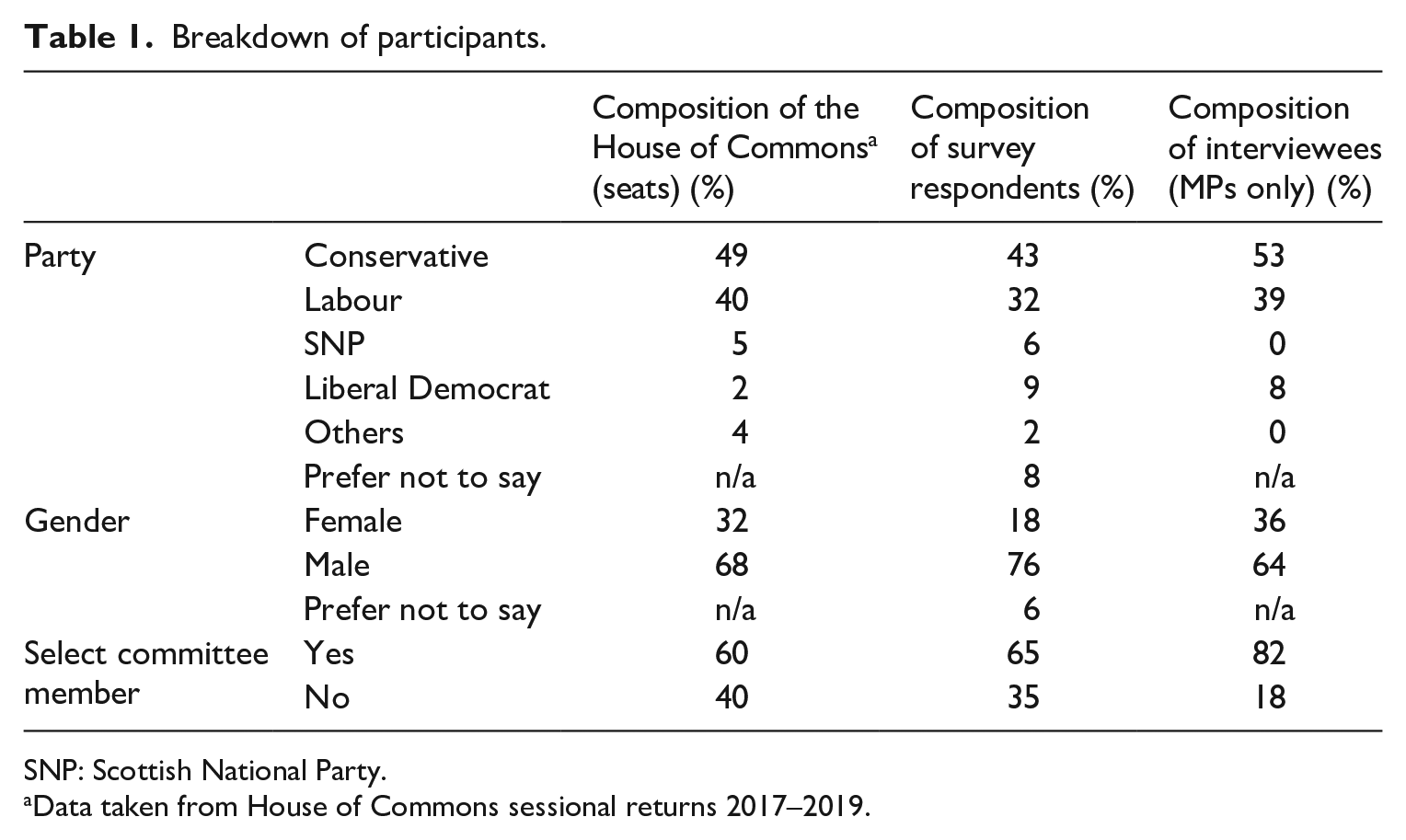
SNP: Scottish National Party.
Data taken from House of Commons sessional returns 2017–2019.
To interrogate the research questions and themes in greater depth, fact-to-face interviews were conducted with MPs and relevant parliamentary officials. Interviews were held with parliamentary officials for two reasons. First, parliamentary officials have extensive day-to-day contact with MPs across the House and are therefore well-placed to offer an overarching account of Westminster’s political elites’ engagement with e-petitions. Second, recent research has demonstrated the important role of parliamentary officials in embedding new forms of ‘non-electoral’ parliamentary engagement (e.g. Judge and Leston-Bandeira, 2018; Leston-Bandeira, 2016; see also Geddes, 2019). Accordingly, parliamentary officials were purposefully selected in accordance with their role, targeting officials who served as the ‘interface’ between the public and elected MPs. This included officials whose main role can be regarded as ‘public engagement’ (and whose main audience is ‘the public’) and officials whose public engagement activities were secondary to their ‘parliamentary support’ role (and whose main audience is ‘elected MPs’). A variety of officials participated, including those from public engagement teams, select committee teams, and support services within the House. A total of 32 interviews were held, 15 with MPs and 17 with officials. Interviews were conducted between May and August 2019, and lasted between 45 and 60 minutes. To encourage frankness and to protect their identity, full anonymity was afforded to all participants. Participants are therefore referred to as ‘MP’ or ‘official’ without any specific detail about party affiliation or job title. For ease of differentiation, MPs are identified by letter (interviewees A–P) and officials by number (interviewees 1–17). Both waves of research received ethical approval from the Department of Politics and International Relations at the University of Sheffield.
Political elites’ engagement with, and perceptions of, parliamentary e-petitions
Contribution to the parliamentary agenda
Survey respondents were first asked about their engagement with e-petitions, as detailed in Table 2. In terms of integrating e-petitions into their parliamentary activities, petitions debates were particularly popular: 79% of respondents had attended a debate, motivated by personal interest in the topic (81%) and correspondence from constituents (81%). There was some crossover with other parliamentary activities, with many respondents tabling Parliamentary Questions on issues inspired by e-petitions (30%) and discussing an e-petition in an All-Party Parliamentary Group (28%). However, the survey suggested that select committees have made limited use of e-petitions, as few of the 65% of respondents who were select committee members reported their select committee using e-petitions as the basis of a specific enquiry (0%), to set the committee agenda (9%), or as evidence in another enquiry (12%). Respondents were then asked their views about whether e-petitions foster public engagement with Parliament. As detailed in Table 3, a total of 66% agreed that e-petitions provide a useful way for the public to make their concerns heard, and 51% agreed that e-petitions allow the public to influence the parliamentary agenda.
MPs’ engagement with parliamentary e-petitions.
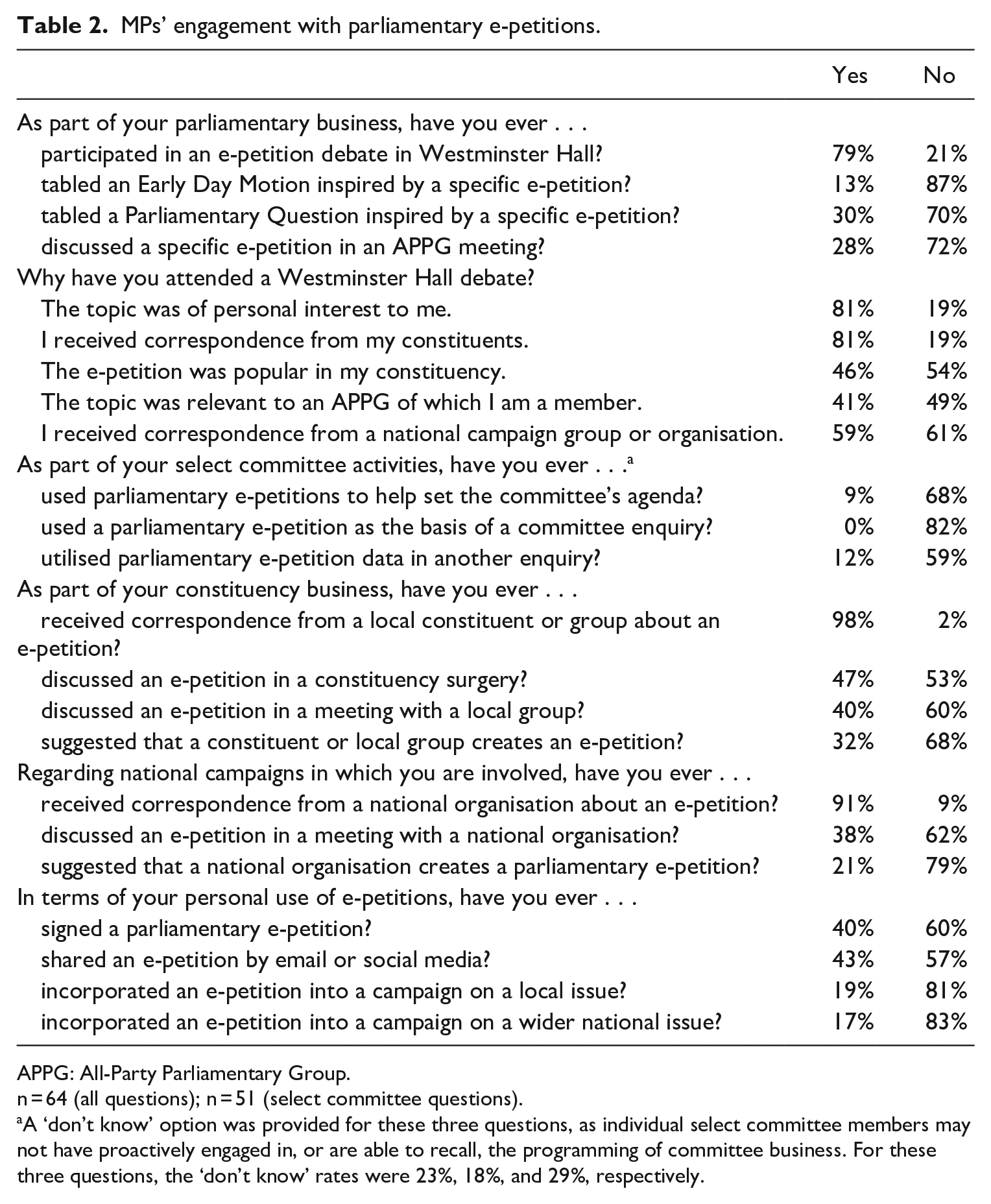
APPG: All-Party Parliamentary Group.
n = 64 (all questions); n = 51 (select committee questions).
A ‘don’t know’ option was provided for these three questions, as individual select committee members may not have proactively engaged in, or are able to recall, the programming of committee business. For these three questions, the ‘don’t know’ rates were 23%, 18%, and 29%, respectively.
MPs’ views about parliamentary e-petitions.
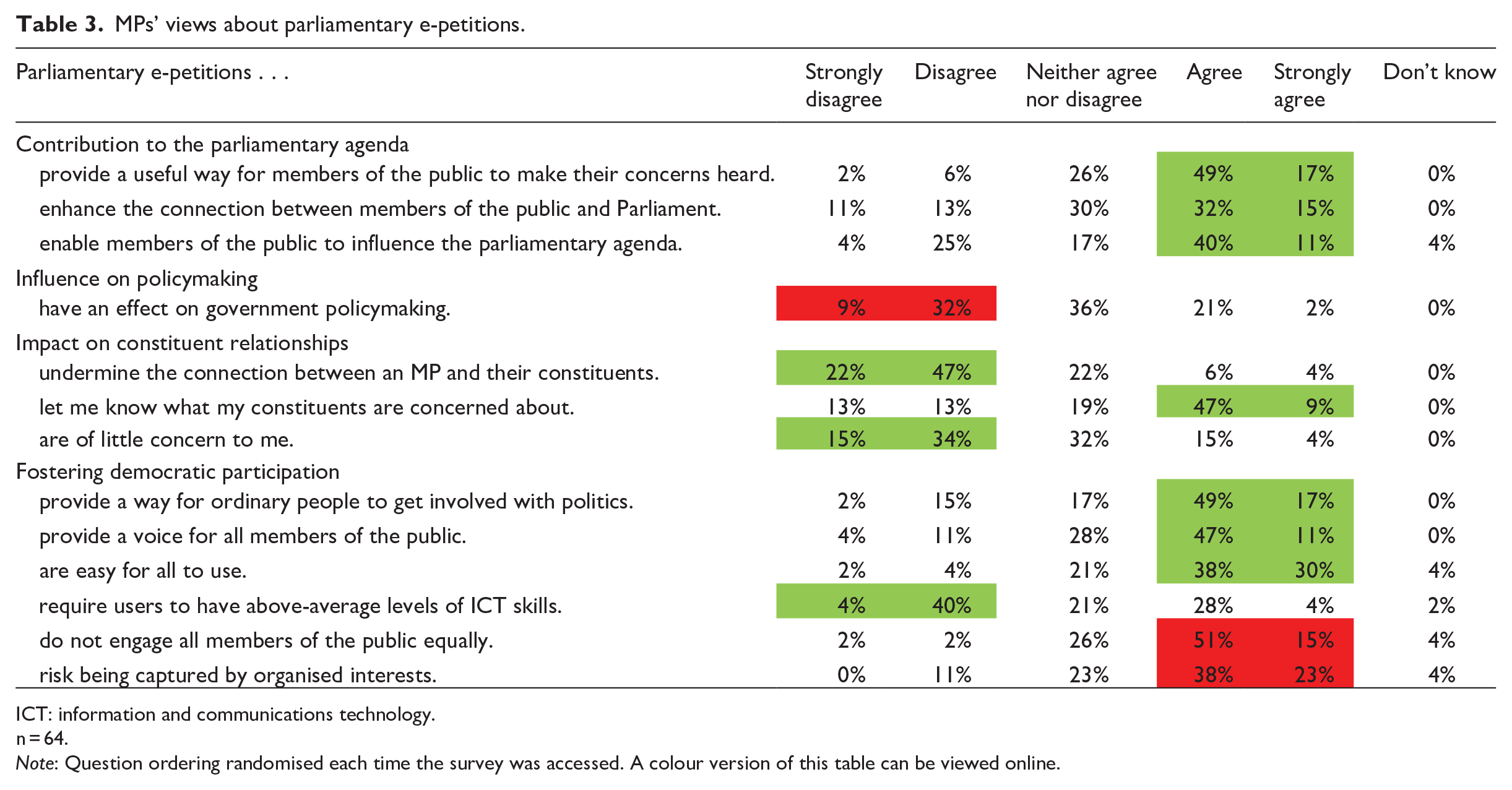
ICT: information and communications technology.
n = 64.
Note: Question ordering randomised each time the survey was accessed. A colour version of this table can be viewed online.
These headline findings were reflected in the interviews. Nearly all agreed that e-petitions can illuminate unseen issues or advance alternative perspectives. Interviewees also recognised that e-petitions enable the public to respond to the issues of the day, but while some welcomed this ‘immediacy’ (Interviewee 4), others were concerned that e-petitions may be ‘taken over by what is topical at the moment’ (Interviewee C). Nonetheless, interviewees generally agreed that e-petitions offer a useful mechanism to aggregate public opinion, particularly where issues may only affect a few people in any one constituency. The most popular route to advancing such concerns from within the Parliament was again the petition debate, and MPs again highlighted the importance of constituency concerns in motivating attendance:
I’ve probably done more than my fair share of debates because the kinds of things that come up are the kind of things which are quite [popular in my constituency], so we’re doing waste packaging and online homophobia in the next few weeks. Anything animal-related goes down a storm . . . Obviously not eating them, though! (Interviewee A)
There was also general agreement that the tone of petition debates differed from Main Chamber debates, which reflected the ‘non-partisan’ nature of petition topics, and some regarded petition debates as useful opportunities to build cross-party alliances. Nonetheless, some interviewees expressed reservations about the effectiveness of petition debates, with several suggesting that Westminster Hall lacks the gravitas of the Main Chamber. One MP stated that ‘the floor of the House is still regarded psychologically as the more important platform. There is no getting around that’ (Interviewee P), and another stated that ‘given the choice, I’d rather have ten seconds putting a point to the Prime Minister than 20 minutes in Westminster Hall responding to a debate’ (Interviewee M).
Interviewees were more equivocal about the role of the Petitions Committee and the impact of e-petitions on select committee activities. Interviewees generally welcomed the Petitions Committee. One praised its enquiries for focusing on ‘areas which were being neglected, not picked up by any other select committee or anyone in the House, and which were not party political’ (Interviewee B), and several praised the Committee for engaging under-represented groups and making effective use of ‘lived experience’ in its enquiries. Several interviewees also highlighted the mutual benefits of joint enquiries with the Petitions Committee in terms of increasing the capacity, visibility, reach, and impact of their own select committees. However, while the Petitions Committee can ‘refer a petition to a select committee if it is already inquiring into the subject of the petition, or is about to do so’, it has also committed to ‘consult the relevant select committee (informally or formally) before referring a petition, to find out whether the committee would be likely to take any action as a result of the referral’. 3 Perhaps unsurprisingly given the relative informality of the referral process, interviewees generally agreed that e-petitions had a limited effect on select committees’ standalone activities. This underlines the fact that select committees often have their own agendas to advance and are unlikely to deviate from pre-agreed priorities and standard evidence-taking practices. Related to this, there were also concerns that the Petitions Committee’s ownership of the e-petition system had rendered it somewhat removed from MPs at large, which some regarded as obviating the need for other MPs – as individual backbenchers or as part of a select committee – to proactively engage with the e-petition system.
Influence on policymaking
Compared to the relative optimism regarding the capacity of e-petitions to affect the parliamentary agenda, there was general scepticism regarding their subsequent policy impact. Indeed, only 23% of survey respondents agreed that e-petitions have an effect on Government policymaking. Interviewees were similarly pessimistic, which dovetailed with wider concerns about the extent that e-petitions risked misrepresenting the incremental nature of policy change, and the indirect and diffuse influence of Parliament (see below). Some were highly cynical. One MP described parliamentary e-petitions as disappearing into ‘a parliamentary black hole’, where ‘vast numbers of people sign these petitions’ but get ‘absolutely nothing in return’ in terms of policy change (Interviewee D). Another suggested:
The expectation is not met by the outcome. There’s quite a lot of build-up around these things. But actually. . . the Government just says ‘there, there, we’ve heard you. Now, clear off. (Interviewee L)
In a similar vein, one MP suggested that e-petitions entailed a fundamental tension:
Petitions act as a lightning conductor. They allow people to feel they’re having a say without actually committing government or individuals to any particular course of action. Therein lies the problem. (Interviewee N)
Several interviewees also suggested that ‘successful’ e-petitions often benefited from a degree of serendipity. In particular, several suggested that the success of the e-petition concerning funding for brain tumour research was in part due to the exposure given to the issue by former Labour Minister Tessa Jowell’s experience of the disease.
Nonetheless, there was a recognition that e-petitions can pressure government to publicly acknowledge the issue raised. In particular, several interviewees suggested that the obligation to send a relevant minister to a Westminster Hall petition debate provided an additional opportunity for backbench MPs to press for action:
I’ve been in standing room only at debates on petitions, literally, where people have run out of space. And the Minister has to sit through the debate, as indeed does the Shadow Minister. And they have to respond to the debate, and the officials are there. It is democratic leverage. (Interviewee I)
The emphasis on lived experience was also regarded as a powerful force for change. Reflecting on the brain tumour research debate, one official recalled:
I’m reasonably sure the minister made an announcement that wasn’t in his speech, because he was so influenced by that room. And he felt that he couldn’t just stand up after three hours of really moving stories and say the Government wasn’t going to do anything differently. (Interviewee 1)
More generally, while most interviewees acknowledged that ministers were unlikely to announce a change of policy in direct response to a debate, it was suggested that debates nonetheless entailed an ‘anticipatory’ effect. As one MP put it, ‘if they’re having to attend a Westminster Hall debate because it’s been triggered through an e-petition, they will be asking questions of their officials and asking questions of themselves. They need to be on solid ground’ (Interviewee I).
Impact on constituent relationships
As detailed above, an initial stumbling block to the establishment of the e-petition system were concerns that it would sever the link between petitioners and their MP. Such concerns were not reflected in the survey, where 69% of respondents disagreed with the statement that ‘e-petitions undermine the connection between an MP and their constituents’. Indeed, 53% welcomed e-petitions for providing information about constituents’ concerns. Nonetheless, the survey also suggests that parliamentary e-petitions are not part of the repertoire of MPs’ constituency activities. As Table 2 shows, while nearly all MPs had received correspondence regarding a parliamentary e-petition from an individual constituent or local group (98%) or a national organisation (91%), relatively few MPs were actively encouraging constituents and local groups (32%) or national organisations (21%) to further their campaigning via parliamentary e-petitions. The survey also shows that MPs themselves have not used e-petitions as a campaign tool, as less than half of respondents reported signing (40%) or sharing (43%) an e-petition, with fewer still incorporating an e-petition into their campaigns on local or national issues (19% and 17%, respectively).
Again, these headline findings were reflected in the interviews. Some interviewees were adamant that the e-petition system had bypassed the relationship between MPs and constituents:
It’s replicating or bypassing an age old extremely successful structure, which is MPs of Parliament. (Interviewee D)
Others disagreed, with concerns that an MP ‘filter’ would discourage would-be petitioners. Nonetheless, while most agreed that e-petitions provide petitioners with a voice, it was acknowledged that there ‘is no guarantee that anyone is listening’ (Interviewee 16). As one official put it, that ‘e-petitions are not the centre of [Members’] lives. . . They are constantly doing things because their constituents have raised them; and this is just another channel among many’ (Interviewee 1). Indeed, all MPs interviewed underlined the significance of direct, one-to-one engagement with their constituents, which was near-universally regarded as the most effective way for constituents to be heard:
An individual coming and seeing me, and being able to open my eyes to a particular issue, is more likely to engage me in for a longer time thing than an e-petition which comes across the desk, goes out the other. (Interviewee I)
The significance of one-to-one engagement was also reiterated by departmental officials. One described how ‘every Monday, we can see what issues were discussed at constituency surgeries on the Friday, because we will get an absolute deluge of Parliamentary Questions on issues we might not have seen for weeks or months’ (Interviewee 17).
The e-petition system does not provide MPs with details of signatories in their constituency, and reflecting on what one MP described as the ‘wall of silence’ between a petitioner and their MP (Interviewee L), several suggested that they would like to be able to make direct contact with petitioners. Not all interviewees were enthused by such suggestions. Several MPs regarded such correspondence as superfluous. One suggested that ‘if people really care about something, they’re probably going to get in touch with you anyway’ (Interviewee F). Many also suggested that they were already overwhelmed: ‘we don’t go looking for business, business finds us quite easily. . . so I’ve got no real interest in getting more work for my hard-pressed team to do’ (Interviewee E). There were also concerns about such information being used for party political or electioneering purposes, which could discourage the public from petitioning and undermine the legitimacy of the system.
Fostering democratic participation
Notwithstanding these concerns, the role of e-petitions in fostering political participation was widely acknowledged, with 66% of survey respondents agreeing that e-petitions provide a way for ordinary people to get involved in politics. However, the survey also revealed concerns about persistence of a democratic divide, as 66% of respondents agreed that e-petitions do not engage all members of the public equally and 61% agreed that e-petitions risk being captured by organised interests. There were also concerns regarding the digital divide, as 32% agreed that ‘e-petitions require users to have above-average levels of ICT skills’.
Interviewees echoed these findings. One suggested that e-petitions ‘bridge a bit of the democratic gap between voting in an election every five years’ (Interviewee 8), and another described them as ‘an interesting initiative to respond to an alienation from politics’ (Interviewee J). It was also suggested that e-petitions are suited to contemporary patterns of political participation, where voters place more emphasis on individual issues than on overarching party programmes. There were some concerns about the quality of political engagement. One MP complained that ‘it’s quite easy for people to just keep clicking’ (Interviewee F), and another said that popular e-petitions ‘tend to reflect what is flavor of the week’ rather than genuine strength of feeling (Interviewee A). Others were more sanguine about such ‘clicktivism’, with one describing it as ‘a low-level action that indicates support and that’s perfectly legitimate’ (Interviewee I). Indeed, several argued it was incumbent upon MPs to adjust to new patterns of political participation.
Nonetheless, many interviewees were concerned that the ‘immediacy’ of e-petitions has led to a misunderstanding of the slower, incremental, and often indirect process of policymaking. Several MPs had witnessed this on social media:
There were lots of very angry people tweeting about it. It was like they thought the Government was just going to cave in because we had a petition debate on it. (Interviewee F)
In turn, many interviewees were concerned about the role of organised interest groups – who often disseminate parliamentary e-petitions on social media – in misrepresenting their purpose and likely impact:
Lobbying organisations with large databases may instruct, advise, cajole people on their databases to sign the petition. And I’m quite certain that a lot of people that do sign petitions haven’t the foggiest clue what they’re signing. (Interviewee N)
Nonetheless, several recognised the trade-off in terms of increased exposure and engagement.
More broadly, many suggested that public misconceptions of parliamentary e-petitions reflect a wider lack of ‘political literacy’ among the public:
People largely don’t understand how Parliament works. They imagine that it is a discussion, they probably would expect there to be a vote and something to change. Well of course, that doesn’t happen at all. As with so many debates in Parliament, they don’t lead to anything. Now arguably [e-petitions] can lead to influencing either the current government or future thinking. But, of course, that’s a much more long-term process. (Interviewee I)
Related to this were concerns that the e-petition system has merely amplified the voices of those who already shout loudly, and several interviewees warned that already marginalised groups were unlikely to engage in e-petitioning:
I can tell you pretty much where the [signatories of the Revoke Article 50 petition] in my city would have come from and it would have been the half of the city that is constantly emailing us and engaging with us. That would be one of the things that I don’t like about this process, because the other half of the city, whose voices really don’t get heard, are much less likely to use a system like that. So, in some ways, it amplifies those who have already got a voice. (Interviewee A)
Addressing the democratic divide is one of the most pressing issues faced by representative institutions such as Westminster. However, for e-petitions to be part of the solution, several suggested that more should be done to ‘level that playing field between really savvy groups that know how to [lobby via e-petitions] and groups that don’t really understand that that’s part of the deal’ (Interviewee A).
Discussion and concluding remarks
Since 2015, Westminster’s jointly owned e-petition system has become an important channel of ‘between-election’ political participation, and when compared to other national-level e-petition systems, the scale of usage is unprecedented (see, for example, Escher and Riehm, 2017; Lee et al., 2014). However, despite such public popularity, this article’s research reveals a degree of apathy – occasionally outright antipathy – on the part of parliament’s political elites. MPs have welcomed e-petitions for providing additional information about constituents’ concerns and have used e-petitions as a way of leveraging these concerns from within Parliament, particularly via petition debates. However, the research demonstrates that traditional forms of constituent-to-Member engagement remain regarded as the most effective means for constituents to have their concerns heard. Indeed, the research underlines the visceral way that MPs prize the constituency link and guard against any incursions into their relationship with constituents. Second, there remains scepticism about the policy impact of parliamentary e-petitions, with many suggesting that the seeming immediacy of e-petitioning risks misrepresenting the indirect, non-linear, and diffuse reality of policy change. Because of this, there are significant concerns that e-petitions foster unrealistic expectations of policy change risks exacerbating, rather than ameliorating, public distrust and democratic disengagement. Finally, the research findings temper the optimism often associated with such initiatives, with important concerns expressed regarding the quality of democratic engagement and of the capacity of parliamentary e-petitions to provide a voice for the less vocal and more marginalised groups in society.
Taken together, these research findings advance our understanding of the impact of parliamentary e-petitions on parliamentary and policymaking practice. While some studies have recognised the importance of ‘buy-in’ (e.g. Hough, 2012; Schmitter and Trechsel, 2004), existing scholarship has generally assumed, rather than established, the support of political elites (for partial exceptions, see Bochel, 2019; Leston-Bandeira, 2019; Wright, 2016). In contrast, this research has demonstrated the extent that attitudes of elected MPs towards parliamentary e-petitions are varied and contingent. In turn, it has also drawn attention to the role of a parliament’s political elites – in particular those who are not part of formal petition bodies – in embedding its e-petition system and championing petitioners’ causes, and has highlighted the multitude of intrinsic and instrumental factors that affect an MP’s willingness to do so.
More broadly, this research offers an important contribution to extant scholarship on the impacts of institutionalised participatory initiatives. Although several have argued that successful participatory mechanisms should not only provide citizens with a voice, but must also foster responsiveness (e.g. Fung, 2015; Ulbig, 2008), there is a paucity of studies that consider whether political elites actually value this input. Yet the attitudes of political elites should be regarded as vital to the success of such participatory initiatives in terms of bridging the gap between the public and policymaking process. By focusing on the response of Westminster’s political elites to parliamentary e-petitions, this research therefore adds to the small pool of studies examining the effects of ‘between-election’ participation in practice (e.g. Font et al., 2018; Goodin and Dryzek, 2006; Johnson, 2015). In particular, its findings add credence to the arguments advanced by Hendriks and Lees-Marshment (2019: 13–14), who assert that while political elites ‘value public input for epistemic and instrumental reasons. . . they do not want to relinquish power to that same public’. This reluctance to cede power was apparent in concerns that e-petitions risk undermining the relationship between MPs and their constituents; inundating the parliamentary agenda with immediate, but not necessarily important, issues; and exacerbating misunderstandings of the parliamentary process. Moreover, by contrasting these concerns with the public popularity of parliamentary e-petitions (as shown by the unprecedented scale of use), there is evidence to suggest a potential ‘mismatch’ in the participatory preferences of political elites and the public, which may risk ‘important consequences for the legitimacy of the political decision-making process’ (Hooghe and Marien, 2014: 536). As this article has argued throughout, the willingness of political elites to listen to the public should not be assumed, and if they do not engage with or value new forms of participation, the democratic credentials of such initiatives are called into question. And in practical terms, this underlines the necessity of ensuring that the design and operation of new channels of ‘between-election’ participation – such as parliamentary e-petitions – are attuned to the preferences of those political elites within receiving institutions.
Future scholarship on parliamentary e-petitions should therefore pay closer attention to the mediating role of parliament’s political elites and acknowledge the heterogeneity of attitudes concerning the value of public input into policymaking. In particular, the findings of this article highlight two key areas that demand further research. First, future research should drill down to examine the factors that affect the attitudes of parliament’s political elites towards new forms of public participation. Research in the field of legislative studies demonstrates that MPs’ parliamentary behaviours are conditioned by a wide range of party, policy, and constituency concerns and that factors such as electoral systems and marginality are key dependent variables. Moreover, this array of demands places practical constraints upon what MPs can do, which frequently necessitates a prioritisation of activities (for a useful comparative analysis, see Deschouwer and Depauw, 2014; see also Campbell and Lovenduski, 2014; Katz, 1997; Vivyan and Wagner, 2016). Future research should therefore consider whether parliament’s political elites’ attitudes towards new forms of public participation are similarly conditioned and whether they have sufficient capacity to engage with such tools. Second, relatedly, research should consider the extent that political elites are actually involved in the design and implementation of such initiatives. In the case presented here, while MPs collectively established the broad parameters of Westminster’s e-petition system, its design and subsequent operation has been the preserve of a small number of parliamentary committee members, which contributed to the sense of cynicism regarding the efficacy of e-petitions as a way of connecting the public with parliament via its parliamentarians. Other countries have sought to engage political elites alongside the public to reduce the risk of political detachment. In Ireland, for example, the Government’s decision to include 33 parliamentarians alongside 66 randomly selected citizens in the Convention on the Constitution has been regarded as a key factor in the subsequent implementation of many of its (often controversial) proposals (Farrell et al., 2019, but for a counterargument see White, 2017). In taking this agenda forwards, and by recognising the role of parliament’s political elites not only as the key interface between the public and policy process but also as the drivers of policy change, future research can therefore generate critical insights regarding the capacity of citizens to inform policymaking ‘between elections’ via non-electoral participatory mechanisms.
Footnotes
Acknowledgements
The author would like to thank the members and officials of the Petitions Committee for their generous support. The author would also like to thank Emily O’Connor for the research assistance that she provided.
Funding
This research was hosted by the House of Commons Petitions Committee during 2018–2019 as part of an Economic and Social Research Council (ESRC)-funded Parliamentary Academic Fellowship.
