




Abstract
We demonstrate effects of political preferences on interpersonal interactions in the environment of the highly unstable and volatile party system of the Czech Republic. The effects of partisanship on interpersonal relations are compared to the effects of attitudes on a salient issue. Two experiments confirm the potential of political partisanship to affect the individual’s ingroup preferences and outgroup biases, which can influence willingness to converse with others in the context of an unstable party system. In a conjoint experiment, dis/agreement on immigration has comparable effects on interpersonal interactions. Avoidance of interactions with out-partisans is amplified when out-partisans talk about politics often. The patterns of ingroup preferences and outgroup biases are replicated in a trust game experiment. Both partisanship and immigration attitudes influence how subjects interact with others. Given the political context, the study provides a hard test of politically motivated ingroup and outgroup biases stemming both from party and policy preferences.
Introduction
Does affective polarization influence interpersonal interactions outside the realm of politics under a condition of unstable multipartism? An extensive body of research has demonstrated how partisan sympathy and antipathy drive attitudes and behaviour outside politics (Chen and Rohla, 2018; Huber and Malhotra, 2017; Hui, 2013; McConnell et al., 2018; see Iyengar et al., 2019 for a review). However, most of this work on partisan spillover has been confined to the US with its distinctive party system. It is unclear whether political animosity similarly spills over into other spheres of people’s lives in countries where partisanship is not as long-lasting and all-consuming as it is in the US. To better understand where and how political hostilities work, we need to look at contexts outside the US (Iyengar et al., 2019). Our study considers a difficult case for partisan spillover theory. We look at the Czech Republic, where partisan identities are relatively new, unstable, and less salient than in party systems with established and well-institutionalized political parties. If we find effects of politically driven animosities on people’s interactions outside politics in Czechia, it is likely to be a widespread and perhaps even universal phenomenon.
Based on two original experimental studies, one conjoint and the other a trust game, this paper advances research on political polarization and hostility in several ways. First, we test the effects of political partisanship and policy preferences on interpersonal interactions in the context of the Czech Republic. While previous research confirms that affective polarization towards political parties is not a uniquely US phenomenon and that it also applies to both Western and Central and Eastern Europe (Boxell et al., 2022; Gidron et al., 2020; Harteveld, 2021; Knudsen, 2021; Reiljan, 2019; Reiljan and Ryan, 2021; Wagner, 2021), there has been little attention paid to the polarizing potential of political preferences in the everyday lives of citizens. Evidence from multiple West European countries suggests that partisanship diminishes interpersonal trust compared to traditional social cleavages such as class or regional identity (Westwood et al., 2018). However, there is little evidence on the effects of partisanship on people’s social interactions relative to political issues (Hobolt et al., 2021; Orr and Huber, 2020).
Second, while previous research conducted in multiparty settings focused on relatively stable party systems (Helbling and Jungkunz, 2020; Westwood et al., 2018), we investigate a country with a fragmented and considerably volatile party system. The Czech Republic has been experiencing party system ‘earthquakes’ typical of CEE party politics (Haughton and Deegan-Krause, 2015) in which new parties emerge only to be replaced in the next election cycle with even newer ones. Our study is a hard test of politically motivated intergroup hostility hypotheses focusing on the influence of political partisanship and issue attitudes on social relations in a fragmented and unstable party system.
Within a polity, affective polarization, a concept anchored in the notion of partisanship as a social identity (Huddy, 2001; Iyengar and Westwood, 2015; Tajfel and Turner, 1979), supposedly arises over time as voters develop psychological attachments to political parties. But scholars have found a gap between likes of one’s preferred party and dislikes of other parties even in CEE politics (Reiljan, 2019; Wagner, 2021). This finding deserves more scholarly attention not only to shed light on the nature of partisanship in the region, but also to extend our understanding of politically motivated biases.
We present two original experiments in a party system consisting of nine major political parties. These experiments allow us to determine how individuals behave differently towards those who share and those who do not share their political preferences. The first study is a conjoint experiment which tests partisanship relative to other potential polarizing factors. We explore the effects of partisan biases in respondents’ selection of communication partners relative to the effects of a political issue preferences, argued by some scholars to be the true source of affective polarization (Bougher, 2017; Lelkes, 2021; Orr and Huber, 2020; Rogowski and Sutherland, 2016; Webster and Abramowitz, 2017). We also include people’s values and their habit of talking about politics in the conjoint design. In the second study, we conduct a trust game experiment to determine whether biases rooted in either partisanship or issue preferences operate beyond attitudes and affect behaviour as well.
We find that differences in both party and issue preferences diminish both willingness of subjects to converse with others as well as the level of interpersonal trust. The findings confirm the primacy of political partyism in a system without stable partisan patterns. Our results also indicate that attitudes towards salient issues may have similar effects on people’s interpersonal interactions as partisanship. However, the difference between partisan spillover and the effects of issue (dis)agreement lies in the capacity of shared party preferences to provoke stronger ingroup biases (Carlin and Love, 2013; Iyengar et al., 2012; Iyengar and Westwood, 2015b; Mason, 2015).
Political parties and polarization
The origins of politically motivated hostility and biases in social relations are typically traced back to political partisanship (Carlin and Love, 2013; Iyengar et al., 2012; Iyengar and Westwood, 2015b; Mason, 2015). The literature on affective polarization demonstrates that in the USA, partisanship not only polarizes people’s attachments to political parties but it also influences their evaluation of other voters (Druckman and Levendusky, 2019) and their preferences outside the political realm, such as romantic and family relationships (Chen and Rohla, 2018; Huber and Malhotra, 2017), economic behaviour (McConnell et al., 2018), choice of residential neighbourhood (Chopik and Motyl, 2016; Gimpel and Hui, 2015; Hui, 2013), and students’ roommate preferences (Shafranek, 2021).
In this paper, we examine the influence of political disagreement on two types of interpersonal interactions: conversations and interpersonal trust. Lack of interpersonal interaction resulting from political disagreement might have a crucial effect on democracy, because everyday interactions with others enable people to test new and old ideas and improve decision making (Mansbridge, 1999). Interpersonal conversations are the basis of political dialogue and the social integration of communities, and of tolerance to opposing attitudes (McPherson et al., 2001; Mutz, 2002). The interactions and informal communication of private citizens, even if they do not appear directly politically relevant, are vital for sustaining social networks and for democratic governance (Putnam, 2000). Mass polarization has a negative impact on democratic processes, since polarized citizens disregard the views of outgroups and perceive their arguments as unworthy of consideration (Strickler, 2018).
Behaviour concerning others may be also affected by political preferences. For example, altruism is stronger for one’s ingroup political party (Fowler and Kam, 2007) and partisanship decreases trust in out-partisans while increasing ingroup trust (Carlin and Love, 2018). These effects are especially important since the weakening of interpersonal trust due to partisan biases can cause collective action problems and strengthen a zero-sum perception of politics. These patterns have already been identified in multiple political systems (Carlin and Love, 2018; Helbling and Jungkunz, 2020; Iyengar and Westwood, 2015; Martini and Torcal, 2019; Westwood et al., 2018). The literature suggests that people tend to trust their co-partisans significantly more than partisans of other parties, which results in sending more endowment to co-partisan players than to other partisans in game theoretical experiments. The strength of the party effect is substantial across multiple political contexts in established Western democracies and in the Latin world, where party-based effects usually trump the influence of other relevant social cleavages such as race, class, or regional identity (Carlin and Love, 2018; Martini and Torcal, 2019; Westwood et al., 2018). Research of affective polarization of social interactions in multiparty systems is rather limited. Knudsen (2021) found that people in Norway tend to be unhappy with their child marrying somebody from the opposing party bloc. Helbling and Jungkunz, 2020 confirm negative attitudes towards voters of the out-parties, especially if the parties belongs to the other side of the integration-demarcation cleavage. However, effects of party-driven affective gap compared to political attitude dis/agreement on interpersonal relations are understudied.
We test the potential of partisan preferences to influence personal interaction in terms of conversations and interpersonal trust in the context of Czechia’s fragmented and unstable multipartism. We assume that the mechanism of party-based group biases might not be straightforward. This is because of the high number of parties occupying varying positions in the political space, multiple political cleavages, party coalition patterns, and the ever-changing number of parties in the parliament; these factors make it difficult to identify the political ingroups and outgroups based on party affiliation.
Previous research in multi-party systems revealed that party preferences influence social distance in Austria and Germany, where division occurs mainly between supporters of parties on opposite sides of the populist cleavage (Helbling and Jungkunz, 2020). In Czechia, the idea of interpersonal interactions being affected by political partisanship seems less likely. After becoming one of the most stable party systems among the post-communist countries, with electorally and organizationally stabilized parties (the conservative ODS, Christian Democratic KDU-ČSL, Czech Social Democratic Party, and the radical left communists) resembling the party families in Western Europe, the combination of both economic and political crises in the late 2000s and the beginning of the 2010s led to a dramatic decrease in support for the established parties and the emergence of new anti-establishment parties, including the far-right Freedom and Direct Democracy, technocratic populist ANO, and the social-liberal and technocratic Pirate Party (Hanley, 2012). The rise of these challengers undermined the long-established patterns of electoral behaviour structured around the socio-economic conflict of the political right and left and increased the importance of issues such as immigration and populism cross-cutting the traditional cleavages (Havlík and Kluknavská, 2022; Havlík and Voda, 2018). In turn, factors such as increasing voter volatility (Linek, 2014), low levels of trust in parties and party identification (Linek and Voženílková, 2017), historically strong anti-party sentiments and anti-party populism (Havelka, 2016; Havlík, 2019), and the strengthening role of the non-partisan president have weakened the potential of party-based group biases. Reiljan (2019), however, identified strong polarization in evaluations by voters of their party of choice and other parties. If partisan affective polarization applies not only to parties but also to their supporters, then we assume that party driven affective polarization does affect everyday interactions in terms of communication and interpersonal trust.
Research on affective polarization in multipartisms (Gidron et al., 2020; Reiljan, 2019; Wagner, 2021) reveals that citizens hold different affective evaluations of different political parties. Unlike voters in a two-party system, voters in multi-party systems may have unequally positive and negative feelings about several political parties. We assume that these differences in sympathy may drive differences in the magnitude of out-party bias, and we test this assumption in the trust game experiment.
Polarization over issues
Even though partisanship has been identified in the literature as the main source of politically driven biases (Iyengar et al., 2019), some scholars suggest that affective polarization originates in ideological disagreements over issues (Bougher, 2017; Lelkes, 2021; Orr and Huber, 2020; Rogowski and Sutherland, 2016; Webster and Abramowitz, 2017). People evaluate others based on their attitudes towards salient issues and they are more attracted to and associate more with those who agree with them on such issues (Krosnick, 1990). Issues which are perceived as salient have strong polarizing effects even when the actual distance between groups’ opinions is relatively small (Hetherington and Weiler, 2009). According to this alternative explanation of affective polarization, people base their evaluations of political actors on policies. These evaluations evolve into hostility to both political actors and people with opposing policy preferences (Orr and Huber, 2020).
Takeoff issues (Baldassarri and Bearman, 2007), i.e. highly salient issues substantively attracting collective attention, are especially likely to polarize public opinion and distract people’s attention from other issues which remain unpolarized. For example, Brexit created two distinct groups, ‘Leavers’ and ‘Remainers’, displaying all the features of affectively polarized identity-based political camps, a division that transcended or even replaced traditional partisanship in the UK (Hobolt et al., 2021). Moreover, attitudes towards an issue as salient as Brexit can bias and polarize other attitudes (Sorace and Hobolt, 2021). Huddy, Bankert, and Davies (Huddy et al., 2018) observe that even though voters in multiparty systems are affectively polarized towards political parties, information about policies may evoke affective responses equally strong towards political parties as partisan identities.
The takeoff issue that we consider as a polarizing factor is immigration. Though the issue of immigration has been important in Western Europe for decades (Grande et al., 2019; Kriesi, 2010), it only recently became a takeoff issue in CEE (Hooghe and Marks, 2018), with the culmination of the so-called refugee crisis in 2015. Even though the actual numbers of refugees coming to Czechia have been low and other types of migration have been stable over time, immigration became a dominant issue in public discourse, with almost 80% of the public considering immigration one of the two most important issues (Institute of Sociology Czech Academy of Sciences, 2015). This distracted attention from other issues (Prokop, 2020). The 2017 Czech Election Study revealed that 14.9% of voters agreed that immigration was beneficial for the Czech economy, while 27.9% of voters held a neutral attitude, and 35.6% disagreed. Tensions rose within parties when some members expressed disapproval of official anti-refugee party positions (Dolejší, 2015). This cross-cutting nature of the issue contributes to its potential to create specific opinion groups (Hobolt et al., 2021). In both the conjoint and trust game studies, we experimentally test whether attitudes towards immigration significantly influence social interaction in terms of conversation with others and interpersonal trust.
Alternative explanation: dislike of politics and values
Besides the two main explanatory factors of politically motivated biases, political partisanship and attitudes towards immigration, we include other potential factors which may drive people away from others. One such factor relates to an alternative explanation of individuals distancing themselves from other partisans. Klar et al. (2018) argue that politically motivated social distance stems not from partisan hostility but instead is a manifestation of a general dislike of political parties and politics. To capture the effect of avoidance of politics in everyday interaction, in the conjoint experiment we include the frequency of political talk as a potential source of reluctance to communicate with others.
Evidence suggests that political engagement may interact with political preferences and that incongruent political partisanship causes people to avoid others who are highly interested in politics (Shafranek, 2021). Individuals might shun those who like talking about politics and who also express opposing political preferences. Building on the previous hypotheses, we propose two additional assumptions to test in the conjoint experiment.
Political preferences might reflect one’s underlying political values; therefore, we test the effects of values on people’s willingness to interact with others, as well. For example, authoritarian values such as emphasis on security against risk and disorder, conformity to traditional ways of life, and obedience to authorities protecting social order may drive both party choice and immigration attitudes (Norris and Inglehart, 2019). There is a link between authoritarianism and positions on issues such as gay rights and immigration (Hetherington and Suhay, 2011; Hetherington and Weiler, 2009), but authoritarianism also affects how citizens process information about economic policies (Johnston, 2018). Incorporating the core authoritarian-libertarian value scale into our research design adds a robust test of the causal effects of partisan and immigration preferences in the conjoint experiment.
Data and methods
The hypotheses were tested in a conjoint and a trust game experiment. In the conjoint experiment, we tested subjects’ willingness to interact with others in a conversation. The conjoint design enabled us to compare the relative effects of multiple independent variables when presented together during an experimental task. In the trust game experiment we examined whether political preferences affect people’s interaction with others in the form of allocation of resources and trust that the others will reciprocate. For the purpose of the trust game study, the independent variables were presented separately. In the second study, we focused only on party and immigration preferences, the main drivers of interaction in the first study.
Conjoint attributes and attribute levels.
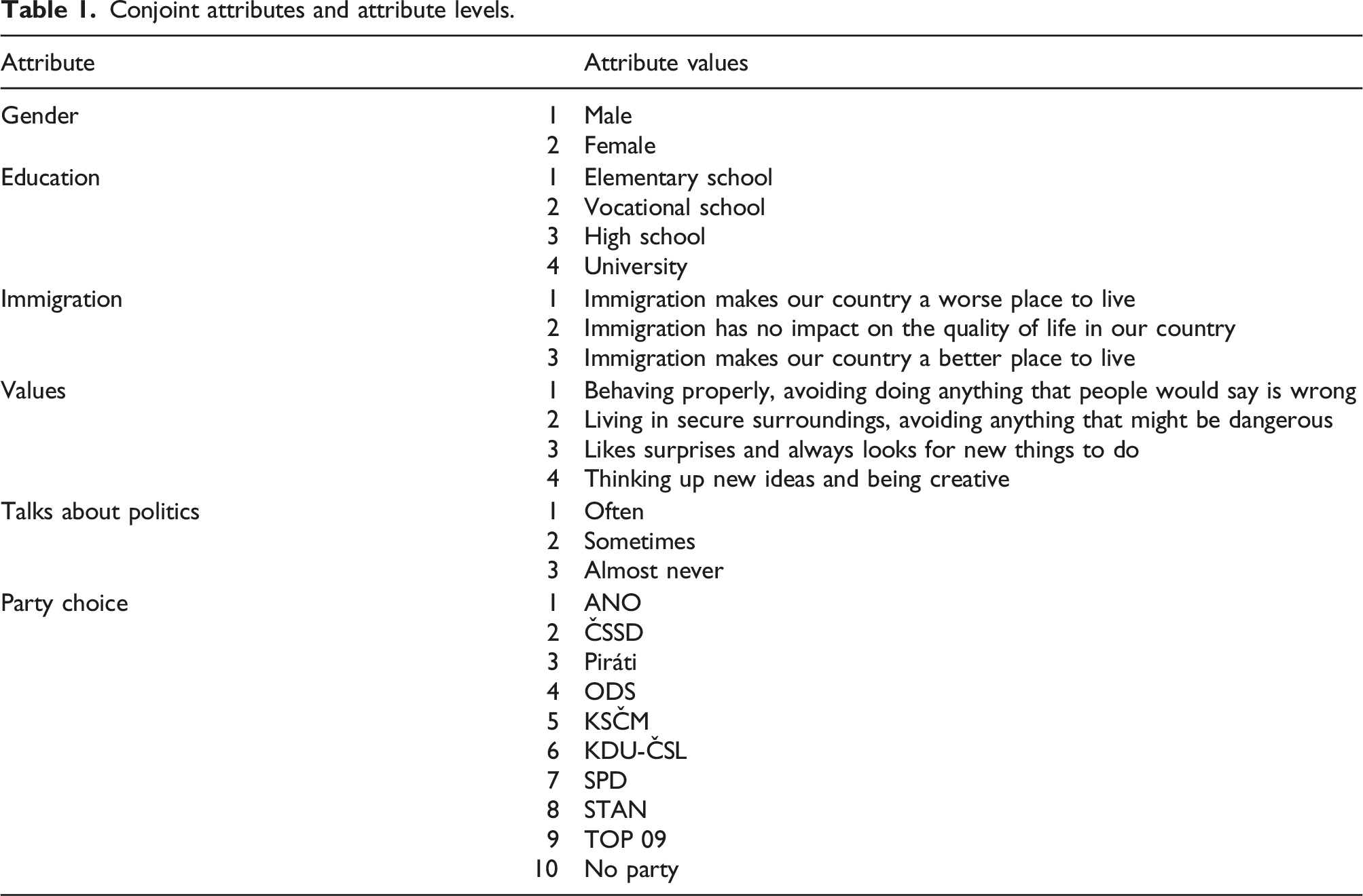
The attributes and attribute values describing the profiles mirrored the pre-treatment questionnaire (question wording in SI). This procedure was intended to increase the sense that the partners being evaluated had filled in the same questionnaire. In the analysis, we coded whether the subject’s response matched the partner’s preferences or characteristics. To assess the subjects’ most and least preferred political parties, the survey included questions about the party they would most likely vote for in an election and the party for which they would never vote. The conjoint design was unrestricted, and the attribute values were generated randomly. The order of attributes was kept constant for each respondent.
The conjoint experiment was fielded by the Focus Marketing and Social Research company between 22 May and 3 June 2019, on a sample of 1,032 adult Czech respondents (a non-probability sample using quotas on gender, education, age, region, and the size of municipality). Each respondent evaluated five pairs of fictional communication partners’ profiles; the total number of cases used in the analysis was 10,250.
To validate the findings of the conjoint study, we also implemented a trust game using an online survey in which subjects filled in basic socio-demographic information and answered a set of questions about their party preferences. Their positive and negative party preferences were ascertained using the same methods as in the conjoint experiment. Subjects also indicated their likes and dislikes for each parliamentary party on a 10-point party sympathy scale.
Experimental conditions of the trust game.
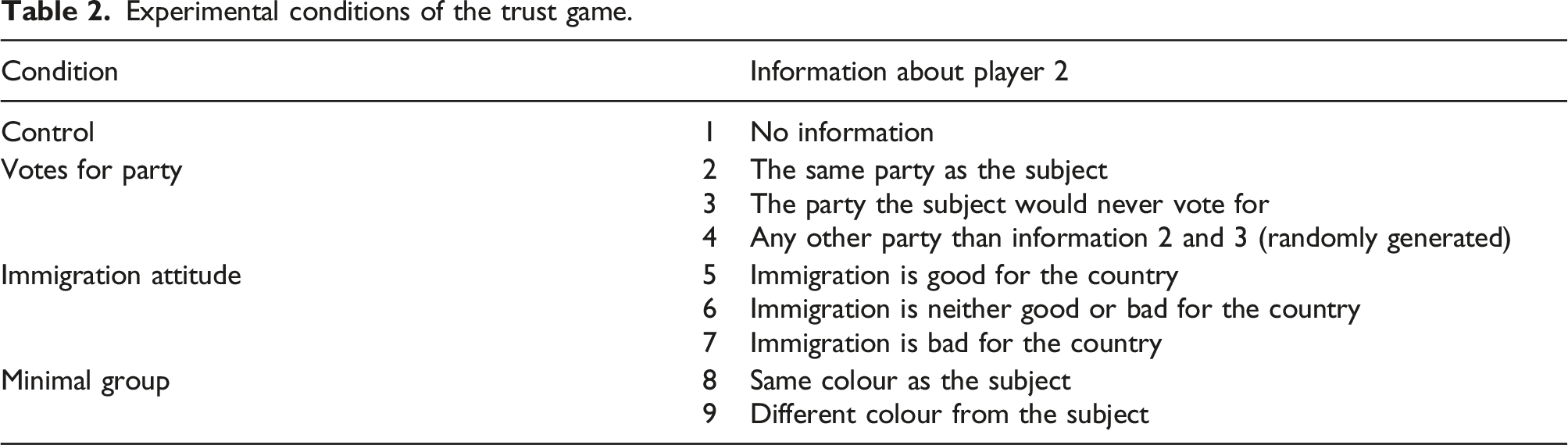
The trust game study was conducted between 4 and 17 December 2019, on a sample of 946 adult respondents. The data were collected by the same company as in the previous study, based on the same quota measures, provided that the respondents participating in the conjoint experiment were excluded from the pool of respondents. 2 Each subject played nine rounds of the game, with resulted in a total of 8,461 cases. 3
The data were recoded to a structure appropriate for testing our hypotheses. Since our hypotheses focus on biases regarding congruence and incongruence of subjects’ political dispositions with the attributes of the experimental treatments (Knudsen and Johannesson, 2019; Shafranek, 2021), we recoded the conjoint attribute variables and Player 2 characteristics to indicate a match or lack of a match between the features of each subject and the experimentally generated profiles. For example, a subject-profile match for party preference is coded as a positive party match when both the subject and the experimentally generated profile prefer voting for the same party. A negative party match was coded when the least preferred party of the subject matches the party the experimentally generated profile would vote for. To separate the effects of subjects without any reported positive party preference (non-voters), we created a category capturing a match between a non-voter subject and a non-voter partner. The reference category is the situation when neither the subject’s most nor least preferred parties match the experimentally generated profile’s positive or negative preferences. The recoding of all the other variables is described in the supplementary information.
For the purpose of the conjoint analysis, we used the average marginal component effects (AMCEs) (cjoint package). We used two different outcome variables – the rating of each personality profile on a feeling thermometer (0–100) and a discrete choice (coded 0 for unselected profiles and 1 for the selected profiles). We used the same linear regression estimator for the continuous and binary variables, as proposed by Hainmueller et al. (2014). To estimate treatment effects in a within-subject design of the trust game study, we employed a multilevel tobit regression model for a dependent variable with its range limited from 0 to 100 CZK. 4
Results
We present only the results of the ACME model using the discrete choice in the conjoint experiment and the results of the tobit regression model for the trust game. Additional analyses are reported in the supplementary information. The results based on the conjoint and the trust game support H1a and H1b. Party preferences significantly influence interpersonal interactions. The conjoint results (Figure 1) show that individuals prefer talking to others who vote for their preferred political party and are disinclined to talk to people who vote for the party they would never vote for. On average, congruent voting produces a 0.18 increase in the probability that the subject chooses to talk to the person, while voting for the party which the subject would never vote for leads to a 0.18 decrease in the probability of choosing to talk to the person. Effects of congruence between subjects and experimentally generated profiles on the communication partner choice. Note: AMCEs of subject-profile attribute in/congruence on the choice of the communication partner. The variables indicate a match or a mismatch of the attributes between subjects and the experimental communication partners. For attitudes on immigration and political talk, the first characteristics refers to the attitude and the frequency of political talk of the subject and the second characteristics refers to the experimental communication partner attribute. Therefore, proimmigration−antiimmigration mismatch means a mismatch between the subject who holds a positive attitude on immigration and a communication partner with a negative attitude on immigration. For partisanship, negative indicates congruence of the communication partner’s vote choice with subject’s negative partisanship, positive indicates congruence of positive party preference, nonvoter match indicates a match between a subject nonvoter and an experimental nonvoter profile.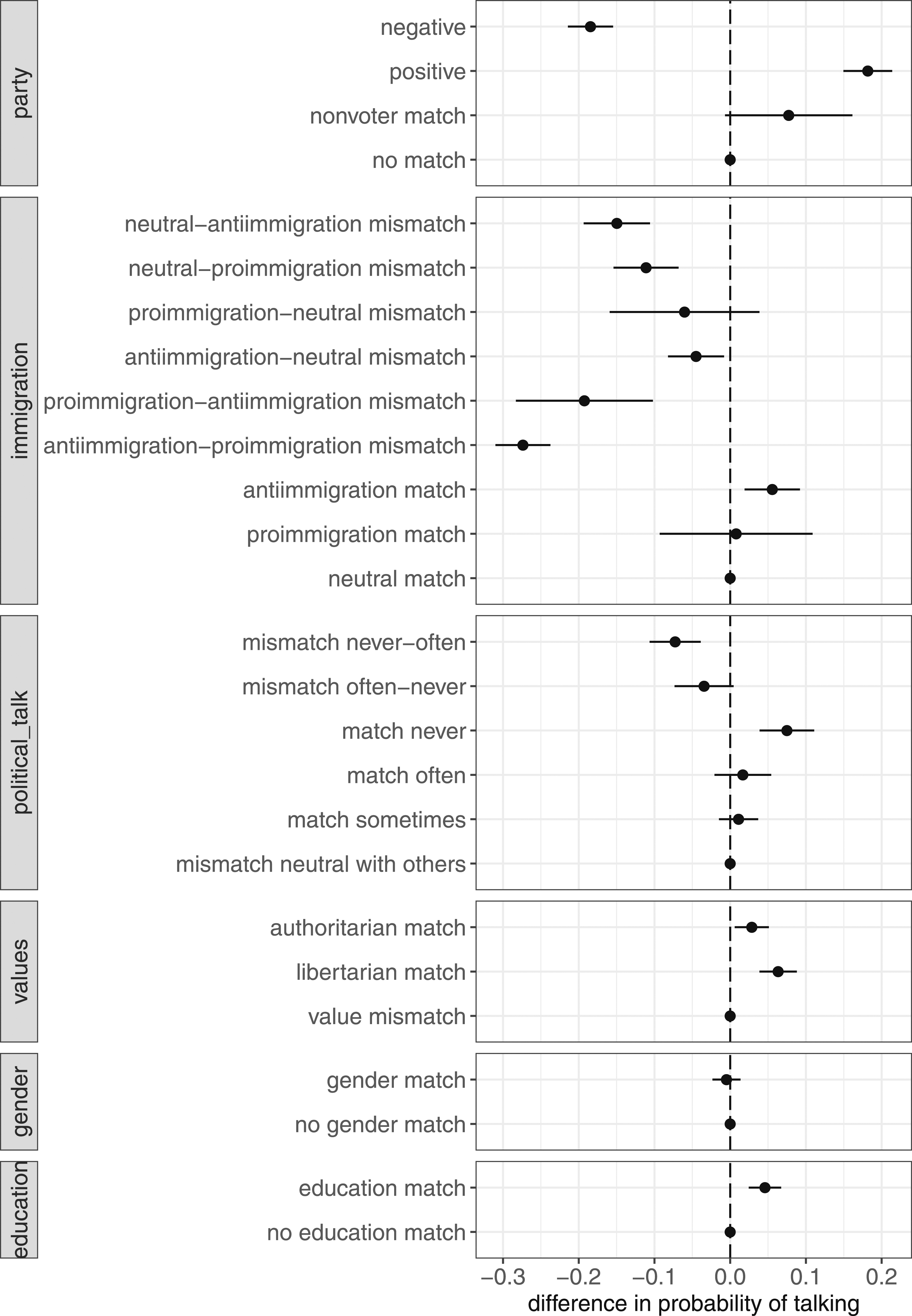
The trust game produced similar results. Figure 2 indicates that the allocation of money to another voter increases by 24.70 CZK when the subject and Player 2 support the same party compared to the amount given to an anonymous player. When the partner is a voter for the subject’s least favourite party, the allocation decreases by 57 CZK. The gap in allocations to co-partisans compared supporters of the subject’s least preferred party is notable. The amount of money allocated also decreases when Player 2 votes for any other randomly selected party, even though this average decrease of 24 CZK indicates a weaker negative bias compared to that for the subject’s least preferred party. The effect of the subject’s least preferred party is the largest effect in the model and substantially determines the pattern of interpersonal trust gaps.
5
Effects of partisanship, immigration attitudes, and minimal group membership on allocations to Player 2. Note: Multilevel tobit model. Attitudes about immigration were coded as a subject-Player 2 match (e.g. immigration: proimmigration match when the Player 2’s attitude matched the subject´s attitude) or mismatch (immigration: pro-anti mismatch when the subject held a pro-immigration attitude while the Player 2 held anti-immigration attitude). Party preference is coded as the subject’s vote choice matching Player 2 choice (positive match), the subjects’ negative partisanship matching Player 2 vote choice (negative match), interaction with a nonvoter (nonvoter match) or interaction with a voter of a random party (random). Control indicates allocations to members of an ingroup and an outgroup in the minimal group condition.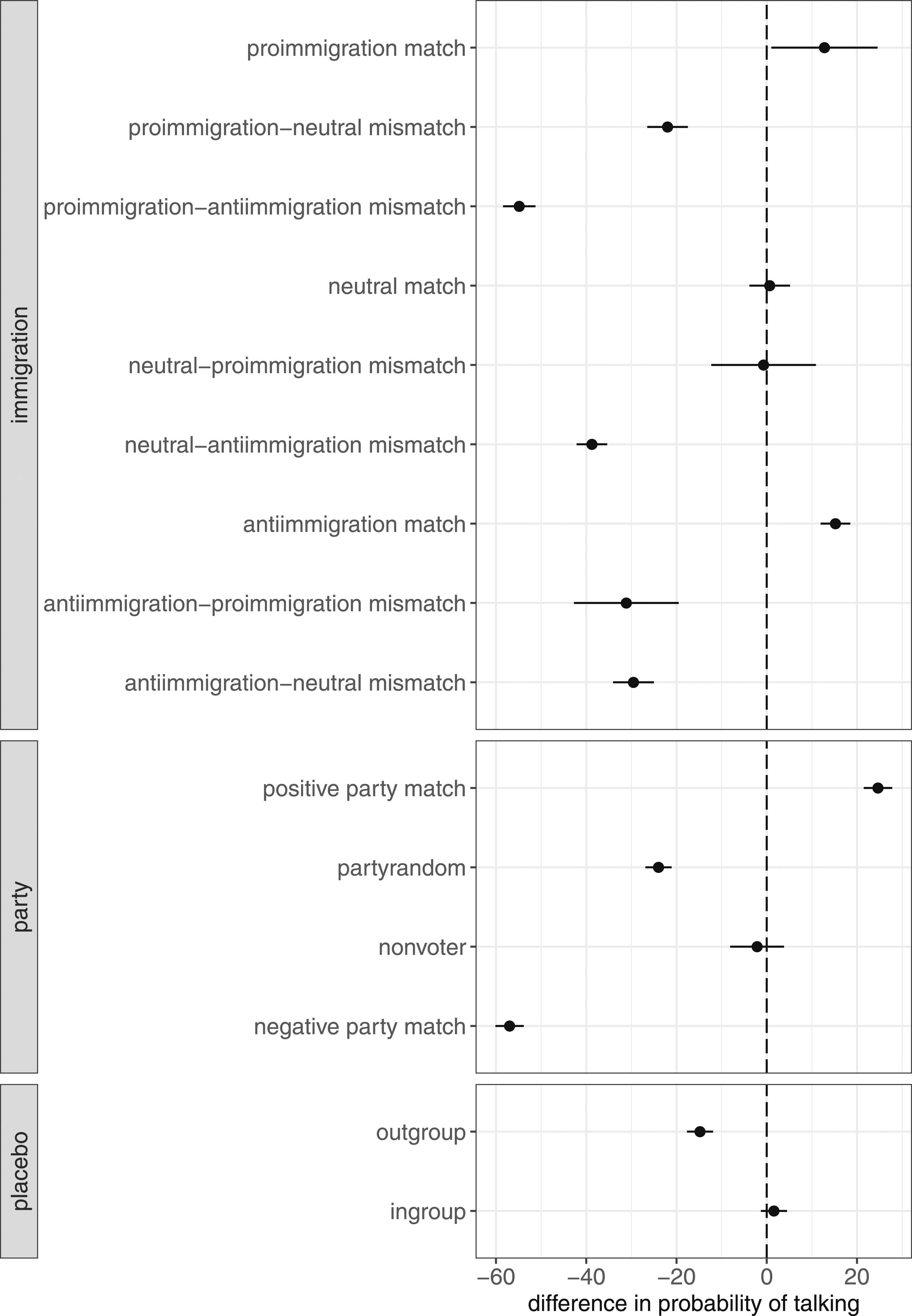
The conditional effect of party sympathy is tested only in the trust game. Inclusion of the like-dislike score for a randomly assigned party into the model reveals that the amount of money allocated to Player 2 who prefers any party other than the subject’s most and least preferred parties is conditional on the like-dislike score for that party (Figure 3). There is a clear effect of party sympathy for the randomly chosen party.
6
As sympathy for the party increases, the amount of money sent to the fictitious supporter of that party increases. Therefore, the results support H2. Effect of the like-dislike score for a randomly assigned party on the amount of allocations.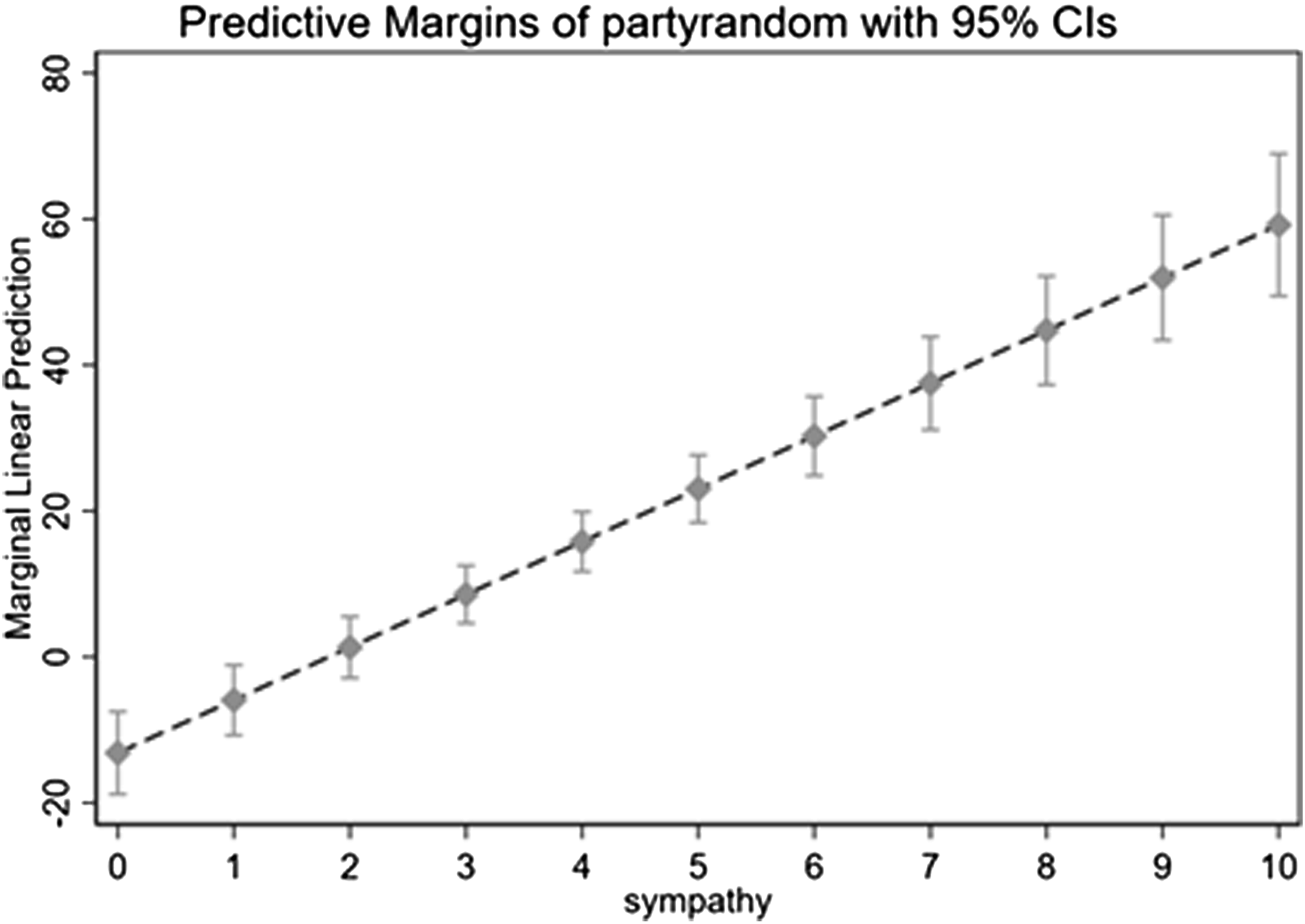
Our data also support H3a and H3b on the effects of immigration attitudes. As for the conjoint data, the effects of congruent attitudes on immigration are not as large as the effects of partisan congruence, but the effects of disagreement over immigration are even larger than the effect of partisan incongruence (Figure 1). For those who think that immigration is bad for the country, the probability of speaking to someone who thinks immigration is good for the country decreases by 0.27 compared to talking to someone with an ambivalent attitude. Subjects who hold positive attitudes towards immigration are less biased. The probability that a subject who thinks immigration makes the country a better place would talk to somebody who thinks immigration is harmful for the country is 0.19 lower than for talking to someone with an ambivalent opinion. A positive effect of congruence of attitudes about immigration between the subject and the experimental profile was identified only for anti-immigration attitudes, but the association was weaker compared to the positive effect of congruent partisanship. 7 Interestingly, the probability of the willingness of someone with a neutral opinion to talk to a person with a more decided attitude (either pro- or anti-immigration) attitude also decreases.
The same structure of results is identified in the trust game data (Table 2). Subjects with either pro- or anti-immigration attitudes are willing to send more money to people with the same attitude about immigration and are not willing to send as much money to those with the opposite attitude. For people with a negative attitude towards immigration, it does not matter whether Player 2 is neutral or positive towards immigration, the amount sent to such players decreases by 29.50 CZK and 31.10 CZK, respectively. Facing a Player 2 with negative opinions about immigration decreases the allocation by 55 CZK for subjects who perceive immigration positively, compared to the allocation to an anonymous Player 2. However, the gaps in trust between the ingroup and outgroup characteristics of Player 2 are smaller for immigration attitudes than for partisanship.
We can also test the effects of the alternative variables using the conjoint data (Table 1). The frequency of political talk and values are included among the conjoint attributes. The results are mixed. Individuals who never talk about politics tend to choose communication partners who also don’t talk about politics, and they tend to avoid those who talk about politics often. Therefore, the habit of talking often about politics may negatively influence one’s attractiveness to other people. The effects of this variable are smaller than the effects of partisanship and immigration attitudes. We find weak support for H5 since people prefer speaking with those who hold the same values. The strength of the effect is small compared to the effects of party preferences and immigration attitudes.
We tested H4a and H4b using an additional set of analyses with the interaction between frequency of talking about politics and political preferences. The hypotheses suggest that the effects of party preferences and attitudes towards immigration are conditional on the frequency of political talk of the communication partner. We identify a significant interaction for the discrete choice variable for H4a (Figure 4). When the subject and the partner share the same party preference, the frequency of the partner’s political talk does not influence the probability of their selection as the preferred partner. But there is a significant decrease in the average probability of choosing a person who votes for one’s least favourite party and likes to talk about politics often compared to an out-partisan who does not talk about politics often. The prospect of a supporter of a disliked party talking about politics decreases one’s propensity to talk to such a person. However, there is still a substantial negative effect for out-party supporters who do not talk about politics often. There is a similar effect related to H4b about the interaction between the frequency of political talk and immigration attitudes. This effect is significant only at a 0.1 level of statistical significance (details in SI). Effects of congruence between subjects and experimentally generated profiles on profile choice, including the interaction term of party preference and frequency of talking about politics. Note: AMCEs of subject-profile attribute in/congruence on the choice of the communication partner. The variables indicate a match or a mismatch of the attributes between subjects and the experimental communication partners. For attitudes on immigration and political talk, the first characteristics refers to the attitude and the frequency of political talk of the subject and the second characteristics refers to the experimental communication partner attribute. Therefore, proimmigration−antiimmigration mismatch means a mismatch between the subject who holds a positive attitude on immigration and a communication partner with a negative attitude on immigration. For partisanship, negative indicates congruence of the communication partner’s vote choice with subject’s negative partisanship, positive indicates congruence of positive party preference, nonvoter match indicates a match between a subject nonvoter and an experimental nonvoter profile.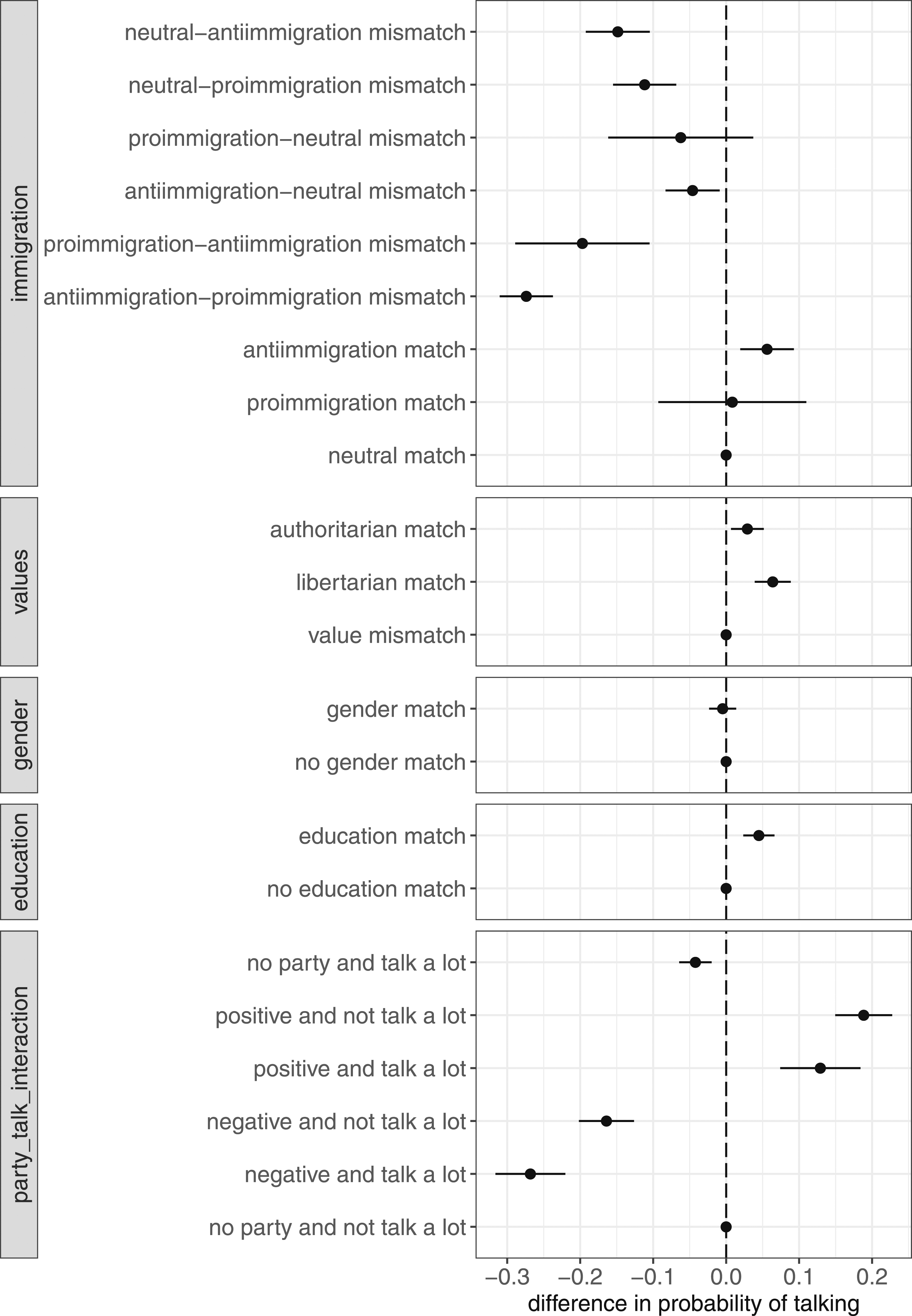
Both the conjoint and trust game experiments inform us that partisanship is a major polarizing factor even in a country with multiple parties and an unstable party system. People tend to avoid those who vote for their least liked parties. Instead, they prefer to interact with others who vote for the same party. The trust game data also indicate the phenomena of in-party trust and out-party distrust. The major trust gap is driven mainly by distrust of those who vote for one’s least favourite parties. The level of trust in voters for other parties is driven by one’s varying sympathy for the other parties. Our data reveal that issue-based attitudes may also be affectively polarizing. Data from the conjoint experiment demonstrate that subjects avoid those who hold dissimilar and especially opposing opinions on immigration. Moreover, those who perceive immigration negatively tend to prefer communication with people who hold the same opinion. The trust game data reveal a reversed pattern in the asymmetry of interaction preferences for subjects with pro-immigration and anti-immigration attitudes compared to the conjoint. In the trust game, larger trust gaps driven by opposing immigration attitudes were evidenced by the different allocations made by subjects with pro-immigration attitudes. In the conjoint experiment, larger negative effects were identified for people who perceive immigration negatively.
Conclusion
Our findings reveal that partisanship divides citizens even in an unstable party system in which voters do not often stick to their party choices across elections. Party-driven interpersonal biases depend on the levels of sympathy and antipathy they hold towards political parties. At the same time, we find that political biases are a complex phenomenon and may be driven by multiple factors and not solely by either partisanship or policy preferences, as suggested previously (Iyengar et al., 2012; Lelkes, 2021). While this study does not tackle the issue of the relationship between policy preferences and party preferences, it offers evidence that when the two variables are presented together (conjoint) and separately (trust game), their effects on interpersonal relations are comparable.
A major difference in the polarizing effects of partisanship and immigration attitudes stems from the more substantive ingroup bias resulting from a shared party preference. The impact of party preferences on the lack of willingness to interact with others is especially profound when they vote for one’s disliked parties and talk about politics often. The frequency of political talk seems to interact with immigration attitudes less than with party preference, revealing that it is mainly partisan politics that people avoid discussing in everyday life. Even though Klar et al. (2018) suggest that people are willing to spend time with those they disagree with as long as they do not talk about politics, according to our study people generally do not want to interact with others who hold different political preferences and discussing politics only strengthens the tendency to avoid out-partisans.
What needs to be researched in the next step, is the exact role of identity in politically motivated hostility and polarization. While our finding about the impact of partisanship on social interactions is in line with the notion of expressive partisanship anchored in social identity (Huddy et al., 2015), the operationalization of partisanship in our experiments does not capture identity-based expressive partisanship but simply vote choice. Together with the structure of the Czech party system, this makes our findings about the impact of partisanship on social interactions notable. As we assume the nature of partisanship in the Czech Republic to be instrumental and we operationalize it through vote choice, political conflicts driving party choice seem to also be driving broader social conflicts. At the same time, this conflict cannot be explained by disagreement about immigration.
Our analysis on affective polarization thus offers new insights both geographically and methodologically. We present evidence that affective polarization in CEE occurs not only on the level of electoral party politics (Knudsen, 2021; Reiljan, 2019; Wagner, 2021), but that these biases influence how people relate to each other. We shed light on politically driven divisions in a traditionally understudied context. Even though previous research discovered that political parties in CEE can work as political heuristics (Brader et al., 2013; Hrbková 2016), we know very little about the nature of political partisanship in the region. We use a dynamic approach assigning political parties to individual subjects’ preferences, which extends the applicability of these experimental methods to the study of intergroup relations and society-wide hostilities in complex party systems. Future research should focus on what happens when the dispositions are contradictory. The mismatch between partisan identity and issue positions sheds more light on the relative importance of these dispositions in different contexts (Lelkes, 2021; Mummolo et al., 2019). We did not address this topic in our studies in order to keep the experimental designs simple and the surveys short. Future research should also focus on more policy dimensions.
Supplemental Material
Supplemental Material - Politically motivated interpersonal biases: Polarizing effects of partisanship and immigration attitudes
Supplemental Material for Politically motivated interpersonal biases: Polarizing effects of partisanship and immigration attitudes by Lenka Hrbková, Petr Voda and Vlastimil Havlík in Party Politics
Footnotes
Declaration of conflicting interests
The author(s) declared no potential conflicts of interest with respect to the research, authorship, and/or publication of this article.
Funding
The author(s) disclosed receipt of the following financial support for the research, authorship, and/or publication of this article: This output was supported by the NPO “Systemic Risk Institute” number LX22NPO5101, funded by European Union - Next Generation EU (Ministry of Education, Youth and Sports, NPO: EXCELES).

Supplemental Material
Supplemental material for this article is available online.
Notes
Author biographies
References
Supplementary Material
Please find the following supplemental material available below.
For Open Access articles published under a Creative Commons License, all supplemental material carries the same license as the article it is associated with.
For non-Open Access articles published, all supplemental material carries a non-exclusive license, and permission requests for re-use of supplemental material or any part of supplemental material shall be sent directly to the copyright owner as specified in the copyright notice associated with the article.
