




Abstract
Research linking political polarization to spatial divides has largely overlooked policy preferences. This article argues that local conditions meaningfully moderate the relationship between party affiliation and people’s policy preferences. Focusing on public education in the United States, it contends that local realities can create contextual cross-pressures for partisans, especially Republicans, whose education needs may be at odds with the party agenda. In rural contexts, alternative schooling is limited and traditional public schools are essential institutions. Preferences should reflect these contextual pressures. Examining survey data for tax and spending preferences, findings suggest that while Republicans generally oppose increased education funding, rural Republicans, particularly in areas with limited school choice, are more supportive of public education taxes and spending than their urban counterparts. Shedding new light on party-voter congruence, the article shows how local policy realities reshape partisan divides, particularly in rural America, where partisan loyalty persists but policy alignment is more complex.
Introduction
Research on polarization increasingly links political parties with spatial distinctions such as the urban-rural divide (Brown and Mettler, 2024; Gimpel et al., 2020; Mettler and Brown, 2022; Rodden, 2019). Voting patterns in the United States reflect this division, with Democrats dominating elections in urban areas and Republicans in rural areas (Huijsmans and Rodden, 2025; Johnson and Scala, 2022). One might reasonably assume that this spatial divide in voting will extend to people’s policy preferences. Rising intraparty homogeneity (Abramowitz and Saunders, 2008; Mehlhaff, 2025), strong party loyalty (Abramowitz and Webster, 2016; Bartels, 2018), and deepening affective polarization (Diermeier and Li, 2022; Iyengar et al., 2019; Rogowski and Sutherland, 2016) all suggest that voters and parties should converge along the lines of policy preferences (Abramowitz, 2022; Kozlowski and Murphy, 2021). The connection between party affiliation and policy preferences, however, remains underexplored from a spatial perspective.
The bulk of research on the intersection of place and politics has focused on either voting (e.g. Albrecht, 2022a; Johnson and Scala, 2020; Scala et al., 2015) or place-based resentment, consciousness, or social identity (e.g. Cramer, 2016; Jacobs and Munis, 2023; Lin and Lunz Trujillo, 2023a, 2023b). The scant literature directly examining policy attitudes from a spatial perspective has largely bracketed the role of partisanship (Diamond, 2023; Thompson, 2023). To make sense of the role of place vis-à-vis partisanship and individual preferences, competing mechanisms have been put forth. While one long-standing perspective broadly suggests that preferences are largely shaped by partisan affiliation regardless of place (it doesn’t matter where you live) (Mason, 2018; D. J. Hopkins, 2018; J. R. Brown and Enos, 2021), another avers that place shapes preferences, even when accounting for partisan affiliation (it matters where you live) (Fennelly and Federico, 2008; Fudge, 2020; Martin and Webster, 2020). An emerging third perspective contends that place interacts with partisanship in shaping preferences (where you live may strengthen or weaken the role of partisanship) (Fudge and Armaly, 2021; Lin and Lunz Trujillo, 2024; Ternullo, 2024).
Drawing on this third perspective, I examine how policy preferences vary across the urban–rural divide by considering both partisan affiliation and spatial policy effects. While party affiliation is a strong predictor of political preferences, I argue that the geographic disparities in policy consequences across space may moderate this relationship due to local contextual pressures. Because policies have different effects across types of places (like urban and rural) and partisan policy solutions do not necessarily align with the everyday realities of voters, the effect of partisanship should be stronger or weaker for policy preferences. As a result, gaps between party platforms and the lived experiences of voters may emerge. This tension should become particularly pronounced in times of rising ideological polarization, as parties adopt more extreme positions. While local conditions matter for people in determining their policy preferences, potentially leading voters to hold positions that diverge from their party’s platform, this does not necessarily mean that voters will turn away from their preferred party. Rather, this argument highlights the potential for growing misalignment between party platforms and voter preferences, especially under conditions of polarization.
To test this argument, I focus on the preferences of rural Republicans regarding public education finance. Education policy has become increasingly nationalized and polarized (Finger and Reckhow, 2022; Houston and Barone, 2025). In recent years, Republican policymakers have proposed a range of education policies that would significantly change current approaches to public schooling and education finance, often by reducing or redirecting resources away from traditional public schools (Lonas, 2023; Perez, 2023; Strauss, 2023). 1 In rural areas, public schools play a relatively more essential role than in urban contexts, where they often serve as the primary education option, act as a central community institution, and function as a key local employer (Biddle and Azano, 2016; Tieken and Montgomery, 2021). Against this backdrop, spatial policy factors in rural contexts should meaningfully moderate the relationship between party affiliation and individual preferences for education. This creates a potential tension for rural Republicans who are cross-pressured between the local importance of public schools and their partisan alliance. Republican policymakers increasingly emphasize policies, such as expanding school choice, that can undermine the public institutions rural voters rely upon. In contrast, Democratic voters are less likely to face conflict between their party’s pro-public-funding-education-platform and the needs of their local community. Consequently, I expect rural Republicans to show greater support for taxes and spending on public education than their urban counterparts, while spatial dynamics should be less relevant for other party affiliations. Reflecting how local conditions can override partisan-aligned attitudes, Republicans in rural contexts with few school choice options are likely to show the highest support for public education funding.
To empirically examine this, I rely on data from multiple waves of the Cooperative Election Survey (CES) matched with urban-rural continuum codes (county) and rural-urban commuting codes. To assess education policy preferences over time, I analyze two measures that capture attitudes toward taxes and spending on public education. I find that at the national level, political affiliations are closely in line with party patterns: Republicans are less likely to support taxes and spending on education. When taking into account urban–rural contexts, however, preferences of individuals are no longer congruent with their affiliated parties. Republicans in rural areas are significantly more supportive of education taxes and spending than their urban Republican counterparts. Taking into account the spatial policy effects, rural Republicans in contexts with low school choice options show the strongest support for public education funding. This suggests that local policy consequences can drive divergence between voter preferences and national partisan policy platforms.
Moving away from electoral outcomes and partisan sorting across geography, this article sheds light on the variation in policy preferences among voters in times of polarization (Brown and Mettler, 2024; Druckman et al., 2021; Spoon and Klüver, 2015). The findings offer new insights into issue polarization and party-voter alignment by showing that even when parties dominate across space, voters may still hold diverging policy preferences. Building on calls to explore policy areas with greater “relevance of local and place-based considerations” (Lin and Lunz Trujillo, 2024: 676), this study examines public education, a distinctly local policy domain that both reflects and reinforces local conditions. Focusing on how place and partisanship interact to shape policy preferences, this highlights the contextual pressures voters face when evaluating politics and policies (Diamond, 2023; Fudge and Armaly, 2021; Newby, 2024; Zumbrunn, 2024). Despite rising political polarization, voter preferences, particularly in rural areas, continue to reflect local needs and conditions, echoing the behavior of lawmakers who also resist education policies that threaten rural interests (Lopez and Svitek, 2023; MacGillis, 2024; Sequeria, 2025).
This paper also adds to work that documents how the decline or uneven provision of public services, especially in rural or periphery areas, can lead to political dissatisfaction with mainstream politics, often fueling support for populist or radical right parties (Cremaschi et al., 2025; Cremaschi et al., 2024; Dickson et al., 2025; Nyholt, 2024; Patana, 2020, 2022; Scheiring et al., 2025; Stroppe, 2023; Ziblatt et al., 2023). These studies show that local service decline and discontent with national party agendas can create ideological inconsistencies among voters, leading them to support anti-establishment parties who they perceive as more responsive to local needs. In the same way, findings presented here suggest that while party loyalty in rural areas remains strong (affirming partisan polarization across geography), ideological cohesion may be weaker than often assumed (countering ideological polarization within geographical areas). This raises important questions about alignment between voters and parties related to public services across the urban–rural divide in times of rising polarization.
Polarization and Partisanship Across the Urban-Rural Divide
Scholars largely agree that political polarization has intensified among both political parties and the mass public (Abramowitz, 2010; Baldassarri and Gelman, 2008; Campbell, 2018; Fiorina and Abrams, 2008). While parties are expected to represent the preferences of voters (Downs, 1957; Ezrow et al., 2023; Ezrow and Hellwig, 2014), research suggests that citizens adjust their preferences to match with those of their preferred party (Abramowitz, 2010; Moral, 2017). This implies that party polarization drives citizens toward more polarized positions themselves (Layman et al., 2006; Lenz, 2013; Levendusky, 2009; Merrill et al., 2024; Moral and Best, 2023). As parties become more ideologically distinct, voters receive clearer partisan cues, reinforcing ideological sorting and deepening polarization (Lachat, 2008; Thornton, 2013; Zingher and Flynn, 2018). Supporting this, research shows that Americans are more polarized and partisan identities have continued to strengthen among the electorate (Iyengar and Krupenkin, 2018; Lelkes, 2016; Mason, 2015, 2018; Iyengar et al., 2019).
Intersecting with political polarization is the phenomenon of geographical polarization, which reflects patterns of partisanship across space (Hopkins, 2017; Mettler and Brown, 2022). The urban-rural cleavage, especially in the United States, has become progressively more associated with partisan affiliations that mirror political polarization: red rural places versus blue urban places (Gimpel et al., 2020; Johnson and Scala, 2020; Rodden, 2019). Emerging political rifts have been linked to distinct sets of values (Gimpel et al., 2020; Kenny and Luca, 2021), place-based “us versus them” identities (Bornschier et al., 2021; Brown et al., 2021; Lyons and Utych, 2023), distinct demographic and sociological compositions (Maxwell, 2019, 2020; Huijsmans et al., 2021), varying relationships with the government (Ashwood, 2018; Munis and Nemerever, 2024), and divergent trends in economic opportunities that fuel discontent (Borwein and Lucas, 2023; Jacobs and Munis, 2023; McKay, 2019; Spicer, 2018). As Brown and Mettler (2024: 648) observe, “Americans in rural and urban areas of the United States have, particularly since the late 1990s, experienced contemporary life in very different ways.”
Some scholars argue that political sorting, where residential choice relates to political preferences, contributes to this divide (Bishop and Cushing, 2009; Hopkins, 2017). Although geographical polarization through sorting based on partisan lines has been called into question (Abrams and Fiorina, 2012; Kaplan et al., 2022; Martin and Webster, 2020; Mummolo and Nall, 2017; Strickler, 2016), recent studies suggest that contemporary voters have reduced exposure within local contexts to political out-groups, reinforcing partisan homogeneity (Brown and Enos, 2021; Carlson and Gimpel, 2019; Rohla et al., 2018). In addition, this geographic clustering of partisanship has been found to foster sentiments of tribalism along partisan lines (Brown et al., 2021; Mason, 2018) and shape tendencies for partisan discrimination (Lyons and Utych, 2023). Tightly woven into spatial polarization is not only increasing political distance between voters but also deepening partisanship among voters.
However, spatial-political polarization is not uniform, impacting rural contexts more deeply in many ways. For instance, fueled by place-based discontent, rural voters perceive themselves as particularly disadvantaged in the national distribution of power and resources (Cramer, 2016; Mettler and Brown, 2022; Taylor et al., 2023). The logic is that local communities “lose” in the allocation of political resources leading people to turn toward politically extreme parties or candidates (Bolet, 2020; Colombo and Dinas, 2023; Cremaschi et al., 2024; Salomo, 2019). Much of this story stems from a sense of resentment, where rural voters feel overlooked and under-resourced (Cramer, 2016; Cramer Walsh, 2012; Monnat and Brown, 2017; Munis, 2022). While urban and suburban residents also exhibit forms of place-based resentment, it is strongest among rural residents, who tend to be more conservative and less satisfied with democracy (Borwein and Lucas, 2023).
Partially due to this “rural resentment,” rural voters tend to lean conservative (Ashwood, 2018; Dasgupta and Ramirez, 2024; Fudge, 2020; Hawley, 2020; Monnat and Brown, 2017). For example, Republicans are electorally more successful in contexts still dependent on the old rural farming economy (Scala et al., 2015). Especially during the 2016 presidential election, many scholars were unsurprised by the support of the Republican party in rural America: “Conditions were ripe for such an antiestablishment, ‘Make America great again’ vote” (Ashwood, 2018: 718). Rural political identity is shaped, in part, by shared beliefs and collective grievances but also corresponds with Republican messaging around structural changes affecting conditions at the local level (Carpenter et al., 2022; Greenblatt, 2022; Shea and Jacobs, 2023). These factors point to deepening partisanship, especially in rural contexts, where a combination of perceptions of disadvantage and actual structural changes, strengthens political identity and the link to the Republican party.
The dynamics underlying the relationship between place and partisanship, however, remain unclear. Many studies show that rural residency, identity, and consciousness are important explanatory factors for people’s politics, including partisan affiliation and sentiments such as institutional distrust (Cramer, 2016; Jacobs and Munis, 2019, 2020; Kaufman, 2025; Lunz Trujillo, 2022). Other work counters this assertion by showing that partisan identity, overriding place-based factors, shapes political values and sentiments of rural identity (Hershewe and Smith, 2025; Lunz Trujillo and Lin, 2025). While these studies offer valuable insights into the interaction between rurality and partisanship in shaping political choices and values, they have yet to explain how these factors influence policy preferences.
Among the few works focusing on policy attitudes, many find that place matters for preferences, even after controlling for party affiliation (Fennelly and Federico, 2008; Fudge, 2020; Martin and Webster, 2020). Rural residency, in particular, influences views on policy issues, leading to nuanced differences within both partisan groups (Albrecht, 2022b; Kaufman, 2021; Lin and Lunz Trujillo, 2024). This means that while partisans across the urban-rural continuum appear politically similar, certain policy issues can expose place-specific tendencies, leading to preference divergence within parties. Lin and Lunz Trujillo (2024: 676) argue that this is because issues are “creating contextual pressures on opinions”, which is reflective of other work on the limits of partisanship when it comes down to specific issues (Mummolo et al., 2021). As this research has focused on broad national matters, like income inequality, it overlooks policies that are more directly tied to local considerations and needs, better capturing the politics of place (Masuda and Garvin, 2008; Munis, 2022; Shea and Jacobs, 2023). Examining preferences for policies with more direct impact from local conditions and place-based factors are an important missing piece for understanding how contextual pressures between place and partisanship shape policy preferences.
Education Policy, Rural Context, and Party-Preference Divergence
To preview my argument briefly, I contend that, for the context of American education policy, local realities will reshape people’s taxation and spending preferences in ways that can diverge from their preferred party, primarily for cross-pressured Republican voters. Before elaborating on this claim, some contextual information on education policy in the broader setting of political polarization is in order.
Historically, education policy did not neatly fit into traditional political cleavages. In recent years, it has become entangled in national ideological debates, making it a more politically salient and divisive issue (Brezicha et al., 2023; Collins and Reckhow, 2024). As a result, education policy-making is now also impacted by growing party polarization (Finger, 2018; Finger and Reckhow, 2022; Houston, 2021). Especially since the 2016 election, efforts to restructure the public education system have intensified, with a strong push for policies aligned with the school choice movement, mainly among conservatives (Giroux, 2023; Lindberg, 2021). Proposals include legislation to create education savings accounts, increase homeschooling, and expand parental choice (Hendrie, 2023; Hess, 2023; Hamlin and Peterson, 2022). In the 2024 election, then presidential candidate Donald J. Trump made promises to eliminate the Department of Education, with actions toward this goal set in motion during the early stages of his presidency (Goldstein, 2024; Turner, 2025).
Party support for policies to reshape traditional public education, such as school choice options like charter schools and voucher programs, largely reflect ongoing partisan differences. In contemporary politics, Republicans advocate for measures that would significantly reform public education, instituting charter schools and expanding school choice (Houston, 2024; Reckhow et al., 2015; Shelton et al., 2022). Democrats, in contrast, tend to favor traditional funding mechanisms and increasing investment in public schools (Kitchens, 2021; Wolbrecht and Hartney, 2014). In addition, despite low trust in either party, Independents tend to align with Democrats in supporting the improvement of public schools and remain skeptical of voucher systems (Bernal, 2023). In general, Republicans argue that maintaining or increasing funding will not solve the main problems impacting public schools, while the Democratic party has advocated for increased levels of funding as a way to improve educational achievement standards and student outcomes (Kitchens, 2021; Meier and Rutherford, 2016). Notably, diverging party platforms underscore the degree of polarization characterizing education policy-making (Brezicha et al., 2023; Finger and Reckhow, 2022; Galston, 2005; Reckhow et al., 2015). This has also impacted public opinion on education, which also reflects growing signs of polarization (Houston, 2021, 2024).
Notwithstanding trends to nationalize education policy, the provision of education remains a local issue with a highly decentralized governance system (Collins and Reckhow, 2024). It is a policy cornerstone of nearly every US community with local needs and levels of funding varying significantly across geography (Berkman and Plutzer, 2005). Regardless of the heightened politicization of education at the national level (Henig et al., 2019; Reckhow et al., 2017; Weinschenk, 2022), education policies are still largely made at the state and local level (Kitchens, 2021). While debates at the national level are mainly ideological and partisan, “at the street level. . .parents and practitioners wrestle on a day-to-day basis with questions of what is needed and what to do” (Henig and Stone, 2008: 193). I contend that, even in the wake of education policy becoming nationalized and polarized, local realities will remain a causally powerful force in shaping people’s education preferences. Local conditions should create contextual pressures that complicate partisan alignment on the issue of education.
One way of capturing these local realities is through the lens of spatial categories like urban and rural. 2 By no means exhaustive of the variation in local contexts, this binary geographical distinction broadly captures differing local conditions that should reshape the role of partisanship for public opinion on funding education. Urban and rural educational contexts face distinct challenges. Rural districts often grapple with declining populations and limited tax bases, whereas urban districts contend with overcrowding and resource allocation issues (Anderson and Summerfield, 2010; Logan and Burdick-Will, 2017; Tieken and Montgomery, 2021). Rural places, in particular, are ideal for examining how local conditions challenge party loyalty because they often experience unique policy challenges that can create tension between national partisan positions and local needs. Unlike urban contexts, rural places are more vulnerable to contextual factors that can reshape attitudes toward public investment in education. These dynamics make rural areas an appropriate setting to focus on how local realities impact partisan alignment.
Long-standing research highlights the unique struggles of rural education, including small and geographically dispersed schools (Biddle and Azano, 2016), unique financial burdens due to lower tax bases or local demographics (Berriochoa, 2022; Imazeki and Reschovsky, 2003; Kolbe et al., 2021), and lower educational achievements (Drescher et al., 2022; Roscigno and Crowle, 2001). Local challenges are exacerbated by ongoing population decline and limited local employment opportunities (Kirschner et al., 2006; Li et al., 2019; Lichter and Johnson, 2023). Public schools serve as vital community institutions in these areas, fostering local attachment and economic stability (Sowl et al., 2022). However, rural school districts often face declining revenues and heightened financial strain, making public education an essential yet vulnerable policy domain (Tieken and Montgomery, 2021).
Local conditions for education should create distinct contextual pressures that shape how residents evaluate public school funding, constituting spatial policy effects. In contrast to urban settings, rural context introduces material and institutional constraints that can attenuate the influence of partisan identity on education policy preferences. These conditions are likely to be most consequential for individuals facing the greatest ostensible cross-pressure between party stance and the needs of their community.
Republican voters in rural places are in a unique position because these communities tend to heavily rely on public schools, whereas the agenda of their party has increasingly moved toward fiscal austerity and concomitant public education reform. This means that this group, in particular, may face a conflict between partisanship and the practical necessities of maintaining local schools. As public schools remain essential to the rural context, I expect rural Republicans to exhibit higher levels of support for education finance than their urban counterparts. This reflects the cross-pressure for Republicans between partisan affiliation and local educational realities.
Democrats should be less susceptible to these spatial policy effects, given their party’s more consistent support for public education funding. They are less likely to experience cross-pressure across spatial contexts. As a result, I expect Democrats to exhibit high levels of support for education funding, regardless of local variation.
Against this backdrop, the first hypothesis can be formulated: Cross-pressures of partisanship and local realities lead to spatial policy effects among Republican voters, where support for taxes and spending on public education is higher among rural Republicans than among their urban counterparts.
Rural disparities also shape access to types of schools. While school choice initiatives like charter schools and voucher programs are central to Republican platforms, they have gained limited traction in rural areas, where alternative education options are scarce (Irwin et al., 2023). Compared to urban places, rural areas are often at a disadvantage in implementing school choice policies due to issues like sparse and remote populations, transportation challenges, and funding limitations (Robson et al., 2020). Rural communities tend to have the least access with only about 12% of charter schools operating in rural areas, leading to lower enrollment but also lower parental interest (Enrollment and School Choice in Rural Areas, 2023). Rural areas also experience a disproportionate number of school closures, further limiting educational access (Tieken and Auldridge-Reveles, 2019). This means that existing public schools in rural areas are often isolated in providing services, leading these schooling institutions to play a relatively more essential local role (Tieken, 2014; Tieken and Montgomery, 2021).
Education preferences should reflect this local landscape of available school options. In areas where alternative schools, such as charter or private, are more accessible, a policy agenda for expanding school choice is likely to be more appealing to voters. However, the availability of school choice options significantly varies across communities. Some voters live in places with more schools that operate independent of the public system, like charter schools, making school choice policies more feasible. Others, particularly in rural areas, continue to rely heavily on the public school system. In such places, proposals to expand school choice may be seen as especially threatening to already scarce educational resources. Consequently, education preferences among Republican voters in these varying contexts should be shaped by the local availability of school choice options.
In contrast, spatial variation should matter less for Democrats. Even in areas where school choice options are limited, the absence of alternatives may reinforce their consistent support for strengthening the public education system. Local conditions align with, rather than challenge, their parties’ long-standing position, thereby diminishing the likelihood of local of contextual pressures.
These considerations related to the cross-pressure of partisanship and local school choice availability lead to the second hypothesis: Support for taxes and spending on public education is higher among rural Republicans in areas with limited school choice than Republicans in rural areas with more school choice as well as urban Republicans.
Data and Methods
To empirically assess party and place on education preferences, I rely on two measures that capture attitudes toward taxes and spending on public education. For tax preferences, I examine three novel modules of the Cooperative Election Survey (CES) run during the years of 2015, 2016, and 2022. For spending preferences, I rely on the common content section from the CES over the years 2016, 2018, 2020, and 2022. The common content section of CES provides a cross-sectional sample of over 50,000 yearly respondents with repeated questions about policy preferences, but is limited in its measures about public education. In contrast, the survey modules are limited by smaller sample sizes (ranging from 1000 to 1500 respondents), but provide responses for repeated survey questions specifically designed to gauge attitudes toward public education funding. These surveys are nationally representative, meaning that there is also a limited sample of rural respondents with less than 15% of each sample is located in rural parts of the United States.
Combined, the two main dependent variables provide a broad understanding of respondents’ support for taxes and spending on traditional public schools. For tax preferences, respondents were asked “Would you vote to increase taxes for public school funding, decrease taxes for public school funding, or keep taxes for public school funding the same?” with a 3-point response scale (1 = decrease, 2 = keep the same, and 3 = increase taxes). For the spending preference, respondents were asked “State legislatures must make choices when making spending decisions on important state programs. How would you like your legislature to spend money on education?” with a 5-point response scale (1 = greatly decrease, 2 = somewhat decrease, 3 = maintain, 4 = somewhat increase, 5 = greatly increase).
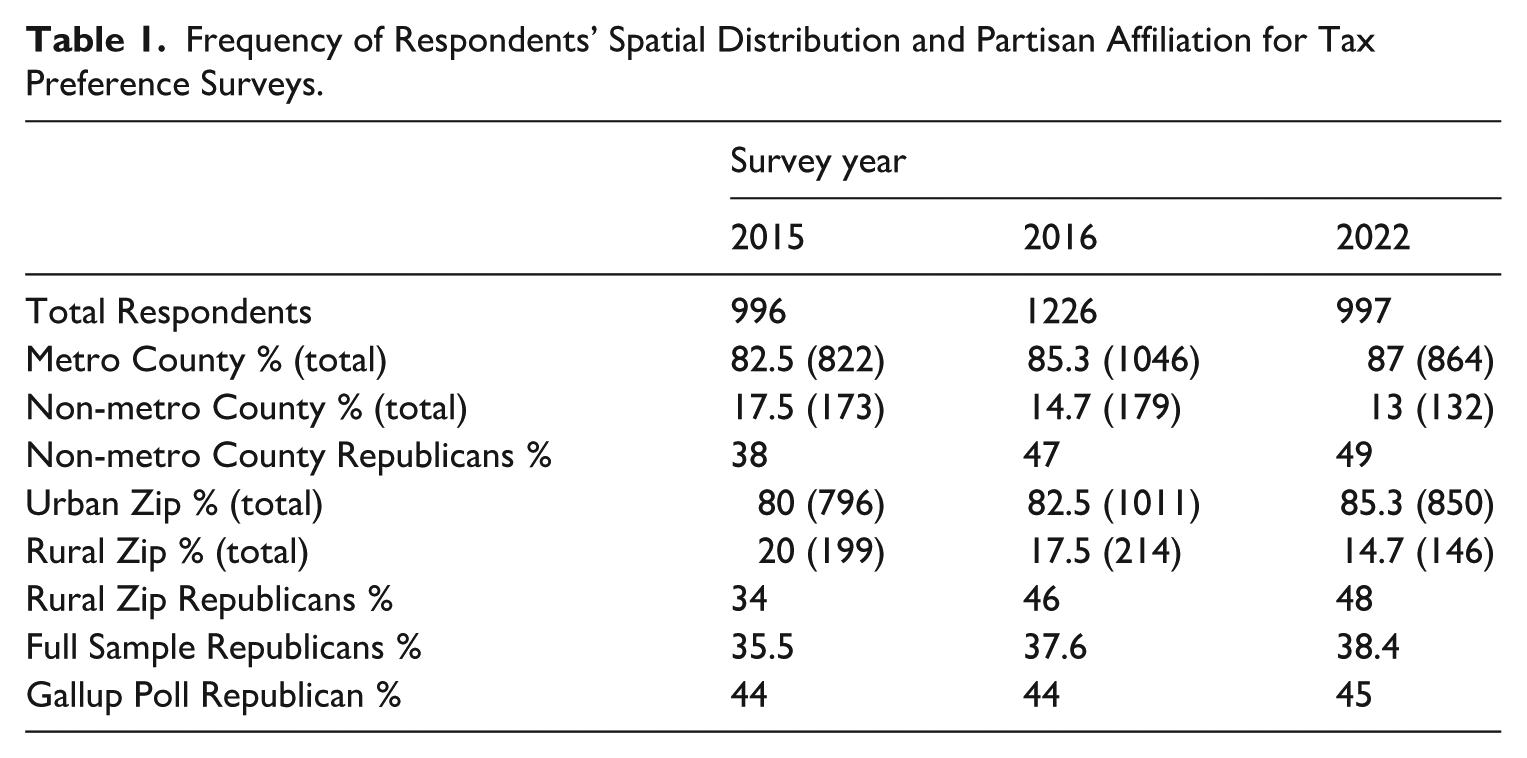
For the measure of partisan affiliation, I rely on the 7-point measure of partisan identity. The scale of identity includes unsure, strong Democrat, not very strong Democrat, lean Democrat, Independent, lean Republican, not very strong Republican, and strong Republican. Using this measure, I construct the binary measure for being Republican (= 1) which consists of lean, not very strong, and strong Republican, compared to all else (= 0). Table 1 displays the distribution of respondents by geographic context and the percentage classified as Republican in rural contexts, the main dummy variable used in the analysis, in the tax preference surveys. Table 2 displays the distribution in the spending preference surveys. These tables also include the percentage of each full survey that is classified as Republican. For a comparison, the percentage of Americans identifying as Republican/Lean Republican in 2023 Gallup Polling is also listed.
Frequency of Respondents’ Spatial Distribution and Partisan Affiliation for Tax Preference Surveys.
Frequency of Respondents’ Spatial Distribution and Partisan Affiliation for Spending Preference Surveys.
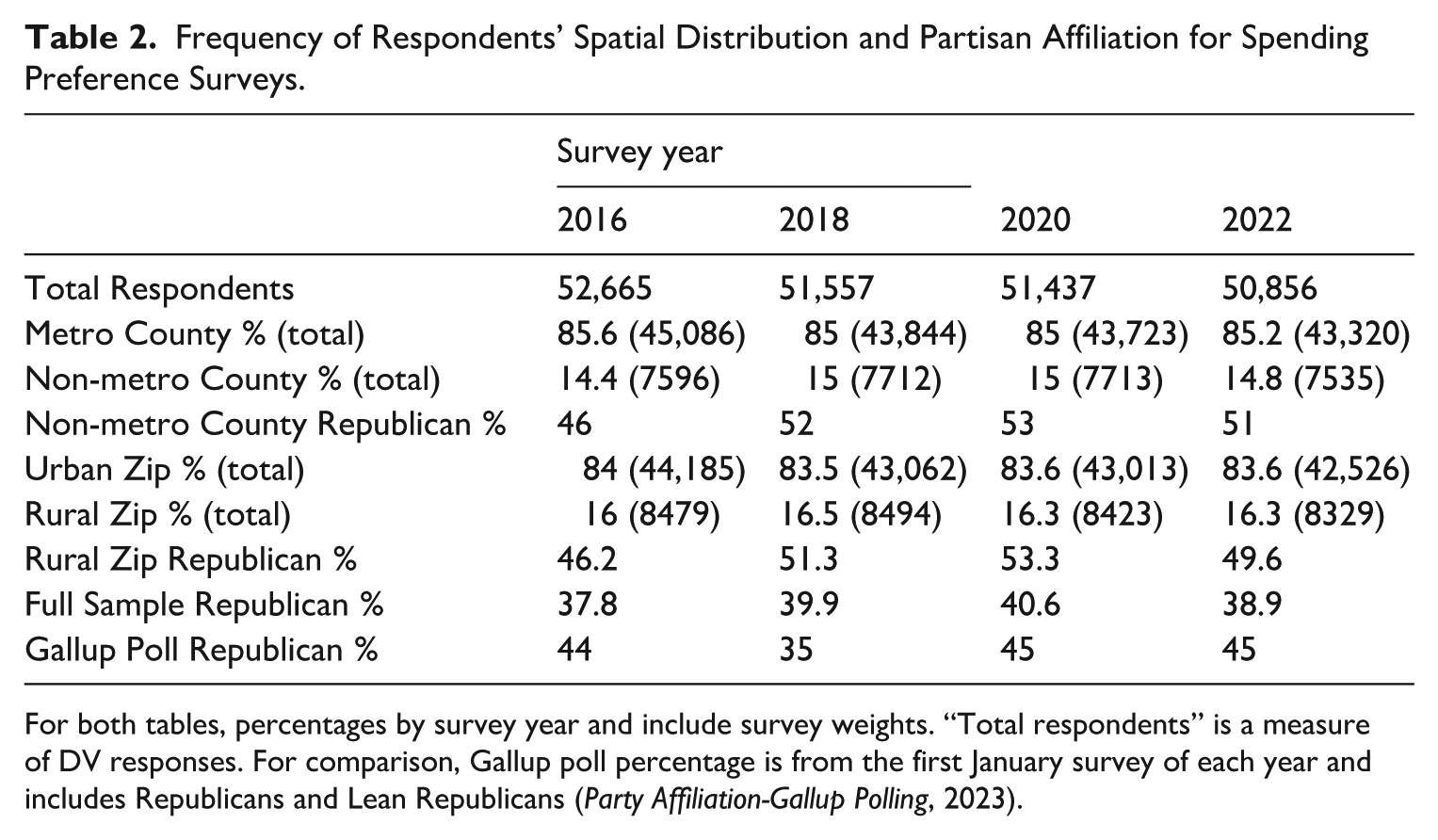
For both tables, percentages by survey year and include survey weights. “Total respondents” is a measure of DV responses. For comparison, Gallup poll percentage is from the first January survey of each year and includes Republicans and Lean Republicans (Party Affiliation-Gallup Polling, 2023).
To match respondents to their local context, I rely on two measures. First, I use the Federal Information Processing Codes (FIPS) to match respondents to their county. The Rural-Urban Continuum Codes (RUCC) classification scheme, collected from the US Department of Agriculture, distinguishes between metropolitan counties and non-metropolitan counties. There are nine codes that can be used to construct binary indicators of metropolitan (urban) and non-metropolitan (rural) areas (USDA ERS, 2025). Average preferences for taxes (Figure 1) and spending (Figure 2) over the years of the surveys are illustrated in urban and rural contexts.
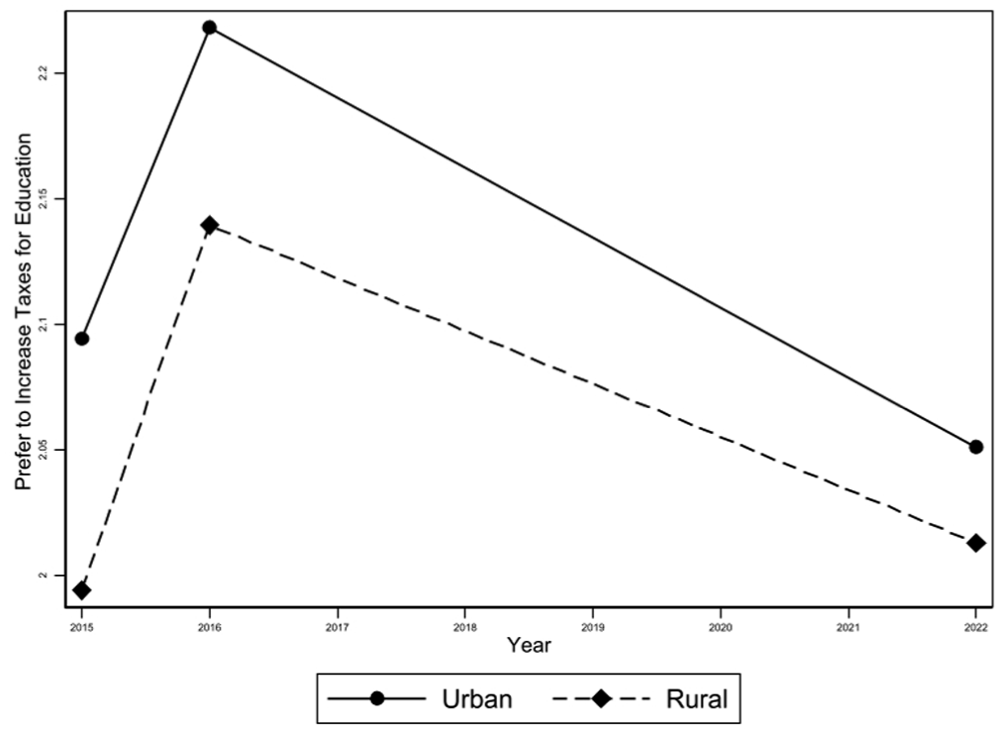
Average Preferences for Education Taxes Across Urban and Rural Counties.
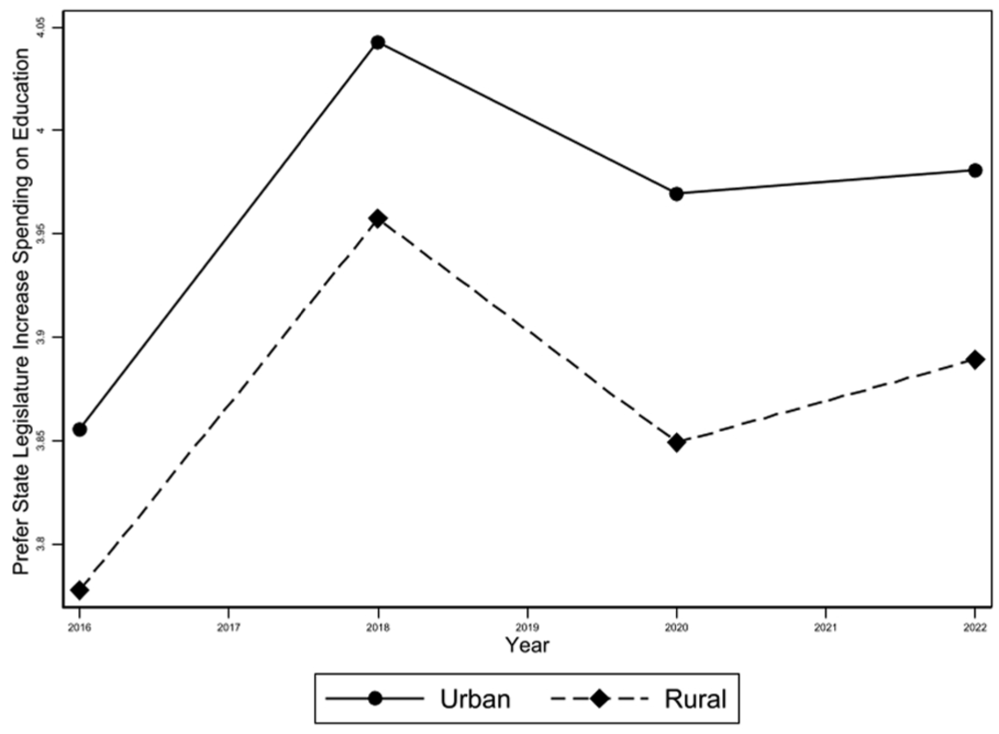
Average Preferences for Education Spending Across Urban and Rural Counties.
I also use an additional measure that classifies geography at the census tract level. For spatial classification at the census tract level, I rely on the Rural-Urban Commuting Area Codes (RUCA), also downloaded from the US Department of Agriculture. These codes classify US census tracts and rely on measures of population density, urbanization, and daily commuting. They can be matched to respondents using their zip codes and allow for a more granular classification scheme. Furthermore, these codes can be classified in a number of ways. Using these codes, I define urban and rural based on the guidelines of the Rural Health Research Center at the University of Washington; urban is defined as all places that have 30% or more of their workers going to a Census Bureau defined Urbanized Area. The remaining are classified as rural.
In the following empirical analysis, I run all models using the county-level and census track-level classifications for both the tax and spending preferences of respondents. The following series of linear regression models are estimated using the individual year survey weights provided by CES. Because the bulk of education policies (spending and taxes) are made at the state-level, I include state-level dummies to hold constant common educational infrastructure. To control for time trends that may also shape preferences, I also include survey years in the models. Robust standard errors are also applied.
All models include individual- and contextual-level controls. Table 3 displays the descriptive statistics for these variables. I include family income (a 12-point scale ranging from less than 10,000 dollars to over 150,000 dollars), no income reported (= 1), level of education (6-point scale from no high school to post-graduate), religious affiliation, gender (1 = female), race (1 = white), ideology (a 7-point scale of liberal to conservativeness), no ideology reported (= 1), being a parent (= 1), being married (= 1), age, and having no health insurance (= 1). 3 Ideology is controlled for as a means to isolate the effect of party, however, because party affiliation partly shapes ideological beliefs, inclusion of this may also underestimate the effects of the party. To examine the latter, I also run models excluding ideology controls.
Descriptive Statistics of Dependent, Independent, and Control Variables (Weighted).
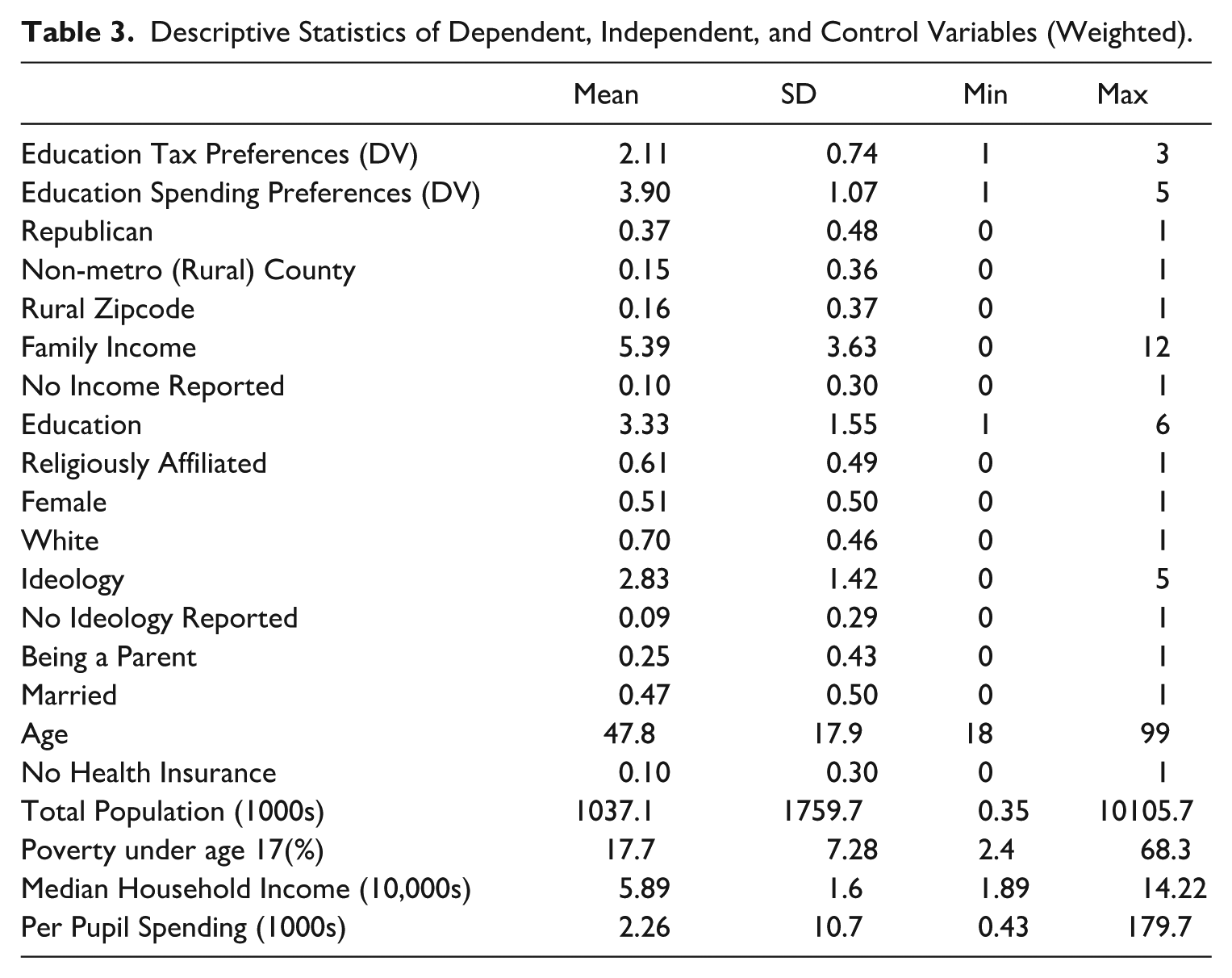
At the local level, I include data from the American Community Survey (5-year trends) to control for total population (in thousands), percent of children under the age of 17 in poverty, and the median household income. I also include aggregated data from school districts (from the National Center for Education Statistics) to control for per pupil spending (in thousands). These data use average spending per pupil within all districts within the county to provide an approximation of the current funding effort in the direct locality of respondents.
To get an idea of the make-up of schools in rural counties and zip codes, I first run a series of correlational estimations for the survey samples. For both non-metro counties and rural zip codes, there is a negative correlation (−0.18) with the number of schools in the district (an aggregate estimate of all school districts in the county). This follows the anticipated results that rural contexts maintain fewer schools than their urban counterparts. In addition, there is a negative correlation at both these estimation levels to the average per pupil expenditures (−0.03), meaning rural districts also spend slightly less per student. There is also a negative correlation (−0.16) for the percentage of funding in these rural contexts that comes from local property taxes. Higher local housing values enable local tax efforts and reduce reliance on state funding for schools (Sipple et al., 2019). Higher local property taxes can reflect a more affluent local community and greater ability to generate funding for education through levying local taxes.
These descriptive correlations illustrate the geographical variation within samples of respondents across geography. Rural contexts have fewer schools, lower spending on students, and lower economic vitality. They are also more conservative than urban contexts. Rural contexts are positively correlated with being a Republican (0.08), with about 43% of respondents being Republican in non-metro counties and rural zip codes (compared to 34% in urban). This means that a greater percentage of the electorate in rural contexts identify as Republican.
Policy Preferences Across Geography
Before focusing on spatial policy effects, I first estimate a baseline model of average partisan preferences for education taxes and spending. Assuming that voters follow their party on policy, we would expect that Republicans are opposed to taxes and spending for public education. However, based on the argument, Republicans in rural places as cross-pressured voters should diverge from the general platform of their party and show higher levels of support for public school taxes and spending. Shifts in preferences for Democrats (and other Independents) are expected to be less shaped by the spatial context. Tables showing full results are included in the appendix.
As shown in Supplemental Table A1, ceteris paribus, Republican respondents are less likely than Democrats and Independents to endorse increased taxes and spending. Including the county level controls in the first iterations of the model, holding all else equal, Republicans are 0.17 points less supportive of increasing taxes to fund education compared to respondents with other political affiliations. Similarly, they are associated with a 0.32-point decrease in support for increased public education spending. These patterns hold when accounting for zip-code-level controls. On average, Republicans are 0.17 points less supportive of increased taxes and 0.32 points less supportive of increased spending on education. This baseline model illustrates that education policy preferences tend to align with national party positions—Republican voters, on average, express lower support for taxes and spending.
Next, I examine whether this congruence between party and voters holds when accounting for rural context. I estimate cross-level interaction models interacting party affiliation with rural context, measured at both the county and zip code level. This interaction estimates whether being in a rural context affects Republicans differently than other partisan groups and, more specifically, how rural Republicans differ from urban Republicans. A positive value can be interpreted as higher support for taxes and spending on public education among Republican in rural areas compared to urban areas.
Supplemental Table A2 shows the baseline results (without controls) for rural counties and zip codes. The positive and statistically significant interaction term indicates that being Republican in a rural county indicates a higher likelihood to endorse taxes and spending on public schools. These results hold when accounting for this relationship with rurality measured at the zip code level. Most surprisingly, the magnitude of effects is largest in reference to support for increased taxes for public schools. Holding all else equal, Republicans in a rural county are 0.35 points more supportive of taxes to fund public schools than Republicans in urban counties. Similarly, those residing in rural zip codes are associated with a 0.29-point increase in support for education related taxes, compared to their urban counterparts. These results hold for spending preferences; Republicans in rural counties are 0.17 points more supportive for spending on education, while those in rural zip codes are 0.15-point more supportive.
Supplemental Table A3 shows these models with all controls. Findings remain unchanged. Holding all else equal, Republicans in rural counties are estimated to be 0.30 points more supportive of taxes for public schools (on a 3-point scale) and 0.12 points more supportive of spending (on a 5-point scale) than Republicans in urban counties. Republicans in rural zip codes are estimated to be 0.25 points more supportive of taxes and 0.11 points more supportive of spending. This positive interaction suggests that the effect of partisanship on policy preferences varies by place, with the spatial policy effect weakening typical partisan trends in support for education funding, especially for Republicans. The partisan effect declines in rural contexts where Republicans are significantly more supportive of taxes and spending, lending support to the first hypothesis.
The following figures illustrate the average marginal effect of place for Republicans, contrasting urban contexts to rural. Figure 3 shows that, for tax preferences, the Republicans in urban context reflect expected partisan patterns (lower support). However, this pattern shifts in rural areas, where Republicans’ support is notably higher, suggesting that place moderates the influence of partisanship on preferences. Similar trends are observed for spending preferences in Figure 4. These findings are nearly identical at the zip code level.
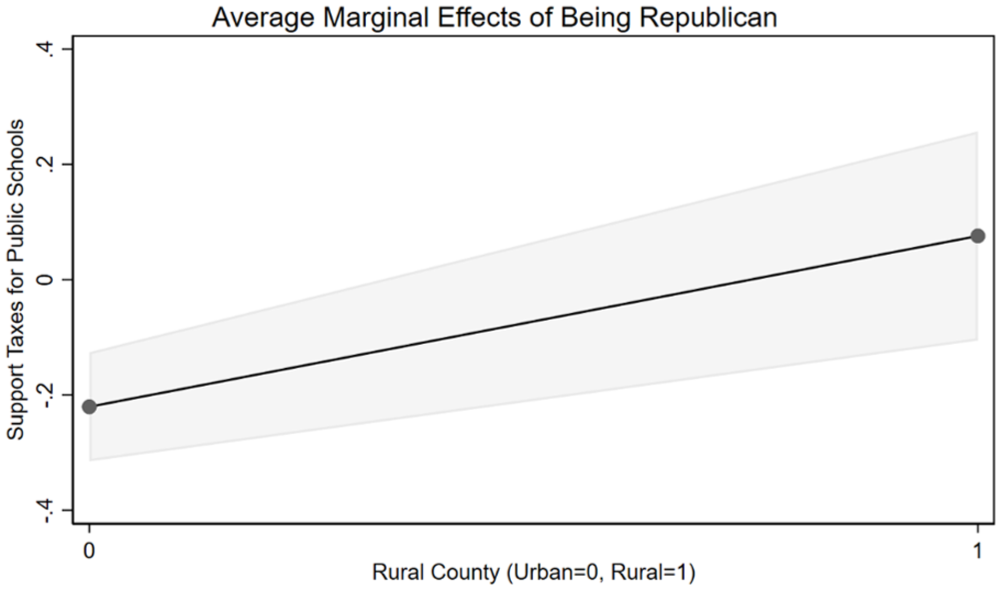
Average Marginal Effects of Republican by Urban–Rural County on Education Tax Preferences (95% Confidence Intervals, Results from Supplemental Table A3, Model 1).
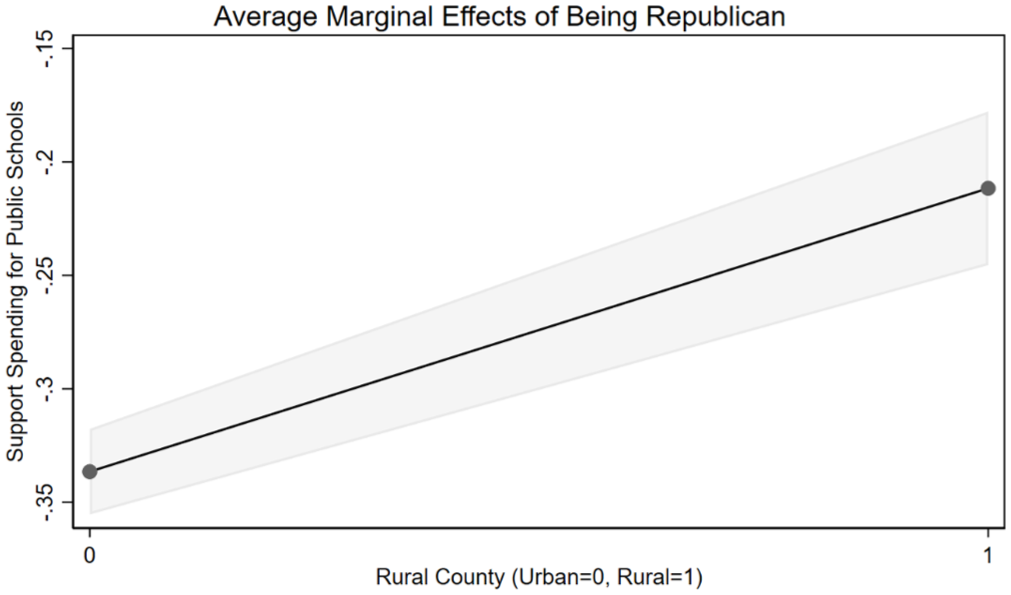
Average Marginal Effects of Republican by Urban–Rural County on Education Spending Preferences (95% Confidence Intervals, Results from Supplemental Table A3, Model 2).
To verify the robustness of these results, I also estimate models excluding ideology to avoid problematic correlations. As shown in Supplemental Table A4, the results remain consistent. While urban Republicans align closely with national party ideology in their lower support for education funding, rural Republicans deviate from this pattern. This suggests that the relationship between partisanship and policy preferences is context-dependent, where local needs and conditions can override ideology aligned with party affiliation. In short, rural contexts appear to moderate Republican opposition to public education funding.
As shown in Supplemental Table A5, I also estimate these models comparing Republicans to Democrats, excluding independents. The findings remain consistent. Holding all else equal and compared to urban Republicans, Republicans in rural counties are 0.30 points more supportive of taxes and 0.11 points more supportive of spending on public schools. In rural zip codes, they are 0.25 points more supportive of taxes and 0.09 points more supportive of spending on public schools. Especially for Republicans, the spatial policy effect diminishes the partisan effect, leading them to show greater support for education funding in rural contexts than in urban contexts.
To illustrate the interaction between partisanship and place, I also plot the predictive margins for tax and spending preferences at both the county level. Illustrated in Figure 5, rural Republicans exhibit higher support for taxes than their urban counterparts. Democrats (and independents) show a decline in support when comparing urban and rural contexts. This indicates that, contrary to the initial hypothesis, the spatial policy effect is not exclusive to Republicans. One plausible explanation for this trend is that rural Democrats, in particular, may hold high levels of support for spending (in line with their party) but experience persistent funding challenges for rural schools. This could foster greater skepticism or frustration toward education taxes and spending compared to their urban counterparts, who generally enjoy more access to resources. Alternatively, they may hold more moderate or conservative views shaped by their local political context.
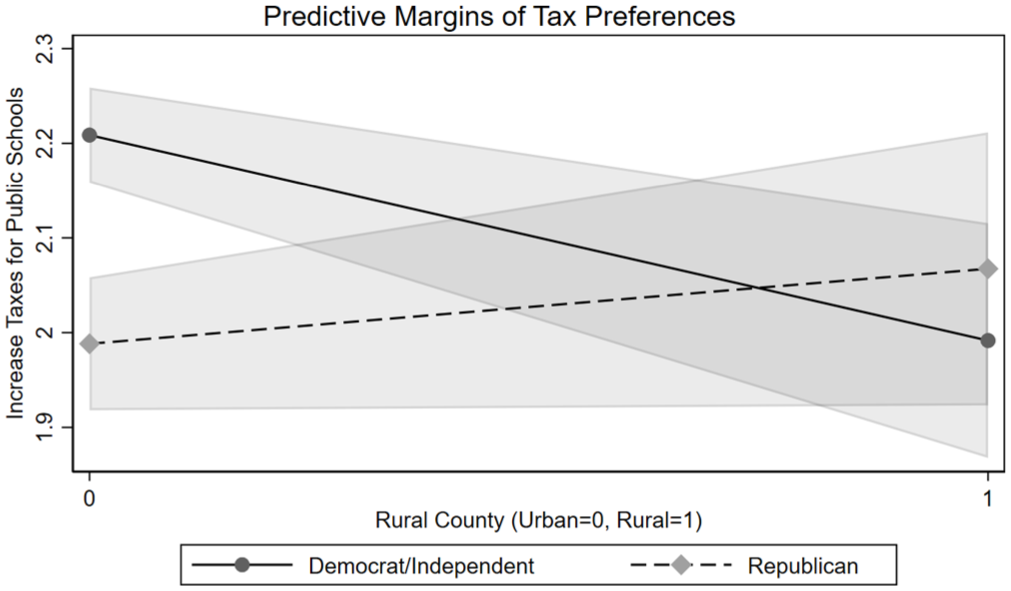
Interaction Effects of Party by Urban–Rural County on Education Tax Preferences (95% Confidence Intervals, Results from Supplemental Table A3, Model 1).
A similar pattern emerges for education spending preferences, as shown in Figure 6. While the interaction effect is less pronounced, the general trend remains. Rural Republicans exhibit more support for education spending than urban Republicans, as indicated by the upward slope. While Democrats generally express higher support for education spending, we find that this support declines slightly from urban to rural contexts. Taken together, this suggests that local conditions play a potential role in reshaping traditional partisan attitudes across the political spectrum.
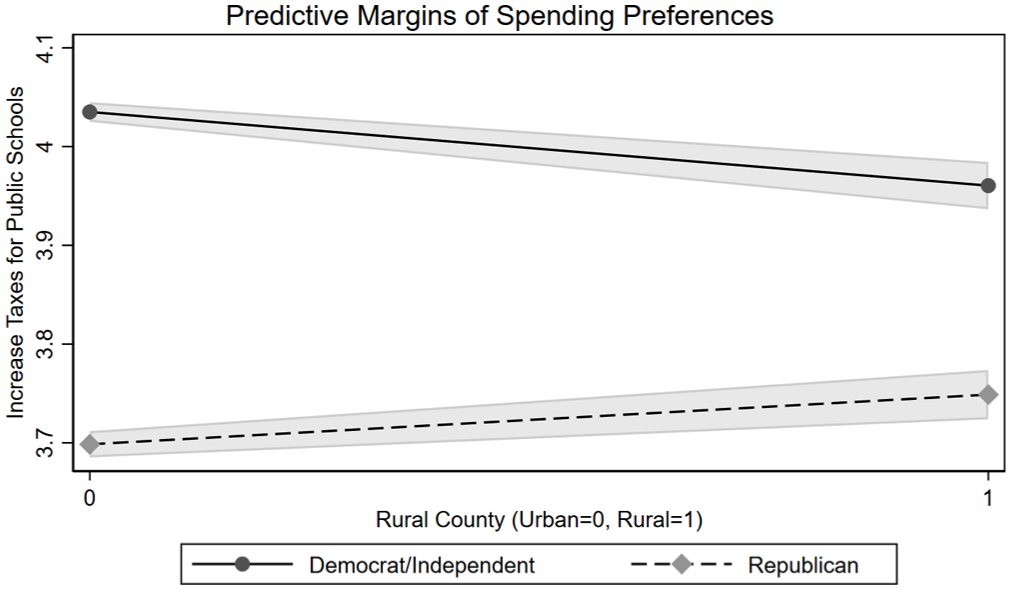
Interaction Effects of Party by Urban–Rural County on Education Spending Preferences (95% Confidence Intervals, Results from Supplemental Table A3, Model 2).
Specifying Spatial Policy Effects
Thus far, results have suggested that rurality may have an effect on how closely parties and voter’s preferences align regarding education. To more fully examine the effects of proposed policies across space, I now account for local levels of school choice as a measure of the spatial policy effect creating contextual pressure for partisan groups across place.
Using school district-level data from the National Center for Education Statistics, I calculate the percentage of school districts with charter schools and average this value within a county. To indicate counties with low school choice, I first construct a binary value to capture counties with charter school shares below the mean among non-metro counties <0.09% and metro counties <0.42. This indicates low school choice options across geography. I also construct a measure that is categorical where 1 = non-metro (rural)/low school choice, 2 = non-metro (rural)/high school choice, 3 = metro (urban)/low school choice, and 4 = metro (urban)/high school choice. Because the measure of school choice is restricted to the county level, I only run these models at the county level.
I first estimate the interaction of being a Republican in rural or urban areas with low school choice (Supplemental Table A6). The results reveal a significant and positive interaction effect. Specifically, rural Republicans in low school choice contexts show higher levels of support for both education taxes and spending. Holding all else equal, Republicans in a rural county with low school choice options are associated with a 0.43-point increase in support of taxes on public schools, compared to Republicans in urban counties with low school choice, plotted in Figure 7. Spending support also increases, as shown in Figure 8. Republicans in a rural county with low school choice are 0.17 points more supportive of spending on public schools. Democrats (and Independents) again show declining support in rural contexts with limited school choice.
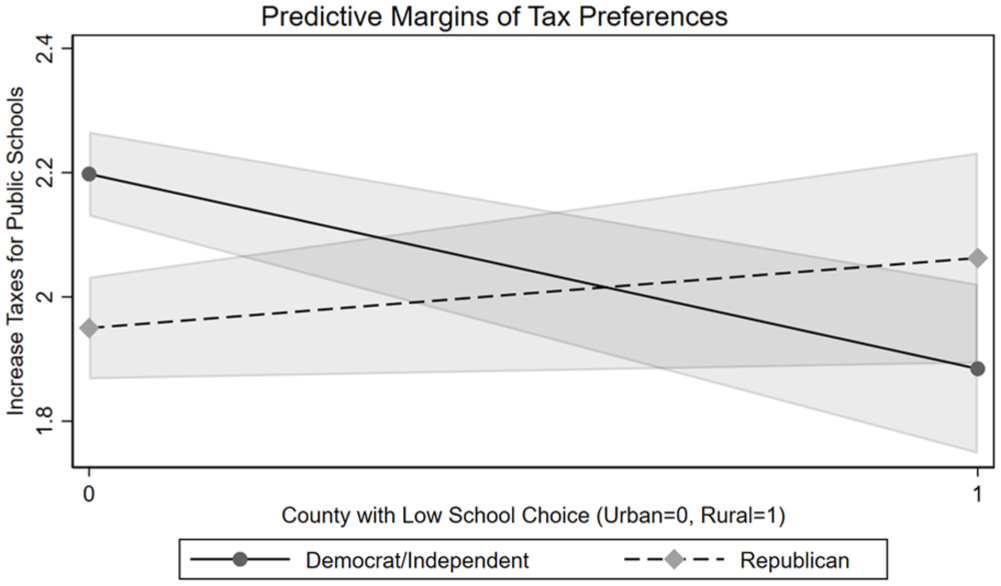
Interaction Effects of Party by Urban–Rural County on Education Tax Preferences (95% Confidence Intervals, Results from A6, Model 2).
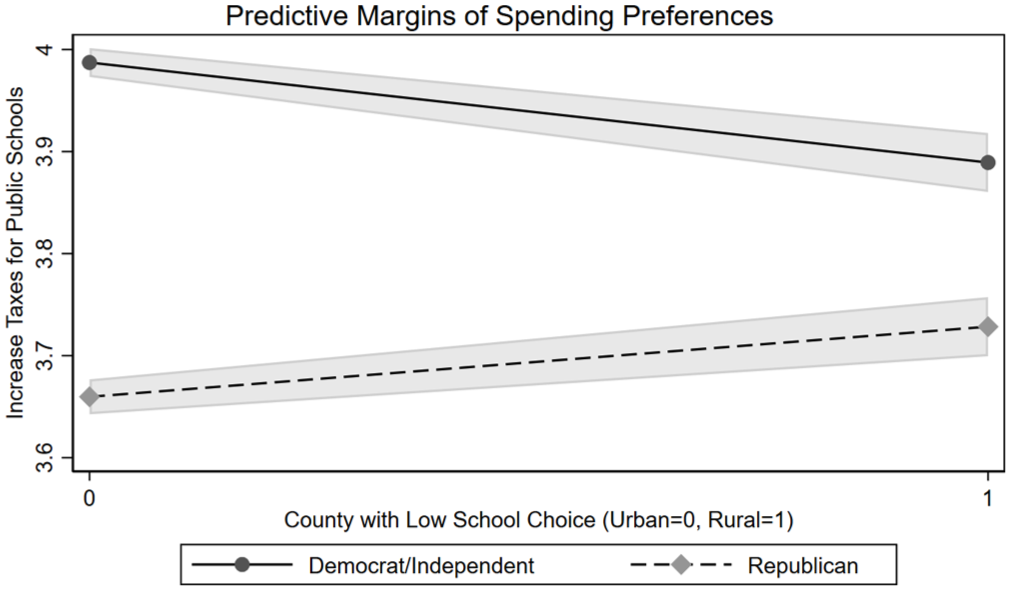
Interaction Effects of Party by Urban–Rural County on Education Spending Preferences (95% Confidence Intervals, Results from A6, Model 4).
Next, I examine a categorical variable that captures low and high school choice options in urban (metro) and rural (non-metro) counties (Supplemental Table A7). In line with the second hypothesis, I expect cross-pressure to be especially pronounced among rural Republicans in places with few school choice options, leading them to show greater support for education funding than urban Republicans and rural Republicans with more school choice options.
Reflecting typical partisan patterns, Republicans are less supportive of taxes and spending for education, relative to other partisan groups. However, this partisan gap narrows significantly (i.e. they are more supportive of education funding) in rural areas with low school choice options. Republicans in rural contexts with low school choice are more supportive of taxes and spending for education relative to Republicans elsewhere. Compared to other urban Republicans with high school choice, this group is associated with a 0.33-point increase in support for taxes on public schools (Figure 9) and a 0.16-point increase in support for spending (Figure 10). The positive interaction indicates that, as hypothesized, rural Republicans in areas with fewer school choice options experience heightened cross-pressure, leading to high levels of support. In contrast, Democrats (and Independents) in rural contexts with low school choice appear the least supportive of education taxes and spending among their partisan group. This may potentially be due to a disillusionment with public institutions or reflect more moderate political views, in line with the dominant conservatism of rural areas. More generally, this also implies that the partisan structure of policy attitudes in rural contexts looks somewhat differently from urban contexts.
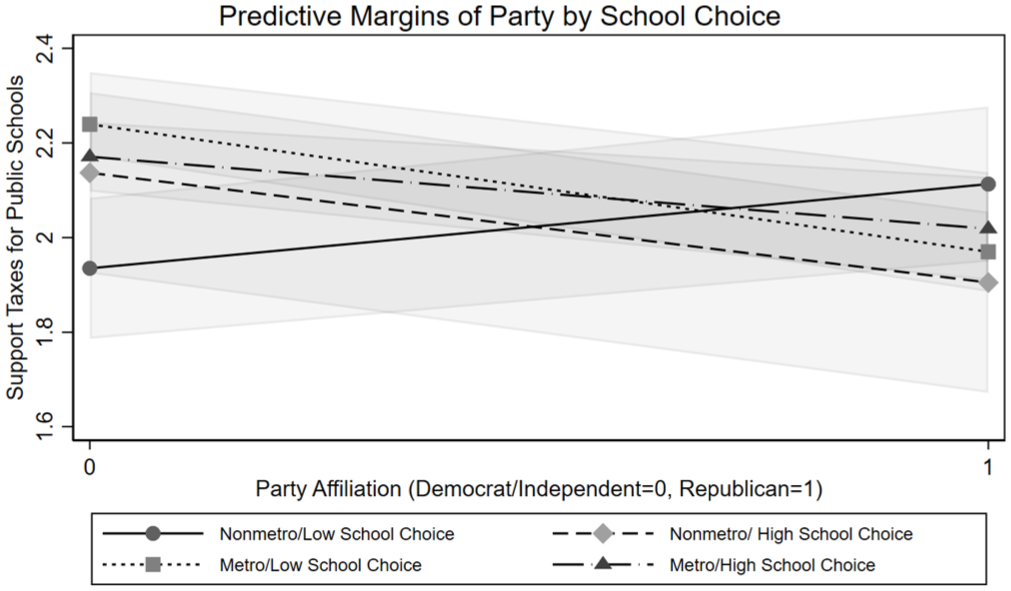
Predictive Margins of Party by Urban–Rural County and School Choice Context on Education Tax Preferences (95% Confidence Intervals, Results from Supplemental Table A7, model 2).
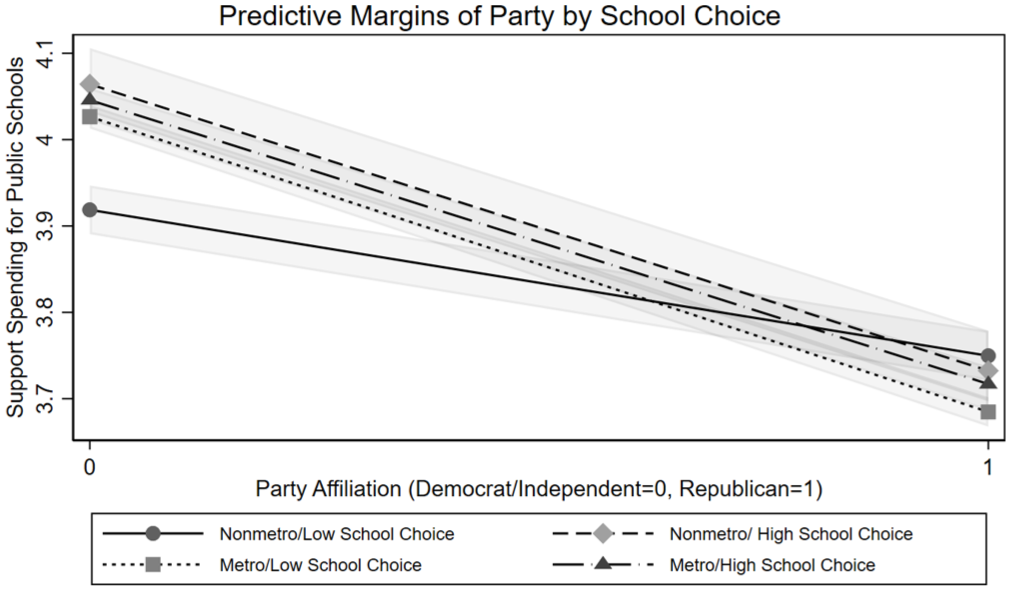
Predictive Margins of Party by Urban–Rural County and School Choice Context on Education Spending Preferences (95% Confidence Intervals, Results from Supplemental Table A7, model 2).
I also estimate these models but focus the interaction on Republicans and Democrats (Supplemental Table A7). Overall, Republicans remain less supportive of taxes and spending on education than Democrats. As in other models, there is a positive and significant interaction term, indicating that Republicans in rural areas with low school choice are more supportive of taxes and spending than Republicans elsewhere. They are estimated to be 0.35 points more supportive of taxes on public schools and 0.13 points more supportive of spending than urban Republicans with high school choice. I also replicate these models excluding ideological controls with results left unchanged (Supplemental Table A8). Without ideology and only contrasting to Democrats, results hold. Republicans in rural areas with low school choice are 0.38 points more supportive of taxes on public schools and 0.14 points more supportive of spending, compared to Republicans in urban contexts.
Robustness and Limitations
As a robustness check, I consider preferences for education at a time of high political salience, namely the election of Donald J. Trump in November 2016. Tax preferences were measured over 2015 and 2016, a period in which partisanship was particularly high in the United States. It also provides an opportunity to test a least-likely case for the argument presented here. That is, at a time of heightened political partisanship, it is plausible that local realities may play less of a role in shaping preferences. Education, in particular, was an important policy agenda item for the Republican party at the national level. To test the robustness of this argument I narrow the focus of analysis on the years around the presidential election during a period of high salience. Figures 11 and 12 present the average marginal effects (full results are in Supplemental Table A9).
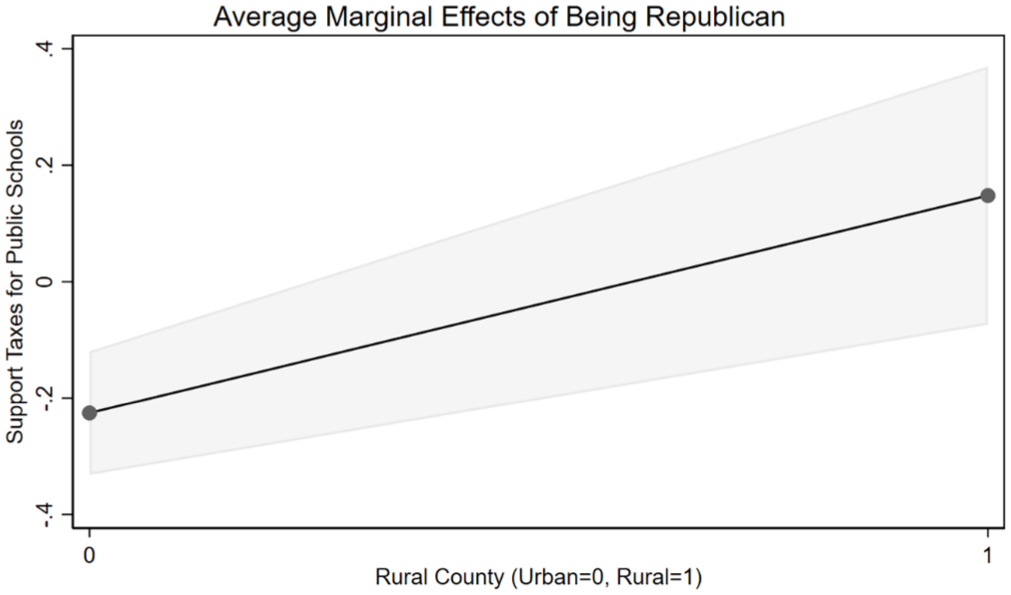
Average Marginal Effects of Republican by Urban–Rural County on Education Tax Preferences over period of 2015–2016 (95% Confidence Intervals, Results from Supplemental Table A9, Model 1).
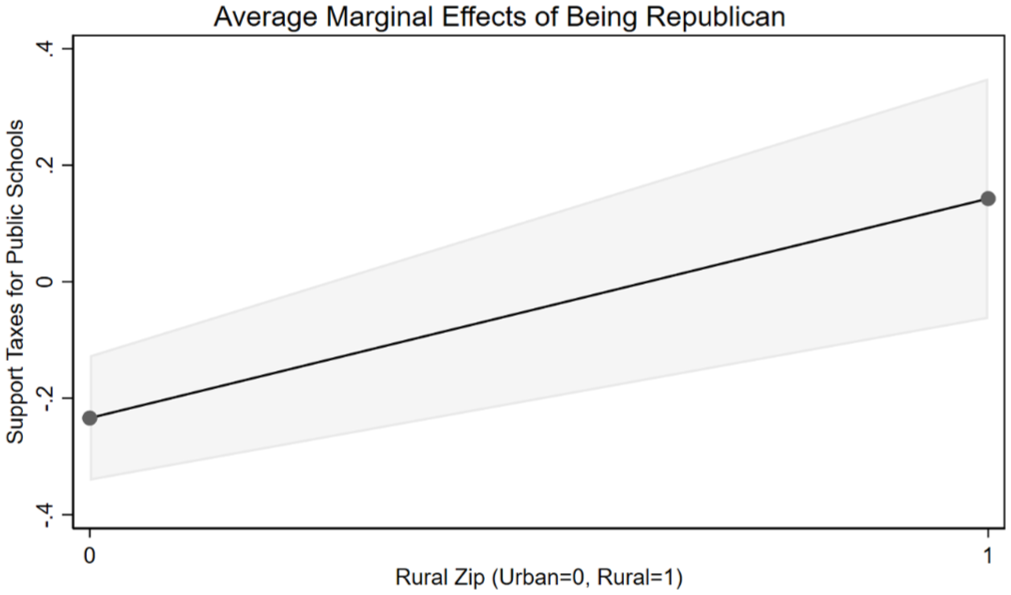
Average Marginal Effects of Republican by Urban–Rural Zip Code on Education Tax Preferences over period of 2015–2016 (95% Confidence Intervals, Results from Supplemental Table A9, Model 2).
In both of these figures, there is a positive effect among Republicans on support for education taxes. Between Republicans in urban and rural contexts during this period of time, there is a positive and significant coefficient indicating increased support for taxes. Republicans in rural areas are 0.37 points more supportive of taxes and 0.38 points more supportive of spending than Republicans in urban areas, offsetting their overall average lower support. These findings suggest that, even at times of high political salience and partisanship, there is an incongruence across geography when bearing in mind place-based considerations for policy preferences. Supplemental Table A10 shows these results excluding ideology.
It could also be that the findings are driven by the specification of the party affiliation variable. The CES survey also includes a 3-point scale for party affiliation for Republican, Democrat, and Independent. I re-run all models using this definition of Republican finding that while the magnitude of effects is slightly reduced, the findings remain mostly unchanged. Results from this alternative specification are shown in Supplemental Table A11.
While the findings presented here offer new insights into the relationship of place and partisanship, there are clear limitations related to sample sizes, particularly in rural areas. Across survey waves, less than 15% of respondents reside in rural contexts. As a result, statistical power to detect differences within rural partisan groups is limited. Future research would benefit from oversampling rural populations to allow for more robust subgroup analyses and improve estimations of the spatial policy effect on voter preferences across diverse rural geographies.
Conclusion
Polarization across parties and geography in the United States has received much attention (e.g. Brown and Mettler, 2025; Mettler and Brown, 2022; Rodden, 2019). Most studies explain electoral outcomes, showing that voters in urban and rural contexts are growing further apart (Brown and Mettler, 2024; Gimpel et al., 2020; Kelly and Lobao, 2019; Lyons and Utych, 2023). This singular focus on electoral outcomes can mask the nuances in people’s political preferences. Research on the urban-rural divide cautions against oversimplifying political behavior based on geographic location (Johnson and Scala, 2020; Pied and Sappleton, 2023; Scala and Johnson, 2017). Focusing on public education, this article shows how spatial policy effects moderate the effect of partisanship on individuals’ attitudes. Despite Republican politicians advocating for policies that seek to shift funding for public education (Finger, 2018; Finger and Reckhow, 2020), when accounting for local policy effects, Republican voters do not neatly align with their party’s stance on education policy. In rural areas, they demonstrate greater support for public education funding through both taxes and spending suggesting that local needs at times may outweigh partisan loyalty.
This divergence between rural Republican voters and their party stems, as argued herein, from the geographically uneven effects of public policies which create contextual pressures for voters. Rural contexts face distinct challenges in education (Biddle and Azano, 2016; Davis et al., 2023; McShane and Smarick, 2018). As a result, public education plays a relatively greater role in these contexts, making policies that seek to restructure traditional public schools more challenging to implement. Given rural education challenges, preferences should reflect local conditions, leading to divergence from national policy platforms, especially as the party advocates for shifting funds away from public education. This means that while rural voters may exhibit strong party loyalty, cracks in ideological cohesion appear once spatial policy effects are taken into account. Simply put, the local effects of proposed policy can lead to a mismatch between voters and parties, creating contextual pressure between place and partisanship. The growing divide that has reshaped education policymaking among parties may also be distancing policy proposals from localized needs.
More broadly, these findings show that while geography is associated with patterns of partisan polarization, this does not necessarily translate into voters simply following party platforms on policy issues. Divergence in policy preferences among rural voters on education, but arguably also other policy areas, suggests that spatial effects of policies can override partisan patterns. It also underscores the influence of local contextual conditions for voters (Baxter-King et al., 2022; Berriochoa and Busemeyer, 2025; Druckman et al., 2021; Kelly and Lobao, 2021; Newman et al., 2018). These findings highlight how policy preferences can diverge from partisan affiliations based on the variegated effects of policy across geography, shedding new light on the landscape of the urban-rural divide (Albrecht, 2022b; Kelly and Lobao, 2019; Lunz Trujillo and Lin, 2025; Mettler and Brown, 2022).
It also speaks to literature about the political consequences of inequalities across space (Patana, 2020, 2022; Scheiring et al., 2025; Ziblatt et al., 2023). These studies show that public service deprivation and geographical marginalization can fuel discontent and increase support for radical and populist parties (Cremaschi et al., 2025; Dickson et al., 2025; Nyholt, 2024; Stroppe, 2023). Local service cuts and perceived threats to essential public goods erode political trust and create spatially rooted tensions (Cremaschi et al., 2025; McCann, 2020). The long-term effect of the mismatch between local policy preferences and national party platforms signals a potential strain on party-voter alignment. When national parties advance agendas that undercut key public services, like education, they risk alienating voters whose lived experiences and material needs depend on these very services.
This disconnect may reduce trust in institutions, create political distance, and weaken ideological cohesion, even when partisan affiliation largely remains intact. It could lead to political disengagement if the party remains unresponsive to local concerns or drive political mobilization among voters who seek political alternatives, like anti-establishment candidates or parties, that better address (or are perceived to prioritize) place-based needs. If this mismatch persists and parties fail to adjust national policy positions to reflect local issues, it could destabilize traditional partisan coalitions across regions and deepen spatial resentment.
The case of rural Republicans and rural Democrats illustrates a tension between partisan identity and place-based policy needs. Local realities often demand voter positions to be at odds with party positions, creating contextual cross-pressure. For instance, while rural Republicans may support public education funding despite their party’s position, rural Democrats appear to be less supportive. Both highlight divergence in national policy platforms and lived policy needs at the local level. Despite these mismatches, many voters maintain strong partisan loyalties. While such divergences have had limited impact on recent electoral outcomes, it raises an important question: What are the limits of national party loyalty when policy consequences fail to align with local policy preferences or serve local interests? Future research on the urban-rural political divide would do well to probe into this question.
Supplemental Material
sj-docx-1-psx-10.1177_00323217251382020 – Supplemental material for Partisanship and Place: Education Preferences Across the Urban–Rural Divide
Supplemental material, sj-docx-1-psx-10.1177_00323217251382020 for Partisanship and Place: Education Preferences Across the Urban–Rural Divide by Kattalina M Berriochoa in Political Studies
Footnotes
Acknowledgements
The author would like to thank Nils Röper and Thomas Kurer for their helpful feedback and suggestions as well as Stephen Ansolabehere for his survey support.
Declaration of Conflicting Interests
The author(s) declared no potential conflicts of interest with respect to the research, authorship, and/or publication of this article.
Funding
The author(s) disclosed receipt of the following financial support for the research, authorship, and/or publication of this article: Funded by the Deutsche Forschungsgemeinschaft (DFG—German Research Foundation) under Germany’s Excellence Strategy—EXC-2035/1–390681379.

Supplemental material
Additional Supplementary Information may be found with the online version of this article.
Table A1. Linear Regression Models of Education Tax and Spending Preferences. Table A2. Linear Regression Models of Education Tax and Spending Preferences. Table A3. Linear Regression Models of Education Tax and Spending Preferences. Table A4. Linear Regression Models of Education Tax and Spending Preferences without Ideology. Table A5. Linear Regression Models of Education Tax and Spending Preferences Compare only to Democrats. Table A6. Linear Regression Models of Education Tax and Spending Preferences in Low School Choice Context (Counties Only). Table A7. Linear Regression Models of Education Tax and Spending Preferences Across Low and High School Choice (SC) Contexts (Counties Only). Table A8. Linear Regression Models of Education Tax and Spending Preferences Across Low and High School Choice Contexts without controlling for ideology. Table A9. Linear Regression Models of Education Tax Preferences over 2016 Presidential Election. Table A10. Linear Regression Models of Education Tax Preferences over 2016 Presidential Election without Ideology. Table A11. Linear Regression Models of Education Tax and Spending Preferences with Alternative Republican Variable.
Notes
Author Biography
References
Supplementary Material
Please find the following supplemental material available below.
For Open Access articles published under a Creative Commons License, all supplemental material carries the same license as the article it is associated with.
For non-Open Access articles published, all supplemental material carries a non-exclusive license, and permission requests for re-use of supplemental material or any part of supplemental material shall be sent directly to the copyright owner as specified in the copyright notice associated with the article.
