




Abstract
Though radical right parties are easily identified by their strong nationalism and anti-immigrant sentiment, significant confusion surrounds their positions on core economic issues, such as taxation and redistribution. This uncertainty may reflect an electoral strategy in which these parties intentionally blur their positions to avoid taking stances on economic issues that divide their target constituencies. Existing research on position blurring and the radical right focuses exclusively on expert surveys and party manifesto statements, providing little information about voter-level perceptions of these parties. This study directly investigates public perception of the positions of the Danish People’s Party, one of the most successful radical right parties in Europe. The study finds strong evidence that the DPP draws on a voter base with below average political awareness, allowing it to more easily recruit voters on opposing sides of economic issues by obscuring its own positions.
Introduction
The rise of radical right-wing parties and sentiment across Western societies is one of the most widely studied phenomena in contemporary comparative politics. Despite widespread scholarly interest in these parties and movements, there exists substantial disagreement on the ideological features that define them. Though these parties are easily placed on the far right due to their strong nationalism, support for authoritarian leaders, and anti-immigrant views, confusion surrounds their positions on the core economic issues that have historically defined the left-right spectrum. Importantly, this uncertainty is not limited to the party-family as a whole, but extends to the positions of individual parties themselves, where expert survey data reveals significant disagreement concerning their positions on social spending, redistribution, taxation, and other economic issues (Rovny 2013).
The absence of scholarly consensus surrounding these parties’ economic positions may stem from their tendency to adopt platforms such as welfare chauvinism that defy easy categorization in the traditional left-right dimension (Otjes et al., 2018). Yet, this disagreement may also reflect a strategic electoral tactic in which these parties intentionally blur their economic positions to avoid taking stances that might divide their core constituencies. The success of radical right parties depends upon their ability to exploit wedge issues such as immigration and anti-Europeanization that divide the constituencies of mainstream parties. Ironically, this strategy has left these parties vulnerable on traditional economic issues by forcing them to balance their position on the political right with a political constituency of largely working-class voters. From this perspective, by intentionally obfuscating their positions, radical right parties are able to rally a cross-class coalition centered on their core issues while avoiding clear stances on economic issues that divide their target constituencies.
Much of the existing research on radical right position taking focuses on expert surveys and manifesto statements in an effort to pin down the true position of these parties. Such research largely assumes that voter-level perceptions of the party positions will match those identified in official party statements or by expert analysts. Yet, as an electoral strategy, position blurring depends upon the ability of parties to obscure their stances from a public whose attention to politics is on the whole low and highly variable. In an environment in which large portions of the public cannot identify the positions of even mainstream parties with long standing records on economic issues, position blurring strategies may prove highly effective even in cases where expert surveys or manifesto statements may allow easy identification of the party’s position.
Recognizing the general limits of political interest and knowledge among voters is of particular importance for understanding the use of position blurring strategies by far-right parties. These parties increasingly target voters with lower incomes and education who are frequently dissatisfied with and turned off by mainstream politics. Such groups traditionally exhibit more limited political awareness, making them potentially more susceptible to the efforts of these parties to render their positions on economic issues ambiguous. A full understanding of position blurring as an electoral strategy requires moving beyond efforts to pin down these parties’ “true” positions based on manifesto statements, to a more direct analysis of how a citizenry with more limited and highly variable political knowledge perceive these parties and the positions they take.
This study extends our understanding of position blurring among radical right parties by using survey data to investigate popular perceptions of the Danish People’s Party, one of the most successful radical right parties in Europe. Public opinion surveys allow a direct investigation of the extent to which ordinary citizens struggle to identify the positions of radical right parties on economic issues. Additionally, the data allows for the exploration of how radical right voters may be uniquely susceptible to these strategies. The next section outlines existing debates surrounding position taking among radical right parties. After a discussion of the data and methods, the following sections explore voter perceptions of the DPP and how these perceptions may influence the electoral success of the party. The final section concludes with a discussion of the implications of these findings for our understanding of the electoral strategies deployed by radical right parties.
Strategic ambiguity and the radical right
Extensive research has examined the ideological features that define a distinctive radical-right party family (Kitschelt and McGann, 1997; Mudde, 1996; Mudde and Kaltwasser, 2017; McGann and Kitschelt, 2005). Broadly speaking, radical right-wing parties adopt an exclusionary ethno-nationalist perspective that sees globalization, Europeanization, and particularly immigration as a threat to national sovereignty and culture (Eger and Valdez, 2015; Jungar and Jupskås, 2014; Mudde and Kaltwasser, 2017). Though many of these parties have historical roots in pre-War fascist movements, in recent decades, most have sought to escape their extremist image by downplaying overtly racist rhetoric in favor of populist appeals attacking an ill-defined elite. Populism allows the parties to make a claim to be anti-establishment while simultaneously appearing more mainstream (Akkerman et al. 2016a).
Though there is widespread agreement on radical right parties’ positions on immigration and globalization, significant disagreement surrounds their positions on core economic issues, such as business regulation, social spending, taxation, and income redistribution (Rovny, 2013; Rovny and Polk, 2020). Early on, radical right parties adopted what Kitschelt and McGann (1997) described as a “winning-formula,” combining ethnocentric and anti-immigrant appeals with support for free market economic policies. This neo-liberal economic agenda fit with the broader rejection of the bureaucratic state, political elites, and labor unions embedded in the populist attack on mainstream political parties of the right and left. Over time, this winning formula proved increasingly problematic, as radical-right wing parties sought to expand beyond their niche party status to compete for a larger share of working-class voters (McGann and Kitschelt, 2005). The growing success of radical right parties depends upon their ability to hold together a cross-class coalition with divergent economic interests (Ivarsflaten, 2005; Oesch and Rennwald, 2018). Moreover, the effort to move beyond niche party status to become potential parties of government, creates a tension between the preferences of their growing base of working-class voters for a more generous and redistributive welfare state and the preferences of the conservative parties who represent their most likely coalition partners (Afonso, 2015; Careja et al., 2016; Ivarsflaten, 2005).
Responding to these conflicts within their constituencies, radical right parties have largely shifted away from the overt neo-liberalism that defined the winning formula of the 1980s (de Lange, 2007). As part of these efforts to shift toward the center, radical right parties increasingly rely upon appeals to welfare chauvinism, whereby parties support restrictions to welfare benefits for immigrants in order to protect “native” groups (Afonso and Rennwald, 2018; Careja et al., 2016; Lefkofridi and Michel, 2014). While such a strategy is meant to bring support for the status quo welfare state in line with opposition to immigrants, in practice, welfare chauvinism generally requires support for the welfare retrenchment policies desired by more traditional center-right parties who reject overt chauvinist policies (Careja et al., 2016). As such, welfare chauvinism provides limited relief to the inherent tension between seeking working-class votes while supporting center-right governments dedicated to social spending cuts.
Despite a general consensus that radical right-wing parties have abandoned overt calls for neo-liberal reforms in a move toward the center, considerable disagreement remains surrounding their current economic positions (Otjes et al., 2018; Rovny, 2013). Eger and Valdez (2015) find a reduced emphasis on economic liberalism in radical right party manifestos, yet still place the parties economic positions largely in line with mainstream parties on the right. Alternatively, Lefkofridi and Michel (2014) argue that radical right parties adopt positions largely in line with social democratic parties. Examining expert survey data, Rovny and Polk (2020) find an overall consensus that these parties have shifted toward the economic center; however, they also uncover substantial uncertainty concerning the position of the party family as a whole as well as for the stances of individual parties.
Some of the uncertainty surrounding the positions of radical right parties’ economic positions stem from the heterogeneity of the parties across countries as well as their changing profiles over time; however, this confusion may also reflect an intentional effort of these parties to obscure their stances on these issues. Downs (1957) early suggested that in a real-world of multi-dimensional issue spaces, parties would face strong incentives to reduce the number of salient policy issues to simplify politics for the electorate. In doing so, parties should seek to focus attention onto those issues that unite their base, while trying to avoid taking clear positions on wedge issues that divide their target voters (De Vries and Hobolt, 2020; Han, 2018; Stimson, 2015). Downs (1957) argued that intentional position blurring would be attenuated in multi-party systems as smaller parties would be forced to compete over smaller, more unified constituencies; however, evidence suggests that even in multi-party systems, parties may seek to expand their appeal by adopting “beclouding” strategies designed to avoid taking controversial stances that may alienate voters (Somer-Topcu, 2015). From this perspective, obfuscation and ambiguity are an essential electoral strategy for all parties seeking to expand their base while not sewing divisions amongst their supporters.
In a political environment in which strategic ambiguity plays a central role for all parties seeking to expand beyond niche party status, the confusion among scholars surrounding radical right parties’ economic positions may be a product of intentional efforts of these parties to avoid easy categorization. Rovny (2013) argues that strategic ambiguity is an essential component of the radical right electoral strategy. For all challenger parties, electoral success hinges on their ability to interject new issues onto the political agenda to disrupt the bipolar political competition between mainstream parties (Carmines and Stimson, 1989; De Vries and Hobolt, 2020; Stimson, 2015). For radical right parties, the emphasis on cultural issues drives a wedge between voters and party elites, who may be out of step with larger sections of their party supporters on these issues (Oesch and Rennwald, 2018). By increasing the salience of these issues, radical right parties are able to appeal to voters from across the political spectrum; however, this strategy can only be effective if the party is able to lower the salience of the traditional economic conflicts that have traditionally divided the electorate. Position blurring allows the parties to build a new coalition of voters around issues of cultural conflict while avoiding stances on economic issues that divide that coalition. Importantly, mainstream parties with long histories, deep ideological roots, and long track records in office, do not have the same access to such strategies (Rovny, 2013). As radical right parties place new issues onto the political agenda, these parties are forced to take clearer stances on new issues without the option to become ambiguous about traditional issues such as redistribution and the welfare state. Ambiguity of radical right party positions on economic issues thus represents an intentional and essential component of their electoral strategy designed to limit voter awareness and attention to issues that might damage the parties’ electoral prospects.
Otjes et al. (2018) argue that over time opportunities to participate in government or as parties of support for center-right governments may have reduced opportunities for strategic ambiguity by requiring the parties to take open votes on economic issues. Moreover, the European Debt Crisis and Great Recession raised the salience of economic issues potentially forcing these parties to take more clear positions (Afonso and Rennwald, 2018; Ivaldi, 2015). Yet, Lefkofridi and Michel (2014) find that, even after the economic crisis, radical right parties generally afford economic issues lower levels of attention than other parties. Moreover, Akkerman et al. (Akkerman et al., 2016) find no consistent evidence that radical right parties are mainstreaming by increasing the salience of economic issues in their voter appeals. This suggests that, even in the face of growing pressures to take more clearly defined positions, radical right parties continue to try to obscure their stances on economic issues.
Existing research on position blurring relies extensively on expert surveys and manifesto statements with data at the individual-voter level much more limited. Somer-Topcu (2015) demonstrate that widespread disagreement exists on the left-right positioning of single-issue parties compared to those of more mainstream parties, yet such evidence of overall left-right positioning does not provide evidence of position blurring around particular issues as suggested by the theory. Rovny and Polk (2020) show wide disparities in the economic positions of radical right-wing voters (See also Ivarsflaten, 2005) and that economic positioning has limited impact on the probability of voting for these parties. Such, evidence is consistent with a position blurring strategy in which voters unknowingly vote for a party with economic positions that diverge from their own. At the same time, such data are also consistent with a model in which voters ignore their economic preferences and knowingly vote for a party with conflicting economic positions due to the greater salience or importance they place on cultural issues. As such, there remains extremely limited evidence of how voters perceive the positions taken by these parties on specific economic issues, the central claim upon which the position blurring hypothesis rests.
Lacking specific data on voter-level perceptions of issues positions much of the literature has emphasized manifesto statements and expert surveys that downplay the more limited information environment faced by most citizens. On a theoretical level, the strategy of position blurring works by limiting and distorting the information available to voters about the positions of the party on specific issues; however, the attempt to identify the party’s “true” position from manifesto statements or expert surveys tends to assume a rather easy translation of the party’s official statements or positions to voter knowledge of those positions. Such an assumption runs counter to decades of public opinion research demonstrating that large sections of the public are inattentive to politics and struggle to identify the positions of even mainstream political parties (Achen and Bartels, 2017; Converse, 1964; Delli Carpini and Keeter, 1996; Zaller, 1992). Empirical investigation also reveals that citizens are largely unresponsive to shifts in party manifestos (Adams et al. 2011, 2014), providing more reason to suspect that most voters do not closely follow the formal party statements that may influence expert and elite opinions of party positioning.
Recognizing that political awareness in the general public is low and unevenly distributed is of significant importance to the investigation of position blurring. In a public only partially interested and informed, parties may find it significantly easier to obscure their positions from voters than from experts. As importantly, because political awareness is not evenly distributed across the public, radical right parties may find it particularly easy to engage in a position blurring strategy. This is so for two reasons. First, even if right-wing parties take clear positions on economic issues in their manifesto statements, media and voter attention may substantially reduce the salience of those issues compared to the socio-cultural issues that have historically defined these parties. As such, formal manifesto positions may play a more limited part in voter education about these parties and their stances compared to mainstream parties. Second, radical right voters may be particularly vulnerable to obfuscation strategies. Radical right parties draw extensively on voters with lower incomes and education (Elchardus and Spruyt, 2016; Rooduijn, 2016). Moreover, their populist appeals target those who with low political interest and trust of mainstream media and parties. As such, radical right voters exhibit characteristics generally associated with below average political knowledge and awareness (Bartels, 2008; Delli Carpini and Keeter, 1996) Given that low knowledge and interest voters struggle to identify the positions of even mainstream parties(Achen and Bartels, 2017; Bartels, 2008; Delli Carpini and Keeter, 1996), they may be particularly vulnerable to efforts by radical right parties to obscure their economic positions.
This discussion suggests four testable propositions. First, if radical right parties engage in position blurring, citizens should express significantly less certainty about their economic positions compared to other parties. Second, radical right-wing parties draw disproportionately from constituencies with lower political knowledge and interest. Third, those with lower knowledge are more susceptible to blurring strategies and so will be less likely to perceive a mismatch between their positions and that of the party. Finally, this has important electoral consequences, as avoiding the perception of mismatched positions on economic issues increases the probability that voters will support the party. Stated more formally:
Citizen’s perception of the economic positions of radical right-wing parties vary much more widely than that of mainstream parties.
Radical right-wing voters are significantly less politically knowledgeable and interested than the voters of mainstream parties.
Voters with low political knowledge and interest are significantly less likely to perceive a mismatch between their preferred positions on economic issues and that of radical right-wing parties.
The perception of a mismatch between one’s own position on economic issues and that of the radical right party significantly reduces the probability of voting for that party. The following section outlines the data and methods used to test these propositions before moving onto an analysis of the data.
Data and methods
This study examines data from the 2015 Danish Election Study to compare voter perceptions of the Danish People’s Party (DPP) to the two mainstream parties on the right, Venstre, and left, the Social Democratic Party (SDP). 1 As one of the most successful radical right-wing parties in Europe, the DPP represents a valuable case study of the use of strategic ambiguity and position blurring as an electoral strategy. The DPP’s historical origins lie in the Danish Progress Party, a populist protest party focused on the abolition of the income tax and welfare state (Andersen, 2003; Christiansen, 2016). In 2001, with support for the Progress Party collapsing, the DPP formed as a splinter group abandoning the neoliberal assault on the welfare state in favor of an emphasis on nationalism, anti-immigration, and Euroskepticism (Andersen, 2003). Over time, the party’s economic positions became more centrist and more ambiguous with references to tax cuts largely replaced with vague claims about the value of work and general support for maintaining unemployment insurance (Christiansen, 2016). Though its manifesto position has shifted to the center, as a support party for Venstre led governments, the DPP has consistently voted in favor of conservative budgets largely trading away its economic policy agenda in exchange for minor and often symbolic moves on immigration and socio-cultural issues (Christiansen, 2016; Christiansen et al., 2019). The DPP was one of the earliest adopters of welfare chauvinism (Jungar and Jupskås, 2014); however, in practice this has placed them in the position of claiming to defend the welfare state while voting for significant welfare retrenchment policies favored by mainstream conservative parties (Careja et al., 2016).
Given the party’s history and success, the DPP provides an excellent opportunity to examine the role of position blurring as an electoral strategy for radical right-wing parties. The 2015 Danish Election Study contains a battery of questions asking respondents to identify their own positions and that of each of the political parties on five policy issues. Restrictions on refugees represents one of the core issues for the DPP as well as a potential wedge issue for mainstream parties. Inequality reduction and public sector spending represent the core issues that defined the conflicts between Social Democratic and Venstre led governments in the post-War period and which pose a significant challenge for the radical right parties. As such, we would expect to see signs of position blurring for mainstream parties on the issue of refugees, while inequality and public sector spending represent issues where the DPP should be engaged in position blurring. The final two issues, crime and environmentalism represent non-core issues for all three parties. Comparing respondents’ answers to these questions allows for an investigation of the extent of uncertainty in voter perceptions of the DPP in comparison to its more mainstream competitors.
The survey additionally contains information concerning political interest, knowledge, and all traditional demographic control variables. Political knowledge is measured through a four-point knowledge quiz. Respondents were asked to identify the number of seats in Parliament, the parties of prominent politicians Trine Bramsen and Karsten Lauritzen, and which parties formed the current governing coalition. Respondents were given one point for each correct answer and scored no points for incorrect or don’t know responses. 2 Political interest is measured on the basis of a 4-point self-assessment ranging from “not at all interested” to “very interested."
This survey data allows unique insights into the nature of position blurring and strategic obfuscation in the success of radical right-wing parties. The next sections compare the DPP to the Social Democrats and Venstre in order to explore the three questions raised by the strategic ambiguity literature.
Position blurring among Danish parties
Position uncertainty across party and issue area.
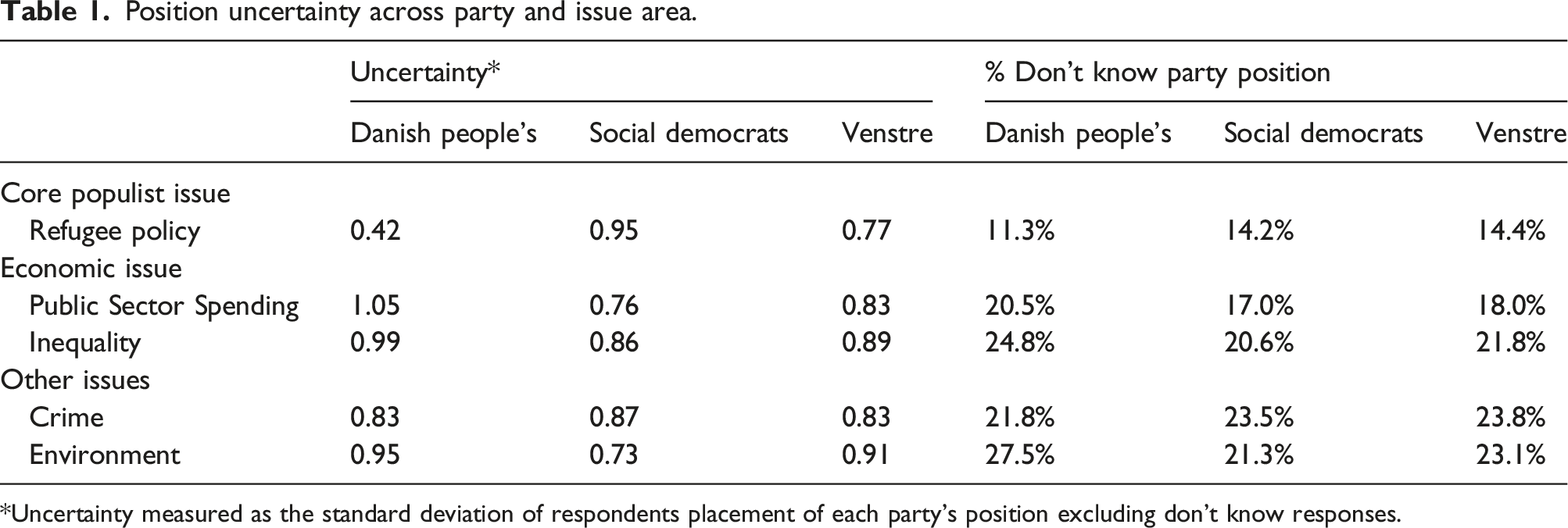
*Uncertainty measured as the standard deviation of respondents placement of each party's position excluding don't know responses.
Figure 1 explores the substantive relevance of these differences by presenting the percentage of respondents who placed each party on the left, right, and center of each issue. For refugee policy, there is overwhelming agreement on the DPPs right-wing position, while substantial disagreement exists for the Social Democrats, suggesting this may be an issue where the center-left engages in a blurring strategy. Turning to economic issues, the data reveal significantly greater disagreement among respondents on the DPP position. A majority (55.4%) believe that the DPP prefers to raise public sector spending, yet a full 23.1% assert that they prefer to cut spending. The differences are even more stark for the issue of inequality. Though the mainstream parties are clearly skewed left and right, respondent perceptions of the DPP are widely distributed over the center with 26.2% placing them on the left and 30.6% placing them on the right on this issue. Respondent Placements of Parties Across Policy Issue.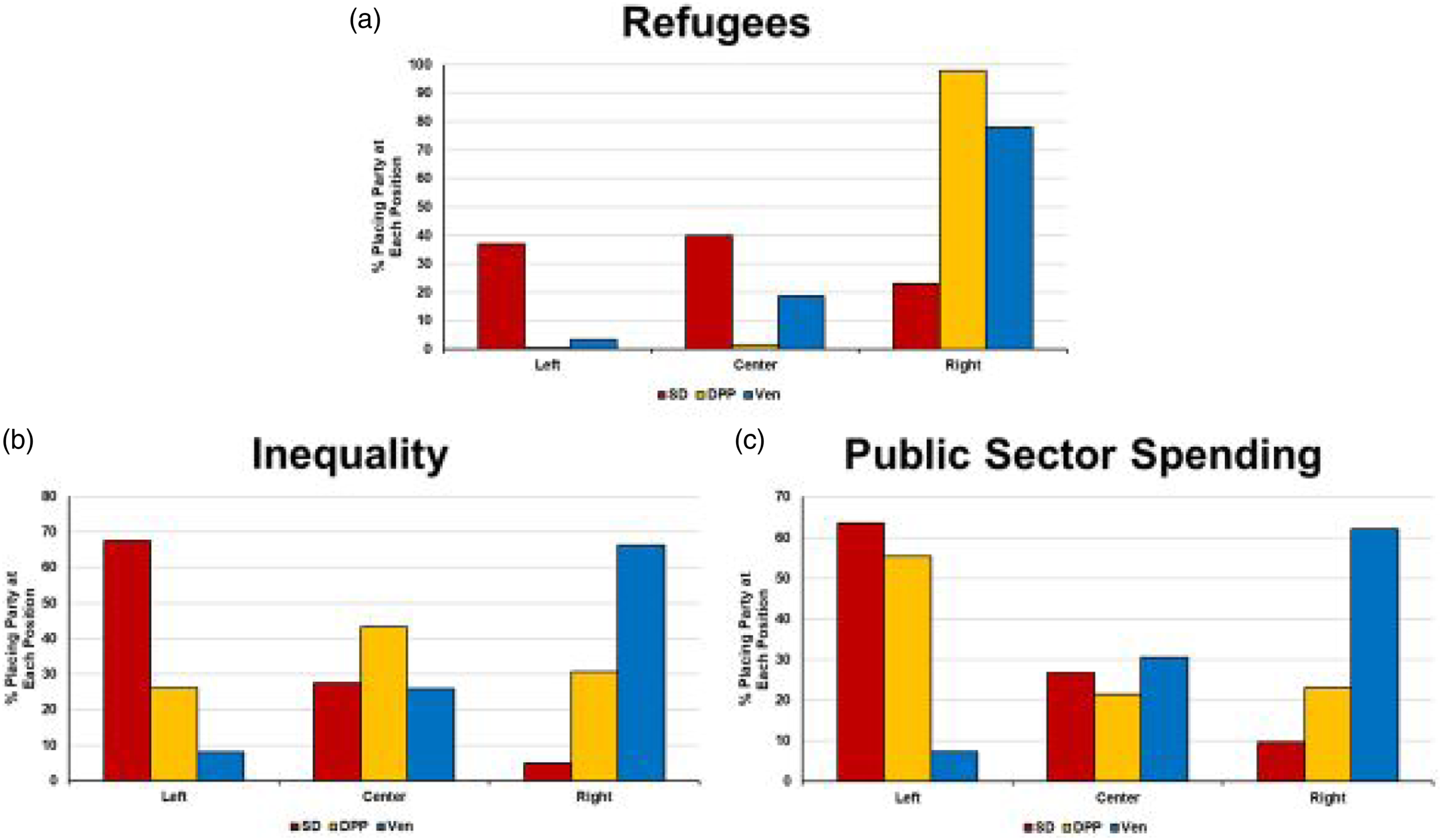
Taken together, the data provide strong evidence of position blurring on the part of the DPP. Public opinion data follows closely patterns found in expert surveys and scholarly estimates of radical right positioning. Though substantial agreement exists surrounding the DPP position on a core issue such as refugee policy, significantly less agreement exists concerning their stance on economic issues like inequality and public sector spending that have traditionally defined political competition between mainstream parties.
The (knowledge) base of the Danish parties
Hypotheses 2 and 3 together predict that radical right parties are more likely to draw on constituencies with limited political knowledge and interest for whom position blurring may be particularly effective. The survey data demonstrate that DPP voters are indeed less politically aware than the voters of the two mainstream parties. In terms of education, 19.1% of DPP voters had completed less than a secondary education compared to 15.1% for SDP and 10.3% for Venstre. There also exists a substantial gap in higher education with only 15.7% of DPP voters having a college degree compared to 34.5% for the SDP and 32.9% for Venstre. DPP voters also exhibited significantly lower levels of political interest with 37.6% expressing slight or no interest in politics compared to 28.5% among Social Democrats and 26.5% for Venstre voters.
These low levels of education and interest contribute to a base of DPP supporters who are on the whole substantially less politically knowledgeable than that of other mainstream parties. On the four-question knowledge test, DPP voters scored an average of 1.40 questions correct compared to 1.95 for the Social Democrats (t = 5.95) and 1.89 for Venstre voters (t = 4.81). These reflect substantively meaningful differences with 58.2% of Danish People Party voters answering fewer than two answers correctly compared to 40.9% among Social Democrats and 41.8% among Venstre supporters. At the highest end of the scale, only 9.9% of DPP voters received a perfect score compared to 20.2% for Social Democrats and 18.7% for Venstre.
Political knowledge and the danish people’s party vote.
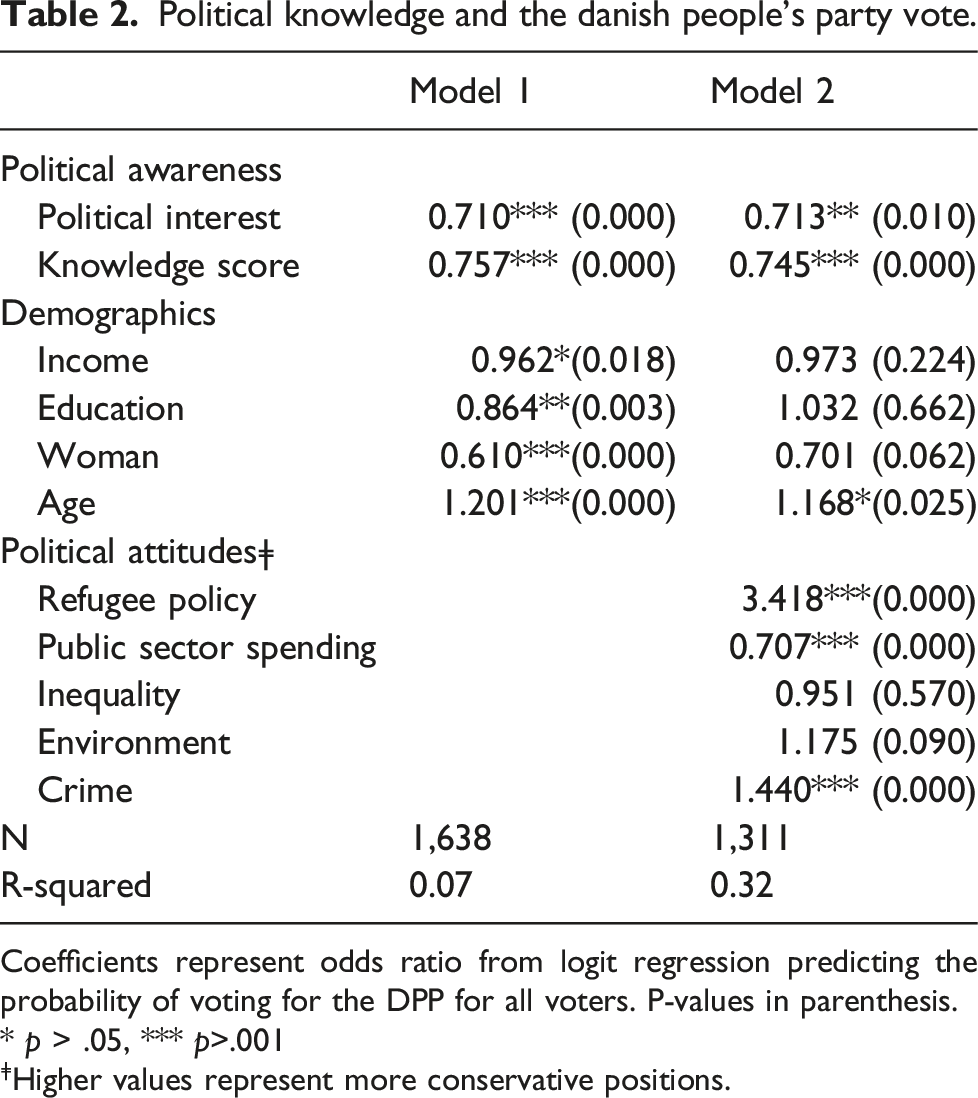
Coefficients represent odds ratio from logit regression predicting the probability of voting for the DPP for all voters. P-values in parenthesis.
* p > .05, *** p>.001
ǂHigher values represent more conservative positions.
These models do not necessarily demonstrate that low knowledge causes support for the DPP; however, they do make clear that the party draws heavily upon a constituency of low interest and knowledge voters. Existing research demonstrates that such voters frequently struggle to identify the positions of even mainstream political parties and are certainly less likely to pay close attention to party manifesto statements. Obfuscation strategies may be particularly effective against such voters, who are less attentive to all political messaging.
Political knowledge and position uncertainty.
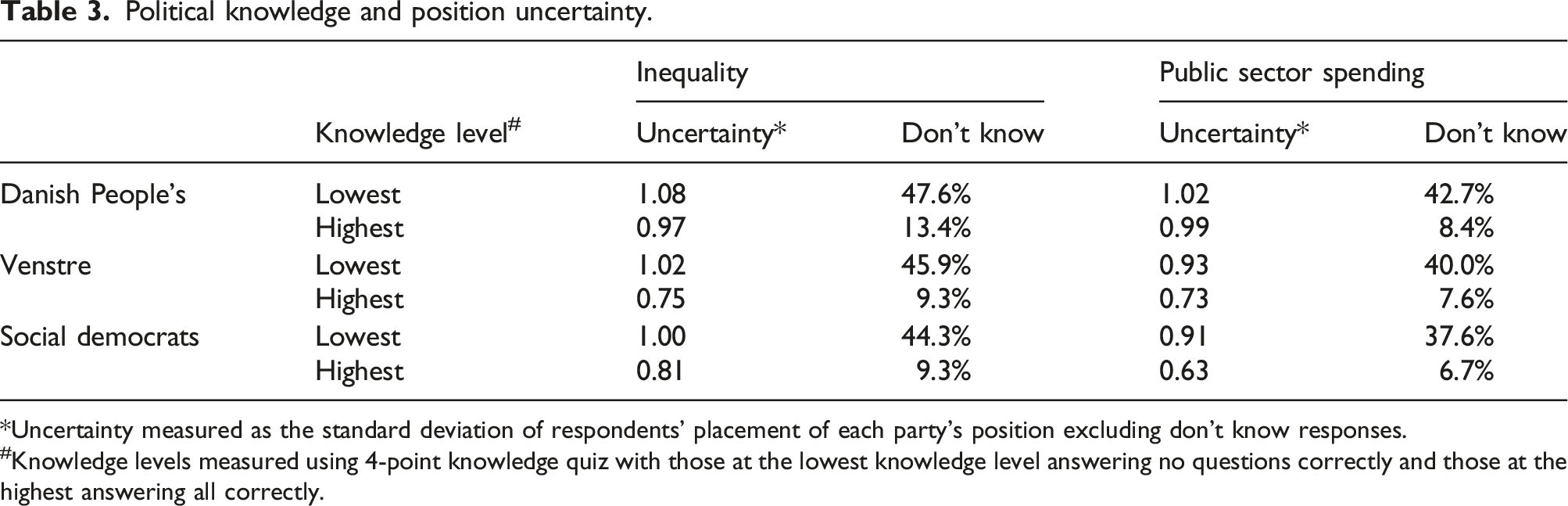
*Uncertainty measured as the standard deviation of respondents’ placement of each party’s position excluding don’t know responses.
#Knowledge levels measured using 4-point knowledge quiz with those at the lowest knowledge level answering no questions correctly and those at the highest answering all correctly.
How do we interpret these results? First, the evidence provides the strongest evidence yet that the DPP engages in position blurring strategies on these issues. The data demonstrate that significant uncertainty exists for even the most knowledgeable voters, which is consistent with a party intentionally masking its positions on these issues. Second, though increasing knowledge has a more limited effect for the DPP than for other parties, the combined effect of the dramatic reduction in don’t know responses and the more modest reduction in uncertainty among those who do guess may have substantial practical consequences for the likelihood that low and high knowledge voters of both the right and left perceive a mismatch between their preferred position and that of the DPP. For example, in the case of public sector spending, fully 60% of the most knowledgeable respondents placed the DPP on the left compared to only 24% for those at the lowest knowledge level. This means that for those on the right, preferring spending cuts, highly knowledgeable voters are much more likely to perceive a mismatch betweeen their perefences and the DPP than are low knowledge voters.
To further test this proposition, we can examine the extent to which voters perceive a mismatch between their economic positions and those of the DPP contingent upon their level of political awareness. A mismatch exists when a respondent takes a position on the left, center, or right of an issue and perceives that the DPP takes a different position on that issue. 3 In conducting this test, it is necessary to consider that the knowledge effects suggested in hypothesis 3 are only visible when a respondent guess a position that is “incorrect” from the perspective of the most knowledgeable respondents. For example, if a low knowledge respondent on the left of the social spending question simply assumes the DPP shares that position with no real information, they have still made a guess which is indistinguishable from that of a high knowledge respondent who places the DPP in that position because they have carefully followed the DPP’s manifesto statements. Thus, knowledge effects are only empirically distinguishable when low knowledge voters assume the party is close to them and their own position is different from where the most knowledgeable voters place the party (e.g. on the center or right for public social spending). Thought of differently, position blurring as a strategy is designed to attract lower knowledge voters whose own positions differ from that of the party. Thus, only when a disconnect exists between the position of the party and the respondent, do we expect to see low and high knowledge voters perceive the party differently. As a result, the analysis divides the sample between respondents on the left, center, and right of each issue, expecting to see knowledge effects only for those whose own positions differ from that of where the most knowledgeable place the DPP (i.e. the center on inequality and the left on public sector spending).
Political knowledge and the perception of a mismatch with DPP positions.
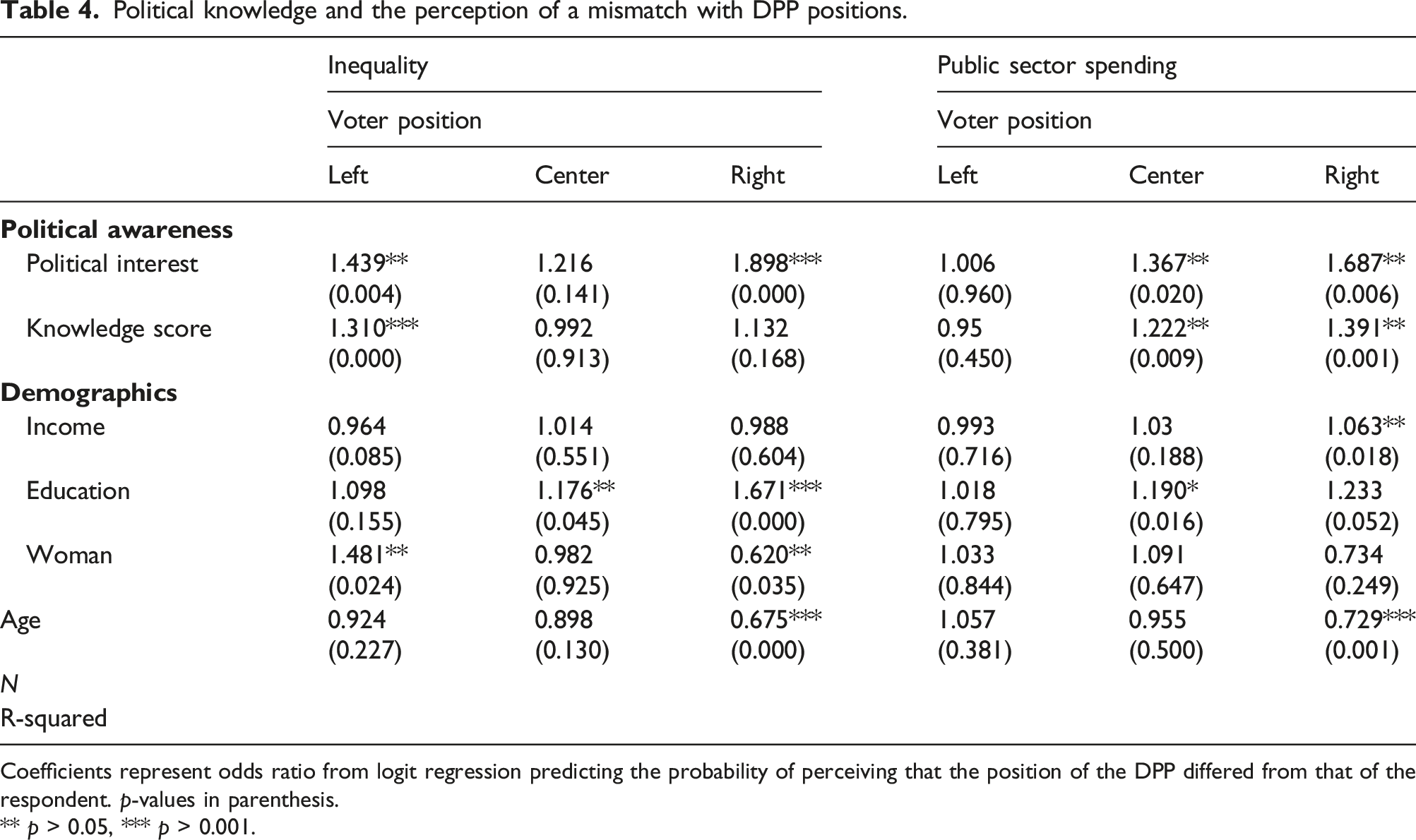
Coefficients represent odds ratio from logit regression predicting the probability of perceiving that the position of the DPP differed from that of the respondent. p-values in parenthesis.
** p > 0.05, *** p > 0.001.
The electoral consequences of position blurring
The results so far demonstrate that (1) the positions of the DPP on economic issues are highly uncertain among potential voters, (2) the DPP’s voter base is significantly less politically interested and knowledgeable than the voters of other parties, and (3) that low knowledge voters are significantly less likely to perceive a mismatch between their positions and those of the party. Taken together, these findings suggest that the DPP does indeed adopt vague positions on economic issues and that their base of voters may be particularly susceptible to this strategy of strategic ambiguity. Is there evidence that position blurring has significant electoral implications for the party, as suggested in hypothesis 4?
The electoral effect of perceived mismatch on economic issues.
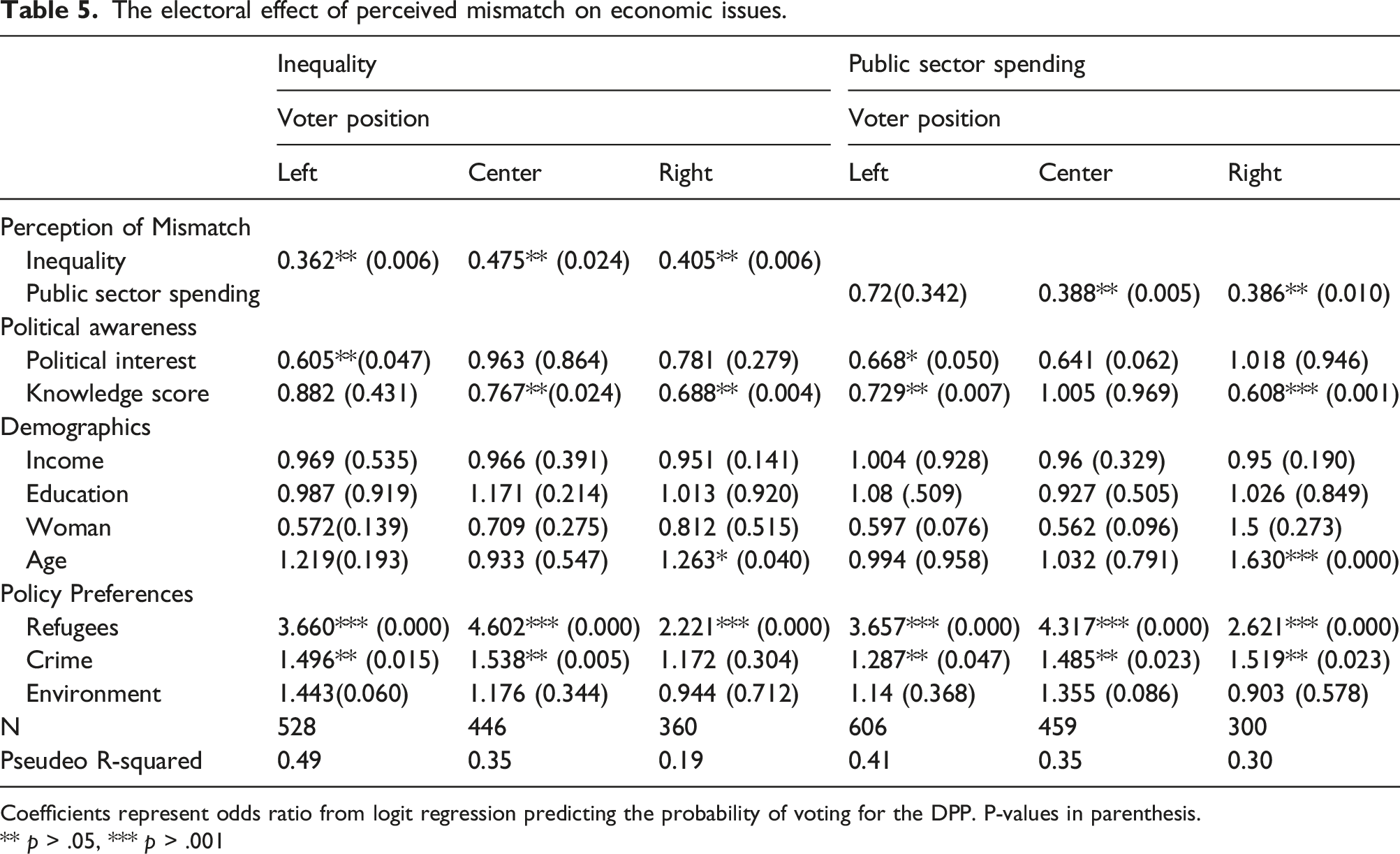
Coefficients represent odds ratio from logit regression predicting the probability of voting for the DPP. P-values in parenthesis.
** p > .05, *** p > .001
Evidence of projection among voters for three main parties.
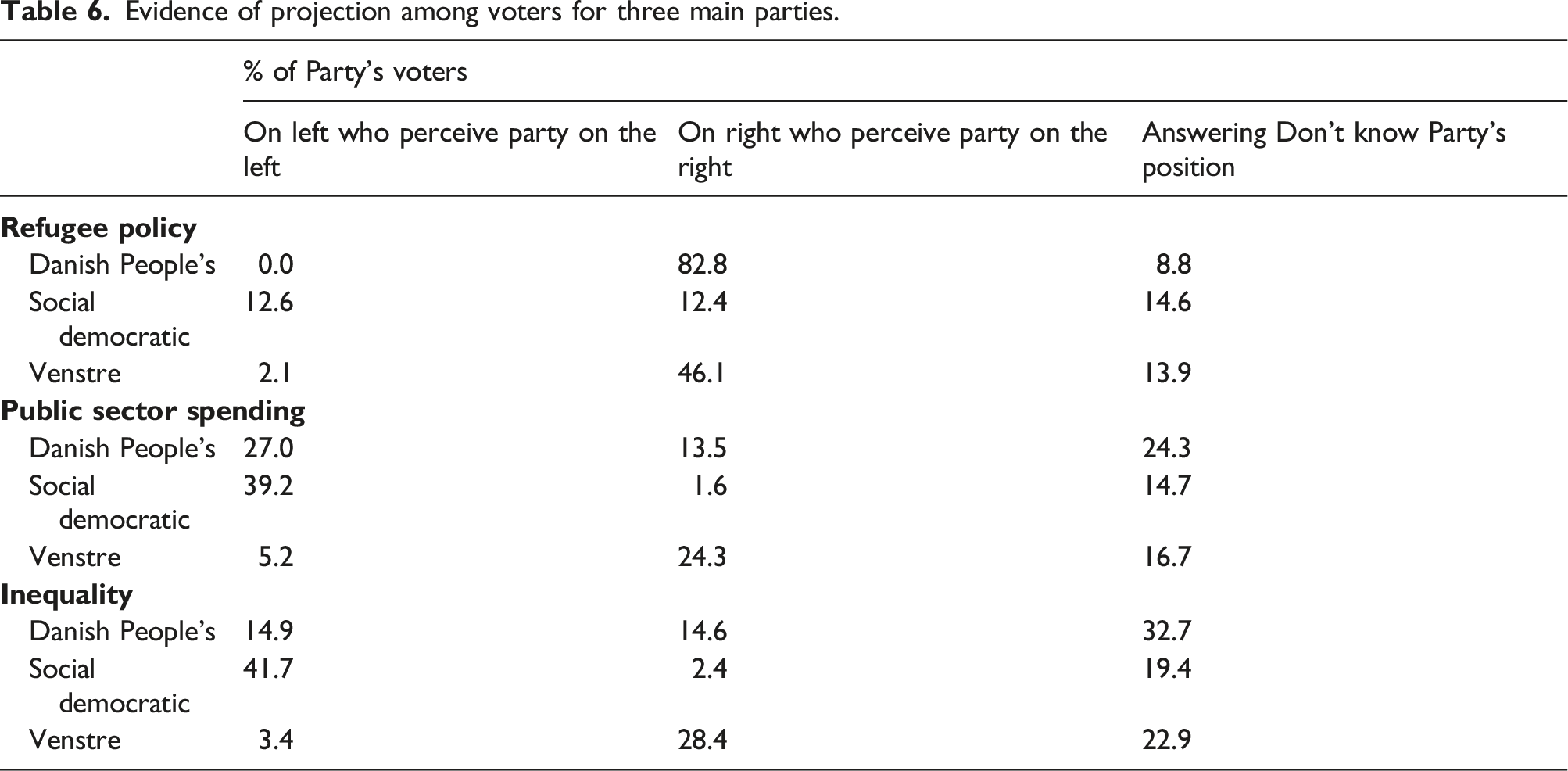
By comparison there exists significantly more agreement on the economic positions of the mainstream parties with far fewer SDP voters identifying themselves and the party on the right or Venstre voters identifying the party and themselves on the left. Additionally, SDP and Venstre voters were significantly less likely to say they didn’t know their preferred party’s position. The one telling exception to this pattern is the relatively high ambiguity surrounding the position of the SDP on refugee policy with a nearly equal proportion of their voters identifying a shared position on the left (12.6%) and right (12.4%). Again, this provides evidence that the Social Democrats may be engaged in position blurring on a policy area that is a potential wedge issue for its base.
Whatever the “true” position of the DPP on these issues, the evidence reveals significant amounts of projection among DPP voters with large numbers of their supporters on opposing sides of economic issues and assuming the party shares their preferred position. Combined with the significant portions of their voters who claim not to know the DPP position, the uncertainty surrounding the party’s position allows a large number of voters highly divided on economic issues to support the party without recognizing any conflict between their preferences and the party’s position.
Conclusions
The case study of the Danish People’s Party provides strong evidence of position blurring in one of the most successful radical right-wing parties in Europe. The survey data reveals widespread uncertainty among Danish voters concerning the economic positioning of the DPP. Moreover, the data strongly suggest that this uncertainty is of significant electoral benefit to the party. Compared to the Social Democrats and Venstre, the DPP relies on a constituency simultaneously less politically aware and more divided on economic issues. Such a combination creates strong incentives for the party to engage in strategic ambiguity as its target constituencies are more susceptible to a tactic designed to reduce tensions in the party by playing upon voter ignorance. Consistent with the expectations of Rovny (2013), the survey data demonstrate that public perception of DPP economic positions was significantly less clear than that of mainstream parties with large numbers placing them on the right and left while many claimed not to know their position. Finally, large portions of DPP supporters took opposing positions on economic issues while believing the party shared their view, suggesting that the DPP turned uncertainty around its economic positions to its electoral advantage.
These findings suggest at least two important areas for future research. First, the 2015 election, studied here, represented a high-point for the DPP who suffered a humiliating defeat in the 2019, losing nearly 60% of their votes, after making explicit their willingness to support a Social Democratic government (Christiansen et al. 2019). Future research should examine whether this shift in strategy may have undermined the strategic ambiguity that had supported the rise of the DPP to prominence in previous elections. Second, this research demonstrates the need to more seriously engage voter perceptions of radical right parties, incorporating a discussion of how variations in levels of political awareness across different groups may influence the incentives to engage in and the effectiveness of position blurring as an electoral strategy. Future research should extend this to other radical right-wing parties to determine whether these findings can be generalized across the wider range of radical right-wing parties.
Footnotes
Declaration of conflicting interests
The author(s) declared no potential conflicts of interest with respect to the research, authorship, and/or publication of this article.
Funding
The author(s) received no financial support for the research, authorship, and/or publication of this article.
