




Abstract
Despite attention in comparativist and Americanist literatures to populism and affective polarization, relatively little theoretical and empirical work has been done linking these two concepts. We present a comprehensive theory arguing that populism leads to greater affective polarization among both populist citizens and non-populist citizens, and that the latter effect grows as populism increases. We test this two-way effect using V-Dem expert rankings of populism and CSES surveys to measure affective polarization for 185 elections in 53 countries. This cross-regional analysis confirms and extends previous claims of a strong correlation between populist party identity and individual-level affective polarization; just as important, it also shows that an individual’s affective polarization is associated with populism at the country level, whether or not that individual is a supporter of populist parties. We show further that these results help explain a common finding in the comparative literature, that radical-right parties in Western democracies are disproportionately the target of animosity from other parties.
Introduction
Affective polarization is increasing across the world’s democracies. Affective polarization denotes increasing favor towards one’s own political group and distrust and hatred towards political opponents. As affective polarization increases, voters come to view other parties and citizens as threats to the political community (Iyengar et al., 2019; Mason, 2018; McCoy et al., 2018). Affective polarization has been blamed for many of the contemporary political challenges facing the United States, including partisan gridlock (Barber & McCarty, 2016), contention over responses to the Coronavirus pandemic (Leonhardt, 2022), and even the storming of the US Capitol (Costa, 2021; Rove, 2022). While polarization is often discussed as a growing problem in American politics, Gidron et al. (2020) show that the United States is not exceptional.
At the same time, many of the world’s democracies are experiencing an increase in the number of populist parties and movements. By populist, we mean that leaders and supporters of these forces frame politics as a struggle between the will of the common people and an evil elite. Voting for populist parties has grown over many regions of the globe over the past two decades (Jenne, Hawkins, and Silva, 2021; Lewis et al., 2018). This increase has different causes in different regions, such as rising conflict over economic and cultural globalization in the wealthy democracies, and continuing problems of corruption and weak democratic governance in the developing world (Berman, 2021; Hawkins et al., 2019). Whatever its causes, populist parties seem to have consistently negative effects on liberal democracy, including restrictions on media freedom and other civil liberties, lower quality elections, and reduced horizontal accountability (Huber & Schimpf, 2016; Juon & Bochsler, 2020; Kenny, 2020).
Given populism’s demonization of opponents, not to mention the upward trend in both populism and polarization, a few scholars have suggested that populism is an important cause of affective polarization (Handlin, 2018; McCoy et al., 2018; Reiljan & Mölder, 2022; Stavrakakis, 2018). According to this view, populist ideas encourage a moralizing stance that raises the stakes of political conflict and changes how opponents view each other, making compromise more difficult and violent confrontation more likely. However, most studies connecting the two phenomena still see this as a one-way relationship—of populists demonizing their non-populist opponents—despite evidence of unusually strong animosity of non-populists towards populists. Furthermore, empirical work here is fairly new, and there are still no cross-regional studies showing a broad link between populism and polarization.
This article presents a more comprehensive theory of populism and polarization, and a large-scale, quantitative test of this argument. In terms of theory, we draw from work using the ideational approach to populism to argue that populism has a two-way effect, generating increased animosity between both sides of a political conflict. It does so first, as other scholars suggest, by catalyzing strong in-group and out-group sentiment among populists. But we argue that its demonizing language also provokes a reaction among the populists’ opponents, encouraging them to view themselves as a separate identity group that must defend itself, an effect that grows as populist parties become more of an electoral threat. Thus, populism’s negative impact spreads, turning both sides, populists and non-populists, into mutually antagonistic poles.
We test this two-way effect at the individual level using observational data, specifically, a multilevel model on data from the Comparative Study of Electoral Systems (CSES) and the Variety of Democracies’ V-Party dataset, an analysis that allows us to look at 53 countries over 24 years. This analysis confirms and extends previous research about populism’s initial effect, showing that individuals who support populist parties or have populist attitudes are more likely to view their partisan opposition with animosity in every region of the globe that we analyze; this effect holds after controlling for other factors commonly associated with affective polarization. At the same time, our analysis shows that individuals who do not support populist parties or have strong populist attitudes also display negative affect towards their opponents; importantly, this association is strong only when populist parties are strong at the country level, and is negligible when populists are weak. This suggests that non-populist voters also feel animosity towards populists, and that this sense of threat is conditional.
To be clear, we do not find that populism is the only important predictor of affective polarization. Our models confirm the importance of traditional explanations for polarization, including ideological polarization and strength of partisan identity, finding that these factors are stronger predictors than populism. And our study is observational, making it difficult to demonstrate causality. However, our analysis makes at least two important contributions to studies of both populism and polarization. First, our results confirm and extend the findings of previous research, showing that the relationship between populism and polarization is a strong cross-regional association visible at the individual level, even after controlling for other factors emphasized in the literature. Second, taking populism into account helps answer a puzzle in the comparative literature on affective polarization: why opposing partisans dislike far-right partisans more than is to be expected based on ideological difference alone (Helbling & Jungkunz, 2020; Meléndez & Rovira Kaltwasser, 2021; van Heerden & van der Brug, 2017; Van Spanje & van der Brug, 2007). We confirm findings elsewhere (Reiljan, 2020) showing that the animosity felt by non-populists towards populists explains this disconnect, while showing that this effect is largely limited to Europe and North America.
We begin with a review of the literature on affective polarization and populism, followed by a discussion of the fledgling literature that ties them together. We then lay out the theoretical explanation for populism’s positive effect on polarization and set forth the hypotheses specific to this study. After explaining our data sources and methodology, we lay out the evidence for the relationship between populism and affective polarization.
Does Populism Polarize?
Until recently, the literature on affective polarization has not engaged the topic of populism but has instead highlighted a variety of traditional explanations based on ideologies, identities, and institutions. Among scholars of US politics, attention has centered on the first two of these explanations. Some Americanists argue that affective polarization in the United States springs from growing ideological or policy differences (Webster & Abramowitz, 2017). According to this view, polarization is driven by loyalty to principle and disagreement over high-stakes issues, as voters come to see their ideological differences in more emotionally charged ways. In contrast, other scholars draw from social identity theory to argue that contemporary divisions are primarily rooted in increasingly distinct partisan identities (Iyengar et al., 2012; Mason, 2018). According to this argument, polarization is not so much the result of a principled decision over the substance of policy as it is people’s instinctive tendencies to support their political in-group and fight against members of the out-group. More recent work takes a more inclusive view of this debate, arguing that ideology and identity are complementary. For example, Lelkes (2019) finds experimental evidence that ideology is polarizing, but that this polarizing effect is strongest in a partisan context. (See also Orr & Huber, 2020).
Comparativists have confirmed these findings while expanding the number of ideological and social identity categories and, more especially, examining the role of institutional factors that can only be seen in comparative relief. The resulting picture suggests increasingly that all of these factors matter and are even complementary. Reiljan (2020) performed one of the first large-N, cross-national studies of affective polarization. In line with U.S. research, he found that affective polarization was related to ideological polarization, but also suggested that there were connections between affective polarization and geographic region, ethnic divisions, and corruption. Gidron et al. (2020) expanded his findings to show that national-level affective polarization was correlated with elite-level polarization on cultural issues, income inequality, and majoritarian electoral systems, especially first-past-the-post electoral laws. Other scholars have suggested the importance of temporal proximity to elections (Bassan-Nygate & Weiss, 2021; Hernández et al., 2021).
In comparative research, however, there is also a growing sense that populism plays a role in affective polarization. For example, McCoy and Somer (2019) mention that populist parties and politicians are protagonists in countries experiencing high levels of affective polarization, and they note the similarity between the process by which affective polarization comes about and the process by which populist forces emerge and come to power. Handlin (2018) goes as far as labeling these instances of affective polarization “polarizing populism” because of the coincidence of the two forces, suggesting that both result from crises of democratic representation. And in a study of affective polarization in Sweden, Reiljan and Ryan (2021) argue that the anti-system attitudes of populists and pro-system attitudes of non-populists are a key factor exacerbating their mutual animosity. However, most of these studies do not test this relationship systematically with measures of populism, and those that do use indirect indicators such as the presence of radical outsider movements or measures of trust in political institutions, and they do not go beyond single country studies or within-region comparisons.
A more recent study by Fuller et al. (2022) addresses some of these deficits by using expert measures of party-level populism from the V-Party dataset to gauge the impact of populism on affective polarization. Specifically, they consider the impact of party-level populism and ideological distance in 8 European countries, finding that both are important predictors of affective polarization. Their analysis is significant for using a direct indicator of populism. However, their study is limited to a relatively small number of party systems and does not include any controls besides ideology and party populism, leaving open the question of whether it is populist ideas or some other factor at work, and how general the effect of populism really is.
A Theory of Populist Polarization
While populism lurks on the fringes of the affective polarization literature, scholars within the field of populism studies have given more serious attention to the question of whether populism causes affective polarization (see, for example, Mudde & Rovira Kaltwasser, 2018). These arguments allow us to specify a two-step process by which populism might exacerbate polarization.
To make sense of this argument, it is important to first outline what we mean by populism. While scholars have historically used a variety of definitions linking populism to particular policy positions, such as leftist macroeconomic policies that overstimulate consumer demand (Dornbusch & Edwards, 1991) or a radical-right stance that combines anti-immigrant views with social conservatism (Norris & Inglehart, 2019), most contemporary populism scholars include some notion of a pro-people, anti-elite rhetoric in their definition that is not specific to any one issue position, and can instead be seen as a frame that populist parties use to justify their policy proposals and build their electoral strategy. To capture this unique quality of populist ideas, scholars refer to populism in this sense as a discursive frame or thin-centered ideology (Aslanidis, 2016; Mudde, 2004). Regardless of the label, researchers who define populism in these ideational terms view populist rhetoric and its underlying ideas as an important element in the appeal of populist politicians, and they argue that this rhetoric resonates with voters when there are policy failures that can plausibly be connected to political malfeasance. Importantly, populist ideas can be found at any point of a traditional left-right ideological spectrum, although they tend to be associated with radical policy positions (Akkerman et al., 2017; Hawkins et al., 2019; Rooduijn & Akkerman, 2017).
Scholars using some form of this ideational definition suggest two mechanisms by which populism produces affective polarization. The first and more familiar argument is that populism is inherently polarizing for its proponents (Pappas, 2019; Roberts, 2021; Urbinati, 2019). Citizens and politicians that frame politics in terms of an elite-versus-people struggle are casting themselves as the unique bearers of democratic virtue while demonizing their opponents. This worldview justifies restricting the civil liberties of their opponents, violating principles of electoral fairness, and undermining the separation of powers (Houle & Kenny, 2018; Huber & Schimpf, 2016; Levitsky & Loxton, 2013), an outcome that Roberts (2021) calls “institutional” polarization. But it also has what Roberts calls a “constitutive” effect, in that it causes populists to redraw the boundaries of the democratic community to exclude their opponents from consideration as fellow citizens. Thus, we should expect populism to have an individual-level, attitudinal impact on norms of tolerance, the stereotypes that populists have about their opponents, and their willingness to interact with opponents in settings outside of politics.
Whether populism is a cause of this affective shift or merely the rhetoric that justifies it is hard to disentangle; it could be both. For populist ideas to become active in the minds of citizens, there must be a policy context that makes the frame sensible; this would make populist ideas (and their polarizing effects) endogenous to larger, structural forces (Busby et al., 2019; Hameleers et al., 2017). But populist politicians can catalyze this process through their own rhetoric. For example, Marx (2020) finds that populist anti-elite rhetoric encouraged participants in a survey experiment to blame external forces for their economic woes. And Sarsfield (Forthcoming) finds that exposure to anti-elite rhetoric decreases tolerance for political opponents. This research suggests that there is room for populists and their ideas to act as independent catalysts of polarization. Ultimately, we suspect that causality here is complex, with populist ideas and rhetoric acting endogenously and exogenously.
Second, and perhaps more importantly, populism scholars have begun to suggest that populism furthers the process of polarization by playing on the minds of populists’ opponents. Populists’ confrontational rhetoric threatens their opponents’ civil rights and sense of personhood, and those targeted by this rhetoric often respond in kind (Hawkins & Hawkins, forthcoming). This can take the form of an elitist response, in which opponents denigrate populist leaders as demagogues and dehumanize their followers as an ignorant, dangerous mob or as a disease that threatens the state (Stavrakakis, 2018), but it can also take the form of a counter-reaction in which opponents of populists declare themselves the true representatives of the popular will and attempt to demonstrate their popular support through what Gamboa (2017) calls extra-institutional strategies, such as counter-protests and large-scale mobilizations. Either way, populism provokes its opponents to embrace polarizing strategies that deepen the spiral of conflict (Somer et al., 2021). Importantly, this effect is not automatic, since opponents are not initially driven by a Manichaean cosmology like that of the populists. Their reaction is conditional on the strength of populist forces and the threat they present to liberal democratic institutions. As this perception of threat grows, opponents of populist forces shift towards a more emotionally laden defense of their in-group while denigrating populists as enemies and outsiders of the political community. Thus, populism causes not just a one-sided antagonism, but true polarization between two opposing groups: populists and non-populists.
There is some cross-national evidence that populism has these polarizing effects, especially on its opponents. As mentioned earlier, many prominent causes of growing affective polarization around the globe involve populist protagonists. Indeed, several of the country-cases mentioned in McCoy and Somers’ (2019) special issue involve populists who came to power, often through parties and movements that initially garnered widespread support. In a typical pattern, after winning power, the populists’ policies, constitutional reforms (often undermining liberal democratic institutions), and inflammatory rhetoric provoked strong counter-reactions from a growing opposition. Importantly, as Roberts (2021) notes, most of these countries experienced low levels of polarization (affective or ideological) between traditional parties before populists came to power, the lack of polarization being one of the key features of politics that fed support for anti-system candidates; the U.S. experience, in which polarization preceded the election of Donald Trump as president, is exceptional. Thus, when the two are associated, populism often precedes polarization.
Another piece of evidence comes from the study of polarization in countries with radical right parties. A number of studies have demonstrated the unusually high level of animosity that mainstream politicians direct towards radical right parties and politicians, many of which are populist (Helbling & Jungkunz, 2020; Meléndez & Rovira Kaltwasser, 2021; van Heerden & van der Brug, 2017; Van Spanje & van der Brug, 2007). Importantly, this antipathy is greater than what would be predicted by differences in parties’ positions on socio-cultural issues alone, suggesting that some added factor is at work (Gidron, Adams, and Horne, 2022; Harteveld, 2021; Reiljan & Ryan, 2021). Because most of these studies do not measure populism separately from ideological radicalism, they leave open the question of whether it is populism that causes this antipathy (but see Harteveld, 2021; Reiljan & Mölder, 2022).
To be clear, we are not arguing that populism is the only cause of affective polarization. Our approach readily admits the importance of other factors, such as traditional ideologies and issue positions, the political institutions that create opportunities for new parties to organize, and the preexisting identities that compete for citizens’ loyalty. Indeed, in some countries, populism may not be a factor at all. However, wherever it is active, we expect populism to polarize citizens by encouraging those who agree with populists to hate their enemies and by inspiring a backlash among those the populists oppose. Thus, populist ideas and rhetoric strengthen both poles of affective polarization.
Hypotheses and Research Design
We can summarize our argument in two hypotheses. First (H1), the more populist the party that an individual supports, the higher the level of that individual’s affective polarization. The use of populist rhetoric by politicians and its acceptance by their followers should be associated with animosity towards their opponents and an improved self-regard.
Second (H2), the higher the level of populism in a country, the higher the level of affective polarization of non-populists in that country. Non-populists are capable of increasing their own affective polarization, and should do so in proportion to the strength of the populist threat they confront. Minor populist forces that are unable to win control of government pose a small threat to their opponents, but populists that command large numbers of votes pose a significant threat that activates group identities and creates an increasingly strong affective response. Thus, polarization among non-populists will depend on the overall strength of populist parties in the electoral system.
To test these hypotheses, we model affective polarization using a multilevel, cross-regional study of public opinion data on affective polarization. We opt for this strategy over a purely country-level design because testing our hypotheses requires both individual-level and country-level measures of polarization, and because affective polarization is ultimately an attitudinal phenomenon. We pursue a cross-regional study rather than a more geographically focused one in order to gauge the generalizability of populism’s impact. And we rely on observational data rather than an experimental method because it allows us to better identify the strength of populism relative to other well-known correlates, such as ideological polarization or institutions, that are difficult to manipulate experimentally. Finding strong, global evidence of a relationship between support for populist parties and affective polarization will provide a baseline for future research.
Dependent Variable: Affective Polarization
An increasing number of scholars have developed methods of studying affective polarization across country borders. We follow the example of others (see Gidron et al., 2020; Wagner, 2021) in using data from the Comparative Study of Electoral Systems (CSES) survey modules. We use the CSES Integrated Module Dataset (1996–2016) appended with the recent CSES Module 5 (2016–2021), which provides us with over 155,000 respondents in 185 elections in 53 countries over 24 years (Comparative Study of Electoral Systems, 2021, 2022).
We conceptualize affective polarization as how much a citizen likes the party he or she identifies with compared to how much a citizen likes the other parties in that country. Thus, there is no affective polarization if a citizen likes (or dislikes) all parties equally, including if they have no strong preference for any party. And affective polarization is maximized when a citizen strongly likes his or her party, and strongly dislikes all others.
To measure affective polarization, we combine the results of two sets of questions from the CSES. First, the CSES asks respondents if there is any party that they are close to. If the respondent answers no, in some modules/countries of the CSES, the respondent is further probed if there is any party that they are closer to. 1 We call this party (the close or closer one) the respondent’s party. 2 Because some of our key independent variables can only be calculated for individuals with a partisan preference, respondents who do not express a partisan preference are not included in our study. This is also the practice of most studies of affective polarization using survey data. 3 Second, the CSES also asks respondents to rate various parties on a scale from 0 (strongly dislike) to 10 (strongly like), i.e., on a feeling thermometer. Gidron, Sheffer, and Mor (2022) show that the feeling thermometer is a valid measure of partisan affect in multiparty systems.
Because existing measures of affective polarization present some unique challenges in multiparty systems, we use the previous two sets of questions to calculate three different measures, adapted from Wagner (2021). Our first is Weighted Distance: the difference between the respondent’s rating of their preferred party and the weighted average of their ratings of the other parties, where the weighting is by vote share in the election. Although the respondent rates multiple parties, there is only one observation per respondent. If the respondent rates his or her party at 10 and rates all other parties at 0, then the Weighted Distance is 10 (the maximum). If the respondent rates all parties the same (including his or her own), then the Weighted Distance is 0.
4
If the respondent gives differing ratings to the other parties, than those ratings are weighted by the parties’ vote shares. This means that larger parties have a stronger effect on Weighted Distance than smaller parties. To get a sense of how affective polarization differs across countries and elections, we show the average Weighted Distance for the elections in our analysis in Figure 1. While the affective polarization of some countries is stable across elections (e.g., Iceland on the low end, Czech Republic on the high end), in other countries, the affective polarization changes substantially across elections (e.g., Thailand). This variation of affective polarization across elections in the same country is why we examine affective polarization and populism in individual elections within a country, rather than by combining data from all of the country’s elections. Average affective polarization (weighted distance) of country-elections included in the analysis. The dots on a horizontal line represent the average weighted distance in a country for each election. The countries are ordered by average across elections.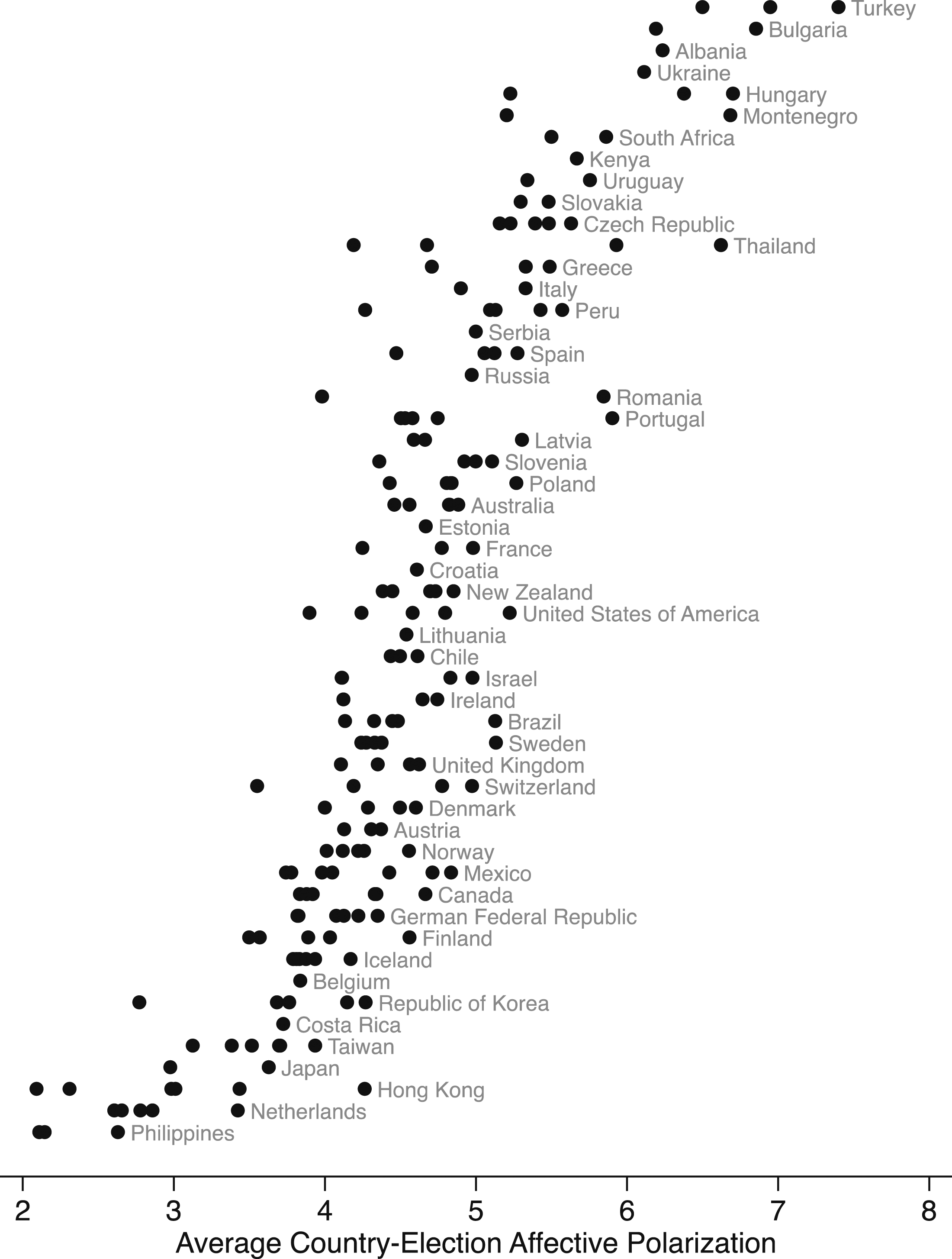
Our second measure of affective polarization is Unweighted Distance. This is measured as the difference between the respondent’s rating of the respondent’s party and the unweighted average of the respondent’s ratings of the other parties. This measure takes into account that a small, disliked party could have a large impact on polarization. This measure also incorporates ratings of parties that (for whatever reason) did not run candidates in the election (e.g., the Peace and Democracy Party in Turkey in 2011); such parties are necessarily excluded in Weighted Distance.
Our third measure of affective polarization is Weighted Variation, which is the standard deviation of respondent ratings, weighted by vote share. This is Wagner’s (2021, p. 10) preferred measure, and it ranges from 0 to 5. Like our Weighted Distance measure, parties that receive more votes are more influential. Unlike our Weighted Distance and Unweighted Distance measures, this measure does not differentiate a respondent’s party from any other party: all of the ratings are included in the calculated standard deviation. 5 Because including the respondent’s party this way leads to counter-intuitive results, Weighted Distance is our preferred measure. 6
Independent Variables: Populism
We test for the effect of populism at two levels using data from the Varieties of Democracy’s Varieties of Party Identity and Organization (V-Party) experts survey (Luhrmann et al., 2020). The V-Party data provide an expert ranking of how populist each party in our sample is. Using two items, experts are asked the importance of anti-elite rhetoric of a party and how often party leaders glorify and identify with ordinary people. V-Party then combines these results using a harmonic mean, which gives greater weight to the lower of the two values. 7 We use this mean to construct our two independent variables, one at each level.
At the first level we measure the effect of identification with a populist party. This allows us to test our hypothesis that individuals will be more polarized when they identify more closely with populists. Since different individuals identify with different parties, this makes the first independent variable a joint individual-party-level variable. We call this variable Individual Party Populism. We assign each individual the V-Party populism score of their close party as their level of Individual Party Populism. Note that if an individual does not have a preferred party, we cannot calculate this measure, and these individuals are dropped from the analysis.
At the second level, we measure the effect of country-level populism. This allows us to test our expectation that the overall level of populism within a country will have a polarizing effect on individuals, regardless of how much they agree or identify with populists. This variable, Country-Election Populism, uses the weighted average of V-Party populism score of each party in the country in the year the CSES was conducted, with the share of each party’s supporters in the survey as the weight.
Both independent variables range on a scale of 0–1. Additional information on the distribution of these variables across individuals and across the 53 countries in our analysis can be found in the Online Appendix.
Control Variables
The literature on affective polarization suggests several other factors that are important drivers of affective polarization, and we control for these as we investigate the effect of populism. The first is individual ideological polarization (Webster & Abramowitz, 2017). As with populism, we control for this effect at two levels, using the CSES measure of self-placement on a left-right ideological scale. At the first level, we measure Individual Ideological Polarization as the absolute distance of the respondent’s left-right self-placement from the average self-placement of all respondents in that country’s election. 8 We thus capture how far an individual may feel they are ideologically from the mainstream of their nation’s politics. 9 At the second level, we measure Country-Election Ideological Polarization as the average Individual Ideological Polarization in that country.
Our second control is the strength of partisan identity, which we measure as the individual’s closeness to a party (Iyengar et al., 2012; Mason, 2018). 10 As noted above, the CSES asks respondents if a party is close (or closer) to them. After asking which party is close, the CSES asks how close the party is: very, somewhat, or not very close. We label this latter measure Party Closeness and scale the responses as 1, 0.5, and 0, respectively. 11 This variable is analogous to partisan strength variables in the Americanist literature.
In their global study, Gidron et al. (2020) find strong correlations between several additional factors and affective polarization. Specifically, high levels of affective polarization are correlated with high levels of unemployment, inequality, and elite-level polarization on economic and cultural issues. They also find that majoritarian electoral systems are characterized by higher levels of affective polarization.
We control for many of these variables as well. The total Unemployment for the country in each given year comes from the CSES data. Data on the Gini coefficient for Inequality of disposable income comes from the same source that Gidron et al. (2020) use, the Standardized World Income Inequality Database (Solt, 2019). We control for electoral system (variable Proportional Representation) using a binary variable where observations were assigned a Proportional Representation value of 1 if the country’s lower house uses a proportional or mixed electoral system, and observations were assigned a value of zero if the lower house used a plurality electoral system, provided by the CSES dataset.
Finally, we also control for whether respondents are female. This control is more speculative, but we expect women to be less affectively polarized than men because Adams et al. (2023) found that female MPs tend to reduce affective polarization, and because the literature on radical right populism finds that women tend not to support these parties. Data on the gender of the respondent (Female = 1, 0 otherwise) comes from the CSES dataset.
A few other factors have been found to be correlated with affective polarization in comparative context, especially temporal proximity to an election (Hernández et al., 2021). We do not control for these factors in our models due to space constraints, and also because it is not clear that they will be correlated with our different measures of populism. However, we obtain qualitatively similar results for our populism variables when we include Days Since Election as a control variable.
Methods
We use a multilevel model to test our hypotheses. Multilevel models take into account that the respondents of a survey in a particular country in a particular election year are not independent of each other, and further, they estimate the extent of this dependence. Multilevel models also allow us to test individual- and country-level hypotheses simultaneously.
To fix the well-known disadvantage of these models–the potential endogeneity of individual-level variables–we utilize an extension of the standard multilevel model; in fact, this extension allows us to test our second hypothesis directly. In an ordinary regression model, the observations are assumed to be drawn from the same population and independent of each other. However, while two citizens of two different countries might be independent of each other, it would be more appropriate to assume that they are drawn from two different populations. Further, two citizens of the same country (in the same election year) are likely to share culture and other country-level experiences that make them less than independent of each other. One way to deal with this problem is to cluster the standard errors, though this essentially sweeps the problem under the rug (Leamer, 1988). Instead, we choose to model the heterogeneity and non-independence directly using a multilevel model that includes a random effect for each election in each country, which absorbs the country-level experiences that are common to citizens of the country in that election. 12 This random effect also differentiates each country’s election from another election, controlling for the heterogeneity across elections, noted above in Figure 1. We can then estimate how much heterogeneity across elections and non-independence there is within a country’s election.
Hypothesis 1 is a joint individual-party-level phenomenon since different individuals identify with different parties. Although the observations are not fully independent, we have over 155,000 observations on which we can estimate the relationship between individual-party populism and polarization. Since the citizens of a country all experience the same party system, Hypothesis 2 is a country-level phenomenon for each election. The size of our data set for this second hypothesis is effectively the number of elections in the data set: 185. We wish to control for the effects of one hypothesis while estimating the effect of the other (and to use the correct effective size of the data set for each hypothesis); 13 a multilevel model allows us to do that.
In our study, the key variable is populism. This is measured jointly at the individual and party level, and at the country-election level. However, an individual’s preference for a particular party and that party’s level of populism may be influenced by a country’s overall populism (or other country-election-level variables), which is modeled by the country-election-level random effect. Since the random effect is assumed to be independent of Individual Party Populism, this will cause bias if not corrected. Mundlak’s (1978) solution to this problem is to include the average of Individual Party Populism within each election, which will control for (and estimate the effect of) the country-election-level variable. The estimate of the effect of country-election variable is the “between” effect, or the effect across country-elections. The coefficient on Individual Party Populism is then the effect of a change in Individual Party Populism on affective polarization within that election, i.e., it is the fixed-effects estimate, also known as the “within” effect. 14 We use Allison’s (2009) extension, which de-means Individual Party Populism by election along with including the country-election-level average. By de-meaning Individual Party Populism, we can present the within effect and between effect directly. Thus, our estimate of our first hypothesis examines the effect of increasing populism within a country’s election. 15
To operationalize the level of populism of the party system, we use the average level of Individual Party Populism (across individuals) within a country’s election. That is, the variable that we include to correct the bias in the estimation of the first hypothesis will, in fact, also be used to estimate the second hypothesis. We call this variable Country-Election Populism. As discussed above, another conceptualization of this measure is that it is the weighted average of V-Party populism score of each party in the country in the year the CSES was conducted, with the share of each party’s supporters in the survey as the weight. 16
Since this is a kind of fixed-effects model, we are able to control for one kind of endogeneity: any omitted variables that are correlated with affective polarization and populism at the country-election level (such as ethnic cleavages). While this does not control for omitted variables at the individual level (as is true for any fixed-effects regression), we have included the other individual-level covariates that previous researchers found to be correlated with both affective polarization and populism: ideological polarization, party closeness/identification, and gender.
Results
Multilevel Models of Affective Polarization.
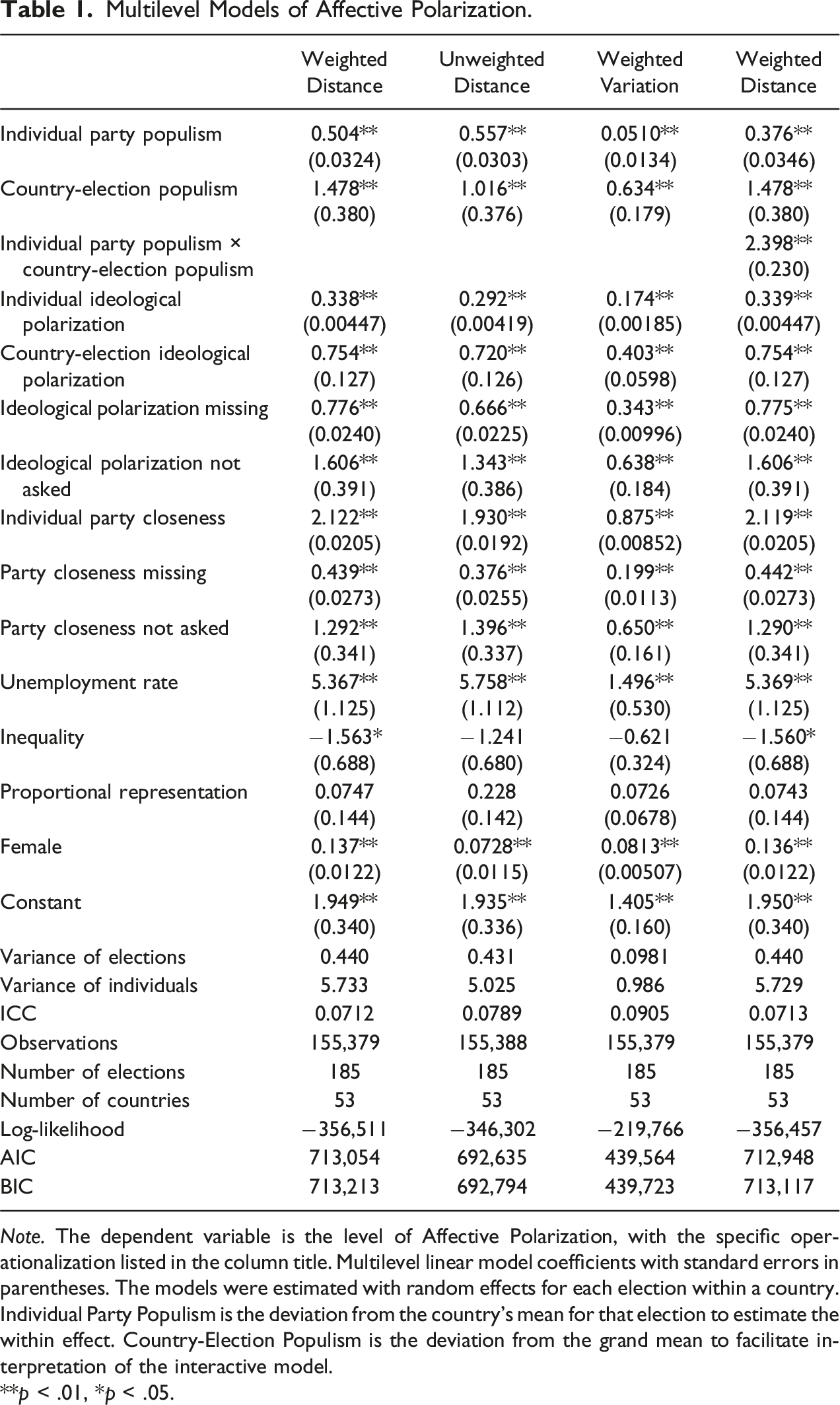
Note. The dependent variable is the level of Affective Polarization, with the specific operationalization listed in the column title. Multilevel linear model coefficients with standard errors in parentheses. The models were estimated with random effects for each election within a country. Individual Party Populism is the deviation from the country’s mean for that election to estimate the within effect. Country-Election Populism is the deviation from the grand mean to facilitate interpretation of the interactive model.
**p < .01, *p < .05.
The results support our hypotheses: Using all three operationalizations of affective polarization, both Individual Party Populism and Country-Election Populism coefficients are positive and statistically significant. 18 For H1, as individuals identify with a more populist party, those individuals increase their affective polarization (controlling for Country-Election Populism, Individual Ideological Polarization, Country-Election Ideological Polarization, Party Closeness and the other control variables). For H2, as individuals live in a country with more populism in the party system, those individuals increase their affective polarization (controlling for Individual Party Populism, Individual Ideological Polarization, Country-Election Ideological Polarization, Party Closeness, and the other control variables). To check whether outliers were influential, we estimated the model dropping one election at a time, or dropping one country at a time; in all instances, Individual Party Populism and Country-Election Populism remain qualitatively similar (positive and statistically significant). We also test for regional effects by including the UN Statistic’s subregion as a fixed effect, or as a random effect (with country-election as a nested random effect). Again, the results on the populism variables are qualitatively similar.
The results for our control variables support most other findings from the affective polarization literature. First, individuals that have greater ideological polarization have higher affective polarization, and individuals that live in countries with more ideologically polarized citizens have higher affective polarization. Second, individuals that are closer to their party have higher affective polarization. And finally, countries with higher unemployment rates have citizens with higher affective polarization. In contrast to Gidron et al.’s (2020) findings, however, income inequality and proportional representation have no consistent statistical effect. 19 Also, female citizens have more affective polarization on average, not less. This latter finding is somewhat surprising, but our argument here was more speculative, and it may be the case that women are more likely to be polarized once we control for their opposition to/support for populist parties.
We are also interested in the relative strength of our different variables. We estimate substantive effects by increasing each variable by a standard amount and calculating how much the (predicted) dependent variable changes (Gelman & Pardoe, 2007). For continuous variables, we increase each variable by 2 standard deviations. For binary variables (Female, Proportional Representation), we move from 0 to 1.
20
The graph of the estimated substantive effects and their 95% confidence intervals is in Figure 2. Substantive effects using weighted distance model in the first column of Table 1. Each continuous variable is increased 2 standard deviations, and each binary variable is increased from 0 to 1. The markers show the predicted change in Affective Polarization and the lines show the 95% confidence interval.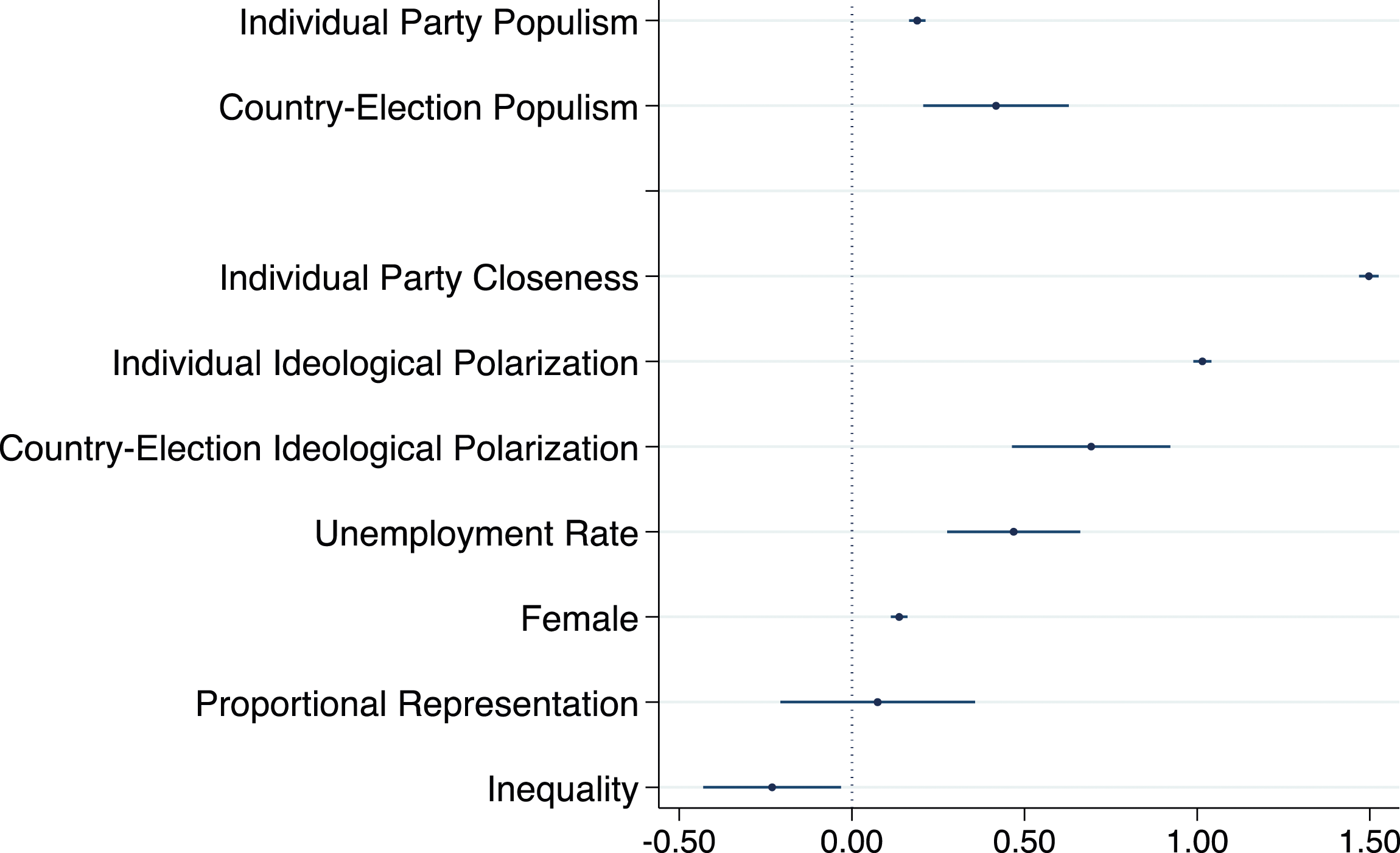
The strongest substantive effects are for Individual Party Closeness and Individual Ideological Polarization. It is perhaps unsurprising that the strongest predictors of one kind of polarization is another kind of polarization and party strength; both findings are consistent with past research on the causes of affective polarization.
The next strongest effects are the country-election-level effects: Country-Election Ideological Polarization, Country-Election Populism, and Unemployment Rate; there is no statistical difference in the size of these three substantive effects. Individual Party Populism is also in the expected positive direction, but somewhat weaker. The estimated substantive effect of Proportional Representation is not statistically different from zero, and Inequality is the wrong sign (and not statistically significant in the other two models). Note that the confidence intervals of the individual-level variables—Individual Party Populism, Individual Ideological Polarization, Individual Party Closeness, and Female—are small, while the confidence intervals of country-election-level variables are relatively large. This is to be expected since the effective sample size of the individual-level variables is over 155,000 while the effective sample size of the election-level variables is 185.
Thus, we find evidence of a modest association of populism with the affective polarization of populist voters, and a stronger association of populism in the party system with the affective polarization of all voters. We can expect that citizens who live in a populist environment will have higher affective polarization, even if they are not members of a populist party. Thus far, however, we have assumed (by the model’s construction) that all citizens are affected by the level of populism in a country equally. We relax this assumption to examine how an individual’s populism affects the relationship between Country-Election Populism and Affective Polarization. To do so, we interact Individual Party Populism and Country-Election Populism in our preferred model, that of Weighted Distance. 21 In multilevel terms, this is a cross-level interaction, which makes it a type of random coefficient model. We show the results in the last column of Table 1.
The key variable to examine in this model is the interactive variable. It is statistically significant, which means that the relationship between Country-Election Populism and Affective Polarization depends on the level of Individual Party Populism. (It also means that the relationship between Individual Party Populism and Affective Polarization depends on Country-Election Populism, but that is less important to our theory.) The positive coefficient means that individuals that belong to a populist party are more strongly influenced by the overall level of populism in a country.
Because we have centered the two populism variables, we can interpret the coefficients of the constitutive variables directly. The coefficient on Individual Party Populism represents the effect of that variable when Country-Election Populism is set to its average. Since the coefficient is positive and statistically significant, it means that Hypothesis 1 holds for an individual in a country whose election has an average level of populism. The coefficient on Country-Election Populism represents the effect of that variable when Individual Party Populism is at the average. Since that coefficient is positive and statistically significant it means that Hypothesis 2 holds for an individual with an average level of populism (in that country-election). In fact, the predicted positive relationship between Country-Election Populism and Affective Polarization holds for 99.98% of the sample’s observed values of Individual Party Populism. (The non-positive effect is only for respondents from one party in one country-election.) The effect of country-election populism on affective polarization is positive and statistically significant for 96.5% of observations in the sample. We illustrate this in Figure 3, which shows the relationship between Country-Election Populism and Affective Polarization for high and low values of Individual Party Populism (2 standard deviations above and below the mean for that election, respectively). Relationship between country-election populism and affective polarization (weighted distance) for high and low values of individual party populism. The rug plot is observed values of country-election populism for the 185 elections in 53 countries.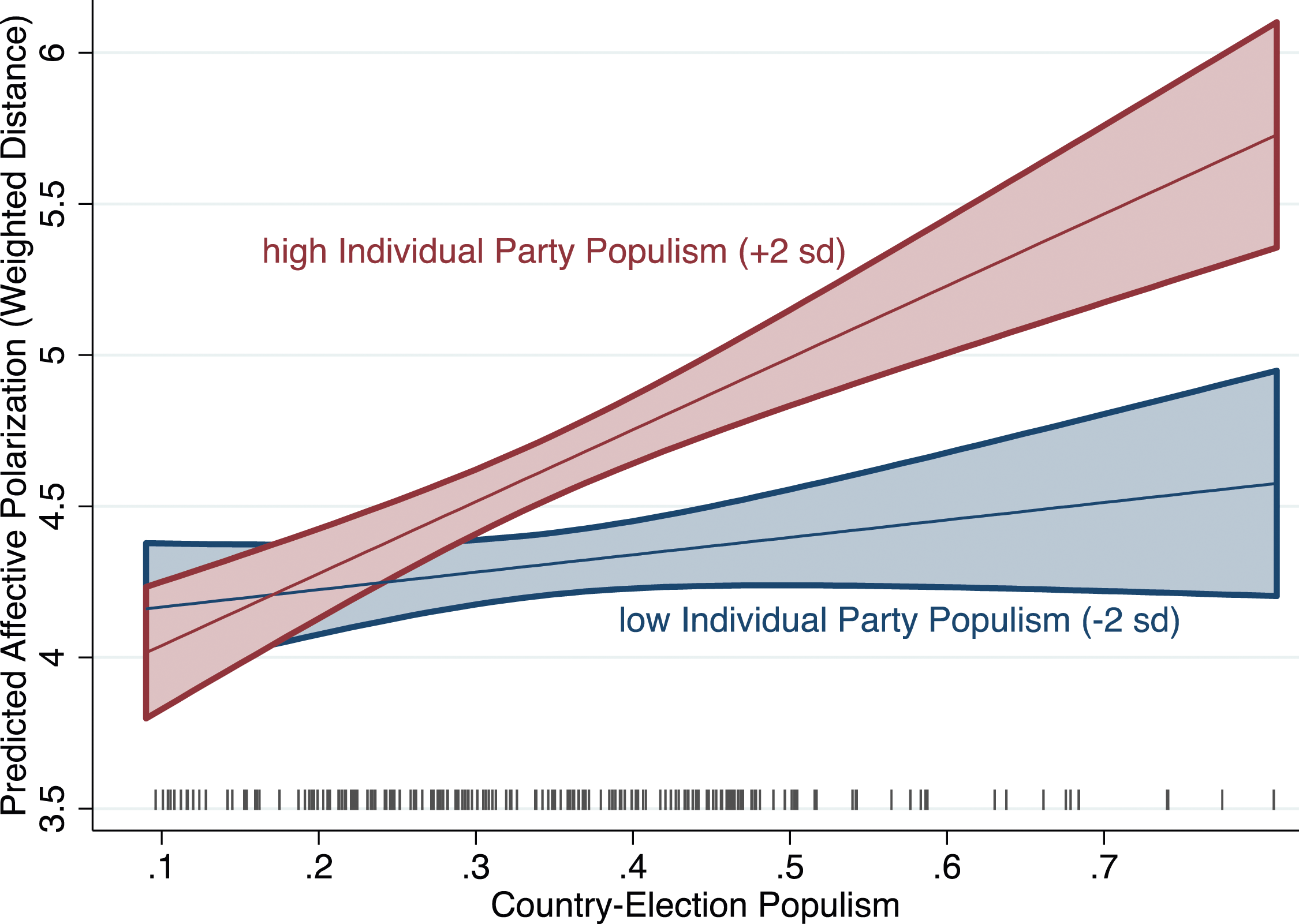
We thus find that citizens become more affectively polarized as the level of populism in their country increases, even for those citizens who do not themselves prefer a populist party. However, citizens who do prefer populist parties are more strongly affected.
Other Populism Measures
In our analysis thus far, we have used the CSES to measure affective polarization at the individual level and estimate its relationship with individual-party-level and country-election-level populism, as measured by V-Party’s expert ratings of the populism of the CSES respondent’s close party. By using all of the CSES modules along with V-Party’s coverage of many parties in many years, we have been able to estimate the effect of country-level variables—including populism—across 185 elections. (We have also been able to estimate individual-level variables across over 155,000 respondents.) While we have shown the robustness of these results by measuring affective polarization three different ways and repeating the models while dropping individual country-elections, readers may wonder if we have appropriately measured the populist leanings of respondents; after all, respondents may support populist parties for reasons other than the parties’ populist rhetoric.
The most recent module of the CSES, Module 5 (CSES, 2022), provides a more direct measure of respondents’ populist attitudes: a battery of questions about their attitudes towards elites and the people. 22 We use these to assess the robustness of our results beyond the V-Party measure of populism. Because these variables are only on the most recent CSES module, we have 32 elections in our analysis, which limits our ability to assess country-level variables. We also note that this measure of populism is an imperfect indicator of support for populist parties. While populist attitudes are important predictors of populist voting, average levels of these attitudes tend to be similar across countries (Van Hauwaert & Van Kessel, 2018). Scholars using the ideational approach speculate that populist attitudes are a latent disposition that must become salient in order to have an effect on other political attitudes and behavior (Hawkins et al., 2019). If true, then any model that uses populist attitudes as an indicator of populist support will conservatively estimate the association between (active) populist attitudes and voting. 23
The items in Module 5 ask respondents their agreement with several statements, originally scaled from 1 to 5 (strongly disagree to strongly agree), and which we rescale from 0 to 1.
24
For consistency, we use two statements similar to the V-Party variables: (1) “Most politicians do not care about the people”; and (2) “The people, and not politicians, should make our most important policy decisions.” As with V-Party, we calculate the harmonic mean of these variables, and label the result Individual Populism. As in our other models, we include as well the mean of Individual Populism in a country-election, which we call Citizenry Populism, to both control for omitted variables and estimate a country-election-level effect. We also interact Individual Populism and Citizenry Populism. And we include the control variables and a country-election random effect. We show the effects of populism in Figure 4. Relationship between citizenry populism and affective polarization (weighted distance) for high and low values of Individual Populism. The rug plot is observed values of citizenry populism for the 32 elections in 31 countries.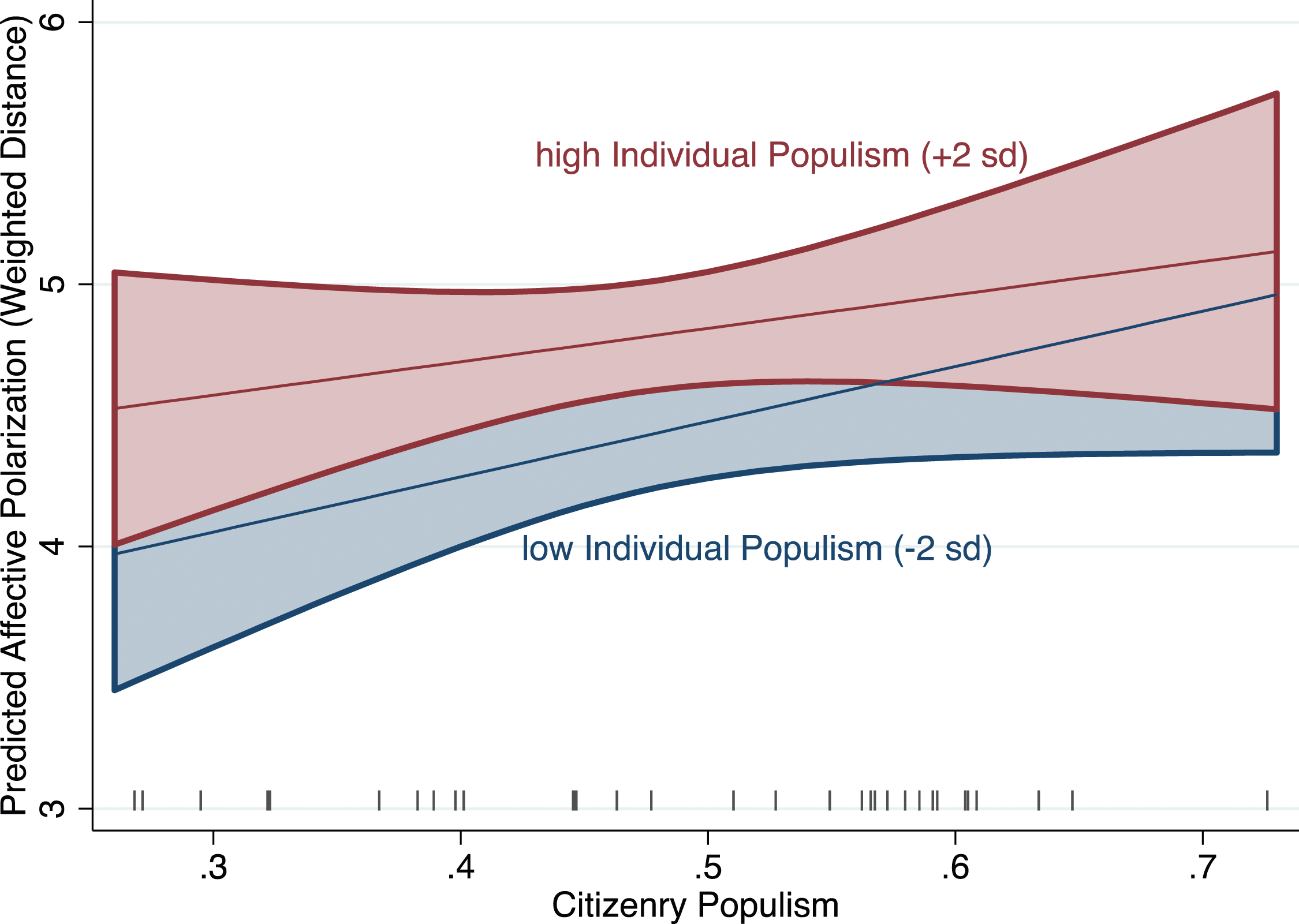
The results consistently support H1 and H2. The vertical distance between the lines shows the effect of Individual Populism: as Individual Populism increases, so does Affective Polarization. The upward sloping lines show the positive effect of Citizenry Populism on Affective Polarization. Because the lines are close to parallel, this shows that there is no interactive effect, which is different from what we find using the V-Party populism scores of parties. Here, then, the effect of country-level populism is equally strong for those who do or do not prefer populist parties.
Populism and the Radical Right
As a final robustness check, we consider the ability of populism to explain the association of radical right parties with unusually high affective polarization. As mentioned already, studies find that radical right parties in Western democracies attract much greater animosity than other parties; that is, there is disproportionate affective polarization against radical right parties. This effect is not explained by the general ideological distance between radical right parties and the other parties (Gidron, Adams, and Horne, 2022; Harteveld, 2021; Reiljan & Ryan, 2021). In an analysis of European parties, Reiljan (2020) finds that part of this association is in fact explained away once we control for the populist attitudes of voters (the rest of the variation being explained by specific issue positions of the radical right, especially nativism), the argument being that many radical right parties in Europe are also populist (Mudde, 2017). We also expect for this unusual polarization to be explained away by the populist discourse of radical right parties. However, we expect this phenomenon to be unique to Western democracies, where populism is concentrated among parties on the ideological right. In other regions, populism is more commonly associated with the ideological left or with other, regionally specific ideological configurations (Jenne, Hawkins, and Silva, 2021; Rooduijn & Akkerman, 2017).
We re-estimate the Weighted Distance model of Table 1 (first column) for European countries and non-European countries separately, to be certain that the effect of populism is present in regions with and without radical right parties; in both sub-samples, we find that the populism variable coefficients are positive and statistically significant. We also estimate the model separately on regions with more right-populism (Northern America, Eastern Europe, Northern Europe, Western Europe) and regions with more left-populism (South America, Central America, Southern Europe). In both sets of regions, the Individual Party Populism variable coefficients are positive and statistically significant. The Country-Election Populism variable is positive and statistically significant in the right-populism regions, but statistically insignificant in the left-populism regions. This could indicate that our H2 holds in some, but not all, countries with left populism.
To more directly test the claim that polarization directed towards the radical right can be explained by populism, we rerun our earlier models while including a measure of Radical Right used by Gidron, Adams, and Horne (2022), which is in turn derived from the Manifesto Project (Lehmann, Tobias, Matthieß, Regal et al., 2022; Lehmann, Tobias, Matthieß, Regal et al., 2022).
25
We incorporate this as both an individual-level variable (1 if the respondent supports a radical right party, 0 otherwise) and a country-election-level variable (the election-level weighted mean of the individual-level variable, similar to the formulations in previous models). We run three versions of the model: one with only our populism measures from V-Dem/V-Party (country-election and individual-party levels), one with only the Radical Right measures (country-election and individual level), and one with both sets of measures together. To account for regional effects and to facilitate comparison to Gidron, Adams, and Horne (2022), we run the model separately for Northern and Western Europe and for all other regions, using the World Bank regional designations. We show the results of these models for the Populism and Radical Right variables in Figure 5. Full results, as well as results for all regions combined, can be found in the Online Appendix.
26
Substantive Effects for models including populism, or radical right, or both. Separate models run for Northern and Western Europe, and all other regions. Each variable is increased 2 standard deviations. The markers show the predicted change in Affective Polarization and the lines show the 95% confidence interval.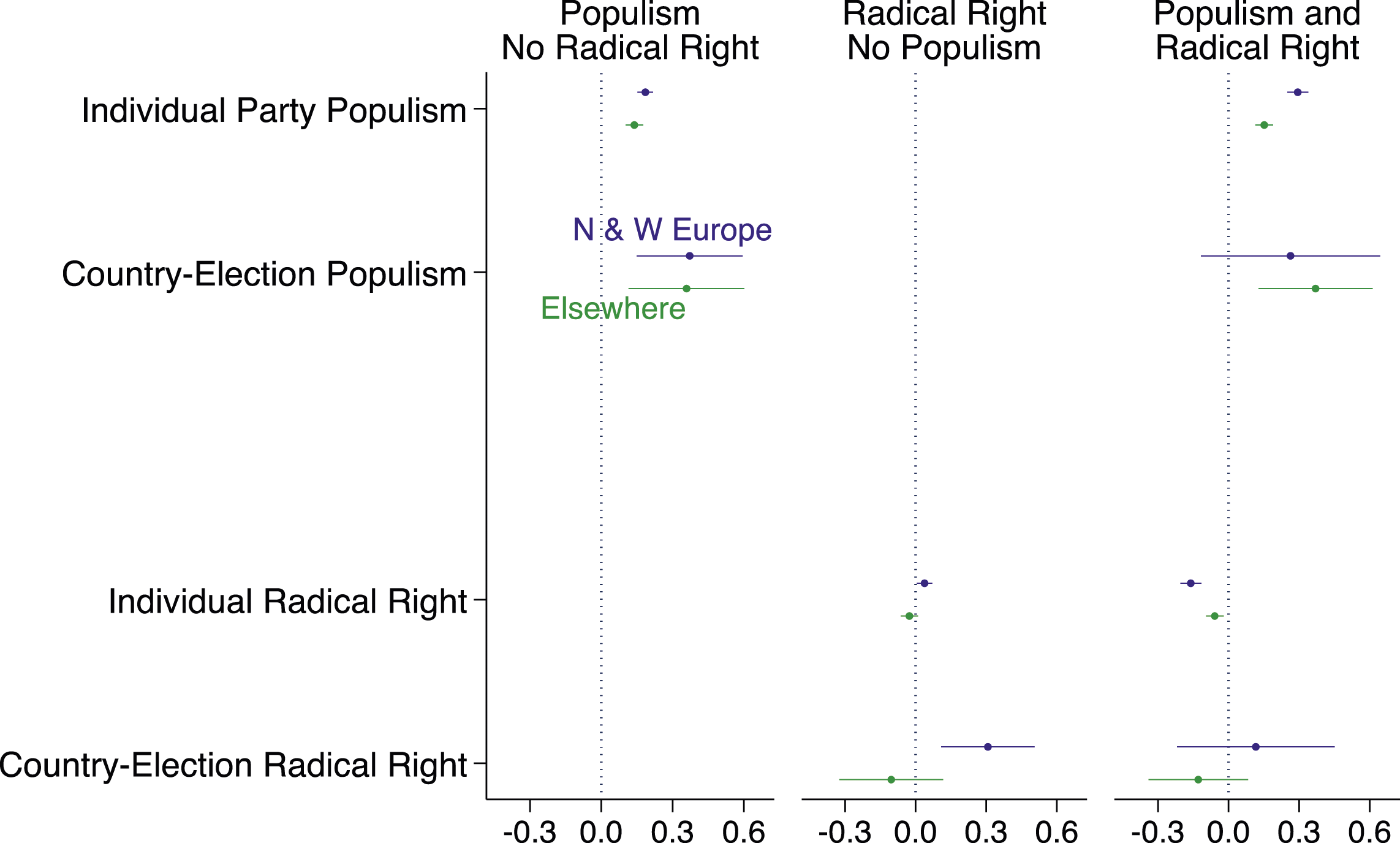
The results in the first column of Figure 5 show our Individual Party Populism and Country-Election Populism model (the first column of Table 1 and Figure 2), run separately for Northern and Western Europe and for all other regions. These show that our results for Hypotheses 1 and 2 hold in those regions separately. The second column of Figure 5 confirms the findings of earlier studies concerning the radical right: countries with radical right parties in Northern and Western Europe do experience unusually high levels of affective polarization, even after controlling for other common factors (excluding populism). This suggests that affective polarization is disproportionately high against the radical right. However, this country-election effect is unique to countries in Northern and Western Europe; individuals in countries with radical right parties in regions outside of Northern and Western Europe do not have more polarization. Furthermore, when we include populism in the model with Radical Right (third column of Figure 5), the effect of Individual Radical Right becomes negative, while the effect of Country-Election Radical Right weakens. The effect of Individual Party Populism remains about the same, and the effect of Country-Election Populism stays about the same, though less precisely estimated for Northern and Western Europe. We take this as evidence that much of the polarization effect of radical right parties can indeed be explained by their populist rhetoric, and that the effect of populism is the more general one.
Discussion and Conclusion
Our findings confirm both of our hypotheses. Sympathy for a populist party is correlated with higher levels of affective polarization across several regions of the globe, a finding which supports the claim found in the polarization and populism literatures. Additionally, however, higher levels of populist discourse in a country’s party system are correlated with higher levels of affective polarization for both populists and non-populists; this effect is especially strong for populists, but is still present for non-populists, and for some measures of populism it is just as strong for non-populists. This supports the argument that non-populists also begin to view their opponents with greater distrust and disdain as they come under threat by divisive populist rhetoric and improving populist electoral fortunes. Thus, populism can drive both sides of polarization. Significantly, populism (both individual and country-wide) is a predictor of polarization even in the face of the effects of ideological polarization and partisan attachment. These results further confirm the traditional explanations for affective polarization found throughout the literature while also suggesting that there is more to the story.
While these results provide an important confirmation of arguments now being made in the polarization and populism literatures, our causal argument requires further examination. Future research could rely on experiments and process tracing techniques to help isolate populism as a cause of affective polarization, and not just as a correlate or even a consequence of polarization. Admittedly, our general approach also leaves unanswered questions about the causal mechanisms underlying populism’s two-way polarizing effects. For example, whose rhetoric matters most in this process of polarization—that of political chief executives (especially populists in power), party leaders, or other influencers? Additionally, what are the underlying psychological mechanisms causing populists and their opponents to feel more negative affect? We have theorized that it is feelings of threat, but more fine-grained and experimental research is needed to confirm this argument.
Still, these results yield important insights for scholars focusing on both populism and affective polarization. Studies of populism’s consequences for democracy have thus far focused primarily on state-level effects on institutions (Huber & Schimpf, 2016; Kenny, 2020; Pappas, 2019). While these consequences are obviously significant, our results suggest that populism also has an impact on individual- and group-level phenomena, such as how willing citizens are to tolerate their political opponents. If populism affects more than elite-level behavior, pushing citizens and societies further down the spiral of conflict, then we have added reason for concern about the increase in populism around the globe.
For scholars studying affective polarization, our results suggest an important role for communication and language. Populism, as we have measured it, consists largely of a set of communicated ideas about the nature of politics and sovereignty. It is not reducible to a set of policy positions, and it reflects a deeper identity than that of partisanship, namely, who constitutes the demos (De Cleen & Stavrakakis, 2017). But if the language of populism inspires fear and a sense of threat, it seems critically important that non-populists–or as Stavrakakis (2018) calls them, anti-populists–not engage in the same divisive rhetoric as populists. There may be alternative languages or modes of communication that can reduce this threat. Just as the Manichaean, us-versus-them, rhetoric of populism is associated with higher levels of polarization, future research could test the ability of more bridge-building, pluralistic communications strategies to reduce affective polarization.
Additionally, instead of stooping to the polarizing rhetorical level of populists, non-populists could seek to address populists’ legitimate policy concerns. Shifting values of political elites (Norris & Inglehart, 2019), forced austerity by supranational organizations (Stavrakakis, 2018), growing inequality (Milner, 2021), trade shocks from increased globalization (Rodrik, 2018), and corruption (Castanho Silva, 2019) are all potential fuel for populist grievances. Non-populists interested in quelling the populist threat to liberal democracy could spend less time engaging in the pernicious cycle of polarization (McCoy & Somer, 2019) and more time identifying and solving the problems that motivate populist politicians and their supporters.
Supplemental Material
Supplemental Material - The Two-Way Effects of Populism on Affective Polarization
Supplemental Material for The Two-Way Effects of Populism on Affective Polarization by Braeden Davis, Kirk Hawkins, and Jay Goodliffe in Comparative Political Studies
Footnotes
Declaration of Conflicting Interests
The author(s) declared no potential conflicts of interest with respect to the research, authorship, and/or publication of this article.
Funding
The author(s) received no financial support for the research, authorship, and/or publication of this article.
Data Availability Statement
Davis, Goodliffe, Hawkins, 2024, “Replication Data for: The Two-Way Effects of Populism on Affective Polarization”,  , Harvard Dataverse, DRAFT VERSION.
Supplemental Material
Supplemental material for this article is available online.
Notes
Author Biographies
References
Supplementary Material
Please find the following supplemental material available below.
For Open Access articles published under a Creative Commons License, all supplemental material carries the same license as the article it is associated with.
For non-Open Access articles published, all supplemental material carries a non-exclusive license, and permission requests for re-use of supplemental material or any part of supplemental material shall be sent directly to the copyright owner as specified in the copyright notice associated with the article.
