




Abstract
Does religion shape political competition in Thailand? Despite the prominence of religiously inflected rhetoric of good and evil in contemporary political contestation, existing research suggests that it does not. This article challenges this conventional wisdom. Survey data collected in connection with Thailand’s 2019 general election, which marked a transition from direct military rule to a hybrid regime, allow us to examine the political relevance of religious belonging, belief, and behaviour. Our analysis finds evidence for the political salience of a secular/religious cleavage: voters who self-identified as more religious were more inclined to support the main pro-military party Palang Pracharath and its closest allies, whilst more secularised voters tended to support anti-military parties in general and the Future Forward Party in particular. We also find that Thailand’s religious minorities were politically divided: Muslims and Protestants backed the pro-military parties whilst Catholics opposed them. Our analysis underscores the need for more attention to the role of religious cleavages in Thai political contention.
Introduction
On the eve of the March 2019 election, Thailand’s King Vajiralongkorn urged the citizenry to support ‘good persons’ (khon di) for the government of the country. That appeal summed up a recurring concern of the kingdom’s political establishment to promote a Buddhisized notion of virtuous government – rule by good persons. Whilst there was little overtly religious in this royal plea for voters to back the righteous, it is an example of a traditionalist Thai Buddhist moral-political discourse intended to mobilize pious voters. Whilst general calls for morality are not necessarily politically partisan, in the Thai context it could be, and was, interpreted as a royal reminder that some parties competing in the election were more virtuous than others. A vibrant election campaign had made clear that the choice that the electorate faced was, effectively, whether to choose parties supporting or opposing the incumbent prime minister, General Prayuth Chan-ocha. In May 2014, the then Commander-in-Chief of the Royal Thai Army had staged a coup which toppled the coalition government led by the Pheu Thai Party (PTP). In the 2019 election campaign, Prayuth had been nominated as the prime ministerial candidate of several parties, including but not limited to the military’s main proxy, the Palang Pracharath Party (PPRP, established in 2018). The military-appointed drafters of the 2017 constitution had paved the way for an unelected prime minister to emerge once the votes had been counted. Prayuth would only need to win the support, in a joint sitting, of the elected lower house and the military-selected and appointed upper house. Following the election, the general continued to serve as prime minister with backing of a coalition of pro-military parties.
From a certain conservative and ultra-royalist perspective, the 2019 election was just the latest skirmish in a Manichean struggle between the self-proclaimed forces for Buddhist righteousness in politics and their ‘evil’ opponents. The latter were represented by PTP, closely associated with the Shinawatra siblings whose elected governments, following politically paralysing street protests against their ‘corruption’ (Sinpeng 2021), had been overthrown by the military in 2006 (Thaksin Shinawatra) and 2014 (Yingluck Shinawatra). Indeed, the junta and its backers had turned into law, binding on future governments, a 20-year national strategic plan which, among other things, aimed to transform the kingdom into a dhammacracy (Thai: thammathipatai) – a form of democracy in which righteousness rules. The king’s call for voters to make sure that ‘good persons’ triumphed in the general election was therefore widely perceived as an unabashed endorsement of the 2014 coup group’s continued role in government, and thus of their prospective parliamentary allies.
General Prayuth’s main rival for the prime ministership was a veteran Bangkok politician regarded, by some, as a female paragon of lay Buddhist piety. Sudarat Keyurapan had played a leading role in the Palang Dharma Party (‘moral force’) in the 1990s and in 1998 she had co-founded the Thai Rak Thai Party, the electoral juggernaut which brought Thaksin Shinawatra to a position of unprecedented domination of Thailand’s electoral landscape. By the time of the 2006 coup she served as Minister for Agriculture and Cooperatives, and in its wake she was banned from politics for 5 years. Exiled from democratic politics and branded as one of the country’s leading ‘evil’ politicians, Sudarat turned to bolstering her religious credentials. She played a prominent role in high-profile Buddhist charity projects, earned numerous awards for her exemplary support of Buddhism, and in 2018 graduated with a doctorate in Buddhist Studies from the state university run by the country’s largest Buddhist order (and well known as a hotbed of Buddhist nationalist activism and resistance to the military’s efforts to ‘reform’ and ‘purify’ the sangha). By nominating Sudarat as its candidate for prime minister for the 2019 election, PTP (established in 2008) had picked a figurehead who presented herself as an embodiment of dedication to the flourishing of Buddhism (Chaiyen, 2012; Larsson, In press). Implicitly, at least, this sought to signal that PTP was led by a ‘good person’ too.
As these vignette suggests, religiously coloured language, symbols and associations were being mobilized in political struggles in the run up to Thailand’s 2019 general election. This is more puzzling than it may appear. The conventional wisdom holds that religious factors do not matter in Thai party politics and electoral politics. The data from the CSES survey conducted in connection with the election allow us to assess whether religious factors perhaps play a greater role than the existing literature has recognized. There are at least two good reasons to expect that they may.
Firstly, over the past two decades a great deal of research has pointed to the increasing role of religion as a feature of political contestation in Southeast Asia, most notably in Muslim-majority societies (Buehler 2013; Fossati 2019). More recently, scholars have highlighted similar tendencies manifesting also in Theravada Buddhist societies in Southern Asia, where anti-Islamic discourses and movements have suddenly emerged as prominent factors in relation to electoral politics (Reny 2020; DeVotta 2021). In the past 20 years, religious identities and issues have become focal points for political struggles also in Thailand. This trend has been driven by three main factors. Firstly, a Malay Muslim separatist insurgency which erupted in 2004. Secondly, cycles of mass mobilization against the ‘corruption’ of Thai democracy by Thaksin Shinawatra’s Thai Rak Thai Party and its successors, in which religiously coloured moralistic rhetoric was weaponized (Sinpeng 2021). Thirdly, a growing perception that Buddhism was suffering a ‘crisis of legitimacy and credibility’ (McCargo 2012: 629), which, in turn, triggered two different but equally contentious responses. On the one hand, Buddhist nationalists mobilized to demand (unsuccessfully) that Buddhism be established as the country’s official state religion in the 2007 and 2017 constitutions. And on the other hand, in the wake of the 2014 coup the military junta, known as the National Council for Peace and Order (NCPO), launched a campaign, led by ultra-royalist lay persons, to ‘reform’ Thai Buddhism (Kulabkaew 2019; Larsson 2022).
Secondly, the platforms of political parties contesting the 2019 election varied in the extent to which and how they referenced religious issues and identities. Drawing on research which complements this article (Larsson, In press), we may briefly point to a few noteworthy patterns. Firstly, the pro-Prayuth parties tended to at most invoke ‘morality’ and ‘religion’ in general but stayed clear of making explicit references to any particular religion, such as Buddhism or Islam. Secondly, the platforms of two key parties in the pro-democracy camp made explicit appeals to particular identities, with PTP addressing Buddhist concerns (which it had not done in previous elections) and Prachachat (formerly a faction in PTP) addressing Muslim concerns. Thirdly, Future Forward (FFP) presented itself as a ‘secular’ party for which religion was a matter of personal choice and a matter for public policy only to the extent that the state should guarantee religious freedom and non-discrimination. During the campaign, the party’s leader was attacked as a proponent of a radical, in the Thai context, form of secularism, and its candidates were often forced to defend themselves against the charge that the party posed a threat to Buddhism and religion. Finally, we may draw attention to the fact that the Democrat Party’s (DP) 2019 party platform had removed all indications of support for Islam contained in the 2008 platform. This suggests that the party feared that explicit appeals to Muslim voters now risked alienating some Buddhist voters. Taken together, this evidence indicates that parties contesting the 2019 election deployed discourses with religious valence in distinct ways which might be expected to resonate more with some voters than others, depending on their religious affiliations and attitudes.
This article contributes to our understanding of political parties and voting behaviour in Thailand by exploring and demonstrating the salience of religious factors in the 2019 general election. Our analysis proceeds in two steps. Firstly, we explore how the support bases of Thai political parties reflect religious cleavages. We find that Thai political parties in terms of their sociological make-up indeed have distinctive religious profiles, along two main dimensions. The first is the degree to which parties are dependent on support from the country’s Buddhist majority versus the country’s religious minorities. The second dimension is the degree to which voters who place themselves at different ends of the religiosity spectrum support different parties. Within the Thai party system, these two dimensions overlap to some extent. The parties that are backed, disproportionately, by religious minority voters also tend to be supported, disproportionally, by more pious members of the electorate. Conversely, the parties that are more heavily dependent on Buddhist majority backing are also disproportionately supported by the more secularized segments of the electorate. Secondly, we explore whether the relationships between religious factors and vote choice hold when controlling for other social factors. Our statistical analysis shows that associations between religious factors and vote choice are statistically significant even when we control for other social cleavages. Taken together, these findings suggest that scholars who wish to advance the social-scientific understanding of political competition in Thailand should pay careful attention to the role of religious identities, religiosity and religious practices.
Religion, political parties and party choice in Thailand
Whilst it is widely agreed that religion – and Buddhism specifically – constitutes an important source of political legitimacy in modern Thailand (Larsson 2019, 2022), studies of Thai electoral politics have hitherto generally neglected religious factors.
Previous research on Thai political parties have emphasized how they are built around families, cliques and factions (Chambers 2008; Ockey 2015). Though some ideological and sociological divides have been identified as having enduring political salience – pro- versus anti-royalist, centre versus periphery, left versus right, pro- versus anti-military (Ockey 2005) – religion is not among them. Neither has a stable party system reflecting such cleavages emerged. Scholars explain that the institutionalization of the party system in Thailand has been undermined by frequent military coups, repression and constitutional engineering (Kuhonta 2014). Indeed, the 2006 and 2014 military coups were motivated, in no small part, by a desire to reverse a trend towards stronger and more programmatic parties (Hicken, 2013; Selway, 2011). The electoral rules were thus re-engineered in order to protect the interests of the royal and military elites from majoritarian challengers (Chambers and Waitoolkiat 2020). The inclusive nature of ‘official’ Thai nationalism has also inhibited the politicization of religious cleavages (Ricks 2019a, 2020). In the literature on Thai political parties and the party system, therefore, religion is conspicuous by its absence.
Religious factors have been neglected also in extant studies of vote choice in Thailand. The pioneering study by Bunbongkarn and Phongphaeo (1984) considered four socioeconomic factors (age, education, residency and occupation) but not religious factors. Studies of electoral behaviour of Muslims and Buddhists in Southern Thailand have argued that religious identity is not a salient factor (Albritton 2010; Albritton et al., 1996). Recent studies of parties and voting behaviour in Thailand contain no mention of ‘religion’, ‘Buddhism’, or ‘Islam’ (Hicken 2013; Huang and Thananithichot 2018; Ockey 2005). Studies of the 2019 election, widely characterized as neither free nor fair, have similarly highlighted the enduring centrality of factionalism, clientelism and material interests, thus underscoring the limited salience of social cleavages in Thai electoral politics today (Ricks 2019b; Selway 2020). Despite the profusion and indeed weaponization of religiously imbricated political discourse in Thailand over the past two decades, religious cleavages have hitherto been ignored in studies of electoral competition.
The few studies that have explored religion in relation to Thai electoral politics have all adopted a narrow conception of religion, reducing it to a matter of identification. Priority has been placed on comparing the political orientations of ‘Buddhists’ with those of ‘Muslims’ (Albritton 2010; Albritton et al., 1996). In contrast, this paper follows what has become standard in quantitative studies of religion and politics, and conceptualizes religion as a multifaceted phenomenon. To explore the significance of religious factors in the 2019 election, we disaggregate religion into three main dimensions: belonging, belief, and behaviour (see Smidt et al., 2009).
Data and methods
To study the link between religious factors and voting we use Comparative Study of Electoral Systems (2020) survey data gathered in connection with Thailand’s 2019 general election. 1 Data collection for this survey was organized by King Prajadhipok’s Institute between 25 February and 15 March 2019. The respondents were identified through a probability sampling of eligible Thai voters, which includes all Thai citizens 18 years of age and older. The survey included 1537 respondents. The sample corresponds closely with the country’s religious demography as reported by the National Statistical Office (2020, viii): 93.5% Buddhist; 5.4% Islam; 1.1% Christian; and less than 0.1% ‘other’. Muslims are concentrated in the country’s South, where they comprise 28.9% of the population. The highest proportions of Christians are found in the North (3.0%) and Bangkok (1.3%). 2
The analysis proceeds in two steps. Firstly, we calculate, for each of the five major political parties the proportion of their supporters who belong to different religions: Buddhism, Islam, Catholicism, Protestantism and Other. We then calculate where the supporters of different political parties are positioned in terms of religious belief and behaviour. We operationalize religious belief by using responses to a survey question which asks whether religious respondents consider themselves to be non-religious, not very religious, somewhat religious, or very religious. To create the religious belief variable, we recode the answers on a 3-point scale, where the value of 0 stands for ‘non-religious’, 1 for ‘moderately religious’ (combining ‘not very religious’ and ‘somewhat religious’ responses), and 2 for ‘very religious’. Religious behaviour is operationalized in terms of voters’ self-reported frequency of attendance at religious services (excluding special occasions such as funerals). The original question asks the respondents to choose from a scale ranging from 1 to 6: never (1); once a year (2); two to 11 times a year (3); once a month (4); two or more times a month (5); once a week/more than once a week (6). This scale is recoded to create the religious behaviour variable, which is measured on a scale from 0 to 3, where the value of 0 stands for ‘never’, 1 for ‘occasionally’ (combining ‘once a year’ and ‘two to eleven times a year’ responses), 2 for ‘frequently’ (combining ‘once a month’ and ‘two or more times a month’ responses), and 3 for ‘very frequently’ (‘once a week/more than once a week’ responses).
Secondly, we construct seven logit regression models to estimate the religious effects on voting choice in Thailand’s 2019 election. Dependent variables for the models are binary variables of voter support for each of the five individual political parties as well as for either of the two main political blocs. The five individual political parties are PPRP, PTP, FFP, DP and Bhumjaithai (BJT). The ‘pro-Prayuth’ bloc is made up of political parties supportive of the legacy of the 2014 coup and of Prayuth continuing as prime minister: PPRP, the Action Coalition for Thailand (ACT), and the People Reform Party (PRP). The ‘pro-democracy’ bloc combines votes for the parties most explicitly opposed to the legacy of the 2014 coup: PTP, FFP, Thai Liberal Party (TLP), Pheu Chat Party (PCP), Prachachat Party (PP) and New Economy Party (NEP). For each party choice model, religious belonging, religious belief and religious behaviour are employed as the main independent variables and are measured as below.
For models 1–4, the religious belonging variables are the main independent variables. These variables are separately measured as a binary variable, where 1 is coded for respondents who identify as Buddhists (model 1); Muslims (model 2); Catholics (model 3); or Protestants (model 4) and 0 is coded for respondents who do not identify as such. The religious belief and religious behaviour variables, which are measured in the same way as in the first step of this paper’s analysis explained above, are separately the main explanatory variables in models 5 and 6, respectively; and they are jointly the main explanatory variables in model 7.
The effects of religious belonging, belief and behaviour on party choice are compared with the effects of control variables highlighted by the extant literature on electoral behaviour in Thailand. The first control variable is the degree of urbanization (Huang and Thananithichot 2018; Laothamatas, 1996; Thananithichot 2012). This variable is classified as a 4-point scale variable identifying the type of area in which respondents live: 0 for village; 1 for small or middle-sized town; 2 for suburb of large town or city; and 3 for a city or metropolitan area. Previous studies on the effects of education on voting behaviour at general elections in Thailand have shown that voters with a lower level of education are more likely to turn out and vote than voters with higher level of education (Albritton and Bureekul 2008). In this study, the survey question that asked respondents about their highest level of education is used as a measure of education, on a scale ranging from no formal education (0) to doctoral degree or equivalent (8).
Since the emergence and remarkable success of FFP in the 2019 election, the generational effect on voting choice has received considerable attention (McCargo and Chattharakul 2020; Ockey 2020). The emerging consensus is that the pro-Prayuth parties received disproportionate support from older voters, whilst FFP in particular obtained significant support from younger voters and especially from first-time voters. The age variable, measured as the respondent’s actual age in years, is employed to evaluate generational differences in voting decisions.
Region of residence is another variable that the literature on electoral behaviour in Thailand has drawn attention to (Lumphasi and Sakworawitch 2018; Selway 2021; Thananithichot 2021). For our regression models, a northern and northeastern region dummy variable is constructed, coded 1 for respondents who live in the northern or northeastern region and 0 for respondents who live elsewhere.
Also included is another measure linked to social cleavages in Thai politics – language spoken at home. Extant research has drawn attention to the political importance of language as a marker of identity, with particular significance attributed to the minority languages Malay (Albritton 2010) and Lao (Ricks 2019b, 2020). Relying on the survey question that asked the respondent about the language they normally use for speaking at home, we construct a dichotomous variable, where respondents that speak central Thai at home are coded as 1 and respondents that speak any other language at home are coded as 0.
To examine the connection between religion and voting for a pro-military party in particular, we calculate the average marginal effects of three religious factors – Buddhist identity, religiosity and religious service attendance – on the likelihood that a respondent supports a party in the pro-Prayuth bloc. To contextualize this, we also compare the effects for the five main political parties.
Finally, along the lines of Kotler-Berkowitz (2001) we present the results of bivariate crosstabulations and multinominal regressions for (1) the pro-Prayuth and pro-democracy blocs, (2) the two main parties of the respective blocs, i.e., PPRP and PTP, and (3) PPRP and the second-largest party in the anti-military bloc, FFP. These paired comparisons exclude voters for other parties and thus better capture the effects of religious factors along the politically most consequential lines of competition.
Empirical results
Religious belonging and party choice
Religious belonging and composition of party support (%).

These differences in the religious make-up of the people backing different political parties suggest that voters sort themselves into different political parties in part based on their religious affiliations. In short, Muslim voters gravitate towards PPRP and BJT, and away from PTP, FFP and DP. Christians are politically divided, with Protestants disproportionally favouring PPRP and Catholics favouring FFP. Whether there is a causal relationship between religious identity and party choice is a question we return to below.
Religious belief and party choice
Religious belief and composition of party support (%).

Religious behaviour and vote choice
Religious behaviour and composition of party support (%).

Religious determinants of party choice
Summary of effects of religious factors on party choice in Thailand’s 2019 election.
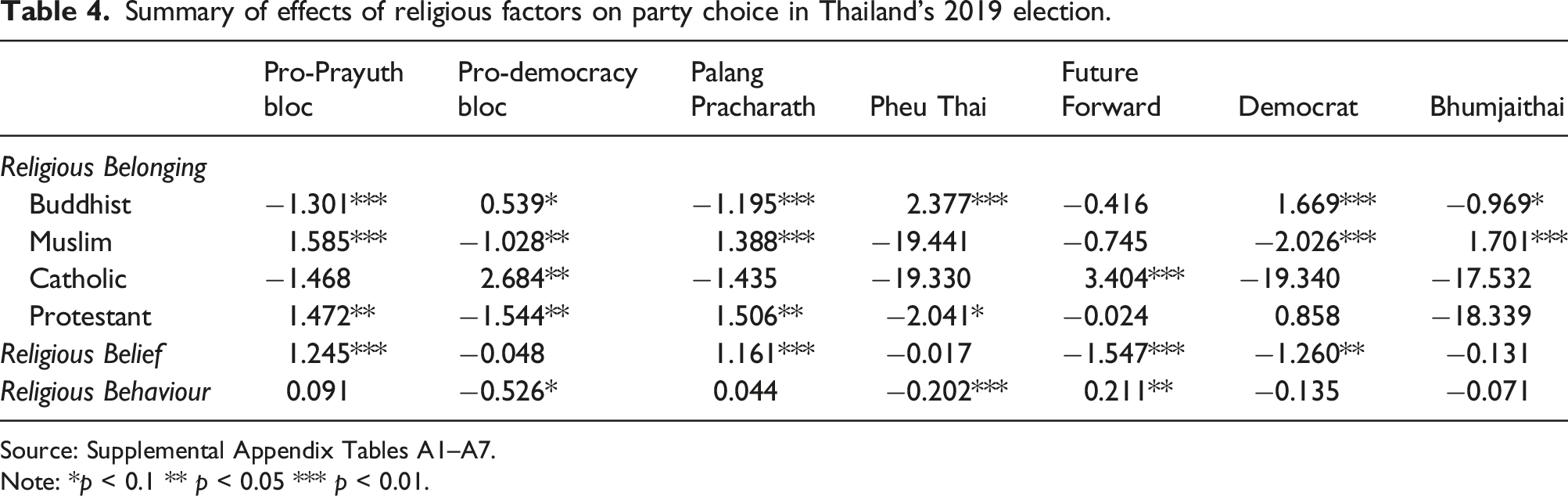
Source: Supplemental Appendix Tables A1–A7.
Note: *p < 0.1 ** p < 0.05 *** p < 0.01.
The analysis shows that religious divisions affected vote choice in the 2019 election. Buddhist identity was statistically significant in all analyses except for FFP. Buddhist voters disproportionately lent their support to PTP and DP and demonstrated a strong disinclination to support the pro-military alliance, PPRP, and, to a lesser extent, BJT. Muslim identity was statistically significant in five of the seven analyses. Muslim voters chose to lend disproportionate support to the pro-military alliance, PPRP and BJT, whilst rejecting the pro-democracy bloc and DP. Catholic identity was statistically significant in two of the seven analyses. Catholic voters showed themselves to be particularly inclined to vote for FFP, and, by extension, for the pro-democracy bloc. Protestant identity was statistically significant in four of the seven analyses. Protestant voters proved to be enthusiastic supporters of the pro-military alliance and PPRP and disinclined to back the pro-democracy bloc and PTP.
The analysis also showed that religious beliefs and religious behaviour significantly affected vote choice in the 2019 election. Voters who considered themselves to be more religious voted in ways that differed from the less religious, with the belief variable achieving statistically significant results in four of the seven analyses. Religious voters disproportionately chose the pro-military alliance and PPRP, whilst rejecting FFP and DP. Religious practices have some electoral salience, but less so than religiosity as a matter of belief. The religious behaviour variable was statistically significant in only two of the six analyses. Voters who more frequently participate in religious activities were less likely to vote for the pro-democracy bloc and PTP, and more likely to vote for FFP. Whilst not reaching conventional standards of statistical significance, religious behaviour correlate positively with support for the pro-Prayuth bloc and PPRP. The values of the coefficients suggest that the effect of religious belief, on average, was stronger than that of religious behaviour. Taken together these findings suggest that Thailand’s voting public is, in part, split along religious lines. Voters who are more religious in terms of belief and behaviour appear somewhat more inclined to support the pro-military conservative block and PPRP than to back their rivals.
Traditional religious identities were also found to divide the Thai electorate. Religious minority groups, and especially Muslims and Protestants, supported the pro-military bloc and PPRP. Buddhist voters, on the other hand, reveal a predisposition to support the pro-democracy bloc and PTP and DP. Thai Christians are internally divided: Protestants tend to back the pro-military alliance and PPRP, whilst Catholics have emerged as strong supporters of the 2019 election’s most progressive and anti-establishment party, FFP.
The statistical results also highlight the salience of other social cleavages in determining vote choice in the 2019 election. The pro-military and pro-establishment bloc and PPRP found strong support among Central Thai speakers and older voters. A regional cleavage is also evident, with voters in the north and northeast flocking to the pro-democracy bloc, PTP and FFP. There is also some support for the salience of urban/rural and education cleavages, but these variables have a spottier record and the size of the coefficients are on average small. Nevertheless, urban voters tended to back the pro-democracy bloc, PTP, and FFP, whilst rural voters tended to back the pro-Prayuth bloc and PPRP, DP, and BJT. The more highly educated segments of the voting public supported the pro-Prayuth bloc and PPRP, whilst the less educated supported PTP.
To what extent do religious variables explain electoral decisions? Figure 1 displays the marginal effect of each religious variable on party choice, assuming the control variables are fixed at their mean values. It indicates that a voter’s religious belong, belief and behaviour are important determinants of their electoral decisions. It also indicates that religious identity and religious belief are significantly more influential than religious behaviour in explaining their choice of party. We know from Table 1 that Buddhists were less likely to support the pro-Prayuth bloc and PPRP and more likely to support the pro-democracy bloc and PTP. Figure 1 confirms this finding, indicating that a Buddhist voter is 20% less likely than a non-Buddhist voter to vote for a pro-military party and 40% more likely to vote for PTP, if the control variables are held at their mean values (as in model 1). This shows that religious minorities constitute an important base of support for the pro-military parties. Figure 1 also indicates that religiuos belief to a corresponding degree affects voting decisions for the pro-military parties and PPRP (positively) and FFP (negatively). In contrast with both religious identity variables and religious belief, religious service attendance has a substantively more marginal effect on electoral choices. Substantive effects of religious belonging, belief, and behaviour in Thailand’s 2019 election. Note: The values represent the probability that a voter would vote for the political party. The dots indicate the marginal effect of each variable when other variables are constant at their mean values. The solid vertical lines represent 95% confidence intervals.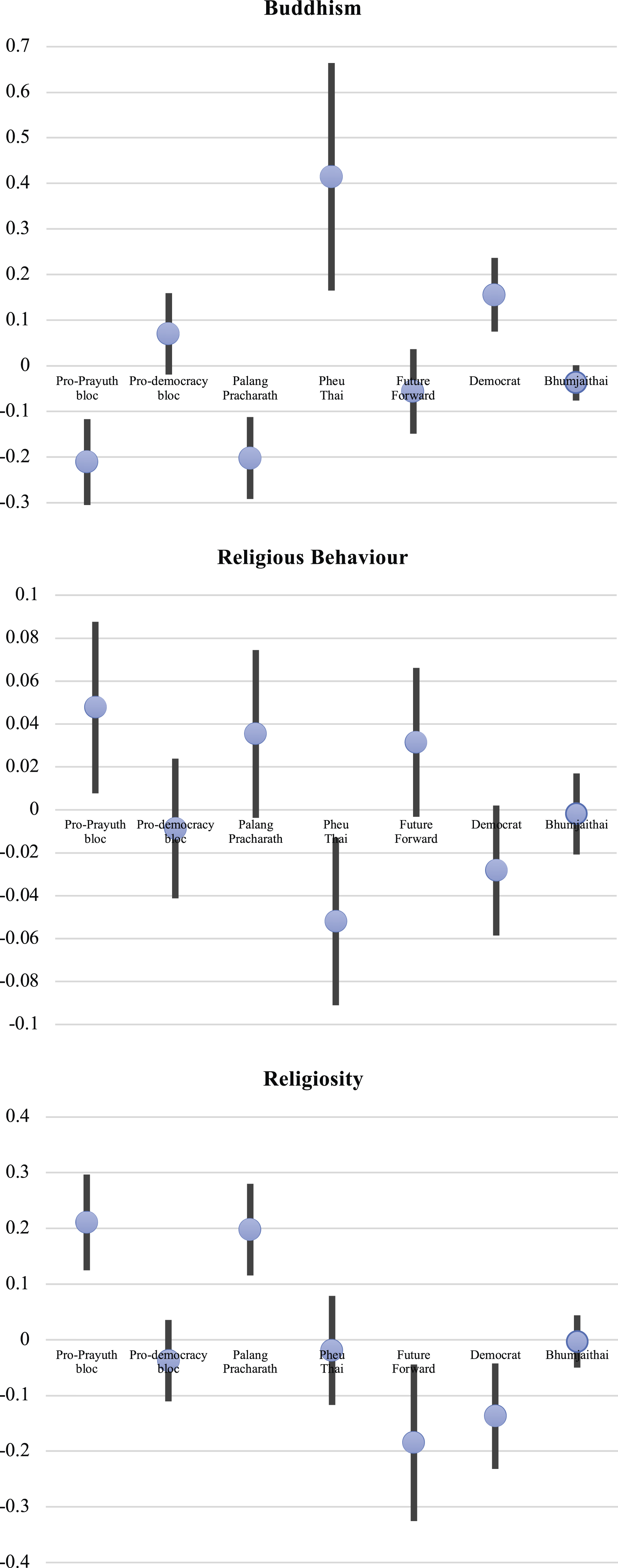
There is a statistically significant relationship between the religious variables and political partisanship. These relationships hold also when controlling for other social characteristics.
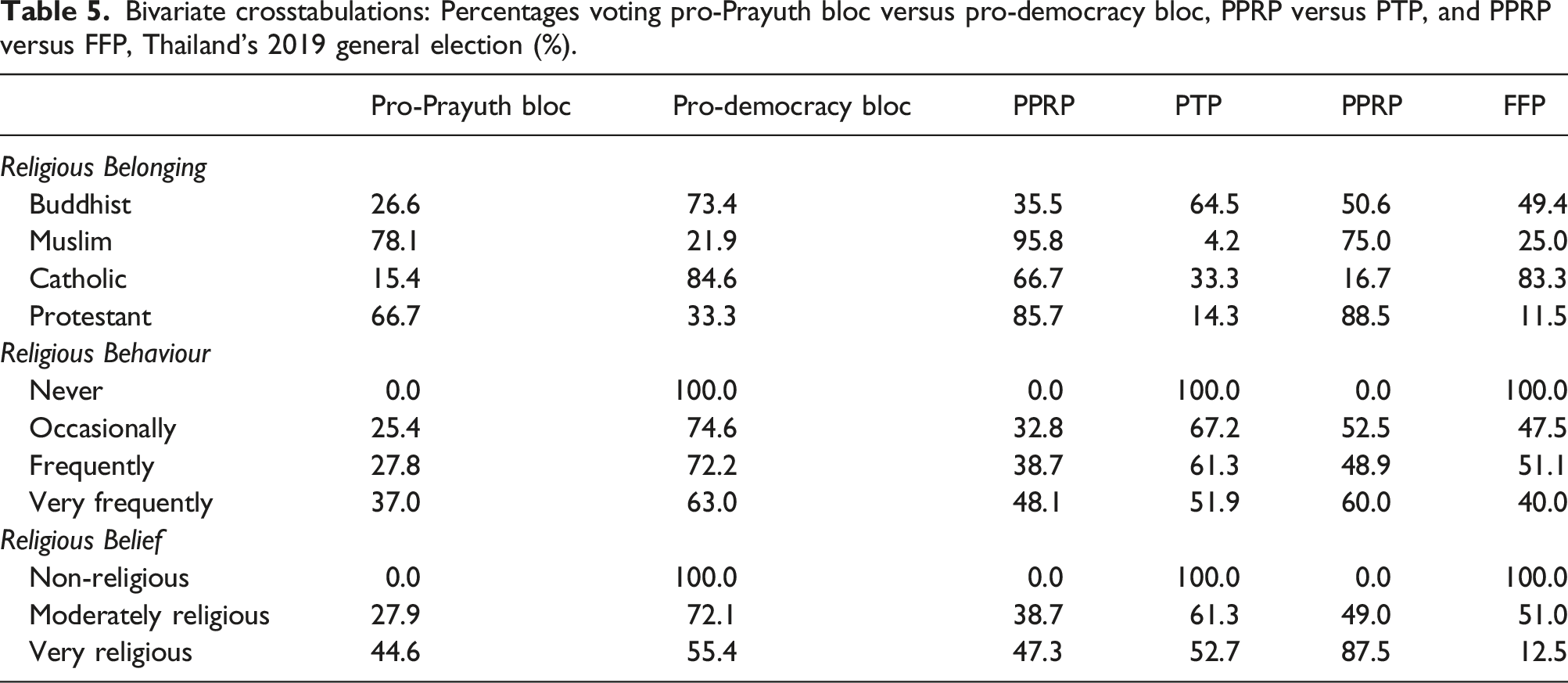
Bivariate crosstabulations: Percentages voting pro-Prayuth bloc versus pro-democracy bloc, PPRP versus PTP, and PPRP versus FFP, Thailand’s 2019 general election (%).
Multinominal logistic regression: pro-Prayuth bloc compared to pro-democracy bloc vote, PPRP compared to PTP vote and PPRP compared to FFP vote.
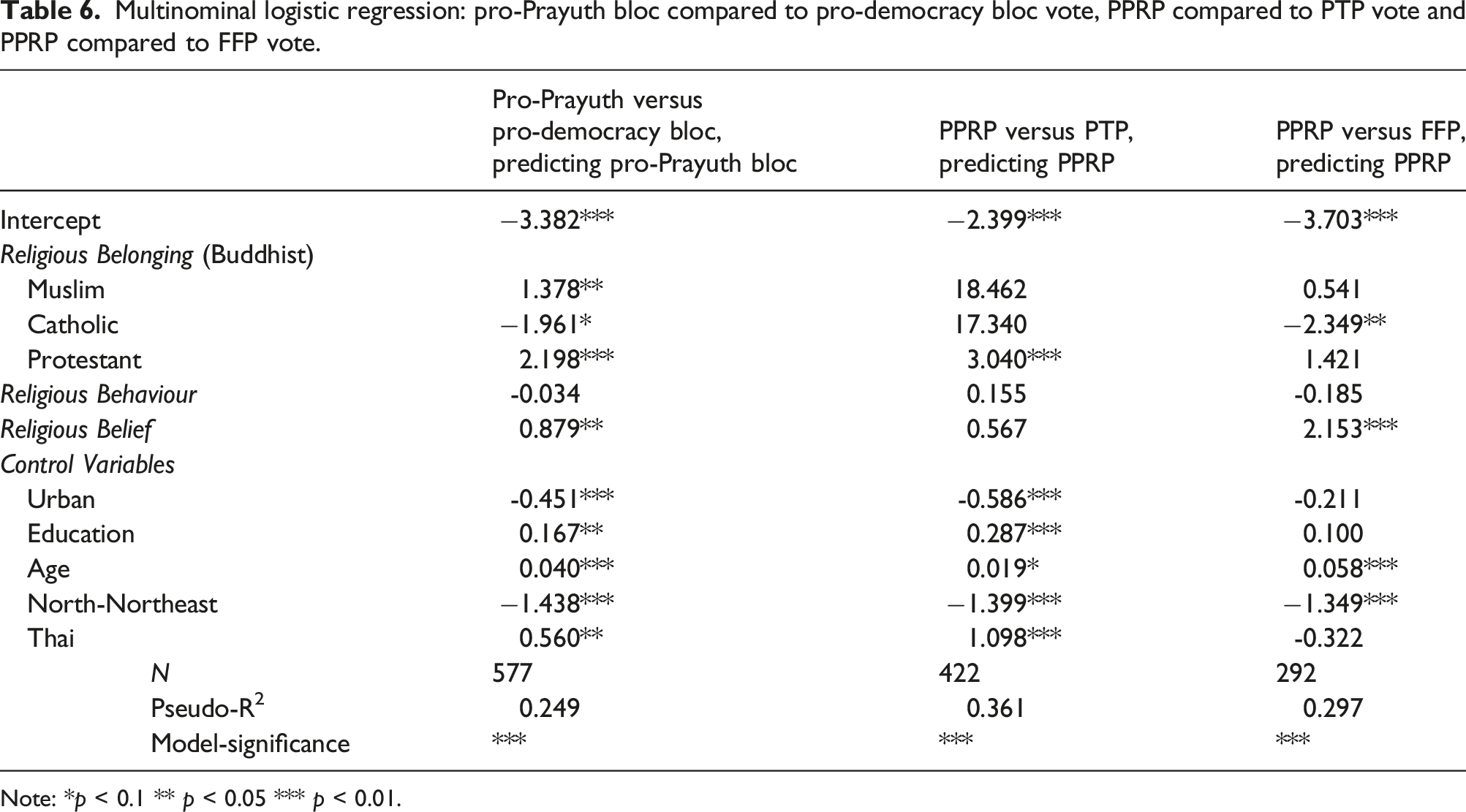
Note: *p < 0.1 ** p < 0.05 *** p < 0.01.
The results from multinominal regression analysis thus lend additional support to our overarching argument: religious factors were politically more salient in the 2019 election than the relevant literature would lead scholars to expect. However, they also reveal that the effects of religious factors are more readily apparent at the level of the two main rival blocs (pro-Prayuth versus pro-democracy) than at the level of the two largest parties in the respective blocs (PPRP versus PTP). This suggests that many of the religious effects may be driven by voters for smaller parties in the respective blocs. Indeed, the secular/religious cleavage is most pronounced in the paired comparison of PPRP and FFP voters.
Discussion and conclusion
We studied the relation between religious factors and voting in Thailand, using survey data collected during the campaign for the March 2019 general election. The rise of religion in politics globally and regionally led us to investigate whether religious factors are politically salient also in Thailand. In contrast with the conventional wisdom, which holds that religious cleavages play no role in electoral competition in Thailand, we find that religious belonging and belief in particular influence party choice.
This article demonstrates that religion was an important predictor of voters’ party choices in the 2019 national election to the House of Representatives in Thailand. Based on an analysis of public opinion data, we argue that this relationship is not due to differences in the social profiles of different religious groups. Rather, we show that the relationship mainly, but not exclusively, reflects religious majority/minority dynamics. Given that most Thais identify as Buddhists, all major parties have a Buddhist majority support base. But some parties are monolithically Buddhist (PTP) whilst others are markedly religiously pluralistic (the pro-Prayuth bloc, BJT). This article has also highlighted the political salience of a social cleavage between religious ‘traditionalists’ (for whom religious beliefs are very important) who flock to the pro-military parties and ‘secularists’ (for whom religious beliefs have little meaning) who mainly support FFP and DP. Our findings challenge conventional views of the marginal role of religion as a determinant of political behaviour in Thailand. They may have implications for how we understand, and study, electoral politics in Thailand.
Following the 2019 election, the five parties in the pro-military bloc – PPRP (which won 116 seats), ACT (5 seats) and PRP (1 seat) – formed the core of the parliamentary support base which allowed former junta leader Prayuth to continue to serve as prime minister. The ruling coalition was bolstered by support from the DP (53 seats), BJT (51 seats), Chartthaipattana (10 seats), Chart Pattana (3 seats) and a large number of smaller parties. PTP (136 seats), FFP (81 seats), TLP (10 seats) and PP (7 seats) constituted the core of the opposition.
One of the implications of our findings is that the perpetuation of military-dominated forms of rule in Thailand can at least in part be attributed to the tendency for the most religious segments of the population as well as some religious minorities (Muslims and Protestants) to side with pro-military parties. In other words, religious factors play a role in sustaining authoritarian and hybrid regimes in Thailand. However, they do not necessarily do so in a straightforward manner. For example, whilst survey data revealed that Muslim voters disproportionately signalled support for pro-military parties, we also know from the actual election result that PP, a member of the pro-democracy bloc, tended to come out on top in the parts of the country where Muslims constitute a majority.
We hope that this research inspires further research into the role of religion in Thai political contestation. A number of potentially fruitful avenues of inquiry suggest themselves. The first concerns change over time. Are the effects of religious factors on electoral behaviour that we identify for 2019 novel phenomena or were they present also in earlier elections? It is important to emphasize that this article has identified the salience of religion in a single election only. Further research is needed to establish whether similar patterns were present in previous elections. And it cannot be assumed that they will manifest in future elections. Thailand’s next election will be conducted under different electoral rules, and it is uncertain whether the more secularist segments of the population will be able to find as congenial a political home as FFP, which has been dissolved by the constitutional court. The second concerns scale. Whilst the national data we have used indicates that religious factors matter for vote choice, it would be desirable to evaluate their salience in particular constituencies. With more granular data it would be possible to evaluate the salience of religious factors in party strongholds and swing constituencies. It is thus a task for future research to assess whether and, if so, how religious factors determine the outcome of electoral competition at the constituency level. The third concerns causality. Experimental methods have become increasingly popular also in studies of Thai electoral behaviour. These can and should be applied to seek to address how religious belonging, belief, and behaviour affect the political attitudes and electoral choices of Thai voters. A fourth concerns limitations of the available data. With regards to religious identity, for example, it would be desirable to get more fine-grained data for the broad ‘Buddhist’ category to which the vast majority of Thais belong. We know, for instance, that the opposition to Thaksin Shinawatra has been particularly strong among followers of Santi Asoke and of prominent monks in the forest tradition of the Thammayut sect. Conversely, Wat Phara Dhammakaya has been linked, rightly or wrongly, with support for the Shinawatra side of Thailand’s political divide, as have prominent ecclesiastics in the Mahanikai sect. It is therefore possible that affiliation with different Buddhist movements and traditions are associated with differences in political partisanship. It would be desirable for future surveys to better reflect the different religious affiliations of Thai Buddhist, as well as to tailor indicators of religious behaviour to the Thai religious context. One weakness of the CSES measure of religious behaviour is that it reflects a behavioural norm that is more Christian than universal (i.e. going to church). To advance the study of religion and politics in Thailand, it is therefore desirable for future research to generate data on religious behaviours that are more relevant in the context of Thai Buddhism (praying, giving alms, keeping the five precepts) and Islam (praying, giving alms, fasting, pilgrimage). Finally, these findings should inspire comparative work on the role of religious factors in relation to political behaviour also in other predominantly Theravada Buddhist societies (i.e. Sri Lanka, Myanmar, Cambodia and Laos).
Supplemental Material
sj-pdf-1-ppq-10.1177_13540688221075586 – Supplemental Material for Who votes for virtue? Religion and party choice in Thailand’s 2019 election
Supplemental Material, sj-pdf-1-ppq-10.1177_13540688221075586 for Who votes for virtue? Religion and party choice in Thailand’s 2019 election by Tomas Larsson and Stithorn Thananithichot in Party Politics
Footnotes
Declaration of conflicting interests
The author(s) declared no potential conflicts of interest with respect to the research, authorship and/or publication of this article.
Funding
Parts of the research published here received financial support from the European Union’s Horizon 2020 Program for Research and Innovation within the framework of the project CRISEA (‘Competing Regional Integrations in Southeast Asia’), grant agreement No. 770562/Europe in a changing world, Engaging together globally.

Supplemental Material
Supplemental material for this article is available online.
Notes
Author biographies
References
Supplementary Material
Please find the following supplemental material available below.
For Open Access articles published under a Creative Commons License, all supplemental material carries the same license as the article it is associated with.
For non-Open Access articles published, all supplemental material carries a non-exclusive license, and permission requests for re-use of supplemental material or any part of supplemental material shall be sent directly to the copyright owner as specified in the copyright notice associated with the article.
