




Abstract
This paper explores an alternative mechanism for understanding the drivers of the nomination of women for elective office in single-member electoral systems. Previous research has generally examined two sources of gender-based politics: party ideology, with leftist parties being more female-friendly than rightist parties, and the strategic nomination of candidates depending on whether the party is expected to win or lose in the district, with women more likely to be used as ‘sacrificial lambs’ in hopeless contests. We argue that the nomination of male and female candidates across districts reflects an interdependence of party strategies – in particular, the actions of the main opposition party. We hypothesise that when the trailing party is not committed to gender equality, its equilibrium strategy in a given district is the nomination of a candidate of the same gender as that of the front-running party. Secondary data from 1,017 single-member Australian districts and more than 2,000 candidates from 2001–2019 confirm our hypothesis.
Introduction
A crucial strategic decision of political parties when an election occurs is the selection of candidates. The choices that parties make affect not only their election results but also the representation of women and minorities. The decisions of parties to offer their voters female candidates is a precondition for attaining the equal representation of women. Although the attitudes of voters may play a role in explaining the under-representation of certain groups, if female candidates are under-represented on ballot papers, then representation will be biased against women.
There is a rich literature explaining when and why parties select female candidates. Two sources of gender-based politics have been extensively examined: party ideology, with leftist parties being more female-friendly than rightist ones, and the strategic nomination of candidates depending on whether the party is expected to win or lose in the particular district, with women more likely to be fielded in hopeless cases as ‘sacrificial lambs’. In this paper, we focus on strategic models of party competition in single-member district electoral systems to explore the conditions under which parties respond to the behaviour of other parties in their decision to nominate female candidates.
There is scant research exploring whether parties feel pressured to nominate more women if one of their political rivals begins to promote the representation of women. More specifically, at the district level, this micro-contagion occurs when a party increases the number of women in electable positions as a response to the nomination of women to prominent positions by its competitors within the district (Matland and Studlar, 1996; see also Jankowski et al., 2019). Interestingly, Gilardi (2015) shows that descriptive representation in one unit has consequences for women’s representation not only in that same district but also in other districts. Two mechanisms driving the micro-contagion have been hypothesised: parties learn from the experience of other parties that women are electorally competitive and parties feel increased pressure to respond by more actively promoting women candidates themselves (Matland and Studlar, 1996: 272).
Although the contagion argument rightly points to the interdependence in candidate nomination, the argument is underspecified. Other than stating that (some) parties accommodate to some extent their nomination strategies, the conditions under which the micro-contagion occurs are not indicated. Why do parties offer female candidates as a response to the nomination of women by their competitors in some specific districts and elections, but not in others? To fill this gap, this article maps the conditions under which the micro-contagion occurs in single-member district electoral systems. The degree to which parties decide to nominate female candidate is a function of two conditions: whether parties are trailing or front-running and their ideology. We hypothesise that the equilibrium strategy for the trailing party in a district is nominating a candidate of the same gender as the front-running party. We expect that this relationship is particularly strong when the trailing party is not committed to gender equality as party ideology and expectations of electoral results are considered to be drivers of micro-contagion.
To explore equilibrium nomination strategies, we analyse secondary data from 1,017 single-member Australian districts and more than 2,000 candidates from the conservative Liberal–National Coalition (Coalition) and the centre-left Australian Labor Party (ALP) collected between 2001 and 2019. Australia is a ‘hard’ case to test our argument. In contrast with Matland and Studlar (1996: 728), who selected their cases because ‘the probability of finding micro-contagion was strong’, in Australia such odds are low as it has traditionally been a fairly stable political landscape. Furthermore, Australia has not legally adopted gender quotas. The ALP has formally implemented gender quotas since the 1980s, whereas the Coalition has not yet implemented any. 1 This difference allows us to avoid the inherent endogeneity problem when quotas are legally adopted, whereby parties would be influenced to nominate a female candidate by the legal obligation to fulfil a quota.
We find evidence that the Coalition is more likely to present a candidate of the same gender when it is trailing in the district, whereas this pattern does not hold for the ALP. This suggests that parties not committed to gender equality act strategically when nominating candidates and mimic the behaviour of the front-running party in the district.
Our results offer two important implications. First, we show that the interdependence of candidate nomination is another source of gender-based politics that must be considered together with party ideology and the ‘sacrificial lamb’ argument. Second, a crucial implication of exploring this different explanation for the nomination of women to elective office is that the ‘sacrificial lamb’ effect has been overestimated by prior research. Instead of women being nominated to fill out tickets against incumbents regarded as unbeatable (i.e. hopeless contests), we observe trailing parties mimicking the strategies of front-running parties. In other words, rather than observing parties’ nominations of female candidates or sacrificial lambs to stand in unwinnable contests, we see female candidates being strategically selected to run against female incumbents from opposition parties.
Arguments
Electoral democracy rests upon a simple idea: citizens elect fellow citizens to represent their interests and values. From this, political parties inevitably take prominence by defining the options available on the ballot paper. In this article, we focus on one of these decisions – whether to nominate male or female candidates. Our point of departure is that the parties’ decision to run male or female candidates is, to some extent, a strategic choice and, as such, depends on the expected electoral consequences of the possible decisions. Although the attitudes of voters may play a role in explaining the underrepresentation of women, parties’ nomination choices precondition the possibility of attaining equal representation. When examining whether the nomination of women to elective office is gender based, prior research has examined two dimensions: partisan differences and the strategic nomination of candidates depending on whether the party is winning or losing in the district.
Partisan differences in the nomination of women to elective office
One of the most consistent results of empirical research is that leftist ideology is a strong predictor of a higher proportion of women elected (Wängnerud, 2009: 55). More specifically, left-leaning parties are often more likely to nominate women in winnable electoral contests and thus send more women to parliament than right-leaning parties. In addition, leftist parties promote more women to high leadership positions (Kittilson, 2013: 543).
At least two factors explain why left-wing parties are more female-friendly than right-wing ones. The first is that female-friendly institutional structures, such as gender quotas, are more likely to be embraced by left-wing parties (Krook, 2009; Verge and Wiesehomeier, 2019). In Australia, for instance, the ALP introduced a 25 percent quota for female nominees in 1981 and aims to reach 50 percent by 2025 or earlier (McCann, 2013: 13). By contrast, the Coalition has repeatedly rejected gender quotas. The second is that right-wing parties are expected to support more conservative and traditional values that do not promote women’s participation in politics as strongly as left-wing parties, which are more likely to pursue greater female representation due to their egalitarian ideologies (Caul, 1999). In a similar vein, Kittilson (2006) argues that parties which value the environment over economic growth and are pro-permissive in social policy tend to elect a higher proportion of women.
The selection of female candidates across districts
A substantial body of literature has shown that parties do not allocate their resources uniformly across districts in elections but do so strategically. Parties invest more heavily in districts where their efforts can make the difference between winning and losing (Aldrich 2011; Cox, 1999). This also extends to the selection of candidates. Although some candidates run in specific districts to maximise the chances of winning seats (André et al., 2017), other candidates are used as ‘sacrificial lambs’ (Canon, 1993) – new or aspiring politicians recruited to stand in seemingly hopeless contests before being considered for a winnable seat (Herron and Nishikawa, 2001; Norris and Lovenduski, 1993).
The nomination of women to elective office has traditionally been examined in terms of the ‘sacrificial lamb’ model (Carroll, 1985), particularly when examining conservative parties. As explained by Stambough and O’Regan (2007: 350 and 354), women are often used as ‘sacrificial lambs’ in hopeless elections where the party faces a seemingly unbeatable incumbent, in an attempt to ‘shake up’ the dynamics of the contest by injecting a gender element. The empirical evidence from countries such as Australia (Bean and MacAllister, 1990; Mackerras, 1977), Canada (Thomas and Bodet, 2013), South Korea (Lee, 2019) and the United States (Niven, 2006; Stambough and O’Regan, 2007), and from both first-past-the-post (Ryan et al., 2010), and proportional representation (PR) systems (Luhiste, 2015), shows that women are disproportionately nominated in unfavourable contests. The most fundamental criterion used to identify hopeless seats is the presence of an incumbent from the opposing party (Stambough and O’Regan, 2007: 355). 2
Interdependence in candidate nomination
In elections, parties do not make decisions in isolation but are, rather, affected by other parties’ candidate selections. Examining the nomination of female candidates, Matland and Studlar (1996) argue that the nomination of women by one party can encourage other parties to nominate more female candidates for two reasons. First, by nominating women, small parties can demonstrate that there is no electoral penalty associated with female candidates. Second, as small parties are those who usually initiate the nomination of female candidates, larger parties which are ideologically aligned to them will feel increased pressure to more actively promote women.
This contagion occurs at both the national and local level. For local elections, contagion occurs ‘when a party’s constituency candidate selection meeting decides to increase the number of women in electable positions, as a response to the nomination of women in prominent positions by its competitors within the district’ (Matland and Studlar, 1996: 714). In a recent article, Jankowski et al. (2019) find some evidence of the contagion effect in the Polish open-list PR system.
We argue that the degree to which parties feel sufficiently pressured to respond to their political rivals’ promotion of women by more actively promoting women themselves is a function of two conditions: first, whether parties are trailing or front-running in the district; second, their ideology. As innovations regarding women’s nominations are usually first adopted by leftist parties, contagion should mainly affect trailing conservative parties.
First, a considerable body of research regarding parties’ ideological shifts (see Dassonneville, 2018 for a recent presentation of the state or the art) has shown that a party’s own degree of electoral success (Budge, 1994; Janda et al., 1995; Somer-Topcu, 2009) but also the electoral success of other parties (Meijers, 2017; Van Spanje, 2010), are triggers for change. More specifically, parties are more likely to change their ideological positions when their electoral results are poor. 3 In an article focusing on immigration policy, Van Spanje (2010) shows that parties who perform well in elections are mimicked by under-performing parties, noting that there is a contagion effect for immigration stances flowing from successful anti-immigration parties to others. In accordance with the Downsian spatial competition logic, ‘[i]f a particular competitor performs well in particular elections, it is reasonable for the other parties to expect many voters to be close to their competitor’s position on the continuum’ (Van Spanje, 2010: 566). He adds ‘[t]hese parties will therefore expect to attract more voters by moving closer to their competitor’s position’ (2010: 566).
We hypothesise that the mimicking of successful parties also applies to candidate nomination, such that parties who perform poorly in district-level elections face an incentive to nominate a candidate of the same gender as the front-running party. Imagine two parties competing in a single-member district. Under complete information, the equilibrium is that the challenger party will nominate a same-gender candidate as the front-running party. More specifically, three conditions should be met to produce this equilibrium: (i) it is a safe district, (ii) the gender of the front-running candidate is known in advance, as is the case when the incumbent stands for re-election, and (iii) the challenger is not committed to gender equality and, therefore, the gender of the candidate is an asset to be exploited.
Second, according to existing empirical evidence (Matland and Studlar, 1996 or Sanbonmatsu, 2002), leftist parties are often the innovators in nominating large numbers of women for parliamentary seats. As leftist parties have led the way in this respect, contagion pressures to promote women candidates in single-member district electoral systems should mainly affect rightist parties. As the rule is that there are only two viable parties in single-member districts, conservative parties are forced to adapt to the innovations of women’s nominations adopted by leftist parties.
Table 1 displays the different combinations of candidates by gender in a safe single-member district with two competitors. Two scenarios demonstrate the expected equilibria of the challenger’s strategy of mimicking the incumbent’s nomination strategy. Interestingly, when the challenger is female, our hypothesis differs from prior research. According to the ‘sacrificial lamb’ model, challengers nominate more women in safe districts. The two cells in the bottom row of Table 1 capture this phenomenon. To the best of our knowledge, whether the incumbent is male or female has yet to be explored when examining whether female candidates are treated as ‘sacrificial lambs’. At least implicitly, the assumption is that female candidates running in hopeless races are sacrificial lambs independent of the incumbent’s gender. Our approach, however, stipulates that sacrificial lambs are only represented in the bottom left cell (where the incumbent is male and the challenger is female). In the bottom right cell (where a female incumbent runs against a female challenger), challengers mimic the gendered nomination strategy of incumbents. In other words, we do not question the ‘sacrificial lamb’ model but claim that previous research has overestimated the impact of sacrificial lambs in district-level elections. The top right cell (where the female incumbent runs against a male hopeless challenger) captures males as sacrificial lambs, which, according to prior research, is an infrequent scenario.
Interdependence of nomination strategies in safe seats in single-member districts.
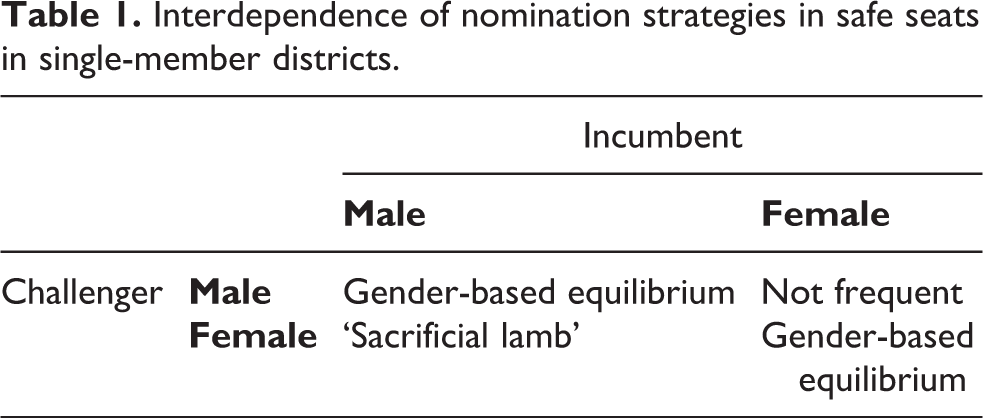
Finally, in open seats where there is no clear front-runner or when the challenger is from a leftist party that is more female-friendly than a conservative one, mimicking will not occur. Therefore, nominating a candidate of the same gender as the front-running party will not produce a gender-based equilibrium.
We therefore hypothesise the following, capturing both the conventional wisdom and the interdependence of parties’ nominations:
Data and methods
To test our hypotheses, we rely on district-level data from Australia. There are several reasons for using Australia as a case study. First, Australia’s lower chamber uses the single-member district majority-preferential, or alternative vote (AV) system. Voters indicate their preferred ranking of candidates. If no candidate garners a majority of first-preference votes, the candidate receiving the fewest first-preference votes is removed from the contest. The second preferences of the discarded candidate’s ballots are then distributed to the other candidates. This process continues until one candidate gains a majority (Heitshusen et al., 2005: 34). At the six elections held from 2001 to 2016 there were 150 districts, whereas in the 2019 election the number of districts was increased to 151.
Second, both the electoral system and the parties remain stable across the two decades being examined. During this time, Australian politics has been dominated by the centre-right Coalition and the centre-left ALP. These two parties have obtained the highest number of votes and seats in all elections analysed (together they have obtained between 96 and 98.6 percent of all seats in these elections) and nominated candidates in all districts.
Third, compared to U.S. parties, for instance, Australian parties play a fundamental role in the nomination of candidates. There is a ‘remarkable diversity’ of selection methods (Cross and Gauja, 2014: 23; see also Gauja and Cross, 2015: 290) across and within parties. Each party state branch nominates their candidates for federal state elections. In contrast to more centralised nomination systems, it is the party state branch rather than the party leader who decides on the candidates nominated. For instance, as Cross and Gauja (2014) show, in New South Wales (NSW) the rank-and-file members select candidates, whereas in Tasmania (TAS), there is an electoral college involving State Conference delegates and a local ballot. The Liberal party in NSW relies on an electoral college composed of a central selection committee and a local ballot, whereas in TAS there is a rank-and-file member vote. In total, Cross and Gauja count nine different selection methods for the House of Representatives for two parties in six states and two territories. However, this diversity in selection methods only matters when it is ‘supported by a willing party culture’ (Gauja and Cross, 2015: 288). In other words, the party culture is the necessary and prevailing condition for selection methods to support female candidates.
Fourth, more than 100 countries have adopted gender quotas (O’Brien and Rickne, 2016: 112), and this creates an endogeneity problem when examining the nomination of women to elective office across nations: parties in countries adopting gender quotas are more prone to selecting female candidates. Variance in the nomination of women to elective office could be driven by party ideology or cultural factors.
We sidestep this endogeneity issue by focusing on the ALP and the Coalition in Australia as the introduction of quotas has been an issue ‘marked by party divisions’ (Beauregard, 2018: 291). Following the distinction made by Krook et al. (2009) on types of gender quotas, Australia combines support for party quotas, per the ALP who applies quotas federally, with their rejection, per the Coalition. The ALP has implemented quotas incrementally since 1981, when it decided that 25 percent of state delegations to the National Conference should be women. However, in 1994 enforceable quotas of 35 percent female candidates were introduced. In 2002, the quota was changed to 40 percent, which was due to be met by 2012. In 2015, the quota was again changed to 50 percent which is due to be met by 2025 or earlier. The ALP has seen the number of women increase but not in a linear manner. In fact, an examination of the number of female candidates fielded by the ALP for the Senate reveals that in the years when the number of females was lower in the House, the number of candidates for Senate was higher (Hanrahan, 2019). In other words, the ALP was achieving the quota considering both chambers. In contrast, both the Liberal and National parties (the Coalition) have consistently rejected gender quotas on the basis of pursuing a meritocracy.
Finally, following Matland and Studlar’s (1996) rationale, Australia is a ‘hard’ case upon which to test our argument. In their analysis comparing two countries using a proportional representation system (Norway) and a first-past-the-post system (Canada), the latter was selected because ‘the probability of finding micro-contagion was strong’ (1996: 728). The fragmentation of the party system encouraged micro-contagion, with one party that ‘strongly promot[ed] women’ (1996: 720) 4 and a third well-established party that could trigger innovation – the New Democrats (NDs) – along with a very volatile electorate. Australia could be considered an opposite case to Canada as two main parties with loyal members dominate the political landscape. 5 In other words, if there is a primary case where micro-contagion should not be expected, that case would be Australia. 6
We gathered, collated and formatted information on all the districts where ALP and Coalition candidates have run in the seven elections to the House held from 2001 to 2019. The data are publicly available from the Australian Electoral Commission (AEC). The AEC provides the first and last names of candidates. However, the gender of the candidates is only provided in one of the elections and is therefore manually coded. In most cases, assigning a gender was a straightforward task (for names such as Hellen or John); when there was uncertainty (for names such as Kim), we sought official sources and undertook web searches. To validate the accuracy of coding, we then compared the results of the codification with the aggregated official parliamentary records. We selected 1,017 districts (representing 96.76 percent of the 1,051 total districts) where ALP and Coalition candidates received the most votes.
Figure 1 displays the transition in the number of female candidates per party over the seven elections in the 2001–2019 period. The 2019 election produced the highest number of female candidates (106), whereas the 2010 and 2013 elections produced the lowest numbers (73 and 78, respectively). The total number of female candidates is 605 (out of 2,102), 28.7 percent. Interestingly, whereas 36.0 percent of ALP candidates (367) were females, the percentage is substantially lower for the Coalition at 23.4 percent (238). This difference is statistically significant at the 0.01 percent level. In summary, there is evidence that there are partisan differences in the nomination of females to elective office.
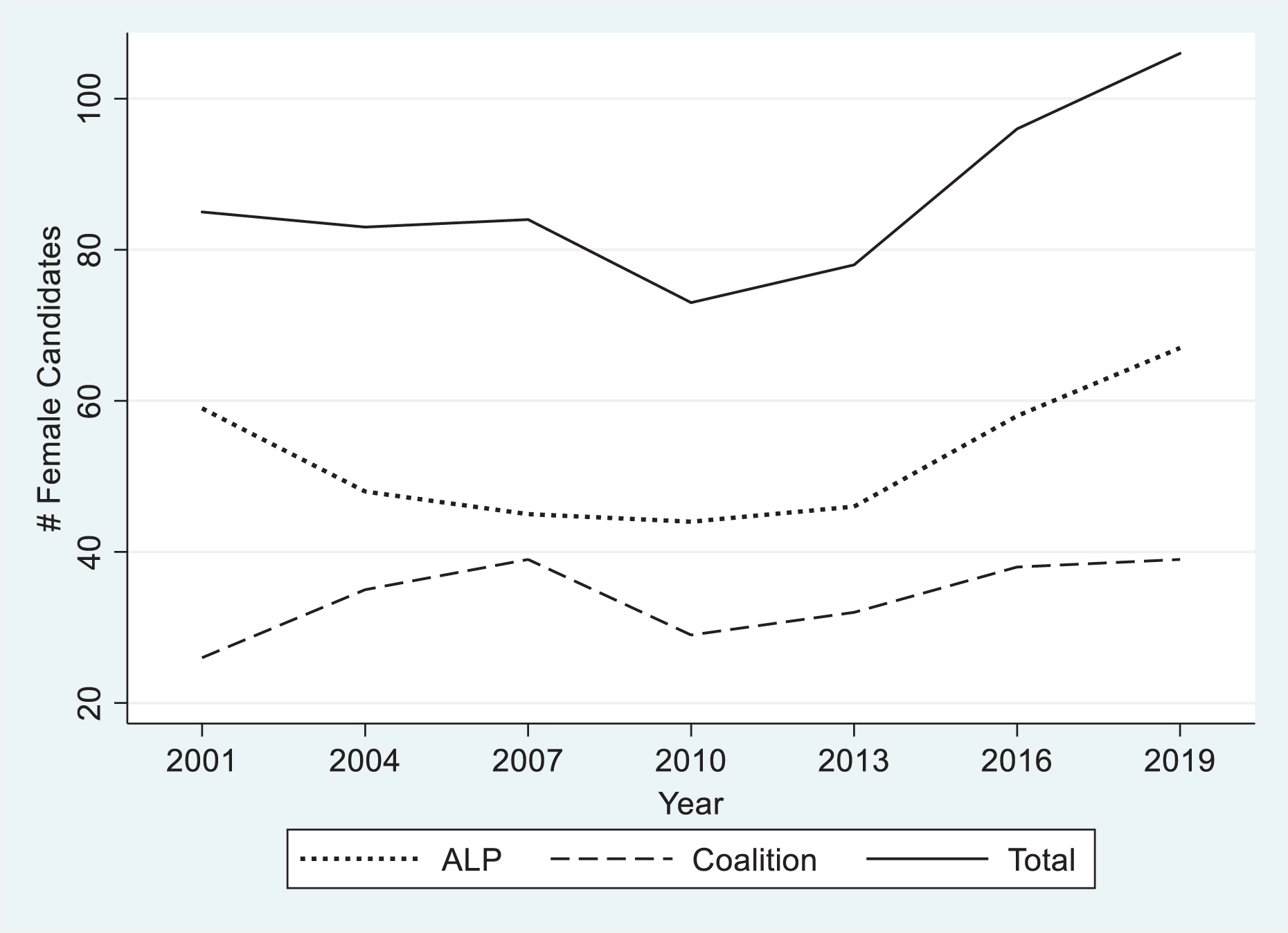
House female candidates per party, 2001–2019.
The transition in the number of female candidates has not been linear: whereas the ALP has followed a ‘V’ pattern, the Coalition’s pattern has been more random. In every election, more female candidates have been nominated by the ALP than by the Coalition. In fact, the lowest number of ALP female candidates (44 in 2010) is still greater than the highest number of Coalition female candidates (39 in 2007 and 2019).
In our analysis, the dependent variable is the gender of the district candidate (coded 0 if the candidate is male; 1 if the candidate is female).
Our main independent variable is District type. To test the ‘sacrificial lamb’ hypothesis, this categorical variable adopts three values. In the ALP models, these are ALP incumbent (the reference category), Coalition incumbent, and Open seat. For the Coalition models, these are Coalition incumbent (the reference category), ALP incumbent and Open seat. The conventional measure of open seats (or hopeless seats) in single-member districts when examining the nomination of women for elective office (Sanbonmatsu, 2002: 804; Stambough and O’Regan, 2007: 355; or Thomas and Bodet, 2013: 161), party competition (Banks and Kiewiet, 1989: 1007) or economic voting (Campbell et al., 2010: 1083) is whether the incumbent is running or not. Therefore, in our empirical analysis, a seat is considered open when no incumbent is running.
To test the interdependence of nomination strategies, the categorical variable adopts five values. For the ALP models, they are ALP incumbent (the reference category), Male Coalition incumbent, Female Coalition incumbent, Male Coalition open seat and Female Coalition open seat. For the Coalition models, they are Coalition incumbent (the reference category), Male ALP incumbent, Female ALP incumbent, Male ALP open seat and Female ALP open seat. If a party nominates more female candidates in districts with opposition incumbents than in its safe districts (i.e. both the coefficients of Male Coalition incumbent and Female Coalition incumbent are greater than the coefficient of ALP incumbent in the case of the ALP, for instance), then the ‘sacrificial lamb’ hypothesis is supported. However, if the number of female candidates is higher in districts with female incumbents from the opposition party (i.e. only the coefficient of Female Coalition incumbent is greater than the coefficient of ALP incumbent in the case of the ALP, for instance), then the interdependence of nomination strategies hypothesis is supported over the ‘sacrificial lamb’ hypothesis.
We control for the number of competitors in a district and election fixed effects. We expect that a higher number of competitors negatively affects the challenger’s incentive to nominate a candidate of the same gender as the incumbent, as voters’ attention is dispersed across multiple candidates. According to Gordon and Segura (1997: 131), there are three reasons which account for the negative correlation between voter information and the number of parties; ‘First, as the number of parties grows, the shades of distinction between them grow murky. (…) Second, as parties proliferate, the increased likelihood of coalition governments further damps the effect the party-policy linkage may have on voting decisions. Finally, and most simply, as parties proliferate, the information demands on the voters go up’. The election fixed effects account for election-to-election variation in the baseline probability of nominating men or women as candidates.
As the dependent variable is binary, we estimate a logit model. Finally, as virtually all districts are considered several times (in elections), the standard errors are clustered by electoral division. We run the models separately for the ALP and the Coalition to control for partisan preferences in female representation.
Results
Table 2 displays the descriptive statistics for the ALP and the Coalition. As expected, the ALP is a more female-friendly party than the Coalition. First, the average number of female ALP candidates, 0.36, is substantially greater than the average number of female Coalition candidates, 0.23. The difference is statistically significant at the 0.01 percent level. Second, the ALP ran more women than the Coalition in open seats (0.12 versus 0.06). The difference is also statistically significant at the 0.01 percent level. Finally, the number of female ALP incumbents is also greater than the number of female Coalition incumbents (0.11 versus 0.07). Again, the difference is statistically significant at the 0.01 percent level.
Descriptive statistics a.
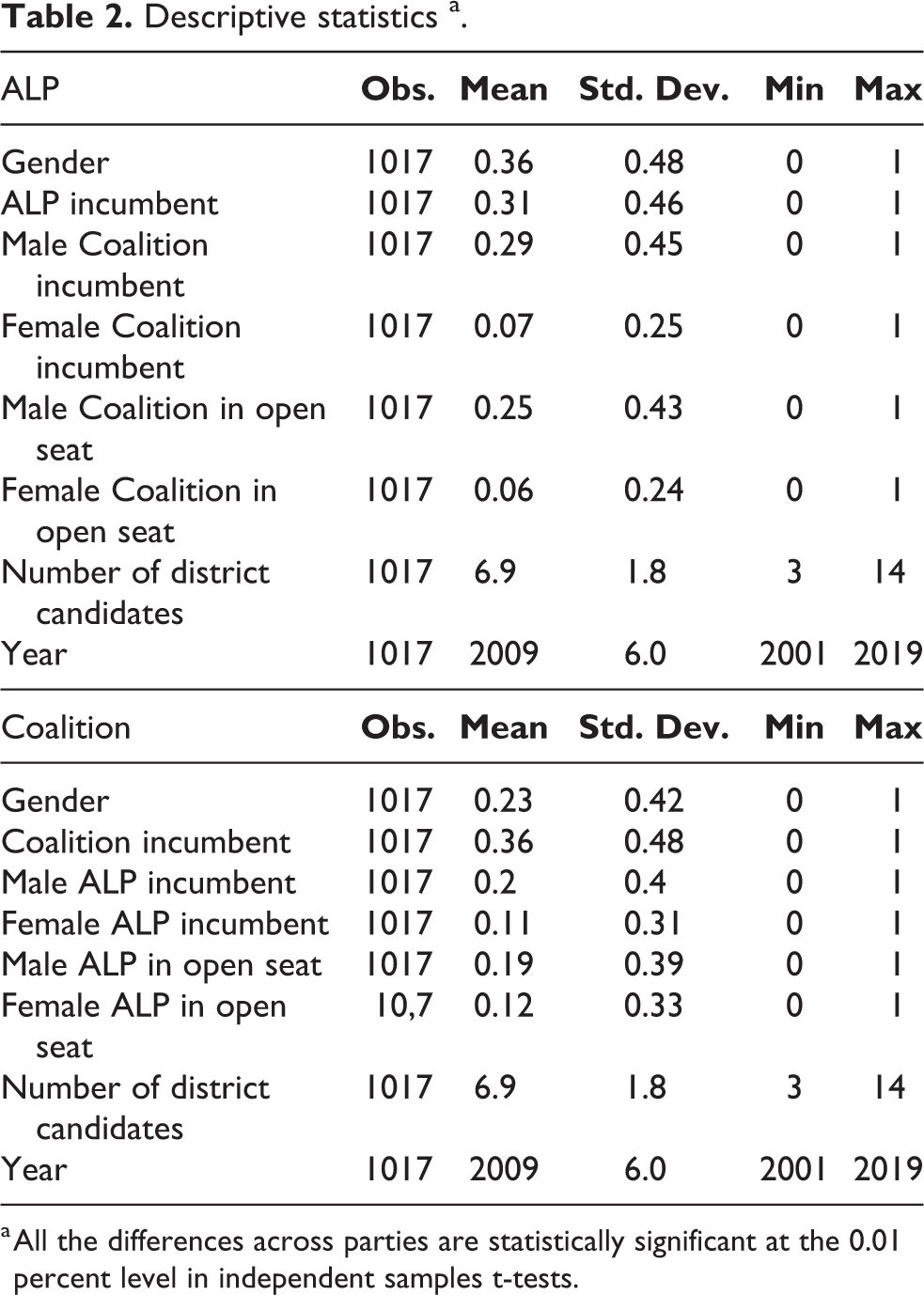
a All the differences across parties are statistically significant at the 0.01 percent level in independent samples t-tests.
Tables 3 and 4 present the results of the application of the ‘sacrificial lamb’ hypothesis and the interdependence candidate nomination hypothesis respectively. Table 3 examines whether women are more likely to be used as sacrificial lambs in hopeless seat elections. We identify hopeless seats according to the presence of an opposition incumbent. Although female ALP candidates are uniformly distributed across safe, hopeless and open seats, female Coalition candidates mainly contested hopeless elections. In districts with an ALP incumbent, 29.6 percent of the Coalition candidates are female, in contrast to 21 percent in open seats and 19.8 percent in safe seats. The Chi squared states that the relationship is not statistically significant when the data for the two parties are aggregated.
The ‘sacrificial lamb’ hypothesis.
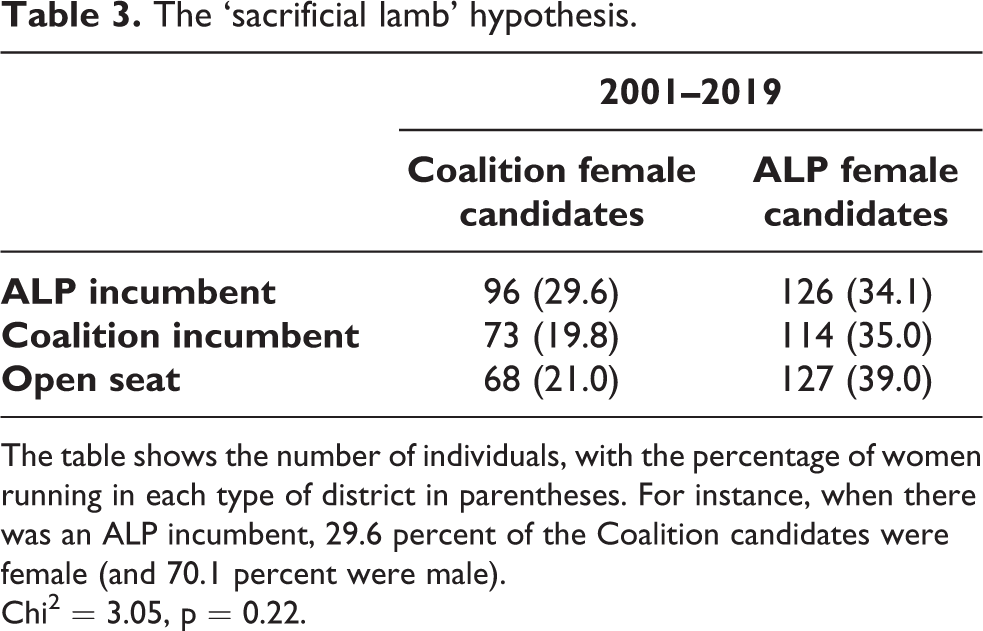
The table shows the number of individuals, with the percentage of women running in each type of district in parentheses. For instance, when there was an ALP incumbent, 29.6 percent of the Coalition candidates were female (and 70.1 percent were male).
Chi2 = 3.05, p = 0.22.
The interdependence of nomination strategies.
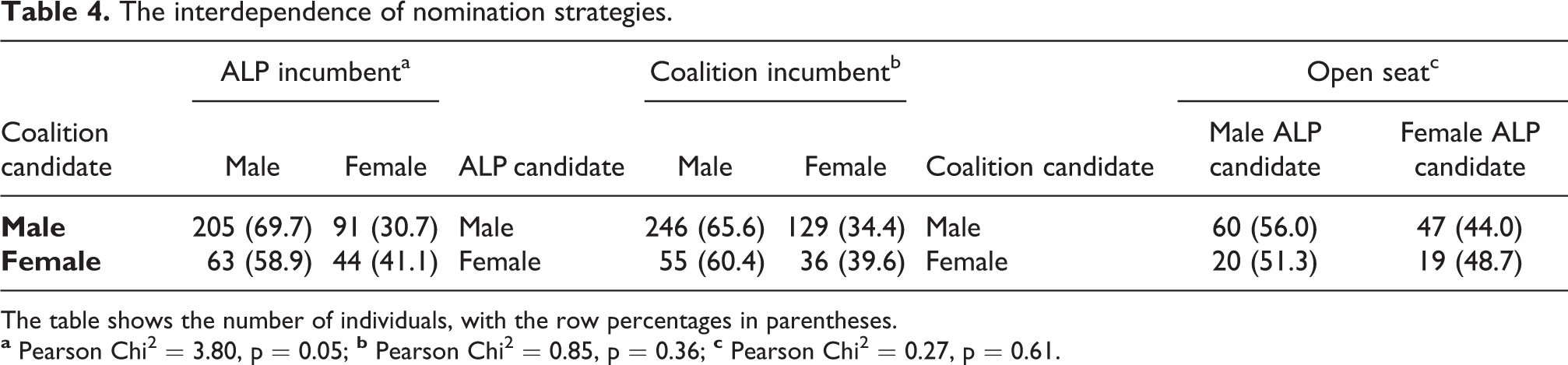
The table shows the number of individuals, with the row percentages in parentheses.
Finally, Table 4 explores our interdependence hypothesis by comparing nomination strategies in hopeless districts (i.e. where there is an incumbent) and in open districts. Our expectation is that trailing parties, especially those not committed to gender equality (i.e. the Coalition), mimic the gender nomination strategy of their opponent in hopeless elections more than when the contest is open. Three different analyses are displayed: the Coalition’s nomination strategy in hopeless districts (left), the ALP’s nomination strategy in hopeless districts (centre) and the Coalition and ALP’s nomination strategies in open seats. The scenarios in the top left and bottom right cells show gender mimicry, whereas the bottom left and top right cells show gender division. If the candidate nominations were completely unrelated to gender, the row and column proportions would all be 50 percent.
As is evident, 61.8 percent of the Coalition candidates in hopeless districts are the same gender as the ALP incumbents ((205+44)/403). The equivalent for ALP candidates in hopeless districts is 60.5 percent ((246+36)/466) and 54.1 percent for candidates in open seats (60+19)/146)). The only relationship that is significant at the 0.05 percent level is that of Coalition nominees challenging the incumbent in hopeless districts. Overall, in terms of the direction of relationships, these results are in line with our expectations.
In the multivariable analysis of candidate nomination, we examine the ‘sacrificial lamb’ hypothesis through a specification whereby the candidate’s gender is regressed onto the Type of district (i.e. whether the incumbent is a Coalition or ALP nominee, or if the seat is open) while controlling for the number of districts and candidates, and election fixed effects. 7 When testing our theory on the interdependence of nomination strategies, we replace the categorical variable with three values capturing the type of district with the categorical variable which adopts five values.
Table 5 displays the results for the ALP. The variables are not statistically significant, indicating that the ‘sacrificial lamb’ hypothesis is not supported. Whether the incumbent is a Coalition or ALP nominee, or the seat is open, does not affect the probability of nominating a female candidate. This non-strategic result is in line, however, with the expectation that the ALP is a female-friendly party.
The determinants of ALP candidate nomination.
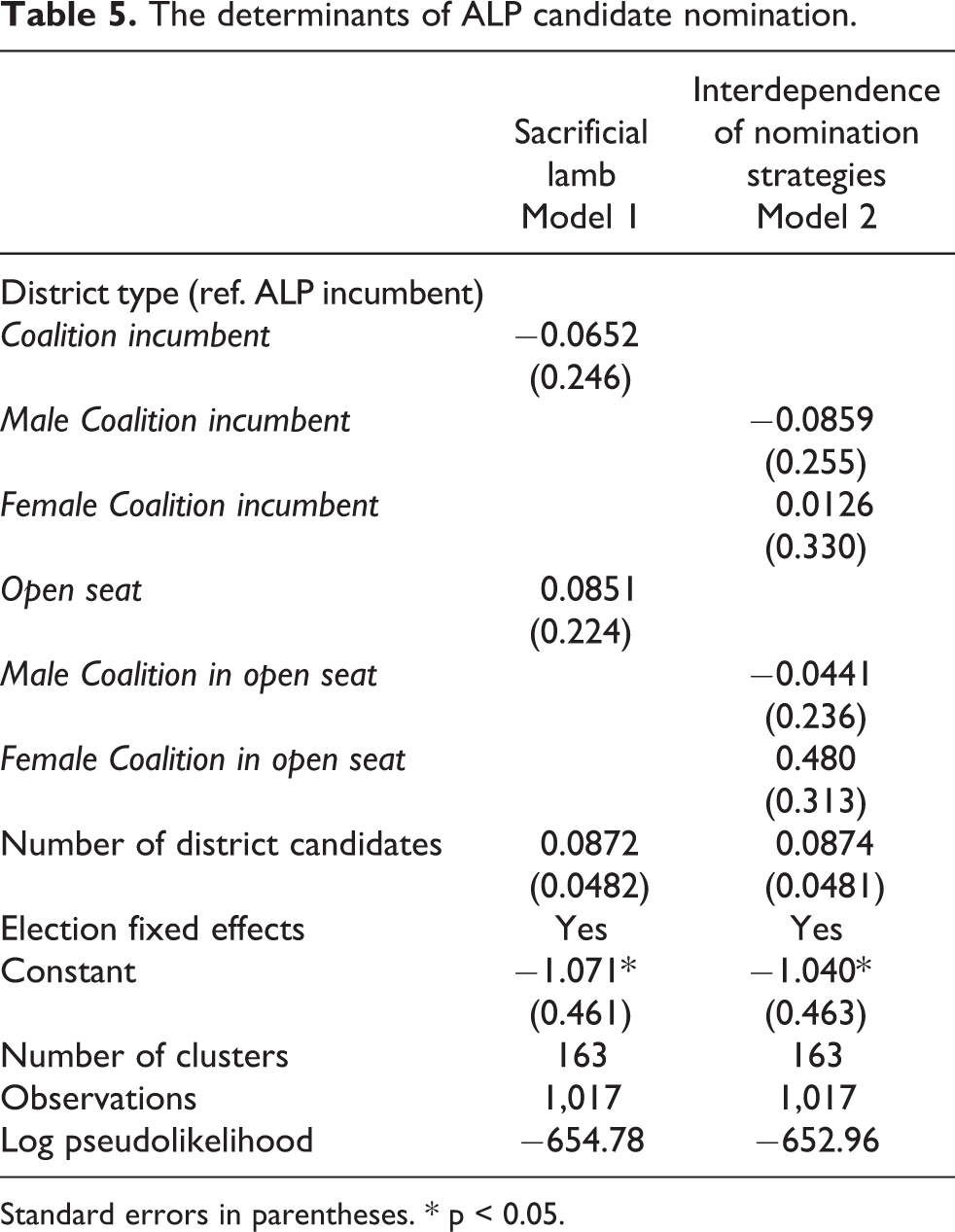
Standard errors in parentheses. * p < 0.05.
The results for the interdependence of nomination strategies in Model 2 are extremely similar as the type of district does not play a significant role. The genders of the Coalition incumbent and the Coalition candidate in an open seat do not make a difference on the ALP’s likelihood of nominating female candidates. In summary, the ALP commitment to gender equality does not accommodate strategic behaviour when nominating male or female candidates.
Table 6 displays the results for the Coalition, which differ significantly from those of the ALP. Model 1 shows that when the ALP candidate is the incumbent, the Coalition’s probability of nominating a female candidate is higher than when the incumbent is from the Coalition as the ALP incumbent variable is statistically significant at the 0.05 percent level. However, there are no statistically significant differences in the number of female candidates running in open seats and in safe Coalition seats. In summary, our results appear to support the ‘sacrificial lamb’ hypothesis.
The determinants of Coalition candidate nomination.
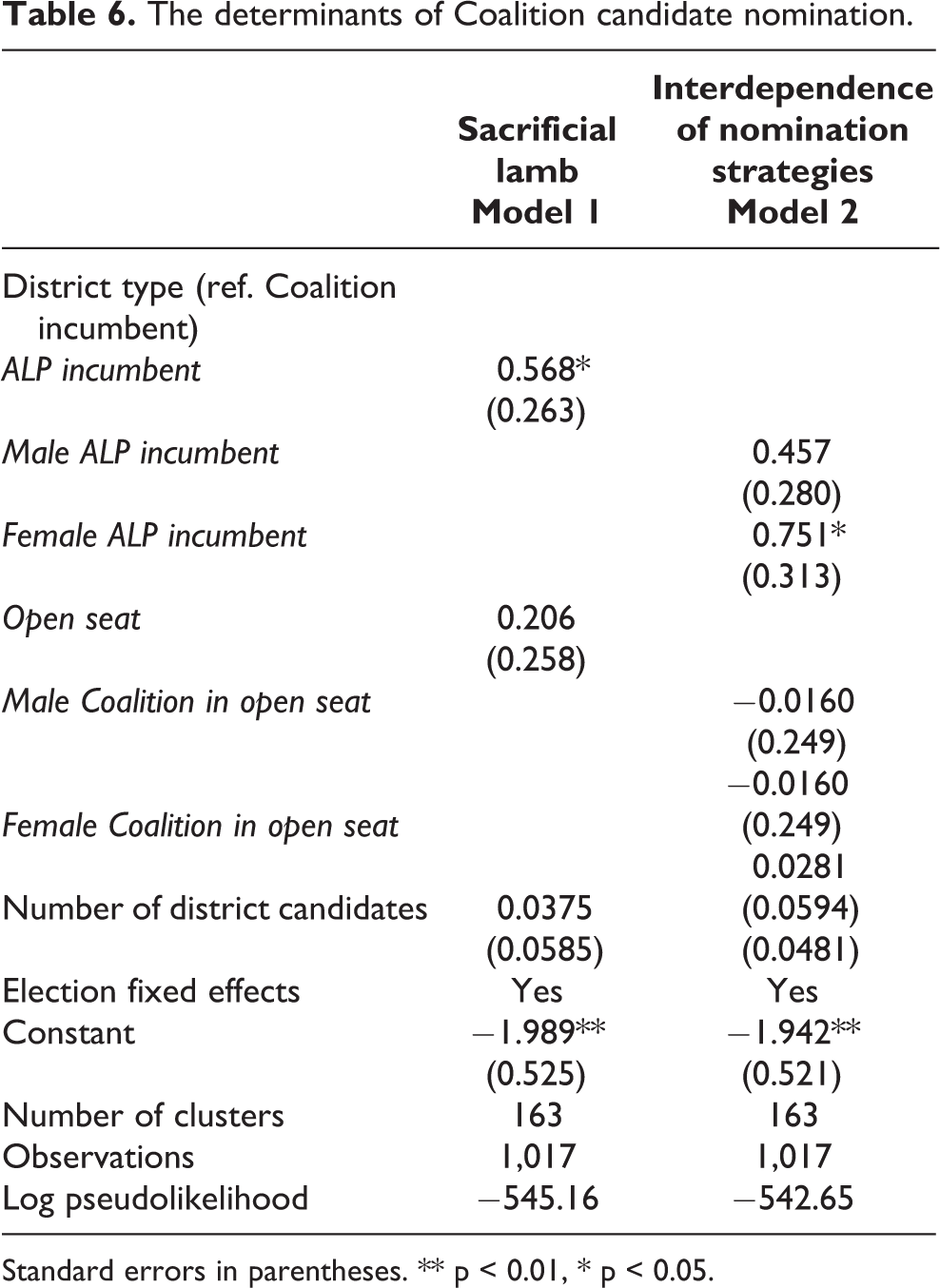
Standard errors in parentheses. ** p < 0.01, * p < 0.05.
Model 2 distinguishes between male and female ALP incumbents, and between male and female Coalition candidates in open seats. We find the Coalition’s probability of nominating female candidates to be higher in districts where the ALP incumbent is female than in safe Coalition districts, but not when the ALP incumbent is female. The Female ALP incumbent variable is statistically significant at the 0.05 percent level. In other words, the evidence does not support the ‘sacrificial lamb’ model but does support the interdependence of nomination strategies when a party is not committed to gender equality. The gender of the opposition party’s candidate in open seats does not affect the nomination of Coalition female candidates. In addition, the number of district competitors does not affect the Coalition’s nomination strategy.
Figure 2 plots the average marginal effect of District type on the Coalition (Model 2 in Table 6). The Coalition’s probability of nominating a female candidate increases by approximately 13 percent in districts with female ALP incumbents in comparison with districts with Coalition incumbents. None of the remaining marginal effects are statistically significant.
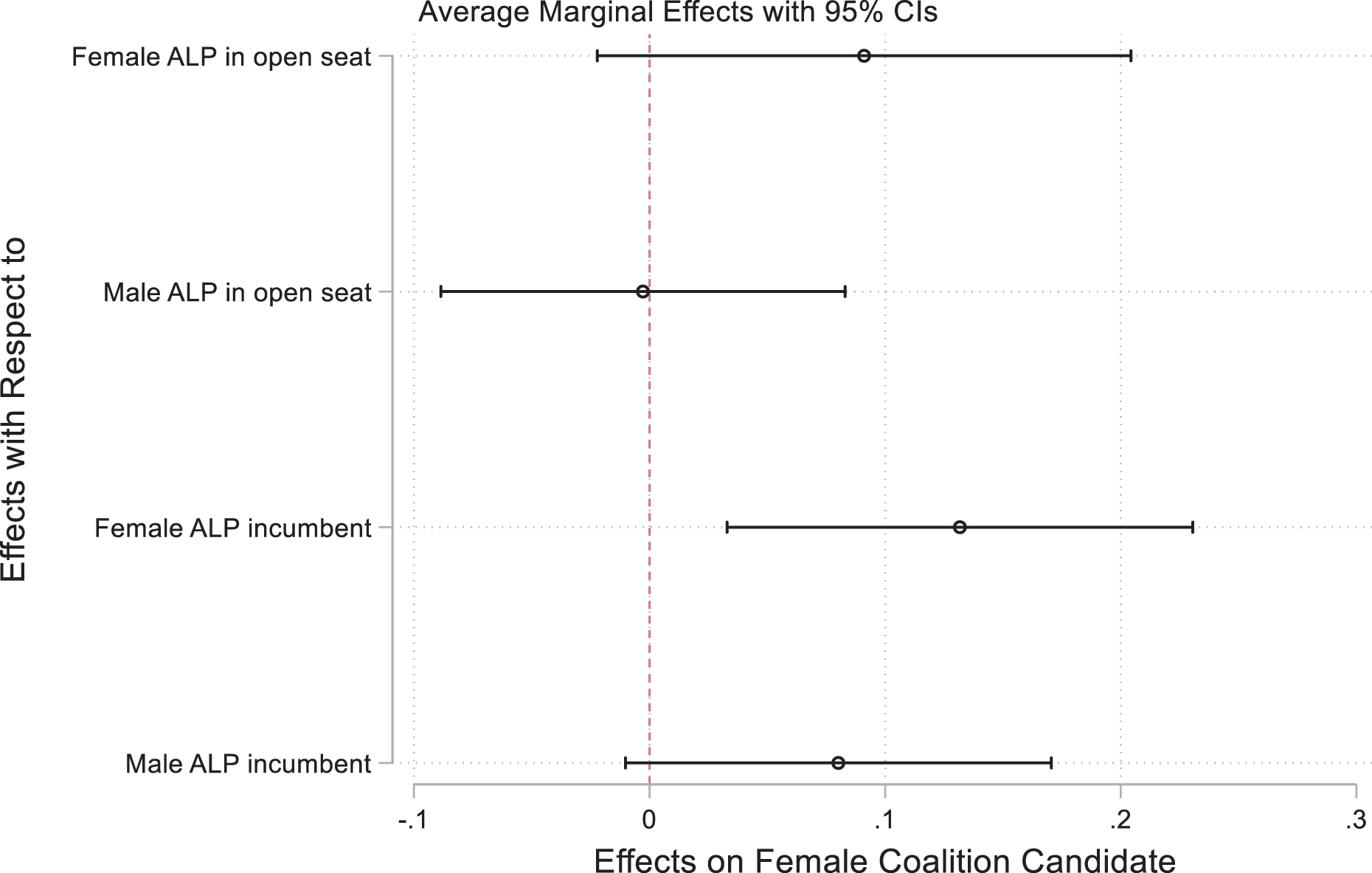
Average marginal effect of district type.
To explore the robustness of our results, we re-estimate the regression models using the margin of victory as the criterion to identify safe districts instead of the presence of an incumbent in the election. A district is considered ‘safe’ if the previous election’s margin of victory is above 5 percent. The results, as given in the Appendix, do not differ significantly. Female ALP safe district is, again, the only positive and statistically significant variable.
Conclusion
Our research acknowledges that party ideology and the strategic nomination of female candidates are key drivers of trends in the nomination of female candidates in single-member electoral systems. However, we argue that there is a third influencing factor stemming from the interdependence of party strategies in elections. Specifically, we contend that the nomination of female candidates from one party is contingent upon the actions of the opposing party, given that previous research has argued that parties feel pressured to nominate more women if a political rival promotes the representation of women. However, the mechanisms driving this relationship are unclear. We therefore map the conditions under which this contagion occurs at the district level.
We show that the equilibrium strategy for the trailing party in a district is to nominate a candidate of the same gender as the front-running party’s nominee when the trailing party is not committed to gender equality. An important implication of our analysis is the re-examination of the empirical relevance of the ‘sacrificial lamb’ model. Sacrificial lambs have been understood in a unilateral sense whereby women are nominated for unwinnable seats whereas men are nominated for winnable seats (Berch, 2004). When controlling for the fact that trailing parties mimic front-running parties’ strategies, the true impact of the ‘sacrificial lamb’ is smaller than suggested by prior research. Our results also suggest that quotas not only affect the parties that implement them but also opposition parties, including those who explicitly reject such a policy. In other words, once quotas are established and implemented, their impact goes beyond the adopting party as they condition the nomination behaviour of those parties that reject them.
In contrast with Matland and Studlar’s (1996) influential paper, we provide fairly conclusive evidence that challengers mimic the gender-based nomination strategy of incumbents in Australia, where micro-contagion is more difficult to observe than in the countries the aforementioned authors studied. In our view, this can be considered initial evidence of the spill-over effects of gender quotas and of the need to reassess the impact of electoral systems. Hence, we recommend further theoretical and empirical exploration in this area.
We envision several avenues for future research. The most obvious is to test the theories espoused here in electoral systems outside of Australia. If our hypothesis is valid, this should be the case regardless of national contexts. A second avenue is to reassess previous studies on the impact of the sacrificial lamb hypothesis in light of our results. Third, we note that our results show that once a party introduces quotas, this affects the behaviour of other parties, even when other parties do not introduce such measures themselves. However, our analysis does not consider temporal effects as we group all elections held between 2001 and 2019 in order to produce a sufficiently large dataset. An analysis that considers time dynamics could more appropriately address whether, and in what manner, the contagion effect operates. Fourth, future research could also consider whether our argument on mimicking could be extended to other underrepresented groups in other countries. For example, similar analyses on candidates could be performed on the basis of race, ethnicity or class in Europe, the United States and Australia, or on caste in India. Fifth, it is worth exploring state elections to explore whether the interaction between first- and second-order elections (i.e. national and subnational elections, respectively) affects the equilibrium nomination strategies. Finally, the analysis would also benefit from conducting interviews with party officials.
Supplemental material
Supplemental Material, sj-pdf-1-ppq-10.1177_1354068821998235 - ‘Sacrifical lambs’ or candidate mimicking? Gender-based nomination strategies in elections
Supplemental Material, sj-pdf-1-ppq-10.1177_1354068821998235 for ‘Sacrifical lambs’ or candidate mimicking? Gender-based nomination strategies in elections by Ferran Martínez i Coma and Ignacio Lago in Party Politics
Footnotes
Declaration of conflicting interests
The author(s) declared no potential conflicts of interest with respect to the research, authorship, and/or publication of this article.
Funding
The author(s) disclosed receipt of the following financial support for the research, authorship, and/or publication of this article: We acknowledge support from the Australian Research Council Discovery Project [Grant Number: DP190101978], the Spanish Ministry of Economy and Competitiveness [Grant number: CSO2017-85024-C2-1-P (AEI/FEDER)], and ICREA, under the ICREA Academia programme.

Supplemental material
Supplemental material for this article is available online.
Notes
References
Supplementary Material
Please find the following supplemental material available below.
For Open Access articles published under a Creative Commons License, all supplemental material carries the same license as the article it is associated with.
For non-Open Access articles published, all supplemental material carries a non-exclusive license, and permission requests for re-use of supplemental material or any part of supplemental material shall be sent directly to the copyright owner as specified in the copyright notice associated with the article.
