



Abstract
This paper examines when parties listen to interest groups and adopt their input. Interest group information can help parties bolster their positions, and by taking their input into account, parties show that they are responsive to the groups’ interests which can increase their appeal to their constituents. Listening to interest groups can, however, also repel voters who disagree with the groups’ positions. This paper argues that party and issue-level characteristics affect whether the benefits of listening to interest groups exceed the costs. Examining more than 25,000 party-interest group observations on 88 Norwegian policy proposals and using a text reuse approach to measure interest group influence, the findings indicate that public salience, party issue emphasis, interest group coalitions, and government status affect parties’ propensity to listen. This implies that interest groups can be a pertinent source of information for parties under certain circumstances which affects the link between voters and parties.
Introduction
Political parties legislate, govern, and are central intermediary organizations that function as links between citizens and the state (Dalton et al., 2011). Interest groups have a similar intermediary role. They aggregate their constituents’ interests and concerns on issues, work out possible policy responses, and present their policy frames to political decision makers (Hansen, 1991). This type of information can help parties bolster their positions. By listening and taking their input into account, parties moreover show that they are responsive to the groups’ interests which may increase their appeal to their constituents and positively affect their vote shares. In this way, listening affects the link between citizens and parties (De Bruycker and Rasmussen, 2021; Giger and Klüver, 2016). This makes it important to examine when parties listen to interest groups and adopt their input.
Previous studies have mainly focused on interest group influence on individual legislators, different branches of the government, and public policy outcomes (Hojnacki et al., 2012). These studies show that interest group and issue characteristics, such as interest group type, public salience, and interest group coalitions, affect the success of interest groups (e.g., Dür et al., 2015; Junk, 2020; Nelson and Yackee, 2012; Stevens and De Bruycker, 2020). Less is known about interest group influence on political parties. Given parties’ central role, however, affecting parties can be an important step on the way to influencing public policy outcomes. Interest groups may have a harder time moving final outcomes if they ignore parties. Studying interest group influence on parties hence provides insight into groups’ impact on an important type of political actor.
While listening to interest groups can increase parties’ appeal to the groups’ constituents, it may also repel voters who disagree with the groups’ positions. Drawing on the party literature, the benefits may exceed the costs when parties emphasize the issue in question more than their competitors as well as when they are in opposition rather than government. Furthermore, drawing on previous research on interest group influence, parties are expected to listen when the public salience of an issue is lower and when the interest group input is provided by a larger and/or more coordinated coalition. To test these hypotheses, I examine 88 policy proposals from 2005 to 2015 in Norway. More than 25,000 party-interest group observations are included. Using a text reuse approach, I look at whether input submitted by interest groups to government consultations is mirrored in parties’ parliamentary speeches and remarks in parliamentary committee recommendations. Interest groups are in other words thought to have influenced a party on a given proposal when the party reuses the substantive arguments or ideas that interest groups have advocated for. This approach allows for a relatively direct measure of interest group influence on parties at the decision-making stage in the policy process. The expectations receive support.
These findings imply that interest groups can be a pertinent source of information for parties on specific policy proposals. Interest group information can help parties signal responsiveness to specific constituents which may enhance the link between these voters and parties. Moreover, when parties listen to interest groups, both actors achieve some of what they seek. Interest groups gain political traction for their views by having them represented by parties and parties bolster their positions as well as their appeal to specific constituents to maintain or improve their vote shares. Parties and interest groups thus mutually benefit from each other.
This paper first of all contributes to the literature on party positions. Previous studies show that parties’ positions are informed by, for example, public opinion and their own voters’ preferences (Adams, 2012; Pereira, 2020). This paper demonstrates that interest groups also inform parties and can function as an intermediary between citizens and parties. The paper moreover adds to the few existing studies on interest group influence on political parties which have found that interest group resources and party characteristics seem to matter (Clifton, 2004; Røed, 2021; Victor and Reinhardt, 2018). This paper shows that issue-level characteristics are pertinent to explain interest group influence on parties as well. Lastly, the paper contributes to the broader interest group influence literature. Theoretically, this literature has tended to treat actors of the same type as homogeneous. The finding that opposition parties generally listen to interest groups more than government parties indicates that considering differences between the actors that interest groups try to influence—also when they are of the same type—can be pertinent to understand when interest groups are influential. Furthermore, by shedding light on when interest groups are less likely to influence parties, the paper has implications for research on organizational choice (Farrer, 2017). Methodologically, the paper shows that using a semi-automated text reuse approach can be fruitful to measure interest group influence.
Theory
Parties seek to maximize their vote shares, office benefits, and policy influence (Strøm, 1990). When parties choose their position on a given policy proposal, they likely consider how the position will affect their ability to reach these goals. Policy influence considerations are likely especially prominent while parties are in legislature between elections, but considering how future office prospects and vote shares are affected is also pertinent. Such calculations are difficult, however. Parties have incomplete information on how different alternatives affect different constituencies (Austen-Smith, 1993). Information from interest groups can enlighten parties in this regard. Interest groups typically specialize in a narrower range of policy areas than parties (Hansen, 1991), and they are able to provide expertise as well as information on the level of support a given position has among the groups’ constituents or the broader public (Chalmers, 2013). This helps parties navigate what position to take in order to appeal to specific voter groups. Listening to an interest group furthermore strongly signals that the party is responsive to the group’s interests. This can positively affect the party’s vote share. Interest group expertise may moreover help parties improve their arguments and bolster their positions and thus positively impact their policy influence. Parties hence have incentives to listen to interest groups. Listening is not, however, without potential costs as it can repel voters who disagree with the groups’ stances. I argue that party and issue-level characteristics affect whether the benefits of listening to interest groups are likely to exceed the costs.
The public salience of an issue is one such aspect. Previous research shows that while certain interest groups may have incentives to work to increase the salience of the issues they are active on (Dür and Mateo, 2014), interest groups’ chances of influencing policy outcomes as well as legislators’ votes are generally lower when issues are more salient to the public (e.g., Culpepper, 2011; Mahoney, 2007a; Witko, 2006). Most people do not follow politics closely and the average voter is unlikely to have clear stances on many policy proposals. This is especially probable in the case of less salient issues (Zaller, 1992). In the event that voters take note in these cases, they tend to follow party cues and adopt a position that is similar to the party they prefer (Carsey and Layman, 2006). Political actors are thus less likely to be held accountable for their positions on less salient issues. This means that parties run a lower risk of being electorally punished for taking a position that contradicts public opinion or runs counter to the interests of a majority of voters on less salient proposals. Parties hence have freer reins when it comes to the positions they take on these proposals. This gives parties leeway to signal responsiveness and cater to interest groups, including those that do not represent public interests (Lohmann, 1998). Furthermore, although the average voter is unlikely to pay attention in these cases, affected constituents and the groups that represent them might. Parties thus have an incentive to listen to attract these voters. On more salient proposals where the public at large is more likely to pay attention, signaling responsiveness to specific interest groups could be a riskier strategy and repel more voters than it attracts. I therefore expect that,
Hypothesis 1: Parties are more likely to adopt more interest group input when policy proposals concern issues that are less salient to the public. The salience of issues to the parties themselves can also affect whether the benefits of listening to interest groups exceed the costs. Saliency theory posits that parties compete for votes by emphasizing issues that show them in a favorable light and ignoring issues where their competitors dominate. Focusing on advantageous issues could increase their public salience and subsequently benefit the party electorally (Budge and Farlie, 1983). Issue emphasis is furthermore related to parties’ office benefits (Bäck et al., 2011). While parties have agency when it comes to the issues they prioritize, they are not able to ignore issues where they do not have the upper hand completely (Green-Pedersen and Mortensen, 2010). When parties emphasize issues more than their competitors, however, they stand out and distinguish themselves. These are the issues that voters may associate with a given party and that potentially drive them to vote for the party. Parties are hence likely particularly worried about losing their prominent position on these issues. On the one hand, parties may be especially protective of their positions on issues they emphasize. This could make them warier of listening to interest groups. On the other hand, however, listening to interest groups on emphasized issues is a way to signal to interest group constituents—who are especially likely to pay attention—that the party is responsive to their interests. This can help parties continue to stay ahead of their competitors. The potential costs of being perceived as equally unresponsive or less responsive than one’s competitors on the issues that distinguish the party may exceed the costs associated with listening to interest groups in this regard. Furthermore, parties want to present clear positions on emphasized issues (Han, 2020; Rovny, 2012). Catering to specific groups of voters may be part of this strategy and interest groups are a source of information on what these voters want. Listening to interest groups can hence help parties become more attuned to the interests of the specific constituencies they want to appeal to. In a second step, however, it is likely important for parties to frame the interest group input they listen to in a way that is consistent with their broader ideological profile to promote their agenda at large and in order not to repel their core constituents (see also Koedam, 2021). For parties that emphasize a given issue less than their competitors, the possibility of disrupting these competitors’ advantage by listening to interest groups is appealing. Such a strategy could nevertheless backfire since it simultaneously may increase the amount of attention the issue gets overall. This is likely to be more advantageous to the parties that already have a distinct position on the issue. Instead, blurring the party’s position can be a more attractive strategy (Han, 2020; Rovny, 2012). Listening and signaling responsiveness to specific groups and their constituents may be detrimental in such an endeavor. The costs of listening to interest groups on average therefore likely exceed the benefits. Overall, I expect that,
Hypothesis 2: Parties are more likely to adopt more interest group input on issues they emphasize more than their competitors. Interest group coalitions may also affect parties’ cost-benefit analyses. These coalitions are informal and formed “for a single discrete issue fight” (Mahoney, 2007b: 368). They range from relatively loose coalitions to ones characterized by coordinated collaboration where groups come together to work out a joint position on the proposal in question (Mahoney, 2007b). Coalitions are an important tool for interest groups that seek political influence (Hojnacki et al., 2012), and previous studies show that coalitions are relatively successful when it comes to influencing bureaucratic rule making and policy issues (Junk, 2020; Nelson and Yackee, 2012). Input from interest group coalitions can be particularly pertinent to political parties. Coalitions provide parties with a clear signal that the information has support among more than one group (Mahoney, 2007b; Nelson and Yackee, 2012). The position the interest group coalition reflects is supported by all participants. In comparison, how representative the input from one single interest group is of the broader interest group community that it is part of is more uncertain. By listening to larger interest group coalitions, parties hence potentially appeal to a larger group of constituents than they do when they listen to input from individual interest groups. Whether the coalition is coordinated can also matter for parties’ propensity to listen. Coordinating a position implies that the participants care enough about the issue to incur the costs of coming together and working out a joint position. This signals to a greater extent that the issue is important to the actors and that there is unified support for the promoted position compared to cases where responses are similar but not coordinated. By pooling resources and deliberating on a joint position, coordination can furthermore entail that the coalition’s position overall is of better quality (Junk, 2020). Coordinated interest group coalitions may therefore excel at providing parties with expertise that help them improve their positions. The third hypothesis is therefore,
Hypothesis 3: Parties are more likely to adopt more input from interest groups that are part of a larger and/or more coordinated coalition. Lastly, whether a party is in government or opposition may also affect the costs and benefits associated with listening to interest groups. First, opposition parties are less constrained than government parties in terms of the positions they take. They are not in the same favorable position when it comes to carrying out what they promise to do right away. The positions of opposition parties in other words do not need to be as implementable in practice as the positions of government parties (Van Spanje, 2010). This gives opposition parties more flexibility when it comes to listening to interest groups. Listening can also be more pertinent to opposition parties to the extent that they want to attract voters in order to get into government in the future. Lastly, opposition parties tend to have fewer resources at their disposal than government parties. Their reliance on external input can hence be higher than that of government parties at this stage in the policy process. This leads to the following hypothesis,
Hypothesis 4: Opposition parties are more likely to adopt more interest group input than government parties.
Research design
To examine when parties listen to interest groups and adopt their input, I investigate parties’ parliamentary speeches and committee amendments for 88 Norwegian policy proposals from 2005 to 2015. Studying this in Norway means that eight parties with parliamentary representation are included here: the Labour Party (Ap), Progress Party (FrP), Conservative Party (H), Socialist Left Party (SV), Christian Democratic Party (KrF), Centre Party (Sp), Liberal Party (V), and from 2013, the Green Party (MDG). These parties cover the range of prevalent party families in Western Europe. The parties are mainly vote- or office-seeking in the time period covered and the degree of party unity is moreover high. The results are hence most likely to travel to other multi-party systems with strong parties, and, given the relatively corporatist nature of state-interest group relations in Norway, to other corporatist, established, Western democracies.
“Interest groups” refer to a broad range of actors in this paper, including membership associations and non-membership actors (e.g., companies). Governmental actors are included in the latter category. The common denominator is that they all participate in government consultations and hence fulfill the criterion of engaging in “observable, policy-related activities” (Baroni et al., 2014: 142). In this regard, governmental actors such as ministries can function as interest groups in the same way as other institutional actors. The findings still generally hold, however, when a narrower definition of interest groups that excludes public authorities is used with the partial exception of party issue emphasis. The findings furthermore hold if potentially controversial interest groups are excluded (see Supplemental Appendix).
Parties’ reuse of interest group input
I use a text reuse approach to gauge when parties adopt interest group input in their positions on specific policy proposals. Text reuse tools have gained traction in political science and have, for example, been used to examine interest groups’ impact on legislation (Cross et al., 2021; McKay, 2018). Text reuse broadly involves either determining the degree of global similarity between two texts, akin to plagiarism tools, or determining the most similar sequence within the texts (local similarity) (Wilkerson and Casas, 2017). I use the latter approach which makes it possible to detect whether parties directly copy input from interest groups.
This approach does not allow for measuring how parties’ overall positions are affected by interest groups, but it importantly allows for a relatively direct measure of interest group influence on the substantive ideas and arguments parties bring up. Differences in the communication styles of parties and interest groups make examining global similarity or using other large-n text analysis approaches problematic (see also Bunea and Ibenskas, 2015). Parties can nevertheless reuse specific arguments and ideas from interest groups which a local alignment approach is able to capture. 1 By reusing interest group input, parties moreover signal to the interest group in question that they are listening. Compared to the current main approaches to measuring interest group influence (Dür, 2008), this approach furthermore makes it possible to examine a larger number of policy proposals, interest groups, and parties (or other political actors or outcomes) in a way that is not reliant on the actors’ recollections or judgments.
I more specifically examine whether parties reuse the same arguments or ideas that interest groups have submitted in government consultations in their parliamentary speeches and remarks in parliamentary committees. These texts likely cover parties’ and interest groups’ positions on a given policy proposal (Klüver, 2013; Proksch and Slapin, 2012). Participating in government consultations is furthermore a relatively low-cost and common interest group strategy (Binderkrantz, 2005). Norwegian government consultations are open to all and information about a given consultation is publicly available on the government’s website. The probability that groups that are active on a given issue submit a consultation response is in other words likely high. The information contained in these submissions may hence reflect more or less the sum of interest group input that is available to parties on a given proposal. These responses are accessible to all. Parties can seek out this information on their own or it may be provided by the interest group directly; this approach is thus not limited to the effect of one specific interest group strategy.
All proposals from 2005 to 2015 that have been subject to a government consultation and debated in parliament are included. I exclude proposals where the government consultation was held post committee consideration or floor debate, as well as government budget bills where the overall connection between the consultation and proposal likely is minimal. This leaves 88 proposals. These proposals cover a wide variety of topics, including culture, education and research, social security and welfare services, law and order, climate change and environmental protection, immigration, intellectual property rights, and market regulation and competition. Speech transcripts are from the Talk of Norway dataset (Lapponi et al., 2018), while committee remarks and consultation submissions were collected from the parliament’s and government’s websites. When a policy proposal has been subject to a government consultation, the government provides a link to the consultation on the proposal website. This is how I connected a given proposal and consultation.
I use the Smith–Waterman algorithm to compare the interest group and party documents. 2 This algorithm locates the optimal matching subset of two texts (here, the interest group and party texts) by comparing them word-for-word. Letter case and punctuation are not taken into account. The algorithm assigns an optimal match score to each pair which, among other things, takes the strength of the match into account as well as the length of the two documents (see Supplemental Appendix for details) (Mullen, 2016). A given optimal match score can reflect a case of actual text reuse, where a party more or less directly copies a substantive interest group argument, or it can reflect a non-substantive match (e.g., the match “it is important that”). To gauge when scores typically indicate a substantive match, I manually coded the interest group-party matches for ten randomly selected policy proposals and distinguished between instances of direct text reuse (coded as 1) and non-substantive matches (coded as 0). The results overall indicate that the optimal alignment scores discriminate well between cases of direct text reuse and cases with no substantive overlap (see Supplemental Appendix).
For the remaining 78 proposals, I therefore used a semi-automated approach to coding matches. 99.9% of the manually coded matches below 30 were not substantive, and I assumed that this also would be the case for the remaining proposals. All matches below 30 were hence automatically considered to be non-substantive. I then manually checked the remaining matches. When these matches were not substantive or reflected sequences that were copied from the policy proposal, I replaced the match with the second-best match and checked if this was a case of direct text reuse. I furthermore checked whether substantive matches originated from a different actor than the interest group in question by first reading the texts to see if the group or party explicitly credited someone else with the argument, and second, by googling the exact passage that was reused. I removed matches that originated from a different actor. These processes were repeated until all remaining non-substantive matches scored below 30.
The Smith–Waterman score takes the length of the documents into account which decreases the comparability of the scores across observations. Instead of the scores, I use the number of words that the party reuses from an interest group as the dependent variable. This makes it possible to examine when parties adopt more substantial parts of interest groups’ substantive arguments. Of the 25,353 observations, there are 698 instances of reuse. Reusing interest group input is in other words not a rare event in terms of the number of “positive” cases. The mean number of words reused overall is 1.14 (SD = 9.62). Looking only at cases of text reuse, the mean is 41.39 (SD = 41.23). There is at least one instance of reuse for 59% of the proposals.
Descriptive statistics for each party’s reuse of interest group input.
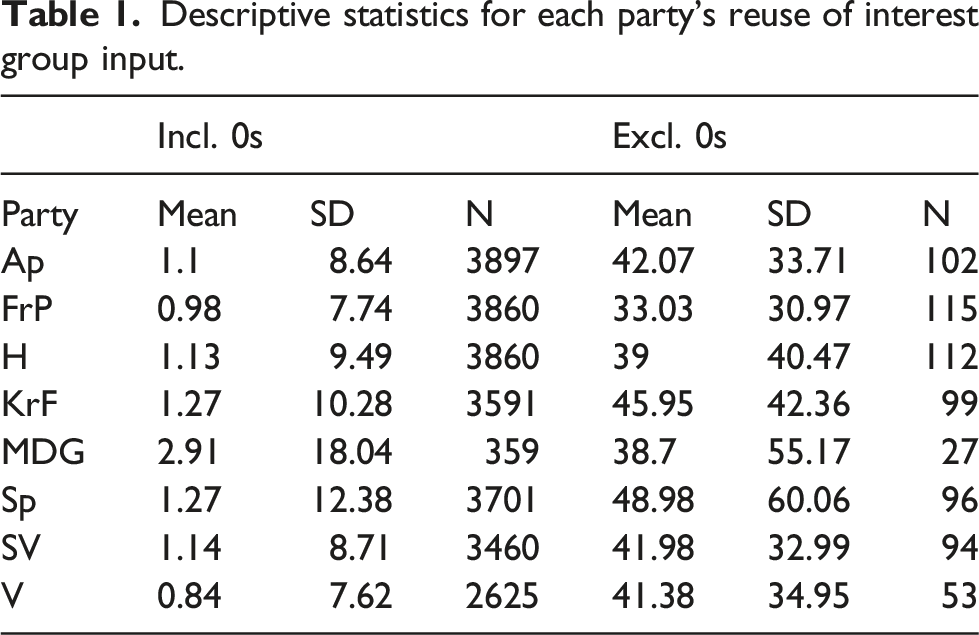
The dependent variable is an overdispersed count measure. I therefore run negative binomial regressions. The unit of analysis is party-interest group pairs, and standard errors are clustered by parties and interest groups to account for potential dependencies in the data. I include fixed effects for the year the parliamentary debate took place to account for any unmeasured variation that could make parties more prone to use interest group input in a given year. 4 Multicollinearity is not a problem. 5
Independent and control variables
To measure public salience, I use the number of articles written about the issue a given proposal concerns in the three largest national newspapers in Norway (VG, Dagbladet, and Aftenposten) in the three-month period preceding the start of the government consultation. This information was collected from the Nordic news media archive Retriever. The measure ranges from 0 to 52 articles with a mean of 4.68 (SD = 10.43). To measure the salience of an issue to parties, I link the topic of a proposal to relevant MARPOR manifesto categories (Volkens et al., 2020). I use the total number of quasi-sentences each party dedicated to the issue in its latest manifesto prior to the start of the government consultation. This time lag ensures that any interest group mobilization surrounding a given proposal has not had an impact on the parties’ issue emphasis. I calculate the average emphasis all parties except the party in question place on the issue and subtract this from the party’s emphasis. Higher values thus indicate that a party emphasizes the issue more than its average competitor. The measure ranges from −11.71 to 27.42, with a mean of 0.09 (SD = 3.85).
To measure the presence and size of interest group coalitions, I merge several indicators. First, I use the number of groups (excluding the group in question) that submit a joint response. If, for example, five groups submit a joint response, each group is given a value of four on this indicator. Second, I use the number of groups that support a given response. This is gauged by reading the beginning and end of consultation submissions to see if the sender explicitly mentions that it supports another submission. For example, in a specific consultation, two business associations mention that they support the response of the Confederation of Norwegian Enterprise. This confederation thus gets a value of two on this indicator. Third, and similar to Pagliari and Young (2020), I run the Smith–Waterman algorithm on all interest group document pairs for each proposal and count the number of (partially) identical submissions. In contrast to the two other indicators, this allows for detecting instances where specific input is reflected by several actors without them explicitly acknowledging this. Each group is assigned the number of responses that are (partially) identical to the group’s own response. These three indicators are added together and standardized to range between 0 and 1. In addition to this, I take into account whether the consultation response is submitted individually (coded as 0) or jointly (coded as 1). I assume that jointly submitted responses are more coordinated than individually submitted responses. Higher values on the combined measure therefore indicate that the response is supported by a larger number of interest groups and/or more coordinated.
I use a dummy variable to measure whether a given party is in opposition (coded as 0) or government (coded as 1) at the time a given proposal was debated in parliament. I furthermore control for several party, interest group, and issue characteristics. Regarding parties, I control for how niche a party’s profile is as well as party size (seat shares). Regarding interest groups, I control for interest group type and resources in terms of employees. Both may affect how attractive the input groups provide is to parties. I furthermore control for the ideological proximity between a given party and interest group. At the issue level, I include a proxy for each proposal’s degree of interest group conflict as well as a control for policy proposal type. Details about the control variables are available in the Supplemental Appendix.
Results
The effect of party and issue characteristics on party reuse of interest group input.
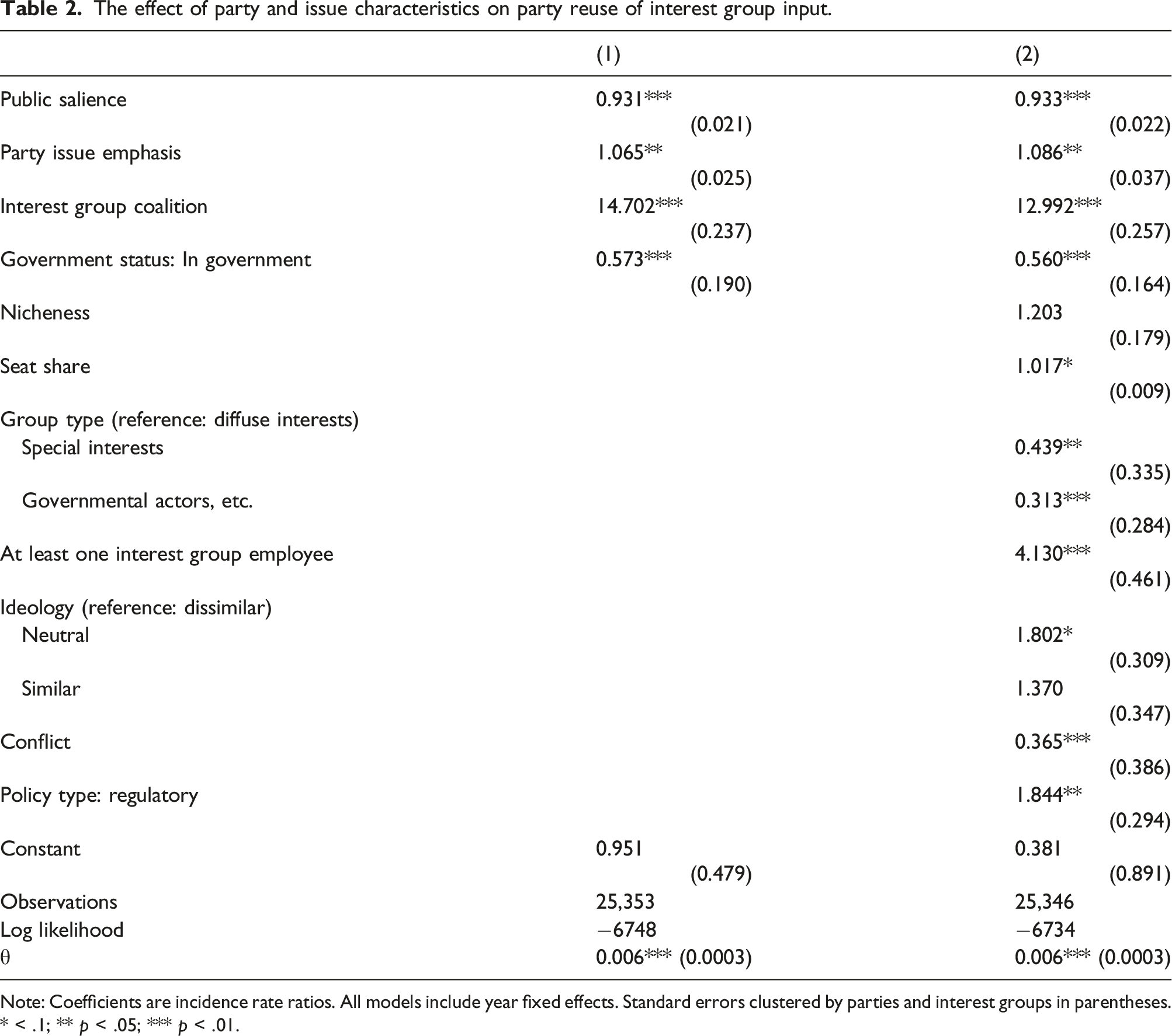
Note: Coefficients are incidence rate ratios. All models include year fixed effects. Standard errors clustered by parties and interest groups in parentheses. * < .1; ** p < .05; *** p < .01.
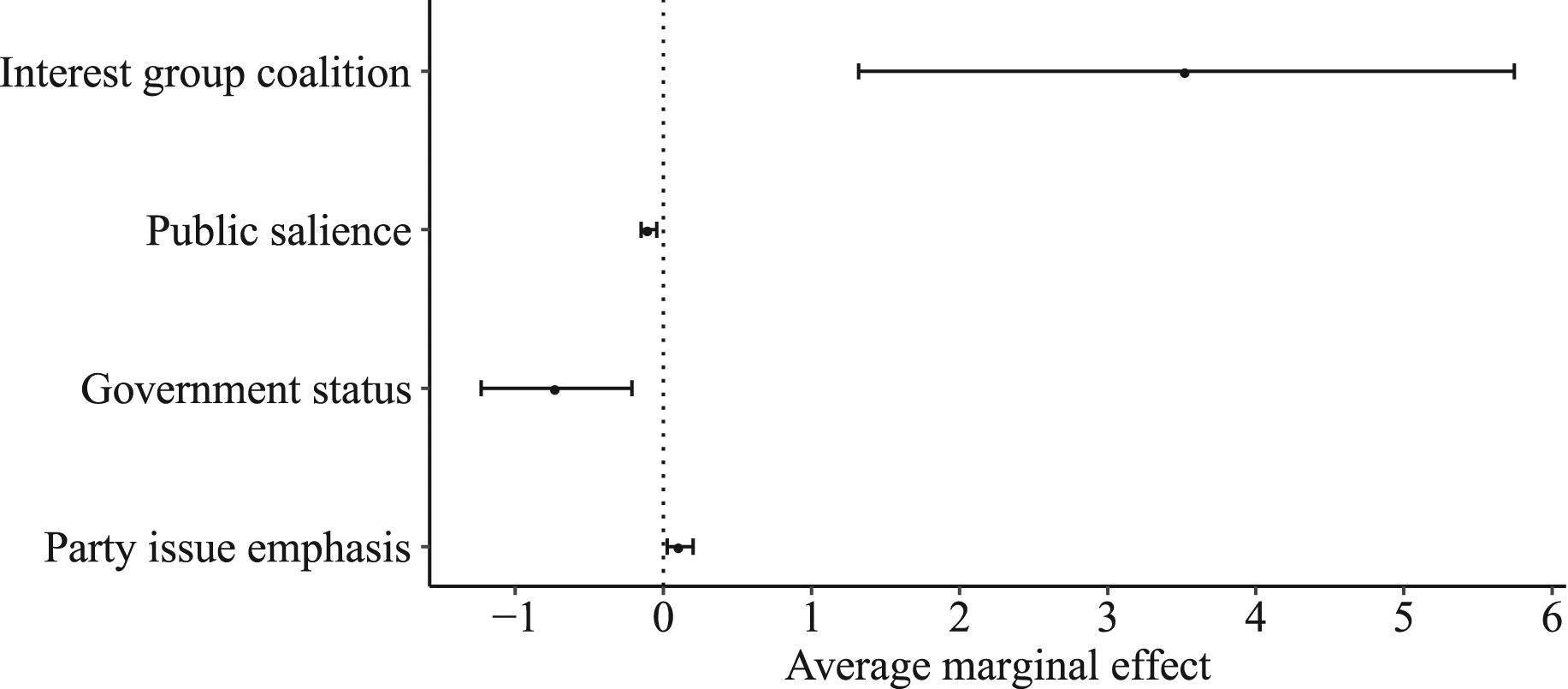
Average marginal effects (based on Model 2, Table 2). 95% confidence intervals.
The results also support the second hypothesis. Parties are more likely to adopt more interest group input on issues they emphasize more than their competitors. Parties on average reuse 0.11 more words when they emphasize the issue more (Figure 1). They stand out from their competitors on these issues and may be interested in listening to interest groups to stay attuned to specific important constituents and to continue to stay ahead of their competitors by signaling responsiveness to these groups. Parties likely want to make sure, however, that the input they reuse in these cases is consistent with their overarching ideological principles. Looking at instances of text reuse where parties’ issue emphasis is above 0, parties reuse input from ideologically dissimilar groups 10.21% of the time. 56.34% of the instances are reuse from “neutral” interest groups and 33.45% from ideologically similar interest groups. In both of the latter instances, it can be easier for parties to frame the input in a way that is consistent with the party’s ideological profile.
This moreover seems to be the case when parties listen to ideologically dissimilar groups on emphasized issues as well. One example is the Green Party’s reuse of input from the Norwegian Association of Hunters and Anglers on a proposal concerning the right to fish in the Tana River. This river flows through Norway and Finland and the reused input concerns the importance of reaching an agreement with Finland that ensures long-term sustainable management of the river as well as what this agreement should include. This focus on sustainability is in line with the Green Party’s position on environmental protection. Overall, it hence seems that parties tend to reuse input on emphasized issues in ways that fit with their ideological image.
The third hypothesis also receives support. Parties are generally more likely to adopt more input from groups that are part of larger and/or more coordinated coalitions. On average, parties reuse 3.53 more words when the interest group input is supported by more interest groups or submitted jointly by a coalition (Figure 1). Ap, Sp, and SV, for example, reuse input (94 words) submitted jointly by the Norwegian Booksellers Association and two student organizations on a proposal concerning the sale of books, and seven parties reuse input (between 80 and 193 words) submitted jointly by 11 interest groups on a proposal concerning new regulations for construction companies. Parties may be particularly prone to adopt more interest group input from coalitions because their chances of appealing to a larger group of voters may be greater.
There is moreover support for the fourth hypothesis regarding opposition versus government parties. Government parties on average reuse 0.72 fewer words compared to opposition parties (Figure 1). To illustrate and looking only at instances of text reuse, Ap, Sp, and SV on average reused between 32.61 and 34.02 words during their time in government (2005–2013). While in opposition, they on average reused between 47.70 and 59.71 words. Opposition parties typically have fewer resources than government parties and may be more reliant on external input. They moreover likely want to attract potential voters in order to get into government in the future. Listening to interest groups can be a pertinent strategy in this regard. Listening potentially also comes with fewer costs for opposition parties as they are not in the same position as government parties to implement what they promise to do in the immediate future.
As for the control variables, party nicheness is not significantly related to parties’ reuse of interest group input. The same is partially the case for ideological proximity. Parties are only more likely to reuse more input from interest groups that have a “neutral” ideological profile compared to those that have a dissimilar ideological profile from themselves. Larger parties are, however, generally more likely to adopt more interest group input. As for the interest group controls, parties are more prone to reuse more input from interest groups that represent more diffuse interests compared to special interest groups and others as well as from interest groups that have at least one employee. With regard to the issue-level controls, parties are more likely to adopt more input from interest groups when there is more conflict and on regulatory policy proposals compared to (re-)distributive ones.
Conclusion
Examining parties’ parliamentary speeches and committee amendments for 88 specific policy proposals in Norway from 2005 to 2015, this study shows that parties listen to and adopt input from interest groups. Interest group input can improve parties’ arguments and adhering to interest group input signals that parties are responsive to the groups’ interests. Assuming that interest group constituents are affected by a given proposal, they likely pay closer attention than the average voter. Signaling responsiveness can hence increase parties’ appeal to these voters. Listening to interest groups can also repel voters, however, and I argue that party and issue-level characteristics affect whether the benefits exceed the costs of adopting input. I find that parties adopt more interest group input when the issue in question is less salient to the public at large as well as when they emphasize the issue more than their competitors. Parties are also more prone to adopt more input when they are in opposition and when the interest group information is echoed by a broader and/or more coordinated coalition of groups. In these cases, the benefits of listening in terms of appealing to the groups’ constituents may be higher than the costs as parties are less likely to alienate party supporters and the electorate at large.
These findings show that interest groups can be a relevant source of information for parties. More broadly, this first of all implies that interest groups affect the link between voters and parties. Interest groups can increase the probability that parties cater to the interests of the groups’ constituents which likely improves the link between parties and these voter groups. Second, that parties are more prone to listen to interest groups on issues they emphasize and in ways that seem to be consistent with their broader ideological profile imply that listening is not a zero-sum game where interest group influence means that parties lose. First, interest groups’ and parties’ constituents may to some extent overlap and listening to interest groups is thus a way for parties to keep up-to-date on what their own voters want. In this way, interest groups function as a transmission belt between a party’s own voters and the party (see also De Bruycker and Rasmussen, 2021). Second, in cases where the constituents overlap to a lesser extent, parties may be able to find a way to keep their core constituents and activists appeased while also appealing to a different group of voters. In both cases, listening to interest groups means that both actors achieve some of what they seek. Interest groups gain traction for their views and interests and parties are able to bolster their positions on policy proposals and appeal to voters to maintain or improve their vote shares. Interest groups and parties can hence mutually benefit from each other.
Unanswered questions remain. A mechanism that potentially connects the explanations offered here and parties’ incorporation of interest group input in their positions is the amount of lobbying they have been subject to. Similarly, longer-term organizational ties between interest groups and parties could be a way for groups to convey their preferences to parties (Allern et al., 2020). Including these aspects in future research is therefore relevant. Future studies could furthermore look into the effect of public opinion on parties’ propensity to listen to interest groups. Previous research shows that interest groups are more likely to wield influence on policy outcomes when their positions are aligned with public opinion (Rasmussen et al., 2018). Whether this holds for parties’ willingness listen to interest groups as well might vary across parties. Less policy-seeking, more mainstream parties are, for example, more responsive to public opinion than parties that prioritize policy purity (Adams et al., 2006; Bischof and Wagner, 2020). More generally, being aligned with public opinion may offset the negative impact of public salience on listening. Examining such interactions could be interesting and would also add to broader theories on interest groups and parties (Albareda, 2020; Blings, 2020; Bolleyer, 2021; Fraussen and Halpin, 2018). Looking into whether the election cycle affects parties’ reuse of interest group input is moreover pertinent. While this paper only covers two national elections, results indicate that reuse is less likely in the months leading up to these. Lastly, future studies could investigate whether the results hold in other institutional contexts and examine how reuse of interest group arguments affects parties’ overall positions on policy proposals.
Supplemental Material
sj-pdf-1-ppq-10.1177_13540688211062832 – Supplemental Material for When do political parties listen to interest groups?
Supplemental Material, sj-pdf-1-ppq-10.1177_13540688211062832 for When do political parties listen to interest groups? by Maiken Røed in Party Politics
Footnotes
Acknowledgments
I am very grateful for excellent feedback on previous versions of this paper from Hanna Bäck, Jan Teorell, Elin Haugsgjerd Allern, Johannes Lindvall, Jonathan Polk, Esther Calvo, Petrus Olander, Simon Davidsson, as well as participants at the 2019 PAIRDEM mini-conference in Oslo and the 2021 digital ECPR general conference.
Declaration of conflicting interests
The author(s) declared no potential conflicts of interest with respect to the research, authorship, and/or publication of this article.
Funding
The author(s) received no financial support for the research, authorship, and/or publication of this article.

Supplemental Material
Supplemental material for this article is available online.
Notes
Author biography
References
Supplementary Material
Please find the following supplemental material available below.
For Open Access articles published under a Creative Commons License, all supplemental material carries the same license as the article it is associated with.
For non-Open Access articles published, all supplemental material carries a non-exclusive license, and permission requests for re-use of supplemental material or any part of supplemental material shall be sent directly to the copyright owner as specified in the copyright notice associated with the article.
