




Abstract
Organizational ties between political parties and interest groups are common in contemporary democracies, but little is known about the political effects of such ties. This article examines whether the strength of organizational ties between parties and interest groups affects the probability of (1) interest group influence on parties, (2) party influence on interest groups, and (3) mutual party–interest group influence in decision-making. Using novel interest group survey data from six democracies, we are the first to systematically examine the relationship between organizational ties and perceived and attributed influence across multiple policy areas. The findings indicate that one-sided influence is more likely when the actors have stronger ties but that such ties also increase the likelihood of influence going both ways. Close party–interest group relationships hence likely involve give-and-take across policy issues. These findings shed important new light on the role of parties and interest groups as intermediaries in democracies.
Introduction
A growing body of work shows that numerous parties and interest groups—actors which fundamentally impact public policy outcomes in democracies—maintain organizational ties such as agreements about regular meetings and regularized top-leadership contact (Allern et al., 2021a; Berkhout et al., 2021; Eichenberger and Mach, 2017; Gava et al., 2016; Rasmussen and Lindeboom, 2013; Witko, 2009). Such ties may shape, enable, and constrain political action, and examining the effects of ties is therefore crucial to better understand the workings of representative democracies.
Party-group ties may improve parties’ responsiveness to the interests represented by connected groups, and hereby influence the relationship between voters and parties. Input from, and ties to, interest groups may strengthen parties’ ability to represent the policy views of voters, but may also weaken it, as group and voter preferences do not necessarily overlap. If parties are out of touch with (their) voters in, for example, economic, immigration or environmental issues, one possible explanation might be pressure from particular interest groups. At the same time, we shall argue, it is possible to imagine that influence is a two-way street when organizational ties are strong. If so, the possible tensions between parties, groups, and voters will be weaker.
A handful of studies investigate interest group influence on parties. The main focus is on the effects of interest group resources and party characteristics (Clifton, 2004; Røed, 2022; Victor and Reinhardt, 2018). Research specifically addressing how party–interest group interactions affect parties’ positions is mainly limited to case studies. The results here indicate that party-group interactions go together with interest group influence on parties (Allern, 2010; Karol, 2009). Concentrating on parties and interest groups that have been close historically, Allern and Bale (2017) furthermore suggest that trade unions with weaker ties to left-wing parties find it harder to stop these parties from promoting policies they regard as hostile. Romeijn (2021) similarly finds that traditional interest group allies of a negotiating party are more likely to influence government coalition agreements in the Netherlands. More systematic, large-N studies on the association between organizational ties and one-sided influence, however, are missing. Are interest groups generally more likely to influence the parties they have stronger ties to across policy areas? Or are such ties mainly of symbolic importance in politics?
In this article, we address this question but also highlight that influence in politics can be mutual; it is not necessarily a zero-sum game (Mahoney, 2007). A policy issue might be complex and involve multiple positions, and parties may inspire changes in the views of interest groups during a decision-making process too. Influence can in other words be one-sided and go from interest groups to parties or the other way around, but it can also be mutual. While few have theorized about this before (but see Öberg, 2002), we examine whether parties influence the groups they regularly interact with.
We argue that organizational ties are likely to increase the probability of one-sided group influence on parties, one-sided party influence on groups, and mutual influence. Organizational ties, which involve a degree of commitment, can make both interest groups and parties better able to monitor each other’s policy delivery. The ties might moreover be based on political kinship to begin with, making it less costly and instead potentially beneficial for parties to accommodate interest groups’ wishes and vice versa. However, regularly interacting may also increase the common understanding and trust between the actors over time and lay the groundwork for a cooperative exchange situation where mutually beneficial compromises are common. In a relationship, the two sides may give and take in a single issue or across issues. Mutual influence may in other words be a likely outcome when parties and interest groups have stronger ties.
Using novel interest group survey data from six mature democracies, we provide the first systematic analyses of the relationship between an extensive range of organizational ties and perceived and attributed influence. We find that stronger organizational ties go together with one-sided influence of both parties and interest groups but also that it makes mutual party-group influence more likely in a given relationship. This holds when we control for a range of alternative explanations for influence, such as interest group donations and proximity along general policy dimensions between the party-group dyads.
These findings shed important new light on the role of parties and interest groups as intermediaries in democracies. We show that parties seem to be responsive to the interests of the groups they are organizationally connected to. This speaks to the party responsiveness literature which has mainly focused on parties’ direct responsiveness to voters (e.g. Adams et al., 2004; Ibenskas and Polk, 2022 but see De Bruycker and Rasmussen, 2021; Giger and Klüver, 2016). Thus, the study falsifies the view that organizational ties are just window dressing and a way for parties to legitimize policy decisions they have already made internally.
Our findings that strong ties involve party influence on interest groups in addition to give-and-take between both actors furthermore indicate that parties are active participants in their interactions with interest groups. This qualifies the conventional wisdom that such relationships entail zero-sum games where interest groups dominate (Schattschneider, 1948). A broader implication of this finding is that through interest groups, parties may potentially gain traction for their views among the groups’ supporters and sympathizers.
Our findings highlight the importance of going beyond the usual focus in the interest group literature on lobbying and influence in single issues (see Hojnacki et al., 2012). Paying attention to the enduring, routinized structures that interest groups and other political actors have put in place is pertinent to understand when interest groups are influential.
Theory
Our basic assumption is that parties and interest groups both seek political influence. Whereas parties are generalists that compete in elections and aim to maximize votes, office, and policy goals, interest groups are policy maximizers that specialize in select domains (Beyers et al., 2008; Sartori, 1976; Strøm, 1990). This opens up for mutually beneficial exchanges. Interest groups can offer parties expertise and political information on how a given position likely will fare among the groups’ constituents. They can furthermore donate money and other in-kind resources to parties, and they may endorse and encourage their constituents to vote for a given party or its candidates. Such resources are likely to help parties improve their policy positions and appeal to certain voter groups overall. In exchange for resources, parties can offer groups access to public office and policy benefits (Warner, 2000) and thus affect interest groups’ ability to achieve political influence. Influencing political parties can be an indirect way to eventually influence public policy outcomes in systems where parties are strong.
However, parties do not instantly deliver on any policy promises they make to interest groups in exchange for their resources. They may try to shirk from delivering as they have other, potentially conflicting, concerns when they decide on specific positions, such as the views of their members and activists, the general public opinion, and other parties’ positions. Thus, to make parties’ supply of friendly policy reliable, interest groups have incentives to institutionalize their interactions with parties. Regularized interactions allow interest groups to monitor what parties do, which weakens parties’ ability to renege without the interest groups noticing and holding the parties accountable—for instance by cutting the supply of resources (Quinn, 2002, 2010). In other words, stronger ties give interest groups more opportunities to hold parties to what they promise, and they can hence increase the groups’ chances of influencing parties’ positions.
Parties can also be interested in institutionalizing their interactions with groups that provide resources to ensure that this provision continues. A growing number of empirical studies support the notion that organizational ties are more common when interest groups have a record of supplying more resources and when parties are more powerful (e.g. Allern et al., 2021b; Otjes and Rasmussen, 2017; Quinn, 2010; Rasmussen and Lindeboom, 2013). Hence, organizational ties may constitute a causal pathway between the resources each actor provides and influence.
Moreover, existing research suggests that organizational ties tend to be more common among groups sharing general policy views, just like research on broader lobbying strategies finds that interest groups generally focus on subsidizing the pursuits of legislators with similar general policy goals instead of trying to change the minds of legislators who are undecided or indisposed to the groups’ positions (Hall and Deardorff, 2006; Hojnacki and Kimball, 1998 see also Marshall, 2015). The literature on party–interest groups ties indicates that, in addition to resource exchange, policy proximity in general policy views seems to play a part. Relationships between actors that are positioned closer to each other along major policy dimensions—such as redistribution or the environment—tend to be stronger (Allern et al., 2021a; Otjes and Rasmussen, 2017).
Given such policy proximity, interest groups with ties to parties are more likely to provide particularly relevant information seen from the parties’ perspective in light of their policy- and vote-seeking goals. This can increase the groups’ chances of influencing the parties’ positions. Parties’ cost–benefit analyses in specific cases are also more likely to be positive because the groups’ preferences on specific policy issues may better correspond with the preferences of the parties’ core voters, members, and activists. Hence, one way policy proximity increases the chances of influence is through organizational ties.
The reason for this is that ties not only constitute a way to monitor parties but also that the structured interactions between particular parties and interest groups that organizational ties allow for involve a degree of commitment. Over time, the ties may further increase the actors’ mutual understanding and foster an acknowledgment of goal sharing among them. This can positively affect the trust between the actors and reduce the costs associated with using interest group input, for instance, in terms of not needing to vet the input internally to the same extent to ensure that it fits with the broader party line.
In sum, interaction through organizational ties can positively affect the likelihood of interest group influence on parties, by modifying existing positions or by pushing the party to take a position on a new issue. The stronger—more formal—the ties, the more likely it is that parties will seriously consider the group’s position in cases of disagreement. Overall, these rationales lead to the following hypothesis on the relationship between organizational ties and one-sided interest group influence on parties:
H1: Interest groups are more likely to influence political parties to which they have stronger organizational ties to across issues.
However, this does not preclude party influence on interest groups, and it is far from evident that parties are passive actors in these exchanges. Parties are policy seekers with their own preferences, perspectives, and ideas that they seek to promote among the public at large (see, for example, Boudreau and MacKenzie, 2014; Brader et al., 2012; Slothuus and de Vreese, 2010). In this regard, influencing interest groups and potentially indirectly their supporters and sympathizers can be a relevant strategy for parties to gain broader traction for their views in specific cases. Parties may therefore also seek to influence the positions of interest groups in a given relationship.
Interest groups for their part can be willing to take input from political parties on board. Beyond seeking political influence, interest groups need to ensure their organizational survival (Beyers et al., 2008). Given that parties typically need to pay attention to developments and issues in a broader range of policy areas than interest groups, parties can also provide new information and perspectives on policy issues that can be of value to the interest groups. Taking information from political parties into account can possibly help the interest groups improve the appeal of their positions to existing and potential constituents. This can positively affect the groups’ chances of survival.
As with one-sided interest group influence on political parties, the likelihood that interest groups will consider input from parties may increase when they have stronger ties. Regularized interactions also allow parties to monitor that the interest groups keep their word when it comes to agreed-upon positions. Shared general policy views and that both actors aim for similar broad societal outcomes can moreover be an important mechanism here. The input these parties provide may be more likely to appeal to the constituents the interest groups want to keep or attract.
The second hypothesis concerning the relationship between organizational ties and one-sided party influence on interest groups is therefore:
H2: Political parties are more likely to influence interest groups to which they have stronger organizational ties to across issues.
Strong ties between interest groups and parties can moreover enable the actors to mutually influence each other. Putting venues in place that allow for regular interaction gives both interest groups and parties opportunities to voice their opinions and exchange information. Over time, these interactions may increase the actors’ mutual understanding and knowledge of each other and positively affect the mutual trust between the actors. This can lead them to approach their interactions as deliberations where they share and discuss their arguments in ways that induce both to adapt their positions (see Öberg, 2002).
The literature on political negotiations points to “conditions that foster a cooperative approach to negotiations: identification with common goals and values and trust in dynamics of diffuse reciprocity” (Thomas, 2021: 626). Such conditions are conducive to cooperative rather than competitive bargaining situations where the actors mutually compromise to try to arrive at agreements that are acceptable to all (Thomas, 2021; see also Lewis, 2010; Naurin, 2010). Strong ties between parties and interest groups provide a similar institutionalized setting with repeated interactions that can lay the groundwork for mutual influence. That parties and interest groups that maintain strong ties typically share similar general policy views may moreover be a mechanism here. When parties and interest groups maintain closer ties, both can hence be stimulated to change their own positions.
This outcome is what Mahoney (2007) describes as the most common real-life scenario: non-zero-sum games involving compromises between, in our setting, interest groups and parties. This moreover ties into the power resource approach which highlights that influence does not necessarily entail conflict where the actors involved use pressure, but that influence can also take place in exchange situations where both actors reap rewards (Korpi, 1985; Woll, 2007).
A classic example of a close party-group relationship in Europe—the organizational ties between the Norwegian Labor Party and the Confederation of Trade Unions (LO)—can serve as an illustration. On one hand, this long-established relationship, which includes a joint co-operation committee, has been seen as synonymous with the strong influence of trade unions on the Labor Party. In the public sphere, the party leadership is regularly accused of being “in the pocket of LO” and ties are thus suggested to lead to one-sided influence by LO on the social democratic party (Allern, 2010: 270). On the other hand, this joint committee has been described as an arena for deliberation and bargaining by insiders and historians: “The process of informal bargaining takes place with each passing day on matters big and small, in order to harmonize differences within the structure” (Millen, 1963: 128). Hence, influence allegedly goes both ways.
The third hypothesis, on the relationship between organizational ties and mutual influence, is therefore:
H3: Interest groups and political parties with stronger organizational ties are more likely to mutually influence each other across issues.
Research Design
To examine these hypotheses, we rely on the PAIRDEM interest group survey data set from 2017 to 2018 (Allern et al., 2023; Allern and Hansen, 2022). 1 We include six countries here: Denmark, France, Germany, the Netherlands, Norway, and the United Kingdom. 2 These countries differ in terms of corporatism, public subsidies to parties, and party finance regulations—all aspects that might affect the incentives for party-group ties—but our results are nevertheless mainly applicable to mature democracies.
The theoretical interest group population for this data set consists of non-governmental, formal associations of individuals or organizations that advocate a particular interest or cause in public and attempt to influence public policy. Our analysis thus covers groups with and without members, including for example trade unions, business groups, and think tanks.
When generating interest group sampling frames, existing lists of interest group populations in all countries were used. A challenge of relying on existing lists is that some are not entirely up-to-date. Moreover, the interest group definition covers organizations that may not be included on existing lists, such as foundations, charities, and think tanks. Therefore, different types of sources (e.g. national lobby registers) were checked to see whether there were new groups that should be added and to add groups that were not covered. Finally, the data collection covers national groups only. Local and regional groups and branches were therefore removed from the sampling frames. The group sampling frames (including lists used) are further described in the complete survey documentation report included in the data DOI (Allern and Hansen, 2022).
In each country, the survey was sent to a random sample of groups and a purposive sample consisting of the ten most important groups active in eight policy areas with high party-political relevance. The total sample therefore mirrors the general group population but with a certain oversampling of major actors.
The overall response rate was 29% with no significant differences across group types (for details and assessments of representativeness see Allern and Hansen, 2022). The person in charge of governmental affairs, public relations, or public policy work responded to the questionnaire on behalf of their organization. For groups that did not employ such a person, the director-general or head of communications was addressed instead.
Measurement of the Dependent Variable: One-Sided and Mutual Influence
To measure influence, we build on two PAIRDEM survey questions that tap into perceived and attributed influence. The first survey question concerns interest group influence on parties—to what extent interest groups have an impact on parties’ policy decisions in different policy areas. The survey question asked the interest group respondents to consider the input they provided to parliamentary party groups in the current legislative term and rate their influence on each party group. The respondents were asked about their influence on individual parties’ decisions in the up to three specific policy areas that the groups were the most active in during the last 2 years (chosen from a list of 24 policy areas): Thinking about when your organization has input into decisions made by parliamentary party groups about [policy area] during the current legislative term, how would you rate the influence of your organization on the following parties? Note: If the present legislative term has just begun, please refer to the preceding period. To be considered “very influential,” your organization’s input must have had a decisive influence on the positions taken by the parliamentary party.
The response alternatives for interest group influence on parties, in addition to “don’t know,” were “not at all influential,” “not very influential,” “somewhat influential,” and “very influential.” This question hence taps into the influence a given interest group perceives to have had when they have provided input to a given party regarding decisions in a specific policy area. Note that the term “decisive influence” indicates that the group should have made a difference, not only attained its preferences.
The second survey question concerns party influence on interest groups. This question was asked immediately after the question regarding interest group influence on parties. First, the respondents were asked whether any of the parties inspired a change in the organization’s policy positions during the decision-making processes where they had provided input. The response alternatives, in addition to “don’t know,” were “such a change never occurred,” “yes, it happened once,” “yes, it happened in a few cases,” and “yes, it happened several times.” Choosing one of the yes-alternatives prompted a follow-up question that asked respondents which parties had inspired such a change. Here, we hence rely on a measure that gets at attributed influence. Online Appendix A contains the exact wording for both questions regarding parties’ influence. Compared to the interest group influence question, we note that the party influence question is not policy-area specific but only refers to the “decision-making processes” where the interest groups also provided input. We therefore also show the results for this measure on its own in Online Appendix B. These results, which are not policy-area specific, are similar to our main results.
We use the interest group influence question and the party-specific question regarding party influence on interest groups to construct our dependent variable. Note that these questions were asked late in the survey compared to the questions on organizational ties to minimize possible priming effects. A value of 0 on our dependent variable indicates no influence: The interest group was not at all or not very influential and the party never caused a change in the interest group’s positions. This is the most common outcome and applies to 57% of the observations. A value of 1 indicates one-sided interest group influence on the party only: The interest group was somewhat or very influential, but the party never caused a change in the interest group’s positions. This applies to 29% of the observations. A value of 2 indicates one-sided party influence on the interest group only: the interest group was not at all or not very influential but the party caused a change in the interest group’s positions. This is the least common outcome and applies to 4% of the observations. A value of 3 indicates mutual party–interest group influence: The interest group was somewhat or very influential and the party caused a change in the interest group’s policy positions. This applies to 10% of the observations.
Our dependent variable measure allows us to compare no influence with one-sided influence only and mutual party–interest group influence. The units of analysis are interest group-party-policy area triads. 3 Because the measure consists of four different categories that are not ordered, we run multinomial logistic regressions with country fixed effects and standard errors clustered by interest groups and parties to account for potential dependencies in the data. 4
Some potential sources of measurement error should be addressed. First, social desirability bias suggests that respondents may have normative or strategic incentives to downplay or exaggerate their influence (Dür, 2008). We note, however, that the groups were assured anonymity. This can have encouraged more honest answers. Compared to parties, moreover, interest groups deal with fewer policy areas and actors and therefore likely have a better overview of outcomes. The survey was sent to key informants who likely possess this type of information.
Second, online surveys in general have a bias toward more resourceful actors. Interest groups with more resources are more likely to have the time and ability to answer the survey and can find participating more useful due to a higher level of self-recognition with the questions asked. This problem was remedied to some extent in the survey invitations and in the follow-up calls by urging all types of groups to answer regardless of whether they have contact with parties. Fortunately, the reported degree of variation appears plausible. A further indication of reaching also the less resourceful, is the comparison of the distribution of groups that answered with the distribution of groups in the country samples. With regard to public interest groups, where less resourceful groups are known to be numerous, we see that these are not underrepresented among those that answered (see Allern and Hansen, 2022). In fact, the “de facto” most resourceful group type, namely, business, industry, and employers’ associations, had a lower response rate and was thus slightly underrepresented in comparison to other group types.
Third, the survey questions do not concern specific party decisions to ensure that the survey questions concerning influence were both relevant and manageable for all respondents and to avoid respondent fatigue (Allern et al., 2020). We are hence unable to include controls for decision-level characteristics, such as issue salience, that previous studies have found affect interest groups’ ability to influence political decision-making and political parties (Bunea, 2013; Chalmers, 2020; Klüver, 2011; Mahoney, 2007; Røed, 2023; Rasmussen et al., 2018). The influence questions are, however, not asking for wide and amorphous evaluations of influence. The respondents were asked to think about specific instances where they had provided input in concrete policy areas during the current legislative term. As we discuss below, we furthermore include policy area controls in our analyses. Thus, despite drawbacks, the influence measure enables us to tap into interest groups’ perceived aggregated impact on specific parties’ decisions across different policy areas and the influence they attribute to parties.
Finally, it might be the case that respondents who report that their interest group has several types of organizational ties to parties conflate this with the question of influence and are thus inclined to perceive that their group and the party in question have influenced the other. On this point, we again note that the questions regarding influence were asked late in the survey compared to the questions on organizational ties which were asked in the very beginning. Moreover, the questions on ties dealt with the actual existence of specific ties, not the informant’s perception of the overall strength of an organizational connection. We also note that having organizational ties and perceiving that either actor has influenced the other do not follow the same empirical pattern. For example, some interest groups with strong ties to parties report that neither actor influenced the other, and several interest groups with no ties to a given party report either one-sided or mutual influence (see Online Appendix C for frequencies).
Measurement of Organizational Ties
Organizational ties “connect decision-making bodies, headquarters and/or the decision-makers or staff” of an interest group and party and constitute “means by which a party and an interest group may interact repeatedly” (Allern et al., 2021c: 1257). We rely on 13 survey questions concerning the existence of specific organizational ties between a given interest group and party in the last 5 years. As can be seen in Table 1, we thus cover an extensive range of regularized interactions between specific interest groups and parties. In particular, seven of the ties concern joint arrangements and agreements and the remaining six ties concern organized routines.
Organizational Ties.
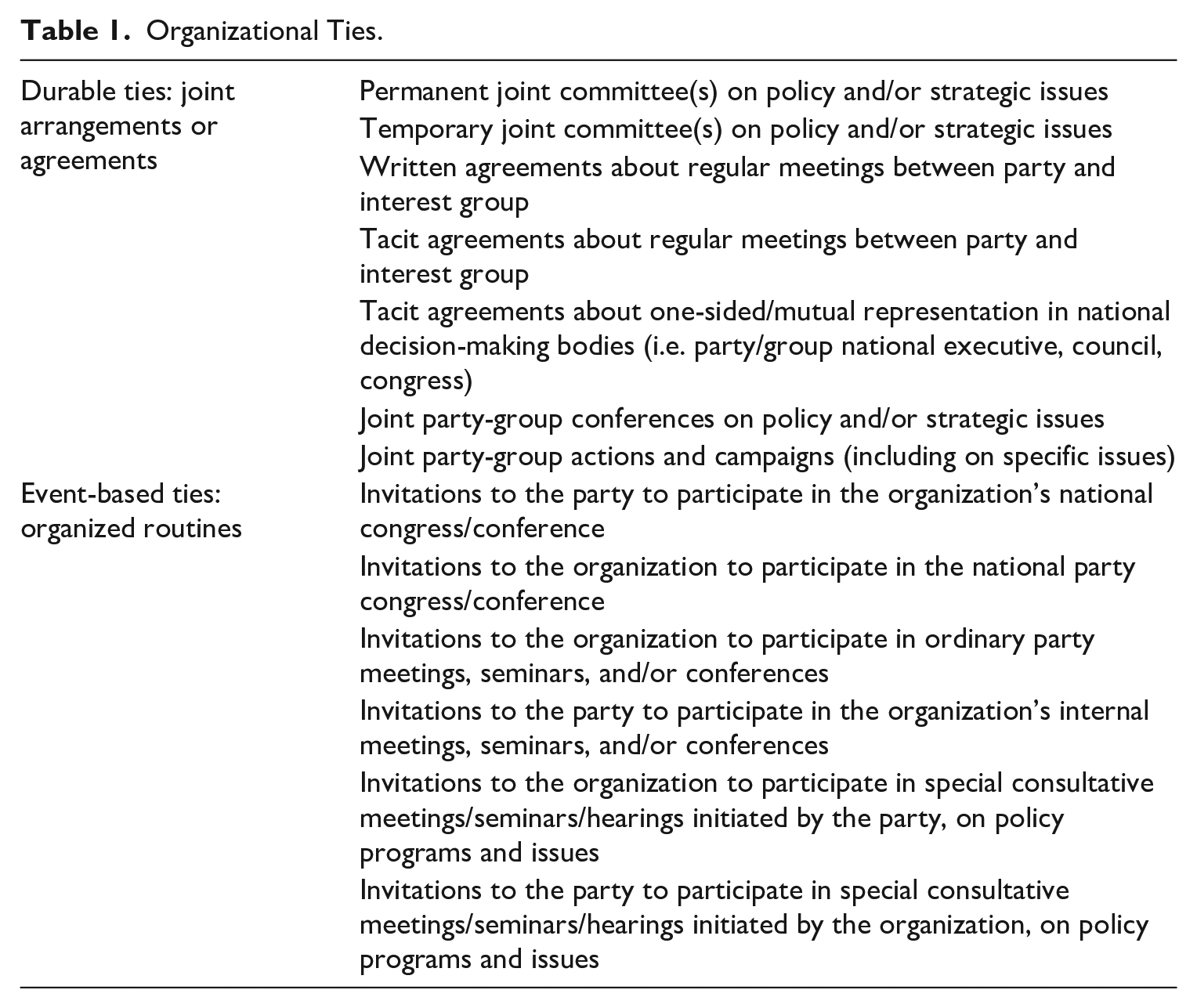
Following Allern et al. (2021c), we add these 13 items together to create an index where higher values indicate stronger (i.e. more formal) organizational ties between a given interest group and party. Allern et al. (2021c) validate the use of an additive index using Mokken scaling. They find that stronger ties are rare but tend to go together with weaker, more common ties. They therefore argue that ties constitute a hierarchical, one-dimensional scale. As Table 2 shows, the mean number of ties here is 1.12 (SD = 1.94).
Descriptive Statistics for Independent and Control Variables.
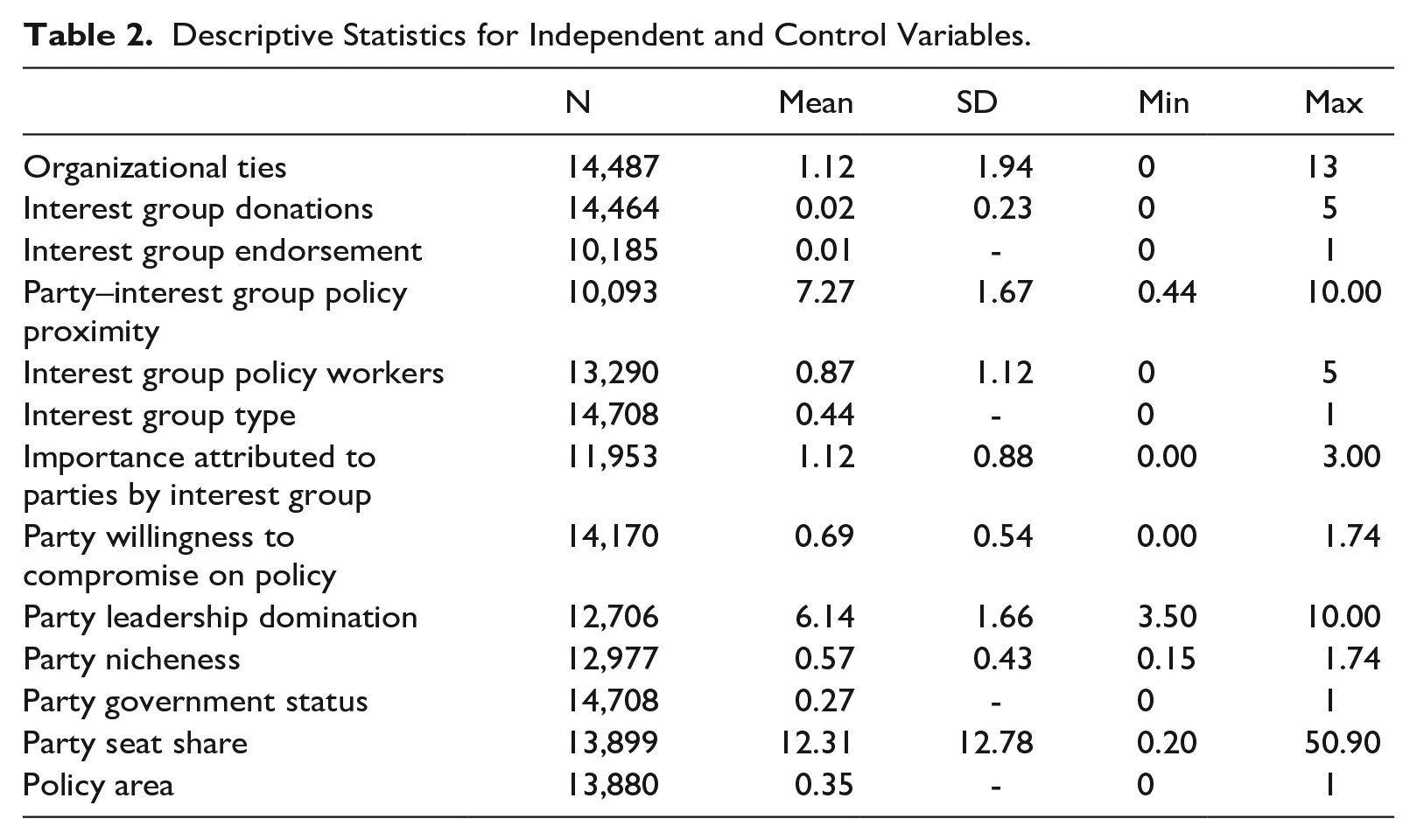
Figure 1 shows the frequency distribution of ties for the party–interest group dyads (see Online Appendix D for country overviews). 68.61% of the dyads have no ties. For the remaining dyads, it is relatively common to have one or a few ties whereas having eight or more ties is rarer.
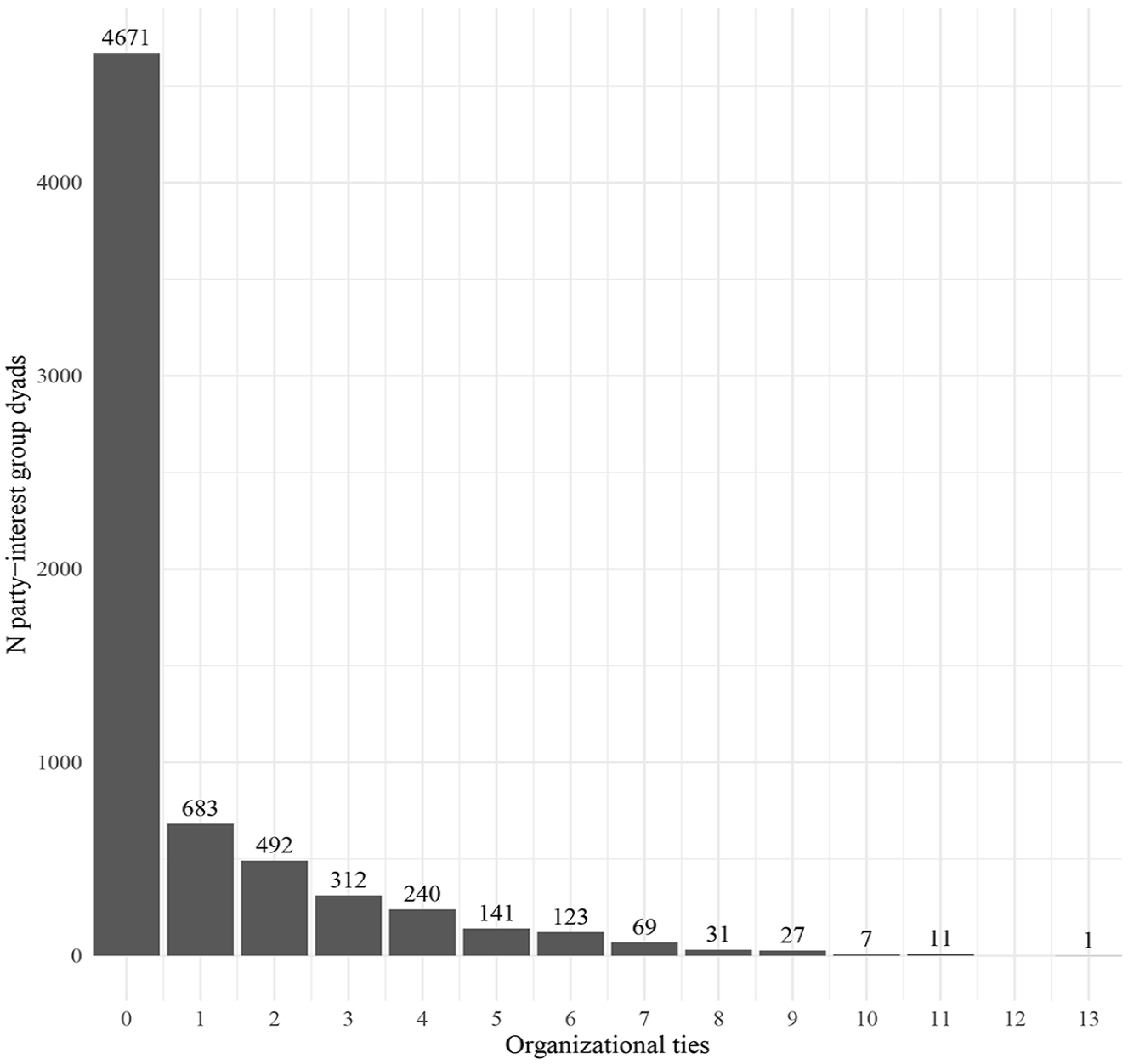
Frequency Distribution of Organizational Ties for the Party–Interest Group Dyads.
In Online Appendix E, we examine whether the results are robust to alternative operationalizations of party–interest group ties. We first of all split the full index of ties into two alternative indexes with conceptually different types of ties, one concerning the more institutionalized, durable joint arrangements and agreements and one concerning the less institutionalized, event-based routines. This enables us to examine whether the results are driven by either subset of tie types. Second, we examine regularized elite-level interactions between interest groups and parties. That is, we look at the presence of meetings between interest group leaders and party top leaders. Our results are robust across these different operationalizations of ties.
We argue that organizational ties, which provide parties and interest groups with a certain degree of stable, long-term access to each other, positively affect influence. The causal direction may, however, also be the reverse. Over time, ties and influence may reinforce each other. This leads to potential endogeneity issues. The survey questions ask respondents to consider their group’s ties to parties in the last 5 years and influence during the current legislative term. This means that the ties we document generally precede or are concurrent with influence, which makes endogeneity less of an issue here. With the data at hand, we are nevertheless only able to examine whether there is a robust association between ties and influence.
Control Variables
We control for an extensive range of factors that may affect both strength of ties and influence. First, we control for interest group donations to parties because money and other resources might independently motivate parties to alter their positions (Allern et al., 2021b; Victor and Reinhardt, 2018). We use an additive index consisting of five survey questions that cover direct and indirect financial contributions and in-kind contributions (offering labor, material resources, and party premises during election campaigns) to specific parties over the preceding 5 years. Higher values indicate more types of donations to the party in question. To test validity, we compared the survey responses on direct financial contributions with publicly available information and only found a few discrepancies that could be explained by unclear aspects of reporting rules. Second and again using a question from the survey, we control for official interest group endorsements of a given party or its candidates before the latest election. 0 equals no endorsement and 1 equals endorsement.
We furthermore include a measure on the general policy proximity between a given party and interest group along different policy dimensions. Parties may be more willing to listen to what they consider ideological friends than adversaries (Otjes and Rasmussen, 2017; Røed, 2022). We combine survey questions that ask the respondents to indicate the group’s position on several policy dimensions from the Chapel Hill Expert Survey (CHES) with CHES party positions (Polk et al., 2017). The measure gets at the average proximity between the interest group’s and party’s position on one or more of six dimensions that cover both material and post-material issues. 5 Higher values indicate more similar positions. With this control variable, we effectively exclude groups that do not have a position on at least one policy dimension. If we instead control for whether an interest group has (at least one) position on a party-political dimension or not—and thus include a broader set of interest groups—the results are similar.
We moreover control for the interest groups’ organizational capacity and resources by means of a survey question that concerns their number of policy workers that mainly deal with monitoring and commenting on public policy. This measure ranges from 0 to more than 50 such employees. Having more policy workers can positively affect interest groups’ efforts to interact with and influence political actors (Mahoney, 2007). To account more specifically for the efforts interest groups may invest in parties, we also include a measure that captures the average importance an interest group attributes to party organizations and parliamentary party groups (Rasmussen and Lindeboom, 2013). This measure is based on two survey questions and ranges from not at all important to very important.
We furthermore control for interest group type. The country experts of the PAIRDEM survey project classified the different interest groups based on a categorization scheme widely used in the field (see, for example, Binderkrantz et al., 2015). By merging these interest group categories, we distinguish between special interest groups (business, occupational, labor, and institutional groups) and diffuse interest groups (public interest and identity groups). Diffuse interest groups tend to supply more political information on voter preferences, which can be especially helpful for parties in light of their goals (Flöthe, 2020; Flöthe and Rasmussen, 2019).
As for party characteristics that may affect both ties and influence, we first of all control for parties’ willingness to compromise on policy. It may be easier to influence parties that are more willing to compromise. Following Røed (2022), we measure this by combining standardized indicators of parties’ government participation (days in government) and the CHES general left-right distance to their most dissimilar coalition partner between 2000 and 2016. Higher values indicate a greater willingness to compromise. Second, we control for parties’ power resources in terms of seat shares and whether a given party was in government (coded as 1) during the time period the influence measure covers. Interest groups may put more effort into getting access to more powerful parties which can increase their chances of succeeding (Otjes and Rasmussen, 2017).
Third, we control for intra-party democracy—and thereby the party leadership’s freedom to compromise in policy conflicts—using a measure on party leadership versus members or activists making party policy choices from the 2019 CHES. The measure ranges from 0 to 10 with higher values indicating a more leadership-dominated party (Bakker et al., 2020). Fourth, we control for how niche parties’ profiles are using Bischof’s (2017) approach and MARPOR data (Volkens et al., 2020). This measure reflects to what extent a given party is alone in emphasizing several niche issues in the party system. Higher scores indicate more niche parties. Niche parties may give higher priority to policy goals which can make gaining influence harder for the average interest group.
Finally, to account for potential differences between policy areas, we include a variable that distinguishes between (re-)distributive and regulatory policy areas. Benefits and costs are more concentrated in regulatory policy areas, which could lead to a greater degree of conflict and thus affect groups’ chances of being influential (Dür and De Bièvre, 2007).
In Online Appendix F, we furthermore control for how salient the policy area in question is to the given party. Parties may be particularly interested in getting input on issues that are more salient to them (Røed, 2023). This party salience variable is based on data from MARPOR and coded by matching relevant party manifesto categories with the PAIRDEM policy areas (Rødland et al., 2021). Not all policy areas could be matched to a manifesto category, resulting in missing data, and because of this drawback we include this as a robustness test. The results are robust to the inclusion of this control variable (Online Appendix F).
Results
Table 3 shows the regression results. Our first hypothesis posits that interest groups are more likely to influence the parties they have stronger ties to. Looking at Model 2 in Table 3 where we control for possible confounders, we see that interest group influence on parties is more likely compared to no influence when the ties between the actors are stronger.
Party–Interest Group Ties and Influence.
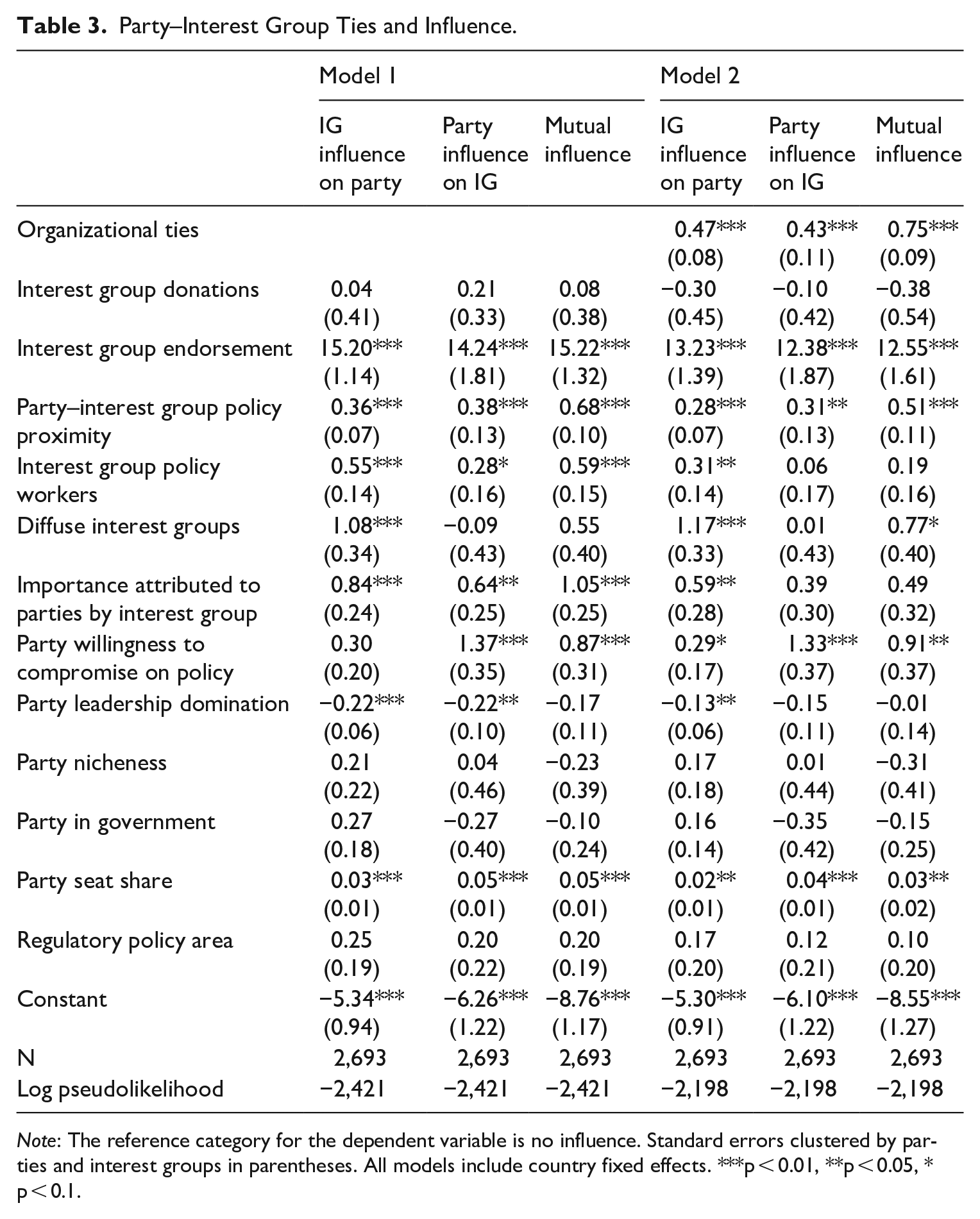
Note: The reference category for the dependent variable is no influence. Standard errors clustered by parties and interest groups in parentheses. All models include country fixed effects. ***p < 0.01, **p < 0.05, * p < 0.1.
With no ties, the predicted probability of one-sided interest group influence on parties is 0.21 (Figure 2). With six ties, on the other hand, the predicted probability of one-sided interest group influence on parties is 0.47. After this, the predicted probability of one-sided interest group influence on parties diminishes and the predicted probability of mutual influence increases. One-sided interest group influence on parties is hence most likely when the actors have medium-strong ties.
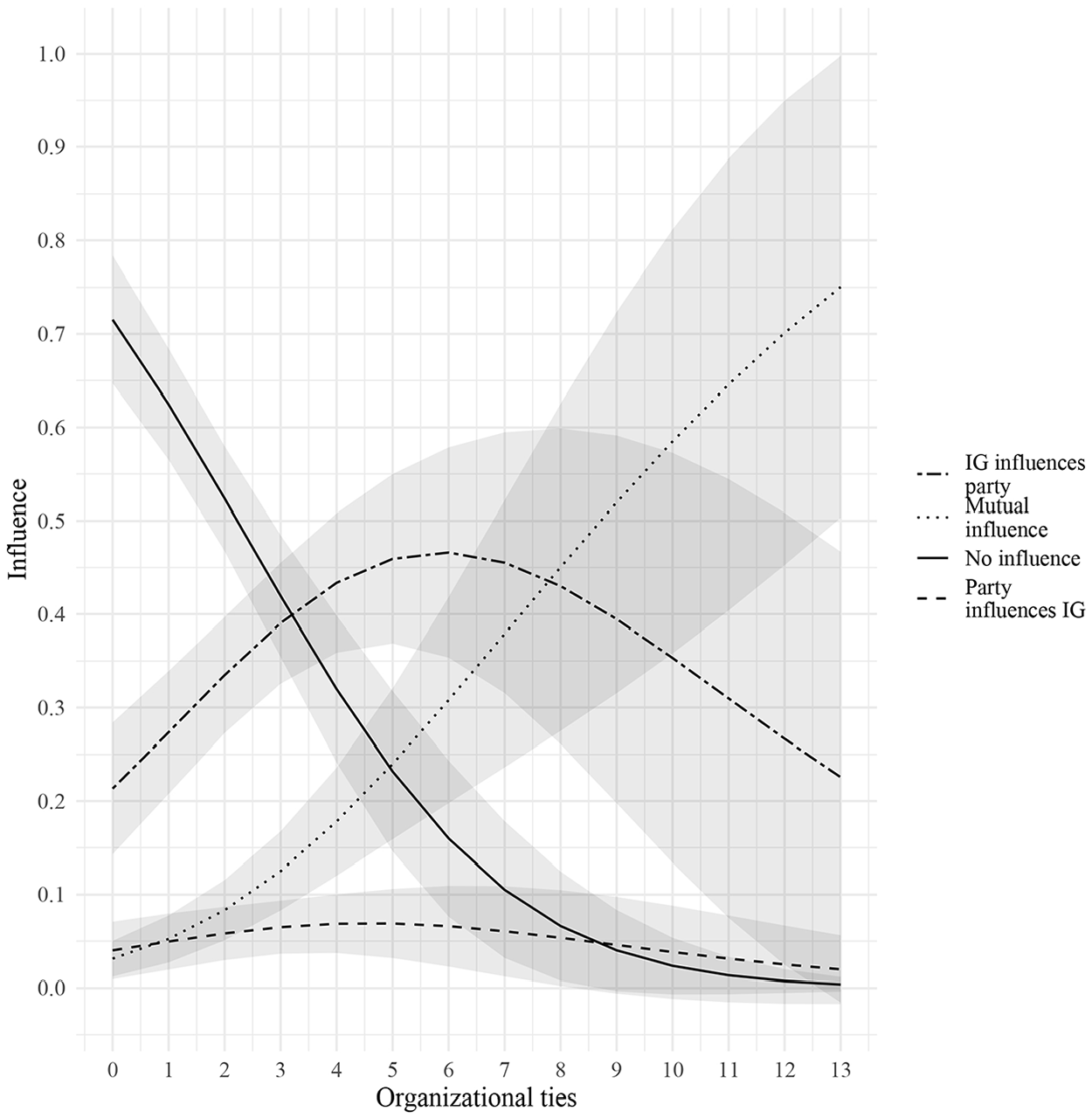
Predicted Probability of Influence by Party–Interest Group Organizational Ties (Model 2, Table 3). 95% Confidence Intervals.
These results overall lend support to the first hypothesis. We find that stronger ties are positively associated with interest groups’ perceived influence on parties. In these models, we control for an extensive range of factors that may affect both the strength of ties and influence. The findings are in other words robust to controlling for alternative explanations for interest group influence on parties. Regular, institutionalized interactions may increase interest groups’ ability to monitor that parties keep their policy promises. They may also positively affect the mutual understanding and trust between parties and interest groups, which can increase the chances that interest groups influence parties.
Our second hypothesis concerns one-sided party influence on interest groups. As can be seen in Table 3, Model 2, we also find that the likelihood of this—compared to no influence—increases when interest groups and parties have stronger ties (see also Online Appendix B). Given that only the interest group influence question asks about influence in specific policy areas whereas the party influence question is more general, there are limits to a direct comparison of the one-sided influence results. With this caveat in mind, however, as Figure 2 shows, one-sided interest group influence on parties and mutual influence are more likely outcomes than one-sided party influence on interest groups. The predicted probability of one-sided party influence on interest groups ranges from 0.04 when parties and interest groups do not have any ties to 0.07 when they have medium-strong (five) ties to 0.03 when they have strong (eleven) ties.
Regular, institutionalized interactions between parties and interest groups in other words positively affect the chances of one-sided party influence on interest groups. Parties hence seemingly do not just receive and incorporate interest group input; they are in some cases also able to incite interest groups to change their positions. This is, however, the least likely outcome. This may reflect that whereas interest groups likely primarily seek to influence political parties, this is potentially a more secondary goal for parties when it comes to their interactions with interest groups. Nevertheless, the positive relationship implies that stronger ties also allow parties to monitor that interest groups keep their policy promises and that interest groups find the input parties provide useful when it comes to appealing to existing and new constituents to ensure their organizational survival.
Finally, the regression results support our third hypothesis regarding mutual influence. Parties and interest groups are more likely to influence each other when they have stronger ties (Table 3, Model 2). As Figure 2 shows, when the strength of ties increases, the predicted probability of mutual influence increases. With eight ties or more, mutual influence is the most likely outcome. Mutual influence is, however, only significantly more likely compared to one-sided interest group influence on parties with 13 ties.
When interest groups and parties have stronger ties, mutual influence is overall a likely outcome. When interest groups and parties are more strongly connected as organizations, both actors may in other words give and take. In Model 2, we control for general policy proximity between the actors meaning that organizational ties seem to have an independent effect on the likelihood of mutual influence. This implies that organizational ties may be conducive to a cooperative exchange situation where the actors trust and know each other and aim to achieve mutually beneficial compromises.
Nevertheless, the likelihood that this relationship is characterized by mutually rewarding exchanges instead of conflict and the use of pressure may be higher if the actors to a greater extent share similar general policy views. The policy proximity scale ranges from 0 to 10, and the average policy proximity between interest groups and parties that maintain strong (six or more) ties is 8.16. This compares to an average policy proximity of 6.81 for parties and interest groups without ties. An interaction effect between ties and policy proximity is, however, not statistically significant (see Online Appendix G). Interest groups and parties with stronger ties and more similar policy views are in other words not significantly more likely to influence each other than interest groups and parties with stronger ties and less similar policy views. Still, given the relatively high average proximity between the actors that maintain stronger ties, the influence relationship between them may overall be characterized by mutually rewarding exchanges rather than conflict and pressure.
Regarding the control variables, we find some statistically significant effects (Table 3, Models 1 and 2). The effects of interest group endorsements, policy proximity, party willingness to compromise on policy, and party seat share are—as expected—positive and significant across outcomes. Other control variables are only significant when it comes to one-sided interest group influence on parties. Both interest group policy workers and the importance interest groups attribute to parties are positively and significantly related to one-sided interest group influence on parties as expected. We furthermore find that party leadership domination is significant and negative. Interest group type has a significant effect both on one-sided interest group influence on parties and mutual influence. We find that diffuse interest groups are more likely to influence parties and that the likelihood of mutual influence is also higher for these types of interest groups compared to special interest groups. The remaining control variables—interest group donations, party nicheness, party in government, and type of policy area—are not statistically significant.
We moreover note that the estimates of the resources interest groups and parties provide the other—such as donations in the case of the interest groups and power (being in government and party size) in the case of the parties—are smaller after we include organizational ties in Model 2. This could indicate that some of the impact these resource variables have on influence is mediated by organizational ties.
Conclusion
Political parties and interest groups regularly interact, and some have relatively strong organizational ties in contemporary democracies. Whether such ties affect parties’ and interest groups’ policy positions and decisions has received little attention to date. Structured party-group interactions, however, provide venues where both actors can voice their opinions, they allow both to monitor that the other deliver on their policy promises, and they can moreover increase the mutual understanding and trust between the actors. Given that similar general policy views are common when parties and interest groups maintain strong ties, the information the other actor supplies may furthermore be especially useful when it comes to goal attainment. We therefore expect that stronger ties positively affect one-sided influence on the part of both actors and mutual party–interest group influence. Using interest group survey data and examining an extensive range of organizational ties, we find support for these hypotheses. With stronger ties, the likelihood of one-sided influence and mutual influence is higher.
Our findings imply that ties are more than window dressing and a way for parties to legitimize policy decisions they have already made internally. Just as intra-party relations with members and activists, organizational ties have substantive value. Ties may enhance parties’ responsiveness to the interests represented by connected groups. This means that party-group relations can affect the link between voters and parties. If parties are located further away from voters in a given policy area, one possible explanation can be found in their organizational ties to particular groups. Stronger ties to interest groups may also make the adoption of certain policies more likely for the parties in question. This in turn can affect public policy outputs if the parties are powerful or pivotal in decision-making. Welfare state retrenchment, for example, may be less pronounced in countries where trade unions have strong ties to parties.
Our findings furthermore suggest that interest group influence on parties does not preclude that parties influence groups as well across issues. Indeed, mutual influence is the most common outcome when parties and interest groups are closely connected in terms of strong organizational ties. This implies that parties are active participants in their interactions with interest groups, and that there is room for parties to handle possible conflicts between the interests of a given group and the parties’ voters, activists, and elites on specific legislative issues. Thus, our study qualifies the assumption that strong party-group ties lead to group dominance and involves a zero-sum power game. Strong organizational ties are perhaps more about long-term collaboration and compromises than enhanced opportunities to efficiently lobby individual parties.
Future research should examine the robustness of the results with other measures of influence that do not rely on actors’ perceptions. This is a difficult task but one way forward could be to trace party and interest group position changes as reflected in the media or in the actors’ manifestos or platforms. Moreover, using alternative measures of influence could importantly make it possible to examine the role issue characteristics play here. Does issue salience, for example, affect the impact ties has on influence?
Another pertinent avenue for future research is to look into what explains variation in influence between dyads with strong ties. Most of the observations of parties and interest groups in the survey data set we use that maintain stronger (six or more) ties concern cases where either the interest group influenced the party (47% of the observations) or where both influenced each other (46% of the observations). 4% of the dyads with stronger links have not, however, influenced each other in a one-sided way or mutually. Looking closer at this subset of observations, we see that interest groups and parties with stronger ties but no influence differ from those that influence each other when it comes to for instance the average policy proximity between them. For the no-influence dyads, the average policy proximity—which theoretically ranges from 0 to 10—is 7.4 compared to around 8.2 for dyads with one-sided or mutual influence. This may furthermore point to the importance of looking into issue-level explanations when it comes to this type of variation.
Finally, although the data set used in this article allows us to investigate the relationship between different types of ties and influence and control for important possible confounders, it only covers one point in time. Future data collection efforts could hence try to build on our original research to better understand the sequencing of events. Do changes in the strength of party–interest group ties over time impact the actors’ abilities to influence each other? Are interest groups incentivized to reinforce their ties to parties when they consistently listen to the groups’ input, as the ties produce the policy rewards they were assumed to reliably provide? These questions may be addressed with data spanning both several years and issues.
Supplemental Material
sj-docx-1-psx-10.1177_00323217231202596 – Supplemental material for Party–Interest Group Ties and Patterns of Political Influence
Supplemental material, sj-docx-1-psx-10.1177_00323217231202596 for Party–Interest Group Ties and Patterns of Political Influence by Maiken Røed, Elin Haugsgjerd Allern and Vibeke Wøien Hansen in Political Studies
Footnotes
Acknowledgements
Former versions of this article have been presented at the 2021 ECPR General Conference: Virtual Event and at the 2022 Political Data Science Workshop in Oslo. We thank the participants and in particular Nicole Bolleyer for their excellent comments. We would also like to thank all the wonderful scholars and research assistants who have contributed to the PAIRDEM project which data we utilize in this article.
Declaration of Conflicting Interests
The author(s) declared no potential conflicts of interest with respect to the research, authorship, and/or publication of this article.
Funding
The author(s) disclosed receipt of the following financial support for the research, authorship, and/or publication of this article: The research for this article was generously supported by the Research Council of Norway and the University of Oslo (FRIPRO, YRT, grant no. 231755/F10).

Supplementary Information
Additional supplementary information may be found with the online version of this article.
Contents
Table A1. Party–Interest Group Ties and Party Influence on Interest Groups Table A2. Party–Interest Group Ties and Mutual Party–Interest Group Influence
Figure A1. Frequency Distribution of Organizational Ties and Influence for the Party–Interest Group-Policy Area Triads
Figure A2. Frequency Distribution of Organizational Ties for the Party–Interest Group Dyads in Denmark Figure A3. Frequency Distribution of Organizational Ties for the Party–Interest Group Dyads in France Figure A4. Frequency Distribution of Organizational Ties for the Party–Interest Group Dyads in Germany Figure A5. Frequency Distribution of Organizational Ties for the Party–Interest Group Dyads in the Netherlands Figure A6. Frequency Distribution of Organizational Ties for the Party–Interest Group Dyads in Norway Figure A7. Frequency Distribution Of Organizational Ties For The Party–Interest Group Dyads in the United Kingdom
Table A3. Alternative Operationalizations of Party–Interest Group Ties and Influence.
Table A4. Party–Interest Group Ties and Influence with Policy Area Salience for Party as a Control Variable.
Table A5. Interaction Effect Between Organizational Ties and Party-Interest Group Policy Proximity.
Notes
Author Biographies
References
Supplementary Material
Please find the following supplemental material available below.
For Open Access articles published under a Creative Commons License, all supplemental material carries the same license as the article it is associated with.
For non-Open Access articles published, all supplemental material carries a non-exclusive license, and permission requests for re-use of supplemental material or any part of supplemental material shall be sent directly to the copyright owner as specified in the copyright notice associated with the article.
