



Abstract
This paper evaluates the circumstances under which affluent interest groups wield influence over policy outcomes. Interest group scholarship is ambiguous about the beneficial role of economic resources for lobbying influence. Economically resourceful groups are often presumed to provide more and better expert information to decision-makers and, in exchange, receive more favourable policy concessions. We argue that the beneficial role of economic resources is contingent on the media salience of policy dossiers. We expect that resourceful groups are more influential when issues are discussed behind the public scenes, while their competitive advantage dampens once issues grow salient in the news media. We test our expectations in the context of European Union policymaking, drawing from 183 expert surveys with lobbyists connected to a sample of 41 policy issues. Our empirical findings demonstrate that economic resources matter for lobbying influence, but that their effect is conditional on the media salience of policy issues.
Introduction
Influencing policy decisions is one of the main objectives of interest groups (Dür, 2008a; Klüver, 2011), which we conceive of as all organisations with political objectives and which aggregate political preferences, including business associations, labour unions, civil society organisations and social movement organisations (Beyers et al., 2008). Conventional wisdom holds that rich interests prevail and that policies will ultimately benefit the highest bidder. Furthermore, academic debates often presume that policymakers respond almost exclusively to the economically advantaged (Gilens, 2012). Various studies have therefore highlighted the relevance of economic resources to explain interest groups’ success or influence (Baumgartner et al., 2009; Binderkrantz et al., 2015; Gerber, 1999; Hall and Deardorff, 2006; Kohler-Koch, 1994). This ‘transaction cost’ perspective reflects an elitist understanding of interest group politics in which lobbyists ‘buy’ attention and cooperation from politicians (Lowery and Gray, 2004: 165). However, this understanding of lobbying is problematic for democratic governance, as it implies that policies are biased towards well-endowed interests, undermining majority rule and jeopardising the public interest. This pessimistic perspective contrasts with the pluralist thought, which perceives the population of organised interests to validly reflect the distribution of salient interests in society (Truman, 1951). Baumgartner and Leech (1998: 48) summarised the pluralist account: ‘one of the explanations of America’s success in maintaining democracy […] is the vibrant group system based on competition and independence from the state’. Yet, the pluralist view of interest representation does not take into account that some interests organise themselves more easily than others (Olson, 1965). As Schattschneider famously observed in the early 1960s, ‘the flaw in the pluralist heaven is that the heavenly chorus sings with a strong upper-class accent (1960: 34–35)’. In other words, a pluralist system ultimately produces elitist influence distributions biased in favour of ‘the happy few’.
Building on the deeply engrained tensions between pluralist and elitist thought, several studies have attempted to empirically clarify the role of economic resources in political influence. However, interest group scholarship has yet to reach a consensus about the validity of either the elitist or pluralist perspective and the corresponding role of economic resources in political influence. This disagreement is due in part to differing operationalisations of political success and influence, calling for the combination of different measurement methods (Dür, 2008b).
Meanwhile, the more recent neopluralist stream of research embodies this disagreement and posits that ‘the most telling trait of the influence enterprise is its contingency’ (Lowery and Gray, 2004: 167). Neopluralist research emphasises the moderating role of the issue context (see Klüver, 2011; Mahoney, 2007) and analyses ‘when, why, and to what extent interest groups are powerful on what types of issues’ (Baumgartner and Leech, 1998: 134). In the neopluralist vein, this research asks whether economic resources are more important in some issues with specific characteristics than in others. The aim of this article is to contribute to understanding the role of economic resources and to assess under which conditions economic resources lead to lobbying influence. In line with previous studies on issue salience (Beyers, 2008; Dür and De Bièvre, 2007b; Klüver, 2011; Mahoney, 2007), we examine whether the role of economic resources in interest group influence is contingent upon the media salience of policy issues in the context of European Union (EU) public policy.
Addressing this question in the context of the EU is particularly relevant because of the criticism regarding its democratic deficit (Follesdal and Hix, 2006; Michalowitz, 2004). Despite the considerable regulatory scope of the EU, scholars have pointed to the absence of a clear link between the public sphere and decision-making processes (Kohler-Koch, 2010). In the past two decades, the European Commission (EC) launched several initiatives, such as the White Paper on European Governance (or the Transparency Register (TR)), to make the EU more participatory and to improve the legitimacy of its policies (European Commission, 2002, 2018; Kohler-Koch and Finke, 2007). However, as it is still largely resourceful insiders who gain access to EU decision-making bodies, these initiatives have not served their purpose (Beyers et al., 2008: 1117; Eising, 2007). By combining two different measurement methods of lobbying influence and by drawing on 183 expert surveys, our results show that, indeed, affluent groups are more influential than less-endowed groups. But, the benefits of economic resources weaken and eventually disappear when issues become more salient in the news media. More precisely, the findings demonstrate that on more salient issues, wealthy groups are not significantly more influential than resource-poor interest organisations.
Conceptualising influence
To assess under which conditions economic resources impact the degree of interest group influence on EU policy, we must first conceptualise the abstract idea of influence. Most studies that have investigated the extent to which economic resources matter have done so with regard to access (Eising, 2007). However, although many groups find contacts with policymakers necessary in their efforts to shape EU policy, access is not equal to influence. Indeed, influence can be gained through other strategies as well, such as through outside lobbying to communicate information about the organisation’s preferences or through impacting the selection of political candidates (Bouwen, 2002; De Bruycker and Beyers, 2019; Dür, 2008a; Eising, 2007). In short, there are several pathways to influence (Dür, 2008a: 1221). As a result, there is no single common understanding of the concept of influence and how to gain it (Bouwen, 2002; Dür, 2008b; Dür and De Bièvre, 2007b; Helboe Pedersen, 2013). Despite the existence of various definitions of influence, Dür (2008a: 1221) suggested to ‘consciously focus on specific aspects of the concept (of influence), therefore making it amenable to empirical research’.
Influence is often associated with power as its more abstract, overarching counterpart (Dür, 2008a; Helboe Pedersen, 2013). The literature provides a variety of interpretations with respect to power, which lies at the heart of the political science discipline (Baldwin, 1971). Generally, scholars perceive power in three possible ways, the ‘three faces of power’ (Gilens and Page, 2014: 576). The first face of power refers to a competition with winners and losers in which the winners are considered to be those who are able to force other actors to do what they would not do otherwise (Dahl, 2007: 202–203).Bachrach and Baratz (1962) criticise this conception and argue that power also can be seen as the ability to set the political agenda or the second face of power.Finally, Lukes (2004) argues that even the second face of power is inaccurate and defines power as the capability to manipulate preferences of weak actors to the extent that they do not recognise their own genuine interests.
The first face of power is similar to the basic definition provided by Berry (1979: 183), who defined interest group influence as the achievement of interest fulfilment, which brings us closer to an empirical observable phenomenon. The assumption here is that each interest group has (a) certain policy preference(s) and actively tries to shape policymaking on this/these matter(s) in a desirable way. However, as Michalowitz (2007: 134) argued, this framing does not necessarily mean that the favoured outcomes derive from a Weberian interpretation of power whereby actor A forces actor B to take/prevent a certain action. Rather, Michalowitz claimed that influence is a softer version of power: through persuasion (i.e. offering an incentive) by actor A, actor B takes/prevents an action in line with the preferences of actor A, which is not necessarily actor B’s intention.
Building upon the work of Dür and De Bièvre (2007b: 3), we therefore conceptualise influence as control over political outputs rather than control over actors. We thus consider interest groups influential if they are successful in influencing outcomes in a favourable way. In other words, the emphasis in this work is strongly placed on the political action of groups and to what extent it results in congruence between the interests of the organisation and policy outputs (Michalowitz, 2007). Our conceptualisation differs from the frequently used concept of lobbying success, which captures actors’ utility gains or losses, without attributing causality to their political activities (Dür et al., 2019: 8). Our focus captures the action of pushing political decisions if they are preferable as well as preventing them if they are undesirable. Moreover, as Dür and De Bièvre have argued (2007b), this conceptualisation of influence does not gauge the abstract and unobservable concept of ‘power’ but instead focuses on its empirically observable effects in policy processes.
Media salience moderating the effect of economic resources
In this study, we understand economic resources as the financial means that interest groups can spend on lobbying efforts. Economic resources ‘allow an organisation to hire staff with the necessary expertise or buy expertise for a specific issue’ (Flöthe, 2019b: 163). Several scholars have argued that economic resources contribute to the influence of interest groups on policymaking through increasing their capacity to provide expert information (Bouwen, 2002; Dür, 2008a; Eising, 2007; Gerber, 1999; Hall and Deardorff, 2006). In this perspective, affluent groups hold a greater strategic advantage in their exchanges with policymakers compared to less affluent groups. According to Baumgartner et al., ‘the wealthier the group, the more advantages’ (2009: 193). We support this argument theoretically with the application of Pfeffer and Salancik’s (1978) resource dependency theory (RDT).Under RDT, resources do not refer to economic resources, but to exchange goods, such as expert information.
According to RDT, an organisation – whether it is an interest group or a government – is not self-sufficient and must rely on its environment to sustain itself (Pfeffer and Salancik, 1978). Applied to political decision-making, RDT suggests that decision-makers are dependent on external organisations and rely on expert information from third parties in order to design and implement effective and feasible policies (Bouwen, 2004; Braun, 2012; Flöthe, 2019a). As a result, policymakers must interact with their environment to avoid designing and implementing policies with negative unanticipated consequences. Interest groups may possess information on technical details, the effectiveness of a policy, its legal aspects and its economic impact (De Bruycker, 2016; Flöthe, 2019b).This expert information is valuable to policymakers, as it helps them to make informed policy choices. Interest groups may provide their expert information to help policymakers assess the consequences of an intended measure and, in return, they seek to advance their own policy goals (Bernhagen, 2013). Mutual resource dependencies thus trigger reciprocal exchanges of expertise for influence.
As a result of this mutual dependence, those organisations that are able to provide the most and the best (i.e. reliable, research-based, relevant) expert information will, in theory, attain greater policy influence (Bouwen, 2004; Eising, 2007). However, the question remains: which groups are better in the provision of expert information? Dür et al. (2015) argued that financial means allow for delivering exchange goods such as expert information in both a qualitative and a quantitative manner (see also Bernhagen, 2013; Flöthe, 2019a). In this way, economic resources make it possible to professionalise as an organisation. Well-endowed groups are able to follow policy processes more closely; collect, process and communicate more expert information to policy makers; convey this information through various channels (e.g. media, direct contacts, expert meetings) and provide it to as many relevant players as possible. Therefore, we expect that well-endowed groups will be more successful in influencing policy: H1: The more economic resources an interest group has at its disposal, the more likely that the organisation will be influential.
In the existing literature, scholars have often contended that issue salience plays a significant role in influence (Beyers, 2008; Dür and De Bièvre, 2007b; Klüver, 2011; Mahoney, 2007). However, salience can differ across different types of actors involved in policymaking: that is, the same issue may be salient for citizens yet unimportant for most interest groups (Beyers et al., 2018). In this article, we therefore focus on media salience, which we conceptualise as the amount of media attention an issue receives. With this focus, we look beyond the salience which one particular type of actor attaches to an issue. Media content incorporates the actions and statements of a wide variety of political actors (e.g. policymakers, journalists, interest groups, citizens) and reflects the topics deemed important by different types of political stakeholders. Moreover, media attention itself affects political actors’ salience assessments (Vliegenthart et al., 2013).
We argue that the role of economic resources in facilitating lobbying influence is contingent upon the media salience of policy issues. Several scholars have documented how interest groups attempt to shape the policy process quietly behind the scenes (Culpepper, 2011; Dür et al., 2015). Decision-makers have little to gain and much to lose by opposing economically resourceful groups on quiet issues, as they depend on such groups’ expert information (Culpepper, 2008: 7). Even though (elected) decision-makers have a particular incentive to pay attention to voters’ priorities, this incentive is less consequential when an issue is discussed behind the public scenes. More specifically, when issues gain little traction in the media, policymakers are less vulnerable to public pressures and less reliant on public support. For such issues, policymakers are more reliant on technical, legal and economic expertise to make technically sound, efficient and effective policy decisions (Lucas et al., 2019). As such, well-endowed groups can fully exploit their competitive edge in providing technical expertise when issues gain little to no media attention (Rasmussen, 2015: 369).
However, mutual dependencies may drastically shift when issues acquire high levels of media salience. Media attention is a key mechanism for bringing issues to the public’s attention (Culpepper, 2011: 7). Dür and Mateo (2014) demonstrated that public pressure rises for issues that appear frequently in the media. Moreover, as Schattschneider argued more than half a century ago, ‘the outcome of every conflict is determined by the extent to which the audience becomes involved’ (1960: 2). In the face of a vigilant public, it is difficult for legislators to deviate from voters’ interests due to the threat of legitimacy loss or electoral retribution (Klüver, 2011; Mahoney, 2007). We expect this mechanism to hold true in a supranational polity like the EU. The EU is a political system with a representative democratic European Parliament (EP); a second chamber able to voice a diversity of preferences and interests among the 27 constituent member states and an executive body – the EC – that is likely to be attentive to the public, as it must defend the public perception of the EU as a legitimate system (Bressanelli et al., 2020).
If an issue attracts abundant media attention, policymakers will have fewer incentives to exchange information with well-endowed groups (Culpepper, 2011: 7). We argue that this is the result of shifting resource dependencies: when media attention increases, and the public becomes involved, additional types of policy resources become more valuable to policymakers. For issues attracting high levels of media attention, policymakers will prefer political support and information on public preferences, electoral consequences or moral concerns (Flöthe, 2019b; Rasmussen, 2015). Rather, resources such as the ability to represent the public, to act as a mediating actor between citizens and policymakers and to mobilise the public become more important for an organisation when they want to provide political support and information. Whereas expert information is mostly acquired with financial and material means, gathering political information is relatively less costly and more dependent on alternative (political) resources (De Bruycker, 2016; Flöthe, 2019b). In this way, media attention creates a level playing field for both wealthy and poor interest groups, as they are equally equipped to provide policymakers with the political support valued under salient circumstances. H2: The more salient an issue is in the media, the less likely it is that economic resources will lead to more influence.
Research design
Case selection
The setting of this study is the EU because the EU is a most likely case to find empirical proof for our hypotheses. First, the EU – more specifically, the Commission – has a broad policy agenda but limited policy resources (Dür, 2008a: 1215). As a result, the institution may rely more on interest group exchange goods compared to national governments (Eising, 2007). Second, critiques regarding the EU’s democratic deficit may cause greater demand for input from civil society. Some scholars have argued that the involvement of interest groups can redress, in part, the EU’s democratic deficit (Saurugger, 2008). Finally, there are very few EU media sources and EU topics account for only a small proportion of the reporting in national media (Machill et al., 2006). As such, most EU policy issues attract little media salience. EU policymakers are consequently less exposed to public scrutiny compared to national legislators. Therefore, we assume that increasing media salience will have a larger relative impact on their responsiveness to public pressures and their information demands.
The starting point for this project is a sample of 41 issues that were examined in Eurobarometer polls, for which the fieldwork was conducted between 1 January 2012 and 31 December 2014. In the Online appendix, we provide a detailed overview of the issues and their corresponding Eurobarometer questions. In this study, an issue is operationalised as a specific policy topic for which the EU is at least partially competent and for which citizens in all EU member states were surveyed. All of the issues deal with potential policy measures or objectives for which it was possible to identify from responses a position in favour and a position opposed to more policy change. For example, one issue in the data set is whether or not citizens supported the introduction of an EU financial transaction tax. This research design builds on insights from previous policy-centred research projects founded upon concrete policy issues for which public opinion polls were conducted (Rasmussen et al., 2018; Wratil, 2019).
One concern regarding studies that rely exclusively on cases for which public opinion surveys were conducted is that they involve only issues that are already salient among the public and media, which biases the sample of cases (Burstein, 2014). To assess this concern, Figure 1 depicts the variation in media salience within the sample of issues across the eight European news outlets: Aftonbladet, Corriere Della Sera, De Telegraaf, EurActiv, Fakt, Financial Times, Frankfurter Allgemeine Zeitung and Le Monde. These media outlets were selected based on a ‘most different case selection design’ (see the Online appendix): they come from different countries geographically located in different parts of Europe and exhibit different journalistic styles that vary in format and adhere to diverse political orientations. The relevant media coverage was assembled manually. We based our search for articles in the media archives on carefully selected keywords (see the Online appendix). Only articles that were directly related to the sample cases were retained. In total, 2085 articles were identified. Once articles were mapped, the statements made by different political actors within these articles were archived and coded. A statement is a quote or paraphrase in the news that can be connected to a specific actor. In total, 5891 statements were identified from various political actors. Intercoder reliability checks (based on 180 double coded statements by two different coders) proved satisfactory with Krippendorff’s alpha ranging from 0.7 to 0.9 for the variables used in the project.
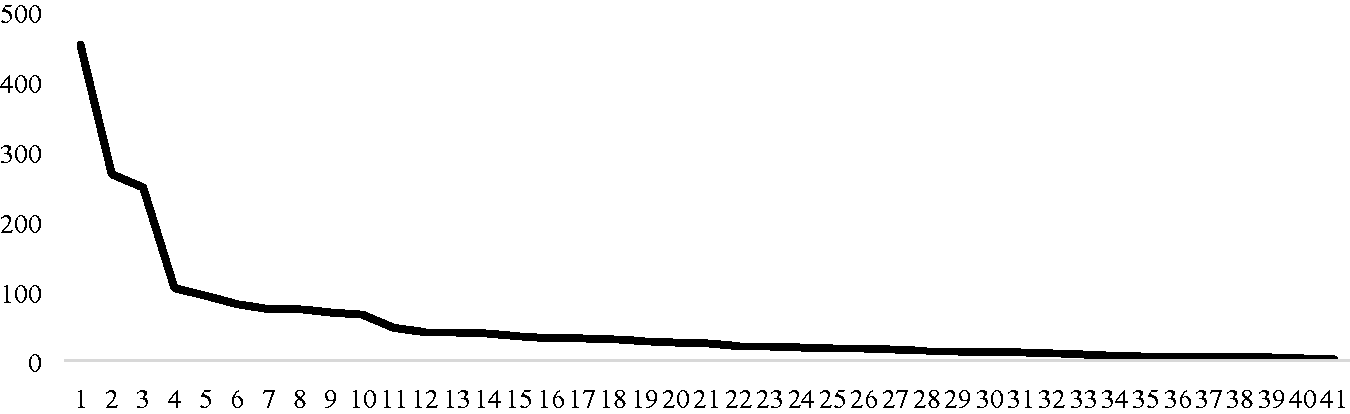
Distribution of media salience: total number of news articles per issue.
Figure 1 illustrates that the examined policy issues vary strongly in terms of the media salience that they attract. The most highly salient issues were the Transatlantic Trade and Investment Partnership (TTIP) (with an average of 54 articles per news outlet), the proposal for a tax on financial transactions (32 articles) and the plans to complete the European banking union (31 articles). Issues that rarely appeared in the media were the ban on the sales of tobacco via the Internet (0 articles), the European Accessibility Act (0.38 articles) and the initiative to ban micro plastics in cosmetics and similar products (0.63 articles). This distribution of media attention resembles the distribution of media attention found in other projects, most notably the INTEREURO project, which relied on a random sample of policy proposals (De Bruycker and Beyers, 2015). We also tested if media attention was consistent over the different media outlets. The results demonstrate that media attention for the issues covered in our survey is highly correlated across the different outlets with an average correlation of 0.7, which affirms the reliability of our measure. In the Online appendix, we present that the issues also strongly vary with regards to public ignorance, stakeholder mobilisation, stakeholder polarisation and corresponding policy areas.
Following the selection of policy issues and tracking of media coverage, an online expert survey was disseminated to the interest groups that were active on the sampled issues in the period between June 2017 and August 2018 (see the Online appendix). Respondents were identified based on relevant statements made in the coded news media articles or on the basis of desk research if media statements were lacking. Interest groups that were identified as active on an issue by other survey respondents were also contacted. Of the 183 participating experts, 124 (68%) were directly identified based on media reports, while 55 (30%) were identified through survey responses and 4 (2%) 1 were identified through desk research. The survey had a response rate of 30%, which is comparable to other survey projects on EU interest group politics (Chalmers, 2013; Crepaz and Hanegraaff, 2020).The survey was sent to 613 interest group representatives of which 411 respondents (67%) never replied to the requests or declined to participate and 183 representatives (30%) completed the survey. Another four representatives (1%) indicated that they were not actively lobbying on the issue. Finally, 15 organisations (2%) were wrongly identified as interest organisations and were therefore excluded from the survey.
In the survey, groups were asked to report on their lobbying strategies in the period from 2011 to 2015 and to list policy measures related to the issue between January 2010 and December 2017. Our unit of analysis is one interest group that was active on one of the sampled issues and that participated in the survey. In the remainder of the article, we denote these observations as group-issue dyads. We analyse 183 group-issue dyads from 113 unique interest groups. Several groups thus appear more than once (up to six times) in the dataset.
Operationalisation and measurement of variables
Due to differing conceptualisations and operationalisations of influence, comparing results across different studies is a challenging task. This issue has recently gained traction, and several authors have proposed prescriptions for scholars investigating interest group influence (Dür, 2008a, 2008b; Helboe Pedersen, 2013). Among the prescriptions, there is significant consensus around a call for combining measures, which is necessary to provide a more exhaustive understanding of the complex concept of influence (Dür, 2008b). Combining different methods for measuring influence allows for comparing results and drawing conclusions about the robustness of the findings (Dür, 2008b; Helboe Pedersen, 2013).
In this study, we rely on both self-reported influence and attributed influence (Dür, 2008b; Helboe Pedersen, 2013). Both measures are often used (Arts and Mack, 2003; Binderkrantz and Helboe Pedersen, 2019; Dür and De Bièvre, 2007a; Helboe Pedersen, 2013) because they have several advantages, including their relative simplicity (Dür, 2008b).We incorporate both these operationalisations into one: Measuring influence based on self-perception and the perception of relevant peers is likely to capture most channels of influence (Helboe Pedersen, 2013). When combined, these measures should provide an accurate depiction of whether a group exerted control over policy outputs. More specifically, when asking which organisations were able to significantly impact the EU’s decision-making process on a particular issue, we assume that the respondents have a conception of the relationship between cause and effect. This allows us to move beyond the frequently used concept of ‘lobbying success’, which does not necessarily assume causality, as the congruence between a position and an outcome might be the result of random variation or another group’s actions (see Dür et al., 2019).
Nevertheless, in addition to difficulties such as the design of a questionnaire and ensuring a sufficiently high response rate, both self-perceived and attributed influence exhibit several disadvantages (Dür, 2008b). In a self-reported influence measure, lobbyists may exaggerate their influence in order to build the impression of an important and successful organisation. At the same time, it is also plausible that interest groups may report modestly about their impact in order to avoid public disapproval and the creation of counter-lobbies. Meanwhile, in an attributed influence measure, respondents may find it difficult to estimate the influence of other actors due to a lack of information on the effects of lobbying activities and causes of policy decisions. Finally, both influence measures only capture perceptions, which are inherently subjective.
Given these shortcomings, we counter the over- and underestimation of interest groups’ influence in this study through the combined use of different measures (Dür, 2008a). Combining an attributed influence measure along with self-perceived influence allows for validating if peers hold a similar perception as the group in question. In addition, allowing interest groups to report on their own perceived influence similarly may help to overcome the information gap that would otherwise persist if we relied only on attributed influence. With this two-sided approach, we are able to answer the following questions: do interest groups perceive themselves as influential on a policy issue, and does this perception correspond with the perceptions of other groups?
Our influence measures are based on the following survey question: Please list below the interest organisations that come to mind which were active on the issue of [Issue name]. Also, could you indicate, which of these were influential, i.e. able to significantly impact the EU’s decision-making process on this issue (please also consider your own organisation). To answer this question, respondents could fill in the organisations’ names in a matrix and then indicate in a tick box whether each organisation was influential or not. Groups could also label their own organisation as influential. In order to reduce measurement error and achieve more reliable and conclusive results, we combined self-perceived and attributed influence into one measure of influence. This combined measure had three possible values. Groups that were not perceived as influential in either of the two measures were coded as Not-influential. If a group was deemed influential in one of the two measures, it was coded as Inconclusive. Finally, if a group was perceived as influential in both measurements, it was coded as Influential. The measures we implemented in our combined measure of influence were arguably crude, as they do not distinguish between different sub-issues or capture differences in influence over time. At the same time, this crude approach allows for cross-validating self-perceived and attributed influence measures at the level of interest group-issue dyads. 2
We measured our main explanatory variable ‘economic resources’ by the number of full-time equivalents that interest groups employ at their Brussels offices, which was gathered in the survey. We cross-validated these responses by comparing them with the data of the TR. Not all groups responded to the staff item in the survey. For these groups (33), we used the data from the Register. We consider staff size to be an effective indicator of the level of financial resources that interest groups spend on lobbying efforts. Moreover, staff size is highly correlated with other, more difficult-to-gather indicators of economic resources, such as an organisation’s annual budget or money spent on lobbying (Mahoney, 2007). However, the latter two operationalisations may be biased due to social desirability. Interest group representatives will not always be honest about financial resources spent on lobbying as it may spur criticism and mobilise counter-lobbies. Nonetheless, in the Online appendix, we present regression models that rely on ‘the money spent on lobbying’ as an alternative measure of economic resources. With regard to the measurement of our moderating variable media salience, we use the mean number of media articles about a certain issue (logged because of its skewed distribution) across the eight selected news outlets.
Various control variables were integrated in our model to account for alternative explanations. First, in the literature, group type is often conflated with economic resources, with corporate interest groups considered overall more resourceful than civil society organisations (Klüver, 2012). As economic resources may capture group type and vice versa, we included group type in the analysis as a control variable differentiating between businesses, civil society, labour organisations and others. Business interest groups are businesses or professional interest associations with firms or professionals as members, while civil society groups have individuals as members and pursue certain societal values or ideals. Labour unions include associations of workers or associations of trade unions (i.e. the European Trade Union Confederation). The ‘other’ category includes research-based and regional or territorial interest associations.
Second, we integrated the policy position of interest groups. Previous research has demonstrated that groups that support the status quo are more likely to be influential (Baumgartner et al., 2009). Therefore, we controlled for whether an interest group opposed policy change, whether their position was unclear or whether they supported policy change. Third, interest groups invest more resources in issues that are considered to be more important. Therefore, we included a measure of organisational salience to capture the importance of an issue for a specific organised interest (Beyers et al., 2018). To do so, we asked respondents whether each issue was more, equally or less important compared to other issues they work on. Fourth, we controlled for the amount of survey responses on each issue, which may affect our influence measure. Fifth, researchers have argued that the intensity of interest mobilisation affects influence on policymaking (Rasmussen et al., 2018). The more competitors a group has, the less likely that the group will be able to shape policy. Therefore, the number of organised interest groups identified per proposal was added as an additional control variable (logged because of its skewed distribution).
Sixth, we included two control variables capturing alternative (political) resources: media access and coalition membership. Both variables are beneficial for exerting influence: coalitions signal unity and consensus across different societal interests (Junk, 2020), and media access expands the claims of a group to a wider audience (De Bruycker, 2019).Media access was captured by coding groups that appeared in media outlets as ‘1’ and others as ‘0’. Similarly, groups engaging in coalitions were coded as ‘1’ and others as ‘0’. Finally, we integrated the decision-makers’ perspective in the analysis. Different venues offer different opportunity structures to interest groups (Princen and Kerremans, 2008). Therefore, we included the extent to which different types of decision-makers (Council, EC, EP) were lobbied. Lobbying intensity was measured in the survey on a five-point scale ranging from no contacts at all to regular contacts of ‘at least once a week’.
Analysis
Before examining our hypotheses, we explore the distribution of the dependent variable: the combined measure of influence. First of all, we look at the distribution of the measurements that make up the combined influence measure. With regard to self-perceived influence, 39 (21.3%) interest group representatives in our survey identified themselves as influential. In the attributed influence measure, 64 (35.5%) interest groups were identified as influential by at least one other group. According to the combined measure of influence, 105 (58.3%) groups were not identified as influential in either of the influence measures, 49 (27.2%) were identified as influential in one of the two measures and 26 (14.4%) were identified as influential in both measures. With respect to the validity of our combined influence measure, a one-way analysis of variances of the two different influence measures demonstrates that lobbyists who identified their own organisation as influential have a significantly higher mean for the attributed influence measure compared to those who perceived themselves as not being able to significantly impact the EU’s decision-making process on a particular issue (F = 28.04; p = 0.00). Although they do not correlate perfectly, the two variables used for gauging influence in the combined measure are significantly related.
We analysed the relationship between the variables using a multinomial logistic regression. 3 Table 1 gives an overview of the variables in our regression models. Table 2 presents the results with the combined influence measure as the dependent variable with Not-influential as the baseline and Inconclusive as the intermediary category. To arrive at a conclusive assessment, we interpreted the estimates for observations where both measures confirm that the group was Influential. With this statistical model, we tested the effect of our main independent variable, economic resources, (H1) in Model 1. In order to test our second hypothesis, we interacted our measures of economic resources and media salience in Model 2.
Overview dependent, independent, moderating and control variables.
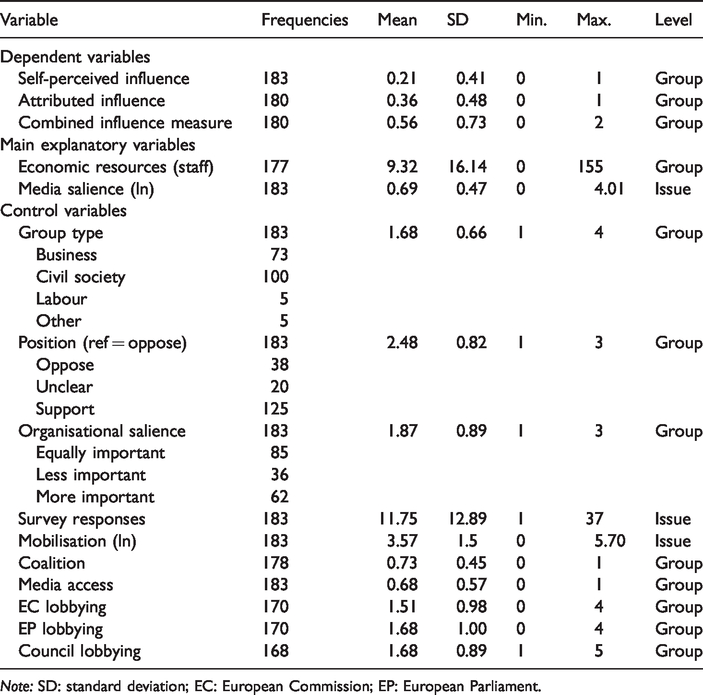
Note: SD: standard deviation; EC: European Commission; EP: European Parliament.
Multinomial logistic regression of combined measure of influence (baseline = not influential).
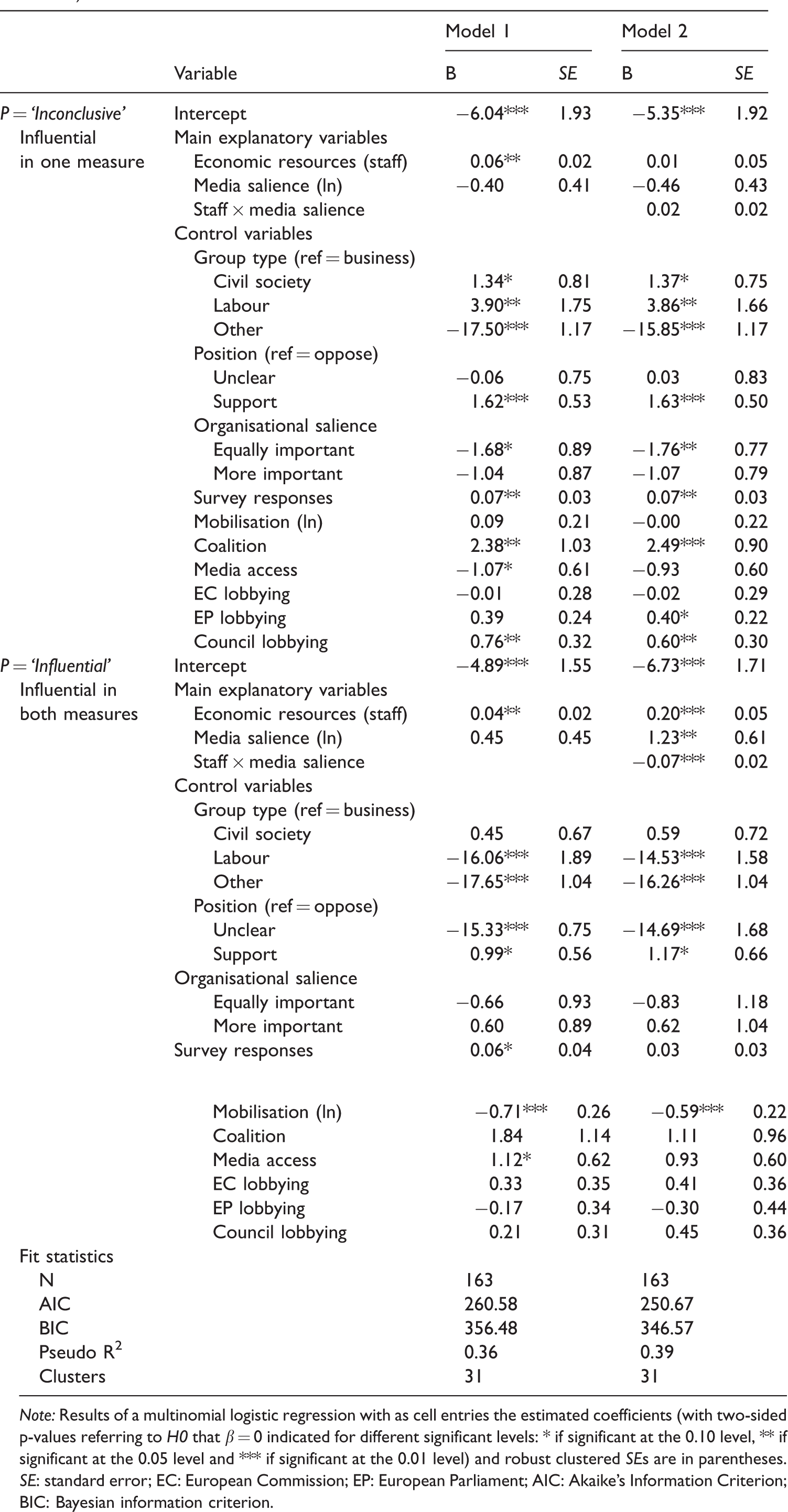
Note: Results of a multinomial logistic regression with as cell entries the estimated coefficients (with two-sided p-values referring to H0 that β = 0 indicated for different significant levels: * if significant at the 0.10 level, ** if significant at the 0.05 level and *** if significant at the 0.01 level) and robust clustered SEs are in parentheses. SE: standard error; EC: European Commission; EP: European Parliament; AIC: Akaike's Information Criterion; BIC: Bayesian information criterion.
With regard to the main effects (Model 1), staff resources significantly increase the probability that an interest group is influential, which supports H1. In line with Eising (2007) and Binderkrantz et al. (2015), among others, we found that the more economic resources an interest group has, the more influential they are. In addition, the increased media salience of an issue does not lead to greater or lesser influence by interest groups. When an interest group is active on an issue attracting substantial media attention, its influence is not likely to be significantly higher or lower than for issues with low media salience.
Examining the interaction term staff × media salience(ln) in Model 2 reveals that the effect of staff resources is nuanced. The negative interaction coefficient for P(influence) = ‘Influential’ demonstrates that, for issues that are salient in the media, economic resources do not lead to greater influence, while for issues characterised by low media salience, economic resources do significantly increase the probability that a group is influential. This effect is illustrated in Figure 2, which portrays the differences in the predicted probabilities of P(influence) = ‘Influential’ for different levels of media salience. For interest groups active on a low-salience issue in the media, we see that groups with only one staff member have a 3.20% (standard error (SE) = 0.02) probability of being influential, while interest groups with 50 staff members have a 70% (SE = 0.14) probability of being influential, which is significantly higher. The issues of biodiversity subsidies, financial rewards and nature protection (only 2.38 articles on average) illustrate this divergence: of the three interest groups that were indicated as influential, two had more than 30 staff members and the other had 12 staff members. The remaining representatives who participated in our survey employ four or less staff members. Their organisations were not indicated as influential in either of the measures.
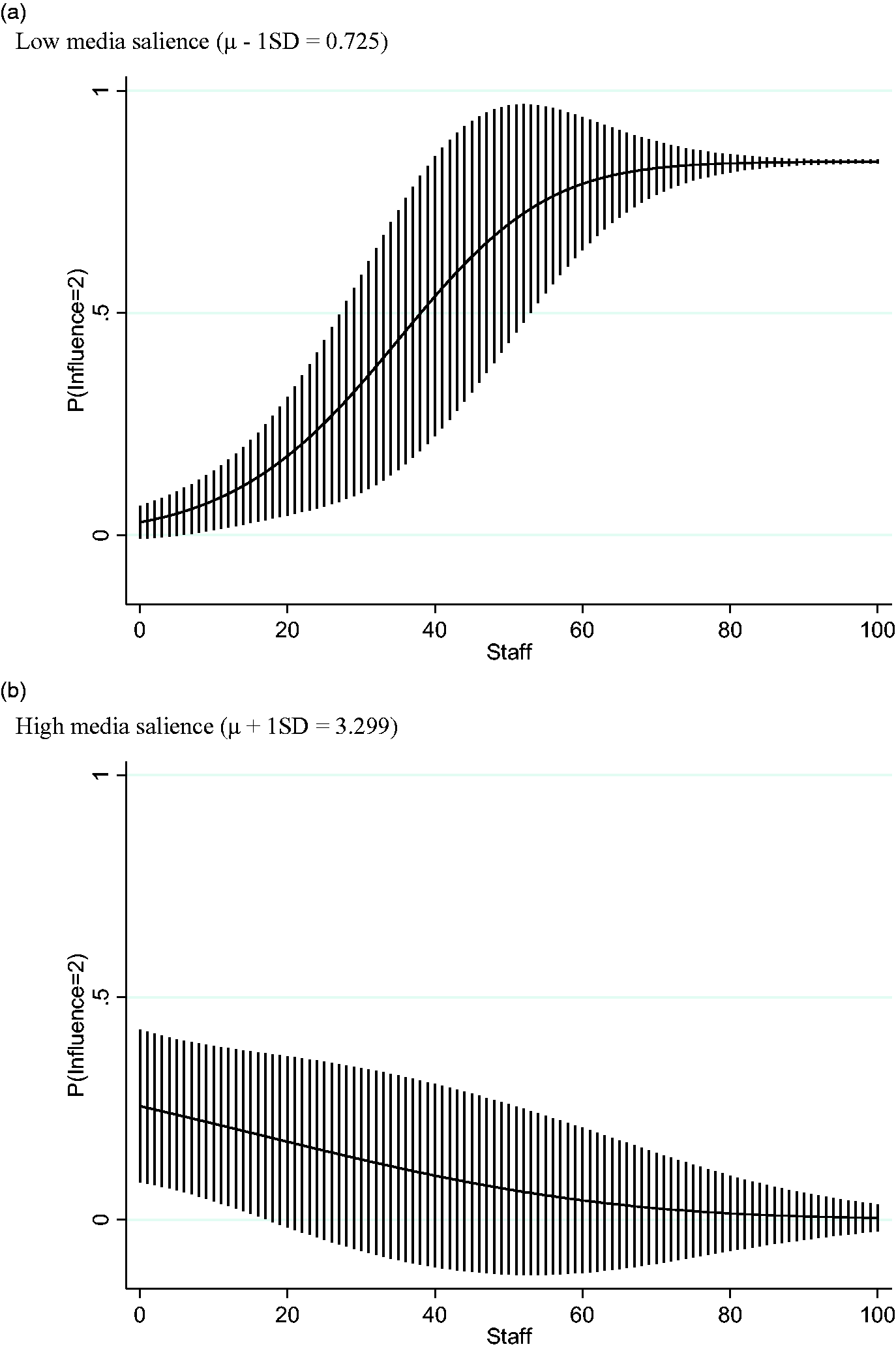
Predictive margins of economic resources with 95% confidence intervals. (P = ‘Influential’). (a) Low media salience (ln) represents µ − 1 standard deviation (SD) (= 0.725) and (b) high media salience (ln) equals µ + 1 SD (= 3.299) – based on Model 2.
In contrast, for issues that are highly salient in the media, interest groups with one staff member have a 25.16% (SE = 0.09) probability of being influential, while interest groups with 50 staff members have a significantly lower probability of being influential: 6.79% (SE = 0.10). This finding is exemplified by the highly salient financial transactions tax (FTT) issue (32.25 articles on average). Neither influence measure indicated that the highly economically resourceful European Savings and Retail Banking Group (with more than 30 staff members in their Brussels’ office) was influential on the FTT issue. Meanwhile, the much less economically resourceful European Network on Debt and Development (with only five staff members) was considered influential according to both measures. This finding can be explained by the fact that economically resourceful groups lose their competitive advantage in the case of salient issues. In such cases, other types of information that do not require economic resources to be produced might be more important than the provision of expert information. For example, the interest group ‘War on Want’ formed a coalition and framed their position as aligned with the public interest on the issue of TTIP. Although they did not have a single full-time employee, the group indicated themselves and were mentioned by others as influential. Thus, our results indicate that the competitive advantage of well-endowed groups only holds true for issues discussed behind the public scenes. These findings are affirmed by using an alternative measure for economic resources based on ‘money spent on lobbying’ (see the Online appendix).
Our control variables also provide important insights. 4 First, we did not observe significant differences between business organisations and civil society groups in the models combining influence measures. However, labour and other organisations are less influential compared to business organisations. Second, unclear positions evidently lead to a strong decrease in the likelihood of being influential. Moreover, in contrast to Baumgartner et al. (2009), we found that groups advocating for policy change are more likely to enjoy a reputation of strong influence compared to groups advocating for the status quo. Third, more survey responses lead to higher degrees of interest group influence. This finding is arguably a methodological artefact, as the likelihood of being identified by others as influential increases when more groups are surveyed. Fourth, more groups mobilising on an issue decreases the probability of being influential on that issue. If there are more competitors on the issue, it is much more difficult for interest groups to impact policy. Finally, media access increases the probability of being perceived as influential (see also De Bruycker, 2019; Junk and Rasmussen, 2019).
Conclusion
This article set out to explain the role of economic resources in affecting lobbying influence within EU public policy. Our main argument is that the impact of economic resources on lobbying influence is contingent on the media salience of policy issues. We expected economic resources to matter more for issues discussed outside of the public spotlight and anticipated that the competitive edge of wealthy groups vanishes when issues are widely discussed in the mass media. We tested these expectations in the context of EU policymaking. We relied on a sample of 41 policy issues for which public opinion polls were conducted, a large-scale content analysis of 2085 news media articles and 183 lobbyists’ survey responses. Our analyses demonstrated that economic resources are key in explaining interest group influence, but that its effect is contingent on the media salience of policy issues.
Our findings confirm the results of earlier research, including the work of Eising (2007), Binderkrantz et al. (2015) and Klüver (2010). Our analyses demonstrate that well-endowed groups are more likely to be perceived as influential in EU public policy. Although the EU is characterised by an ever-increasing and diversifying interest group population (Berkhout and Lowery, 2010), our results seem to confirm the elitist conception of interest group politics.This does not mean, however, that only corporate interests are heard in the EU. Similarly to Dür et al. (2015), we found that business groups are not significantly more influential than civil society.
However, the most important contribution of this article lies in the nuanced way in which we examined the role of economic resources in determining lobbying influence. Although neopluralist research has emphasised the contingency of influence, the moderating role of the issue context on the impact of economic resources has been largely overlooked. Our study found evidence for ‘the limits of influence’ (Lowery and Gray, 2004: 167) and demonstrated that we cannot generalise findings about economic resources across different policy contexts. We demonstrated that well-endowed organisations are more likely to impact EU policy decisions. Yet, the positive effect of possessing more economic resources on a group’s influence weakens and even disappears as issues receive more media attention. When issues attract abundant media attention, the competitive edge of well-endowed groups vanishes. The mass media’s attention to policy issues can thus partly alleviate concerns about biased political influence in favour of the resourceful.
Our study has clear normative implications. On the bright side, our results suggest that media attention and public scrutiny can counterbalance the role of economic resources in political influence. Especially in an increasingly mediated world, these findings may offer nuance to the popular concern that money buys power. From a less optimistic perspective, however, the question is whether and to what extent EU policies are mediatised. There are very few EU-oriented media outlets and EU topics account for an extremely small proportion of the reporting in national media (Machill et al., 2006). Therefore, most European policy issues are, in Culpepper’s (2011) words, ‘quiet politics’. Indeed, there is significant opportunity for affluent groups to reap the political fruits of their economic wealth. In order to counterbalance the biases in favour of well-endowed organisations and strengthen the democratic legitimacy of the EU, it is important that European issues attract the attention of the mass media, allowing for public scrutiny and control.
We addressed the methodological challenges in measuring and operationalising influence in this study by combining two influence measures. This approach allowed us to provide a more exhaustive empirical account of the complex concept of influence (Dür, 2008b). By relying on two different operationalisations of influence and combining them into a single measure, we were able to assess the robustness of our findings and draw more reliable conclusions (Dür, 2008b; Helboe Pedersen, 2013). Nevertheless, it is important to not overstate the results presented in this article. Our two measures of influence only considered influence perceptions, rather than actual control over outputs. While we are confident of the validity of our findings, future research has yet to reveal whether other unobtrusive measures of influence corroborate our results.
With this article, we hope to encourage other researchers to test whether our findings hold true in diverse contexts. Future research should consider how the mediating effect of media attention on economic resources varies across different policymakers, institutions and domestic political systems. Furthermore, we did not test whether other types of resources become important under high levels of media salience. Subsequent studies are therefore necessary to identify, for example, whether politically resourceful groups (i.e. groups with many members) dominate in issues attracting abundant media attention. In addition, qualitative process-tracing studies could further unravel the mechanisms through which media salience counterbalances the role of economic resources in determining policy influence. Finally, beyond media salience, other issue characteristics may moderate the effect of economic resources on political influence, such as the technicality of a policy dossier, interest group polarisation or support from public opinion (Klüver, 2011; Rasmussen et al., 2018). Notwithstanding these promising pathways for future research, our study has highlighted the beneficial role of economic resources in determining lobbying influence and the counterbalancing function of the mass media in alleviating influence biases towards affluent interest groups in EU public policy.
Supplemental Material
sj-pdf-1-eup-10.1177_1465116520944572 - Supplemental material for Influence, affluence and media salience: Economic resources and lobbying influence in the European Union
Supplemental material, sj-pdf-1-eup-10.1177_1465116520944572 for Influence, affluence and media salience: Economic resources and lobbying influence in the European Union by Frederik Stevens and Iskander De Bruycker in European Union Politics
Supplemental Material
sj-zip-2-eup-10.1177_1465116520944572 - Supplemental material for Influence, affluence and media salience: Economic resources and lobbying influence in the European Union
Supplemental material, sj-zip-2-eup-10.1177_1465116520944572 for Influence, affluence and media salience: Economic resources and lobbying influence in the European Union by Frederik Stevens and Iskander De Bruycker in European Union Politics
Footnotes
Acknowledgements
The authors are grateful to Sarah Arras, Jan Beyers, Marcel Hanegraaff and Anne Rasmussen for their help with the overall research project. The authors thank Kris Van Berendoncks, Dirk De Bièvre, the anonymous reviewers and European Union Politics’ editorial team for their insightful comments.Finally, the authors are thankful to the many lobbyists who participated in the expert survey.
Funding
The author(s) disclosed receipt of the following financial support for the research, authorship, and/or publication of this article: The data collection for this article was supported by an FWO-V grant (Lobbying for the people—GA 171-11 N) to Iskander De Bruycker from Research Foundation Flanders (FWO).

Supplemental material
Supplemental material for this article is available online.
Notes
References
Supplementary Material
Please find the following supplemental material available below.
For Open Access articles published under a Creative Commons License, all supplemental material carries the same license as the article it is associated with.
For non-Open Access articles published, all supplemental material carries a non-exclusive license, and permission requests for re-use of supplemental material or any part of supplemental material shall be sent directly to the copyright owner as specified in the copyright notice associated with the article.
