




Abstract
Party membership is in decline across the established democracies, but populist parties appear to be reversing this trend. The expansion of populist parties’ membership base raises the question whether these parties are fulfilling their role as actors who serve as a “corrective to democracy” by mobilizing the socially and politically marginalized to become politically active. Using large comparative datasets from the European Social Survey and the World Values Survey, we examine the characteristics of populist party members in terms of their socio-demographic background and their political attitudes. We show that, with the exceptions of income levels and church attendance, the members of populist and non-populist parties look very much alike and hold similar political attitudes. These findings imply that mobilizing the politically disaffected remains a challenge, even for populist actors.
The membership of political parties has been declining rapidly around the world since at least the 1980s. According to Scarrow (2017), total party membership in the established parliamentary democracies is now “in the third decade of a slow and steady decline.” Others have viewed the change in more dramatic terms, characterizing the decline as “going, going, gone?” (Van Biezen et al., 2012). This decline in party membership, however, does not affect all parties equally (Kölln, 2016) and populist parties, in particular, “appear to have reversed a long-established trend of declining membership” (Whiteley et al., 2021, p. 645).
Populist parties differ from mainstream parties on a number of points, which can be broadly divided into positive and negative. On the negative side, populists evoke an opposition between the pure people and a corrupt elite and present themselves as those who—unlike mainstream parties—express “the will of the people” (Mudde, 2004). Populist parties also “highlight the necessity for politics to follow the general will without any unnecessary restrictions” (Huber and Schimpf, 2017, p. 147). This tendency to undermine the checks and balances that characterize liberal democracy, combined with the anti-pluralist character of populist parties (Müller, 2017), has led some to view the rise and increased electoral success of populist parties across the established democracies as a threat to representative democracy (Huber and Schimpf, 2017; Norris and Inglehart, 2019). Such concerns have also been shown to be valid. In different countries, populist parties that have acceded to power have been found to challenge core elements of liberal democracy by undermining the power of the judiciary or by limiting the extent to which minorities are protected. According to Albertazzi and Mueller (2013, p. 364), “in their determination to champion ‘the will of the people’, [populist parties] end up stifling criticism, challenging the rights of ‘undesirable’ individuals and rejecting the slow and complicated procedures and division of roles through which liberal democracies must operate.”
A more positive take on the impact of populism for democracy stresses the fact that populist parties may have a mobilizing impact on previously underrepresented and/or ignored groups. Populism may therefore voice the grievances of groups that do not feel represented by the established political parties; in this way populism may serve as a “corrective for democracy” (Mudde and Rovira Kaltwasser, 2017, p. 83). At first sight, the fact that populist parties grow their membership base seems indicative of their mobilizing impact. But whether that is indeed the case depends on the characteristics of citizens that become members of political parties. Is it really those who would otherwise not participate in politics who are mobilized by populist parties? In other words, are populist party members different, socially and attitudinally, from other party members?
A series of recent studies have scrutinized the mobilizing potential of populist parties empirically, with a focus on electoral turnout (Huber and Ruth, 2017; Immerzeel and Pickup, 2015; Leininger and Meijers, 2021; Schulte-Cloos and Leininger, forthcoming). These studies shed light on the potential of populist parties to mobilize citizens with a lower socio-economic status, those who are politically disaffected, or who would otherwise not participate. By focusing on voter turnout, however, these studies analyze mobilization with regards to the most accessible and widespread kind of participation. In this paper, we extend this work by focusing on the mobilizing appeal of populist parties for a more restrictive and time-consuming type of political participation: party membership.
Using comparative survey data from the cumulative 2002–2010 European Social Survey (ESS) and the 1981–2020 combined file of the World Values Survey (WVS), we examine whether and how individuals who are members of European populist parties differ from members of other parties, as well as non-members. Our focus is on socio-demographic characteristics and citizens’ attitudes toward democracy and democratic institutions. Our results show that populist parties mobilize citizens with lower incomes and who are less religious, but apart from that populist and non-populist party members are very much alike. In other words, populist parties are no more or less effective as other parties in mobilizing socially marginalized groups.
Party membership and populist parties
The nature of party membership varies by the type of party in question, by how it is organized, the type of political system within which the party operates, and even by its geographical location. All of these factors offer different incentives (and disincentives) to join a party. Formally, party membership involves the act of joining a voluntary organization (Scarrow, 2017). In practice, however, this can be blurred by open primary elections to select candidates, by collective membership through, for example, labor unions, or even by using different levels or degrees of membership. Not least, a person may commit considerable resources to supporting a party but may not formally be a member (Webb et al., 2017). The notion of membership is, therefore, complex and changing and often context-specific. However, one common theme is that membership, however, defined has been declining across almost all of the advanced democracies (Van Biezen et al., 2012).
While the trend in party membership in many established democracies is a downward one, this pattern does not appear to hold for all parties. In fact, many populist parties appear to have expanded their membership over time. This trend holds for both populist parties on the right and on the left, as data on party membership from the MAPP project illustrate (for details, see Online Appendix A). At first sight this is surprising, given the key characteristics of populist parties (Canovan, 1999; Mudde, 2004; Pappas, 2016). At its core, populism is “an ideology that considers society to be ultimately separated into two homogeneous and antagonistic groups, ‘the pure people’ versus ‘the corrupt elite’, and which argues that politics should be an expression of the volonté générale (general will) of the people” (Mudde, 2004: 543). Along these lines, much scholarly work has described populist parties as both anti-elitist and people-centrist (Taggart, 2002). In their discourse, populist parties portray the political elite as, at best, inadequately reflecting the public’s interests and, at worst, corrupt and venal (Barr, 2009). The decision-making power in democracies should thus be taken away from the governing elite and returned to the people (Pauwels, 2014). Of course, how exactly “the people” are conceived by populist movements varies somewhat, with right-wing populist parties more often referring to a nation while left-wing populists often define the people in economic terms (Canovan, 1999; Rooduijn, 2018).
As conceptual work on populism makes clear, populism is seen as synonymous with anti-elitism. In this view, the elite is interested only in serving its own interests and not those of the mass public it professes to represent. In principle, anti-elitism should be antithetical to a formal, hierarchical organization like a political party, or at the very least imply a flat structure giving party members equal say with their leaders. The traditional mass party membership model would therefore not appear to fit the precepts of a populist party.
A second trait of populism is the idea that true sovereignty in democratic society rests with the people and only they can be trusted to act in the best interests of all of the population (Huber and Schimpf, 2017). Populist parties argue that ordinary citizens have been “shut out of power by corrupt politicians and an unrepresentative elite” (Canovan, 2002, p. 27). As a way to remove power from the corrupt elite and return it to the people, many populist parties advocate for more direct democracy (Bowler et al., 2017; Mohrenberg et al., 2021). A focus on direct democracy should weaken the need for strong party organizations or for the recruitment of party members. If decisions can be taken through binding referenda and rely on the direct involvement of citizens, there is no need for parties that represent citizens’ views in parliament.
While populist parties often promote direct democracy and the involvement of the public in decision-making, in practice, populist party supporters do not appear to be particularly supportive of direct democracy (Bowler et al., 2017). Instead, and especially if support for populism is shaped by anti-elitism, populists often prefer to delegate decision-making to a leader who is the “true” representative of the authentic will of the people. Citizens themselves can then be “passive” (Müller, 2014, p. 486) and do not have to be particularly politically engaged. In this model the leader acts as a surrogate for the party organization. Müller (2017, p. 55–56) expresses this view when he argues “if there is only one, clearly identifiable people’s will, which the leader or leadership can single out—what does one need intra-party democracy for?”
However, other research comes to a different conclusion. 1 This work shows that in many respects, populist party members exercise an influence on the policy and direction of their parties similar to that of other parties. For example, research on the Italian Northern League suggests that it has moved beyond that of a protest party with a limited role for the membership, and instead occupies the position of a more established, programmatic party that relies on an active membership base for success (Passarelli and Tuorto, 2018; Zulianello, 2018, 2019). Comparative work on the radical right in Europe, covering such parties as the Vlaams Belang in Belgium and the National Rally in France, has come to similar conclusions (Art, 2011; Heinisch and Mazzoleni, 2016). In practice, then, it is evident that a centralized party organization together with the dominance of a strong, personal leadership can result in an active an engaged party membership.
Despite the fact that formal party membership seems incompatible with a number of key elements of populism, populist parties in many countries are extending their membership base. This trend is suggestive of the strong mobilizing potential of these parties. But are these new party members different from those of the other, non-populist parties?
The mobilizing potential of populist parties
The growth in populist parties’ membership base can be driven by mobilization among different sections of the electorate. Perhaps individuals who are active in populist parties are similar to members of any other party and would be politically active even in the absence of populist parties. Alternatively, in the same way as they appeal to sections of the electorate who feel socially marginalized (Gidron and Hall, 2020), populist parties could recruit members among people who are generally less well represented by mainstream parties.
Research on the effects of populism for electoral turnout has provided indications that populists can have such a mobilizing potential. The mobilizing potential of populist parties among these groups has been linked to different theoretical mechanisms. First, populist parties—through their emergence and the opposition they create with other parties—arguably increase political competition and by so doing increase the salience of the election (Immerzeel and Pickup, 2015; Leininger and Meijers, 2021). This mechanism potentially boosts turnout among both those who support populist parties and those who oppose them (Leininger and Meijers, 2021). Second, populist parties are thought to specifically mobilize groups who are dissatisfied and lack trust in mainstream parties, and who would not turnout to vote in the absence of populist parties. Populist parties claim to voice the grievances of citizens who do not feel represented. This message is thought to resonate especially among groups that are sometimes referred to as the “losers of globalization,” resulting in higher turnout among this section of the electorate (Huber and Ruth, 2017). In addition, the way in which populist parties campaign has been argued to appeal to and mobilize citizens who are unlikely to vote. Leininger and Meijers (2021, p. 669), for example, refer to a reliance on charismatic leaders, but also a reliance on less complex language as elements of populist parties’ campaigns that could explain why they succeed in reaching and mobilizing non-voters.
In this article, we examine whether a similar pattern emerges when focusing on party membership. Party membership offers a hard test for the mobilizing potential of populist parties among citizens who are otherwise underrepresented or alienated from politics. First, it is a much more restrictive and resource-intensive form of participation. Second, as indicated in the previous section, because of the ideas that are central to populism, party members generally do not have a large role to play within populist parties. Based on research that has studied the effects of populism on voter turnout, however, the hypothesis that guides our analysis is that members of populist parties will be of a lower socio-economic status and more politically disaffected than members of non-populist parties.
Data and method
To test our hypothesis, we make use of two large comparative datasets. First, we analyze the data from the combined file of the European Social Survey (ESS), with a focus on the five waves that were fielded between 2002 and 2010. We cannot include more recent ESS waves in the analyses because party membership was no longer measured in recent surveys. We limit the ESS data to the countries for which PopuList 2 provides a coding of populist parties, resulting in a dataset with 212,028 observations. Second, we replicate and extend the ESS analyses by relying on the 1981–2020 World Values Survey (WVS) cumulative file, which combines the seven waves of the survey conducted between 1981 and 2019. 3 For comparability with the ESS data, and because our coding of populist parties is limited to European countries, we restrict the WVS sample to respondents in the 24 European countries 4 that are included in the WVS cumulative file and for which PopuList provides a list of populist parties (N = 63,106).
In line with previous work (Hooghe and Kern, 2015), we capture party membership in the ESS by means of the question “Are you a member of any political party?” Respondents who indicate that they are a member of a party are subsequently asked to indicate what party they are a member of. As indicated above, to distinguish between members of populist parties and members of other parties, we rely on the coding of parties in the PopuList project. Across all countries, we find that 4.9% of the respondents are a party member (N = 10,378). Of all party members, 93% are a member of a party that is not considered populist, while 7% of party members are a member of a populist party.
Measuring party membership in the WVS is more complex, in part because two separate sets of questions were asked during the course of the seven waves of the survey, and in part because neither of the questions asked which party the respondent was a member of. We explain our estimation procedure in Online Appendix B. Our approach produces estimates which are similar to those of the ESS, with 8% of all WVS respondents being a party member (N = 4848) and among party members, 93% are coded as non-populist and 7% as populist.
While the share of party members is small, and the share of populist party members is even smaller, by relying on large cross-national datasets, the small numbers in different countries and waves add up to a number that allows us to analyze their characteristics and to contrast them with other groups. The small numbers of populist party members within each country and in each survey (see Online Appendix C), however, remain an important limitation—and prevent us from exploring heterogeneity between countries and parties.
To explore whether populist party members are different from members of other parties and from non-members, we focus on their socio-demographic characteristics and on a select number of political attitudes. For socio-demographics, we include gender, age, education, religion (church attendance), income, and the level of urbanization of a respondent’s residence (available in the WVS only). For attitudinal differences, we include attitudes that capture political engagement and political disaffection. The former are captured by means of indicators of political interest and the importance of politics (in the WVS only). Political disaffection is measured by means of items that capture satisfaction with democracy and political trust. For a more limited number of survey waves, the WVS also allows us to examine support for democratic principles measured by how important respondents think democracy is, the importance they attach to elections and their reported preference for strong leaders. To enhance the comparability of the estimates, all political attitudes were coded to run from 0 to 1, so the effects capture the difference between the highest and lowest score on a particular measure. Details on the question wording and coding of all variables are reported in Online Appendix D.
To examine differences between groups, we estimate multinomial logit models. We use non-members as the reference outcome and contrast them with non-populist and populist party members. Both the ESS and WVS datasets include information from a wide range of countries, which provides us with a sufficiently large number of populist party members to examine their characteristics (see Online Appendix C). We account for country-level differences in party membership by means of country-fixed effects and clustered standard errors by country. We also control for variations over time in levels of party membership by means of wave fixed effects.
For interpreting the results, we focus on the coefficients of the different predictors on three sets of contrasts (1) being a non-populist party member versus a non-member, (2) being a populist party member versus a non-member, and (3) being a populist party member versus a non-populist party member.
Results
The socio-demographic profile of populist party members
Figure 1 summarizes the results of our analyses of the socio-demographic profiles of the different groups, using ESS data. We plot the logit coefficients of a series of socio-demographic variables on the probability of being a non-populist party member versus a non-member (left), being a populist party member versus a non-member (middle) and for being a member of a populist party rather than a member of a non-populist party (right). Effects of socio-demographic characteristics, ESS data. Note: Logit coefficients and 95% confidence intervals are shown. Estimates from a multinomial logit regression that includes country and wave fixed effects (not shown). The full model is reported in Online Appendix E.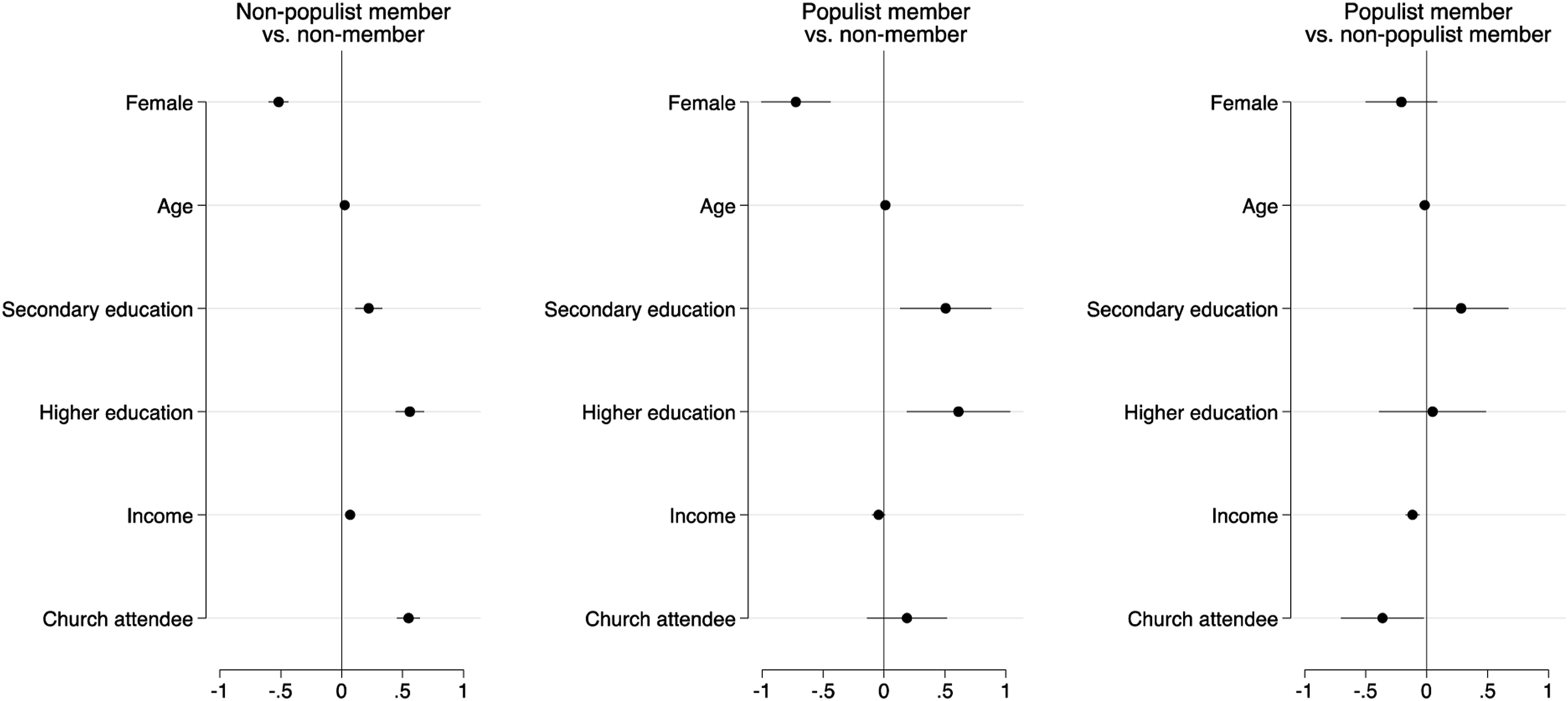
A first observation is that for each of the socio-demographic variables, the effects on being a non-populist party member versus a non-member (left panel) and those for being a populist party member versus a non-member (middle panel) are very similar. The effects of these variables are also in line with expectations. For example, the presence of a gender gap in political party membership confirms earlier work (Coffé and Bolzendahl, 2010). Furthermore, education appears as a significant predictor of party membership. Having a secondary degree versus none or a lower level of education, and being higher educated versus having a lower level of education, significantly increases the likelihood of party membership—in both populist and non-populist parties. The finding that higher levels of education are positively associated with party membership is not surprising and is in line with the resource model of political participation (Brady et al., 1995). That church attendance positively affects the likelihood of being a non-populist party member is also as expected, given the social capital that individuals might gain from being a member of a church community. It is noteworthy, however, that the effect of church attendance fails to attain statistical significance when populist party members are examined. This is perhaps indicative of the “vaccine” effect of religious movements against the appeal of populist parties (Arzheimer and Carter, 2009; Marcinkiewicz and Dassonneville, 2021).
That the effects are so similar regardless of whether members of non-populist or populist parties are examined is surprising and rejects our expectation that members of populist parties will be from a different socio-demographic background compared to non-populist party members. The right-hand panel in Figure 1 teases out the differences between populist and non-populist party members, by directly estimating the effect of different socio-demographics on being a populist rather than a non-populist party member. The main difference between the two groups relates to the effect of income, as we see that higher levels of income significantly decrease the likelihood of being a populist rather than a non-populist party member. While this difference reaches statistical significance, it is substantively small. Furthermore, attending church is associated with a significantly lower likelihood of being a populist rather than a non-populist party member.
The inclusion of income in the models significantly reduces the sample size for the estimation—and limits it to data from two waves only. As can be seen from Online Appendix F, however, the effects of the other variables are very similar when not controlling for income in the models. Overall, the results only offer slight evidence that populist parties manage to mobilize the less resourceful to become politically active. With respect to most characteristics, such as gender or levels of education, the members of populist and non-populist parties are very much alike.
We replicate these results with the WVS data, and also account for individuals’ place of residence by means of variables that capture the contrast between living in a small town rather than a small village, or a large town versus a small village. Figure 2 summarizes the findings using the same format as Figure 1. The results are strikingly similar to the earlier ESS analysis. We again see that many socio-demographic variables have similar effects on the membership of populist and non-populist parties. In terms of gender, age, and education, we cannot distinguish between the two groups of members (right-hand panel in Figure 2). Furthermore, the WVS data show no indications that respondents’ place of residence matters. Effects of socio-demographic characteristics, WVS data. Note: Logit coefficients and 95% confidence intervals are shown. Estimates from a multinomial logit regression that includes country and wave fixed effects (not shown). The full model is reported in Online Appendix E.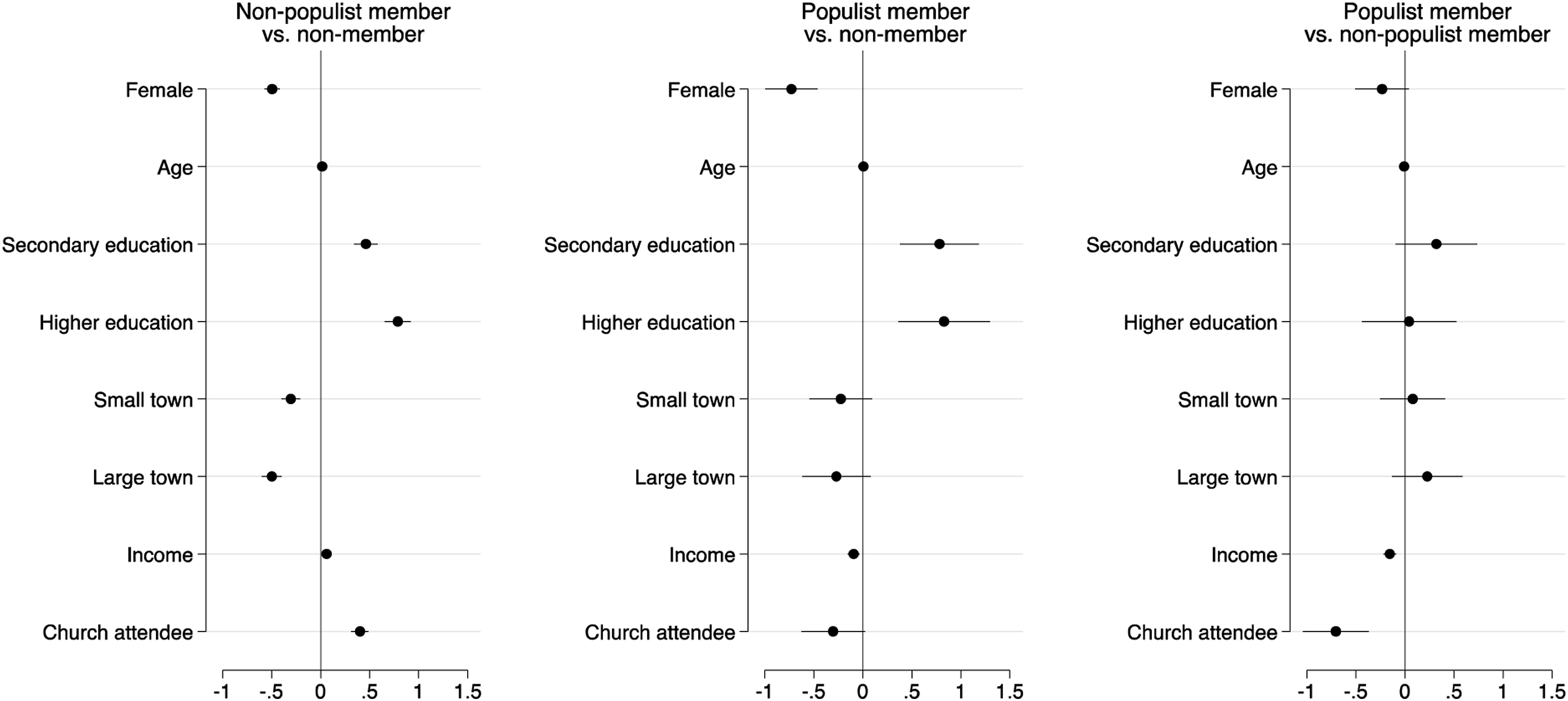
Again, there are more indications of differential effects when focusing on the role of income and religion. The right-hand panel in Figure 2 suggests that having a higher income and being a regular church attender both significantly decrease the likelihood of being a populist party member rather than a non-populist party member.
An important advantage of the WVS data is that it enables us to distinguish between active and inactive party members. Being an active member, by attending meetings and participating in election campaigns, for example, is a more substantial personal investment that arguably requires even more resources—implying active members are a small and select group. When focusing on active members, the estimates are less precise, but as can be seen from the results in Online Appendix G, we still observe that populist parties recruit members from lower income groups and individuals who do not attend church.
There is, of course, much heterogeneity in the types of parties that are characterized as populist. Notably, previous work has highlighted important differences in the correlates of voting for left- and right-populist parties (Rooduijn, 2018; Rooduijn et al., 2017). A key distinction in this regard relates to the role of education, with the work of Rooduijn et al. (2017) pointing out that while higher education is negatively correlated with voting for right-populist parties, it is positively associated with support for left-populist parties. If the membership base of left-populist parties is similarly higher educated compared with right-wing populist parties, this might drive the lack of differentiation between populist party members and others in terms of their level of education. In short, it is important to account for the ideological heterogeneity among populist party members in the dataset. Unfortunately, variations in the ideological leanings of the populist parties of which respondents in the dataset are members are limited. In the ESS data, we find that 548 (77.4%) of all populist party members are a member of a right-wing party, while 160 (22.6%) are members of left-wing parties. 5 The small number of left-populist party members prevents us from analyzing separately the dynamics of left- and right-populist party membership. Even so, we did verify whether our conclusions held when limiting the group of populist party members to those that are a member of a right-populist party. As can be seen from Online Appendix I, these results are substantively very similar to our main results, suggesting that the ideological heterogeneity among populist party members does not drive the lack of differentiation between them and non-populist party members.
The attitudinal profile of populist party members
The results so far suggest that populist parties recruit members that have a different socio-demographic profile than members of other parties. This difference, however, appears to be mostly limited to income and religion. In terms of levels of education, gender, and age, populist and non-populist party members look strikingly alike.
As a final step, we verify whether populist parties motivate citizens to become politically engaged who are otherwise unlikely to be politically active, because of their lower levels of political interest, confidence in political institutions, or views about representative democracy.
Turning first to the ESS data, Figure 3 shows results for democratic satisfaction, political trust, and political interest. Since all the independent variables are scaled from 0 and 1, the estimates in Figure 3 correspond to the effect of a shift from the lowest to the highest value on each political attitude. For satisfaction with democracy, higher levels of democratic satisfaction decrease the likelihood of being a party member. The sizes of the coefficients for satisfaction with democracy, however, are comparatively small—suggesting satisfaction with democracy is not the most important political attitude to explain party membership. Political trust and political interest are more important predictors of party membership. Higher levels of political trust and higher levels of political interest significantly increase the likelihood of being a party member. In contrast to what we hypothesized, however, the profile of populist party members is very similar to that of other party members. This is clear from the right-hand panel in Figure 3, that illustrates that higher levels of satisfaction with democracy, political trust and political interest do not significantly decrease the likelihood of being a populist party member instead of a non-populist party member. Effects of attitudinal characteristics, ESS data. Note: Logit coefficients and 95% confidence intervals are shown. Estimates from a multinomial logit regression that includes socio-demographic controls, country and wave fixed effects (not shown). The full model is reported in Online Appendix E.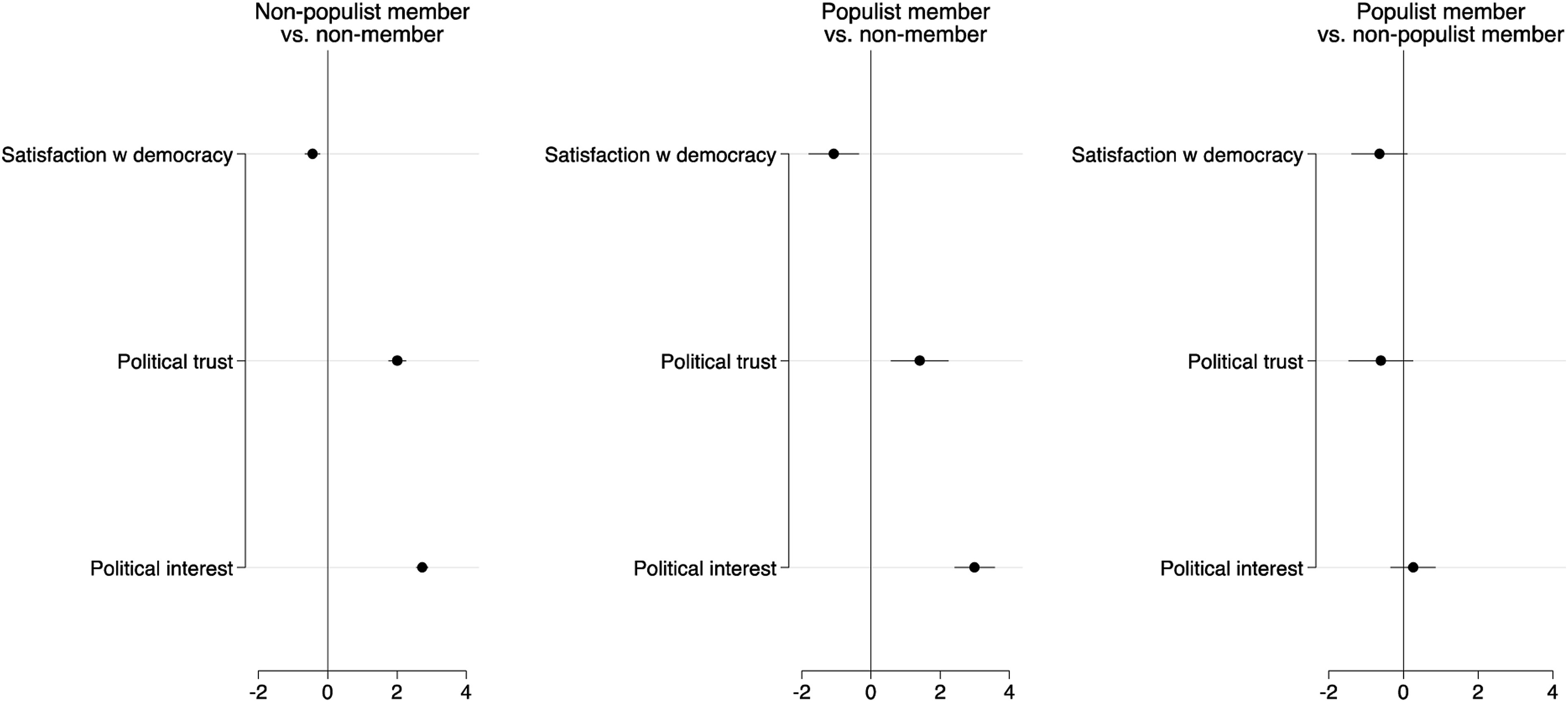
Figure 3 suggests that members of populist parties are about as satisfied with democracy, as politically trusting, and as politically interested as members of other parties. In particular, the similarity between the two groups in terms of satisfaction with democracy is surprising because one of the characteristics that sets populist parties apart from mainstream parties is their critique of the functioning of democracy and their skepticism about representative democracy (Huber and Schimpf, 2017). Using the WVS data, we examine this in more depth, by means of different indicators that capture democratic attitudes beyond a general measure of satisfaction with democracy—which is known to capture how democracy works in practice rather than support for democracy in principle (Linde and Ekman, 2003). The WVS data also allows us to replicate the findings with regard to political trust and political interest.
The detailed results of these analyses are reported in Online Appendix H. The results broadly confirm that in terms of their political attitudes, there are few differences between populist and non-populist party members. Out of the seven political attitudes for which we test differences in Online Appendix H, there are only three for which the results show a significant difference in the likelihood of being a populist party member rather than a non-populist party member. The exceptions are the indicator of political trust—for which the WVS data suggest that populist members are on average somewhat less trusting than non-populist party members, political interest—and preferences for a strong leader. The latter effect indicates that populist party members are significantly more likely to support the idea of having a strong leader than non-populist party members. As can be seen from the estimates in Online Appendix H, however, the substantive size of this effect is small. Overall, these results further support the conclusion that the attitudinal differences between populist and non-populist party members are, at best, minimal.
Conclusion
That populist parties manage to recruit members at a time of a global decline in party membership and political participation leads to the obvious question: who are these new party members? The characteristics and discourse of populist parties—the “true defenders of the people” in opposition to what they see as a corrupt and self-serving elite—led us to expect that populist party members would be less politically resourceful and more politically disaffected than members of other parties.
Our results offer little evidence to support this expectation. Using two large cumulative surveys, we find that populist party members have a lower income and are somewhat less religiously active than members of other parties. However, in terms of gender, age, levels of education, and place of residence, the membership base of populist parties is very similar to that of non-populist parties. On these indicators, populist and non-populist party members differ in similar ways from the general population. We also find evidence that populist and non-populist parties alike recruit members who are more politically interested and more political trusting than non-members.
These findings offer little evidence that populist parties have a mobilizing effect among a section of the electorate that would otherwise not become politically active in party politics. In terms of socio-economic status, there are some indications that populist party members appeal more broadly and their members do appear to have a lower income on average compared to non-populist party members. With regard to other socio-demographic characteristics, and with respect to citizens’ political attitudes, however, the differences between the two types of parties are minimal. Previous work has found that there is such a mobilizing potential in terms of voter turnout. That this does not hold for party membership is indicative of the challenges that parties—even populist parties—face when trying to recruit socially and politically marginalized subgroups within the electorate. On socio-demographic characteristics and in terms of political interest or trust, the membership base of populist parties does not appear to be markedly closer to “the people” than that of mainstream parties.
Finally, our conclusions seemingly contradict the observations of Dal Bó et al. (2019), who find that candidates from the populist Swedish Democrats disproportionally come from lower income groups. In this regard, it is useful to recall that the indicator for which we find most evidence of a difference in the profiles between populist and non-populist members is income—although the difference between the two groups is arguably very small. The findings of Dal Bó et al. also point to the possibility that the patterns we observe do not necessarily apply to all populist parties. Unfortunately, because of the small number of observations that we have in each country, we cannot explore between country- or party-level heterogeneity with the data at hand. But examining this question in more depth and identifying which populist parties do manage to recruit their members more widely should be high on the agenda of scholars of populism and party politics.
Supplemental Material
sj-pdf-1-ppq-10.1177_13540688211060652 – Supplemental Material for Are they different? A comparative study of European populist party members
Supplemental Material, sj-pdf-1-ppq-10.1177_13540688211060652 for Are they different? A comparative study of European populist party members by Ruth Dassonneville and Ian McAllister in Party Politics
Footnotes
Declaration of conflicting interests
The author(s) declared no potential conflicts of interest with respect to the research, authorship, and/or publication of this article.
Funding
The author(s) received no financial support for the research, authorship, and/or publication of this article.

Supplemental material
Supplementary material for this article is available online
Notes
Author biographies
References
Supplementary Material
Please find the following supplemental material available below.
For Open Access articles published under a Creative Commons License, all supplemental material carries the same license as the article it is associated with.
For non-Open Access articles published, all supplemental material carries a non-exclusive license, and permission requests for re-use of supplemental material or any part of supplemental material shall be sent directly to the copyright owner as specified in the copyright notice associated with the article.
