



Abstract
Previous research into the relationship between income inequality and turnout inequality has produced mixed results, as consensus is lacking whether inequality reduces turnout for all income groups, low-income earners, or no one. Therefore, this paper builds on this literature by introducing supply-side logic, through the first individual-level test of the impact that income inequality (moderated by policy manifesto positions) has on turnout. It does so through multilevel logistic regressions utilizing mixed effects, on a sample of 30 advanced democracies in 102 elections from 1996 to 2016. It finds that higher levels of income inequality significantly reduce turnout and widen the turnout gap between rich and poor. However, it also finds that when party systems are more polarized, low-income earners are mobilized the greatest extent coupled with higher inequality, resulting in a significantly reduced income gap in turnout. The findings magnify the negative impacts income inequality can exert on political behavior and contribute to the study of policy offerings as a key moderating mechanism in the relationship.
Introduction
As democracy is predicated on the ideal of equality, with one person equaling one vote, irrespective of income or resources available, it is taken for granted that all citizens should have equal influence in the political process. However, political inequality can occur when the preferences of some are systematically afforded more weight than others. Thus, when low-income earners do not participate in the political process, political power becomes more highly concentrated among the affluent, which undermines how democracy should effectively function (Soss and Jacobs, 2009).
This study seeks to understand the relationship between income inequality and the income gap in turnout. It builds on recent cross-national aggregate-level research by Polacko et al. (2020), which finds that income inequality has a negative impact on turnout, especially in depolarized party systems. But, if party system polarization increases, the negative impact of inequality is significantly mitigated. Polacko et al. reveal that the degree of economic policy polarization is a key moderating variable in the relationship between inequality and turnout. However, they do not incorporate any individual-level income analysis to identify the income groups that are most affected.
Here, I continue this line of research by probing further. I bring in the individual level, by focusing on the impact most specifically for low-income earners. Thus, this study offers the first direct individual-level test as to whether inequality (moderated by policy manifesto positions) induces a double impact, by both lowering participation overall, and widening the turnout gap across income groups. It provides a novel explanation as to why inequality is related to greater turnout inequality by highlighting a key causal mechanism in the relationship. Namely, higher income inequality increases the saliency of redistribution for rich and poor alike, but it is lower income earners who have the most to lose relatively, and who are then mobilized the largest extent via greater economic policy choice. I hypothesize that this stems from a lack of effective economic policy representation for low-income earners, who are typically much less likely to vote. Increasingly so, under higher levels of inequality.
The income gap in turnout tends to be widest in countries with the most inequality (Jensen and van Kersbergen, 2017; Schäfer and Schwander, 2019) such as the United States (US), where the difference in voting between the highest and lowest income quintile has typically been reported between 35 and 40 percentage points (Leighley and Nagler, 2014; Schlozman et al., 2018: 210). The income gap in turnout has also increased in many democracies and has increased most noticeably in countries that have experienced the largest rises in inequality, such as the United Kingdom (Birch et al., 2014: 8).
Although there exists some evidence that increasing income inequality can be demobilizing for the poor (Jensen and Jespersen, 2017; Schäfer and Schwander, 2019; Solt, 2008, 2010), many studies have found little or no significant effects in the relationship between inequality and turnout (Fumagalli and Narciso, 2012; Horn, 2011; Persson, 2010; Stockemer and Parent, 2014; Stockemer and Scruggs, 2012). There also exists no clear consensus as to whether income inequality reduces turnout for everyone, or just low-income earners.
One explanation for the absence of agreement could stem from the fact that scholars have been largely focused on the demands of citizens in the turnout inequality literature and have paid less attention to the agency of political parties. As such, scholars have so far primarily concentrated on the “bottom up” or demand side of the inequality turnout equation and neglected the “top down” supply side. In this instance “supply” entails the policy choices made available to citizens. However, a growing consensus of scholars now emphasize that party supply—in terms of the choices that parties present to the public—substantively matter for political participation (Evans and de Graaf, 2013; Heath, 2015; Leighley and Nagler, 2014). Recent evidence shows that voters do indeed listen to parties and understand their policy messages, especially on the issue of redistribution (Somer-Topcu et al., 2020). As “relative power theory” posits that low-income individuals become de-mobilized and less likely to vote when income inequality increases, de-mobilization could be occurring due to disillusionment with not just the political process, but the actual policy choices on offer. For example, despite the assumption that increasing inequality is expected to make preferences for redistribution stronger overall, the lower turnout of low-income individuals can make them less relevant to political parties who consequently target more centrist voters. Thus, the complete story of the link between turnout and inequality consists of the combined product of political parties’ incentives to mobilize and citizen incentives to vote (Anderson and Beramendi, 2012: 716).
The paper proceeds with a review of the existing literature, providing the basis for the key hypotheses, which are discussed in the subsequent section. The research design and modeling strategy are then outlined, followed by a test of the expectations against 102 elections (from 1996 to 2016), on 30 established democracies. Lastly, the paper will conclude with a discussion of the key implications and avenues for future enquiry.
Inequality and turnout literature
Scholars have predominantly focused on the effects of inequality and turnout at the individual level. It has been established in the literature that voting is positively associated with income and is accompanied by a clear gradient whereby those on high incomes vote more frequently than low-income earners (Anderson and Beramendi, 2008; Blais, 2006; Leighley and Nagler, 2014; Schlozman et al., 2018).
The relationship has predominantly been examined cross-nationally at the individual level (Anderson and Beramendi, 2008; Filetti, 2016; Filetti and Janmaat, 2018; Horn, 2011; Jaime-Castillo, 2009; Jensen and Jespersen, 2017; Lancee and Van de Werfhorst, 2012; Persson, 2010; Schäfer and Streeck, 2013; Schäfer and Schwander, 2019; Solt, 2008; Steinbrecher and Seeber, 2011; Wilford, 2020), but also within the US (Solt, 2010; Szewczyk and Crowder-Meyer, 2020). The studies span various time periods and find inequality to predominantly exert either a negative or null relationship. These academics have developed rival theories attempting to explain the effects of inequality on the turnout of different income groups, namely “relative power” and “conflict” theory.
Relative power theory predicts that income inequality has a negative effect on turnout and that the turnout of all income groups is expected to decline. This occurs due to inequality generating a greater concentration of wealth into the hands of high-income individuals, who then translate that increased wealth into more political power, as policymakers respond to their interests over the poor (Goodin and Dryzek, 1980). Consequently, low-income earners become disengaged from the political process as they “conclude that politics is simply not a game a worth playing” (Solt, 2008: 57).
Solt finds evidence in support of relative power theory both cross-nationally (2008) and at the US state level (2010). The results indicate that political participation is lower in countries with above average income inequality, particularly among those on low incomes, which serves to exaggerate the turnout income gap. Most recently, Schäfer and Schwander (2019) confirm and expand on Solt’s cross-national results in a comprehensive study of 21 Organisation for Economic Co-operation and Development (OECD) (2019) countries over 30 years. They find a 7–15 percentage point difference in turnout between the most equal to the least egalitarian countries (Schäfer and Schwander, 2019: 13). Moreover, in a 1996–2009 Comparative Study of Electoral Systems (CSES) cross-national study, Gallego (2015) finds that higher gross income inequality increases the income gap in turnout but also that net income inequality reduces turnout equally for all income groups.
In contrast to relative power theory, conflict theory predicts the opposite effect on turnout. It builds on Meltzer and Richard’s (1981) median voter model, by predicting that higher income inequality will lead to a more conflictive politics because increasing income inequality stimulates more engagement in the political process for all income groups. This occurs because low-income individuals will start to push for more redistribution, due to being made worse off from increased inequality. This in turn becomes costlier for the rich, who then become more politically engaged, albeit to a lesser extent than the poor, so that they can counter the adoption of redistributive policies (Stockemer and Parent, 2014).
Evidence for conflict theory is sparse. Leighley and Nagler (2014) do find some support via the first study of turnout inequality to include party choices. They examine both the perceived policy difference and alienation in a case study of US presidential elections from 1972 to 2008. They find that turnout inequality has not increased over the period analyzed. They also find that people who perceive greater policy differences are more likely to vote and that the poor are less likely to perceive policy differences than the wealthy. However, the study concentrates on perceived rather than actual policy differences, does not incorporate aggregate-level inequality, or focus on the policies that are most closely related to inequality, and is limited to a single country. Most recently, utilizing the 2012 and 2016 American National Election Studies, Szewczyk and Crowder-Meyer (2020) find evidence that community-level inequality increases various forms of political participation, although predominantly for the affluent.
Lastly, and somewhat counter-intuitively, several papers find evidence that inequality can depress the turnout of the rich more than the poor (Jaime-Castillo, 2009; Persson, 2010; Steinbrecher and Seeber, 2011). However, they also find that the income gap in turnout is smaller in countries with high inequality, as the rich are relatively less likely to vote. The surprising finding that turnout of the well-off is lower in unequal societies is also found in two similar studies of OECD countries using CSES data, by Jaime-Castillo (2009) and Persson (2010).
In sum, it appears that there is not yet a conclusive answer to the effect of income inequality on turnout inequality, and the issue remains divided. Previous work has also not yet managed to pin down the precise mechanisms that link inequality to unequal turnout. Consequently, this study builds on the previous literature by incorporating a different set of mechanisms—the programmatic policy offerings of political parties. Thus, the full explanation of turnout inequality not only requires the policy demands of the electorate but also the supply of policy choices provided by parties—as the two are interlinked.
Hypotheses
In this paper I test three main hypotheses related to: relative power and conflict theory. The first relates to relative power theory, which posits that greater income inequality leads to lower turnout, especially among low-income earners. Given the mixed results of past research, the first hypothesis replicates previous tests on the link between inequality and the income gap in turnout, on the largest sample of exclusively advanced democracies yet. The second and third hypotheses relate to conflict theory, whereby income inequality is predicted to lead to a more conflictual politics by making class issues more salient. The second builds on the recent aggregate-level finding that as party system polarization increases, the negative impact of inequality on turnout is significantly mitigated (Polacko et al., 2020), by extending the analysis to the individual level. The third hypothesis provides the main contribution of the paper, by testing whether turnout is greater during periods of higher inequality for low-income earners—if parties adopt stronger redistributive policy positions in their election manifestos.
Mounting evidence demonstrates that governments are much more responsive to the interests of the wealthy over everyone else, in both the American (Bartels, 2008; Epp, 2018; Gilens, 2012; Hayes, 2013) and European context (Elsässer et al., 2020; Rosset et al., 2013; Schakel, 2019). For instance, Gilens (2012: 1) finds in an extensive US investigation of hundreds of thousands of individual public opinion-poll responses, that “the preferences of the vast majority of Americans appear to have essentially no impact” on an assortment of government policies.
The wealthy achieve such influence over the policy agenda through multiple mechanisms. Politicians themselves are increasingly wealthy and tend to come from the business world, which increases the social distance between themselves and their constituents (Franko and Witko, 2018: 139). This has led to a “revolving door” whereby large companies also hire former government officials and politicians to gain access and influence over policy. High-income earners are also considerably more likely to donate to political campaigns and many parties have become increasingly dependent on such donations for their campaigns (Campbell, 2007). Consequently, the persistent exclusion of the interests of lower income earners could lead that group to marginalization and abstention over time, which inequality can exacerbate:
The lower classes can potentially redress this power imbalance by demanding greater redistribution through mass participation in elections (Meltzer and Richard, 1981). However, they need to be aware of rising inequality, and they need to be mobilized. Even though people largely underestimate the true extent of income inequality, often by substantial amounts (Hauser and Norton, 2017), polling indicates that the public is still very concerned about rising inequality. Pew Research Center found in 2019, that 68% of Europeans believe that the gap between rich and poor should be reduced (Devlin and Moncus, 2020), and 52% of lower income Americans (bottom third) consider it to be a top policy priority (Horowitz et al., 2020). Moreover, although past research on the effect of inequality on redistribution is mixed, “the newest research generally finds that a high Gini coefficient is associated with relatively high support for redistribution” (Kevins et al., 2018). Therefore, despite heightened public concern about inequality it continues to rise, and Western governments have not responded with increased redistribution, which could be in part owing to party movements that exacerbate turnout inequality.
Tavits and Potter (2015) have shown that when inequality is high, parties on the right tend to pursue a party strategy emphasizing values and non-economic issues to distract voters’ attention away from their economic interests. Correspondingly, leftist parties should be able to counter this strategy by emphasizing redistribution during periods of high inequality to capitalize on the increased potential constituency that inequality generates. However, Barth et al. (2015), demonstrate that increased inequality causes parties on the left, across the OECD, to shift their political manifestos to the right and toward less welfare generosity. Such party movements indicate a lack of meaningful policy difference available to the public. Moreover, evidence suggests a positive relationship between policy polarization and turnout in both the American (Abramowitz and Saunders, 2008; Layman et al., 2006) and comparative contexts (Crepaz, 1990). As people cannot respond to policy differences that are not visible, turnout is not likely to increase under higher inequality, unless one or more of the major parties offers them a distinctive and compelling choice:
Increasing inequality places greater saliency on redistribution and leads to greater divergence in the economic policy preferences of low- and high-income earners. However, it is low-income earners who are typically much less likely to vote and who receive the least political representation—increasingly so under higher income inequality. Thus, it is expected that low-income earners will then be mobilized the largest extent via greater economic policy choice in the context of higher inequality:
Data and methodology
Methodology
These hypotheses are tested on a dataset that includes 180,490 individuals, surveyed after 102 elections, across 30 advanced democracies from 1996 to 2016. The integrated four-wave CSES, provides the base individual-level data, which is merged with socio-economic, political, and manifesto country-level data.
Case selection is based on a country’s level of democracy and economic development, as the hypotheses apply specifically to established democracies where the policy offerings of parties are perceived to matter to voters. Evidence shows that policy polarization rises with development (Kitschelt, 2014) and that perceptions of electoral integrity are positively associated with both a propensity to vote (Birch, 2010), and confidence in electoral institutions (Norris, 2014). Thus, where electoral integrity is lacking, a key disconnect emerges between voters and parties, as parties lose their accountability and voters become doubtful that policy offerings will be properly implemented. Freedom House provides a seven-point composite political rights and civil liberties score where: (1 = “Most free” to 7 = “Least free”). Therefore, any election that fails to attain a 1 or 2 are excluded from the sample, as any scores above 3 are defined as being not fully free by Freedom House (2018). The key economic criterion for inclusion is OECD membership, which is the world’s leading intergovernmental economic organization.
The dataset contains individuals nested within countries over time, therefore, multilevel models are applied to repeated cross-sectional data. As the dependent variable measuring turnout is dichotomous, logistic mixed-effects models are estimated, which include both fixed and random effects. Random intercepts are chosen to isolate the potential effects of country-specific factors on voting, as the hypotheses rely on differences and changes across countries, rather than changes over time. Since the number of elections per country is too small in the CSES (varying from one to five) to identify election-level variance within a country, it is unsuitable to include random effects for both levels, with the election-level variance nested within the country-level (Bryan and Jenkins, 2016; Park, 2019). Therefore, to account for clustered variance at both levels, standard errors are clustered by country, with year fixed effects. As a robustness check, models are also estimated with country fixed effects and random effects at the year level (see section 6 and Appendix A9).
Micro-level variables
The dependent variable is turnout, which is a dichotomous measure of whether a respondent voted in their recent national election. It is drawn from the CSES along with each of the individual-level variables. A key explanatory variable utilized is household income, divided into five quintiles (lowest to highest). Quintiles were chosen because they are the most common measurement of individual income in the literature and are conducive to effective comparison between income groups as well as across time (Leighley and Nagler, 1992: 727). 1
Demographic controls at the individual level are first introduced into the analysis. Education is positively correlated with voting (Blais, 2000; Smets and van Ham, 2013). 2 Age is important for turnout, as the likelihood of voting increases with age until around 55, when it then begins to level off (Blais, 2000: 49–50). Previous research has also shown that men typically vote more than women, however, the gender gap has receded in recent years across the West (Kostelka et al., 2019). Voting is also negatively related to urbanization (Smets and van Ham, 2013). Therefore, female and rural dummy variables are added.
Macro-level variables
The first key aggregate-level explanatory variable is income inequality. Here, the most widely used measure has long been the Gini coefficient. To aid in interpretation, the Gini Index ranging from 0 to 100 (low to high) is employed. The Gini rates are included from the commonly used Standardized World Income Inequality Database (SWIID), which maximizes accuracy and coverage (Solt, 2020). 3 The adjusted after-tax Gini coefficient is employed because the main mechanisms leading inequality to affect turnout are most likely to operate via a person’s disposable income after taxes and transfers, rather than their market income (Stockemer and Scruggs, 2012: 767). The Gini indicator is also lagged 1 year, to account for retrospective voting. As voters are typically backward looking with a memory of roughly 1 year when evaluating the performance of government and impact of the economy (Lewis-Beck and Stegmaier, 2013).
The additional key independent aggregate-level variables rely on the policy offerings of political parties. Following previous research, policy positions are estimated utilizing party manifesto data (Ezrow and Xenokasis, 2011). This data provides an appropriate indication of party positions since they represent the choices that the electorate faces before each election. The data is drawn from the Comparative Manifesto Project (CMP), 4 which is one of the most widely used sources for estimating party positions. The CMP covers a wide number of countries over an extensive period, classifying policy statements into 56 different categories. It should be noted that its research validity has been questioned (see Laver, 2014 for a review). However, the criticisms tend to focus on inter-coder reliability, or the additive general Left-Right “RILE” position measure. While this paper only employs party positions on matters of redistribution. In addition, after thoroughly examining the original hand-annotated and coded manifesto text (newly digitized) for German and American parties from 2002 to 2014, Horn et al. (2017: 412) find that “the items do measure what they are supposed to measure: emphasis on equality and welfare state expansion,” which are the most relevant items for this study.
The left–right economic scores of the various parties have been calculated by summing up the percentages of all the sentences in the left-leaning category and subtracting their total from the sum of the percentages of the sentences in the right-leaning category (Laver et al., 2003). 5 To examine the degree of economic choice for a given election, a policy polarization variable is then constructed. The variable is calculated utilizing the weighted by vote share policy dispersion of the party system, which is the standard deviations of all the parties’ positions on redistribution for each election (Alvarez and Nagler, 2004; Ezrow, 2007). Vote share is weighted because smaller parties located on the fringes of a party system are unlikely to be considered by most voters or have influence over policy in a meaningful way (Dalton, 2008). The equation for policy polarization is:

where Pk signifies the weighted mean of all the parties’ economic positions in country k; Pjk indicates the economic position of party j in country k; and VSj is the vote share for party j.
In addition, a variety of institutional controls related to turnout at the aggregate level are included. Proportional representation (PR) systems increase turnout as compared to majoritarian systems (Blais, 2006). Therefore, a majoritarian dummy variable is included. One of the leading positive predictors of turnout is whether compulsory voting laws exist in a country (Cancela and Geys, 2016). 6 Both variables are drawn from the Comparative Political Data Set (Armingeon et al., 2018). The competitiveness of an election is added, as measured by the electoral victory margin, which is the difference in total votes between the first- and second-place parties. The variable is generally expected to have a negative association with turnout, as uncompetitive elections reduce the incentive to vote (Cancela and Geys, 2016). The effective number of parties (ENP) is also controlled for, and across most studies is negatively associated with turnout (Cancela and Geys, 2016), even though theory might predict a positive association (Blais, 2006). 7 Data for both variables derive from the CMP.
Turnout has also been shown to be positively affected by socio-economic factors, such as the level of a country’s economic development (Blais, 2006). Therefore, a logged lagged yearly measure of Gross Domestic Product (GDP) per capita, measured at current US dollars, is included from the World Bank. Lastly, due to the substantial influence that unions have on mobilizing working-class voters around elections (Kerrissey and Schofer, 2018), union density is added from the ICTWSS (Visser, 2019), and the OECD.
Results
Descriptive analysis
Firstly, the trends in turnout inequality are investigated. Turnout in the sample is 83.4% and there is a substantial income gap in turnout, as the likelihood to vote steadily increases with each income quintile. Turnout among the richest quintile is 89.6%, compared to the bottom quintile at 78.6%—a full 11 percentage point difference.
Turnout inequality varies considerably cross-nationally. Figure 1 displays the cross-national average income gap in turnout. Due to their strict compulsory voting regimes, both Australia and Belgium exhibit a very small turnout inequality gap. Poland and especially the US, stand out as exhibiting very high degrees of turnout inequality, followed by Finland and Slovenia at nearly double the mean. Whereas Spain is the only country where the lowest income quintile votes at essentially the same rate as the richest.
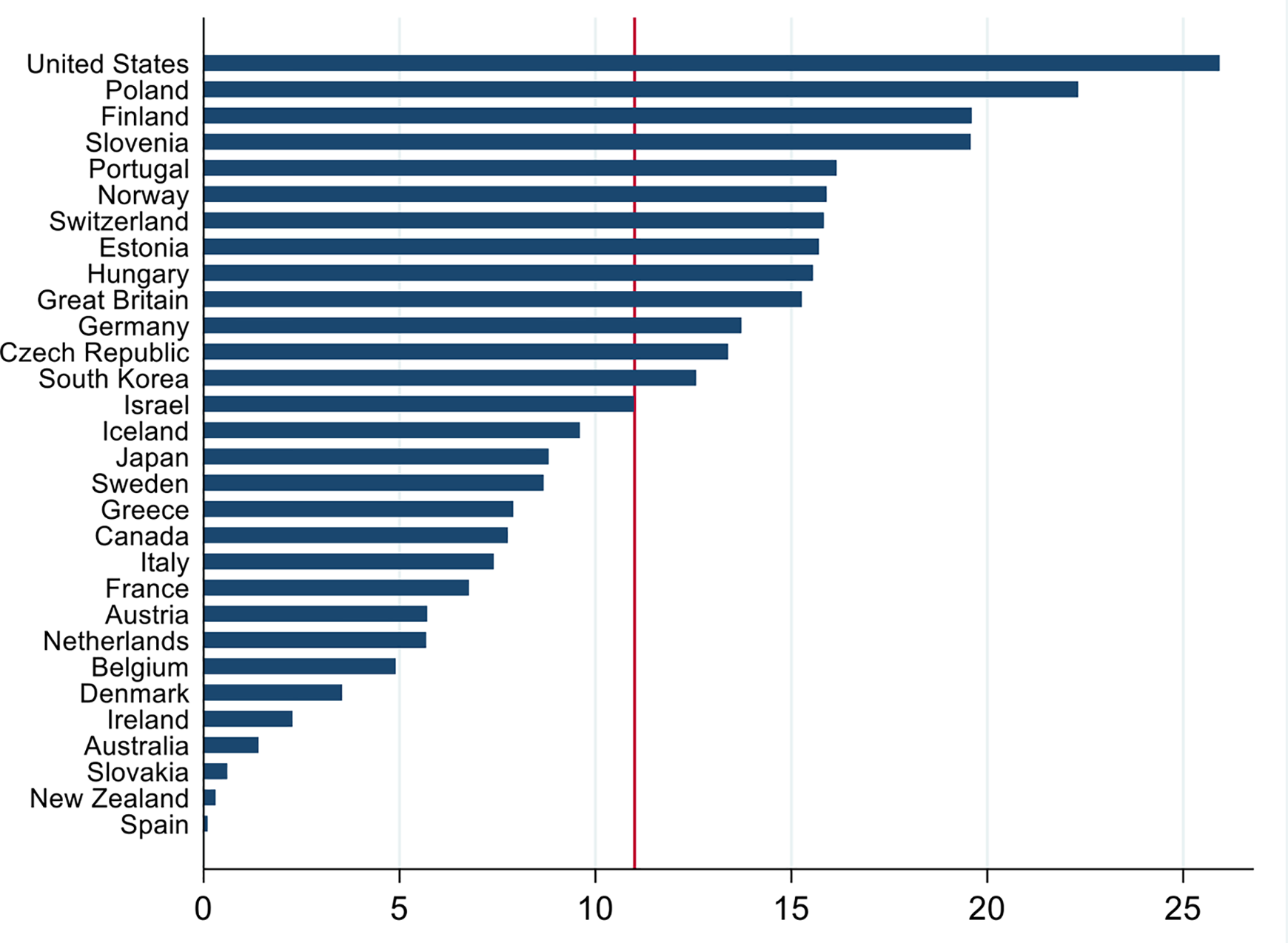
Income gap in turnout by country. Cross-national average income gap in turnout.
Delving further, Figure 2 displays the cross-national average aggregated income gap in turnout plotted by income inequality in the sample. There is a positive, albeit very slight correlation, as the income gap in turnout increases roughly 3 percentage points when moving from the lowest inequality countries to the highest.
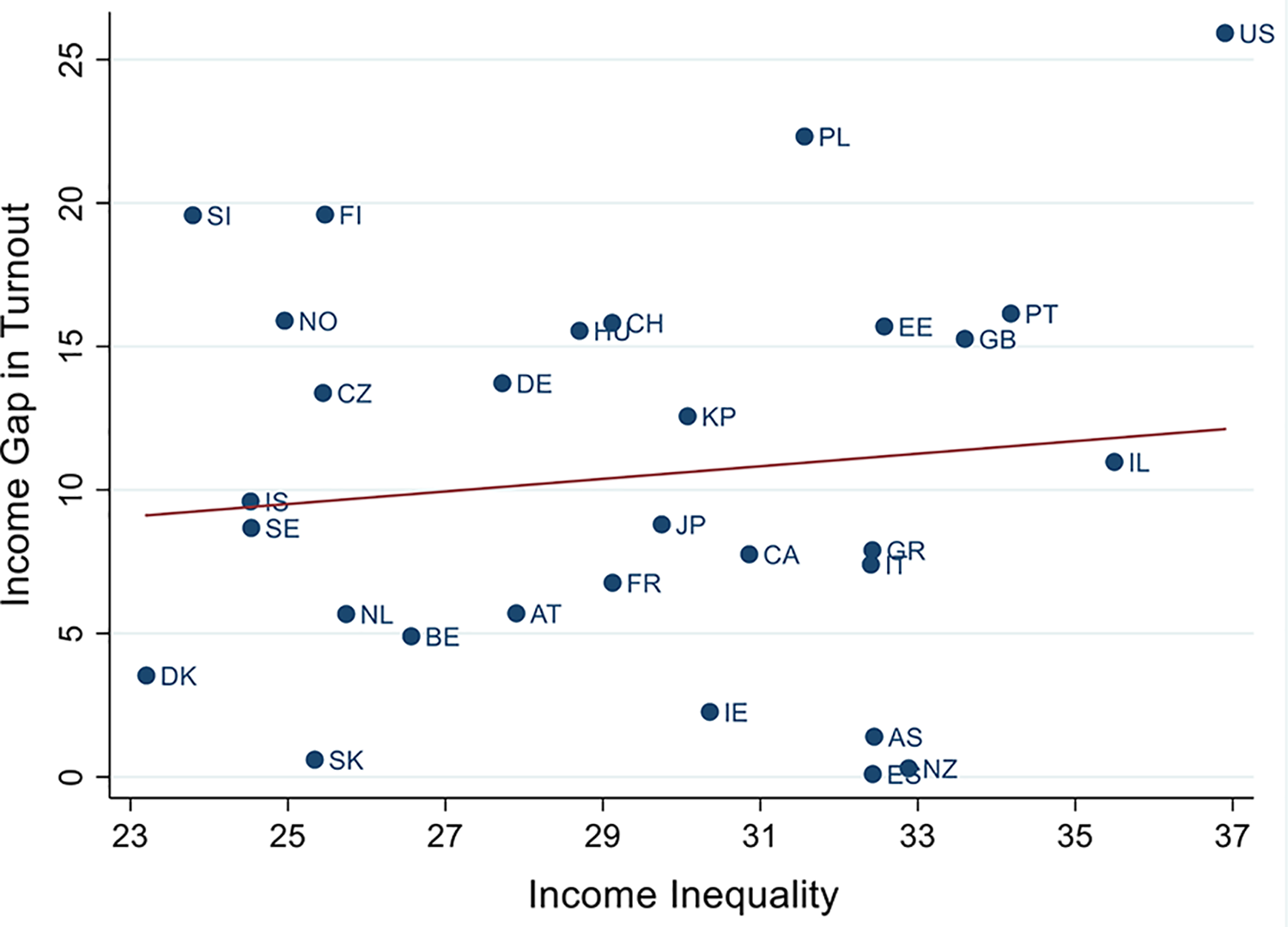
Income gap in turnout by income inequality. Cross-national average income inequality plotted against the average turnout income gap.
Examining the party policy position variable reveals a negative correlation with the income gap in turnout, which is in line with Hypothesis 3c. Figure 3 shows that when moving from countries with the lowest average levels of policy polarization to countries with the highest, the income gap in turnout declines from roughly 13 to 5 percentage points.
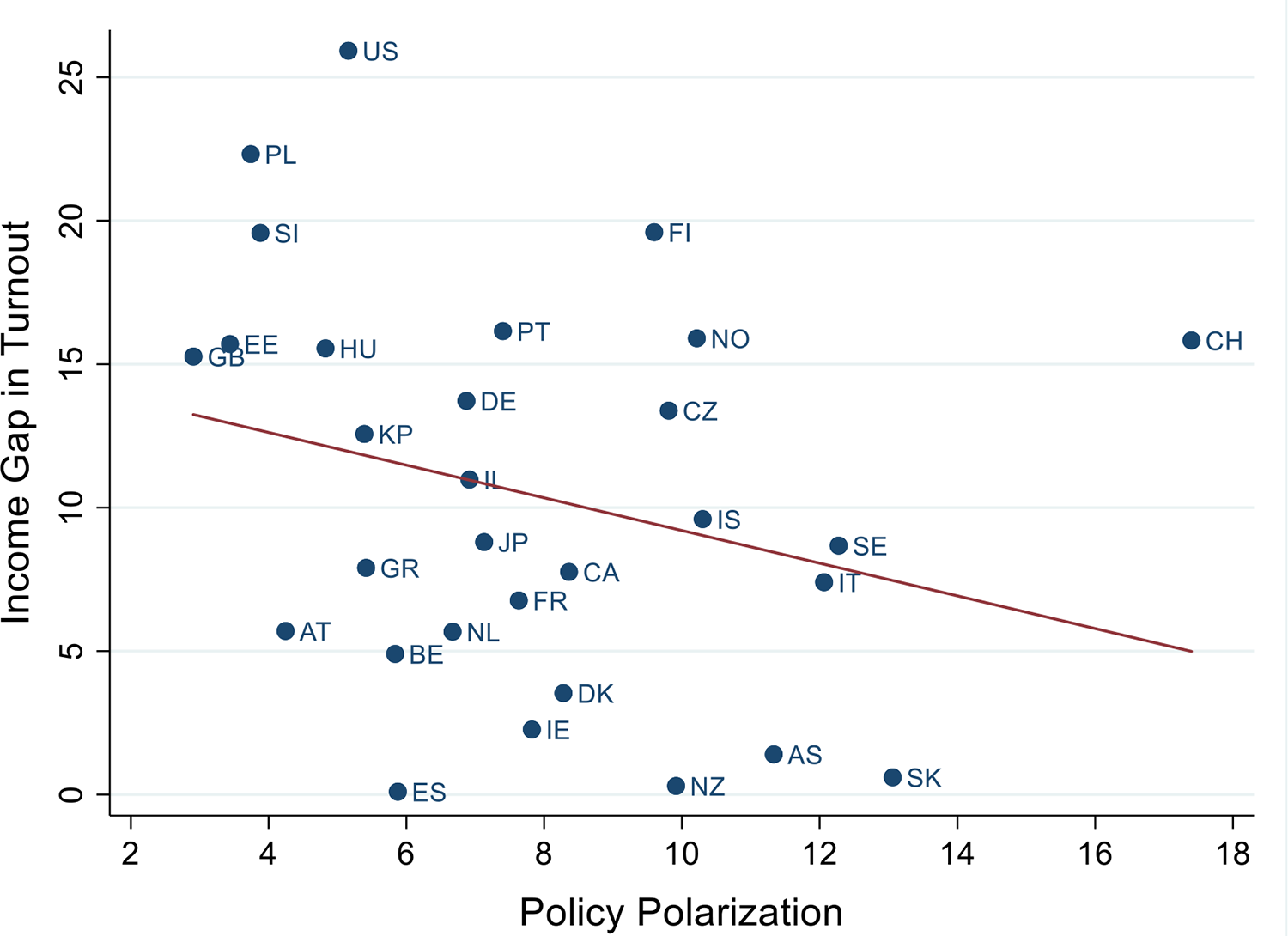
Income gap in turnout by policy polarization. Cross-national average policy polarization plotted against the average turnout income gap.
Lastly, the income gap in turnout increases slightly from 1996 to 2016. Smoothing and plotting the time series with local polynomial regression, reveals that the yearly mean income gap in turnout increases from roughly 10.4 to 11.8 percentage points (see Appendix A12).
Estimation results
To test the main hypotheses, I specify a mixed-effects logistic regression. Table 1 presents the results from three different models. Model 1 provides a baseline estimate including each of the individual and aggregate-level variables. The variables behave largely as expected. The demographic controls are all significant at (p < 0.001), with rural at (p < 0.1). As previous research has shown, turnout tends to be higher among females, the highly educated and increases with age. Turnout also increases with income (b=0.213), and when the logged odds of voting are measured, those in the highest quintile are 1.35 times more likely to vote than those in the lowest quintile.
Mixed-effects logistic regression predicting propensity to vote.
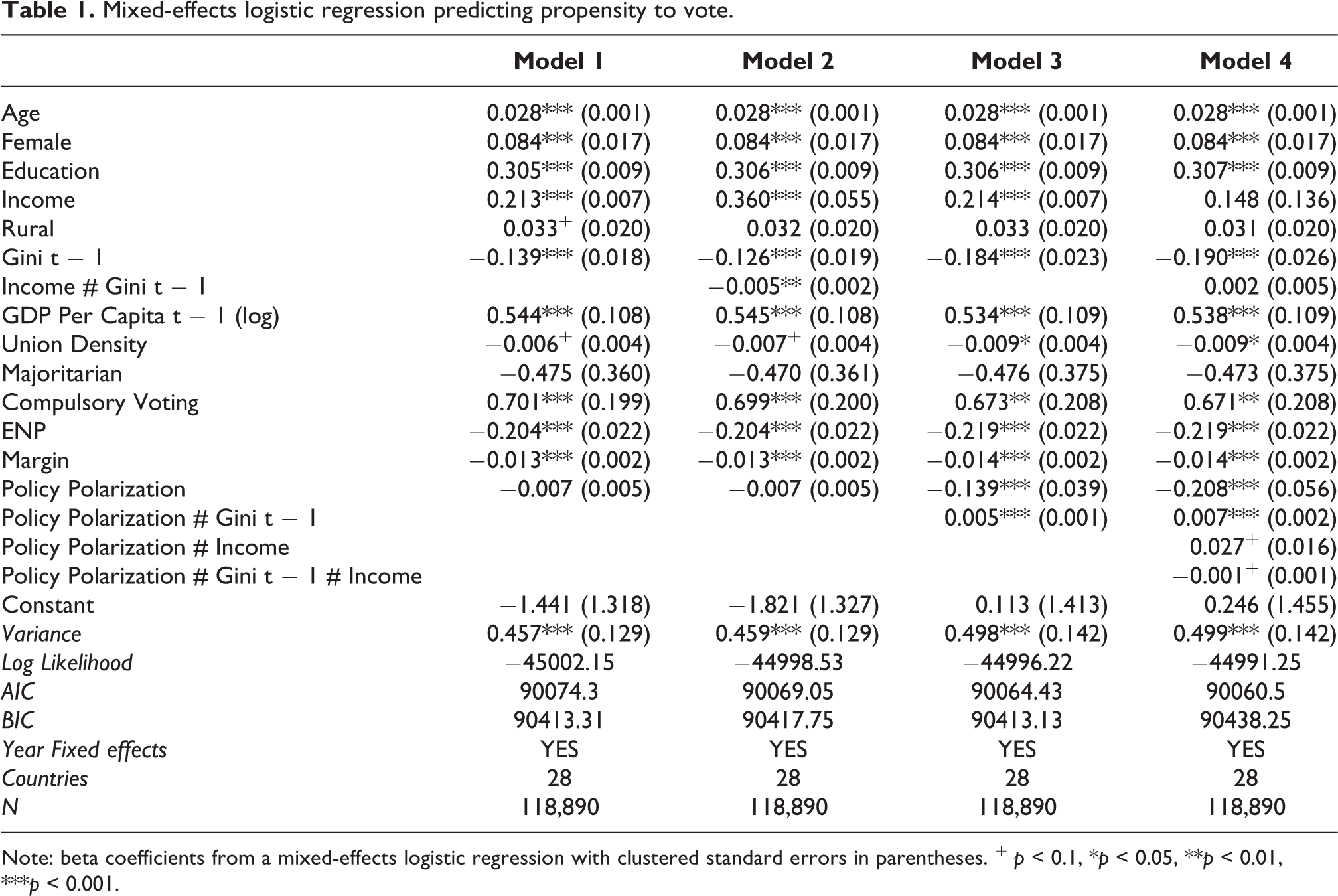
Note: beta coefficients from a mixed-effects logistic regression with clustered standard errors in parentheses. + p < 0.1, *p < 0.05, **p < 0.01, ***p < 0.001.
Most of the country controls are significant. As expected, people living in countries with compulsory voting are significantly more likely to vote. There is also some evidence that people are less likely to vote when parties are highly polarized, although the effect is non-significant. Most importantly, Model 1 indicates that inequality does significantly depress turnout at (p < 0.001), which lends support to Hypothesis 1a.
Turning to the main hypotheses of interest, Model 2 specifies an interaction between gini t − 1 and income to test whether the income gap in turnout is greater when inequality is higher. The interaction is significant and displayed graphically in Figure 4, which presents the effects of inequality on the predicted probabilities of voting for the top and bottom income quintiles. It shows that turnout substantially decreases for both groups as inequality increases and that the income gap in turnout widens. We can see that the turnout gap more than doubles in size from roughly 6 to 13 percentage points between the lowest and highest levels of income inequality. Therefore, in line with Solt (2008, 2010), some support is found for Hypothesis 1c.
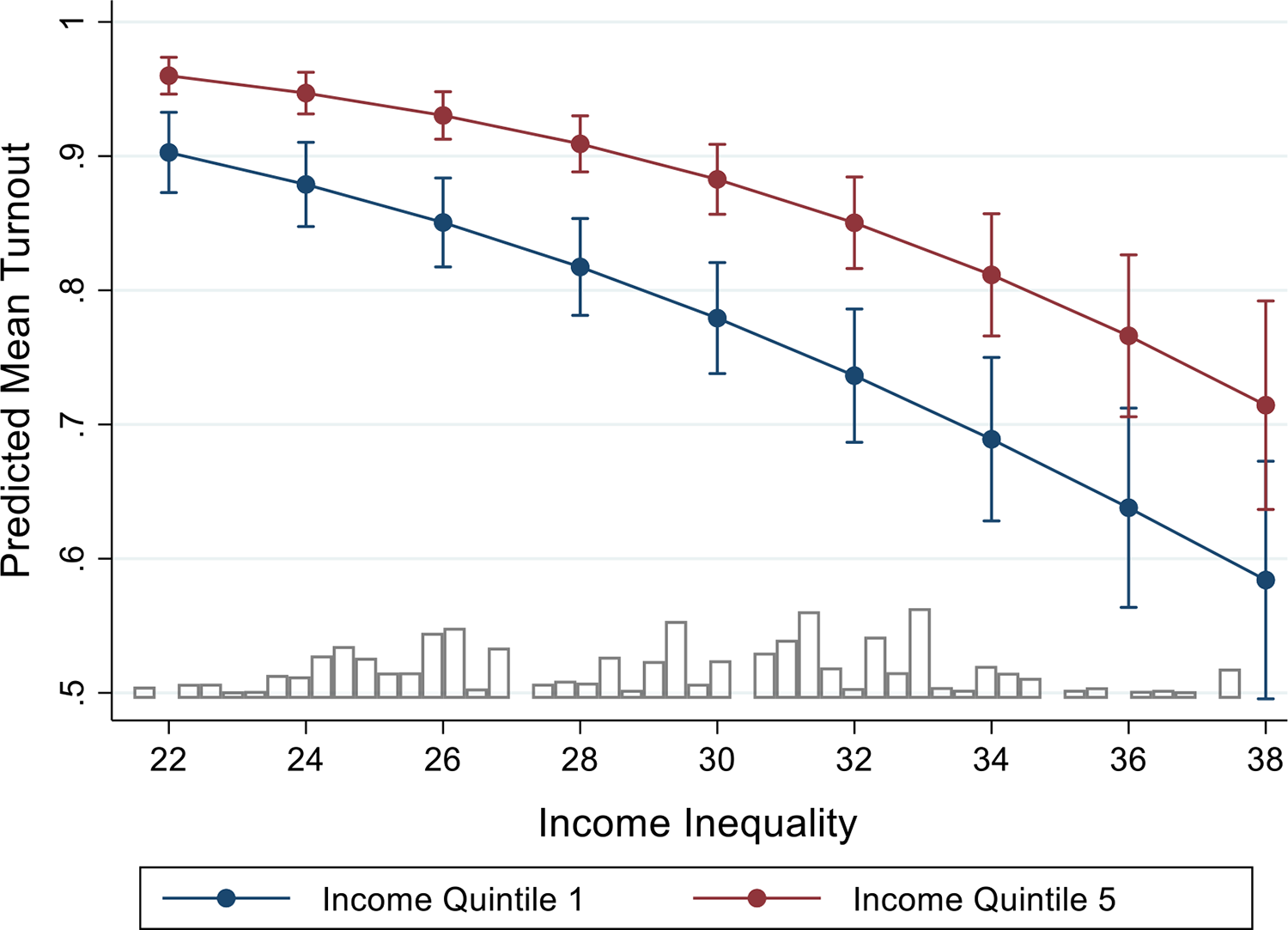
Effects of inequality on predicted mean turnout for top and bottom income quintiles with 95% C.I. (Model 2).
Model 3 tests the second hypothesis—that increased inequality leads to greater turnout when party systems adopt greater redistributive policy choice, than when they are depolarized—via an interaction between gini t − 1 and policy polarization. The interaction is positive and significant at (p < 0.001). Figure 5 shows that in highly polarized systems, turnout does not vary much by levels of inequality, but in depolarized systems, turnout is much lower when inequality is high. Moreover, at low levels of inequality turnout is somewhat higher in depolarized systems than it is in polarized systems, at high levels of inequality turnout is higher in polarized systems than it is in depolarized systems. To aid in interpretation of the substantive magnitude of the interaction, I standardize gini t − 1 so that it has a mean of 0 and a standard deviation of 1. We see that at relatively low levels of policy polarization, 1 standard deviation below the mean (4.25), a 1 standard deviation increase in inequality is associated with a 0.7 percentage point decrease in turnout. Whereas, at relatively high levels of policy polarization, 1 standard deviation above the mean (12.4), a 1 standard deviation increase in inequality is associated with only a 0.5 percentage point decrease in turnout. Although the magnitude is relatively small, the finding provides support for Hypothesis 2 and is in line with the recent aggregate-level results of Polacko et al. (2020).
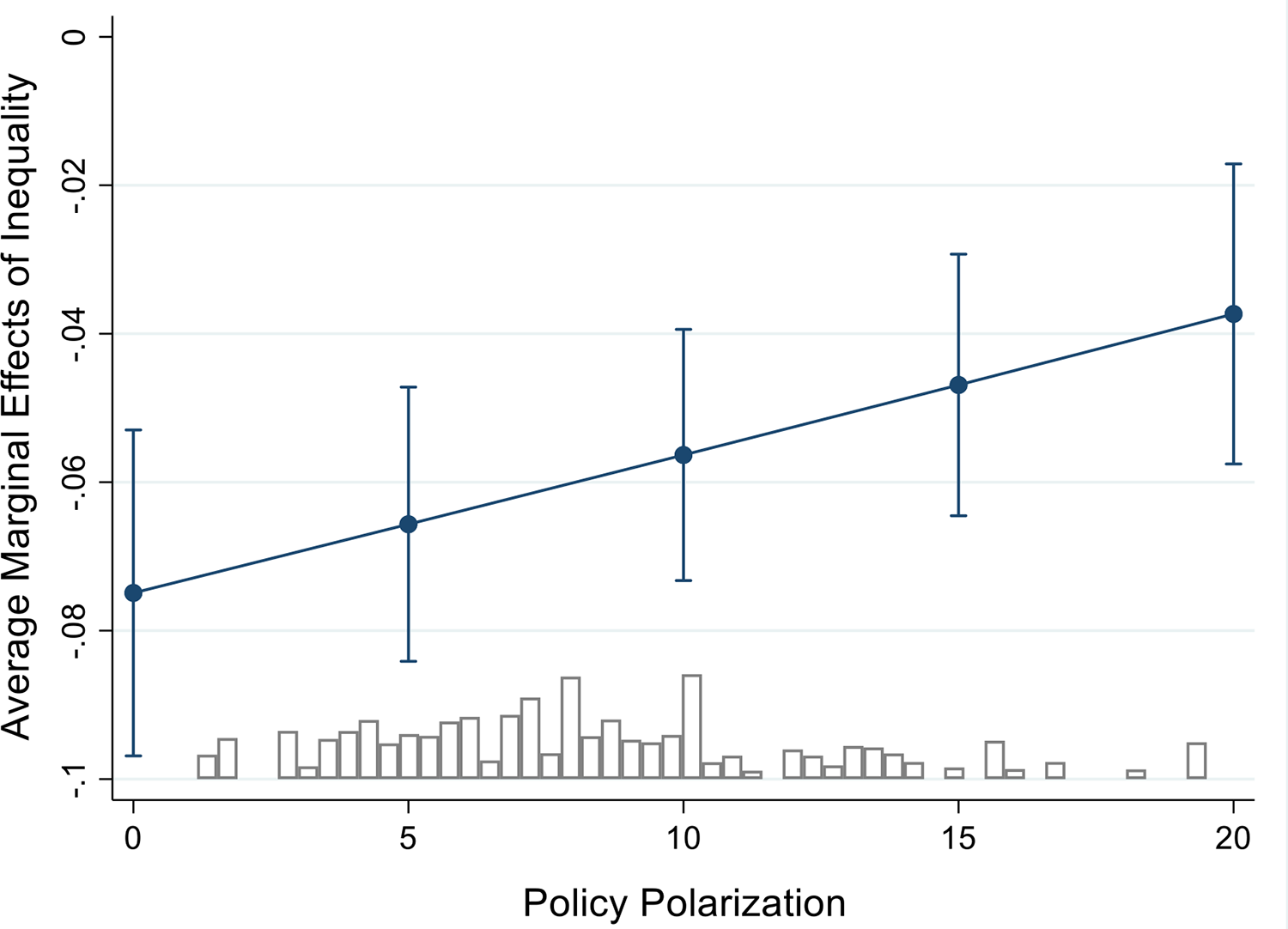
Average marginal effects of inequality by polarization on turnout with 95% C.I. (Model 3).
Model 4 offers a test of the income effects in the relationship via a three-way interaction between gini t − 1, policy polarization, and income. The interaction is negative and statistically significant at (p < 0.1). When the average marginal effects of inequality on turnout is estimated, we can see that policy polarization attenuates the negative impact of inequality on turnout. Figure 6 shows that for people on both high and low incomes, inequality has a negative impact on turnout at both low and high levels of polarization. However, and most importantly, at low levels of polarization, inequality is much more likely to reduce the participation of people on low incomes than high incomes, whereas at the highest levels of polarization, inequality is slightly less likely to reduce the participation of low-income earners than high-income earners. In substantive terms, when standardized, the average marginal effect of inequality is associated with roughly a 0.7 percentage point increase in turnout for the bottom quintile when moving from the lowest to highest level of policy polarization, but only roughly a 0.1 percentage point increase for the top quintile. The implication of this, is that inequality leads to a greater turnout gap when party systems are depolarized than when they are polarized. This is because party system depolarization has a significant demobilizing effect on low-income earners, but not on high-income earners. Therefore, some support is found for the third hypothesis.
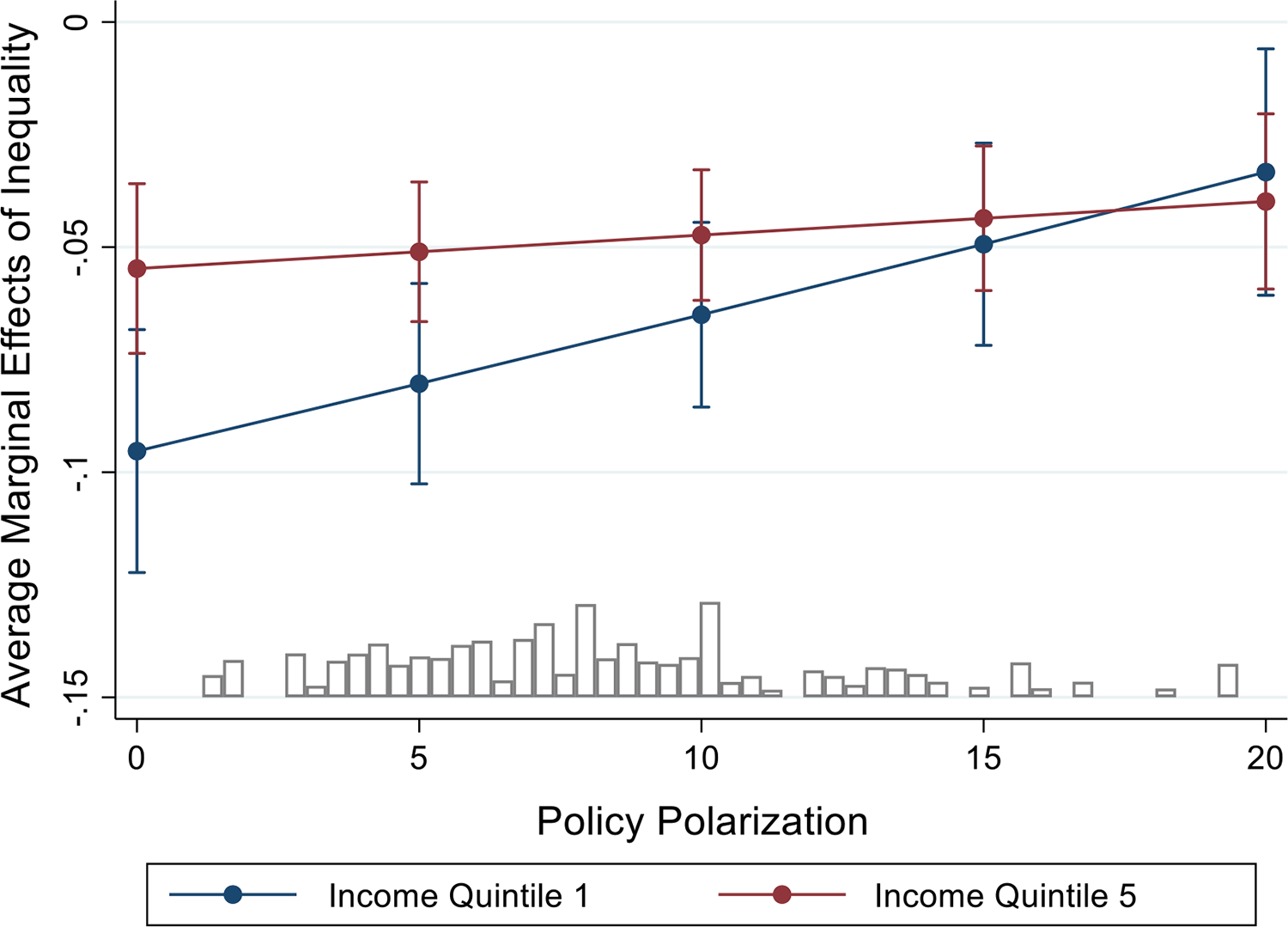
Average marginal effects of inequality by polarization on turnout for top and bottom income quintiles with 95% C.I. (Model 4).
To better determine the income effects for the main hypotheses, the models are performed again on each income quintile sub-sample (Models 5 and 6). Table 2 reports the mixed-effects logistic regression sub-sample results for the bottom and top income quintiles. Model 5 is the baseline model without interactions. 8 The negative effect of inequality on voting is most substantial for the bottom quintile and least for the top, just as the first hypothesis predicts. The effect is also significant for all five income quintiles, although at (p < 0.001) for the bottom quintile only, which provides support for Hypothesis 1b.
Mixed-effects logistic regression predicting propensity to vote for top and bottom income quintiles.
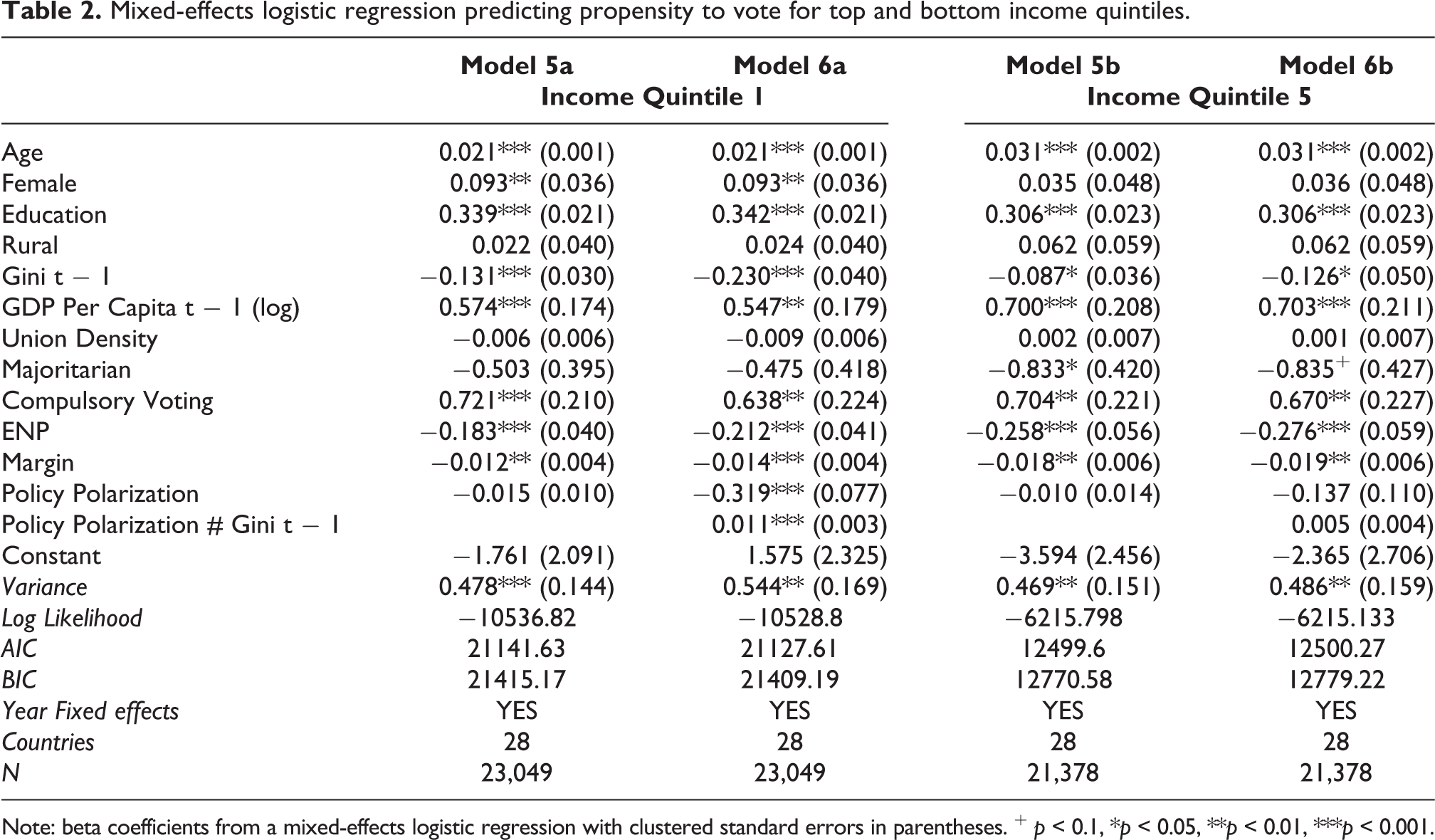
Note: beta coefficients from a mixed-effects logistic regression with clustered standard errors in parentheses. + p < 0.1, *p < 0.05, **p < 0.01, ***p < 0.001.
Model 6 introduces an interaction between gini t − 1 and policy polarization, which is only statistically significant for the bottom quintile (p < 0.001). While each quintile displays greater propensity to vote with higher inequality and polarization, the magnitude is greatest for the bottom quintile, as the interaction coefficient is more than twice as large. Figure 7 illustrates the different average marginal effects of income inequality by policy polarization for both the lowest and top income quintiles. We can see that the effect of inequality is much greater for the lowest. Higher inequality has a dampening effect on turnout roughly three times greater for the lowest quintile under low levels of polarization, with no overlap of the confidence intervals occurring at this level. While the effect is close to zero at the highest levels of polarization. Moreover, while higher inequality reduces turnout for the richest quintile at all levels of polarization, its effect varies much less and only declines by roughly half when moving from the highest to lowest levels. We see that the difference between 1 standard deviation below and 1 above mean policy polarization, is associated with a 0.6 percentage point increase in turnout for the bottom quintile, but barely a 0.1 percentage point increase for the top. Recall that the substantive magnitude of the interaction for the entire income sample (Model 3) was only a 0.2 percentage point increase in turnout when comparing standard deviations. This suggests again that while polarization positively affects turnout as inequality increases, people on low incomes are affected to a much greater extent, and the income gap in turnout is substantially reduced. Thus, further support is provided for Hypothesis 3.
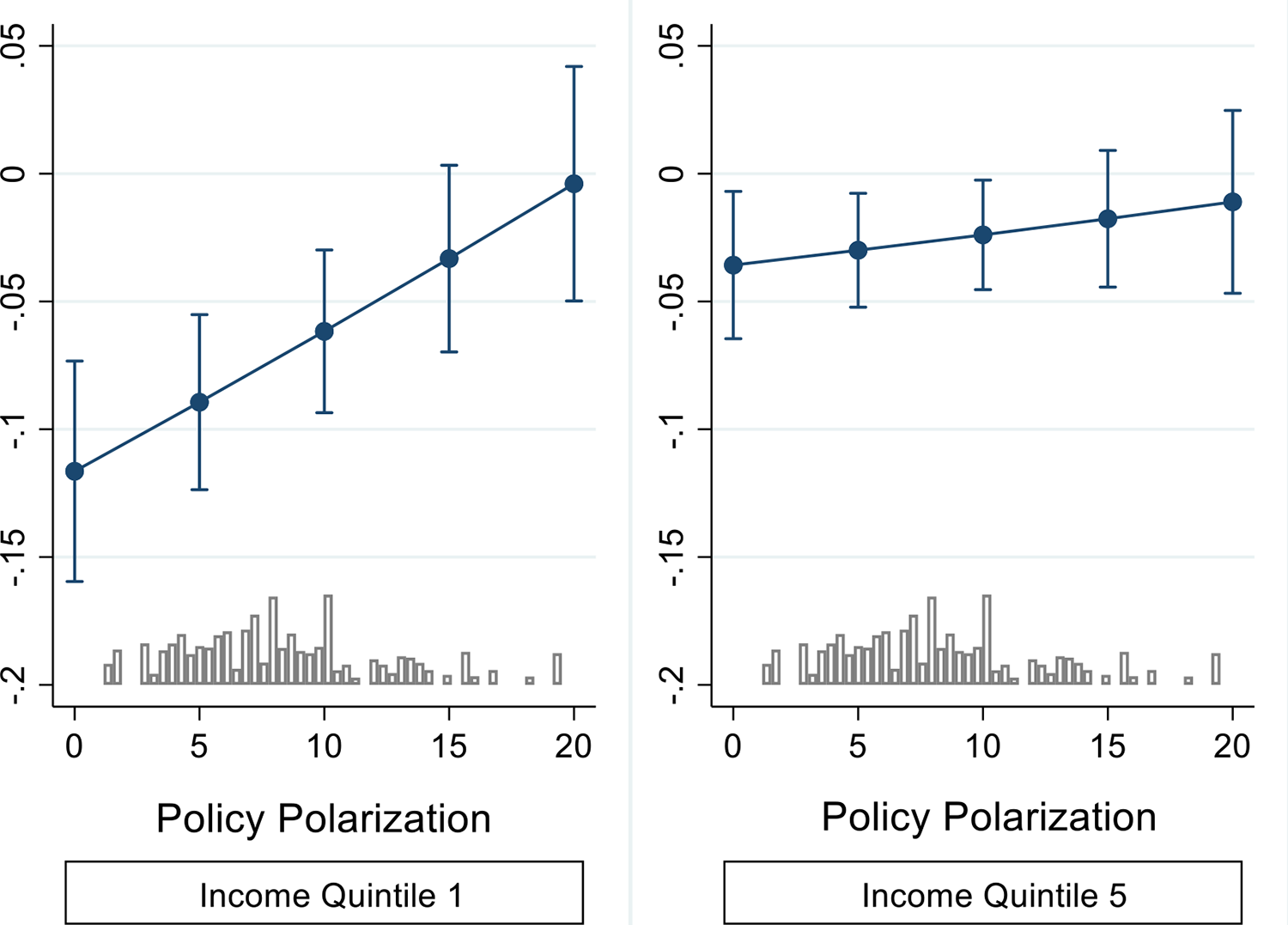
Average marginal effects of inequality by polarization on turnout for the bottom (left) and top (right) income quintiles with 95% C.I. (Model 6).
Robustness tests
The findings are robust to additional controls, and alternative data measurement and model specifications. Additional demographic dummy controls, including being married, full-time employed, and having union membership are added as a robustness check. The variables were not included in the main models due to substantial missing elections and values, union density’s inclusion at the aggregate level, and weaker theoretical relevance (Smets and van Ham, 2013). When added, married and union are positively related to turnout and significant. The main results all hold, except the three-way interaction does not reach statistical significance, likely owing to the high statistical power required in such interactions, which is constrained due to the lower sample size. However, the pattern of substantive differing effects between bottom and top income quintiles remains from Figure 7 (see Appendix A4).
As income is key to the hypotheses, multiple checks are performed on the variable. Firstly, as roughly one-fifth of respondents failed to provide an income response, multiple imputation is performed on the missing income values. The results reveal slightly stronger effects overall, most notably for the three-way interaction, which is significant now at (p < 0.001) (see Appendix A5). Secondly, to guard against the findings being dependent on the categorization of income, the models are re-run with income as terciles and the results all hold (see Appendix A6). Thirdly, an aggregate analysis is undertaken utilizing the turnout income gap between the top and bottom quintiles as the dependent variable. We again find support for the hypotheses, as both gini t − 1 and policy polarization increase the turnout income gap and when interacted, higher levels of polarization and inequality are negatively associated with the gap (see Appendix A7).
Robustness tests are also undertaken to examine whether within-country movements and estimations re-run with country fixed effects clustered by year, largely mirror the main Models 1–6 (see Appendix A8). Additionally, to account for turnout over-reporting, weights are added for voting in each of the models and the main results largely hold (see Appendix A9). Lastly, an external validity of the policy polarization measure derived from the CMP is performed using an equivalent measure of redistribution from the Chapel Hill Expert Survey (CHES). The CHES variable correlates (r=0.36) with the CMP economic policy variable and the main results once again largely hold despite the reduced sample size (see Appendix A10).
Conclusion
Previous research into the relationship between income inequality and the income gap in turnout has produced mixed results, as scholarly attention has overlooked the party supply aspect in the inequality turnout story. Thus, this paper introduces supply-side logic to an equation that has, heretofore, been primarily investigated through demand-side mechanisms. In doing so, it contributes to the study of policy offerings as a key mechanism moderating inequality and turnout. Building on the recent aggregate-level work of Polacko et al. (2020), which found that as party systems polarize economically, the negative impact of income inequality on turnout is reduced, until it is eliminated, this paper importantly focuses on the individual level, to identify the income groups that are most affected in the relationship. It finds that higher levels of income inequality are associated with reduced turnout, but also a wider gap in inequality turnout. Additionally, it finds that when party systems are more polarized, the income gap in turnout is significantly reduced, as it is low-income earners that have the most to lose relatively from rising inequality, who are then mobilized to a greater extent than everyone else. The findings are robust cross-temporally (two decades) and across 30 advanced democracies.
These findings have numerous important implications. The research clearly shows that the policy choices presented to the electorate substantially matter for turnout inequality. Voting disaffection has been on the rise throughout the West and many scholars and commentators have also pointed to a general decline in democracy. Much evidence also shows that party systems, where the primary parties all cluster around the center, can lead to increased voter indifference and reduced turnout (Callander and Wilson, 2007). However, greater polarization can engender more effective party attachments by providing clearly differentiated policy options, which can then spur turnout (Béjar et al., 2020). Thus, if political parties offer greater policy differentiation, it could also go some way toward rekindling the lost trust and interest of citizens in politics.
The findings also point to a distinct inequality in representation throughout the West. Despite the egalitarian principles of elections, the findings here show that party systems are under-representing its poorest citizens in the electoral policy space. By not providing effective economic policy options for low-income earners, parties are dampening turnout and increasing political inequality. Political inequality, as measured through the income gap in turnout, suggests that the rich have greater influence in elections than the poor. This study reveals that rising income inequality is likely to increase political inequality over time, unless parties offer greater economic policy choices—to better represent all citizens—but most substantially the under-represented poor.
Political parties can also substantially affect and shape distributional outcomes through policy, as inequality does not result exclusively from efficient market forces. Parties move closer to the preferences of the rich and away from the poor, as income inequality increases (Rosset et al., 2013), and there is “overwhelming comparative evidence” on the positive effect of high turnout on redistribution (Blais et al., 2020). Thus, the failure of parties to address rising inequality through policy, is also likely perpetuating a vicious cycle of economic marginalization that depresses the participation of lower income groups, which then leads to even greater representation of the wealthy and less public effort to combat inequality. It can also increase the pool of disenfranchised voters, which can then form an attractive prospective reservoir of support for populists and authoritarians to draw from—especially on the radical right (Engler and Weisstanner, 2021). Investigating whether rising inequality and a lack of effective representation in the policy space is a factor in the increasingly strong performances of fringe candidates and parties throughout the West in recent years, is a likely fruitful path of further research.
This study provides a novel avenue of enquiry into the inequality turnout conundrum. It sheds greater light onto the issues of political inequality and unequal voice that persist throughout the West and draws on evidence in support of greater representation that can ideally lead to the implementation of policies that can help mitigate the cycle of increasing inequality. The findings outlined in this paper should also provide renewed impetus for scholars to analyze more carefully the different ways that policy choice affects voter turnout in established democracies, as well as mobilizing further investigation into the consequential effects of inequality on political behavior.
Supplemental material
Supplemental Material, sj-pdf-1-ppq-10.1177_13540688211011924 - Inequality, policy polarization and the income gap in turnout
Supplemental Material, sj-pdf-1-ppq-10.1177_13540688211011924 for Inequality, policy polarization and the income gap in turnout by Matthew Polacko in Party Politics
Footnotes
Acknowledgements
I would like to thank Oliver Heath and Kaat Smets for very valuable advice and comments as well as two anonymous reviewers who helped substantially improve the paper. Earlier versions of this paper have also benefited from the advice and comments of Jack Bailey, Jennifer Cryer, Chris Hanretty, Michael Lewis-Beck, Ivica Petrovica, and Piotr Zagórski. Versions of the paper were presented at the 5th Leuven-Montréal Winter School on Elections at the University of Leuven, Belgium and the 2019 Midwest Political Science Association annual conference.
Declaration of conflicting interests
The author(s) declared no potential conflicts of interest with respect to the research, authorship, and/or publication of this article.
Funding
The author(s) received no financial support for the research, authorship, and/or publication of this article.

Supplemental material
Supplemental material for this article is available online.
Notes
References
Supplementary Material
Please find the following supplemental material available below.
For Open Access articles published under a Creative Commons License, all supplemental material carries the same license as the article it is associated with.
For non-Open Access articles published, all supplemental material carries a non-exclusive license, and permission requests for re-use of supplemental material or any part of supplemental material shall be sent directly to the copyright owner as specified in the copyright notice associated with the article.
