




Abstract
Does party system polarization mobilize voters? Polarization is increasingly shaping democratic competition across Europe. While often perceived to be negative, polarization can be an effective remedy against voter disengagement. This paper investigates two distinct, but often conflated mechanisms, which could explain why polarization leads to mobilization. Spatial polarization of parties diversifies electoral options at the ballot, while affective polarization mobilizes based on emotional considerations. This article then shows the link between polarization and turnout across 22 European countries. The results are complemented by a difference-in-differences analysis of German local elections. However, voting results alone do not inform about the mechanism at play. Survey data is used to show that negative affect appears to be the main driver of voter participation. Party polarization thus has ambivalent consequences for democracies: It mobilizes the electorate, but its effect is driven by negative emotions.
Introduction
What did the general elections of Germany 2017, Spain 2015, and Austria 1995 have in common? At a first glance, the dynamics around election day have been quite dissimilar: The German right-wing party “Alternative for Germany” (AfD) gained representation for the first time in 2017 and became the largest faction in opposition. In 2015, Spanish anti-austerity movements joined forces as the newly formed Podemos party was successfully entering parliament on a radical left platform. Finally, the established Freedom Party of Austria FPÖ had only recently overhauled its profile in 1995 under its new eccentric leader: Jörg Haider abandoned moderate positions in exchange for populist and nationalist appeals. These changes in European party systems originated from different actions and dynamics, such as party formations or leadership change. But all three elections experienced a significant increase in turnout as parties were able to mobilize larger shares of the electorate. This paper argues that there has been a common cause: an increase in polarization of the party systems.
These examples also reveal that polarization can be volatile in systems of proportional representation, which are associated with higher degrees of polarization in the first place. To test the argument of voter mobilization through polarization, I conduct a range of cross-sectional and panel data analyses. 1 First, I show that polarization is associated with higher levels of turnout in 22 parliamentary democracies across Europe. Second, I make use of the uneven participation of the newly formed AfD at German local elections around 2013 to implement a difference-in-differences design. The results show that the “Alternative for Germany,” as a newly formed right-wing party boosted participation in localities where it was on the ballot. This empirical case study nicely complements the initial results. Both analyses suggest that party polarization and voter turnout are closely linked, but reveal little information on the mechanism that connects both phenomena. In a third analysis, I therefore investigate dynamics within cross-country survey data to disentangle spatial from affective polarization. I contribute to the growing literature on polarization and voting behavior by operationalizing spatial and affective polarization as distinct mechanisms. Upon closer analysis, negative affect appears to be the most relevant predictor of turnout.
Overall, polarization can be considered an effective remedy against political disengagement. However, increasing voter involvement comes at a substantial cost: If turnout is driven by negative emotions, polarization can further undermine the legitimacy of democratic decision-making. In the concluding discussion, I elaborate on potential implications of these findings for the study of polarization and turnout in Europe and beyond. Importantly, this study highlights the affective component of mobilization, which so far received little attention in comparative research. In part, this is due a lack of consensus around a clear conceptualization and measurement of affective polarization in multiparty democracies (see Boxell et al., 2022; Wagner, 2021, for valuable contributions). This paper underscores that due to the different ways in which polarization evolves under proportional representation, simple adaptations of concepts and measurements from the US context have some shortcomings. Building on previous work, I also propose a new way to differentiate positive from negative affect in a comparative analysis of constituent attitudes. With regard to turnout, the main implication of this article is quite sobering. After decades of persistent turnout decline, many established democracies in Europe recently experienced more participation. The overall findings of my analyses suggest that this spike could at least partially be explained by rising negative affect across parties and their supporters. Events like the 2015 refugee influx, the electoral success of populist parties, or dispute about the Covid-related policies have reinforced societal tension. This can become harmful if political activism fueled by animosity motivates illicit behavior such as violent protests or the targeted harassment of democratic representatives. Ultimately, increasingly polarized party systems have the potential to undermine the political cohesion of established democracies.
Polarization and Voter Turnout
So far, polarization has mostly been seen as an undesirable trend in established democracies. Especially in the US, scholars tend to blame elite polarization for a range of poor outcomes. This includes lacking levels of representation and elite-constituent alignment (Fiorina & Abrams, 2012; Poole & Rosenthal, 1984), legislative gridlock (Jones, 2001), or the splintering and politicization of the media landscape (Prior, 2013).
This paper zooms in on the consequences of party system polarization in established democracies. This concept of polarization implies that ideological positions across parties drift apart (Dalton, 2008). It connects to work by scholars who emphasize that party elites take increasingly diverging positions on salient issues whenever polarization is high (Hetherington, 2001; Poole & Rosenthal, 1984). But not only did the ideological distance among party elites increase. Voters also started to place their own preferences closer to those of their favorable party (Abramowitz & Saunders, 2008; Lenz, 2013). Under the labels of “sorting” (Baldassarri & Gelman, 2008; Fiorina & Abrams, 2008; Levendusky, 2009) or “realignment” (Abramowitz & Saunders, 1998), scholars of US politics describe that party elites and their partisan voters rally closer around certain core policies. Polarization therefore is also associated with increasing ideological homogeneity within parties, distinct policy profiles, and less overlap across party lines.
However, increasing ideological disagreement is not the only way in which polarization has been conceptualized and examined. Rather than looking at changing policy preferences, some scholars highlight increasingly hostile attitudes towards political opponents and blind obedience to one’s preferred party elites. Banda and Cluverius (2018) find that when elite positions diverge, partisans develop increasing feelings of animus towards the opposing party. And Johnston (2018) shows how position-taking by elites elevates authoritarian feelings among partisans. As personal and political identities start to align, constituent’s emotions become a stronger motivation for actual behavior (see Achen & Bartels, 2016; Tajfel, 1982; Turner et al., 1979). Voters engage in politics not to see their preferences put into legislation, but to “express” a salient part of their identity (Huddy et al., 2015). Strong identification with a political camp can also provoke strong animosity against political opponents. A range of studies show that this negative view of political competitors is increasing over time in a range of established democracies (Boxell et al., 2022; Iyengar et al., 2012) and shapes constituent behavior even beyond politics (McConnell et al., 2018).
I argue that both narratives associated with party polarization can have a distinct effect on turnout, as illustrated in Figure 1. Polarization can either increase the dispersion of political offerings across the ideological range (see Dalton, 2008). Spatially polarized elites with coherent party preferences make it easier for voters to identify and support a party close to their own ideological views (Levendusky, 2010; Lupu, 2015). Constituents are confronted with more distinct electoral options in a polarized party system (Dalton, 2008). Based on a rational understanding of voting behavior, this should increase the utility of participation (Hobolt & Hoerner, 2020; Moral, 2017). Illustration of theoretical argument.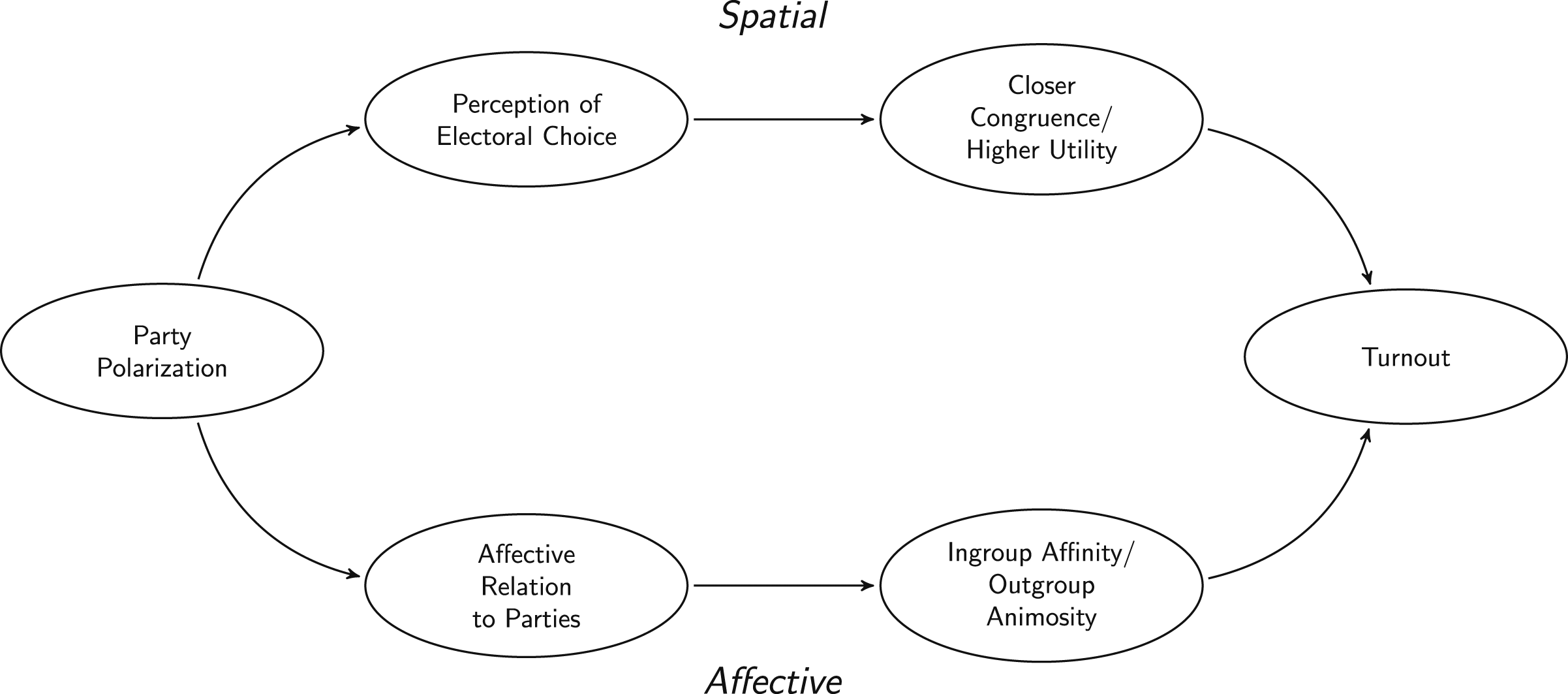
But voter mobilization could also be a consequence of increasingly salient partisan identities (Huddy, 2001; Mason, 2018). In this scenario, behavior is not policy-, but identity driven (see Achen & Bartels, 2016). When the ideological overlap between rivaling parties shrink and their followers sort into homogeneous groups, appreciation for demands by political competitors declines (Iyengar & Westwood, 2015). Therefore, individual participation could result from “anger, prejudice, and activism on behalf of that prejudice and anger” (Mason, 2018, p. 4). For example, Abramowitz and Stone (2006) argue that the 2004 American presidential elections experienced a spike in turnout not because voters were divided over president Bush’s proposed policies, but because his persona triggered emotions among Republicans and Democrats alike. As the authors put it, “Americans either loved him or hated him and […] went to the polls in record numbers to express those feelings” (Abramowitz & Stone, 2006, p. 141).
For conceptual clarity, I treat spatial and affective polarization as distinct mechanisms that link party system polarization to higher turnout. However, both concepts are intertwined and potentially reinforcing. To my best knowledge, few studies explicitly model the relationship between affective and ideological polarization. A recent exemption is a seminal study by Druckman et al. (2021). In the context of American public opinion formation during Covid, the authors find that prior affective polarization predicts higher degrees of ideological polarization. Their study suggests that when partisan animus is high already, subsequent policy preferences will be divided. Parts of the literature conversely claim that affective polarization has increased due to greater ideological extremity (Bougher, 2017; Webster & Abramowitz, 2017). According to the authors, radicalizing party elites and the sorting into cohesive partisan camps have sparked the growth of affective out-group hostility. Confirming the view of policy-based affective polarization, Lelkes (2021) finds that party elites with radical ideologies increase affective polarization among the electorate.
One caveat of these research endeavors is that they mostly are situated within the American two-party system. Under plurality rule with single-member districts, barriers of entry for new parties are high. Hence, party system polarization is mostly driven by established parties’ moving to extreme positions and growing animus across existing political camps. This study however focuses on the consequences of party system polarization in European multiparty democracies, many of which rely on a variant of proportional representation (PR). Here, party competition is much more volatile and the formation, discontinuation, merger, or separation of parties occur frequently. Moreover, electoral volatility across parties and party families is more pronounced. Based on the conceptualization of party system polarization by Dalton (2008), one can infer three potential causes of rising polarization in PR systems: First, new radical parties can emerge and gain electoral support. Second, existing parties can move towards more extreme positions and maintain or even gain electoral support. And third, even when parties do not reposition, voters can shift their support from centrist towards more radical parties.
Party system polarization thus appears more complex in a PR context, a fact that has received relatively little attention in the recent literature on the origins of polarization. Notable studies on this topic primarily pay attention to the consequences of new party entry (see Bischof & Wagner, 2019; Leininger & Meijers, 2021). But to the best of my knowledge, there exist few systematic assessments of party radicalization or shifting voter support as determinants of polarization beyond the US.
The scope of this article however remains the consequence of polarization for voting behavior. That is, I am somewhat agnostic about the origins of polarization within a given country at a specific point in time. It is nonetheless interesting to situate the level of party system polarization across different types of democracies in a comparative perspective. A simple analysis conducted in Appendix Section A.4 compares polarization across the three main electoral systems based on existing CSES data. In accordance with the classical comparative party systems literature, I find that PR systems possess the highest levels of political polarization (Downs, 1957; Sartori, 1976). How does this relate to the dynamics around polarization and mobilization? I argue that testing this relationship under rules of proportional representation could be more challenging. First, the causes of polarization are more complex. In order to correctly assess changing polarization in a multiparty system, voters need to be aware of party entries or exits, the ideological platform of these new parties, as well as adjustments in ideology by all existing parties. Moreover, they need to account for electoral shifts towards more or less extreme parties around elections. All in all, tracking these different aspects of polarization under PR-rule can be challenging and may lead to the fact that rising polarization has a more subdued effect on voting behavior. In contrast, party system polarization in the US has primarily been driven by growing ideological divides and animus across two existing political parties with relatively stable support bases. Large electoral swings or new party entry are less common under plurality rule, thus potentially simplifying voter assessment of changing polarization. The next section clarifies and formalizes how both spatial and affective polarization are expected to operate in a multiparty context.
Spatial Polarization and the Decision to Vote
Conceptualizing spatial polarization assumes that political preferences can be ordered along policy dimensions in which actors purposefully choose their positions. This incentivizes parties to diversify their profiles, spread across the ideological spectrum, and cater to voters at moderate and extreme positions. The strategic positioning across the policy space can be explained as vote-maximizing behavior in which parties search an electoral niche (Cox, 1990). This understanding of party behavior originates from the spatial proximity model of voting (Downs, 1957; Stokes, 1963). It posits that voters deliberately choose the party that is closest to their personal policy preferences. Note that the spatial proximity model is only one subbranch of existing spatial models on voting behavior, which for instance also incorporate theories on directional voting (Rabinowitz & Macdonald, 1989). To the best of my knowledge, most research on party system polarization and spatial voting either implicitly or explicitly adopts the proximity model.
Given its core assumptions, the proximity model of voting foresees a system of spatial representation in which parties take an active role and position themselves strategically to decrease the distance towards voters (Stimson et al., 1995). This dynamic process implies that individual utility from voting is dynamic and depends on party (re-)positioning at a given election. In order to decide whether to participate or abstain, rational voters engage in a simple cost-benefit analysis (Aldrich, 1993; Riker & Ordeshook, 1968). In this paper, I focus on variation in perceived utility associated with rising party system polarization.

Constituents’ utility of voting U v depends on the positioning of parties before elections. It is formalized as being the inverse of the absolute distance between voters and parties along the general right-left dimension. Spatial polarization alters the perceived utility from voting by changing the supply side of politics. In a spatially polarized system, constituents can choose from a wider range of electoral alternatives positioned across the entire ideological spectrum (Dalton, 2008; Moral, 2017). It can be caused by formerly moderate parties that adopt more radical positions to address new groups in the electorate, a strategy known as differentiation and profile building (Cox, 1990; Spoon & Klüver, 2019). But spatial polarization can also result from new party entry (Tavits, 2006). If parts of the electorate are not sufficiently represented by established parties, incentives for new actors to appeal to underrepresented voter groups are high. This polarizing effect of emerging parties is reflected in the niche party literature (Meguid, 2005, 2008). For example, voters with environmental preferences have been poorly represented by established social democratic and conservative parties in the 1980s, which changed after the formation of new green parties across Europe (Kitschelt, 1989). The incorporation of the Greens into the traditional party system has raised the dispersion of preferences, thus resulting in higher levels of spatial polarization. The radical right, another group of newly formed political parties, has had an even more substantial impact on ideological polarization (Kitschelt & McGann, 1997). Their nationalist and anti-immigration positions significantly broadened the spectrum of ideological viewpoints represented in many European party systems.
Spatially polarized systems with parties catering to constituents across the whole ideological range—from libertarian, over environmentalist, to nationalist preferences—on average minimize the distance between party and constituent positions. This should increase the levels of perceived utility of voting for individuals, who are able to identify a party that represents their interests reasonably well. Thus, I expect an increase of mobilization.
Higher degrees of
Affective Polarization and the Decision to Vote
When affective polarization triggers mobilization, I do not assume that voters are acting perfectly rational. To the contrary, I expect them to make sense of politics in terms of social group relationships (Achen & Bartels, 2016; Festinger, 1954). This path is rooted in social identity theory and related theories of relative group worth (see Huddy, 2001; Tajfel, 1982; Turner et al., 1979). Within this framework, individuals are presumed to categorize themselves and their peers into socially constructed groups. The more partisanship becomes part of this self-determined identity, the likelier it is that emotions are a key driver of political behavior (Iyengar et al., 2019). Mason (2018) defines affective polarization as the increasing social distance between partisans based on three phenomena: “increased partisan bias, increased reactivity [based on this bias], and increased activism” (2018, p. 17), the latter suggesting that growing partisanship is likely to trigger political action.
Especially in the US, affective polarization has become a widely studied phenomenon (Iyengar et al., 2012; Rogowski & Sutherland, 2016). The hostility and prejudice facing political opponents has grown (Mason, 2018). But affective polarization is imperfectly explained by diverging party positions alone (Iyengar et al., 2012). Dynamics of in-group favoritism and out-group animosity emerge (Tajfel, 1982; Turner et al., 1979), which go beyond a “rational” disregard for the opposing positions on certain policies (Lelkes, 2018).

The simple equation formalizes the intuition behind the affective polarization proposition. Voter utility U v is now the result of in-group feelings Fin−group compared out-group feelings Fout−group. The groups are subjectively classified by constituents along party lines. Seeing your own party win, or the opponent loose, maximizes individual self-esteem and thus makes you more likely to participate. The extent of utility generated by affect can thus be increased by two parameters, either by holding extremely strong feelings towards one’s favorite party (which I call positive affect) or extremely strong feelings against a specific party (which I label negative affect).
First, constituents with a strong partisan identification should have few reasons to abstain from voting. Conversely, “cross-pressured” voters who are not committed to a single political party are more likely to abstain (Berelson et al., 1954). Affective polarization increases positive identification with the preferred party, thus elevating the motivation to help this party win the election. This mechanism sees “warm” and positive feelings towards the in-group as a main driver of affective polarization. Second, committed partisans could also want to see their opponents loose (Miller et al., 1981). Affective polarization can increase hostility and animosity towards the out-group, which can be an equally strong force of mobilization. As anger and animosity towards political opponents increase, constituents should feel that more is at stake during an election. This means that the fear of losing out to the other party grows once they are perceived as incompetent and corrupt (Mason, 2018).
Affective polarization is known to drive other forms of political activism as well, such as volunteering, donating, or campaigning (Mason, 2018). Mason reveals that personal identification with a party, not actual agreement on any specific policy issue determines political involvement. Her findings suggest that there is more to mobilization than just positional alignment between elites and voters. Similarly, Huddy et al. (2015) show that social identification with a party is a stronger predictor of activism than policy congruence. Citizens who donate or volunteer do not necessarily have to agree with a party’s policy stances as long as they feel closely attached to it. While there is little evidence beyond the American case, first comparative studies suggest that radical right parties trigger turnout also by those who strongly oppose them (Immerzeel & Pickup, 2015). And Wagner (2021) concludes that affective polarization is associated with higher degrees of self-reported activism and participation. Finally, Leininger and Meijers (2021) present conflicting evidence and show that the presence of populist parties—one important driver of affective polarization—does not increase turnout in Western European elections, but only does so in Eastern Europe.
In total, I argue that affective polarization elevates turnout either by strengthening positive associations with one preferred party, increasing hostility towards its political competitors, or both combined.
Higher degrees of
Empirical Strategy and Analysis
The empirical section of this paper contains three distinct analyses. First, I establish a positive association between polarization and turnout based on two-way fixed effects regressions based on a panel of 22 European democracies. Second, I leverage irregularities in radical right party participation in German local elections around 2013 to conduct a difference-in-differences analysis on the local level. While having the downside of limited generalizability towards the entire country sample, this more elaborate causal identification strategy confirms that the entry of a radical party into politics elevates voter participation. In a third stage, I then use CSES survey data collected from the sample of 22 democracies to disentangle the role of affective and spatial polarization on the individual level. Is it the case that stronger emotions towards political actors encourage voter mobilization, or do constituents turn out because of their ability to choose from a broader menu of politically distinct alternatives? An analysis of self-reported and actual turnout suggests that negative affect encourages participation. Voters are mobilized when they possess hostile feelings with regard to their political opponents.
Analysis 1: Polarization and Turnout Across Europe
Sample
The first analysis is conducted using election results and party positions derived from electoral manifestos for 22 established European multiparty systems. The sample of countries contains Austria, Bulgaria, Denmark, Finland, Germany, Hungary, Iceland, Ireland, Italy, Latvia, Lithuania, Netherlands, Norway, Poland, Portugal, Romania, Slovakia, Slovenia, Spain, and Sweden. 2
Since the argument focuses on established democracies with stable party systems, I consider the time period from 1975 to 2021 for Western countries. Eastern European party systems until recently have been substantially less stable and experienced high degrees of electoral volatility over the first decades after their democratization. I therefore include elections from 2005 on, a year after accession to the European Union 3 and in a time period where their party systems became less volatile (see Tavits, 2008).
Independent Variables
To measure polarization across countries, I rely on the party system polarization index introduced by Dalton (2008). His measure of the weighted ideological dispersion of parties incorporates two types of information: Party size and their ideological positions. Through the weighting process, positions of smaller parties are discounted while larger parties have more impact on the overall score. Positive values denote higher perceptions if ideological diversity among parties.

In the equation, vj,c,t denotes the vote share of party j in country c at time t. τj,c,t is the left-right score of party j at time-period t and
As additional control variables, I add the election-specific effective number of parties (Laakso & Taagepera, 1979) and the disproportionality index (Gallagher, 1991). Controlling for the number of parties ensures that the parameter of the polarization index captures variation in ideological diversity, more so than changes in the mere number of parties on the ballot. The disproportionality index measures variation in congruence between vote and seat distributions, which mainly stem from varying electoral rules and institutional differences across countries. Higher levels of incongruence should make individual votes less pivotal for the seat distribution, which may discourage turnout. Values for both statistics derive from the ParlGov database and are measured on the election level (Döring & Manow, 2018).
Dependent Variable
Turnout at parliamentary elections constitutes the dependent variable of the analyses. It is scaled from 0 to 100 percentage points. Values are taken from the ParlGov database (Döring & Manow, 2018). Figure 2 illustrates the decline of turnout over time within the sample. Individual dots display the average turnout for each year. Over the last thirty years, average turnout rates declined from more than 85% to well below 70%. Trends of turnout in 22 countries.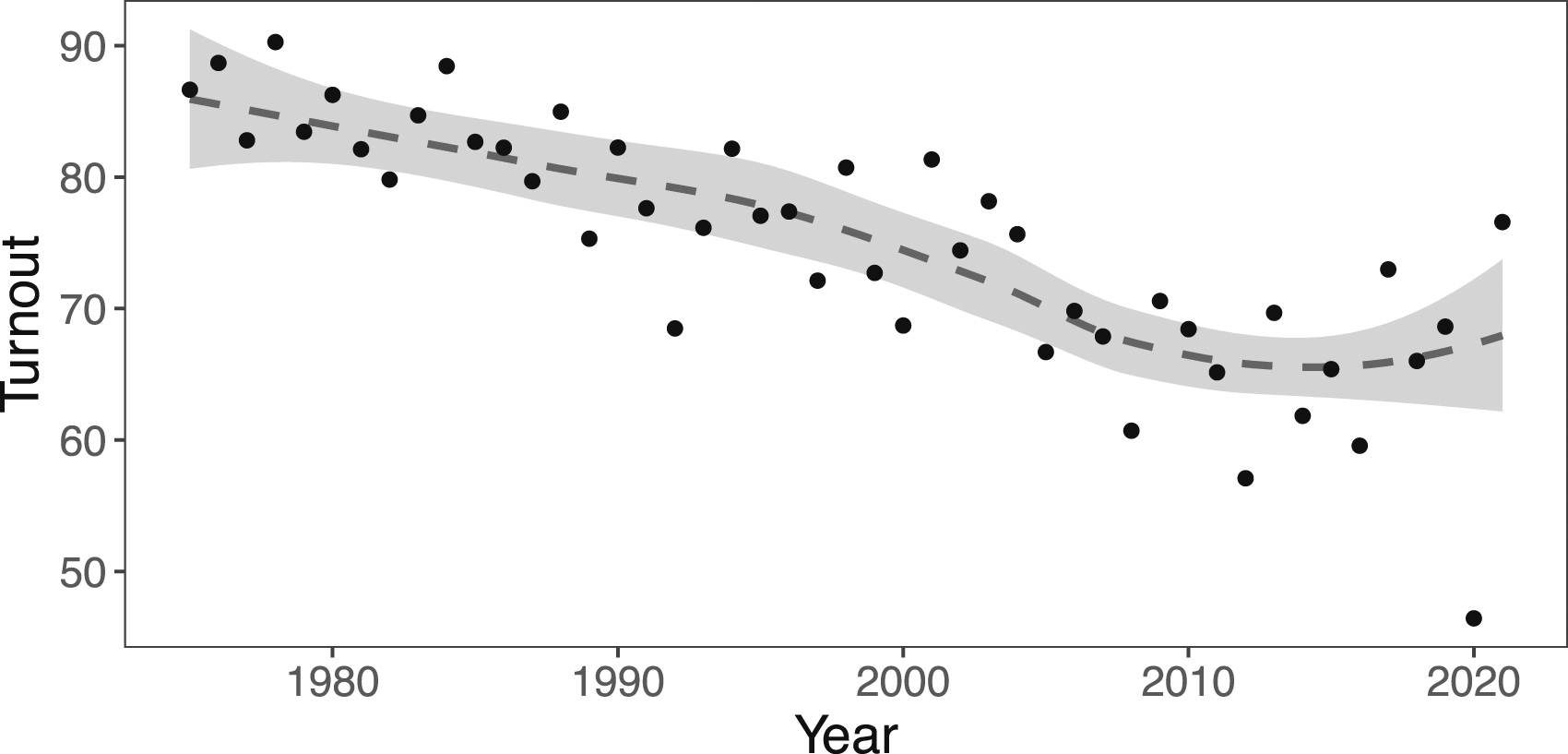
Estimation
To analyze the effect of polarization on voter turnout, I estimate a series of OLS regression models of the following form:

Note that the three independent variables are lagged to minimize endogeneity concerns. In addition, time fixed effects α t are added in order to not extrapolate across years. For the second model, year and country fixed effects α c,t are added to focus on within-unit variation. Standard errors are clustered by country.
Results for Parliamentary Elections in 22 Countries
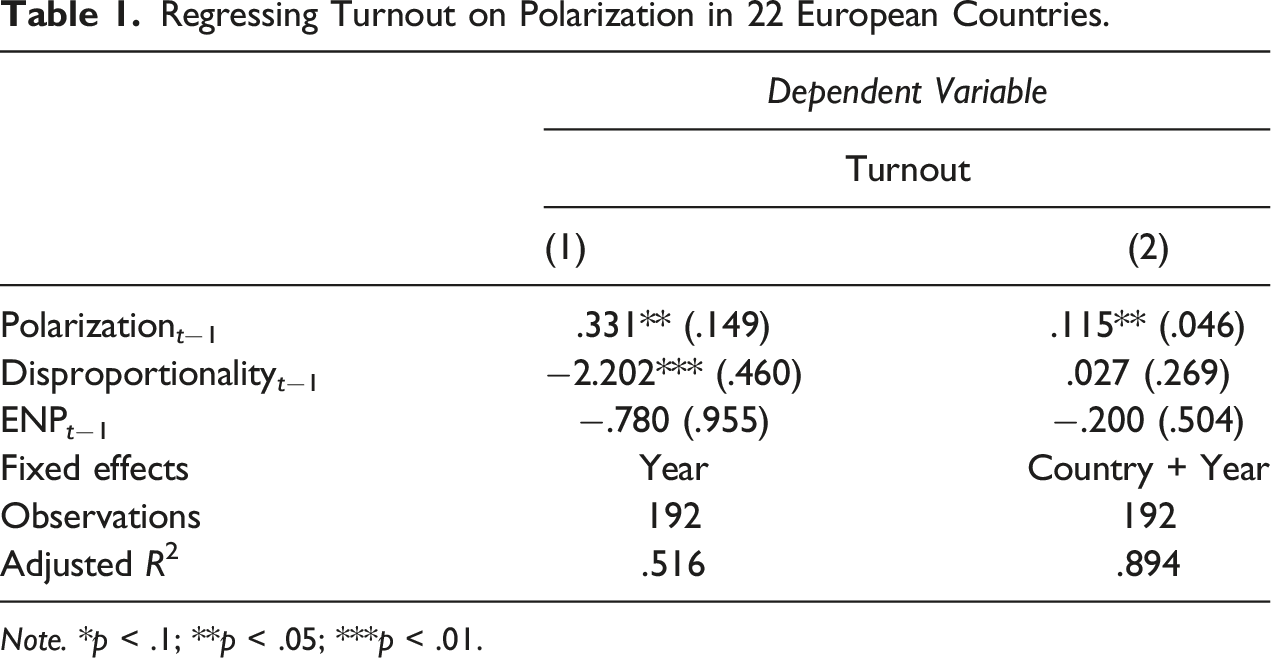
Regressing Turnout on Polarization in 22 European Countries.
Note. *p < .1; **p < .05; ***p < .01.
Half of the observations in the sample score between 10 and 19 on the polarization index. 4 According to model 2, which includes country and year fixed effects and election-specific covariates, moving from a moderately unpolarized to a moderately polarized election (i.e., moving from the first to the third quartile) increases turnout by roughly one percentage point. According the first model, which acknowledges variation across countries, such a change predicts an increase in turnout of around three percentage points.
To put this effect magnitude in context, Gerber et al. (2008) find that a letter which reminds constituents of turning out as a civic duty in US state primaries has increased turnout by 1.8 percentage points.
Importantly, the results hold when conducting jackknife resampling by country, as shown in Appendix Section A.6. For each model, only the exclusion of one country (Denmark and Portugal, respectively) elevates the p-value barely above conventional levels of statistical significance. The results are robust when excluding each of the remaining 21 countries in the sample.
All in all, the first results suggest that the degree of polarization in a party system matters for voter turnout, even when accounting for the number of electoral parties, the disproportionality of seat allocation, and county and time-specific differences across observations. Analysis two proceeds to identify the causal effect of radical party entry on participation by exploiting the dissimilar fielding of radical right party candidates in German local elections around 2013.
Analysis 2: Polarization and Turnout in German Local Elections
Sample
In the second analysis, I utilize a panel of German local elections on the county-level (Kreistagswahlen) to conduct a difference-in-differences analysis. I track changes of voter turnout within counties conditional on either having the newly formed AfD participating in the election or not. The data originates from the local election database by Rademacher (2018), which covers the time period from 1990 to 2016. This empirical case study complements findings of the initial analysis and yields a causal estimate of the effect of radical new party entry on voter turnout in the context of recent German local elections.
German local electoral laws typically deviate from state to state. For instance, legislative terms vary between 4 and 6 years, depending on state regulations. Nonetheless, local elections share an overwhelming majority of characteristics across Germany. The bulk of votes go to subsidiaries of parties represented in national parliament. The electoral system in all states follows some sort of proportional representation (see Holtmann et al., 2017). The motivation for this case study on German politics is to treat the existence of the radical right AfD on the ballot sheet as a proxy for local party system polarization. Appendix Section A.7 shows that AfD presence actually increased local party system polarization in counties where it fielded candidates. The AfD was formed in February 2013 and debuted in the federal elections later that year, where it failed to gain representation due to the national five percent electoral threshold. As a new party that could not profit from existing organizational structures, it only incrementally managed to build up local-level infrastructure and up until recently was not able to field sufficient amounts of candidates in all municipal and county elections (see SWR Aktuell, 2020). With regard to ideology, the AfD is characterized as a populist and radical right party, whose main claims at that time revolved around EU-criticism and an increasing level of nationalist, anti-immigration appeals (Arzheimer, 2015). As a newly formed right-wing populist party, its formation has affected voter perceptions of polarization (Bischof & Wagner, 2019).
The Difference-in-Differences Estimation
The intuition of the difference-in-differences approach is to compare changes in turnout between counties with and without exposition to the AfD (see Angrist & Pischke, 2008). This requires local election data for at least one observation before and after the initial candidacies by the AfD. Counties for which data on the pre- and post-treatment period was not available in the local election database (Rademacher, 2018) are dropped from the analysis. This includes the city states of Berlin, Hamburg, and Bremen. Besides that, the data contains incomplete information for four additional counties. 5 Apart from these missings, the sample consists of complete local election data for every Germam state (Baden-Württemberg, Bavaria, Brandenburg, Hesse, Lower Saxony, Mecklenburg-Vorpommern, Northrhine-Westphalia, Rhineland-Palatine, Saarland, Saxony, Saxony-Anhalt, Schleswig-Holstein, and Thuringia). I restrict the sample to election directly before and after the AfD has started to field candidates in 2013. In total, there are 378 unique counties for each of which two election results are recorded.
Independent Variables
For the analysis, I create two simple dichotomous variables required for the difference-in-differences estimation. AfD founded is a dummy which denotes whether elections took place before or after the AfD was formed and participated in elections. For the pre-treatment period, which in our case includes local elections between 2008 and 2011, 0 is assigned. Local elections after 2013 receive the value of 1. At this time period, the AfD could have potentially fielded a candidate.
Second, counties in which the AfD ended up campaigning are considered being treated. This implies that constituents and their communities had exposure to a more polarized local party offering, in which an EU-skeptic populist party competed for votes. The AfD elevated polarization in two ways: First, it created a more heterogeneous party landscape in terms of ideological positions by promoting conservative, euroskeptic, and nationalist policies. Second, it intensified affective polarization due to populist appeals and strong, hostile criticism of their political opponents.
To differentiate counties with such an exposure to elevated levels of polarization from their counterparts where the AfD did not end up fielding candidates, I create the dichotomous variable AfD candidate. Again, a 1 is coded for those counties in which representatives of the AfD did run for office, while a 0 expresses AfD abstention at the ballot.
Dependent Variable and Estimation
I define turnout at the county elections as the dependent variable, which is again scaled from 0 to 100. The subsequent estimation strategy is a plain application of a difference-in-differences analysis with two time points and depicted in the equation below (see Angrist & Pischke, 2008, p. 227):
According to the model, the interaction term AfdFounded * Candidate u denotes the change in turnout for counties u where the AfD was on the ballot compared to the change where they did not field a candidate. Note that the preferred specification also includes α s state fixed effects or α e East fixed effects to account for unobserved differences across regions. Standard errors are clustered on the county level.
Discussion of Results
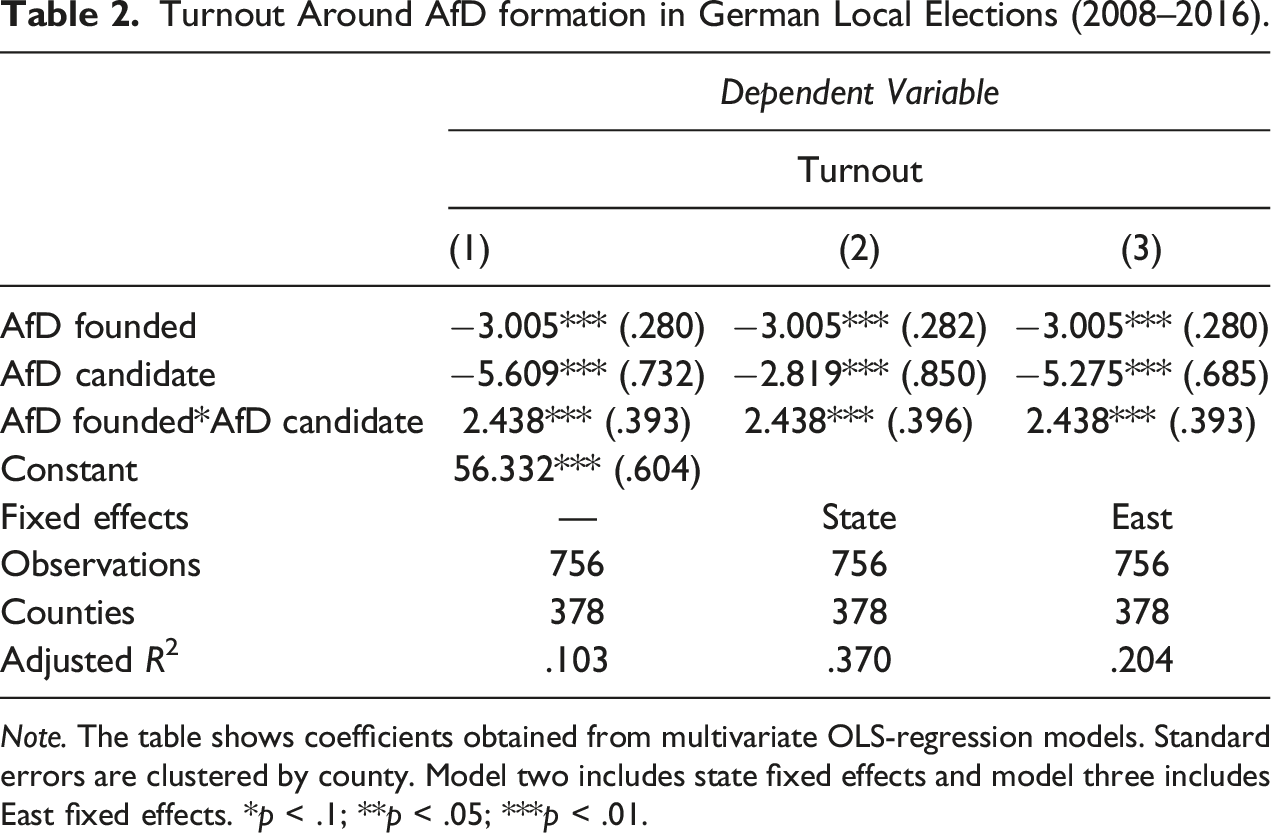
Turnout Around AfD formation in German Local Elections (2008–2016).
Note. The table shows coefficients obtained from multivariate OLS-regression models. Standard errors are clustered by county. Model two includes state fixed effects and model three includes East fixed effects. *p < .1; **p < .05; ***p < .01.
Finally, the interaction term reveals the difference-in-differences, or difference in turnout change between treatment and control group. When comparing changes in turnout from county elections where the AfD has fielded candidates to the untreated counterparts, the former experience an increase of roughly 2.4 percentage points. Albeit the operationalization of polarization, estimation strategy, and electoral context meaningfully differs from the first analysis, the effect magnitude is surprisingly similar. Local party system polarization, induced by AfD presence at county elections, indeed increases voter participation by 2.4 percentage points. The results hold when including state or East fixed effects. Appendix Section A.9 further explores the effect for the former Eastern and Western counties, showing that the direction of the effect remains similar in both subsamples, but the total effect is largely driven by counties in Western Germany, which constitute 80% of the total sample. This differential effect could be caused by a lack of observations in the East, but also by higher preexisting polarization due to the success of the radical left party.
Validity Checks and Limitations
The difference-in-differences estimation relies on a range of assumptions to ensure causal inference. Among the most relevant is the assumption of parallel trends. It posits that the treated and untreated counties are on similar trajectories with regard to the outcome prior to being treated. Figure 3 shows that trends in turnout are virtually identical for counties in which the AfD fielded or did not field candidates in county elections. Both plots show local turnout starting in 1990. The left pane assumes a linear trend—and both slopes are virtually the same. The right pane allows for local weighting and offers a more nuanced picture of turnout trends. Up until the early 2000s, turnout declined steeply, before the curve simultaneously flattens for both treated and untreated counties. Parallel trends in turnout for German local elections. Note. The plots show trends in turnout for the German counties in the sample starting in 1990. The left plot shows linear trends, whereas the right plot shows trends based on local non-parametric weighting. Red lines indicate trends for untreated counties and green lines show trends for treated counties. The vertical black line indicates the formation of the AfD in 2013.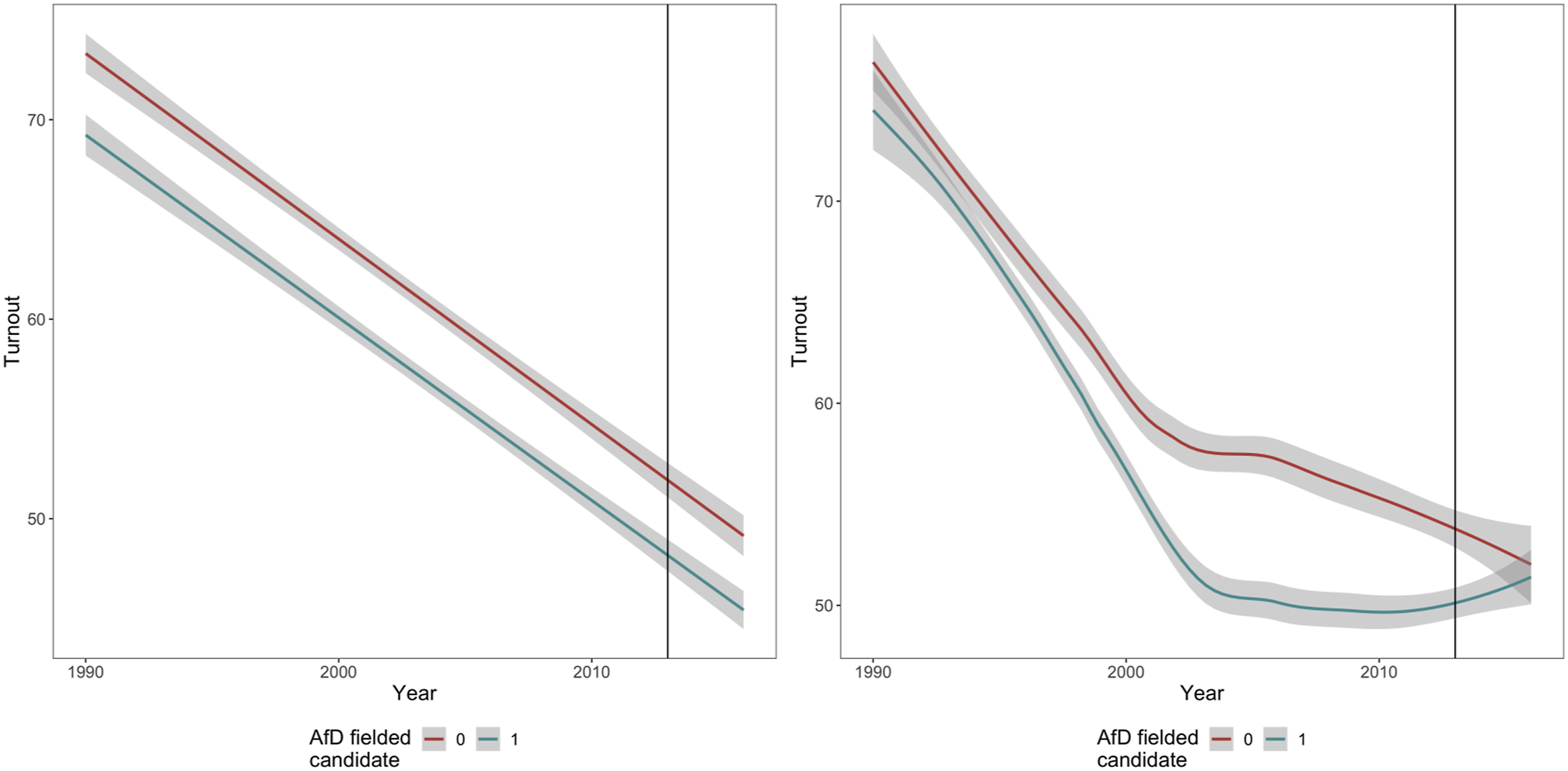
In addition, I conduct a series of validity checks in the appendix. First, I test if the occurrence of AfD candidacy can be explained by trends in the outcome. This is to rule out the suspicion that the AfD field candidates in counties where turnout significantly rose or declined even prior to its formation, perhaps for strategic reasons. Table A.13 shows that treated counties have been on similar trajectories with regard to participation and that changes in turnout do not predict AfD candidacies. In a second validity check, I test if treated and untreated counties differ on other important dimensions. Figure A.1 shows that other covariate trends do not predict the treatment status. That is, the AfD is not more likely to field candidates in counties that experience population decline, economic decline (measured as county-level GDP per capita change) or unemployment change. Accordingly, Table A.14 shows the balance across said covariates for the treated and untreated counties. In total, the validity tests are in line with the assumptions presupposed by the difference-in-differences design. Counties with the AfD on the ballot are on no different trajectory with regard to turnout prior to treatment and do not differ on a range of relevant social and economic developments.
The local level analysis still comes with important limitations, most of which are discussed in more detail in the appendix as well. First, the fielding of radical right candidates acts as a simple proxy for affective polarization. In Appendix Section A.7, I show that counties with AfD candidates indeed became more polarized, but I cannot rule out the effect of other factors related to AfD entry. This could be increased media reporting or stronger mobilization efforts by establishment parties wherever the AfD fielded candidates. Thus, my treatment should be considered as a proxy measure for party system polarization and causal estimates have to be interpreted accordingly. Next, the question arises if dynamics on the local level are generalizable to national politics. As highlighted earlier and in Appendix Section A.8, German local and national politics share many formal and informal features. Both are structured along similar ideological lines of conflict and possess the same political actors. Moreover, voter anonymity is highly regarded even in local elections, making informal pressures or kinship networks less potent. Empirically, the appendix section also shows that electoral behavior on the local level explains national election results. While turnout is more attenuated on the local level, patterns between local and federal elections are extremely similar with regard to extreme party voting. Extreme party vote shares in local elections are highly predictive of extreme party vote shares during national elections, indicating that the nature of political competition is comparable in both arenas.
However, based on the second analysis alone, one cannot assume similar mobilization effects around new party entry for the entire cross-country sample. As discussed in the theory section, party system polarization is complex and multi-faceted. Polarization across Europe is not only driven by the emergence of new extreme parties, but also shaped by party repositioning and voter fluctuations. A final limitation is that none of the results presented so far can differentiate between affective and spatial polarization. The next section therefore explores both mechanisms on the individual level.
Analysis 3: Disentangling Affective and Spatial Polarization
So far, the results seem to corroborate the narrative of “benevolent” polarization which fosters more engagement. But election results alone reveal little about the underlying mechanism and motivation to turn out. Why do more people go to the ballot in a polarized party system? I discussed two plausible mechanisms that could link polarization to turnout. Party system polarization is associated with a more pronounced differentiation of electoral alternatives. If parties offer a wide range of policy positions, voters are better able to distinguish their profiles and also have a higher chance of finding a party that represents their own preferences reasonably well. For a rational voter, this development is likely to increase the utility of participation.
However, polarization is also associated with shifting feelings towards political actors. When parties take on fundamentally different positions on salient issues and party elites fight with their competitors, constituents tend to create an increasing emotional bond with the party they identify with (Lelkes, 2021; Rogowski & Sutherland, 2016). Conversely, parties on the other end of the political spectrum can become the target of disgust and anger (Mason, 2018). This increase in affective polarization has proven to be an equally relevant determinant of political activism. In the end, voters might not be interested in an accurate representation of their policy preferences, but merely in seeing their political opponents loose.
In the final section of this article I therefore analyze survey data for the same 22 European parliamentary systems included in analysis one. 6 The survey data has been harmonized and curated by the comparative study of electoral systems (CSES, 2020) and covers elections from 1996 to 2020. 7 For each country and election, a representative sample of the voting age population is surveyed. The analysis relies on responses of 46′505 to 48′681 individuals, depending on the inclusion of covariates and missingness of the independent variables.
Measuring Spatial and Affective Polarization in Survey Data
According to the spatial polarization proposition, electoral choice is the main driver of mobilization. Thus, individual-level measures of spatial polarization have to include some sort of positional information based on voter perceptions. A commonly used method of operationalization is the Dalton index of polarization, which can be adapted to capture the perceived ideological dispersion of a party system. In this case, it is calculated based on respondents subjective classification of party positions along the left-right dimension. Instead of weighting positions by party vote shares, one simply weights positions by the share of respondents indicating to vote for each party. However, some authors debate if polarization, especially when measured on the individual level, should acknowledge party size (see Wagner, 2021). A more straight forward, alternative measure of party position dispersion is to simply calculate the unweighted standard deviation of perceived party positions. I label this the measure of spatial deviation. Both the spatial deviation and the Dalton index variable capture voter perceptions about the dispersion of party preferences across the ideological spectrum.
While the measurement of ideological dispersion is relatively uncontroversial, a variety of recent studies and working papers make diverging claims over the operationalization of affective polarization in a multiparty environment (Gidron et al., 2019; Reiljan, 2019; Wagner, 2021). Boxell et al. (2022), for example, adopt a simple measure and merely calculate the range between highest and lowest feeling towards a party. While being easy to implement based on the so called feeling thermometer scores, this measure has two major drawbacks. First, it is very sensitive to the inclusion of outliers, such as radical fringe parties. In a multiparty context, the inclusion or omission of such parties can severely alter the results, which could undermine measurement validity. That aside, it also does not allow to differentiate positive from negative emotions. High scores can be the product of strong affection towards one party, strong distaste towards a competing party, or both.
To circumvent these problems, I come up with two measures that also rely on the likability ratings (or feeling thermometer scores) provided by CSES (2020). Positive affect is defined as the difference between the highest feeling score towards one party and the average feeling score towards all remaining parties. Thus, constituents that express extremely strong admiration for one party relative the others score high on this metric. Negative affect is constructed in the same way, but this time focuses on the range between the poorest rated party and the average feeling towards all remainders. Discerning among positive and negative affect also allows me to assess whether attraction or aversion towards a specific party drives mobilization. In order to facilitate meaningful comparisons across the four different measures of polarization, I decided to standardize them on a scale from 0 to 10.
Dependent Variables and Further Controls
Two measures of turnout are used as dependent variables. First I show the effect of polarization on self-reported participation (Personal Vote). Such self reports in surveys typically suffer from social desirability bias, leading to underreporting of abstention. Albeit being a dichotomous outcome, I rescale the variable so that abstention is coded 0 and self-reported participation is coded 100. This is done to make estimates comparable to models which include the second measure of participation, which is the official turnout at the election (National Vote) measured on a continuous scale.
Due to the structure of this cross-sectional data, country and election year fixed effects are added to all analyses. Those account for unobserved heterogeneity across units and over time, but I also control for a range of individual-level characteristics that are associated with political preferences and participation. First, I control for each individual’s spatial congruence, which measures the distance between a respondent’s self-placement on the left-right scale and the position she assigned to the closest party. In addition, all models include sociodemographic characteristics such as gender, age, level of education, and income bracket. Table A.4 in the appendix contains descriptive information for all variables of analysis three.
Discussion of Individual-Level Results
Figure 4 displays coefficients for each measure of polarization derived from the multivariate regression models. The first four models inside the left pane of the figure use self-reported turnout as a dependent variable. All of them are positive and precisely estimated, ranging from 1.5 percentage point to 2.8 percentage point changes in probability of participation per unit increase in polarization.
8
These models confirm that all four types of polarization are associated with higher degrees of self-reported turnout. We also observe that both measures of affective polarization obtain larger estimates than the measures of spatial polarization. Regressing turnout on polarization in cross sectional survey data. Note. The plot shows the estimated effect of four different measures of polarization on two outcome variables: personal vote, as well as election turnout. Personal vote is a binary indicator of self-reported turnout, whereas election turnout measures the turnout at the respective election. Both DVs are scaled from 0 to 100. All four measures of polarization are standardized on a scale from 0 to 10. Results are derived from models that control for spatial congruence, age, gender, level of education, and income bracket of the respondent. All specifications include country and year fixed effects. The plot shows standard errors clustered by country at the 95% C.I.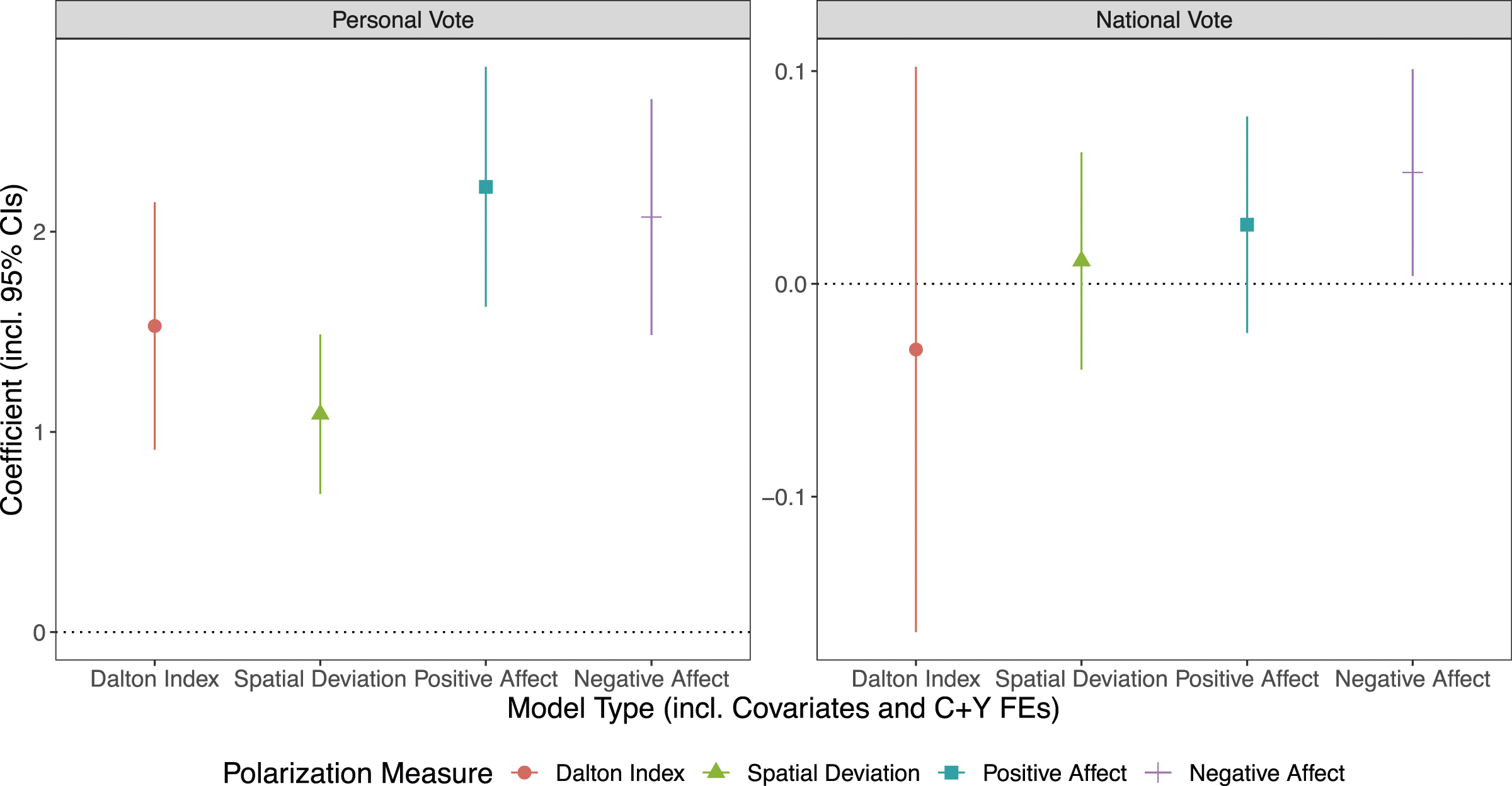
The right side of the plot illustrates the influence of polarization on the official election turnout, measured on a continuous scale from 0 to 100. The measures of spatial polarization do not produce significant estimates at all. Now, voter perceptions of electoral choice are not associated with an increase in actual turnout. The same is true for positive affect, for which I also find a null estimate. Negative affect, depicted in violet, remains a substantially significant determinant of participation.
What more can we learn from the survey data about negative affect? In Appendix Section A.12, I explore individual-level characteristics that correlate with negative affect. Primarily, I find that political extremism is associated with higher degrees of outparty animosity. This is mainly driven by constituents that locate themselves on the extreme right. Additionally, voters with high political knowledge report significantly higher degrees of animosity, while those with low political knowledge show less animus. This aligns with prior evidence on the US (Rogowski & Sutherland, 2016) and suggests that those who are particularly interested and invested in politics develop stronger emotional attachments.
Also, the results could be influenced by endogenous confounders like the closeness of an election. In Appendix Section A.13, I thus show that my results hold when controlling for this election-specific covariate that could have an influence on both voter attitudes and turnout.
Overall, the results in Figure 4 reveal a disparity between constituent self-reports and their actual behavior on election day. Within the sample of 22 countries, turnout at national elections has only increased when voters held intense negative feeling towards particular parties. The notion of a rational voter who is strategically choosing from an extended menu of political flavors does not seem to be supported by individual-level data. If animosity becomes the fuel of engagement, as suggested by the estimate for negative affect, polarization might not be an easy solution to restore democratic engagement.
Conclusion
All results presented in this paper point to the fact that party system polarization is increasing voter mobilization in established multiparty democracies. When parties become polarized and pivot away from the ideological center, more voters partake in elections. This pattern persists for the cross-country sample of 22 national elections or when focusing on German local elections. Thus, increasing levels of party system polarization observed in various established democracies across Europe (see Boxell et al., 2022; Wagner, 2021) could be considered an effective remedy against prevalent trends of declining participation. However, this does not mean that polarization is ultimately beneficial for democracy. A close examination of survey data for 22 European democracies reveals that negative affect, the intensity of animosity expressed towards the least liked opposition party, is the most reliable predictor of turnout.
Testing the electoral implications of growing polarization in a multiparty context is relevant since most studies focus on the US under majoritarian rule. As I have highlighted before, correctly tracing polarization under PR rules can be more challenging. General levels of polarization are higher (Downs, 1957; Sartori, 1976) and variation within one country can originate from a multitude of factors (see Dalton, 2008).
What do these findings imply for democratic politics more generally? Regarding turnout, the conclusions are sobering. Participation in elections has only recently recovered from decades of persistent decline (see Figure 2). But my analysis suggests that this rally could have been fueled by rising animosity and negative affect. Looking back at recent years, events like the refugee crisis or the Covid pandemic have beyond doubt increased social divisions. If party elites successfully mobilize based on resentment, more party system polarization and turnout arise. This trend alone can be seen as a challenge to democracy which impedes cooperation and consensus-seeking. I therefore doubt that negative affect can lead to persistent recoveries of electoral turnout. Animus across political camps should further undermine the ability to find majorities in order to enact policies. In PR systems that rely on cooperation and coalition-building, growing negative affect should be especially detrimental to the functioning of democratic processes and a cause of gridlock. It is questionable to assume that negative affect will endure to elevate electoral involvement if voters become disillusioned by a divided and dysfunctional political system. When resentment towards the democratic system grows, constituents’ animus can also spill over into crime. Even in the realm of established European democracies, violent crime such as the murder of Labour MP Jo Cox in 2016 or the German CDU politician Walter Lübcke in 2019 appear to become more frequent. While these are extreme examples, less severe forms of violence, harassment, and intimidation against representatives gained traction wherever resentment is high. In addition, increasing negative affect as determinant of voter mobilization could put moderate elites into an electoral dilemma. For long, they have seen a public disengagement from politics as one of the most severe threats for democratic governance and legitimacy. But growing polarization should motivate former non-voters with extreme ideology to engage in politics based on negative affect towards the establishment (see Ezrow et al., 2014). While this would ensure that unheard voices have a say in politics, it might also reinforce devision and further exacerbate polarization.
Looking beyond societal implications, this article also engages with recent contributions to the comparative literature on polarization. For instance, it highlights that scholars have mostly focused on the electoral implications of polarization through the lens of spatial proximity voting. Polarization leads to easier distinguishable party profiles (Lupu, 2015) and more choice on the political menu (Crepaz, 1990; Moral, 2017), but these factors do not have to be the sole cause of mobilization. We need to acknowledge that a polarized party system also leads to more entrenched political identities, tendencies of sorting into insular partisan groups, and heightened levels of emotional involvement (Huddy, 2001; Iyengar et al., 2019). Such involvement can easily backfire once actions are driven by emotions instead of deliberation (Mason, 2018).
Going forwards, the affective component of voter mobilization has to receive more attention in comparative research. One challenge is the lack of consensus around a clear conceptualization and measurement of affective polarization in multiparty democracies (see Boxell et al., 2022; Wagner, 2021, for valuable contributions in this regard). Due to the different ways in which polarization evolves in PR systems, simple adaptations of concepts and measurements from the US context are limited. Building on existing work, I thus propose a novel strategy to differentiate positive from negative affect in a comparative analysis. Future work should put more effort into disentangling different aspects of polarization and more directly test the relationship between spatial and ideological polarization. So far, this literature is dominated by studies on the US and inconclusive in answering whether spatial polarization precedes affective polarization or vice versa (see Druckman et al., 2021; Lelkes, 2021; Webster & Abramowitz, 2017). Given the systemic differences in multiparty democracies, comparative research should contribute to this debate both with new theoretical insights and a broader empirical scope.
Supplemental Material
Supplemental Material - The Mobilizing Effect of Party System Polarization. Evidence From Europe
Supplemental Material for The Mobilizing Effect of Party System Polarization. Evidence From Europe by Fabio Ellger in Comparative Political Studies.
Footnotes
Acknowledgments
I thank Heike Klüver and Mark Kayser for supervision and guidance. In addition, I am thankful for helpful comments by Anthea Alberto, Jeyhun Alizade, Daniel Bischof, Anselm Hager, Hanno Hilbig, Jochen Müller, Sascha Riaz, Lukas Stötzer, Denise Traber, Tim Wappenhans, Daniel Ziblatt, as well as audiences at the 2019 Berlin Political Behavior and the 2020 Free University-WZB Workshops.
Declaration of Conflicting Interests
The author declared no potential conflicts of interest with respect to the research, authorship, and/or publication of this article.
Funding
The author received no financial support for the research, authorship, and/or publication of this article.

Data Availability Statement
Replication code and data are available on the Comparative Political Studies Dataverse: https://doi.org/10.7910/DVN/9Z1QK6 (see Ellger, 2023).
Supplemental Material
Supplemental material for this article is available online.
Notes
Author Biography
References
Supplementary Material
Please find the following supplemental material available below.
For Open Access articles published under a Creative Commons License, all supplemental material carries the same license as the article it is associated with.
For non-Open Access articles published, all supplemental material carries a non-exclusive license, and permission requests for re-use of supplemental material or any part of supplemental material shall be sent directly to the copyright owner as specified in the copyright notice associated with the article.
