




Abstract
Independent local lists (ILL) have become an important non-partisan actor in many local elections. However, little is known about which factors explain their electoral success. Drawing on recent contributions regarding the anti-establishment attitudes of many ILL, we argue that the rise of anti-establishment parties, especially the rise of populist radical-right parties, potentially harms the electoral success of ILL. Our main argument is that both actors attract voters that are dissatisfied with established parties. To test this hypothesis, we draw on the case of municipal elections in the German federal state of Lower Saxony. In the election of 2016, the populist radical-right party AfD competed in only a subset of all municipalities, meaning that some voters could cast their vote for the AfD in only some of the municipalities. We use a difference-in-differences approach to estimate the effect of the AfD on independent local list’s vote share and demonstrate that ILL suffered strongly from the entrance of the AfD to the electoral arena. More specifically, our findings demonstrate that the increase in the success of ILL was halted in municipalities in which the AfD competed, while it continued to increase in regions where the AfD was absent. These findings suggest that the increasing success of ILL is due to voters’ dissatisfaction with the established parties and not necessarily due to an increasing interest in local issues.
Introduction
While many established parties have recently suffered from the increasing political distrust of their (former) voters, independent local lists (ILL) are on the rise in many Western European countries (Aberg and Ahlberger, 2015; Otjes, 2020). In some cases, such as the Movimento 5 Stelle in Italy, local movements even became successful actors at the national or European level. Germany is no exception to this trend. While being historically more successful in Southern German federal states, ILL were able to gain influence at the local level in Western and Eastern Germany and are now represented in various local councils (Holtkamp et al., 2015; Reiser et al., 2008).
Given this increase in the success of ILL across Europe, the question of which factors explain their electoral success gains importance. While many studies have addressed this question from different perspectives (Boogers and Voerman, 2010; Otjes, 2018, 2020; Vampa, 2016), this paper tests the influence of a very specific factor, namely the impact of nationally successful anti-establishment parties on the electoral success of ILL. Our main argument is that ILL can serve as a functional equivalent for anti-establishment parties at the local level. This argument builds on recent contributions which provide first evidence that ILL are often prone to anti-establishment attitudes. Among others, Otjes (2018, 2020) points out that members of ILL tend to have anti-establishment attitudes. Quite similarly, Aberg and Ahlberger (2015: 818) argue that ILL have “become an expression of dissent in relation to national-level parties.” Finally, Angenendt (2015, 2018) focuses directly on the case of ILL in Germany and demonstrates that they have a strong “anti-party” profile. As he argues, ILL in Germany compete “through a successful strategy of criticizing the ‘political cartel’…and may benefit from increasing popular disaffection toward established political parties in local elections” (Angenendt, 2018: 3). Such categorizations imply that ILL do not only exist because they address certain local issue (Aars and Ringkjøb, 2005), but also because they offer a clear alternative to the established parties that are well known to voters from the national electoral arena. In fact, Otjes argues that these anti-establishment attitudes provide an explanation for the rise in ILL’s electoral success in recent years (Otjes, 2018, 2020).
In contemplation of this potential link between anti-establishment attitudes and the success of ILL, the rise of nationally successful anti-establishment parties, which are often populist radical right parties, can be seen as a threat to the policy profile of ILL with respect to ILL’s anti-party attitude. Simply put, ILL have to compete against parties which have become the prime examples of anti-establishment rhetoric at the national level. According to this rationale, our paper argues that the rise of nationally successful anti-establishment, including populist (radical right) parties, has a negative impact on the electoral success of ILL.
We test this hypothesis based on local elections in the German federal state of Lower Saxony. These elections provide a highly interesting case for an analysis of the mechanism described above. The two most recent local elections were held in 2011 and 2016. Our identification strategy takes advantage of the fact that the Alternative für Deutschland (AfD) entered the German party system in 2013, and thus competed only in the local election of 2016 for seats. Moreover, the AfD only competed in some municipalities in said local election. Therefore, we can analyze the change in the electoral success of ILL between 2011 and 2016, and between municipalities in which the AfD was present or absent in the 2016 elections by using a difference-in-differences approach. In this regard, our research design resembles other recent studies which have leveraged the entrance of the AfD into the German party system in a comparable way (e.g., Hobolt and Hoerner, 2020).
The results indicate that ILL suffered the most from the entry of the AfD in 2016. We estimate that the vote share of ILL was more than three percentage points lower when the AfD competed for votes. While a decrease in vote shares could be expected when a new party successfully competes for votes in a PR election, this decrease is by far the strongest among all other parties. We can further specify this finding: The AfD caused a stop in the vote share increase of ILL’ electoral success, meaning that in municipalities without the AfD, the vote share of ILL continued to increase. In treated municipalities, however, the vote share of ILL remained on the level of the local elections of 2011.
This paper proceeds as follows. The next section specifies our argument that ILL and populist radical-right parties compete, at least partially, for the same type of dissatisfied voters. The third section explains the case of local elections in Lower Saxony in more detail. The fourth section introduces the data and research design. After presenting our results, we discuss potential avenues for future research.
Independent local lists and anti-establishment attitudes
ILL are defined as organized groups that run in local elections but not in regional or national elections (Otjes, 2018), further they do not have any links to national parties (Boogers and Voerman, 2010). 1 Recent research suggests different mechanisms for the success of ILL in local elections. One of the main assumptions is that ILL can focus specifically on local issues and can thus be described as political actors which act independently of dynamics in national politics (Boogers and Voerman, 2010). This focus on “localism” is one of the dominant explanations why voters are attracted by ILL (e.g. Aberg and Ahlberger, 2015). In addition, Otjes (2018, 2020) suggests a supply-side based explanation for the increasing success of ILL. Specifically, it is argued that ILL perform better in municipalities in which the number of established parties competing in the local election is rather small. Finally, and most importantly for our study, it is also suggested that ILL might benefit from the increasing levels of distrust towards established parties (Otjes, 2018: 307).
That voters and members of ILL tend to have anti-establishment attitudes is not only an assumption of this paper, but also confirmed by recent research on the policy profile of these lists. For the supply side, Gross and Jankowski (2020) provide an analysis of parties at the local level in Germany. They find that local party branches and ILL cannot only be differentiated regarding their ideological position on a general left–right scale, but also regarding their degree to which parties tend to criticize politics at the national level. According to this study, ILL are more likely than many local instances of established parties to address national issues in their manifestos, because they try to “provide an alternative to political parties at the local level” and that “ILL are [ideologically] very diverse and comprise subdivisions that use populist, anti-elite rhetoric, [and] have strong anti-party sentiments” (Gross and Jankowski, 2020: 87). These findings are in line with work by Angenendt (2018), who finds that members of ILL in Germany have strong anti-party attitudes.
Similar results have been found for other countries. Focusing on the Netherlands, Boogers and Voerman (2010) used three categories to make a distinction between ILL. Besides localist parties, which focus on the quality of the local administration in the municipality, there are interest parties that aim to represent a certain group of inhabitants. There are also ILL that operate as protest parties to express dissatisfaction with the local administration (Boogers and Voerman, 2010). Not only the motivation to found an ILL often is caused by anti-establishment attitudes (Boogers and Voerman, 2010; Otjes, 2018), the behavior of such parties can be classified as protest against politics in general and against political parties at the national level in particular (Boogers and Voerman, 2010: 9).
In this regard, ILL fit well into existing conceptualizations of “anti-establishment” parties (Abedi, 2002; Barr, 2009; Schedler, 1996), which can be understood as parties which “declare war on the political class” (Schedler, 1996: 292–293). 2 Instead of criticizing a specific party for their policies, anti-establishment parties formulate a more fundamental critique of the political system, by opposing all “established” parties, as they claim that the political elite is “unable or unwilling to represent ordinary citizens” (Barr, 2009: 31). Recently, De Vries and Hobolt (2020) suggested to classify such parties as challenger parties, which offer both policy innovation as well as anti-establishment rhetoric. In addition, the main criterion for classifying a party as “challenger party” is the absence of any office-holding experience at the national level (De Vries and Hobolt, 2020: 21). Without going too much into the details of this conceptualization, it should be noted that this concept of challenger parties fits very well to the profile of ILL as they frequently also offer policy innovation in combination with anti-establishment rhetoric and have, by definition, no office-holding experience at the national level. Therefore, one might think of ILL as challenger parties based on the conceptualization offered by De Vries and Hobolt (2020).
Recent research has demonstrated that advocating anti-establishment attitudes can be a successful way of competing for votes. In other words, (some) voters seem to value parties which actively try to distance themselves from “established” politics and thus parties can gain votes by using anti-establishment rhetoric. Curini (2019: 1) describes anti-elitism as a “non-policy vote-winning strategy that could be valued positively by a broad class of voters across ideological lines.” In general, this strategy can be used by any party. Quite similarly, Barr (2009: 31) argues, “a variety of political actors use anti-establishment appeals,” but he also claims that “populists are particularly known for doing so.”
Given this relationship between anti-establishment attitudes of parties and voters, it follows that the increasing success of ILL might not just be the development of an increased interest of voters in local issues. Instead, ILL seem to attract those voters with anti-establishment attitudes, or that are dissatisfied with politics in general (Otjes, 2018). This critique of the political elite is also at the core of the frequently used definition of populism by Mudde (2004, 2007). 3 Therefore, ILL compete, at least to a certain degree, with other anti-establishment parties (which includes populist parties) for votes. ILL provide a viable electoral alternative for voters who are dissatisfied with established parties. However, when populist parties, which by definition have strong anti-establishment sentiments, enter the electoral arena, ILL must fear that some of their voters perceive these parties as a more attractive alternative. Therefore, the main theoretical argument of this paper is that ILL compete with other anti-establishment parties for votes. Particularly populist radical right parties have become best known for their strong anti-establishment attitudes due to their electoral success and strong critique of the political elite. Consequently, this paper argues that the entrance of populist parties—in our study a populist radical right party—in the electoral competition at the local level has a negative impact on the electoral success of ILL.
Testing the hypothesis: The case of the AfD in lower Saxony’s local elections
To test our hypothesis, we rely on data from local elections in the German federal state of Lower Saxony. This case is particularly suitable for analysis for several reasons. First, just like in many other states, ILL are increasingly successful in Lower Saxony’s local elections. 4 In 2016, ILL received 15.6% of the votes, the highest vote share of ILL in Lower Saxony’s history. Thus, Lower Saxony is an exemplary case where ILL are increasingly successful in elections. Second, local elections are held every 5 years in Lower Saxony, meaning that the last two local elections were held in 2011 and 2016. This is beneficial for our analysis, as Germany had no clear nationally successful anti-establishment party in 2011. 5 However, in 2016 the AfD had not only become a successful party in Germany, it had also fully transformed into a populist radical-right party with strong anti-establishment attitudes (Arzheimer, 2019; Arzheimer and Berning, 2019; Jankowski et al., 2019). Therefore, one of the main differences between the 2011 and 2016 election is the entrance of the AfD to the German party system. Finally, what makes the case of Lower Saxony especially suitable, is the fact that the AfD did not compete in all municipalities in the election of 2016. In fact, the AfD competed only in 88 of 398 municipalities, which corresponds to 28.9% of the municipalities. Thus, we can compare the performance of ILL in municipalities in which the AfD competed with those municipalities in which the AfD did not compete. This research design is explained in more detail in the following section.
Before turning to the research design, a potential weakness of the case selection should also be discussed. Our theoretical argument focuses on the impact of anti-establishment parties on ILL’s electoral success in general and not specifically on the impact of populist radical-right parties such as the AfD. Therefore, it should be noted that for the purpose of our theoretical argument, the AfD is used as an example for the entrance of a nationally successful anti-establishment party to the German party system, because having strong anti-establishment attitudes is one of the core elements of populist radical right parties (Mudde, 2004). Put differently, we would expect that any other nationally successful party with similar levels of anti-establishment attitudes as the AfD would have a comparable impact on ILL’s electoral success. In terms of the “challenger party” concept offered by De Vries and Hobolt (2020), one could say that we treat the AfD as a nationally successful challenger party that has an impact on the electoral success of ILL, which can be understood as local challenger parties.
This does not imply, however, that we argue that the ideological profile of the AfD as a radical right party is irrelevant. As studies on the AfD have shown, the AfD wins votes not despite but rather due to their strong radical right policy positions (Arzheimer and Berning, 2019). Therefore, we acknowledge that the impact of the AfD on the electoral success of ILL should be potentially moderated by the ideological overlap between the policy profile of the specific ILL and the AfD. In fact, it seems plausible to assume that the AfD will have an ever stronger impact on ILL’s success when both parties show a larger ideological overlap, i.e. when the ILL is more right-wing. Unfortunately, it is very challenging for us to test this mechanism, as there is no database or easily applicable method for measuring the ideological position of ILL in each municipality. Given the findings reported by Gross and Jankowski (2020), it becomes clear that ILL tend to have very different ideological profiles which speaks against the concern that all ILL are ideologically similar to the AfD. Therefore, we consider it very plausible that a potential negative impact of the AfD on ILL is not only due to ILL’s policy position, but indeed due to their anti-establishment attitudes.
Research design
Difference-in-differences
The case of local elections in Lower Saxony, as described above, allows for a robust analysis of how the entrance of the AfD to the German party system affects the electoral success of ILL. Specifically, the case allows us to employ a difference-in-differences (DiD) research design (Angrist and Pischke, 2008: Chapter 5). The DiD research design exploits that the AfD competed only in certain but not all municipalities in the local elections of 2016. Therefore, only some municipalities received the “treatment” of having the AfD competing for votes, while the AfD was absent from the election in all other municipalities. Of course, where the AfD competes is not a randomized treatment, and many factors possibly affect the AfD’s decision to run for office. However, the validity of the DiD is not affected by this non-random treatment assignment, as this research design compares the changes within units. This means that, in our case, we are comparing how the success of ILL changed between the elections of 2016 and 2011 in the treatment and in the control group. The treatment effect of the AfD is the difference between these changes, therefore the method is called difference-in-differences. The DiD can be estimated by running the following regression analysis:

where η is the municipality fixed-effect, ψ is the effect for the election and γ denotes the effect of the AfD competing in a municipality in the election of 2016. Thus, γ is the treatment effect which we are interested in.
The validity of the DiD approach rests on the important assumption of “parallel trends”: treatment and control group should follow similar patterns in the dependent variable during the pre-treatment period. Essentially, this assumption means that the change in the dependent variable—in our case the vote share of ILL—should not significantly differ between the treatment and control group in previous elections. If this assumption is satisfied, it is plausible that a change of these patterns in the post-treatment period is in fact due to the treatment. The parallel trends assumption is frequently tested by artificially assigning the treatment to an earlier time period in which treatment could not have had an effect. Later, we will demonstrate that this assumption is satisfied for our case.
Data
The dataset covers the election results from all municipalities in Lower Saxony since 1996. Five local elections have been held since then: 1996, 2001, 2006, 2011, and 2016. As the treatment occurred in 2016, the four other elections denote the pre-treatment period and can be used for placebo analyses, i.e. for testing the assumption of parallel trends.
In total, we analyze 369 municipalities. This is not the full set of all municipalities of Lower Saxony because we removed municipalities which have been merged with other municipalities since 1996. Merged municipalities were excluded because it is not possible to analyze the development of election results for these municipalities for the complete time period. After excluding these merged municipalities, we have a strongly balanced data set of 369 municipalities over five elections.
Addressing missing values
Finally, we have to deal with the problem of missing values in our data. Specifically, the problem is that ILL did not compete in all municipalities in all elections. Thus, for some municipalities, the vote share for ILL is missing. To demonstrate the validity of our findings, we report results with regard to three possible ways to deal with the issue: We run DiD models and keep the missing values. We can demonstrate that the entrance of the AfD did not lead to a change in the probability that an ILL ran for local council. Thus, comparing the change in the electoral success only for cases in which ILL competed should not lead to systematic bias in the treatment effect. We make the DiD estimate more “local” by subsetting our data to cases in which ILL have always competed, i.e. we only consider municipalities for which there are no missing values in the pre- or post-treatment period (since 1996). The estimate is more local in this case as it is only estimated for a specific subset of the data. Finally, we treat the missing values as zeros. This is plausible as not running for council is identical to receiving a vote share of 0%. Again, as the treatment did not affect whether an ILL ran for council, this approach should not lead to systematic bias. This approach guarantees that all cases can be used for estimation.
Results
We start with a descriptive analysis of our data. Figure 1 displays the success of ILL in all local elections in Lower Saxony since 1996. The results are always displayed for two groups: the “treated” municipalities, in which the AfD ran for council in 2016, and the “control” municipalities in which the AfD did not compete. The left panel of Figure 1 shows the distribution of vote shares for ILL for both groups. This plot suggests that the distribution became more similar between treatment and control group in more recent elections, as both distributions tend to overlap more strongly in the election of 2011 than they did in earlier elections. This pattern comes to an end with the election of 2016, in which the treatment occurred. After this point, both distributions once again diverge. Specifically, the treatment group has a higher concentration of municipalities with a lower vote share for ILL.
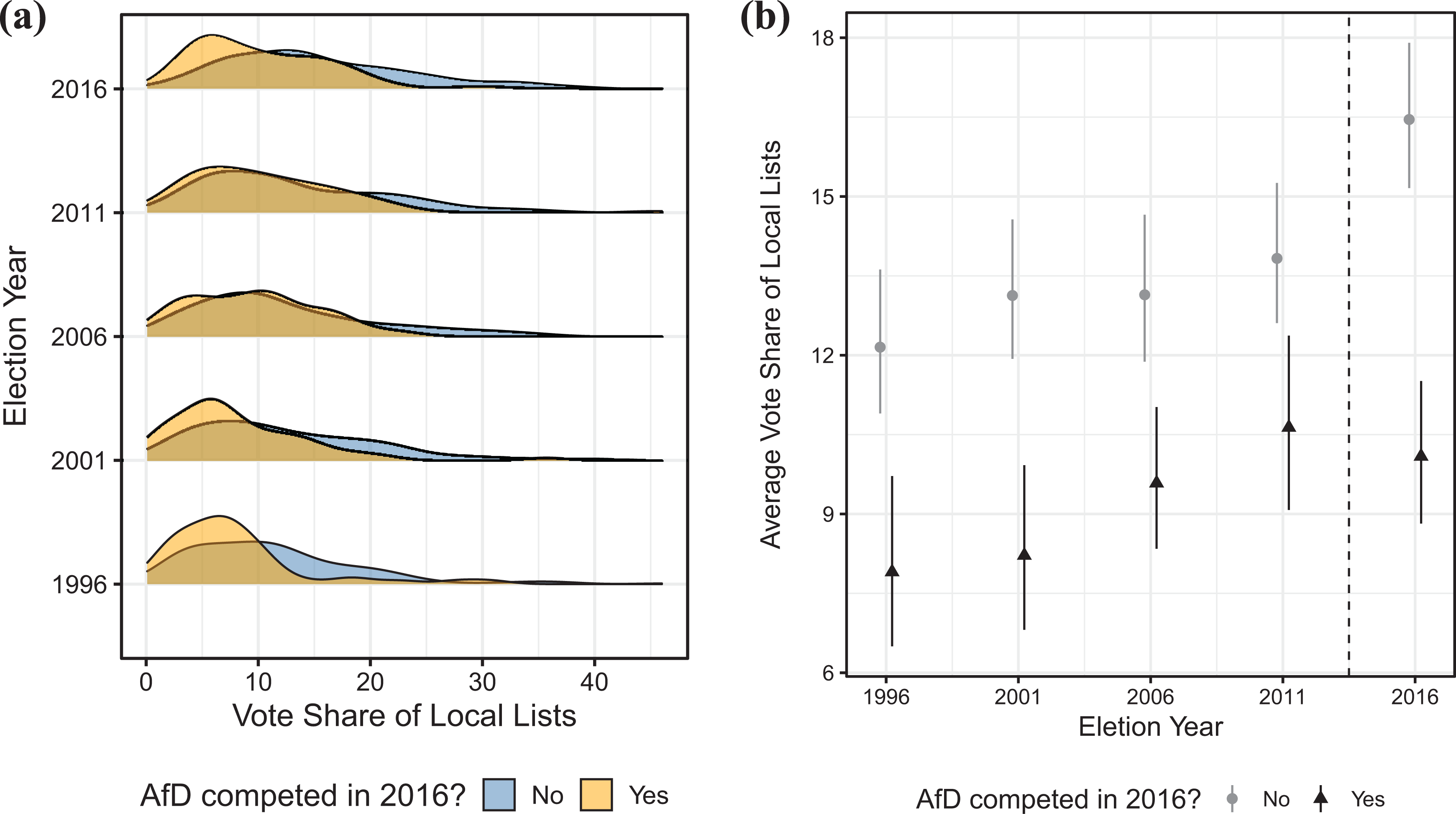
Descriptive trends in the electoral success of ILL for treatment and control group.
The right panel in Figure 1 is a more common descriptive DiD visualization, as it depicts the average vote share of ILL in the treatment and control group for all time periods. This plot makes it clear that the AfD competed in municipalities in which ILL are traditionally weaker. What we can also observe is that the pattern of independent local lists’ electoral success has drastically changed after the entrance of the AfD in the German party system. While treatment and control group have both shown an increase in the electoral success for ILL, this trend was stopped in the treatment group. The average success for ILL even slightly decreased in the treated municipalities. In stark contrast, the success of ILL substantially increased in the control group.
The effect of the AfD on independent local lists’ electoral success
In Table 1, we report the results from the difference-in-differences analysis. Three models are reported in Table 1 due to our different treatment of missing values in the dependent variable (the vote share of ILL). As can be seen, how we treat these cases has basically no effect on the direction or size of the treatment effect. For all three models, we observe a substantial negative treatment effect of the AfD on the vote share of ILL. In municipalities in which the AfD contested the election, the vote share of ILL decreased by more than three percentage points. Thus, our results strongly indicate that the presence of the AfD in local elections had a negative impact on the electoral success of ILL.
Difference-in-differences results: effect of presence of AfD on ILL.
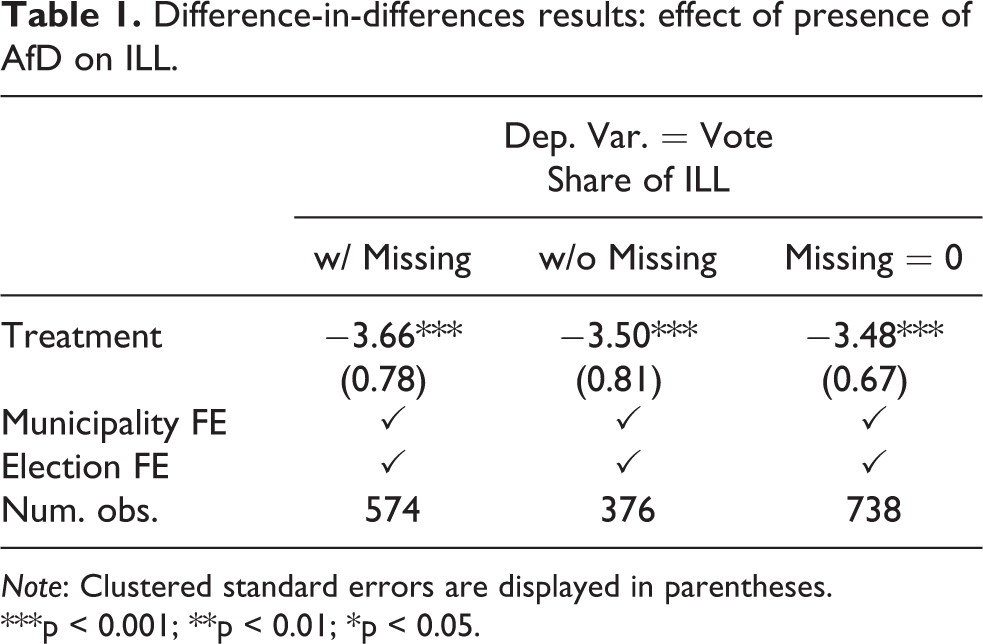
Note: Clustered standard errors are displayed in parentheses. ***p < 0.001; **p < 0.01; *p < 0.05.
Effect of the AfD on other parties’ electoral success
The previous section has demonstrated that the AfD had a substantial impact on the electoral success of ILL. However, one might argue that these effects could be observed for other parties as well. In fact, it is plausible that when a new party gains votes under PR, that the vote share of the other parties has to decrease. Therefore, in order to compare the substantial effect size of the AfD on the electoral success on ILL, we run the same analysis with regard to the electoral success of other established parties. The results are displayed in Table 2.
Difference-in-differences results: effect of presence of AfD on electoral success of other parties.
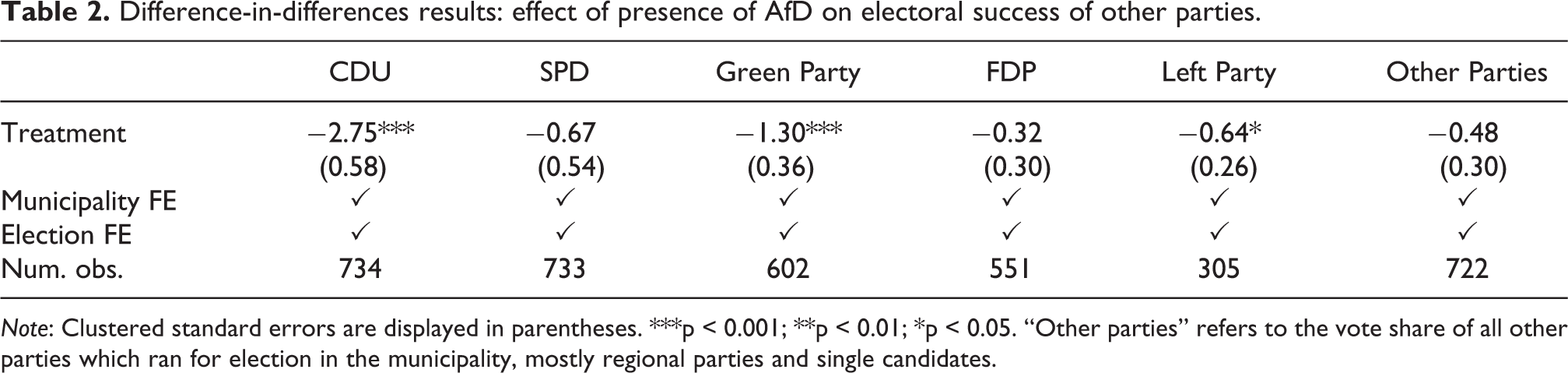
Note: Clustered standard errors are displayed in parentheses. ***p < 0.001; **p < 0.01; *p < 0.05. “Other parties” refers to the vote share of all other parties which ran for election in the municipality, mostly regional parties and single candidates.
The results indicate that the presence of the AfD did not only affect the electoral success of ILL. Particularly the conservative CDU witnessed a decrease in its electoral success by approximately 2.5 percentage points. While this is also a strong decrease, the effect is still substantially smaller than the large negative effect size that we observed for ILL. Therefore, these results indicate that the entrance of the AfD had the strongest negative effect on the electoral success of ILL. These results are even more interesting, given that the CDU is on average far more successful in local elections than ILL. For example, in the election of 2011, the CDU received an average vote share of 40.7% in all municipalities in which it competed. Given this level of electoral success, a decrease by 2.5 points in the vote share is rather small. In contrast, ILL received an average vote share of 13.1% in the election of 2011. Based on this lower vote share, the negative effect of more than 3 percentage point is particularly notable and demonstrates that ILL do indeed suffer the strongest from the entry of the AfD to the German party system.
Validity and robustness checks
Alternative mechanism: Change in the pool of parties?
The results of the analysis demonstrate that ILL indeed suffer severely from the entrance of the AfD in local elections. Therefore, the findings are in line with our theoretical expectation that these two actors compete for votes from the same type of voters. However, as our analysis is based on aggregate data, other mechanisms explaining these results are possible. Importantly, one could argue that the entrance of the AfD affected whether other parties decided to run for seats in the local council. Assume, for example, that some ILL did no longer participate in the election because these lists transformed into the AfD in the respective municipality. If this is the case, then our results are a simple artifact of such a “relabeling” of some ILL. We are not aware that something like this has happened in Lower Saxony, but it is a potential mechanism which should be analyzed. Likewise, one could argue that the entrance of the AfD affected the behavior of other parties. Most importantly, the smaller established German parties—the Green Party, the FDP, and the Left Party—also did not compete in all municipalities. If the entrance of the AfD affected the decision of these parties to run for office, then our results could be affected by this. For example, if the Left Party decides to run in municipalities in which the AfD also runs for office, then the decrease of votes for ILL could also be the effect of the Left Party competing in the election. This argument is even more warranted as existing literature has argued that the number of competing parties can be a powerful explanation for the electoral success of ILL (Otjes, 2018, 2020).
For testing whether such alternative mechanisms can explain our results, we run additional DiD models. With these models, we analyze whether the municipalities in which the AfD competed in 2016 show certain patterns of party competition. Specifically, we test whether the entrance of the AfD had an effect on (1) whether no ILL ran for election, (2) the number of ILL competing in the election, (3) the presence of the Green Party in the municipality, (4) the presence of the Left Party in the municipality, (5) the presence of the FDP in the municipality, and (6) the total number of parties (which in some cases includes independent candidates) that run for election in a municipality. The results are depicted in Table 3. As can be seen, not a single effect is significant or substantially large. This means that the entrance of the AfD apparently did not affect the decision of other parties to run for office in these municipalities. In other words, a change in the choice set in treated municipalities in 2016 is unlikely to explain our findings.
Testing alternative explanations: the effect of the AfD on the decision of other parties to compete in a municipality.
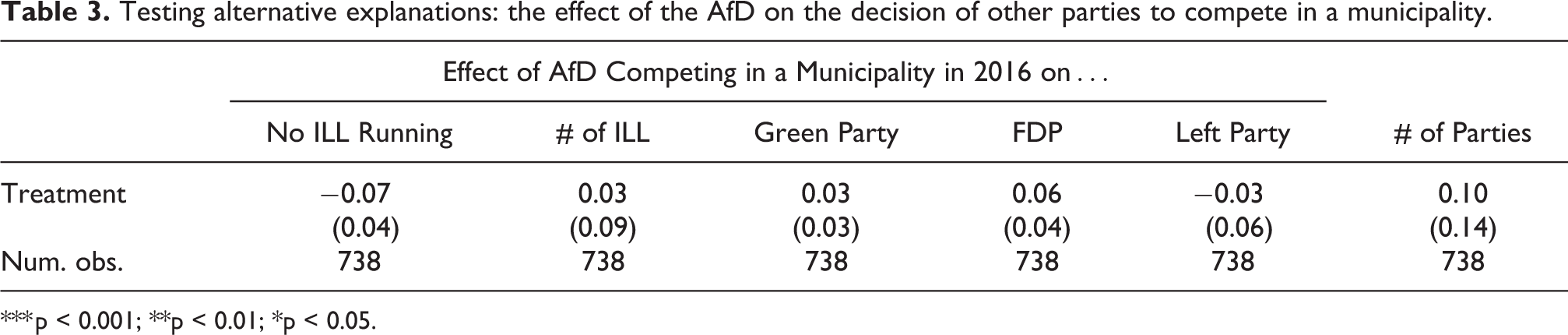
*** p < 0.001; **p < 0.01; *p < 0.05.
Parallel trends? Placebo analysis in time
To test for parallel trends between treated and untreated municipalities in the pre-treatment period, we conduct a placebo analysis in which we artificially assign the treatment to earlier elections. This means that we test whether a treatment effect can also be observed when we assume the treatment would have occurred, e.g. in 2011 instead of 2016. The results of this placebo analysis, displayed in Figure 2, largely confirm the parallel trends assumption. For the elections in 2001 and 2011, the placebo analysis shows treatment effects which are virtually zero and statistically insignificant. The exception is the election of 2006, in which two of the three model specifications show a positive treatment effect. This artificial treatment effect is substantially smaller compared to the true effect from 2016. Therefore, we do not see this as hard evidence that the parallel trends assumption is strongly violated.
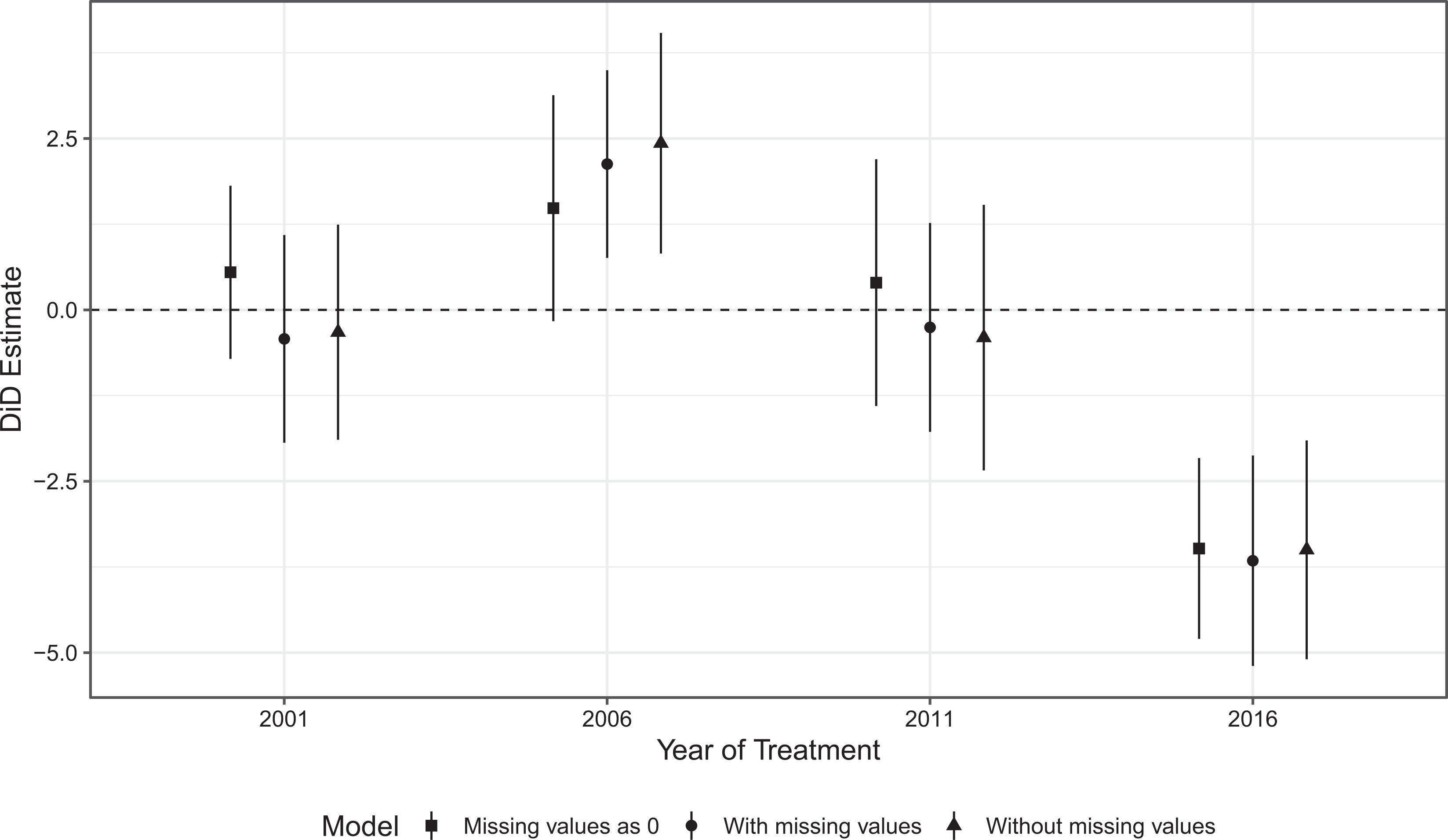
Testing the parallel trends assumption: effect of treatment in different time-periods.
Conclusion
Independent local lists have become an important challenger of established parties in local elections. While almost all established parties from the national level are also active at the local level, ILL explicitly avoid running under a certain party label. Frequently, ILL argue that they do not stick to certain party labels as they do not want to follow a certain meta-ideology and because they want to focus on local issues. While this might be true for the political supply side, i.e. the ILL, this argument does not necessarily apply to the demand side, i.e. the voters. By providing an alternative to the established parties, ILL might not only benefit from their emphasis on local issues, but also from the anti-establishment preferences of voters. Following this line of reasoning, we have argued that the rise of highly successful anti-establishment parties at the national level might pose a threat to the electoral success of ILL.
Using a difference-in-differences design and data from the case of Lower Saxony in Germany, we have demonstrated that ILL do indeed perform worse in municipalities in which an anti-establishment party—the populist radical right party AfD—also competes for votes. The effect is not only significant, but also substantially relevant. The vote share of ILL is, on average, more than three percentage points lower compared to municipalities in which there is no nationally successful anti-establishment contender. As we demonstrate, this is the strongest decrease in the vote share of all parties in absolute terms, but even more so when the effect size is compared to the level of support in previous elections. What is important to mention, however, is that our data also indicates that ILL do not perform much worse compared to previous elections when an anti-establishment party competes for votes. Instead, we have demonstrated that these ILL simply do not follow the path of ILL in “non-treated” municipalities, meaning that they do not gain votes while the others continue to do so.
There are several implications of our findings, many of which have direct consequences for the study of ILL and local elections in future research. First, our findings are consistent with the assumption that the supply-side matters for explaining independent local lists’ electoral success. Depending on whether another anti-establishment party competes for votes, the electoral success of ILL decreases. This should be considered in future research which tries to explain the rising success of ILL in Western Europe more generally. Second, our findings also have implications for the political demand-side, i.e. the voters. While it seems tempting to explain the success of ILL solely based on their focus on local issues, our study echos calls which highlight that anti-establishment attitudes are crucial in understanding voters’ preferences for ILL. Third, our findings might have implications for the future behavior of ILL and party competition at the local level in general. For example, one might argue that ILL will respond to the presence of an anti-establishment contender by putting more emphasis on their “localism” or by developing a clear ideological position in order to distinguish themselves more strongly from other anti-establishment parties.
Some limitations of our study should be discussed as well. First, our paper provides an indirect proof of the assumed theoretical mechanism. As already stated earlier, our analysis compared aggregate election results, and thus the problem of ecological fallacy might apply. We cannot show that voters moved directly from ILL to the AfD. Given the absence of panel data at the voter level for local elections, such an analysis seems impossible. Therefore, it could also be the case that, for example, former voters of ILL in treated municipalities started supporting more left-wing parties, and that former voters of left-wing parties started to support the anti-establishment party. We do not believe that this is the case for theoretical reasons. In other words, we consider it most plausible from a theoretical perspective that ILL suffer directly from the competition with anti-establishment parties. However, in order to provide even more robust evidence on the tested theoretical mechanism, future studies should focus on using voter surveys, which are unfortunately rarely conducted in local elections.
Second, it seems important to shed light on the question of how the ideological position of ILL matter for our results. It is plausible to assume that the electoral success of ILL is harmed even more by an anti-establishment contender if both actors show a high degree of ideological overlap. Addressing such research questions based on election results might be challenging due to the lack of systematic information about the ideological positions of ILL (Gross and Jankowski, 2020), but it is theoretically important to analyze how much our findings depend on the fact that the AfD has a clear right-wing policy profile.
Finally, while we have argued that Lower Saxony is a particularly suitable case for analysis, the generalizability of our findings crucially depends on the replication in different contexts. Therefore, it would be highly interesting to analyze the described mechanism in more federal states of Germany, as for example ILL are historically more rooted in the local party systems of Southern Germany, which in turn might affect their levels of anti-establishment attitudes. More importantly, however, the described mechanism does not only apply to the case of Germany. Both anti-establishment parties and ILL are also increasingly successful in other West European countries. Examples such as the direct emergence of the Lijst Pim Fortuyn out of the independent local “Livable Netherlands” movement (van Holsteyn and Irwin, 2003) demonstrate that the connection between ILL and nationally successful anti-establishment parties does not seem to be an artifact of our case selection. Replications of our study would also be particularly helpful for understanding which factors moderate the impact of anti-establishment parties on independent local lists’ electoral success. For example, one might expect that ILL benefit from their anti-establishment attitudes the most when the local elections are particularly “second-order.” When voters follow the patterns suggested by the second-order election approach (Marien et al., 2015; Reif and Schmitt, 1980), we might observe that ILL will suffer more strongly when the local election is held in close proximity to a national election. Again, such variation in the effects can only be assessed by a broader comparative analysis.
Supplemental material
Supplemental Material, sj-docx-1-ppq-10.1177_1354068820965430 - The impact of anti-establishment parties on the electoral success of independent local lists: Evidence from Germany
Supplemental Material, sj-docx-1-ppq-10.1177_1354068820965430 for The impact of anti-establishment parties on the electoral success of independent local lists: Evidence from Germany by Michael Jankowski, Christina-Marie Juen and Markus Tepe in Party Politics
Footnotes
Acknowledgements
We would like to thank two anonymous reviewers, Martin Gross, Jakob Schwörer and the participants of the fifth Norddeutsche Kolloquium für Sozialwissenschaften for very helpful comments and suggestions on previous versions of this article. The usual disclaimer applies.
Declaration of conflicting interests
The author(s) declared no potential conflicts of interest with respect to the research, authorship, and/or publication of this article.
Funding
The authors disclosed receipt of the following financial support for the research, authorship, and/or publication of this article: This research was founded by the Ministry of Science and Culture of Lower Saxony, Germany (Grant Number: 76ZN1498 (VWVN 1357)). Any opinions, findings, and conclusion or recommendations expressed in this article are those of the authors and do not necessarily reflect the view of the Ministry of Science and Culture of Lower Saxony, Germany.

Supplemental material
Supplemental material for this article is available online.
Notes
References
Supplementary Material
Please find the following supplemental material available below.
For Open Access articles published under a Creative Commons License, all supplemental material carries the same license as the article it is associated with.
For non-Open Access articles published, all supplemental material carries a non-exclusive license, and permission requests for re-use of supplemental material or any part of supplemental material shall be sent directly to the copyright owner as specified in the copyright notice associated with the article.
