




Abstract
What little research exists on why party members quit has tended to find that exit is driven primarily by political and ideological concerns. This research note builds on this, framing this finding theoretically and arguing that such theory should allow for the role of negative triggers – events that cause people to quit. We focus on the example of changes of leadership. Using data from four Party Members Project surveys, we find that British party members seem to leave parties mainly for political and ideological reasons, and because of disillusionment or disagreement with their leaders. This disillusionment, in turn, is often based on perceived ideological differences. We illustrate this with tweets by Labour members cancelling (or considering cancelling) their membership in the immediate wake of the election of Keir Starmer as party leader in April 2020.
Introduction
Research on party membership has focused almost exclusively on why people join political parties rather than on why they leave them (Van Haute, 2015). This research note aims to further our understanding of the latter, drawing on existing research and theory. It extends these contributions by pointing to the potential importance of triggers, highlighting one key example: changes of leadership. Using data from the UK gathered by Bale et al. (2019) for the Party Members Project (PMP), we argue that changes of leader can reorient members’ motivations. Party leaders’ perceived positions act as a heuristic that members use to gauge how ideologically well-aligned they themselves are with their party, and so inform their decision as to whether to remain loyal, stay and voice their discontent, or go.
We apply data from three PMP surveys to shed light on why party members quit. Consistent with existing, smaller-scale studies, we show that exit is motivated primarily by ideological disagreement (Bale et al., 2019, chapter 8 explores this further). But we also find that perceptions of party leaders play an important role. Recent examples of tweets posted on the day of Keir Starmer’s election to the leadership of the Labour Party by members claiming they were quitting – or questioning their continued membership – illustrate the link between these two factors. Starmer’s election acts as a trigger which shifts or nullifies these members’ motivations, ultimately leading to their exit.
Why do people leave political parties? Evidence and theory
Previous studies on the decline in party membership mostly talk in terms of broad structural changes, rather than individual-level decisions (Ponce and Scarrow, 2014; Van Biezen et al., 2012). Yet as Van Haute and Gauja (2015: 4) put it, ‘looking at party membership decline alone does not say anything about who is staying and who is leaving’. Wagner (2016) provides one exception, finding that the more strongly Austrian party members feel about ideology, the less likely they are to leave their parties, unless they perceive a mismatch between themselves and their party. This finding is echoed among Swedish party members, with those who are more misaligned with their parties ideologically being more likely to consider switching parties (Kölln and Polk, 2016). Ideological disagreement has also been shown to matter to Danish party members entertaining the idea of quitting (Kosiara-Pedersen, 2016). In the UK, Whiteley and Seyd (2002) found that the ‘General Incentives Model’ of party membership (see Seyd and Whiteley, 1992; Whiteley et al., 2006, 1994) was broadly able to explain the exit of Labour members. The effect of socio-economic factors was minimal, while disappointment with the party’s performance in office, and level of involvement in party activities also emerged as important predictors of quitting. Once again, ideology was a driving force: left-leaning members were more likely than their right-leaning counterparts to leave the party under Tony Blair’s ‘New Labour’ leadership. Lots of Labour members had quit after 1997 and after 2001, possibly in response to the Iraq War. This was not solely a cost of governing – the Conservative Party also lost many members in 2006, possibly reflecting a large-scale rejection of David Cameron’s ‘liberal Conservative’ modernisation project (Whiteley, 2009).
These findings tally with a broader economic theory of ‘exit’ (Hirschmann, 1970). Hirschmann argues that any organisation providing any service to members can see the quality of that service degrade over time. It will learn about this deterioration in one of two ways: ‘exit’ – members leave – or ‘voice’ – members express their dissatisfaction. In the specific case of political parties, changes in the ‘quality’ of the ‘service’ provided can largely be thought of in terms of representation of political positions. As such, it is felt differently by different members (p. 62). Some members will be more aligned than others with the party’s political position at any given point and therefore more satisfied with it. Parties can lose these members when they veer too far out of alignment with their political preferences. Hirschmann claims that the rational response to this is for the party or organisation to ‘minimize discontent’ (p. 63). As such, to keep members loyal, parties should take political positions that are most representative of most of their members.
Indeed, recent work points to the importance of such ‘motivations’ (Power and Dommett, 2020: 4). Motivations matter to members as the ‘social, psychological, material and political incentives’ which constitute the ‘influences that lead an individual to be more disposed towards a party’. Hirschmann’s account, above, describes a wearing-away of such motivations. But parties can also fail in terms of process: the presence and operation of the mechanisms and infrastructure that allow people to join parties. Finally, triggers are events that activate ‘motivations’ and lead to membership. Power and Dommett (2020: 13) suggest that ‘just as the presence of a motivation, process and trigger explain why people join a party, so too the absence of these factors can explain why members leave’. Yet members may also conceivably be affected by adverse or negative triggers that take away their motivation, rather than activating it, pushing them towards exit or voicing their discontent. One such trigger, and our focus here, is a change of party leadership.
Consider the recent election of Keir Starmer as leader of the Labour Party. Starmer won 56.2% of the vote. However, many Labour members joined because of the election of Jeremy Corbyn in 2015 (Whiteley et al., 2018). Many of these members are likely to see Keir Starmer’s politics as out of step with their own. In turn, the strength of this discontent is likely to push many of these people to leave or at least consider doing so. Keir Starmer’s election is, for them at least, a negative trigger which alters and in some cases takes away their motivations for membership, even if for some non-members (or perhaps lapsed members) it may represent a positive trigger, prompting them to (re)join.
Quitting in the recent UK context
Data
To explore these possibilities, we use data from four PMP surveys. The first two of these are a 2015 survey of 5,755 members of the Conservatives, Labour, Liberal Democrats, Greens, UKIP and the SNP, and a 2016 survey of 876 new Labour members. Respondents in these surveys were asked if they had previously left and rejoined their respective parties, and if so, why. In total, 17% of the 2015 respondents had at some stage left their party. Their write-in reasons for having previously left were manually coded into categories. The third survey was fielded in 2017 to a sample of 1,760 people who had previously been, but were no longer, members of a political party. Based on the categories formed in the manual coding of the 2015 and 2016 surveys, the 2017 respondents were instead given a fixed range of options for why they had left their party, including a ‘don’t know’ option as well as an opportunity to expand on their answers. They were asked to choose three options from this list, in rank order.
In 2017, we also surveyed party members, some of whom had responded to the 2015 survey, and some of whom had since left their 2015 party. Given this, we report the results of a logistic regression analysis retrodicting the decision to quit between 2015 and 2017. The predictor variables include change in subjective left-right distance from the party over the period, its perceived performance and that of its leader in the 2015 election, controlling for the length of party membership, as well as gender, social grade, and education.
Throughout the discussion, we complement the analyses of these data with examples of tweets by Labour members announcing they were leaving (‘exit’), or threatening to leave (‘voice’), the party on the day of Keir Starmer’s election. The sampling process is detailed in the Supplemental Material. Table 1 provides a summary of these tweets, in terms of themes mentioned. The clear primacy of concerns about ‘party ideology’ and how well this aligns with their own (‘misalignment’) already suggests that the new leader is acting as a trigger, altering the motivations members have for continued membership. Similarly, the loss of Corbyn and the movement away from ‘socialism’ suggest that triggers and motivations that were previously present for those supportive of both the man and the measures with which he was associated are now absent.
Tweeted reasons given for quitting the Labour Party (exit) or threatening to do so (voice) upon Keir Starmer’s election as leader, 4 April 2020.
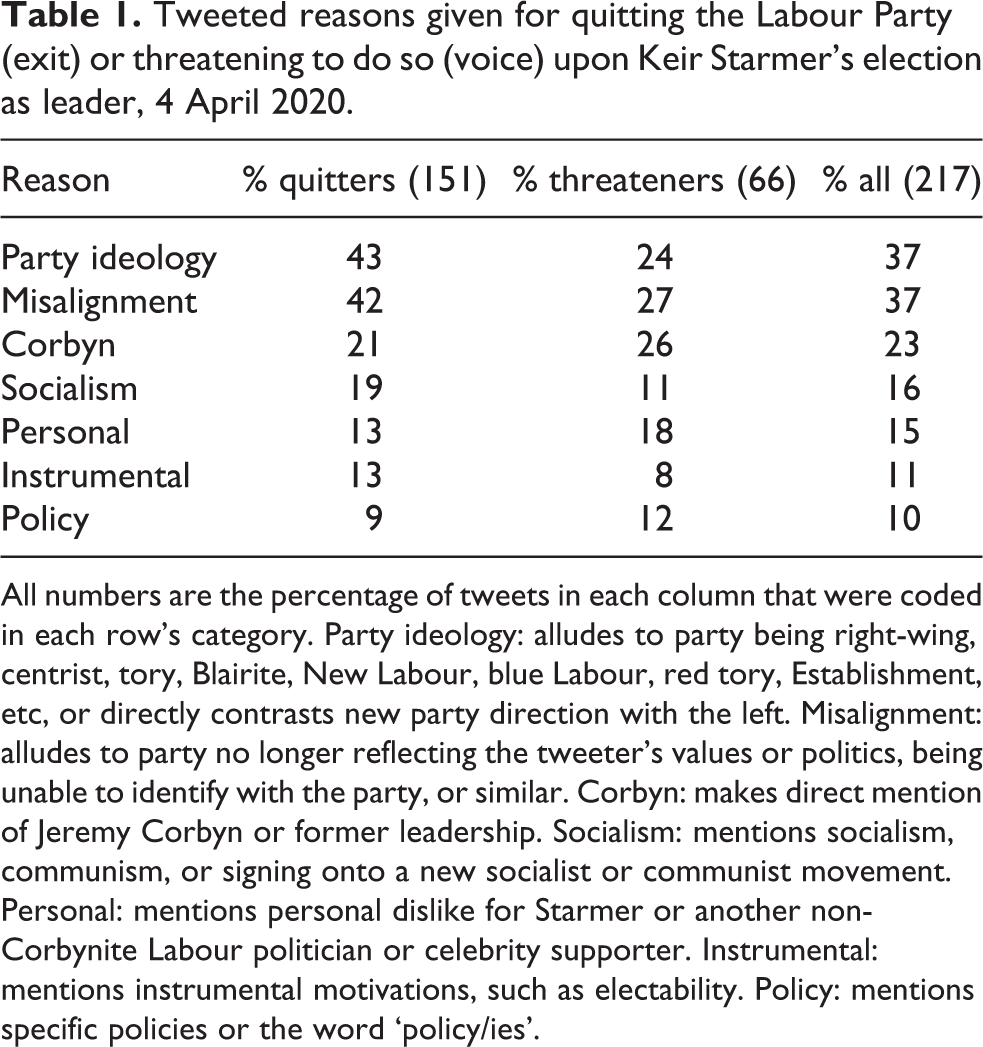
All numbers are the percentage of tweets in each column that were coded in each row’s category. Party ideology: alludes to party being right-wing, centrist, tory, Blairite, New Labour, blue Labour, red tory, Establishment, etc, or directly contrasts new party direction with the left. Misalignment: alludes to party no longer reflecting the tweeter’s values or politics, being unable to identify with the party, or similar. Corbyn: makes direct mention of Jeremy Corbyn or former leadership. Socialism: mentions socialism, communism, or signing onto a new socialist or communist movement. Personal: mentions personal dislike for Starmer or another non-Corbynite Labour politician or celebrity supporter. Instrumental: mentions instrumental motivations, such as electability. Policy: mentions specific policies or the word ‘policy/ies’.
Results: Why quitters quit
Table 2 shows the percentages of each party membership’s respondents, who had at some stage left (and rejoined) their party, who reported each of the manually coded reasons for having done so. Taking all parties together, disagreement with party policies and direction are among the top reasons, but so too is disappointment with the party leader. Beyond this, there appears to be some variation between members of different parties. Given the relatively small number of respondents from each individual party, these comparisons should be read with caution. UKIP and to a lesser extent Conservative members seem more inclined simply to have forgotten to renew. Green Party members, on the other hand, seem much more likely than others to say that they had let their membership lapse due to a lack of funds. Both of these might speak to a lack of what Power and Dommett call ‘process’ in that the parties were unable to retain these members through more robust or accessible infrastructure.
Main reasons for quitting given by those party members surveyed in 2015 (N = 5,755) and 2016 (N = 876) who had previously left and then rejoined their party.
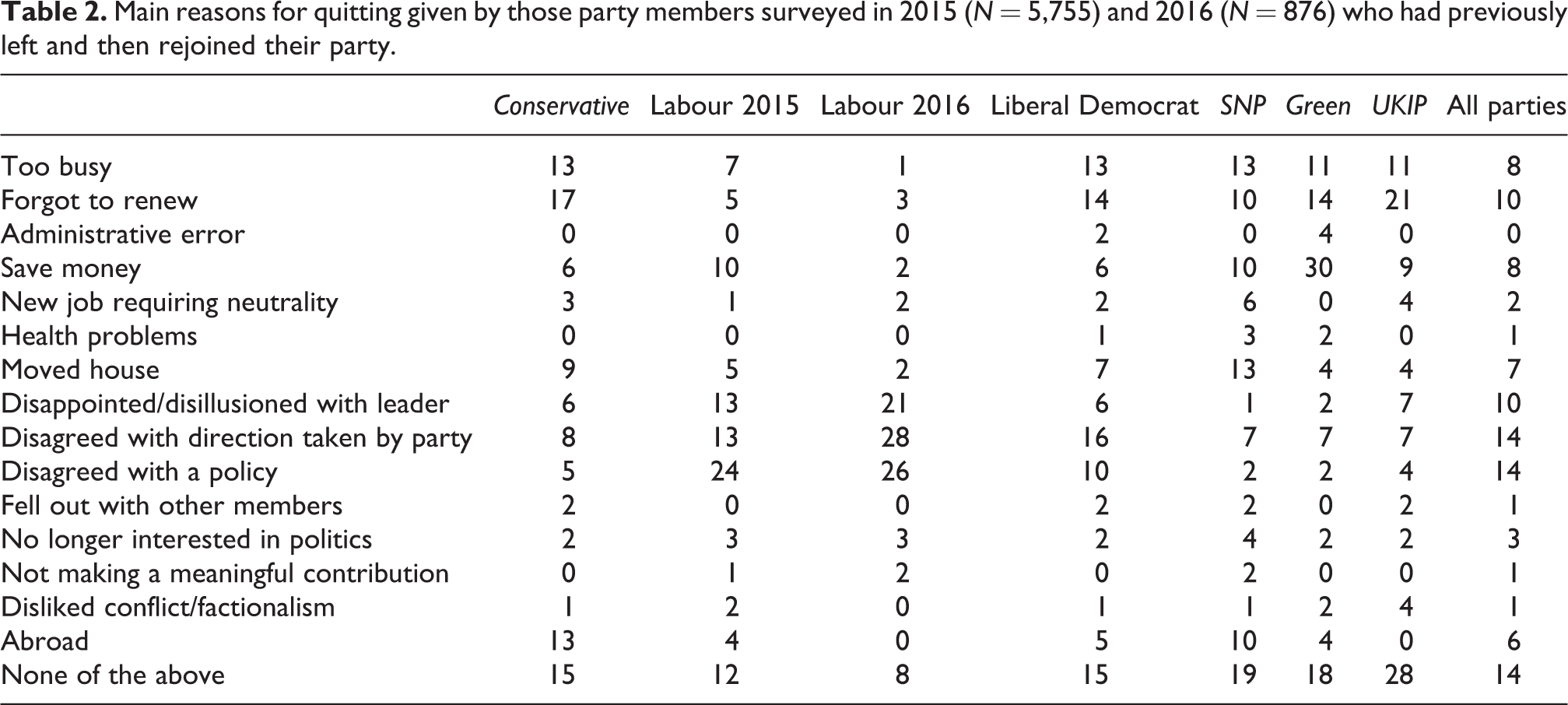
Summing up the percentage of members whose responses suggest they had a politically principled reason for leaving their party (combining disagreement with its leader, its general direction and specific policies that it adopted), this category explains the departures of under a fifth of Conservative and UKIP members, about a tenth of SNP and Green members, and an admittedly sizable third of Liberal Democrats. But approximately half of those Labour members who said they had previously left the party when we surveyed them in 2015 had quit over ideology or principle – or three-quarters of those returning members surveyed in 2016. This may indicate that many of those who flocked to join the party to support Jeremy Corbyn from 2015 onwards sought to rescue their party from ‘Blair’, ‘neo-liberalism’ and ‘Iraq’, all of which were cited repeatedly in their responses. In any case, the fact that those who rejoined the Labour Party following the election of a new, markedly more left-wing leader were those who reported having previously left the party for reasons related to policy and ideology (and indeed, to disagreement with a leader) is surely suggestive of a connection between ideology, leadership, and quitting. The case of the Labour Party over recent years might be seen as particularly ripe for such leader-motivated ideological effects.
Indeed, many tweets by those announcing they were leaving Labour upon Starmer’s election also gave reasons related predominantly to the ideological direction his leadership implies. A consistent theme clearly emerged around the idea of an ideological mismatch. Starmer’s election (and subsequent appointments) is clearly the trigger for this, shifting motivations: ‘I’m resigning my Labour Party membership. Centrist barbarism can go on without me. Yvette Cooper and Hilary Benn in the shadow cabinet, FFS! Hope the Green Party can now become a genuine left wing party and house all of us who are leaving the red Tories’.
1
‘As of today I am no longer a member of The Labour Party My values have not changed The party has Starmer wrecked our chances of winning the last election I have no respect for him And will never forgive him’
4
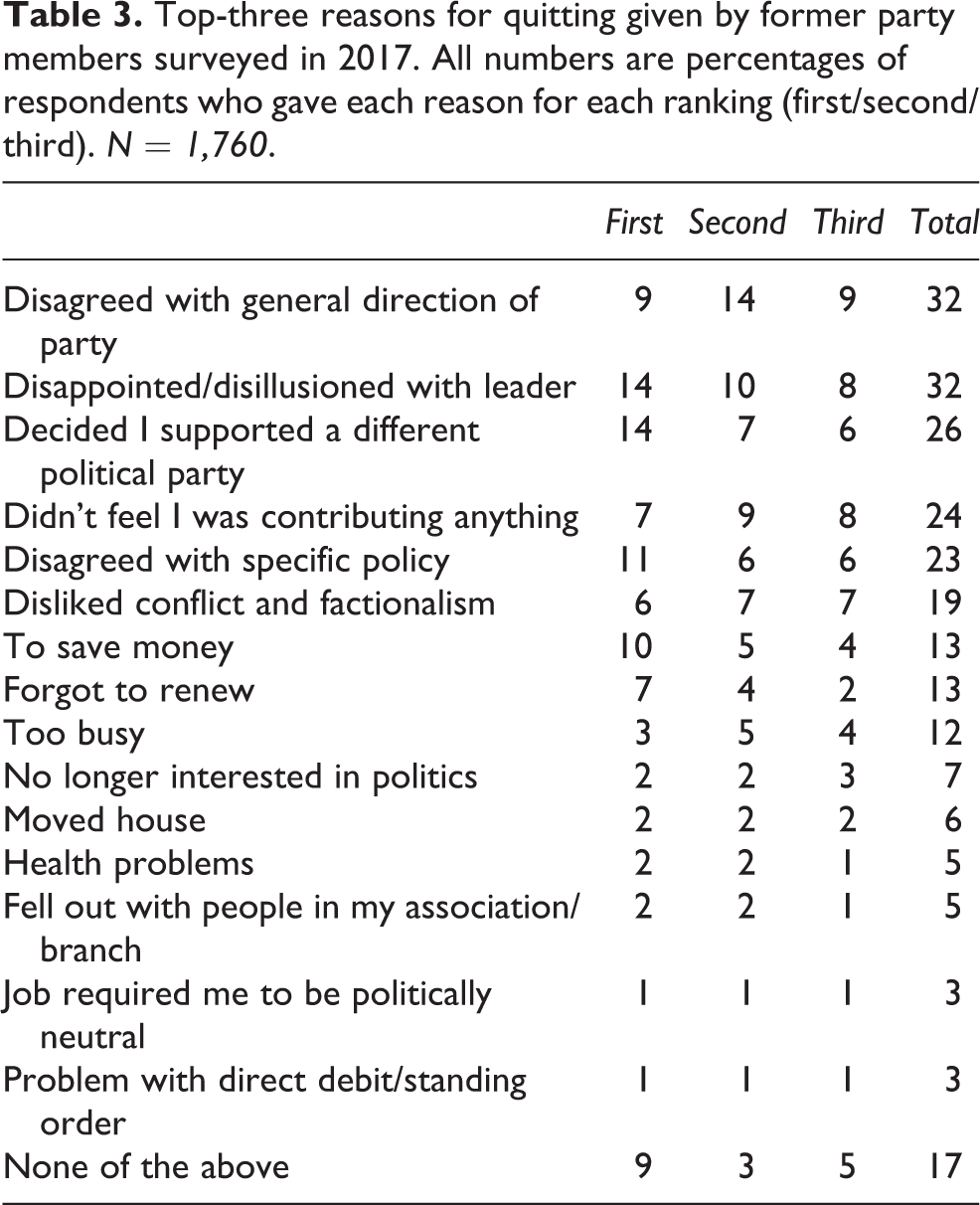
Turning to the 2017 survey of party leavers, Table 3 shows the percentages of respondents who chose each of the response options for why they left their party, as their first, second and third main reasons. While sample size precludes inter-party comparisons here, clearly, again, broadly principled political motives dominate. Specifically, 32% of respondents placed disagreement with the direction of the party and disillusionment with its leader in their top three reasons. The point that disillusionment with the party leader, as a cause of quitting, is related to ideology is borne out where respondents elaborate on their answer in a write-in format. A respondent who had quit Labour, for instance, claimed that ‘Corbyn represents a form of socialism that will impoverish this nation’ – the leader, in effect, as synecdoche.
Top-three reasons for quitting given by former party members surveyed in 2017. All numbers are percentages of respondents who gave each reason for each ranking (first/second/third). N = 1,760.
This process was reversed for many tweeting about leaving the party after Starmer’s election. Starmer’s (centrist, blue, or even ‘red tory’) Labour clashed, for many, with Corbyn’s ‘socialism’: ‘I joined the Labour Party in 2015 because I felt represented by the socialism that Corbyn symbolised as a leader – the party as lead [sic] by Starmer, I feel, is not one that I identify with. I’ll vote for Labour at the next general election, but I won’t be doing so as a member’.
8
In order to establish whether or not this primacy of political and ideological concerns that people report appears to be significantly associated with having quit a party, Table 4 presents the results of a simple logistic regression analysis. The findings discussed here should be treated with caution, because relatively few of our respondents quit in the 2015–2017 period. We also necessarily still rely on self-reported measures. For example, the change in ideological distance from the party is estimated by taking the difference between respondents’ reported left-right positions, and those of the party they were a member of, in 2015 and 2017. Given that any exit took place in between these dates, changes in these reported positions could be the result of post-hoc rationalisation, rather than what is driving exit.
The correlates of quitting? Results of binary logistic regression model.
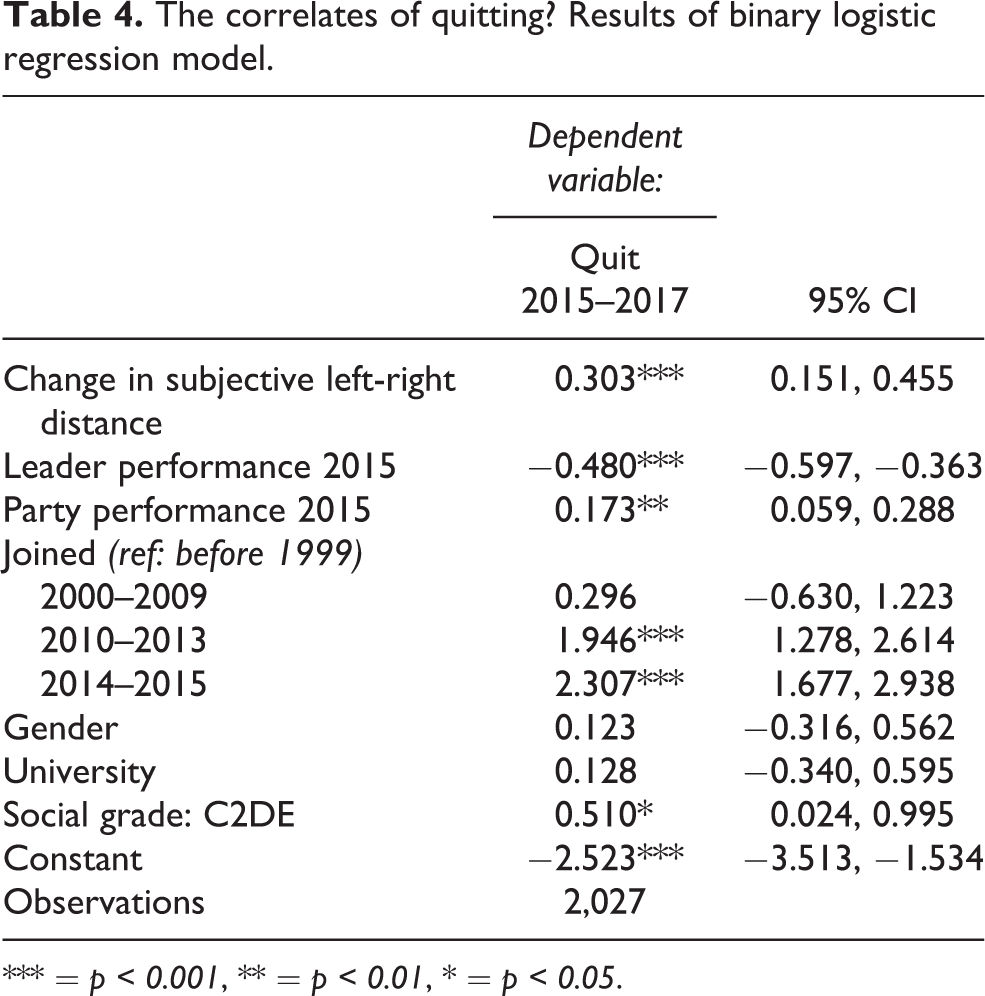
*** = p < 0.001, ** = p < 0.01, * = p < 0.05.
Party leaders appear to matter here in a clear, concrete sense. The less impressed someone was by their party leader’s performance in 2015, the more likely they were to go on to leave over the next two years – this matters above and beyond how well they deem the party as a whole to have performed. Changes in perceived ideological proximity are strongly associated with having quit a party, for either of the reasons above. The greater the change, the more likely someone is to leave. This holds when controlling for socio-economic/demographic differences, which are not consistently or strongly associated with exit (although C2DE members seem to have been more likely to quit than ABC1 members), as well as the length of time someone has been a member, which is strongly negatively associated with exit.
Given the period covered by these analyses, this could be read as further support for the claim that leaders (and their perceived positions) matter. In the 2015–2017 period, the Labour Party acquired a new leader in Jeremy Corbyn (write-in responses are, understandably, strongly suggestive of his being a particularly influential appointment), David Cameron was replaced by Theresa May as leader of the Conservative Party, and the Liberal Democrats, Greens and UKIP all underwent changes of leadership. We might speculate that the changes of party members’ perceived ideological distance from their party are related to these changes of leadership in some cases, though we cannot directly test this tentative claim.
This would, however, tally well with the thought processes we observe among those Labour members tweeting about quitting in response to Starmer’s election. Admittedly, some members, despite concerns over his politics, seem willing to give Starmer a chance to prove he will not alter the direction of the party too much, threatening otherwise to terminate their memberships: ‘Conflicted with Kier Starmer winning. I will hang on for a few months and see the direction, but I just might chuck in my Labour Party membership after this’
9
‘Labour will still have my membership till at least September, conference will be the judge of if I am still politically aligned with the movement of not’.
10
Conclusion
Party members tend to quit when they become less closely aligned with their parties, disillusioned with them, or disappointed in them (see Bale et al., 2019, chapter 8, for more detail on this point). We have demonstrated how this finding fits into a parsimonious theoretical understanding of party member exit, and brought new evidence to bear on the question from multiple angles. In line with existing research, our survey data shows that ideological disagreement is the main reason members give for quitting. We argue that theories of member exit should account for the fact that changes in the extent to which members see themselves as aligned with their parties could be brought about by negative triggers, and argue that changes of leader are a prominent example. We find consistently (with some evidence of inter-party variation) that disillusionment with the party leader is a driver of exit and that this disillusionment is often itself expressed in terms of ideological or policy differences. Moreover, British party members who claim to have become more ideologically distant from their parties are more likely to have quit them, over a period in which nearly every party changed its leader. Leaders also seem to matter for other reasons, such as how well they perform in elections. The interaction between ideological proximity and changes of leadership is most clearly drawn out by our qualitative evidence: those who tweeted about leaving the Labour Party following the election of Keir Starmer as its new leader frequently cited their ideological differences with the party under his prospective leadership, and how he stands for something they cannot abide.
Clearly, although we argue ideology matters, we acknowledge that quitting may well involve considerations that go beyond ideology: as Whiteley and Seyd (2002: 150) note, a decline in selective incentives such as meeting like-minded people or fulfilling career ambitions, may also play a role. Moreover, even the process we put forward here is not deterministic, nor is it always symmetrical, as two members with similar histories, but drawing different conclusions from Starmer’s election, remind us: ‘I have been a Labour Member since 1970 I cancelled my Membership when I realised New Labour were a Neoliberal Party continuing Thatcher’s Legacy. I rejoined when Corbyn was made Leader…If Starmer is made Leader I will cancel my Membership’.
11
‘Quitting Labour today is throwing toys out the pram. @jeremycorbyn invigorated me to rejoin after Iraq made me quit. @Keir_Starmer was not my choice, but we need back him as our “enemy” are the tories, not each other. I am a Momentum member, but we are a broad church. Back us’
12
Supplemental material
Supplemental Material, sj-docx-1-ppq-10.1177_1354068820962035 - ‘Leaving the red Tories’: Ideology, leaders, and why party members quit
Supplemental Material, sj-docx-1-ppq-10.1177_1354068820962035 for ‘Leaving the red Tories’: Ideology, leaders, and why party members quit by Matthew Barnfield and Tim Bale in Party Politics
Footnotes
Acknowledgements
We would like to thank Monica Poletti and Paul Webb for their assistance, the reviewers for their helpful comments, and the Economic and Social Research Council for providing funding for the PMP’s research.
Declaration of conflicting interests
The author(s) declared no potential conflicts of interest with respect to the research, authorship, and/or publication of this article.
Funding
The author(s) disclosed receipt of the following financial support for the research, authorship, and/or publication of this article: This work was financially supported by the Economic and Social Research Council (grant number ES/M007537/1).

Supplemental material
Supplemental material for this article is available online.
Notes
References
Supplementary Material
Please find the following supplemental material available below.
For Open Access articles published under a Creative Commons License, all supplemental material carries the same license as the article it is associated with.
For non-Open Access articles published, all supplemental material carries a non-exclusive license, and permission requests for re-use of supplemental material or any part of supplemental material shall be sent directly to the copyright owner as specified in the copyright notice associated with the article.
