



Abstract
British parties have pioneered the use of ‘one-member, one-vote’ ballots to select their leaders. However, the elections of Jeremy Corbyn (Labour) and Liz Truss (Conservative) prompted calls to return leadership selection to parliamentarians. Critics claim that party members are non-centrist and liable to impose unsuitable leaders on MPs. This weakens the cohesion of parliamentary parties, undermining the functioning of Britain’s majoritarian democracy. This article assesses the major parties’ leader-selection systems. It goes beyond existing research by identifying and applying four evaluative criteria for selection institutions: legitimacy, parliamentary acceptability, leader-eviction and timeliness. It shows that most criticisms of one-member, one-vote are overstated because the latter is heavily mediated by ex-ante and/or ex-post parliamentary controls, for example, nomination thresholds and confidence votes. One-member, one-vote generally produces leaders acceptable to MPs; ‘unsuitable’ ones typically arise when the parliamentary controls fail. However, key institutional weaknesses are identified: legitimacy in the Conservatives’ system and leader-eviction in Labour’s.
Keywords
Political parties are indispensable organisational forms for modern democracy, aggregating interests, offering policies and candidates to voters, and implementing governmental programmes (Aldrich, 2011; Dalton et al., 2011). The internal structure of parties affects how they perform these tasks, influencing choices over policies and candidates (Duverger, 1964; Katz and Mair, 2002; Panebianco, 1988). The leader is the most prominent individual in any party, mobilising intra-party actors to achieve collective goals (Hayton and Heppell, 2015; Poguntke and Webb, 2005; Rhodes and t’Hart, 2014). Leader evaluations are important determinants of voting behaviour (Clarke et al., 2009). The selection of leaders, therefore, is a crucial realm of decision-making.
Research on leadership selection has increased substantially in recent years. An expanding comparative literature has noted trends in several democracies of membership involvement in choosing leaders (Bennister and Heppell, 2016; Cross, 2013; Cross and Blais, 2012; Cross and Pilet, 2015; Kenig, 2009a, 2009b; LeDuc, 2001; Pilet and Cross, 2014; cf. Denham, 2016). The largest literature is on British parties, partly reflecting their innovations in membership participation (Bale and Webb, 2014; Punnett, 1992; Quinn, 2012).
The British literature is rich in cross-party comparisons (Bale and Webb, 2014; Denham, 2013, 2018; Denham et al., 2020; McAnulla, 2010; Punnett, 1992; Quinn, 2005, 2012; Stark, 1996); single-party case studies (Alderman, 1999; Alderman and Smith, 1990; Bogdanor, 1994; 2022; Denham and O’Hara, 2008; Heppell, 2008, 2010; McSweeney, 1999; Niendorf, 2021; Quinn, 2004a, 2018a); and single-contest studies (Alderman and Carter, 1991, 1993, 1995, 2002; Denham and Dorey, 2007; Dorey and Denham, 2011, 2016; Drucker, 1976, 1981, 1984; Heppell, 2021; Jobson and Wickham-Jones, 2011; Pemberton and Wickham-Jones, 2013; Quinn, 2016, 2019). A quantitative literature collates MPs’ preferences in individual contests to uncover factional patterns (Booth et al., 2023; Cowley and Bailey, 2000; Cowley and Garry, 1998; Crines et al., 2018; Jeffery et al., 2018, 2022, 2023; Heppell et al., 2010, 2022; Heppell and Crines, 2011; Heppell and Hill, 2008, 2009, 2010; Roe- Crines et al., 2021). Leadership selection has also been linked to related political questions, such as cabinet reshuffles (Allen, 2023) and general-election forecasting (Murr, 2015, 2021).
The subject of leadership selection is salient in Britain after recent experiences in the major parties. Labour selected a left-wing backbencher, Jeremy Corbyn, as its leader in 2015 despite opposition from its MPs (Dorey and Denham, 2016; Quinn, 2016). In 2022, the governing Conservatives chose Liz Truss, who lasted 6 weeks before resigning after policy failures (Booth et al., 2023). In each case, the final choice was made by party members, not MPs. Both parties once permitted MPs to choose leaders (Punnett, 1992), but, along with other British parties, pioneered ‘inclusive’ systems like ‘one-member one-vote’ (OMOV) (Bale and Webb, 2014; Cross and Blais, 2012). The cases of Corbyn and Truss have prompted calls for leader selection to be returned to MPs (Russell, 2022; Russell and James, 2023: 327–328; Saunders, 2019). Even the former Tory leader who introduced OMOV agrees (Hague, 2022).
A frequently used analytical framework exists for explaining the outcomes of British leadership contests (Stark, 1996; see also Dorey and Denham, 2011; Heppell, 2021; Quinn, 2012). However, the literature lacks a common set of evaluative criteria for selection institutions. Yet, general criteria are essential if the comparative merits of institutions such as parliamentary ballots, electoral colleges and OMOV are to be properly gauged. This article fills that gap in existing research. It identifies four criteria that are sometimes explicitly, more often implicitly, used to evaluate selection systems: (1) legitimacy; (2) parliamentary acceptability; (3) leader-eviction; and (4) timeliness. The article applies these criteria to selection systems in the Conservative and Labour parties.
Using the evaluative framework, the article argues that many criticisms of OMOV are overstated. In Britain, intra-party democracy is heavily mediated by ex-ante and ex-post parliamentary controls. These are normally sufficient to ensure victorious candidates are acceptable to MPs. Some claimed instances of members ‘imposing’ unsuitable leaders reflected a lack of parliamentary consensus. Even the one incontrovertible case of a leader imposed – Corbyn – could easily have been stopped by MPs through the existing rules. Nevertheless, key weaknesses are identified in both parties’ systems: legitimacy in the Conservatives’ and leader-eviction in Labour’s.
The article proceeds as follows. The first section explains the evaluative criteria. The next examines Conservative and Labour parliamentary ballots. The following three sections consider Labour’s electoral college, its current OMOV system, and the Conservatives’ OMOV system. A final section discusses the findings.
Criteria for leadership selection systems
It is a truism that ‘institutions matter’ (March and Olsen, 1984; Rhodes et al., 2006). However, the dominant analytical framework for British leadership elections asserts that, largely, they do not (Stark, 1996: 131–138). Within this perspective, regardless of who chooses the leader, their selection criteria are the same: acceptability, electability and competence (Stark, 1996: 125–126). Yet, these may be interpreted differently: what is ideologically acceptable to MPs might not be for party members (Maiguashca and Dean, 2020; Quinn, 2012: 14–15). The identity of the selectors matters. Corbyn had overwhelming backing from Labour members, but little parliamentary support (Quinn, 2016).
It would be surprising if selection institutions did not matter (Kenig, 2009a; LeDuc, 2001; Punnett, 1992). Party leaders are in a principal–agent relationship with their appointers, and may pursue their own goals rather than principals’ (Shepsle and Bonchek, 1997: 380–404). Institutional design is central to leader-selection systems (Goodin, 1996; Tsebelis, 2002). Relevant issues include: who the principals are and how they appoint the agent (Laver, 1997: 68–88); ex-ante controls, such as screening; and ex-post controls, such as eviction (Shepsle and Bonchek, 1997: 361–362).
To evaluate different institutional methods of selecting party leaders, a set of criteria are needed. These must reflect general principles of leader selection as well as the specificities of Britain’s majoritarian democracy (Lijphart, 2012). Four institutional criteria can be vicariously identified within extant research on British parties.
Legitimacy
The first criterion is that selection systems should bestow legitimacy on new leaders (Punnett, 1992: 12). Legitimacy is the justification of political authority, with an obligation on others to respect it (Peter, 2017). Leaders who lack legitimacy may find their authority and ability to enforce decisions undermined. Legitimacy can attach to procedures and outcomes, although they are not always easy to separate. Doubts over the legitimacy of a procedure will extend to the outcomes it produces.
Weber’s (1918/2009) three types of legitimate authority – charismatic, traditional and ‘rational-legal’ – apply to party leaders. Traditional authority, based on social roles, was important before the extension of the franchise, but less so now (Ramsden, 1998). Charismatic leaders who assume their position through non-elected means are viable in small or new parties, such as the Brexit Party under Nigel Farage (Crick, 2022). However, in most contemporary parties, a legitimate leader is an elected one, reflecting ‘rational-legal’ authority. Demands within parties for changes to selection procedures frequently invoke ‘democratisation’ (Cross, 2013; LeDuc, 2001).
Democracy requires a demos, the body of voters. To constitute a demos, a group must have some connection with each other. In political parties, it is based on common formal membership and commitment to the party’s values (Scarrow, 1996, 2014). That still leaves debate over whether all classes of members constitute this demos, or ‘selectorate’, or whether it is restricted to party elites, such as MPs (Cross and Blais, 2012: 14–33; Hazan and Rahat, 2010; Kenig, 2009a: 434–437). In both major British parties, the selectorate was previously MPs, but now includes members (Denham et al., 2020; Quinn, 2012).
The selectorate’s composition raises other questions about legitimacy. First, when selection procedures separate MPs, members and sometimes other actors, into different sections or stages, it becomes possible for one candidate to secure a majority of MPs while another achieves a majority of party members. Such competing legitimacies may undermine a leader’s authority (Quinn, 2012). Second, in the case of all-member ballots, parties must decide whether to require a minimum period of membership or to allow individuals to join the party to vote in a leadership contest (Hazan and Rahat, 2010). The latter generates funds but dilutes the sense of attachment. A fleeting, unstable membership is less committed to the party; the legitimacy it confers on new leaders may be weaker.
Legitimacy can be considered internally, vis-à-vis intra-party actors, and externally, in relation to voters (Punnett, 1992: 12). Internal illegitimacy can cause intra-party conflict, while external illegitimacy may entail electoral damage. A procedure viewed internally as legitimate may strike voters as illegitimate, and vice versa. Internal legitimacy takes priority over external legitimacy because intra-party unity is a prerequisite for electability (Sjöblom, 1968; Stark, 1996: 125–126).
Parliamentary acceptability
Political parties are voluntary organisations at the grassroots level, but in the legislative arena they are composed of elected and paid officers – MPs – who must act collectively to achieve the party’s goals. This requires unity of purpose, or, cohesion: a party’s MPs must coordinate their legislative voting to maximise the party’s effectiveness, whether in government or opposition. When legislative parties are divided and their MPs vote different ways, they cancel each other out (Bowler et al., 1999; Cox, 1987; Dewan and Spirling, 2011; Kam, 2009, 2014; Saalfeld and Strøm, 2014). Cohesion may require selective incentives – patronage and sanctions – for MPs (Benedetto and Hix, 2007). Leaders possess powers to impose discipline to generate cohesion (Kam, 2014: 399).
Legislative leaders are not dictators, however. Ultimately, MPs must consent to being led if the legislative party is to remain functional. This touches on legitimacy, with the obligation to obey justified authority. Leaders are more able to impose discipline and unite their MPs if the latter consider them broadly acceptable qua leaders (Stark, 1996). This is the second criterion for major parties’ selection systems. ‘Broad acceptability’ is a specific form of outcome legitimacy concerning a leader’s authority to manage the parliamentary party (Bogdanor, 2022; Russell, 2022). It is distinct from procedural legitimacy, relating to practicalities of intra-party management, not principles of ‘fairness’ or ‘democracy’.
Figure 1 shows a centre-left party whose MPs are ordered from radical left (x) to centrist 1 (y). The intra-party median MP is m. Three potential leaders are shown: A1 at m, A2 at x, and A3 at y. Average ideological distances between the leader and her MPs are minimised with a leader at the median position, the largest distances being x-m and m-y. Under radical-left or centrist leaders, the largest distances are x-y and y-x respectively; these leaders may struggle to carry MPs with them. Cohesion is maximised under A1, but a ‘broadly acceptable’ leader, to whom MPs would consent, could be positioned within a moderate range around the median, for example, r1-r2. 2
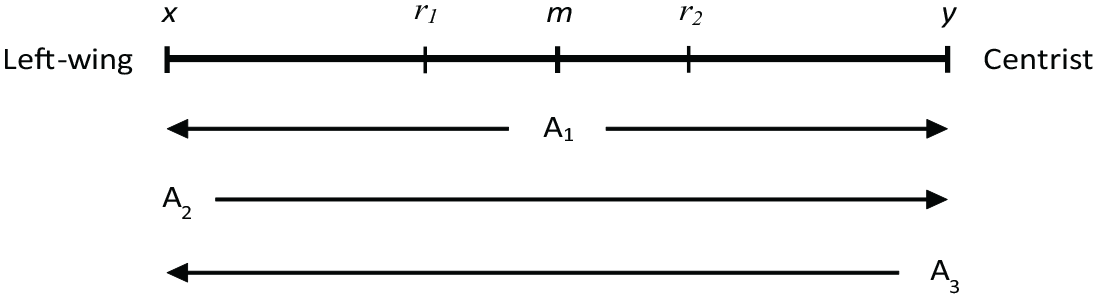
Ideological distances between party leaders and their MPs (Centre-Left Party).
The criterion of parliamentary acceptability is embodied in ex-ante gatekeeping controls by MPs, such as eligibility and nomination rules. The acceptability of leaders to other intra-party actors, such as members, is desirable but not a necessary condition for party functionality in the legislative arena (although it helps mobilise activists in the electoral arena).
Eviction
The third criterion is for a party to be able to hold its leaders to account, through their formal removal, or eviction, if necessary (Kenig, 2009a: 442–445; McAnulla, 2010). This represents an ex-post institutional control, and it raises several issues. First, a balance must be struck between giving the party the means to remove leaders who outstay their welcome and offering security of tenure to incumbents from ‘frivolous’ but damaging challenges (Punnett, 1992). Second, are the processes of evicting one leader and selecting a new one fused or separated (Quinn, 2005)? Third, who should constitute the ‘de-selectorate’: parliamentarians or party members?
Leader eviction may entail the same procedures as leader selection, as when it involves a formal challenge to an incumbent in a leadership contest. Removing the leader requires a named challenger to instigate and win a contest. The processes of evicting the incumbent and replacing them are fused. Alternatively, the two processes may be separated, as with confidence votes. Only if the incumbent loses the latter will a leadership election occur (Quinn, 2005).
With formal challenges, OMOV systems enable party members to participate in removing leaders. In contrast, confidence votes might involve members or be restricted to MPs. The argument for the first approach is based on legitimacy: if members elect a leader, they should not have that choice retrospectively overturned by MPs. The argument for confidence votes by MPs is based on acceptability. Since parliamentary parties function better when leaders are acceptable to their MPs, the latter must be able to remove leaders who have insufficient authority.
Timeliness
The final criterion is timeliness: leadership elections should be run as quickly as is necessary to ensure a fair contest (Punnett, 1992: 12). That includes the campaign and time for selectors to vote. Ballots of MPs located at Westminster can be conducted in days. OMOV ballots may take weeks or months because of hustings and postal voting.
What is considered ‘timely’ varies by circumstances. When governments choose new leaders, they might prefer quicker contests because the task of governing continues. An opposition party that has just lost an election may prefer a longer leadership contest to debate the way forward. Ideally, a flexible system would enable either to occur as necessary.
Parliamentary ballots
Parliamentary politics has always been central to leadership in the two main British parties (Punnett, 1992). In Britain’s majoritarian democracy, executive power usually rests on parliamentary majorities, with the two main parties’ leaders fulfilling the roles of prime minister and leader of the opposition respectively (Hennessy, 2000; Heppell, 2012; Johnson, 1997). Both main parties have assumed that leaders would be MPs under all the selection systems examined in this article. 3
Beyond the question of eligibility, it may seem logical that leaders would be chosen by a parliamentary selectorate, as each party’s parliamentary effectiveness depends on unity and cohesion (Punnett, 1992; Russell, 2022). Given that cohesion will be better facilitated by a leader close to the intra-party median MP (Figure 1), a ballot of those MPs appears an effective way to achieve it (Black, 1958; Downs, 1957). Parliamentary ballots offer clarity over the identity of the demos, which consists of one class of selector, MPs. Leaders who are chosen in parliamentary ballots have publicly demonstrated that they enjoy majority support from their fellow MPs.
Both major parties once used a parliamentary selectorate to choose their leaders. Labour leaders (called chairmen until 1922) were elected in secret ballots of the Parliamentary Labour Party (PLP) from 1906 to 1980. Conservative leaders once ‘emerged’ from informal consultations among parliamentary elites (Bogdanor, 1994; Punnett, 1992: 26–51). This system, sometimes disparaged as ‘the magic circle’, was replaced by secret ballots of MPs from 1965 to 1998 (Denham et al., 2020: 5–78, 129–158).
This is not the place for an exhaustive analysis of parliamentary ballots (see Heppell, 2008, 2010; Punnett, 1992; Stark, 1996). Nevertheless, some observations are appropriate. In the 12 post-war Labour and Conservative parliamentary ballots, 11 produced an absolute majority for the winner (John Major won a plurality of 49.7% in the second-round Conservative ballot of 1990 after his opponents withdrew). Only two produced close (< 10%) results (Tables 1 and 2).
Post-war Labour leadership contests under parliamentary ballots.
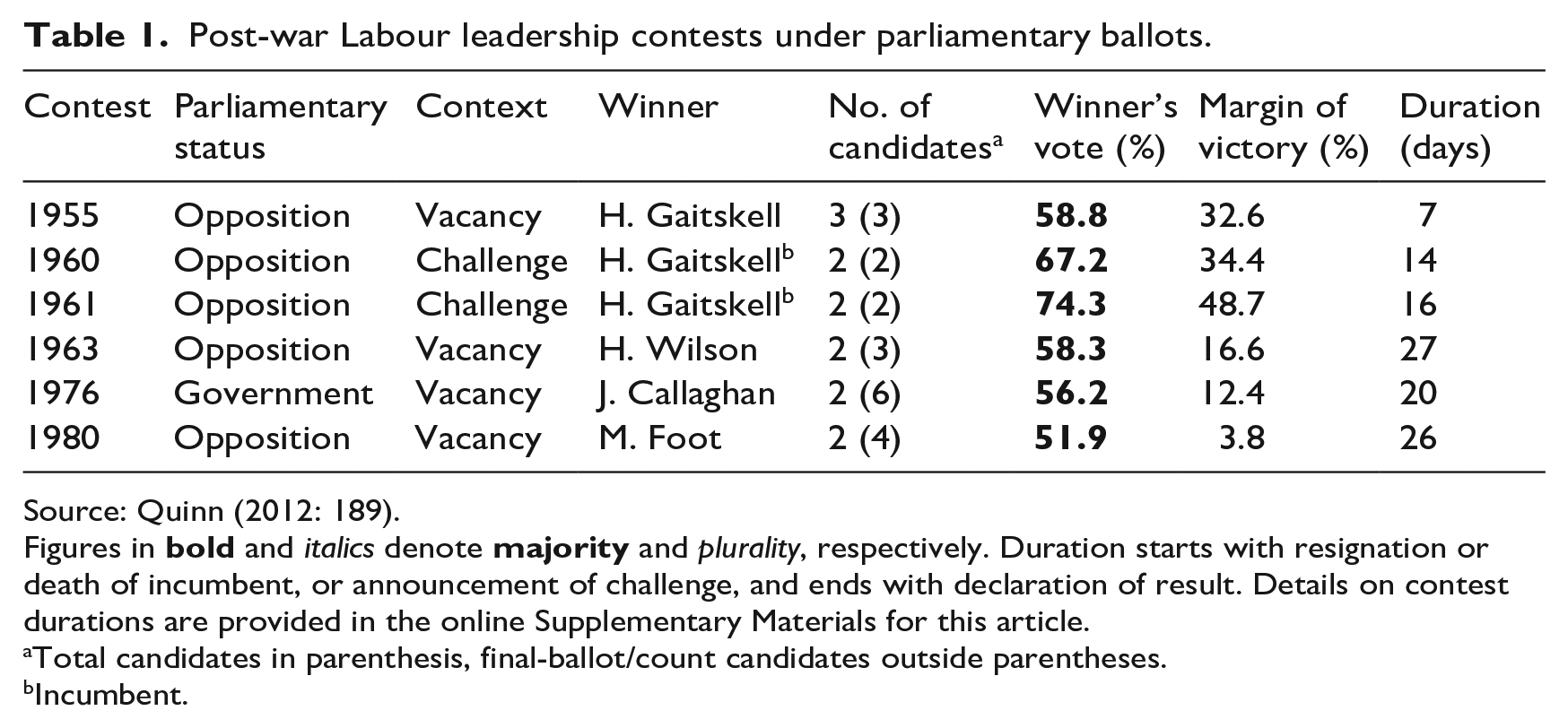
Source: Quinn (2012: 189).
Figures in
Total candidates in parenthesis, final-ballot/count candidates outside parentheses.
Incumbent.
Conservative leadership contests under parliamentary ballots.
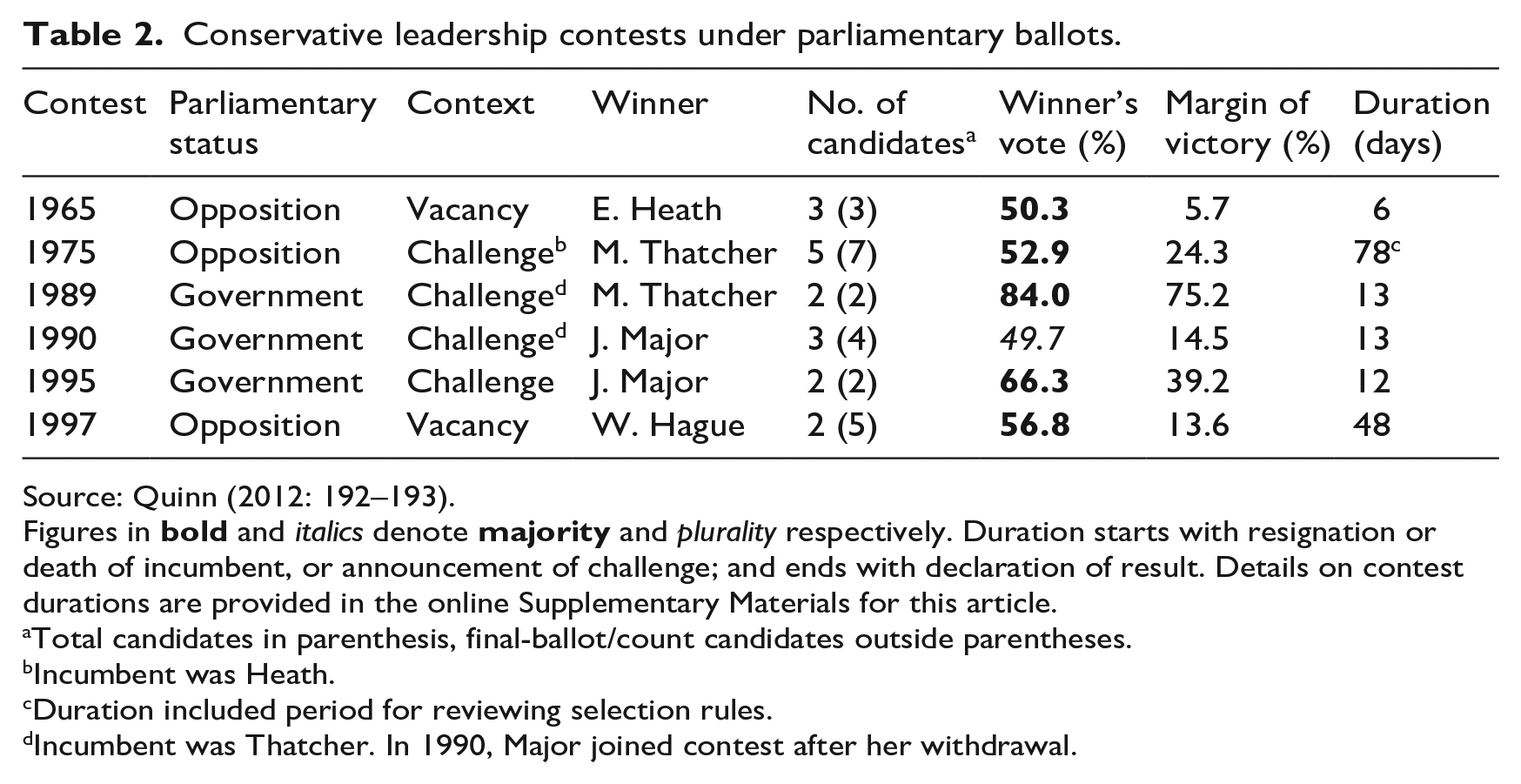
Source: Quinn (2012: 192–193).
Figures in
Total candidates in parenthesis, final-ballot/count candidates outside parentheses.
Incumbent was Heath.
Duration included period for reviewing selection rules.
Incumbent was Thatcher. In 1990, Major joined contest after her withdrawal.
Incumbents’ positions could sometimes be tested. Labour allowed annual challenges in opposition, provided a challenger came forward, as occurred in 1935, 1960 and 1961. The rules were silent on contests in government (Punnett, 1992: 89). (PLP ballots were used to select James Callaghan following Harold Wilson’s resignation in 1976, but that was for a vacancy.) Initially, the Conservatives did not permit challenges, but changed this rule in 1975. Margaret Thatcher duly challenged Edward Heath, forcing his resignation. Thatcher herself was forced out after a challenge by Michael Heseltine in 1990, although Major eventually won the contest 4 (Alderman and Carter, 1991; Heppell, 2008: 51–93). Most contests were quick, the 12 post-war ballots lasting a median of 15 days, with 13 days for contests in government and 21 days in opposition. The longest, at 78 days, was the 1975 Conservative contest, which included a period for revising the rules (Stark, 1996: 26–30).
There appeared little public disquiet over the legitimacy of parliamentary selectorates. Ultimately, however, both parties abandoned parliamentary ballots because of internal criticism over their legitimacy. This was sharpened when the preferences of MPs and non-enfranchised members clashed. Labour activists were infuriated by Callaghan’s decision to resign as leader in 1980 shortly before the introduction of a more inclusive system, allowing his successor to be chosen by MPs (Drucker, 1981). Conservative activists were outraged at their MPs’ defenestration of Thatcher in 1990 (Heppell, 2008: 75–93; Punnett, 1992: 63–72). Parliamentary ballots performed well on acceptability and timeliness, while enabling eviction in some circumstances. But any attempt to revive them faces opposition inside both parties because of the perceived illegitimacy of an elite selectorate.
Labour’s electoral college
Labour’s journey from parliamentary to all-member ballots was not direct. After the party’s election defeat in 1979, left-wing constituency and trade-union activists accused Labour MPs of ignoring their preferences during the Wilson and Callaghan governments. They demanded ‘democratisation’ and introduced reforms to subject MPs to grassroots control (Russell, 2005; Seyd, 1987). The PLP’s sole right to elect the leader was condemned for leaving the latter unaccountable and lacking legitimacy. The left wanted a selection system that enfranchised intra-party stakeholders beyond the PLP (Punnett, 1992: 95–103).
At a special conference in 1981, the party created an electoral college with three voting sections to choose leaders and deputy leaders. The PLP would have 30% of the votes, party member 30% and affiliates – overwhelmingly trade unions – 40% (Quinn, 2004a). This division reflected tactical manoeuvring at the conference, rather than coherent principle (Kogan and Kogan, 1982). The following day, four centrist MPs, who would form the SDP, issued their ‘Limehouse Declaration’, whose opening paragraph proclaimed: ‘A handful of trade union leaders can now dictate the choice of a future Prime Minister’ (cited in Minkin, 1992: 220). Although the college was abolished in 2014, there was a failed attempt to revive it in 2021, indicating continued support (Johnston, 2022a: 32–33). It is, therefore, worthwhile evaluating it against the selection-system criteria.
Legitimacy
The electoral college was intended to address the internal legitimacy weaknesses of PLP ballots, but was dogged throughout its existence by external legitimacy problems. Criticism focused primarily on the power it gave Labour’s affiliated unions. For many inside Labour, the unions were a legitimate part of its internal demos because of their role in forming and funding the party. But to Labour’s opponents, they represented sectional interests illegitimately involved in choosing the party’s leader (Kogan and Kogan, 1982; Quinn, 2004b; cf. Minkin, 1992).
From 1981 to 1993, union votes in the electoral college were cast as large, undivided blocks by each organisation. This concentration of power ensured that union leaders could decisively influence contests with early endorsements (Quinn, 2004a). This happened in 1983, 1988 and 1992, when union leaders were accused of ‘bouncing’ the party into choosing Neil Kinnock and John Smith (Alderman and Carter, 1993; Punnett, 1992: 112–118). The college was reformed in 1993 to enhance its legitimacy, equalising the voting weights of the three sections and permitting individual union members, not organisations, to cast votes (Russell, 2005; Wickham-Jones, 2014). That produced the college’s most legitimising contest, when Tony Blair triumphed in 1994, although turnout in the affiliates’ section was 19.5% (Alderman and Carter, 1995).
With its separate sections, the electoral college created the potential for competing legitimacies. In practice, union dominance ensured most contests were decided early, and non-secret voting in the PLP section incentivised MPs to rally behind the frontrunner (Quinn, 2004a). Most contests were won by wide margins (Table 3). The 2010 contest delivered a narrow victory for Ed Miliband over his brother, David, based on minority support from MPs and party members, but strong support from trade unionists (Jobson and Wickham-Jones, 2010; Pemberton and Wickham-Jones, 2013). Union leaders’ endorsements for Ed Miliband (sometimes mailed with ballot papers) appeared to swing the votes of their members on a turnout of just 9% in the affiliates’ section (Quinn, 2012: 78–82).
Labour leadership contests in the electoral college.
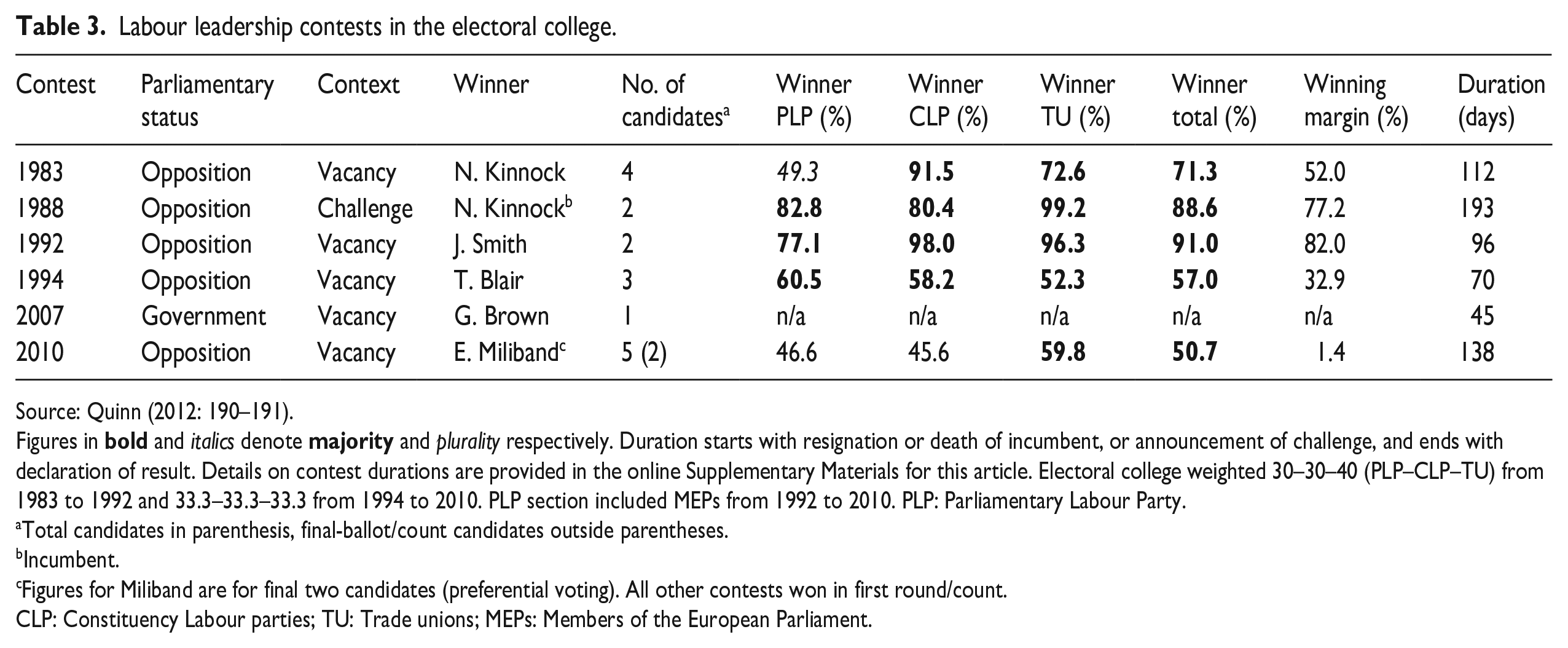
Source: Quinn (2012: 190–191).
Figures in
Total candidates in parenthesis, final-ballot/count candidates outside parentheses.
Incumbent.
Figures for Miliband are for final two candidates (preferential voting). All other contests won in first round/count.
CLP: Constituency Labour parties; TU: Trade unions; MEPs: Members of the European Parliament.
Only one contest occurred when Labour was in government. In 2007, Gordon Brown succeeded Blair as party leader and prime minister without a vote because he accumulated 88.2% of PLP nominations, leaving left-wing opponents mathematically unable to pass the 12.5% threshold (Heppell, 2010: 185–188). Had Labour run a 2010-style contest in government, with the winner becoming prime minister on the back of union votes, while MPs preferred another candidate, questions over the winner’s legitimacy would have been acute.
Parliamentary acceptability
The electoral college had two methods 5 of ensuring winners were broadly acceptable to the PLP. First, candidates had to pass a parliamentary nomination threshold initially of 5% of MPs, raised to 20% in 1988, and maintained at that level for challenges though reduced to 12.5% for vacancies in 1993 (Quinn, 2004a). Second, MPs had a 30% vote share, increased to 33.3% in 1993. These rules helped ensure all Labour leaders chosen in the electoral college were acceptable to the PLP. Five of the six winners in the electoral college either won majorities or solid pluralities of MPs, or in Brown’s case, a landslide of nominations (Quinn, 2012: 190). Only in 2010 did the majority choice of MPs not become leader, when David Miliband lost to brother, Ed. Despite that, Ed Miliband was broadly acceptable to Labour MPs (he won 47% in the PLP section). His centre-left platform was arguably more in tune with them than that of his Blairite brother (Bale, 2015; Goes, 2016). David’s appeal reflected his perceived electability and experience, not ideology (Dorey and Denham, 2011; Quinn, 2012: 72–78). There was little overt controversy in the PLP after Ed’s victory and his shadow cabinets united his and David’s supporters. Most complaints came from outside the party.
Eviction
The electoral college continued the practice of leaders being challenged in a formal election (Punnett, 1992: 105–129). Provided a challenger came forward, contests took place annually in opposition, but required endorsement by the party conference in government. The college’s broader selectorate meant the extra-parliamentary had a say in whether incumbents would be evicted.
Incumbents’ main safeguard was the 20% nomination threshold for challengers to meet. It was increased from 5% in 1988 to prevent forlorn, but damaging left-wing challenges to Kinnock (McSmith, 1996: 65). Only ‘serious’ challenges became possible. Non-secret voting in the PLP section left supporters of challengers vulnerable to retaliation by re-elected incumbents (Quinn, 2004a, 2005). The effect of the rules can be seen on the challenges that did not occur. The clearest example was Brown, who, as prime minister, faced repeated threats of a challenge during 2008–2010, but ultimately none came. One of Brown’s critics, the ex-home secretary, Charles Clarke, claimed he would have challenged Brown had the rules made it easier (Quinn, 2012: 86–94).
Timeliness
Contests in the electoral college were long, sometimes reflecting their timing after election defeats. Selectorates beyond the parliamentary party do not know as much about the candidates, requiring longer campaigns. The median duration of electoral-college leadership contests was 104 days. The longest was Tony Benn’s challenge to Kinnock in 1988, involving 7 months of campaigning, despite the outcome being a foregone conclusion. The shortest was Brown’s 45-day ‘coronation’ in 2007, the timetable accelerated to minimise disruption to government.
Labour’s OMOV system
A dispute over union influence in parliamentary candidate selection led Labour to review its organisation in 2013–2014 (Denham et al., 2020: 193–197). With criticism over union votes in the 2010 leadership election still fresh, Labour replaced the electoral college with an OMOV-based system (Collins, 2014: 25–27). As well as individual party members, members of Labour-affiliated unions could vote if they enrolled as ‘affiliated supporters’, free of charge (beyond paying their usual political levies) but agreeing to Labour’s values. 6 A new category of ‘registered supporter’ was also created in a move towards a closed primary, with individuals able to vote in leadership contests on payment of a fee and agreeing to Labour’s values. All votes were equally weighted, with no separate sections.
MPs lost their own voting section. However, in recognition ‘that the leader of the Labour Party has a special duty to head the PLP in Westminster, MPs will retain the responsibility of deciding the final shortlist of candidates that will be put to the ballot’ (Collins, 2014: 26). This was achieved through the PLP nomination threshold, which remained 20% for challenges but was increased from 12.5% to 15% for vacancies. These rules underwent several subsequent changes. The thresholds applied to the combined tally of Labour MPs and MEPs from 2016. The parliamentary threshold for vacancies was reduced to 10% in 2018, but increased to 20% in 2021. From 2018, candidates were further required to obtain nominations from either 5% of constituency parties or from three affiliates (of which two had to be unions) constituting 5% of total affiliated membership (Johnston, 2022a: 7–8; Quinn, 2018a).
Legitimacy
OMOV was intended to address the legitimacy weaknesses of the electoral college. However, Labour’s first OMOV contest in 2015 was embroiled in controversy over the legitimacy of the selectorate (Dorey and Denham, 2016; Niendorf, 2021). Labour used the contest as a fund-raising opportunity, permitting individuals to join during the campaign to cast a ballot to choose Ed Miliband’s successor. For 3 months, individuals could sign up as full members, affiliated supporters or registered supporters, the latter for just £3.00.
The consequence was a huge influx of selectors. 7 The final selectorate was 554,000, with 76% voting, including 245,000 members, 105,000 registered supporters and 71,000 affiliated supporters. Many new recruits had only a weak loyalty to Labour: 10% of the selectorate voted for the Green Party in the 2015 general election (Quinn, 2016). The (il)legitimacy of allowing so-called ‘three-pounders’ to vote was fiercely criticised. Accusations of ‘entryism’ followed, with several thousand applicants rejected after eligibility checks (Dorey and Denham, 2016; Quinn, 2016).
Later attempts were made to address the system’s weaknesses. A membership ‘freeze date’ of 6 months prior to a leadership election to be eligible to vote was used in the 2016 contest. The fee for registered supporters was increased to £25.00 for the 2016 and 2020 contests, with the signing-up period limited to 2 days. The circumstances of the 2016 contest – a challenge to the incumbent, Jeremy Corbyn – saw attempts by his supporters and his challenger’s to ‘pack’ the selectorate through online mobilisation. Fully 121,000 registered supporters and 99,000 affiliated supporters joined 285,000 full members in voting in the 2016 contest. The more sedate 2020 contest saw 401,000 members (out of 552,000) vote, along with 76,000 affiliated supporters and just 13,000 registered supporters (Denham et al., 2020: 218–223; Johnston, 2022a: 15, 21).
All three OMOV contests occurred with Labour in opposition. Had the system as originally constituted been used in government, the instability of the selectorate would likely have attracted even greater controversy. The prospects of selectorate ‘packing’ and individuals paying fees to choose a prime minister could have undermined the winner’s legitimacy.
The system’s legitimacy shortfalls – and perhaps factional considerations – led Corbyn’s successor, Keir Starmer, to seek changes in 2021. Starmer first attempted to reinstitute the electoral college, but retreated amid opposition. He settled on reforming the main weaknesses of OMOV. The registered-supporter category was abolished, although affiliated supporters remained, and a 6-month ‘freeze date’ became mandatory (Johnston, 2022a: 32–33).
Parliamentary acceptability
The PLP nomination threshold is the only ex-ante mechanism 8 to ensure that leaders chosen under OMOV are acceptable to Labour MPs. The loss of the PLP’s voting section in the electoral college was the justification for increasing the threshold for vacancies to 15% (Collins, 2014: 26). Higher thresholds are traded off against wider choice for the selectorate. It was therefore surprising that in Labour’s first OMOV contest, the nomination threshold was deliberately deactivated by the PLP.
The 2015 contest involved three ‘mainstream’ candidates and Jeremy Corbyn, a veteran left-wing backbencher. Given the radical-left’s weakness in the PLP, Corbyn had to be ‘loaned’ nominations by MPs who expected him to be defeated easily but wanted to ‘widen the debate’ (Quinn, 2016). But, as noted, a left-wing influx into the selectorate saw Corbyn surge to victory (Table 4).
Labour leadership contests under OMOV.
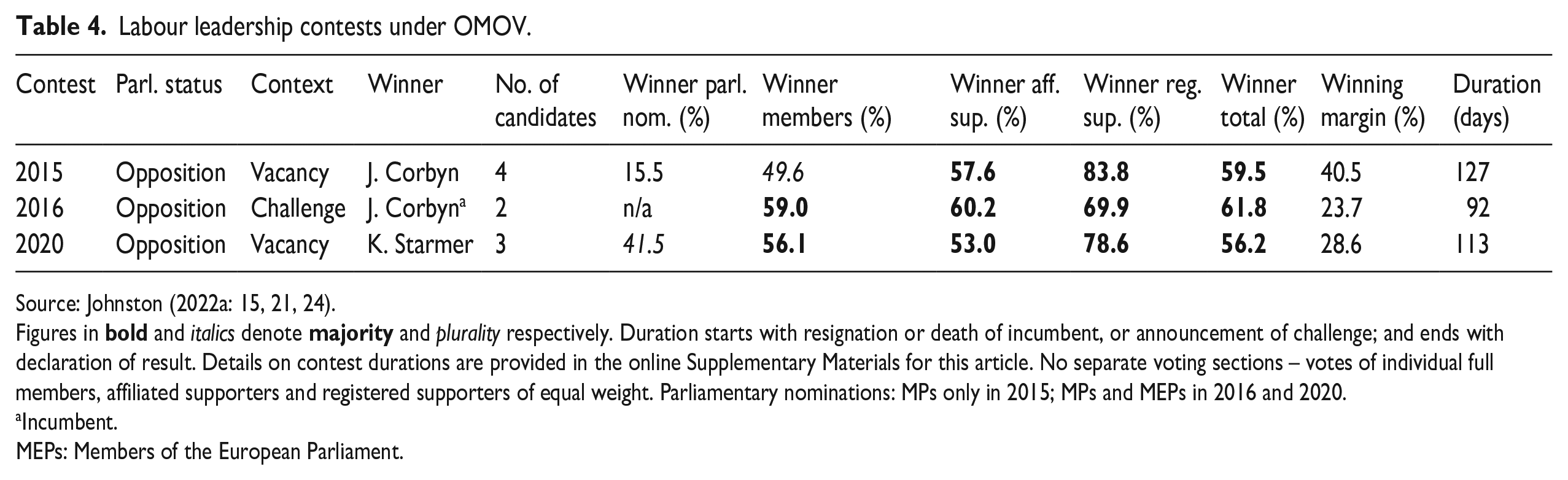
Source: Johnston (2022a: 15, 21, 24).
Figures in
Incumbent.
MEPs: Members of the European Parliament.
Corbyn’s win appalled Labour MPs, who considered him completely unacceptable (Crines et al., 2018). This was evident in Corbyn’s shadow cabinets. His first was boycotted by numerous senior figures from the centre and right of the PLP. This was followed by a wave of resignations in 2016, leaving the shadow cabinet reliant on the minority of radical-left MPs and those first elected in 2015. It resulted in a dysfunctional parliamentary operation. Corbyn dealt with splits over the Trident nuclear-missile system and military action in Syria with ‘free’ (unwhipped) votes, which are normally used in issues of conscience. Under Corbyn, they became ‘agreements to disagree’ and reflected his inability to engender cohesion in the PLP (Denham et al., 2020: 214–218; Quinn, 2018b).
Corbyn’s victory in 2015 and a follow-up triumph in 2016 are clear instances of a leader imposed by party members on unwilling MPs. Starmer’s win in 2020 was the first time OMOV delivered a leader acceptable to the PLP (Heppell, 2021). Starmer’s subsequent failed attempt to revive the electoral college indicated that he held OMOV responsible for Corbyn’s victories. But is this correct? OMOV is mediated by PLP control at the nomination stage. The key decision in 2015 was the circumventing of the rules to loan Corbyn nominations, frustrating the purpose of the mechanism. It was an act of complacency by Labour MPs that enabled everything that followed (Quinn, 2016). Realising the left could not always rely on such naivety, Corbyn’s allies reduced the nomination threshold to 10% in 2018. Starmer in turn raised it to 20%, a major barrier to left-wing candidates (Johnston, 2022a: 31–33). The nomination threshold is one of the most contested parts of Labour’s rule-book precisely because it is a PLP gatekeeping power (Quinn, 2018a).
Eviction
As with previous Labour selection systems, OMOV provides for leader eviction through a formal challenge by a named politician (Johnston, 2022a: 8–9). Rules on the timing of contests arising from challenges remain unchanged from the electoral college. Expanding the selectorate beyond the PLP gave the extra-parliamentary party a say in whether incumbent leaders are evicted. The 20% nomination threshold for challenges was intended to offer incumbents security from frivolous challengers. But not all challenges are frivolous, and this points to two problems in Labour’s system. First, it is difficult to mobilise 20% of MPs to nominate a challenger in anything other than extraordinary circumstances, as the non-challenges to Brown in the electoral college showed (Quinn, 2012: 86–94).
Second, even in extraordinary circumstances, as when the PLP tried to remove Corbyn in 2016, success depends on members’ support. Labour MPs faced a dilemma: they had no confidence in Corbyn, but polls of party members showed he would easily win a leadership contest. Therefore, the MPs organised an unofficial no-confidence vote, by secret ballot and restricted to the PLP. They hoped to force Corbyn’s resignation by demonstrating he had lost his authority. Corbyn was heavily defeated by 172 votes to 40, with 18 abstentions. But the ballot had no formal standing and Corbyn dismissed it, citing his mandate from members (Crines et al., 2018; Quinn, 2018b: 45–48).
That left only a leadership challenge, which was initiated by a former frontbencher, Owen Smith. Smith was nominated by 162 of Labour’s 231 MPs, fully 70%. As the incumbent, Corbyn did not require re-nominating (Johnston, 2022a: 18–19). 9 Corbyn won the OMOV ballot convincingly, 62–38% (Crines et al., 2018; Denham et al., 2020: 218–223). When the possibility of a cross-party government emerged during the parliamentary conflict over Brexit in late-2019, it floundered on other parties’ unwillingness to accept Corbyn as prime minister (Allen, 2021; Russell and James, 2023: 261). Labour MPs had no appetite to attempt another putsch.
Eviction mechanisms are important ex-post powers for MPs if they lose confidence in their leader. Changing leader may help the parliamentary party restore unity and cohesion (Punnett, 1992: 169–175). If eviction is through a challenge in a leadership contest, a parliamentary-ballot system enables MPs to sound each other out and perform the deed quickly. Under OMOV, it is slower and may fail if the leader retains members’ confidence.
Timeliness
The duration of Labour’s three OMOV contests ranged from 92 to 127 days. Two occurred in the aftermath of general-election defeats, while the challenge to Corbyn was during the quieter summer months. In principle, it would be possible to accelerate contests to a few weeks if necessary. In this respect, OMOV is similar to the electoral college.
The Conservatives’ OMOV system
The Conservatives’ election defeat in 1997 followed a tumultuous period of factional conflict in government (Bale, 2010: 22–66). As with Labour activists in 1979, the Tory grassroots blamed their MPs for the defeat. To make the latter more accountable, activists demanded a say in leadership elections. The 1922 Committee, the organisational body for Conservative backbench MPs and guardian of the party’s leadership-selection procedures, agreed a review of the rules, although not until MPs had chosen John Major’s successor, William Hague.
MPs were balloted on their preferences and there was strong support to retain parliamentary predominance in leadership selection. Despite initially appearing to favour an electoral college, the Conservatives eventually settled on a two-stage procedure. Through a series of eliminative ballots, MPs would produce a shortlist of two candidates to put to party members, who would make the final choice in an OMOV ballot. The parliamentary ballots would remove candidates that MPs found unacceptable (Alderman, 1999: 264–265; Denham et al., 2020: 80–87; Quinn, 2012: 97–102).
Incumbent leaders would be evicted through no-confidence votes of MPs, rather than direct challenges, which were thought to encourage ‘stalking horses’, or, non-serious candidates (Alderman, 1999: 261–264). This would obviate the need for destabilising annual leadership contests. Confidence votes could be triggered by 15% of Conservative MPs demanding one in writing to the chairman of the 1922 Committee. The Committee backed down from an attempt to prescribe a 20% threshold amid a revolt by MPs (Alderman, 1999: 266–267; Quinn, 2012: 99). Incumbents required a simple majority in the secret ballot to survive. Incumbents who won confidence votes would be safe from a challenge for 12 months. A leader who lost a confidence vote could not participate in the leadership contest to replace him or her. The new system was formally introduced in 1998 and has been used to choose seven Conservative leaders (Table 5).
Conservative leadership contests under OMOV.
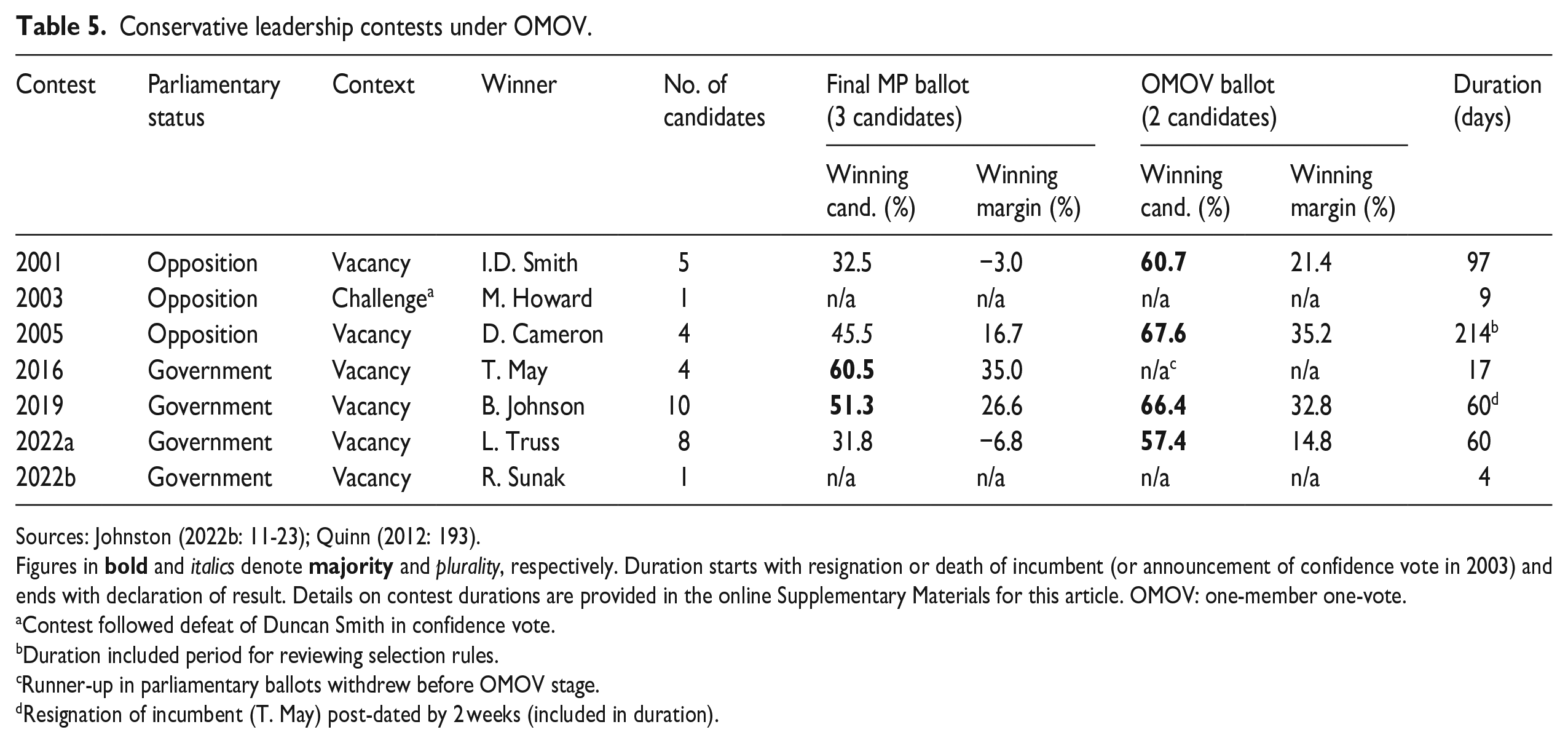
Sources: Johnston (2022b: 11-23); Quinn (2012: 193).
Figures in
Contest followed defeat of Duncan Smith in confidence vote.
Duration included period for reviewing selection rules.
Runner-up in parliamentary ballots withdrew before OMOV stage.
Resignation of incumbent (T. May) post-dated by 2 weeks (included in duration).
Legitimacy
Concerns over legitimacy in the Conservatives’ system focus on the interaction of the parliamentary and OMOV ballots. The parliamentary ballots do not formally function to indicate MPs’ collective preference over the leadership because they produce two candidates, not one. However, the ballots are widely interpreted that way inside and outside the party. Three problematic scenarios can arise.
First, competing legitimacies are possible. A candidate might be supported by a majority of MPs but lose the OMOV ballot. This has not yet happened, but could have occurred in the 2016 contest, held after the EU referendum. Theresa May won 199 of 330 MPs’ votes, while Andrea Leadsom came second with 84. As a Leaver, Leadsom was more aligned with the pro-Brexit preferences of members than the Remainer May (though trailed her in the polls). But a membership mandate for Leadsom might not have nullified May’s mandate from MPs. Any potential crisis was averted when Leadsom voluntarily withdrew before the OMOV ballot (Jeffery et al., 2018; Quinn, 2019).
Second, the winner’s legitimacy may hang haphazardly on the order in which minor candidates are eliminated. This is exacerbated by a tendency for the parliamentary ballots to operate as ‘dual primaries’ for the leading factions (Denham and Dorey, 2007). As candidates are eliminated, their support typically transfers to ideologically-adjacent candidates. In Figure 2, the centrist faction has 100 MPs split between three candidates, A, B and C, and the right-wing faction 80 MPs divided between candidates D and E. The first two rounds of voting see B and then E eliminated. In the final round, D wins all 80 right-wing votes, but C and A split the centrist bloc 55-45. D enters the OMOV stage claiming a plurality of MPs by monopolising the right-wing vote. This depended on B’s supporters dividing 15-10 for A over C in the second round, enabling A to overtake E. If B’s supporters, noting C’s frontrunner status, split 20-5 for C, then A would win 35 votes in the second round, trailing E on 37. A would be eliminated. C would then monopolise the 100-strong centrist vote in the third ballot, with D on 43 and E on 37. C would still face D in the OMOV stage but with majority support from MPs.
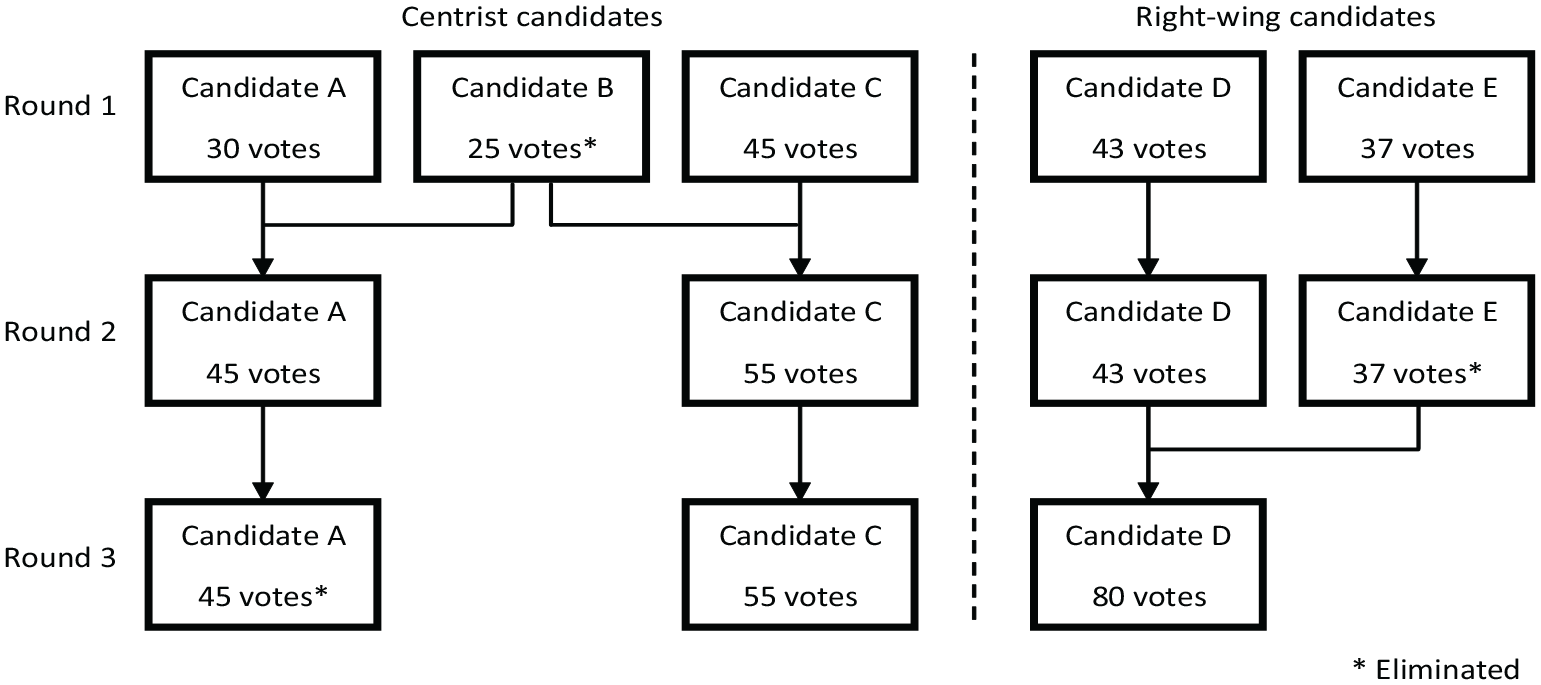
‘Dual primaries’ in conservative parliamentary ballots (post-1998 rules).
Third, the system incentivises strategic voting. Going back to the previous example, suppose candidates C and D were ideologically equidistant from the median party member (M), while A was more distant (Figure 3). With sincere voting by MPs, D is on course to win 80 votes in the final parliamentary ballot and face C (55 votes) in the OMOV stage. The race would be close because of C and D’s joint proximity to M. But if D persuaded 12 of her supporters to vote strategically for A in the final parliamentary ballot, D would still finish first (68 votes), but A would pip C 57-55 for second place. D would then face an easier task in the OMOV stage against the ideologically-distant A. Strategic voting can undermine the winner’s legitimacy if it is seen as attempting to ‘rig’ the contest and thwart candidates popular with the membership.

Sincere versus strategic voting in conservative parliamentary ballots (post-1998 rules).
Strategic voting was widely rumoured in the 2005 contest, when David Cameron was thought to prefer facing David Davis over Liam Fox (Denham and Dorey, 2007). In 2019, the final parliamentary ballot saw Boris Johnson face fellow Brexiteer, Michael Gove, and Remainer, Jeremy Hunt. Some Johnson supporters were believed to have voted for Hunt to ensure Gove’s elimination (by two votes). Hunt was considered an easier opponent for Johnson in the ballot of the pro-Brexit membership (Denham et al., 2020: 121; Quinn, 2021).
Parliamentary acceptability
A persistent complaint about the Conservatives’ OMOV system is that it enables a right-wing membership to impose unsuitable leaders on the parliamentary party. In this vein, Iain Duncan Smith in 2001 and Liz Truss in 2022 are commonly cited (Heppell, 2008: 147–152; Russell, 2022). Yet, the charge seems overstated.
First, surveys of Conservative members show they are less right-wing than Tory MPs on economic policy. Although the members are more socially conservative than MPs, they are less so than Tory voters. On Brexit, there is little difference between MPs and members (Bale et al., 2020a; Wager et al., 2022). It was Conservative MPs who selected the right-wing Thatcher in 1975 and the Eurosceptic Hague in 1997 (Heppell, 2008: 51–69, 115–129; Heppell and Hill, 2008). MPs and members alike preferred the centrist moderniser Cameron in 2005 (Dommett, 2015; Hayton, 2012: 40–58) and the Brexiteer Johnson in 2019 (Jeffery et al., 2022; Quinn, 2021).
Second, the system was designed to ensure that leaders were acceptable to MPs through preliminary parliamentary ballots. Any candidate whose support is weak among MPs struggles to navigate these ballots (Alderman, 1999; Bogdanor, 2022).
Third, MPs still control most leadership-selection rules. Although the party’s constitution requires ‘a choice of candidates’ to be offered to the members, the details, including nomination thresholds and even the number of candidates sent through to the OMOV stage, are decided, and can be changed, by the 1922 Committee’s executive, in consultation with the Party Board (Conservative Party, 2021: Sched. 2, Para. 3; 1922 Committee, 2008: Para. 3). This gives the system considerable flexibility. For instance, candidates’ nomination requirements were initially two MPs but were increased to eight in 2019, 20 in July 2022 and 100 in October 2022 (Booth et al., 2023; Jeffery et al., 2022, 2023). Higher thresholds make it more likely that winners are broadly acceptable to MPs.
Five of the system’s seven contests left no questions over the winner’s acceptability. Johnson won a majority of MPs, while Cameron secured a solid plurality (Table 5). May won 60.5% of voting MPs in 2016, prompting the withdrawal of Leadsom, who won 25.5%. Leadsom explained that this was not ‘sufficient support to lead a strong and stable government should I win the leadership election [at the OMOV stage]’ (Johnston, 2022b: 18).
Two other contests were won by the sole nominee. MPs united behind Michael Howard after Duncan Smith’s defeat in a confidence vote in 2003 (Heppell, 2008: 155–170). In the aftermath of Truss’s chaotic 6 weeks as prime minister and subsequent resignation in 2022, the Conservatives again recoiled from a full-blown contest. Rishi Sunak was the only candidate to submit the necessary nominations of 100 MPs (28% of 357). Johnson collected sufficient nominations, but declined to submit them when it became clear how many MPs would refuse to serve in his ministry (Booth et al., 2023). 10 The 2003, 2016 and October 2022 contests thus all had the OMOV stage curtailed; in each case, it was at least partly because of fears that party members might disagree with MPs.
The ‘coronations’ of Howard and Sunak followed the two contests cited as instances of the members imposing unacceptable leaders. Both Duncan Smith and Truss were right-wingers who finished second in the parliamentary ballots before winning the OMOV ballot (Heppell, 2008: 131–153; Quinn, 2012: 103–107). The choosing of each brought complaints about the rules: Duncan Smith’s successor, Howard, made a failed attempt to reintroduce selection by MPs in 2005 (Johnston, 2022b: 25–27); and after Truss’s resignation, the 1922 Committee mandated an indicative vote among MPs on the final two candidates in October 2022 to steer the members’ choice (ultimately not needed) (Booth et al., 2023).
But were party members really to blame? The weak authority of Duncan Smith and Truss arguably had more to do with the lack of parliamentary consensus around any candidate because of cross-cutting factional divisions. In both cases, there was a close three-way split in the final parliamentary ballot. In 2001, just 3.6% separated Kenneth Clarke in first place from Michael Portillo in third. In 2022, Sunak won 38.6% of MPs, Truss 31.8% and Penny Mordaunt 29.6%. In both contests, leading candidates were unacceptable to the supporters of others. 11 The pro-EU Clarke was anathema to Duncan Smith’s Eurosceptic followers, and Portillo was unacceptable to social conservatives. Notably, after removing Duncan Smith in 2003, MPs rallied behind another socially-conservative Eurosceptic, indicating that credibility, not ideology was the problem (Quinn, 2012: 105–107). But Howard had not been a candidate in 2001; MPs and members had to select from those available.
In 2022, Sunak was considered disloyal and a high taxer by the right, while Mordaunt’s views on transgender rights dismayed traditionalists. Truss was arguably the least divisive candidate of the final three and would eventually secure more parliamentary endorsements than Sunak (Bogdanor, 2022; Jeffery et al., 2023). Both Duncan Smith and Truss were firmly within the ideological mainstream of their parliamentary parties. Both were senior frontbenchers when they won the leadership (foreign secretary in Truss’s case). Neither was comparable to Corbyn in the Labour Party.
Three-way divisions of MPs are always possible in the Conservatives’ system. Leaders like Duncan Smith and Truss can find their authority damaged from the start. Each could plausibly (not definitely) have won head-to-head parliamentary ballots against their respective opponents, Clarke and Sunak, neither of whom could win 40% of MPs. The interaction of the parliamentary and OMOV ballots is a fundamental weakness in the Tories’ selection system.
Eviction
The Conservatives’ system splits the process of leader eviction from leader selection. The former entails a formal confidence vote among MPs only, making them a ‘de-selectorate’ with ex-post powers to overturn the members’ choice (Alderman, 1999). MPs can thus remove a leader they no longer consider acceptable, ruling out a Corbyn-type scenario where members keep the leader in place against the wishes of parliamentarians. Preventing defeated incumbents running in the following contest stops the leader appealing over MPs’ heads to the membership. A confidence vote obviates the need for a named challenger to take the risk of triggering a contest, in principle making eviction easier (Alderman, 1999; Quinn, 2005). It re-emphasises how the Conservatives’ OMOV system prioritises the acceptability of leaders to MPs.
The confidence-vote procedure has been used three times (Table 6). The first, in opposition in 2003, saw Duncan Smith defeated 90-75. The other two were in government and both prime ministers survived, albeit temporarily. May won 200-117 during the parliamentary struggle over Brexit in 2018. In 2022, Johnson won 211-148 while beset by scandal (Jeffery et al., 2023; Quinn, 2021; Roe-Crines et al., 2020). The latter two ballots were held on the day the 1922 Committee’s chairman publicly announced the 15% threshold had been reached. Thus, both officially lasted 1 day, significantly quicker than a leadership challenge in Labour’s system. However, all three confidence votes were preceded by months of speculation about whether the threshold would be met (Johnston, 2022b).
Conservative confidence votes.
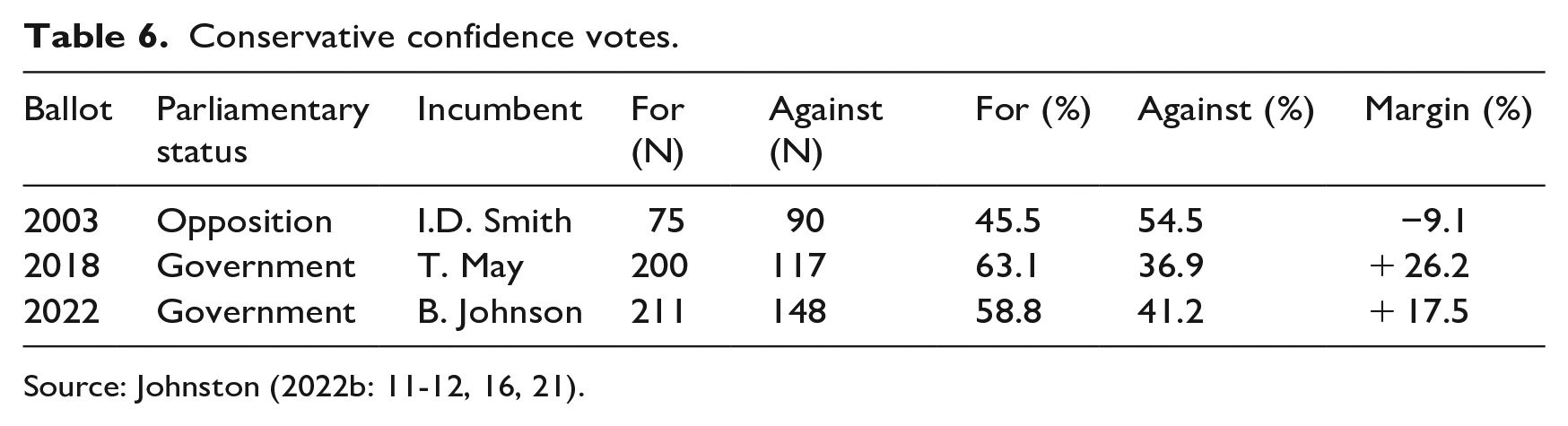
Source: Johnston (2022b: 11-12, 16, 21).
A disadvantage of confidence votes is that they can undermine the authority of leaders who survive by putting a number on their opponents. Neither May’s nor Johnson’s victories resolved matters. Both were eventually forced out through other means, 6 months and 1 month later respectively. Opponents raised the prospect of changing the rules to permit more frequent votes than the 12 months allowed (Howarth, 2021). Ultimately, that was not required, with both resigning, although in Johnson’s case, only after a ministerial revolt (Jeffery et al., 2023).
Timeliness
The long 2001 and 2005 contests took place after election defeats and saw the party debate the way forward during a quiet period in the political calendar. The contests of 2003, 2016 and October 2022 did not entail OMOV ballots. The 2019 and July-September 2022 contests in government took place in the summer months. Even so, few wanted a second long contest in 2022 and so a high nomination threshold and provisions for an online-only OMOV ballot were set in October 2022. The system thus has sufficient flexibility to permit either long or short contests, depending on the circumstances.
Discussion and conclusion
Critics of inclusive leadership-selection systems argue that they risk burdening parties with leaders possessing insufficient parliamentary authority (Punnett, 1992; Russell, 2022). Only the selection of leaders by MPs can guarantee the efficient functioning of the major parliamentary parties. How accurate is this assessment? Deploying an original set of evaluative criteria, this article’s survey of inclusive selection systems showed that while all had weaknesses, most sub-optimal outcomes were not primarily the fault of the institutions.
OMOV was justified on the grounds of legitimacy, with a broader selectorate preferable in a participatory age (Kenig, 2009b; LeDuc, 2001). Furthermore, recent research has questioned the view that party members are ‘extreme’ (Bale et al., 2020a, 2020b; Norris, 1995; Wager et al., 2022; cf. May, 1973). Conservative members selected Duncan Smith, but 4 years later chose Cameron (Denham and O’Hara, 2008; Hayton and Heppell, 2010). Labour members voted twice for Corbyn, but preferred Starmer to the left-wing Rebecca Long-Bailey as his successor (Heppell, 2021).
Complaints that contests in government from 2016 to 2022 allowed small and unrepresentative selectorates to choose the prime minister can be dismissed. MPs constitute an even smaller group than party members, and may be as unrepresentative (Wager et al., 2022). The logic of these calls is for general elections whenever a prime minister resigns. However, prime ministers are not directly elected in parliamentary systems, but chosen by governing parties.
There is a valid debate over whether party members constitute an appropriate selectorate amid declining membership (Van Biezen et al., 2012). In 2022, the Conservatives had 172,000 members and Labour 432,000, just 0.4% and 0.9% respectively of the electorate (Burton and Tunnicliffe, 2022: 4–5). The era of permanently high memberships is probably over (Scarrow, 1996, 2014). But while parties still need members for activism, finance and personnel for elected office, they must offer incentives to recruit and retain them (Seyd and Whiteley, 1992; Whiteley et al., 1994). Voting rights in leadership contests are important selective incentives (Cross, 2013; Young, 2013).
Some of the strongest complaints of illegitimacy in inclusive systems concern over-expanded selectorates. Labour’s electoral college was bedevilled by criticism of union influence (Quinn, 2004a). Its OMOV system was criticised for allowing hundreds of thousands of individuals to sign up cheaply and cast ballots (Dorey and Denham, 2016). This danger is inherent in online mobilisation. However, 6-month ‘freeze dates’ and the abolition of the registered-supporter category will make ‘entryism’ and ‘packing’ more difficult. Labour’s experience will probably reduce demands for open primaries to replace OMOV (Alexandre-Collier, 2016).
Arguably more important than the selectorate are screening mechanisms to produce leaders acceptable to MPs. Parliamentary ballots ensure that the winner secures the support of their party’s median MP. That is not guaranteed in inclusive systems, but high parliamentary nomination thresholds favour candidates from mainstream parliamentary factions (Quinn, 2018a). In the 2015 Labour contest, this mechanism was purposely deactivated by MPs and that decision, more than anything else, explained why the PLP found itself with a leader it considered unacceptable. The current 20% threshold is a high hurdle: no left-wing candidate has secured this level of support from MPs, either as votes or nominations, in a Labour leadership contest in the electoral college or OMOV systems. The 20% threshold also makes it easier for the PLP to organise ‘coronations’ and avoid OMOV ballots, particularly when an incumbent resigns in government and stability is needed. The price of coronations, however, may be tainted legitimacy.
The Conservatives have two parliamentary screening mechanisms: nomination thresholds and preliminary ballots. The former have been increased in recent contests, reaching 28% in October 2022. The latter make it difficult for minor candidates to reach the OMOV stage. Yet, complaints about Duncan Smith and Truss being foisted on MPs by party members are common (Heppell, 2008: 147–152; Russell and James, 2023: 328). Truss won just 31.8% of MPs’ votes in 2022 and Duncan Smith 32.5% in 2001. But both were on three-way splits of the vote, with no candidate reaching 40%.
The retention of parliamentary voting in the OMOV system reflected MPs’ reluctance to give up their power. But it creates problems, not so much of acceptability than legitimacy: candidates can win OMOV ballots having publicly failed to win even pluralities of MPs. This is a design flaw in the Conservatives’ system: the parliamentary ballots are a de-facto nomination stage for the OMOV ballot, but because they entail MPs voting, they are interpreted as bestowing legitimacy. Viewed as parliamentary nominations, Duncan Smith’s and Truss’s respective support compared favourably with passing a 20% threshold. But as votes, both fell short of a parliamentary plurality and found their authority instantly undermined. Piecemeal changes such as allowing MPs to hold an indicative vote on the final two candidates could backfire if the members simply ignored it.
The criterion of eviction involves a trade-off between security of tenure and removing unpopular/unacceptable leaders. Neither party has struck the right balance. It is hard for Labour MPs to remove a leader who has lost authority. Triggering a contest is difficult, notwithstanding Smith’s 2016 challenge to Corbyn. The latter entailed a collapse in confidence in Corbyn among Labour MPs, with 70% nominating the challenger (Johnston, 2022a: 19). Such challenges would occur in almost any system.
A better illustration is the lack of a formal challenge to Brown in 2008–2010 (in the electoral college). Despite widespread dismay among Labour MPs with Brown’s performance, the chances of a challenge looked remote. It required a named challenger to emerge, probably first resigning from the cabinet. They would then need 20% of Labour MPs publicly to nominate them, with the risks that could pose to the latter’s careers. Unsurprisingly, no-one entered the fray (Quinn, 2012: 86–94).
Corbyn’s survival in 2016 points to a second problem with Labour’s system. Given the means of eviction is a leadership election, PLP discontent will not dislodge the leader if s/he retains the members’ confidence. Non-institutional methods could be used, such as mass resignations, but that was tried with Corbyn and failed. Arguably, this is a more effective tactic in government because of the necessity to have sufficient frontbenchers to form a ministry. It was deployed on a smaller, demonstrative scale against Blair in 2006 to accelerate his retirement (Heppell, 2010: 183–185). Nevertheless, while the PLP has strong ex-ante controls through the 20% nomination threshold, its ex-post controls remain weak.
The Conservatives’ selection system contains ex-ante and ex-post parliamentary controls. The latter is the confidence-vote procedure that enables MPs to overturn the members’ choice (from 12 months after their election-Johnston, 2022b: 10). The procedure helps ensure leaders remain acceptable to MPs, and when they no longer are, a challenge may be forthcoming. The 15% trigger for a vote entails MPs writing confidential letters to the chairman of the 1922 Committee, not publicly backing a challenger. The lower threshold, the anonymity of the process and the unnecessity of a contender combine to make challenges easier to activate than in the Labour Party (Quinn, 2005). It might be too easy: confidence votes damaged the authority of May and Johnson, while leaving both (temporarily) in place. The flexibility of the rules means threats to change them to permit more frequent votes have credibility. That appeared set to happen with Johnson in 2022 had a wave of ministerial resignations not happened first (Booth et al., 2023).
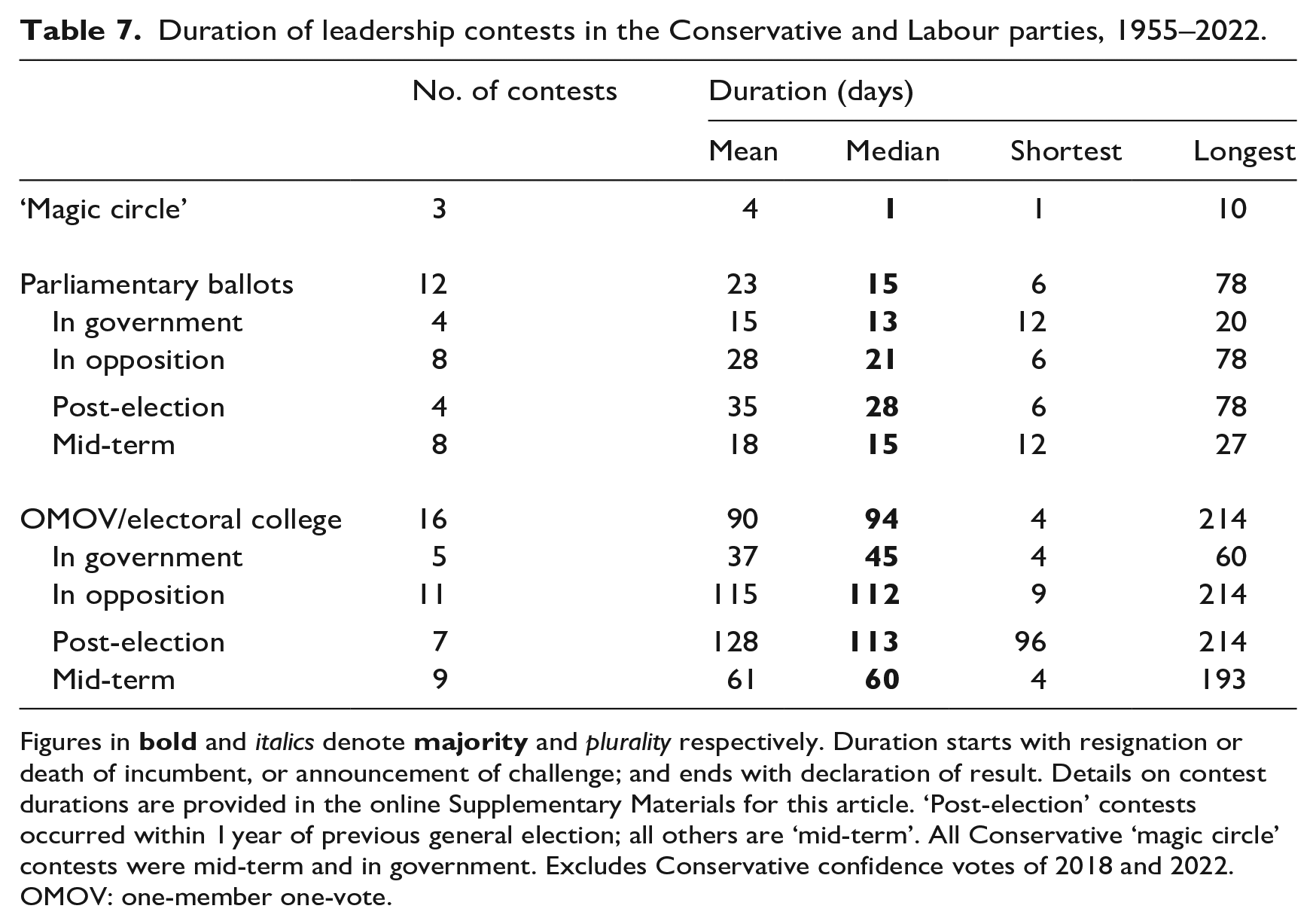
The shift to inclusive systems has resulted in longer contests. Parliamentary ballots in both parties from 1955 to 1997 lasted a median of 15 days (Table 7). Only the three contests in the Conservatives’ ‘magic circle’ (1955 to 1963) were quicker. Contests in inclusive systems (electoral college and OMOV), lasted a median of 94 days, but 45 days in government. 12 Inclusive contests in opposition lasted nearly 4 months, usually after an election defeat as the party debated the way forward. In these circumstances, a long contest in the country may be preferable to a short one at Westminster.
Duration of leadership contests in the Conservative and Labour parties, 1955–2022.
Figures in
Even with inclusive systems, parties can accelerate contests if necessary. In the October 2022 Conservative contest, the 1922 Committee stipulated very high nomination thresholds and online membership voting over 3 days (ultimately not needed). However, the Committee generally allows contests to proceed over the summer. Likewise, Labour’s NEC has autonomy in setting leadership-election timetables. The obstacles to timely contests under OMOV can be surmounted, but parties sometimes prefer longer contests.
Both parties use OMOV systems mediated by ex-ante and/or ex-post parliamentary controls. This is a concession to the realities of majoritarian democracy. Labour’s experience under Corbyn, with the deactivation of the nomination threshold, offered a glimpse of ‘pure’ OMOV. But any imminent return to parliamentary ballots looks unlikely. Defeated governing parties often face demands for greater grassroots control, which once accommodated, are hard to reverse (Alderman, 1999; Quinn, 2004b).
Each party could learn from the other. The Conservatives’ mixed selectorate of MPs and members creates legitimacy problems. They might be better dispensing with parliamentary ballots and using high nomination thresholds to ensure leaders’ acceptability to MPs. Labour’s eviction mechanism protects overstaying leaders. A confidence-vote procedure, restricted to MPs, would enable the PLP to pursue timely changes of leader. The overall lesson is that OMOV is adaptable.
Supplemental Material
sj-pdf-1-bpi-10.1177_13691481231191915 – Supplemental material for Parliamentarians versus party members? Leadership selection systems in the British Conservative and Labour parties
Supplemental material, sj-pdf-1-bpi-10.1177_13691481231191915 for Parliamentarians versus party members? Leadership selection systems in the British Conservative and Labour parties by Thomas Quinn in The British Journal of Politics and International Relations
Footnotes
Acknowledgements
The author thanks the editors and two referees for their helpful comments on a draft of this paper.
Funding
The author(s) received no financial support for the research, authorship and/or publication of this article.

Supplemental material
Additional supplementary information may be found with the online version of this article.
Notes
References
Supplementary Material
Please find the following supplemental material available below.
For Open Access articles published under a Creative Commons License, all supplemental material carries the same license as the article it is associated with.
For non-Open Access articles published, all supplemental material carries a non-exclusive license, and permission requests for re-use of supplemental material or any part of supplemental material shall be sent directly to the copyright owner as specified in the copyright notice associated with the article.
