




Abstract
Intra-party politics has long been neglected due to lacking data sources. While we have a good understanding of the dynamics of ideological competition between parties, we know less about how individuals or groups inside parties influence policy, leadership selection and coalition bargaining. These questions can only be answered if we can place individual politicians and sub-party groups like factions on the same dimensions as in inter-party competition. This task has been notoriously difficult, as most existing measures either work on the party level, or are in other ways determined by the party agenda. Social media is a new data source that allows analyzing positions of individual politicians in party-centered systems, as it is subject to limited party control. I apply canonical correspondence analysis to account for hierarchical data structures and estimate multidimensional positions of the Twitter accounts of 498 Members of the German Bundestag based on more than 800,000 tweets since 2017. To test the effect of intra-party actors on their relative ideological placement, I coded the faction membership of 247 Twitter users in the Bundestag. I show that Twitter text reproduces party positions and dimensions. Members of factions are more likely to represent their faction’s positions, both on the cultural and the economic dimension.
Introduction
Intra-party conflict is an often neglected, albeit important dimension of party politics. It is highly important for changes in party strategies and positioning (Bowler et al., 1999; Budge et al., 2010; Wagner and Meyer, 2014), leadership selection (Greene and Haber, 2016) and coalition politics (Bäck et al., 2016; Ceron, 2016a).
A common way of organizing this conflict inside parties are factions of principle (Sartori, 2005), groups of party members who share an ideological predisposition inside the bounds of the party. These factions of interests or party wings position themselves along the dimensions of inter-party competition and attempt to influence leadership selection, party strategy and policy. But do members of these factions express differing ideological positions?
To measure ideological differences, I apply spatial models of politics (Laver, 2014) to individuals inside parties. In parliamentary systems, this presents a daunting task, as common measures of positions like roll-call votes (Poole and Rosenthal, 1985) and election manifestos mainly reveal party positions. As an alternative, social media data is an established data source to estimate preferences of users, parties and legislators on a common scale. Social media gives individual party members the ability to communicate their political positions with no consequence for government stability and little agenda control by the party (Ceron, 2016b). Up until now, these measurements are mainly validated for the U.S. context where individual-level measurements are available (Barberá, 2015). I suggest a way to conceptualize political position taking on social media in such terms as we can apply text-based position measurement (Laver et al., 2003; Proksch and Slapin, 2010) that addresses the main issues of social media data. I apply correspondence analysis (Greenacre, 2007; Lowe, 2016) to 800,000 tweets of 498 Members of the German Bundestag. I show that the dimensionality of policy positions of individual Members of Parliament (MP) mirrors the political dimensions found in expert survey data on the party level, both in terms of expected party position and substantive content of the policy dimension.
Based on a qualitative evaluation of faction membership for 247 MPs with Twitter accounts, I show that members of ideological factions express their ideology relative to their partisans both on the economic and cultural dimension.
Parties and their inner conflicts
Parties are often seen as unitary actors, as they propose a common position that the leaders, or maybe even most of the members, compromised on. These positions are elemental for coalition bargaining, campaigning and governing, but are heavily influenced by intra-party processes. The recent focus (Polk and Kölln, 2017) on these intra-party conflicts reflects the overwhelming anecdotal influence of conflicting groups inside parties influencing policy and personnel decisions.
Budge et al. (2010) argue that replacement mechanisms inside parties heavily determine the final positioning of parties. Ceron and Greene (2019) show that these conflicts change the salience of issues in manifestos, while Greene and Haber (2016) show this effect for leadership selection.
Beyond internal decision making, this diversity influences government formation (Ceron, 2016a) and coalition negotiation (Bäck et al., 2016; Giannetti and Benoit, 2009). They result from negotiations and conflicts between heterogeneous actors inside the same party, may they be individual candidates or organized subgroups, so-called factions.
Factions and tendencies
Factions are considered any kind of party subgroup, from personal network to ideological club. While factions are involved in leadership or policy struggles, they are not necessarily ideological in nature. Typical factionalized parties such as the Japanese Liberal Democratic Party are not split along ideological lines, but personal networks of patronage (Boucek, 2009).
Sartori (2005) called ideological groups “factions of principle.” Differences, even “ideological” ones, do not necessarily need to mirror the main dimensions of party competition, but can also reflect differences on other issues or dimensions of political conflict. These conflicts can be understood in spatial terms (Laver, 2014), meaning that factions, like parties, occupy a position on one or more policy dimensions. To be influential in terms of party competition and coalition bargaining, differences produced by factions need to be visible in their member’s position on the relevant dimensions of inter-party competition.
Intra-party groups which align themselves ideologically along the main dimensions of party competition I call wing, if officially organized, or tendency, if not. They represent certain positions inside a political party (Bettcher, 2005) that might conflict with one another.
Positions of faction members
So how will ideological conflict present itself in intra-party politics? Individual politicians, just as parties, can be considered seeking office, policy and votes (Strøm and Müller, 1999). If a faction aligns along a relevant dimension of political conflict, we would assume policy-seeking members of this faction will share their ideology. Party members who make the active choice to join an ideological faction therefore signal position in ideological intra-party conflict. However politicians can also be merely office or vote-seeking, being dependent on faction-based patronage networks, and therefore strategically take their position (Bernauer and Bräuninger, 2009; Ceron, 2016b). Analogously, we would assume that members of a party wing are close to their own party, but also take a faction-influenced position inside their party. To test this concept of intra-party spatial conflict, we need to observe some degree of individual positioning inside political parties.
Observing conflict on Twitter
Intra-party conflict is a part of political reality, but has only recently found major scholarly attention, mainly since parties go out of their way to hide it. As Greene and Haber (2015) show, voters punish parties that seem divided, so parties attempt to apply discipline (Andeweg and Thomassen, 2011) to act and appear united.
This limits the expression of dissent and makes it difficult to observe from the outside. One way to do so is the use of elite surveys. Carroll and Kubo (2019) present an internationally comparable measurement of intra-party heterogeneity while Steiner and Mader (2019) show the effect of this heterogeneity on issue salience. Jankowski et al. (2019) demonstrate the validity of these methods to measure changes over time. However, elite surveys are limited in two major ways: First, they do not represent actual conflict, but only preference differences between members. Whether or not this translates into influencing the party line is not given. To measure conflict, the stated positions should matter more than preference heterogeneity. Second, due to anonymity the data can’t be linked to external data sources such as faction membership.
The traditional data source is the analysis of parliamentary rollcall votes to analyze party unity or individual positions. This approach to measuring individual-level positions was developed for the U.S. context (Poole and Rosenthal, 1985), where there is little incentive for party unity, but a large incentive to adapt to the voters in one’s constituency. This is not the case in parliamentary systems, in which the government depends on the parliamentary majority (Bräuninger et al., 2016). Roll-call votes against one’s party can have dire consequences and therefore induce the necessity of loyalty and possibly discipline, even if preferences deviate. This leads to roll-call vote analysis underestimating intra-party conflict in parliamentary systems.
A less dire form to state deviating positions is political communication (Laver et al. 2003), as talk is comparatively cheap. Speaking against the party is much less consequential than voting. Accordingly, parties are less likely to apply disciplinary measures. Accordingly, numerous contributions analyzed legislative speech (Bäck and Debus, 2018; Proksch and Slapin, 2010) to estimate positions in parliamentary systems. However, in many parliaments parties select who speaks for them in parliament (Proksch and Slapin, 2012). As speaking time is scarce, it will more likely be allocated to members who represent the party line.
But there are means of communication parties can’t influence directly. Interviews and quotes allow individuals to communicate deviant opinions but require a certain prominence and are potentially biased by the media. A specifically unrestricted and non-consequential form of communication is social media activity. Social media is comparatively free from agenda setting or selection power by political parties. An arena, in which personal preferences and individual strategic considerations dominate position taking.
Social media has been used successfully to estimate the preferences of users on Twitter (Barberá, 2015). As we are mostly interested in stated positions of politicians, we apply text analysis to position estimation on Twitter. Boireau (2014) and Ceron (2016b) apply Wordfish (Slapin and Proksch, 2008) models to the textual content to estimate positions on the left-right dimension. Ceron (2016b) shows that Twitter data produces valid estimates for individual politicians and uses these positions to successfully predict party fission and ministerial appointments. In this contribution, I extend the Wordfish approach to multiple dimensions and present a theoretical framework for this measurement. While Boireau (2014) briefly refers to Saliency Theory (Budge et al., 2001), it is not clear how this relates to the data generation process on Twitter. In the following section, I will present a way to account for the specific features of Twitter data.
Saliency theory and social media
Text analysis started mostly with the systematic analysis of party positions in the Comparative Manifesto Project (Budge et al., 2001) and led to numerous methodological innovations and countless substantive publications based on their data. While manifestos only provide party level data, the theoretical basis is also applicable to individual communication. Subsequently, these manifestos were analyzed without the original codings using quantitative text analysis (Laver et al., 2003; Proksch and Slapin, 2010). Based on the idea that specific words in political text are indicative for positions, the differences between word use is interpreted as distance. The assumption behind models like Wordfish and Wordscores (Laver et al., 2003) is to some degree based on Saliency Theory applied to manifestos before.
Budge et al. (2001) argue that politics as stated in manifestos is not directly oppositional. They do not take negative positions, but ignore the positive positions of the opponent and talk about their own issues. As Budge puts it, they are not pro-unemployment, but anti-inflation, therefore emphasizing their side of the issue and neglecting the opponent’s. Saliency Theory was developed for and during the research on party manifestos which are “carefully considered and finely honed documents” (Budge et al., 2001) a feature not necessarily applicable to tweets. Party manifestos mirror the full scope of the political space as they are drafted to be general and apply to all fields. They have a catch-all, encyclopedic character. Twitter however is the opposite of a controlled, thought-out political environment, but a place for individual members and officials as well as party accounts to communicate to the public constantly without topic restrictions and limitations, closer to press statements than manifestos. Grimmer (2010) describes the content of press statements of politicians as their “expressed agenda,” they signal attention toward a certain topic to their constituents. Press statements are used in the same way as Twitter: In contrast, they can be produced as often as wanted, are not limited to a certain timing and can be single issue. A single press statement does not contain a policy position as in Saliency Theory, but the combination does.
While Twitter data seems free, the reason for individual politicians to address a certain issue could be non-ideological. When we consider intra-party heterogeneity, we have to assume some division of labor. This is a problem of all individual salience measurement as there is heterogeneity inside parties in terms of shared workload. Parties have speakers for certain issue areas, send legislators into parliamentary committees and control government ministries. For politicians that have these roles, we need to account for this potential bias. I present a framework that allows modeling the hierarchical structure and multidimensionality.
Research design
These theoretical implications of measurement bias in parliamentary systems necessitate Twitter analysis of a party-centered parliamentary system with known dimensionality and according party wings. In this contribution, I will analyze heterogeneity in and between German parties. The main conflict in German politics is expressed in two dimensions. Traditionally, the economic left-right scale described party politics well enough. Over time, through further differentiation, the cultural dimension of liberal versus conservative attitudes became more important (Däubler, 2017). Accordingly, factions that will be considered as wings or tendencies have to be placed on at least one of these dimensions. Following Bräuninger et al. (2012), factions are coded as being relatively conservative or economically liberal in comparison to their party.
Heterogeneity in German parties
In the
The “natural ally” of the CDU are the
Traditionally, the
The
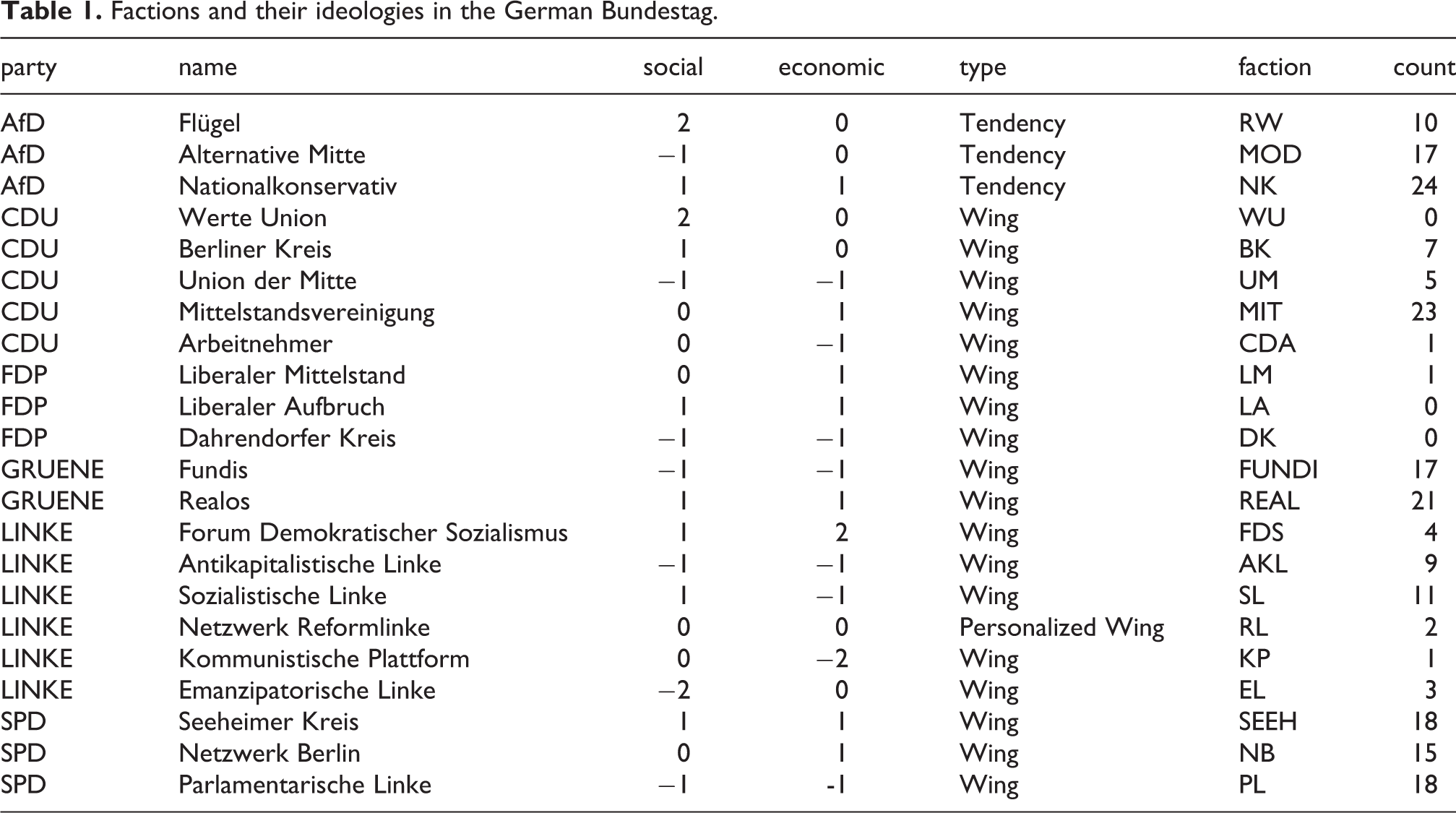
The membership in a faction is a more or less official act. Some factions are highly institutionalized and provide full member lists. Other “factions” can only be inferred by press articles or qualitative assessments. Bernauer and Bräuninger (2009) used a survey of MPs to assess themselves and others. In this study, faction membership was coded by the analysis of a wide number of sources (found in the Online Appendix). Based on 75 individual sources, faction associations for 246 MPs with Twitter accounts could be identified. Membership was coded if a news article, an official list or the MP themself in an interview reveals faction membership explicitly. For the AfD, official faction referrals are very rare. In press articles, members were labeled “moderate,” “national conservative,” “ultra-right” based on previous affiliations and actions of the MPs. While this is far from optimal, it again makes the case for the necessity to develop quantifiable measures for intra-party heterogeneity. Table 1 summarizes the expectations of MP behavior based on their orientation.
Factions and their ideologies in the German Bundestag.
I use the Twitter API implementation in the R package rtweet (Kearney, 2018) to collect data from the timelines of 500 German MPs for the year 2017. As retweets are considered affirmative, at least inside a party, a retweet is indicative of emphasis. However, I removed all Twitter handles, since they create artificial proximity of words of accounts. Analysis including hashtags and mentions creates slightly stronger clusters of parties, which can’t be considered common position, but a feature of social networks created by Twitter itself.
I relied on the Quanteda (Benoit et al., 2018) package to clean the data. To prepare the data, I removed all URLs, lower cased and cleaned for HTML code (like in emojis etc.). I removed stopwords, names of politicians, punctuation and numbers. Since tweets are quite informal and scaling mechanisms are very susceptible to clusters of unique terms, I removed very rare words (Slapin and Proksch, 2008), more particularly those words that were used by less than 100 accounts. This step is optional but otherwise requires removal of outliers later on. It also makes the wordplots used to evaluate the substantive content of the dimensions more difficult to interpret. Results from other specifications can be found in the Online Appendix.
As argued above, the assumptions of a purely ideological selection of issues and therefore expressed agenda do not necessarily hold for individuals inside political parties. To account for these effects, it is necessary to control for mechanisms that might lead to this behavior. To do so, I collected the committee memberships, government positions in ministries and mandate type of all members of the German Bundestag from the homepage www.abgeordnetenwatch.de, which is based on the less accessible database of the Bundestag.
4.2 Method: Canonical correspondence analysis
Measuring latent positions empirically means projecting them in lower dimensional political space. Two approaches dominate the literature: the theory-driven classification of particular issues as defining a dimension. The second approach is recovering the dimensions from the data itself, using methods of dimensional reduction (Benoit and Laver, 2012; de Vries and Hobolt, 2012). These approaches are inductive and require a posteriori interpretation. To allow interpretation, it is useful to consider additional results these models provide, the factor loading or feature scores used by the model to define the dimension and scale the position. For the analysis of social media, the creation of a priori dimensions is impossible due to the large amount of unstructured data.
While the substantive meaning of the many data sources available for position estimation differ, the methods applied to them have been quite similar (Lowe, 2016). To make qualified assumptions about the substantive meaning of the dimensions, we have to interpret the features which constitute the dimension. Based on this, we can interpret the proximity of the feature and the case as being similar and content-wise related. Lowe (2016) suggests correspondence analysis (CA) and biplots to maximize interpretability (Greenacre, 2007).
A major problem addressed in the previous section are non-ideological causes of salience. Due to intra-party division of labor, individual politicians might have issues they emphasize, not because they are more conservative, but because they represent their party on these issues. For example, members of the labor and welfare committee might discuss issues that are considered “leftist,” not because they are leftist themselves, but because they are members of the committee.
Ter Braak (1987) presents canonical correspondence analysis which incorporates multivariate analysis of “environmental” factors in the scaling of positions. Therefore, we can reduce the impact terms used by all members of a committee on the derived ideological position.
Dimensions and determinants of heterogeneity
Based on Twitter data since January 2017, I estimate the ideological position of 498 members of the German Bundestag who have active Twitter accounts. First, I will show the dimensionality of the Twittersphere and what issues and terms distinguish politicians from one another. Then, I will test the effect of faction membership on these respective dimensions.
Dimensions of Twitter space
Correspondence analysis extracts dimensions based on their ability to explain variation in the data. I chose the first three dimensions based on inspecting the screeplot (see Online Appendix figure 5,2). The main dimension of difference extracted from the model can be interpreted as the emphasis on migration (see Online Appendix). In other words, the biggest difference between politicians in Germany is whether or not they talk about refugees. The second dimension is the classical left-right dimension, while the third represents liberal emphasis not related to migration. Dimensions one and three can only be interpreted in combination with the underlying left-right dimension. They have to be separated.
To compute the economic left-right dimension I remove all terms which also correlate to migration and cultural salience and subtract the corresponding coordinates. To compute the cultural dimension, I add these migration and cultural terms to the left-right dimension and add the corresponding coordinates. The results are shown in Figure 1, the upper of which shows the positions of all 500 MPs in political space (I removed one outlier on the third dimension).
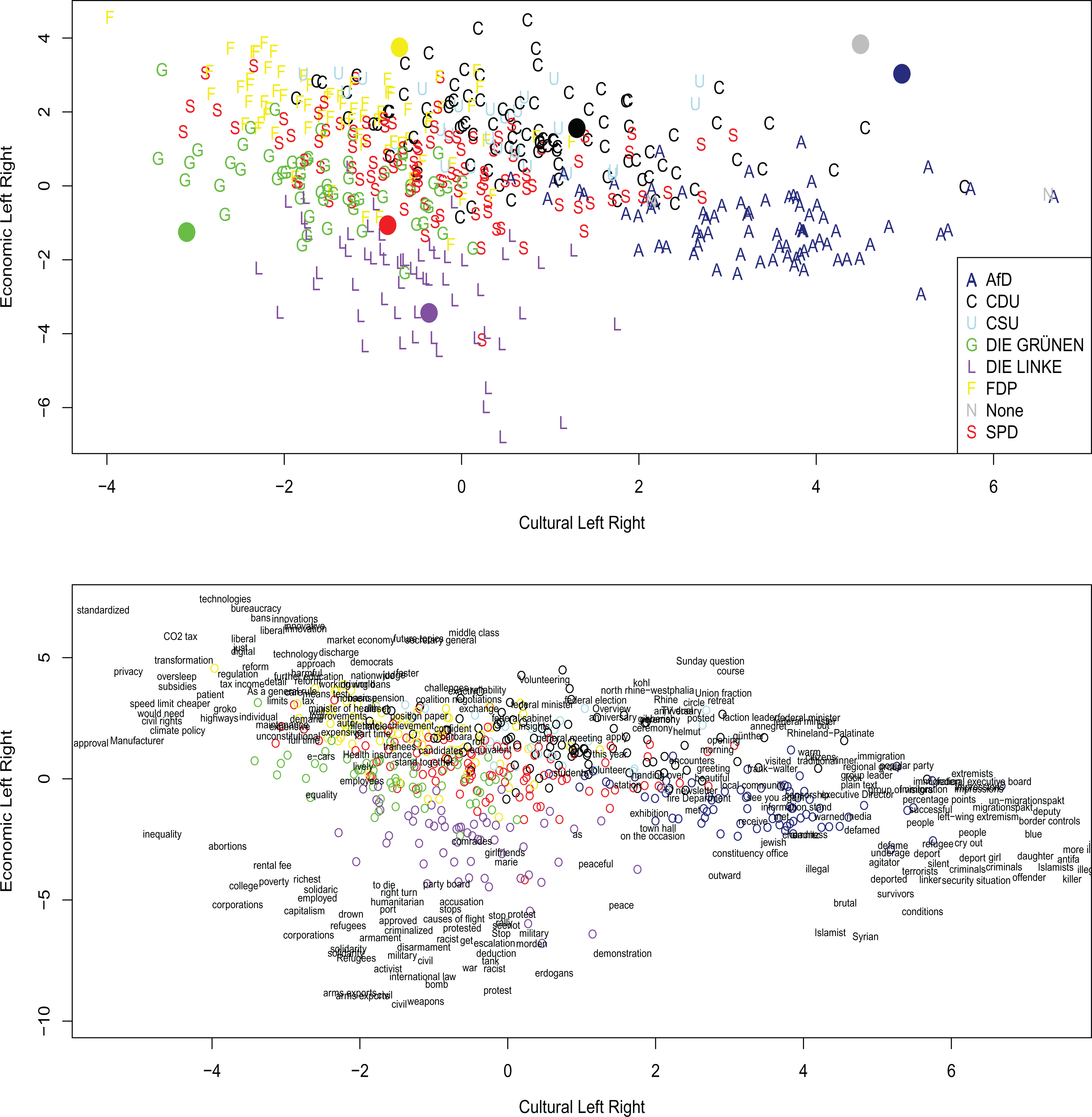
First and second dimension. Terms automatically translated and placed approximately. Dots indicate expected position based on CHES 2017.
We see the parties cluster as we would expect them based on the underlying dimensions. The expected positions from the Chapel Hill Expert Survey (Polk et al., 2017), scaled on the Twitter dimensions, overlap with the party clusters derived here. Only the AfD seems less economically conservative and the SPD very heterogeneous on the cultural dimension.
The terms are scaled accordingly and can be observed in the lower part of Figure 1. To validate my findings, I first substantiate the dimensions based on the content of the dimensions and the general party positions. Then, I test whether individual differences in faction membership influence the relative position inside their parties. In the upper left quadrant, we have terms related to civil liberties from civil rights to data protection. This area is occupied by the Liberals. Straight on top, we find terms like market democracy and middle class, subsidies and innovation. Moving to the left end of the spectrum, we see environmental issues, covered by the Green Party. In the overlapping areas, we find terms like CO2 taxation, highways, regulation. Moving down the economic left-right scale, we find cultural left-wing issues such as women rights, abortion, equality and equal pay. Further down in the area of the Left Party, we see straight up terms such as capitalism, solidarity, rents, pensions. Moving along on the cultural axis, we now find issues like refugees and anti-war efforts. In the center of the distribution, we find the quite scattered SPD, some of which are part of the FDP cluster, while some move quite for the cultural right, overlapping with the CDU. The CDU occupies issue areas that are quite “apolitical.” Their tweets mainly communicate party events and district visits. However, some are scattered into FDP territory while some are closer to the AfD. The AfD is the most separate cluster. In contrary to expert surveys, the AfD is not economically right-wing. It is about as conservative as the SPD and less conservative than the CDU. Instead, the AfD polarizes heavily on the cultural dimensions. They occupy terms such as migrant, illegal, terrorism, deportation and border control. While this seems to be surprising, the cause is that the AfD talks about little else, and specifically not about social or economic issues. This is why the model can’t really judge the AfD’s economic position and scales them at 0.
Factional determinants of positions
After substantiating the meaning of the dimensions and successfully placing the party clusters, the question remains whether the extracted positions are valid on the
Based on the concept of a two-dimensional policy space and the relative factional orientations, I test their effect on the respective dimensions. All in all, 247 individuals identified with both a Twitter account and a faction membership or known ideological orientation. Each of them was assigned their factions political orientations, based on Table 1. All other individuals were coded zero, as if having no orientation, leading to a very conservative estimate. I test the effect of faction membership on the economic left-right dimension.
Figure 2 shows the results of three OLS-regressions. In the first model, I test the main effect. In the second model, I include the cultural faction orientation as a control variable. In the third model, I control for mandate type since party, faction and mandate type are not independently distributed. I also control for being a frontbencher, as we would assume that this correlates with faction membership and ideology and might bias estimates.
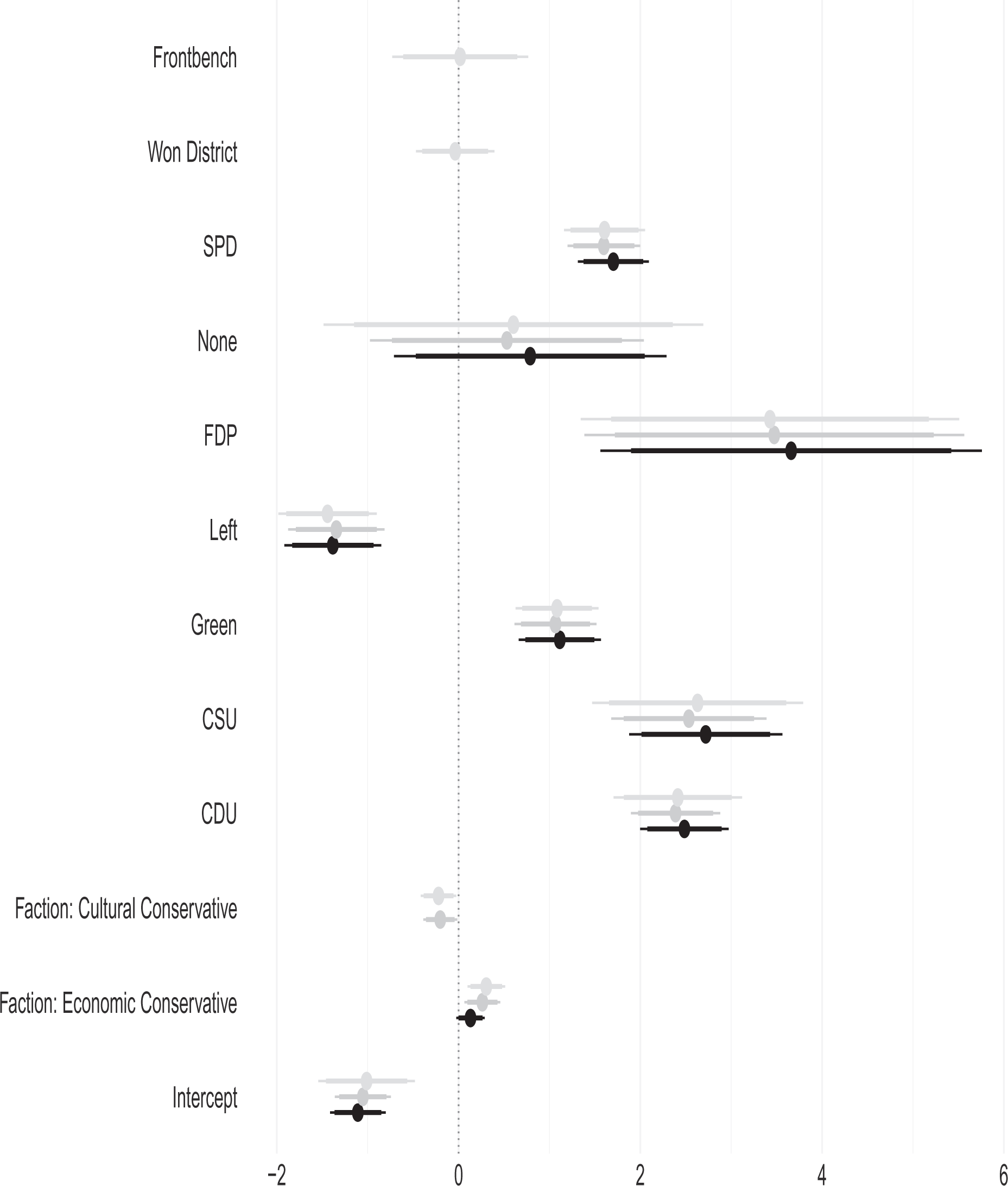
Effect of faction membership on the economic dimension. Error bars indicate 95 and 90 percent confidence intervals. N = 489. Regression tables in the appendix. Reference Party: AfD.
In general we can see that the effect of parties dominates almost completely: Left-wing parties are of course more left-wing on Twitter, an observation we already encountered in the dimensional analysis. However, members of economic right-wing factions are slightly more economically right-wing than their counterparts. While this effect is small, it is statistically significant. Of course, the low number of actual cases in which faction membership is known is low and inflated by many zeros. It replicates the results of Bernauer and Bräuninger (2009) who find 3 percent of variation explained by faction membership.
On the cultural dimension, which is tested analogously in Figure 3, we also find the expected effect, albeit small, after controlling for the faction’s economic orientation.
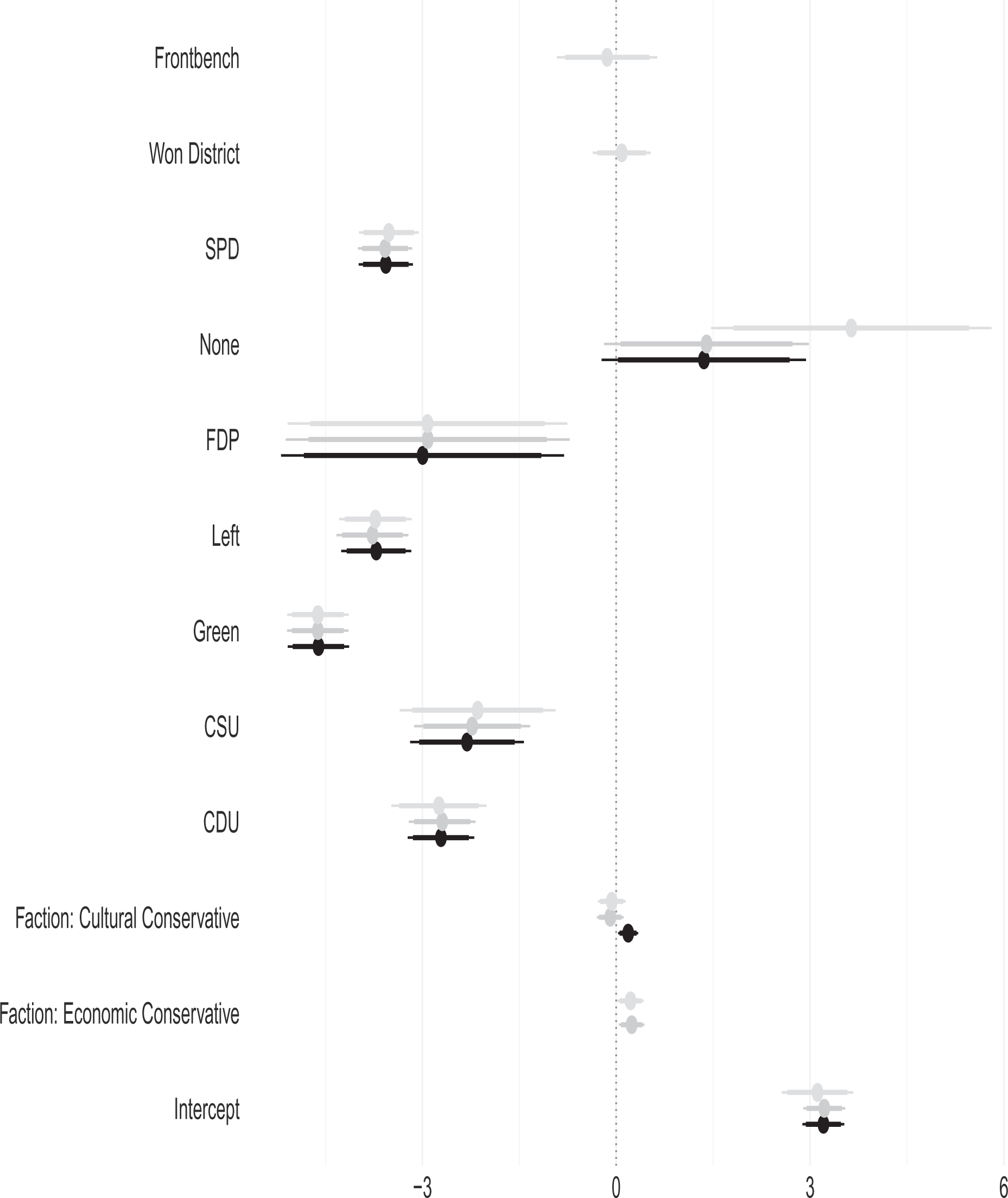
Effect of faction membership on the cultural dimension. Error bars indicate 95 and 90 percent confidence intervals. N = 489. Regression tables in the online appendix. Reference Party: AfD.
Conclusion
In general we can constitute that the expected effects are visible in social media. Members of conservative parties and factions are more likely to tweet conservatively, therefore validating measurement. However, the strong party effects we observe indicate that factions play a minor, yet significant role in MP’s expressed positions.
This contribution presents and validates a new method to extract political positions for individuals. Through the application of quantitative text analysis of tweets, we can estimate individual positions of political actors, even in party-centered systems. Ceron (2016b) showed the first application of a comparable method, I provide multidimensional ideal points for all Twitter using members of a parliament and show that the underlying dimensions have substantive meaning for intra- and inter-party competition. Like Ceron, I can validate my findings, showing that Twitter is a valid and useful data source that is easily collected and, along with the right tool set, easily analyzed.
This method can contribute to various fields in political science from research on party discipline, coalition research or party competition, in which individual preferences or positions in contrast to parties are relevant. One particular advantage is that it not only allows to scale members of the same legislature, but extends to any politician or institution with a Twitter account. Future research will extend this approach to nominally non-ideological factions such as regional and demographic party organizations like youth wings or state-level parties as well as state-level legislators. In principle we can project ministers, politicians or interest groups in the same political space. This would allow to tackle questions of multi-level party competition and connect geographic intra-party heterogeneity and regional party systems. It would also allow the comparison of individual positions in different stages of political careers.
Supplemental material
Supplemental Material, sj-docx-1-ppq-10.1177_1354068820957960 - Finding the bird’s wings: Dimensions of factional conflict on Twitter
Supplemental Material, sj-docx-1-ppq-10.1177_1354068820957960 for Finding the bird’s wings: Dimensions of factional conflict on Twitter by Marius Sältzer in Party Politics
Footnotes
Acknowledgements
I thank Marc Debus, Samuel Müller, Ulrich Sieberer, Christian Stecker and Daniel Braby for helpful comments and support. I also thank Anna Wohlmann for valuable research assistance.
Declaration of conflicting interests
The author(s) declared no potential conflicts of interest with respect to the research, authorship, and/or publication of this article.
Funding
The author(s) disclosed receipt of the following financial support for the research, authorship, and/or publication of this article: This work was supported by the the University of Mannheim’s Graduate School of Economic and Social Sciences (GESS).

References
Supplementary Material
Please find the following supplemental material available below.
For Open Access articles published under a Creative Commons License, all supplemental material carries the same license as the article it is associated with.
For non-Open Access articles published, all supplemental material carries a non-exclusive license, and permission requests for re-use of supplemental material or any part of supplemental material shall be sent directly to the copyright owner as specified in the copyright notice associated with the article.
