




Abstract
Mobilization is central to the emergence, survival and success of armed groups challenging the state, and has lately expanded to new arenas with the rise of social media. Using a new dataset of rebel group Twitter use, we examined the topics contained in rebel group social media communications to understand how different messaging strategies impact civilian engagement with rebel messages. Rather than benefiting solely from direct calls to action, we found that rebel groups also increased civilian engagement through indirect messages of self-promotion. While direct appeals received more engagement than indirect appeals, their effects were tempered by audience fatigue when relied on too heavily. We additionally found that including images further enhanced the impact of a mobilizing message. These findings expanded our understanding of rebel communications and mobilization, with important implications for combating the use of social media as a recruitment tool for violent extremism.
If you want to talk to a terrorist, […]. You just need to follow that terrorist on Twitter. – FBI Director James Comey, December 16, 2015
1
Introduction
As it grew to global prominence between 2014 and 2015, the Islamic State (IS) drew significant international attention in part due to a coordinated social media strategy, where tens of thousands of individual Twitter accounts functioned as a networked propaganda arm, energizing existing supporters and recruiting new ones. Twitter came under intense scrutiny for providing a platform for this activity, and eventually responded by issuing targeted bans against over 125,000 IS-related accounts in late 2015 (Twitter Inc., 2016). The ability to mobilize support has always been central to the success of rebel groups (e.g. Moore, 1995; Gates, 2002; Weinstein, 2005; Bueno de Mesquita & Dickson, 2007; Eck, 2014), but in an increasingly connected world, where social media and advancements in information and communications technology have dramatically changed the way that political communication functions, rebel mobilization occurs in new ways and introduces new kinds of questions.
Despite the attention given to disaggregated and networked social media campaigns such as the one employed by IS, such strategies are relatively rare. Instead, non-state armed actors that employ social media commonly have a small number of centrally controlled ‘official’ accounts from which they post news, updates on operations and activity and commentary on the group’s grievances and objectives (Loyle & Bestvater, 2019). In most cases, rebel groups on social media act more like conventional political parties (Barberá & Zeitzoff, 2018) than like vast networks of shadowy operatives looking to recruit the disaffected through messages of extreme violence. Where counterterrorism and counterinsurgency efforts have focused on rebel group social media use, they have largely been concerned with restricting groups’ ability to effectively recruit new fighters. However, direct recruitment, such as that exemplified by IS, is only one way that rebel groups make use of social media technologies. In this article, we consider the many ways in which rebel groups engage in social media messaging, and examine which communication strategies are most effective for increasing civilian attention to the rebel group.
Rebel groups have choices in how they engage with social media. Direct calls for mobilization on public social media platforms can be inherently risky, both in terms of potentially telegraphing upcoming group operations to counterinsurgency forces and giving up tactical advantages (Gohdes, 2020), and in drawing negative attention to the group’s presence and provoking the platform to issue a ban, as in the case of IS. Indirect mobilization – messages where rebel groups frame issues and shape how audiences think about the conflict without providing an explicit call to action – offers a potentially less risky alternative. Groups can use their official social media presence to self-promote, building a ‘brand’ by raising awareness about group objectives and grievances, and controlling the narrative about their activities. Strategies built around indirect mobilization, while more subtle, can be highly effective in engaging audiences, generating support and increasing the international profile of rebel groups.
As rebel groups make choices about when and how to incorporate social media technologies into their mobilization strategies, we can expect that they will tailor their decision to gain the greatest audience engagement, while operating within the inherent constraints of the medium. Audience engagement with social media can be an essential first step in gaining greater support for the rebel cause, potentially leading to greater material support or recruitment. But while the rise of social media use by non-state armed actors has been documented (Klausen, 2015; Zeitzoff, 2017; Loyle & Bestvater, 2019), we still know relatively little about the variation across different rebel social media strategies. In this article, we leverage a new corpus of tweets sent from official rebel group Twitter accounts to gain a better understanding of the impact of rebel social media strategies on civilian engagement with rebel group social media. We use this analysis as an early-stage attempt to understand how social media can lead to greater support for rebel groups. Drawing from the political communications literature, we develop a theory of social media engagement that relies on a distinction between direct and indirect calls to action. We then apply this theory to rebel group social media use, contributing to the literature on rebel group mobilization and communication by furthering our understanding of how audiences respond to different rebel group communication strategies in the new social media-driven public sphere. This study has important implications for counterinsurgency policy, as a better understanding of which messaging strategies are most effective for rebels in garnering increased public engagement and why, will provide new context for combating the use of social media as a recruitment tool for violent extremism.
Rebel mobilization and communication
The ability to effectively mobilize has always been critical to a rebel group’s ability to overcome its collective action problems and continue operations (Moore, 1995; Gates, 2002; Weinstein, 2005; Bueno de Mesquita & Dickson, 2007; Eck, 2014). Increased political mobilization often precedes civil war onset, as salient cleavages deepen and non-state actors shore up support in order to challenge the state (Wood, 2008). As a conflict develops, rebel groups benefit from mobilizing and maintaining popular support in the areas where they operate (Fearon & Laitin, 2003). Since World War II, the majority of civil wars have been what Balcells & Kalyvas (2007) call ‘irregular wars’, where insurgents rely on civilian populations for cover and intelligence as well as resources in the form of materials and personnel. Armed non-state actors often recruit new fighters from these populations (Hegghammer, 2013) and compete in the local labor market to do so (Dal Bó & Dal Bó, 2011; Dube & Vargas, 2013). Finally, to maintain operations, rebel groups must collect and leverage material and informational resources, a task for which they often rely on quotidian social networks within mobilized civilian populations (Parkinson, 2013; Lewis, 2020).
While new developments in information and communications technologies (ICTs), such as widely available internet-connected devices and mass adoption of social media platforms, have provided new tools for political mobilization, most research into the impact of these tools on political dissent has largely focused on mobilization in the context of social movements and protest. Protest participants increasingly rely on social media to learn about events and coordinate action with each other (Tufekci & Wilson, 2012; Weidmann & Rød, 2019). At the elite level, both regime and opposition figures use social media as an arena to offer competing narratives about the movement, either defining or distracting from the issues (Barberá & Zeitzoff, 2018; Munger et al., 2019). Studies that have considered rebel group ICT and social media use have often found that armed non-state actors are leveraging these technologies towards their mobilization needs (Loyle & Bestvater, 2019). Pierskalla & Hollenbach (2013) found that increased access to cell phone infrastructure within conflict zones correlates with higher levels of political violence, empowering rebel groups to improve cooperation and coordinate support. Studying foreign fighters in Syria and Iraq, Klausen (2015) found that social media communications were commonplace and made up a central component of a group’s mobilization strategy. Walter (2017) suggests that ICT and social media are changing rebel mobilization so profoundly as to create ‘new new civil wars’.
The use of media for rebel mobilization and propagandizing is not a new phenomenon. The FARC (Revolutionary Armed Forces of Colombia) ran a TV station in Colombia, for example, and PIRA (Provisional Irish Republican Army)-aligned Sinn Féin published a weekly newsletter in Northern Ireland. New developments in ICT, however, provide more pervasive means of communication, reduce the costs of publishing content in mediums such as images or video, and decentralize dissemination networks (Weidmann, 2015). While popular narratives have assumed that these technologies primarily empower dissidents and rebels in their struggles against governments, states also make effective use of them (Rød & Weidmann, 2015; Barberá & Zeitzoff, 2018). Shapiro & Weidmann (2015) found that counterinsurgency forces in Iraq were able to leverage new developments in cell phone infrastructure to obtain intelligence about rebel operations from the local populations the rebels were trying to mobilize as civilian support networks. Likewise, Gohdes (2020) found that increased access to internet infrastructure among the population better empowers states to engage in targeted repression against dissent. Yet, while state leaders engage social media to promote their own political activities with an eye towards staying in power (Barberá & Zeitzoff, 2018), rebel groups are focused on gaining power, and so direct their social media activity towards building legitimacy and mobilizing support (Loyle & Bestvater, 2019).
Where the policy and academic literatures have considered rebel group social media use, the assumption has largely been that rebels use social media as a direct call to action for new recruits or potential funders (Walter, 2017). However, in a content analysis of the tweets sent out by official rebel group Twitter accounts, Loyle & Bestvater (2019) found that mobilization in the form of direct calls for action were actually quite rare in rebel Twitter feeds. Instead, rebel groups largely use their official social media presence in ways that are reminiscent of conventional political parties. Rebel groups share news, report on their operations and self-promote by framing events in terms of group grievances and objectives. This makes sense: mobilization relies on a form of political persuasion, so it follows that rebel groups would adopt similar strategies to those that work in conventional political settings. For example, election campaign ads shape political behavior by repeatedly exposing audiences to political messages framed according to a narrative chosen by the party or candidate (Freedman, Franz & Goldstein, 2004). On social media, political persuasion occurs in a context defined by informal discussion and incidental exposure (Diehl, Weeks & Gil de Zúñiga, 2016). Incidental exposure to political issues on social media can have an agenda-setting effect, raising issue salience for audiences (Feezell, 2018). Mobilizing messages on social media can also have far-reaching indirect effects, as social sharing helps political content diffuse through the network, reaching a wider audience (Bond et al., 2012).
Despite the strong presence of indirect effects and incidental exposure through social sharing, social media is still a communications environment largely defined by selective exposure. Users choose who they follow and what posts they engage with, and most people using social media engage primarily for non-political purposes (Settle, 2018). In information-rich environments, attention is a limited resource, creating what Hindman (2018) calls an ‘attention economy’. Research on selective exposure in political communications indicates that when given the choice of what content to engage with, audiences frequently tune out political messages (Arceneaux, Johnson & Cryderman, 2013). Where audiences do engage with political content, they often prefer the information they consume to be ideologically congenial (Sood & Lelkes, 2018). Even for content that audiences are interested in, limited attention is a constraint (DellaVigna, 2009) and audiences may become desensitized by repeated exposure to the same messages. Research from public health communications suggests that ‘message fatigue’ reduces the efficacy of calls to action in repeated messages (Baseman et al., 2013).
Rebel messaging through social media
Unlike governments whose primary objective is to maintain power, the central goal of rebel groups is to increase support for their cause, recruit new members and raise resources (Moore, 1995; Gates, 2002). In other words, rebel groups have an incentive to mobilize members of the civilian population. As part of the mobilization process, rebel groups seek to broadcast information about their cause and their efforts with the intention of gaining greater resources and support.
Social media is an effective strategy for reaching a wide audience for low a cost. Work by Loyle & Bestvater (2019) found that social media use among rebel groups has been growing over time with adoption ranging from small guerrilla groups such as the ARSA (Arakan Rohingya Salvation Army) in Myanmar to more sophisticated political organizations such as the Donetsk People’s Republic in Ukraine and FARC in Colombia. Rather than the multi-user account strategy popularized by IS, Loyle & Bestvater (2019) found that, similar to conventional political parties and state leaders, many rebel groups maintain a centrally controlled social media presence through which they are able to broadcast messages. The increased use of social media should not be surprising as it is a low-cost option for getting out a mobilizing message and calling for resources.
Individuals who are exposed to rebel social media are able to engage with the information with comparably less risk than other forms of engagement, such as attending public gatherings or meeting with members of the rebel cadre. Despite the lower costs, online engagement can be a crucial first step for other forms of in-person engagement and support (Larsen et al., 2019). While online engagement may result in in-person mobilization for the rebel cause, it can also result in simply greater sympathy towards the rebel group or material support. At its base, engagement is a signal of increased knowledge and legitimacy for the rebel group. As with other forms of rebel communication, social media messaging is most likely to be consumed by individuals who are already predisposed to engage with the rebel group, however, social media outreach allows rebel organizations to reach new audiences and potentially increase mobilization. In this way online engagement is distinct, yet related, to other forms of mobilization for the rebel cause.
The twin goals of recruitment and resources and the potential role that social media can play in achieving these ends suggest that rebels have a strategic incentive to leverage a social media presence towards the aim of increasing online engagement. Popular policy renditions of rebel group social media strategy focus almost exclusively on rebel messaging as calls for recruitment and radicalization (Comey, 2015). But direct calls to mobilization are not the only messaging strategy that rebel groups engage in. Loyle & Bestvater (2019) catalog a variety of different types of messages that are adopted by rebel groups in addition to direct mobilization, including indirect mobilization through self-promotion and brand-building, and reporting factual information about group operations. Rebels have a choice between strategies that communicate direct calls to action, those strategies that indirectly garner support, and communication strategies that serve solely to report on rebel activities. It is likely that not all these strategies are equally effective in engaging rebel audiences. Given the potential utility of social media for increasing the profile of rebel organizations, which rebel communication strategies are most effective for increasing engagement with the civilian population?
Mobilizing messages will largely appear in an incidental exposure environment, where social media users see rebel messages alongside other non-political content that might appear in their feeds. When choosing how to frame their messages, rebel groups must consider the context in which their messages are being consumed in order to successfully compete for potential audiences’ limited attention (Arceneaux, Johnson & Cryderman, 2013) without subjecting audiences to message fatigue (Baseman et al., 2013). Within this context, rebel groups can increase the salience of their messages by framing them as a direct call to action – framing information to prompt audiences to modify or reinforce their behaviors, beliefs or attitudes towards the group. Intuitively, a message that contains this kind of direct, actionable request for civilian engagement is likely to garner higher levels of attention and subsequent social media engagement than messages that do not contain such straightforward requests. This suggested the first hypothesis to be tested:
Hypothesis 1: Messages that make direct calls to action receive higher levels of audience engagement than other forms of rebel messages.
Despite the likely impact of direct calls to action, rebel groups need to be cautious about using a direct messaging strategy too frequently. We know from prior research that after repeated exposure to urgent requests, audiences can develop message fatigue and become less responsive to direct calls to action (e.g. Baseman et al., 2013). Therefore, we can expect that the higher salience of direct calls for mobilization will be contingent on the group making such calls sufficiently rarely, as expressed in a related hypothesis:
Hypothesis 2: The effect of direct calls for mobilization on audience engagement is moderated by the frequency with which groups make such direct calls.
Given the likely utility of direct calls for action, we might anticipate that rebel groups will rely primarily on this strategy. However, beyond the conventional costs of social media messaging, violent actors challenging the state face two unique constraints. The first consideration is defensive: public social media platforms are, by definition, visible to anyone, including the state against which the group is fighting. Recent studies have emphasized that states are generally adept at incorporating information revealed through dissident social media use into their strategies for maintaining the status quo (Rød & Weidmann, 2015; Gohdes, 2020). If rebels want to use social media to make direct calls for mobilization to a public audience, they risk telegraphing their moves or needs to counterinsurgency forces, and yielding a strategic advantage. The second constraint concerns the policies of the social media platform itself regarding what kind of content the platform will permit to be posted. Sites such as Twitter and Facebook have strict guidelines limiting content that promotes or incites violence, and these platforms ban accounts that repeatedly violate these policies through their posts. Highly disaggregated IS-style social media approaches are able to circumvent content moderation policies by exploiting the fact that banned accounts can be easily replaced, forcing platforms like Twitter into extended games of whack-a-mole. However, the messages disseminated by these disaggregated strategies are, by necessity, fragmented and preclude the establishment of a strong central brand that helps the rebel group build legitimacy and increase support. Groups that want to be able to mobilize through the projection of a strong central message must therefore operate within both sets of constraints, limiting the degree to which they can make direct calls for mobilization.
Given the constraints on direct calls for mobilization, rebel groups also choose to engage indirect messaging strategies. Indirect calls to action occur in social media messages that exhibit self-promoting or brand-building behavior, which showcase the benefits of group membership without calling for specific actions. Yet rather than simply reporting news about the group or its operations, indirect calls to action contain interpretive context – these messages express grievances, make ideological statements or contextualize and justify the group’s activities. Indirect calls implicitly instruct audiences on what to believe and how to think about the group and its objectives. Research on the impacts of product marketing suggests that advertising cues can effectively communicate a product’s purported benefits to the consumer, increasing brand recall (Keller, 1987). Indirect calls to action engage with a viewer’s pre-existing grievances and promise solutions to those problems. These mobilizing messages are therefore likely to garner greater online attention than a messaging strategy focused solely on providing group updates or other forms of news. Given the potential impact of indirect messaging we hypothesized,
Hypothesis 3: Messages that contain an indirect call to action receive higher levels of audience engagement than messages that simply report factually presented information about operations or group news.
Research design
To examine these hypotheses empirically, we leveraged an original data collection effort where we paired active rebel groups to their official Twitter accounts and then collected the full tweet history of these accounts. This effort yielded a rich data resource containing metadata, text and image information that can provide new insights into how rebel groups communicate given the rise of social media. While Twitter alone cannot perfectly represent all social media platforms (Tufekci, 2014), it was appropriate for this study for three specific reasons. First, Twitter was designed to be easy and inexpensive to use, accessible even from basic cell phones – a fact that has led to global adoption of the platform. Second, posts on Twitter are publicly visible by default, making the platform an ideal tool for spreading information to new audiences. Finally, Twitter is of particular interest for analyses of rebel groups’ social media use due to its centrality in high-profile cases such as that of the IS. Given that Twitter alone does not represent the universe of social media platforms, the behaviors that can be observed on Twitter do not necessarily reflect how rebel groups might behave on other platforms, particularly ones that are not as public. In addition, while Twitter has a global userbase, adoption of the platform is not geographically uniform. Rebel information presented on Twitter is only available to individuals with internet connectivity and access to the Twitter platform. 2 A study such as this one, focusing solely on rebel groups’ use of Twitter, should therefore be understood as a study of behaviors that are relevant to, but not necessarily representative of, rebel social media use or rebel group communication as a whole.
To collect our Twitter archive, we began by referencing the UCDP/PRIO Armed Conflict Dataset (ACD) (Gleditsch et al., 2002; Therése Pettersson, Högbladh & Öberg, 2019) to compile a list of non-state armed groups involved in an active conflict against a state government at some point between Twitter’s founding in 2006 and the end of 2018. Since the ACD is a yearly conflict dataset, in order for a group to appear in the data for a given year, the conflict must have been active in that year, as defined by a threshold of 25 battle-related deaths. Because we were interested in rebel group communications, which often occur before and after moments of active conflict, we relaxed the 25 battle-related deaths per year requirement when compiling our list of groups, and included each group that was involved in an active conflict at any point during the 12-year period from 2006 to 2018. This approach yielded a set of 155 organizations for which we attempted to identify Twitter accounts.
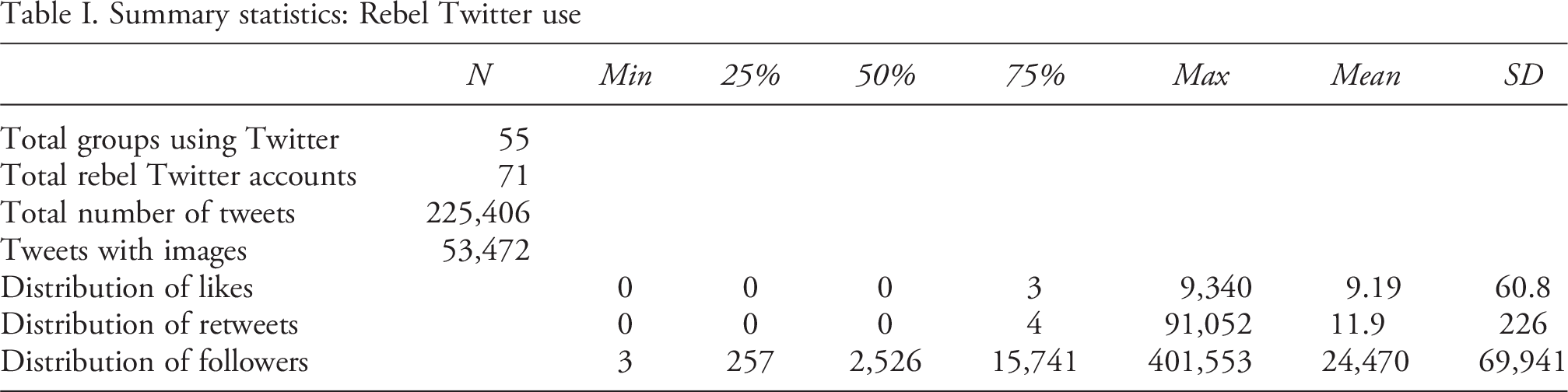
Independent coders worked to identify official Twitter accounts for each of the 155 organizations identified in the previous step. This was primarily done using Twitter’s own search tools, along with references to news articles and group websites and literature. In most cases where an official account existed for a given group, coders were able to identify it quickly and with a high level of agreement. An official social media account for a political actor of any kind is, by definition, public. The goal is for the account to be visible in order to make it clear that these are branded messages curated and/or endorsed by the group that owns the account. Using this procedure, we were able to identify official Twitter accounts for 55 of the 155 rebel groups involved in an active conflict against a domestic government at any point between 2006 and 2018. 3 These groups together control 71 Twitter accounts as, in some cases, groups such as FARC or Hamas were observed to control more than one account, often to post content in multiple languages. Groups failed to appear in this subset for one of two potential reasons. First, they are simply not active on Twitter, or use it so infrequently that their activity cannot really be considered an official group social media presence. A second reason, however, is that a group had a Twitter account that no longer exists due to an account ban. In these cases, there is no way to retroactively retrieve the deleted content. 4 Given this data collection procedure, the results of the present analysis are best interpreted as representing the online behaviors of rebel groups who have selected a social media strategy focused on centralized public messaging, and have largely operated within the terms of service of mainstream public platforms.
Having matched active rebel groups to official Twitter accounts where relevant, we then used the Twitter applicating programming interface (API) to collect the full history for each account, including all the tweets in its timeline along with all the metadata associated with the account. 5 The tweet objects returned by the Twitter API using this method included information about the multimedia content of the tweet, but did not actually include that content. Therefore, we added an additional step to the tweet collection process where the image content for tweets that contained images was separately retrieved using the metadata provided through the API.
Summary statistics: Rebel Twitter use
Tweet characteristics
The goal of the present analysis was to understand civilian engagement with rebel group communication strategies. To unpack the mechanisms of this process and capture how audiences respond to different types of messages, we examined the content of the messages that rebel groups posted on Twitter. Following an existing trend in the literature on social media and contentious politics (e.g. Berman, 2012; Theocharis et al., 2015), we classified rebel tweets into three main categories according to whether their primary message consisted of (1) direct calls mobilizing supporters, (2) indirect mobilization through self-promotion or brand-building in the form of framing events, expressing grievances or making ideological statements, or (3) simply reporting factual information about their operations. Additionally, we included a catch-all ‘other’ classification for miscellaneous messages that did not fit into one of these three primary categories. These categories are described in detail below.
The classification pipeline began with preprocessing the tweet texts. We first conducted some minimal preprocessing, removing excessive whitespace, URLs and emoji characters from the text. Then, non-English texts were passed through a machine translation system to generate an English version. Information about the original language was preserved in a separate variable. Next, of the preprocessed tweet texts, we randomly selected and manually coded 5,000 tweets according to the aforementioned content typology. Once labeled, these texts were used as training data to fine-tune a DistilBERT classifier (Vaswani et al., 2017; Sanh et al., 2019) that, once trained, could automatically generate labels for the text of all the other tweets in the corpus. 7
In addition to information in text form, tweets commonly include embedded images. Images were included in over 26% of posts for the rebel tweets we collected. These images contain important information that is particularly relevant to how audiences interact with and are impacted by a given message. Images draw attention to a message’s text content, and can frame or contextualize the text, changing the way that audiences interpret what is written. Since the images attached to tweets can carry such relevant information, we noted where images accompanied tweet texts and considered this in our analysis. Furthermore, since the main text field for tweets is limited to 280 characters (an increase to the original 140), it is common for groups to post longer messages as images of text with a short summary in the main text field. We processed the collected images to extract this text content and analyzed it along with the rest of the tweet texts.
Tweet images were processed through the Google Cloud Vision API, which uses a series of pre-trained models for a variety of computer vision tasks including image labeling and optical character recognition (OCR). For our use case, the Vision API began by providing object labels for each image, which told us the model’s prediction of what the image contained. In cases where this model identified an image as ‘document’ or ‘text’, we Tweet processing pipeline Tweet message categories OCR: optical character recognition.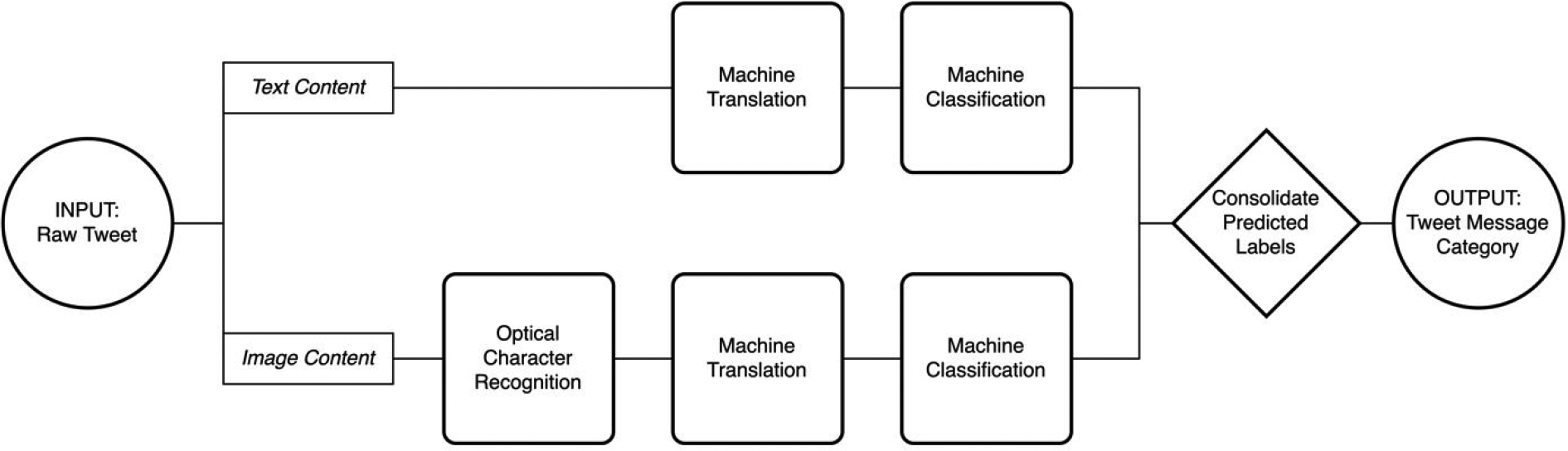
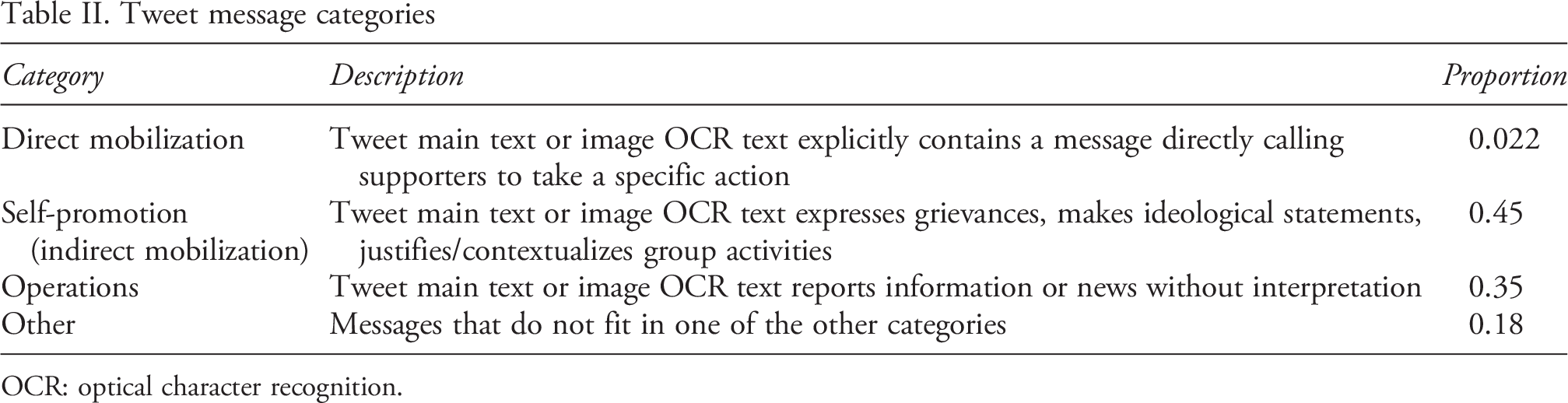
Once both the text and image content of the tweets had been processed, textual information from both sources was combined into a single, mutually exclusive classification for each tweet’s message, as shown in Table II. Tweets containing a message explicitly calling supporters to take a specific action through either the main text or text contained within the image were categorized as ‘direct mobilization’. Tweets that mobilized indirectly by using text to express grievances, make ideological statements or frame and contextualize the group’s activities were categorized as ‘self-promotion’. Tweets that simply reported factual information without providing any framing or interpretation were categorized as ‘operations’. Finally, tweets that did not cleanly fall into one of the other categories as defined were classified as ‘other’. These messages could cover a wide variety of potential topics, but are generally unrelated to the conflict or the group’s objectives. Common examples include references to local events, figures or celebrities, or observations of holidays. 8
Examples of each of these tweet message categories can be seen in Figure 2. Self-promotion and operations messages made up the majority of the tweets in the corpus, with messages that contained direct calls to action appearing quite rarely. This was consistent with the constraints to rebel social media use theorized above – rebel groups that use public platforms to provide direct, explicit instructions to mobilize to their followers risk telegraphing their plans to counterinsurgency forces Tweet message category examples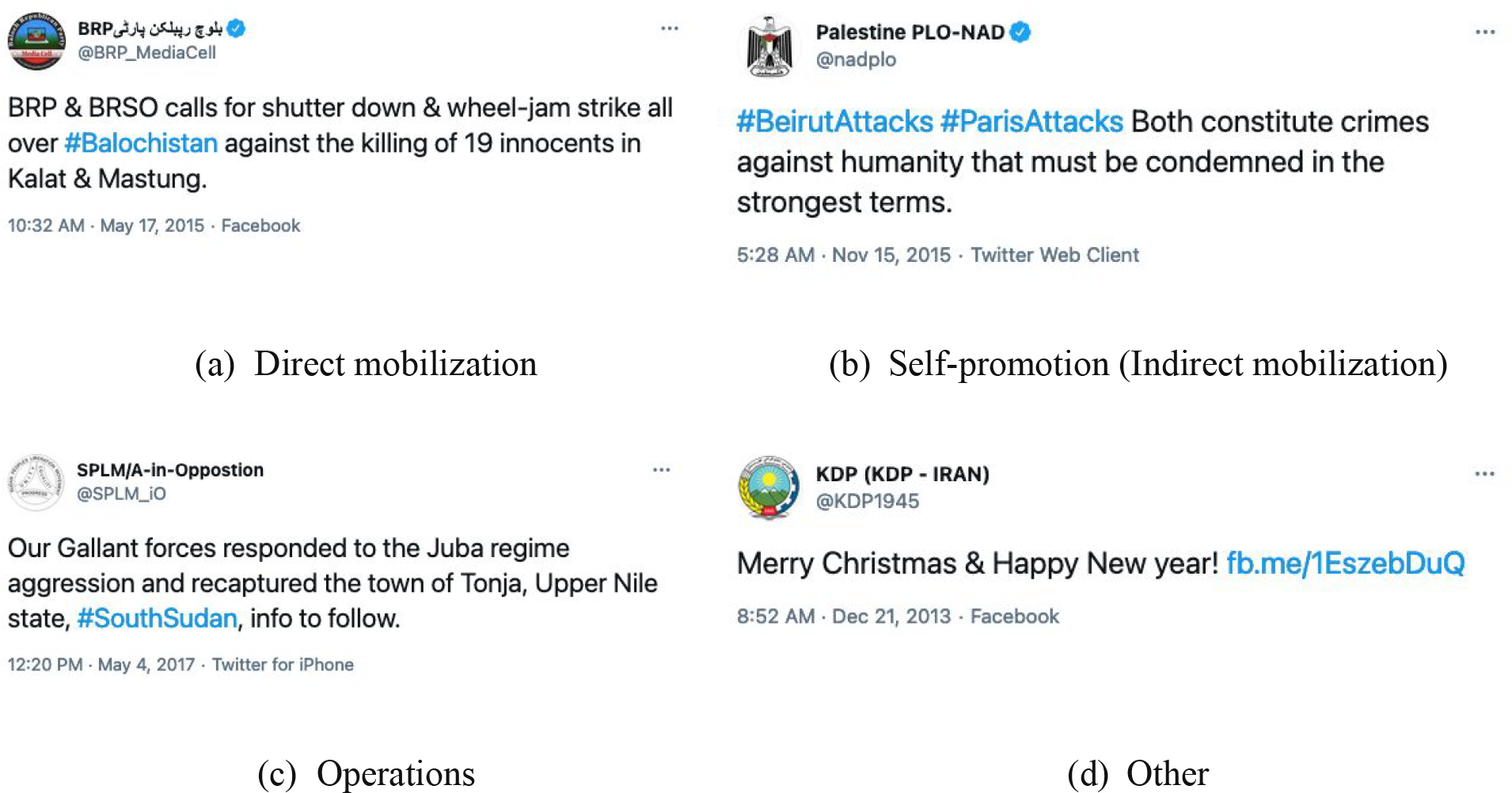
Audience engagement
To test the aforementioned hypotheses, we considered our tweet corpus at the level of individual messages. We were interested with the level of attention and engagement that tweets containing different kinds of messages receive. Differences in levels of measurable audience engagement within a given rebel group’s tweets highlight the relative differences in how that group’s audience responds to the various types of messages under various conditions. High levels of engagement indicate that audiences are paying substantial attention to what the group is saying, and are also taking action to help disseminate the message further. While we can assume as a starting point that any given tweet appears in the feed of any user who follows the account that posted it, this fact alone does not guarantee that the user actually saw and read the message, or that it had any impact on their behavior or stance towards the group. Rather than simply measuring the number of people who follow a particular account, a more promising approach is to proxy audience attention by looking at the instances where people viewed the tweet and then took some publicly visible action to engage with that message in response. On Twitter, users can engage with posts by ‘liking’ or ‘favoriting’ – where their approval is publicly marked next to the original tweet – or by ‘retweeting’ – where the original tweet gets re-posted from the responding user’s account, either with or without additional commentary. 9 While ‘liking’ a tweet suggests a basic degree of attention, ‘retweeting’ demonstrates a higher degree of user engagement. These activities both represent public political statements, as in either case, the user’s interaction with the original rebel group tweet appears in the feed of everyone who follows that user, allowing diffusion through the social network to increase the reach of the message. Although engaging with a rebel group’s messages online is not as politically costly a behavior as personally taking up arms would be, in many circumstances public indications of dissent online can still incur significant personal costs and therefore should be considered a meaningful form of political engagement (Tufekci, 2017). 10
How rebel tweet messaging type affects audience engagement
BIC: Bayesian information criterion. One-way (group) standard errors in parentheses.
Significance: †: 0.1; *: 0.05; **: 0.01.
Results
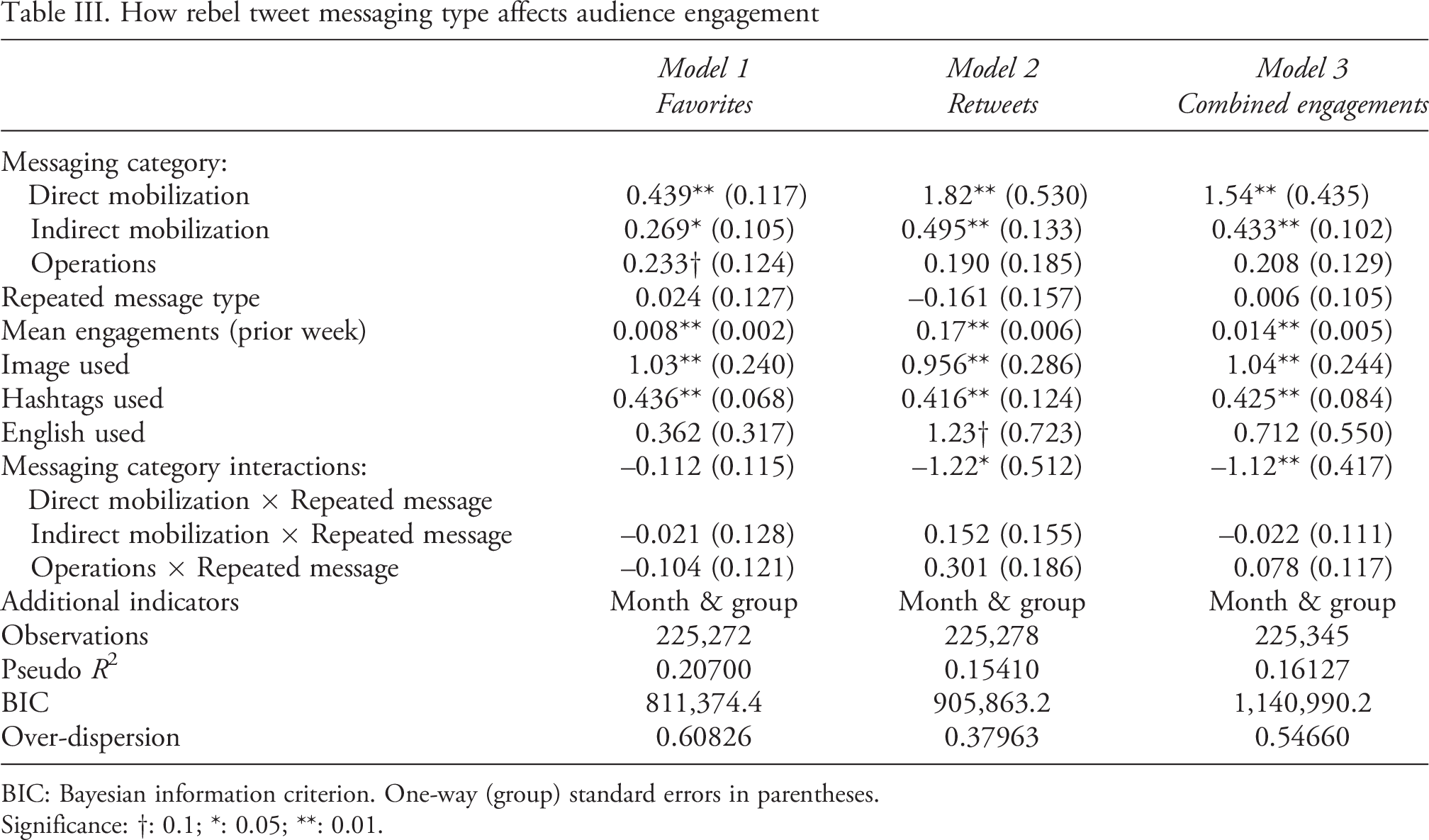
To study how diverse strategies of rebel group social media messaging have differential effects on audience engagement, we employed a series of regression models at the tweet level that sought to predict how a rebel group’s audience would engage with tweet messages from the characteristics of the tweet. As discussed, we can measure engagement with a tweet in two ways: by the number of times a particular tweet was liked or favorited, and by the number of times it was retweeted. Likes and retweets represent substantively different degrees and categories of engagement, so we examined them in separate models first, then combined the counts together to produce an aggregate measure of ‘tweet engagement’. These three measures served as the dependent variables in Models 1 to 3 respectively in Table III.
The primary independent variable of interest in these models was the content category of each tweet’s text (direct mobilization, indirect mobilization (self-promotion), or operations against an omitted baseline category of ‘other’). To test hypotheses about message fatigue, this variable was also interacted with an indicator representing whether a given group had posted other tweets in the same messaging category within the previous seven days. In addition to the content of a tweet’s text, additional factors that predict user engagement should include other characteristics of the tweet itself, such as whether it employs hashtags, 12 what language it is written in and whether it includes an image. To account for potential serial correlation between a group’s tweets, we also included the average number of engagements received by the tweets the group had posted during the prior week.
In addition to these tweet-level characteristics, engagement is also likely to be predicted by contextual factors such as the existing profile or popularity of the rebel group, the number of followers a rebel group has on Twitter, the context of the armed conflict, as well as the overall size of the Twitter userbase, which represents a theoretical maximum audience size at any given point of time. But while we can observe direct measures for a number of relevant tweet characteristics at the level of individual tweets, available measures for many of these contextual factors are much coarser. For instance, while we have follower counts for each of the accounts in the rebel Twitter dataset, these measures only represent the number of followers that an account had at the precise moment when the data for that group was accessed from the Twitter API (in our case, Spring 2019) – Twitter does not provide information on how follower counts vary over time through the Standard or Academic API endpoints. Likewise, many group- and conflict-level characteristics tend to be measured yearly. Therefore, rather than attempting to control for all contextual factors that might affect audience engagement with rebel tweets, all models were fit using group and month indicators, which together captured variation between groups, as well as changes in the context of the conflicts and social media ecosystems the groups engaged with. 13
Table III shows the results of three negative binomial models regressing tweet favorite counts, retweet counts, and combined engagements, respectively, on the variables of interest previously discussed. We see here that the type of messages contained within the text of a tweet had a meaningful effect on both the level and type of engagement that tweet received. Model 3, in which retweets and favorites are combined into a single outcome measure, showed that direct mobilization and indirect mobilization (self-promotion) were significantly more likely to be favorited and retweeted than the baseline. This indicates that when a group tweeted a message containing a call to action – even if implicit – it received more audience attention than other types of messages. This pattern was substantively similar when looking at favorites and retweets separately: tweets making a direct call for mobilization were the most likely to be favorited (Model 1) and retweeted (Model 2) out of any of the message categories, followed by indirect mobilization tweets, where the group offered a self-promoting narrative to events or made ideological statements. Operations tweets, where the group essentially reported news about their activities in a more-or-less factual manner, were no more likely than the baseline to be retweeted. Taken together, these findings provided evidence in support of both Hypothesis 1: that messages with a direct call to action will be most salient to audiences, and Hypothesis 3: that indirect messages of mobilization that invite the reader to modify or reinforce their attitudes towards the group will be more salient to audiences than straightforward operations reporting or other kinds of messages.
Comparing engagement between substantive categories
BIC: Bayesian information criterion. One-way (group) standard errors in parentheses.
Significance: †: 0.1; *: 0.05; **: 0.01.
In addition to providing a means to test these hypothesized relationships between the kind of messaging strategy rebel groups choose for their tweets and the level of audience engagement those tweets receive, the models presented in Table III also provided insights into how several other factors affected audience engagement. First, across all three model specifications we found that the inclusion of visual content significantly increased engagement with a tweet. This finding was consistent with Twitter’s own internal studies, which have found that tweets with images consistently receive higher levels of engagement across the platform (Rogers, 2014). All things being equal, a tweet containing any image content will receive combined engagements at a rate 2.82 times that of a tweet containing only text. Furthermore, the use of hashtags increases engagement with rebel tweets, which is again consistent with the purpose and effect of hashtags in social media engagement (Rogers, 2014). Interestingly, use of the English language did not appear to affect the engagement a tweet received. This is surprising given the relatively large proportion of rebel groups that choose to post tweets in English rather than the languages used by their local constituencies. We anticipated that this choice would have a strategic payoff in audience engagement, but that was not apparent in this analysis. One possibility is that since there is relatively little within-account variation in language, the use of group indicators in the model specification precluded a precise estimate. The predominant use of English across rebel group Twitter accounts calls us to question the target alternative audiences for rebel tweets beyond just potential supporters, such as international diplomatic efforts (Jo, 2015; Huang, 2016).
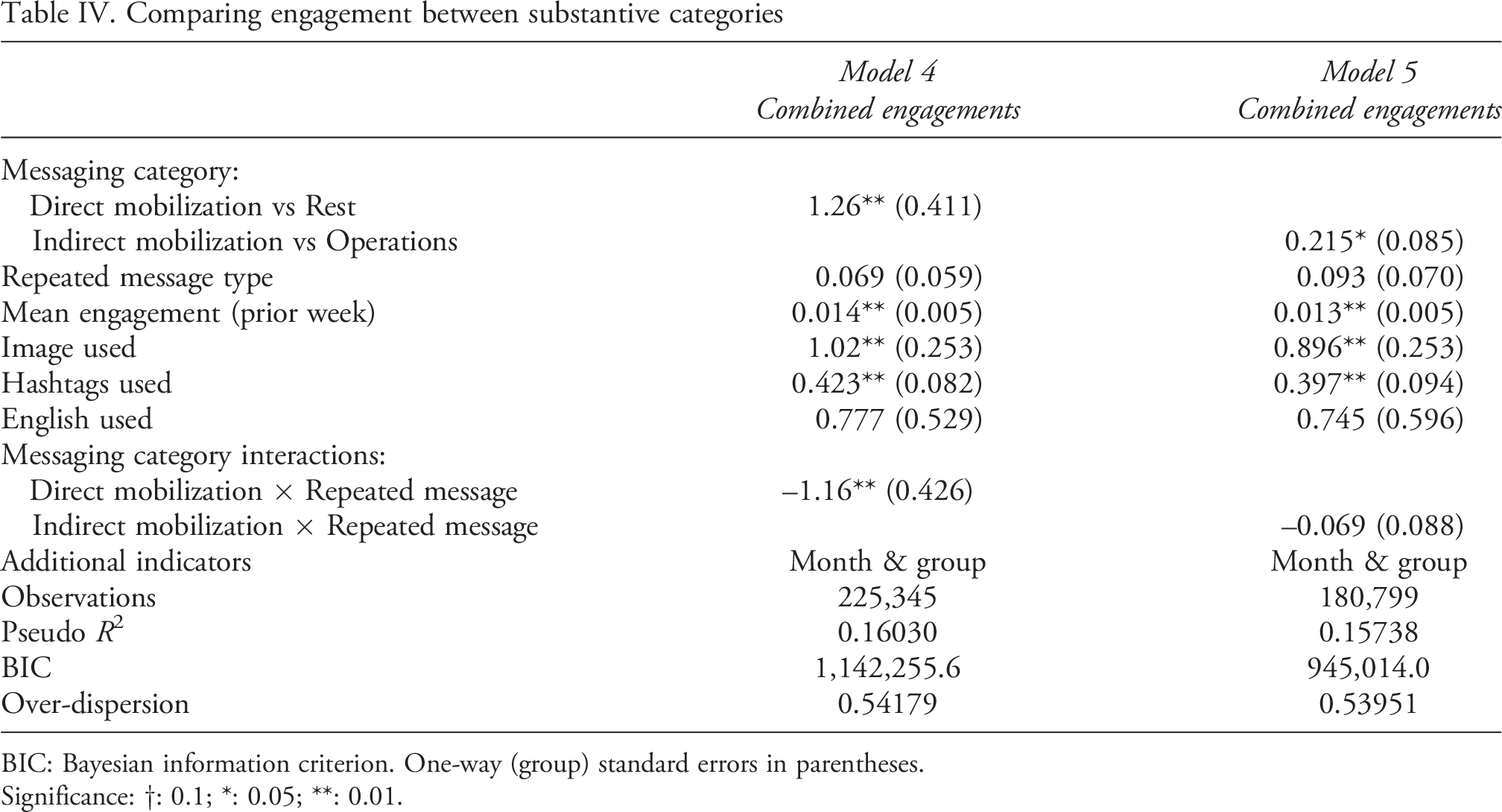
The models described in Table III all compared engagement with direct mobilization, indirect mobilization and operations tweets against the ‘other’ category. However, in addition to the relative differences between each category and generic messages, we were also interested in several direct comparisons between the substantive categories themselves. Table IV shows the results of two additional negative binomial models predicting combined favorites and retweets to make these comparisons. In Model 4, the messaging category variable is a binary indicator, comparing direct mobilization messages to all other categories, and Model 5 indicates indirect mobilization over operations, excluding any tweets that are in the other two categories.
How previous high engagement affects rebel tweet messaging
AIC: Akaike information criterion. Standard errors in parentheses.
Significance: †: 0.1; *: 0.05; **: 0.01.
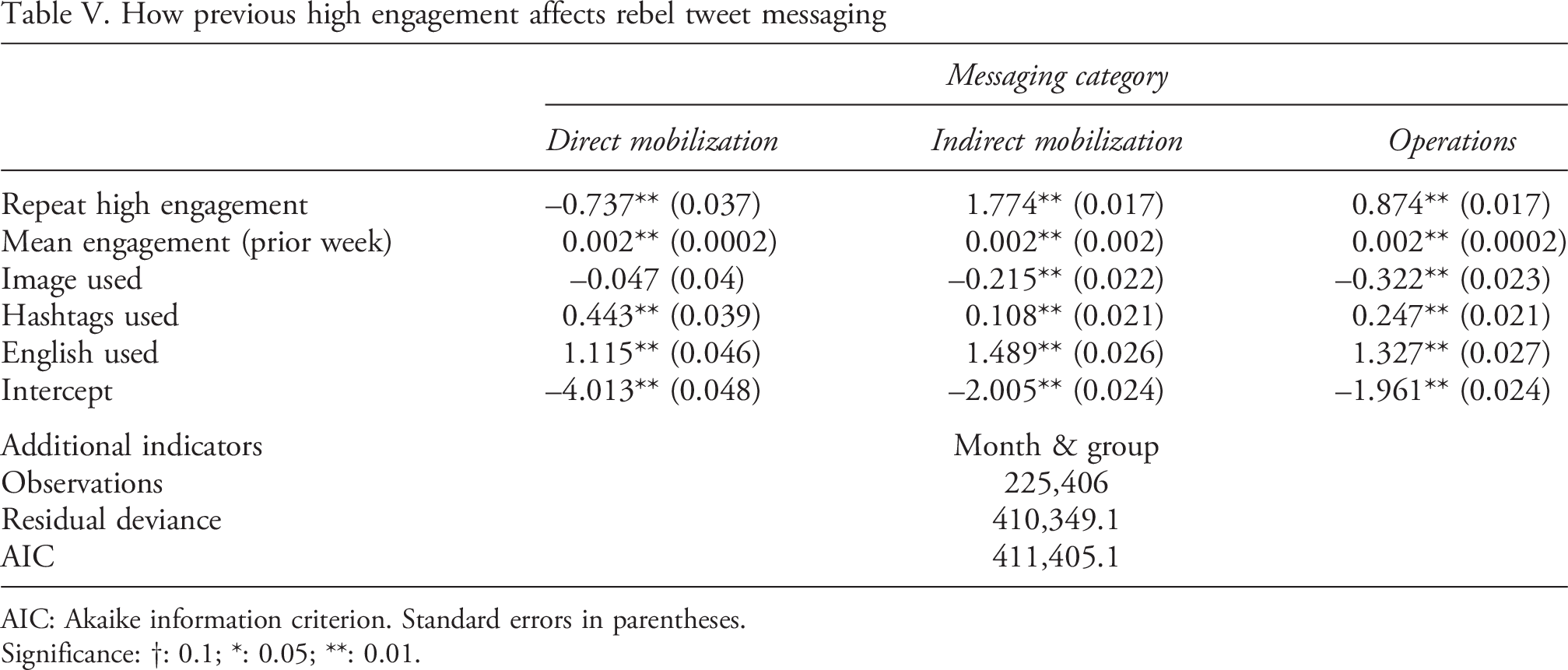
Finally, although the majority of the present analysis was concerned with how audiences respond to different types of messaging strategies from rebel groups, we also modeled how groups might tailor the content of their tweets to the responses of their audiences. To do this, we identified engagement outliers – tweets with a combined engagement count more than 3 standard deviations above the seven-day rolling average for the group that posted it. Then, we fitted a multinomial logistic regression, predicting the messaging category with an indicator for whether an engagement outlier of the same type had occurred during the previous week, along with the same tweet characteristic controls and additional indicators from the earlier models. These results are shown in Table V. Some interesting patterns emerged from this analysis. First, the odds of a tweet containing an indirect mobilization message rather than ‘other’ were 489% higher when the tweet was posted following a week where a group’s indirect mobilization message had received abnormally high engagement. And the odds of a tweet containing an operations message rather than ‘other’ were 140% higher following a week where an operations message had received abnormally high engagement. But the odds of a tweet containing a direct mobilization message were actually 52% lower following weeks where a direct mobilization message had received abnormally high engagement. This finding could suggest that not only do audiences grow fatigued of repeated calls to action, but that groups actually perceive this and avoid posting direct mobilization messages immediately after a tweet containing such a message received substantial attention.
Conclusion
Despite the costs and inherent risks in maintaining a public social media presence, violent actors involved in confrontation against the state engage with social media platforms to communicate with and mobilize potential supporters. While both scholars and practitioners of counterinsurgency strategies have turned their attention to the role of social media for direct mobilization, we found evidence that indirect calls to mobilization can also be an effective tool in garnering increased engagement with a rebel group.
Our findings suggest that while direct calls to mobilization can indeed be highly effective drivers of audience engagement with a rebel group, they are also uniquely subject to message fatigue, and attract much less attention when employed too frequently. This finding, along with the inherent strategic and platform-related risks associated with posting public calls to mobilize on social media, might explain why these types of messages appear as rarely as they do. However, beyond direct calls to action we found that indirect mobilization in the form of self-promotion and brand-building were also effective strategies in increasing engagement with a group’s message. Much like more traditional forms of political messaging from political parties and other nonviolent actors, we found that rebel groups can effectively engage their Twitter audience through indirect calls to action and engagement.
While the attention of the counterinsurgency community has been focused on the deleterious effects of direct calls for action from violent actors, our findings suggest that indirect mobilization can also be effective in increasing engagement with rebel groups. Our work calls us to question the ways in which social media algorithms are being designed to prevent the spread of violent extremism, urging greater attention to the mobilizing power of indirect messaging. Our findings also call on contentious-politics scholars to engage more directly with the ICT and communications literatures to better understand the ways in which rebel groups are communicating and mobilizing in a digitally connected world.
Footnotes
Replication data

Acknowledgements
The authors would like to thank the three anonymous reviewers for their insightful feedback. Molly Utter provided research support while at Indiana University. We would also like to thank the Rebel Governance Network for case-specific assistance with data collection and coding.