




Abstract
This article analyses the conditions under which political parties pay attention to labour issues. It compares the dominant partisan perspective, which proposes that attention to issues is shaped by party competition, to an interest group perspective, which proposes that strong interest groups, in particular when their power is institutionalized in corporatist systems, can force parties to pay attention to their issue. We use the Comparative Agenda Project data set of election manifestos to examine these patterns in seven West European countries and corroborate our findings in the Comparative Manifesto Project data set for 25 countries. The evidence supports the interest group perspective over the partisan perspective. This shows that the study of party attention to issues should not isolate party competition from the influence of other political actors.
Keywords
Introduction
Issue competition has taken a flight in the study of party politics over the last decade (Green-Pedersen, 2019a; Hobolt and de Vries, 2015; Klüver and Spoon, 2016; Meyer and Wagner, 2016). The central idea is that political parties compete to determine the issues that will be put on the agenda because some issues are beneficial to them while others are not (Carmines and Stimson, 1990: 6). So far, the issue competition literature has found that parties try to focus on the issues they ‘own’ and that they seek to force their competitors to pay attention to such issues (Dolezal et al., 2013; Green-Pedersen and Mortensen, 2015; Meyer and Wagner, 2016; Sigelman and Buell, 2004). The dominant focus within the study of issue competition has thus been on the way in which political parties react to each other’s issue emphasis.
This perspective sets political competition apart from other political actors. Yet, political parties do not compete with each other in a vacuum. In the same way as political parties, interest groups are important intermediary organizations between the citizenry and the government (Rasmussen et al., 2014), and they specifically work to affect the political agenda. However, with one notable exception (Klüver, 2020), the role of interest groups in issue competition has received limited attention. This may be reasonable in relation to some issues such as European integration where interest groups play a limited role (Van de Wardt, 2015). However, when it comes to issues such as labour market policy or agriculture where interest groups are strong, the issue competition literature is sparse.
This article, therefore, aims to investigate which factors shape party attention to labour market policy. We focus on labour market policy because this is a good example of an issue where we can test both the partisan perspective and the interest group perspective. We can easily identify parties and interest groups that own labour market issues, that is, centre-left parties, labour parties and trade unions (Gumbrell-McCormick and Hyman, 2013; Seeberg, 2017: 482–487).
We investigate party manifestos in seven West European countries (Sweden, the United Kingdom, France, Germany, the Netherlands, Denmark and Belgium) from 1980 and onward. The party manifestos have been coded according to the Comparative Agenda Project (CAP) coding scheme. We corroborate the robustness of our findings by looking at the CAP data in more detail as well as the Comparative Manifesto Project (CMP) data for 25 countries. We show that where strong labour unions operate in corporatist systems, political parties will generally pay more attention to labour market policy.
Beyond the issue competition literature, our findings also speak to the literature on interest groups and their interaction with political parties. This is a small, but growing field (Allern and Bale, 2017; Allern et al., 2007; Otjes and Rasmussen, 2017; Thomas, 2001; Witko, 2009). The exchange model is at the core of the theoretical work in this field: parties offer access to policymaking in exchange, for example, public support from interest groups. Yet, the research has so far focused on routine or institutionalized contacts and has paid less attention to what is exchanged. By focusing on election manifestos, we are able to get a grasp of the substance of the exchange.
This article will have the following structure. First, we discuss the existing theory on issue competition between parties and deduce some basic expectations about the partisan predictors of attention to labour market issues. Second, we turn to the role of interest groups and propose a number of expectations as to how they affect the attention to labour market issues. Third, we briefly discuss a number of controls. Fourth, we will discuss how we will operationalize these concepts in the method section. Fifth, we show that the attention political parties devote to the labour market is associated with the institutionalized power of trade unions. Lastly, we conclude on the role of party competition and interest groups with respect to attention to labour market issues.
Issue competition between parties
The starting point in the issue competition literature is issue ownership (Walgrave et al., 2015). Political parties have some issues that they ‘own’ in the sense that voters consider them more competent at dealing with such issues than other parties. Therefore, parties would like to focus on those issues. However, the literature repeatedly finds that this is only half the story. Political parties may focus disproportionally on their own issues, but at the same time, they pay considerable attention to the issues that their opponents own (Dolezal et al., 2013; Green-Pedersen and Mortensen, 2015; Meyer and Wagner, 2016). Thus, parties respond to the issues, which are emphasized by other parties in the same party system (Green-Pedersen and Mortensen 2010, 2015; Steenbergen and Scott, 2004).
So far, the study of issue competition has focused on new issues that are emphasized by political entrepreneurs, such as European integration (Hobolt and de Vries, 2015; Van de Wardt, 2015). Political entrepreneurs seek to reshape the political landscape by emphasizing new issues that are not yet part of the existing lines of conflict. Scant attention has been paid to bread-and-butter issues related to the welfare state and the economy (Busemeyer et al., 2013; Green-Pedersen, 2019a; Green-Pedersen and Jensen, 2019) although issue competition is just as relevant for such issues (Green-Pedersen 2019a).
Issue competition is about setting the party system agenda (Green-Pedersen and Mortensen 2010). The more successful a party is in this respect, the more it will benefit electorally. What has not been studied extensively how forces outside the party system affect whether or not parties are successful in forcing other parties to pay attention to their preferred issues. ‘Problem’ indicators such as number of immigrants or focusing events such as the Chernobyl disaster in 1986 play a role (Abou-Chadi, 2016; Green-Pedersen, 2019a; Green-Pedersen and Otjes, 2019; Spoon et al., 2014). The role of other actors than the political parties themselves – such as interest groups – has, however, largely been neglected (though see Klüver, 2020).
Another key insight regarding the issue competition literature is the importance of ‘issue characteristics’. Policy issues differ in terms of the nature of the policy problems involved and the likelihood of focusing events, but also in terms of how interests are structured – as classically laid out by Wilson (1973). Therefore, specific hypotheses about the dynamics of issue competition should be developed in relation to specific issues, in this case labour market policy.
What drives party attention to labour market policy?
As argued, the key dynamic of issue competition is that parties have preferred issues that they try to get other parties to focus on, other parties that would prefer focus on different issues. An initial question in relation to labour market policy is which party ‘owns’ the issue.
Seeberg (2017: 482–487) shows that unemployment is typically an issue owned by the left. The left focuses on labour market policies that seek to protect workers from fickle labour markets, by ensuring fair wages and good working conditions while also providing benefits and job retraining for those who are unemployed. A key aim of parties to the left is thus to generate more attention to labour market policy. We can therefore hypothesise:
1. Left–Right Position Hypothesis: The more left-wing a political party is, the more attention it will devote to labour market issues.
A second hypothesis is that the stronger the major left-wing party is in electoral terms, the more attention all parties will pay to labour market issues. We expect that other parties react to ‘labour’ parties in the same way as they do to anti-immigration and green parties (Green Pedersen and Otjes, 2017; Meguid, 2008; Spoon et al., 2014). The idea that parties respond to strong left-wing parties by increasing attention to their issues can also be found in the power resource approach to welfare state development. If social democratic parties are powerful, there may be a contagion from the left (Huber and Stephens, 2001: 20; Korpi, 1989: 313). This leads to the following hypothesis:
2. Party Competition Hypothesis: The larger the main centre-left party became in the previous election, the more attention all parties will devote to labour market issues.
While the role of parties in shaping attention to issues is well established, less is known about interest groups. 1 The party politics literature focuses on the idea that parties formulate policies to gain votes and set them apart from the broader societal context of policy formulation (Hacker and Pierson, 2014). Yet, just like political parties, interest groups seek to influence policy. One important way in which they seek to do this is by defining the political agenda. We perceive political parties and interest groups as separate organizations that compete for influence, cooperate on common goals and influence each other (Allern and Bale, 2017). 2 The core idea is that the interaction between parties and labour unions is characterized by exchange (Allern et al., 2007; Allern and Bale, 2017; Hacker and Pierson, 2014; Quinn, 2002). Labour unions want legislation and policy rewards, in particular protective legislation in the area of employment and social security (Howell et al., 1992: 1). Party leaders are attentive to such demands because in exchange for such policy benefits, labour unions may give political parties electoral support and provide financial and organizational resources, information on specific policies and organization assistance (Allern and Bale, 2017; Hacker and Pierson, 2014; Klüver, 2020: 982–985). Strong labour unions are also likely to have a stronger voice in the public debate and be better able to generate media attention around labour market issues. This makes it difficult for those parties that would rather avoid the issue and easy for those parties that want to draw attention to labour market issues. Therefore, we propose the following hypothesis:
3. Labour Union Hypothesis: The stronger the labour unions, the more attention will all parties devote to labour market issues.
The power of trade unions does not just depend on their membership. Their power can be institutionalized in corporatist arrangements. Following Jahn (2014), we conceive of corporatism as having three dimensions: hierarchically centralized interest organizations (structure dimension), which engage in concertation with each other and the government in relation to socio-economic policies and wages (function dimension), which again leads to agreements that encompass broad segments of the labour market (scope dimension).
The institutionalized cooperation between the social partners and the government may institutionalize political attention on issues that are important to the labour movement (Huber et al., 1993: 718). Corporatism also makes employers more willing to accept labour market regulation and social protection (Jensen, 2011: 172–174). If there is consultation, deals can be struck between social partners about an extended welfare state where employers accept the increased costs of social policies in return for other benefits. A similar logic is likely to apply to political parties: in corporatist systems, political parties do not just offer policies to convince voters, they are also in constant negotiation with social partners. Therefore, they are more likely to discuss labour market issues in their manifestos, signalling possible tripartite compromises. Also, corporatist arrangements work as ‘focusing events’ around labour market policy, which generate media attention. This makes it more likely that political parties will focus on the issues. Finally, in non-corporatist systems, governments have less influence over wage negotiations in the private sector. Therefore, parties in pluralist systems are less likely to mention preferences related to wage negotiations in their manifesto because this issue is outside of their control.
4. Corporatism Hypothesis: The more corporatist a polity is, the more attention parties will devote to labour market issues.
There are also reasons to believe that the effect might be in the opposite direction or that corporatism has no effect: thus, many authors have observed a decline of corporatism and a rise of lobbyism, which may lead to the belief that corporatism is no longer relevant (Christiansen and Rommetvedt, 1999; Rommetvedt et al., 2013; but see Jahn, 2014 for a critical discussion). One might thus also argue that corporatism is meant to depoliticize issues. Creating a negotiation space between trade unions and employers’ organizations outside of politics may be one way to keep certain issues away from (party) politics. 3
Hacker and Pierson (2014: 647) observe that ‘the institutional terrain’ has a strong effect on how groups organize, with whom they align, and to what extent they can influence policies. For this case, trade union strength and corporatism are thus likely to interact: Under corporatism, labour unions are more powerful actors as they have a seat in tripartite negotiations about policy. Therefore, political parties may want to talk more about matters that directly interest labour unions, such as labour market policies. This may be a way for political parties to signal their willingness to cooperate with labour unions once in government. When trade unions are strong actors, it is difficult for even parties that prioritize other issues to ignore labour market policy.
5. Corporatism-Labour Union Hypothesis: The more corporatist the polity is, the stronger effect that labour unions will have on the level of attention all parties will devote to labour market issues.
Control variables
The attention parties pay to labour market issues does not just reflect party priorities or even the priorities of other powerful actors in the political system. External events such as natural disasters and media reports on social or economic problems, for example, unemployment, can also force parties to pay attention to issues, at least in the short to medium term (Baumgartner and Jones, 1993; Green-Pedersen, 2019a; Green-Pedersen and Jensen, 2019). For the labour market, the actual level of unemployment is a good indicator of the importance that citizens attach to the issue and thus allows us to incorporate the riding-the-wave perspective where parties react to the public importance citizens attach to an issue (Klüver, 2020). Therefore, we expect that the higher the unemployment, the more parties will prioritize policy solutions pertaining to employment issues.
Over the last decades, the relevance of the class theory of politics has declined in Western countries as working-class voters have oriented themselves away from the left (Houtman et al., 2009), and parties to the left have embraced post-materialist policies, such as the environment. Support for environmental protection may be particularly at odds with support for labour issues: environmentalists are willing to accept lower economic growth to protect the environment. Therefore, we expect that the less pro-environment a political party is, the more attention it will devote to labour market issues.
Methods
In this study, we use a number of different data sources to show the effect of party strategy, interest groups and economic circumstances on political attention. Online Appendix 1 lists the availability of data, and Online Appendix 2 lists descriptives. To ease the interpretation, all independent variables have been standardized so that their minima are zero and their maxima are one.
Our dependent variable is the level of attention, which individual parties pay to labour issues in their party manifestos. Each party manifesto is coded according to the CAP coding system. This system is based on policy issues that are divided into main topics (e.g. macroeconomic policy) and subtopics (e.g. inflation or taxation within the category of macroeconomic policy). The coding system was originally developed by Baumgartner and Jones and contained 19 main topics and more than 200 subtopics. Later, other research teams made national versions of the codebooks by modifying the American codebook. Cross-national comparison was then secured by means of a crosswalk system (Bevan, 2019). The data sets were established independently for each country and later merged into one data set. Green-Pedersen (2019b) presents details about the coding for each country. In all countries, trained human coders coded the documents using either natural sentences or quasi-sentences as coding units. 4 Since each coding unit is coded at the subtopic level, the system is completely flexible in terms of generating new major categories by aggregating subtopics.
We focus on the category ‘labour’. In the master codebook, this category has a number of subcategories, that is, ‘worker safety and protection’, ‘employment training and workforce development (active labour market policy)’, ‘employee benefits’, ‘employee relations and labour unions’, ‘fair labour standards’ and ‘youth employment and child labour’. We exclude sentences concerning the subtopic of labour migration because it is more related to the issue of immigration. We included the subtopic of ‘unemployment’, normally placed under the main topic of macroeconomics. 5 The CAP measure specifically measures issue saliency and not the policy direction: It may also contain ‘right-wing’ proposals concerning the labour market, such as eliminating protection against dismissal. Our argument is that corporatism and union strength raise the saliency of the issue, not that political parties necessarily pursue union-friendly policies. This is the variable ‘CAP Labour’.
We include a number of robustness tests in Online Appendix 2. First, we use the depth of the CAP coding scheme to analyse a specific subset of labour market policies, that is, active labour market policies and cash benefits related to the labour market (unemployment benefits, sickness benefits, etc.). This is done to test whether the findings are the same when only including attention to ‘labour-friendly’ subissues: it consists of two subcategories from the CAP Labour-category ‘Active Labour Market Policies’ and ‘Benefits to Employees’.
Second, the CAP data are available for seven countries and from the early 1980s and until the mid-2010s. While these data give us considerable depth and flexibility, they are also limited in scope. Therefore, we also use the CMP data set, which has a greater geographic scope and covers a longer period. Two categories in this codebook explicitly concern labour issues (per701 (Labour Groups Positive) and per702 (Labour Groups Negative)). We construct one variable CMP Labour, which includes both positive and negative mentions. This contains all sentences that refer positively or negatively to labour groups, the working class, labour unions, the unemployed and calls for more jobs, better working conditions, fair wages and so on. Thus, while the CAP looks at the saliency of a policy area, the CMP looks at the saliency of the group in manifestos. We further focus on advanced industrialized countries to analyse countries compared with the CAP data. 6 Combined with other restrictions regarding the number of countries and years, the CMP analyses have 25 countries and a maximum of 797 cases. The CAP and CMP variables concern (mostly) the same documents, but the coding strategies are different. Therefore, there is a correlation between the two variables, but of intermediate strength. 7 If both data sets show the same results despite different coding schemes and codes, this provides strong evidence for the hypotheses we propose.
To test the Left–Right Position Hypothesis, we need a measure of party positioning for a longer time period. To ensure that the measures of the dependent and independent variables are truly exogenous, we use expert surveys to establish left–right positions. There have been five projects using expert surveys to collect data since the Second World War: Benoit and Laver (2006), Castles and Mair (1984), Huber and Inglehart (1995), Morgan (1976) and the Chapel Hill Expert Survey (CHES) of Hooghe et al. (2010). We use the general left–right dimension from these data sets. This means that while economic policy positions may play a role in parties placed left or right, so do their positions on moral issues, immigration and other issues. This provides a more conservative test of our hypothesis than if we were to use a measure of merely parties’ economic left–right attitudes. 8 We have left–right estimates for 1897 party-election-year combinations, between 1963 and 2017. The CHES and the Benoit and Laver (2006) surveys use similar items to measure environmental attitudes. Both ask experts to place parties on a dimension where the extremes represent either prioritizing environmental protection or economic growth, but this limits the scope of the analyses that are using this variable to more recent decades. We have data for 946 party–election–year combinations. In Online Appendix 2, we also look at models without the environmental variable. 9
To test the Party Competition Hypothesis, we look at the size of the main party of the centre-left. The codebook of the CMP includes the party family of the party for every manifesto. We look at parties in the social democratic category. 10 If there are multiple social democratic parties, we chose the one that was the largest in the last election. This is often the largest party to the left, but in some cases, a communist party was larger. We assign the share of the votes in the previous election. These data were also included in the CMP data set. This variable was available for all elections, except for the first elections in every data set. As a robustness test, we also included models in Online Appendix 2 that control the attention which the largest centre-left party paid to labour market issues in their manifesto for the previous election. Parties may not just respond to the size of this party, but also to the attention that it raises. 11
To test the Corporatism Hypothesis, we use data from Jahn (2014) who provides estimates of corporatism based on Visser’s database (2016). This measure of corporatism taps into all the dimensions that are relevant for our hypothesis: Under corporatism the government can influence wage negotiations and labour unions, and that employers’ organizations are involved in policymaking. This measure is available for 27 countries, between 1960 and 2010, in a total of 2063 manifestos. To ensure that we look at a causal effect, we use the level of corporatism in the year preceding the election. Note that this measure of corporatism is dynamic: It can wax and wane over time as the institutional ties between governments, trade unions and employers intensify or weaken.
To test the Unionization Hypothesis, we use data from Visser (2016). This data set has comparable data on the share of the workforce that are members of a labour union. These data are available between 1960 and 2013 for 26 countries, although for five countries estimates are not available for every election. We use the level of unionization in the year before the election. There is a moderate correlation between unionization and corporatism. 12 In the CAP data set, there are corporatist countries with strong unions (Sweden), corporatist countries with weak unions (the Netherlands), non-corporatist countries with strong unions (the United Kingdom) and non-corporatist countries with weak unions (France).
To control for the level of unemployment, we use data from the OECD (2018), which collect comparable estimates of unemployment in a large number of countries, in some cases since 1950, in most cases since 1980, but data are not available for every year for all eight countries. Therefore, we have data for 1393 cases. We use the level of unemployment the year before the election to prevent that our findings are the result of reversed causality.
We use a multilevel least squares regression with random effects for elections, since at that level country-level measures, like unemployment, that are the same for multiple cases are introduced.
Results
Before we turn to our results, we will briefly look at the descriptive results of the main independent variable, the level of attention political parties pay to labour market issues as defined above. We will look at this cross-nationally and within party families. Figure 1 shows the average across parties per election for different countries. We see that average party attention declines from above 12% in the early 1980s to around 7% in the 2010s. Attention to labour declines in Denmark, France, the Netherlands and the United Kingdom. The attention is relatively stable in Belgium and Germany. In Sweden, the attention oscillates.
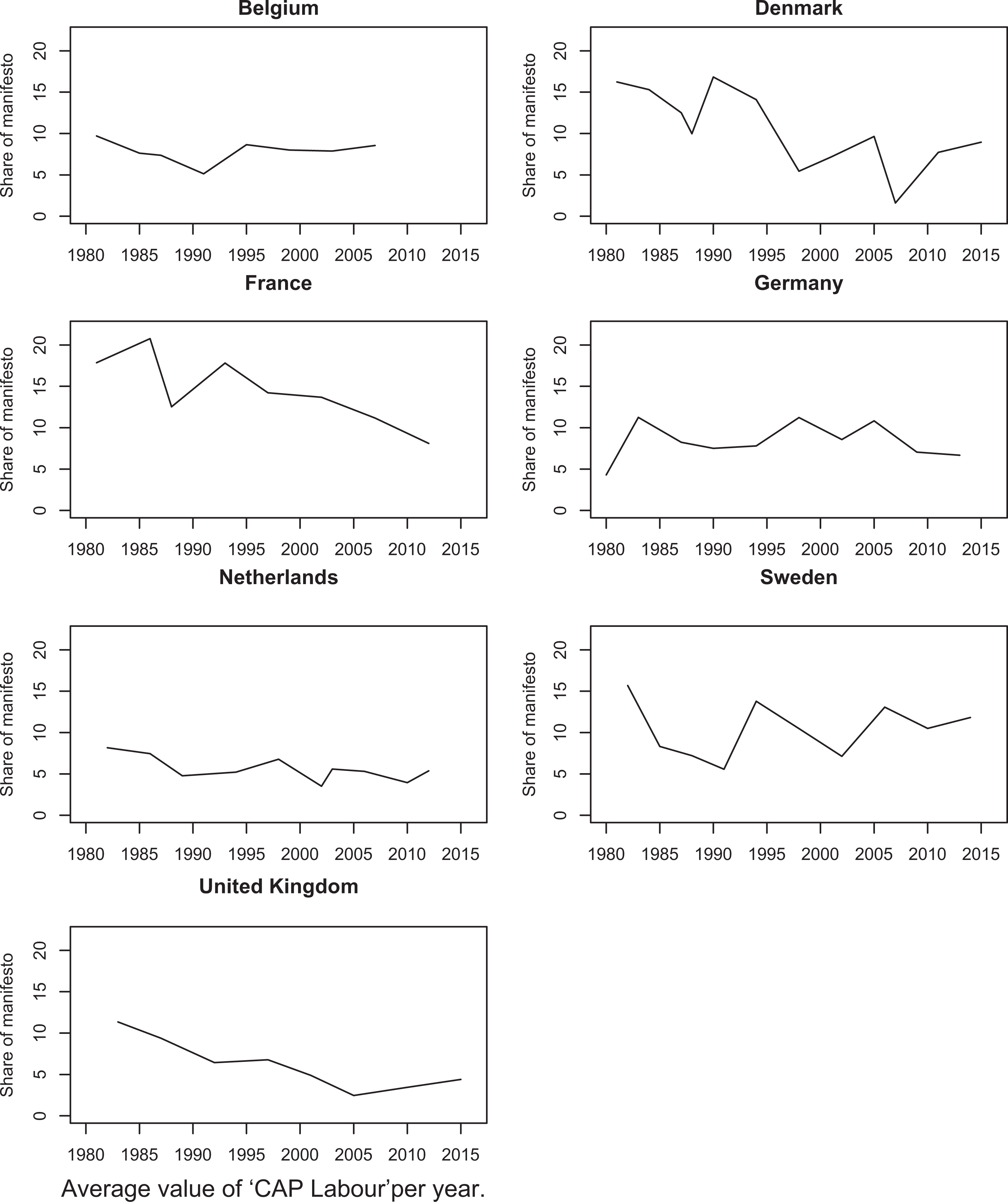
Trends in attention to labour 1980–2016. Average value of ‘CAP Labour’ per year. CAP: Comparative Agenda Project.
Figure 2 shows the patterns per party family. They show that the greatest attention to labour is among the traditional working parties, the communists/socialists and the social democrats. Interestingly, the green parties that stand in between the communist/socialists and the social democrats pay less attention to the issue than these two. The green parties are more likely to focus on new political issues, particularly the environment. This supports our notion that both the left–right position and the party’s position on environmentalism play a role. Among the other party families, the attention on labour is considerably lower. Nationalist parties to the utmost right on the figure pay the least attention to the issue.
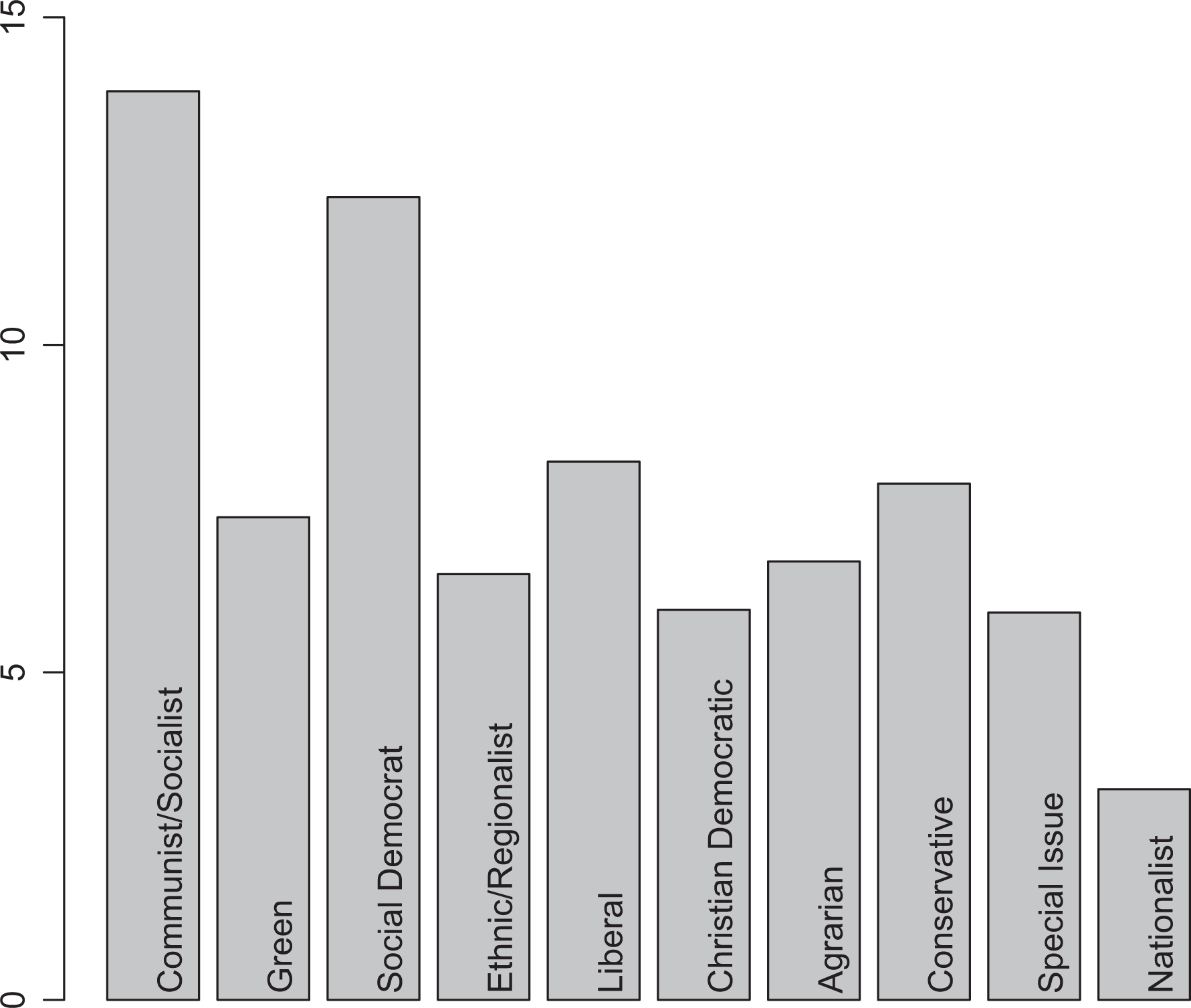
Averages of attention to labour per party family. Average value of ‘CAP Labour’ per year. Parties arranged from left to right by average left–right position of the party family. Party families as per CMP data set. CAP: Comparative Agenda Project; CMP: Comparative Manifesto Project.
Next, we will examine what can explain these patterns.
Table 1 presents a number of regression models. Online Appendix 2 offers a number of robustness tests. 13 First, we test the Right–Left Hypothesis, that is, the idea that left-wing parties will focus more on labour issues than right-wing parties. The idea is that the left owns labour issues and that right-wing parties will want to ignore them. In each model we run, left–right positioning has a sizeable and significant effect on the attention parties pay to labour issues. The same is true for all robustness tests in Online Appendix 2. In model 3, the uttermost left-wing party pays about 12 points more attention to labour than the least left-wing party, which corresponds to about two standard deviations (SDs) of this variable. This clearly corroborates the Left–Right Position Hypothesis.
The Party Competition Hypothesis proposed that the larger the centre-left party, the more attention will other parties give to labour issues, because it should indicate that focusing on labour issues is a successful strategy. We find no support for this hypothesis at all. Rather, in the three models in Table 1, the relationship is negative. All the coefficients in Online Appendix 2 are also negative and significant in less than half of the cases. This may indicate that focusing on labour issues – and in particular on the interests of labour groups – is less attractive when labour parties are stronger. In the conclusion below, we reflect further on the possible underlying reasons for this unexpected result. For now, it suffices to conclude that large labour parties do not elicit more attention to labour, so the Party Competition Hypothesis should be rejected. 14
Regression models.
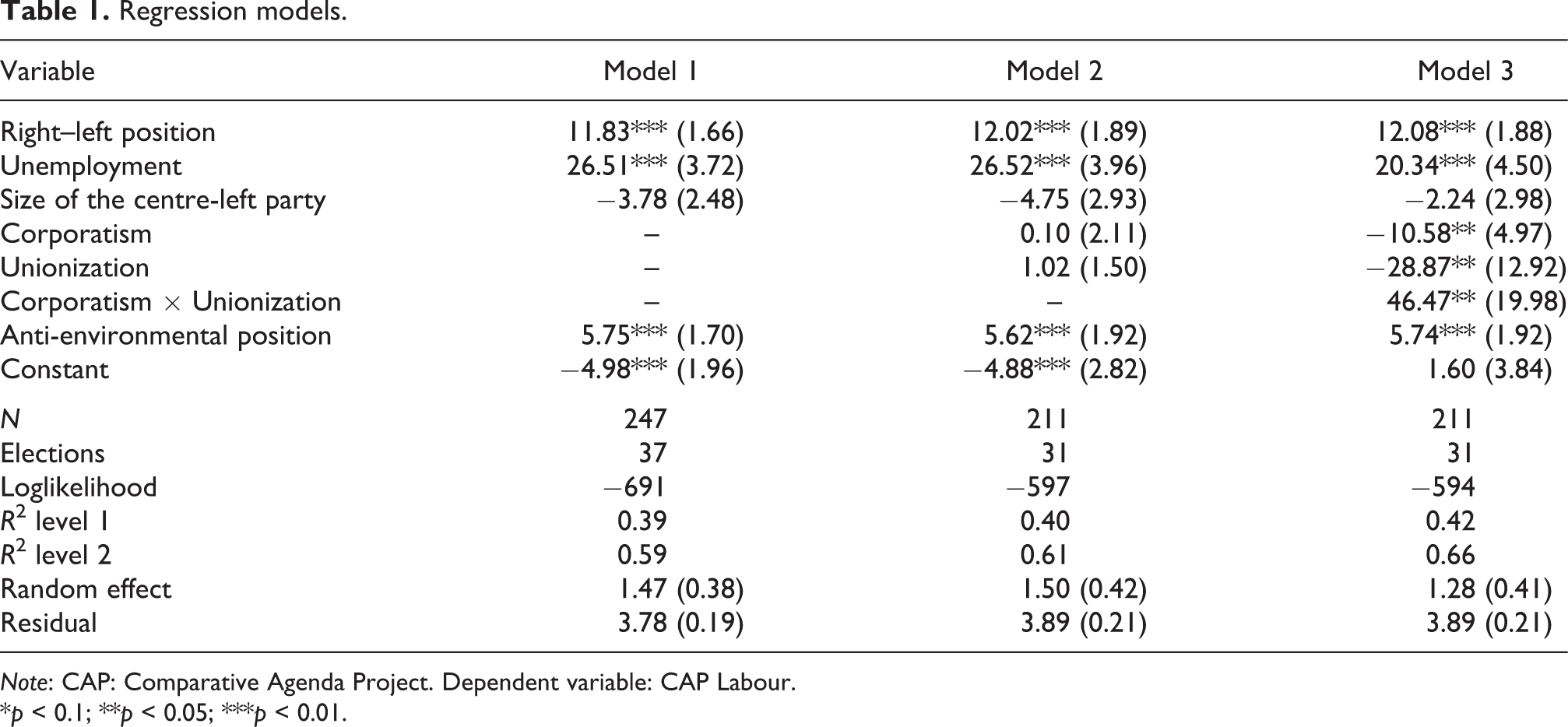
Note: CAP: Comparative Agenda Project. Dependent variable: CAP Labour.
*p < 0.1; **p < 0.05; ***p < 0.01.
Next, we look at the role of interest groups with three hypotheses: The Labour Union Hypothesis proposes that the stronger the labour unions, the more attention will parties devote to labour. This variable is added in model 2. We do not find that there is a significant direct effect of the size of labour unions on the attention to labour, although the effect is in the correct direction. In Online Appendix 2, all but one coefficient for unionization is insignificant. This indicates that in itself labour union strength does not boost attention to labour.
The Corporatism Hypothesis proposes that in corporatist systems, parties will devote more attention to labour. This variable is added in model 2. The coefficient is in the correct direction but is neither significant nor very strong. Only one-third of the coefficients for corporatism in Online Appendix 2 are significant. The models also differ in the direction of the effect. Only three of seven coefficients for corporatism in Online Appendix 2 are significant. The models also differ in the direction of the effect. Thus, the evidence for the Corporatism Hypothesis is weak.
On the other hand, it seems that the combination of corporatism and trade unionism boosts party attention to labour (as hypothesized in the Corporatism-Labour Union Hypothesis). We visualize the pattern (from model 3) in Figure 3: It shows that when the level of corporatism is strong, the effect of labour union strength on attention to labour becomes stronger, significantly and substantially, in line with the hypothesis. In non-corporatist countries, strong labour unions weaken rather than strengthen attention to labour. In corporatist countries, their strength increases attention to labour. This effect is strong and significant. All but one robustness check in Online Appendix 2 supports this finding. 15 This is important because interaction on system-level variables like union strength and corporatism may depend strongly on the selection of countries. Both in the smaller sample of seven West European countries (in the CAP data) and in the broader range of 25 advanced industrial democracies (in the CMP data), this interaction works in much the same way. All in all, we find sufficient evidence that in recent decades, strong labour unions in combination with high levels of corporatism lead to more attention to labour. The fact that we find strong support for this hypothesis in both the CAP and the CMP databases is notable: In terms of both the methodological approach and the empirical patterns, these measures are quite different.
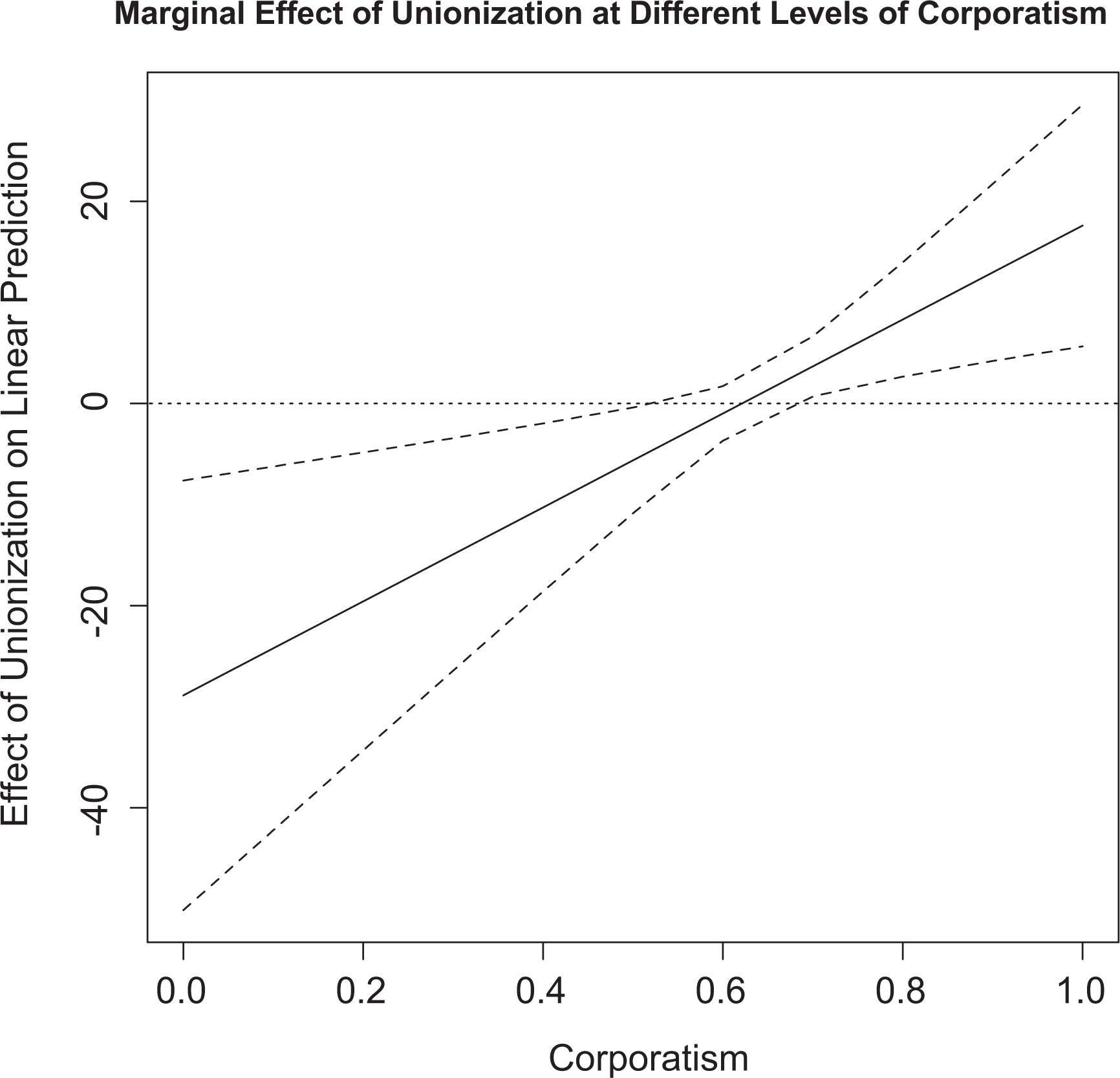
Average marginal effects of unionization on attention to labour at different levels of corporatism. Based on model 3, with 90% confidence interval.
Next, we look at our control variables, the first of these is unemployment. The idea is that the higher the unemployment, the greater is the attention to the issue. Model 3 indicates that in-between situations – between the lowest and the highest unemployment – parties pay about 20 percentage points more attention to labour, a very sizeable and significant effect. This effect can be seen in all analyses with the CAP data in Online Appendix 2. In the analyses with CMP data in Online Appendix 2, this effect is less consistent. 16
Finally, we look at the position of parties on the dimension between environmental protection and economic growth. In itself, anti-environmentalism has a negative relationship with the different measures of attention to labour, 17 as left-wing parties tend to be more pro-environmental. 18 When controlling for the left–right position of parties, the pattern shows the expected direction. Thus, in model 3, the least environmentalist party pays six percentage points more attention to labour. This is a significant effect of about one SD of the data. This effect persists in every model included in Online Appendix 2. Note that this variable constrains the N considerably. The significant patterns in analyses of the CAP data are corroborated when this variable is dropped.
All in all, attention to labour issues reflects party characteristics and the relations with interest groups. Left-wing parties emphasize labour issues. Trade union strength also plays a role, but only in corporatist systems when their power is entrenched. The size of the centre-left party does not influence the attention to labour.
Conclusion
The aim of this article was to study to what extent and under what conditions interest groups are able to shape issue attention to specific policies. We added an important comparative perspective in addition to Klüver’s (2018) study, which examined the influence of interest groups on multiple issues in one country. We focused on labour market issues because here, we would be able to contrast partisan and interest group effects starkly. We saw that when the power of trade unions is institutionalized in corporatist arrangements, the attention to labour market issues is greater. Our results are robust, when we look at both the CAP data covering 7 countries and the CMP data covering 25 countries. The same applies when looking at general patterns for labour and when zooming in on specific categories concerning active labour market policies.
We compared the importance of party competition to the importance of trade union power. The evidence is squarely on the union side: political parties pay more attention to labour issues when unions are strong and their power is institutionalized through corporatism. This shows that election manifestos are not just part of party competition, but also important signalling devices between political parties and interest groups. Parties seek to court trade unions (Allern and Bale, 2017): Parties have to address the issues trade unions raise when they are strong and when this power is formalized in corporatist structures. By paying attention to labour in their manifestos, political parties signal their willingness to cooperate with trade unions once in power. As in Klüver’s (2018) study of Germany, we show that interest group influence matters when it comes to political attention, but our comparative study also shows that this influence strongly depends on the institutional context, which parties and interest groups operate in. One puzzling, but consistent, result is that at low levels of corporatism, strong trade unions have a negative effect on attention to labour. In non-corporatist systems, parties pay more attention to labour when trade unions are weak as opposed to strong. An explanation might be that in non-corporatist systems – in the absence of trade unions – political parties take over the mediating role of the interest of employees that trade unions otherwise have. When trade unions are strong, they take over this mediating role themselves. Future research may want to look in particular at understanding attention patterns in non-corporatist systems. All in all, the empirical patterns indicate that the relationship between interest groups and political parties is more complex than the literature on issue competition has so far assumed.
The finding that union power and not party power boosts attention to labour stands in contrast to the party political literature on competition regarding non-economic issues. There, the idea has been that the stronger the party that owned an issue, the more would the established parties focus on such issues. We found no clear relationship between the size of the main centre-left party and the attention to labour. There are no indications that large social democratic parties lead to more attention to labour, but rather that the relationship, if anything, is negative. Two factors may explain this: The first factor relates to the elections. The larger the centre-left party, the more likely it is that it will have the support of all voters concerned with labour issues. Under these conditions, it is likely that competition between large catch-all parties will focus on the centrist swing voters who will care about issues that to do not map to the left or right, such as labour. The second factor is related to coalition formation (cf. Green-Pedersen and Otjes, 2019). If the main party of the centre-left is large, it is likely to be able to govern on its own. If the main party of the centre-left is small, it is more likely that a coalition will be needed between this centre-left party and other parties, and if parties expect to govern with the main party of the centre-left, they will need to prepare their own labour market agenda, in order to offer alternatives to those on the centre-left’s agenda.
Future research may want to expand on the issues raised in this article and study the phenomenon beyond the limitations of this study: The first avenue for further research may be an examination of the role of interest groups with respect to the attention political parties pay to other issues. This comparative article has taken a limited perspective by focusing on one issue and one kind of interest group. Future research may want to look at the political role that employers’ organizations play with respect to attention to issues that are of special concern to them, such as business regulation or corporate taxation. Farmer groups may want gain influence on agricultural issues. Future research may want to look at the effect of strong business groups on political attention and the role of institutional context. Moreover, this article has focused on bread-and-butter issues, but a similar logic may also apply to new political issues. Thus, it may be interesting to study the role that environmental groups play in raising the salience of the environment. Also, future analyses may want to pay attention to the organizational connections between parties and interest groups, in particular trade unions and the role they play in shaping the agendas of parties (cf. Allern and Bale, 2017).
Supplemental Material
Supplemental Material, 190701_Appendix_1 - When do political parties prioritize labour? Issue attention between party competition and interest group power
Supplemental Material, 190701_Appendix_1 for When do political parties prioritize labour? Issue attention between party competition and interest group power by Simon Otjes and Christoffer Green-Pedersen in Party Politics
Supplemental Material
Supplemental Material, 190624_Appendix_2 - When do political parties prioritize labour? Issue attention between party competition and interest group power
Supplemental Material, 190624_Appendix_2 for When do political parties prioritize labour? Issue attention between party competition and interest group power by Simon Otjes and Christoffer Green-Pedersen in Party Politics
Footnotes
Declaration of conflicting interests
The author(s) declared no potential conflicts of interest with respect to the research, authorship, and/or publication of this article.
Funding
The author(s) received no financial support for the research, authorship, and/or publication of this article.

Supplemental material
Supplemental material for this article is available online.
Notes
References
Supplementary Material
Please find the following supplemental material available below.
For Open Access articles published under a Creative Commons License, all supplemental material carries the same license as the article it is associated with.
For non-Open Access articles published, all supplemental material carries a non-exclusive license, and permission requests for re-use of supplemental material or any part of supplemental material shall be sent directly to the copyright owner as specified in the copyright notice associated with the article.
