




Abstract
We use historical data on union density and new historical data on policies toward migrants to study the long-run relationship between the strength of trade unions and the social and economic rights of migrants in the Global North. In countries with strong trade unions, there was, for a long time, a widening distance between the rights of migrants and the rights of citizens, probably because the rights of citizens expanded sooner and more quickly than the rights of migrants. Over time, however, the differences between countries with strong and weak unions have diminished, and in more recent years, the ‘rights gap’ between citizens and migrants has in fact been smaller in countries with strong unions than in countries with weak unions.
Migration has been on the labour movement’s agenda ever since the 19th century. In fact, one of the motives behind the formation of the International Workingmen’s Association, commonly known as the First International, in 1864 was to advocate restrictions on international labour mobility, as the labour movement underwent a transition from its ‘pre-national’ into its ‘national’ phase (van der Linden, 2003: 14). The role of trade unions in immigration policy has therefore long been an important theme in the scholarly literature on migration (Castles and Kosack, 1973). Several significant studies of unions and migration have been published in the past two decades (see, for example, Gorodzeisky and Richards, 2013; Hardy et al., 2012; Krings, 2009; Marino, 2012; Marino et al., 2015; Wrench, 2004).
As the introduction to this special issue explains, labour unions can potentially influence the ‘immigration–welfare nexus’ in several ways and at several different stages of the policy process. We concentrate on one important element of migration policy: the social and economic rights of resident migrants. We use comparative, historical data on the rights of migrants to study the relationship between the strength of the union movement and the changing width of the ‘rights gap’ between migrants and citizens (the difference between the social and economic rights of migrants and those of citizens).
Some scholars have argued that trade unions tend to ignore migrant rights or even support exclusionary policies such as job restrictions and inferior working conditions for migrants (e.g. Gächter, 2000). Others point out, by contrast, that trade unions often insist on equality in wages, employment conditions and social rights between native and migrant workers (e.g. Knocke, 2000). Our study is an attempt to move these debates forward. We develop a new argument about the dynamic, long-run relationship between the strength of trade unions and the social and economic rights of migrants. The first result of an increase in union strength, we argue, is a widening rights gap between migrants and citizens, since new rights are typically extended to citizens before they are extended to migrants. Over time, however, the gap between citizens and migrants is likely to narrow where unions are strong, for once rights for native workers are secured, strong unions put more effort into improving the lot of migrant workers as well.
Existing scholarship in this field tends to be based either on small samples, short time frames, or both. This is unfortunate, for as several authors have shown, both the political strategies of unions (Haus, 2002; Watts, 2002) and their political success (Boräng and Cerna, 2017) have varied a great deal over time and among countries (see also Penninx and Roosblad, 2000). Accordingly, we test our argument using historical data on the social and economic rights of migrants that have been compiled by Peters (2015, 2017), Kalm and Lindvall (2019), Shin (2019), and ourselves, along with historical data on trade unions compiled by Rasmussen and Pontusson (2018). Our dataset covers 18 countries in the Global North during the period between 1900 and 2010.
As we discuss in the concluding section, the ideas and findings of this paper have important implications not only for the literature on migration and migrant rights, but also for the literature on trade unions. Our main finding is that the relationship between the strength of unions and the social and economic rights of migrants is dynamic and context-bound, suggesting that it is wrong to label trade unions as either exclusionary or inclusionary across the board. It is likely that the role of trade unions is similarly dynamic and context-bound in other respects as well, notably when it comes to contemporary tensions between ‘insiders’ and ‘outsiders’ in the labour market.
Unions and migrants
Immigration policy has two main domains (Hammar, 1985): admission policy (the extent to which foreigners are admitted at all, and, if so, how they are selected) and migrant-rights policy (the civic, political, social and economic rights immigrants enjoy once they have arrived in the country, e.g. in terms of access to social security and employment). This paper concentrates on the latter, since we wish to investigate the relationship between union strength and the rights of migrants. We concentrate on the rights of labour migrants – that is, migrants who are admitted for the main purpose of work (thus excluding asylum seekers and refugees) and who are not citizens in the country of entry. We are primarily, but not exclusively, concerned with social rights, and we conceptualise the main outcome variable as the difference, or ‘gap’, between the rights which migrants enjoy and the rights which citizens enjoy.
According to one widely held view, trade unions resist immigration since it poses a threat to the native labour force: a pool of surplus labour undermines union power, particularly if it is made up of non-unionised labour, and may depress wages (Avci and McDonald, 2000).
When they do accept labour immigration, however – or when increased labour migration is already a fact – a key concern for trade unions is to make sure that labour migration does not result in a deterioration in wages or working conditions (Menz, 2010: 97). Unions thus have a strong interest in policies concerning the rights that are extended to labour migrants once they have been admitted: their wages and working conditions, their access to different sectors of the labour market, and their social rights. Previous research has shown that unions sometimes have neglected migrant rights, or even supported exclusionary policies (Gächter, 2000; Wrench, 2000; see also Afonso et al., 2020). There are, however, several reasons for trade unions to instead choose an ‘equalization strategy’ and push for equality of rights between native and foreign workers to fight exploitation and unfair competition.
Clearly, such a strategy is more in line with the idea of international unity among workers than a strategy of accepting inferior conditions for foreigners. Moreover, for reasons both of solidarity and narrower self-interest, unions wish to prevent foreign labour from being used to undercut wages and working conditions. If migrants’ rights are significantly more restricted than those of native workers, they are more likely to accept inferior conditions of employment. The strategy of demanding equal rights for all workers is – when successful – the most effective way to ensure that wages and working conditions are not undercut. 1 Finally, demanding increased rights for migrants could be a way to persuade migrants to join trade unions. As demonstrated by Milkman (2006), among others, migrants have played an important role in trade union revitalisation, not least in periods of de-unionisation.
To sum up, although there are empirical examples of how trade unions have ignored or even opposed the rights of foreign workers, there are strong theoretical reasons for why we should expect trade unions to work for equal rights for migrants. Our own argument, which helps to make sense of these contradictions, is based on three ideas. The first is that a rights gap between migrants and citizens can emerge in two different ways, either because rights are taken away from migrants, or because citizens’ rights are extended while those of migrants are not. The second is that increased rights for migrants is unlikely to be high on trade unions’ agenda while basic social rights for native workers are not yet secured, since unions are likely to care more about rights for native workers – who make up most of their membership – than rights for migrants; once social rights for natives are secured, however, social rights for migrants are likely to receive more attention from strong unions that strive to avoid discrimination, unfair competition or both. The third idea, which follows from the first two, is that the relationship between union strength and the rights gap between citizens and migrants is not constant but dynamic and changes over time.
To illustrate the implications of these ideas, we will now develop a stylised argument about how the rights of both citizens and migrants are likely to develop over time, starting from a situation in which neither group has many social and economic rights. In our argument, the only difference between strong unions and weak unions is that the former have more political influence. We assume that weak and strong unions have the same basic goals: both want more social and economic rights, but at least at the outset, they care more about citizens than migrants since most of their members are citizens and the unionisation rate among migrants is typically low. The difference between weak and strong unions is not in the goals, but in their ability to achieve those goals, and, related to this, in the policy positions and strategies that they adopt. Taking welfare state expansion and inclusion as an example, we assume that all trade unions have strong social rights for all workers as a basic goal. However, in order to fight for a shift from a situation with weak social rights for everyone to one with strong social rights for everyone (citizens and non-citizens alike), unions have to engage in two battles: one about the strength of the welfare state, and one about the inclusion of non-citizens in the welfare state. We suggest that depending on their strength, trade unions will pick one or both battles, and depending on their strength they will be able to win zero, one or both of them. Regardless of their strength, trade unions will prioritise the interests of the majority of their members and first fight for increased social rights for citizens.
This distinction between underlying goals, which are constant, and policy positions and strategies, which are not, is familiar from other analyses of the role of interest groups in public policymaking, notably Thomas Paster’s study of the political behaviour of German business interests (2013). To clarify this point further, we do not wish to rule out the possibility that the basic goals may vary among trade unions and over time. But for the purposes of this paper, we make the simplifying assumption that trade unions have the same underlying goals but, depending on their strength and the political and economic circumstances, adopt different strategies and take different policy positions on migrant workers.
Figure 1 illustrates our argument. Since, ex hypothesi, trade unions fight for citizens first, the relationship between union strength and the social and economic rights of citizens is best described by a concave curve. The relationship between union strength and the social and economic rights of migrants, by contrast, is described by a convex curve since we assume that unions put more effort into increasing the rights of migrants once they have already achieved their primary goals regarding the rights of citizens.
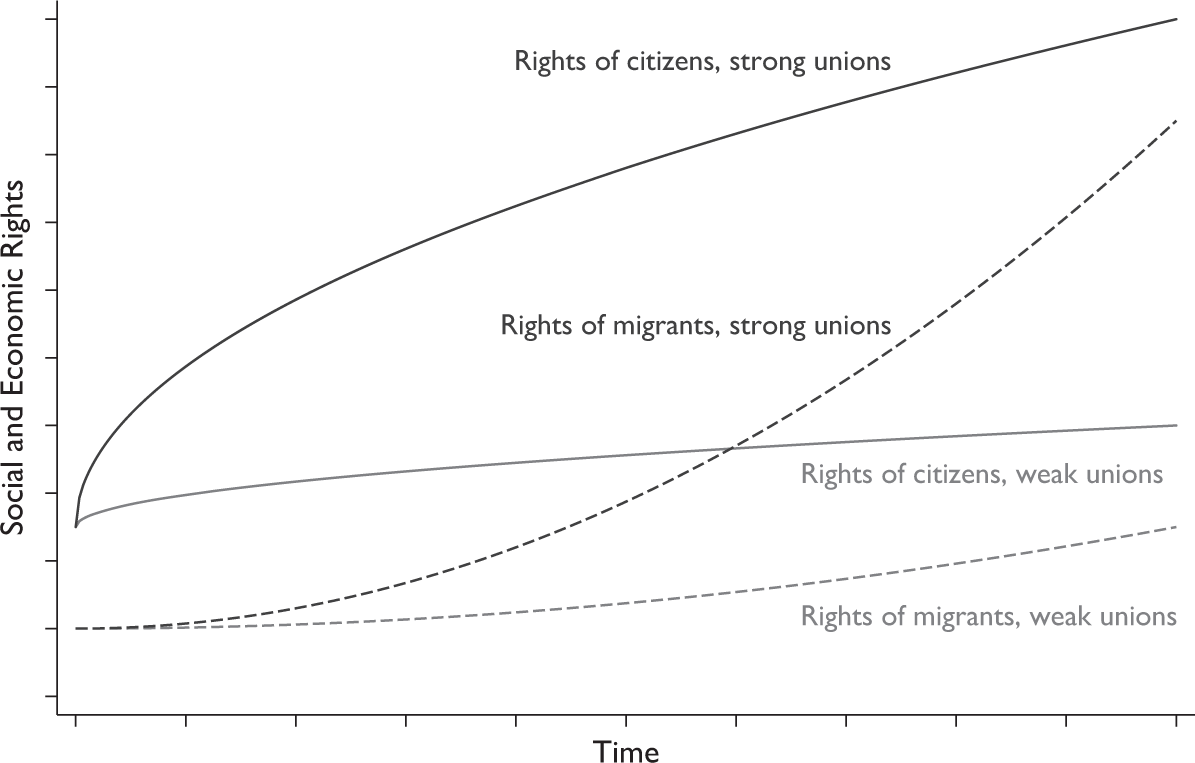
Unions and the social and economic rights of citizens and migrants.
The point we wish to make on the basis of this figure is that until migrant workers have ‘caught up’ with native workers, the rights gap between migrants and citizens remains greater in countries with strong unions than in countries with weak unions, even if all groups of workers do better in absolute terms in countries where the unions are strong. This is easy to see in Figure 2, which instead of having the level of social and economic rights on the y-axis describes the difference in social and economic rights between migrants and citizens (the horizontal line at the top describes a situation of full equality, or parity). Because strong unions are more effective politically – this is the only difference between strong and weak unions in our highly stylised argument – they achieve more rapid gains for citizens, which means that migrants are initially left behind to a greater extent in countries with strong unions than in countries with weak unions.
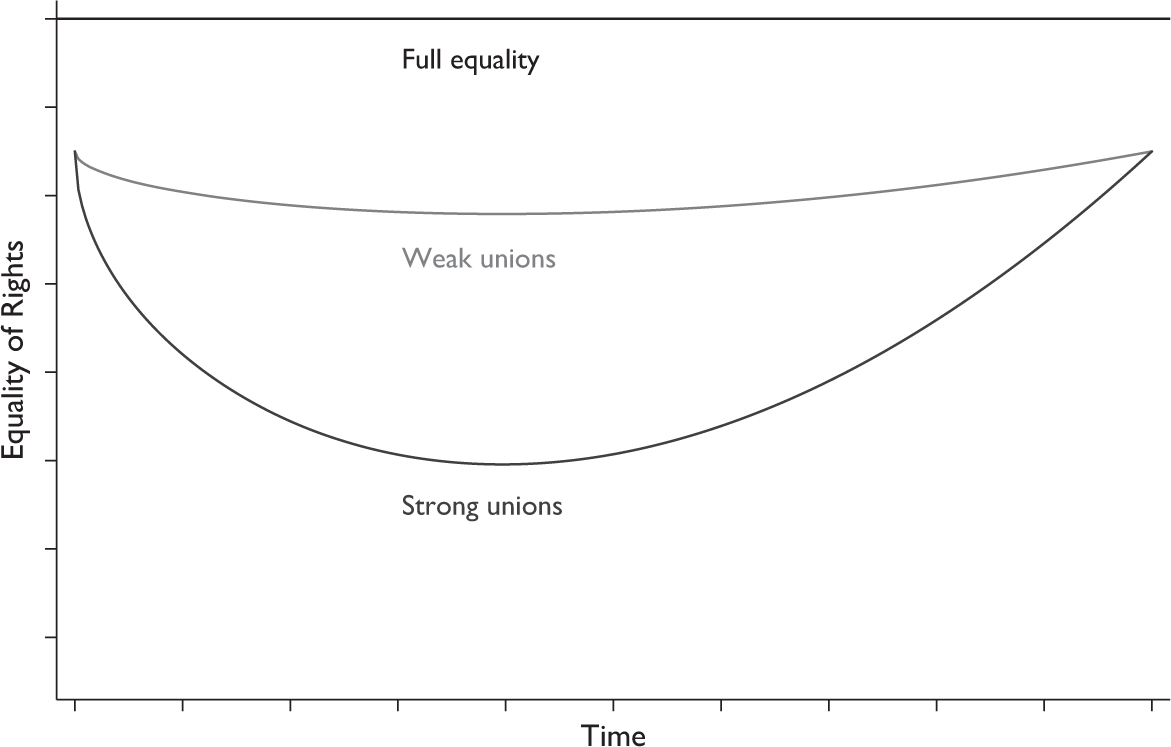
The rights gap.
Finally, imagine another scenario, which is exactly like the first except in one respect: in addition to wanting to increase the social rights of all – with priority given to native workers – we make the additional assumption that unions wish to reduce the initial gap between citizens and migrants (the pre-existing difference between the two groups at t = 0 in Figure 1). Again, unions may have varied reasons for doing so. They may, for instance, have a strong belief in international solidarity among workers, they may want to gain more members, they may feel that the presence of a vulnerable migrant population is harmful for native workers, or, most likely, they may hold all these beliefs (which are often difficult to separate from each other). The implication of this change in the underlying assumptions, as Figure 3 reveals, is that when enough time has passed, countries with strong unions do not only catch up with countries with weak unions, in terms of the inclusiveness of economic and social rights: they become more inclusive than countries with weak unions.
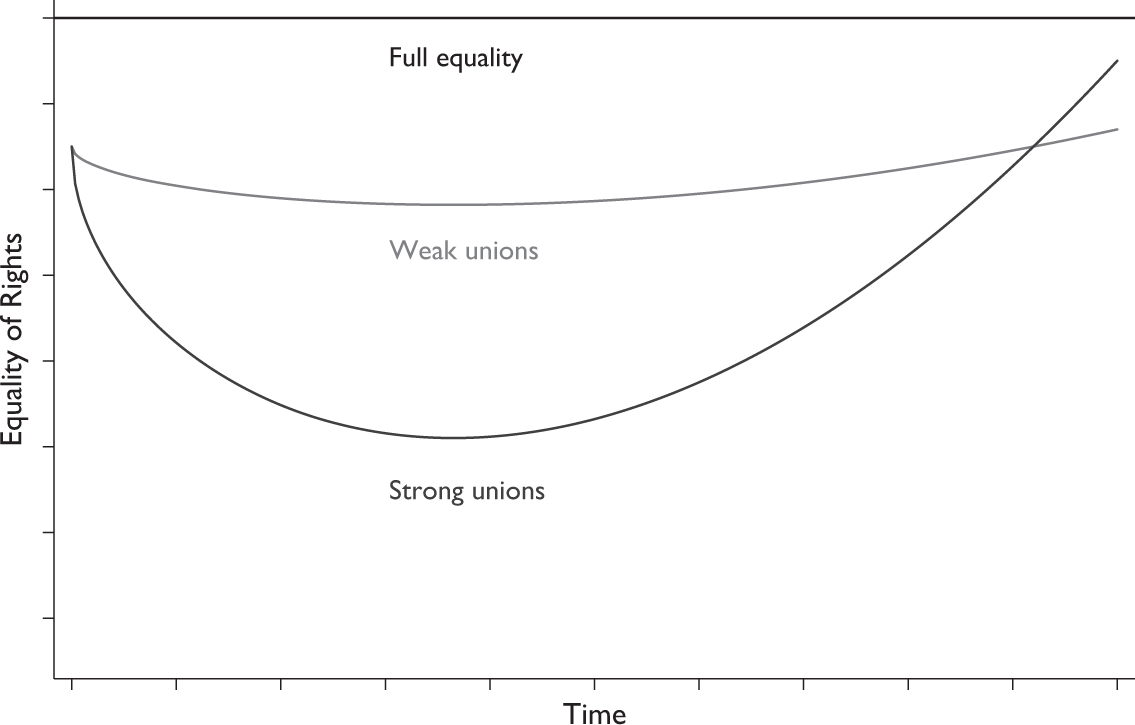
The rights gap, alternative scenario.
The main implication of our argument remains the same, however: both Figure 3 and the earlier Figure 2 suggest that the relationship between union strength and the rights gap between citizens and migrants is likely to have changed significantly over time. At first, we therefore expect high union strength to increase the rights gap, but at some later point, we expect the relationship to change: in countries with high union strength, the rights gap begins to shrink faster.
Data and methods
Over the period we study – from 1900 to 2010 – there is a great deal of variation in the overall level of social and economic rights in the countries in our sample. Starting from extremely low levels, there was a strong and sustained expansion of social and economic rights for much of the period (toward the end, especially in the 1980s and early 1990s, there was also some retrenchment in most countries). Using long-term historical data, we are therefore able to study the relationship between union strength and migrant rights under very different conditions, testing the ideas that we have developed in the previous section.
By now, several quantitative indicators are available for those who wish to study comparative immigration policies, (see, e.g. Helbling et al., 2017 and Beine et al., 2016). The problem with these indicators is that they cover a rather short time-period: they go back a few decades at most. This paper therefore relies on new cross-country comparative evidence on the relationship between union density and migrant rights in the rich countries in the Global North between 1900 and 2010. We use immigration policy data originally compiled by Margaret Peters (2015), adding data for some countries in 1950–2010 from Shin (2019) and a great deal of new historical and contemporary data on Western European countries that have in part been compiled by Kalm and Lindvall (2019) and in part by ourselves. We have endeavoured to follow Peters’s (2015, 2017) coding conventions closely (for a detailed description of the coding rules, see online Appendix A). The countries included in the study are: Australia, Austria, Belgium, Canada, Denmark, Finland, France, Germany, Ireland, Italy, Japan, the Netherlands, New Zealand, Norway, Sweden, Switzerland, United Kingdom and the United States. It is important to note that we study the development of de jure policy, not outcomes such as migration or employment patterns.
Our measure of the rights of migrants is an additive index based on four separate indicators: (1) Immigrant Rights, which includes social rights such as access to the welfare state, but also other rights such as freedom of movement, property rights, anti-discrimination legislation and so on, and which ranges from 1 (few legal rights) to 5 (parity to citizens); (2) Labour Prohibitions, which ranges from 1 (immigrants not allowed in any industry) to 5 (only highly sensitive national security positions restricted, with no restrictions on the number of immigrants workers in a given occupation); (3) Family Reunification Policy, which ranges from 1 (no special provisions for family reunification) to 5 (many categories of relatives can be sponsored by citizens or residents); (4) Citizenship Policy, which ranges from 1 (citizenship only given through birth) to 5 (citizenship given to all children born in the state, naturalisation is easy).
The measure describes the extent to which migrants have rights that are on par with those of natives. In other words, the measure describes the rights gap between citizens and resident migrants (corresponding with the y-axis in Figures 2 and 3), not the extent of the rights that migrants in fact enjoy (corresponding with the y-axis in Figure 1). This is very clear in the case of Labour Prohibitions and Immigrant Rights, where high scores quite simply imply parity with citizens.
The indicator for Immigrant Rights relies heavily, but not exclusively, on the extent to which migrants have social rights that are equal to those of natives – both in our own coding and in the original coding by Peters (2015).
Labour Prohibitions is an instrument for exclusion that over the years has been promoted by some trade unions as a way to protect native workers, with substantial implications for migrants’ rights. Not only are social rights strongly connected with an individual’s position on the labour market; when significant parts of the labour market are closed for migrants, they end up in a more vulnerable labour market position. This may force migrants to accept wages and working conditions that are even lower than what is standard for the jobs they are allowed to take.
Family Reunification Policy is closely related to social rights since a generous reunification policy indicates that a country is willing to accept non-employed spouses as well as children, who are likely to be more dependent on the welfare state than the labour migrants themselves. This link to the welfare state is reflected in the coding for this variable, where obligations for migrants to provide for their family members during a certain period after arrival lowers the score.
As for Citizenship Policy, a change in status from non-citizen to citizen typically evens out any remaining differences in rights between migrants and natives, and it is therefore the most efficient way to close any rights gap that may exist between the two groups.
In sum, our index of migrant rights – a non-weighted mean of the four indicators – captures whether policies vis-à-vis the migrant population are exclusionary or inclusionary. To make sure that the results do not hinge on any particular aggregation of our four items into an overall index, we test the robustness of our results by estimating our statistical model separately for the four indicators.
We use union density – net union membership as a proportion of all wage and salary earners in employment – as a proxy for the strength of trade unions. The union density data come from Rasmussen and Pontusson (2018), with the exception of the data for United Kingdom, which come mainly from Bain and Price (1980), and the years since 2007, which we have extrapolated with the help of data from Visser (2019). 2 It is important to be aware that in some countries, factors other than union density also matter greatly to the strength of the unions (the French unions are the most well-known examples of unions that are much stronger than their membership numbers suggest). In most cases, however, union density is a reasonable proxy for the strength of trade unions, and it is difficult to conceive of a better alternative for the purposes of statistical analysis (Lindvall, 2013). For example, an indicator of corporatist arrangements – institutions that privilege trade unions (as well as employers’ organisations) in policymaking – would lead to an assessment of union strength that is artificially stable, hiding important differences in union strength over time. In additional analyses that are included in the Supplementary Material, however, we include the centralisation of the union movement, using data from Visser (2019).
One potential objection to treating union density as the key explanatory variable is that the organisational capacity of the unions’ main opponents – employers – also varies greatly among countries and over time (and, more generally, the political context has changed greatly). We certainly agree that employers play an important part in immigration policymaking, but union density is important in its own right. In all countries and during the entire time period we study, employers have been significantly stronger than labour in terms of economic resources, since these resources can be concentrated among a small number of actors. Therefore, it is labour – weaker in economic resources but stronger in numbers – that has most to gain from organisation (Korpi and Palme, 2003). Business can have policy influence both individually (large corporations) and collectively (business organisations), which means that business influence is a real possibility in all the contexts we study; but labour can only have policy influence when workers act collectively. 3
We first present our data in graphs that visualise the relationship between union strength and the rights gap over time. We then analyse these patterns with regression methods, which allow us to estimate more precisely how migrant rights are related to union density. Apart from describing the relationship between union strength and immigrant rights for the full period, we examine the patterns in two sub-periods that are suggested by both theoretical considerations and our own descriptive data analyses: 1900–1938 (excluding 1914–1918) and 1946–2010. We exclude the years of the First and Second World Wars, since the exceptional circumstances during the wars in many cases led to dramatic changes in the priorities and options for action available for trade unions. We also exclude periods in which countries were not democratic since our theoretical argument builds on the assumption that trade unions enjoy the freedom to organise and formulate policy positions independent of state policy.
The statistical models are kept parsimonious since few potential control variables are exogenous to our model, and we prefer a sparse model to one that includes ‘bad controls’ (variables that are themselves influenced by our main explanatory variable, union density). Due to their expected importance throughout the period and their well-known effects on both union density and immigration policy, we include GDP per capita and GDP growth (although some potential endogeneity problems are present also for these variables). These data come from Maddison (2011).
Empirical evidence
Before we examine the empirical relationship between the rights gap and union density, we present some univariate descriptive evidence on these different indicators, describing the variation we seek to explain. We begin, in Figure 4, with our main outcome variable, the parity of rights between migrants and citizens. The grey lines represent individual countries; the thicker black line represents the cross- country mean. As the figure shows, the difference between migrants’ and citizens’ rights increased in the period leading up to the Second World War (note that high values represent more equality since that is how our indicators are defined), but decreased in the period after the Second World War. In the 1990s and 2000s, the line is more or less flat. This flattening towards the end of the period is interesting and somewhat surprising. It coincides with significant widening and deepening of European integration, which one could have expected would have led to further narrowing of the rights gap in many of our countries. The figure suggests that this effect, if it existed, was not particularly large. Instead, welfare-state retrenchment is a plausible explanation for the flattening of the curve from the late 1980s onward. So, we would argue, is the weakening of unions.
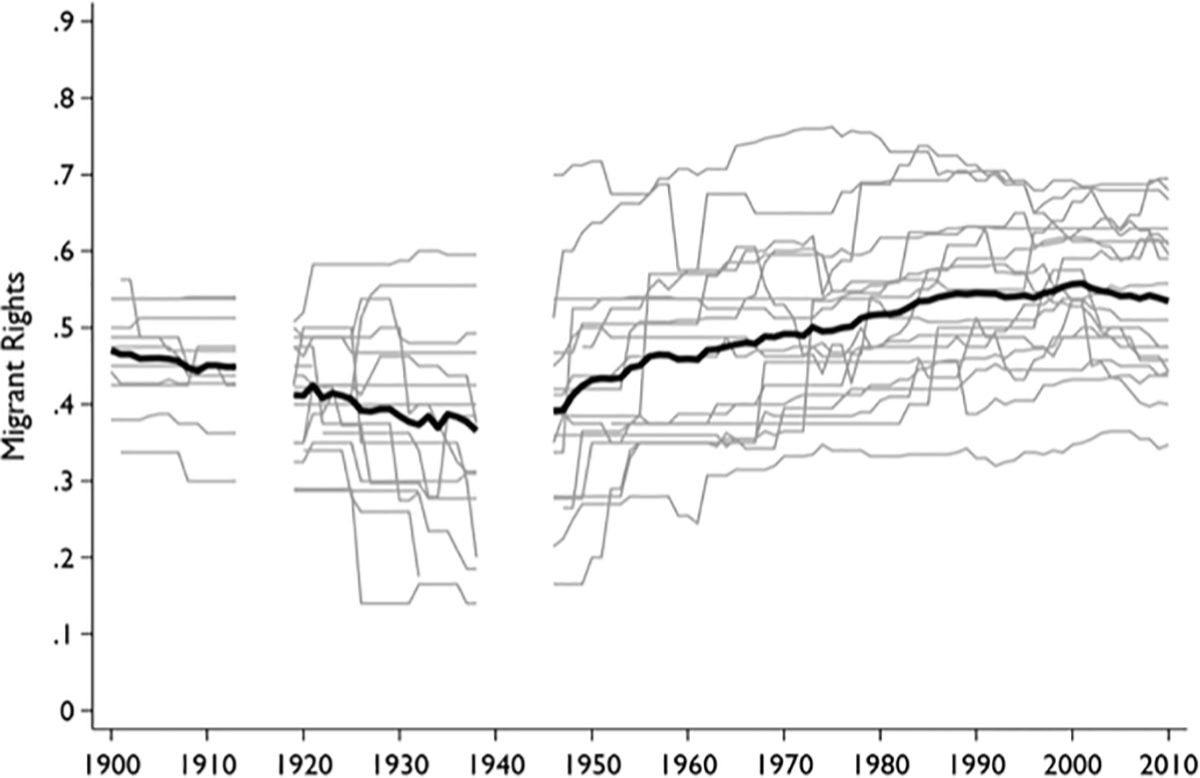
Migrant rights, 1900–2010.
During the long period that we describe in Figure 4, trade unions first became stronger, and then weaker (Figure 5). Average union density in our sample of countries increased from very low levels in the first decades of the twentieth century (note the spikes in the wakes of the economic downturns in the early 1920s and early-to-mid 1930s); it then remained high but declined slightly during the post-war boom, before experiencing another increase during the low-growth 1970s; since around 1980, union density has declined significantly.
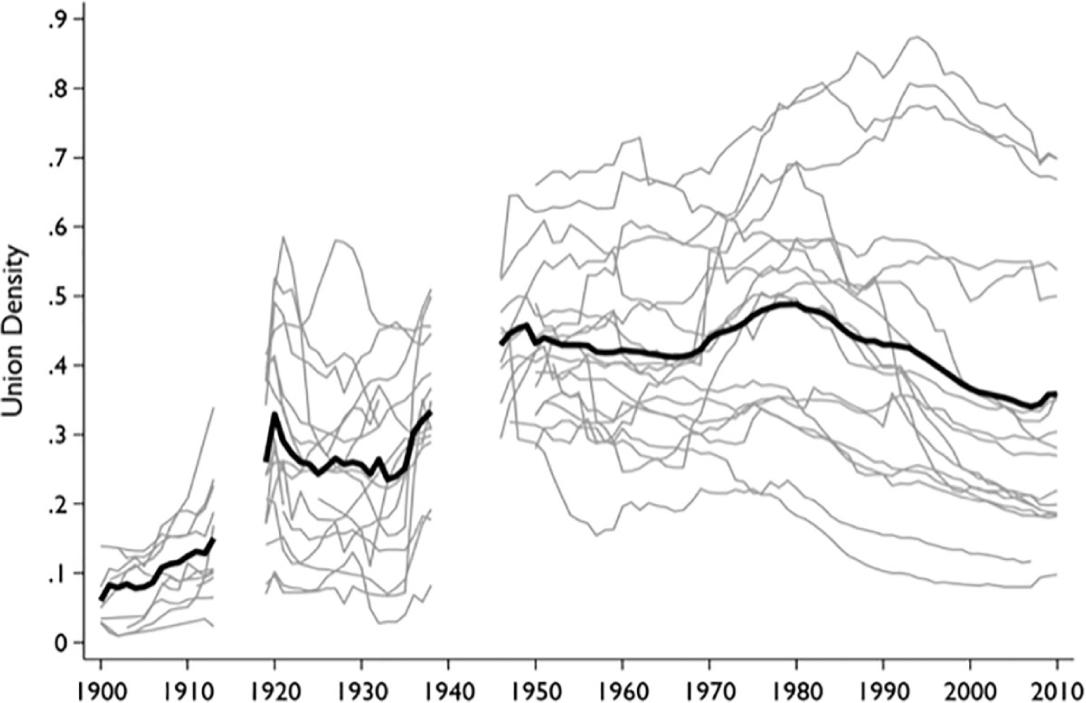
Union density, 1900–2010.
We are now ready to examine the long-run relationship between trade union strength and the rights gap graphically. Figure 6 shows how the rights gap has developed over time within two groups of countries: the top third in terms of union density in each year (‘strong unions’) and the bottom third (‘weak unions’; note that since the groups are defined in relative terms, the composition of the two groups changes somewhat over time). The two lines describe, for each year, the average of our main outcome variable, the rights gap, within the two groups of countries. 4
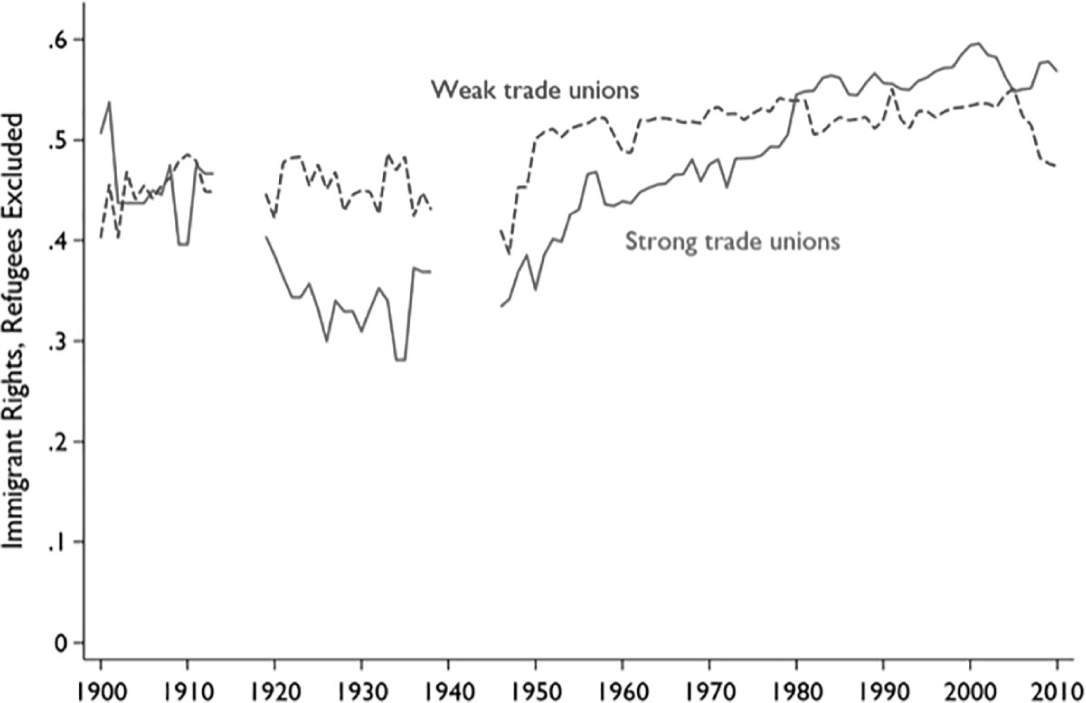
Union strength and the rights gap.
As Figure 6 shows, there is no uniform relationship between union strength and the rights of migrants. During the first decades of the 20th century, we find that where unions were strong, the rights gap between citizens and migrants increased, while remaining more stable where unions were weak. Our interpretation of this pattern is that stronger unions managed to achieve more social rights for citizens, compared to the very low levels at the turn of the 20th century, and that this increase in rights for citizens was not matched by a corresponding increase in migrant rights, leading to a widening gap between natives and migrants.
Early social insurance legislation often distinguished between migrants and citizens, which meant that as citizens gained more rights, the rights gap increased. Note, for instance, that one landmark piece of early social-insurance legislation – the National Insurance Act 1911 in the United Kingdom – provided that immigrants were not entitled to tax-funded benefits (only contribution-based benefits), and to the extent that aliens were in fact entitled to benefits, they were lower than those similarly situated citizens would have received (Kalm and Lindvall, 2019: 8).
The rights gap that emerged in the early 20th century remained during the decades of strong welfare state expansion in the middle of that century, but after the Second World War, countries with strong unions began to catch up, in terms of the inclusion of migrants, and by around 1980 they were on par with countries with weaker unions. During the 1990s and 2000s, countries with strong unions even had a slight edge over countries with weak unions in terms of closing the gap between natives and migrants (note that the maximum value of 1 represents parity between migrants and citizens in our dataset).
Observe the basic similarity between Figures 6 and 3: the pattern in the data corresponds well with the theoretical expectations we formulated in the first section. In countries with weak trade unions, the rights gap is quite stable over time, diminishing very slowly; in countries with strong trade unions, the rights gap at first increases greatly, then it shrinks at a fast rate. In the first half of the 20th century, the relationship between union strength and migrant rights is consequently negative, but it then switches, as our argument suggests it should, and becomes positive.
We will now move from these uni- and bivariate figures to a more detailed statistical analysis. Our main expectation is that union strength will be associated with the rights gap in different ways over time, as Figure 6 suggests it is. The conditional effect of union density could be modelled, for instance, by interacting union density, our main explanatory variable, with a continuous time variable (which yields substantively similar results to those we report here). In our analysis, however, we have opted for simplicity and chosen to interact union density with a dichotomous measure of time periods: before and after the Second World War. This procedure is associated with some loss of nuance, but it makes the results intuitive and easy to understand. The cut-off in the 1940s is not only justified by our descriptive findings, but also by substantive and theoretical considerations: it is well-known that the period immediately after the Second World War was a watershed in 20th-century political history, as the welfare state was consolidated and as organised labour and the working class were more integrated in domestic political systems (Huber and Stephens, 2001; Milward, 1992).
There is also the possibility that there is a non-linear effect of union density: very strong unions might have been confident and powerful enough to demand equal conditions already early on, in which case we would find a U-shaped relationship between union density and migrant rights within periods. This is an interesting question worth exploring further – preliminary tests suggest that this is indeed the case – but for the purposes of this paper, modelling a linear relationship between union density and migrant rights in two different time periods approximates the theoretical model reasonably well.
There are also different choices to be made regarding how to treat the within- and between-country variation we have in the data. In the model we use, we control for unobserved heterogeneity between countries as well as for common shocks by including both country and year fixed effects. The inclusion of fixed effects is sometimes discouraged if important cross-country differences emerged before the period under analysis (Plümper et al., 2005). In our case, however, we are interested in the local effect of union density in each of the periods we analyse, so fixed effects are helpful for our purposes. It should be noted, however, that the results are robust to a range of specifications. The results are shown in Table 1.
Statistical analysis.
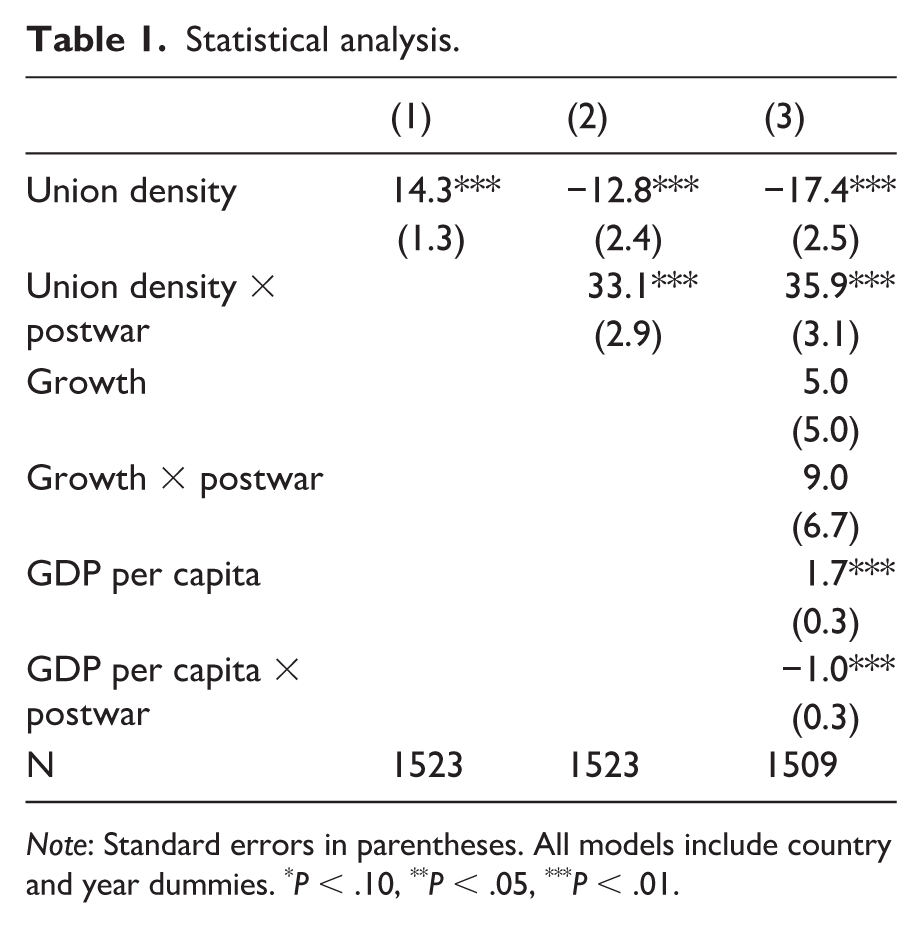
Note: Standard errors in parentheses. All models include country and year dummies. *P < .10, **P < .05, ***P < .01.
In column 1, we estimate the linear relationship between union density and migrant rights during the whole period, including country fixed effects and year fixed effects to control for common unobserved shocks and stable, unobserved country-level differences, but no time-varying covariates. We have recoded our migrant-rights variable to the interval 0 to 100. In this model, where we do not allow the effect of union density to vary over time, there appears to be a positive effect of union density on migrant rights (a 10%-point increase in union density is associated with a change of +1.4 in our migrant-rights index).
In column 2, we interact union density with a dummy for the postwar period (distinguishing the time before and the time after the Second World War) and thus allow the effect of union density to vary between the two periods. We now find that the estimated effect of union density for the period before the Second World War is negative (a 10%-point increase in union density is associated with a change of −1.3), whereas the estimated effect after the Second World War is positive (a 10%-point increase in union density is associated with a change of +2.0).
In column 3, we include time-varying covariates (which are also interacted with the period dummy for consistency). As the results in this column show, the estimates are robust to the inclusion of economic controls (before the Second World War, a 10%-point increase in union density is associated with a change of −1.7; after the Second World War, the same increase was associated with a change of +1.8).
The above analysis uses the composite index of the rights gap. In Table 2, we estimate the same model as in column 3 in Table 1 separately for the four indicators on which our index of migrant rights is based (rights, labour, citizenship, family). The same pattern recurs when we study these variables one by one: before the Second World War, an increase in union density was associated with a widening rights gap for all indicators, but after the Second World War it was associated with a narrowing gap. This indicates that the composite index works well; but there are also some subtle differences among the different outcome variables, indicating that there are interesting dynamics related to the timing of the introduction of different rights.
Statistical analysis 2.
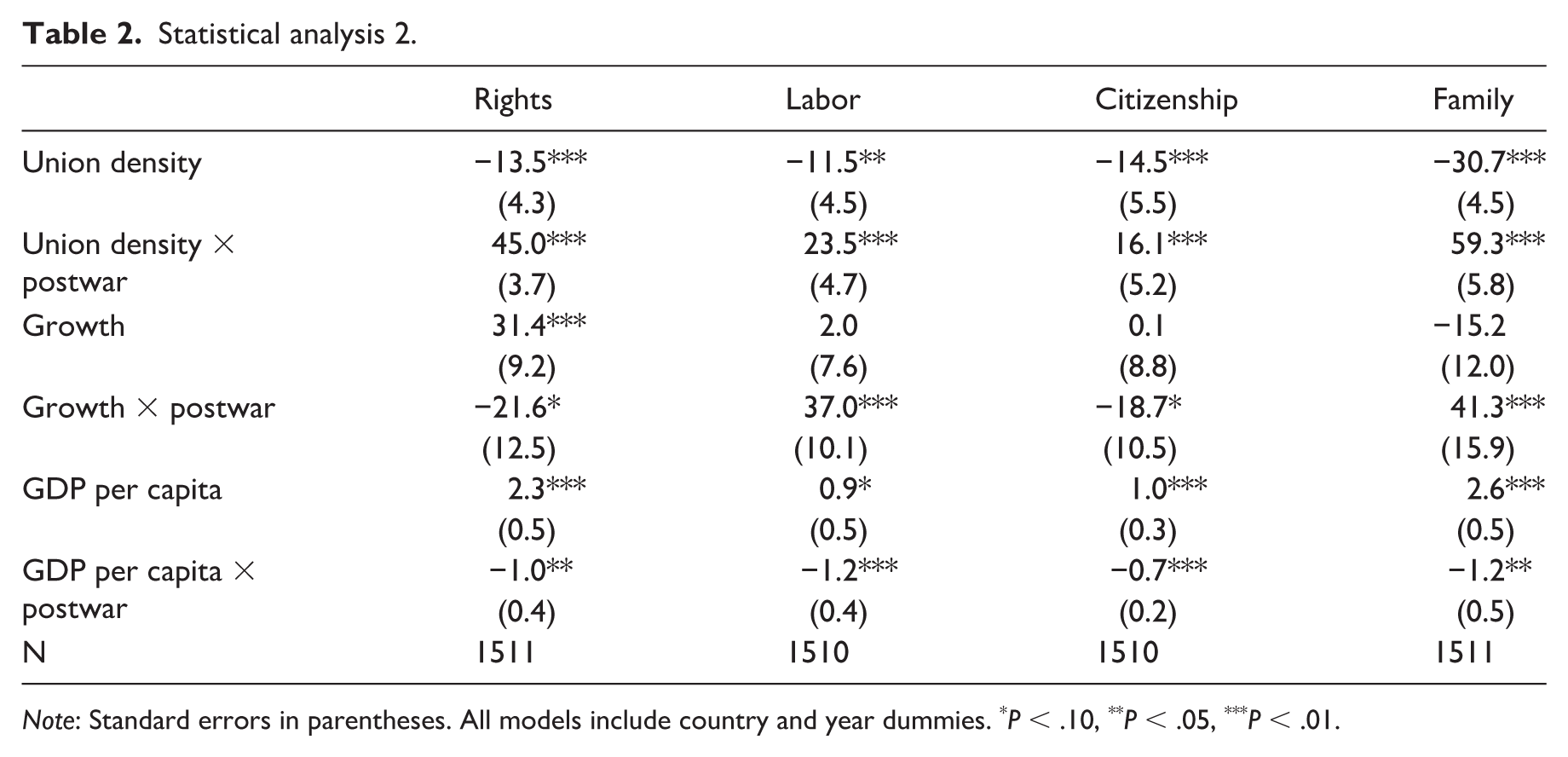
Note: Standard errors in parentheses. All models include country and year dummies. *P < .10, **P < .05, ***P < .01.
Conclusion
The evidence presented in this paper shows that union strength has been related to immigrant policy in different ways over the long period that we study. During the first decades of the twentieth century, union strength was correlated with a widening gap between the rights of migrants and the rights of citizens. This gap begins to narrow from the 1960s and narrows more rapidly during the 1970s. From the 1980s, countries with strong unions in fact extend more rights to migrants – compared with citizens – than do countries with weak unions.
The main contribution of this paper is to estimate the overall relationship between union strength and the rights gap between migrants and citizens among 18 countries over a long period of time. Estimating that relationship is an important step toward an improved understanding of the role that organised labour plays in immigration policymaking. But it is also important to recognise the limitations of our methodological approach, which relies on aggregate data and broad generalisations and abstracts from the experiences of individual countries and periods. Getting a firmer understanding of the policy positions, strategies and policy impact of unions – and how they have varied over time – requires more in-depth analyses of union activities and policy impact in specific policy processes. In their contribution to this issue, for example, Afonso, Negash and Wolff analyse under which conditions unions choose to pursue an equalising strategy in the specific case of the opening of labour markets for new EU member states. Combining such comparative case studies with the large-N evidence we provide in this paper will give us a better understanding of the role trade unions play.
The ideas and findings that we discuss in this paper also have important implications beyond immigration policy. We show that the relationship between the strength of unions and the social and economic rights of migrants has changed over time. We also show that the association between unionisation and the rights gap between migrants and citizens during the 20th century is likely to have been a result of relative differences among groups (more rights were extended to citizens than to migrants), not an absolute decline in the rights of some groups (rights were removed from migrants). It is therefore wrong to label trade unions as either exclusionary or inclusionary across the board; a more nuanced story needs to be told about the role that unions have played. The role that trade unions play in the more recent general ‘dualization’ of labour markets in rich democracies is likely to be equally complex – there is, in that sense, a structural similarity between the relationship between citizens and migrant workers and the more general relationship between ‘insiders’ and ‘outsiders.’ Scholars such as Rueda (2007) portray trade unions as essentially exclusionary vis-à-vis labour market ‘outsiders’. More recent scholarship, by contrast, portrays trade unions as more inclusive, both when it comes to social insurances and labour market policies (Rathgeb, 2018) and when it comes to industrial relations (Doellgast et al., 2018). In the future, it may become possible to describe the dynamic relationship between union strength and general dualisation in a manner that resembles this paper’s long-run description of the relationship between union strength and the rights gap between migrants and citizens, which is, after all, a very old form of dualisation.
Supplemental Material
sj-pdf-1-esp-10.1177_0958928720954699 – Supplemental material for Unions and the rights of migrants in the long run
Supplemental material, sj-pdf-1-esp-10.1177_0958928720954699 for Unions and the rights of migrants in the long run by Frida Boräng, Sara Kalm and Johannes Lindvall in Journal of European Social Policy
Footnotes
Acknowledgements
We are grateful to Johan Ekstedt and Klara Eitrem Holmgren for excellent research assistance. We are also grateful to Maggie Peters for generously sharing her data and helping us in our efforts to compile new data, and we are grateful to Adrian Shin for fruitful discussions about how to match our coding for the period 1930–1960 with his coding for the fifty subsequent years.
Funding
The author(s) disclosed receipt of the following financial support for the research, authorship, and/or publication of this article: This study received generous financial support from the Swedish Research Council (Grant Number 2017-01644). Some of the historical data collection was funded by Riksbankens Jubileumsfond (Grant Number M14—0087:1).
Supplemental material
Supplemental material for this article is available online.
Notes
References
Supplementary Material
Please find the following supplemental material available below.
For Open Access articles published under a Creative Commons License, all supplemental material carries the same license as the article it is associated with.
For non-Open Access articles published, all supplemental material carries a non-exclusive license, and permission requests for re-use of supplemental material or any part of supplemental material shall be sent directly to the copyright owner as specified in the copyright notice associated with the article.
