




Abstract
Late Peter Mair argued that, in the contemporary multilevel institutional setting of global governance, parties are faced with a dilemma between Responsiveness and Responsibility (RR dilemma). However, Mair did not theorize variation in how different parties experience the RR dilemma (degrees of tension) and how they manage it (strategies). We develop his work in three ways: first, we advance variants of the RR dilemma, where the tension party leaders face differs, and elucidate how viable contenders for executive office are likely to behave in each of these scenarios, and why. Second, we highlight domestic institutional factors (electoral rules and leadership autonomy) that regulate the pressure for being responsive to public opinion and to partisans. Third, we place the RR dilemma in the context of multidimensional issue competition, which helps identify strategies for managing it. Finally, we provide an empirical illustration of our arguments using data on public opinion and partisans. We show that although responsibility can be combined with (some) voters’ representation, tension is high when leaders are constrained and partisans oppose responsibility even if the public endorses it; this is also the case under disproportional electoral rules when the public opposes responsibility, even if party supporters endorse it.
Introduction
Parties serve two basic functions in modern representative democracy (Mair, 2013, 2014): first, they represent, which presupposes listening to and voicing citizens’ opinions in the policy-making process (responsiveness). Second, they govern, and they are expected to do so in a prudent and consistent manner, following accepted procedural norms and practices (responsibility). The late Peter Mair (2013, 2014) theorized a growing tension between these two functions and, based on the Irish case during the European sovereign debt crisis (2008–2011), derived bleak implications for Western European parties and party systems. Mair argued that parties’ declining capacity to manage the gap between their governing and representative roles led to a bifurcation of party systems: a group of “mainstream” or “core” parties offers the choice of government but not representation; representation either moves outside the arena of electoral politics (i.e. protest and social movements) or becomes the property of a second group of parties that constitutes the new opposition (Mair, 2013, 2014).
Peter Mair’s predictions about the future of European party systems have been contested. Various scholars underline the persevering relevance of electoral coalitions and the role parties play in connecting citizens to public policies (e.g. Beramendi et al., 2015; Dalton et al., 2011). In addition, the bifurcation thesis per se has been criticized as being too static because it does not allow for “a dynamic transformation” of populist challengers and of party systems (Kriesi, 2014: 368). The division of labor between core parties and their challengers at the margins of the party system can be of transitory nature: challengers may eventually also enter into government or support governments from the outside. Kriesi’s (2014) point implies that, ceteris paribus, the dilemma between responsiveness and responsibility (hereafter, the RR dilemma) will—sooner or later—also haunt parties challenging the “governing cartel” (Katz and Mair, 1995). In fact, in recent years, we have increasingly witnessed such challenger parties gaining government office, as for example SYRIZA in Greece or the Five Star Movement in Italy. Not only do these recent developments defy the “freezing” of bifurcation, but they also raise the question: how do viable contenders of office—from within and outside of the cartel—behave when faced with the RR dilemma?
We delve into this question and develop Mair’s framework by theorizing potential sources of variation in how parties experience the RR dilemma (degrees of tension) and consequently, how they manage it (strategies). With our refined model and its empirical illustration, we seek to contribute not only to the discussions that Mair’s thesis has spurred (Bardi et al., 2014a, 2014b), but also to broader debates on party competition, electoral rules, and responsiveness (e.g. Bartolini, 1999, 2000; de Sio and Weber, 2014; Weßels, 1999), as well as to research on party organization, party goals, and coalition building (e.g. Bäck, 2008; Pedersen, 2012; Strøm, 1990).
Our article consists of three main parts. First, we restate Mair’s main argument and discuss why it runs short of further theoretical elaboration on certain aspects. Second, we develop our own theoretical model, whereby we advance different scenarios of the RR dilemma that range from a perfect overlap (no gap) to the largest possible gap between responsiveness and responsibility. We proceed by elucidating what each variant of the RR dilemma implies for optimal party strategy, and how each variant may be affected by domestic institutional factors. Third, we give an empirical illustration of challenger party behavior in a scenario of high tension between responsiveness and responsibility: SYRIZA in crisis-ridden Greece (2010–2015).
Mair’s distinction between responsiveness and responsibility, and its shortcomings
Responsiveness pertains to the representative role of parties: it concerns their willingness and/or capacity to listen to and express citizens’ preferences in policy-making (Mair, 2013, 2014). Responsibility, in turn, relates to the governing role of parties: it means acting “from a sense of duty and moral responsibility,” namely within the bounds of accepted practice and following known legal and procedural rules and conventions (Mair, 2014: 587), for example, those laid down in the constitution, or in treaties of international organizations to which a country belongs. 1
The distinction between the two boils down to our expectations from parties as political organizations (mobilizing citizens in elections and voicing them in policy-making) versus our expectations from parties as state administrators (performing the duties of the executive). Mair’s argument is that in the contemporary multilevel institutional setting of global governance, the two sets of expectations are increasingly divergent, as the demands of a diversified electorate are becoming incompatible with the duties associated with the rules and procedures laid down by supranational or international institutions. Examples of such institutions are the European Union (EU) or the World Trade Organization. Under the conditions of European integration and global governance, responsible government means to fulfill the demands of audiences other than national electorates (Bardi et al., 2014b: 237).
In Mair’s theory, the growing tension between responsibility and responsiveness is the cumulative result of two sets of factors. The first set concerns changes in the operating environment of governing parties, namely the increase in the number of actors that constrain governing parties as well as in the legacies of previous governments (prior policies commitments). This is pronouncedly visible in the case of the EU: the power of its supranational institutions over domestic policy and the interdependence among its member states has increased (see Rose, 2014; Karremans and Damhuis, 2020) and the rules and policies constituting the acquis communautaire have accumulated with time. Hence, when a member state government changes, it cannot reverse decisions made at the EU level by its predecessor due to the supremacy of EU law.
The second set of factors concerns parties “as organizations” and their ever-weaker relationship with society. Responsiveness diminishes, Mair argues, because parties can neither read nor aggregate voters’ preferences. This not only results in a failure of parties to respond to voter preferences, but also an inability to persuade voters to align behind their policies.
Mair (2013, 2014) views the first set of factors as increasing the pressure for responsibility; and he views the second set as decreasing both the capacity of parties to listen and respond to voters, while also decreasing their ability to persuade voters to affirm their what are now responsible but unresponsive policies. We endorse Mair’s arguments and acknowledge that specific situational contexts (e.g. bankruptcy during an economic crisis) can intensify the emphasis on responsibility (Laffan, 2014). But, as we shall further outline below, we do not share the determinism of Mair’s thesis.
Electoral demands, in fact, vary across time and space, and so do the policy paradigms governments and supranational organizations act in (Hall, 1993: 279). Hence, the policy content of both “responsiveness” and “responsibility” are largely context dependent. Moreover, due to the ideological differences between parties, some party policy platforms and proposals will be more compatible than others with the prevalent interpretation of responsible policy at a given point in time.
The migration crisis in Europe that began in the summer of 2015 illustrates this point. The dutiful course of action in this situation based on international law (to which European countries are subject) would be to accommodate war refugees from Syria. 2 Not letting humans drown in the sea derives “from a sense of duty and moral responsibility” as laid down in international conventions (Mair, 2014: 587). The reactions of political parties to the situation reflect their ideological differences. Using human and liberal rights arguments (e.g. opposition to torture and persecution), Green and left-wing parties (which typically advocate both solidarity and multiculturalism) mobilize citizens to welcome refugees. On the contrary, anti-immigrant and Islamophobic radical right parties in the West, and center-right and center-left parties in the East of the EU (Hafez, 2014), use cultural arguments (e.g. incompatibility of Muslim refugees with Christian societies) to oppose the prevalent definition of responsibility. 3 This example presents a situation where the paradigm for what governments “are expected to do” is a matter of dispute, that is, of political competition.
Conditions for responsiveness
How do national party governments behave vis-à-vis voters when they are required to act within the framework of an international multilevel institutional setting (such as the EU)? To answer this question, we need to specify the conditions under which parties compete. For this purpose, it is useful to link Mair’s insights to the theoretical framework developed by Bartolini (1999, 2000), who identifies four dimensions that shape different modalities of electoral competition. These, we argue, constitute different sources of variation for how different parties experience the RR dilemma. The four dimensions for electoral competition identified by Bartolini (1999, 2000) are the following:
Contestability: the rules of the game that structure political opportunities for old and new contestants (Bartolini, 1999: 460).
Availability: the quota of available voters that are “willing to consider changing their party choice” or the potential for electoral volatility (Bartolini, 1999: 465).
Decidability: the divergence of policy programs offered by parties and thus the level of actual choice available to voters (Bartolini, 2000: 34–51).
Incumbent vulnerability: the likelihood that incumbents are replaced following changes in voters’ choices, for example, due to uncertainty or past performance (Bartolini, 2000: 52–55).
Even though Mair’s RR thesis does not touch upon all elements of these dimensions, a number of linkages between his and Bartolini’s framework can be identified. First of all, Mair’s prediction about responsibility outweighing responsiveness in the governing sphere is essentially an argument about the shrinking of decidability among aspiring governing parties. In the case of European integration, EU rules increasingly define what national governments can or cannot do, the range of policies that parties can credibly offer is inevitably reduced. As the policy offer by traditional mainstream parties becomes hollower, voters are more likely to look for channels of representation elsewhere. Importantly, between aspiring governing parties and challenger populist parties, the level of decidability remains high. Parties that do not target office have more freedom to promise policies that cannot be realized because of external constraints. By remaining outside of office parties evade policy compromises and thus can maintain their policy goal (in terms of advocacy), and can cater to unrealistic demands. In this way, parties can appear “expressive” and “representative” (Romeijn, 2018) and exert pressure on governing parties (Bale, 2003; van Spanje, 2010).
Secondly, Mair’s thesis seems to suggest that weak voter encapsulation by parties increases availability of voters. In support of his theory, there is evidence of the declining capacity of the mainstream Western European political parties (alternating in government since the reestablishment of parliamentary democracy after the Second World War) to mobilize voters: this has been manifested by decreased party identification, party membership, citizens’ trust in parties, voter turnout, as well as higher electoral volatility (Kriesi and Pappas, 2015: 2).
Thirdly, by offering a clear line of division between parties offering responsible government and a representative opposition, Mair’s thesis also implies high incumbent vulnerability as the formation of two polarizing fronts may increase the probability that in the next election the incumbent loses the exclusiveness of holding government office (Bartolini, 2000: 52–55).
What remains undiscussed in Mair’s theory, however, is how responsible parties in representative democracies gain and maintain executive power without being responsive. To shed light on this matter, it is necessary to distinguish between two types of responsiveness: one that responds to the demands of a specific group of voters (e.g. Damhuis and Karremans, 2017) and one that follows the electorate at large (e.g. Ezrow and Hellwig, 2014). These different types of responsiveness may be more or less in line with the existing criteria for responsible policy, thus generating different theoretical scenarios for how parties experience the RR dilemma (degrees of tension). In the following section, we will develop a theoretical framework that accommodates such scenarios and will put forward three propositions that translate into testable hypotheses in empirical settings.
Variant of the RR dilemma and a theory of party behavior
To visualize Mair’s tension between the governing and representative roles of parties in spatial terms, we assume a one-dimensional issue space Z that ranges from no to full accordance with the responsible policy route. Responsible policy does not exist in a vacuum, but is instead derived from existing moral, legal, and institutional duties (D). Since some parts of the electorate may endorse the existing criteria for responsibility, whereas others may oppose it, it is necessary to distinguish between different types of responsiveness. Following previous works (e.g. de Sio and Weber, 2014; Ezrow et al., 2011; Lefkofridi and Casado-Asensio, 2013; Rohrschneider and Whitefield, 2012; Weßels, 1999), we distinguish between: public opinion, which we define as the position of the mean voter m on issue Z, and party supporters, which we define as the mean position of partisans p on issue Z.
The broader public and the supporters of a party (partisans) are viewed as distinct actors, who may or may not agree with each other with regard to the policy implications of the dutiful policy route. The distinction between them allows for identifying gaps of variable size between responsibility (D) and citizens’ preferences. This means that in different scenarios there may be different degrees of tension.
We summarize these different scenarios in Table 1. At the point where public opinion, partisan position, and responsible policy overlap (a), no gap exists between the policy requirements of responsible government and the position of citizens. All other hypothetical scenarios ((b) to (e)) entail a gap between the dutiful policy route and voters.
Gaps between public, partisans, and responsible policy in one-dimensional issue space Z.
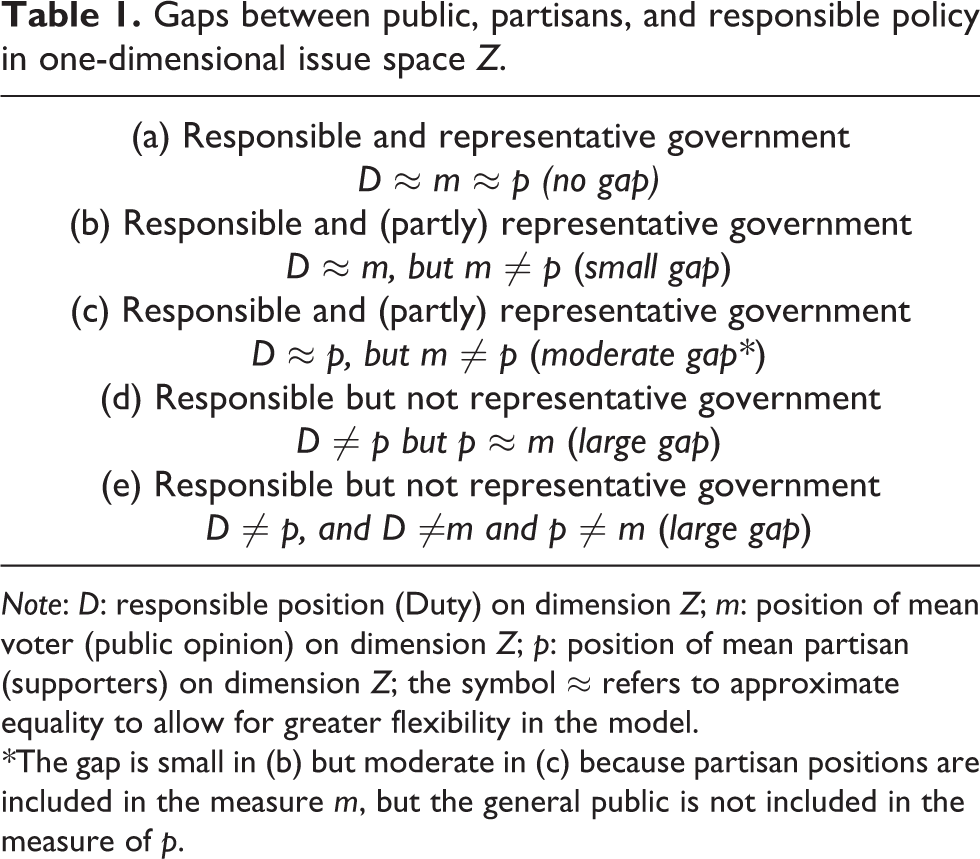
Note: D: responsible position (Duty) on dimension Z; m: position of mean voter (public opinion) on dimension Z; p: position of mean partisan (supporters) on dimension Z; the symbol ≈ refers to approximate equality to allow for greater flexibility in the model.
*The gap is small in (b) but moderate in (c) because partisan positions are included in the measure m, but the general public is not included in the measure of p.
While Mair’s thesis envisages parties as being able to either govern responsibly or represent (which correspond to our scenarios (d) and (e)), we propose two intermediate scenarios ((b) and (c)), where parties can govern responsibly and represent some (but not all) citizens. In the two intermediate scenarios of the RR dilemma ((b) and (c)), the disagreement between partisans and the public with regard to responsibility reduces the gap. Importantly, parties can combine their governing and representative roles: in scenario (b), governing parties can be responsible and represent the broader public (but not their partisans); in scenario (c), they can be responsible and represent their partisans (but not the public). Both scenarios are tenable (see Linz, 1990) because the government is on the one hand representative of the entire nation, and on the other, it stands for a partisan political option since by definition parties express and represent “parts” of the “whole” (Sartori, 1976).
It follows that, even if they are subject to the same pressures for responsibility (D), viable contenders for executive office are likely to be faced with different gaps: these stem from varied degrees of compatibility between the dutiful policy (D) and the preferences of two distinct domestic actors, namely public opinion and partisans (proposition 1).
How are strategic leaders likely to behave in each variant of the RR dilemma? In what follows, we formulate theoretical expectations on how specific domestic conditions induce parties to respond to the public or their supporters. Before proceeding, we will first clarify our basic assumptions about how parties and voters make their strategic decisions.
Assumptions
First, political competition is understood here as the process through which parties try to shape (to their advantage) the structure of the electoral preferences “that are the object, essence and core of party competition” (Bartolini, 2000: 37). We thus assume that voters’ preferences are endogenous to political competition.
Second, we assume that voters seeking policy representation choose parties on the basis of ideological or policy congruence (Thomassen, 1994: 251–252; Thomassen and Schmitt, 1999). However, we also accept that some voters’ calculus takes into account a government’s past record and policy performance (Bartolini, 1999: 465). Hence, if party electoral promises respond to citizens’ demands but the outcomes of their time and role in government reveal consistent discrepancies to these, the credibility and survival of a party will be endangered.
Third, we assume that parties are purposeful actors pursuing votes, policy, and office. This means they aim at increasing their electoral shares, enhancing the advocacy of party ideology, and attaining executive power in the form of politically discretionary governmental and sub-governmental appointments (Bartolini, 1999, 2000; Müller and Strøm, 1999; Pedersen, 2012; Strøm, 1990). Often, however, party leaders face conflicts between these goals (Müller and Strøm, 1999).
Fourth, although Mair never developed a full theory of how a party’s strategies are related to the RR dilemma, his arguments imply that responsibility will shape the trade-offs parties face in their pursuit of votes, policy, and votes. Policy-seeking is a goal linked to partisans, and vote-seeking connects to the consideration of the electorate at large, namely of voters beyond the traditional partisan constituency (de Sio and Weber, 2014). Crucially, the RR dilemma constrains only parties able and willing to enter government, that is, those seeking office. We thus focus on leaders of viable contenders for executive office because, like a ship’s fate under the storm, the success or failure of navigating an organization through the RR dilemmas lies largely with the captain. Leaders’ strategic choices are, however, not made in a vacuum. Hence, we now return to our theoretical expectations for party behavior in response to distinct domestic conditions.
Responsibility versus responsiveness…to whom? The role of domestic institutions
Let us consider the options available to office-seeking leaders in each of the five RR scenarios presented above (Table 1). Scenario (a) constitutes the ideal situation, where the party strategy for one goal (office) is the optimal strategy for the other two (votes and policy). The extreme scenarios (d) and (e) underlie the bifurcation thesis, where responsible government is entirely disassociated from citizen representation. However, scenarios (b) and (c) constitute situations where responsibility and representation can be combined. Here, the RR dilemma depends not only on where public opinion stands, but also on the position of party supporters with respect to the responsible policy route.
Combining insights from previous works (Bartolini, 1999; Strøm, 1990; Weßels, 1999), we propose that when disagreement regarding responsibility (D) exists between the general public opinion (m) and the position of party supporters (p), viable contenders of executive power who are faced with a RR dilemma will find their behavior conditioned by domestic institutions that exert varied pressures on responsiveness (proposition 2). In other words, when all parties are subject to the same factors (e.g. international treaties) encouraging responsibility (D), their responsiveness to the public or their partisans can still vary as their actions are conditioned by leadership autonomy (cross-party variation) and electoral rules (variable across countries and time).
First, in scenario (b), where parties can govern responsibly (D) at the same time as representing the electorate at large (m), vote-seeking and a desire for cabinet participation will conflict with policy advocacy: votes and office versus policy → D ≈ m, but m ≠ p. With policy being severely constrained by prior government commitments as well as by international and supranational institutions (Mair, 2013, 2014), a party’s policy goals come under pressure. Party organizations have different faces and, in case of conflict, the “party on the ground” tends to value ideological purity more, while the party in “public office” tends to value electoral victory more (Katz and Mair, 1993: 599). To be sure, the policy compromises that office entails because of responsibility are likely to be more dire for some parties than others. For instance, it is riskier for parties with small, yet stable supporter bases to move far away from their core programmatic stances in an attempt to attract more voters.
To what extent does partisan disagreement with the policy content of responsibility (D) constrain leaders? This depends on the organizational properties of a party, which can reduce or intensify the organization’s tendency for policy-seeking (Strøm, 1990). Empirical research shows that parties with strong leaders and weak activists respond to public opinion, whereas parties with weak leaders and strong activists respond to their supporters (Schumacher et al., 2013). The latter category is more policy-seeking and thus less likely to join a cabinet if it would mean sacrificing key policy goals (Bäck, 2008; Pedersen, 2010). Faced with this specific type of RR dilemma, leaders constrained by supporters are expected to prioritize policy advocacy at the expense of votes and office, whereas leaders without such constraints are expected to seek votes and office at the expense of policy.
Second, the scenario (c) portrays the situation where the policy content of responsibility (D) is endorsed by partisans (p), but not by the general public (m). From a strategic perspective, this scenario entails a conflict between office- and policy-seeking on the one hand, and vote-seeking on the other: office and policy versus votes → D ≈ p, but p ≠ m. In theory, the goal of office can be achieved by responsible party coalitions that (may not represent the public at large, but) are representative of their partisans. In practice, however, the feasibility of achieving office without vote-seeking will vary across institutional contexts.
Compared to systems of proportional representation (PR) with coalition cabinets, systems with disproportional electoral rules and two-party competition platforms for cabinet will exhibit more pressure on office-seeking parties to claim representation of public opinion (Weßels, 1999). Assuming that only two viable challengers are competing for office, not catering to public opinion is a losing strategy as in winner-takes-all systems winning the votes translates into executive power (votes and office reduce to the same goal; Downs, 1957).
Things look different in PR systems with multiparty cabinets. We do not suggest that parties in such systems are disinterested in mobilizing the average voter. Rather, we argue that the pressure to do so is lower because entry into government is less dependent on gaining the most votes, and more on the ability to coalesce with other parties (Schofield et al., 1998). It follows that in such systems parties can put greater focus on office and policy and less on votes. For these parties, not only the views of their own supporters matter, but also those of their potential coalition partners—and this is especially so if the coalition partner is not easily replaced. Faced with this particular RR dilemma, leaders in PR systems can pursue office and policy advocacy even at the expense of votes. This puts vote-seeking into the background without eliminating it as a goal. However, such behavior would not be feasible for parties seeking power under disproportional rules.
In Table 2, we summarize these scenarios, ranked from the lowest to highest degree of tension faced by office-seeking leaders with varied degrees of autonomy operating either under disproportional (2.1) or under proportional electoral rules (2.2).
Office-seeking leaders’ strategic options in variants of the RR Dilemma in one-dimensional issue space Z.
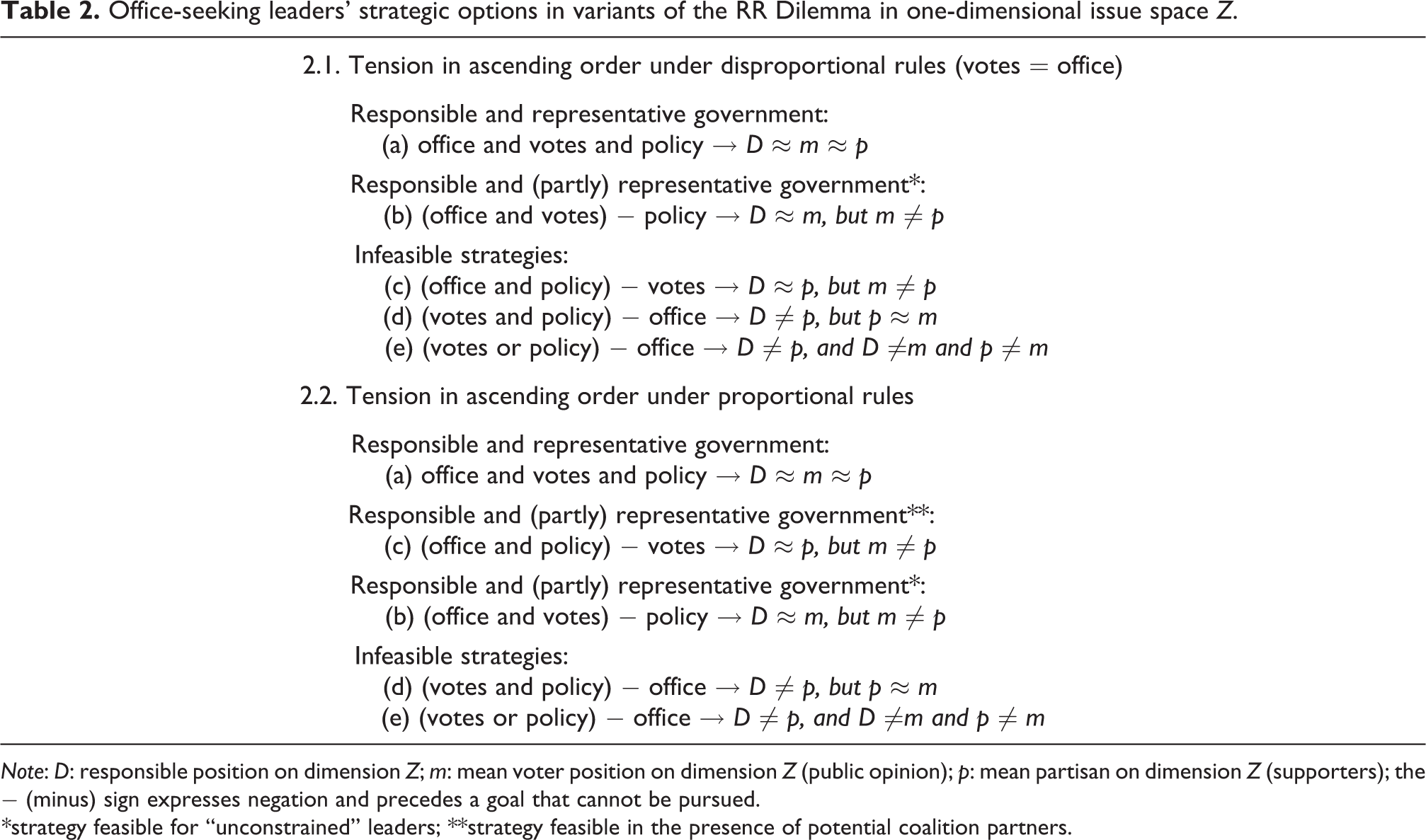
Note: D: responsible position on dimension Z; m: mean voter position on dimension Z (public opinion); p: mean partisan on dimension Z (supporters); the − (minus) sign expresses negation and precedes a goal that cannot be pursued.
*strategy feasible for “unconstrained” leaders; **strategy feasible in the presence of potential coalition partners.
Our goal thus far has been to extend Mair’s thesis by establishing that leaders of different parties face different types of the RR dilemma (Table 1), which translate into different degrees of tension depending on domestic conditions: the feasible strategies available to office-seeking leaders thus vary across party organizations (leadership autonomy) and systems using different electoral rules (proportionality) (Table 2).
From the perspective of party strategy, the key messages from our discussion are: firstly, the conflict between what is defined as responsibility and public opinion generates high tension for office-seekers in scenarios (d) and (e) (Table 2: 2.1.(d) and (e), 2.2.(d) and (e)) but also (c) in systems with disproportional rules, where two-party competition for the government and single-party cabinets are the norm (Table 2: 2.1.(c)): there, tension is high despite the fact that partisans agree with responsibility. Under conditions of PR, multiparty competition, and coalition cabinets, party leaders face high tension only in the absence of potential coalition partners, with whom they could form coalitions offering responsible government and representation (Table 2: 2.2.(b) and (c)). Secondly, the conflict between what is understood as responsibility and partisans’ views generates high tension only for constrained office-seeking leaders in scenario (b) (Table 2: 2.1.(b), 2.2.(b)).
To present these arguments in a simple manner, we have thus far assumed a single-issue space. In political practice, however, multidimensionality of the political space cannot be avoided (e.g. Bartolini, 1999; de Sio and Weber, 2014). The assumption of issue multidimensionality in political competition introduces opportunities for managing the RR dilemma.
Managing the RR dilemma in multidimensional issue competition
In multidimensional contexts, party effort to shape voter attitudes and preferences to their advantage may entail “limiting the offer” on certain issues, defining “the compatibility among different offers,” and convincing (some) voters of “good or lesser packages of offers” that bundle distinct issues (Bartolini, 2000: 45). This connects to the issue yield theory put forward by de Sio and Weber (2014) about parties trying to emphasize those issues, which enjoy majority support and are not divisive for their partisans. This strategy bridges the preferences of party supporters (policy-seeking) and those of the electorate at large (vote-seeking). Here, we argue that strategic parties not only try to emphasize issues that unite their partisans and enjoy majority support, but they also try to obfuscate the offer on issues that present them with high risks, for example, by (1) presenting blurred or unclear positions on an issue, (2) transforming it (from clear partisan to valence), (3) removing the issue tacitly from the political agenda, and (4) displacing the issue from the domain of politically legitimized decision-making and redefining it in a “non-partisan” way (Bartolini, 2000: 47–50).
As the Eurozone and migration crises made evident, the issue salience of responsible policy is not always prone to manipulation; it follows that depoliticization of the responsible policy (via tacit removal or displacement) is not always feasible. Moreover, while parties can blur their positions on D while in opposition, in government they must take clear stances. Synthesizing insights from Bartolini (2000), de Sio and Weber (2014), and Mair (2014), we expect that when issue salience and clarity of position on issue Z cannot be manipulated, leaders in scenarios (b) and (c) will try to alleviate the tension by transforming issue Z or by connecting it with another one, on which they face less or no tension (proposition 3). Leaders may try to transform Z from a positional to a valence issue; or, they may make D the condition for another issue K that enjoys majority support and is not divisive for their partisans. Failure to comply with D can be presented as incompatible with K, a policy goal that unites partisans and the general public. In this way, what the public and partisans want with regard to issue K becomes conditional on what is defined as responsible policy (D) on issue Z.
In the following part, we apply our theory as we have outlined it to answer the question how a challenger party deals with the RR dilemma. Our illustration concerns the SYRIZA party in crisis-ridden Greece (2010–2015). In the Online Appendix we document all (elected and appointed) Greek cabinets (A2) and all relevant governing and opposition parties and their leadership (A3) during this period. We will first explain what responsibility meant in this context. Then we will use voter survey data to specify the RR dilemmas facing party leaders, and will analyze SYRIZA’s behavior in light of our arguments for constrained leaders’ office-seeking behavior under disproportional rules; these are conditions that generate high tension when public and partisans disagree (proposition 2 and Table 2: 2.1.).
Responsibility versus responsiveness in crisis-ridden Greece
In the years of the Eurozone crisis (2010–2015) that followed the global financial crisis, responsibility in economic policy was largely defined by the EU-International Monetary Fund (IMF) paradigm of austerity. In this context, Greece, along with other fragile members of the Eurozone, experienced a sovereign debt crisis. For the governments of Eurozone members with pressing borrowing needs, responsible policy came to connote budgetary austerity and fiscal balance demanded by the Memorandum of Understanding (MoU) signed between debtors and creditors (Laffan, 2014). Doing otherwise would lead the Greek state to default, whose social and political consequences were assessed as too dangerous: the moral duty toward Greek citizens was to avert state collapse. The method offered by the creditors was a loan conditional on neoliberal policies. The bailout agreements (MoUs) created a legal duty: the cash needed to keep the state running was released in tranches, which means that the debtor had no other option than to respect the rules dictated by the creditor, since doing otherwise would bring about the complete paralysis of the state—for example, salaries would not be paid.
Mair’s (2013, 2014) theory describes the Greek political landscape during 2010–2012, when the ND-PASOK governing cartel (mainstream parties alternating in government) accepted the austerity measures as inevitable. Their implementation created a backlash, with thousands protesting (Karyotis and Rüdig, 2018). In 2011, the “Aganaktismenoi” (Indignants) movement even occupied the Syntagma square opposite the Parliament. This constituted the “tipping point” of the system’s bifurcation process: while the political mainstream took care of ensuring responsible government, representation moved out of the electoral arena.
Several small parties tried to voice popular opposition to austerity thus giving voters the opportunity to throw the “rascals out” (Nezi, 2012; Nezi and Katsanidou, 2014). In a context of skyrocketing volatility 4 (i.e. high “voter availability”; Bartolini, 1999), SYRIZA emerged as authoritative representative of this discontent: it presented a program that directly challenged not only the government, but also the mainstream parliamentary opposition. SYRIZA participated actively in the demonstrations against both PASOK’s (2010–2012) and ND’s (2012–2015) MoUs. The more Greece was sinking into the debt crisis, the deeper SYRIZA engaged with society: it took part in the Indignants movement and supported the ‘Won’t Pay!’ movement (Tsakatika and Eleftheriou, 2013). Even though Greece was still under pressure from the EU to fulfill structural adjustments and fiscal reforms, SYRIZA entered government with an anti-austerity mandate in 2015.
The Greek electoral system, which carries the deceptive label “reinforced proportional representation,” is disproportional because it enables single-party cabinets through a majority bonus granted to the plurality party (Nikolakopoulos, 1989). For all post-2009 electoral contests, which concern our period of investigation (2012–2015), that bonus amounts to 50 seats. This bonus motivated the fragmented Left, which for 8 years had functioned under the SYRIZA alliance, to merge into SYRIZA party for the May 2012 election. Importantly, the June 2012 and the September 2015 are “snap” elections, which grant more power to party leaders to discipline their deputies through closed electoral lists (Tsebelis, 2016). This, in turn, counteracts the constraints faced by the leader of SYRIZA, an organization with internally democratic traditions (see Tsakatika and Eleftheriou, 2013).
Responsibility, public opinion, and partisans in debt-ridden Greece (2012–2015)
To specify the dilemma that Greek parties with governing aspiration face on the issue of austerity, we use data on Greek public opinion and each party’s supporters collected through four online surveys conducted prior to four legislative elections (May and June 2012; January and September 2015) by Choose4Greece 5 (Gemenis and Triga, 2012).
Figure 1 maps Greek voters (2012–2015) on the issue of austerity enshrined in the MoU (horizontal axis). One (1) stands for negative views toward austerity, while five (5) represents positive ones; point three (3) represents the neutral position “Neither agree nor disagree.” Party names on the vertical axis correspond to their respective supporters, whose mean position is represented by a circle. The average voter’s position is represented by a black point. Figure 1 reveals diversity of attitudes, suggesting that party leaders experience different gaps between responsiveness and responsibility (proposition 1 and Table 1). Although there is a cartel-outsiders pattern, opposition to responsibility originates both from within (ANEL) and outside the governing cartel. In the Greek case, new parties (e.g. ANEL, DIMAR) emerged because of intraparty disagreement toward responsibility. Consistent support for austerity is expressed mainly by supporters of governing parties (PASOK, ND) and supporters of POTAMI (in 2015), which originates from outside the cartel. The supporters of (SYRIZA’s splinter) DIMAR appear rather undecided in 2012. Until January 2015, the mean voter appears opposed to austerity, but not as much as supporters of parties outside the cartel (SYRIZA, KKE, and GD), who are located to her left.
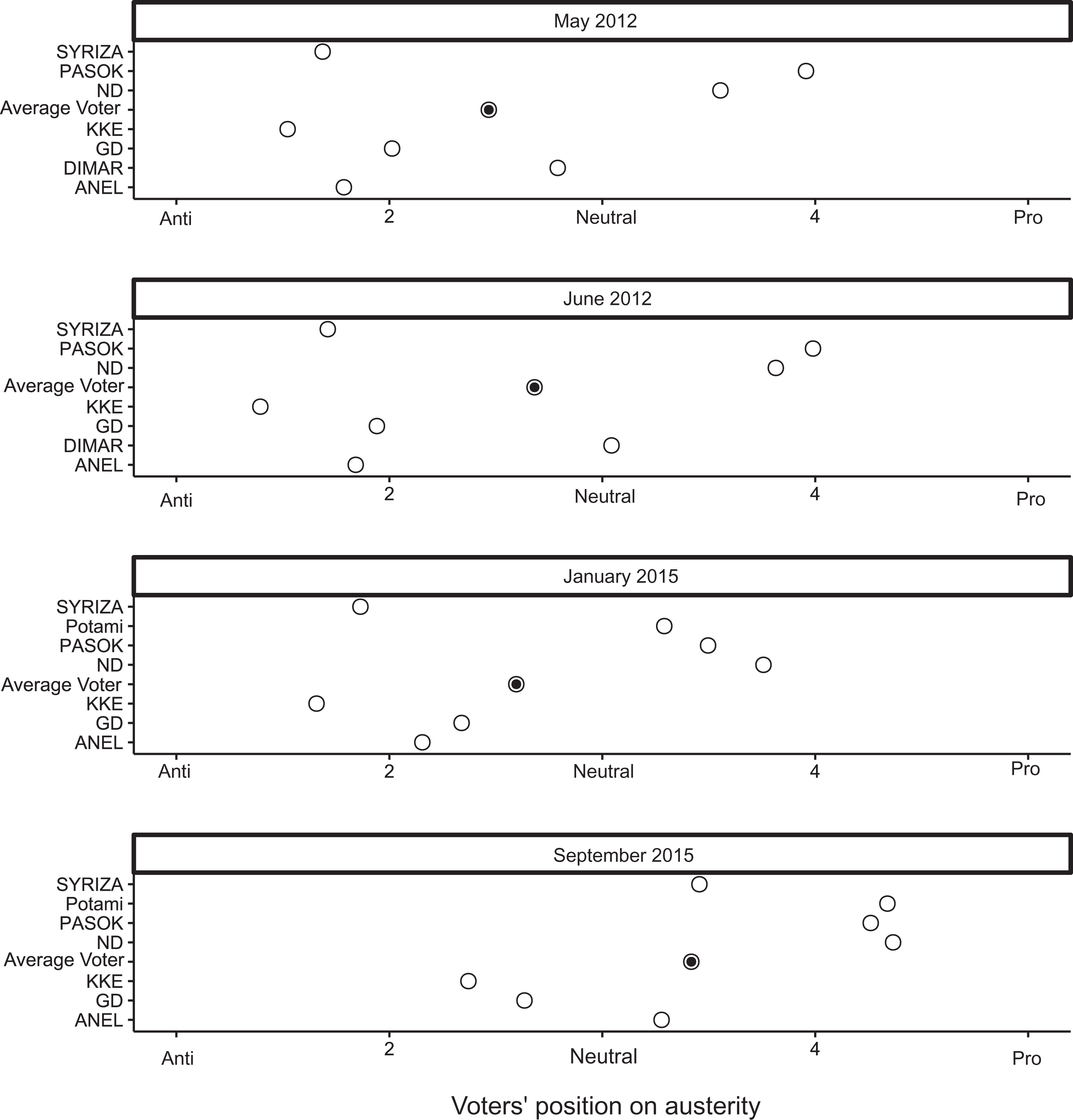
Voters’ position on austerity.
Though ND and PASOK partisans endorsed austerity, these parties’ leaders faced tension because of the disproportional electoral rules that compelled them to appeal to the electorate at large. To alleviate tension with public opinion on the issue of austerity, the governing cartel (PASOK-ND) could thus benefit from conflating issues and connecting austerity with another important issue that enjoyed majority support and was not divisive for their own partisans (proposition 3). This “other issue” that emerged as a dominant issue in party competition during the crisis years was EU membership (Gemenis and Nezi, 2015). What public and these parties’ supporters with regard to the EU wanted was “remain.” If failure to comply with austerity, which was the dominant interpretation of responsible policy (D), were defined as incompatible with EU membership, their key opponent SYRIZA would be disadvantaged. After incumbent ND signed the second MoU (2012), SYRIZA, having attracted disaffected anti-MoU PASOK voters (Tsakatika and Eleftheriou, 2013), emerged as the only viable challenger. SYRIZA supporters and the average Greek voter were united against austerity. But SYRIZA’s internal cohesion on the EU issue was shaky (Lefkofridi and Weissenbach, 2019; Tsakatika and Eleftheriou, 2013).
Figure 2 maps Greek voters (2012–2015) on the issue EU membership: one (1) stands for negative views, five (5) represents positive ones, and three (3) connotes neutrality. Party names on the vertical axis correspond to their respective supporters, whose mean is represented by a circle. The black point represents the mean voter. In contrast to the dispersed and polarized attitudes toward austerity, opinions on EU membership cluster on the right side of the axis. Public opinion data thus suggest that (with the exception of the Communist Party (KKE)’s supporters) a significant part of the population held either moderate or strong pro-European attitudes.
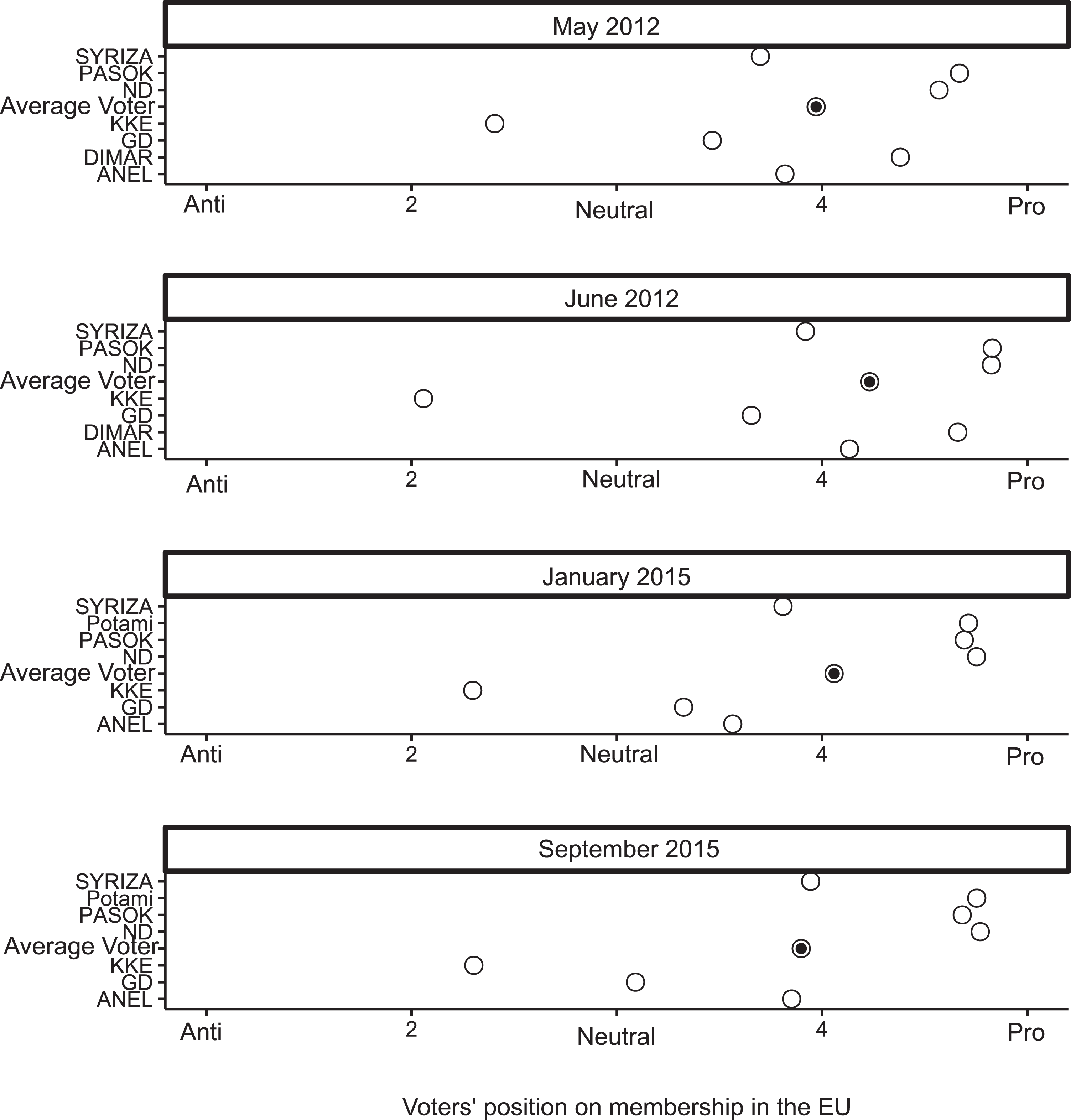
Voters’ position on membership in the European Union (EU).
Combining Figures 1 and 2, we see that what the average Greek voter expressed prior to three electoral contests (May 2012, June 2012, and January 2015) was a combination of opposition to austerity and support for EU membership. We underline that austerity and EU membership constituted two separate political issues; after all, not all EU members are Eurozone members. Their clear separation, however, changed in the course of events between the first (2010) and the third (2015) MoUs, when an economic dimension emerged that encompassed citizens’ attitudes toward the EU, the MoU, and the resulting reforms (Katsanidou and Otjes, 2016).
SYRIZA’s pathway to power and the threat of Grexit
As not only other Greek parties (ND, PASOK, POTAMI) but also representatives of EU institutions increasingly conflated austerity with the preservation of EU membership, SYRIZA’s rhetoric became less Euroskeptic but remained opposed to austerity. Alexis Tsipras, SYRIZA’s leader, sought to appeal to the average voter, and to ANEL, which was his only potential partner in case SYRIZA would not gather the necessary majority to govern alone. Following the January 2015 election, they indeed formed a coalition cabinet; their policy goals and proposals, however, were not well received by EU partners, who put pressure for endorsement of austerity, and a third MoU (Krugman, 2015). Preserving EU membership and opposing austerity was becoming increasingly impossible in the absence of cash to run the state, so PM Tsipras resorted to a referendum on the bailout conditions. This referendum (July 5, 2015) brought to the surface deep divisions among the supporters of SYRIZA and ANEL on Eurozone membership. 6 Moreover, SYRIZA’s long internal conflict toward the EU, which had been kept under the carpet, came to the fore.
Once the PM was presented a serious pro-Grexit determination by the EU institutions, he compromised all of the party’s revolutionary goals. Tsipras’ decisions are better understood if Greece’s membership in the EU and the implementation of the MoU are seen as conjoint issues: Tsipras sought to satisfy the average voter on the issue of EU membership, which was only secure by accepting the third MoU; indeed, he justified his capitulation on the basis of the majority’s opposition to Grexit.
This, however, caused an intense intraparty conflict between Remainers and Grexiters (correspondingly, office-seekers and policy-seekers). To solve this, SYRIZA’s “constrained leader” did not expel vociferous rebels, which would be atypical for SYRIZA, a party proud of democratic decision-making procedures. But, instead of Party Congress, he called for a snap election, where closed lists were used, thus increasing his leverage in the party. SYRIZA’s campaign as incumbent (September 2015) did not focus on the party and its policies; rather, it revolved around PM Tsipras’ competence and performance (Mair, 2013, 2014).
Had he called for a party congress, Tsipras would have been constrained by pro-Grexiters (who were likely to win the congress). Failing to pass the parliamentary threshold, the revolting radical left wing fell from executive power outside the parliament. During SYRIZA’s virgin governmental term in the EU, however, SYRIZA became more presidential. This, in turn, connects to the thesis on the presidentialization of party government caused by the internationalization of decision-making (Poguntke and Webb, 2005).
The challenger SYRIZA’s entry into government brought about the end of bifurcation, and the shrinking of the space on the issue of austerity. The division of labor, however, moved from the party system to the party in public office: SYRIZA’s MPs expressed anti-MoU sentiments, by assigning blame for the economic policies their own government pursued not only to external institutions such as the EU, but also to the (discredited) internal political elites (Vasilopoulou et al., 2014).
Conclusion
With this article, we refine Mair’s thesis of political parties facing tensions between responsibility and responsiveness (RR dilemma) in the multilevel institutional setting of global governance. First, by theorizing different types of responsiveness jointly with responsibility, we argue that the RR dilemma does not always cause high tension; responsible government can be combined with (some) voter representation (proposition 1). Second, we specify that the RR dilemma causes high tension under certain conditions only (proposition 2): either under disproportional electoral rules, when the public opposes responsibility even if supporters endorse it, or when leaders are constrained and partisans oppose responsibility even if the public endorses it. Third, we argue that leaders faced with the RR dilemma in a multidimensional context of competition can still find ways to manage the tension, which bring them advantages vis-à-vis their competitors (proposition 3). As an application of our refined theory, we looked at then challenger party, SYRIZA, during the recent sovereign debt crisis in Greece. This illustrates a situation of a constrained party leader operating under disproportional rules. Here, tension is highest if the public and partisans disagree.
As Mair (2013, 2014) predicted, the Greek party system did bifurcate. Yet, this case stands in contrast to Mair’s prognosis that parties would be unable to understand and aggregate voter preferences. The economic austerity implied by responsibility became a condition for EU membership and this conditional issue not only united the broader public with partisans of the governing cartel, but also divided the challenger’s partisans. While this deflated the tension faced by the governing cartel, it heightened the tension faced by their challenger SYRIZA. A non-negligible fraction of SYRIZA supporters denounced austerity so much that they would rather do without EU membership (Online Appendix A4). Thus, for SYRIZA’s leader, the two-dimensional RR dilemma (austerity and EU membership vs. non-austerity and Grexit) translated into a choice between votes and office on the one hand, and policy on the other (Table 2, scenario (b)).
The pursuit of office under disproportional rules motivated the challenger party’s leader to follow the general public will to keep Greece in the EU even if this meant compromising on its key policy goal (anti-austerity). Abandoning the key policy goal, however, is not easy for leaders with limited autonomy. Hence, even if the public would eventually endorse austerity as a means to avert Grexit, the tension was high for SYRIZA’s leader who was constrained by the party organization. To unchain himself from this constraint, he used the extraordinary electoral rules of snap elections with closed lists. Using closed lists, which strengthen the leader’s grip on the party (see also Tsebelis, 2016), he competed with his internal opponents externally in a national contest, which he won by appealing to the average voter. In contrast to Mair’s argument (2013, 2014), we show that parties may still convince (enough) voters to align behind a profound positional change.
Our analysis of SYRIZA in Greece applies only part of our theory, namely to the case of a constrained leader under disproportional rules. Therefore, we hope that future research will test the applicability of this model in its entirety; examples, from the recent migration crisis under PR (e.g. Germany) to Brexit under disproportional rules, are not wanting.
Supplemental material
Supplemental Material, sj-pdf-1-ppq-10.1177_1354068819866076 - Responsibility versus responsiveness…to whom? A theory of party behavior
Supplemental Material, sj-pdf-1-ppq-10.1177_1354068819866076 for Responsibility versus responsiveness…to whom? A theory of party behavior by Zoe Lefkofridi and Roula Nezi in Party Politics
Supplemental material
Supplemental Material, sj-pdf-2-ppq-10.1177_1354068819866076 - Responsibility versus responsiveness…to whom? A theory of party behavior
Supplemental Material, sj-pdf-2-ppq-10.1177_1354068819866076 for Responsibility versus responsiveness…to whom? A theory of party behavior by Zoe Lefkofridi and Roula Nezi in Party Politics
Supplemental material
Supplemental Material, sj-pdf-3-ppq-10.1177_1354068819866076 - Responsibility versus responsiveness…to whom? A theory of party behavior
Supplemental Material, sj-pdf-3-ppq-10.1177_1354068819866076 for Responsibility versus responsiveness…to whom? A theory of party behavior by Zoe Lefkofridi and Roula Nezi in Party Politics
Footnotes
Acknowledgements
The authors are grateful to three anonymous reviewers for their valuable critique as well as to David Farrell, Paul Webb, and Jan Karremans for their unfailing editorial support. Zoe Lefkofridi also wishes to thank Sophia Hunger and Vicente Valentim for inviting her to present the theoretical model (October 16, 2018) at the European University Institute (EUI)’s Political Behavior Colloquium; as well as Marta Fraile, Julian Garritzmann, Hanspeter Kriesi, Bilyana Petrova, Richard Rose, Stefano Ronchi, Zbigniew Truchlewski, Alina Vranceanu, Elisa Volpi, and especially Sarah T Dippenaar for constructive comments. All errors remain our own.
Declaration of conflicting interests
The author(s) declared no potential conflicts of interest with respect to the research, authorship, and/or publication of this article.
Funding
The author(s) received no financial support for the research, authorship, and/or publication of this article.

Supplemental material
Supplemental material for this article is available online.
Notes
References
Supplementary Material
Please find the following supplemental material available below.
For Open Access articles published under a Creative Commons License, all supplemental material carries the same license as the article it is associated with.
For non-Open Access articles published, all supplemental material carries a non-exclusive license, and permission requests for re-use of supplemental material or any part of supplemental material shall be sent directly to the copyright owner as specified in the copyright notice associated with the article.
