



Abstract
While the Council of the European Union has long been deciding on EU policy insulated from public scrutiny, we argue that enhanced transparency and EU politicisation have strengthened the linkage between its positions and public opinion. We further expect the Council to be more responsive to public opinion in member states, in which citizens view EU policy action as salient and are relatively united in their stance on it. To assess these expectations, we used semi-supervised machine learning to estimate the Council's positions on the expansion of the EU policy authority in legislative acts during the post-Lisbon period (2009–2019) and the Eurobarometer to measure public support for EU action in 21 policies across member states. The results offer evidence of territorial responsiveness of the Council.
Keywords
Introduction
One of the defining features of the democratic deficit in the European Union (EU) is that it is simply ‘too distant’ from voters. Citizens cannot understand it and have limited electoral control over its institutions. As a result, allegedly ‘the EU adopts policies that are not supported by a majority of citizens in many or even most Member States’ (Follesdal and Hix, 2006: 537). In Brussels, member states’ ministers have long been deciding on EU policies in insulation from public scrutiny, as citizens have had limited opportunities to observe and, as a result, hold them accountable for the positions they take in the Council of the EU (Bailer et al., 2015). However, we argue that developments over the past two decades have created preconditions for more responsive decision-making in the Council by exposing it to public pressure.
First, while the inner workings of the Council have historically been opaque, shielding governments’ positions in the EU arena from public visibility and potential scrutiny, the transparency of the Council has significantly increased over time (Brandsma and Meijer, 2022; Cross and Bølstad, 2015; Hillebrandt et al., 2014). This has enhanced the ability of political entrepreneurs back home to challenge governing parties by exposing ministers’ potentially unpopular positions in the Council of the EU (De Vries et al., 2021) for political gains. Second, the European integration process has become politicised (Hutter et al., 2016), as reflected in the formulation, mobilisation and expression of stronger public demands on what the EU should or should not do. While governments enjoyed citizens’ permissive consensus for European integration for most of the Union's history, this has gradually been replaced by constraining dissensus (Hooghe and Marks, 2009).
Various (sovereign debt, refugee, environmental, pandemic and security) crises over the past 15 years have intensified citizens’ demands for collective EU action on some issues and restoring national sovereignty on others. As the question of how much authority the EU should or should not have over different policies has become publicly salient, the pressure for elected representatives to respond to their citizens’ preferences over policy integration has grown. Altogether, government ministers in the Council no longer have the luxury of operating outside the public purview and could be pressured by strong public demands. Have these factors generated responsiveness of the Council to the (dynamics of) citizens’ preferences over EU policy integration?
Our argument is twofold. First, given the increased prospects of public scrutiny for unpopular positions of governments in the Council and, consequently, EU policy outcomes, electorally accountable ministers have become incentivised to respond to public views when deciding on EU legislation in the Council. Indeed, recent studies on responsiveness in the EU show that governments represented in the Council have sought to signal responsiveness to their domestic public at various stages of policymaking, such as deliberations (Hobolt and Wratil, 2020), position-taking (Wratil, 2018) and final voting (e.g. Hagemann et al., 2017; Schneider, 2019). Second, based on the literature on two-level games (Putnam, 1988) and decision-making in the Council (Kleine and Minaudier, 2017; Mariano and Schneider, 2022), governments in the Council also have incentives to and do make concessions to peers that face public pressure back home. 1 In combination, we expect these incentives of government representatives to be reflected in a general linkage between the Council's policy positions and public preferences regarding EU policy action. Specifically, following the predictions of the territorial model of representation (for discussion see Wratil, 2019), we expect public opinion in member states, in which citizens hold stronger preferences over what the EU should (not) do, to weigh more heavily in the Council position formation. Accordingly, we further expect the Council to be more responsive to public opinion in member states, in which citizens view EU policy action as salient and are relatively united in their stance on it.
Empirically, we explore whether and, if so, how citizens’ preferences over EU policy action translate into the negotiation stance of the Council in terms of supporting or not supporting the uploading of further policy authority to the EU level. We focus on the position of the Council at the start of the inter-institutional legislative negotiations with the European Parliament (EP), with which it shares equal amendment and veto power over the legislative proposals of the European Commission falling under the ordinary legislative procedure (OLP), i.e. before policy concessions are made on the final policy measures. We assess our expectations using a novel dataset of the Council's initial negotiation positions on the Commission proposals in the post-Lisbon period (2009–2019), extracted from the so-called ‘trilogue’ tables. These tables are drawn in preparation for the legislative negotiations in informal meetings between the Council and the EP, supported by the Commission (hence, ‘trilogue’ meetings). 2 We relied on semi-supervised machine learning to classify the Council's positions concerning their support for EU authority expansion (Liu et al., 2019). To measure public mood on EU policy action, the level of public policy salience and the extent of public opinion unity in each member state, we used the Eurobarometer surveys between 2009 and 2019.
Our results offer the first evidence of a linkage between the Council's common positions and the preferences of EU citizens over policy integration. The higher the public support for EU action in a policy domain across member states or EU-wide, the more supportive the Council is of expanding EU authority in legislative acts within that policy domain, and vice versa. We further find that responsiveness of the Council's negotiating position to the dynamics of public preferences in an individual member state is more likely the more that state's citizens view the policy in question as salient and the more united they are in their support for or opposition to further EU action in that policy. These findings contribute to the burgeoning literature on democratic responsiveness and resonate with the theoretical model of territorial representation in the EU (see Wratil, 2019).
Responsiveness in the EU Council
Governments represented in the Council have been relatively insulated from domestic electoral control when coining policies on the supranational level (e.g. Bailer et al., 2015). However, propelled by the implementation of Regulation (EC) 1049/2001 (so-called transparency regulation), the transparency of the intra-Council dynamic has steadily increased over the past two decades (Brandsma and Meijer, 2022; Cross and Bølstad, 2015; Hillebrandt et al., 2014). This has exposed governments to potential scrutiny for the positions they take in Council negotiations, which could be more easily politicised by political opponents back home as a result (De Vries et al., 2021). As the literature argues, increased transparency fosters the elites’ responsiveness to public demands (Héritier, 1999). It also increases the chance of policymakers operating on the supranational level to be sanctioned for their choices and eventual policy outcomes that ignore domestic public opinion (Cucciniello et al., 2017; Lindstedt and Naurin, 2010). In turn, this potentially increased publicity should incentivise electorally accountable ministers to respond to the demands of their electorates in the positions they take in the Council of the EU. 3
For public opinion to drive behaviour on the supranational level, however, the electorate must also have clear demands on questions of European integration. Instead, for most of its history, governments have enjoyed citizens’ permissive consensus to shape the nature, direction and speed of integration. Yet, the politicisation of European integration ever since the Maastricht Treaty (1992) has replaced this permissive consensus with a ‘constraining dissensus’ (Hooghe and Marks, 2009). European integration has become the subject of increased public salience, contestation and an expansion of organised interests with competing demands for EU policy that have incentives to mobilise public support for their cause (Hooghe and Marks, 2009; Hutter et al., 2016; Schmidt, 2019).
These developments have turned scholars’ attention to the role of electoral considerations (Kleine, 2013; Kleine and Minaudier, 2017; Wratil, 2018) and domestic public opinion in shaping the negotiating positions in the Council (e.g. Mariano and Schneider, 2022; Târlea et al., 2019; Wratil et al., 2023). Hagemann et al. (2017) show that governments respond to the sceptical views of the public about EU integration by voting against proposals that broaden the powers of the Union. While this ‘responsiveness signal’ does not alter the policy stance of the Council per se, it indicates the alignment of preferences over policy integration of the political elites operating on the EU level and the domestic audiences holding the electoral control. Relying instead on expert survey estimates from the Decision-making in the European Union (DEU) dataset (Thomson et al., 2012), Wratil (2018) demonstrates that governments’ negotiation positions within the Council are responsive to domestic public opinion on left-right issues in the run-up to national elections, and on issues concerning European integration when those become domestically salient. Similarly, relying on a novel approach to studying the Council through video footage of its public deliberations (DICEU – Debates in the Council of the European Union), Hobolt and Wratil (2020) show evidence that public opinion shapes ministerial policy positions, particularly on domestically salient issues. In addition, analysis of the Council debates reveals that domestic public opinion matters for the governments’ willingness to compromise during the Council's legislative deliberations, and this holds specifically for pro-EU governments (Mariano and Schneider, 2022; Wratil et al., 2023).
Despite this growing research on how public opinion shapes the preferences, position-taking or bargaining success of individual governments and their ministers within the Council, there is still a substantial gap in our understanding of how public demands may shape the substantive common positions of the Council. When do these positions reflect citizens’ preferences over EU policy? As the Council positions steer policymaking in the EU, and policymaking is a key linkage in the chain of responsiveness (Powell, 2004), addressing this question can fill an important gap in our knowledge about how the EU may arrive at responsive policy outcomes (Bølstad, 2015; De Bruycker, 2019; Wratil, 2019).
How public opinion shapes the Council's positions
To bridge the gap in our knowledge of how public opinion may be shaping the Council's positions, our contribution is twofold. First, we examine whether and, if so, how the Council's collective positions in the bicameral negotiations follow (the dynamic of) public opinion across member states. Second, instead of considering broad ideological conflict dimensions, we study how the Council reacts to the public views over the expansion of EU authority in specific policies. Drawing on the extant literature (Abbott and Snidal, 1998; Börzel, 2005; Hooghe et al., 2017), we conceptualise EU authority expansion as an increase in either the scope of the governance competences of the EU by ‘establishing EU legislation or programs in previously unaffected areas’ or in the level of its existing governance competences within a policy domain relative to the national authority (Hagemann et al., 2017: 855; also see Abbott and Snidal, 1998; Börzel, 2005; Hooghe et al., 2017).
Various crises over the past 15 years and associated demands for EU solutions or increased national sovereignty have brought to the fore the question of how much authority the EU should or should not have over particular policies (e.g. White Paper of the European Commission, 2017). Hence, we focus on the responsiveness of the Council positions to the multidimensional preferences of citizens over EU policy action.
Following Beyer and Hänni (2018), we differentiate between static and dynamic views on responsiveness. The former refers to the correlation between the levels of public support for EU policy action and the levels of EU policy authority introduced in the Council's policy positions. Some of the extant studies refer to such correlation as congruence (e.g. Louwerse and Andeweg, 2020). We refer to such static responsiveness as linkage (of policy positions or outcomes to public opinion) to differentiate it from other forms of responsiveness and to avoid confusion with more narrow definitions of congruence, which has also been defined as the complete overlap of citizens preferences and their representatives’ policy positions (or policy outcomes) (e.g. Lax and Phillips, 2012). In turn, dynamic responsiveness depends on whether the shifts in public attitudes are followed by the shifts in policy positions (also see Soroka and Wlezien, 2010; Stimson et al., 1995; Wlezien, 1995). We refer to it simply as responsiveness in the rest of the paper. This twofold conceptualisation allows us to examine both whether there is any association (or linkage) between the public policy demands and the Council's policy positions and whether such an association occurs possibly by ‘luck’ or rather can be attributed to the Council's purposeful modifications of the proposed legislation in line with shifts in public opinion (responsiveness). We examine these alternatives in the following two sections.
Opinion-position linkage
In a multilevel political system, such as the EU, it is difficult for citizens to assign responsibility for decisions as they may not know at what level of government a decision is taken (Jones et al., 2009), lowering pressure on governments to respond to public views (Wlezien and Soroka, 2012). This blurred responsibility should result in weaker opinion-policy linkage at the central level in federal political systems such as the EU (Rasmussen et al., 2019). Yet, citizens have the most control over their own governments and are, thus, likely to hold them electorally accountable for EU policies, even if these policies are the product of collective decision-making and compromise.
Furthermore, as we discussed, there are good reasons to expect public opinion, particularly public views on what the EU should or should not do, to shape governments’ positions in the Council in recent years. The increased transparency of Council decision-making and the politicisation of European integration have enhanced the risk of potential domestic sanctions for unpopular decisions at the supranational level (Schneider, 2019). This should have incentivised governments to pursue publicly acceptable policies through the Council, leading to an overall linkage between public views and the Council's positions on policy integration. Thus, we expect the Council's common negotiation positions, which shape the final EU policy outputs, to reflect the policy demands of the public.
Given the heterogeneity of public preferences across the member states, the question that arises is which public opinion the Council reflects in its policy positions. In turn, this depends on how the Council reaches its common position. The latter question has occupied scholars for a long time. While we observe mostly unanimous decision-making in the Council even when no unanimity is procedurally required (Heisenberg, 2005), the literature has offered different explanations for this.
Some scholars have stressed the informal ‘culture of consensus’ as the primary driver of decision-making in the Council (Puetter, 2014), whereby countries accommodate each other's preferences in close deliberations. Based on this logic, no states predominate in shaping the Council's position. However, other scholars have underlined that the observed consensus or unanimity does not necessarily indicate complete agreement of all member states. As Van Gruisen et al. (2019) and Novak (2013) explain, casting an explicit ‘No’ vote is generally avoided as it is likely to generate high reputational costs for the member state government that voices it and undermine its bargaining power and cooperation in the longer-term (also see Hagemann et al., 2017). If not through full agreement, how else does the Council reach a common position and what does that tell us about its likelihood of accommodating public preferences in different member states?
Models rooted in non-cooperative game theory and spatial voting theory point to the importance of preferences and procedures. They predict that the Council adopts the position of the pivotal government given the preference configuration and voting rule, which can act as a veto player (e.g. the most sceptical member for policy change under unanimity) (e.g. König and Pöter, 2001; Tsebelis and Garrett, 2001). 4 This is to avoid policy failure or delay.
Alternatively, bargaining models stress that leverage in the Council depends on informal negotiations rather than purely formal decision-making rules. Based on such models, the Council's stance is the result of a compromise between its member state governments given their voting powers in the Council (Arregui et al., 2006; Costello and Thomson, 2013; Rasmussen and Reh, 2013; Thomson et al., 2004, 2006). Such a compromise in the Council can be reached, for instance, through logrolling or package deals, where countries trade votes in policies they care little about in exchange for other countries’ support in policies they care a lot about (Aksoy, 2012; König and Junge, 2009).
Following the general logic of these accounts of position formation in the Council, respectively, we can expect a linkage between the Council positions and: (1) EU-wide public support for EU action (consistent with the ‘culture of consensus’ argumentation); (2) public opinion in the pivotal member state (drawing on spatial voting models); or (3) the average public opinion across member states, weighted by states’ voting powers (based on a basic bargaining model). We assess these expectations in our empirical analysis (see the Online Appendix). However, none of these established accounts has explicitly considered the role of public opinion.
A recently proposed model of territorial representation Wratil (2019) can help to fill this gap. This model postulates that policymaking under territorial representation in federal-style systems, such as the EU, should be systematically skewed toward opinion in those states where citizens care about a policy issue. This is because representatives will only agree to policies that are not desired by most of their constituents on issues of low importance to the constituents. On issues of high salience for their voters, they will demand support from other representatives, which they can secure, for instance, through vote trading and logrolling. Translating this model to decision-making in the Council, we can expect governments’ weights in shaping the Council's common positions to be determined not just by the voting powers of their countries but also by the salience that their fellow citizens attribute to an issue.
H1 (Linkage): The Council's positions on the expansion of the policy authority of the EU reflect the voting power and salience-weighted average public opinion on EU policy action across the member states.
Responsiveness
A linkage between public opinion and the Council positions may be attributable to the responsiveness of the Commission, which sets the agenda with its legislative proposals, rather than to the responsiveness of governments in the Council. Holding the right of legislative initiative, the Commission would respond to public opinion to maintain its legitimacy when drawing its legislative proposals to facilitate their smooth passage and approval by the EP and the Council, which share amendment and veto power under the ordinary legislative procedure (Bunea and Thomson, 2015; Giurcanu and Kostadinova, 2022; Haverland et al., 2018; Koop et al., 2020; Rauh, 2016; Yordanova et al., 2025). Nevertheless, Commission proposals do get amended in the legislative process. The Council's amendments could be explained with developments between the time of the Commission proposal and the time when the Council position is set, such as changes in the Council composition due to national elections and associated shifts in public preferences, which the Commission could not have observed or foreseen (Boranbay-Akan et al., 2017). To assess the Council's responsiveness net of any Commission responsiveness at an earlier stage, we next consider whether the Council's changes to the Commission proposals reflect shifts in public opinion in the member states. As Beyer and Hänni (2018: 19) postulate, policy responsiveness requires that, if public opinion moves in a certain direction, policymakers adapt policy outputs in the same direction (see Stimson et al., 1995; Wlezien, 1995). Thus, shifts in public preferences prompt action by policymakers so that policies adapt to public demands.
However, in a federal type of system such as the EU, if public preferences shift in different directions across territorial units or states, whom are policymakers likely to respond to? Based on two-level game models, national governments that can credibly claim domestic constraints, such as unfavourable public opinion, can obtain concessions on the international level (Putnam, 1988; Schelling, 1980). Such strategies succeed because other countries’ governments seek to avoid gridlock and reach an agreement.
We argue further that such claims of domestic public constraints are most credible if the policy under consideration is both salient for the citizens back home and citizens are united in their views on that policy. This expectation follows the logic of territorial representation (Wratil, 2019) where the central level caters more to the sub-territorial units that send a stronger and more coherent signal about their preferred policy. It is also in line with other contributions showing that the salience of the issue could be an important factor shaping the extent of institutional responsiveness in the EU (e.g. Hobolt and Wratil, 2020; Koop et al., 2020; Page and Shapiro, 1983; Reh et al., 2020; Soroka and Wlezien, 2010; Wratil, 2018).
H2 (Responsiveness): The higher the public salience of and unity on EU policy action in a member state, the more likely the Council is to respond to public opinion shifts in that state.
Data and analyses
To evaluate our expectations, we rely on a novel dataset of the legislative negotiations on 380 legislative proposals, and, within them, 100,464 provisions falling under the OLP and negotiated between 2009 and 2019 (for details on the representativeness of this sample, see the Online Appendix). This unique dataset comprises the texts of the Commission proposals and the Council positions available in the so-called four-column trilogue tables, prepared for the negotiations on a new legislative proposal between the Parliament and the Council, facilitated by the Commission – hence ‘trilogue’ negotiations (or trilogues). We obtained these tables through the Council's Document Register or via requests to the EU institutions (see the Online Appendix). Our focus lies on the start of the legislative negotiations and, thus, the first trilogue on a legislative proposal. This allows us to come closest to measuring the Council's policy position before it is shaped by compromises with the other legislative chamber – the EP – with which it shares equal amendment and veto power over all legislative proposals falling under the OLP.
Trilogue meetings have been described as ‘drivers of much of the interinstitutional legislative activity’ under the OLP (Pittella et al., 2014: 11). Envisioned to facilitate a prompt agreement between the legislators, trilogues have become the main forum for striking legislative deals in the EU (Leino and Curtin, 2017). During these talks, the EP and the Council exchange their positions on the policy proposals of the Commission in a secluded setting (for discussion on transparency in trilogues, see Brandsma, 2018; Leino and Curtin, 2017). However, trilogue negotiations are permeable due to a dense web of contacts across and within levels of governance and actors (Hoppe, 2023; Roederer-Rynning and Greenwood, 2020), coupled with the strategic use of politicisation management by policymakers to leverage concessions during the negotiation process and advance their interests (Hoppe, 2023; Schimmelfennig, 2020). Thus, negotiation positions taken in trilogues can be exposed to the public, making the governments susceptible to public blame for unpopular positions and eventual policy outcomes. In anticipation, member state governments are incentivised to modulate the policy negotiation stance of the Council to address the (changing) views of domestic audiences.
We used information from the trilogue tables to measure the Council's and the Commission's support for EU authority expansion in individual legislative proposals at the start of the informal negotiations. Each table contains the full legislative proposal of the Commission (first column) split into single provisions (comprised of paragraphs and quasi-paragraphs), and the corresponding positions and amendments of the EP (second column), Council (third column), as well as potential compromise or points for further discussion (fourth column). Thus, each cell in our cleaned dataset contains the position of an institution on a single provision within the legislative proposal.
Combining hand-coding with machine learning, we first sub-sampled approximately 5% of the sample of provisions, balanced across policy domains and years. Next, using an extensive codebook (see the Online Appendix), two coders independently annotated the stances of the institutions, labelling the provisions reflecting pro-SQ positions as ‘0’, provisions indicating EU authority expansion as ‘1’ and provisions containing only technical information that is of little relevance for the current or future level of the Union's authority as ‘2’. 5 Relying on these annotations, we trained a classifier using RoBERTa Large model (Liu et al., 2019) and applied it to the rest of the provisions in our dataset (see the Online Appendix for a detailed discussion of the classifier training and performance). This classifier assigned to each provision a label and a corresponding probability – that it is a pro-SQ provision, a pro-EU authority expansion provision, or a technical provision – with these three probabilities summing up to one for each provision. We then performed additional validation of a random sample of these estimates by a human coder, yielding a high Krippendorff's alpha of 0.81 (N = 402) for the Commission's positions and 0.72 (N = 402) for the Council positions. This reassured us of the validity of automatically produced labels (see the Online Appendix). To measure the Council's position on a legislative proposal, we then calculated the mean probability of expanding the EU authority that the classifier assigned to the Council's position on each provision within the proposal. We estimated the Commission's positions on individual proposals using the same approach.
As a plausibility check of the estimated Council positions, we relied on documents from the EP's Legislative Observatory and the Council's Register to examine qualitatively the Council positions on the legislative proposals for which we measured the five lowest and the five highest values of Council support for EU authority expansion. Our qualitative analysis of the documents for these ten cases yielded evidence in line with the Council position estimates based on the machine learning classification, increasing our confidence in the validity of our dependent variable measurement (see the Online Appendix for the complete plausibility check analysis).
Linkage between the Council position and the EU-wide public
The measure of the Council's Support for EU authority expansion in individual acts, which we presented in the previous section, serves as the dependent variable (DV1) for our test of H1, in which the unit of analysis is a single act.
To construct our measure of voting Power and salience weighted average public support for EU action across member states and the alternative public support measures discussed in the theory section, we turned to the Standard, Special and Flash Eurobarometer surveys that were carried out between 2009 and 2019, building on data from Ershova et al. (2024) and Yordanova et al. (2025). We identified the questions that addressed the matter of further EU policy action across the survey waves and classified them into CAP-EUPAP policy areas and subcategories. Thereafter, we selected one question per unique policy subcategory per year (chronologically, the latest in the year) to avoid any over/under-estimation bias due to repeated questions on a policy subcategory within a year. 6 Next, we re-coded the response options into three categories – support for the status quo, approval of more EU action in a policy area, or opposition to it. Following Wratil (2019), we calculated the level of public support as the number of supporting responses divided by the sum of opposing, supporting and neutral responses within each year, policy area and member state.
Our measure of average public opinion across member states weights member states’ support by their voting powers in the Council and the salience their citizens attribute to EU action in a given policy area and year (alternative measures of public support, which we assess in the Online Appendix, include different country weights or capture EU-wide support). 7
Voting power weights are based on the member states’ population voting weights, adjusted for the accession of Croatia on 1 July 2013. Salience weights, measured at the time of the trilogue, are constructed using the country-specific estimates of policy salience, which we measure using the ‘Don’t know’ (DK) responses from the Eurobarometer questions. 8 More specifically, our estimate of salience is based on the inverted proportion of the DK responses, where Salience amounts formally to 1-(DK/All responses) (following Ershova et al., 2024; Page and Shapiro, 1983; Wratil, 2019; Yordanova et al., 2025).
We further added a control for a variable that may be mediating the effect of public support on the Council's support for EU authority expansion. This is the Commission support for EU authority expansion embedded in its legislative proposal, presented in the previous section. It is possible that the Commission has already incorporated public views fully in its proposal (and the public views remained stable between the times of the Commission's proposal and the start of the legislative negotiations). Controlling for the Commission proposal position thus allows us to observe the linkage between the Council's position and public views irrespective of the relationship between the Commission's proposal and public views predating it.
To test H1 we rely on fractional regression as our dependent variable is constrained between 0 and 1. Unlike other methods, such as beta-regression, fractional models allow for the outcome variable to take extreme values of 0 and 1 while not generating out-of-bounds predictions (see Papke and Wooldridge, 1996).
First, we considered the independent effect of our key measure and of alternative measures of public opinion we hypothesised in separate models, controlling only for the ambitiousness of the original Commission proposal, i.e., the level of support for EU authority expansion it entails (see the Online Appendix). As could be expected for such aggregated public opinion measures (Wratil, 2019), we found that these estimates of public opinion were highly correlated (r = .97 or higher, p < .01; except for the pivot state public opinion measure, which still highly correlates with the other public opinion measures at r = .87 or higher, p < .01). Therefore, due to concerns about multicollinearity, we could not include them in the same model to judge their relative importance in shaping the Council policy positions. Instead, we turned to Clarke's discrimination tests for non-nested models (Clarke, 2007). These tests show that none of the models relying on alternative measures of public opinion offers a significantly better fit than the rest.
Crucially, each measure of public support for EU policy action had a statistically significant and positive effect on the Council's support for expanding EU authority. In Figure 1 (based on the bi-variate model presented in the Online Appendix), we illustrate the hypothesised effect of the power and salience-weighted support across member states. As this support grows from its minimum to its maximum, the Council's support for broadened supranational authority (averaging 0.34 in our data) increases from 0.26 points to 0.38 points (on the 0–1 dependent variable scale). For every 10 percentage points increase in the power and salience weighted average support for EU policy action across member states, the Council's support for expanding the policy authority of the EU increases by about 1.2 percentage points. This finding underscores the importance of public opinion in shaping the Council's policy positions.
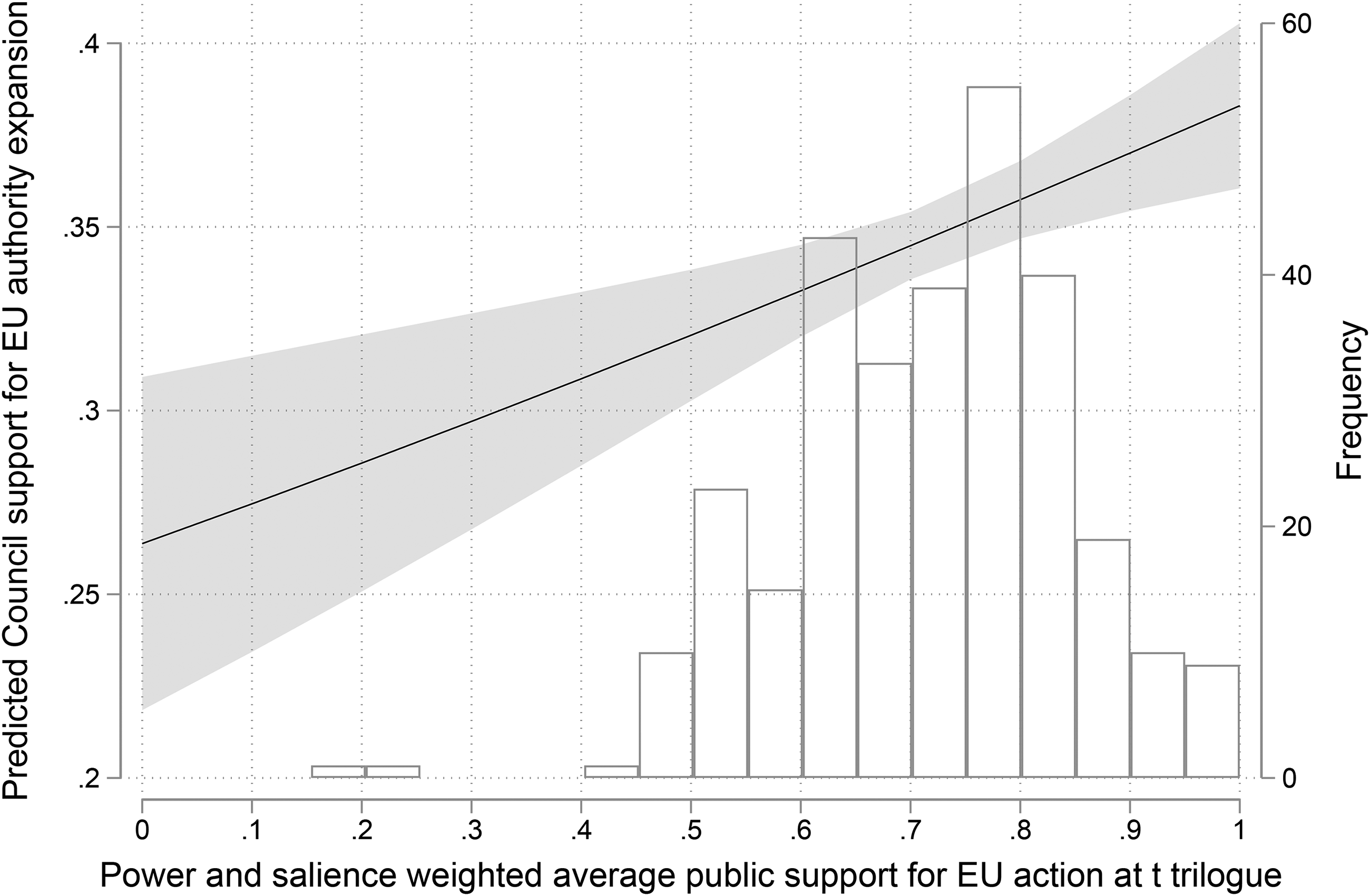
Effect of public support for EU policy action across member states on the Council supporting the expansion of EU authority in that policy.
We ran several robustness checks. Excluding the single control for the Commission's support for EU authority expansion does not alter the main results (see the Online Appendix). Our results may be mediated by other observed or unobserved factors at the act, policy domain or year level. To scrutinise that, we set up additional tests, where we introduced further controls (namely, EU-wide salience, intra-EP polarisation, the amending status and complexity of the act) as well as fixed effects for policy domains and years to our baseline models (reported in the Online Appendix). While the magnitude of the coefficient slightly declines, the initial pattern of a strong positive relationship between the Council's stance and the public views across member states remains intact.
Council responsiveness to individual member states
To test our responsiveness hypothesis (H2), we build a second dependent variable (DV2) capturing whether the changes the Council introduced to the Commission's proposals concerning EU authority expansion align with shifts in public opinion in individual member states between the time of Commission proposal the time when the Council position is formulated (as expressed in the first trilogue), i.e. our measure of Council Responsiveness. The units in this analysis of responsiveness are, thus, proposal-country dyads. As public opinion in the member states also shapes the behaviour of the Commission (Koop et al., 2020; Rauh, 2016, 2019; Yordanova et al., 2025), and so presumably the Commission proposals are already responsive to it, to limit endogeneity problems we focus on public opinion shifts following the legislative proposal publication, which the Commission had not yet observed before tabling its proposal.
To do so, using the country-level indicators from the EB, we calculated the level of public support for the EU authority expansion within each member state, year and policy domain at the time of proposal and the time the initial Council position was drawn. 9 We were then able to compare public support for EU action between the time when the Commission initiated the proposal and the time when the trilogue negotiations started. We categorised the changes during that time frame conservatively as ‘+1’ when the support for EU action increased by more than 3 percentage points (on the 0–1 public support scale); ‘0’ when the public mood remained the same ± 3 percentage points, and ‘−1’ when the people became less supportive of the EU action in a policy domain by more than 3 percentage points.
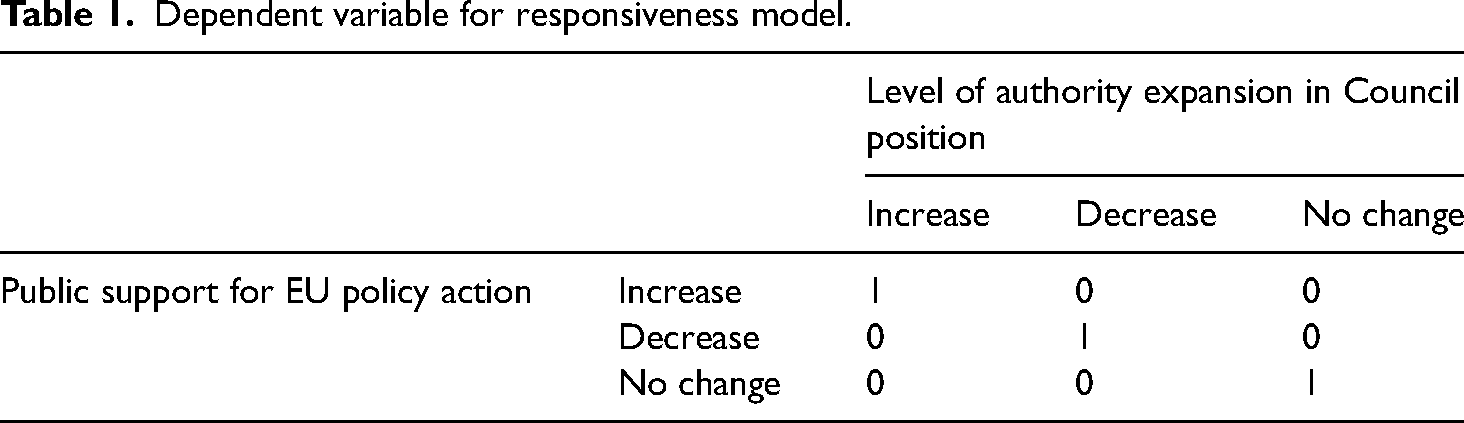
We did the same to compare the support of the EU authority expansion in the Commission proposal text and the Council position text in reaction to it, as classified by our machine learning model. Subsequently, as outlined in Table 1, our DV2 measures whether the direction of change the Council puts forward to the Commission proposal with respect to EU authority expansion aligns with the direction of change in public opinion in an individual member state (see Table 1). It takes a value of ‘1’ when the Council's position expanded (maintained the SQ in) the EU authority relative to the Commission position and the public support for the EU action in a member state grew (declined) from the time of proposal to the time of the trilogue. Otherwise, our DV2 takes the value of ‘0’, capturing a mismatch in the shifts in public opinion on EU action in the relevant policy domain and the changes in the legislative text with respect to EU authority expansion between the Commission proposal and the Council position (descriptive statistics are reported in the Online Appendix).
Dependent variable for responsiveness model.
Our first key independent variable to test Hypothesis 2 is country-level Salience of EU policy action at the time of the trilogue, defined in the previous subsection.
To measure the opinion Unity in a country at the time of trilogue, i.e. our second independent variable necessary to assess Hypothesis 2, we calculated the absolute difference between the proportion of the respondents who expressed support for the EU action in a policy domain and those who were opposed to it. The resulting measure of the level of member state's public opinion unity varies between 0 (50:50 split) and 1 (complete public support or opposition).
To assess whether the Council is most responsive to public opinion in member states where EU policy action is more salient and, at the same time, the public is relatively united in its views, we included an interaction term of country-level public Salience and Unity in our regression analysis. A positive and statistically significant effect of this interaction term will offer support for Hypothesis 2.
Furthermore, we controlled for the number of months between the proposal and first trilogue dates. The more time passes since the proposal, the easier it could become for a member state's representatives to shape the Council position in response to shifting public demands. Also, the passage of time before the first trilogue could potentially also shape how publicly salient and uniting or divisive the policy (still) is at the point of the trilogue due to interim developments. Finally, we included country-, year- and policy fixed effects. This allows us to control for unobserved dynamics across countries, years and policy domains.
As our DV2 measuring Council responsiveness is binary, we used logistic regression. Table 2 summarises the results. In the first model, we explored the independent effects of public unity and salience. The results from Model 1 suggest that the higher salience the public attaches to the policy, the more likely the Council's position is to be responsive to the change in the domestic public mood. As public salience in a member state rises from its minimum (0) to its maximum (1), the predicted probability of the Council responding to public opinion shifts in that state increases from 0.27 to 0.36 (see Figure 2).
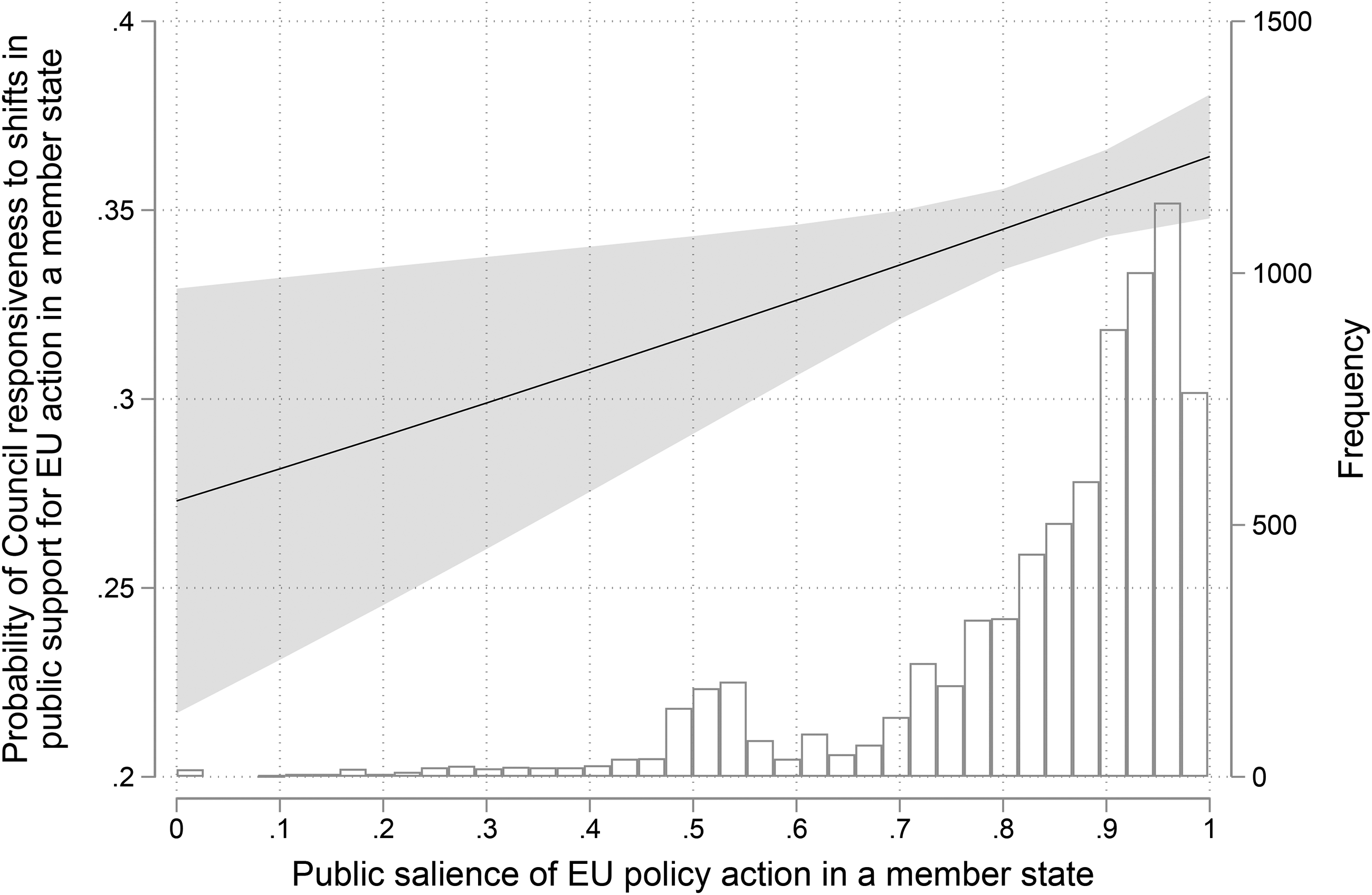
Effect of public salience in a member state on the responsiveness of the Council to shifts in public support for EU policy action.
Logistic regression of the responsiveness of the Council to public opinion shifts in member states.
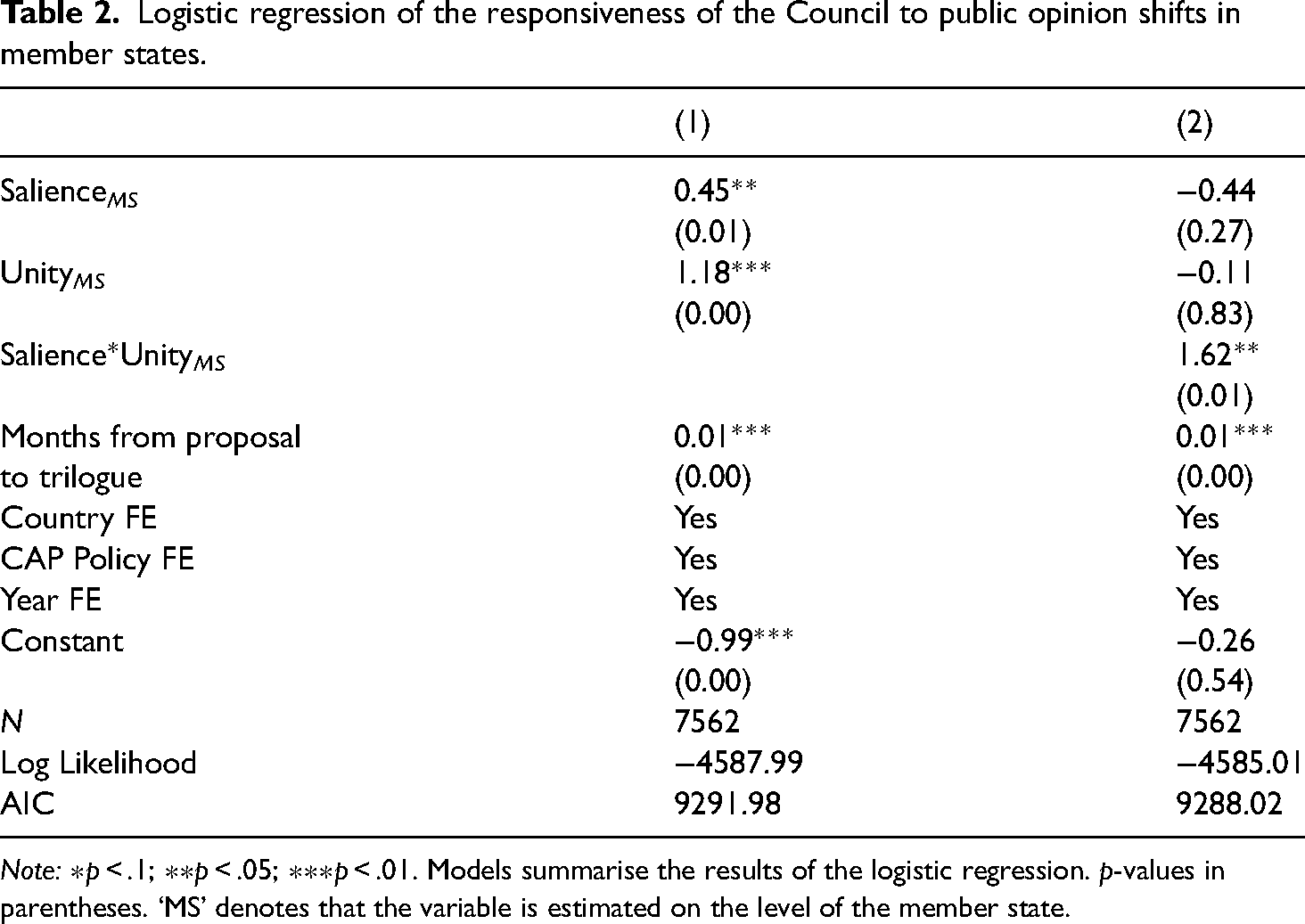
Note: ∗p < .1; ∗∗p < .05; ∗∗∗p < .01. Models summarise the results of the logistic regression. p-values in parentheses. ‘MS’ denotes that the variable is estimated on the level of the member state.
Moreover, Model 1 shows that higher unity of the opinion of a member state's public leads to a higher probability of the Council position aligning with the dynamics of public opinion in that member state, and this effect is statistically significant. As public opinion changes from fully divided (0) to fully united (1) in terms of preferences over EU policy action, the probability of the Council responding to public opinion dynamics in a member state increases from 0.23 to 0.48 (where the mean observed probability of such responsiveness is 0.35). We plot the effect in Figure 3. This effect is hardly surprising as united public preferences send a clearer signal to representatives in the Council and motivate them to account for the domestic opinion on further EU authority (or consider the consequences of not doing so) when negotiating supranational policies. Also, governments whose country citizens are more united in their opinion may enjoy a more advantageous negotiating position in the supranational arena (Putnam, 1988), and thus be better positioned to tilt the Council's position in line with the demands of their public.
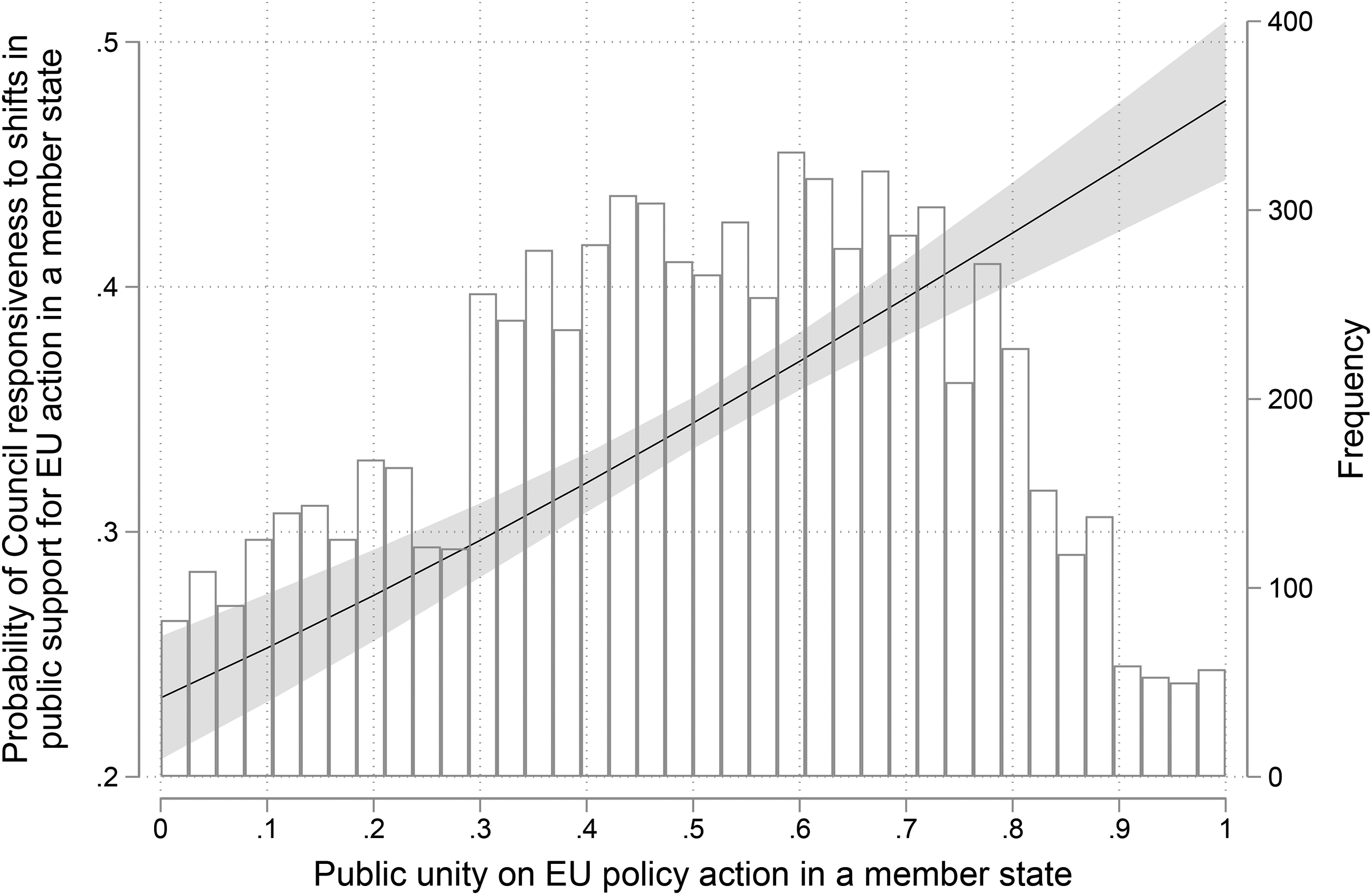
Effect of public unity in a member state on the responsiveness of Council to shifts in public support for EU policy action.
In line with our second hypothesis, we find a strong positive and statistically significant effect of the interaction between the public salience of EU policy action and the unity of opinion in a country. The marginal effect plots presented in Figures 4(a) and (b) illustrate this interactive effect. On average, public unity has no effect on the Council responsiveness when the public salience is lower than 0.4, i.e. when 60% or more of the people in a country have no opinion on a policy question (see Figure 4(a)), while it has a positive, statistically significant effect at higher levels of public salience. Conversely, public salience has a positive and statistically significant effect on the probability of Council responsiveness only when the level of public unity is relatively high, i.e., ≥ 0.5 on the measurement scale (or when 75% or more of a country's citizens share the same preferences over EU action in a policy) (see Figure 4(b)).
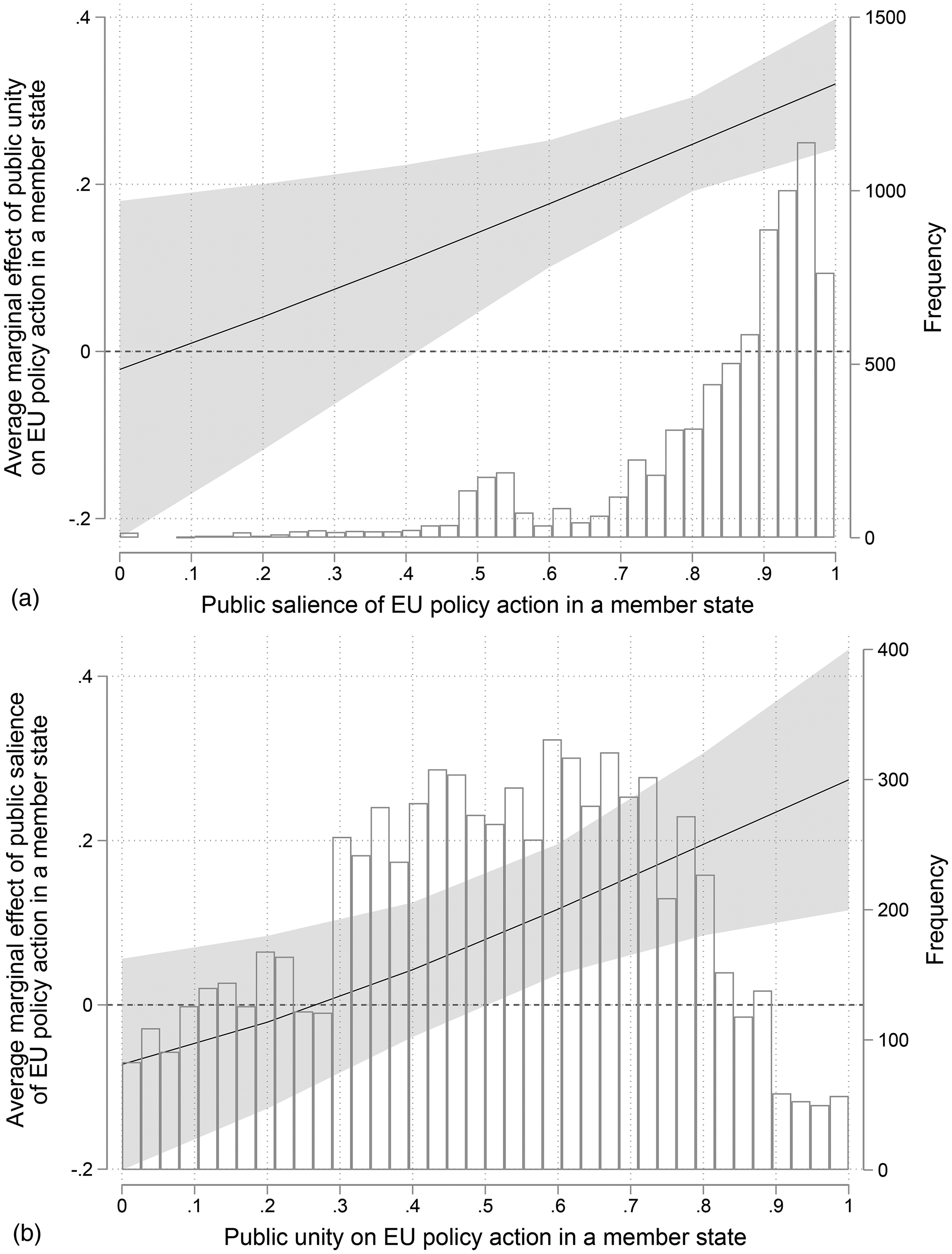
Average marginal effects of public unity and salience on the responsiveness of the Council (based on Model 2 in Table 2).
Discussion and concluding remarks
To assess claims of democratic deficit in the EU due to decision-making in Brussels being distanced from the voters and, partially as a result, the drift of EU policy from citizens’ preferences, in this paper, we analysed whether the EU Council's positions on expanding the policy authority of the EU reflect citizens’ policy-specific preferences over EU action. We further analysed under which conditions the Council responds to shifts in public opinion within member states.
We argued that the increased transparency of decision-making in the Council and the politicisation of European integration have motivated the ministers in the Council to pursue positions that are responsive to public opinion on policy integration to avoid public scrutiny for potentially unpopular positions. As a result, the Council's positions should reflect public attitudes in the member states. This is due to the tendency of governments in the Council to accommodate the domestic constraints that other governments face, be it due to a culture of consensus or a form of bargaining. Domestic constraints can increase a government's leverage in the Council, especially when it can credibly claim that these constraints bind its hands. As the Council may not be able to accommodate equally all, potentially heterogeneous, public demands, we therefore further expected it to be more likely to respond to public opinion in the member states, whose citizens view the policy under consideration as more salient and whose preferences over more or less EU policy action are relatively united.
To analyse these expectations, we relied on a novel dataset of trilogue tables, compiled in preparation for informal negotiations and containing the positions of EU institutions on individual legislative proposals. Covering a representative sample of all the proposals falling under the OLP across major policy areas between 2009 and 2019, these data offered an invaluable source to measure institutional positions on individual proposals, prepared for informal negotiations, which have become the dominant mode of policymaking in the Union. Using this dataset, we applied semi-supervised machine learning to estimate the Council's level of support for EU authority expansion. Subsequently, we examined whether this support reflects public opinion on EU action in specific policies across the member states, which we measured based on the Eurobarometer surveys. The results support our expectations of the Council's position linkage to public opinion.
These results resonate well with and add to the burgeoning research on the responsiveness of EU actors to public opinion (e.g. De Bruycker, 2019; Koop et al., 2020; Lo, 2013; Rauh, 2016; Williams and Bevan, 2019; Wratil, 2019). They demonstrate a shift away from the insensitivity of the EU institutional system to the (changing) demands of its citizens (Follesdal and Hix, 2006). In contrast to analysing signals of responsiveness in the Council expressed in votes on adopted legislation (Hagemann et al., 2017), we focused on the actual legislative positions, which shape the EU policy outputs. Thus, the findings also add to the broader discussion on the policy responsiveness in the EU (e.g. De Bruycker, 2019; Wratil et al., 2023). They suggest potentially less policy drift or, at least, decision-making less devoid of public responsiveness in the EU in recent years than assumed in the past (Follesdal and Hix, 2006: 537). Importantly, this does not imply that there is an exact match between what citizens want and what governments deliver in EU policymaking (for discussion, see Lax and Phillips, 2012), which is difficult to assess empirically and remains an important topic for further research (for a step in that direction, see Wratil, 2019).
Our focus on the EU Council positions formulated before the very first inter-institutional trilogue negotiations could be subject to critique. Following bargaining theory, one could argue that this position is not a sincere representation of the Council's preferences and could be strategically exaggerated in anticipation of hard bargaining with the EP (Bailer, 2010). Future studies should thus further examine whether and, if so, how such negotiation strategies potentially employed by the Council affect the linkage between its positions and the public views. Furthermore, while our analysis showed evidence of the Council's responsiveness to public opinion across member states, its responsiveness to societal subgroups requires further research.
Finally, unlike previous studies focused on the ideological (e.g. Wratil, 2018) or redistributive (Bailer et al., 2015) dimension of Council decision-making, to the best of our knowledge, here we present the first analysis of the public preferences for and Council positions on expanding the authority of the EU in specific policies. Given the recent (and ongoing) crises and increased EU politicisation, which have generated strong public demands for EU actions in some policies and for national sovereignty in others, conflict over the preferred course of European policy integration is likely to cut across the pro-/anti-integration and the classic ideological divides. The ability of the EU to adapt its policy authority in response to the public mood could be a means to secure the future of the European project more broadly.
Supplemental Material
sj-pdf-1-eup-10.1177_14651165251340212 - Supplemental material for When the EU Council responds to public opinion: Negotiating European policy integration
Supplemental material, sj-pdf-1-eup-10.1177_14651165251340212 for When the EU Council responds to public opinion: Negotiating European policy integration by Nikoleta Yordanova, Anastasia Ershova, Aleksandra Khokhlova, Saad Obaid Ul-Islam and Goran Glavaš in European Union Politics
Supplemental Material
sj-zip-2-eup-10.1177_14651165251340212 - Supplemental material for When the EU Council responds to public opinion: Negotiating European policy integration
Supplemental material, sj-zip-2-eup-10.1177_14651165251340212 for When the EU Council responds to public opinion: Negotiating European policy integration by Nikoleta Yordanova, Anastasia Ershova, Aleksandra Khokhlova, Saad Obaid Ul-Islam and Goran Glavaš in European Union Politics
Supplemental Material
sj-zip-3-eup-10.1177_14651165251340212 - Supplemental material for When the EU Council responds to public opinion: Negotiating European policy integration
Supplemental material, sj-zip-3-eup-10.1177_14651165251340212 for When the EU Council responds to public opinion: Negotiating European policy integration by Nikoleta Yordanova, Anastasia Ershova, Aleksandra Khokhlova, Saad Obaid Ul-Islam and Goran Glavaš in European Union Politics
Supplemental Material
sj-zip-4-eup-10.1177_14651165251340212 - Supplemental material for When the EU Council responds to public opinion: Negotiating European policy integration
Supplemental material, sj-zip-4-eup-10.1177_14651165251340212 for When the EU Council responds to public opinion: Negotiating European policy integration by Nikoleta Yordanova, Anastasia Ershova, Aleksandra Khokhlova, Saad Obaid Ul-Islam and Goran Glavaš in European Union Politics
Footnotes
Acknowledgements
We are grateful to Fabian David Schmidt, Marlena Kuc, Benedikt Ebing, Sarah Knabl, Daniel J. Whitten and Bence Hamrák for their invaluable help with the data collection. We would like to thank Adina Akbik, Bjørn Høyland, Hans Peter Kriesi, Daniel Naurin and Daniel Thomas as well as the panel participants at COMPTEXT 2023, EPSA 2023, CES 2023, and the seminar series of ARENA Center for European Studies, the Europe Hub and the Institute of Political Science at Leiden University, and the Leverhulme Interdisciplinary Network on Algorithmic Solutions at Queen's University Belfast for their comments and suggestions on the earlier versions of this paper.
Author contributions
Yordanova contributed to conceptualization; methodology; analysis; investigation; data curation; writing; project administration; supervision; funding acquisition.
Ershova contributed to conceptualization; methodology; validation; analysis; investigation; data curation; writing; visualization; project administration.
Khokhlova contributed to conceptualization; methodology; validation; analysis; investigation; data curation; writing; visualization; project administration.
Obaid Ul-Islam contributed to software; methodology; validation; data curation; writing.
Glavaš contributed to software; methodology; supervision; funding acquisition.
Declaration of conflicting interests
The authors declared no potential conflicts of interest with respect to the research, authorship, and/or publication of this article.
Funding
The authors disclosed receipt of the following financial support for the research, authorship, and/or publication of this article: This work was conducted as part of the project EUINACTION ‘Willingness and Capacity for EU Policy Change’, financially supported by the NORFACE Joint Research Programme on Democratic Governance in a Turbulent Age and co-funded by DFG, ESRC and NWO, and the European Commission through Horizon 2020 under agreement No 822166.

Data availability statement
Supplementary material
Supplemental material for this article is available online.
Notes
References
Supplementary Material
Please find the following supplemental material available below.
For Open Access articles published under a Creative Commons License, all supplemental material carries the same license as the article it is associated with.
For non-Open Access articles published, all supplemental material carries a non-exclusive license, and permission requests for re-use of supplemental material or any part of supplemental material shall be sent directly to the copyright owner as specified in the copyright notice associated with the article.
