




Abstract
Do radical right fringe parties affect main parties in Central and Eastern Europe (CEE)? Using data from the Manifesto Project, we analyze the relationship between radical right fringe parties’ and main parties’ policy programs regarding sociocultural issues in six post-communist countries of CEE. Even though radical right fringe parties have participated in government in several of these countries, and in Hungary a fringe party has become the country’s second largest party, our analysis shows that the sociocultural issues in radical right fringe party manifestos do not systematically relate to the changes in main party manifestos regarding those issues. Even if some of the main parties in our study might often agree with the radical right fringe parties, our analysis shows that the latter do not directly influence the policy priorities of the main parties.
Introduction
What is the effect of fringe parties on main parties in Central and Eastern Europe (CEE)? The role of, especially, radical right fringe parties has been a source of contention among scholars. Some scholars have found that these parties, which compete along a narrow set of sociocultural issues, exert influence on main parties, particularly but not only on the right. This effect sees the latter moving further and further toward extreme nativist, authoritarian, and xenophobe positions both in Western Europe (WE) (e.g. Abou-Chadi and Krause, 2018; Han, 2015; Schumacher and van Kersbergen, 2016) and in some CEE countries (Minkenberg, 2017; Pytlas, 2015; Pytlas and Kossack, 2015). Radical right fringe parties are said to play the role of agenda setters to which main parties respond often by accommodating and adopting the most salient issues. This role attributed to the radical right fringe is said to be even stronger in CEE compared to WE because of the comparatively greater salience of sociocultural issues in post-communist societies. Case study analyses have supported this pattern between main and fringe parties, especially for the Hungarian parties Fidesz and radical right Jobbik (Krekó and Mayer, 2015; Pirro, 2015a, 2015b). In strong contrast to these claims, other scholars find that the influence of fringe parties in CEE is overstated and there is little evidence that they affect changes in main party positions (Akkerman, 2015; Meyer and Rosenberger, 2015; Mudde, 2013). Thus, currently we have conflicting arguments and findings about the effect of radical right fringe parties on the main parties in CEE. So far, these findings have been based mainly on demand side, media, and qualitative analyses in single countries or limited country comparisons.
This article extends the investigation to an analysis of the relationship between radical right fringe parties’ and main parties’ policy programs in six CEE countries over 27 years. We consider radical right fringe parties to be small relative to their party system. They compete on a limited number of noneconomic issues and their radical right profile is created by their nativist and authoritarian policy positions. The cases selected for analysis are Bulgaria, the Czech Republic, Hungary, Poland, Romania and Slovakia. Our research question therefore is: Do radical right fringe parties in CEE exert a measurable effect on main parties’ political agenda? We argue that such an effect is in evidence if two conditions are met: (1) there is a significant positive relationship between the salience of an issue in the radical right fringe party manifesto and the main party manifesto. (2) This positive relationship differs markedly from the average change in salience on that issue for all parties in the system. The latter thus serves as a benchmark to filter out trends affecting the entire party system. In our analysis, we draw on sociocultural issues in the Manifesto data (Volkens et al., 2018) and examine all available parties in CEE which fit the definitions outlined below. We also test for differences between countries and issue categories.
Our article proceeds as follows: In the next segment, we address the thorny issue of conceptualizing “radical right fringe” and “main party” in the context of the highly volatile and fragmented polities of CEE. In discussing the literature, we lay out the arguments and then present in detail our methodology. In the subsequent section, we provide an overview of radical right fringe parties in the regions and present their profiles along with classifications of whether they are radical right. Then, the article proceeds to the main analysis and discusses our findings. Our analysis shows that radical right fringe parties actually have little or no influence on issue salience among the main political parties as we do not find a relationship between their policy programs. We, thus, confirm those previous studies arguing that fringe parties do not independently affect the behavior of main parties. Finally, we conclude by discussing the theoretical implications of our results.
Conceptualizing radical right fringe parties and party competition in CEE
In this segment, we will first introduce our key concept of “fringe” as well as the subset of radical right fringe party and discuss the context of party competition in CEE. Subsequently, we present the arguments for why we would expect radical right fringe parties to exert influence on main parties.
Fringe parties in the context of volatile and fragmented party systems
Scholars have defined “fringe party” in a number of ways and often use it in a pejorative sense to differentiate between “reasonable” mainstream politics and the “extreme.” “Fringe” is often thought of in terms of low voter support, tiny party membership, and niche representation and thus normally not electorally relevant (Arzheimer, 2011: 638–639). They are contrasted in particular to “main parties,” meaning those that dominate the party competition because of their size and roles in the political system, especially being at the core of government formation. The relationship between these two broad party types is at the heart of this investigation (see especially Gherghina and Fagan, 2021).
However, the term “fringe” party needs further elaboration as “some parties remain isolated and outside the political mainstream although they attract large segments of the electorate” (Gherghina and Fagan, 2021) and thus vote-share and electoral success are not necessarily a knockout criterion for the categorization. Fringe can be considered marginal or extreme only in relation to other parties (Arzheimer, 2011: 639). In a liberal democratic regime, extreme positions on both sides of the political spectrum that promote a radical transformation of the political systems are clearly considered “fringe” (Adams et al., 2006: 513). These parties combine “ideological radicalism with a tribune discourse pitting certain sections of society—perceived to have been ignored by the mainstream parties—versus a large range of patricians of which political elites are the primary but not sole members” (Nedelcu, 2012: 8). The definition also depends on time: ideological views that were once considered fringe or extreme are becoming increasingly prevalent as former fringe parties are entering mainstream politics (Polyakova and Shekhovtsov, 2016). The turmoil in CEE party systems makes it challenging to define “fringe” in relation to ideological extremism or diminutive political influence.
In our work, we accept the main argument of the fringe party literature discussed above that these parties are small relative to their respective party system (Gherghina and Fagan, 2021). However, as a study of how extra-parliamentary parties affect main parties would be theoretically and empirically outside of the scope of this article, we restrict ourselves to the study of small parties with parliamentary representation. Furthermore, we follow Meguid (2005: 347–348) and Wagner (2011: 847) whose work on niche party challengers and main party response has been instrumental for conceptualizing this relationship. The main characteristics of such parties are that they reject the traditional class-based orientation of politics and that their issues often do not coincide with the existing left–right lines of political division (Meguid, 2005). Furthermore, they are perceived either as single-issue parties (Meguid, 2005) or as competing “primarily on a small number of non-economic issues” (Wagner, 2011: 847). While this definition encompasses parties of every possible ideological persuasion, we will see in the next section that the radical right—for which the primary issues are nativism and authoritarianism (Mudde, 2007)—plays a deep-seated cultural and political role in CEE. Thus, given the surge of nationalist identity politics and the political strength of both the radical and mainstream right in CEE, this analysis will focus primarily on the relationship between (a) radical right fringe parties, meaning small parties competing on a limited number of issues around nativist and authoritarian values, and (b) main parties, meaning large parties that are the radical right parties’ primary contender in the party system.
Radical right issues in CEE transition societies
There is an extensive literature suggesting that the widespread appeal of nationalism and nativism, two key components of radical right-wing populism (Mudde, 2007), is strongly connected to CEE’s long history of outside domination and restricted national sovereignty. This caused competing historical narratives, unfulfilled national aspirations while increasing the salience of ethnic or religious cleavages within these societies (Henderson, 2008; Hloušek and Kopeček, 2008; Minkenberg, 2010, 2015). In fact, as Minkenberg (2015: 41) argues, “[traditional and] new cleavages do not structure party competition in a stable fashion, except for the ethnic cleavage […].” The role of collective identities, especially ethnic ones, has been central to understanding party competition in CEE and “the subject of dozens of studies analysing transitional developments in post-communist countries” (Gyárfášová and Mesežnikov, 2015: 224). Thus, historical grievances and imagined or genuine national traumas continue to serve as sociocultural sources of political contestation (Minkenberg, 2015: 27–42). This historical legacy has also led to the phenomenon that such nationalist and nativist positions can not only be found in the policy profiles of right-wing but also in left-wing parties (Marks et al., 2006: 159).
Furthermore, delayed European integration also affected the advent of radical right parties in that the harsh conditions of membership imposed on the accession countries needed to be defended by the political mainstream, especially the government parties (Harmsen, 2010; Harmsen and Spiering, 2004: 228; Riishøj, 2004: 7). Whereas initially, European Union (EU) accession had been a valence issue in all pre-accession countries, joining the EU “late” meant that membership was now viewed unfavorably by significant segments of the voting publics. Thus, the greater the cost and the higher the imposed conditionality, the greater was the potential for the political opposition to exploit the accession process for political gain. When disillusionment with the accession process set in, mainstream parties on the right were arguably better positioned to champion nationalist causes and adopt more Eurosceptical positions. This is because the main competition had initially been between the reformist center–right and the less reform-willing left. By the mid-1990s, this changed as left-leaning parties – except for the rather marginalized communist parties – were no longer potential obstacles to pro-Western reforms but became in part rather market-liberal or turned to ethno-cultural issues for mobilization (Ishiyama and Bozóki, 2002). Newly established, mainly radical right parties rushed in to fill the Eurosceptical, anti-reformist gap. The main right-wing parties had to respond to this development to remain competitive (Henderson, 2008: 121–22; Neumayer, 2008: 136).
An important distinctive feature of CEE party systems is their “under-institutionalization” (Minkenberg, 2015: 34), making the parties “disconcertingly fluid” and contributing to “permeable borders between the radical right and the mainstream right” (Minkenberg, 2015: 34). Rovny (2014: 675) comments that although “party organizations in Eastern Europe remain weak and fluid, the ideological frames of party competition are surprisingly structured.” Especially, new protest parties want to draw a contrast to the post-transition mainstream by attacking the latter for political corruption and “selling out” the national interest to international political forces (Zapryanova, 2010). This, in turn, reenforces the centrality of the sociocultural issue dimension in CEE party competition.
Explaining the effect of radical right fringe parties on main parties
Turning to our research question and main arguments, we need to appraise briefly the aforementioned political conditions to understand why we would expect the effect of radical right fringe parties on main parties to be particularly pronounced in CEE. The process of regime transition and modernization in CEE resulted in an increase in anti-liberal and Eurosceptical positions. The permeability of the parties themselves and the volatility of the party system imply that main parties, especially but not exclusively on the right, needed to respond effectively to such challenges lest they risked a party split or would have to contend with fringe party rivals that continue to morph and present new challenges. Thus far, studies on party behavior both in WE and CEE have identified three distinct reactions by main parties to their radical right fringe challenger: adaption, partial co-option with isolation, and no discernible reaction. For WE party systems, studies have focused either primarily on mainstream (i.e. moderate or centrist) parties instead of main parties or on niche instead of radical right fringe parties. As there is a wide overlap between these sets of parties, both of these discussions are relevant here.
The most commonly analyzed pattern of main (or mainstream) parties reacting to the radical right is the adaption of the former to the latter, producing consequences for the electoral fortunes of both sets of parties. With radical right fringe parties emphasizing issues such as immigration and nationalism related to the cultural value dimension, they present a substantial and lasting challenge to their main party competitors, which are still largely focused on socioeconomic contestation. Several studies of WE party systems conclude that radical right parties have succeeded in “dragging” the mainstream toward themselves (Abou-Chadi, 2016; Han, 2015; Schumacher and van Kersbergen, 2016), because they compete on the sociocultural dimension, while main parties still largely focus on the socioeconomic contestation (Abou-Chadi and Krause, 2018). This “dragging” can manifest itself by affecting mainstream parties’ programs, government policies, and/or public discourse. Similarly, studies focusing on the electoral threat of the radical right to mainstream parties suggest that mainstream parties move their position in the hope of “stealing” both ownership of issues and voters (back) from their radical right challengers (Meguid, 2005; Otjes, 2011). Several cross-country studies found that both mainstream right and mainstream left parties adjusted their positions with regard to immigration, integration, or multiculturalism (Abou-Chadi, 2016; Abou-Chadi and Krause, 2018; Han, 2015; van Spanje, 2010) or more broadly on the cultural dimension (Minkenberg, 2001; Wagner and Meyer, 2017).
The external conditions in CEE countries are different to WE because party competition is dominated by sociocultural issues. Until the recent refugee crisis, the issue of immigration was not politicized, while national minorities played a central role in radical right parties’ mobilization (Buštíková, 2017). Despite these contextual differences, Minkenberg (2017) argues that the mechanisms underlying the contagious impact of radical right parties are the same in CEE and that the “radical right’s effect occurred primarily by shifting the overall political agenda to the right in the dimension of identity politics” (2017: 134). Using expert survey data to measure shifts in party positions in five CEE countries and interpreting the underlying mechanisms in qualitative explorations, Pytlas and Kossack (2015) show that mainstream parties on the right not only accommodate identity-related issues but also co-opt the frames from radical right parties’ narratives. Studies focusing on the consequences of such behavior have shown that they are sometimes successful, for instance when the Hungarian Fidesz successfully crowded out the radical right MIÉP (Pytlas, 2018a: 193).
Two alternative schools of thought challenge the claim that radical right fringe parties affect mainstream parties directly. The first argues that conservative and center–right parties do not really adopt the radical right positions but rather merely imitate the rhetoric of the latter—or co-opt some of these positions while still isolating the “pariah” politically (van Spanje and de Graaf, 2018; see also: Spies and Franzmann, 2011; van Spanje and van der Brug, 2007). Studies in CEE have found similar patterns in individual countries, suggesting that main parties engage in adversarial strategies and attempt to isolate their challengers politically when faced with radical parties (e.g. Pirro, 2015b; Pytlas, 2015). Because of the general acceptability and legitimacy of radical right frames and narratives, the adoption of some radical right rhetoric or positions might then result in a radicalization of the mainstream. Moreover, if the radical right is capable of maintaining ownership of their frames (in this case, nativist and nationalist or ethnocentric claims), it results in what Pytlas calls the “contest over meaning” (2015: 48). However, whether fringe parties maintain their frame ownership or main parties successfully co-opt these policies (potentially resulting in the demise of such fringe parties), the programmatic effect on main parties remains the same.
The second alternative school of thought calls into question whether there is any impact of radical right parties on the behavior of their competitors at all (e.g. Akkerman, 2015; Meyer and Rosenberger, 2015; Mudde, 2013). Mudde (2013: 8–9) argues that parties respond to voter demands (or their perception of voter demands) in the overall party-political context but do not make significant adjustments based on the issue salience of competing parties. The radical right is thus “not the main factor behind the ‘anti-immigrant turn’ of mainstream parties” (Alonso and Fonseca, 2012: 869) but rather a symptom of a discourse generally shifting to the right. Similarly, comparative studies focusing on CEE party systems regularly accentuate that traditionalist, nationalist, and even racist positions are equally found among established parties, Poland and Romania being cited often in this context (e.g. Buštíková, 2017). Buštíková (2017) even speaks of “radical mainstream parties” blurring the boundaries between the mainstream and the fringes. A general discursive openness toward radical right positions provides a permissive environment for mainstream parties on the right. Squeezed out by mainstream politics, however, radical right challenger parties have therefore been found to be only “moderately successful” (Pirro, 2015a: 80; Pytlas, 2018b). 1
Many of the studies focusing on radical right fringe and main parties in CEE acknowledge the importance of main party reactions to their radical right challenger but ultimately focus on the electoral fortunes of the latter and the role of the demand side in its explanation (Buštíková, 2014; Buštíková and Kitschelt, 2009; Kluknavská and Smolík, 2016; Pytlas, 2015). Similarly, genuinely party-centered studies investigating the role of party organizations, propaganda, and leadership concentrate on explaining the electoral success of these parties (Werkmann and Gherghina, 2018) or their internal configurations (Gherghina, 2014). Those studies that have focused on whether and how main parties react to radical right fringe parties have done so in one to three countries and base their analysis on public opinion or media data as well as qualitative interpretations of issues frames (Minkenberg, 2017; Pytlas, 2018a; Pytlas and Kossck, 2015). Thus, while this article is not the first to investigate the question of whether main parties in CEE are affected by radical right fringe parties, its most important contribution lies in investigating this effect on the policy program of main parties. Thus, we shift the focus from the “contest over meaning” and ownership of particular frames to the parties’ policies and positions. How and to what extent have (radical right) fringe parties exerted programmatic influence on their “nearby main competitors” on the sociocultural dimension? To trace these programmatic effects, and in an attempt to overcome the limited focus of either single-country studies or studies concentrating on narrow time frames, we include radical right fringe parties from six countries in CEE (Bulgaria, Czech Republic, Hungary, Poland, Romania, and Slovakia) from 1990 to 2017.
We focus on radical right parties as the most common fringe parties and on the main parties that are their main competitors, as they are the most likely to be affected by the radical right parties. If radical right fringe parties do not affect those main parties’ policies, they are unlikely to affect any other parties’ profiles. These main parties are mostly center–right parties but, given the complexity of the CEE party systems, they might also be radical right or mainstream left parties. Given the centrality of the sociocultural dimension to both the general political competition in CEE and to radical right fringe parties in particular (Pytlas, 2018a: 196–97; see also Kluknavská and Smolík, 2016), we draw on parties’ position regarding sociocultural issues. Following the most recent and dominant literature from WE and some findings from previous CEE studies, as discussed above, we expect that main parties are likely to adjust their programs to the radical right parties’ programs on a range of salient sociocultural issue. Thus, we formulate the following hypothesis: When competing with a radical right fringe party, the main party significantly changes its position in the direction of the most salient issue positions of radical right fringe party. To support this hypothesis, two types of evidence are needed: First, there has to be a significant increase in the salience a main right party attributes to an issue that is highly salient for the competing fringe party. Second, the increase in main party issue salience has to differ significantly from the average change in salience on that issue for all parties in the system.
To test this hypothesis, we utilize Manifesto data provided by the 2018a MARPOR update (Volkens et al., 2018). These data consist of the relative shares of quasisentences in parties’ electoral programs that were attributed to 56 main policy categories by specially trained expert coders. Consistent with the argument above regarding the centrality of the sociocultural dimension in CEE party competition, we focus our analysis on 11 sociocultural Manifesto categories: culture, nationalism positive and negative, traditional morality positive and negative, law and order, civic mindedness, multiculturalism positive and negative, as well as positive mentions of minority and noneconomic demographic groups. While there have been debates around the reliability of some aspects of the Manifesto data (e.g. Gemenis, 2013; Volkens et al., 2013), employing these data has the advantages that its standardized numerical scores allow for cross-country and cross-time comparison, that it covers all CEE countries since 1990 and that includes almost all parties relevant to our research question. Furthermore, our focus on the sociocultural issue categories avoids the known problems around category aggregation and index building.
Empirical analysis
We examine the party system of the six largest CEE member states of the EU, which are comparable with each other due to their general historical and geographic communalities. By comparison, the Baltic States and the Western Balkans have been shaped by profoundly different sociocultural and geopolitical developments, resulting in unique issue environments affecting national party politics to such an extent that the inclusion of these cases in this framework would present genuine problems of comparability. In the Baltic countries, the overriding and singular issue of the relationship with ethnic Russians and Russia is not just sociocultural but rather one that is geopolitical, raising questions of national security and external alliances. Similarly, the Western Balkan presents an issue environment shaped by the violent breakup of former Yugoslavia and the conditions of recent state formation. This includes territorial disputes (Croatia and Slovenia), clashes over the nature of the state (Bosnia, Macedonia) or even the very acceptance of statehood (Kosovo), as well as overriding concerns about protecting national institutions and language after just gaining sovereignty for the first time (Slovenia). While sociocultural issues are bound up with these questions, their implications are much wider and not just limited to a dyadic contestation between main parties and the fringe where the latter may be assumed to serve as agenda setter. In cases such as Croatia and Serbia, it is the main parties and not necessarily the fringe that emerged from the nationalist formations most engaged in the conflict. Other countries in the area that are not included in our analysis, such as the Ukraine, are not members of the EU and even more difficult to compare meaningfully. They had emerged from the breakup of the former Soviet Union and with starting conditions rather different from Hungary or Poland.
Concerning main parties, we focus on those that are dominant in the respective party system and are most likely to be affected by the radical right fringe parties, given their conservative sociocultural leaning. These are the following main right parties: the Polish Law and Justice Party (PiS), the Citizens for European Development of Bulgaria (GERB), Fidesz—Hungarian Civic Alliance, 2 the Czech Civic Democratic Party (ODS) (see Saxonberg, 2003), and the Romanian National Liberal Party (PNL) (including its different alliances). Furthermore, we include two mainstream parties: the Slovak Direction-Social Democracy Direction-Social Democracy (SMER-SD) and the Romanian Social Democratic Party (PSD). 3 Both parties have a track record of engaging in nationalist and populist discourses and/or coalitions such as SMER’s government cooperation with the radical right Slovak National Party (SNS) and People’s Party - Movement for a Democratic Slovakia (L’S-HZDS) (cf. Pirro, 2015a: 93–95). While PSD is economically social–democratic, it is a conservative party on the sociocultural dimension. Confirming that these are indeed dominant main parties, their average vote share is 29% (standard deviation = 14). 4
Following our earlier definition of radical right fringe parties and limiting to those with parliamentary representation, we identified the 12 radical right fringe parties listed in Table 1. As the categorization of these parties is often contested, we provide multiple sources for our selection, including Nedelcu (2012), Minkenberg (2015), Gherghina et al. (2017), van Kessel (2015), and the Chapel Hill Expert Survey (Bakker et al., 2015). As we do not have sufficient data for the Polish KPN from the Manifesto data set, we analyze 11 radical right fringe parties that have an average vote share of 8.6% (standard deviation = 4.8).
Fringe parties in six CEE countries.
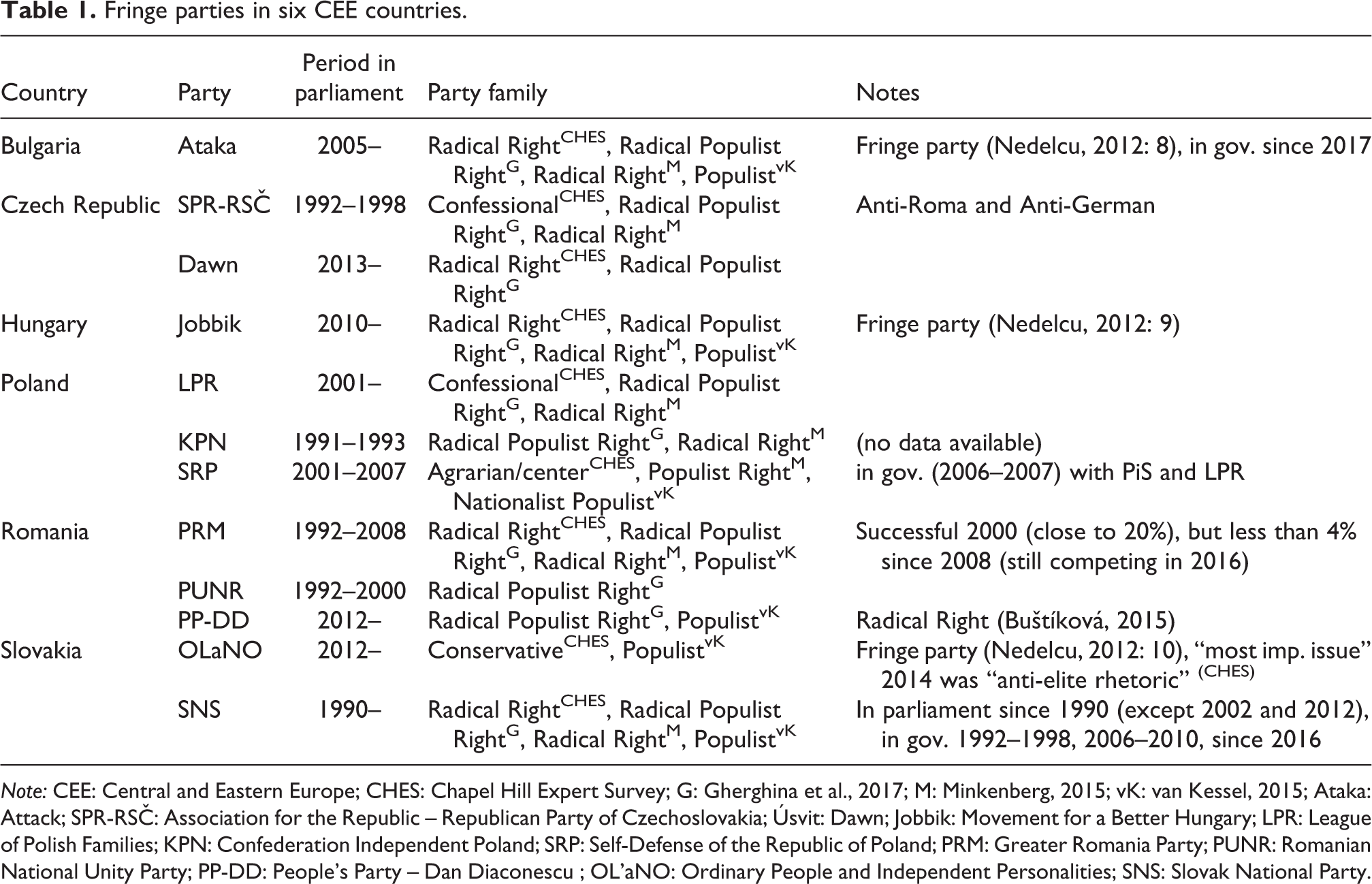
Note: CEE: Central and Eastern Europe; CHES: Chapel Hill Expert Survey; G: Gherghina et al., 2017; M: Minkenberg, 2015; vK: van Kessel, 2015; Ataka: Attack; SPR-RSČ: Association for the Republic – Republican Party of Czechoslovakia; Úsvit: Dawn; Jobbik: Movement for a Better Hungary; LPR: League of Polish Families; KPN: Confederation Independent Poland; SRP: Self-Defense of the Republic of Poland; PRM: Greater Romania Party; PUNR: Romanian National Unity Party; PP-DD: People’s Party – Dan Diaconescu ; OL’aNO: Ordinary People and Independent Personalities; SNS: Slovak National Party.
While not all parties are present at all times, the resulting data set includes elections from 1990 to 2017. For each election, the Manifesto data set provides the saliences of the 11 sociocultural categories mentioned above for each of these parties’ manifestos whenever the party won at least two seats in their respective national parliament. From these data, we construct the main dependent and independent variables. As the research question concerns a change in the main parties’ manifestos, the dependent variable is the change within the salience of each of the 11 categories from one election to the next (i.e. main party salience at t 0 subtracted from salience at t 1). As each of the categories is directional (positive or negative), we can ascertain the strength and direction of the movement of the main party in their stance toward these sociocultural issues. This is important as we would expect main parties to increase the salience of those categories highlighted by the radical right fringe parties. The main independent variables are the saliences of these categories in the fringe parties’ manifestos. The main party might react to the radical right fringe party at the previous election (t 0, if the fringe party won parliamentary seats) or at the later election (t 1), in response for example to the challenger’s electoral campaign at t 0 or to its issue politics as parliamentary opposition prior to t 1. Therefore, the saliences of the radical right fringe parties are included into the analysis when they appear at either time point. In the analysis below, the saliences at t 0 and t 1 are included separately.
Building on these decisions, the following analysis investigates the relationship between radical right fringe party salience and main party movement, controlling for possible variation between countries and between policy issues. If we find a significant relationship, this would be a strong indicator that there might be an effect and would warrant a more sophisticated analysis. However, our results strongly suggest that no such relationship exists. 5
Figure 1 graphs the relationship between the salience of sociocultural issues in the radical right fringe party manifestos at t 0 and the movement in the main party manifestos from t 0 to t 1, both for each of the six countries and all data pooled together. Furthermore, Table A1 in the Online Appendix includes the results of the correlation analysis. Both show that the salience in the radical right fringe party manifestos is not related to the movement in the main parties. The only exception here is Bulgaria where radical right fringe party salience has a significant negative relationship with the movement of main parties, meaning that GERB de-emphasized these issues while Ataka had emphasized them in the previous election.
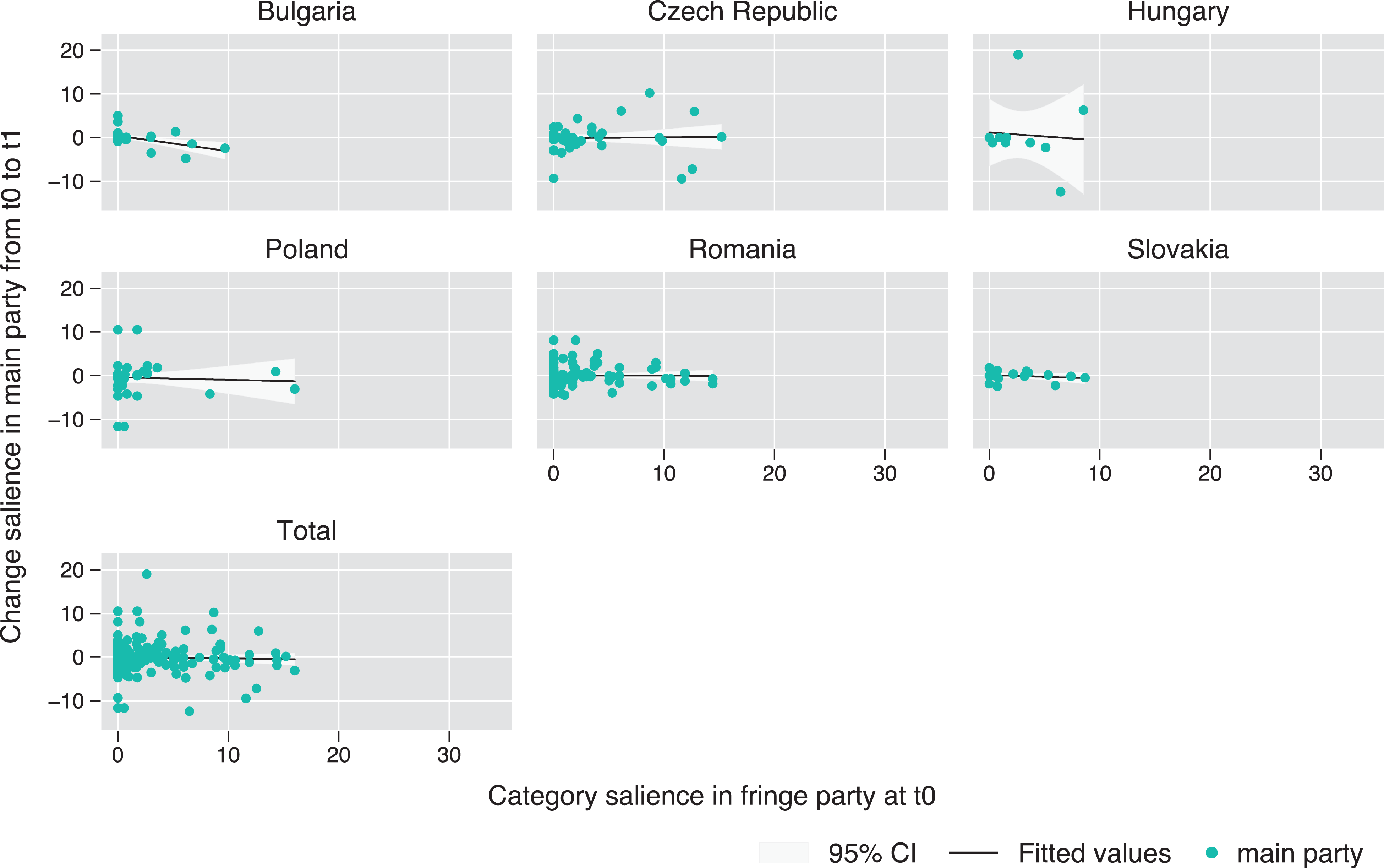
Relationship between fringe party salience at t 0 and main party movement from t 0 to t 1, per country.
Figure 2 shows the respective graphs for the relationship between the main party movement and the radical right fringe party salience at t 1, meaning the later election at which the main party change appears. Again, there is generally no relationship except in Bulgaria, for which Table A1 in the Online Appendix shows that there is a significant positive correlation (r = 0.51, p < 0.000, N = 44).
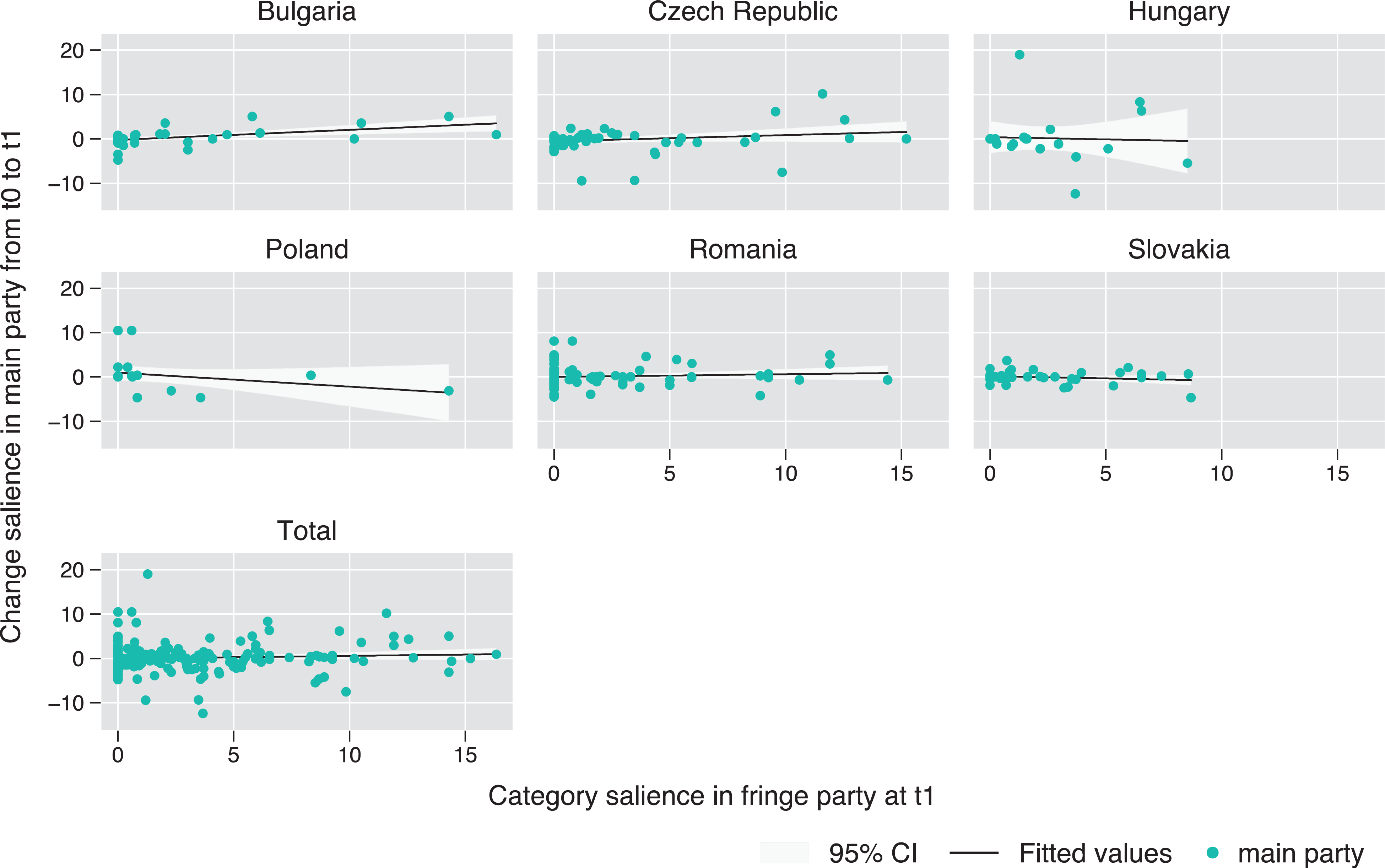
Relationship between fringe party salience at t 1 and main party movement from t 0 to t 1, per country.
The following part of the analysis takes a closer look at the 11 categories to discern whether the relationships might cancel each other out. Figures 3 and 4, therefore, show again the relationships between main party movement and radical right fringe party salience, at t 0 and t 1, respectively. The graphs with all categories pooled confirm the general finding that there is no relationship between main movement and radical right fringe party salience. While there seems to be a slight inverse relationship for positive mentions of nationalism and traditional morality, neither relationship is significant (shown in Table A2 in the Online Appendix). The positive relationship in the civic mindedness category seems to be driven by a small number of outliers.
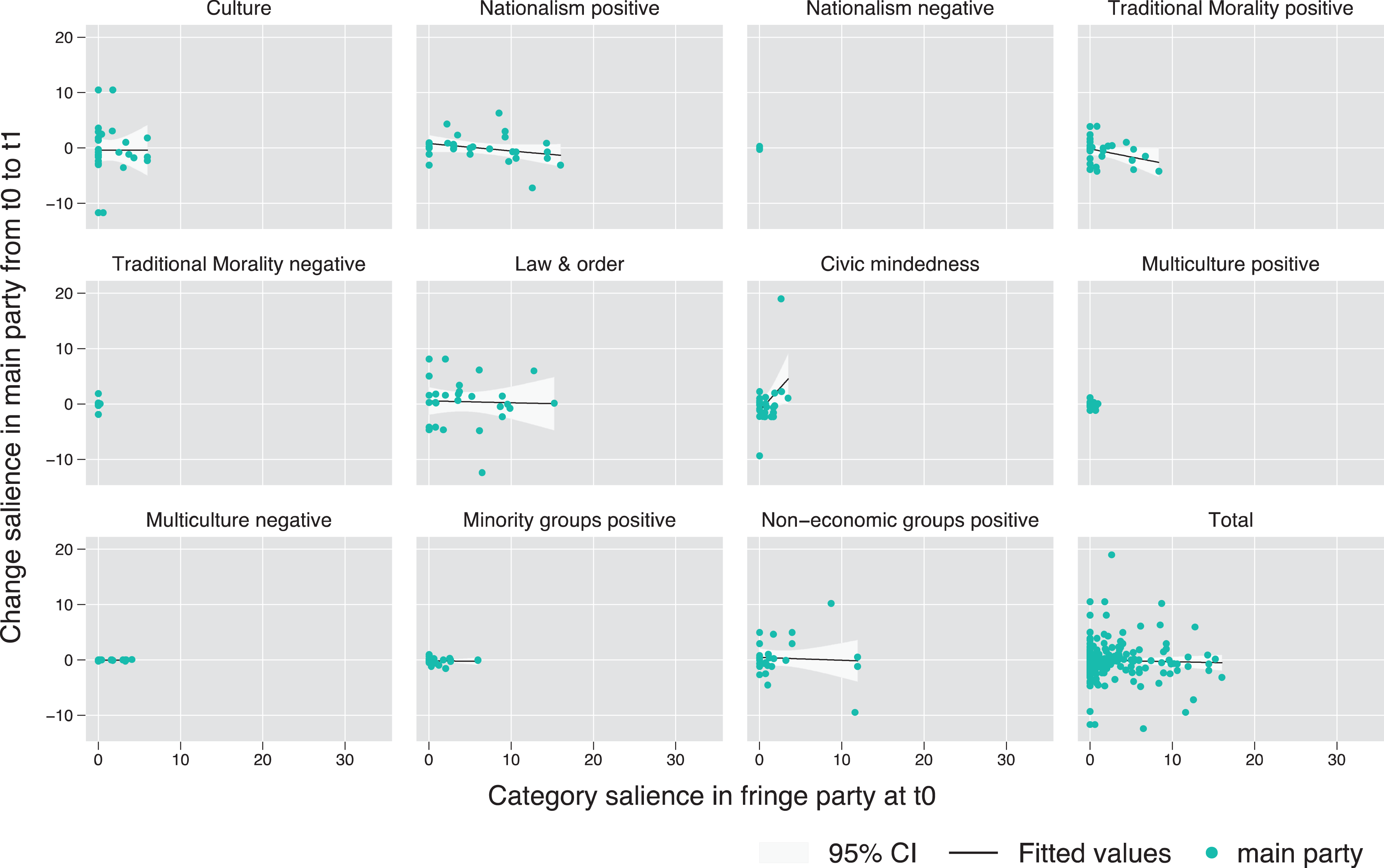
Relationship between fringe party salience at t 0 and main party movement from t 0 to t 1, per category.
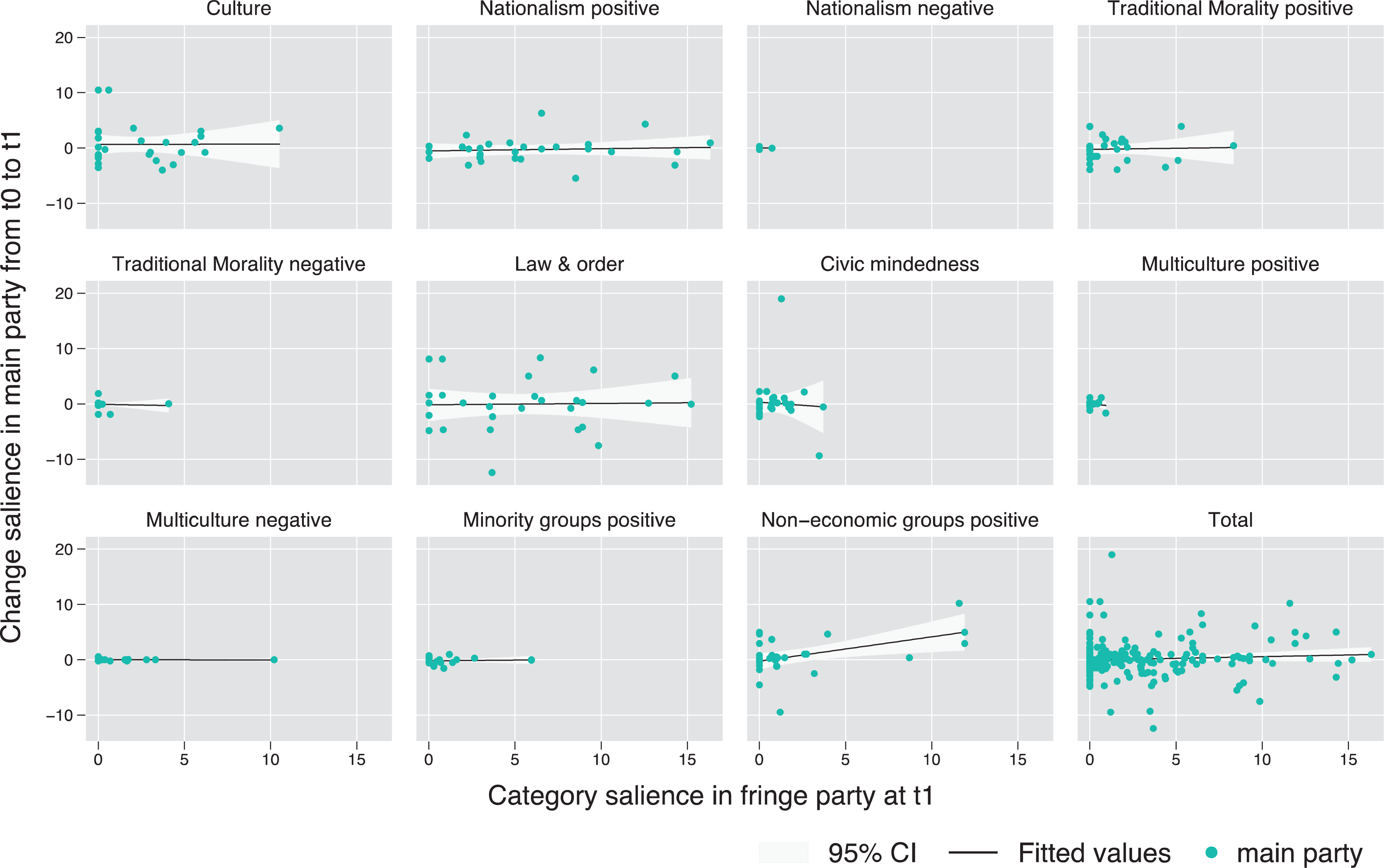
Relationship between fringe party salience at t 1 and main party movement from t 0 to t 1, per category.
Similarly, Figure 4 confirms the lack of relationships. Against common assumptions and regardless of the salience of anti-multicultural issues, the main parties in CEE have not significantly changed positions in their manifestos. The only exception is found in the category of positive statements toward noneconomic groups, which include women, university students, and specific age groups (Werner et al., 2014: 26). Here we find a positive relationship, meaning that when radical right fringe parties talk more about these groups, main parties also attribute higher salience to these issues (and vice versa).
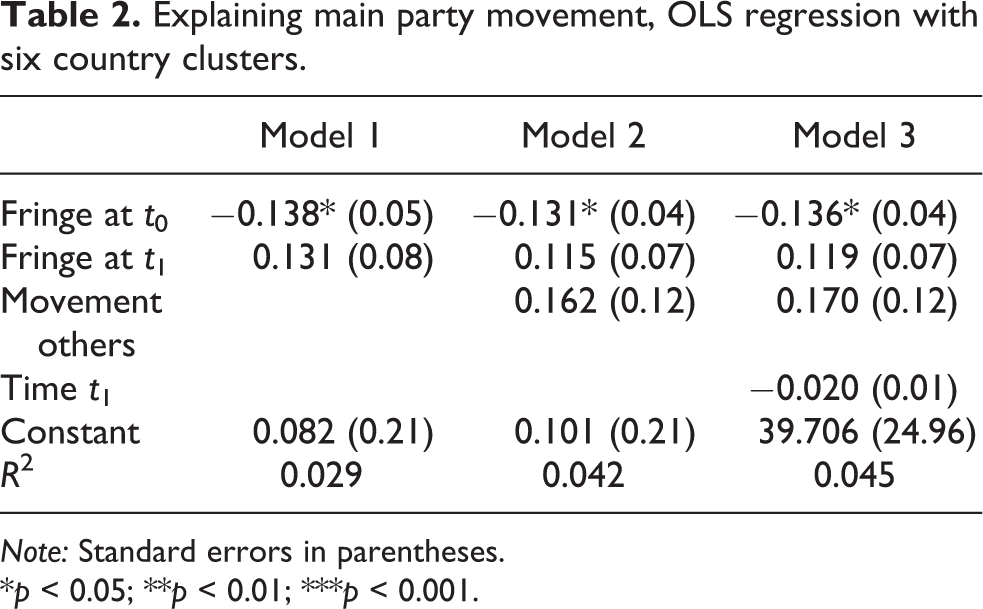
To further test these results, we ran a series of ordinary least square (OLS) models with countries as second-level variables. 6 Table 2 shows the results, with model 1 only testing the saliences in the radical right fringe party manifestos and model 2 also considering systematic changes in general issue importance by including the average movement of all other parties in the system, and model 3 including time. The results show that once we control for the other factors, the salience in radical right fringe party manifestos at the earlier election has a significant effect. However, this effect is very small, with only a 0.1 scale point movement (on a 200-point scale) for every 1 scale point in higher salience. Even more important is the fact that this relationship is negative. Thus, main parties tend to attribute lower salience to those categories that were prioritized by the radical right fringe parties in the previous election. This is in line with literature on WE such as by Rovny who finds that parties tend to de-emphasize policies and “blur” their positions where they are less involved in a given area compared to other parties that can claim issue ownership and face no dilemmas with regard to other policy dimensions (Rovny, 2012, 2013). Moreover, it is also consistent with studies suggesting that main parties sometimes engage in an “adversarial strategy,” intentionally seeking to distance themselves from fringe parties in response to their electoral success or parliamentary breakthrough (e.g. Meguid, 2005: 348).
Explaining main party movement, OLS regression with six country clusters.
Note: Standard errors in parentheses.
*p < 0.05; **p < 0.01; ***p < 0.001.
In a final step of the analysis, we tested for the possibility that the radical right fringe party salience might not only be related to the same category. For instance, a change in the salience of nationalism by the radical right fringe party might be related to a change in the main party not only in the nationalism category (observed above) but also in the anti-nationalism category. The MARPOR data allow for the investigation of such an effect on three sociocultural issues: nationalism, traditional morality, and multiculturalism. We investigated these relationships in the manner described above by analyzing graphs and correlations (see Online Appendix Table A3 and Figures A3–A6) and show that there is no relationship between the salience attributed by the radical right fringe parties and the salience of the opposite category attributed by the main parties (Table 2).
In sum, our analysis of main and radical right fringe parties in six CEE countries strongly indicates that the salience of sociocultural issues in fringe party manifestos does not systematically relate to the changes in main party manifestos regarding those issues. Given that we do not find any relationship between radical right fringe party salience and main party movement, it seems save to conclude that there is also no effect by the former onto the latter. The policy issues included in our analysis encompass both nationalist and anti-immigration issues, which rank highly on the priority list of the radical right fringe parties under investigation. While our results do not negate the fact that the main parties under investigation might often agree with the fringe parties, it seems rather clear that they do not systematically affect each other.
Conclusion
Radical right fringe parties seem to be playing an important role in the development of post-communist politics, as for example Jobbik in Hungary became the country’s second largest party, gaining nearly 20% of the vote in the recent elections, Self-Defence (SRP) and the League of Polish Families (LPR) held cabinet seats during the Polish government in 2006-7, and three different fringe parties have held cabinet seats in Slovakia. We would expect this development to influence the policies of the main political parties directly, as they might co-opt some of the positions of the radical right fringe parties to compete with them. At the same time, previous case analyses and quantitative studies focusing mainly on WE have revealed that the influence of these challenger parties may be overstated because main parties may, out of strategic considerations, even choose to distance themselves from the radical right fringe rather than form coalitions with radical outsiders. Studies under the rubric of “Parroting the Pariah” have shown that the adoption of radical positions may be short-sighted and rather hurt main parties in the long run since this strategy alienates key support groups. Others have pointed to common ideological roots of right-wing parties and the fact that main right parties, especially in CEE systems, partly already cover issue positions that would be perceived as radical in WE party systems, thereby squeezing out the demand for radical right actors.
The contribution of our analysis is to test whether there is an agenda stetting effect by radical right fringe parties on the policy position of main parties in six CEE countries. This analysis therefore extends the literature on the influence of radical right fringe parties on their major contending parties by analyzing their most salient dimension of contestation. It also adds to the scientific literature by expanding the number of empirical cases and increasing the period of study to nearly three decades. Our principal findings are that the party manifestos do not show a statistically significant correlation between issue salience of radical right fringe parties and the programmatic movements by main parties. This finding is robust over 11 sociocultural policy issues, over time, and different analytical angles. Bulgaria presents a slight exception, but even there, the influence is quite small. Since we do not find a relationship between radical right fringe party and main party programmatic offerings, for the post-communist cases, our study confirms the arguments of scholars such as Mudde (2013), Akkerman (2015), and Meyer and Rosenberger (2015), who claim that fringe parties have only limited influence over the policies of main parties. It also appears to confirm the view of those scholars arguing that the radicalization of the mainstream may have squeezed out fringe parties and neutralized their impact on main parties’ agendas (Buštíková and Kitschelt, 2009; Pirro, 2015a: 80; Pytlas, 2018b). This is, of course, not to deny that radical right fringe parties have had influence on post-communist politics, as some of them have even participated in government coalitions. However, it shows that on sociocultural issues, radical right fringe parties do not systematically pull main parties into their corner of the competition. Importantly, sociocultural issues have been at the core of contestation in CEE party systems well before recent crises around the EU and refugees have brought them into focus in WE. Thus, fringe party influence on main parties may be based not only on strategic calculations on the part of the main parties but also dependent on the long-term salience of these parties’ issues.
Supplemental material
Supplemental Material, sj-docx-1-ppq-10.1177_1354068819863620 - The effect of radical right fringe parties on main parties in Central and Eastern Europe: Empirical evidence from manifesto data
Supplemental Material, sj-docx-1-ppq-10.1177_1354068819863620 for The effect of radical right fringe parties on main parties in Central and Eastern Europe: Empirical evidence from manifesto data by Reinhard Heinisch, Steven Saxonberg, Annika Werner and Fabian Habersack in Party Politics
Footnotes
Acknowledgement
The authors wish to thank Sergiu Gherghina, Adam Fagan, and the two anonymous reviewers for their helpful feedback and comments.
Declaration of Conflicting Interests
The author(s) declared no potential conflicts of interest with respect to the research, authorship, and/or publication of this article.
Funding
The author(s) disclosed receipt of the following financial support for the research, authorship, and/or publication of this article: Steven Saxonberg’s participation was financed by the grant from the Slovak Grant Agency: APVV-17-0596 “Politics of Emotions as a Form of Political Inclusion and Exclusion.”

Supplemental material
Supplemental material for this article is available online.
Notes
References
Supplementary Material
Please find the following supplemental material available below.
For Open Access articles published under a Creative Commons License, all supplemental material carries the same license as the article it is associated with.
For non-Open Access articles published, all supplemental material carries a non-exclusive license, and permission requests for re-use of supplemental material or any part of supplemental material shall be sent directly to the copyright owner as specified in the copyright notice associated with the article.
