




Abstract
While the Polish party system has shown signs of consolidation and stabilization in recent years, it is still susceptible to the emergence of new parties that seek to exploit untended ideological niches. However, these fringe parties consistently fail to establish themselves as permanent inhabitants of these niches or to consolidate their initial electoral gains by transforming themselves into mainstream parties. In this article, we use data from the Polish National Election Study to analyse voting patterns over the period 2001–2015 in an attempt to explain fringe party failure. We conclude that fringe parties in Poland fail for two reasons: they are electorally ‘squeezed’ by mainstream parties that are capable of attracting the natural constituencies of fringe parties, while those natural constituencies also have a greater propensity to abstain from participating in elections.
Introduction
Western European politics is full of examples of fringe parties that succeeded in moving from the fringes to the mainstream, such as the Scottish National Party in the United Kingdom (Mitchell et al., 2011; Webb, 2005), or parties that have established themselves as a persistent element of the party system without crossing over to the mainstream, such as the Party for Freedom in the Netherlands (Vossen, 2017). While fewer fringe parties achieved conspicuous success in Central and Eastern Europe amid the perpetual churn of the first two decades of transition, there are nevertheless some significant examples of fringe party persistence, such as the remarkable durability of the Communist Party of Bohemia and Moravia (Stegmaier and Vlachová, 2009) and the dogged resilience of the radical-right Slovak National Party (Bustikova, 2018).
However, the story of Polish fringe parties thus far is a story of failure. Instead of expanding to establish themselves as parties of the mainstream, or carving out a persistent niche for themselves as marginal but meaningful elements of the party system, fringe parties have swiftly been marginalized and ultimately expelled from the party system. The aim of this article is to explain why this has happened.
Persistence, mainstreaming and marginalization: Three types of fringe party success and failure
If ‘mainstream’ parties are those that embody the main locus of competition in a given party system and command the support of a large and potentially diverse group of voters, fringe parties are those that are located outside the primary cleavage and that attract the support of a small proportion of the electorate. From this starting point, the fortunes of fringe parties may diverge along three distinct paths.
The first path is persistence. If fringe parties capture a small but loyal group of voters and monopolize a set of interests and policies, they may succeed in perpetuating themselves as minor elements of the party system.
The second path is mainstreaming. Fringe parties tend to start out with a narrow appeal, a restricted membership base, a shallow party organization and a particularly prominent role for the party leadership. Over time, each of these characteristics may change as the party matures: it may accumulate support from other sections of the electorate by broadening its ideological appeal and in the process develop a more complex and less leader-centric party organization. In doing this, it will tend towards the mainstream and eventually join it, either by adapting to fit or by redefining the mainstream in its own image.
The third path is marginalization. A lot of fringe parties will fail to persist because the niche they identify is tenuous, because they fail to exploit it satisfactorily or because mainstream parties move into that niche and remove the fringe party’s raison d’être.
Conceptualizing fringe party success and failure
In their analysis of electoral failure in several countries of Central and Eastern Europe, Bakke and Sitter (2013: 209) identify five key variables: the nature of the electoral system, the salience of cleavages, participation in government as a junior coalition partner, the management of internal dissent and the nature of party organization.
These factors can tell us much in a general sense about why parties succeed or fail. However, their application to the specific case of fringe parties is problematic. The broad constraints placed on party agency apply to both sides of the ‘fringe versus mainstream’ divide. While the nature of the electoral system certainly exerts an influence on the prospects of fringe parties, minor parties that are not fringe in character are also exposed to its influence. 1 Junior coalition status has an impact on the prospects of minor parties of non-fringe character as well as fringe parties. Internal party politics and the organizational structures of parties are also factors relevant to the success or failure of fringe and non-fringe parties alike.
The nature of the cleavage system is particularly problematic as an explanatory factor for the success or failure of fringe parties. Since by definition fringe parties stand outside the main structure of competition that governs the party system, their success or failure cannot adequately be explained by the nature of cleavages alone. Some of these parties persist in spite of inauspicious cleavage structures. Others adapt to these cleavage structures. Others may succeed in having an impact on how patterns of competition evolve. Still others, such as ethnic minority parties, may function in spite of the prevalence of a cleavage with which it has little in common, since it represents a persistent electoral niche.
Thus, since existing cleavage structures are central to the very categorization of fringe parties, they cannot be seen as explanatory factors that are external to those parties. It is therefore necessary to focus on factors that are more directly related to the specific experiences of those parties. In explaining the failure of fringe parties in Poland, we focus not on what constrains the agency of Polish fringe parties but on the nature of that agency itself: that is, on what the party is attempting to achieve.
The strategic and ideological goals of fringe parties may vary significantly, but the major categories into which they devolve give us a sense of their aims. Radical and extreme parties emerge at the fringes through the tendency of liberal democracies to exclude or isolate parties that oppose the values on which liberal democratic political systems are founded. These parties have two key aims: to advance the values that they regard as having been pushed to the fringes and to organize opposition to the mainstream establishment that has isolated them. Extreme parties may take this further, rejecting the legitimacy of democratic political systems themselves and advocating their overthrow. Regional and ethnic parties exist primarily to promote the particular interests of their core constituency. Similarly, religious parties serve the interests of a particular confessional group and attempt to forward a broader set of religious values and interests. Issue parties focus on particular areas of policy which mainstream parties are accused of neglecting (such as lowering taxation, opposing European integration or restricting immigration) or representing the interests of allegedly neglected constituencies. Finally, frivolous parties exist primarily to mock mainstream parties or the democratic system and to gain access to resources offered to political parties by the state.
The nature of the aims of fringe parties has an impact on how the successes and failures of these parties are conceptualized. To refer back to the three paths identified above, regional, ethnic and religious minority parties are more likely to regard persistence as success, since their overriding purpose is to stand up for the interests of a socio-demographic minority. The measure of success or failure for these parties is the extent to which they succeed in providing long-term representation for their core constituencies. Conversely, radical parties and issue parties that aim to galvanize support for neglected interests, values and areas of policy are more likely to measure success and failure in terms of the extent to which they are able to expand into the mainstream and reshape it in accordance with those interests and values.
Given its relative ethnic heterogeneity, Poland has not produced many ethnic minority parties. The most significant, the German Minority (Mniejszość Niemiecka) is exempt from the threshold for parliamentary representation, but even then only returns one or two deputies to parliament, and has no impact on the party system. With the exception of the first fully free election in 1991, Poland has also tended not to produce frivolous parties. Fringe-party politics in Poland is therefore predominantly, although not exclusively, about parties that challenge the mainstream rather than attempt to coexist within its niches.
Hypotheses
It might be tempting to ascribe the failure of Polish fringe parties simply to the high rates of turnover in the Polish party system. Indeed, one plausible explanation is that these parties failed not because of any particular characteristics they possessed as fringe parties, but simply because they were too minor to succeed. However, before we can conclude that these parties were simply victims of general party-system instability, we need to test hypotheses about their failure that relate specifically to their fringe-party characteristics.
Based on our conceptual discussion of fringe party success and failure and the observation that Polish parties have almost exclusively been radical and issue-led in character (see the next section for a more detailed discussion of this), we expect to find that the failure of these parties is rooted in several factors: their inability to mobilize and consolidate support among sections of the electorate not yet encapsulated by other parties, their inability to expand their support to mainstream voters, their inability to create new partisan attachments to rival those of the mainstream parties and their inability to rival mainstream parties for issue ownership.
First, we expect to find that the electorates of fringe parties remained characterized by more unstable voting behaviour than the electorates of mainstream parties (H1). To address this hypothesis, we must analyse the nature and stability of the electoral choices of fringe party voters, compared with the nature and stability of the choices made by other voters.
Second, we expect to find that those who voted for fringe parties were less likely than those who voted for mainstream parties to have a strong partisan attachment to their party of choice (H2). To address this hypothesis, we must use measures of partisanship that allow us to compare how much voters identify with and have an affective attachment to specific parties.
Third, we expect to find that fringe party voters were no more likely than those who vote for mainstream parties to be alienated from the political system (H3). As we explain in detail in the following section, the common aspect of the fringe parties present in Polish politics over the last two decades is their appeal to those who are disenchanted with mainstream parties and with the political system more generally. If fringe parties had been successful in Poland, we would expect to see their electorates characterized by relatively high proportions of (a) citizens belonging to marginalized social groups (such as the poorly educated, those in blue-collar jobs and inhabitants of rural areas); (b) those disenchanted with and alienated from Polish democracy in general; (c) those with extreme views. Given the lack of success experienced by these parties, we expect instead to find that their electorates are no more likely than those of mainstream parties to be socio-demographically marginalized (H3a), politically alienated (H3b) or ideologically extreme (H3c).
Finally, we look at the issue of representation. If fringe parties had succeeded, we would expect to find that they were increasingly ideologically proximate to their own voters and the broader electorate as they became more mainstream elements of the party system. We therefore hypothesize that fringe party electorates were – both from their inception and over time – less likely than the supporters of mainstream parties to be ideologically proximate to (a) their electorates, and (b) the electorate as a whole (H4).
Challengers to the mainstream: Fringe parties in Poland
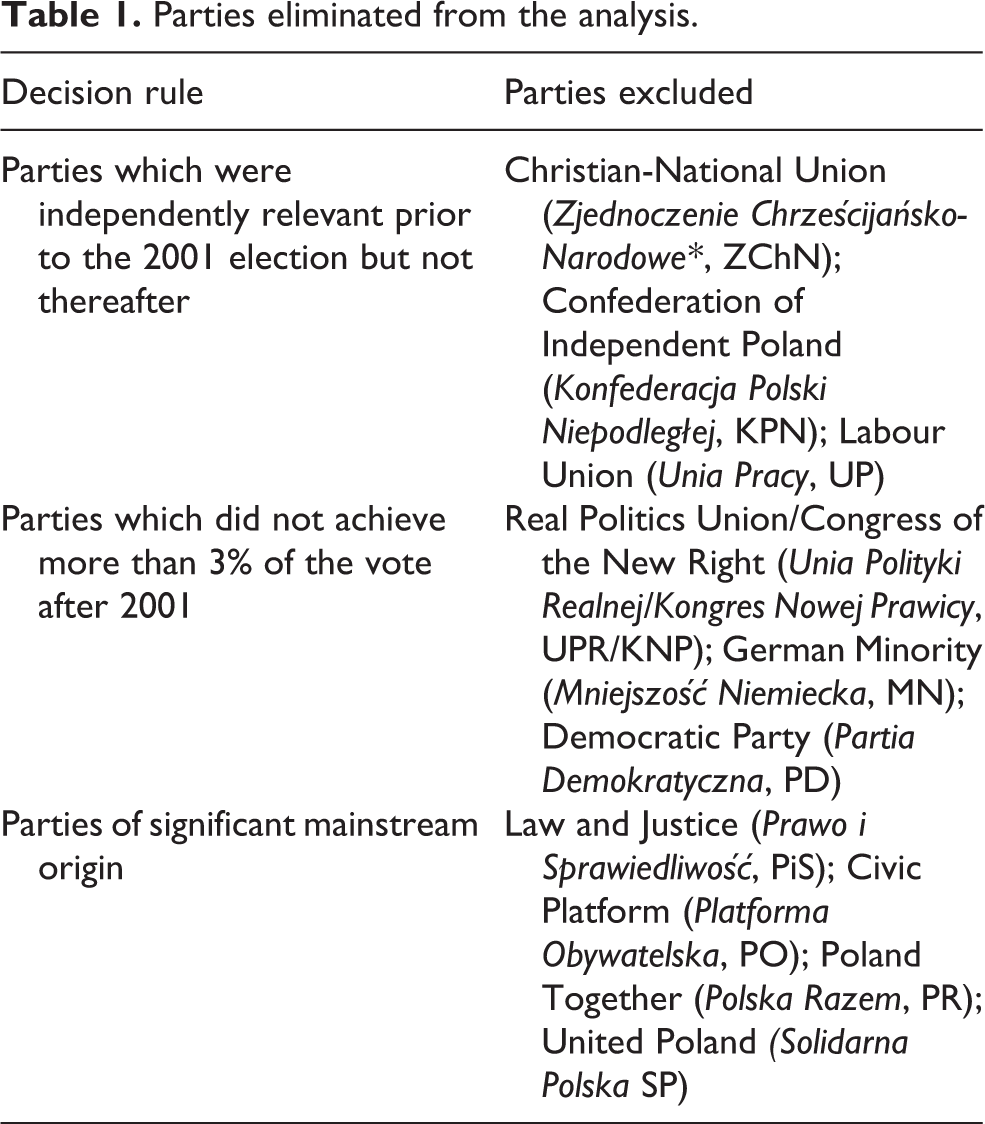
We employ the conceptual definition outlined by Gherghina and Fagan (2021) in the introduction to this symposium: fringe parties are ‘those that are either at the extremes of the predominant political cleavage or parties that specifically represent particular (minority) segments of society’. To narrow down the selection of parties, we apply three decision rules. First, we begin our analysis in 2001. In retrospect, the ‘earthquake’ (Szczerbiak, 2002) elections of that year were the point at which the ‘post-communist divide’ (Grabowska, 2004) that held sway during the first decade of transition to democracy began to break down and the current semi-consolidated party system began to emerge.
The second step is to eliminate all parties that have failed at any stage of their existence to achieve at least 3% of the vote. This is the qualifying threshold for the receipt of state subventions, and thus the level at which the state acknowledges that a party has achieved a level of viability and representativeness conducive to becoming an established element of the party system. 2
The third step is to eliminate parties that emerged as splinters of mainstream parties or as ‘new’ parties that were actually rebranded vehicles for mainstream politicians (Sikk, 2005: 399).
In Table 1, we list the parties eliminated from the analysis at each of these steps. This process of elimination leaves us with five parties. Three of these are the main object of our analysis: the League of Polish Families (Liga Polskich Rodzin, LPR), Self-Defence (Samoobrona Rzeczypospolitej Polskiej, SRP) and the Palikot Movement (Ruch Palikota, RP). 3 The other two cases – the Modern Party (Nowoczesna, N) and the Kukiz’15 social movement – entered parliament at the 2015 election. They cannot therefore be analysed as cases of failure, but including them in the analysis can help us shed light on the failures of fringe parties to date.
Parties eliminated from the analysis.
Former fringe parties: SRP, LPR and RP
The SRP party emerged from a social movement and trade union which coordinated the protests of farmers struggling to adapt to the shock therapy reforms in the early years of post-communist transition (Morgan, 1992: 154). Initially, it achieved little electoral success and was associated in the public mind primarily with radical protest actions (Stanley, 2015: 192–194). Over the course of the 1990s, it broadened its appeal to other excluded and economically vulnerable groups (Piskorski, 2010: 62–63) and turned towards more conventional avenues of political campaigning (Gładkiewicz, 2004b: 147–148).
SRP eventually succeeded in entering parliament at the 2001 election. The party’s lack of clear affiliations with either side of the post-communist divide gave it more latitude to express the three key aspects of its appeal: an uncompromisingly populist critique of the elites of Poland’s transition to democracy, hostility to international institutions and to the European Union (EU) in particular and an anti-liberal economic policy based on cheap credit and extensive social spending. SRP articulated the core tropes of populist ideology in textbook fashion, and the party’s populism was central to its diagnosis of the deficiencies of post-communist democracy; it argued that economic growth had been stymied by a conspiracy of domestic elites and foreign capital against the interests of the Polish people, with strict monetary policy, ‘rapacious and criminal privatisation’ and a failure to control imports rendering it impossible for the state to plan the economy ‘in accordance with the needs of society as a whole’ (Samoobrona Rzeczypospolitej Polskiej, 2003: 8). The party’s economic and social programme aimed to ‘halt the breakdown of the economy and the state’ by opposing the liquidation of state enterprises, the closure of mines and cuts to social welfare provision (Gładkiewicz, 2004b: 148; Piskorski, 2010: 62). SRP frequently made reference to patriotism and the national interest but did not espouse a coherent nationalist ideology.
The LPR was founded shortly before the 2001 election, bringing together several small Catholic–nationalist parties and organizations under the patronage of controversial Redemptorist priest and media proprietor Father Tadeusz Rydzyk (Gładkiewicz, 2004a: 57). Prominent figures in LPR were associated with the anti-communist opposition, but the party identified primarily with the interwar heritage of the nationalist endecja movement (Pankowski and Kornak, 2005: 159). This tradition, rooted in the fusion of Polish national identity and Catholicism (Lange and Guerra, 2009: 530) provided the party with an overarching purpose: the defence of the integrity of the nation state and traditional moral values. To pursue this, LPR advocated a foreign policy based on the egoistic pursuit of national interests and a principled Euroscepticism, and on the domestic level it sought to place Christian ethics at the heart of legislative activity, demanding intervention in the content of the public media and education to cultivate patriotic attitudes and ensure the sanctity of traditional mores. The party also outlined a model of economic organization based on principles of self-sufficiency at the commune level, with the national economy protected from foreign competition and capital (Liga Polskich Rodzin, 2006: 5–6). Although LPR did not articulate populist ideology as explicitly as Self-Defence, the party’s ideological message was filtered through the anti-establishment rhetoric of Father Rydzyk’s Radio Maryja movement, reaching the countercultural civil society movement of Catholic nationalists as a populist critique of the ‘imposed’ and ‘inauthentic’ nature of Poland’s transition to democracy.
As Markowski and Tucker (2010) have argued, the emergence of SRP and LPR owes a great deal to the salience of the EU membership issue. Both parties attempted to exploit an important policy dimension on which a significant section of the electorate was under-represented. In the case of the SRP and its voters, Euroscepticism was largely a matter of pragmatism: they were opposed to the expected terms of Poland’s accession to the EU and to the potential consequences of this for economic policy. The initial electoral base of the SRP had an over-representation of men, those living in the countryside and in villages, the young and middle aged, the poorly educated and those belonging to marginalized social groups who were allegedly the victims of the transformation. Cultural and religious issues did not play an important role for SRP’s supporters, but they were clearly anti-elitist and anti-institutional. LPR’s electorate was also Eurosceptic, but in a much more value-driven and fundamentalist way. They were opposed not only to the practical character of Polish accession to the EU but to the liberal–secular world that the Western Europe-dominated EU represented. LPR’s electorate was located mainly in provincial areas, mostly villages, characterized by low educational attainment and by relatively impoverished economic circumstances. They were also disproportionately female, old and fundamentalist in their religious beliefs (Markowski and Tucker, 2010, 527).
The RP was set up in 2011, after the departure of its leader, businessman and parliamentary deputy Janusz Palikot, from the governing Civic Platform. Despite Palikot’s origins, RP should not be seen as a splinter party; both ideologically and in personnel terms it differed significantly from the former party of its leader. There were three main aspects to RP’s programme. The most prominent was a strident anti-clericalism and sociocultural progressivism, some elements of which had been present in the political appeals of other parties but which had not hitherto been expressed so comprehensively or given such priority. In this respect, RP was truly on the fringes of the party system: not only did its sociocultural values conflict significantly with those of the conservative median voter, it also stood out for the salience these values assumed in its political appeal. A secondary element of the party’s appeal was its economic policy, which – initially at least – was strongly pro-market. One of the reasons for Palikot’s departure from Civic Platform was his disenchantment at the party’s movement away from economic liberalism towards the political centre, and it campaigned on a return to those policies, including a flat tax, removing tax and social security privileges, halving the budget and eliminating barriers to business activity. Finally, while RP’s political discourse lacked the strongly moral tone characteristic of populism, it shared SRP and LPR’s antipathy for the political establishment and the system of rules and norms that enabled it to maintain its hold on power (Stanley and Czesnik, 2016: 707). An analysis of RP’s supporters just after the 2011 election suggests above-average levels of support among those without religious beliefs, the young, those living in large – but not the largest – towns and cities, those with higher levels of education and those working in the service sector or self-employed (Pankowski, 2011: 115).
While these three parties differed in their programmatic emphases and the constituencies they targeted, they nevertheless shared a common factor: opposition to the mainstream establishment. They also shared a common fate. Having made a meteoric and unexpected entry into parliament, they failed to build on their initial gains, lost support and were sidelined by other parties that adopted elements of their agendas.
Current fringe parties: Modern and Kukiz’15
The Modern party was founded in mid-2015 in advance of the elections in October of that year. While some of those involved with the party from its outset had previously been members of liberal parties, a majority had no previous direct participation in party politics. Thus, while the party explicitly sought to appeal to voters who were dissatisfied with the drift of the formerly liberal Civic Platform towards the centre, it should not be regarded as a splinter formation.
While Modern’s ideological appeal has evolved somewhat since the election, placing greater emphasis than hitherto on issues of the open society and civic rights, there were two main strands to its appeal at the 2015 elections. First, it strongly advocated economic liberalism, emphasizing the need to shrink the size of the state, remove privileges enjoyed by certain occupational groups, introduce a flat tax, and lower the costs of employment. The second aspect of its appeal was an attack on the political mainstream, which it represented as a closed cartel of parties which subsisted on state financing and which offered voters little genuine choice.
In terms of its attitude to the mainstream, the Kukiz’15 movement employed many of the same arguments as the Modern party, although it generally couched them in blunter language. After his unexpectedly good performance as the outsider candidate in the May 2015 presidential elections, founder Paweł Kukiz organized a social movement to compete in the parliamentary elections, putting together party lists comprising candidates unattached to political parties and others who were members of small, extra-parliamentary parties primarily of the nationalist and libertarian right.
Kukiz came to political prominence by leveraging his fame as a rock musician to campaign for the introduction of single-member constituencies. He subsequently expanded this policy into a call for a complete overhaul of Poland’s political system, with the promulgation of a new constitution, the greater use of instruments of direct democracy and the ‘de-partifying’ of Polish democracy through the removal of state subventions for political parties.
A key emphasis of Kukiz’15’s appeal was and remains its anti-establishment appeal. Kukiz has consistently refused to consolidate the movement as a political party or to publish a political programme, regarding the formalization of political parties in this way as one of the major pathologies afflicting modern democratic systems. For this reason, the party does not formally define itself in ideological terms, but in practice it has tended to combine nationalism and social conservatism with libertarian economic ideas.
The Polish Peasant Party as a party of reference
The Polish Peasant Party (Polskie Stronnictwo Ludowe, PSL) serves as a ‘party of reference’ in our analysis. PSL has persisted as an element of the party system since 1989 despite lacking a large base of support. Only once, in 1993, did its share of the vote reach double figures (15.4%). Despite broadening its ideological appeal to compensate for the diminishing size of its agrarian class base, the party has failed to gain more support but has also managed to avoid dropping below the 5% electoral threshold.
In terms of the size of its support, PSL superficially resembles the fringe parties identified above. Yet its centrist appeal places it firmly in the political mainstream, and it has been regarded by larger parties as a natural coalition partner, serving in 11 of the 21 post-1989 cabinets as the junior partner of both the post-communist Sojusz Lewicy Demokratycznej (Democratic Left Alliance, SLD). and the post-Solidarity PO (Döring and Manow, 2018). Its well-developed internal democratic structures contrast with the leader-centricity and organizational thinness of fringe parties. As a small party that is marginal in terms of its independent political potential but far from peripheral in terms of its coalitionability and ideological congeniality, PSL is a useful point of comparison when evaluating the fates of the fringe parties identified above.
Data and methods
Since we do not possess the kind of panel data that would allow us to track the electoral preferences of individuals over this period, we use the Polish National Election Study (Centre for the Study of Democracy, 2015), a series of post-electoral surveys that cover six successive elections from 1997 to 2015. These data contain information on the current and previous electoral choices of voters, along with a wealth of ideological, attitudinal and socio-demographic variables.
We use several sets of variables to address our hypotheses: voting behaviour and attitudes, socio-demographic status, attitudes to the political system and ideological attitudes. Following the method proposed by Achen (1978), we calculate proximity scores on the left–right divide and on key political issues for the party’s electorate, and for all voters. Details of how these variables were operationalized can be found in Online Appendix, Table 2, and more information about how the variables were constructed is available from the authors on request.
Our analyses are based on four blocs, distinguishing between fringe parties, mainstream parties, our reference party PSL and non-voting. The relationships between current voting behaviour and previous behaviour are analysed using simple descriptive statistics, comparing proportions of consistent and inconsistent vote choices (const), and with a multinomial logistic regression model in which current bloc vote choice (votefor_t) is the dependent variable, and previous bloc vote choice (voteforp_t) is the independent variable. We also use simple descriptive statistics for the analysis of ‘triple coherence’ (tripco), in which we observe the proportions of bloc voters whose vote was cast for the party they most liked and felt closest to, and for the party affective differential (pafdif).
To analyse the impact of socio-demographics, attitudes to democracy and ideological attitudes on bloc voting, we estimate three multinomial logistic regression models, 4 with current bloc vote choice as the dependent variable. Independent variables are entered into the model in three tranches, comprising socio-demographic variables, attitudes to the political system and ideological variables. Due to significant rates of missingness on some of the variables, models were estimated using 10 multiply imputed data sets. All analyses were conducted using Stata 15.0.
All analyses are conducted using sample weights to correct for sampling error. These weights consist of the following parameters: gender (male and female), age (males: 18–24, 25–34, 35–49, 50–64 and 65 or more; females: 18–24, 25–34, 35–49, 50–59 and 60 or more), educational level (elementary, basic vocational, secondary and higher), place of residence (villages, cities 20,000 or less, cities 20,000–100,000 and cities of over 100,000 inhabitants) and economic activity.
Results
The first set of analyses concerns the question of whether fringe parties have a more volatile electorate than that of mainstream parties or our reference party the PSL. Figure 1 presents the results of regressing current vote choice on previous vote choice. The quantities of interest shown in this plot are contrasts with the grand mean, weighted by the proportion of respondents in each of the four categories of the dependent variable. This means that the figure shows the increase or decrease in probability, compared with the grand mean of all voters, that those who voted for a particular type of party at the previous election vote for a particular type of party at the current election. To put this in more practical terms, if a dot on the line is above 0 – that is, to the right of the line – it means there is a higher probability of a voter voting for that party bloc compared to the mean voter. So in 2001, those who voted for mainstream parties in 1997 (the grey dots) were more likely than the average voter to vote for mainstream parties, while those who voted for fringe parties (the black dots) in 1997 were no more likely than the average voter to vote for fringe parties in 2001.
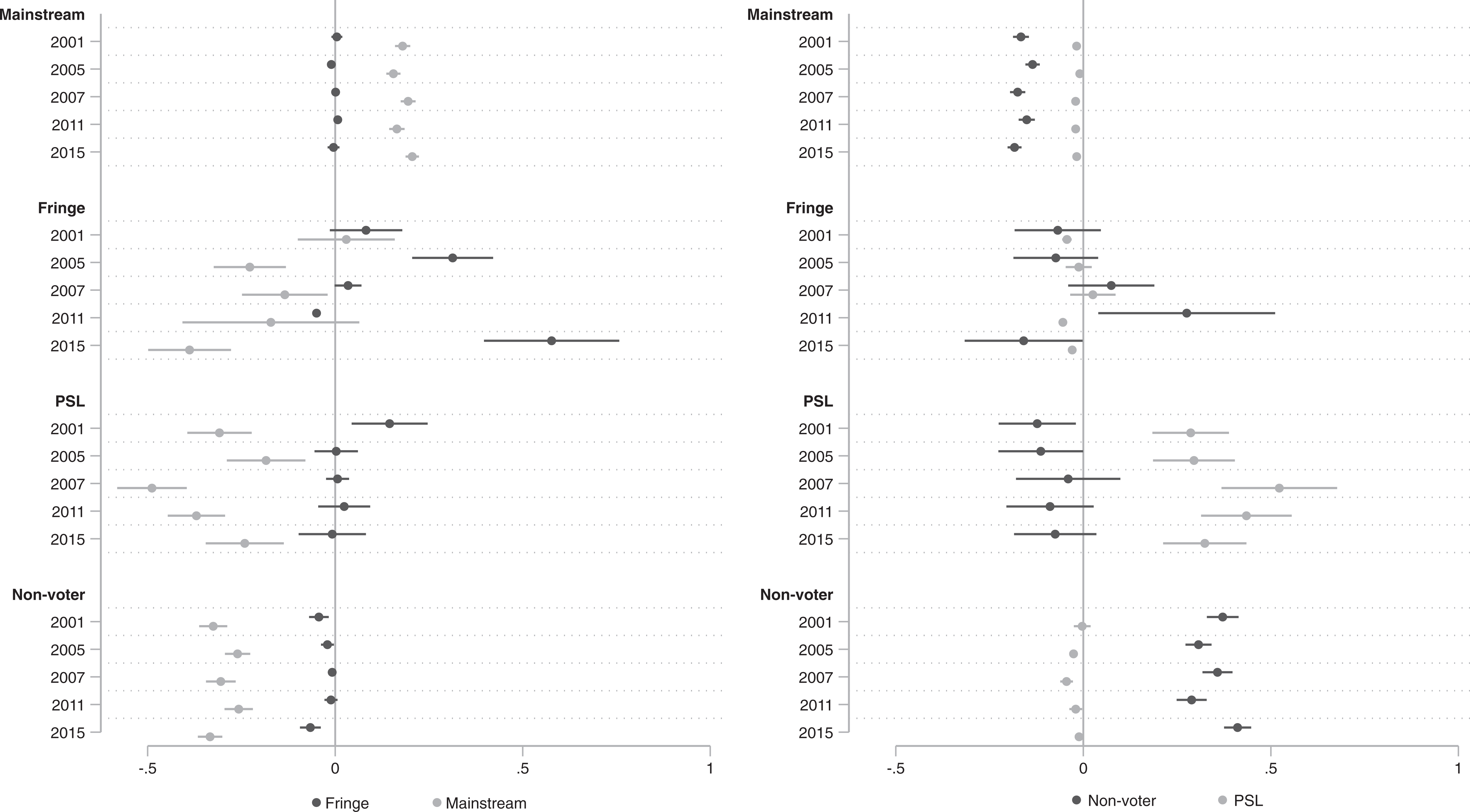
Changes in probability of voting for party blocs.
Several patterns can be identified on the basis of this analysis. First, those who voted for mainstream parties at the previous election were consistently more likely than the average voter to vote for mainstream parties at the current election, less likely (excepting 2001) to vote for fringe parties, less likely to vote for PSL and less likely to abstain from voting. Second, those who voted for fringe parties were consistently no more likely than the average voter to vote for mainstream parties, but their propensity to vote for fringe parties varied. In 2001, 2005 and 2015, those who voted for fringe parties at one election were more likely to vote for them at the next one, but in 2007 they were no more likely to, and in 2011 slightly less likely to. In 2001 and 2015, those who had previously voted for fringe parties were slightly more likely to abstain, but otherwise were no more likely to do this than the average voter. Third, PSL voters maintained a more disciplined relationship with their party. If someone voted for PSL in the previous election, they were more likely than the average voter to vote for PSL in the current election and were also less likely than the average voter to vote for mainstream parties or to abstain. They were no more likely than the average voter to vote for fringe parties. Finally, while those who did not vote in the previous election were consistently less likely to vote in the current election, and consistently less likely to vote for mainstream parties, the propensity of previous non-voters to vote for fringe parties varied. While in 2011, previous non-voters were more likely to vote for fringe parties, in 2015 they were less likely to vote for fringe parties.
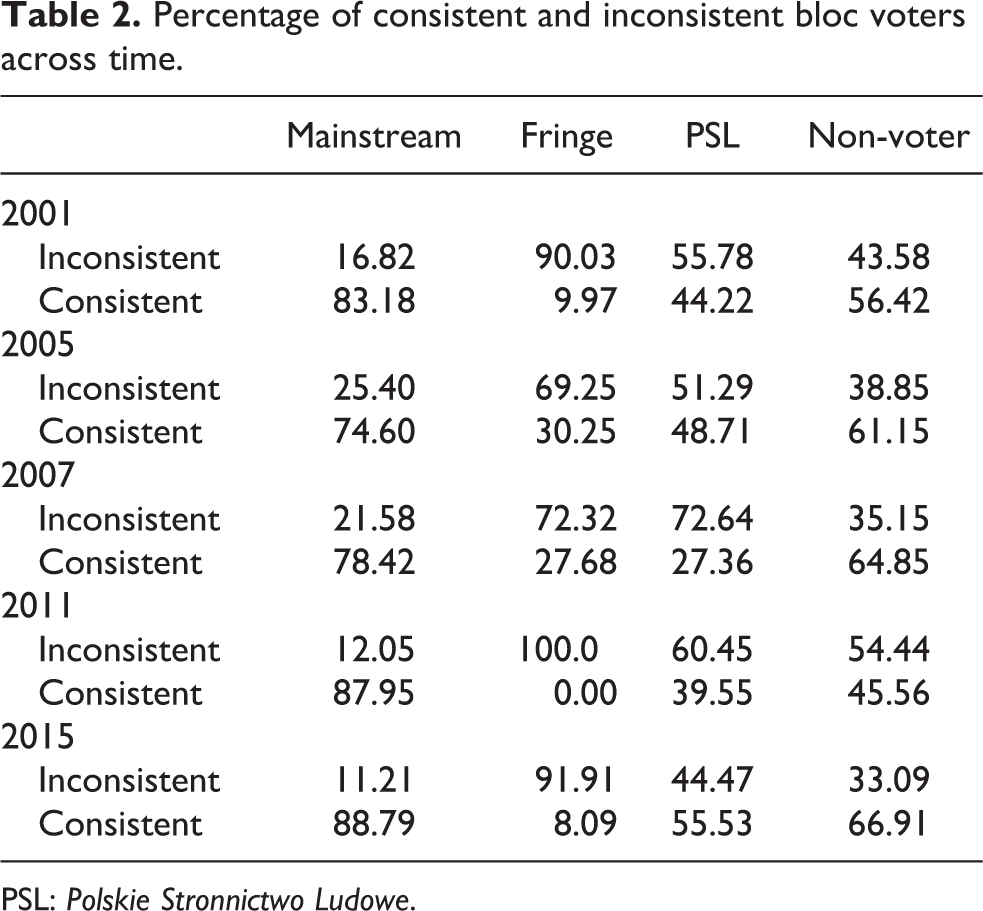
Table 2, which shows the percentage of consistent and inconsistent bloc voters across time, bears out these findings. A large majority of mainstream voters remain consistent in their bloc choice from election to election, as do a substantial majority of non-voters. However, support for fringe parties and PSL is much more volatile.
Percentage of consistent and inconsistent bloc voters across time.
PSL: Polskie Stronnictwo Ludowe.
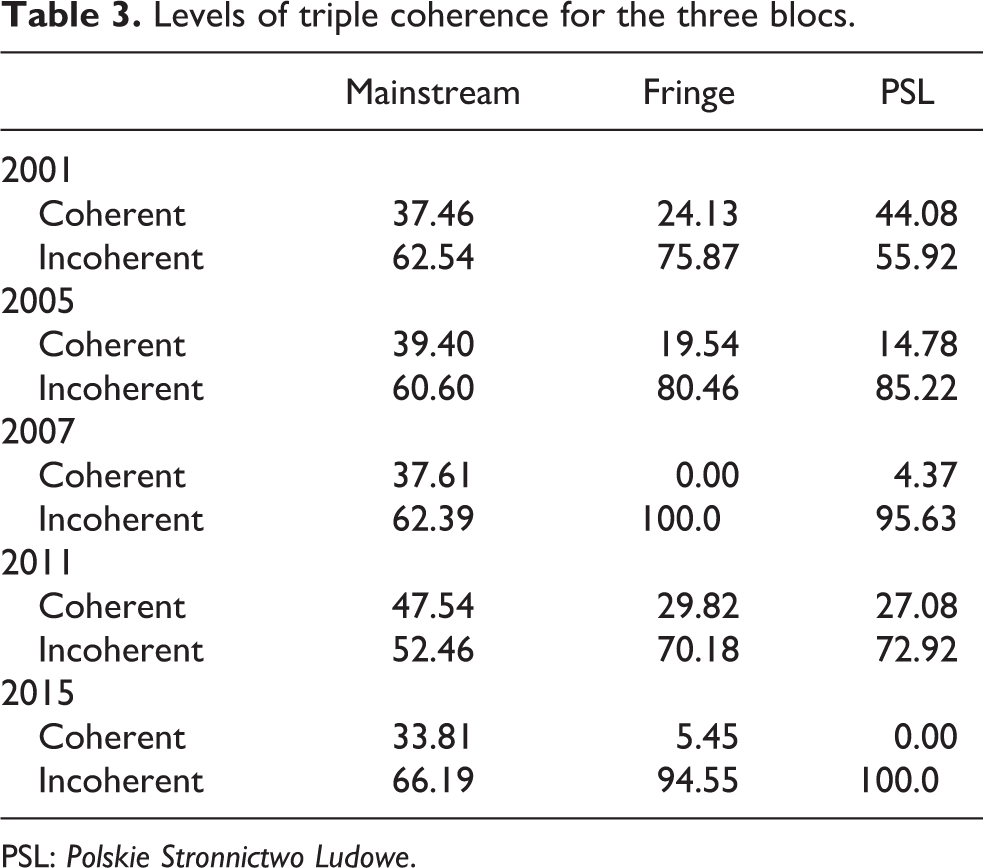
The next part of the analysis concerns the level of partisan attachment of fringe party voters to their party of choice, compared with that of mainstream party voters and PSL voters. Table 3 presents levels of triple coherence for these three blocs. A fairly clear picture emerges from these figures. First, incoherence is the modal configuration: most voters may like their party of choice more than the others, but they do not necessarily feel any particular identification with it. Second, triple coherence is slightly higher among mainstream parties and more stable over time. Third, triple coherence for fringe parties and PSL is prone to significantly greater fluctuations over time and is in most cases clearly lower than in the case of mainstream parties.
Levels of triple coherence for the three blocs.
PSL: Polskie Stronnictwo Ludowe.
We also test partisan attachment by comparing the party affective differentials for our blocs of voters, as illustrated in Figure 2. These results are largely inconclusive. While there is some evidence that the differential is indeed lower for fringe parties at the time of the 2001 and 2005 elections, at later points in time there is no clear and statistically significant difference between fringe party voters on the one hand, and mainstream and PSL voters on the other.
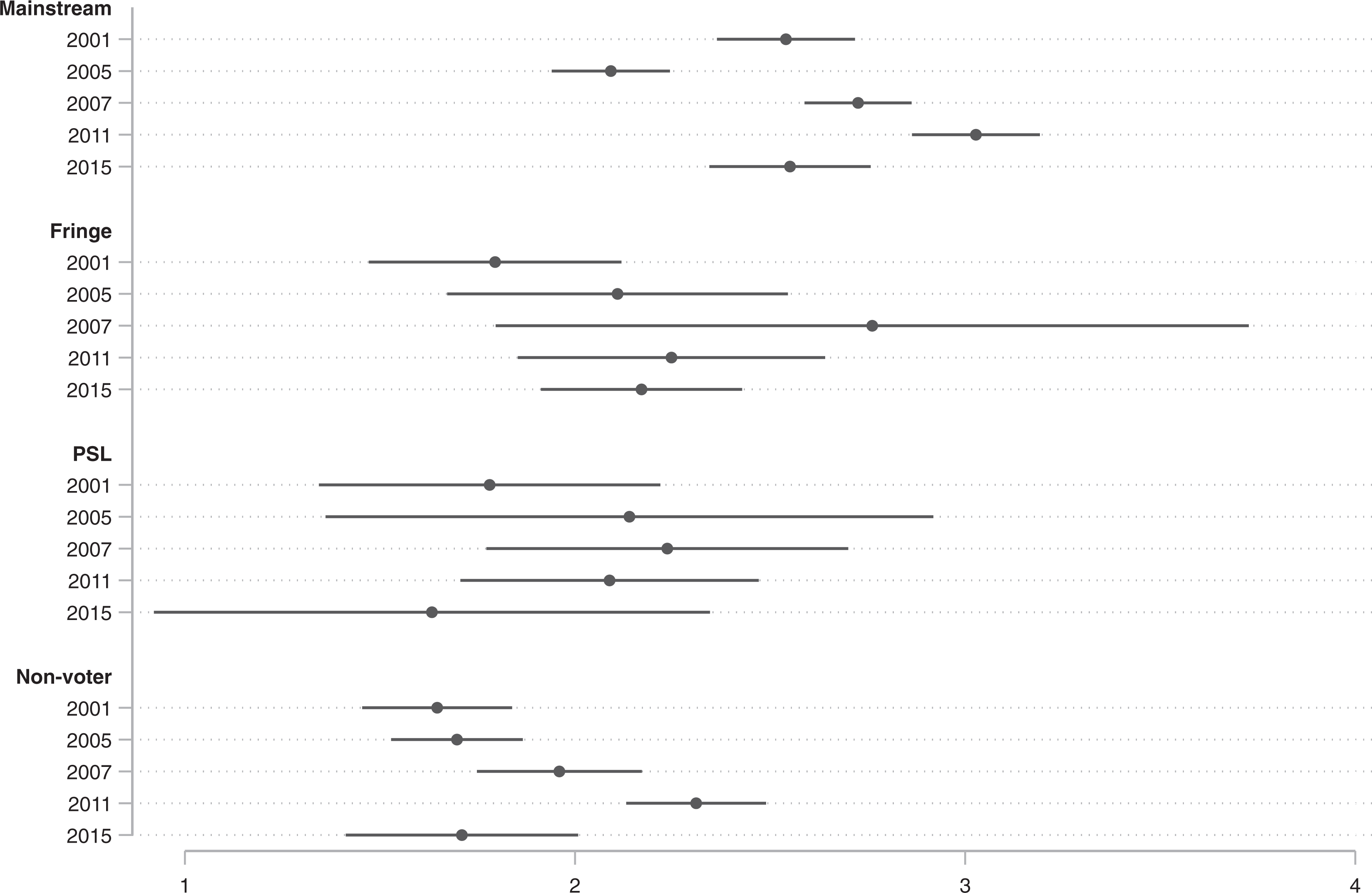
Average party affective differentials per party bloc.
Our next set of analyses focus on the impact of socio-demographic variables, attitudes to democracy and representation and ideological extremism on vote choice. Since the raw coefficients of multinomial regression models (see Online Appendix, Table 5) are difficult to interpret as they stand, it is more useful to calculate and plot key quantities of interest. These are shown in Figure 3. The quantities of interest in question are the predicted probabilities of voting for a mainstream party, a fringe party, or the PSL, or not voting, depending on whether a respondent is a ‘moderate insider’, a ‘radical outsider’ or an average respondent. 5
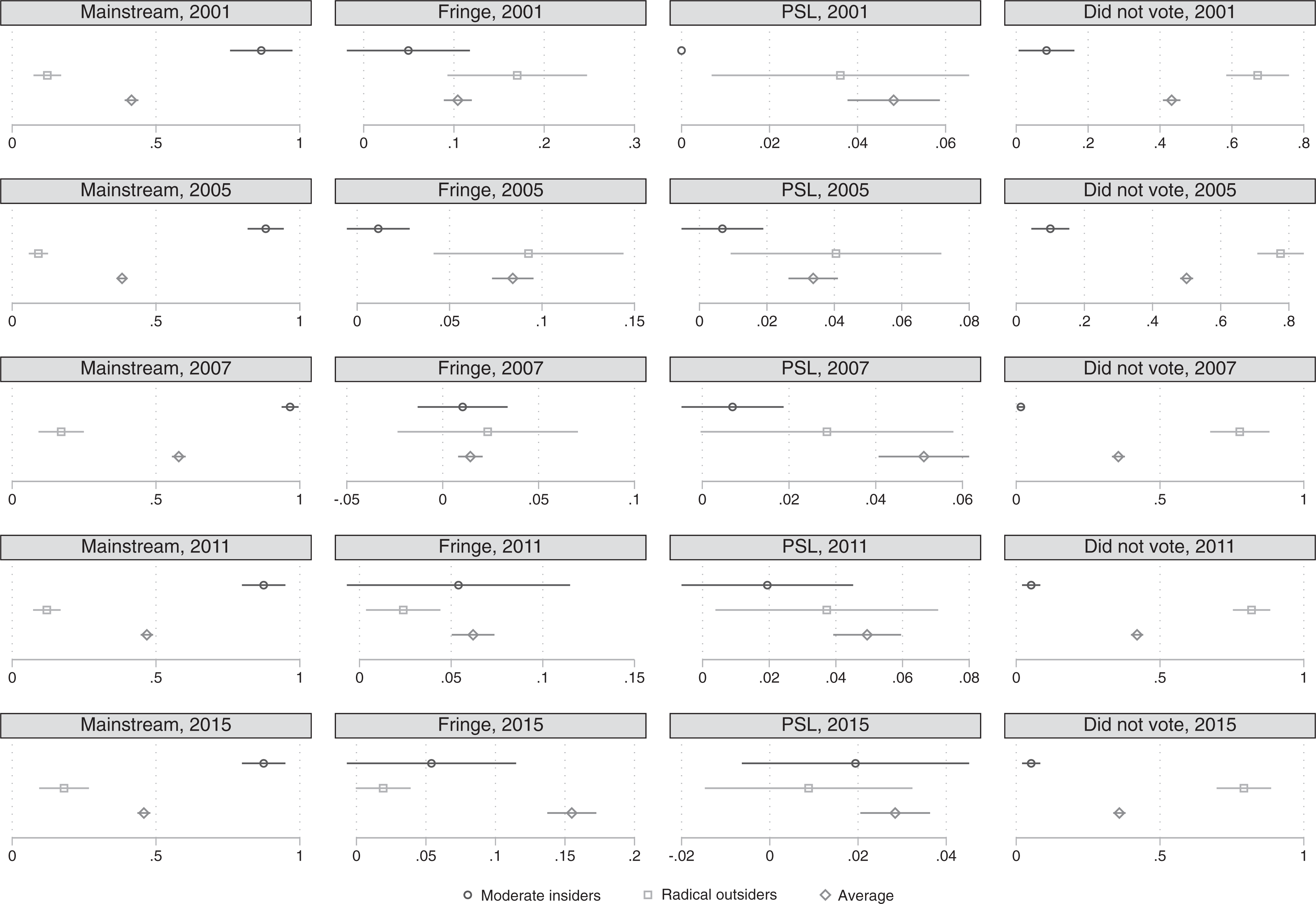
Insider-outsider status and predicted probability of voting for party bloc.
The plots in Figure 3 yield several findings of relevance for our hypotheses. 6 First, it is clear that there is a strong positive relationship between being a ‘moderate insider’ and voting for the mainstream parties (in all years, the probability that respondents in this group will vote for mainstream parties is greater than 0.80). On the other hand, ‘radical outsiders’ are significantly less likely than the average voter to vote for mainstream parties. Second, we find that ‘radical outsiders’ are more likely not to vote than they are to vote for fringe parties. Furthermore, they are no more likely than the average voter to vote for fringe parties.
Finally, we turn to the analysis of ideological proximities. Online Appendix Figures 4 to 8 show average proximities on the left–right divide and on key issues, per party, among both all voters and those who voted for the party is question. For example, we can clearly see in Online Appendix Figure 4 that the average voter (identified by a black square) is clearly more distant from LPR on the left–right divide than the average LPR voter (identified by a grey square).
Unsurprisingly, we can see in most cases that party electorates are significantly closer to their party of choice, compared with the electorate overall. However, we do not find that there are any significant and consistent differences between the electorates of fringe parties and the electorates of mainstream parties in this regard.
Discussion
Our findings confirm some of our hypotheses, in whole or in part, but give only limited support or no support to others. The analysis of electoral volatility partly confirms our first hypothesis: that the electorates of fringe parties remained characterized by more unstable voting behaviour than the electorates of mainstream parties. Those who voted for a mainstream party at one election were very likely to vote for a mainstream party at the next election, while PSL voters were likely to continue to vote for PSL, but the consistency of bloc voting for fringe parties was significantly more variable, suggesting substantial flows to mainstream parties or to the ranks of non-voters.
These findings recall the point made earlier about the partial consolidation of the party system among mainstream parties. It is clear from this analysis that there is much more stability to the mainstream when it is considered as an overall bloc of parties: while voters within that bloc remain volatile in terms of the transfer of their vote between parties of the mainstream, they are significantly less volatile when it comes to shifting between mainstream and fringe parties. On the other hand, fringe party voters are more variable in their behaviour. That a voter chooses a fringe party at one election is no strong indication that they will choose another fringe party at the following election.
However, there is little evidence to suggest that this difference is driven by any particular lack of attachment to parties. Our findings regarding partisan attachment offer only limited support for our second hypothesis: that fringe party voters are significantly less attached to their parties of choice than mainstream voters are. On the one hand, we find that fringe party voters are somewhat less likely than mainstream party voters to hold strongly partisan views about their party of choice. However, the lack of any clear evidence that PSL voters are any more attached to their party of choice than fringe party voters are suggests that the more salient distinction in this case lies between electorally dominant parties and electorally peripheral ones, rather than between mainstream and fringe parties. Overall, our analysis points to a general lack of enthusiasm for political parties, with fringe party voters slightly, but not consistently, less enthusiastic than others.
There is greater support for our third hypothesis: that fringe parties fail to capture those sections of the electorate who are disenchanted, excluded and ideologically radical. First, voters drawn from relatively marginalized socio-demographic groups, who are less interested in politics and more sceptical of the benefits of democracy and who have extreme ideological views are more likely instead simply not to vote. Second, voters with these characteristics who do vote are not significantly more likely to vote for mainstream parties. Together, these findings show that fringe parties fail to capture their ‘natural’ constituency of marginalized and under-represented voters. At the same time, the results for mainstream parties indicate that fringe parties struggle to compete with mainstream parties not only for the average voter but also for those we might reasonably expect to be more likely to vote for fringe parties.
Finally, our findings with respect to ideological proximities lend no support to the hypothesis that fringe parties fail because they remain more ideologically distant not only from the electorate as a whole but from those who vote for them. These analyses clearly show that fringe parties do no worse than mainstream parties at representing the ideological interests of their voters. However, we also find that in general, the average voter is no more distant from fringe parties than from mainstream parties. This points to another possible explanation for fringe party failure: that parties which purport to represent marginalized constituencies and neglected issue positions are nevertheless not regarded as different enough from mainstream parties for voters to see them as a worthwhile alternative.
Conclusions
We began this article with the goal of explaining why the story of fringe parties in Poland has, thus far, been a story of failure. The results of our analysis take us some of the way to understanding this but also point to other unresolved issues that require further investigation.
Together, our findings identify two key factors that help explain the failure of fringe parties to consolidate their initial breakthroughs. First, despite the fact that the majority of the Polish electorate has a generally low level of partisan attachment to all kinds of parties, fringe party electorates are nevertheless more volatile in their electoral behaviour than those who vote for mainstream parties. There appears to be a divide between a relatively stable ‘mainstream electorate’ whose volatility is mostly confined within the set of mainstream parties, and a more unstable ‘fringe electorate’ who are mobilized by parties contesting the system, but who more readily abandon those parties for the mainstream, or opt not to vote. Second, fringe parties struggle to capture those sections of the electorate who are theoretically most conducive to the anti-establishment and ideologically radical messages they convey.
Aside from the findings that relate directly to our hypotheses, our analysis points to other factors that may be of relevance to a more comprehensive explanation of fringe party failure. Two clear findings seem particularly relevant. First, while the electorates of mainstream parties are predominantly associated with socio-demographic ‘insiderdom’, lack of alienation and moderate ideological attitudes, these parties nevertheless also capture a significant proportion of the ‘radical outsider’ voters that fringe parties predominantly pitch their appeal at. Second, radical outsiders are more likely to express their outsider status by not voting than by voting for fringe parties. Fringe parties thus appear to find themselves in an electoral vice, in which they are squeezed from one side by a mainstream that is capable of attracting at least some of the core electorate of fringe parties, and from the other by persistently high levels of non-participation, which disproportionally reduces the base of voters on which fringe parties can draw.
In short, while Polish fringe parties have initially succeeded in gaining the support of excluded and radical voters, these parties are too radical to broaden their base of support by attracting more moderate voters, but at the same time not radical enough to prevent many of their initial base of voters deserting them at the next election. They face the perennial problem of radical parties: how to maintain the anti-establishment essence of their appeal after having become part of the establishment.
Supplemental material
Supplemental Material, sj-docx-1-ppq-10.1177_1354068819863616 - Marginalization, not mainstreaming: Explaining the failure of fringe parties in Poland
Supplemental Material, sj-docx-1-ppq-10.1177_1354068819863616 for Marginalization, not mainstreaming: Explaining the failure of fringe parties in Poland by Ben Stanley, Radosław Markowski and Mikołaj Cześnik in Party Politics
Supplemental material
Supplemental Material, sj-docx-2-ppq-10.1177_1354068819863616 - Marginalization, not mainstreaming: Explaining the failure of fringe parties in Poland
Supplemental Material, sj-docx-2-ppq-10.1177_1354068819863616 for Marginalization, not mainstreaming: Explaining the failure of fringe parties in Poland by Ben Stanley, Radosław Markowski and Mikołaj Cześnik in Party Politics
Supplemental material
Supplemental Material, sj-pdf-1-ppq-10.1177_1354068819863616 - Marginalization, not mainstreaming: Explaining the failure of fringe parties in Poland
Supplemental Material, sj-pdf-1-ppq-10.1177_1354068819863616 for Marginalization, not mainstreaming: Explaining the failure of fringe parties in Poland by Ben Stanley, Radosław Markowski and Mikołaj Cześnik in Party Politics
Supplemental material
Supplemental Material, sj-pdf-2-ppq-10.1177_1354068819863616 - Marginalization, not mainstreaming: Explaining the failure of fringe parties in Poland
Supplemental Material, sj-pdf-2-ppq-10.1177_1354068819863616 for Marginalization, not mainstreaming: Explaining the failure of fringe parties in Poland by Ben Stanley, Radosław Markowski and Mikołaj Cześnik in Party Politics
Supplemental material
Supplemental Material, sj-pdf-3-ppq-10.1177_1354068819863616 - Marginalization, not mainstreaming: Explaining the failure of fringe parties in Poland
Supplemental Material, sj-pdf-3-ppq-10.1177_1354068819863616 for Marginalization, not mainstreaming: Explaining the failure of fringe parties in Poland by Ben Stanley, Radosław Markowski and Mikołaj Cześnik in Party Politics
Supplemental material
Supplemental Material, sj-pdf-4-ppq-10.1177_1354068819863616 - Marginalization, not mainstreaming: Explaining the failure of fringe parties in Poland
Supplemental Material, sj-pdf-4-ppq-10.1177_1354068819863616 for Marginalization, not mainstreaming: Explaining the failure of fringe parties in Poland by Ben Stanley, Radosław Markowski and Mikołaj Cześnik in Party Politics
Supplemental material
Supplemental Material, sj-pdf-5-ppq-10.1177_1354068819863616 - Marginalization, not mainstreaming: Explaining the failure of fringe parties in Poland
Supplemental Material, sj-pdf-5-ppq-10.1177_1354068819863616 for Marginalization, not mainstreaming: Explaining the failure of fringe parties in Poland by Ben Stanley, Radosław Markowski and Mikołaj Cześnik in Party Politics
Footnotes
Declaration of Conflicting Interests
The author(s) declared no potential conflicts of interest with respect to the research, authorship, and/or publication of this article.
Funding
The author(s) received no financial support for the research, authorship, and/or publication of this article.

Supplemental material
Supplemental material for this article is available online.
Notes
References
Supplementary Material
Please find the following supplemental material available below.
For Open Access articles published under a Creative Commons License, all supplemental material carries the same license as the article it is associated with.
For non-Open Access articles published, all supplemental material carries a non-exclusive license, and permission requests for re-use of supplemental material or any part of supplemental material shall be sent directly to the copyright owner as specified in the copyright notice associated with the article.
