




Abstract
Why do some groups and parties maintain contact whereas others do not? Recent studies explain party–interest group contact on the basis of power and ideological proximity. This ‘standard’ model provides reasonably good explanations for the general patterns of party–interest group interactions but requires specification to account for the profound political changes caused by the rise of populist parties. Our argument is (a) that populist ideology leads interest groups to have relatively infrequent contact with populist parties and (b) that strategic incentives related to populist parties moderate the effects of power and proximity. We examine the contact patterns of over 1600 interest groups and political parties derived from elite survey data from five European countries. We find empirical support for our arguments and relate these to normative concerns about the selective involvement of parties and groups in policymaking.
Introduction
Interest groups and political parties are commonly studied separately. This practise is highly reasonable: political parties fight for votes and win or lose political office. Interest groups fight for members and pressure politics through informal channels. This behaviour makes political parties and interest groups fundamentally distinct political organizations that require different theories and merit separate subfields of study (but also note similarities: Halpin and Fraussen, 2019). At the same time, their distinct bases for organizational survival and varying political tactics also make them attractive partners. Their relationship is therefore commonly theorized in terms of the mutually beneficial exchange of politically important resources. Most notably, political parties demand the political support and expertise from interest groups and in exchange supply favourable political decision-making.
The study of the relationship between political parties and interest groups requires challenging embedding in two theoretical subfields and the empirical inclusion of both parties and groups. Despite these research challenges, an important yet relatively small wave of studies have recently examined the several aspects of the relationship between political parties and interest groups. To start, researchers have explored the structured, organizational relations between these actors, investigating how system- and actor-level factors affect the strength and durability of their ties (Allern et al., 2018; Marshall et al., 2018). A number of other studies have assessed the drivers of particular collaborative attempts to influence public policy. These studies have mainly resulted in what we now call a ‘standard model’ of party–interest group contact, which include power and ideological proximity as two main explanatory factors (e.g. Brunell, 2005; De Bruycker, 2016; Fraussen and Halpin, 2018; Heaney, 2010; Klüver, 2020; Marshall, 2015; Otjes and Rasmussen, 2017, Wessels, 2004; Wonka, 2017).
Our main contribution to the literature is that we assess the validity of the standard model on a deviant case and adjust it in important ways. That is, we examine whether interest groups interact equally with populist and non-populist parties and analyse whether populism moderates the effects of power and ideological proximity. Scholars of radical right-wing political parties identify ideological reasons to expect that populist parties and interest groups have relatively little policy-relevant interaction. More to the point, in the ‘thin’ ideology of populism ‘the people’ are viewed in a unitary fashion, undivided and unmediated by faction or groups, and ‘the elite’, of which interest groups are part, is considered corrupt (Mudde, 2007).
Additionally, the typical patterns of strategic interaction between populist and non-populist parties may moderate the relationships identified in the ‘standard model’. To start, studies indicate that radical right-wing populist parties affect the direction of public policy to a very limited extent only, even when in government (e.g. Akkerman, 2012). Populist parties seem to prioritize vote-seeking over policy-seeking activities and therefore public policymaking power may be a relatively weak driver for contact. Also, we expect similarities in issue priorities and positions to be less strong of a driver for contacts between populist parties and interest groups, because the ‘outsider’ profile of populist parties disincentives access-seeking interest groups to establish and maintain contact. We employ an elaborate assessment of political proximity in which we account for ideological positions on both cultural and socio-economic party–political dimensions, and the similarity in the issues parties and interest groups prioritize and emphasize. In particular, our conceptual and operational treatment of the positional component of the ‘standard model’ as both related to issue priorities and ideological distances in a multidimensional space is an important addition to existing work.
This has important theoretical and normative implications, specifically if populist parties grow or gain in numbers, as they have done over the past decade. Key concerns arise when non-populist core or mainstream parties may, despite their (long term) electoral decline, persist in maintaining their pivotal positions in government coalitions partly due to their structurally continuous relationship with interest groups and other civil society groups (Katz and Mair, 1995; Smith, 1989). Similarly, interest groups will not want to endanger such historically institutionalized relationships and therefore strategically refrain from interactions with mainstream-opposing populists. This implies that the interest group system is linked to only the mainstream parts of the party system. Interest group system bias may in this way reinforce a ‘bifurcation in European party systems between parties which claim to represent but don’t govern and those which govern but no longer represent’ (Mair, 2009, 17). Such a party system split is especially relevant in light of the fragmentation of party systems and a continuing, systematic finding of ‘bias’ in interest group politics (e.g. Schlozman et al., 2012).
We test our hypotheses in Belgium, the Netherlands, Lithuania, Slovenia and Sweden and rely on responses to the Comparative Interest Group (CIG) survey of interest group leaders (www.cigsurvey.eu). This survey is one of the most extensive comparative surveys among interest groups in various countries. More specifically, our analysis of contacts between more than 1600 interest groups and 45 political parties (>13,400 dyads) reveals that interaction between them is indeed strongly influenced by populism: interest groups have much less contact with populists. We control for important alternative explanations and model several interaction effects. We find that interest groups have fewer contacts with populist parties even in cases where they are relatively large or attend to relatively similar issues as groups, and that (cultural) ideological extremism adds to the pariah effect of populism.
We continue with specifying our argument and our expectations. We initially discuss why populism should affect party–group interaction. We follow this discussion with a section on intermediating factors, for which we include three conditional effects as hypotheses. We subsequently present our research design and analysis and conclude with several suggestions for further research.
Theorizing populist party–interest group relationships
Over the past decades, the study of interest groups and political parties has functioned in relative isolation from each other. Nevertheless, a recent wave of studies has resulted in what we call a ‘standard model’ in which party–interest group interaction is explained on the basis of the power of parties and the positional proximity between parties and groups (e.g. De Bruycker, 2016; Klüver, 2020; Marshall, 2015; Otjes and Rasmussen, 2017). First, interest groups are attracted to the power of parties. Interest groups have an incentive to invest in contacts with relatively powerful parties in order to gain access and influence in the policy process. Relatively powerful parties are also more likely to need particular types of policy-related information offered by interest groups. Powerful parties, either in vote share or as being part of a government, thus interact more frequently with interest groups. Second, interest group and party interactions are influenced by their positional proximity. The political activities of both groups and parties, in mobilizing constituents or voters, in presenting arguments in the media, and in designing directions of public policy, lead organizations that focus on similar issues and those with similar political concerns to meet each other more frequently. Existing studies therefore note that groups that share political positions with particular parties are more likely to interact with each other.
The standard model has proven highly useful in explaining the general patterns of party–interest group interactions. We further specify the model for the relationship between populist parties and interest groups. Our core argument is that interest groups have less frequent contact with populist parties compared to other (non-populist) political parties because of the nature of the ‘populist ideology’.
Populism is fundamentally distinct from other ideologies. Its view on state–society relations and representative government is effectively the only part of its ideology. Populism is therefore labelled a ‘thin’ ideology that is usually attached to other ideologies such as nativism, socialism, conservatism and so on (Mudde, 2007). The ‘thin’ ideology of populism is commonly defined as ‘an ideology that considers society to be ultimately separated into two homogeneous and antagonistic groups, “the pure people” versus “the corrupt elite”’ (Mudde, 2007). Furthermore, populist ideology implies that politics should be a (direct) expression of the volonté générale (general will) of the people (for a discussion of the specific ideological content of populism or the conceptual relation to non-ideological definitions of populism, see Rooduijn, 2014).
The ideological content of populism matters for the relationship of populist parties and interest groups (and with other politically relevant policy participants). The populist focus on (1) the unity of the people and (2) its rejection of political intermediation should directly result in an uninviting stance of populist parties in relation to interest groups. Regarding the first, populism emphasizes the unity of the people, largely undivided by distinct interests and political causes. In stark contrast, interest organizations are the typical and common organizational form for particular interests or specific causes (particular political positions may, of course, be shared by majority public opinion, e.g. Flöthe and Rasmussen, 2018). In this sense, the inherently fractional nature of interest representation through interest groups should directly induce populist parties to engage in fewer contacts with interest groups. Regarding the second, populist parties would prefer politics to express the voice of the majority of people without any intermediation. Populist ideology therefore favours referenda, minimal party organizations and leaders in direct connection with followers. This ideology does not leave ample room for organizational networks with interest groups, which may delay or interfere with the direct expression of the view of the people. This rationale prompts us to formulate our first hypothesis:
Populism as moderating factor
We also expect that the strategic interaction between populist parties and other parties moderate relationships that are commonly included in the ‘standard’ model. In this section, we develop theoretical arguments that qualify the ‘standard’ ideology-power model for the relationship between populist parties and interest groups. As regards the ideological component of the standard model, we discuss similarities in issue prioritization and the socio-economic and cultural political positions of parties. The power-term of the standard model is discussed in terms of the size of a party.
We take a broad view on the ideological component of the ‘standard model’ by including both the similarity in issue priorities and the proximity of positions in the party–political space. Previous studies have conceived of priorities and positions in slightly different ways; sometimes combining them in a single issue-specific measure of positions (e.g. De Bruycker, 2016) or sometimes focusing on positions party–political ideological dimensions (Otjes and Rasmussen, 2017).
We define shared issue prioritization as the level of similarity in the policy topics on the agenda of different political organizations. Every political organization decides on which issues it wants to be vocal. Various studies have indicated how the distinct priorities of individual political parties work out in public policy debates (e.g. Jerit, 2008), in emphasizing issues in their day-to-day mediated interaction with voters (e.g. Klüver and Sagarzazu, 2016; Sigelman and Buell, 2004), in longer term strategic place in the party–political space (e.g. Green-Pedersen, 2007; Meguid, 2008) and in claiming ‘ownership’ of issues (Hobolt and De Vries, 2015; Lefevere et al., 2015). Similarly, interest groups make important decisions regarding the policy issues they work on. Halpin (2015) notes that the engagement of interest groups with public policy must be conceptualized as being hierarchical, similar to Maslow’s pyramid of needs. Specifically, groups monitor a relatively broad range of issues, sometimes spanning multiple policy domains. They more actively engage on a somewhat narrower range of issues, and they do attempt to directly influence policymakers only on a handful of issues. Various internal and external factors drive the issue prioritization process of interest groups (Halpin et al., 2017; Halpin and Fraussen, 2019). In any case, similar to political parties, interest groups have a discernible policy agenda on which certain policy domains (and issues within them) are prioritized over others.
The extent to which an overlap occurs between the issue priorities of individual parties and interest groups must have implications for the likelihood of their political contacts. Specifically, actors will likely meet each other in ‘issue or policy networks’ (Heclo, 1978) or ‘systems of limited participation’ (Cobb and Elder, 1983). Actors with similar agenda priorities must take each other into account in relation to potential political decisions. They are therefore more likely to be in contact with one another, regardless whether they are also close in the political positions taken.
The inclusion of issue overlap as an explanatory variable especially matters for our interest in populism. That is, populism should be particularly attractive to the challengers of the issue priorities of existing political parties. The issue agenda of populist parties is therefore likely to be different from that of other parties, and to some extent, from the agendas of most interest groups. For instance, the rise of anti-immigration populist political parties in the Netherlands in the past decades has been attributed to the relatively low saliency given to immigration by the mainstream parties (e.g. van Heerden et al., 2014).
However, we do not believe that (a lack of) shared issue priorities with interest groups have strong empirical implications for populist parties. Populist ideology also induces populist parties to have very limited effective motivation to actually change policy (Akkerman, 2012; van Spanje, 2010). That is, even when a populist party has similar issue priorities as a given interest group, populist parties compared to other parties are less likely to enter into policy-relevant exchange relationship because they are not fundamentally interested in affecting policy outcomes nor meaningfully participate in policy-related ‘issue-networks’. Rather, their attention to particular issues is largely voter-oriented and aimed at representing the (perceived) issues-priorities of their core constituents. This distinct difference in policy-seeking motivations between populist and other political parties leads to the following hypothesis on the moderation of the issue-overlap effect:
The second interaction relates to the positional proximity of parties and groups on the most important dimensions of party–political conflict. Parties and groups that share positions are commonly found to interact more frequently and intensely (De Bruycker, 2016; Otjes and Rasmussen, 2017; Wessels, 2004; Wonka, 2017). This factor affects populist parties because of the typical ‘radical’ nature of the host ideology and the ‘outsider’ profile of populists. First, the populist ideology is more commonly attached to the ideologies of challenging, flank or radical parties on the left and the right (e.g. Rooduijn and Akkerman, 2017) and recent research shows that host ideologies are important drivers of populists’ behaviour (March, 2017; Rooduijn, 2018). This part of the political spectrum is generally avoided by the majority of interest groups. The need to survive as organizations prompts interest groups to appreciate political moderation to prevent internal conflict and to broadly attract members (e.g. Lowery and Gray, 2004, 10–11; Salisbury, 1969). By implication, the positional distance between interest groups and populist parties is likely to be relatively large. Empirically, we recognize that party systems in most European democracies are structured along an economic and a cultural dimension, with variation in how well they reduce to one overarching line of conflict (Bakker et al., 2015). In this regard, positional distances on both dimensions may be significant for explaining group interaction with populists: An alliance with flank parties potentially internally divides interest groups, especially those groups that do not mobilize on issues that are commonly included in the dominant dimension of conflict in the party system.
Furthermore, again from the perspective of interest groups, the ‘outsider’ profile of populists is potentially damaging for interest groups that associate with them, reducing even further the likelihood of interaction with politically relatively distant actors. Specifically, interest groups, as an organizational form, have relatively limited organizational legitimacy in the eyes of outsiders (Hannan and Carroll, 1992), and their access to insiders tends to be relatively vulnerable (Maloney et al., 1994). This organizational vulnerability substantially increases the potential costs of collaborating with populists, especially adding to the challenge of overcoming positional differences. This leads us to hypothesize:
Finally, previous studies reveal that interest groups are attracted to power and particularly aim to interact with parties or legislators that have the capabilities to influence the direction of public policy (Brunell, 2005; De Bruycker, 2016; Marshall, 2015; Otjes and Rasmussen, 2017). The ideological substance of populist political thinking and the strategic incentives of parties and groups must interfere with this effect. First, from the perspective of political parties, the ideological identification of powerful elites as ‘enemies’ increases the difficulty for populist parties in assuming meaningful legislative responsibility, particularly in contexts where existing elites, sometimes as a cordon sanitaire, explicitly exclude populists from legislative work (Akkerman and Rooduijn, 2015). Second, every political party has to reconcile the tension between its representative role with positions of responsibility (e.g. Mair, 2009). The effective management of this tension is particularly challenging for populist parties who tend to face relatively high electoral costs of taking responsibility for shaping public policy (van Spanje, 2011). Populist parties may therefore seize fewer opportunities to substantively shape legislation and lack interest in strengthening the party functions associated with public policymaking, such as elite recruitment, and building relationships with interest groups with the aim to jointly establish policy programmes that are favourable to overlapping constituencies. Last, interest groups also have strategic incentives to seek fewer contact with populists parties. That is, interest groups may not want to alienate existing, mainstream friends by building bridges with the populist electoral competitors of mainstream parties. Our fourth hypothesis is therefore stated as follows:
Finally, we control for several alternative explanations for the contacts between political parties and interest groups. To start, more resourceful actors interact more. We expect interest groups with large numbers of staff and a broad policy portfolio, and political parties with government responsibilities and with longer running political experience (party age), to systematically have higher levels of interaction. Furthermore, the socio-political base and goals of interest groups must also matter, and we therefore differentiate several types of groups (professional associations, citizen groups and so on). The systematic relationship of the party system and the interest group systems, as entireties, is also likely to vary between countries (e.g. Balme and Chabanet, 2008; Lowery et al., 2008; Otjes and Rasmussen, 2017; Rasmussen and Lindeboom, 2012). However, we do not have strong theoretical arguments about country differences given the undeveloped or case-specific nature of comparative interest group studies. For instance, Thomas (2001, 280) notes that entire political systems cannot be categorized, and Lowery et al. (2008) consider broad system-comparisons ‘a bridge too far’.
Data and research design
We test our hypotheses on the basis of the Comparative Interest Group (CIG) survey data (Beyers et al., 2016; www.cigsurvey.eu). In this project, research teams in different European countries mapped and surveyed their respective national interest group populations. The translated versions of the same questionnaire address the organizational characteristics and political activities and strategies of interest groups. Interest groups are membership associations of firms, citizens or (semi-)public bodies which engage in activities to influence policy outcomes (but are not political parties). We rely on data collected in Belgium, the Netherlands, Lithuania, Slovenia and Sweden, in 2017 and 2018. This data set contains information on 1603 interest groups and their interaction with the most relevant national parties. 1 The selection of both Eastern and Western European countries and of countries that differ on a range of other factors (e.g. level of corporatism, party system properties, size of the interest group population) makes our findings reasonably generalizable within the European context. Overall, the response rate of the online survey with phone reminders has been 38%, which is relatively high compared to other online surveys (Marchetti, 2015). Moreover, the response rate is quite evenly distributed across countries. More precisely, response rates were as follows, from lowest to highest: Slovenia (36%), Netherlands (38%), Lithuania (40%), Belgium (41%), and Sweden (42%).
With regard to our dependent variable, interest group representatives were asked to indicate the frequency of contact their organization had had with the most relevant national political parties over the previous 12 months. Respondents were presented with a list of parties and could indicate the frequency of their contacts on a five-point scale (‘never’ to ‘at least once a week’). The respondents were not asked to differentiate between the parliamentary party and the party organization, nor does the question specify the nature of the contact (e.g. individual scheduled meeting, ad-hoc contact at a reception, routine lobbying contact, etc.) or relate the contact to particular policy issues or fields (e.g. De Bruycker, 2016; Statsch, 2018). The question phrasing is intended to cover all these types of contacts and we assume that respondents understood the question in that manner (or are not able to meaningfully and empirically differentiate between various types of contact). Our broad and cross-issue operationalization therefore differs slightly from other research in the field and is conceptually distinct from structural organizational relationships between interest groups and parties (the object of study of some of the works cited in the theoretical section).
We recoded the ordinal variable on the frequency of contact into a dummy variable indicating whether a group and a party had none or any contact. We reshaped our interest group-level data and created a data set in which interest group–party dyads form the unit of analysis (n = 13,455 group–party contact dyads). The Contact indicator is our binary dependent variable, and we estimate logistic regression models with random effects at the group level to account for the nested structure of our data. In the Online Appendix, we demonstrate that our findings hold when we rely on an ordinal measure instead.
As implied in our theoretical section, our independent variables are measured at the group- and party-level, as well as at the level of the group–party dyad. To begin with our central explanatory factor, the variable Populist Party indicates whether a party is considered populist or not, based on the classification of van Kessel (2015). 2 Shared issue priorities (H2) denotes the relative overlap of interests in the policy areas of a given interest group and a political party. This variable is measured by a combination of information on the policy interests of interest groups obtained through the CIG survey with a measure of the policy interests of political parties as expressed in their party programmes and based on MARPOR data (Volkens et al., 2017). In the CIG survey, interest groups were asked to indicate any of 20 policy areas where they are active, such as migration, energy, education and farming policy, which we take to signify their policy issue priorities. In the second step, we connect the party manifesto-based MARPOR scores of parties’ attention to the CIG policy areas (see the full list of policy fields and conversion table in Online Appendix). We subsequently determined the rank order of CIG policy fields per party and relate these to the policy priorities of our respondents. Specifically, if an interest group is indicated to be active in three policy fields – say farming, transport and employment – we explore the top three policy fields of a party and verify whether farming, transport or employment are anywhere among these top three. Finally, the proportion of shared interests in policy fields is our measure of shared issue priorities, which accordingly ranges from 0 (no shared interests) to 1 (all interests are shared).
With regard to our positional proximity hypothesis (H3), Left–Right Distance and GAL–TAN Distance measure the absolute distance between party and group positions (0–10), with higher values implying a larger distance. Interest group positions on these dimensions are based on two survey questions asking the respondents to position their organization on the economic and the cultural dimension, respectively (on scales ranging from 0 to 10). To measure parties’ ideological positions and distances to interest group positions, we rely on MARPOR data for parties’ left–right ideological positions (rescaled to range from 0 to 10) and information from the Chapel Hill Expert Survey (Polk et al., 2017) for parties’ position along the GAL–TAN dimension. Seat Share measures parties’ legislative power (H4). It indicates the seat share (in percentage points) that a given party held after the most recent election before the CIG survey was set out and is based on ParlGov data (Döring and Manow, 2018).
Finally, we control for the breadth of a group’s policy engagement (number of policy fields active in), group type (based on the INTERARENA coding scheme, www.interarena.dk) and resources (logged number of staff members) at the group side, and current government participation, age (logged) and ideological extremism at the party side. Left–Right Extremity and GAL–TAN Extremity are squared transformations of the origin-centred left–right and GAL–TAN party positions that theoretically range from 0 (ideologically moderate) to 25 (ideologically most extreme). We include country dummies (fixed effects) to account for the different baseline probabilities of contact in our five countries of observation. Table 1 provides the summary statistics of all variables used and in the Online Appendix we note the exact wordings of the CIG survey questions used.
Summary statistics.
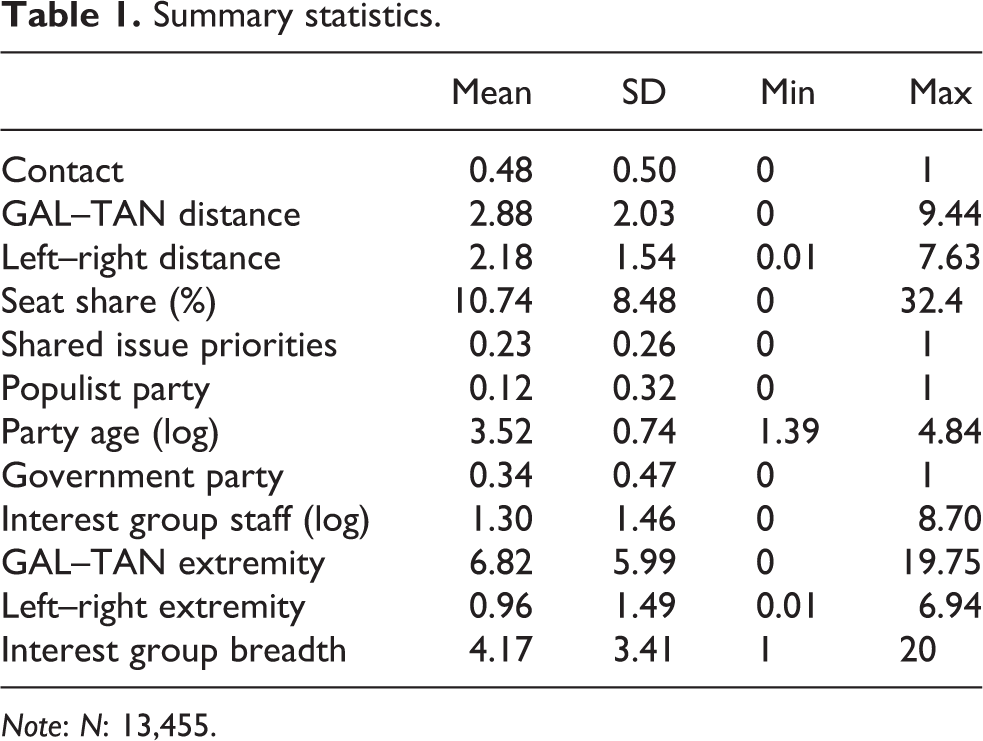
Note: N: 13,455.
Analysis
Main effect
We first explore whether populist parties in general talk less to interest groups than other parties (H1). Figure 1 presents the frequency distribution of contact between interest groups and populist and non-populist political parties. Interest groups have contact half as much with members of populist parties as they do with members of other political parties (t = 22.68; p < 0.001). This finding supports our general argument. We proceed to test our hypotheses in a multivariate manner.
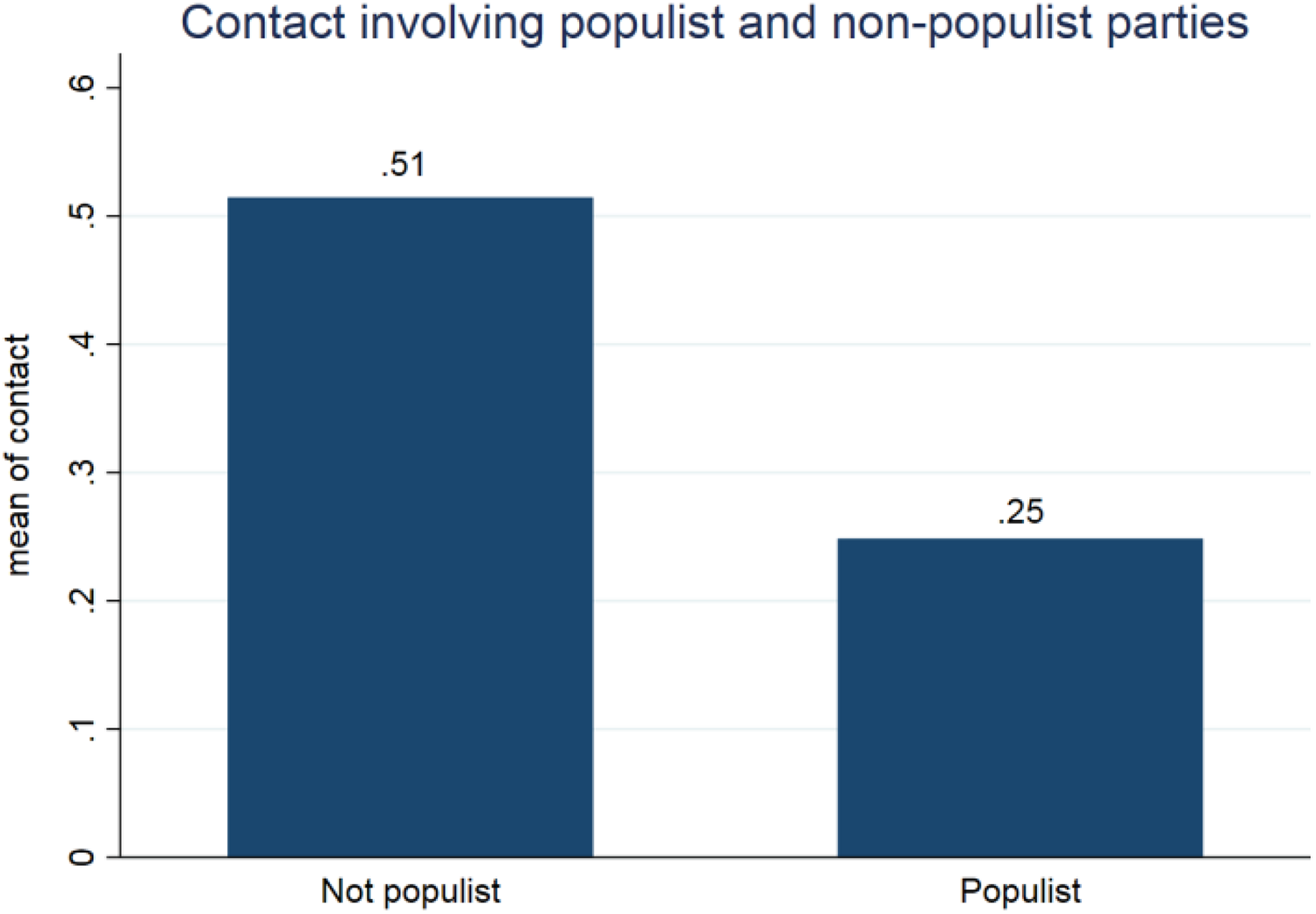
Bivariate relationships between the number of contacts with interest groups by populist and non-populist parties.
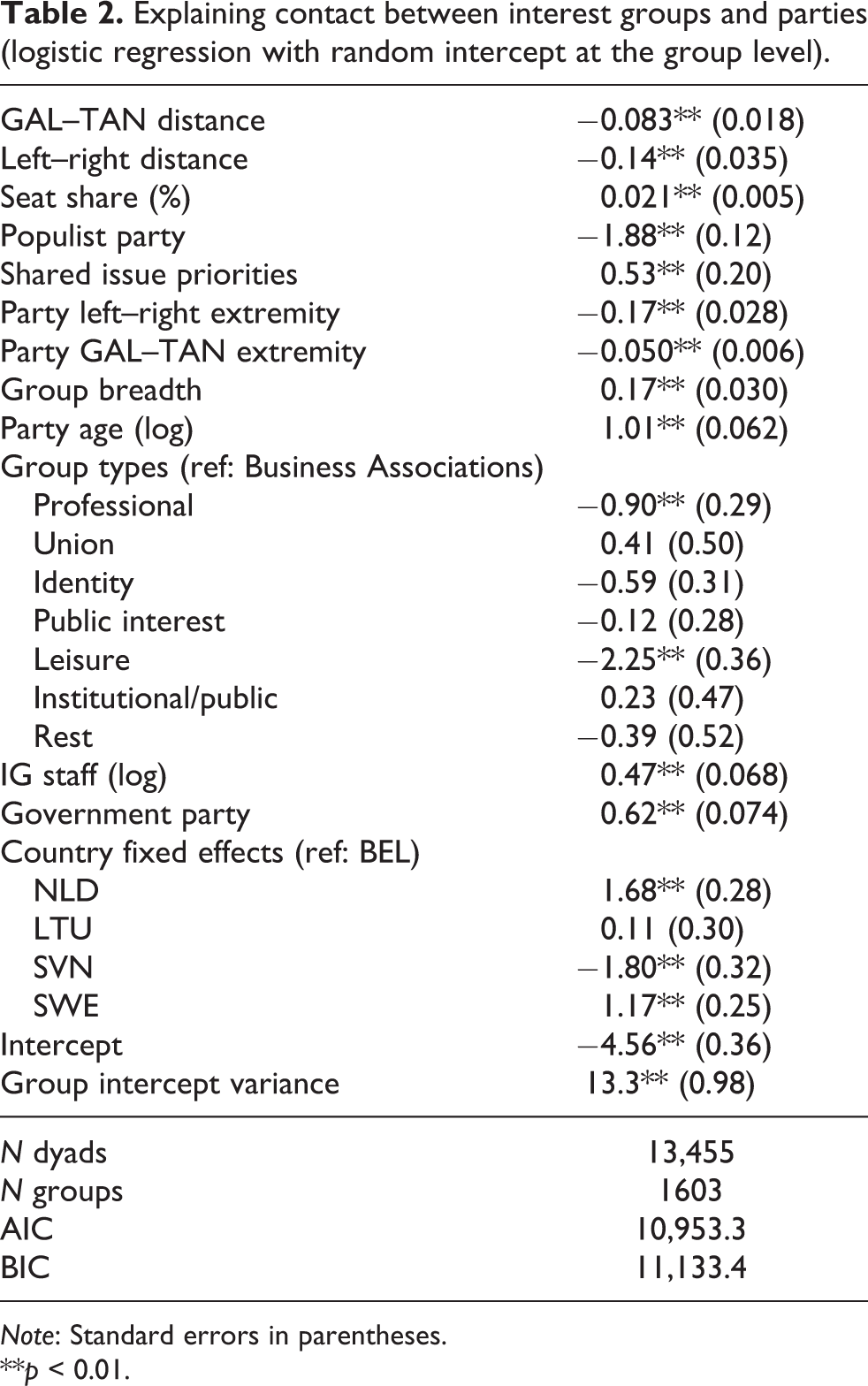
Table 2 presents a logistic regression model. The coefficients indicate that the effect of populism is negative and strong: The likelihood of contact between interest groups and parties decreases significantly if the party is populist. This is clear evidence in favour of our first hypothesis: Interest groups interact less with populist parties than with other parties.
Explaining contact between interest groups and parties (logistic regression with random intercept at the group level).
Note: Standard errors in parentheses.
**p < 0.01.
Practically all other coefficients confirm our expectations and support the ‘standard model’. As regards the ideological component of the model: contact between groups and parties is more likely at higher levels of issue overlap and ideological alignment. Importantly, these effects are independent of each other. Furthermore, the power of parties – assessed by their seat share in parliament – exerts a positive effect on the likelihood of contact. As regards our control variables, the breadth of an interest group’s policy agenda has a positive effect, with more widely engaged groups exhibiting a higher likelihood of contacting parties. The same rationale applies to more resourceful groups and older parties. We also find that party extremism and distance on both the economic left–right and the cultural GAL–TAN dimension decrease the likelihood of contact. This finding indicates that irrespective of the ideological distance between interest groups and parties, parties that take extreme positions are less likely to be contacted. In addition, some group type and country differences emerge, with professional, identity and leisure groups being less likely to contact political parties than business associations, and a higher likelihood of any contact in Sweden and the Netherlands, and less contact in Slovenia (reference category: Belgium).
Interaction effects
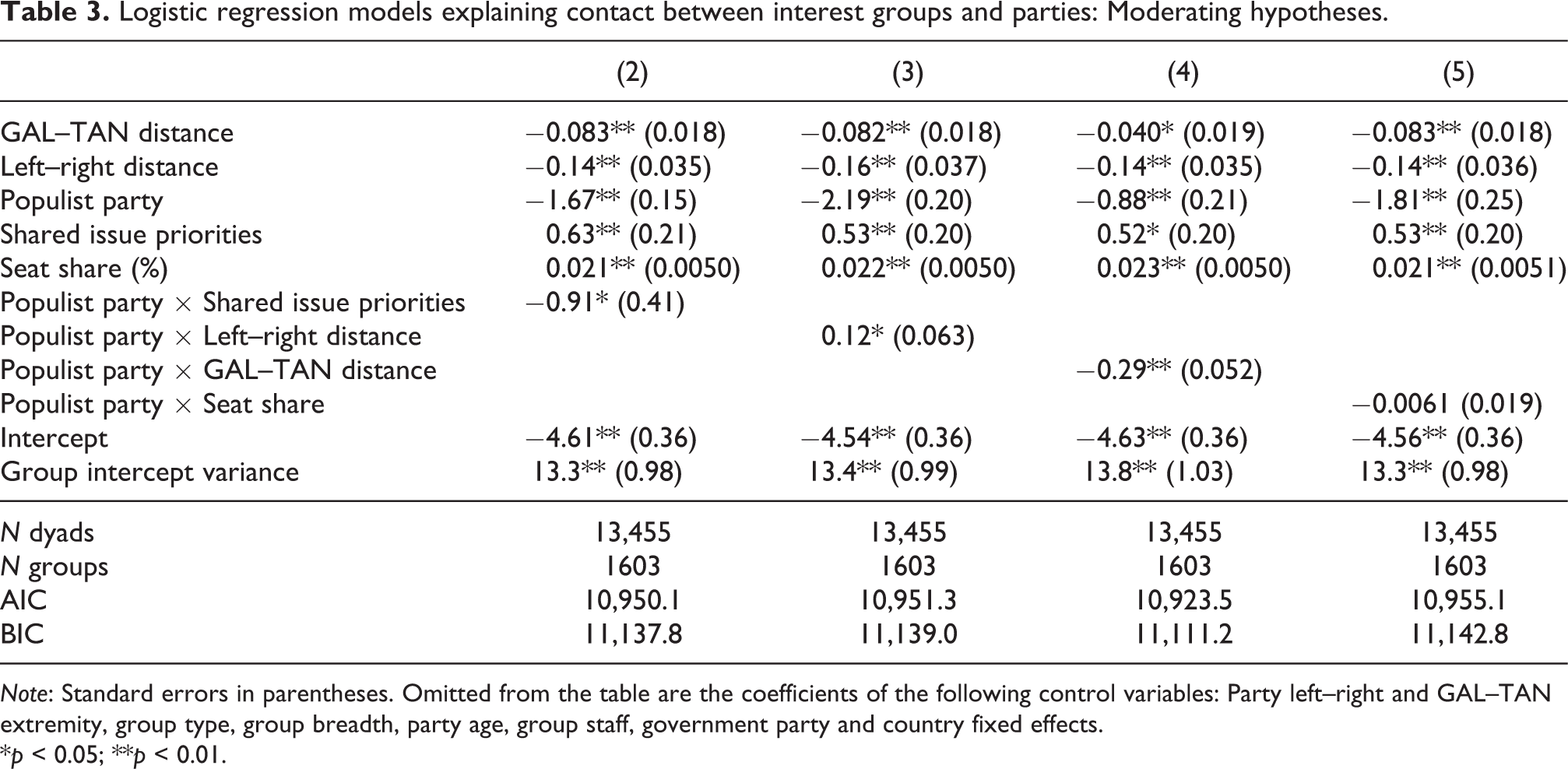
We proceed to assess whether populism moderates the effects of the ‘standard model’ (H2–H4). Table 3 presents four models, each assessing particular different interaction terms. We rely on plots of marginal average predicted probabilities to interpret our findings (Ai and Norton, 2003). We do not display control variables and country fixed effects in Table 3 to allow easier readability (full results are reported in the Online Appendix).
Logistic regression models explaining contact between interest groups and parties: Moderating hypotheses.
Note: Standard errors in parentheses. Omitted from the table are the coefficients of the following control variables: Party left–right and GAL–TAN extremity, group type, group breadth, party age, group staff, government party and country fixed effects.
*p < 0.05; **p < 0.01.
In model 2, we test our hypothesis about the conditional nature of populism and shared issue priorities. To recap, our expectation is that the effect of shared priorities should be smaller for populist parties, given their lack of interest in actually shaping public policy, and therefore in engaging in policy-relevant networking. Figure 2 provides evidence for this argument. The flat dark line indicates that the degree of shared policy priorities with interest groups does not matter for populist parties. For other parties, represented by the dashed grey line, higher issue overlap leads to slightly more interaction.
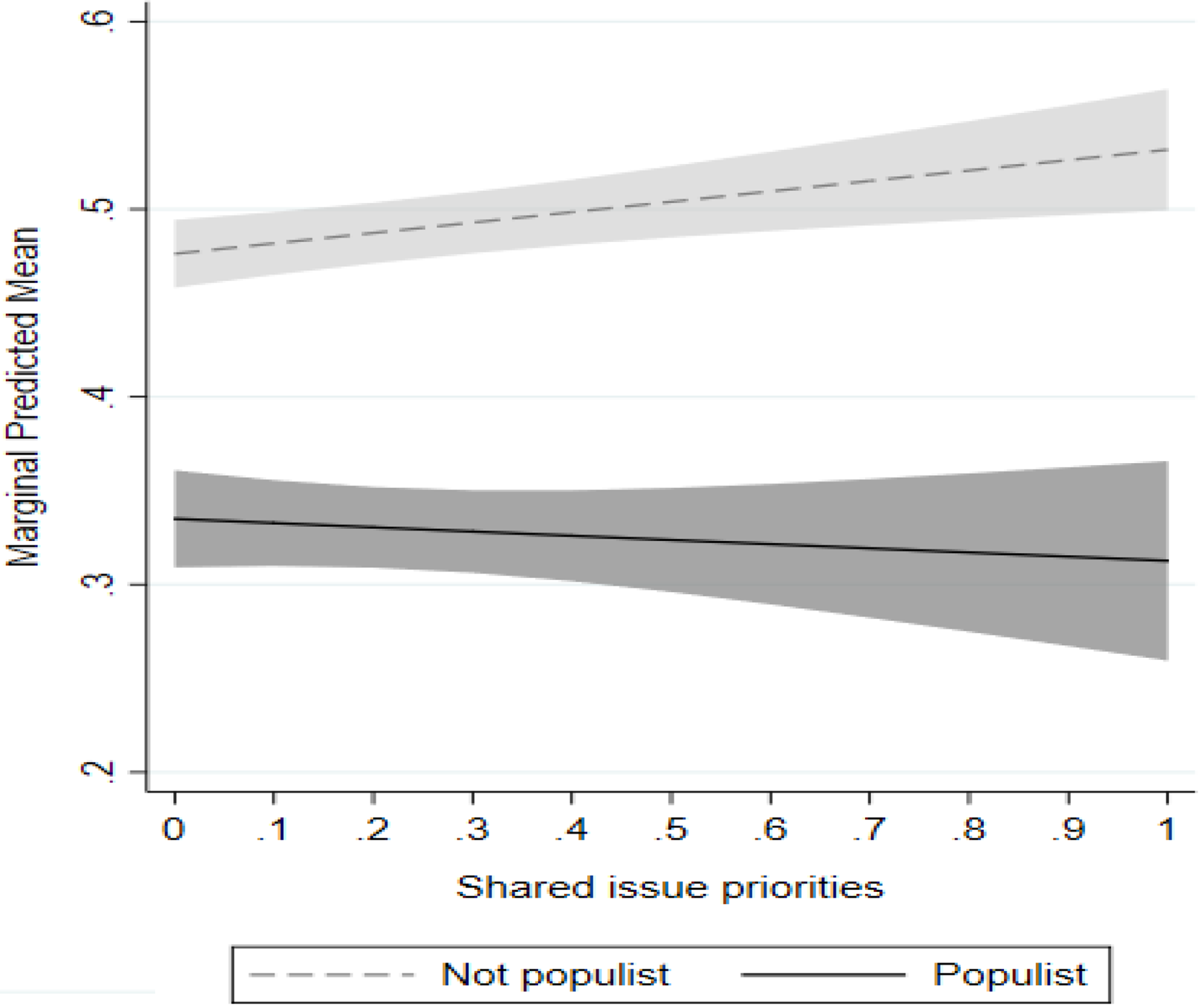
Marginal average predicted probabilities of contacts with varying levels of shared issue priorities.
Next, we argued that the need for political moderation on the side of interest groups might reinforce their avoidance of populist parties. The larger the ideological distance between groups and populist parties, the stronger the negative effect of populism should be. Models 3 and 4 test this hypothesis and provide partial support for this argument. To begin with, ideological distance along the cultural GAL–TAN dimension significantly matters (right panel in Figure 3). Although contact between interest groups and parties becomes generally less likely the more distant cultural positions they take, the effect of distance is considerably stronger for populist parties. The predicted average marginal probability of contact with a most culturally distant mainstream party is roughly 46%, whereas the probability of contact with a populist party taking a similarly distant position on the cultural dimension is merely 19%. In contrast, when the distance on the left–right dimension is considered, the difference between populist and non-populist parties plays out differently (see left panel in Figure 3). With a larger distance along the left–right dimension, interest groups are less likely to contact both types of parties, but the effect is much stronger for non-populists. Thus, while distance on the left–right dimension slightly reduces interaction with non-populist parties, distance on the cultural dimension substantially decreases interaction with populist parties. Interest groups and populist parties who are far apart on ‘cultural’ issues are unlikely to have contact. This is not the case for ‘economic’ issues. The distinct effects of economic and cultural issues may be because economic interests are one of the major triggers of interest group mobilization, and most members are recruited on an economic base. Cultural issues potentially cross-cut the (economic) interests of members and are thus likely to be far more divisive than economic issues. Interest group leaders are therefore particularly keen to avoid cultural radicalism.
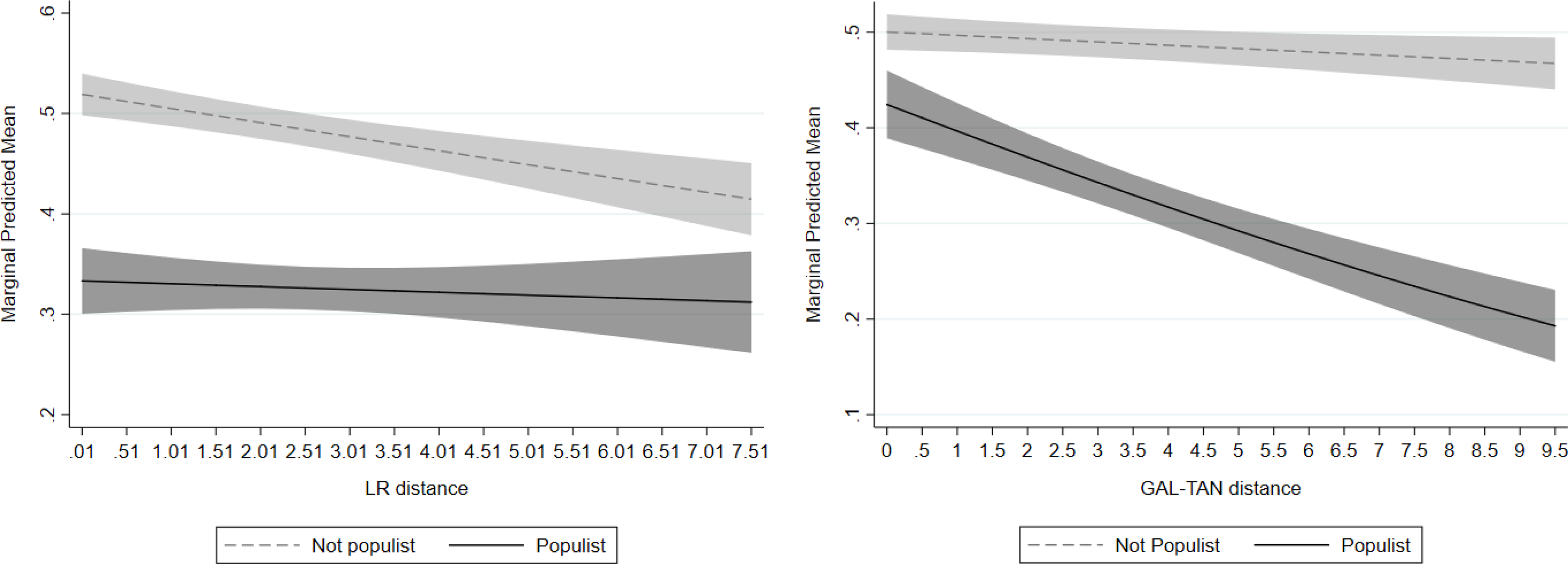
Marginal average predicted probabilities of contacts with varying levels of ideological distance.
Finally, in contrast to our hypothesis 4 and indicated by the similar slopes of the lines in Figure 4, we do not find evidence that the power of a political party, as indicated by its seat share, affects populists and non-populists to a different degree.
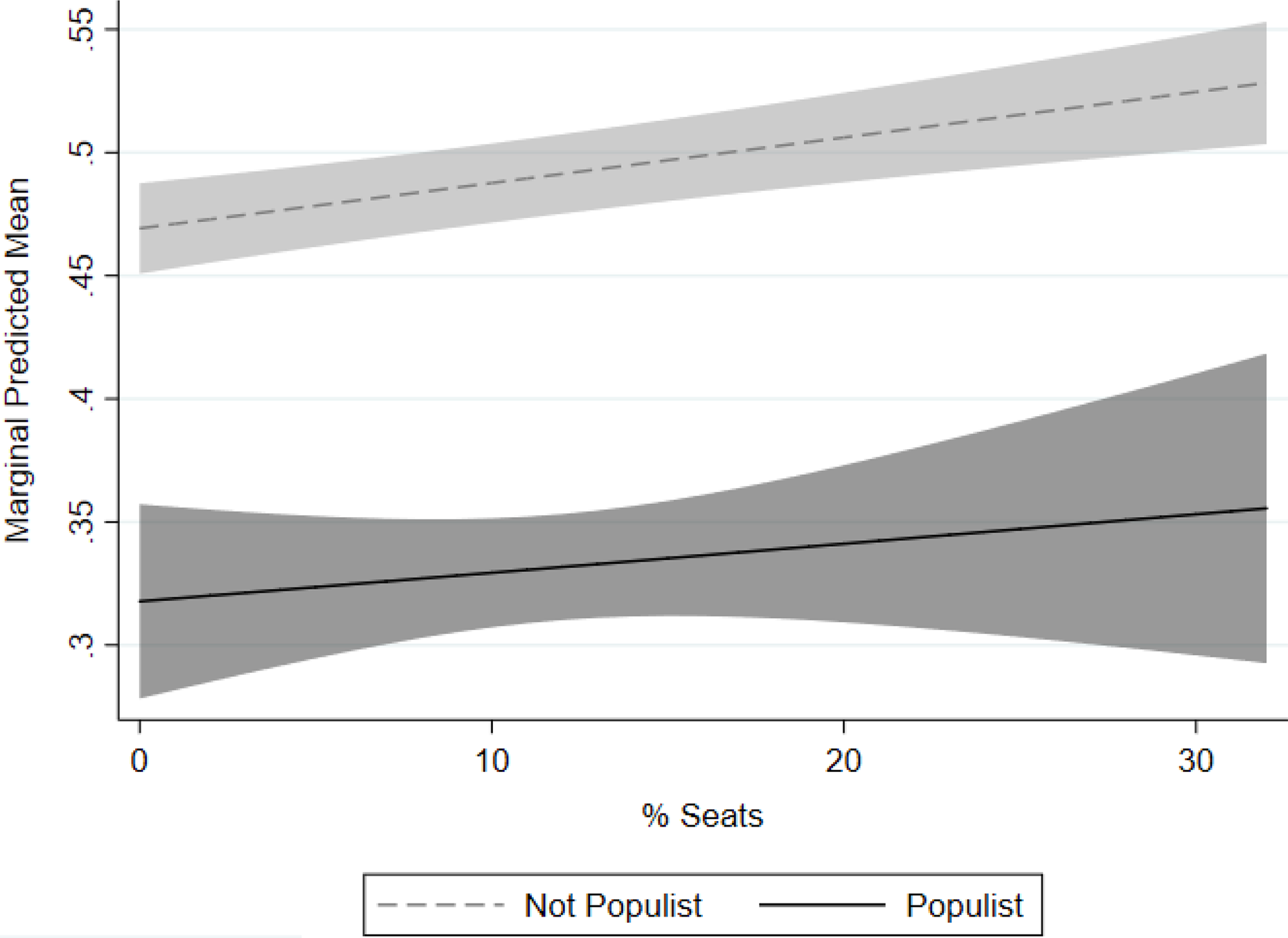
Marginal average predicted probabilities of contacts with varying party seat shares.
Overall, the preceding analyses provide clear support for our first hypothesis: Interest groups interact much less with populist parties than with others. We also found support for the idea that populism moderates the effect of the ideology-component of the standard model. This is evident both in terms of the issue priorities and the effects of ideological distance. That is, contacts between populist parties and interest groups are not more frequent when issue priorities are similar nor when left–right positions are close, whereas this is the case for other political parties. Conversely, distance along the cultural dimension is relevant for populist parties, but much less so for other parties. In the Online Appendix, we provide several robustness checks that all support the findings reported here.
Conclusion
The ‘standard’ power-position model of interest group – political party interaction has relatively strong empirical support. However, it does not account for the particular idiosyncrasies or ideologies of specific party families. This is a conceptual weakness that leaves researchers to omit explanations related to the content of political ideas of parties, and their associated strategic, policy-oriented ideologically driven behaviour. This may not matter in contexts where political parties and interest groups are relatively similar in their issue positions and priorities. This weakness, however, is likely to be especially important in recent circumstances in which party systems changed in terms of the substantive issues on their agendas and the types and number of political parties. The growth in size and number of populist parties is critical in this regard and has been the main focus of this article.
Several subfields of political science are now starting to assess the implications of rise of populism for commonly accepted theories of politics. However, the consequences of this development for the relationship between political parties and interest groups lack proper understanding. In this article, we investigated whether the rise of populism calls for an adjustment of established models of contact between interest groups and parties.
First, our results show that populist parties have much less contact with interest groups in each of the five countries we studied. Our multivariate models suggest that the populist ideology largely affects party–interest group interaction in a direct manner. We explicitly build upon, and empirically control for, the positional and party–political power components of the standard model of interest group–party interaction. This means that our observation of relatively little contact does not result from the size or position of populist parties. Our control for issues prioritization also suggests that the ‘host’ ideological profile of populists (left or right) and the associated issue priorities do not seem to interfere with our observed general relationship. The populist ideas, namely anti-elite views combined with unitary conception of ‘the people’, reduces contacts between interest groups and populist parties.
Second, populism also has indirect effects. A number of the factors included in the standard model are moderated. To start, issue priorities do not drive contact between interest groups and populist parties, whereas similarity of issue concerns commonly leads to slightly more frequent group–party contact. This refutes the argument, commonly made by populists themselves, that they focus on issues that are insufficiently attended to by other actors, including interest groups, and that they, by necessity, have limited contacts. The limited interaction of populist parties with interest groups does not follow from a lack of interest group prioritization on populist issues, as populist parties are also largely out of touch with interest groups with shared interests and issue priorities.
In addition, cultural ideological distance is an important reason for a lack of contacts between interest groups and populist parties, whereas economic distance matters for contact with other parties. This finding highlights that it is not just distance on the economic dimension that shapes party–interest group contacts, as previously assumed, but that different ideological dimensions matter – for different parties. We did not have a priori theoretical arguments about this difference between these dimensions of positional proximity. We think that this may relate to the relatively fundamental, dichotomous and principled character of the positions on the cultural axis. Populist ideas about the unitary nature of the people and its oppositional relation to elites may encourage strong prioritization of identity issues in such a way that it amplifies already existing effects of positional differences. Such amplification is less likely to occur on economic issues where potential policy solutions are less dichotomous and compromises somewhat easier to imagine.
Our findings suggest a number of fruitful venues for further study. The first one relates to the multifaceted treatment of the ideology component of the standard model. The inclusion of a ‘populism’-dummy variable in future studies of group–party relations is a useful starting point but is inadequate to capture the full variation of ideologies. That is, we need more conceptual thinking, along the lines presented in this article, about the nature of political ideologies and their implications for political behaviour. The strong direct effects of populism suggest that such theory construction should start with the direct relationship between political ideology and political contact, and subsequently may address the mediating nature of particular ideologies. In future work, such theory construction is something that can be done for several party–political families. For instance, Green parties, in their ideologies, have a clear conception of the nature of citizenship activism, and this belief is likely to reverberate in their contacts with citizen groups. These party-family specific additions to the standard model are likely increase its explanatory power.
Second, we could not fully study three potential effects of populism. To start, we wonder whether there will be a point at which populist parties become too big to ignore. In among others Italy or Austria, populist parties now form or support national governments, and the systematic limited contact of interest groups to such parties may not persist. Future research should aim to include populist parties ranging from the smallest to the most powerful. This should help us assess the contacts between interest groups and populist parties act when populist parties effectively steer the direction of public policy. Furthermore, our study does not include left populist parties. Although we control for issue priorities and position, it may still be that ‘host’ ideologies have particular effects. We do not think that this is likely to be a direct result of particular ideas of left-wing parties such as the ideas of equality or the nature of capitalism. However, historically institutionalized group (labour unions) and party mobilizations (social-democrat parties) may, under particular circumstances, encourage or discourage contacts between left-wing populists and interest groups.
This leads us to a last, more systemic venue for further study. Our study is a snap-shot with some variation in political systems. We cannot assess the implications of long-term patterns of systemic change in interest group and party systems, and their effects on contacts. We know that there is substantial organizational turn-over (entry and exit) in both organizational systems (e.g. Van der Wardt et al., 2018) and that the functions of these systems, while institutionally persistent, are not constant over time (e.g. Christiansen et al., 2010; Richardson, 1995). This must have plausible implications for various types of behaviour, including the frequency and nature of contact between parties and groups.
To conclude, populist parties substantially interact less frequently with interest groups, which could have significant consequences for interest mediation systems. From the perspective of interest groups, some types of constituents could be heard less by (party–political) policymakers. For the party system, the information supply via interest groups could decline in importance, and information through other channels such as the media could become the dominant basis for issue prioritization and decision-making. This implication is likely to affect, in a complex manner, how political decisions are made and who are likely to be the winners and losers of these decisions. It could be beneficial for some and detrimental for others.
Supplemental Material
Supplemental Material, 2019-03-22_suppl_material - Explaining the patterns of contacts between interest groups and political parties: Revising the standard model for populist times
Supplemental Material, 2019-03-22_suppl_material for Explaining the patterns of contacts between interest groups and political parties: Revising the standard model for populist times by Joost Berkhout, Marcel Hanegraaff and Patrick Statsch in Party Politics
Footnotes
Acknowledgements
We would like to thank Matthijs Rooduijn, Jens van der Ploeg, the participants of the workshop ‘Comparative Research on Interest Group Politics in Europe’ hosted by Andrea Pritoni in Florence and the University of Amsterdam Faculty conference “Populism: Between Resentment and Resistance”, and the reviewers of Party Politics for their very helpful comments. We are also grateful to Jan Beyers for initiating and organizing the ‘Comparative Interest Group Survey’.
Declaration of Conflicting Interests
The author(s) declared no potential conflicts of interest with respect to the research, authorship, and/or publication of this article.
Funding
The author(s) disclosed receipt of the following financial support for the research, authorship, and/or publication of this article: We thank the European Research Council (ERC-2013-CoG 616702-iBias, principal investigator Jan Beyers) for its financial contribution. We also benefited from the financial support of the NWO (Hanegraaff VENI grant: 451-16-016 & Berkhout ORA grant: 464-15-148).

Supplemental Material
Supplemental material for this article is available online.
Notes
References
Supplementary Material
Please find the following supplemental material available below.
For Open Access articles published under a Creative Commons License, all supplemental material carries the same license as the article it is associated with.
For non-Open Access articles published, all supplemental material carries a non-exclusive license, and permission requests for re-use of supplemental material or any part of supplemental material shall be sent directly to the copyright owner as specified in the copyright notice associated with the article.
