




Abstract
Few existing datasets on parties and interest groups include data from both sides and a wide variety of interest groups and parties. We contribute to filling this gap by making several interconnected new datasets publicly available. The Party-Interest Group Relationships in Contemporary Democracies (PAIRDEM) datasets include cross-national data from three different surveys of (1) central party organizations, (2) legislative party groups, and (3) interest groups. A fourth dataset based on coding of party statutes and party finance data was established together with the Political Party Database. The datasets contain novel indicators on party-group relationships in up to 21 mature democracies. In this research note, we first present the main content of the datasets and the research design. Second, we present descriptive statistics documenting the extent of organizational ties between parties and groups in contemporary democracies. Third, we illustrate more advanced usage through a simple application.
Introduction
An increasing number of studies address the intersection between party and interest group politics in contemporary political science, and some existing cross-national datasets on parties and on interest groups describe the relationship of parties with interest groups or vice versa. However, few include numerous relational aspects, data from both types of organizations and all sorts of interest groups and parties. To exemplify, the Political Party Database (PPDB) describes ties regulated by party statutes and includes valuable information on donations from party accounts, but not information about less formal ties and other resources provided. Moreover, it is limited to a few categories of interest groups (Poguntke et al., 2016, 2020). Some interest group datasets include multiple indicators of individual party-group relations but cover relatively few countries (e.g., Rasmussen and Lindeboom, 2013).
The Party-Interest Group Relationships in Contemporary Democracies (PAIRDEM) datasets remedy this. They include data from surveys of central party organizations, legislative party groups and interest groups. This enables us to examine party-group ties from both sides—within and outside the legislative arena. The datasets span 21 countries, cover a range of different relational aspects and introduce new indicators such as groups’ input to parties’ decision-making processes. The party survey datasets include both major and minor parties while the interest group dataset covers representative and purposive samples of interest groups in each country. The survey questionnaires were filled out by key informants answering on behalf of their organization. In collaboration with the PPDB, we furthermore make available a party dataset based on coding of party statutes and party finance data.
In this research note, we introduce the PAIRDEM rationale, research design and the main content of the datasets. We moreover present descriptive statistics on the extent of organizational ties between parties and interest groups in contemporary democracies as well as a simple application on the relationship between party-group policy distance and ties. Taken together, this illustrates that our data can contribute to answering key questions in the burgeoning literature on parties and interest groups.
Party-interest group relationships in contemporary democracies (PAIRDEM) in context
The study of parties and interest groups dates back to the early days of comparative politics. Alliances between particular parties and interest groups—like left-of-center parties and trade unions—were seen as indications of underlying social cleavages in the groundbreaking sociological studies of politics (Lipset and Rokkan, 1967). The early institutionalist literature also highlighted Party-group ties. One important characteristic of the classic “mass party model”—representing internally democratic membership parties with roots in particular social segments of society—was strong organizational ties with certain organized interests (Duverger, 1954: 5–7; Epstein, 1967). It was widely agreed that party-group relationships affect how democracy works (Almond and Powell, 1966; Schattschneider, 1942).
Over time, however, party and interest group politics evolved into separate fields of research (Heaney, 2010; Witko, 2009), and the relationships between these actors were for long largely overlooked (Thomas, 2001). In recent years, scholars have identified this “blind spot” and several studies have analyzed Party-interest group interactions, approaching parties and groups as goal-seeking collective actors (Allern and Bale, 2017; Koger et al., 2009; Otjes and Rasmussen, 2017; Rasmussen and Lindeboom, 2013).
The PAIRDEM project falls within this tradition of studying parties and interest groups as organized collective actors, and was designed to examine (1) the organizational nature, (2) the shaping factors, and (3) the consequences for policy-making of party-group relationships in long-established democracies. Primarily, we aimed to study the strength/weakness of party-group ties and exclusiveness/inclusiveness of individual party and interest group networks, and to enable study of the varieties and impact of party-group relationships on a hitherto unparalleled scale. The PAIRDEM datasets thus contain numerous indicators of various aspects of party-group relationships: of highly formal, less formal and informal organizational ties, be they general or related to specific decision-making processes and policy areas, and of several other aspects of relevance, like ideological positions, financial and material support, as well as perceptions of influence.
What do the Party-interest group relationships in contemporary democracies (PAIRDEM) datasets cover?
Collecting data on political organizations is costly and time-consuming due the private nature of parties and interest groups. Still, PAIRDEM offers great possibilities for cross-national analyses of general party and interest group populations in long-established democracies.
Scope in time and space
The surveys were centrally coordinated and carried out in 2016–2017 (party surveys) and in 2017–2018 (interest group survey). PAIRDEM is thus restricted to current relations. 1 There are older surveys to build on, but no cross-national surveys to follow up with a new wave. The aim of mapping party-group relationships in a multifaceted way precludes the establishment of panel data or time series at this point. 2 The project nevertheless provides a solid basis for developing cruder measures that could inform future efforts based on other types of data sources. Note also that the surveys cover relatively stable items. The data should therefore generally be current also after some years in time.
The PAIRDEM project focuses on long-established democracies and covers 21 countries: Australia, Austria, Belgium, Canada, Denmark, Finland, France, Germany, Iceland, Ireland, Israel, Italy, Japan, Luxembourg, the Netherlands, New Zealand, Norway, Sweden, Switzerland, the United Kingdom and the United States. The datasets include data from three different surveys on (1) central party organizations, (2) legislative party groups, and (3) interest groups.
In the party surveys, we aimed to study all “significant” parties, but employed an inclusion criterion (a combination of representation and votes) to exclude marginal and defunct actors (see the Supplementary Appendix and Allern et al., 2020a for details). The population thus consists of all parties—165 in total—that meet the criterion at the time of the survey launch. This means that there are no sampling errors. We developed one questionnaire for the central party organization and one for the legislative party group to address their different “modus operandi” and thus different avenues for interaction with interest groups.
The interest group survey was carried out in seven countries: Denmark, France, Germany, the Netherlands, Norway, the United Kingdom, and the United States. These countries share relatively similar historical and economic preconditions but vary in their contemporary institutional settings. This opens up for cross-national analyses and more focused comparisons.
The PAIRDEM project uses a wide interest group definition: any non-party and non-governmental formal association of individuals or organizations that advocates a particular interest/cause in public and usually attempts to influence public policy. For detailed information on the sampling criteria and how we identified comparable sampling frames across countries, see the Supplementary Appendix and Allern et al. (2020b).
Thematic focus and range
In line with the general aims of the project, all datasets focus on forms of structured interaction between parties and interest groups. A minimum level of structure (regularity) is required for a relationship to exist. What we sought to capture are ties “securing stable access, not isolated interaction only at a single point in time, regarding a particular issue, or simply the sum of such contacts” (Allern et al., 2021c: 1257). The strength of such organizational ties primarily “reflects the extent to which contact is made formal or otherwise structured” (ibid.). Ties can vary in number, be many or few, but are also themselves characterized by different degrees of formalization and thus institutionalization. Hence, we assume that there is a hierarchy of ties and that the number of ties matter for the overall strength of organizational relationship (see Allern et al., 2021c for a detailed conceptual discussion).
The datasets capture a range of such ties between parties and interest groups: the most formal statutory ties and more or less formal inter-organizational ties. The survey datasets contain both factual and evaluative indicators of inter-organizational ties (see Supplementary Appendix Table A1 for an in-depth overview). The factual indicators concern the existence/non-existence of organizational ties in terms of organizational arrangements, agreements, routines and regularized behavior. The evaluative indicators deal with the key informants’ rating/summary of relations and the content of contacts. The PPDB dataset furthermore covers statutory ties, namely formal party-group affiliation, and interest groups’ representation/participation rights in party bodies.
Beyond organizational ties, the surveys cover variables generally relevant for the study of the intersection of party-group politics, such as organizations’ background information, transfer of resources and perceptions of interest group/party influence on decision-making. The PPDB dataset in addition includes data on party resources (members and finance). This makes it possible to control for historical origins, internal constraints and organizational resources.
Dataset structure
The datasets mirror the structure of the questionnaires (including filter questions). Possible units of analysis are central party organizations, legislative groups, or interest groups. The party surveys can be combined to allow for study of the “party at large.” Moreover, all surveys open up for dyadic (e.g., party-group) and triadic (e.g., party-group-policy area) units of analysis (see Allern et al., 2021, 2021b, for applications). The datasets and/or supplementary material furthermore include ID variables or key information from the PPDB, ParlGov (Döring and Manow, 2018) and Chapel Hill expert surveys (CHES) (Polk et al., 2017) so that the data can easily be merged and combined.
Figure 1 shows one possible data transformation (to party-group dyads) and how to merge the interest group survey data with PPDB data on parties’ revenues using the PTYID-variable. More generally, dyadic units of analysis make it possible to add characteristics describing one or both sides of the dyads such as party revenue, interest group type, or interest group donations to the party. Example of how to transform the interest group survey into a dyadic structure and combine it with other datasets.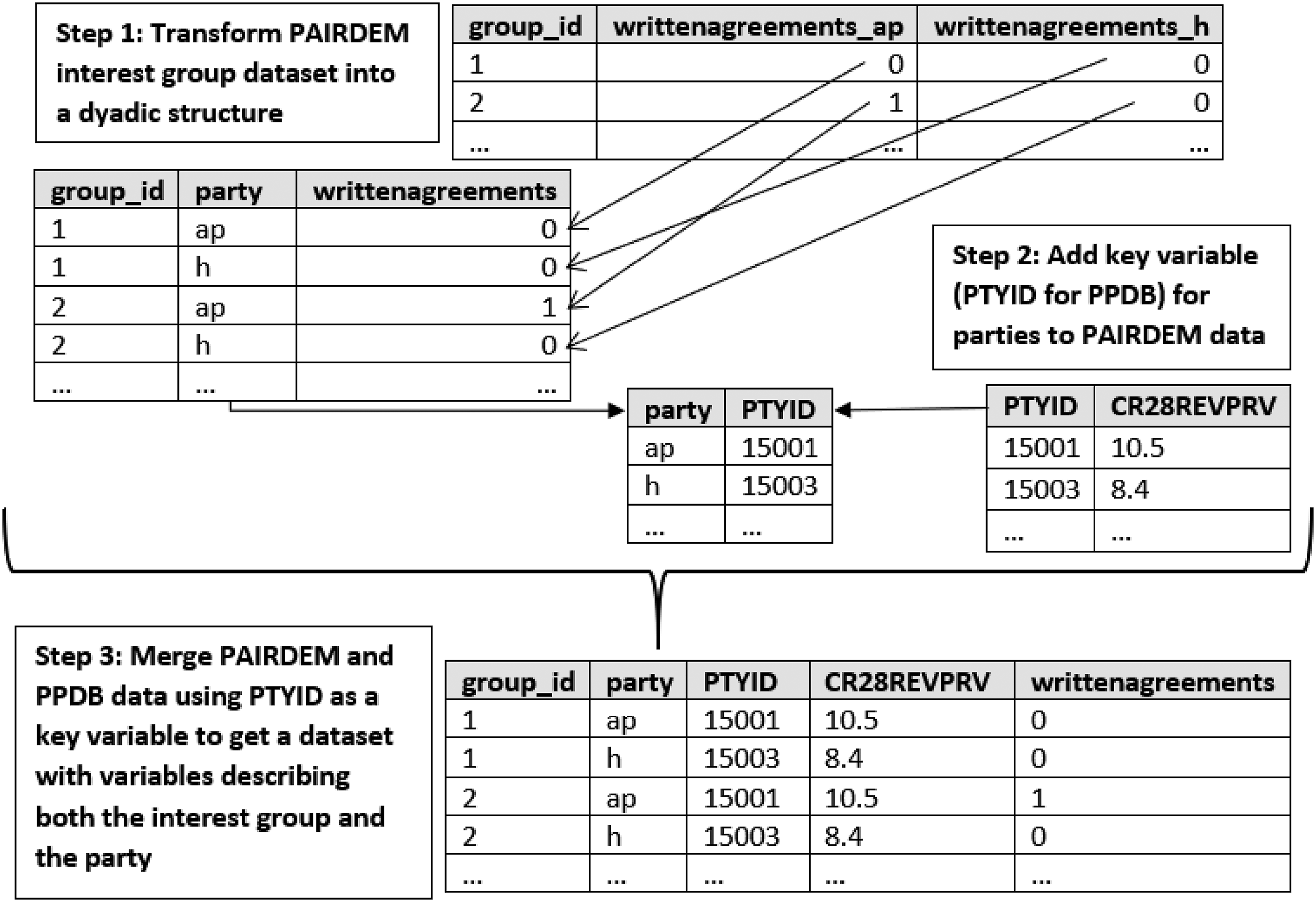
Methodological issues and response rates
In contrast to qualitative interviews and small-n case studies, surveys make it possible to collect quantitative data across many countries, parties and interest groups, to reveal general trends and correlations. By surveying parties and interest groups, we also get information about Party-interest group activities that it would be impossible to uncover if only using text data (party documents) or expert surveys. Still, key informants in parties and groups may have normative or strategic reasons to distort their answers. For instance, a social desirability bias can lead some parties to not acknowledge (or over-acknowledge) their interactions with interest groups in general or with selected groups in particular (Eichenberger et al., 2021). 3 Non-responses, for both parties and groups, could be related to this bias. Furthermore, smaller parties and groups may lack resources to answer surveys and the data could thus be biased towards the most resourceful both in economic and political terms. Compared to documents, a drawback with survey data when asking about factual information is that respondents may interpret questions in different ways which causes problems of comparison. As we explain in the Supplementary Appendix, we have applied several measures to minimize these risks. Hence, we maintain that the validity and reliability of the PAIRDEM data is high.
In general, the response rates are sufficiently high (67% across party surveys and 29% in the interest group survey). There is little bias in responses at the party and group level when comparing the party population and group samples to responding parties and groups. At the country level, there is more variation. We therefore recommend paying attention to country differences and using country fixed effects in regression analyses or comparing the results in selected countries. Note that the American and French parties are excluded from the party survey datasets because none responded to the surveys. See the Supplementary Appendix and Allern et al. (2020a, 2020b) for detailed information on response rates.
Tendencies in contemporary party-group relationships
According to the literature on long-term party changes, current relations between parties and interest groups are likely to be characterized by weak ties and inclusive relationships (Katz and Mair, 1995; Kirchheimer, 1966). Both parties and interest groups are expected to prefer looser (if any) ties to many rather than strong connections to a few. Empirical studies confirm that historically closely tied actors are less close today (Bellucci and Heath, 2012; Poguntke, 2002), but they also suggest that there is reason to question the existence of a general trend of distance (Allern and Bale, 2012, 2017). Studies of selected countries show that while many pairs of parties and interest groups have no structured contact, organizational ties still exist (Eichenberger and Mach, 2017; Rasmussen and Lindeboom, 2013; Tsakatika and Lisi, 2013).
The more extensive PAIRDEM data can shed further light on this in that it covers ties that can shape mutual decision-making, planning and coordination of activities or involve communication about political issues. Given the rarity of statutory ties, we focus on inter-organizational ties here and cover more formal joint party-group arrangements that are durable and reciprocal, such as joint committees, and less formal, event-based ties including regularized congress invitations (see Supplementary Appendix Table A2 for all indicators and Allern et al., 2021c, for a discussion of concepts and measurements).
The items can be added up to create an aggregated tie score measuring the strength of (inter-organizational) ties, going from 0–9 for legislative party groups, 0–10 for central party organizations, and 0–13 for interest groups. 4 The maximum scores differ because the legislative party groups were not asked about interest group participation in the party congress (inapplicable for this party unit), and the parties were not asked about three items concerning group invitations to parties due to the high number of interest groups.
Political parties and inter-organizational ties
The PAIRDEM data shows that inter-organizational ties between political parties and interest groups are frequent in contemporary democracies. 92% of central party organizations and 90% of legislative parties have at least one such tie to one or more interest groups. On average, out of the 9 ties they have in common, central party organizations have 3.5 ties while legislative parties have 3.8 ties. When including invitations to interest groups to participate in the party’s national congress/conference, the average for central party organizations increases to 4.2. Across party units, event-based ties are more common than durable ties.
While parties’ ideological and historical origins are not necessarily drivers behind ties, it may be useful to disaggregate the patterns by party family. Figure 2 shows that all party families have ties to one or more interest groups. The confidence intervals here overlap for most party families, but social democratic central party organizations stand out with an average of 6.7 ties. Average number of durable and event-based ties per party unit, by party family.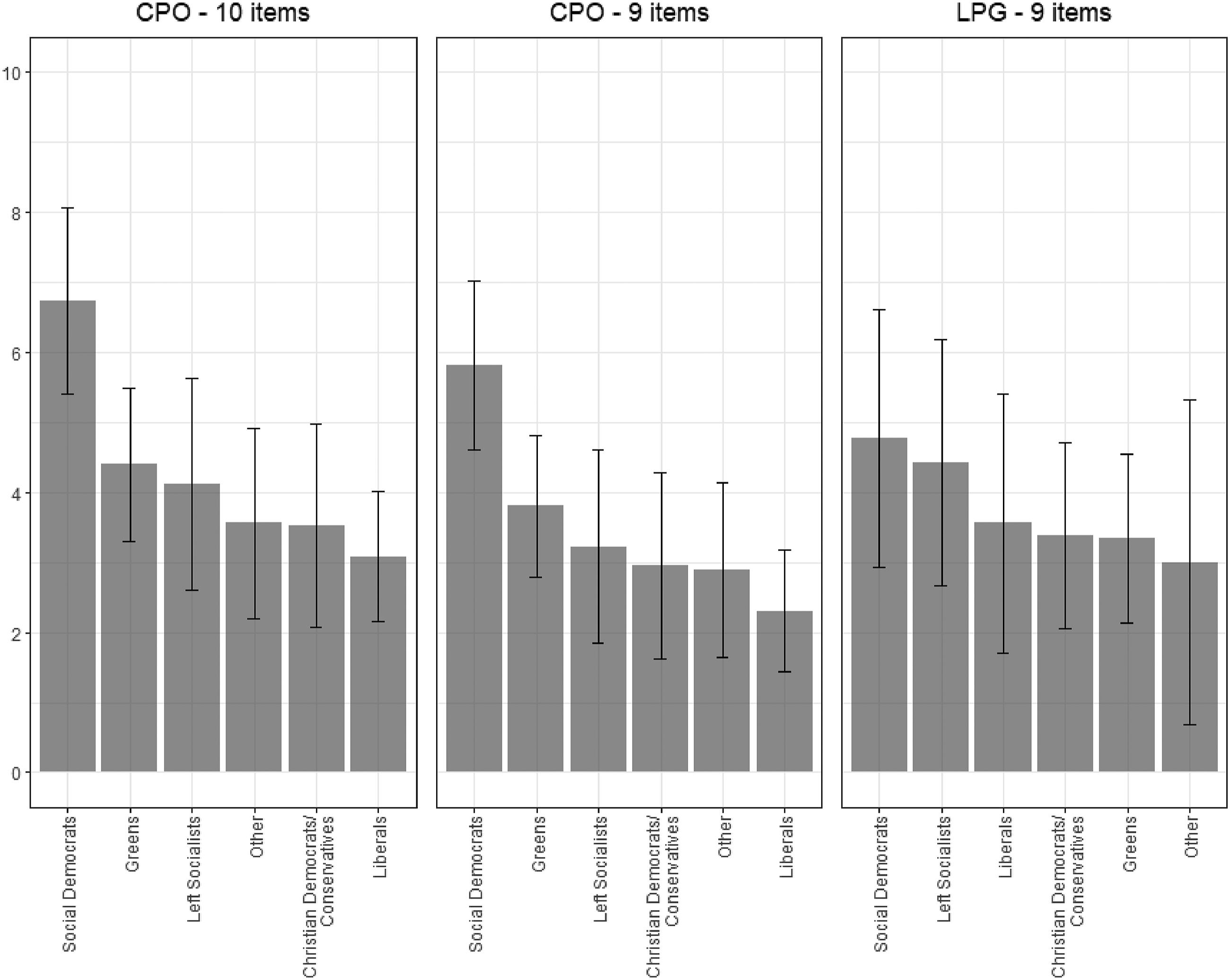
In addition to event-based and durable ties, parties can seek regularized top-leadership contact with interest groups, that is, regular contact between the elected top leaders and executive members in the national party organization or the party’s legislative group leader(s) and spokespersons in different policy fields and the top leaders and executive members of interest groups. Thus, this is a less formal inter-organizational tie generated from the individual level of parties and groups. In 65% of central party organizations and 70% of legislative parties leading members of the party unit are in regular contact with the leaders of one or more specific interest groups.
Both party units have this type of leadership contact with close to all interest group types, anti-immigration groups being the exception (see Figure 3). On average, central party organizations (legislative parties) have leadership ties to 5.2 (5.7) different group types. This gives reason to expect that parties also have organizational-level ties to different types of interest groups. Share of party units that have leadership ties to different interest group types.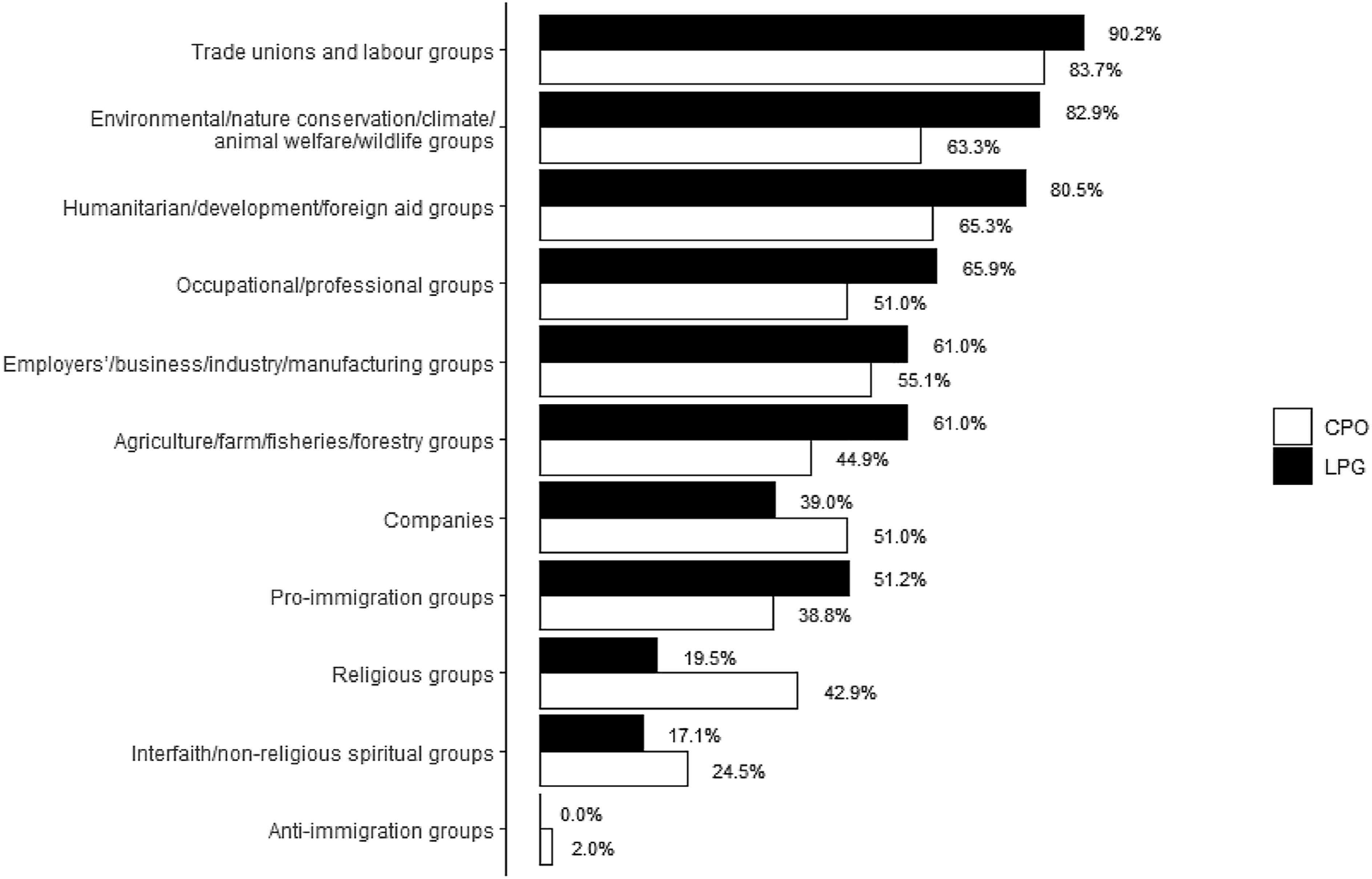
We also asked the central party organizations whether interest groups had contributed to the party’s most recent decision-making on a party manifesto or on a candidate or leadership selection. Figure 4 shows the results. While a majority of the parties report that interest groups had contributed to the manifesto, only 14% report contributions to candidate selection and 4% to leadership selection. Percentage of central party organizations who report that interest groups did not or did provide informal or formal input into major party decision-making processes.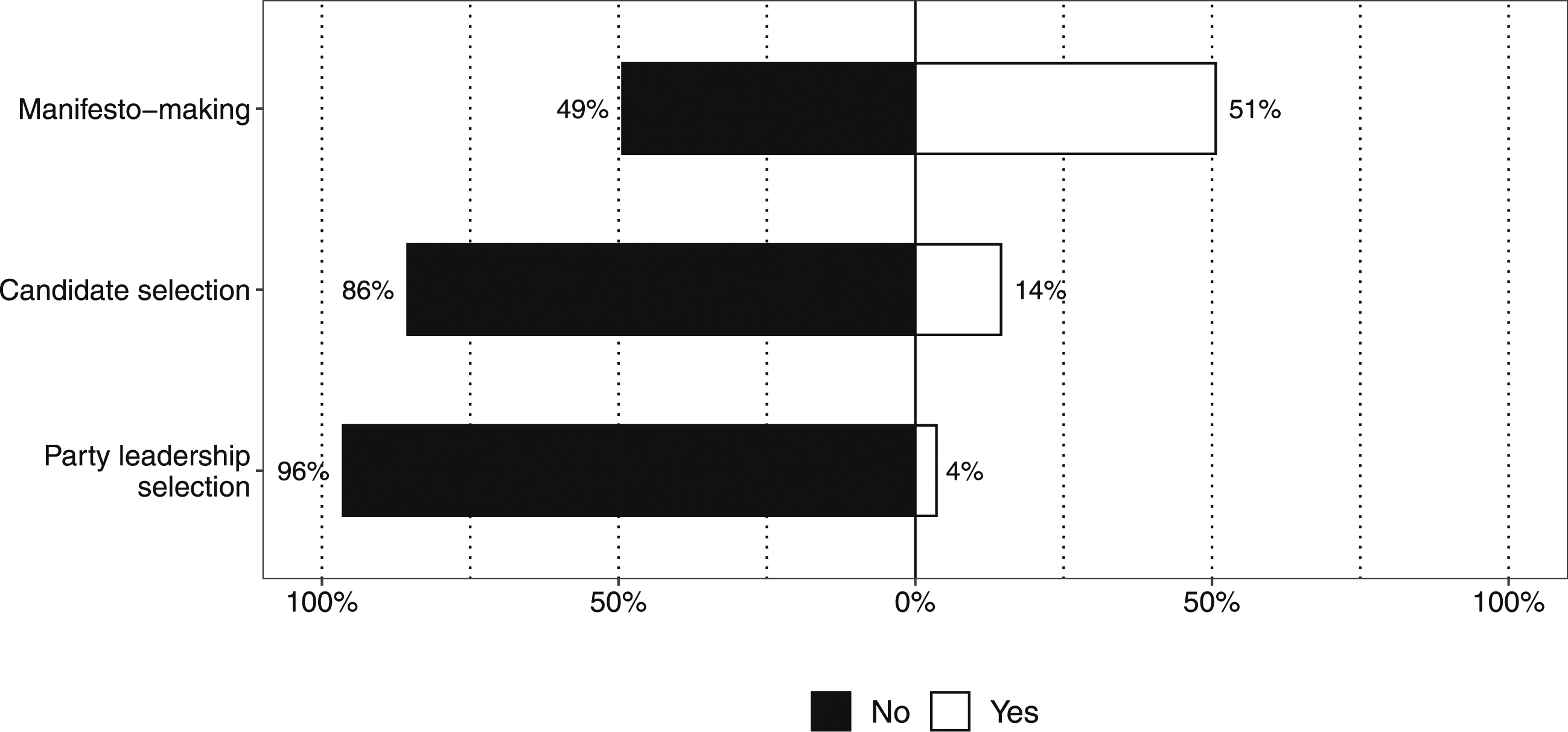
Interest groups and inter-organizational ties
Data from the interest group survey supports the party survey findings. When asked about how important different types of actors are when they participate in public policy processes, 68% of the interest groups consider legislative party-groups to be at least “somewhat important” and 39% consider central party organization to be the same.
Furthermore, 60% of interest groups have at least one inter-organizational tie, measured at the organizational-level, to one or more parties (i.e., to a central party organization and/or legislative party group). Similar to the party survey findings, we find that event-based ties (55%) are more common than durable ties (33%). Amongst the groups with ties, 72% have five or fewer ties. Only 4% have 10 ties, or more. Thus, while ties to parties are quite widespread, some groups have stronger ties than others.
When disaggregating to different group types (Figure 5), unions/labour groups stand out. 86% of these groups have at least one such inter-organizational tie to one or more parties. Most likely, this is not related to the group type itself, but instead to the qualities of the individual unions, such as their resources and historical structures. Average number of durable and event-based ties for different interest group types.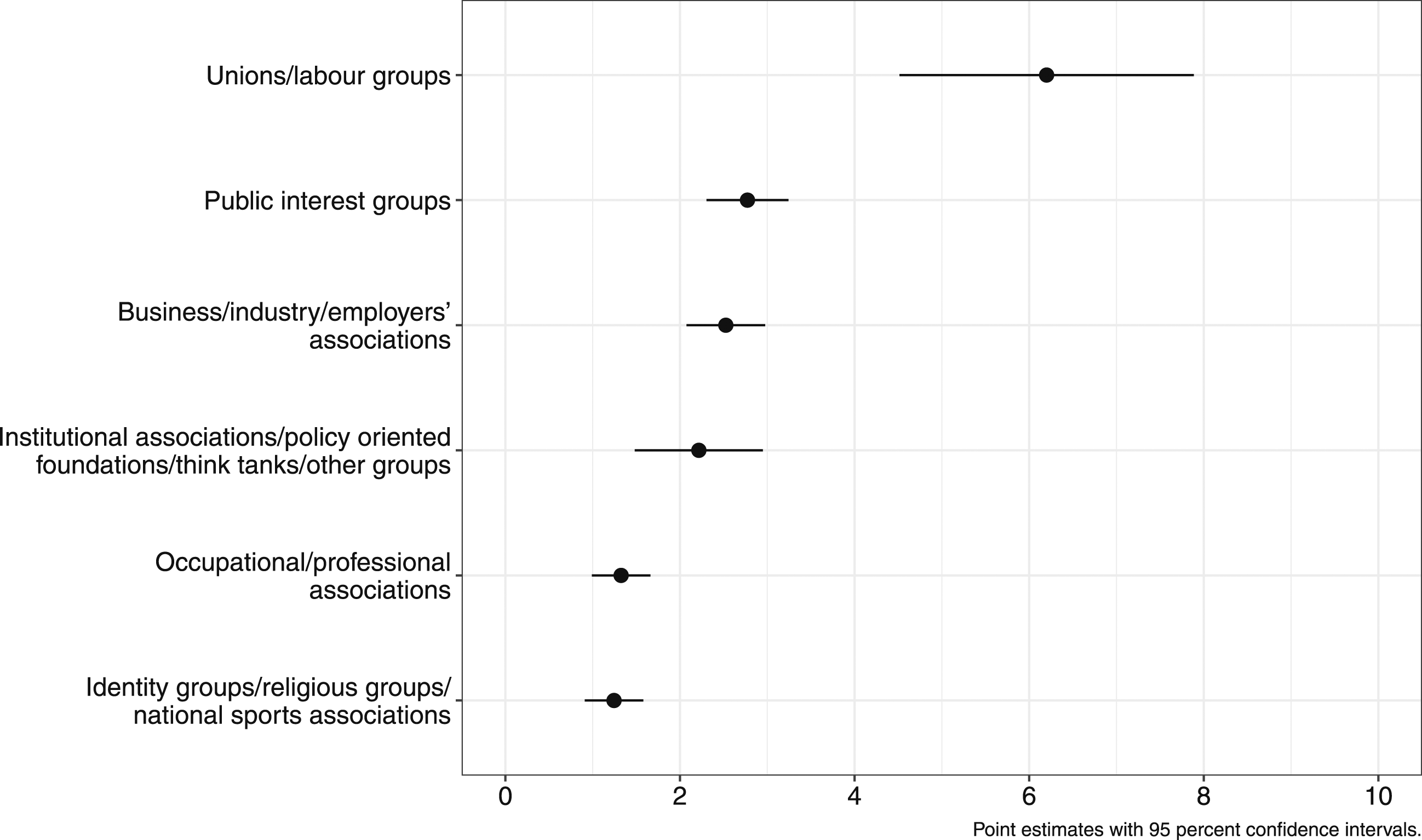
The interest group survey also supports the notion that regularized top-leadership contact between parties and groups occurs. “In the last year,” 28% of the organization leaders have met on a regular basis with leading officials in legislative parties, and 21% have met with leading officials in central party organizations. 11% of the groups have met with one party unit and 18% have met with both. A significant share of interest groups—but not all—thus has access to leading party officials.
Overall, the PAIRDEM data confirms that significant organizational ties between parties and interest groups still exist, contradicting the conventional wisdom of general, mutual separation. In addition, we see that while most parties maintain some ties, many groups do not have such ties at all to political parties. The population of interest groups is thus divided into two “spheres”: one without and one with inter-organizational ties and thus institutionalized access to parties.
A simple application: Policy distance and party-group leadership ties
The PAIRDEM datasets are, as shown in the Supplementary Appendix, a rich source of information that can be used for many analytical purposes concerning the varieties and impact of party-group relationships. Here we illustrate how the datasets can be combined with parties’ policy positions on the redistribution dimension in the 2014 CHES to study the relationship between policy positions and party-group ties (with causal caveats).
We investigate the expectation that increased policy distance between a party and a group (category) is negatively associated with regularized top-leadership contact. Using both party surveys, we zoom in on parties’ regularized top-leadership contact with groups in the trade union category. We assume that trade unions are pro-redistribution and located to the left on the redistribution dimension. 5 For the interest group survey, we use the party-specific question on top-leadership contact and a question where groups were asked to self-locate along the CHES redistribution dimension with the parties’ positions in their respective countries as points of reference. The unit of analysis is dyads of party and group category (trade unions) for the party surveys and dyads of group and party for the group survey.
Simple logistic regression models with regularized top-leadership contact as the DV (yes=1) and policy distance (0–10) as the IV, confirm our expectation across surveys (see Figures 6(a) and (b)). On the redistribution dimension, increased policy distance between a group (category) and a party is negatively associated with regularized top-leadership contact. We also show how the association can vary on basis of for instance the electoral system by including a subsample analysis of the UK (first past the post (FPTP)) and Norway (proportional representation (PR) system) in Figures 6(c) and (d). The association between policy distance and leadership contact is stronger in a PR system like Norway than in a FPTP system like the UK. Note, however, that this is a simple illustration without relevant controls and other substantial variables that may explain differences across countries. Combining PAIRDEM and CHES: Policy distance on redistribution dimension decreases probability of top-leadership party-group ties. (a) party surveys pooled, (b) interest group survey (all countries), (c) UK (interest group survey), and (d) Norway (interest group survey).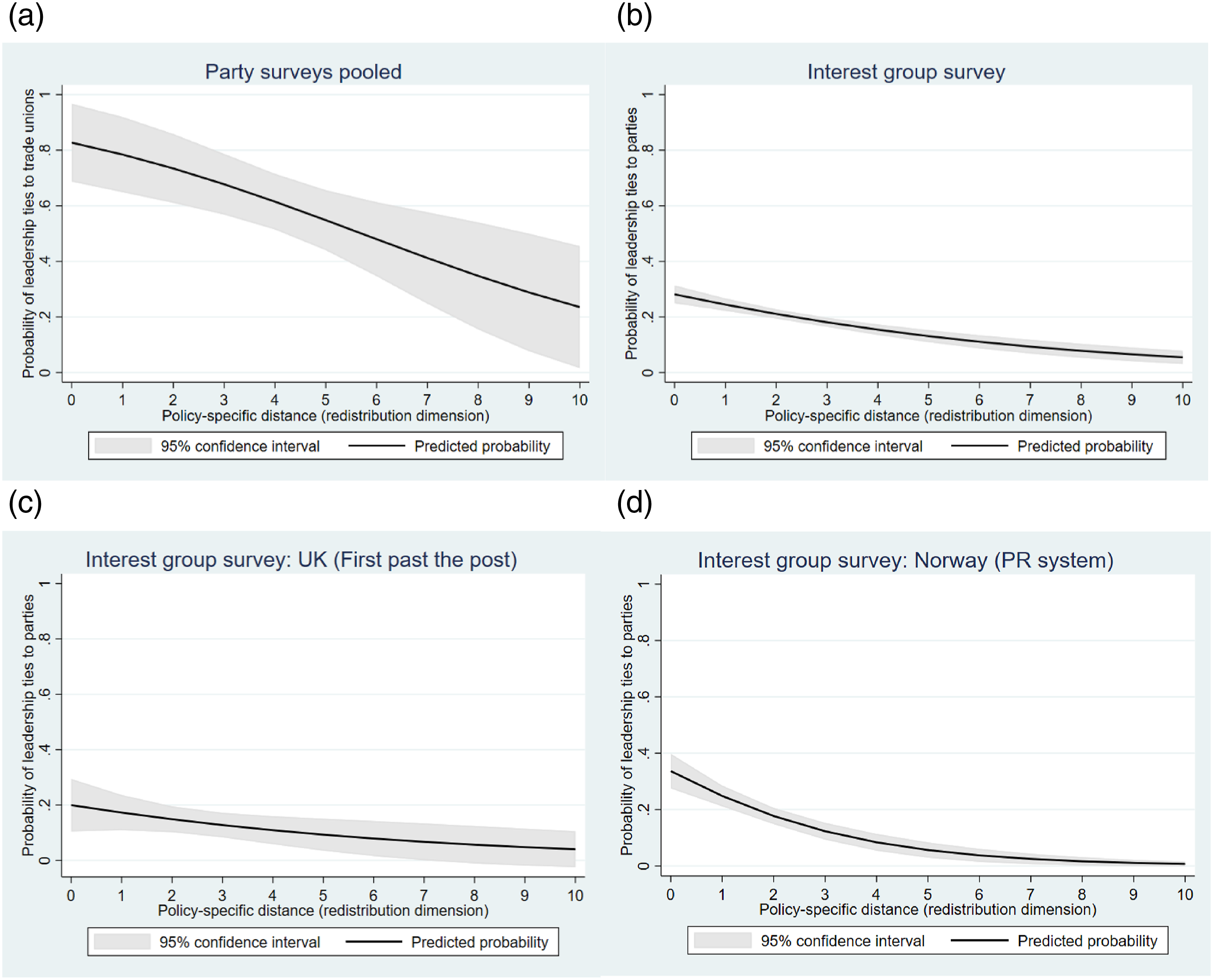
See Allern et al., 2021, 2021b for relevant control variables and other more sophisticated approaches to utilizing the PAIRDEM datasets in combination with CHES data.
Conclusion
In this research note, we have laid out the general features and content of the PAIRDEM datasets and presented some descriptive highlights and a simple application. Combined with other data sources, these datasets can shed new light on the nature, the drivers and the consequences for policy-making of party-group relationships in long-established democracies. Just like internal party democracy may constrain the party leadership, external relations to groups can confine them. Future research can use and add to these data to delve more closely into the details, determinants and effects of different aspects of party-group relations over time.
All the PAIRDEM datasets (including the PAIRDEM-PPDB collaboration), codebooks and survey scripts are accessible through the data archive at Sikt --Norwegian Agency for Shared Services in Education and Research (the former Norwegian Centre for Research Data, see https://doi.org/10.18712/NSD-NSD2978-V3)
Supplemental Material
sj-pdf-1-ppq-10.1177_13540688221075591 – Supplemental Material for Introducing the party-interest group relationships in contemporary democracies datasets
Supplemental Material, sj-pdf-1-ppq-10.1177_13540688221075591 for Introducing the party-interest group relationships in contemporary democracies datasets by Elin H Allern, Vibeke W Hansen, Lise Rødland, Maiken Røed, Heike Klüver, Cal Le Gall, David Marshall, Simon Otjes, Thomas Poguntke, Anne Rasmussen, Sabine Saurugger and Christopher Witko in Journal of Party Politics
Footnotes
Acknowledgments
A special note of appreciation is first due Tim Bale, who played a key role in the early phase of the PAIRDEM project, and second due Paul Webb, who has contributed to the data collection at all stages as member of project core group. We are also deeply grateful to a great number of colleagues for supplementing our own country expertise and for supervising research assistants when we translated and fielded the party surveys in different countries: Nicholas Aylott, Luciano Bardi, Patrick Dumont, Elodie Fabre, Jan Fivaz, Emilie van Haute, Vesa Koskimaa, Stefanía Óskarsdóttir, Gideon Rahat, Tapio Raunio, Daniel Schwarz and Takayoshi Uekami. This project had not been possible without the help from them and the more than 20 research assistants who have worked for the project. A special thank you goes to Eirik Hildal, Mathilde Bålsrud Mjelva, Torill Stavenes and Silje Marie Svartefoss in Oslo for excellent assistance in various stages.
Declaration of conflicting interests
The author(s) declared no potential conflicts of interest with respect to the research, authorship, and/or publication of this article.
ORCID iDs

Funding
The author(s) disclosed receipt of the following financial support for the research, authorship, and/or publication of this article: The research for this article was generously supported by the Research Council of Norway and the University of Oslo (FRIPRO, YRT, grant no. 231755/F10).
Supplemental Material
Supplemental material for this article is available online.
Notes
Author biographies
References
Supplementary Material
Please find the following supplemental material available below.
For Open Access articles published under a Creative Commons License, all supplemental material carries the same license as the article it is associated with.
For non-Open Access articles published, all supplemental material carries a non-exclusive license, and permission requests for re-use of supplemental material or any part of supplemental material shall be sent directly to the copyright owner as specified in the copyright notice associated with the article.
