




Abstract
In this article, we examine the extent to which the influence of external efficacy on support for populist parties is conditional on the degree to which a populist party is an established player in a given party system. We do so using a two-step regression approach that allows us to investigate the varying effect of external efficacy in a multilevel setting. Making use of data on 23 European Union member states, we empirically demonstrate that the nature of support for populists varies depending on the extent to which these parties are established actors in their national party systems. This is true for Western and Eastern European populist parties. These findings make an important contribution to the broader literature on the success and survival of populist parties. They indicate that these parties do not keep up their image as radical opponents of the national political establishment the more they become electorally successful and join government coalitions.
Introduction
Populism is one of the most talked-about phenomena in contemporary political science. Scholars increasingly ask for individual-level factors that can explain the rise and survival of populist parties from a cross-national perspective (see, e.g. Akkerman et al., 2014; Rooduijn, 2018; Van Hauwaert and Van Kessel, 2018). We add to this literature by examining the conditional role of external efficacy for the support of populist parties in Europe. Previous studies confirmed that disaffection with democratic actors and institutions is a critical predictor of right- and left-wing populist voting behavior (see, e.g. Ivarsflaten, 2008; Kitschelt, 1995; Ramiro and Gomez, 2017; van der Brug et al., 2000, 2005; Visser et al., 2014). At the same time, recent research has shown that the importance of anti-elite attitudes as a determinant of populist party support varies tremendously throughout Europe. While some populist parties significantly benefit from critical stances toward the political elite among their voters, the popular support for other populist parties does not rely on these attitudes (Rooduijn, 2018). In this article, we contribute to this puzzle by asking whether parties still benefit from their image as opponents of the political establishment when they are electorally successful and join government coalitions. In other words, is political disaffection only important for nonestablished populist parties and of less relevance for the support of more established populist parties?
We examine this question based on data on 36 populist parties from 23 member states of the European Union (EU) from the European Parliament Election Study (Schmitt et al., 2015). Using a two-step regression design, we focus on the influence of external efficacy—understood as the perceived responsiveness of a political regime—on party support conditional on the degree to which a populist party is an established player in a given party system. We find that feelings of lacking political responsiveness do not motivate vote choice for all populist parties in the same way. Instead, the results of our empirical analysis show that the importance of low levels of external efficacy is moderated by the degree of establishment of the populist party in question. While lacking external efficacy plays to the electoral advantage of less established parties, that is, younger and smaller parties without government experience, the impact of this attitude decreases the more the party in question is a well-established part of its respective party system.
This finding has two important implications. First, it shows that the motives for supporting populist parties vary across Europe. Although it is often assumed that populist voters share displeasure for national political elites, the impact of lacking feelings of external efficacy differs remarkably between populist parties. As we show in our analysis, this variation can be explained neither by a divide between “the” East and “the” West nor by differences between left- and right-wing populist parties. Second, this is the first article that aspires to explain this variation. We demonstrate how the ongoing establishment of populist parties undermines the role of external efficacy as a determinant of vote choice. This finding emphasizes that investigating the conditions of populist party success requires to focus on the varying impact of individual-level factors for differently established populist parties.
This article begins with a brief overview of external efficacy and its impact on vote choice (second section). On this basis, we formulate the guiding hypothesis for the empirical analysis in the following sections (third and fourth sections). After addressing the data situation, we present the operationalization, analytical method (fifth section), the results of the empirical analysis, and a series of robustness checks (sixth section). The conclusion sums up our findings (seventh section).
Antiestablishment orientations and their role in determining populist vote choice
Populism was long regarded as an underspecified concept mostly used unsystematically and inconsistently owing to the diversity of the fields of application. Despite persisting dissension on populism’s core characteristics, scholars have eventually agreed on a minimal definition of the concept during the past decade (see, e.g. Abts and Rummens, 2007; Albertazzi and McDonnell, 2008; Canovan, 2004; March, 2011). According to Mudde (2004: 543), populism is a “thin ideology” whose core consists of dividing society into two homogeneous, diametrically opposed groups: the people and the elite. Populist parties present themselves as self-declared representatives of the “common people,” proclaiming the reinstatement of abused popular sovereignty (Canovan, 1999: 2; see also Stanley, 2008).
Although left- and right-wing populist parties glorify “the people” while simultaneously articulating a far-reaching critique of political elites, the two party families embed their criticism of elites in the framework of different core ideologies—democratic socialism and nativism, respectively (Mény and Surel, 2002; Mudde and Rovira Kaltwasser, 2013). The reasons for supporting populist parties are thus divided into two main sets. First, one can argue that citizens decide to vote for parties closest to their policy stances. Attracted by either sociocultural right-wing or socioeconomic left-wing stances of populists, voters are pulled toward the respective party. Second, push factors work in the opposite direction. Populist criticism is leveled at parties and their perceived lack of responsiveness—in particular, populist parties regard the policies of established mainstream parties as indistinguishable (Pauwels, 2014). Parliament, decried as a “talking shop” with protracted processes of deliberation and decision-making, is another main target of populist rejection. Populist parties criticize intermediary authorities of the political establishment by accusing them of not faithfully representing the alleged popular will and of being unreceptive to citizens’ demands. Disenchanted with the working of democracy and feeling betrayed by a supposedly unresponsive political class, voters of populist parties are, thus, pushed away from mainstream parties. This disenchantment and resulting anti-elite sentiment can be considered equivalent to the absence of external efficacy which is defined as the “belief that the authorities or regime is responsive to influence attempts” (Balch, 1974: 24) by the people.
Previous empirical research provides mixed results with regard to the importance of these push factors when explaining public support for populist parties. Most large-N studies identify hostile attitudes toward the elite as one of the core elements explaining support for populist parties (Spierings and Zaslove, 2017; Van Hauwaert and Van Kessel, 2018). Negative evaluations of politicians and democratic institutions are found to be particularly reliable indicators that distinguish populist voters from those of mainstream parties (Schumacher and Rooduijn, 2013). These push factors accordingly help to explain why people support populist parties—be they “left or right wing” (Hooghe et al., 2011; Rooduijn and Akkerman, 2015). As a consequence, “populism is hardly ever considered to be a positive voting choice” (Hooghe and Oser, 2015: 27) in recent research.
These studies, however, do not answer the question whether populist parties across Europe indeed benefit from such push factors to the same extent. A recent study by Rooduijn (2018) casts doubts on this idea. In his comparison of populist voters in 15 Western European democracies, he shows that low trust in democratic institutions and feelings of lacking political responsiveness do not matter for all populist parties equally and concludes that populist voters have less in common than theoretical expectations on populist parties suggest. Populist voters are thus not united by the same intensity of critical stances toward the political elite, but the significance of push factors varies across countries and parties. In the following, we set out to explain this variation and argue that this fluctuating impact resides in the degree of establishment of populist parties.
Populist party support and the impact of external efficacy
Populist parties are not mere flash phenomena that automatically disappear once confronted with the working of democratic politics. A considerable number of these parties managed to establish a lasting presence in national parliaments and even to participate in national governments as coalition partners or by lending support to minority governments. Their ongoing establishment casts doubts on the idea that populist parties can present themselves as pure outsiders of the political system. Once they enter parliaments and governments, they cannot avoid becoming part of the daily business of legislative bargaining and deliberation. As a consequence, more established populist parties will be under pressure to soften their anti-elite appeals. In line with those authors who underline the chameleonic nature of populism (Mudde and Rovira Kaltwasser, 2013; Taggart, 2000), we argue that populist parties strategically change the character and intensity of their anti-elite appeals throughout different stages of their life cycle. Correspondingly, the extent to which voting for populists is based on anti-elite sentiment will vary with their degree of establishment. In the following paragraphs, we discuss how establishment could affect the relationship between external efficacy and populist party support by considering three factors: presence in national parliaments, party size, and government participation.
Populist parties often initially present themselves as challengers to the political establishment and promote an image that distinguishes them from their competitors. Based on this outsider status and declared opposition to (all) other parties, they capitalize on anti-party sentiment and attract voters who feel alienated from the political establishment. Especially younger populist parties have been said to challenge the rules of the democratic game by rigorously promoting antiestablishment messages as those constitute promising vote-seeking strategies (Akkerman, 2016). These kinds of strategies will dominate parties’ rhetoric throughout the early stages of their development because they must communicate a clear identity that attracts a stable constituency in the mid-run. However, populists do not only offer anti-elite rhetoric but also a clear policy program that they promote during election campaigns. Populist parties are thus not only vote seekers but also aspire to gain policy influence and enter office (Akkerman et al., 2016). Office-seeking goals will come to the fore once populist parties manage to secure a permanent support base among voters (Abedi and Lundberg, 2009). This rebalancing of party goals requires populist parties to accommodate potential coalition partners in order to maximize their office-seeking opportunities. Hence, populist parties need to signal to potential coalition partners that they will be reliable actors vis-à-vis other non-populist parties. Moderating their anti-elite appeals and respecting the rules of the parliamentary game are crucial signals pointing to their openness for negotiations and compromises in office (Rooduijn et al., 2014).
In this regard, maintaining a harsh antiestablishment profile turned out to be increasingly difficult for populist parties with longer parliamentary representation. Prominent examples are rhetorical reorientations as in the case of the Freedom Party of Austria (FPÖ) at the end of the 1990s (Heinisch, 2003), the Dutch Socialist Party in 2005 (van Kessel, 2015a) or the split of the Danish People’s Party from the Progress Party in 1995 (Jupskås, 2015) which—after a period of continuous presence in the national parliament—began to moderate their anti-elite appeals with the aim of participating in future governments. Populist parties thus changed their antiestablishment behavior significantly by toning down their rhetoric and increasingly cooperating with other parties in parliament (Akkerman, 2016).
Relationships with coalition partners that have been developed prior to government participation must be cultivated when populist parties enter a ruling coalition. They need to maintain agreements with their coalition partners in order to guarantee the government’s stability. This might be especially relevant for populist parties as these are often accused of being uncapable and unable to deliver once confronted with government responsibility (Heinisch, 2003; Kitschelt, 2007) with the consequence that failure in government might result in damaging their image as credible agents of policy change. Policy implementation and the fulfillment of election pledges thus increase in importance for their survival (Akkerman and de Lange, 2012: 578). In this regard, populist parties have frequently been found to have modified their anti-elite discourse by shifting from a general antiestablishment appeal to rhetorically targeting specific actors of the political elite or only single mainstream parties that do not represent potential coalition partners (Akkerman and de Lange, 2012; Mudde, 2013). 1 All in all, softening their anti-elite messages will be more pronounced for populist parties that are part of national governments either as formal coalition partners or by lending support to minority governments than for those in opposition.
The pattern of interaction between governing populist and mainstream parties changes if the former manage to win elections and gain full control over the government. In this case, their status as pariah comes to an end and sustaining an anti-elitist profile that targets established parties becomes an impractical electoral strategy. This tendency has been most present in the case of the “paternalist populism” (Enyedi, 2016) put forward by Fidesz after winning the Hungarian parliamentary elections in 2010. Viktor Orbán characterized this electoral victory as a “revolution” signaling a dissolution of the much-hated political elite formerly ruling the country (Batory, 2016: 289). Enyedi (2015: 244) finds that “many of the populist elements of the party ideology were phased out” in the aftermath of Fidesz’ electoral victory. Although elite-criticism did not disappear from the discourses of ruling populist parties (such as in Greece under Syriza, in Hungary under Fidesz, and in Poland under the Law and Justice party (PiS)), it no longer targeted the national parliament and its representatives. Instead, populists continued to attack the EU, the United States, foreign capitalists, “opulent millionaires,” the media, or national democratic institutions limiting the power of the now-ruling parties (see, e.g. Aslanidis and Rovira Kaltwasser, 2016; Batory, 2016).
We thus assume that populists’ anti-elite rhetoric changes in accordance with different degrees of establishment of these parties. This argument is also supported by research on negative campaigning, that is, talking about opponents’ “programs, accomplishments, qualifications, associates, and so on—with the focus [...] on the defects of these attributes” (Lau and Pomper, 2002: 48). With negative campaigning, parties thus try to discourage voters of their competitors. In this regard, studies showed that the relevance of negative campaigning varied with party characteristics. Especially opposition parties, parties that lose in the polls, parties with less coalition potential and those with less government experience are more likely to “go negative.” Conversely, negative campaigning is unusual for parties with governmental experience, with electoral fortune, and a positive coalition outlook, that is, established parties (Elmelund-Præstekær, 2010; Walter et al., 2014). Populist parties in particular seem to tend to engage in negative campaigning (Nai, 2018), although to a lesser degree when they see potential for future cooperation with certain mainstream parties or when they are in power (van Kessel and Castelein, 2016).
Based on these considerations, we consider the degree of party establishment to be a result of the interplay of three related factors: party age, the size of a party and government participation. Taken in isolation, none of these party characteristics is sufficient for viewing parties as an established actor. For instance, the Sweden Democrats, founded in 1988, never managed to gain more than 3% of the national vote in a national election until 2006. It is thus unlikely that this party was an established actor in this period. Accordingly, we would not expect a change in the impact of external efficacy as a determinant of its electoral support. It was only after 2006 that their electoral support increased steadily and the party became a more established actor. Other examples of nonestablished populist parties are those that managed to gain only short-term electoral victories. For instance, the Dutch Lijst Pim Fortuyn (LPF) won 17% of the national vote share in their first national election in 2002 and immediately entered a coalition government together with Christian Democratic Appeal (CDA) and the People’s Party for Freedom and Democracy (VVD). Although LPF gained considerable electoral support, it was hardly a fully established actor in 2002. Consequently, we, again, do not expect fundamental shifts in the preferences of their voters on external efficacy. In contrast to this, the Polish PiS already gained 10% of the national vote in its first election in 2001 and managed to increase its vote share continually until the most recent election in 2015. In 2005, the party entered a coalition government and in 2015, PiS gained an absolute majority in the Polish Sejm. Given the overall age of the Polish party system, it can also be considered one of the older Polish parties. Based on these three factors (party age, party size, and government participation), PiS indeed constitutes a highly established actor in the political arena of Poland. In this case, we expect that lacking feelings of external efficacy have been of decreasing importance over time for citizens’ vote decisions. All in all, it is the combination of these three factors that determines the overall degree of establishment of a party.
To sum up, we argue that with increasing establishment—understood in terms of long-lasting and electorally successful parliamentary presence and government participation—populist parties cannot maintain a strict antiestablishment discourse. They become—at least to some extent—part of the establishment they criticized. As a consequence, they change both their communication styles and their programs (Rooduijn et al., 2014). We thus assume that the motives for supporting populist parties will also differ for more and less established parties. Consequently, we hypothesize that push factors, that is, anti-elite sentiment, represented by a lack of external efficacy, play less important a role in the vote function of more established populist parties.
Methodology
We make use of a two-step strategy to analyze whether the impact of the aforementioned push factors on populist party support is conditioned by populist parties’ degree of establishment (Achen, 2005; Lewis and Linzer, 2005): First, individual-level models are estimated separately for each European populist party using ordinary least squares regressions (step one). The dependent variable of these individual-level models is the propensity to vote (PTV) for the party. The primary advantage of using PTVs instead of vote choice is that the latter might be contaminated in a European election study by second-order electoral behavior (Giebler and Wagner, 2015). Mobilization is lower in second-order elections leaving us with fewer cases to analyze (especially for the smaller populist parties). In addition, voters might have second-order motives for voting for a populist party, which could result in biased estimates for our independent variables. Therefore, we use generalized party utilities represented by voting propensities.
In the second step, the resulting beta coefficients of external efficacy for all parties are pooled and used as the dependent variable of a linear regression. We include two contextual control variables in this second step: a dummy variable of Eastern versus Western Europe to capture structural differences between older and newer democracies, and a second dummy indicating whether there is another populist party in a given party system.
The main advantage of such a two-step design is the simplicity of the analysis compared to a one-step mixed model. As our independent variables explain the variance of the importance of external efficacy on voting propensity, we would have to model multiplicative interaction terms between efficacy and the contextual variables. Furthermore, if the ratio of context-level units divided by lower-level units (individuals) is very small, as in our case, two-step strategies are as efficient as one-step multilevel models (Achen, 2005; Jusko and Shively, 2005). The two-step design also allows to model party support for left- and right-wing populist parties more appropriately in accordance with their host ideology in the first-step regressions. For left-wing populists, we use socioeconomic issues of redistribution and taxation as the relevant issue positions; for right-wing populist parties, we control for sociocultural issue stances on immigration and same-sex marriage.
The hypothesis advanced in the preceding section is tested using a combined data set of the voter survey for the 2014 elections to the European Parliament (Schmitt et al., 2015) and the database “Elections, Parties, Governments” (WZB, 2017). The latter provides data on 70 countries in the world, including all European member states. Data on government participation and election results are taken from this database. The cross-sectional postelection survey covers political attitudes and political behavior as well as a number of sociodemographic parameters for about 1100 respondents per EU country. This allows comparative examination of support for populist parties across a broad country sample using a uniform measurement tool. Since the data set comprises several country samples, the data are prestructured at this level, bringing a risk of idiosyncratic error correlations (Beck and Katz, 1995). We tackle this problem by calculating cluster-corrected standard errors for the countries in the second-step regression. 2
We identify populist parties based on the classification proposed by van Kessel (2015b), who systematized populist parties through secondary analysis and expert interviews. Parties are accordingly defined as populist if they paint a picture of a fundamentally upright and homogeneous “people” whose sovereignty is curbed by the rule of the elites. Populist parties stylize themselves as the contrary of the political establishment, whom they accuse of acting against the interests of the people (van Kessel, 2015b: 33). We distinguish between left- and right-wing populist parties in terms of their connections with one of the two core or “host” ideologies. Countries in which neither a relevant left-wing populist party nor a right-wing party of the same ilk was standing for election were excluded from the sample. 3
The study covers 23 European countries (14 from Western Europe and 9 from Eastern Europe) in which we identified 36 populist parties. The vast majority of populist parties in Europe were on the right wing (26) in 2014; in 12 countries, this was the only variety present, whereas in 7 countries, right-wing populists competed with left-wing populist parties. In Ireland (Sinn Féin) and Spain (Podemos), we could only distinguish left-wing populists.
First-step variables
In the preceding section, we identified the main variable explaining support for populist parties as disaffection with political actors and institutions. 4 We measure these attitudinal patterns of party supporters based on external efficacy. By external efficacy, we mean the individually perceived responsiveness of the political system, which we measure in terms of voters’ evaluations whether the parliament takes the cares and concerns of citizens seriously. 5
The first control variable is internal efficacy, that is, the self-assessment regarding whether politics and the work of the government appear to be too complicated for the respondent. Second, we include the subjective assessment of the economic situation in the respondent’s country. The answers are included in the analysis on a three-point scale from “much better” to “no change” to “much worse”; respondents were asked for both retrospective and prospective assessment. For the attitudes of respondents toward the EU, we use two items. The first is the evaluation of the EU membership of a country in general, which was measured on a three-point scale from “good” to “neutral” to “bad.” Second, we use respondent attitudes toward the desirability of EU influence on national budgets. This influence was evaluated on a scale running from 0 “The EU should have more influence on the economic and budgetary policy of EU member states” to 10 “[Country of the respondent] should retain full control over its economic and budgetary policy.”
Attitudinal variables on issue positions measure the extent to which support for a populist party was due to substantive motives. The weight of specific issues for attracting support for a populist party depends on the concomitant core ideology. For left-wing populists, such issues are greater redistribution and higher taxes. Right-wing populists, by contrast, mobilize along cultural cleavages, so that we use the respondents’ positions toward a more restrictive immigration policy and rejection of same-sex marriage. Issue attitudes are measured on an 11-point scale between the poles of absolute agreement and absolute rejection on a specific issue. Lastly, the analysis includes sociodemographic control variables, namely, age, gender, education (age of highest educational qualification on a four-point scale), and employment status (unemployed vs. gainfully employed at the time of the survey).
Second-step variables
Our explanatory moderator variable on the party level represents the degree to which a party is established in the party system. Here, establishment is a latent construct representing the opposite of a young and new, rather small opposition party—an image often (implicitly) applied to populist challengers. We expect this factor to be a composition of party age, party size, and government participation. If a party is older, larger, and part of a coalition or even single-party government, it can no longer be seen as an anti-system outsider but has more or less become an established player within the system. As explicated above, none of the three components seems sufficient to change a populist party into an established part of a given party system. Consequently, we understand establishment as consisting of all three components, albeit to varying degrees. Using principal component analysis, we retrieved a factor from the three manifest variables (relevant) party age, party size, and government participation. Relevant party age is measured as the years since the party first gained more than 5% of the national vote. Due to the skewed distribution—few parties have existed for a longer time span, most of the populist parties are rather young—and because of the marginal utility of the, say, 20th year of existence, we use the logarithm of this variable. Party size is measured as the vote share at the last national election. Government participation is a dummy variable indicating whether a populist party was either officially part of a government or a government supporter up to 2014. The resulting component with an eigenvalue of about 1.6 explains more than 55% of the variance. 6
The distribution of the resulting index is presented in Figure 1. The values for establishment range from −2 (Croatian Democratic Alliance of Slavonia and Baranja) to close to 3 (the Hungarian Fidesz).
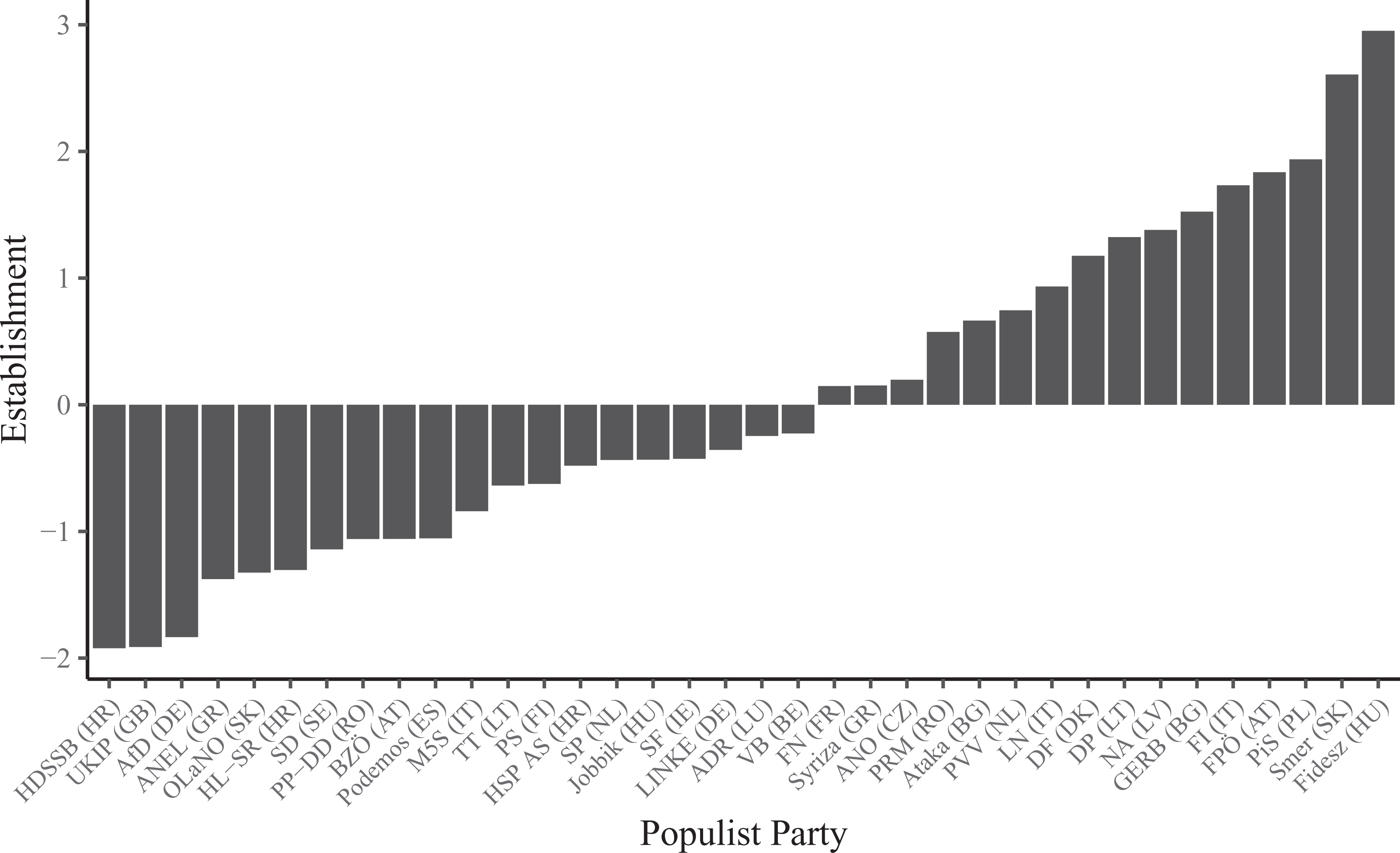
Distribution: establishment of populist parties in 2014.
The following multivariate models of the second-step regression control for two variables that might be confounders for the relationship under investigation. First, it might be that external efficacy unfolds a different effect in Eastern and Western European countries. Studies suggest that lacking feelings of external efficacy are especially widespread in the party systems of the young democracies in Central and Eastern Europe. As a consequence, this factor might be of less relevance for explaining populist party support. For that reason, we include a dummy variable indicating East and Central European countries. Second, the importance of lacking feelings of external efficacy is possibly influenced by the number of populist parties in a party system. If more than one populist challenger is successful, disenchantment with the political elite is likely to be less decisive when determining the support for one specific populist party. Again, we include a dummy variable to control for this possibility.
Results
As a first step, we estimated separate OLS regressions for the 36 populist parties. The dependent variable PTV was regressed on external efficacy controlling for internal efficacy, attitudes on European integration, the evaluation of the economy, attitudes on taxation and redistribution (only for left-wing populist parties) or immigration and same-sex marriage (only for right-wing populist parties), as well as sociodemographic controls. The results for the 36 regression analyses can be found in the Tables A.4 and A.5 in the Online Appendix.
Figure 2 summarizes the effects of lacking external efficacy on the PTV for a populist party for each country included in the analysis. In line with the findings of Rooduijn (2018) and our theoretical expectations, the estimates do not only vary regarding their statistical significance but also with regard to their direction. Six of the eight parties benefiting from lacking feelings of political responsiveness (i.e. with significant positive effects presented in Figure 2) had never been part of their respective national governments until 2014. We further find numerous recently established parties, such as the Spanish Podemos or the German AfD, in this group. Parties held out of government by a cordon sanitaire (the Belgian Vlaams Belang or the French Front National) also benefit the most from antiestablishment attitudes. At the same time, two cases run counter to our expectations. The Dutch PVV and the Danish DF have supported minority governments in the past and had been able to gain seats for at least three election cycles. Although these two parties were in government until 2014, they might have been successful in presenting themselves as political outsiders even while they joined or supported national governments. In this case, they would thus be examples of the “one foot in and one foot out of government” strategy (Albertazzi and McDonnell, 2005: 953).
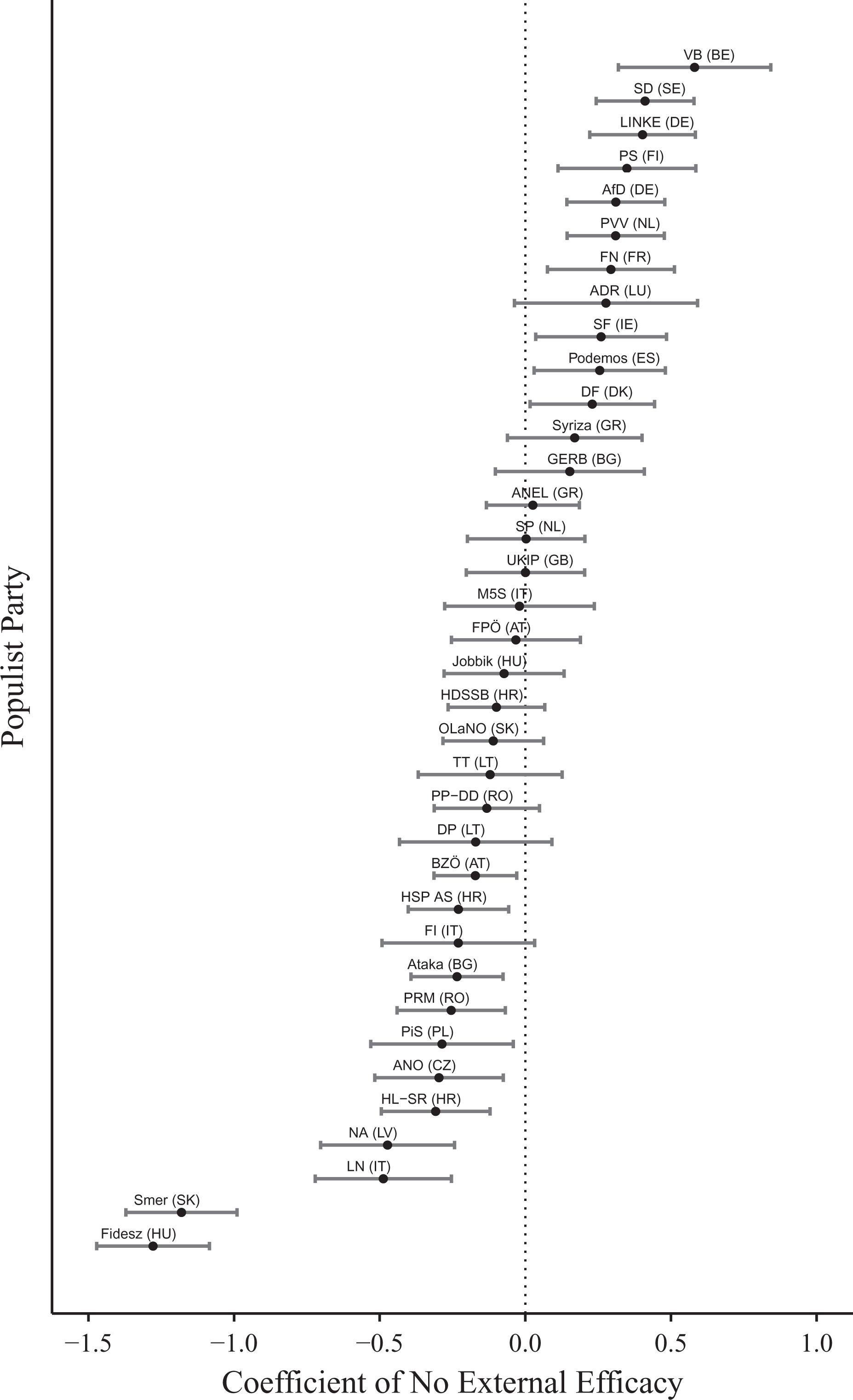
Coefficient of external efficacy on the propensity to vote for a populist party per country with 95% confidence bands.
On the other hand, lacking external efficacy shows a significantly negative effect in nine cases. Strikingly, the effect of feelings of external efficacy is strongest for the two populist parties in single-party majority governments (Fidesz and Smer). The remaining parties—except for the Croatian Labourists–Labour Party—have all been part of a government since their foundation and thus correspond to the idea of a more established party. All in all, this visual inspection lends support to our hypothesis that voting for populist parties is less driven by feelings of political disenchantment the more established these parties are.
Figure 3 shows the bivariate relationship between our two variables of interest along with a linear trend and 95% confidence intervals. The plot lends preliminary support for our central hypothesis. The size of the coefficient of lacking external efficacy is lower the more established a populist party is. As already indicated in Figure 2, Slovakia and Hungary have the most negative effect for lacking external efficacy. Given the limited number of observations in our study, it is possible that regression results are influenced by these particular cases. The following analyses will not only investigate the effects of the full model including all populist parties, but we will also focus on the question whether outlying cases drive the regression results of our main model.
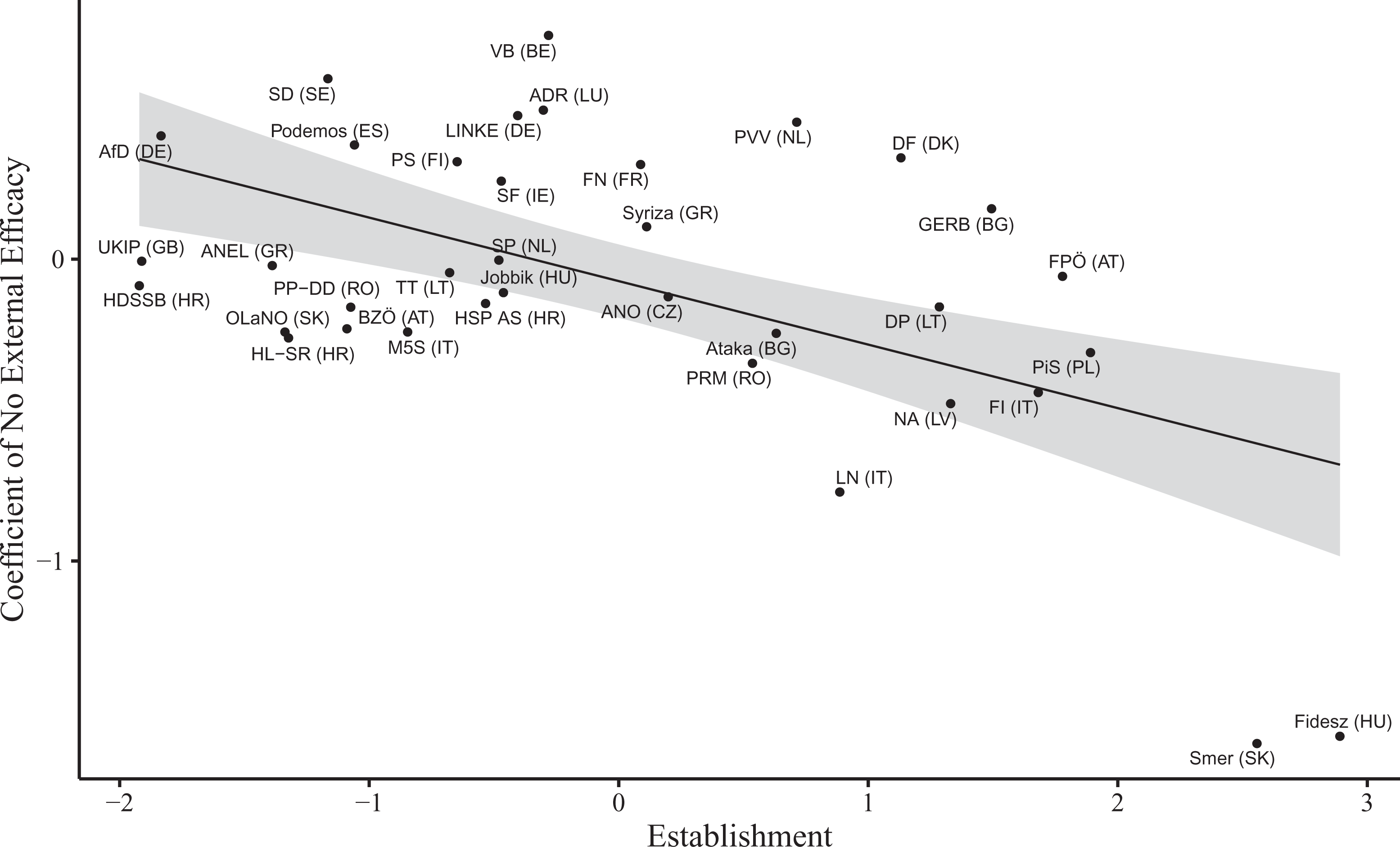
Bivariate relationship of establishment and first-step coefficients of lacking external efficacy. Note: Linear fit with 95% confidence bands.
We systematically analyze how the effects of external efficacy are influenced by the degree of establishment of the respective populist party by running the second-step regression. Hence, we regress the coefficient of external efficacy that has been derived from the country specific regressions on our establishment measure while controlling for the number of populist parties and Eastern European countries. Table 1 shows the corresponding results. The results in the first column are based on the entire country selection without dropping any outlying cases. Considering, first, the adjusted R 2 (more than 50%), this model explains large proportions of the variance presented in Figure 2. In line with our central hypothesis, the coefficient of populist party establishment is negative and statistically significant at the 5% level, indicating that with a one-unit increase in our measure of establishment, the effect of external efficacy decreases by 0.17 points.
Second-step model.
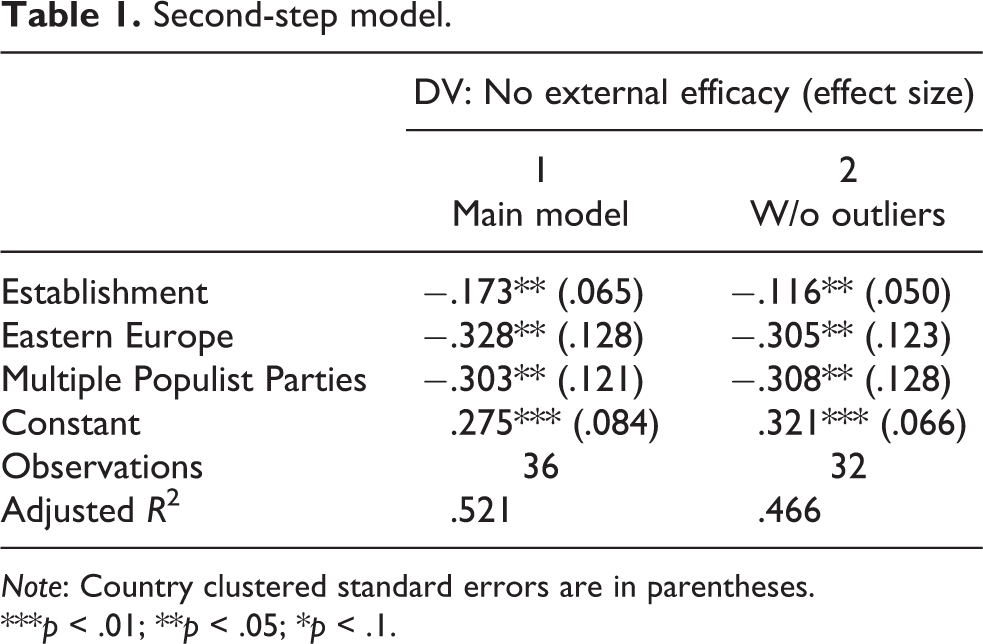
Note: Country clustered standard errors are in parentheses.
***p < .01; **p < .05; *p < .1.
The corresponding marginal effects plot (Figure 4, left panel) illustrates that the effect of lacking external efficacy on populist party support is only positive and significant for parties that are not established. Figure 4 furthermore suggests that the effect of lacking external efficacy becomes negative and significant for highly established populist parties. Populist parties with a long-standing presence in the national parliament and those in office benefit from positive feelings toward political responsiveness. Moreover, the dummy for Eastern European countries in table 1 equally shows a negative effect indicating that the impact of lacking external efficacy is lower in East European than in West European countries. This result is corresponding with observations pointing to the different character of anti-elite sentiment in these countries. Due to the lacking institutionalization of East European party systems, external efficacy is likely to play a more prominent role in these countries in general and is, thus, of less importance for explaining vote choice for specific parties (see, e.g. Kriesi, 2014). Lastly, the effect of additional populist parties within a party system also indicates a negative effect. This is in line with the expectation that the presence of multiple populist parties decreases the overall relevance of push factors as determinants of support for one specific populist party.
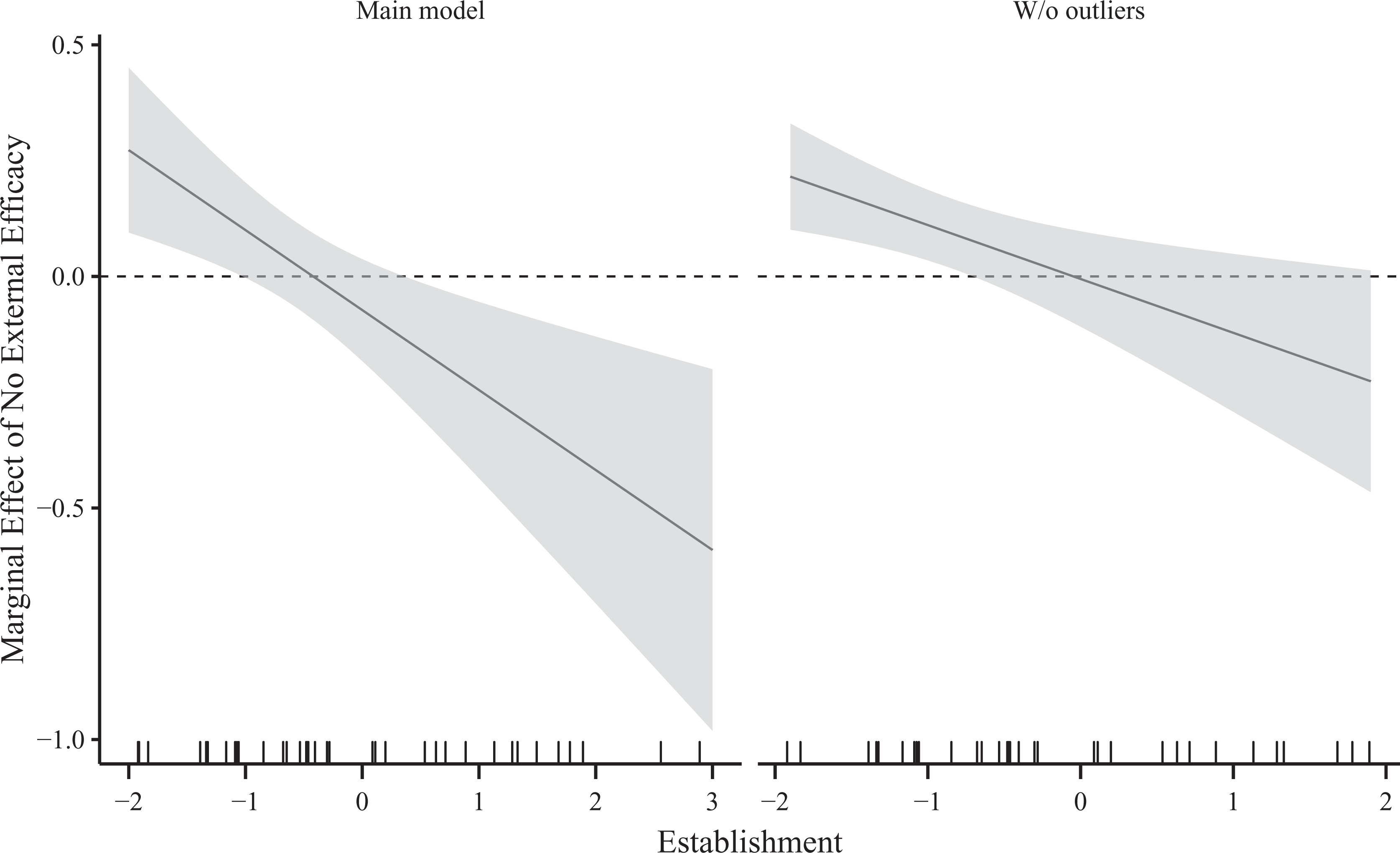
Marginal effects of establishment on external efficacy. Note: Marginal effects with 90% confidence bands.
As mentioned above, given the limited number of observations in the second step of our analysis, we must be careful with drawing conclusions. Outlying cases could drive the identified effect of populist party establishment on the impact of lacking external efficacy. For that reason, we use Cook’s distance criterion to identify potentially influential cases, that is, populist parties with large residuals or high leverage that could distort the results of our analysis. Based on this, four cases (GERB, UKIP, Fidesz, and Smer) were identified and excluded from the analysis. Importantly, this also includes the two cases that we have—by visual inspection of Figure 3—identified as potential drivers of our statistical effects. Model 2 in Table 1 lists the outcomes for this model. While the effect size of our independent variable of interest decreases, the size of the standard error is also reduced by approximately one-fourth. The results confirm the main finding of the first model. At the same time, the effects of the further two covariates remain statistically significant and point in the expected directions. We thus conclude that the identified effect of populist party establishment is not dependent on influential cases. Moreover, the corresponding marginal effects plot (Figure 4, right panel) equally confirms the results of the main model. However, in contrast to the first model, the marginal effect of lacking external efficacy no longer turns statistically significant for highly established parties. This suggests that especially populist parties that are in single-party majority governments benefit from increasing levels of external efficacy.
Robustness
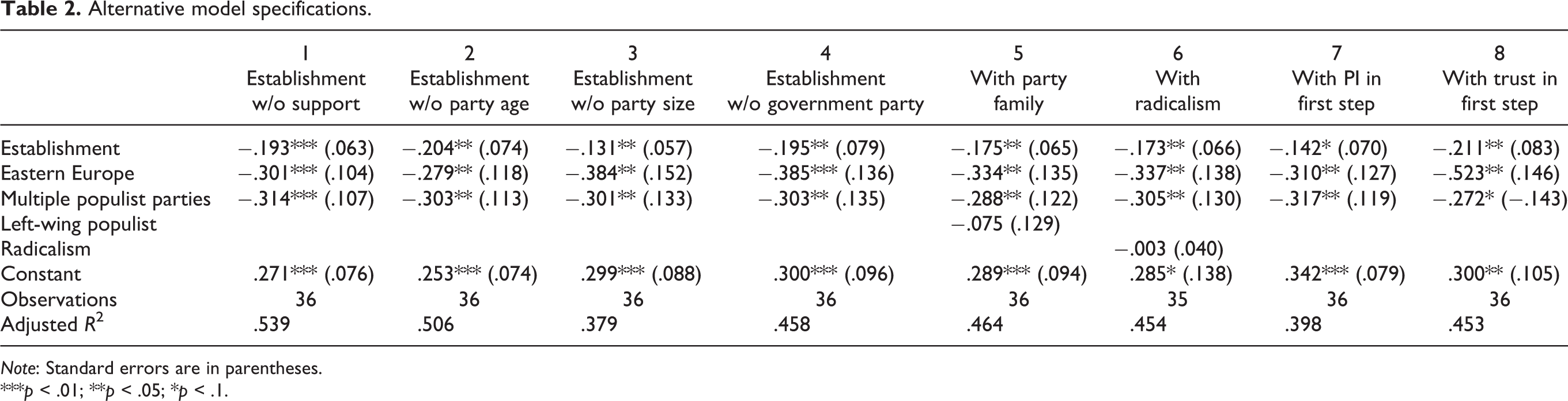
We tested for the robustness of our results by applying alternative specifications of our party establishment indicator (table 2). In model 1, an alternative measure of populist party establishment was used that does not take populist party support of minority governments into account. Furthermore, we excluded party age (model 2), party size (model 3), and government participation (model 4) when calculating the establishment score. None of these four alternative operationalizations of our main explanatory variable of step 2 changes the significance or substance of our results.
Alternative model specifications.
Note: Standard errors are in parentheses.
***p < .01; **p < .05; *p < .1.
In the second set of robustness checks, we included further potentially relevant control variables. Model 5 controls for the possibility that either left-wing or right-wing populist parties could be primarily driven by lacking external efficacy. This is not the case—the coefficient is not statistically significant. Again, size and significance of populist party establishment remain stable in this specification. Moreover, a change in the nature of established populist parties has to be distinguished from a mere moderation effect concerning their policy stances. Whereas decreasing importance of anti-elite criticism and a decrease in radicalism might empirically go hand in hand, they are conceptually different phenomena. When a populist party becomes an established player in a given party system, push factors should lose their relevance. However, this is not necessarily linked to the radicalism of a party—new parties can be moderate, and established parties can become more radical. Hence, we expect the effect of populist party establishment on the importance of external efficacy to be unrelated to the moderation or de-radicalization of the respective party. We controlled for the degree of radicalism by considering the position of each populist party on a general left-right scale provided by the Chapel Hill Expert Survey (Bakker et al., 2015). In order to account for country-specific characteristics, we constructed radicalism as the difference between the populist parties’ scores and the mean position of the overall party system weighted by the vote shares of each party. Controlling for radicalism does not substantially change any results (model 6). 7 Therefore, we are confident that a potential de-radicalization of the parties does not drive the effects found in the main model.
In addition, electoral research has shown that long-standing partisanship is one of the most relevant factors explaining party choice. This sociopsychological bond might be a dividing characteristic for supporters of more and less established parties. We controlled for party identification in the first step of the analysis to make sure that the effects of external efficacy were not merely due to differences in party identification. Model 7 indicates that if we include party identification in the first-step regressions, the effect size of establishment on external efficacy decreases slightly. The same holds for the level of significance although the effect remains significant at the 10% level. In the last of the robustness checks, we calculated the mean score of respondents’ trust in the national parliament and parliament’s perceived responsiveness and introduced this alternative measure of external efficacy in the first-step regression models. Again, the results at the second step remain substantively similar to the main model. Based on these results, we are confident to conclude that the identified impact of our establishment measure is neither caused by influential cases nor due to model specification. Moreover, the effect remains stable when controlling for the ideology or radicalism of populist parties, which reduces the risk of spurious correlation.
Lastly, we reestimated the main model using a classical multilevel model including cross-level interactions between external efficacy and establishment, Eastern Europe, and the number of populist parties in a given party system. We also inspected a multilevel logistic regression model where we replaced the dependent variable with the respondents’ vote intention in the next national election. Again, the establishment measure affects the impact of lacking external efficacy negatively and is only positive and significant for less established parties. 8
Conclusion
Recent literature has investigated the support bases of populist parties from the right and the left end of the European party spectrum (Rooduijn, 2018; Spierings and Zaslove, 2017; Van Hauwaert and Van Kessel, 2018). While these studies have contributed to the pressing question as to what unites voters of populist parties, they also pointed to certain research gaps. In contrast to previous expectations, which assumed political discontent to be a primary determinant of populist vote choice, they draw a more differentiated picture. As illustrated most clearly by Rooduijn (2018), common indicators of political disenchantment (such as lacking trust in parliaments and politicians) do not matter for all populist parties to the same extent. This article set out to explain the varying impact of these indicators.
In a first step, we explored the effect of lacking external efficacy on populist party support on a broad empirical basis. This is—to the best of our knowledge—the first study systematically exploring the impact of political disaffection on populist vote choice that goes beyond the universe of West European party systems. Considering also the “very different world of Central and Eastern European politics” (Kriesi, 2014: 373), our study confirmed the finding mentioned earlier: Lacking external efficacy plays to the advantage of some populist parties, but not of others. In some cases, even the opposite is true: Feelings of political responsiveness contribute to the success of these parties. In a second step, based on voter data on 36 populist parties in 23 EU countries, we have shown that support for populist parties is less driven by lacking external efficacy the more established the parties are in their respective party systems. In other words, while recently founded, smaller parties without government experience indeed benefit from anti-elite sentiment, this relationship does not hold for established populist parties. Our results prove to be robust even if alternative ways are used to operationalize the establishment measure.
Two normative interpretations of our results are possible. On the one hand, an optimistic reading of the findings would suggest that populist parties, when becoming established parts of the respective party system, lose their populist appeal to some extent. This would imply a reduction of populism and a “normalization” of their electoral support. A pessimistic reading, on the other hand, might point to democratically less positive shifts. Established populist parties might simply switch from blaming national institutions and actors to targeting, for example, supranational institutions like the EU. Recent developments in Poland and Hungary seem to speak in favor of this latter interpretation.
It is important to emphasize that our empirical analysis does not test for the underlying causal mechanisms, that is, the question which and how voters’ attitudes change with regard to the support of populist parties. On the one hand, the decreasing effect of lacking external efficacy might be due to attitude changes among the core constituencies of populist parties. In this case, supporters would perceive populist parties as less different from established parties in terms of their outsider status and change their opinion regarding the working of democratic politics in their country. On the other hand, the observed relationship might be the result of a compositional effect. In this case, more established populist parties might increasingly attract supporters that are more concerned about populists’ concrete policy positions at the expense of anti-elite sentiment. Investigating this relationship would necessitate panel data in order to observe and explain changing party preferences of individual voters. While such an approach lies beyond the scope of this article, it is a promising endeavor for future research. Lastly, the electoral consequences of increasing establishment and the demonstrated shifts in voters’ motives to support populist parties so far remain unexplored. Previous research has started to underline that increasing establishment and continued electoral success might cause populist parties to strengthen their organizational structure and enhance their agency credibility, which helps them with mass mobilization (Heinisch and Mazzoleni, 2016). Future research will have to focus on these supply-side factors in order to explain the determinants of populist parties’ electoral survival.
Supplemental material
Supplemental Material, sj-docx-1-ppq-10.1177_1354068819839210 - Becoming part of the gang? Established and nonestablished populist parties and the role of external efficacy
Supplemental Material, sj-docx-1-ppq-10.1177_1354068819839210 for Becoming part of the gang? Established and nonestablished populist parties and the role of external efficacy by Werner Krause and Aiko Wagner in Party Politics
Footnotes
Acknowledgement
The authors wish to thank Matthijs Rooduijn, Lena Röllicke and the two anonymous reviewers for their helpful feedback and comments.
Declaration of Conflicting Interests
The author(s) declared no potential conflicts of interest with respect to the research, authorship, and/or publication of this article.
Funding
We thank the WZB Berlin Social Science Center for funding support.
Supplemental material
Supplemental material for this article is available online.
Notes
References
Supplementary Material
Please find the following supplemental material available below.
For Open Access articles published under a Creative Commons License, all supplemental material carries the same license as the article it is associated with.
For non-Open Access articles published, all supplemental material carries a non-exclusive license, and permission requests for re-use of supplemental material or any part of supplemental material shall be sent directly to the copyright owner as specified in the copyright notice associated with the article.
