




Abstract
Using an agent-based simulation of electoral participation, this paper examines the second order or cascade effects of an exogenous increase in turnout. Unlike most previous applications of agent-based modelling in political science, we adopt a descriptively complex rather than a simple model of behaviour. Experimenting with different levels of mobilisation allows estimation of the extent to which mobilisation spreads beyond the primary mobilisation target across the population as well as whether or not it survives over time. We argue that in a complex world cascade effects are smaller than previously thought. However, mobilisation effects can create secondary effects through habitual voting and increases in political interest and party affiliation, which reverberate over time, creating long-term spillover effects.
Introduction
One way or another election campaigns matter, not necessarily because they persuade voters to change their minds (Erickson and Wlezien, 2012), but because they persuade people to vote (Fieldhouse and Cutts, 2009). Get out the vote (GOTV) campaigns have been subject to a considerable amount of research, most of which shows that mobilisation efforts are effective. Estimates of treatment effects in GOTV experiments are normally based on the difference in turnout between a control and treatment group at one point in time. However some of this effect may survive to subsequent elections, through the development of habit or inertia (Green and Shachar, 2000). Moreover, treatment effects may spill over to members of the social network of the primary recipients of the treatment. For example David Nickerson (2008) estimates that 60% of the average treatment effect is passed on to the spouse of the primary recipient. James Fowler (2005) referred to these as turnout cascades.
The dimensions of turnout cascades are spatial and temporal. Their crucial ingredients are social influence (for spatial contagion) and inertia (for temporal spillover). In recent years, researchers have revisited the effect of socialisation processes and social networks in studies of political behaviour, building on early work from the Columbia school which highlighted the role of social influences on electoral behaviour (Berelson et al., 1954; Lazarsfeld et al., 1948). Contextual voting theories imply that people follow similar patterns of political behaviour when they live in close proximity, interact, share day-to-day experiences, and belong to the same social networks (Huckfeldt and Sprague, 1995). These theories are increasingly being applied to models of electoral participation (Bhatti and Hansen, 2012; Cutts and Fieldhouse, 2009). Scholars have also begun to explore the individual level dynamics of turnout, examining the role of habit, in and of itself and in conjunction with network influences (Fieldhouse and Cutts, 2012; Franklin, 2004). Cascade models, however, present a puzzle. If social influence is as strong as evidence suggests, and participation is conditional on the participation of social referents, then moderate levels of direct, candidate, or party mobilisation should lead to geometric increases in turnout. However, evidently this is not the case.
In this paper we explore the interaction of these social and micro level dynamic processes using an agent-based simulation of electoral participation. The model simulates the interplay between many factors important to understanding individual turnout. These include socio-demographic characteristics, socialisation processes, instrumental behaviour, political interest, social norms, and mobilisation. More specifically we look at the effect of different degrees of party (direct) mobilisation in the presence of peer-to-peer (or indirect) mobilisation on voting behaviour (Rosenstone and Hansen, 1993). Unlike previous applications of agent-based modelling (ABM) in political science (Fowler, 2005; Huckfeldt et al., 2004), we adopt a descriptively complex rather than a simple model of behaviour. Using the complex model, we estimate the cascade effects arising from long and short election campaigns (Johnston et al., 2013). Experimenting with different levels of mobilisation allows us to examine the extent to which mobilisation might spread beyond the primary mobilisation target across the population as well as whether it survives over time. Moreover, we are able to explore the channels through which turnout cascades operate – for example through the development of civic duty or habit. We compare the magnitude of turnout cascades in a “complex world” with results from models of a simpler “small world”.
This paper makes two important contributions to the literature on turnout. First, we demonstrate a dynamic model of voting which is both descriptively complex and applicable to a number of different research puzzles. Second, under a number of different assumptions, we quantify the second-order (or indirect) effects of mobilisation of an election campaign in a realistic, complex scenario where voters have multiple motivations and barriers to voting and are subject to contextual influences in their decision making (McClurg, 2004; Rosenstone and Hansen, 1993). In doing this we are able to get a plausible estimate of the potential total effect of GOTV interventions. In contrast to Fowler (2005) we find that in a complex world, rather than producing simple geometric increases in turnout, cascades can become truncated or overwhelmed by other factors, often affecting those who might have voted anyway, and even crowding out the effects of peer-to-peer mobilisation.
Theoretical underpinnings of the model
There are many theories of turnout reflecting different approaches to political participation in general and to turnout in particular. People vote for a variety of reasons including the fulfilment of civic duty or group norms; to express support or disapproval for a particular party; and the desire to affect the outcome in respect of policy. Equally there are many reasons why people abstain, including indifference about the alternatives, ambivalence, alienation, lack of resources, or an unwillingness to bear the costs of voting (Blais, 2000). Unlike many analyses of observational empirical data which are designed to show support or otherwise for specific theories, an agent-based model is based upon theoretical assumptions and can be used to test the implications of those assumptions. Whilst many scholars set one theory against another on the basis that only one can be correct, an agent-based approach encourages us to explore how different models of voter behaviour can operate side by side and interact with one another to produce complex effects. In building a descriptive agent-based model of turnout it is important to learn from as many theories and as much evidence as possible, identifying the key motivations underpinning voting rather than identifying correlates. In this research our models draw on a number of intellectual inheritances, each of which has something to teach us about why people vote or abstain.
According to sociological theories of voting behaviour, political attachments are assumed to be shaped by voters’ social and psychological characteristics, social group belonging, and the social context in which individuals grow up, live, and work. Voting is, in essence, the expression of those loyalties. In the influential social-psychological approach (typified by the Michigan school), the importance of social group membership is re-enforced by early socialisation experiences that foster the development of partisan attachments or party identification associated with social class membership (Campbell et al., 1960). In turn these influence the propensity to vote as well as party choice. Thus, the act of voting is an act of allegiance, and therefore one explanation for abstention is a lack of group attachment. The early sociological studies of the Columbia school emphasised the importance of interpersonal influences and flows of information within social networks on voting. When individuals make electoral choices, they take into account the values, expectations, and preferences of others, including: family, friends, work colleagues, and neighbours (Berelson et al., 1954; Lazarsfeld et al., 1948). This interpersonal influence, at the heart of early sociological models of voting, forms the core part of mobilisation models of turnout.
Mobilisation can be divided into two main interrelated components (Rosenstone and Hansen, 1993). First, political parties and candidates attempt to mobilise supporters through election campaigns and GOTV initiatives, and there is plentiful evidence from field experiments to show these are effective in persuading electors to turn out to vote (Cutts et al., 2009; Gerber and Green, 2000). Second, interpersonal mobilisation is said to occur when turnout is encouraged by members of the social networks. Interpersonal influence can lead to mobilisation though enhanced interest in politics, or more directly as a result of individuals being asked to vote by friends and acquaintances (Huckfeldt and Sprague, 1995). Understood as a social activity, simply having someone to walk with to the polling station on election day may be the difference between voting and abstaining (Fieldhouse and Cutts, 2012).
Instrumental- or choice-based models focus on the costs and benefits accrued from voting (Aldrich, 1993; Blais, 2000; Downs, 1957; Riker and Ordeshook, 1968). Classic rational choice theories explain non-voting as the rational course of action when the benefits of voting are expected to be outweighed by the costs. Although the costs of voting are usually minor they are often considered to exceed the expected benefits due to the extremely low probability that any one individual’s vote will be decisive. This leads to the well-known ‘paradox of voting’ (Riker and Ordeshook, 1968); given the probability of affecting the outcome is normally vanishingly small, rational, self-interested actors should not vote, yet people do vote in their millions. Notwithstanding this, the expected utility from voting is a function of the relative difference between the utility of a vote cast for one party instead of another. Without a preference for one party over the other(s) there can be no relative utility differences and non-voting may occur because of indifference (Brody and Page, 1973). From this perspective, non-voting is not a separate decision from party choice. Extending this logic, non-voting (or choosing ‘none-of-the-above’) might also reflect electors’ evaluations of party performance on valence issues (Clarke et al., 2009). Instrumental motivations to vote are therefore shaped by the political interest and knowledge of electors which in turn are linked with levels of education and exposure to information (Dalton, 1984). In order to resolve the paradox of voting, rational choice scholars have extended the definition of instrumental voting to include benefits accrued not from the outcome of the election but from the actual participation; or in other words consumption benefits (Fiorina, 1976) including expressive or symbolic motivations (Brennan and Lomasky, 1993) and social norms including civic duty (Knack, 1992).
From these established theories of voting we can identify key motivations underpinning turnout: instrumental motivations reflecting outcome-related benefits and costs; symbolic motivations stemming from the expressive benefits derived from supporting a particular candidate; and normative motivations reflecting the social norms of voting (e.g. civic duty). Our approach brings together these motivations to vote in a relational and dynamic model of turnout in which voting is a social activity which responds to circumstantial factors defined by the voters’ changing social situation (Fieldhouse and Cutts, 2014). It is a dynamic model in the sense that voting on any occasion is causally linked with voting on other occasions in an individual’s lifetime. We draw on the concepts of inertia and habit to represent how turnout evolves over the political life of individuals (Aldrich et al., 2011; Cutts et al., 2009, Denny and Doyle, 2009; Fowler, 2006; Gerber et al., 2003; Green and Shachar, 2000; Plutzer, 2002). The core argument is that voting at one occasion leads to an increase in the probability of voting at a subsequent election after allowing for observed and unobserved characteristics of electors. Voting is relational in the sense that the turnout of any individual is causally linked with the turnout of others in his or her social network. Each of the types of motivation described above has a social component: for example, the strength of expressive motivations to vote depends on the number and identity of other voters in a citizen’s social network (Schuessler, 2000).
Agent-based models as tools of social inquiry
Most previous analyses of turnout had been based on observational data using ‘top-down’ statistical methods such as regression. These methods are suitable for testing hypotheses where processes are linear and additive. However in political science the situation is often a lot more complex than these models can accommodate. Processes overlap and interact in complex and unpredictable ways. Agent-based models, unlike analytical statistical methods, can be built from bottom up and can accommodate the possibility that human groups “may be highly complex, non-linear, path-dependent and self-organising” (Macy and Willer, 2002, p.144). Agent-based simulations are often used to explore inherent possibilities (e.g. thought experimentation) and may be validated by empirical data. In relation to the magnitude of turnout cascades, agent-based modelling allows us to extrapolate the possible total effects of mobilising a proportion of voters, given what we know about how voters behave. This is not self-evident and cannot be simply inferred from the size of treatment effects estimated from an individual level GOTV experiment. The size of the effect on turnout at the micro level will depend not just on the effectiveness of the campaign or the receptiveness of voters but the extent to which voters influence each other and the longevity of that influence.
An agent-based model is relational insofar as behaviour of each agent depends on the behaviour of other agents. Moreover it is dynamic in the sense that electors (or agents) are adaptive: that is, the respondents change due to processes occurring within the model. Adaption can occur at the individual level or the group level and means that processes are potentially subject to feedback effects and path dependence. While agents are autonomous and self-organising, they respond to the actions of others and the properties of the whole, which in turn is more than the sum of the parts. Consequently, macro relationships may not accurately reflect individual-level relationships, giving rise to ecological fallacies and contextual effects. As well as autonomy, interdependence, and adaptivity, agents normally follow simple (or not so simple) rules. These rules are a computational description of a given process, in this case the decision to vote. Some of our behavioural rules for voters are set out in more detail below. First however, we say a little about our approach to modelling.
The central dilemma in modelling social phenomena is rooted in its sheer complexity – there is simply no guarantee that we will be able to understand any agent-based model that adequately captures what is being modelled. There are broadly two approaches to this difficulty: KISS (“Keep It Simple Stupid”) and KIDS (“Keep It Descriptive Stupid”) (Edmonds and Moss, 2005). The former approach is based on a belief that understanding will be more likely to result from the formulation of relatively simple models that will approximate human social behaviour sufficiently well to be useful guides. Such models are sufficiently simple that their behaviour can be comprehensively analysed, possibly using analytic techniques. Such models are often characterised by a use of random “proxies” for aspects of human social behaviour that are either poorly understood or too complicated. Another way of putting this is that the assumptions used are pretty strong and often controversial. These kinds of model are, in general, at some “distance” from observed social behaviour so that they tend to be used more as a formal representation of a theory of behaviour, a way of explicitly representing and understanding a set of ideas about social mechanisms and how they might interact. What results is akin to an analogy, albeit in computational form; the model does not relate directly to the data but rather captures an idea which is then used to understand society in a rich, analogous, but imprecise manner. To summarise, the KISS approach has rigour, in that the model can be well analysed and understood but tends to lack close relevance to what is observed. This is generally the form of ABM used in political science (Axelrod, 1997; Fowler, 2005; Fowler and Smirnov, 2005; Huckfeldt et al., 2004; Rolfe, 2012).
The second approach, and the one taken here, seeks to build simulations that reflect what is observed to occur. Such an approach almost always results in relatively complex simulations, maybe with several social processes occurring and some representation of complex cognition in the computational representation of social actors. Here the assumptions tend to be of a weaker and more “mundane” type and the elements of the simulation correspond in a more natural way to what is observed. The simulations developed in this paper are of this type. The advantage of such simulations is that they can be related more directly to the available evidence at both the micro-level and macro-level (Moss and Edmonds, 2005). The disadvantage of the KIDS approach is that the simulation models that result are slow and complex – sufficiently complex that one can never say that one completely understands the interactions within the model and almost always too complex to analyse analytically. Thus, although this approach produces an explicit model of the complex interaction of social processes, it may not result in a full understanding of them. In other words, the model abstracts in a more gradual way from the evidence, and not in one “heroic” leap as often happens in the KISS approach. However, there remains the danger that by losing the simplicity of the KISS approach we lose ability to isolate and understand the particular effects that we are interested in.
The voter model
The simulation is based on a model that incorporates not only turnout but also all essential attributes relevant to the evolution of a hypothetical electorate. The scenario we have built is for a single constituency/single candidate election in an imaginary geographical location with a population of approximately 1000 people nested in households. The model includes population dynamics (e.g. fertility and mortality), the evolution of the population (immigration, immigration, household formation, moving house, etc.), social network formation (including factors such as homophily and propinquity), individual values and norms (e.g. civic duty, partisanship, voting habits, and voting intentions), network influence and discussion (in respect to values and norms), and political behaviour (turnout party and choice). These processes all happen in conjunction in the simulation, but are based on specific rules. The time component of the simulation is divided into weekly “ticks”, with each tick representing a week and four ticks representing a month. Figure 1 gives an overview of the main elements included in the simulation.
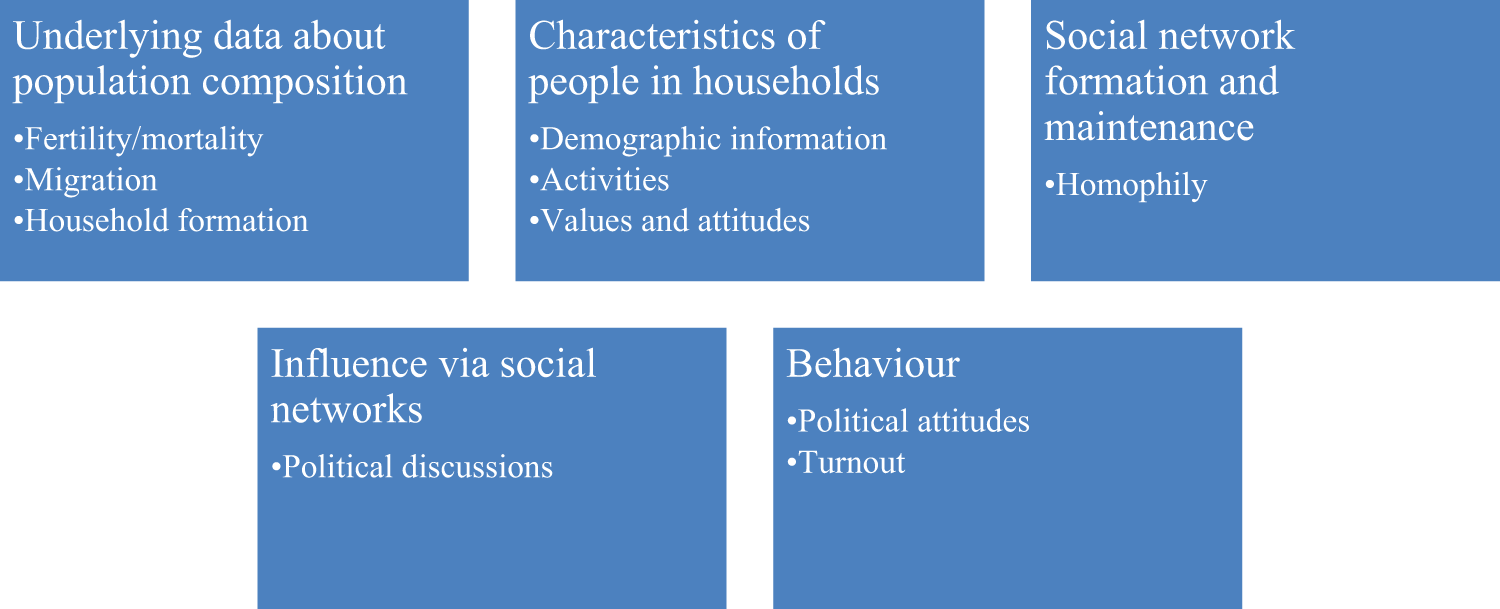
Main components of the voter model.
The simulation’s population evolves according to the population dynamics rules, which are based on official UK population statistics (e.g. fertility and mortality rates). The demographic and socio-economic characteristics of the population are initially drawn from the 1992 British Household Panel Study (BHPS). The initial values with respect to political values and norms are also based on real values from the BHPS. All agents live in households which may or may not include other electors and non-electors (e.g. children). The population inhabits a grid which contains spatial dependence, in that social groups have a tendency to locate in spatial clusters and agents may develop social networks within neighbourhoods (i.e. equality spatial proximity). As noted by Huckfeldt et al. (2004), voters are subject to cross-cutting pressures from interlocking social networks, which allows for disagreement in networks to survive despite pressures towards conformity.
Network formation
Social networks in the model consist of links between agents. These links might appear or disappear so that the network is continually changing. Links are intended to represent a relationship between actors that would sustain a political discussion if the participants are inclined. Thus the absence of a link means that no political discussion could occur, but the presence of a link is only a pre-condition for such an event. Links are of different types: household, neighbour, school, work, and activity related. At different stages agents are “members” of different arenas where networks may form, such as households, schools, workplaces, and social activities. During the simulation, links are made in a number of ways. All agents within a household are always linked to each other, but other links are formed probabilistically
Any agent to similar agents in the surrounding locations. Agents with children to similar agents with children at the same school. Agents in employment to others employed at the same place of work. Members of social activities to other members of the same activity.
For each type of link there is a probability that a new friend is made from all the “friends of friends” but only within each type of link. Links may also be broken if circumstances change. For example, if an agent moves to a new location then, with a high probability, neighbourhood and household links may be broken. Additionally, some links are dropped randomly at any time with a given probability. Links are made using a mixture of randomness and homophily using the following process: a random sample of N candidates (where N is appropriately set for each kind of link formation above) is constructed, and then the most similar selected.
Rules of behaviour for agents
As noted above, the rules that agents follow are critical to the behaviour of the model. To start the model specification process a set of stylised facts about the processes that we believe influence an individual’s decision to vote (directly or indirectly) were derived from the literature. More specifically the model was designed to reflect a relational theory of voting set out as discussed above. We called these “causal stories” to emphasise their narrative character. The model was built to incorporate all of these causal stories within a coherent framework. Whilst agents follow a large number of fairly simple rules, these rules are based on the causal stories, for example between political interest and discussion or between education and civic duty. Other relationships which may be observed as outcomes from the model (and in real life) are not pre-programmed but rather are emergent properties (e.g. differences between ethnic groups or age groups in turnout). There are also a large number of endogenous aspects. For example, children of partners born when the model is running will have new characteristics that are strongly related to those of their parents. Some characteristics of agents, including civic duty, habit, level of political interest, turnout, membership of household, schools, workplaces, and activities, are subject to social influence and therefore change depending on interactions with other agents (see below). These changes are probabilistic, depending both on characteristics of the discussants and on the frequencies with which messages are received. Messages (or ‘endorsements’) and events (such as having a discussion or voting in an election) are stored in agents’ memories but may be forgotten with a specified level of probability. Calibrated aspects include the composition of new households (either at the start or households immigrating into the area); demographic statistics (birth, death, leaving home, class), and the frequency of discussion probabilities.
The decision rules for agents are, individually, relatively simple, but combine in complex sequences as the simulation progresses. The agents make a series of ‘decisions’ covering moving out of the home, partnering, separating, etc., the most important being who to link with, when to hold a political discussion, and whether to vote. The complete model rules are too numerous and too complex to recount in full detail but some of the key ones are summarised below. Readers interested in scrutinising the assumptions and mechanics of the model can refer to the computational code and accompanying document which provides details and sources of evidence for the rules. 1 In this section we present the rules of behaviour of agents which are most important in determining the turnout decision.
In our model, electors intend to vote (or abstain) for a variety of reasons reflecting the motivations described above (see Figure 2). Elections occur every year but every fourth election is considered a high salience or first-order election when campaign conditions are different. Agents always vote for the party they support, which they acquire through political discussion (Huckfeldt and Sprague, 1995). There are a number of possible conditions under which agents will cast a vote. Each condition is acquired probabilistically through processes of interpersonal influence and learning. If the necessary conditions for voting are acquired, turnout is automatic (deterministic) except insofar as ‘disturbances’ intervene to prevent voting.
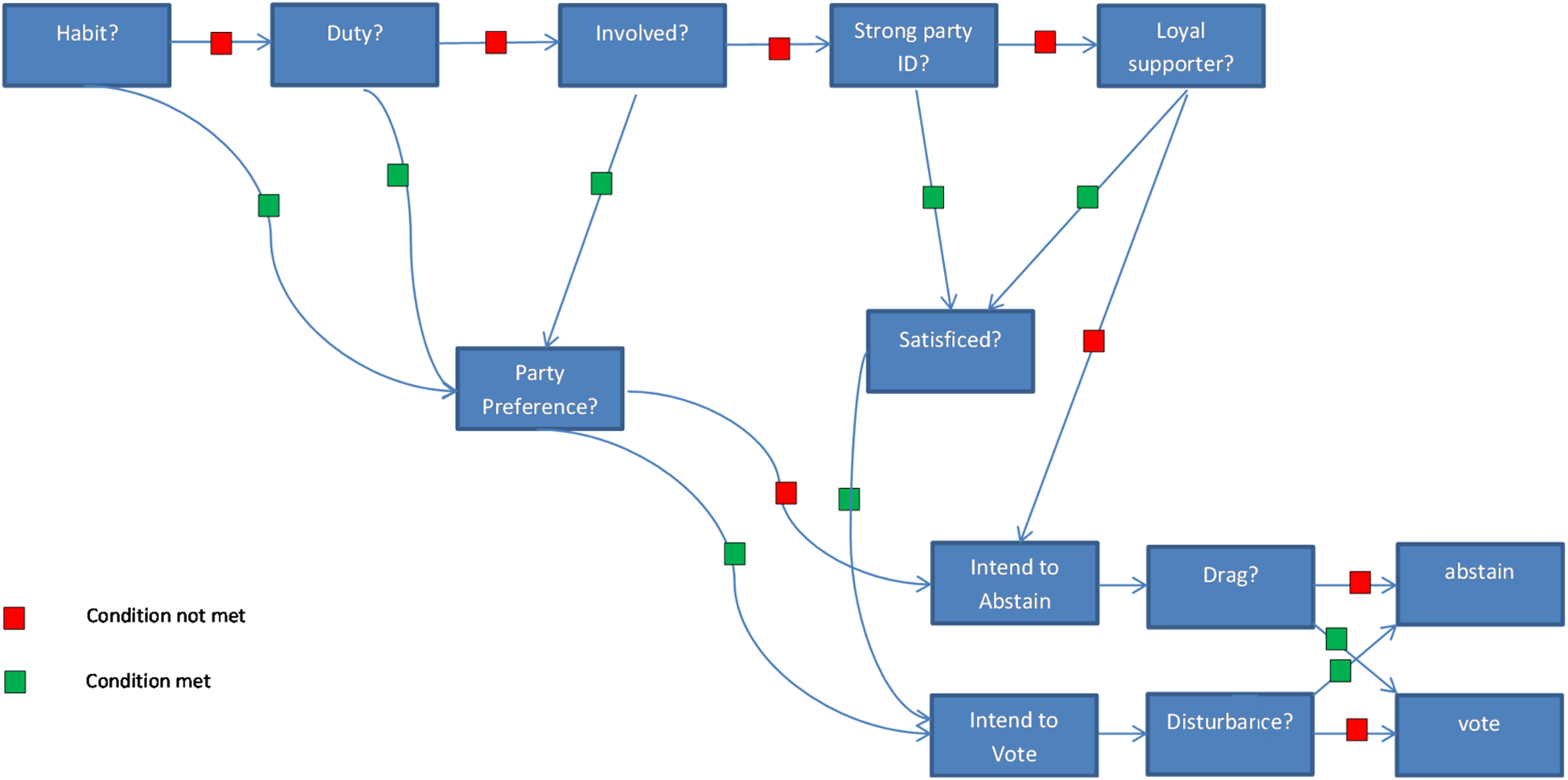
Voting intention criteria.
First, reflecting instrumental and symbolic motivations to vote, agents vote because they care in some way about the election outcome (and never vote if they have no preference). Symbolic or expressive motivations are determined primarily by the strength of party preference of agents and those of their networks (Schuessler, 2000). However, their participation also depends on their previous experience of voting, shown as the ‘satisficing’ condition in Figure 2 (Bendor et al., 2003; Fowler, 2006). The strength of partisanship is itself determined by network influence. Moreover, symbolic motivations are dynamic and self-reinforcing whereby agents vote if they have an established habit of voting for the same party at repeated elections (Lewis-Beck, 2008). This is captured by the ‘loyal supporter’ condition in Figure 2. Moreover, following cognitive mobilisation theory, agents also vote if they are sufficiently politically interested (Dalton, 1984).
Second, reflecting normative motivations for voting, agents vote if they possess a sense of civic duty which represents the social pressure to vote (Blais, 2006; Coleman, 2004; Knack, 1992). Civic duty is a property of agents (an endorsement) that is acquired through discussion and is therefore subject to network influence. The acquisition of civic duty is influenced by the level of education of the agent (Jackson, 1995). Civic duty may be reinforced by voting (Gerber and Rogers, 2009), but like other endorsements can be forgotten.
Reflecting the dynamic element of the model, voting of agents does not require repeated recourse to instrumental, symbolic, or normative motives to vote. Instead voters may use previous behaviour as a heuristic device (Aldrich et al., 2011). In our model, agents vote if they have a habit of voting – once they have voted in three consecutive elections they are considered to have established the habit of voting (Franklin, 2004). This is captured by the ‘habit’ condition in Figure 2.
Whatever their reason for intending to vote, in keeping with the theory of planned behaviour (Ajzen, 1985) the intention to vote may or may not be fulfilled come election time (Netemeyer and Burton, 1990). As noted above, agents without a party preference do not vote regardless of their habits, norms, or level of political interest. In this sense, abstention can be as rational as voting. This reflects the existence of indifference or alienation in the electorate (Brody and Page, 1973). However, if agents do have a preference and a motive to vote, they acquire a vote intention (see Figure 2). However, other factors may disturb or interrupt voting intention including losing a job (Rosenstone, 1982), moving house (Dowding et al., 2012; Highton, 2000; Squire et al., 1987), having very young children in the household (Wolfinger and Wolfinger, 2008), and illness (Denny and Doyle, 2007; Schur and Kruse, 2000). These all carry a probability of causing agents to fail to vote despite a positive intention. Conversely, those without the intention to vote can be mobilised by family and friends or by political parties on Election Day (McClurg, 2004; Nickerson, 2008), a process that is reliant on pre-existing political discussion networks (this is captured by the ‘drag’ condition in Figure 2).
Political discussion networks
As noted above, key factors in the voting decision are subject to network influence. In the model, network influence is passed on via political discussion networks (PDNs). They are a subset of an agent’s wider social network as described above, the only distinction being that political discussion only takes place between those with a minimal level of interest in politics. 2 The discussions that occur within PDNs have various components: (1) Duty, i.e. messages about importance of voting (civic duty), only present if discussant has civic duty; (2) Colour of message (party preference); (3) Strength of message (more weight is given to discussions where experts are involved); (4) Location, i.e. where the discussion happens (network); and (5) Occurrence, i.e. record in memory, including information about the link with the discussant. Endorsements (such as civic duty or interest) are passed on probabilistically through political discussions. The ability to pass or receive information is dependent on the level of political interest, with more interested agents being more prone to discussion (Bennett et al., 2000; McClurg, 2003; Johnston and Pattie, 2006). For example, civic duty is passed from one actor to another on a probabilistic basis if it is part of a given discussion (i.e. if at least one agent in the discussion possesses it). Similarly the party preference of an agent can change depending on the content and frequency of discussions with partisans of other parties. Following Huckfeldt et al. (2004), network influence on party preference is autoregressive. The likelihood of switching allegiance from one party to another is dependent not only on the content of the most recent discussion but also the content of previous discussions held with other agents. For changes of allegiance it is not sufficient to receive the same endorsement repeatedly from the same agent. This message must be reinforced by other agents.
An additional element of network influence is the possibility that agents may persuade other connected citizens to vote with them on Election Day (Fieldhouse and Cutts, 2012). This is an additional component of cascades, in that all agents who have been convinced to vote by parties can also ‘drag’ people from their networks to the polling station on Election Day. 3 Rates of interpersonal mobilisation (or dragging) vary according to the relationship with, and the political interest of, the ‘dragger’. 4
The campaign and the cascade
Political scientists have identified how parties increasingly step up their campaign efforts well in advance of the official declaration of an election. Campaigns commonly consist of two key periods (Johnston et al., 2013). First, the long campaign, which can start from anything from a year before the election, is a period during which parties continue to attempt to build their support base by persuading and socialising voters. Second, from around four to six weeks out, after an election is called, the short (official) campaign period may begin. During this period, the focus switches from persuasion to mobilisation, as parties attempt to ensure their supporters turn out to vote for them. The focus of their efforts is on previous supporters who they are reasonably sure will support them. The notion of turnout cascade is inevitably dependent on the length of the campaign and the extent to which citizens (or agents) who are mobilised have an opportunity to mobilise others in their network: the shorter the campaign period, the lesser the opportunity for second order mobilisation effects to arise. To put it another way: if mobilisation by parties were only to take place on Election Day, then the agents that are contacted will have little opportunity to spread their influence to their friends, neighbours, or colleagues, except perhaps through voting together (Fieldhouse and Cutts, 2012). However if the campaign takes place over a sustained period, then everyday conversations about politics as well as Election Day decisions to vote may spread across the network through discussions, not only about vote intention directly, but also through an increased interest in politics or a spread of the social norms of voting.
To operationalise this opportunity for turnout cascades, we simulate an election campaign, constituting a long campaign where agents may influence each other’s attitudes and political interest, and a short campaign where voters are mobilised and may mobilise each other. The long campaign starts 16 weeks before every fourth (first-order) election. In order to provide a realistic representation of the opportunities for interpersonal influence and turnout cascades during these campaign periods, we allow parties to affect the level of support for their party by increasing the number of favourable discussions. This is achieved through additional political discussions initiated by agents with the highest level of political interest, the ‘politically involved’ (who take the role of party activists). Like regular discussions, these interactions can affect agents’ levels of political interest, civic duty, and affiliation. This represents the party’s attempts to not only convert but to socialise voters into becoming more party-politically oriented. These interactions are not restricted to party supporters, and do not need to belong to the same network. The effects are (by virtue of other properties of the model) limited to those who have a certain level of interest in politics.
The short campaign starts four ticks before the election and occurs at every election. It also includes increased discussion, but these discussions affect the intention to vote of supporters of each party. During this period each politically involved agent will communicate with a set number of agents of the same colour (but not necessarily within their own discussion network). This number is varied to increase or decrease the amount of campaign effort. These additional short campaign (mobilisation) messages carry a probability of altering the intention to vote as well as the normal discussion components. Receiving a message with an intention to vote can increase the recipient’s intention to vote but not decrease it. Following Arcenaux and Nickerson (2009), we might expect a curvilinear relationship between the effectiveness of mobilisation attempts and turnout, such that mobilisation attempts are most successful amongst those with levels of propensity to vote close to 0.5. In other words, the effect on intention may depend on the existing probability of voting of the agent. 5 In the short campaign when intention can be influenced, party mobilisation attempts, by definition, are instigated by involved agents of the same party. Changes to intention to vote, as well as political interest, civic duty, or affiliation may be passed onto other agents through discussion in subsequent weeks up until Election Day. In other words, vote intention is a normal component of all discussions during the short campaign.
Results
Results from agent-based simulation vary from run-to-run. In this section, we show results averaged over 50 simulations for each scenario with what we believe to be the most plausible values on the key parameters (though sensitivity analysis based on alternative assumptions are described in the Appendix). Figure 3 shows the simulated turnout over 10 elections over a 40 year period, under conditions where no electors are mobilised directly by parties (or informed agents), where agents have a 10%, 20%, and 40% chance of being contacted each week. The actual level of turnout is not crucial as it is largely dependent on the precise settings of the model parameters but it is reassuringly similar to turnout in first-order elections in Britain and other countries from where evidence for the model is drawn. Figure 3 suggests that party mobilisation allows turnout to reach a stable equilibrium more quickly. Moreover, analyses with alternative assumptions about the levels of political discussion demonstrate that unless political discussion is relatively high, party mobilisation is necessary to sustain turnout (see Appendix). This has important implications for our understanding of turnout dynamics, most notably in providing support for mobilisation models of participation which stress the significance of declining mobilisation by parties in declining turnout (Rosenstone and Hansen, 1993).
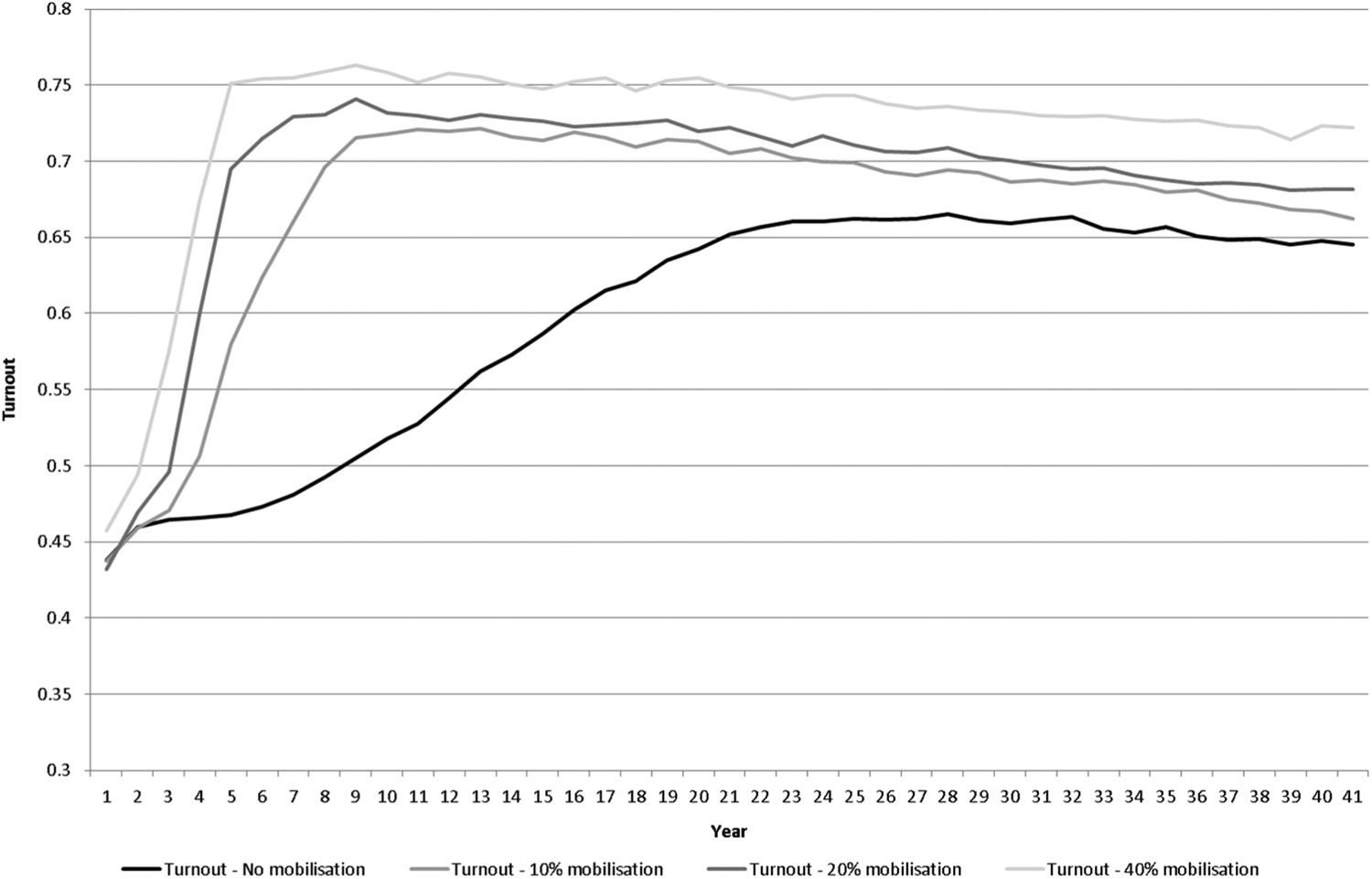
Average turnout with different levels of party mobilisation.
The primary purpose of our simulation is not, however, to predict turnout levels at different levels of mobilisation. Rather we are interested in the extent to which second order, peer-to-peer mobilisation flows from the mobilisation activities of parties. To do this we must estimate the average values of a number of quantities derived from the simulations. Specifically, the aim of the following analyses is to identify the relative size of first-order (party based) mobilisation and any second order peer-to-peer mobilisation effects that occur as a result of that party mobilisation. In other words we do not measure and report all interpersonal influence, but rather compare different scenarios with varying degrees of party mobilisation and interpersonal mobilisation. This is akin to conducting a large experiment in which our simulation is the laboratory and we not only have control over who is mobilised by parties, but also we are able to see inside the heads of agents in order to understand the impact this mobilisation has on those agents and also on members of their social networks. There are three key components of the model that are varied in the long campaign and the short campaign periods:
Peer-to-peer influence over intention (i) Peer-to-peer Election Day mobilisation or ‘dragging’ (d) Party mobilisation (p)
It is important to note that when peer-to-peer influence on intention (i) is ‘switched off’ agents may still pass on civic duty or party preferences as normal, but they do not affect vote intention directly.
Figure 4 compares the evolution of turnout under experimental conditions with party mobilisation set at 0% and 20%, with peer-to-peer influence over intention (i) and Election Day mobilisation or ‘dragging’ (d) both on and off. The first thing to note is that peer-to-peer influence on intention has little impact on the overall level of turnout whether party mobilisation is on or off. For example, comparing the two sets of dashed series in Figure 4, we see that when party mobilisation and interpersonal Election Day mobilisation (dragging) is held constant, there is very little difference whether ‘i’ is on or off. This does not mean that interpersonal influence is not important overall since it is crucial to maintain levels of political interest, party support, and social norms of voting. Rather, despite potentially having quite a substantial influence over intention rates, the peer-to-peer (second-order) influences over intention that flow from the additional (first-order) discussions generated by the campaign provide little by way of additional stimuli to turnout. One reason for this is that the number of agents actually influenced by their peers (as a result of being contacted by the campaign) remains relatively modest in all scenarios due to a lack of discussion about politics within many networks. Second, those who are most likely to be reached by these second-order contacts are already likely to share the voting intention of their discussion partners (through longer term influences on civic duty and political interest running in both directions, together with homophily in network formation). In other words those most likely to pass on positive messages about voting intention are more likely to talk to people who already intend to vote.
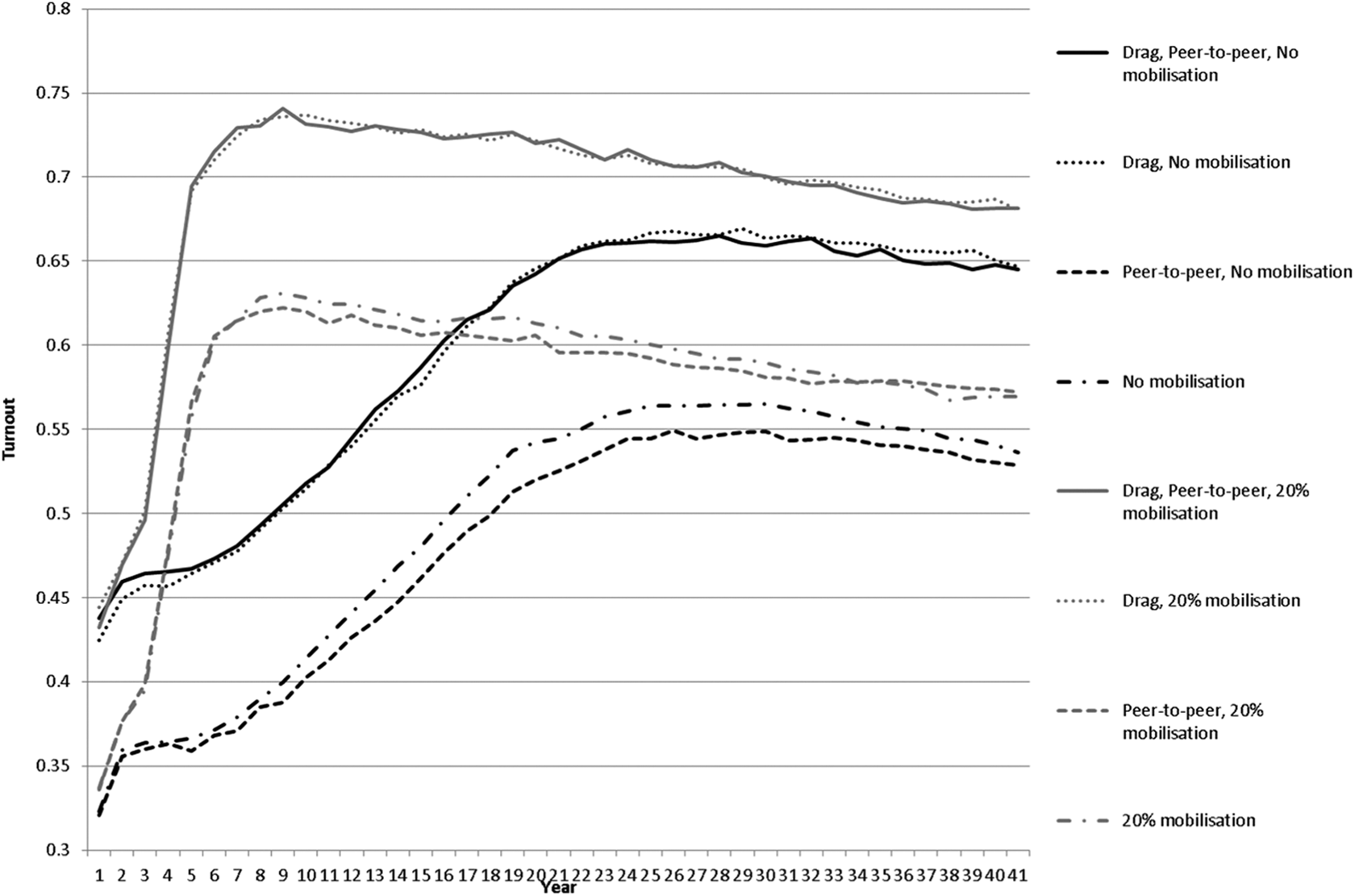
Effect of Election Day mobilisation (d) and peer to peer influence when party mobilisation = 0% and 20%.
By contrast the effect of Election Day mobilisation (d) is quite strong which can be seen by making the relevant pairwise comparisons with d on and off. For example, in Figure 4, comparing the lighter (party mobilisation = 20%) solid line with the lighter dashed line, we see that turnout is roughly 10% higher when interpersonal Election Day mobilisation (d) is switched on. The same is true when party mobilisation is absent (the equivalent darker series). The ability of voters to mobilise others to vote on Election Day regardless of their underlying intention was built into the model and reflects possible companion effects. Nevertheless, that it affects the simulated level of turnout regardless of the level of party mobilisation (unlike peer-to-peer influence) is interesting. Influence over intention may be redundant due to homogeneity of discussion networks with respect to political engagement, the network acting a little like an echo chamber for the highly engaged or the disengaged. In contrast, the possibility of interpersonal mobilisation that is not reliant on raising the underlying level of intention is potentially much more powerful since it is more likely to affect agents who would not otherwise have voted.
Earlier we posed the puzzle as to whether theories of social influence are consistent with the apparent absence of geometric increases in turnout in the face of moderate levels of party mobilisation. Fowler (2005) suggested that direct mobilisation of one additional voter might lead to a total increase in turnout of up to four votes due to indirect network influences, referring to this phenomena as turnout ‘cascades’. The results shown in Figure 4 would suggest such cascades fail to materialise in a complex world, since the net effect of ‘d’ and ‘i’ is roughly equal whether party mobilisation is present or not. To test this more directly we estimate the extent to which additional turnout is the direct product of party contact as compared to the indirect or ‘cascade’ effects of peer to peer mobilisation and influence. To do this we run a number of additional simulations which separate direct from indirect effects. It should be noted here that this does not include the indirect effects of the long campaign (socialising and persuading voters), only the short campaign mobilisation effects. The relevant quantities are shown in Table 1.
Average turnout under different experimental conditions.
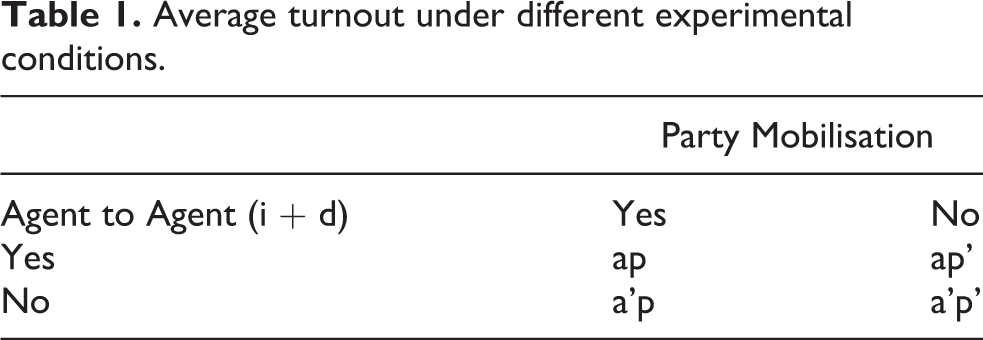
The cascade effect is calculated as follows:
Cascade ratio = (ap – a’p) / (ap’ – a’p’)
and represents the ratio of the difference in turnout (between scenario with and without d and i) when party are active to the equivalent difference when they are inactive. In other words is tells us the extent to which party mobilisation generates additional higher order effects.
Figure 5 shows the cascade ratio across different levels of party mobilisation. Three things are immediately apparent. First, the estimated cascade effect is rather small. Even after allowing for a settling in period for the simulation, regardless of the extent of mobilisation, the ‘cascade’ barely exceeds unity. That is, the additional number of voters generated by mobilisation is relatively unaffected by whether interpersonal Election Day mobilisation (d) and influence on intention (i) is present or not. That is not to say turnout will not be higher as a result of mobilisation, due to the effect the long campaign has on norms of voting (‘duty’), political interest, and party affiliation. Indeed, we saw in Figure 2 that even 10% mobilisation delivered substantially higher turnout. What it does suggest is that there is no substantial cascade where additional stimuli to voting deliver additional votes through higher order influences (via d and i) during the short campaign. When party mobilisation is set at 10% the presence of interpersonal Election Day mobilisation (d) and influence (i) on intention increases the efficacy of party mobilisation by a factor of approximately 1.1, though this varies over time. To be more specific, the turnout cascade grows from around unity (no effect) to between 1.1 and 1.2. A similar effect is found when mobilisation is set at 20% or 40%. In other words for every additional voter persuaded to vote by the political parties, an additional one tenth of a vote is gained though indirect interpersonal influence, and there is no systematic relationship between the amount of mobilisation and this multiplier. We should stress again that this is in addition to any cumulative indirect effects of the long campaign via influence on duty, political interest, and party affiliation. Nevertheless it does suggest that predictions of a geometric increase derived from a simple model may be overly optimistic. One of the reasons that this may be the case is that parties tend to mobilise people whose networks are already predisposed to voting and may be less successful at penetrating (or persuading) agents from less engaged social networks to turn out to vote. Moreover, some crowding-out is even possible, with parties mobilising agents who otherwise may have been persuaded to vote by others in their network (leading to potential negative cascades).
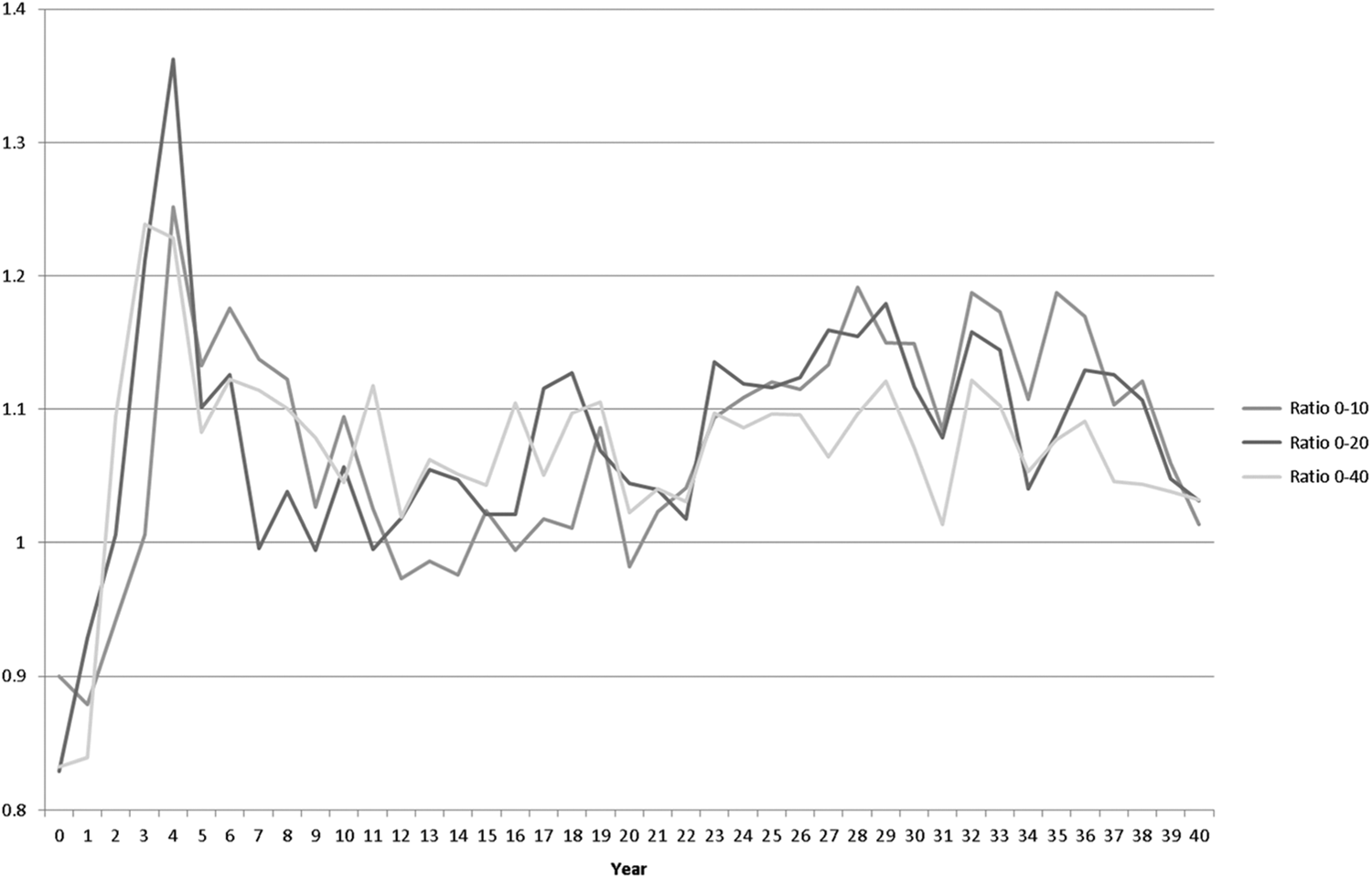
The turnout cascade for varying levels of party mobilization.
To understand what drives the spillover effects (however small they may be) requires us to explore in more detail, at the level of the individual agent, the motivation to vote. By examining the properties of each agent we are able to identify why they voted. Although agents can have multiple reasons for voting it is possible assign a primary reason based on a hierarchy of motivations. 6 It is important to note that the hierarchy has absolutely no bearing on the decision to vote (this is determined by the conditions illustrated in Figure 2). Rather the hierarchy is simply to classify a primary reason for voting, as shown in Figure 6.
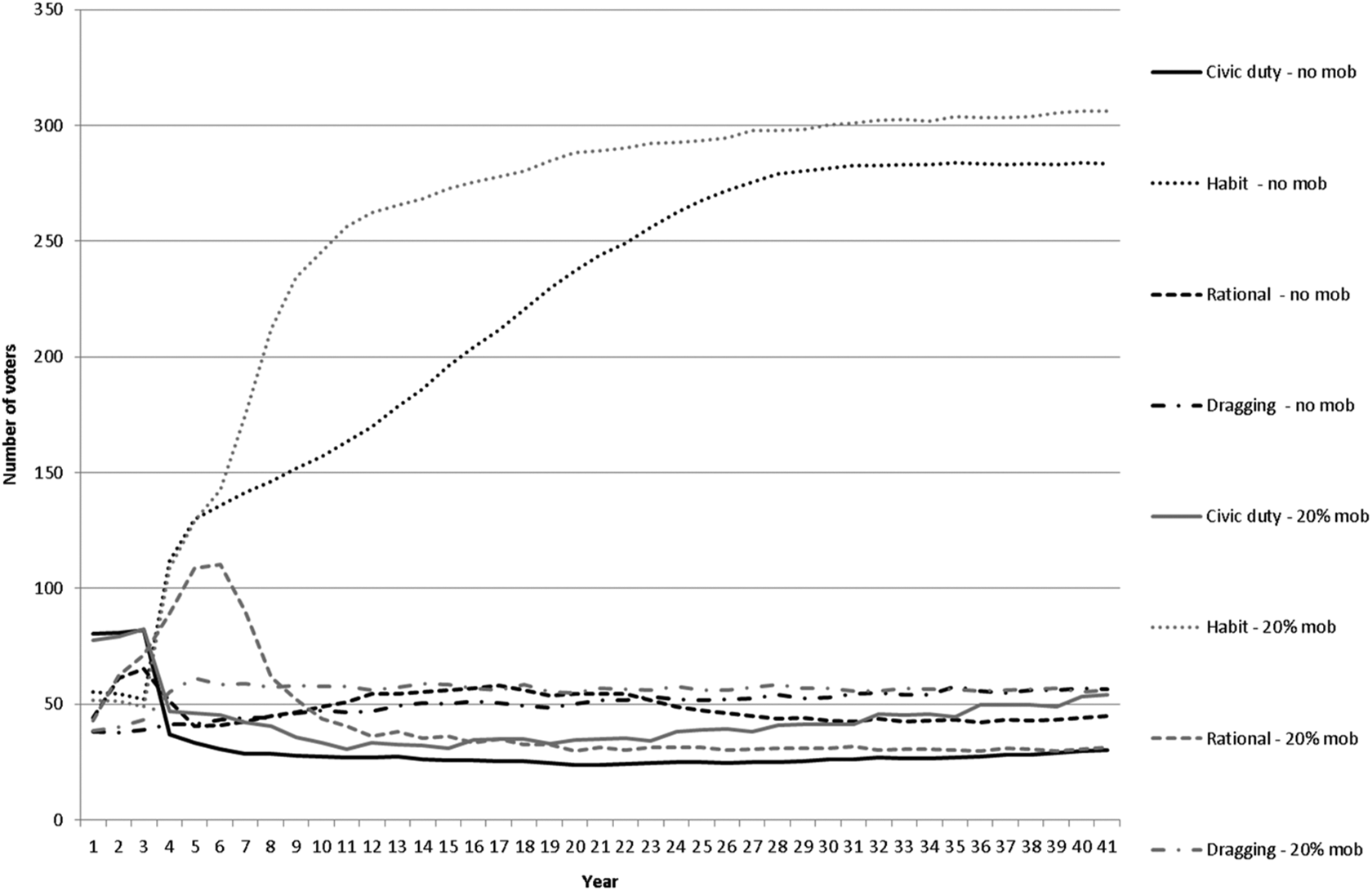
Primary reasons for voting and level of mobilisation.
Figure 6 shows the evolution of primary reasons for voting given two different mobilisation scenarios (0% and 20%), illustrating how primary motives differ in the presence of party mobilisation. What we observe is that in both scenarios initially the most important motivation is civic duty, followed by habit, instrumental reasons, and being ‘dragged’. However, once the model has ‘settled’ habit quickly accelerates over time as more agents acquire the habit of voting, especially when party mobilisation is present. The fact that habitual voting increases faster and to a higher level when mobilisation is present tells us that the higher order of spillover effects may actually be important, but that this spillover is the cumulative effect on individual voters over time, through habit, rather than through social network influence (Green and Shachar, 2000). Similarly, when mobilisation is present the effect via civic duty (like habit) is more pronounced than when it is absent, indicating that party mobilisation has longitudinal spillover effects through the creation of norms of voting.
In contrast, the numbers voting primarily for rational reasons tends to be lower in the presence of mobilisation. This is most likely an effect of the hierarchy as voters with multiple reasons are assigned to habit and duty before rational motives as their primary motive. Nevertheless this also makes intuitive sense – as parties are more active in generating habitual voting and norms of voting, the level of turnout is less dependent on (or sensitive to) instrumental motivations to vote. Finally, the proportion who vote due to being ‘dragged’ (d) to the polling station on Election Day by a fellow voter is slightly higher when mobilisation is present.
Discussion
Previous research has shown clearly that voters are heavily influenced by the values and behaviours of their peers (Zuckerman et al., 2005) and that this produces very strong correlations between the propensities to vote of social intimates (Cutts and Fieldhouse, 2009). Given this it might be expected that, through the spread of social norms of participation and through more direct forms of interpersonal mobilisation such as ‘voting together’ (Fieldhouse and Cutts, 2012), campaign mobilisation effects might quickly spread through social networks, producing substantial turnout ‘cascades’. In a powerfully argued article, Fowler (2005) showed that in a very simple simulation of a networked electorate, every vote mobilised by a candidate might generate up to four votes through secondary mobilisation effects. However, in the real world these effects are rather hard to observe. Neither is there substantial aggregate level evidence that turnout cascades have such a dramatic impact on turnout levels, nor does individual level evidence suggest these indirect effects are especially substantial in increasing the amount of political discussion (McClurg, 2004). So the puzzle remains – is it possible that processes of interpersonal influence are as strong as we believe yet at the same time that turnout cascades can be seemingly invisible?
We suggest the answer is yes. Using a complex descriptive agent based approach, we show that, despite reasonably strong assumptions about network influence based directly on empirical evidence, substantial turnout cascades can fail to materialise. The reason for this, we believe, is that the unhindered geometric rippling of cascades inherent in the simpler agent based models are not reproducible in the messier complexity of a more realistic simulation that can generate numerous obstacles to cascades. First, for mobilisation to be effective it must be received by individual voters who are close to the threshold of voting (Arcenaux and Nickerson, 2009). Second, it must penetrate the networks of those voters, and members of these networks must themselves be close to the threshold of voting. What appears to happen instead is that ‘cascades’ fizzle out when they meet groups of electors who are already fairly certain to vote or not to vote. The likelihood of this occurring is enhanced by the existence of homophily in networks, so that it is the very presence of clustering in voting patterns that limits the capacity for cascades to form. As McClurg (2004) notes, the reach of indirect effects is limited because they do not create political conversations where they do not already exist. Third, electors must have reasons to vote other than that they are asked. Many electors in our simulations do not have a party preference and therefore decline to vote (out of indifference or alienation). Indeed one of the ways in which indirect effects do have an impact on turnout in our simulation is by increasing party support, a phenomena which is a subject of network influence and a necessary precursor to voting. Fourth, the experimental assumptions of the simple cascade model may be overly generous. Crucially in the Fowler model, one agent is constrained to unconditionally vote, and cannot be moved by other agents. Elsewhere, in a replication of the Fowler model, we demonstrate that if the mobilisation of each additional voter is not irreversible and the agent can be influenced by her or his peers (as well as influence them) then the turnout cascade evaporates (Lafuerza et al., 2015). In our more complex world, agents who are mobilised by parties are still subject to the influence of other agents and intervening factors. Moreover, if unconditional voters do exist, then it seems reasonable that unconditional non-voters should also exist, and these will dampen any turnout cascade (Rolfe, 2012). Suffice to say here that a more complex scenario of influence and decision making does not deliver the geometric effects predicted by the small world model.
Despite this, spillover effects do emerge from our simulations, though they take time to evolve and stem more from the socialising effects of the long campaign more than from a cascade from pre-election mobilisation. As has been argued in the context of GOTV experiments, campaign effects are not limited to the election in question but may ripple through time due to the effect of habit and inertia (Cutts et al., 2009; Gerber et al., 2003). Our simulations suggest this mobilisation is important in sustaining levels of turnout that could not be sustained by social networks alone. However, the boost to turnout that is provided by mobilisation is not limited to habitual voting. We also see second-order effects via the spread of social norms of voting and, to a lesser extent, via increased interpersonal mobilisation.
Critics may point out that these are simulations and not ‘real data’ and are sensitive to the assumptions that we make. Of course this is true, yet we would argue that the assumptions are completely consistent with empirical evidence and data, and simulations provide a revealing and meaningful way of extrapolating the implications of many years of research on turnout in general and mobilisation effects in particular. However, that is not to say the conclusions are set in stone. Additional work needs to further test the degree to which the observed effects survive in the face of radically different assumptions about the characteristics and behaviour of voters. In the meantime, however, we believe that these models make two important contributions to our understanding of mobilisation effects. First, they show cascade effects can be expected to be much smaller than simple models would imply; and second, they demonstrate that the effects of mobilisation may survive over a long period of time. In this sense we might compare positive feedback effects in turnout with echoes, the social network acting more like an echo chamber than a cascade.
Footnotes
Appendix
Declaration of Conflicting Interests
The author(s) declared no potential conflicts of interest with respect to the research, authorship, and/or publication of this article.
Funding
The author(s) disclosed receipt of the following financial support for the research, authorship, and/or publication of this article: The authors gratefully acknowledge the support of the EPSRC for this research (award number EP/H02171X/1).