




Abstract
Comparative literature suggests that campaigning efforts impact positively, both in terms of mobilization and turnout. Effects are not uniform. They may be affected by the electoral system, the electoral circumstances and the effectiveness of party management. Studies of district level (constituency) campaigning in Britain have identified two important trends. First, that effective targeting is a core component of a successful district campaign strategy and that parties have become better at targeting resources. However, a question has arisen as to whether increasingly ruthless partisan targeting by parties could have detrimental effects on overall levels of turnout. Second, they have shown how campaign techniques are continuously being modernized but that more traditional labour-intensive campaigning tends to produce stronger electoral payoffs. This article considers three questions in respect of the impact of district level campaigns on turnout: whether the combined campaign efforts of the three principal parties in Britain are associated with higher levels of turnout; whether the different campaigning styles of parties affect levels of turnout equally; and whether the campaigning efforts of different parties have differential effects on turnout and whether intense partisan targeting impacts upon turnout overall. We show that while campaigning boosts turnout, the impact varies by campaign technique and by party.
Introduction
A significant comparative literature suggests that campaigning efforts by political parties impact positively, both in terms of mobilization and turnout. The most detailed studies suggest that campaigning efforts at local (most commonly, district) level are particularly effective, with voters responding positively to contact. This is shown in experimental studies (see, for example, Gerber and Green, 2000), large-scale comparative analyses based on survey responses (see, for example, Karp et al., 2007) and several individual country studies (see, for example, Carty and Eagles, 1999; Hillygus, 2005; Marsh, 2004), particularly in Britain, where a variety of indicators, both at the individual and aggregate levels, has been employed, demonstrating that more intense campaigning activity at district level delivers electoral payoffs for parties (Clarke et al., 2004, 2009; Denver and Hands, 1997; Denver et al., 2003; Fieldhouse and Cutts, 2009; Fisher et al., 2011a; Johnston, 1987; Johnston and Pattie, 2014; Pattie et al., 1995; Whiteley and Seyd, 1994; Whiteley et al., 2013).
However, these effects are not uniform. In comparative analyses, Karp et al. (2007) show that effects may be mediated by the electoral system used. They find that campaigning in candidate-based systems is more likely to mobilize voters than in party-based systems. Fisher et al. (2011a) further show that the impact of campaign effects will vary over time within the same candidate-based system as a function of the marginality of an election, the likelihood of significant change in the composition of government, the number of seats targeted by individual parties and the effectiveness of the central management of district level campaigns. This is mediated significantly by the popularity of parties and whether or not they are part of the incumbent government. From the parties’ perspective, there are clear electoral benefits to be had from campaigning intensively in the places where their efforts are most likely to yield payoffs. What is perhaps less clear is the impact of these campaigns on turnout. We might expect that more intense campaigning will boost turnout overall, mobilizing voters wherever campaigning takes place. However, this becomes a particularly interesting question under the ‘first past the post’ or single member plurality electoral system used for Westminster elections, as the logic of district level campaigning is that parties should rationally focus their efforts principally in those seats where they can reasonably expect to deliver electoral payoffs. As Karp et al. (2007: 92) predict: ‘parties will expend greater effort on mobilizing voters when the expected benefits of turning out voters are greatest, relative to cost’. And this is broadly what occurs, although this does not imply that citizens in safe seats are completely ignored. Indeed, Karp et al. (2007: 102) find that levels of party contact in safe seats in countries with single member districts still exceed those in countries utilizing a system of proportional representation. Notwithstanding, parties in Britain generally campaign most in their target seats (those that they are seeking to defend or capture), somewhat less in those seats that they comfortably hold and even less in those seats where there is no realistic chance of victory (Fisher et al., 2011a; Johnston and Pattie, 2014). The realization in the rational distribution of parties’ campaign efforts varies somewhat, with the Conservatives generally being less successful, but over time all three parties that contest seats in Britain have moved towards this kind of distribution of effort.
While this is true for campaign strength overall, intensity in differing campaigning styles may not be distributed so effectively. Broadly speaking, we can identify three approaches to district level (constituency) campaigning: traditional, modern and e-campaigning. Traditional campaigning is labour intensive, including doorstep canvassing, ‘knocking up’ of voters on polling day and the distribution of leaflets and posters. Modern campaigning includes the use of computers, telephones and direct mail to contact voters. E-campaigning focusses upon contacting voters through social media, email and text message. Fisher and Denver (2009) show that modern campaign efforts are more likely to be distributed effectively compared with traditional ones, which depend to an extent on the mobility of party volunteers between seats and also on the human, financial and other resources available locally. Slightly different patterns are, however, associated with forms of e-campaigning, where differentiation of campaign effort by the electoral status of the seat is much less pronounced (Fisher et al., 2011b).
Notwithstanding, the overall result, as predicted, is that the most intense activity where two or more parties are targeting their efforts takes place in only around 160 seats of the current 632 in Great Britain. As a consequence, we might expect that as the parties become better at focussing their campaign efforts in order to deliver electoral payoffs (which includes raising funds locally for some of the activities), then overall levels of turnout may be differentially affected as most seats are not subject to intense competition and the positive effects of voter mobilization. Equally, we may find that different parties’ campaigns have a differential impact on turnout, reflecting their relative success at distributing campaigning resources effectively to maximize electoral payoffs. Previous detailed analyses on these topics (such as Denver and Hands, 1997) are, however, relatively brief, with the vast majority of studies not differentiating by party. In this article, therefore, we address three questions using data from the 2010 British General Election. First, we consider whether the combined campaign efforts of the three principal parties in Britain at district level are associated with higher levels of turnout. Second, we examine whether the different campaigning styles of parties affect levels of turnout equally. Finally, we examine whether the campaigning efforts of different parties have differential effects on turnout and whether intense partisan targeting does indeed impact upon turnout.
Data sources
The data used to capture campaign effort in these analyses are twofold. First, we use a survey of electoral agents 1 carried out immediately after the 2010 election, designed to capture the many different aspects of campaigns: preparation, organisation, humanpower, use of computers, polling day activity, use of telephones, use of direct mail, canvassing, use of leaflets and e-campaigning. Campaign intensity indexes are calculated using a Principal Components Analysis (PCA) of all these core indicators of constituency campaigning as defined theoretically (see Appendix for variables included in each index). 2 Using conventional cut-off criteria, the PCAs suggest one factor is sufficient to represent the variance in the original variables (Fisher et al., 2011a: 827). The survey delivers the most comprehensive and accurate indicator of campaign intensity. However, despite good response rates overall (54%), there are data gaps when requiring responses from all three main parties in the same seat. Analyses are carried out on those seats where data are available for all three parties but, of course, this produces the possibility of selection bias.
As a check, therefore, we also employ a second data source as a surrogate for campaign intensity: candidate spending. 3 The analysis of candidate spending is not constrained by response rates. Declaration of spending is required by law and the returns are published by the Electoral Commission. Thus, near complete spending data are available for almost all candidates. Candidate spending does not, however, capture free volunteer effort which, as Fisher et al. (2014) show, can have significant independent effects. However, it is a useful surrogate with which to confirm results from the agent survey where analyses are limited by case availability. Indeed spending in previous elections has been shown to be highly correlated with other indicators of overall campaign intensity (Fieldhouse and Cutts, 2009), though in 2010 the correlation was less strong (Fisher et al., 2014). In addition, candidate spending data at the 2010 election offered a more detailed picture than in previous elections due to an extended regulated period of four months. In previous elections, data were only available for the regulated period between dissolution and the election (or, prior to the Political Parties, Elections and Referendums Act 2000, from the point at which a candidate was adopted). The Political Parties and Elections Act 2009, however, extended the regulated period. The period from dissolution to polling day remained regulated and was known as the ‘Short Campaign’. In addition, the period from January 1st 2010 to dissolution was now also regulated – known as the ‘Long Campaign’ (see Johnston et al., 2011 for details). To capture as full a picture of campaign intensity represented by candidate spending as possible, therefore, we use the candidates’ proportion of the maximum permitted expenditure in their constituencies over both regulated periods (‘Long’ and ‘Short’), thus capturing costed activity over a period of four months prior to the election.
The impact of combined levels of campaigning on turnout
Our first question asks whether the combined campaign efforts of all three parties had a positive effect on turnout in the local constituency. We model this using OLS with percentage turnout for each constituency in 2010 as the dependent variable. Our preferred control variable is turnout at the previous election. While turnout does not correlate across constituencies between elections as strongly as party performance, its use does at least capture the many demographic factors that may contribute to higher or lower levels of electoral performance. However, previous turnout may also be a proxy for previous campaigns. There is a potential danger, therefore, of ‘over-controlling’ in our estimates. Notwithstanding, the employment of turnout at the previous election provides a conservative estimate of the marginal effect of the campaign, over and above any previous campaigns. Its use in this election, however, presents some complications; there were extensive boundary changes between the 2005 and 2010 general elections in England and Wales, though not in Scotland. 4 As a result, there are no directly comparable turnout data available. There are, however, notional turnout data which, while not perfect, do represent a useful test of the robust nature of our results. 5
We examine the impact of campaigning on turnout with two separate tests. The first uses constituencies where we have campaign intensity scores for all three parties. Inevitably, this results in a restriction on the number of cases, and we are limited to 102. The second test uses candidate spending as a surrogate variable. This provides data in 619 of the 630 total cases.
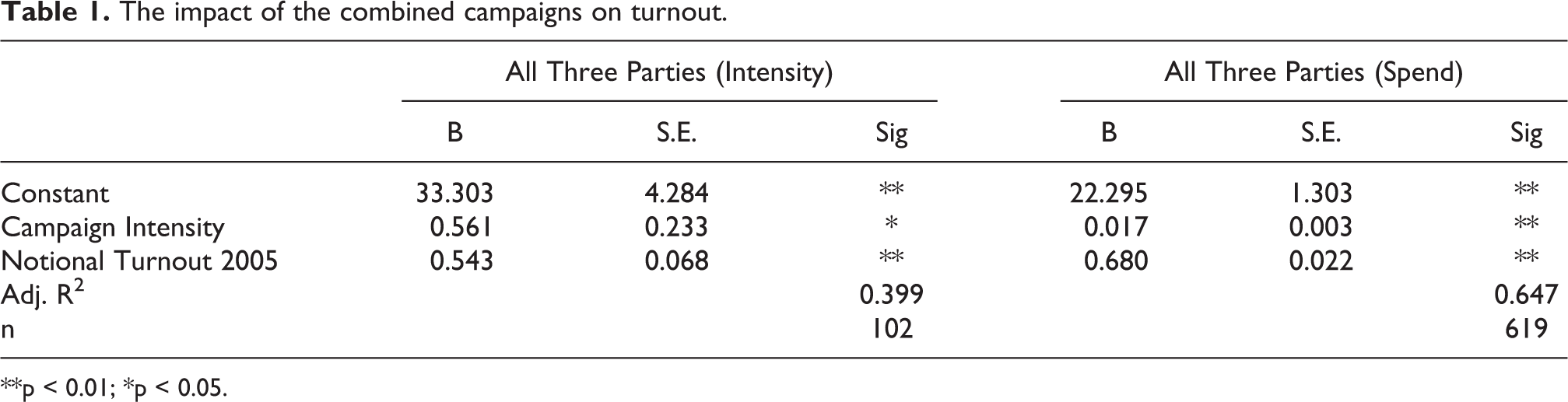
The results for both tests are shown in Table 1 and, despite the different numbers of cases, the results are very similar. 6 The combined campaign intensity and candidate spending models have a positive and statistically significant effect on turnout. Thus, there is a good overall case that campaigning produces positive benefits not only for the parties themselves but also for the health of the elections. By and large, the more campaigning the parties engage in overall, the more voters in general are mobilized. Unfortunately, over time, the parties have confined their intensive campaigning (as measured by candidate spending) to a smaller number of constituencies, in many of which they are spending less than two decades earlier (Johnston and Pattie, 2014).
The impact of the combined campaigns on turnout.
**p < 0.01; *p < 0.05.
The impact of campaigning styles on turnout
Our measure of campaign intensity captures a whole range of techniques employed by parties and provides the best representation of party effort. Inevitably, campaign techniques evolve over time as new technologies become available (and, critically, affordable) and local parties adjust to varying levels of available volunteer effort (Fisher and Denver, 2009). An indicator of such a change is reflected in the constituency campaigning literature. The 1992 election was, for example, dubbed ‘the fax election’ by Denver and Hands (1997). The notion of the fax being the pinnacle of technology seems faintly comical today, but illustrates that over a relatively brief period of time the emphasis in campaign techniques does change. Fisher and Denver (2008) show this has occurred for all parties; the 2001 election was the ‘tipping point’ when more modern campaign techniques using telephones and targeted direct mail became more prevalent than traditional labour-intensive techniques such as doorstep canvassing and hand-delivered leaflets. By 2010, parties increasingly deployed e-campaigning, reflecting the wider availability and accessibility of such technology (Fisher et al., 2011b).
As new campaign styles develop, which campaign styles are most effective at influencing electoral outcomes? Comparative evidence suggests that more traditional forms of labour-intensive campaigning still have the stronger impact. Gerber and Green (2000: 661), for example, found that face-to-face campaigning was more likely to stimulate turnout than direct mail (see also Arceneaux and Nickerson, 2009), while Aldrich et al. (2013) argue that in general face-to-face is more likely to yield payoffs. Similarly, there is strong evidence in Britain of greater voter responsiveness to more traditional doorstep campaigning (Fisher, 2011; Fisher and Denver, 2009; Fisher et al., 2014; Pattie and Johnston, 2003). However, the intensity of use of different techniques is intertwined. Thus, evidence from Britain shows that parties that run extensive campaigns based on traditional methods also tend to adopt extensive ‘modern’ approaches such as telephone canvassing and direct mail. E-campaigns are slightly different, with less discrimination in the level of their use depending on the seat’s strategic importance, a function both of the relative low cost of the technology and parties’ lower prioritization of these techniques (Fisher et al., 2011b).
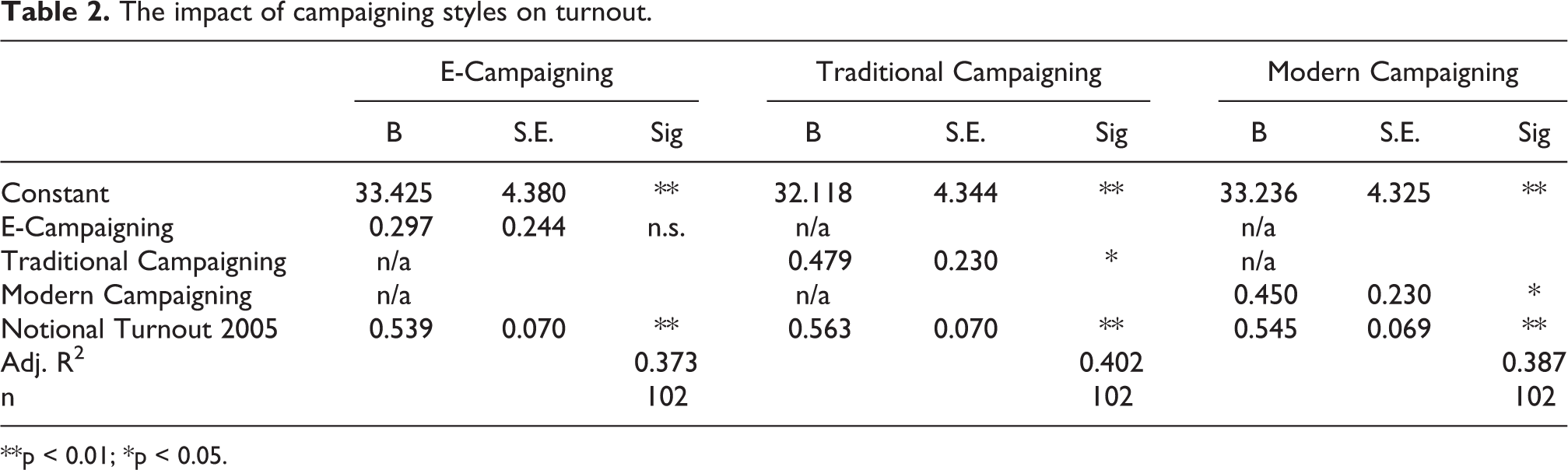
Overall, this presents some challenges in measuring the differential impacts of differing campaign styles relative to each other on turnout, since no campaign will rely exclusively on one approach and inevitably there is some ‘leakage’ of effects from other campaigning styles, making it difficult, if not impossible, to completely isolate individual effects. This can be partly mitigated if models are run separately rather than including traditional, modern and e-campaigning all in the same model. As with the overall measure of campaign intensity, we capture the differing campaign styles through a Principal Components Analysis of a series of items. The scores for each party are combined to produce an overall score of intensity for these three approaches. 7 As with the analysis of overall campaign intensity in Table 1, we model the impact on percentage turnout in 2010 using OLS, while controlling for notional turnout in 2005 (Table 2). Three models are run for each campaign style using seats where we have scores for all three parties. All analyses have the potential risk of selection bias though, as Table 1 suggests, this may not be a particular problem.
The impact of campaigning styles on turnout.
**p < 0.01; *p < 0.05.
Analyses of constituencies where there are scores for all three parties show that the combined levels of both traditional and modern modes of campaigning are associated with higher levels of turnout whereas e-campaigning, while positively signed, has no statistically significant effect (Table 2). This may be partly explained by the relative lack of targeting employed in e-campaigning (Fisher et al., 2011b), but also suggests that in Britain, at least, e-campaigning has some way to go before it has a major impact on electoral outcomes (see also Gibson and Cantijoch, 2011). As Fisher et al. (2014) show, despite the growth in campaigning styles that incur cost, the more traditional approaches conducted by free, volunteer labour still have a greater propensity to deliver electoral impact.
The impact of individual parties’ campaigns on turnout
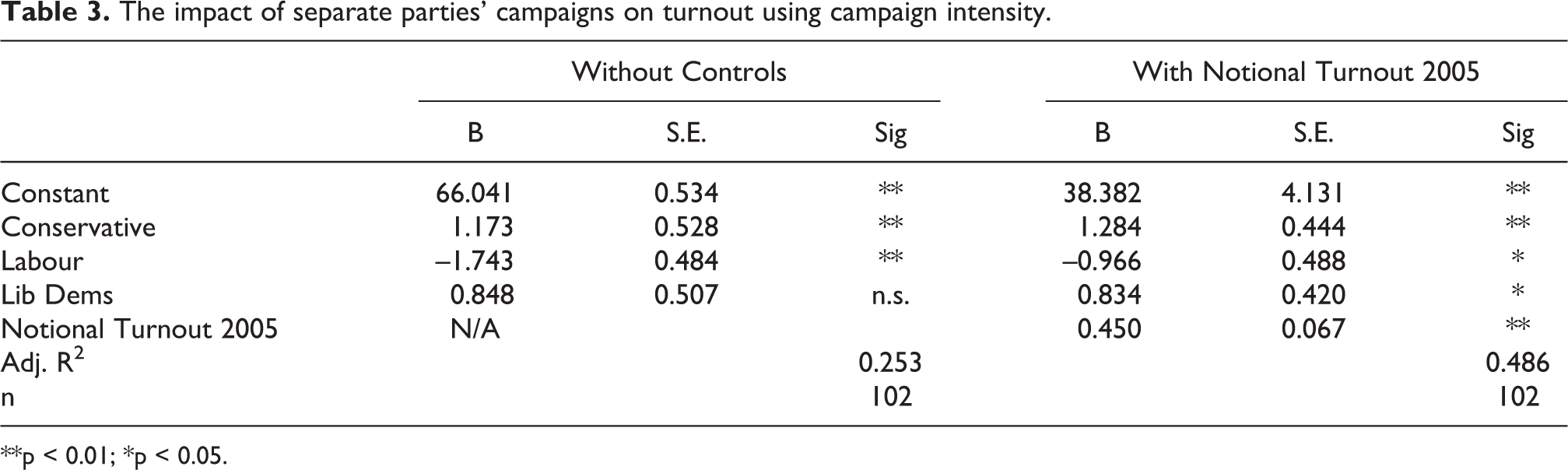
Our third question examines the impact of individual parties’ campaigns on turnout. As Table 1 showed, campaigning overall is associated with higher turnout, but is this true for all parties – particularly as some are more effective at targeting their efforts than others? A party that was ruthless in focussing partisan effort on target seats could theoretically depress turnout overall since, inevitably, most seats will not be targeted and therefore fewer voters will be exposed to the mobilizing effects of intense campaigns. We examine this question first by running the model using only those seats where we have campaign intensity scores for all three parties (Table 3). We run two versions of the model: the first without a control variable, the second using notional turnout in 2005 as a control. Since most demographic predictors of turnout are also associated with parties’ own electoral fortunes it makes sense to run both models and compare results.
The impact of separate parties’ campaigns on turnout using campaign intensity.
**p < 0.01; *p < 0.05.
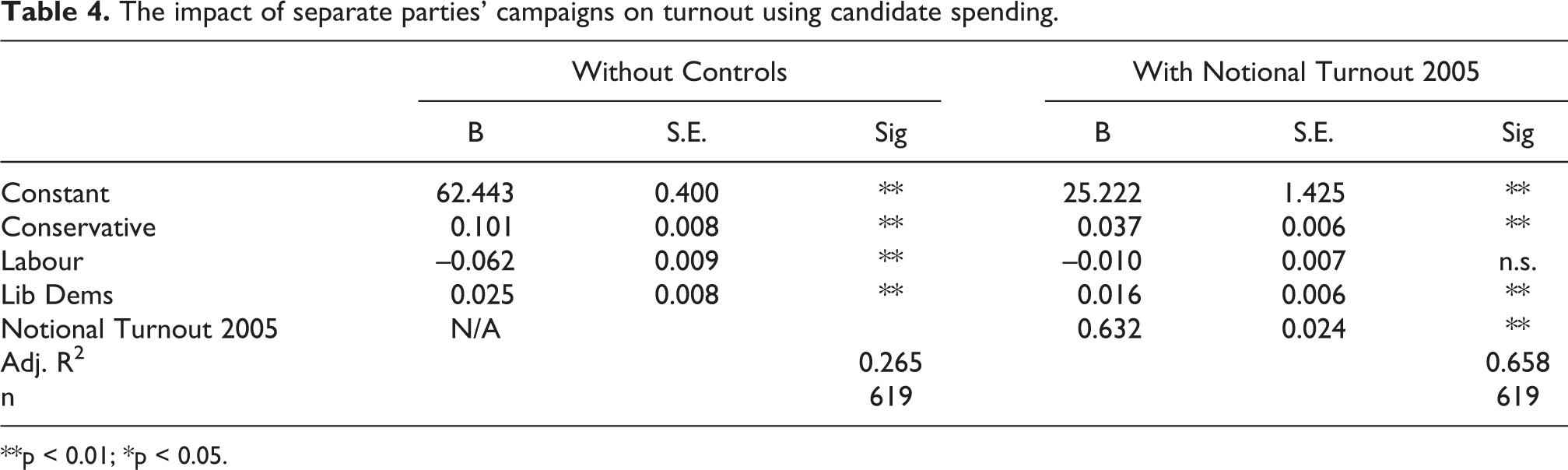
The first results offer interesting findings. In both models, Conservative campaign intensity is associated with higher levels of turnout. Liberal Democrat campaigning has a similarly positive effect in the second model. The results for Labour, however, are more intriguing. In both models, Labour campaigning is associated with lower levels of turnout to a statistically significant degree. The analyses in Table 3 are based only on a limited number of constituencies, again raising the possibility of selection bias. Thus, Table 4 repeats Table 3’s analyses but using the surrogate measure of candidate spending. The findings produced with the limited number of cases in Table 3 are broadly replicated. Both Conservative and Liberal Democrat campaigning is associated with higher levels of turnout, but not campaigning by Labour candidates which, as in Table 3, is associated with lower levels of turnout. Where no controls are used, this finding is statistically significant. When controlling for previous notional turnout, the coefficient is negatively signed, but fails to reach statistical significance. This suggests that, at best, Labour campaigning had no positive impact on turnout.
The impact of separate parties’ campaigns on turnout using candidate spending.
**p < 0.01; *p < 0.05.
Overall, both tests, despite the limitations of the available cases for the preferred measure of campaigning and the employment of a surrogate measure, tell a very similar story. First, these tests, and those in Table 1, show that more intense constituency campaigning was associated with higher levels of turnout at the 2010 general election. Second, this positive impact was shared at the individual party level by the Conservatives and Liberal Democrats. Third, Labour campaigning apparently either depressed turnout at the 2010 general election or at least had no significant effect upon it, raising the obvious question of why Labour’s campaigns should have differential effects on turnout compared with the other two parties.
One possible explanation returns to the impact of partisan targeting which represents entirely rational party behaviour in a first past the post system. The logic is straightforward – a rational party should focus its campaigning resources principally on those seats it needs to win to achieve its overall electoral goals. There is clear, comparative evidence for such a prediction. Karp et al. (2007: 98–99) show, for example, that parties in general are consistently more likely to target voters in marginal districts than in safe ones. If we disaggregate targeting effects by party, analyses of the 2010 election in terms of measuring the impact of campaigning on electoral payoffs suggested that Labour’s targeting was most effective in terms of delivering payoffs, that the Conservatives’ was improved relative to previous elections, and that the Liberal Democrats targeted less effectively than in previous elections (Fisher et al., 2011a). Thus, if partisan targeting is effective, we would expect the positive impact of campaigning on overall turnout to be diminished. Equally, if partisan targeting is less effective, then the positive benefits of campaigning on turnout are likely to be apparent across a larger number of districts.
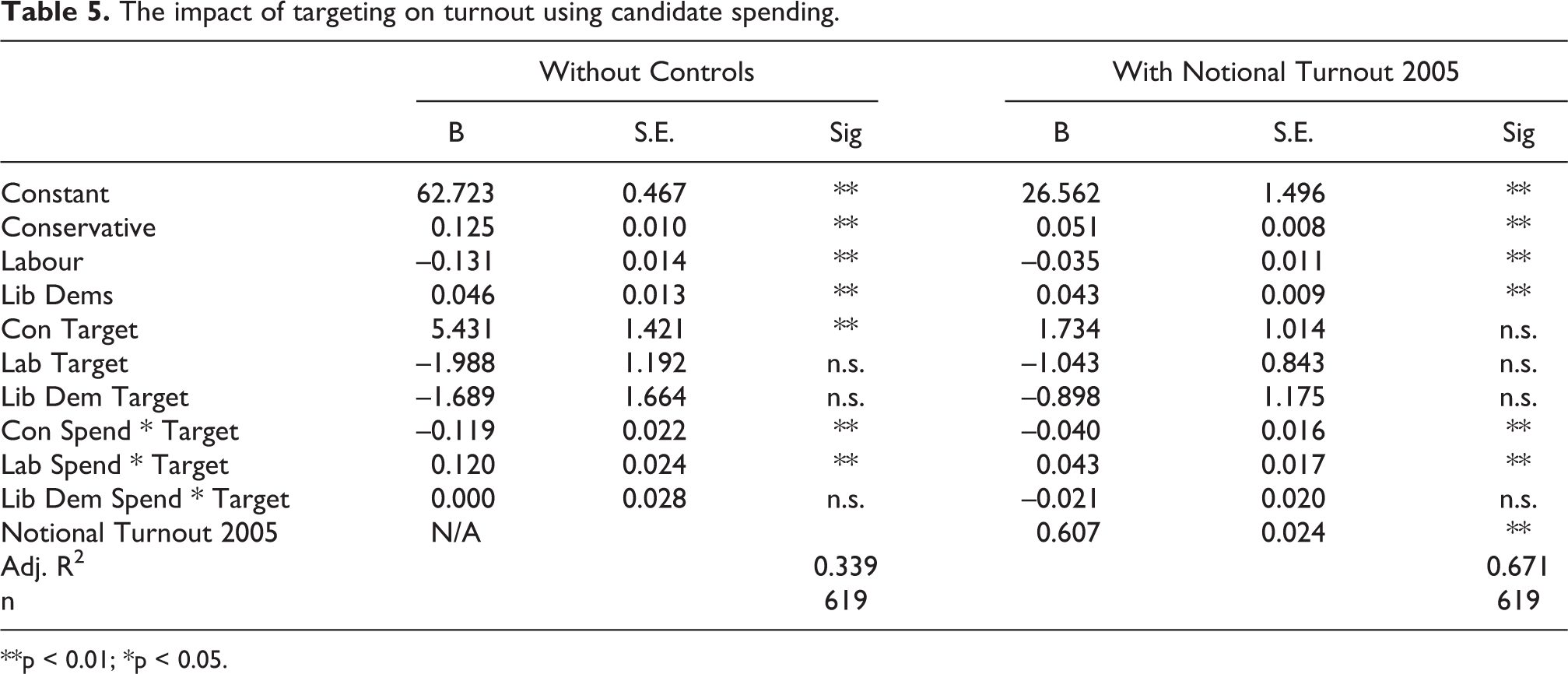
We test whether parties’ targeting efforts impact upon turnout in Table 5, using candidate spending data to maximise the number of cases, and using interaction terms of campaign efforts in target seats alongside the overall campaign efforts, plus a dummy variable capturing the target status of a seat. 8 The model was run without controls, and then controlling for notional turnout in 2005. The results help explain the outcomes in Tables 3 and 4. First, there is no effect of targeting on Liberal Democrat campaigning’s impact on turnout, with the interaction term failing to reach statistical significance. Second, the results for the Conservatives similarly suggest that targeting also had a minimal effect. Labour’s results, however, are different. In both models, there is apparently a negative impact on turnout as a result of Labour campaigning in non-target seats. However, in target seats (145 in total) this negative effect was attenuated, even though overall turnout was lower in these seats. 9
The impact of targeting on turnout using candidate spending.
**p < 0.01; *p < 0.05.
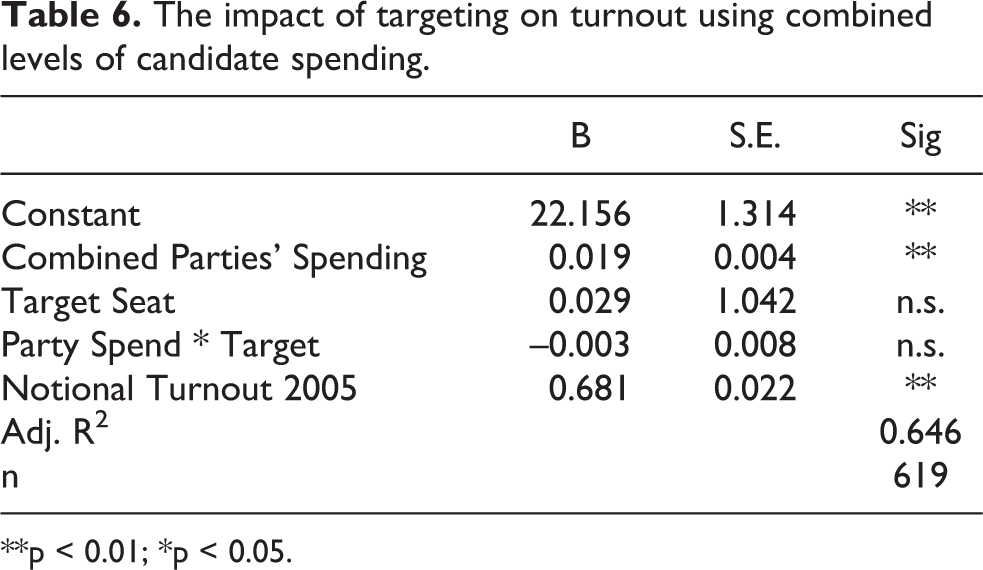
The apparent differential effects of Labour’s campaigns are confirmed re-running the model using combined campaign spending for candidates from the three principal parties and creating an interaction term using a dummy variable capturing whether or not two or more parties from amongst the principal three targeted the seat. The model is run controlling for notional turnout in 2005 and Table 6 shows that, overall, targeting did not have the effect of depressing turnout overall, despite the potential for this to occur under first past the post.
The impact of targeting on turnout using combined levels of candidate spending.
**p < 0.01; *p < 0.05.
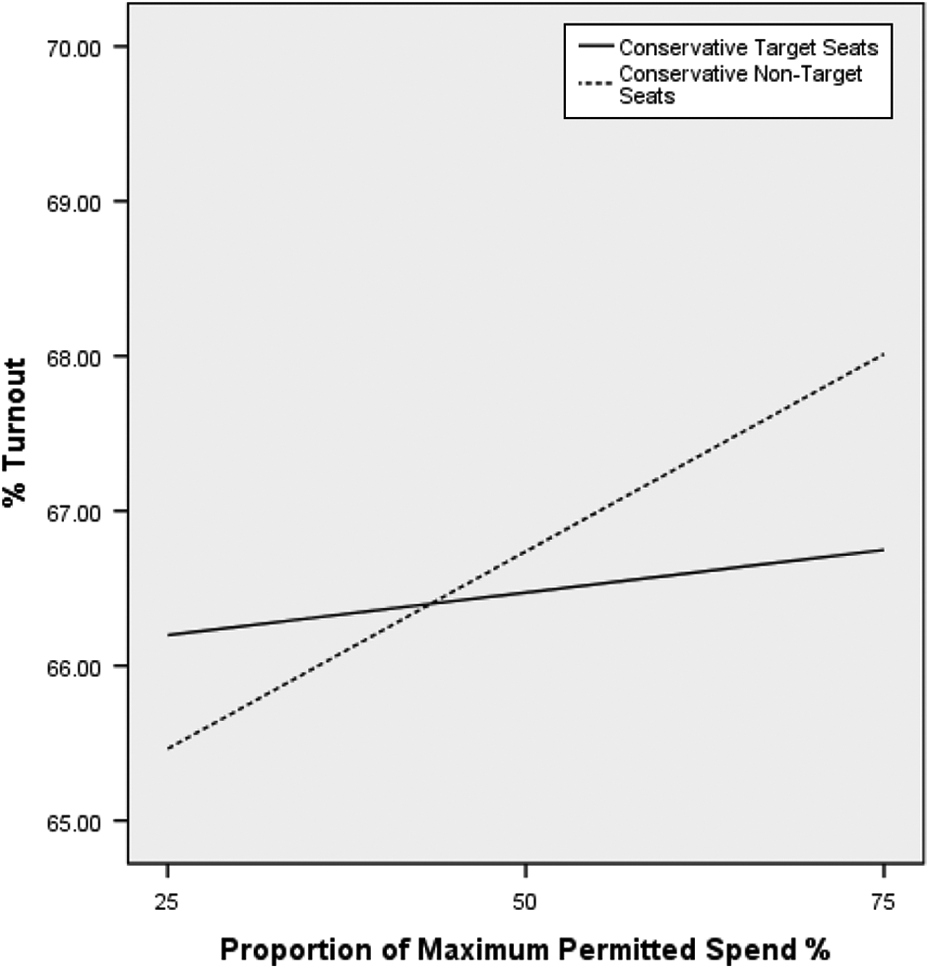
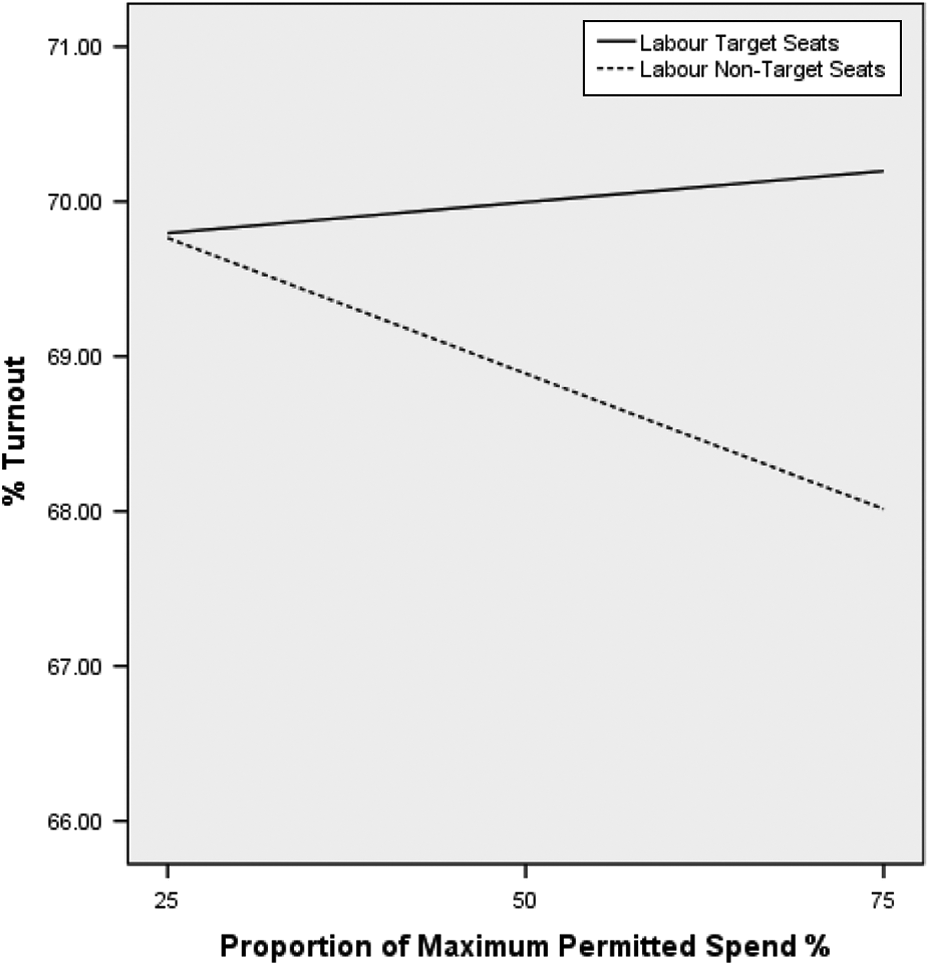
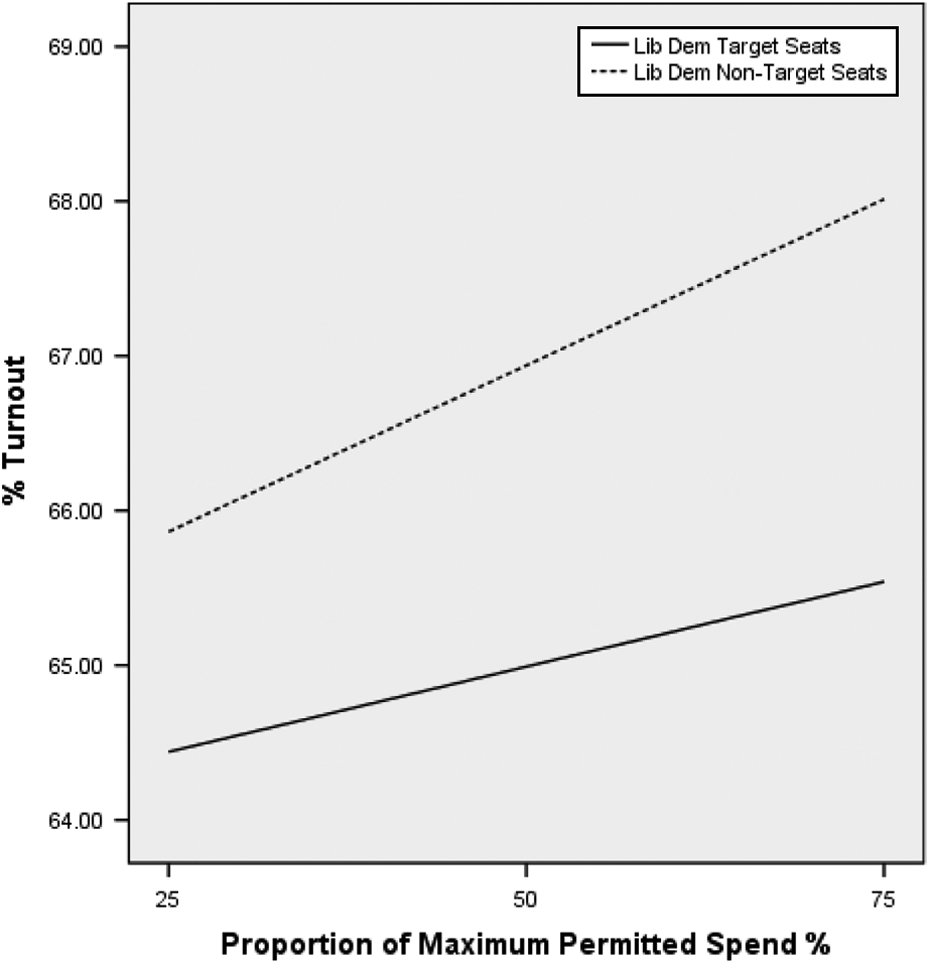
The interaction terms in Table 5 are easier to interpret if we produce graphical representations to compare the effects of different levels of candidate spending in target and non-target seats. We use the second model, which controls for notional turnout in 2005. In Figures 1, 2 and 3, we show a highly simplified scenario of turnout depending on whether candidates spent 25%, 50% or 75% of the permitted maximum and the spending of the two other parties is held constant at 75%. In each figure there are two lines: the projected impact of candidate spending on turnout in a party’s target seats and the projected impact of spending in its non-target seats.
Conservative.
Labour.
Liberal Democrats.
Figure 1 shows that Conservative campaigning in both the party’s targets and its non-targets had a positive impact on turnout. However, in the vast majority of cases, there was a more positive impact on turnout in the party’s non-target seats than in its targets. Figure 3 for the Liberal Democrats paints a similar picture – Liberal Democrat campaigning boosted turnout across the board, but turnout was consistently higher in the party’s non-target seats. The results for Labour (Figure 2) show a different picture, however. Turnout in Labour target seats grew as Labour candidates campaigned more, as we would expect. However, in our simulation, the reverse is true in Labour’s non-target seats – turnout fell as Labour candidates spent more of their permitted allowance. 10 Thus, Labour’s ruthless partisan targeting had clear effects – it significantly boosted turnout in seats Labour actively sought to win, but not elsewhere. Empirically, it’s true that Labour spent less in 2010 where notional turnout in 2005 was higher and that this could produce selection effects. However, we control for these by adding notional turnout in 2005 to the models and find similar results – a fall in turnout in Labour non-targets where candidates spent more of their permitted maximum. The puzzle, then, is why any form of campaigning should apparently be associated with a decline in turnout.
At one level, there may be a simple, common sense explanation. It could be, for example, that campaigning was so poor or antagonistic to voters that they were discouraged from voting. Gerber and Green (2000: 660), for example, found that telephone canvassing had the effect of depressing turnout (though see Imai, 2005 and Gerber and Green, 2005). And, Whiteley et al. (2013: 117) show that, unlike the other two main parties, Labour’s campaign in general was negatively evaluated by citizens – so that the more people were made aware of Labour’s campaign in a constituency the more turned-off it they became. However, given that Labour campaigning in its target seats was associated with higher turnout, we require an alternative explanation to one rooted in the idea of antagonistic campaigning. A more generalizable understanding can be found if we return to the model of exogenous effects on campaign success developed by Fisher et al. (2011a). They highlight a series of conditions to estimate the relative effectiveness of parties’ campaign efforts (see Table 7).
Exogenous factors influencing likely effectiveness of constituency campaigns.
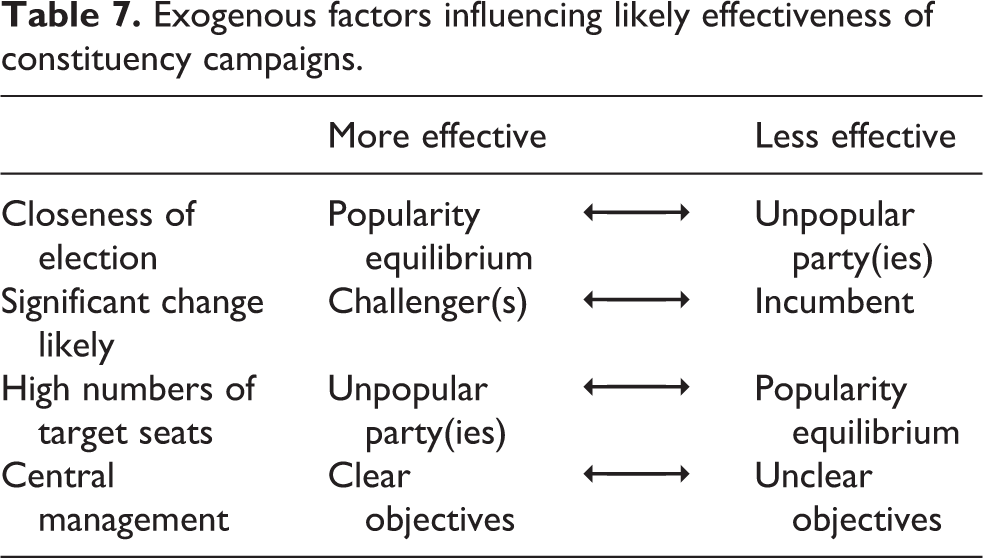
For Labour, two particular conditions were pertinent in respect of turnout – the party’s relative unpopularity in 2010 and the likelihood of significant change at the election. Both conditions were likely to limit the effects of Labour campaigning as the unpopular incumbent. Certainly, research using experimental methods has also shown that campaign interventions are affected by the level of popularity of the party (Arceneaux and Nickerson, 2009; Hillygus, 2005; Niven, 2001). Equally, Karp et al. (2007: 95–96) suggest that where parties are not in a competitive position, they may find it difficult to persuade potential voters to go to the polls, since their votes may be perceived as making little difference to the outcome. They also note that some voters are likely to be easier to contact than others, with previous voters the most cost-effective for parties to contact. Such conditions were particularly pertinent to Labour in 2010. As an unpopular incumbent, its campaigns in its non-target seats would probably only be focussed on either existing Labour supporters or past Labour voters, since the chances of capturing new voters in these seats would be minimal; survey evidence shows that the parties canvassing efforts in the last few months of the campaign focus on their ‘known’ supporters and avoid mobilising their opponents’ probable and possible voters (Johnston et al., 2012). However, at the individual level, we find that previous Labour voters and partisans were significantly more likely to abstain in 2010 compared with those of the other main parties. Denver et al. (2012: 18) show that whereas 6% of both Conservative and Liberal Democrat voters in 2005 abstained in 2010, the comparable figure for Labour was 11%. Equally, if we compare abstention rates of those with partisan identification in 2010 using the British Election Study, we find that 11% of Labour partisans abstained, while the same was true for only 4% of Conservatives and 6% of Liberal Democrats (the differences being statistically significant).
The general explanation, therefore, is related to underlying factors exogenous to campaigns: Labour was the unpopular incumbent at an election where significant change was likely. Under these circumstances, the Labour campaign was only likely to mobilize Labour supporters in Labour’s non-target seats and Labour supporters were more likely to abstain. Such a finding is theoretically important, since it demonstrates not only that campaigning will not have uniform effects, but that it can be associated with negative effects, not so much because the campaign actually discourages participation, but because the circumstances are such that in some seats the campaign will only appeal to a group of voters who are disproportionately more likely to abstain.
So, Labour’s ruthless targeting and the exogenous effects of being an unpopular incumbent may help to explain the significant differentiation in turnout effects between Labour target and non-target seats. However, one further puzzle is why there was not a similarly stark differentiation between the effects as a result of Conservative and Liberal Democrat campaigning in those parties’ target and non-target seats. Certainly, the Liberal Democrats were relatively popular and while the Conservatives were not themselves overwhelmingly popular they were, nevertheless, more popular than Labour (Fisher et al., 2011a). So, if this was only a function of popularity, then we would expect the impact of campaigning on turnout in those parties’ targets to be higher than in their non-targets. But, by and large, that is not the case (and in the case of the Liberal Democrats, turnout in non-targets was consistently higher). The explanation for this may again be related to the exogenous factors highlighted by Fisher et al. (2011a) – the high number of target seats combined with less focussed variation in partisan targeting by the Conservatives and Liberal Democrats. Certainly, analyses of electoral payoffs suggest that these two parties were less successful than Labour in this respect (Fisher et al., 2011a).
Conclusions
Studies of district-level (constituency) campaigning in Britain have identified two important trends. First effective partisan targeting is a core component of a successful constituency-level campaign strategy in terms of delivering electoral payoffs so that, over time, political parties have become better at raising and targeting resources where they are needed most. While improvements in targeting have helped ensure that all three principal parties’ campaigns have delivered electoral payoffs, a question has arisen as to whether increasingly ruthless, partisan-focused targeting by parties could impact upon overall levels of turnout, the reasoning being that the positive effects of campaigning on voter mobilization might only be apparent in a minority of seats. Second, they have shown how campaign techniques are continuously modernizing but that, despite these changes, more traditional, labour-intensive campaigning tends to produce greater electoral payoffs, while noting that as more modern techniques become widespread, voters are becoming more receptive to them (Fisher and Denver, 2009). Similar citizen preferences for more traditional campaign methods (in particular, face-to-face) have been found in other democracies (Aldrich et al., 2013; Gerber and Green, 2000), though few suggest, as Fisher and Denver (2009) do, that responsiveness may grow with familiarity (though see Imai, 2005, who similarly suggests that techniques such as phone calls may produce positive results, and Aldrich et al., 2013, who show that US citizens are increasingly comfortable with online contact).
This article addressed three questions. The first was whether combined levels of campaign effort continued to mobilize voters and the evidence was clear: in aggregate terms, more intense constituency-level campaigns boosted turnout overall in 2010 – the campaigns mobilized voters. The second question was whether the differing forms of campaigns that parties now employ had any differential impact on turnout. The evidence suggested that, in line with studies of different campaign techniques on electoral payoffs, more traditional campaigning was associated with higher levels of turnout as well. Moreover, as suggested by Fisher and Denver (2009), voters are becoming more receptive to modern campaign techniques and by 2010 it appears that their use also had a positive impact on voter turnout. With the newest campaign development of e-campaigning, however, there is at present no evidence of a positive impact on turnout. As Fisher at al. (2011b) suggest, despite the hyperbole surrounding the use of e-campaigning in 2010, the reality is that its electoral effects are currently minimal compared with more established practices.
The final question asked whether individual parties’ campaigns boosted turnout to similar degrees. The evidence suggested that while both Conservative and Liberal Democrat campaigns were associated with higher levels of turnout, the same was not true for Labour’s campaign, which was poorly resourced compared with that of the Conservatives. Such findings brought us back to our initial concern of whether their targeting strategies, while delivering electoral payoffs for the parties themselves, could have the impact of depressing turnout overall through a lack of mobilization in the majority of seats. Although this was not the case for combined levels of campaigning, it appeared to be so for Labour campaigns which boosted turnout in the party’s target seats, but not elsewhere – thus at best contributing no positive effect on levels of turnout overall. In one sense, such a finding may be cause for concern. Labour has for some elections been effective in its partisan targeting, so the effects identified here are not surprising. The Conservatives should eventually become as effective (and indeed, there are signs that they are ‘catching up’ with Labour) and if that occurs (and Labour continues to be effective in its targeting), the likely effect may be a decline in turnout overall. However, we find that the marked difference in the impact of Labour campaigning on turnout in its target and non-target seats is best explained through reference to Fisher et al.’s model of likely campaign effectiveness. Thus the impact of party campaigning on turnout is likely to vary by party over time, with significant intervening variables being the level of popularity of the party and whether they are the incumbent or challenger. Where a party is unpopular, the variation in impact through targeting is likely to be greater, since in non-target seats campaigns will be focussed principally on the party’s core vote. And, if that party’s supporters are disproportionately likely to abstain rather than vote for one of the other parties, the outcome in such seats is likely to be a fall in turnout overall. The overall message is clear – campaigning boosts turnout. The key concern becomes one of where that campaigning takes place and under what exogenous circumstances. The impact of campaigning is far from uniform and is strongly influenced by electoral context, suggesting that comparative analyses must not only disaggregate by country and system type, but also by party.
Footnotes
Appendix
Declaration of Conflicting Interests
The author(s) declared no potential conflicts of interest with respect to the research, authorship, and/or publication of this article.
Funding
Research for this article was funded by the Economic and Social Research Council (Grant No. RES-000-22-2762). This support is gratefully acknowledged.