




Abstract
Research has investigated numerous factors influencing turnout for European Parliament elections but paid insufficient attention to the role of campaign influences. Using survey data collected in the context of the 2019 European Parliament elections, we assess citizens’ passive exposure to media coverage and political advertisements, active forms of engagement such as visiting a party’s website and interpersonal communication on- and offline. We test to which extent these activities contribute to the likelihood that citizens vote. Our study highlights the importance of information factors beyond well-established turnout determinants. The results confirm the mobilizing influence of a number of variables, but we also find consistent negative effects of online forms of communication and engagement. We discuss these findings with regard to a potentially ‘toxic’ online information environment.
Turnout in elections for the European Parliament (EP) has been steadily declining since 1979 and only increased again in the recent 2019 elections. In the literature investigating the factors affecting turnout on the European Union (EU) level, the rationale of ‘second-order elections’ still prevails (Reif and Schmitt, 1980), assuming that national politics influence voting decisions on the EU level and that the electorate believes that less is at stake (Lefevere and van Aelst, 2014; but see, for opposing arguments, e.g. Hobolt and Spoon, 2012; van Elsas et al., 2019). As a result, fewer citizens cast their vote when deciding on the composition of the EP compared to national parliaments (Clark, 2014), and the amount of citizens who do go to the ballot differs greatly between member states: In 2019, turnout ranged between a low 22.7% in Slovakia and 88.5% in Belgium.
It has been argued that these stark differences can partly be attributed to structural factors, such as compulsory voting rules, whether the elections are held on a Sunday, and a country’s contribution to the Union’s budget and/or benefit from subsidies (Flickinger and Studlar, 2007; Franklin, 2001; Mattila, 2003; Stockemer, 2012). Individual factors include voters’ sociodemographic characteristics and their trust in the EU (Flickinger and Studlar, 2007). Studies have further demonstrated that attitudes towards the Union and subsequent support levels are affected by media information (e.g. Marquart et al., 2019; Schuck et al., 2016).
Yet the majority of studies addressing EP turnout disregard the specific role of citizens’ passive exposure to and active engagement with an election campaign. Only little information exists on whether or not, for example, exposure to political parties’ advertisements or informational material, interpersonal communication and active searches for information about the elections can contribute to mobilizing the European electorate. Furthermore, we lack insights into the importance of online forms of communication and engagement. Echoing the observation by Strömbäck et al. (2011: 6), we concede that ‘research on EP election campaigns fell off the agenda of most political communication scholars’. Previous findings suggest that campaigns may have a stronger influence on turnout in second- as compared to first-order elections (Lefevere and van Aelst, 2014; see also Arceneaux and Nickerson, 2009). Hence campaign efforts such as the EP’s 2019 ‘This time I’m voting!’ initiative may be an important part of the information environment in the run-up to an election and may have contributed to the increased turnout in the 2019 elections.
In this study, we address citizens’ exposure to and engagement with a large number of different election campaign activities before the 2019 EP elections, using original panel data from 10 EU countries. We test the effect of these variables in addition to established mobilizing factors and investigate the supplemental impact of information, advertising campaigns, interpersonal political discussion and campaign engagement for turnout. Elections for the EP are a particularly relevant case in which to study these campaign factors, as research demonstrates that citizens’ personal motivation plays a larger role for turnout on the supranational level because the initial level of participation is lower (Söderlund et al., 2011) – hence, provided that this motivation can be increased, there is room for mobilization (see also Lefevere and van Aelst, 2014). Our comparative approach allows us to study different nations that share the same supranational political system, whereas single-case studies of national elections are oftentimes limited in painting a one-sided picture of mobilization factors that cannot necessarily be generalized to other countries. As such, we contribute to the literature on campaign influences that mobilize participation in EP elections, an electoral context that has suffered from low public interest and continuously falling turnout numbers. Our results highlight the importance of additional factors beyond renowned influences that determine under which circumstances EU citizens go to the polls.
Turnout determinants for EP elections
Across time and EU member states, a number of factors have been shown to affect turnout for EP elections. Aggregate level data show that a country’s compulsory voting regulations positively affect turnout (Flickinger and Studlar, 2007; Franklin, 2001; Mattila, 2003; Studlar et al., 2003), and that citizens living in a member state hosting an EU institution are more likely to go to the polls (Studlar et al., 2003). EP elections that are held on the same day as national elections or close to the latter also tend to have larger turnout numbers, as do those that ask citizens to cast their vote on the weekend (Mattila, 2003). On the individual level, the extent to which citizens trust their national government and/or judge its economic performance matters, as do levels of trust in the EU (Flickinger and Studlar, 2007). Feelings of European identity (Studlar et al., 2003), political interest (Stockemer, 2012) and attitudes towards the effectiveness or relevance of EP elections positively affect voting as well (Wessels and Franklin, 2009). Finally, sociodemographic variables play a role, as older and higher educated citizens are more likely to participate in EP elections (e.g. Stockemer, 2012; Wessels and Franklin, 2009).
Research further indicates that the influence of the news media can be crucial for EP election turnout, since most of what people know about the EU stems from the media (Vliegenthart et al., 2008). Citizens’ trust in the Union is affected by the general amount of EU coverage they are exposed to, the tonality of the coverage and the specific topics addressed in conjunction with the EU. Similarly, mediated information about the Union’s workings can affect citizens’ knowledge about and subsequent evaluations of the EU (e.g. Marquart et al., 2019), and heightened EU knowledge is positively related to voting intention for and participation in EP elections (Maier, 2016). Yet the extant literature scarcely pays attention to the role of the multi-faceted campaign environment of EP elections, and there is little knowledge about the extent to which citizens’ exposure to and engagement with different forms of campaign modes affect their electoral participation.
The relevance of different campaign activities for EP turnout
Election campaigns generally aim at increasing turnout through information and mobilization efforts (e.g. Green and Gerber, 2015; Smets and van Ham, 2013) and are part of the larger information environment (Schmitt-Beck, 2016). Numerous studies in different electoral contexts have investigated the extent to which campaign contacts (e.g. with parties, candidates or campaigners) mobilize the electorate, but these rarely take a comparative perspective. In the EU context, Wessels and Franklin (2009) argue that campaign efforts provide citizens with crucial information, motivate them to seek out additional information about the elections and mobilize them to go to the polls. Citizens can be exposed to information about an election by different actors and through various (media) outlets, and they can decide to engage with the campaign themselves, for example by discussing politics within their personal network. The literature has mostly documented positive effects of campaign exposure and engagement for turnout, but has also shown that these effects differ across countries and types of election. Furthermore, research from the United States and Switzerland shows that campaign efforts have differential effects for those citizens who are in doubt about whether or not to participate in an election (or referendum) in comparison to definite voters or abstainers (Arceneaux and Nickerson, 2009; Goldberg et al., 2019a; Hillygus, 2005). No studies have investigated the influence of a multi-faceted campaign environment in the context of EP elections, and it is still an unresolved question whether the different activities and modes of exposure equally and positively contribute to electoral participation on the EU level.
Research shows that turnout probability may increase by up to 55 percentage points in European elections when voters are intensively exposed to a campaign (Lefevere and van Aelst, 2014). In analysing data from Germany, Schmitt-Beck (2016) demonstrates that a higher number of campaign contacts through parties, the mass media and interpersonal political discussion increases the likelihood that citizens will vote in a national election. Here, exposure to political coverage in the news media exerted the strongest influence on turnout, and personal modes of party contact were less effective than impersonal forms. In contrast, findings from Townsley (2018) demonstrate that party leaflets have a stronger effect on turnout in the United Kingdom (UK) when combined with canvass visits, and Gerber and Green (2000) document that, when compared to mail and telephone appeals, face-to-face canvassing has the strongest effect on turnout likelihood in the United States (see also Hillygus, 2005). These findings highlight the importance of simultaneously accounting for different forms of campaign communication and further show that national contexts matter.
Few studies have investigated campaign mobilization for EP elections, with one notable exception: Wessels and Franklin (2009) argue that turnout for EP elections is low if public and political actors fail to provide sufficient information and do not mobilize the electorate. To test this mobilization deficit hypothesis, the authors assess citizens’ exposure to the information and mobilization environment in the context of the 2004 elections. Their measurement relies on dichotomous indicators for the different exposure and activity indicators without assessing their frequency in more detail. Furthermore, Wessels and Franklin combine single items in factors, which limits inferences about their individual contribution for citizens’ electoral participation. Yet the authors show how campaign engagement in the form of information seeking was more effective in increasing turnout for the EP elections 2004 than being contacted by candidates and party representatives. Since 2004, the relevance of the EU and related EP elections have increased substantially, and the findings by Wessels and Franklin (2009) should be re-examined in light of the changing media environment and in reliance on more recent data.
In order to address the outlined research gaps, we investigate the extent to which individual citizens are exposed to and seek out campaign-related information. We focus on a specific set of campaign factors and ask whether these affected citizens’ participation in the 2019 EP elections beyond established turnout determinants. We aim to provide a comprehensive overview of the influence of individual activities as opposed to a generalized measurement and examine the effects of (a) passive exposure to party communication and advertisements, (b) active forms of engagement such as visiting a party’s website or attending a campaign event, and (c) interpersonal conversations about the EU with family members, friends and (online) acquaintances. Overall, and in line with the existing literature (e.g. Lefevere and van Aelst, 2014; Schmitt-Beck, 2016; Wessels and Franklin, 2009), we expect positive effects on electoral participation from all these different campaign activities. However, mobilizing efforts may also be perceived as annoying and tiring by voters, which may decrease the likelihood that citizens go to the polls. Campaigns may therefore result in multiplicative positive effects, demobilize the electorate or cancel each other out, and the influence may go in various directions (Enos and Fowler, 2018; Green et al., 2013). We further assess the effects of these campaign efforts for different parts of the electorate, in acknowledgment of the fact that some individuals are easier to mobilize than others – for example because citizens will turn out anyway or abstain from voting irrespective of the number of campaign contacts they have (e.g. Arceneaux and Nickerson, 2009; Goldberg et al., 2019a). Only by simultaneously accounting for different activities and assessing the effects for different voter groups can we understand the mobilizing effects of citizens’ exposure to and engagement with campaigns preceding EP elections.
Passive and active engagement, political discussions and the role of online activities
Passive exposure
In this study, we first distinguish citizens’ passive exposure to party communication and informational material from more active forms of engagement. While a large number of citizens is likely to be passively exposed to political information during an election campaign, active involvement requires a higher level of engagement. We conceptualize passive campaign exposure as forms of engagement that are primarily focused on information intake and consumption (Kruikemeier et al., 2014) and differentiate between exposure to media coverage of the EP election campaign and targeted efforts by parties. Information provided through the news media may help voters to reduce the perceived costs of voting and mobilize them to turn out (e.g. Panagopolous and Ha, 2015; Smets and van Ham, 2013). The supply of such electorally relevant information can be particularly crucial when considering elections for the EP, given citizens’ comparably low EU knowledge. Indeed, public opinion data show that 43% of EU citizens would be more inclined to turn out on election day if they were better informed about the EU and its impact on their daily life (Eurobarometer, 2018). The news media are important sources for such information and can affect vote choices (Maier, 2016). Another source of EU-related information may stem from political parties and candidates advertising their issue positions and trying to persuade the electorate to vote for them. Yet direct contacts between campaigners and the electorate are less common in European countries, and their mobilizing effects are much smaller when compared to the United States (Bhatti et al., 2016; but see Townsley, 2018).
Only few studies disentangle the impact of media coverage from targeted efforts by parties. One such study by Seeber and Steinbrecher (2011) shows that citizens who were exposed to election media coverage are significantly more likely to turn out to vote, while party contacts increased turnout to a smaller extent (see also Johann et al., 2018). In the United States, Gerber et al. (2000, 2003) document only negligible positive effects of partisan mail on voter turnout, showing that not all campaign efforts necessarily exert a positive influence. In summarizing the extant research on turnout for national elections, Smets and van Ham (2013) show that both mobilization efforts by political parties and exposure to political information in the news media increase individuals’ electoral participation, but document no consistent effect of campaign advertisements (i.e. messages with a persuasive intent). These findings provide important indicators for the mobilizing potential of passive campaign exposure in the EU context but highlight the necessity to differentiate between the information received from news media and political parties.
Active engagement
European citizens may also actively decide to seek out information about the campaign or engage in campaign-related activities. Active engagement requires a higher level of involvement, but may result in enhanced cognitive processing of political information, foster deliberate and critical thinking and increase the willingness to participate in politics (Bucy and Gregson, 2001; Kruikemeier et al., 2014). Activities related to seeking out specific information about the election (e.g. taking part in public gatherings and searching for information about the elections) positively affected turnout for the EP elections in 2004 (Wessels and Franklin, 2009), and similar findings about active information seeking online stem from the United States (Han, 2008) and Sweden (Dimitrova et al., 2014).
We expect that both passive exposure to campaign information and active engagement with an election campaign increase turnout for elections to the EP. However, we refrain from specifying hypotheses about the differences between both forms. We believe that the detailed measurement in this study allows for a better assessment of individual activities’ influences on electoral participation, and that sum scores of combined campaign effects do not allow us to draw conclusions about the strengths and directions of individual activities. Therefore, our analysis takes an explorative approach and accounts for a large number of campaign activities simultaneously. Notwithstanding a later comparison of campaign effects in light of passive and active forms, we therefore abstain from developing detailed expectations for individual campaign activities.
Interpersonal political discussion
Proponents of deliberative democratic norms argue that citizens should engage in political talk, exchange their opinions about politics and be exposed to a variety of different views in order to be able to make an informed vote choice. A large body of research has shown to what extent, e.g., the size of one’s personal network and the frequency with which citizens engage in political discussions matter for participation (e.g. Smets and van Ham, 2013). Political talk seems to foster engagement particularly around election times and can provide relevant knowledge in addition (or contrast) to other forms of political information (Schmitt-Beck, 2016). Accordingly, Boomgaarden (2016) shows that talking about EP elections with friends and family increases satisfaction with EU democracy, and Stockemer (2012) finds the frequency with which citizens discuss politics within their personal network to positively affect turnout for EP elections (but see Lup, 2016). In this study, we do not only assess the influence of citizens’ interpersonal EU communication, but also examine whether it matters who they talk to (Matthes et al., 2020).
The role of online information and activities
So far, we have argued that campaign information, engagement and interpersonal discussion contribute to the mobilization of EU citizens and have considered that different sources may have varying influences. Yet previous comparative analyses on mobilization efforts in the context of EP elections (e.g. Wessels and Franklin, 2009) have not taken into account current developments in the modern media environment. Electoral campaigns are increasingly run on social media (Stier et al., 2018), and citizens are frequently exposed to political content on such platforms (Aldrich et al., 2016). This makes it necessary to investigate the extent to which social media matter for EP elections as well. Evidence from Vaccari (2017) shows that party efforts to mobilize voters online increased political participation in the UK, Italy and Germany in the 2014 EP elections. While online contacts do not increase turnout to the same extent as offline mobilization efforts (Aldrich et al., 2016), they may still positively affect electoral participation. The results of a meta-analysis by Boulianne (2015) demonstrate a general positive relationship between social media use and political participation during election campaigns, with the online environment also easing citizens’ search for relevant information. Hence, exposure to and engagement with political content as well as political discussions online should be investigated as part of larger campaign efforts, and we consider a number of activities that are unique to the online and social media environment.
Lastly, we take into account that mobilization effects by campaign information/engagement and interpersonal discussion on- and offline might be stronger for citizens who have not yet made up their mind about their electoral participation. It is reasonable that specific campaign efforts do not exert additional (positive) effects for respondents who are already certain that they will vote (e.g. Goldberg et al., 2019a; Hillygus, 2005). Similarly, for those respondents who have decided on an abstention early on, campaign effects may not provide a sufficient boost (e.g. Arceneaux and Nickerson, 2009). Whether or not these voter types respond differently to the information environment in EP election campaigns is an unresolved question.
Taken together, we argue that studies which focus on aggregate-level data and/or only take into account a small number of campaign factors paint an incomplete picture when it comes to explaining turnout for EP elections. Instead, we require detailed measurements that allow for an assessment of the strength and direction of individual activities’ effects on electoral participation. We hence consider the larger campaign environment and test the extent to which exposure to both offline and online party communication and news reporting, active engagement with the electoral campaign and interpersonal communication affect the likelihood that different types of voters go to the polls; we address these questions using comparative data in the context of the 2019 elections for the EP.
Data and methods
We use original survey data collected in 10 EU member states (the Czech Republic [CZ], Denmark [DK], France [FR], Germany [DE], Greece [GR], Hungary [HU], the Netherlands [NL], Poland [PL], Spain [ES] and Sweden [SE]), thus going beyond single-case studies in the field (Goldberg et al., 2019b). The country selection represents a variety of smaller, bigger, newer and older EU member states that are geographically spread across Europe and allows a comparative analysis of EP campaign effects. All surveys were conducted by Kantar using Computer-Assisted Web Interviewing. The country samples slightly differ in the databases from which they were drawn and stem from Kantar themselves or partner-panels (Taylor Nelson Sofres Nipo, Lightspeed). Light quotas (on age, gender, region and education) were enforced in sampling from these databases to ensure representativeness on these variables in each country (checked against information from the respective National Statistics Bureaus or governmental sources). The data collection followed panel logic with at least one wave before the elections and one post-election wave. The crucial variables for our study were asked in the post-election wave (27 May–10 June 2019); numerous additional (control) variables were assessed in previous waves (for more details, see the Online appendix). The final numbers of respondents in the post-election wave per country are: NCZ = 1179, NDE = 1140, NDK = 1232, NES = 1172, NFR = 1507, NGR = 1404, NHU = 881, NNL = 1299, NPL = 1603 and NSE = 971.
The dependent variable of electoral participation was asked using the common face-saving approach from election studies: ‘In talking to people about the European Parliament elections, we often find that a lot of people were not able to vote due to lack of time, illness or other reasons. Which of the following statements best describes you?’. We recoded the first three answer options: (1) ‘I did not vote in the European Parliament elections in May this year’, (2) ‘I thought about voting this time - but didn't’ and (3) ‘I usually vote but didn't this time’ into abstention (0). The fourth option (4) ‘I am sure, I did vote in the European Parliament elections in May this year’ was recoded into participation (1) in the resulting binary variable. Self-reported turnout amounts to 74% in the pooled dataset (N = 12,388).
As explanatory variables, we use nine self-reported measures for passive and active forms of campaign engagement, asking respondents ‘How often did you do any of the following during the past weeks?’. To measure passive campaign exposure, we use indicators for general analogue and social media exposure about the EP elections. We also asked about seeing political party ads on social media and seeing parties’ political poster ads. In order to assess active forms of engagement, we measured the attendance of a meeting or campaign event, active information search (online) and reading political parties’ material. We also consider active online communication (post something about the EP elections or mention who one votes for) and the attempt to convince others (who) to vote (for). It is important to note that we did not understand the latter two as forms of interpersonal discussion, but specific mobilization attempts that are different from political discussion as part of everyday conversations (see Vaccari and Valeriani (2018) for a similar argument). Moreover, both directly relate to the EP 2019 elections, whereas our measurements of interpersonal discussions asked about political talk regarding the EU in general, measuring how often respondents discuss EU politics with their family and/or close friends, their colleagues, acquaintances and/or neighbors, and people online.
Several of the discussed variables consist of single items, whereas others are combined scales (see the Online appendix). All are measured on a seven-point scale ranging from never (1) to very often/daily (7). All variables were recoded into three categories: never (1), sometimes (2–4) and (very) often (5–7), due to substantially different distributions of answer patterns, with some variables displaying a rather normal distribution, whereas others are skewed to the lower side of the scale. For some indicators, the important difference is thus whether respondents have done any of the activities and not so much how often they have done so. The recoding into three categories represents a compromise between keeping the original seven-point scales and the usage of dichotomous coding 1 which enables an easy comparison of campaign effects across the measures. Although several predictors correlate with each other, they do so to a maximum of .71, with the variance inflation factor not exceeding 4 (see the Online appendix). While we cannot rule out the possibility that some of the activities and encounters are affected by respondents’ ability to correctly remember and report on them, the fact that the data collection started immediately after election day and lasted only two weeks limits the risk of potential recall biases. We further refrain from weighing predictors in our models because we wish to estimate the different campaign activities’ individual directions and strengths and have no prior indication for their respective importance in the context of EP elections.
To control for the possibility that people first decide to vote in the elections and subsequently participate in any of the campaign activities, we take into account participants’ intended participation in the election measured in the pre-election wave. Finally, we include common determinants of electoral participation: general political participation, political interest in the EU, political efficacy (external), economic evaluations, satisfaction with the (national) government, trust in the EP, civic duty to vote and left–right political orientation (single and squared). These variables are complemented by sociodemographic variables measuring age (single and squared), gender and education (for detailed operationalizations, see the Online appendix).
We rely on logistic multilevel models with respondents nested in countries (see Gelman and Hill, 2007) and run varying intercept models to control for the overall higher/lower turnout in our 10 countries. Despite the comparatively small number of countries, the large sample size per country makes multilevel modelling suitable to obtain reliable individual-level estimates (see Stegmueller, 2013). In addition, we run our models on a split sample based on respondents’ reported turnout intention from the pre-election wave. We separate respondents into those citizens that indicated certainty in their electoral participation or abstention (7 = ‘I certainly will vote’, n = 6959 (56.2%); 1 = ‘I certainly will not vote’, n = 996 (8.0%)) and all others who were less certain about whether or not they intended to turn out (n = 4433 (35.8%)). These additional models help us determine whether campaign effects differ between the three groups.
Results
Figure 1 presents the turnout figures across our 10 countries including both the official results (ordered accordingly) and the aggregate self-reported values from our survey. The common problem of overestimating electoral participation in surveys also pertains to our data: the average difference of almost 23 percentage points between the official and survey figures (between 17 and 31 percentage points per country) is comparatively large (see Selb and Munzert, 2013). However, the overestimation may be explained by the low turnout context of EP elections, which favours turnout overestimation particularly due to an overrepresentation of voters in the survey (e.g. Sciarini and Goldberg, 2017; Selb and Munzert, 2013). Figure 1 shows considerable differences across countries, with citizens in Denmark being twice as likely to participate in the EP elections compared to Czechs.
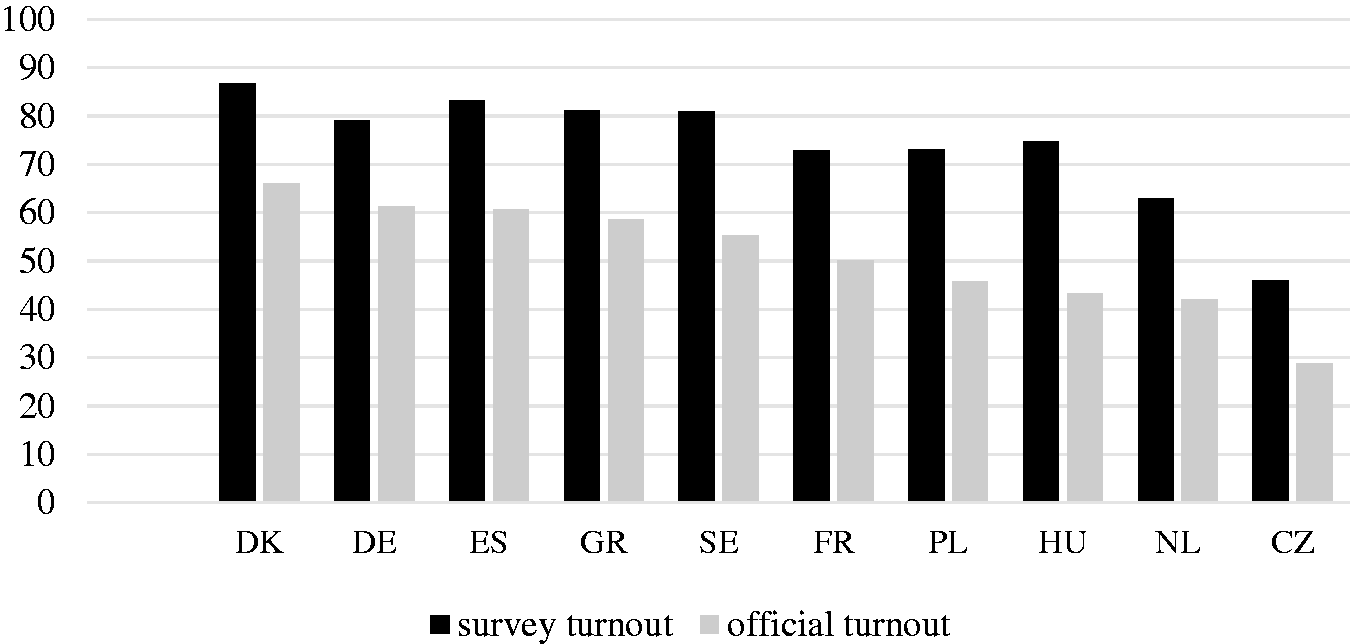
Self-reported and official turnout across countries.
Next, we are interested in how often respondents engaged in the different campaign activities. Figure 2 depicts the frequency of all 12 variables under study in the recoded three-category version and ordered according to the amount of ‘never’ answers. There are large differences between the activities, with more traditional (and passive) activities such as analogue campaign exposure and seeing poster ads as the most frequent ones. In contrast, two of the social media activities are among the least frequent activities, showing that respondents rarely actively posted something about the EP elections and did not often engage in EU-related communication with people online. A third equally seldom activity is the attendance of a campaign event. Only around one-third of the people have participated in these three activities each.
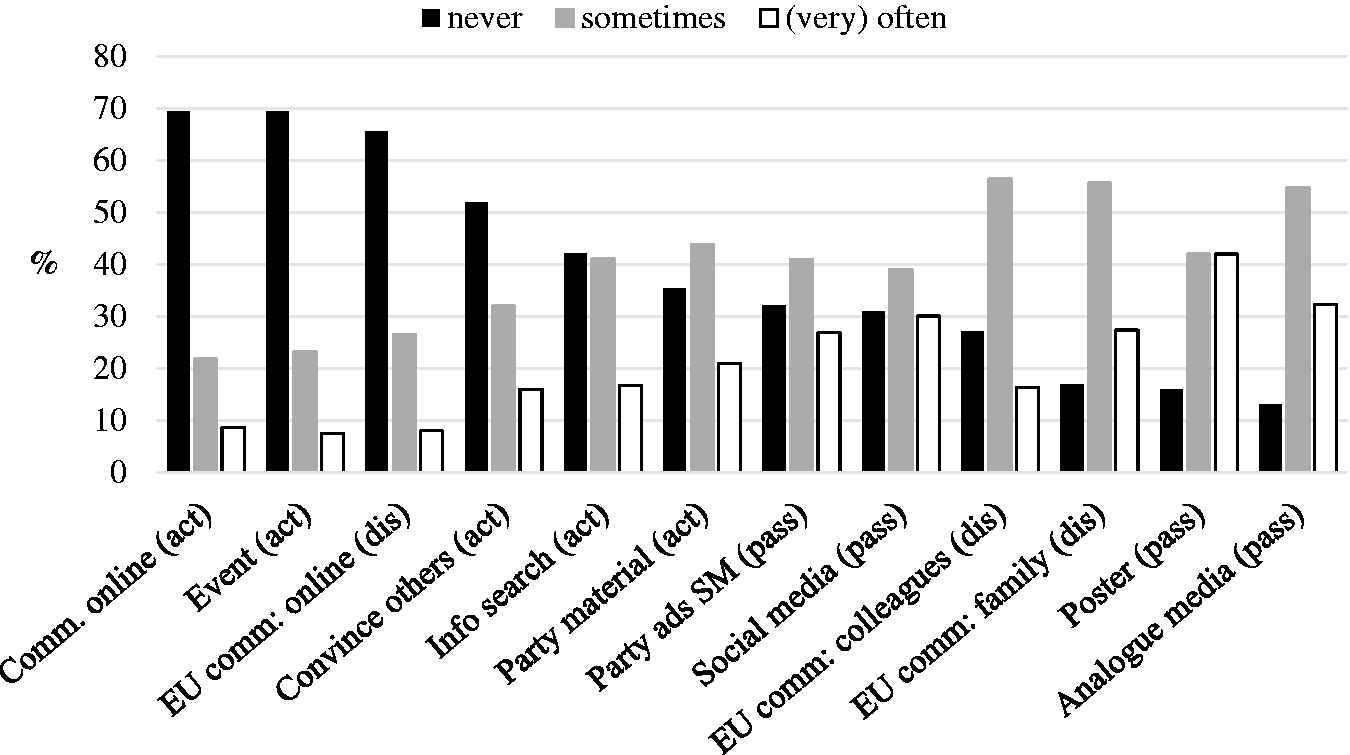
Frequency of campaign activities.
The results of our multilevel regression models are displayed in Table 1. We ran five model specifications, including only the control variables (1), adding the passive campaign factors (2), the active variables (3), the interpersonal communication variables (4) and a final full model (5). We further ran an additional ‘empty’ model to examine the importance of the country context. The resulting intra-class correlation shows that 8.6% of the explained variance stems from the country level; most of the individual differences in electoral participation hence stem from individual-level variables.
Results of logistic multilevel regression models.
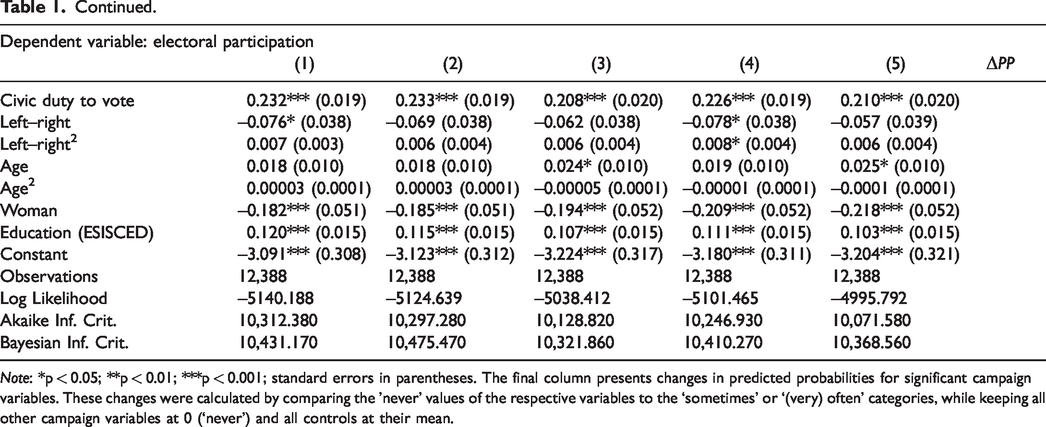
Note: *p < 0.05; **p < 0.01; ***p < 0.001; standard errors in parentheses. The final column presents changes in predicted probabilities for significant campaign variables. These changes were calculated by comparing the ’never’ values of the respective variables to the ‘sometimes’ or ‘(very) often’ categories, while keeping all other campaign variables at 0 (‘never’) and all controls at their mean.
Model 1 confirms the influence of common turnout determinants in the 2019 EP election context, although not all variables have a significant effect. Drivers of individual electoral participation are higher levels of intended participation in the pre-election wave and general political participation, a higher interest in EU politics and strong feelings of civic duty. Turnout further increases among men and higher educated persons. Several other common effects could not be observed (e.g. trust in the EP or satisfaction with one’s national government).
Looking at the main variables of interest, we focus on the fifth model, given the overall stability of the effects compared to the separate models 2–4 and model 5’s superior model fit. Contrary to our general expectation, we find an equal amount of variables showing positive and negative effects across our three categories of campaign variables. The factors with the strongest negative influences on turnout are interpersonal communication with people online, the attendance of campaign-related events, active online communication about the elections and general analogue campaign exposure. In contrast, the strongest significant positive influences on the likelihood to turn out stem from attempts to convince others (what) to vote (for), active searches for information online and the exposure to party material. Seeing political posters and interpersonal family communication are further significant factors, though only when done (very) often. In order to estimate the substantial size of the significant campaign effects, we calculated the respective predicted probabilities, 2 which can be found in the last column of Table 1. The strongest positive and negative effects in-/decrease the probability to turn out by 11 (try to convince others) and 18 percentage points (interpersonal communication with people online), respectively. Compared to effects of common determinants such as higher levels of civic duty to vote (24 percentage points increase) or interest in EU politics (17 percentage points increase), these campaign effects are quite substantial, especially the negative ones.
Running the additional separate models for ‘certain’ abstainers, ‘certain’ voters and undecided respondents (Table 2) offers some more fine-grained results. For instance, three of the negative campaign effects are driven by only two types of respondents: The effects of event attendance (having attended (very) often) and analogue media exposure are particularly large for ‘certain’ and undecided respondents, but not significant for ‘certain’ abstainers. In contrast, only ‘certain’ abstainers and undecided respondents are significantly demobilized by active online communication. Furthermore, seeing party ads on social media negatively affects ‘certain’ abstainers only. Finally, we see that the positive effects of active information search online (doing this (very) often) and trying to convince others (what) to vote (for) are around three to five times as large for ‘certain’ abstainers compared to those individuals who wanted to vote from the start. Family communication, in contrast, only manages to mobilize uncertain respondents.
Regression models with subsets of respondents.
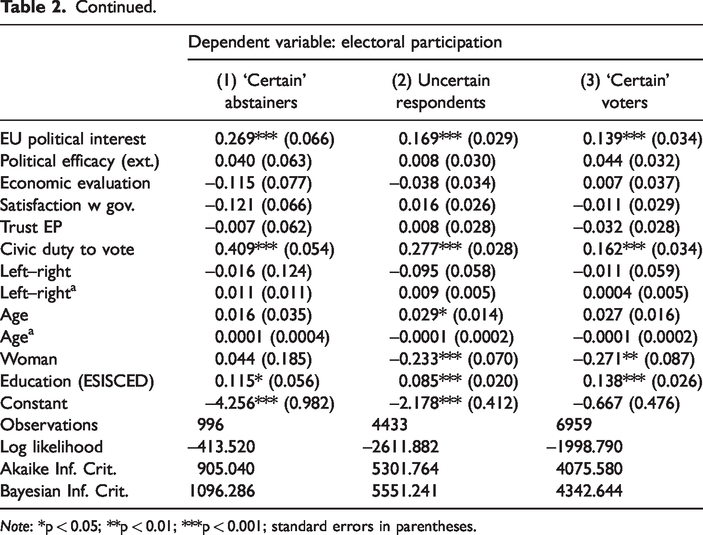
Note: *p < 0.05; **p < 0.01; ***p < 0.001; standard errors in parentheses.
Three robustness checks further confirm our results. First, estimating our main model with the linear seven-point scales of the campaign variables results in the same findings regarding significance and direction of the effects (see the Online appendix). The same is true for an alternative model setup relying on a simple logistic regression model with country-fixed effects using the pooled sample, which shows highly similar coefficients compared to our main multilevel model (not displayed). Finally, a second model setup for the subgroups of certain abstainers/voters and undecided respondents with alternative group recodings (restricting the ‘undecided’ group to middle values of 3–5 on the vote certainty scale) yields highly similar patterns to our original coding of these subgroups (see the Online appendix).
Discussion
We analyzed the extent to which exposure to and engagement with different campaign activities can motivate citizens to vote in EP elections. We assessed the influence of citizens’ passive exposure to party communication and advertisements, their active engagement with the campaign and the frequency with which they discuss EU-topics with their interpersonal network in the context of the 2019 EP elections and provide a comprehensive overview of the different influences that mobilize the EU electorate. Our results paint a mixed picture of campaign effects for citizens’ turnout in EP elections (Table 3).
Overview of campaign effects on turnout, all respondents.
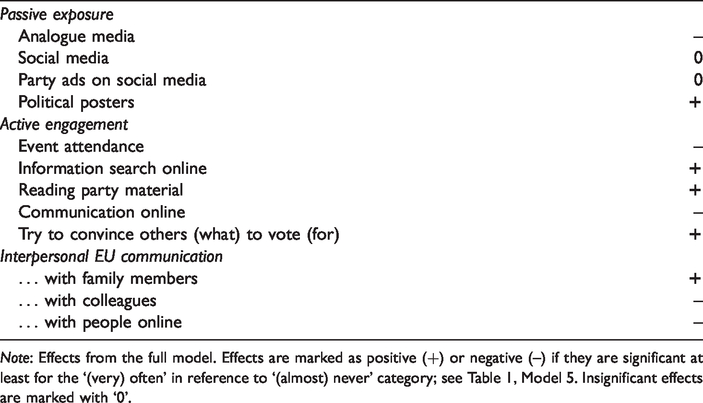
Note: Effects from the full model. Effects are marked as positive (+) or negative (–) if they are significant at least for the ‘(very) often’ in reference to ‘(almost) never’ category; see Table 1, Model 5. Insignificant effects are marked with ‘0’.
We find support for the mobilizing influence of a number of crucial variables beyond the ‘usual suspects’ commonly addressed in the literature; yet contrary to our initial and evidence-based differentiation between passive and active forms of campaign engagement (e.g. Bucy and Gregson, 2001) and interpersonal communication (e.g. Boomgaarden, 2016), our findings cut across different types of activities: Passive exposure to political posters positively affects electoral participation, but exposure to analogue media content depresses turnout; actively attending to party material increases the chances that citizens go to the polls, while actively sharing election-related content online decreases it. And political conversations with family members make electoral participation more likely, but interpersonal communication online demobilizes the European electorate. What do these seemingly inconsistent findings tell us?
First, they show that unidimensional categorizations along voters’ degree of engagement with campaign information are insufficient; instead, types of media formats, discussions and content matter for effects. Second, our results reiterate the fact that measures of general campaign engagement that aggregate effects across different activities may run the risk of summarizing negative and positive influences into apparently non-existing effects or to over-/underreport campaign effects, respectively. Third, we show that campaign effects are not uniform across voter groups, but vary for those citizens that already decided to vote, abstain or were indecisive about their electoral participation prior to the campaign. We hence echo the observation made in other electoral contexts (e.g. Arceneaux and Nickerson, 2009; Goldberg et al., 2019a) that mobilization efforts differ for citizens in the EU.
‘Certain’ abstainers can be mobilized if they frequently search for information online or try to persuade others (whom) to vote (for). Notably, 28.6% of intended abstainers in our sample did report that they voted after all. In this case, active engagement does make a difference. In contrast, mere reminders such as exposure to political posters are insufficient to provide an adequate boost for those citizens. In other words, they know the election is going to take place, but it takes a lot of effort to change their mind – unless they feel the civic duty to cast a vote. Other (very frequent) encounters with campaign-related information reinforce their intention to abstain, all of which take place in the online environment: Seeing party ads on social media, communicating with people online about the EU and posting or commenting content related to the election on social media make it even less likely that they will cast a vote. This finding raises the question about a potentially ‘toxic’ information and communication environment on social media, in which the diversity of opinions and information also increases the likelihood that citizens are exposed to critical content about the Union.
In our study, ‘certain’ voters amounted to 9.8% of the whole sample; considerably fewer individuals changed their mind to not vote compared to intended abstainers who went to the polls. Again, online discussions about the EU depress electoral participation for ‘certain’ voters, even if citizens only engage in them sometimes. Since discussion networks on social media tend to be more heterogeneous than those relationships that we have with people in our immediate environment (Barnidge, 2017), citizens with a positive EU attitude might encounter demobilizing discussion partners online. Indeed, additional analyses from our data (not displayed here) confirm that people who talk about the EU with people online are more likely to encounter opinions that are not in line with their own. Ultimately, such interpersonal discussion may lead citizens to abstain on election-day – even if they initially had a strong intention to vote. ‘Certain’ voters are further demobilized by analogue media exposures; possibly, the coverage was not engaging enough during the 2019 campaign period and tired the electorate, but content information is needed to further substantiate this assumption (see also Schuck et al., 2016). Finally, attending events related to the campaign strongly depresses turnout among this group and consistently across all countries (tested with additional random slope models). Possibly, this effect can be attributed to the nature of the events in question, which was not defined in detail in the questionnaire: For example, one might imagine that respondents attended demonstrations against EU austerity measures. Yet additional analyses reveal that this negative effect is strongest among right-, not left-leaning respondents (as could be expected for such types of events). Another conceivable explanation may lie in a ceiling effect, assuming that those people who attend events are a highly motivated group of citizens already – their electoral participation, if moving in any direction really, can only go down. Indeed, around 58% of those citizens in our sample who attended events (very) often were ‘certain’ voters, and only 5% were initial ‘abstainers’. More information on the context of political events is thus necessary here.
Notably, ‘certain’ voters can be further strengthened in their turnout intention, which highlights the necessity to consider them a relevant target group for campaigners: For them, seeing political posters (very) often seems to serve as a visual reminder of election day, and active searches for information online further strengthen their conviction. Note that this activity has the same effect for ‘certain’ abstainers and undecided respondents; presumably, the more effort one invests into finding information about the election online, the more one is convinced about the importance of casting one’s vote for the EP. Finally, reading party material also underpins prior voting intention, although only to some extent: if ‘certain’ voters attend to it very often, the effect is not significant anymore, and we might assume a tiring effect similar to that of analogue media exposure.
Prior research indicates that campaign effects might be largest for those parts of the population that have not made up their mind about whether to vote or abstain in an election (e.g. Arceneaux and Nickerson, 2009; Goldberg et al., 2019a; Hillygus, 2005). Indeed, ‘uncertain’ respondents in our sample are the most often significantly affected in their decision to turn out – both positively and negatively. We observe similar negative effects for exposure to analogue media content compared to ‘certain’ voters, and event attendance depresses turnout for this group irrespective of its frequency. As noted, active information search online boosts turnout. The positive effect of reading party material is similar to that of ‘certain’ voters, and if they attempt to convince others (who) to vote (for), it increases the chances that they themselves will participate in the election as well. Interestingly, for the group of uncertain respondents, any form of communication about the EU with people online has a negative effect, which substantiates our claim about the heterogeneity of online networks and the likelihood that even those citizens who initially feel positive about the Union and the EP elections might get demoralized (and demobilized) by their online discussion partners. However, this group is the only one that can be persuaded to go to the polls through discussions with family members and close friends. These findings align with the large body of research highlighting the importance of discussion network characteristics and tie strength (Granovetter, 1973) for politically relevant outcomes (but see Matthes et al., 2020). At least for EP elections, it matters just as much who one talks to as how often, and further research should take into account political network heterogeneity as well.
Campaigns for EP elections matter to different extents depending on European citizens’ prior commitment to an election and the individual activities they engage in. In contrast, some of the ‘usual suspects’ in the literature on turnout for EP elections (e.g. satisfaction with the government; Flickinger and Studlar, 2007) do not exert an effect in the 2019 elections. While their absence may be surprising at first, previous studies in the context of EP elections document similar non-findings (e.g. de Vreese and Tobiasen, 2007). Our aim was to disentangle the effects of individual campaign activities within the larger information environment of an EP election campaign, and we argued for the importance of also taking into account campaign exposure and engagement online, given the relevance of online platforms for political issues in the modern media environment. Our results show that rather than looking at the simple offline/online dichotomy, we should consider the specific role of social media platforms. Whether citizens post something about the elections or mention their vote on social media; whether they see political parties’ ads on social media or talk about EU politics with people online – all these forms of exposure or activity (even if not always to a significant extent) decrease the likelihood that citizens are going to cast their vote, and they do so across voter groups. Partly, these negative effects may be attributable to perceptions of slacktivist participation (Kwak et al., 2018), that is, the idea that social media activities alone are sufficient to make a meaningful political impact. As a result, people may feel that they have already ‘done their part’ and refrain from participating in politics offline. Compositional analyses in our data show that those citizens who engage online also tend to be younger than those who refrain from political engagement on social media. Our findings thus highlight the necessity to assess the role of the social media environment in modern political campaigning, and future research is encouraged to further investigate these consistent negative effects.
This study has several limitations. First, we lack further specifications on the type of information or events people were exposed to, shared, discussed or attended. Information alone is not sufficient to affect EU attitudes; instead, the way in which media and parties frame the Union has important implications for the public, and we strongly urge linkage analysis to investigate these questions. Such analyses are also encouraged to take into account EU-wide mobilization strategies such as the Parliament’s ‘This time I’m voting’ initiative. Furthermore, both our main predictors and the dependent variable stem from the same post-election wave, which warrants caution for causal inferences. Given their close proximity, it is difficult to assess past campaign engagement and electoral participation at different points in time; we controlled for turnout intention from an earlier wave to account for this problem. We are also unable to model precise process strategies connecting campaign exposure/engagement and turnout and urge further (comparative) experimental research in this context (see, e.g. Maier et al., 2012). Some of our analytical decisions merit discussion as well: In transforming our measurement of the frequency with which citizens engaged in the different campaign activities and/or were exposed to information about the election into three levels, we limit the variance in our independent variables. Yet this decision was taken because some of the activities were highly skewed in their distribution. A robustness check using the linear scales of all campaign variables yields similar findings (see the Online appendix), and we are thus confident that the results we report here are not an artefact of data transformation or rescaling.
We have argued that elections for the EP are a particularly relevant case in which to study the influence of campaign factors, as research demonstrates that citizens’ personal motivation plays a larger role for turnout on the supranational level because the initial level of participation is lower (Söderlund et al., 2011). However, these activities and types of information may be relevant beyond the supranational EU context as well, particularly when considering voting in ‘second-order’ or low-salience elections (Lefevere and van Aelst, 2014). We have taken into account 10 different nations that share the same supranational political system and whose citizens were called to the polls for the same election, but that display highly diverging levels of electoral participation. We thus contribute to the literature on campaign influences that mobilize participation in EP elections, in an electoral context that has suffered from low public interest and continuously falling turnout numbers. Our findings show that the information environment can play a crucial role in mobilizing the European electorate. However, unlike intended by the EU’s campaign slogan ‘This time I’m voting’, not all efforts increased turnout on election day. Mobilization efforts are multifaceted, and studies which only look at the ‘usual suspects’, focus on aggregate data, take only few of the above tested variables into account and/or pool respondents irrespective of their prior participatory intention fall short of providing a comprehensive picture of factors influencing turnout in EP elections.
Supplemental Material
sj-pdf-1-eup-10.1177_1465116520943670 - Supplemental material for ‘This time I’m (not) voting’: A comprehensive overview of campaign factors influencing turnout at European Parliament elections
Supplemental material, sj-pdf-1-eup-10.1177_1465116520943670 for ‘This time I’m (not) voting’: A comprehensive overview of campaign factors influencing turnout at European Parliament elections by Claes H de Vreese in European Union Politics
Supplemental Material
sj-zip-2-eup-10.1177_1465116520943670 - Supplemental material for ‘This time I’m (not) voting’: A comprehensive overview of campaign factors influencing turnout at European Parliament elections
Supplemental material, sj-zip-2-eup-10.1177_1465116520943670 for ‘This time I’m (not) voting’: A comprehensive overview of campaign factors influencing turnout at European Parliament elections by Claes H de Vreese in European Union Politics
Footnotes
Acknowledgements
Previous versions of this study were presented at the 2019 European Consortium for Political Research general conference in Wrocław, the 2019 European Communication Research and Education Association Political Communication conference in Poznań and the 2020 Etmaal van de Communicatiewetenschap in Amsterdam. We thank all organizers and participants, particularly Agnieszka Stępińska, Piotr Sula and Rens Vliegenthart as well as three anonymous reviewers at EUP for their valuable feedback. We also thank Katjana Gattermann and Alessandro Nai for their helpful comments on earlier drafts of this article.
Funding
The author(s) disclosed receipt of the following financial support for the research, authorship, and/or publication of this article: This research is funded by a grant from the European Research Council (ERC), grant number 647316, awarded to Claes H de Vreese.

Supplemental material
Supplemental material for this article is available online.
Notes
References
Supplementary Material
Please find the following supplemental material available below.
For Open Access articles published under a Creative Commons License, all supplemental material carries the same license as the article it is associated with.
For non-Open Access articles published, all supplemental material carries a non-exclusive license, and permission requests for re-use of supplemental material or any part of supplemental material shall be sent directly to the copyright owner as specified in the copyright notice associated with the article.
