



Abstract
This article focuses on what diverse forms of silence (i.e., silence-phenomena) convey about affective processing and meaning-making as processes. Departing from a dialogical perspective that informs sociocultural and existential theories, we qualitatively analyze Karin and Dana’s (pseudonyms) cases. These two Master’s students attended a three-week-long intensive and interdisciplinary course at a Norwegian university. The course is about silence-phenomena, group dynamics, and quality of life. Our primary data consisted of journal entries (Karin, n = 21; Dana, n = 30) that the study participants wrote at different moments of the day during this course, including a morning session called “The Silent Time.” We also included email follow-ups exchanged with the students after the course ended (Karin n = 1; Dana, n = 3). We use Developmentally oriented Thematic Analysis (DOTA) as a method of analysis in order to address both state and process-oriented narratives in their writings. Our research findings suggest that silence-phenomena can amplify the human experience of uncertainty by bringing contrasts that shift our attention inwards or outwards, activating diverse emotions and positionings of the self. We discuss these findings in light of the model of hypergeneralization of affect in cultural psychology and how this model can integrate phenomenological time and existential meaning.
Keywords
Introduction
The connections between affect and meaning-making are central to psychology (Vygotsky, 1925/1971). Emotions tend to be studied through felt sensations symbolized through language (Greenberg, 2012). Sometimes, a person can experience global distress “characterized by undifferentiated emotional pain, hopelessness, helplessness, confusion, despair, etc.” (Timulak & Pascual-Leone, 2015, p. 620). In these cases, the support of, for example, a psychotherapist can help find words that enhance meaning-making (Pascual-Leone & Greenberg, 2007). Yet, even if defined as a central phenomenon for psychology, it can be difficult to explore and describe the depth and intensity of affective processes through linguistic categories, either theoretically, empirically, or methodologically (Lehmann, 2018, 2019; Valsiner, 2007). Even when symbolized in alignment with our experiences, words themselves do not always suffice to express the intensity of some traumatic or blissful experiences (Lehmann, 2019).
According with Vygotsky’s unfinished work on affect (Vygotsky, 1925/1971), emotions can be studied in terms of the tensions that are part of a process of synthesis of meaning, and not just to a synthesis outcome. These tensions have been described in the literature in terms of ambiguity (Klempe, 2016; Lehmann, 2019), ambivalence (Abbey & Falmagne, 2008; Abbey & Valsiner, 2005), polyphony, homophony, and or multivoicedness (Bakhtin, 1963; Hermans, 2001; Lehmann, 2022). On the one hand, while ambiguity denotes a high level of uncertainty, ambivalence suggests at least two possible trajectories of meaning (Abbey & Valsiner, 2005). On the other hand, while multivoicedness refers to the multiplicity of positionings, or voices, of the self, homophony suggests consonance in the direction of such positionings on voices, and polyphony that there is dissonance or that some of these voices or positions are heading in different directions (Bakhtin, 1963/1999; Lehmann, 2022, 2018).
The hypergeneralization of affect
In sociocultural psychology, the model of semiotic regulation of dynamic fields is a prominent model aimed at diverse levels of differentiation of affect, all the way from bodily sensations into words or to hyper-generalized levels of experience that transcend the limits of language as a system to describe some aspects of the human condition (Branco & Valsiner, 2010, 2012; Lehmann, 2014b; Valsiner, 2020). Recent revisions of this model emphasize that affective processes unfold both in chronological and phenomenological time, and they enable the study of their emergence and association with meaning-making and values to be studied by taking into consideration these qualities of temporality (Lehmann, 2019). In Figure 1 we provide an overview of the revised model. Hyper-generalization of affect through chronological and phenomenological time. Note: Reprinted from “The Poetic Resonance of an Instant. Making Sense of Experience and Existence through the Emotional Value of Encounters” by O. V. Lehmann (2019, p. 61), Ordinary Things and their Extraordinary Significance (Marsico & Tateo, Eds). Reprinted with permission from the series editor.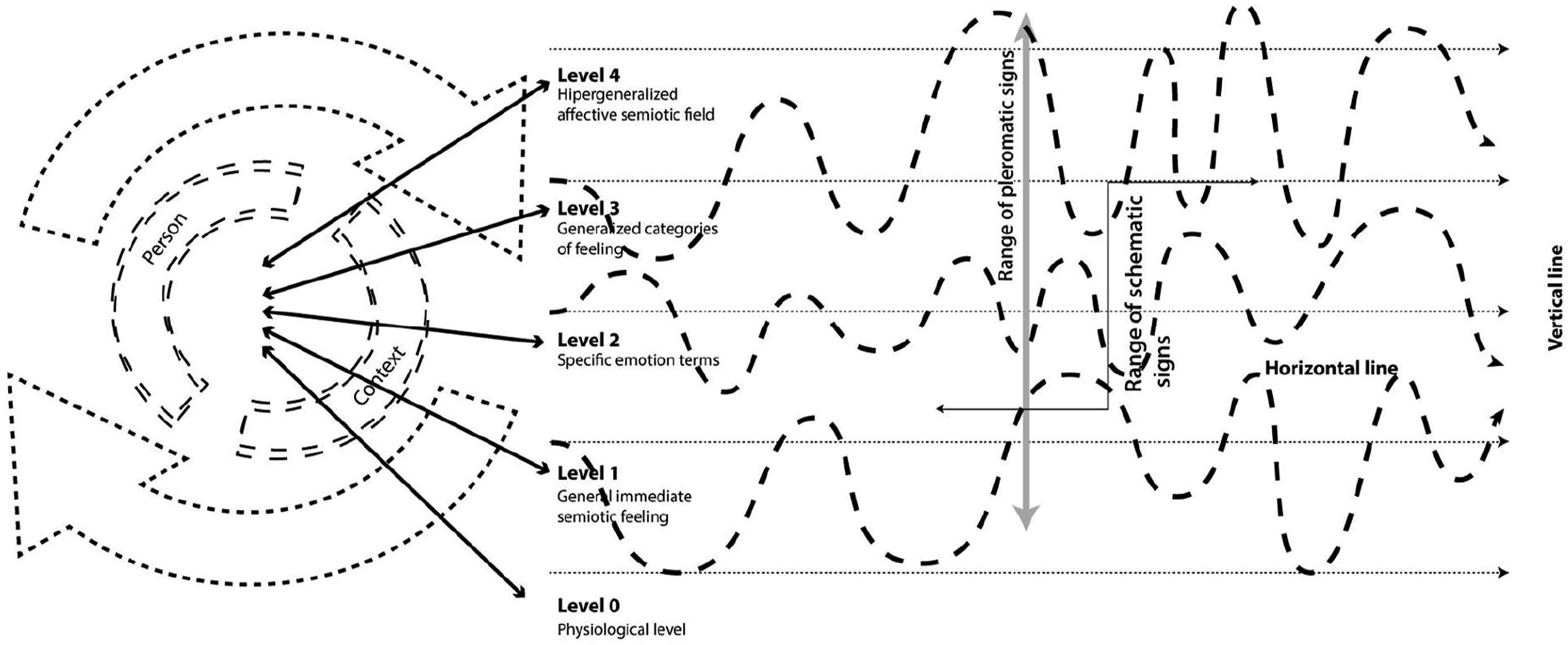
Affective processes happen in the ongoing exchange of information and our perceptions about what happens within the context of our interactions. While these processes occur through chronological time and are to be understood historically, this entails that our emotional world often follows a phenomenological order. We experience temporality and space differently when emotionally aroused, and the intensity of such arousals can also affect our capacity to find words to describe the qualities of our experiences (Bachelard, 1932/2013; Lehmann, 2019). That is, the way we make sense of our experiences is not always sequential but dictated by the felt intensity of some particular moments in our lives (Dilthey, 1978). Some instances impact us more than others, and our memories or anticipations of the future are constantly mixed with our perceptions of the here and now. At times, we lack words because the early activation of feelings makes them undifferentiated, and we need more time to comprehend the message they hold. At other times, global distress constrains our capacity to use language assertively (Pascual-Leone & Greenberg, 2007; Timulak & Pascual-Leone, 2015). In addition, some instances correspond to a hyper-generalized level of affect. That is, instances that remind us that words do not always suffice for us to explain and or express our experiences or convey insights about existential meaning (Lehmann, 2019).
Examples of hyper-generalized levels of affect could be, for instance, our sense of identity and our experience of human values (Märtsin, 2010). Being relationally oriented notions, identity, and values shed light on dialogical aspects of our psychological functions. Different positionings of the self and Others come into the scene of human interactions (Märtsin, 2010; Lehmann et al., 2018). According to the Dialogical Self Theory, our sense of identity is formed by diverse I-positions that coexist, at times in tension; these positionings of the self can correspond to a multiplicity of internalized versions of others or different parts of ourselves (Hermans, 2001; Hermans et al., 1992). Some typologies of these I-positions are, for example, promoter positions and meta-positions. Promoter positions help give other I-positions a sense of order and direction in real-time (Hermans & Gieser, 2011; Valsiner & Cabell, 2012; van Loon & van den Berg, 2016). A meta-position of the self is when one can observe other I-positions from a detached perspective, providing insights into our ways of functioning (Lengelle, 2023; Hermans, 2003 in Nir, 2016). Acknowledging the multiplicity of positionings of the self that can arise or not in each situation calls for a processual focus. Through longitudinal data, such multiplicity and its dynamic patterns can be analyzed. Indeed, perhaps it would be more accurate to describe I-positions as vectors that demarcate trajectories to highlight these dynamics and their tensions (Lehmann & Valsiner, 2017).
A framework to explore silence-phenomena
Various forms of “silence” (here onwards Silence-phenomena) give an account of a wide spectrum of human experiences, all the way from poetic instants to contemplative or meditative experiences of self-transcendence (James, 1899; Bruneau & Ishii, 1988; Lehmann, 2022, 2019), to aspects of our human interactions in terms of turn-taking, self-disclosure, boundary setting and power dynamics (Bruneau, 1973; Bruneau & Ishii, 1988; Kurzon, 1998, 2007; Lehmann, 2022; Noelle-Neumann, 2008). Silence-phenomena can give room for self-exploration as the contrast that they represent to the flow of experiencing leads to attentional shifts and enhances our perception of uncertainty (Lehmann et al., 2018; Lehmann, 2022, 2019). When silent, we can listen and or attend to external and internal stimuli, while we can also imply or say something to other persons and or to ourselves, and we can have experiences of relational depth and values (Lehmann, 2022, 2016a).
We can recognize relational depth when we feel intense contact and connection with another person (Mearns & Cooper, 2005), when we have genuine dialogues, and all parties feel understood, seen, and cared for (Hermans & Hermans-Konopka, 2010). In addition, we can recognize existential meaning through values that give us a sense of purpose and direction, even if not always pleasant (Frankl, 1967/2012). Values can be embraced when we create acts or projects whereby we give something meaningful to others, when we are the recipients of meaningful experiences, and when we face impending suffering with heroic attitudes (Frankl, 1967/2012).
Poetry as a threshold
Vygotsky trusted the arts when suggesting that imaginative processes are key when studying the intersections of affect and psychological functions (Vygotsky, 1925/1971). Similarly, contemporary scholars in sociocultural psychology have aimed to restore the connections between art and science and bring insights from, among others, painters and poets into psychology (e.g., Abbey & Bastos, 2017; Lehmann, 2014a; Lehmann et al., 2017; Lehmann & Brinkmann, 2020; Valsiner, 2014). Both relational depth and existential meaning have been the source of thousands of poems in the history of humankind. Still, to the average person, describing what these experiences convey is challenging. As the Mexican Nobel prize laureate Octavio Paz would beautifully say, all of us experience poetic instants, but not all of us craft poems whose words make us feel and faithfully evoke these experiences (Paz, 1956/1999; Lehmann, 2019). One of art’s main contributions to the theoretical and methodological advances of psychology is that it illuminates aspects of our emotional world in a way that normative uses of speech cannot. It allows us to study the unspeakable, the ineffable, and the pre-verbal aspects of experience.
Objective of the study
In this article, we offer possibilities for theoretical and methodological innovation in studying the intersections of affect and values within psychology. To do so, we assumed that an explicit focus on poetry could help the study of meaning-making and affective processing about experiences of silence-phenomena. The research questions we aim to address in this article are: What are the experiences students document in their journals about silence-phenomena and affect? And, how do students relate to poetry when journaling about silence-phenomena?
Methodology
Context: A class on silence
In the spring semesters of 2015 and 2016, Olga Lehmann, the first author of this paper, taught an intensive and interdisciplinary Master’s course entitled Improving the Quality of Life of Citizens through Experiences of Silence at a Norwegian university. This was a course aiming at providing all the students of a master’s program with skills and tools for transdisciplinary collaboration and teamwork that they can use in their work environments. As part of the didactic tools suggested by the university for courses on teamwork, such as the one led by the principal investigator (PI) of this article, the students were asked to keep a journal where they would keep journal entries about their process of collaborating with other classmates. The course had a twist compared to other courses. Given that this was a course about silence, the tutor and the first author of this article created an experiential setting called Silent Time for about 30 minutes every morning for about three weeks, from Monday to Friday, 8 hours a day. In one way, the setting of this silent time resembles the principle of double stimulation in Vygotsky, given that it was a setting that elicited uncertainty and provided ambiguous tools to see how participants would make sense of the experience (Sannino, 2016). Starting the first minutes of a graduate course on silence was an unusual practice, and the tools the students had available–a stimulus related to silence, a journal to write, and an encouragement to write in a poetic style, were ambiguous enough to promote different trajectories of meaning-making and affective processing.
In Silent the Time, the PI provided students with diverse stimuli such as poems, songs, meditations, and paintings about silence-phenomena. Then, she showcased slides with the instructions and the stimuli. After interacting with the specific stimulus per day, students journaled, reconstructing their experiences. Then, students were encouraged to re-write some of their journal entries in a poetic style, as the principal investigator assumed this would enhance the connection with emotions and values. The PI assumed that using a poetic style would scaffold the internalization of silence-phenomena.
The study participants
After the courses were over and the students had received their grades, the PI asked whether some wanted to voluntarily submit their diaries as data for research use. We chose Dana’s and Karin’s data for further analysis out of the eight initial journals that the PI collected for her doctoral dissertation due to the diversity of experiences that the participants described. The contrasts that the data suggest, we assumed, would benefit the generalization purposes in case study research (Valsiner, 2019).
Karin and Dana, pseudonyms, were two of the 48 master’s students who participated in Olga’s classes in 2015 and 2016. Both were 24 years old at the time of the research. Karin was studying Psychology, and Dana was studying Economics. Karin had already been reflecting on silence-phenomena personally and professionally before enrolling in the course. She manifested a very active attitude towards self-exploration. She journaled 14 out of the 15 days of class, prioritizing the Silent Time (12 entries) over the day reflections (three entries) and afternoon reflections (six entries). Even her afternoon reflections related more to self-explorative processes than to the teamwork of the community project. She wrote eight poems and added sidenotes to explore the content of the poems further. One email follow-up a year after the course was over was included as part of the data.
Dana described herself as interested in meditation and assumed that she was enrolling in a course that had a more explicit focus on it. While suggesting a high motivation and goal orientation during the course, she also described challenges in understanding or complying with poetry and other forms of silence-phenomena other than meditation. Therefore, this case study became a rich learning process for us as researchers, defying some of our assumptions about how silence-phenomena and poetry could be internalized in this classroom context. Similarly to Karin, Dana also journaled 14 out of 15 days of the class and prioritized writing about The Silent Time (14 entries) over the day reflections (four entries) and afternoon reflections (eight entries). Three email follow-ups with Dana were included as parts of the data, one a year after the course ended. She wrote one poem in her journal during the class.
Journaling as a data collection tool
We chose diaries as the data collection method because it is an effective way for researchers to gain access to the participants’ subjective account of experiencing silence-phenomena, and what that means for them. 1 When journaling, we are not only writing our thoughts in stone as if these were permanent and irrefutable conclusions. We write to process and integrate our emotions, thoughts, memories, imagined futures, and what is happening in the here and now. Therefore, the analysis of journal entries can be a treasure for researchers interested in investigating meaning-making and affective processing in their processual nature. While writing a journal, people can reflect and become aware of aspects of their lives that can otherwise be taken for granted (Alaszewski, 2006). Diaries are also effective tools for data collection in case study research, giving account of profound aspects of the mental life of study participants (Allport, 1942; Zittoun & Gillespie, 2015). We are also suggesting that diaries can give an account of the dialogical nature of the mind, as often, those who write are doing so from certain positionings of the self and engaging in a dialogue with another positioning of the self or with another person.
Ethical approvals
Students only donated their diaries voluntarily and after the Master’s course was over and once they had received the corresponding grade for their projects. Consent forms were signed, and data was anonymized when coding. This project received approval from the Norwegian Center for Data Protection (NSD at that time, now known as SIKT).
Developmentally oriented thematic analysis (DOTA)
DOTA (Lehmann et al., 2018) was developed as a process-oriented alternative to study practices of journaling. Studying longitudinal textual data implies working with both meaning outcomes and the ongoing activity of meaning-making and affective processing as it unfolds through time (Lehmann et al., 2018). DOTA is, therefore, a dialogically-informed methodology. It focuses on identifying I-positionings and how the interaction between these positionings of the self would enhance or obstruct dialogue, influencing the development of specific meanings, decisions, or emotional insights.
DOTA integrates insights from thematic analysis as well as microgenetic analysis. On the one hand, microgenetic analysis is a forward-oriented methodology in developmental psychology, often used in case study research, that focuses on capturing the qualitative reorganizations and transformations of the participants’ co-construction of meaning about experiences through time (Valsiner, 2020; Wagoner, 2009; Sato et al., 2015). In the reorganization and transformation process, we come across ambivalence, ambiguity, and uncertainty inherent to meaning-making and affective processing (Abbey & Valsiner, 2005; Abbey, 2012; Lehmann et al., 2017). Microgenetic analysis can reveal the ongoing emerging meaning-making and affective processing. On the other hand, thematic analysis offers a somehow flexible approach to coding and organizing data into themes, acknowledging the reflexivity of the researchers and addressing the researcher’s subjectivity when interpreting the data (Braun & Clarke, 2019). DOTA looks at the process of coding and interpretation and calls for an ongoing reflexive practice from the researcher, as well as both inductive and deductive ways of theorizing (Braun & Clarke, 2022).
Applying DOTA
When applying DOTA to textual data, the researcher would first run intra-individual analyses that are later integrated into inter-individual analyses of the cases (Lehmann et al., 2018). In practice, this involves first differentiating which excerpts of the data are more state-oriented versus those that are more explicitly process-oriented. For instance, the latter would reflect ambivalence, ambiguity, or multivoicedness. In the present article, the analysis of the cases of Karin and Dana started with a revision of the previous analysis done in Lehmann’s (2018) unpublished doctoral dissertation, as well as the first published methodological premises of DOTA (Lehmann et al., 2018). Such a process of revision implied revisiting the anonymized transcriptions of the journals and refining the theoretically driven themes about the meanings and effects of silence-phenomena. This led to a new conceptualization of the themes: (a) silence-phenomena and attention; (b) silence-phenomena and self-exploration; (c) silence phenomena and affect; (d) silence-phenomena and the sense of space. Building on the thematic analysis, the microgenetic analysis of textual narratives, in this study, journal entries by Karin and Dana reveal a developmental trajectory of meaning-making and affective processing. We created a matrix table for each participant, categorizing a journal entry into various themes and sub-themes that characterize layers of self-exploration emerging as a participant writes in his/her journal. The state-oriented narratives are organized following a more traditional approach to thematic analysis (Braun & Clarke, 2019, 2022).
In the presentation of the results, we used the following abbreviations: ST, referring to excerpts written during the silent time at class; AR, referring to entries written as part of the afternoon reflections at class; FU, referring to follow-up e-mails with the participants one year after the class was over.
The case of Karin
Silence-phenomena and the poetic
In the follow-up email one year after the course was over, Karin referred to the Silent Time as her most salient memory of the class. Being more aware of the presence of poetic realms as an experience of Silence in daily life has also made her more receptive to similar experiences. She associated this both with being in nature and appreciating art with a more open-minded attitude: What stuck with me was the term “poetic instants” (...), which actually made a lot of sense to me and of which I notice from time to time - especially when I am in contact with nature. (Karin, FU, p. 4)
She even emphasized that her awareness was not limited to poetic instants. However, to other realms of silence-phenomena: “I am more aware and attentive to its different forms, not always or every day, but more often than before” (Karin, FU, pp. 12–13). Attention and appreciation, for her, appeared to be closely related.
Karin gave another layer of attention to her journal entry. Even if she wanted to be fully engaged in the depth of a poetic instant or a meditation practice, reflecting on silence-phenomena helped her repeatedly notice the contrast between imagined ideals and the surrounding reality: The mindfulness meditation reminds me of the importance of self-love, self-acceptance (…) It made me aware that I’m feeling a little tense and preoccupied with details. This normally happened when I, for some moments, lost track of what is important, what really matters. (Karin, ST, Day 8, p. 8)
When writing about her experiences of silence-phenomena in contrast with other co-existent features, Karin often directed such contrasts towards a value to be embraced, such as self-love or acceptance, and her current experiences of aspiring toward such value while feeling distracted or preoccupied. Let us look at this in relation to self-exploration in the next section.
Silence-phenomena and self-exploration
Example of Karin’s process of self-exploration (AR, Day 1, p. 1.).
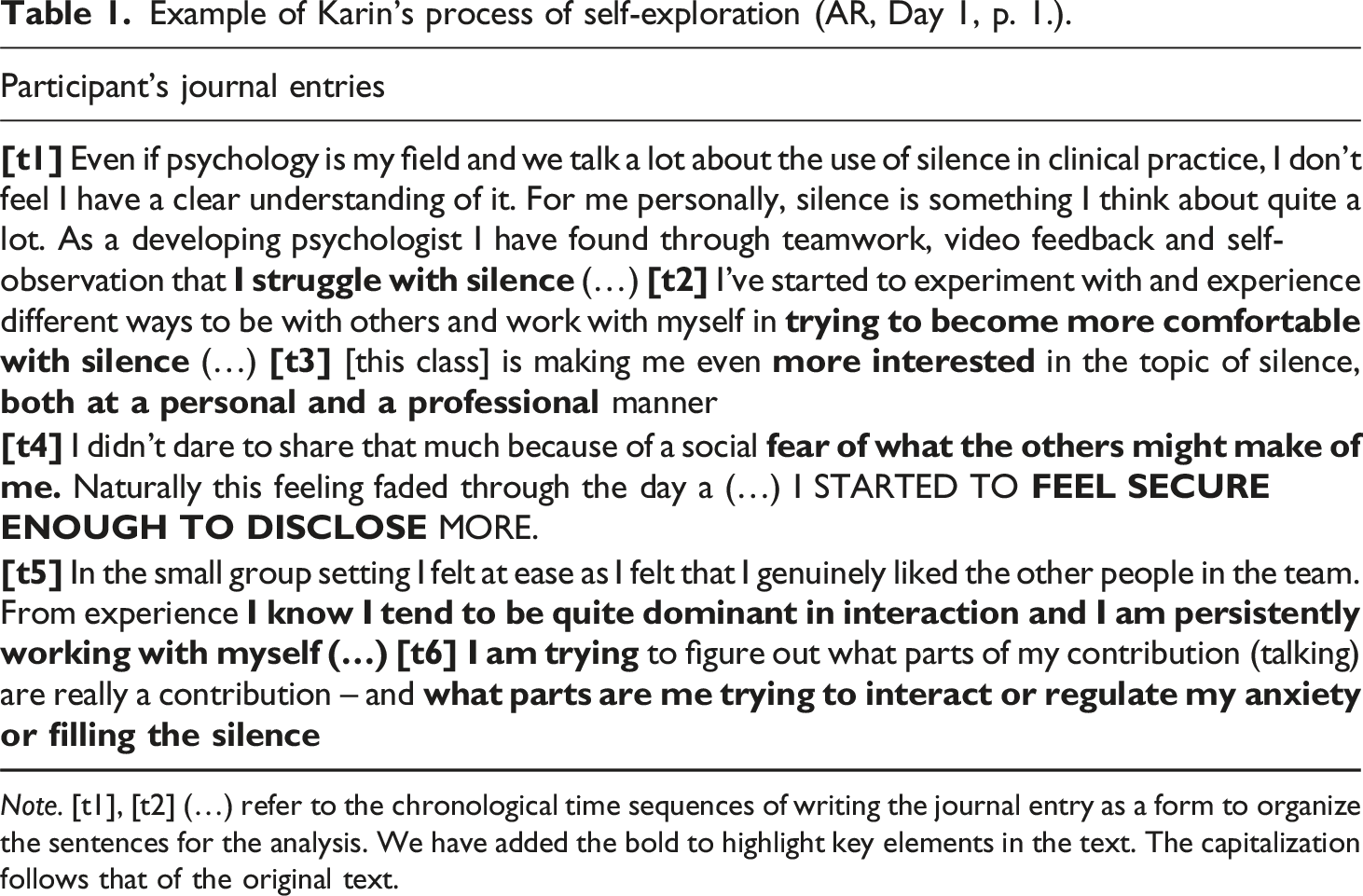
Note. [t1], [t2] (…) refer to the chronological time sequences of writing the journal entry as a form to organize the sentences for the analysis. We have added the bold to highlight key elements in the text. The capitalization follows that of the original text.
Karin’s process of self-exploration in Table 1 ranges from the general description of a struggle, as in section
Given that this journal entry was made during the first day of the three-week-long course, group dynamics might have affected her disclosure, both in smaller groups and at the class plenum. In
Throughout her journal, Karin referred to her desire to find other ways of coping with the uncertainty of silence-phenomena, and the contrast between expectations and reality is brought into the fore. Either positioning herself as a ‘developing psychologist,’ as a ‘new member of a group dynamic at the class,’ or as a ‘person in general,’ her narratives were relationally oriented, describing bonds with external others. In other words, aspiring to tolerate silences appeared to be a possibility for her to both embrace the value of genuineness and to experience deeper forms of dialogue with others: …personally the insight about silence and changing of expectations really resonates with me as I had a long talk and process with my love yesterday about the issue. I really feel that it applies to my daily life. It felt special in a way. (Afternoon Reflection, Day 3, p. 6)
Silence-phenomena as a room for affect
One morning, after encountering a poem by Rilke during a session of the Silent Time, Karin wrote a poem based on Rilke’s verse in which he speaks of a sailor being trapped in his silences (1914/1996, p. 97). Karin compared her self-exploratory process with the life of a sailor; she recognized the need to embrace the darkness of life—which involves uncertainty. She wrote: The poem got me to thinking of traumatized individuals, and how the re-experiencing of past events can be experienced. I thought about the sailor using the silence in a way that allowed feelings to become accessible/activated instead of avoided. I find myself continuously getting back to the theme about emotional avoidance through words when reflecting upon silence. It might have to do with me (the sailor). (Karin, ST, Day 5, p. 6)
In the excerpts above, Karin first shares a general statement suggesting the poem helps her be empathic toward difficult human experiences and how these are re-enhanced. Then, she projects herself into Rilke’s sailor as if she were the sailor. Here, it was not only a silent experience but connecting with a work of poetry, which enabled Karin to be in touch with specific emotional intensities and insight. She also reminded herself of the human tendency to avoid emotions when positioning herself as Rilke’s sailor. Through the resource of poetry, the analogy of the sailor acted to gain distance from herself and to take a meta-position that allowed her to observe herself. In addition, this lived experience of relating to poetry helped her to connect with herself beyond merely remaining an observer of her own experience. In the email follow-up a year later, she noted that “the poem about the sailor (which I adored)” (Karin, FU, p. 12) was one of her most salient memories of the class. In Karin’s case, her interest in poetry and silence-phenomena enabled self-exploration. Perhaps the sailor and the sea showed her that life is a process of dealing with the beauty and darkness of the life course.
Experiencing silence-phenomena, other than giving her the possibility of contacting diverse positionings of the self, enabled her to connect with her affective processes more deeply. In her own words: “A nice experience to change expectations sometimes. Silence gives space and room to really feel and touch my emotional experience” (Karin, ST, day 3, p. 4). For example, in the morning, we visited the humanitarian organization with which the course cooperated, including a temple they use for many of their activities. I walked quietly and lit a candle at the altar, and some students did so as well after me while others remained seated. Karin did not go to this session, but after some classmates told her about it, she wrote: The activity evoked in me strong emotions and memories connected to death and loss (…) just imagining it where I am now sitting in silence is powerful (…) It is as if evoking memories of loss in silence is giving a sense of dignity to that memory in a way. (Karin, ST, Day 6, p. 7)
In this excerpt, again, Karin connects memory and attention more explicitly with different emotional intensities activated when attending to a silent stimulus. She also links these emotional intensities with the value of dignity.
The case of Dana
Silence-phenomena and the poetic
Unlike Karin, Dana constantly resisted reading and writing poems. However, on a few occasions, she connected the poems read in class with topics from her personal life. For instance, after being presented a poem as a stimulus during the Silent Time, she wrote that: This poem reminds me of my distant relationship with my family. We talk on the phone a few times per week, but the rest of the time, in our thoughts, we think and communicate with each other. I can still feel the emotion, the anticipation that we have to see and spend time together. (Dana, Silent Time, Day 9, pp. 5–6)
Reflecting on the poem, Dana became aware of silences as a form of distance between people, and how our imagination and memories can defy such distance given the intensity of emotions when we think of someone. Either because of an intention to keep some privacy about her personal life or because she was not as aware of a concrete emotional label for it, Dana’s words about emotional experiences remained somehow undifferentiated. She leaves us in suspense when saying, “I can still feel the emotion.” She also used similar and somehow undifferentiated sentences during the follow-up a year after the course had ended: I was feeling good in the course and if I have to choose now again in which course to take part, I would do the same choice as I did last year ) (…) You know that I was feeling a little bit strange during these sessions [Silent Time] (Dana, FU, p. 8)
Here, Dana is speaking of “a strange feeling” that coexisted with her “feeling good in the course,” but she does not tell us more about this, bringing in some silent aspects of her experiences. Dana reminds us of the importance of honoring that textual narratives can be open-ended, ambiguous, or undifferentiated, such as in her case.
Silence-phenomena as a room for self-exploration
Example of Dana’s self-exploration of silence-phenomena (ST, Day 2, pp. 1–2).
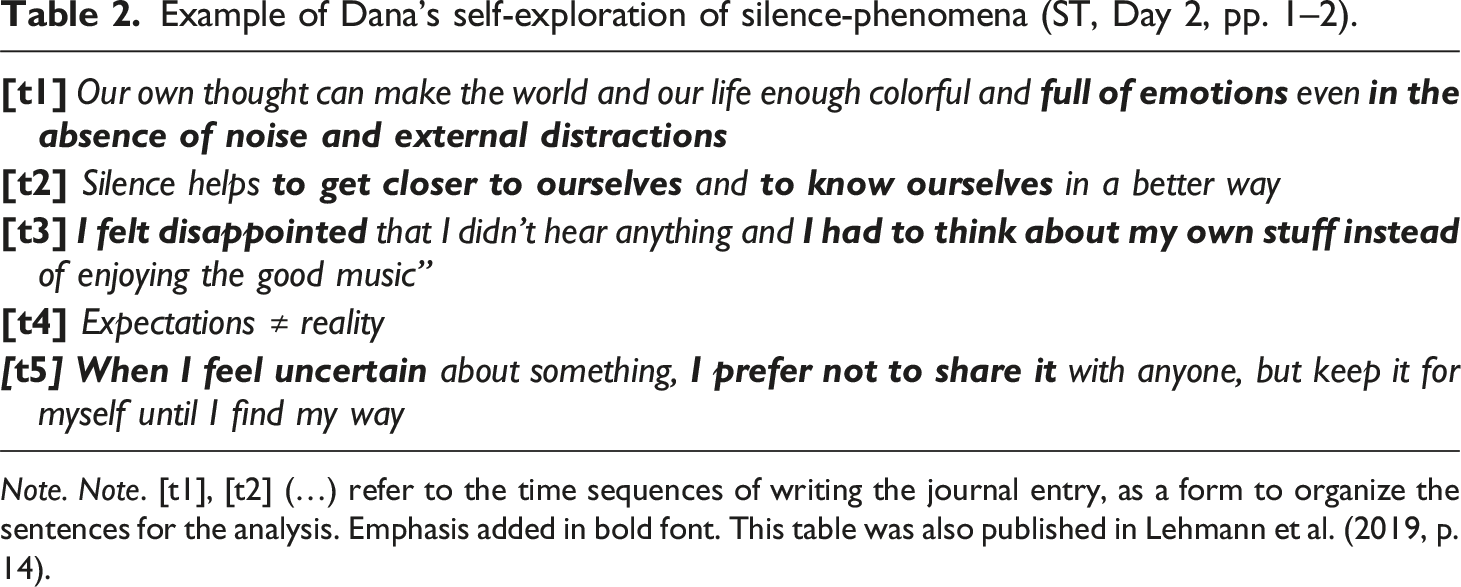
Note. Note. [t1], [t2] (…) refer to the time sequences of writing the journal entry, as a form to organize the sentences for the analysis. Emphasis added in bold font. This table was also published in Lehmann et al. (2019, p. 14).
In
Silence-phenomena as a room for affect
Dana expressed an increased awareness of bodily experiences in two senses in relation to affect. First, she described body language as a potential silent communication, mentioning, for instance, that: “The body language and a beautiful smile are sometimes much more expressive and meaningful than words, because it says everything” (Dana, Silent Time, Day 3, p. 2). Yet, it was not only the body as a form of expression in communication but as a form of contact with herself and to regulate emotions that mattered here: I think it was a positive experience [mindfulness session]. I felt very relaxed and calm. I prefer that kind of activities, which help us to unstress and focus on our body and soul than the poem writing. It is much more helpful, and at least it takes the pressure out of the mind. I like it a lot. (Dana, ST, day 8)
Here, Dana is sharing some of her preferences around silence-phenomena and disclosing her struggle to relate to the poems in the class. There were specific effects in the meditation that she was looking for, such as relaxation or being released from mental noise.
At other times, this shift in attention that silence-phenomena brought into the scene moved her awareness from the environmental stimuli to an inward focus that invites contact with the emotional world: The silence could be so deep that you are able to notice/hear sounds that you usually ignore, but in silence you cannot just hear them, but experience them and go deeply in the emotional aspects of it. (Dana, ST, Day 13, p. 7)
Again, despite the fact that we know little about the specific emotional aspects that she was experiencing, we do know that silence-phenomena, in contrast with noise or sound, can lead to a self-exploration process involving affective nuances at different levels of differentiation.
Discussion
Highlights of the cases
In this section, we would like to start by recapitulating the findings of the DOTA analysis and critically evaluating them with the relevant theories and previous research. Either explicitly or implicitly, both Karin and Dana described silence-phenomena as an amplifier of their perceptions of uncertainty and, altogether with poetry or not, as rooms for affective experiences. The awareness of uncertainty, arousal, and remembrance of emotional intensities brought into the scene aspects of memory, attention, and imagination. Silent experiences became a magnifying glass for self-exploration, and affect is a central aspect of this self-exploration.
Concerning uncertainty, Karin’s journal entries were characterized by the tendency to question existentially the relationship between silences, uncertainty, and avoidance. She experienced uncertainty in the form of tensions, such as ideals versus reality, the decision to talk versus not to talk, or the aspiration to embrace values, such as genuineness, that could enable her to better relate to herself and others. Karin noticed that she could not fully resolve the uncertainty, accepting it as part of life.
Dana’s journal entries mainly reveal the contrast between expectations and reality that silence-phenomena brought into the scene, amplifying her recognition of uncertainty. The contrast between expectations and reality led Dana to shift her attention inward, something that was experienced as disappointing if activating mental activity that she did not expect to deal with. On other occasions, such as in the case of mindfulness, silence-phenomena elicited emotional arousals related to relaxation, which she seemed to enjoy. Dana described that for her, it was important to perceive a sense of certainty in what she was to share beforehand.
Both Dana and Karin wrote about the tensions that inhabit affect and the diverse layers of meaning and affect that coexist simultaneously as we go about life. Similar to Karin, Dana introduced a longing for relational depth and the impact that different forms of silence can have in promoting or obstructing such relational depth. Yet, in Dana’s case, some aspects of such affective processes remain undifferentiated and/or unsaid. The poems elicited this. For Karin, the connection between poetic instants and silence-phenomena was crystal clear and relevant to her personal life. However, it was different for Dana. She said she struggled to relate to the poetic aspects of the class. However, and perhaps implicitly, one of the poems that the class read during one of the Silent Time sessions led her to reflect on silence, particularly in connection with physical distance from her family, having emotional arousals brought by focusing on memories alike.
When it comes to writing about emotions in the journal, Karin wrote extensively and specifically. Dana’s case indicates that the absence of specific labels of affect in her journal entries, or the abstract presence of these, lead to ambiguity. For Dana, such ambiguity did not contradict her motivation in the class. Ambiguity could arguably be interpreted as a form of uncertainty. Either she was uncertain and kept the journal entries open-ended, or she wanted to place some boundaries between us, the readers of her journal, and what felt private to her. In addition, for Dana, silence-phenomena were associated with an increased bodily awareness than from Karin. For instance, the most valuable association for Dana was mindfulness as a source of peace and quietness, which she had been practicing before enrolling in the class.
Whether or not Dana was aware of it, we can see that her ambiguity consists of bringing it towards the core positions of I-as-a-outcome-oriented and I-as-a-mindfulness-practitioner. In contrast, Karin often disclosed details of her personal life, such as the tensions and insights she had in class and memories of difficult and blissful experiences with significant others. Her journal entries involve perceiving herself as being overly talkative, and that speech was a way of coping with the uncertainty that silence-phenomena prompts. Here, we see the activation of I-positions of confidence in situations of uncertainty, as well as their adaptive functions. Such functions of those I-positions can/should be further explored theoretically to negotiate the boundaries of silence-phenomena and speech.
Theoretical integration
The DOTA analysis of the two cases presented above illustrates our argument that silence-phenomena act as magnifying glasses that amplify our perception of uncertainty (Lehmann et al., 2018; Lehmann, 2022). Both the contrast between expectations and reality and our awareness of life’s uncertainty are contents of the process of self-exploration, being qualities of our human condition and fertile ground for embracing relational depth and existential meaning.
Once silent experiences amplify our perception of uncertainty, the awareness of the contrast between our expectations and reality also takes place, experienced as a form of tension. For instance, in Karin’s case, reflecting on the silences that took place in communication within smaller or larger groups, she became aware of her tendency to fill in the silences with words, even if these words were not as genuine as she felt they could be. Re-positioning the self to cope with different degrees of ambivalence is essential for meaning-making (Abbey & Valsiner, 2005). In this sense, a momentary certainty emerges: silence-phenomena seems to enhance attentional shifts that can direct us toward inner or outer stimuli (Lehmann et al., 2018; Lehmann, 2022). Karin’s amplified perception of uncertainty and the uncomfortable feelings it involves in social interactions led to an explicit focus on human values. Her self-exploration process also illustrates that observing our words so that they are not always filling in the silences in the context of our interactions could promote not only genuineness but also empathy, honor, and respect.
In the case of Dana, silences served yet another function in communicating; she would intentionally extend them until she would “find her way” (Dana, Day 2, p.2). These silences caused by hesitation are also a common feature of communication, and even if Dana did not specify the feelings and values that motivated her to search for certainty, these silences can be an automatic reaction to circumvent uncertainty (Bruneau, 1973). We do not doubt that Dana was emotionally aroused when facing uncertainty, even if she did not always label her emotions explicitly in the journal. In one of the entries, she referred to unexpected silences as a form of “disappointment.” In “finding her way”, we assume an indication of the imaginative processes where Dana aimed, in one way or another, to find a sense of certainty and an action plan. Moments of silence can then become a ground for imagination and possibility thinking to make sense of, among other things, uncertainty (Zittoun, 2017). Dana transformed initially unexpected silences into intentional silences to circumvent uncertainty, shifting her attention inward.
The cases of Karin and Dana illustrate that silence-phenomena act as magnifying glasses that amplify our perception of uncertainty; uncertainty being an existential feature of our human condition. These cases also exemplify diverse trajectories in which the participants make sense of uncertainty and the tension within it. While the emotional intensities of such experiences of tension are not always verbalized, acknowledging their presence is crucial to better understand why people delve into silences or avoid them. However, both cases suggest that the hyper-generalization of affect, as previously theorized (e.g., Branco & Valsiner, 2010; Lehmann, 2019) is closely linked to value systems.
Whether it was about love, acceptance, or being genuine, as in the case of Karin, or about self-knowledge, relaxation, or confidence, as in the case of Dana, silence became a journey of self-exploration to more intentionally engage in – and reflect about—meaning-making and affective processing.
Our findings also suggest that our sense of identity and our experiences of values in relation to existential meaning and relational depth are hypergeneralized levels of affect that transcend mere linguistic descriptions of them (Mearns & Cooper, 2005; Branco & Valsiner, 2010; Märtsin, 2010; Knox, 2013). Reading or writing poetry can become a catalyst of an experience of values as hypergeneralized levels of affect due to, among other features, the use of words in poetry is rich in images and musicality (Bastos, 2023; Chaudhary et al., 2017; Lehmann, 2012; 2019). Karin’s and Dana’s journal entries support the pedagogical claim that poetry can be a resource to promote contact with the emotional world and values (Vygotsky, 1925/1975; Lehmann, 2019). Poetry facilitated self-exploration in some circumstances, even if such self-exploration was not necessarily conscious or the insights remained in diverse levels of awareness and or processing. The connection between silence-phenomena and poetry was not as evident for Dana as for Karin. Attending to poetry did, however, in both cases, evoke some specific memories in connection to significant others and activate emotions. The two research participants, turning their attention inwards, either experienced or were reminded of the importance of relational depth in silence, during which affective arousals were intensified (Lehmann, 2016b). Karin recalled this sort of silent refuge by turning attention inwards and explicitly relating them to the notion of poetic instants (Bachelard, 1932/2013; Paz, 1956/1999), while for Dana, the journal entries about what she experienced when turning inwards remained somehow ambiguous, compared to Karin’s self-disclosures. This does not mean that Dana did not experience self-exploration in the silent time. Dana’s journal entries suggested a phenomenological realm where imagination gives room to affective processes related to significant others. In her case, the phenomenological experience of distance between her and the people they thought about was shaped by the intensity of emotions and the imagination of the future. Such a silent refuge for memories and imagination is similar to what Frankl (1946/1985) described as a space for remembrance that resulted in motivation and direction to cope with uncertainty and to appeal to human values. Likewise, Vygotsky (1925/1971) acknowledged this possibility by highlighting that imagination is the main source for studying affect.
In addition, different positionings of the self were also activated, demarcating uniqueness in their meaning-making trajectories over time. For example, Karin activated a meta-position that enabled her to observe her own experiences (Hermans & Gieser, 2011) and to recall her personhood as a whole (Cooper, 2004) to accept uncertainty. On the other hand, Dana relied on aspects that gave her a sense of mastery or certainty, such as appealing to being a mindfulness practitioner and thus valuing mindfulness more than other practices in the Silent Time. Activating promoter positions seems to have given her a sense of direction (Hermans & Gieser, 2011; Lengelle, 2023; Hermans, 2003 in Nir, 2016). This process of self-exploration unfolds through attentional shifts to outward and inward stimuli, as well as attentional shifts that enable us to detach and/or immerse ourselves into experiencing.
Drawing on Märtsin’s view that “identity-dialogues function as ways of working through a rupture” (2010, p. 444), when writing about their experiences, our study participants aspired to relate to uncertainty activating different I-positions. Dialogues provide ongoing feedback loops about our aspiration toward different values that improve our relational capacity (Frankl, 1946/1985; Freeman, 2014; Lehmann, 2019). Understanding a dialogue as a process, then different positionings of the self would act as vectors directed towards a goal rather than as a static “position” or point of time (Lehmann et al., 2017; Valsiner, 2014). Recent research on identity and values seems to go in a similar direction, as the findings show that the meaningfulness of relationships as they unfold through time promotes both affective and reflective modalities of distancing and or identifying with specific values (Schmitz Wortmeyer and Branco, 2019).
In other words, it is not always the case that self-exploration about silence-phenomena lead us to remember, embrace and or anticipate the experience of relational depth and or existential meaning (Lehmann et al., 2018; Lehmann, 2022). Yet, using silence-phenomena as magnifying glasses to investigate the qualities of our experiences and writing about them can be of benefit to studying the trajectories of meaning-making and affective processing. Asking explicitly about their silent nuances to study participants is shedding light on some of the aspects that take part in processes of hypergeneralization of affect. Namely, the activation of I-positions are forms of intentionality and those forms of intentionality are, implicitly or explicitly, related to values and attitudes. No matter which I-position is activated, uncertainty, as an existential feature of our human condition, cannot be fully dissipated but honored. When experiencing uncertainty, turning towards specific values or attitudes can promote meaning-making of such uncertainty and the potential discomfort of life’s unfolding in unexpected ways. In addition, as referred by our participants, connecting experiences of silence-phenomena with values is a possibility to further appreciate meaningful experiences in real-time, or through remembrance and or imagination. From their own theoretical backgrounds, both Vygotsky and Luria (1930/1994) and Frankl (1946/1985) affirm that our attitudes towards life circumstances could be forms of freedom as they help us have more intentional and less impulsive actions. What both Frankl and Vygotsky had in common was their interest in Spinoza’s philosophy. Further theoretical developments could aim for a deeper integration of these theoretical ideas.
Conclusion
In this article, we focused on the dialogical processes of co-construction of meanings around silence-phenomena in Karin’s and Dana’s journals. Asking our research participants, in the context of a graduate course at a Norwegian university, to explicitly reflect upon diverse forms of silence-phenomena shed light on important aspects of the process of hyper-generalization of affect and its connections with meaning-making of experiences and meaning-making of their existence. The awareness of uncertainty and the contrast between expectations and reality, both being features of the human condition, lead to the activation of different I-positions and attitudes that also shed light on the remembrance, embrace, and or anticipation of relational depth, as well as insights about what can become an obstacle for us to embrace such relational depth. In this sense, silence-phenomena are magnifying glasses for self-exploration.
There are diverse trajectories to make sense of uncertainty and the tension it elicits, and these processes bring forward implicit and explicit connections with our emotional world and our value systems. On some occasions, the remembrance of physical distance and or the longing for closeness with significant others, which poetry seemed to have catalyzed in both cases of Karin and Dana, activates emotional intensities that are suggestive of the importance of focusing on phenomenological time in addition to chronological time when studying affect. In addition, all these processes recalled the dynamics of meaning-making in experiential and existential dimensions by acknowledging the possibilities of self-exploration, the importance of affective processes, and the possibility of accepting the uncertainty of life. Further studies could explore what features facilitate and or obstruct relational depth.
Sociocultural psychology has provided different perspectives about language’s role in human development. The study of silence-phenomena complements and expands this quest, providing nuances about affective processes and meaning-making through and beyond linguistic categories. However, aspects such as personality, culture, and personal privacy preferences might also affect the degree to which a person discloses personal information in a journal. The PI could have provided more specific instructions and reflexive questions. In addition, future research, for instance, combines journaling with focus groups or in-depth interviews for data triangulation.
Finally, our research findings also have important implications for qualitative methodologies that use journaling for data collection. Journaling practices can enhance self-exploration among research participants. The DOTA was a viable method when we encountered the ambiguities, ambivalences, and open-ended aspects of textual data, which might mirror the processes of meaning-making and affective processing as they unfold through time.
Footnotes
Acknowledgements
We thank Karin and Dana for sharing their journals and supporting this research project. We are also grateful to the Department of Experts in Team and the Department of Psychology at NTNU – The Norwegian University of Silence and Technology, for their support when Olga Lehmann was doing her PhD fellowship at the university (2013–2018). In addition, we thank Jaan Valsiner and Hroar Klempe for their valuable comments and suggestions on the earlier versions of this work.
Declaration of conflicting interests
The author(s) declared no potential conflicts of interest with respect to the research, authorship, and/or publication of this article.
Funding
The author(s) received no financial support for the research, authorship, and/or publication of this article.
Author’s Note
This article is based on Dr. Lehmann’s unpublished doctoral monograph at the Norwegian University of Science and Technology (NTNU). Some theoretical remarks have been updated. Further elaborations on the methodology, as well as a revision and update of the data analysis has been made for the purposes of this article.
