




Abstract
In the present paper I investigate the phenomenon of mindfulness from a cultural-psychological perspective. During the past years mindfulness has been primarily treated as an independent (intervention) variable trying to evidence its effectiveness in relation to psychotherapy as well as to specific work outcomes such as a decrease in stress symptoms at work. Yet, what has been rather missing within the literature is the analysis of mindfulness from a theoretical and historical perspective. Arguing with E.E. Boesch, I show based on an autoethnography that the need for mindfulness emerges when there are conflicts with one’s fantasms (private needs, goals, wants, wishes) or with a specific myth in one’s community (you should work hard in order to become a good citizen). I conclude with the findings that mindfulness has the power to alter one’s fantasms hierachy as well as the stance towards a specific myth in one’s community. This is further evidenced by analyzing the glass bead game of H. Hesse and which role mindfulness plays in there – a transformative role for individuals and groups.
Mindfulness and its scientific operationalization
Cultural Psychology has always been a transdisciplinary endeavor. Its relations to philosophy (Cassirer, 2015; Valsiner, 2019), literature (von Fircks, 2022a), poetry (Günther, 2020; Valsiner, 2014 von Fircks, 2022b), business (Bendassolli & Gondim, 2019), history (Valsiner, 2014) – among many other domains – are omnipresent. In a recent article, it was argued that the essence of Cultural Psychology (and of all sciences) lies in performing a specific synthesis (von Fircks, 2022a) based upon different ideas or positions (Bachtin, 2010). This is especially important for a synthesis out of two or more domains that in a first instance seems more than brave (Hesse, 2021). In the present paper I strive for relating Cultural Psychology with the notion of mindfulness. Mindfulness has become a very prominent topic in the recent decade (Hof, 2021; Kabat-Zinn, 2015). However, the analysis of mindfulness is somehow restricted. Psychological studies focus mostly on the effectiveness of mindfulness-based therapies on the intra-personal level (Koury et al., 2013; McCarney et al., 2012), and they have become extended onto the work setting (Klatt et al., 2015). Mindfulness is associated in those studies with an increased effectivities in reducing anxiety, depression, rumination or with an increase in concentration or peace of mind (Hofman et al., 2010; Hofman & Gomez, 2017). Thus, in most of the studies mindfulness is treated as an independent variable (intervention variable) that is then associated with a dependent variable (depression score, for instance). Hence, designs are mostly linear models and mindfulness is victim of the quantitative imperative that is dominant in almost all psychological inquiry (Michell, 2003, 2005).
The present manuscript opposes itself in viewing mindfulness solely as an independent variable or as an intra-personal resource. Mindfulness is more than being a variable. Hence, the present manuscript tries to restore the theoretical underpinnings of mindfulness while showing that it also an inter-personal resource that can help people to change the way how they interact with their material and social environment. That mindfulness is an effective instrument is common-sense in psychology, but mechanisms have not been investigated that show the genesis of mindfulness as well as its consequences. Thus, the present manuscript is a theoretical paper trying to shed light how mindfulness emerges and which material and social consequences it might unfold during its coming-into-being. Insofar as I try to restore the theoretical meaning of the term mindfulness, I want to contribute to the community of academic psychology while developing a theoretical and philosophical framework for mindfulness.
Vygotsky (1996) argues that psychology can only come into being scientifically successful if researchers embrace the philosophical roots of their academic endeavor. This is the present meta-code of the paper. But before, we dive deeply into that endeavor, we need – first of all – to define mindfulness as well as relate it to the notion of Cultural Psychology. After that, we can reach a specific synthesis how both disciplines might benefit from each other and create something new that is adaptive for multiple people implied.
Approaching the phenomenon of mindfulness from a resource-based perspective
So, what is mindfulness after all? Mindfulness is a specific technique that helps people to free themselves from obsessive thoughts, thus thoughts that penetrate the human mind all the time and cannot be challenged (Kabat-Zinn, 2003, 2012). As the name of mindfulness implies it must not be confused with the Buddhistic goal of not thinking (Yamada, 2017). Thinking is normal for the human organism (Mead, 2015). It cannot be only aware of things, but it also reflects them (Fircks, 2023a; May, 2007; Mead, 2015; Toomela, 2021). The human being finds meaning in various ways and it cannot free himself from this natural attitude (Luft, 2012). It is always related to the world by specific meaning making opportunities (Sato et al., 2009; Sato & Tanimura, 2016).
At first, it should not play a role whether those meaning making opportunities are socially determined or personally introjected (see also Stern, 2020 or von Fircks, 2023b). If we speak of mindfulness, we accept the state that meaning has already arisen in a specific situation – that the human being cannot exist without making meaning in situations and storing this meaning by means of signs or symbols for the next present moment (future) (Valsiner, 2007, 2014, 2021). We have said that mindfulness is a specific technique or an instrument to free oneself from obsessive thoughts (Kabat-Zinn, 2012). But we have also said that a vacuum of meaninglessness is not possible for the human organism (May, 1981, 1991, 2006). After all, meaninglessness in existential terms is also a crucially – personal – human state of being (Peterson, 2002).
But mindfulness can become more than a simple instrument. It can become a personal choice for adopting a lifestyle that is free of obsessive thoughts. So, mindfulness becomes in this regard a specific life-pattern (Hof, 2021; Schneider & Krug, 2010; Schneider, 2019) – a life pattern that breaks with ruminative and obsessive thinking spirals that put a certain strain on the individual’s psyche (Williams & Kabat-Zinn, 2013). Again, a state of no meaning making by the human organism is not possible as we are meaning making creatures (Graumann, 1960, 1984, 2002). So, the heart of a mindfulness-based experience is that meaning making is relative (Hof, 2021). Thoughts come and go as one breathes in and out. Old air is pushed out – new air is breathed in. So, an idea comes and goes. A new idea, a new thought comes in and goes. Mindfulness in its truest sense is the letting go of the old and the acceptance of the new (von Fircks, 2022a). The acceptance of the new is the realization that ideas do not own the human organism but that the human organism owns the idea (Hof, 2021; Kabat-Zinn & Hanh, 2009). This means, that the human being is not a victim of thought, that thought does not control the human being but that the human being itself controls thought. This is stated in aphorisms such as We are more than our thoughts – that penetrate the internet all day long. Thus, in the deepest sense, mindfulness is the realization that meaning making is relative and that all ideas and thoughts can be substituted if needed or wanted. This is what phenomenologists like Husserl (1900/01) or Luft emphasized with their writings – a new dimension opens up if the human organism realizes that the world as we construct it with our very own thoughts is relative and can be constructed in a new manner (Cassirer, 2015; Luft, 2012). Thus, mindfulness adds a new layer to our experience – the relativity of experience. But the relativity of experience comes with an imperative. As we stated above, a state of pure meaninglessness is not possible for the human being – so when realizing that meaning making is relative, the human organism needs to choose a specific meaning making opportunity for himself (Frankl, 1985). Thus, the human organism when freeing himself from a specific meaning making opportunity – such as past life-patterns – can now appropriate a specific meaning making opportunity and make it central for his present life situation (Brown & Augusta-Scott, 2006). 1 I am aware that the above-mentioned might seem abstract. So, let’s put into practice what we have elaborated so far. I will rely on an autoethnographic example.
A small autoethnography to show the domination of life-patterns
I come from an entrepreneurial background. My family has a pharmacy in the third generation. My parents work 11–12 hours a day. Work was predominant in my life. Conversations at the table when having dinner were always centered around what happened in the pharmacy that day. When my parents were in a bad mood, it was often because somebody was ill or did not do his job adequately. But when my parents were happy, it also had to do with the pharmacy – if for example a client has offered them some sort of present in order to show their gratitude. Even on Sundays, people have called my parents (the pharmacy was closed on Sundays) in order to get medication. People in the village called me junior boss because I have worked for the pharmacy in the back-office. People recognize me in the streets as the son of pharmacist XY. And people regularly ask me whether I will take over the pharmacy once my parents decide to retire. 2
The small autoethnography shows vividly that I was heavily confronted with the life-pattern of a hard-working family. The myths that come with that life-pattern are strong such as you can only become a significant member of society if you are willing to work that amount of time during a week or if you are willing to sacrifice your personal life for your work. If you feel stress, you just work stronger because you can overcome those days and symptoms if you just focus on the essential – that again is work (for this life-pattern and its relation to burnout see Geyerhofer & Unterholzer, 2008).
In the end, this kind of life-pattern portrayed was a sign for becoming a good citizen if one only works diligently. But we need also to think about the ways what this life-pattern bracketed – what it left out for me (Sato et al., 2009). If one focuses oneself only on work or work-related issues, the whole private domain – that make up the totality of human experience – is ignored. Friends, a romantic relationship, the beauty of nature, literature, poetry, leisure time, all these features come second to the person being obsessed with work day in and out (Hagemann & Geuenich, 2009).
As I have adopted such a lifestyle, I was only preoccupied with work and all these other features being important for the human organism came second or third for me. I sacrificed a lot of time and energy (intrapersonal resources) for my work. But there came a time where I could not keep up with this specific life-pattern. My body replied with severe stress symptoms and I needed to re-organize my specific life-pattern. But this was a hard process for me. I was heavily recognized and appreciated for what I was, and for which work I could do. People approached me when they needed help – only for work-related issues. People wanted my specific advice, and I felt respected. My fear was when deciding to work less that people would not appreciate me anymore and that I will lose respect from their perspective. So, the meaning making opportunity came with a positive connotated semantic net of respect, appreciation, recognition but simultaneously it confronted me with a meaning making limitation and the related semantic net of stress, sacrificing one’s personal time, friends, etc. So, adopting the specific life-pattern – in Sternian words introcepting it within my Self (Stern, 2020) – created specific intrapersonal and interpersonal resources. 3
Of course, I was enthused personally by my work and by the appreciation of my colleagues (intra- and interpersonal resource) but I was also heavily stressed by the work as well as somehow isolated privately by having less contact with friends, family or a romantic relationship – something that happens quite regularly for people working every single minute of their time (Buchwald & Hobfoll, 2004). So, introjecting the specific life-pattern created but also consumed resources, in the long run. So, while adopting the life-pattern of a hard-working guy, I related to myself and my social environment in very peculiar ways. But this specific relatedness towards myself as well as my significant other has thrown me also in a specific ambivalent situation. My body showed me that I could not continue working like that while I still wanted to have appreciation and recognition. But I could not see how I can get affection, warmth, appreciation without working hard.
Meditation and its impact onto my past life-patterns
Because I was stuck how to navigate through my life and not knowing whether I should adapt my working routine, I decided to meditate. 4 I went outside because I felt that I needed to be connected with nature. I felt that I needed to leave my work behind. So, I went to a nearby forest, and I lay down in a meadow. It was calm. There were no other people disrupting me. 10 minutes a day. Sometimes it was 20 or 30 minutes. And within that meditation, I was just observing my thoughts: Pictures came into my mind but then disappeared. I was listening to my surroundings. Birds. Cars. Rain. I was smelling spring. And suddenly I experienced, I really felt a shift in my attitudes towards myself. I felt that this life-pattern is only one among many. I felt that being here in this world, being part of the beauty of nature and contributing to it, is sufficient to feel whole. And I felt warmth. I felt appreciation. And I felt love. And I realized that my previous life-pattern is relative because I experienced that this is not the only life-pattern that can provide me with affection. I experienced that there is more to this life than work. So, I felt connected to nature, to my world and to my surroundings. And over the course of this process, I started to accept responsibility for not only myself but for my social environment. I started to become a tennis trainer because I wanted to do something with my body and not only with my mind. Especially, the social component of the job was significant for me. And while working as a tennis trainer, I became friends with a lot of persons – also my pupils – and I found my girlfriend, there.
I started to spend time with people not for the purpose of work but for the purpose of pleasure. Living in the now became central to me, and feeling the beauty of life in friendships, in a partnership as well as in a work where I care for the growth of other people – and not for the sake of money or personal prestige. But importantly, I decided to not turn my back to my previous work. I just adjusted myself. I took the decision to work less and to not only concentrate myself fully upon one domain of living (work) but to find an inner balance between intellectual work, physical work, friendships, partnership, leisure time. And within this balance I could feel appreciation, warmth, affection and love for not only what I was contributing but for what I essentially was (Fromm, 2005). Within meditation, I broke up the rigid fixation on one specific life-pattern (working hard) that fixed my resources and made them static. Moreover, it created more intra- and interpersonal problems than it provided me with personal and social benefits.
So, after breaking up the rigid fixation of one life-pattern and trying to integrate this specific life-pattern (working hard) with other life-patterns (care for your friends, partner, significant other), I experienced an increase in my intrapersonal and interpersonal resources. The reason why is because I started to relate to myself differently (Fircks, 2022c) which showed itself in less somatic stress symptoms but also to my social environment which was evidenced by the fact that I initiated new contacts, friendships and partnerships giving me the proof that work is only a small component in providing oneself affection, warmth and love.
Summarizing some pillars of mindfulness in regards to theory and my autoethnography
So far, we can capture the following in regards to mindfulness and my autoethnography: A The need for mindfulness emerges particularly in an ambivalent situation – a situation that is characterized by interpersonal and/or intrapersonal conflicts. B These conflicts show that the human organism relates to itself or the social environment in a way of fixating specific resources (life-patterns) that come to predominate the human organism. The predomination of the human organism by specific life-patterns come with a lot of personal and social sacrifices – thus pain and suffering. C During mindfulness-based techniques such as meditation, one can learn to realize that predominant life-patterns are relative and that there is more to this life than one’s very own type of relatedness. E Essentially, this is an experience that comes naturally and cannot be taught. The experiential quality of the mindfulness-based insights are the predominant characteristics of shifting resources to the background or foreground. F The mindfulness-based experience helps the human organism to adjust his multiple resources (life-patterns) in a more balanced way and show that his needs can be met by multiple life-patterns that can be cultivated simultaneously. G It is important that the mindfulness-based insight is then supported by concrete action that shows the human organism the validity of his phenomenological experience. The change in actions will further alter the specific hierarchy of resources or life-patterns.
Defining cultural psychology with E.E. Boesch
Up to now, we have elaborated on mindfulness from the perspective of theoretical and practical underpinnings. Yet, we have not clarified how all of that relates to the issues of Cultural Psychology. But before we are shedding light onto this complex question, we need first of all to define Cultural Psychology. Culture is an action field (Boesch, 1991, 1998, 2005). This action field is composed by needs and goals (Boesch, 2021). The environment bears specific valences that relate to the needs (Lewin, 1926) such as food shifting to the foreground of one’s action field in order to satisfy hunger (Boesch, 2002, 2005). Yet, those needs and goals as well as the actions to pursue or satisfy them do not develop solely within the individual (von Fircks, 2022d). The human organism is confronted with a specific culture when meeting his parents, teachers, friends – among many other people. Culture exists only insofar it is embodied by concrete people (Valsiner, 2014, 2021). Those people embodying specific cultural texts and transmitting them do show us for example how we satisfy our hunger – for example by using forks and spoons (Leontev, 1978). They might even explain which food should be eaten and which type of food is a taboo for us because it is unhealthy. Thus, they show us trajectories or pathways (actions) how to pursue our goals (Sato et al., 2009).
But this is only half of the truth. Culture as embodied texts by concrete individuals also explains which goals to pursue. Our parents coming from a rather technical action field tell us to not study philosophy or literature because one cannot earn himself a living with this. Our teachers want us to become democratic citizens and get us involved in the social life of the community. Our friends tell us that we should get a girlfriend/boyfriend because we are too alone, and nobody could life a live all by himself. Thus, all day long we are confronted with cultural texts that unfold in concrete interactions with the people we meet and see, regularly. Hence, the action field begins to incorporate specific myths that are expressed in particular should values – for example you should drink if you have a problem, you should have meaningless sex in order to forget you former partner, you should work hard in order to become a responsible citizen (Boesch, 1991, 1998, 2000). Thus, the myths generalize particular should values from the cultural texts with which we are confronted day in day out (Boesch, 2021). In Boesch’s own words, we can openly define the notion as the following: [Myths] exemplify underlying central themes and attitudes toward life, but it is important not to lose sight of the fact that such central themes can be expressed in many different ways. Myths, therefore, are here treated as collectively accepted means of explanation, justification, and exhortation, which might be expressed in the form of myth-stories, but also of my themes, that is, isolated themes relating to the underlying myth, be they the theme of a story, like little Red Riding Hood, be they in the form of proverbs or other popular exhortations. In other words, a myth is a superordinate pattern of explanation and motivation regulating social action. (1991, p. 124)
But importantly, we relate to those myths not neutrally but with our personal fantasms (wishes, wants, longings, personal needs, etc.) (Boesch, 1991). We are only attracted to those myths only insofar as they express our fantasms (Boesch, 1998, 2005). Thus, the should values with which we are confronted get personal meaning on the basis of these fantasms. For example, you should get a girlfriend in order to be not alone can mean many personal things for different individuals and satisfy a multitude of divergent fantasms. The myth of getting a girlfriend/boyfriend can express the deepest individual want of regular sex or of tender intimacy through cuddling and massaging the significant other. Or it can become an attractive myth personally because both partners have intellectual discussions and feel growing in their relationship. So, the myth alone confronts us with a lot of denotative meaning – you should get a girlfriend because this is good for you. But the myth gets personally colored or filled with personal sense on the basis of connotations (Boesch, 1991). In Boesch’s words: [A] fantasm is here regarded as a kind of overarching goal; it concerns the nature of the anticipated ego-world relationship of the individual, including both hopes and fears. The personal contents the individual gives to a term like “happiness” would constitute a fantasm, as would the subjective meaning given to the term “self-realization” or “order”. (1991, p. 124)
Myths become only embodied or introjected within the personal Self insofar as they express fantasms – thus individual and collective culture meet at the intersection of myths and fantasms. These fantasms are highly important for the human organism because they mirror the way how the individual wants to appropriate the social and material environment, personologically (Boesch, 2021). Hence, the individual wants to realize his inner world within the outer world and create it on the basis of his fantasms. Boesch (2005) calls the transformation of the outer on the basis of the inner the creation of a specific I-world-balance. We make the outer more personal insofar as we can feel comfortable and compatible with the world. Based on this transformation, we experience the world as ich-synthon as the world bears now personal meaning (Boesch, 2021). This personal transformation of the outer world features three major characteristics in Boesch’s Cultural Psychology (Boesch, 1991): First, they bring immediate joy and pleasure – hence positive emotions. Second, they lead to the experience of mastery because the human organism not only masters the environmental demands of his action field but can expand it personally – like an artist creating a new style. Third, it creates transparency for the individual organism. Thus, the individual feels at home because of his transformation of the outer world, and this transparency makes his personal environment predictable and somehow stable (Boesch, 1998).
Thus, the action field confronts us with specific demands (myths) that we need to do justice to but at the same time we transcend those myths or demands by appropriating the environment and relating to it with personal meaning (Boesch, 2021). Here, we become aware that Cultural Psychology focuses on the interaction of personal<>collective culture showing that the individual is the higher function of the social (Mead, 2015; Toomela, 2021). Personal meaning arises only insofar as there exist collective myths that are embodied by concrete individuals and confront the human organism to develop a personal stance towards it.
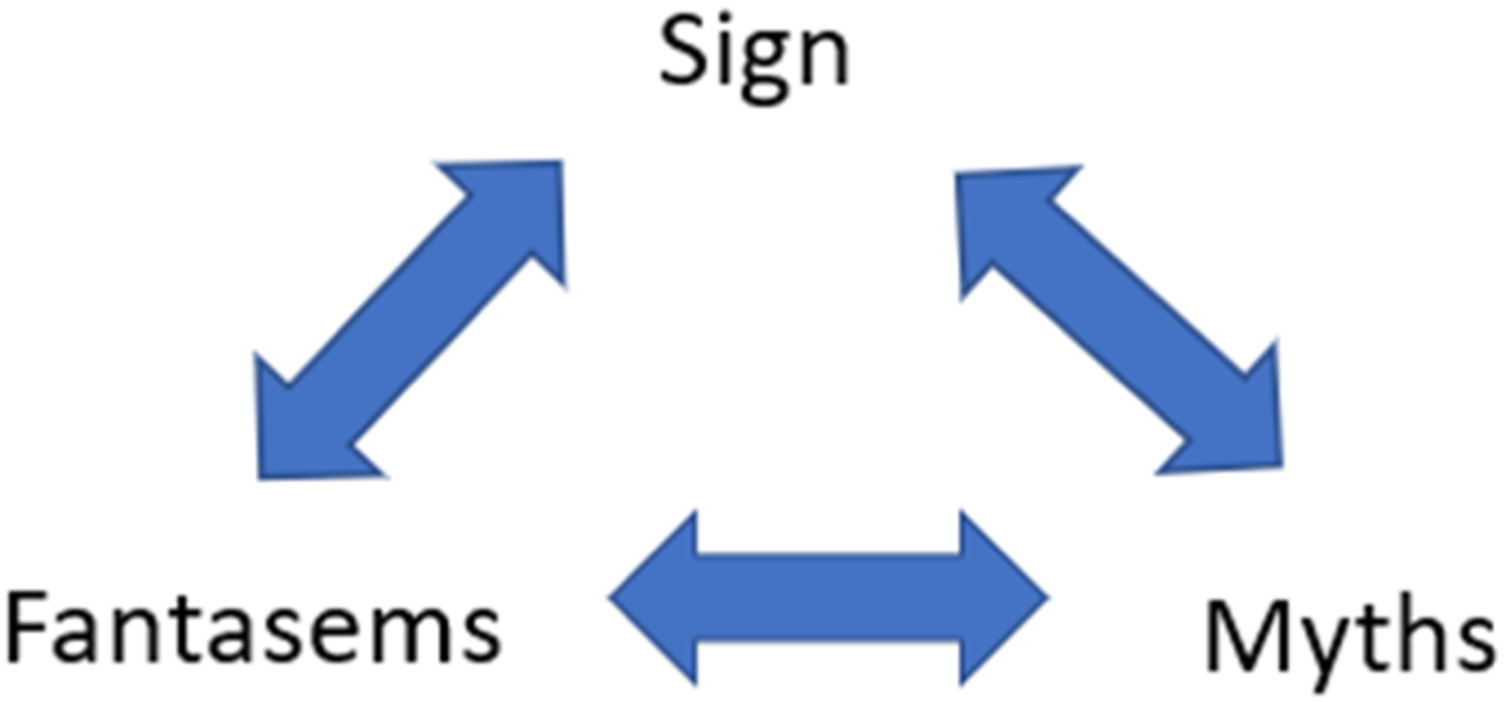
I am the opinion that this type of Cultural Psychology shows some overlap with Valsiner’s definition of cultural psychology of semiotic dynamics. Semiotics is the science of signs (Valsiner, 2014, 2019), and semioticians and psychologists are interested how signs come into being (Valsiner, 2021). A sign stands for something for someone (Valsiner, 2017) but is more importantly in a triadic relationship between person and object – in the Peircian tradition (see Figure 1). The object in the Boeschian sense of Cultural Psychology is the respective myth – the fantasm is the personal feature within the triadic relationship and the sign is the personal appropriation of the cultural myth (text) by a given human organism. Importantly, the sign mirrors polyvalent goals – goals that are important myth-like but also personally (see Figure 2). Thus, the sign understood in a Boeschian way shows the cleavage between a what-is condition and a what-should-be condition confronting the individual with the need of bridging the distance and fulfilling the need/goal (Cassirer, 2015; Peterson, 2002) within himself as well as within his culture. The triadic relationship of a sign (after C.S. Peirce in Valsiner, 2014). Triadic relationship of a sign understood within symbolic action theory.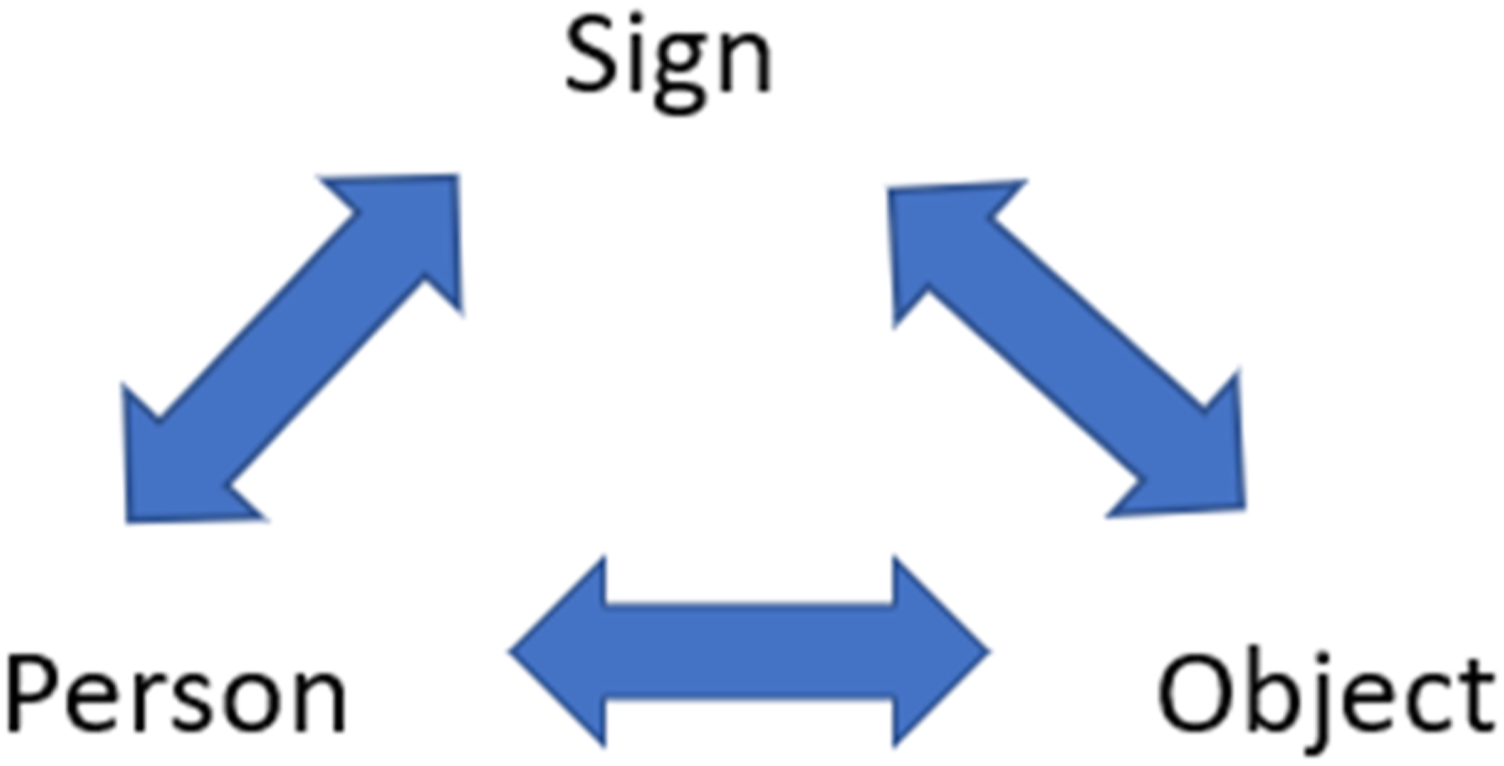
I do not want to equate Valsiner’s theory of semiotic dynamics with the symbolic action theory of E. E. Boesch. Both are different approaches that come with several peculiarities. While Valsiner focuses more bluntly on the notion of signs, and how signs change our relation to ourselves and our environment (Valsiner, 2014, 2019), Boesch uses the concept of action and its symbolism. In other words, Boesch never introduced any notion of explicit semiosis in his writings while Valsiner’s Cultural Psychology relies on the hierachy of signs within the Self (Valsiner, 2021). However, Boesch, within his psychoanalytic training, was more than aware of the power of symbols for Cultural Psychology arguing that the symbol is at the heart of shaping body and mind (Boesch, 1991). For Boesch, the symbol transcends the denotative meaning (picture with a snowy landscape) of a thing while it provokes private feelings and hence connotations (the snowy landscape becomes seen as a cold atmosphere). Importantly, Boesch was aware that symbols are polyvalent in their respective meaning which explains why people act and interact differently because of altered symbolism. Valsiner goes further and argues that the symbols – among other signs – get arranged and re-arranged based on the person’s needs and goals (Valsiner, 2014) that can change any moment in irreversible time (Valsiner, 2017). Hence, we can conclude that both theories share some common ground but are not interchangeable.
So, let us summarize the postulates of Cultural Psychology, briefly: A Cultural Psychology wants to decipher how needs and goals come into being. These needs and goals are in an ecological relationship between person and environment. B Our environment (people) embodies cultural texts and structures them creating specific myths that incorporate particular should-values – thus values how we should appropriate the environment. C However, those myths are met within our personal fantasms (personal wants, longings, dreams, wishes and so forth). We fill those myths with personal meanings. D At the intersection of myth<> fantasm we are appropriating the environment meaningfully and transform that environment personally. We structure it in accordance with our inner world and make it ich-synthon. We experience an I-world-balance that brings us positive emotions, mastery and transparency. E Boeschian Cultural Psychology is in accordance with Valsiner’s theory of semiotic dynamics showing that the sign is the interaction of myth<> fantasm mirroring essentially the interaction of private<>collective goals. Thus, the sign is polyvalent in its meaning.
Understanding mindfulness from a cultural-psychological perspective
Having elaborated on the premises of mindfulness as well as Cultural Psychology, we are now able to relate both disciplines, fruitfully.
Coming back to my autoethnography that I presented in the first paragraphs of the text; we see that I was confronted with the myth You have to work hard in order to become a good citizen. Of course, I related to that cultural text in very personal ways because I dreamed to become a politician when I was still stuck in my hard-working life-pattern. So, becoming a good citizen while working hard and diligently was filled with personal meaning by wanting to be a politician. So, I related to the myth with my personal fantasm. I introjected the myth while relating to it within my deepest wants and wishes. So, I consolidated the myth and strived to work as hard as my parents or my family, in general. As a consequence, I did not doubt the myth because it came to express my fantasms and was therefore central to my Self. As the myth became personal it became even more important for the structuring of my action field. Fantasms are only strong when they consolidate specific myths that are predominant in a given action field because the fantasm not only confirms the centrality of the myth but expands it and provides thus identity to all members that are part of the action field (Boesch, 1991). So, when confirming the myth, I had a good relationship to my family and to all those people sharing a similar work ethos. The personal appropriation of the myth that was in accordance with the general thematic frame provided me with identity, affection and warmth. The sign-making process was thus in accordance with my general action field or culture. But when I realized that this sign is only relative and that other potential sign making processes are possible, my whole world changed.
During meditation, I realized that the myth is relative as there are a multitude of myths that provide affection, appreciation and warmth (love) without denying stress or illness. I realized that the world is polyvalent in its meaning and that I can choose where to live, with whom to interact and where to work. So, I realized that I am free to choose which cultural texts impact my Self – thus which myths might influence me. I did not only realize that myths are relative or only one perspective towards the material and social environment, but I also experienced that I could let go of my fantasms. Thus, I to let go of my fantasms as I realized that they are only causing harm to myself. I experienced that the wish to become a politician was to do something good for one’s community while at the same time to get some social prestige. However, I realized that social prestige (affection, warmth, love) can be obtained by many different actions that are motivated by another reasoning.
Hence, my personal relatedness was altered during meditation as I came to understand that my prior relatedness towards my work and myself was only extrinsically motivated and causing severe troubles for my well-being. Thus, during meditation I altered the ultimate hierarchy of my fantasms (social prestige down and responsibility for others up) because I realized that there is more to life than social prestige and that other facets of exactly that life can fulfill my basic needs more sustainably than working hard to become a politician. This is exactly the power of meditation: it alters the importance of myths and equally the hierarchy of fantasms within a human organism.
The famous German American model Bruce Darnell decided to leave the US because he was victim of a racial crime where he feared for his life (Krause, 2021). Hence, he realized that he needed to leave the US and to not impose himself anymore to the myths of a racist America. But more interestingly is the interaction between the alteration of fantasms that directly affect the myth and thus the personal action fields of other people. As I decided to work less and to concentrate myself upon meditation and peace of mind, I was heavily criticized by not only my parents but also by friends who said that this runs counter the functioning of our modern states. Lang (1988, 1992, 1993) said that a sign unfolds clear effects within our environment. This was certainly evidenced as I became somehow estranged from my previous action fields. As I altered the importance of my fantasms (more responsibility than social prestige), I was not only exposed to critique from my previous action field arguing that my new life-pattern would be esoteric or too spiritual, but I also willfully lost interest in the previous myths that were part and parcel of my everyday life. I became less interested in politics, watched no longer political talk shows, read less political newspaper articles nor did I interact anymore politically on the internet. But simultaneously, I became more interested in meditation, in Taoism, in Chi Gong, in literature dealing with peace of mind (Hermann Hesse) and met people who were also fascinated about meditation.
What I want to point out with my writings and the symbiosis of Cultural Psychology and mindfulness might seem trivial, but the implications are vast: It is during mindfulness that we realize the relativity of our myths – thus the co-constructive endeavor of other people. Here, we can decide to close ourselves off from these myths or we can actively fight those. Alternatively, we can alter our personal meaning making process (fantasms) and re-structure our hierarchical Self which makes us interact with different communities and action fields actualizing our very own action field. By this re-actualization of fantasms, we impose ourselves equally to different myths that are now more in accordance with our actualized fantasms. The power of mediation hides itself in the fact that it intervenes at two different but interrelated components of the sign-making process (see Figure 3). On the one hand, fantasms can be altered in their hierarchical importance which ultimately impacts the myths, or one can leave a specific action field/community or even fight it in favor of another myth that is more in accordance with one’s personal fantasms. Thus, the experience of meditation is two-fold as it leads into the realization of myths and fantasms as being relative and changeable. It can be the starting point for social interventions and as a fight for a more adaptive myth while it is also a personal re-actualization of one’s need hierachy (see Figure 3). Cultural psychological mechanisms of mindfulness.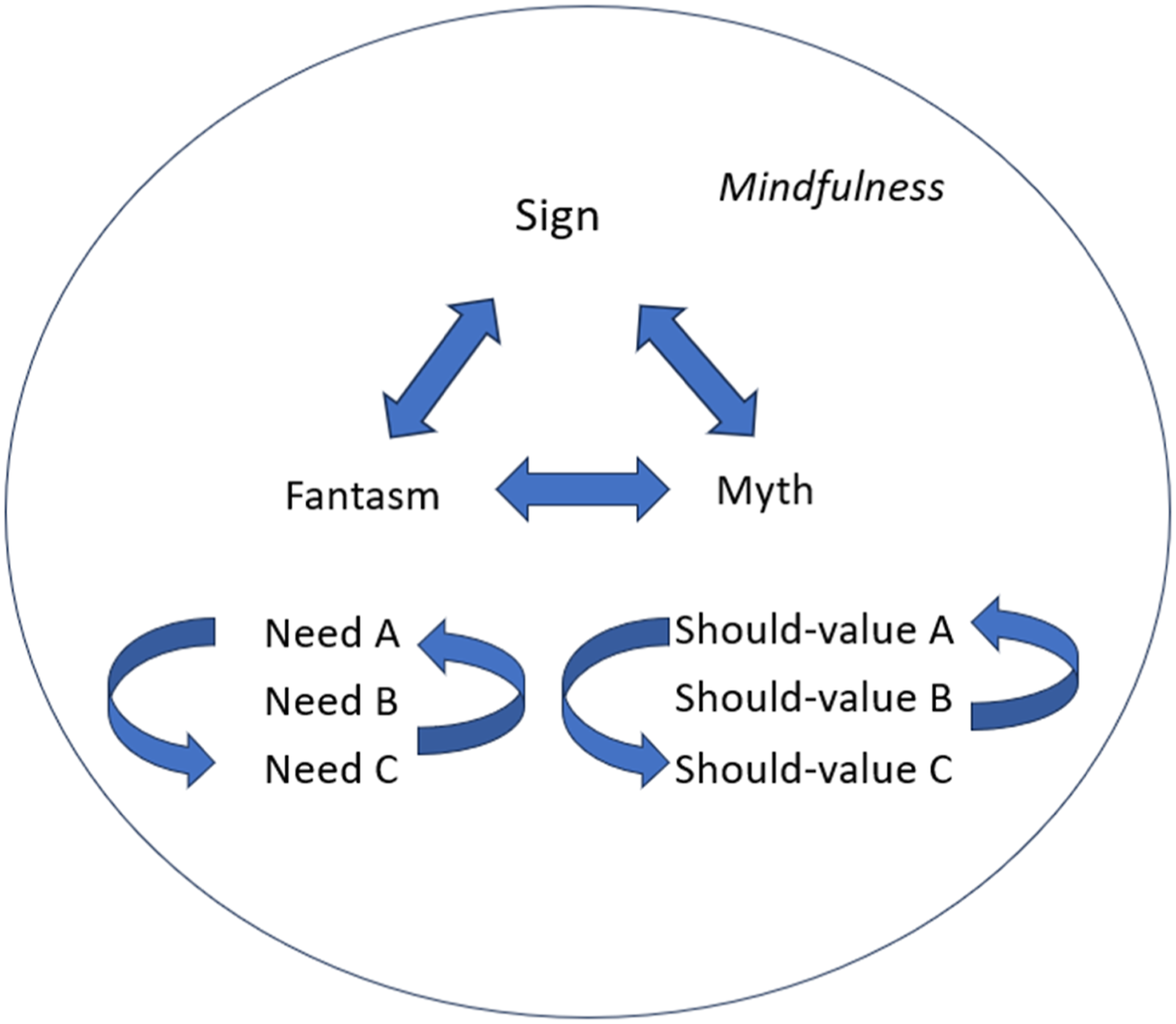
Putting our symbiosis of Cultural Psychology and mindfulness into a general conclusion, we can capture the following: A The need for mindfulness emerges in an ambivalent situation that is characterized within an intrapersonal conflict located in one’s fantasms or interpersonally in the confrontation with myth-like cultural texts. B Certain fantasms or foreign should-values (myths) come to predominate the human organism. The fixation to one specific fantasm or the being swallowed by one overlying myth creates pain and suffering. C During mindfulness-based activities such as meditation, the human organism realizes that he can change the hierachy of his fantasms challenging also his interactions with myth-like texts that penetrate his social environment. D But during mindfulness the human organism can also realize that certain should values being incorporated in specific myths do not mirror his fantasms adequately, so that the human being can willfully decide to leave a community or to challenge the community socially in order to trigger change in the myth-like structure of that community. E Hence, mindfulness is a powerful technique from a cultural psychological viewpoint because it alters intra-personal and interpersonal resources, thus the relatedness towards one’s Self as well as towards one’s social and material environment. F At the end of the paper, I’d like to give a more sufficient and wholistic definition of mindfulness based on Boesch’s Cultural Psychology. Mindfulness is a semiotic resource that recalibrates one’s action field in very significant ways altering the fantasm<>myth interaction which regulates social and personal conduct of a given human organism.
The transformative character of mindfulness understood from a cultural-psychological perspective: An example from Herman Hesse
I am aware that the above-mentioned might remain abstract for some readers. That’s the reason why I’d like to give an example from Hermann Hesse’s glass bead game (Glasperlenspiel) (Hesse, 2021). Hesse is known for his deep insights into the phenomenon of mindfulness even before that topic got popular two decades ago. He wrote his opus magnum during the rise and fall of Nationalsocialism and is recognized as a spiritual expert for meditation, Taoism, Confucianism (Hsia, 1974; Lee, 2002). Knecht is the protagonist in the glass bead game and learns in various schools Taoistic insights (the polarity of life, wu wei = the flow of life) and Confucian principles (go and serve a higher purpose/hierachy). During his studies, he experiences the world of meditation. But he does not realize the colorfulness of this world all by himself. His mentor, the music master guides him to the depth of the experience. The music master starts to play a piece of music and this piece of music should be the starting point for Knecht’s meditation. He should create and re-create the sounds within his Self while trying to observe what happens with the sounds. Let’s see in detail Knecht’s experience: The music master played the piano. It seemed to be a piece of a famous Italian composer. He instructed his guest [Knecht] to imagine the course of music as a dance such as an immediate line of balancing exercises or a sequence of little or bigger steps from the middle of a symmetry axis and to focus only on the figure which makes those steps. He played the piece of music another time and with the hands on his knees he became silent; his eyes were almost closed and without any motion, he observed the music. But also Knecht – as pupil – listened to his inner world, he saw fragments of the staves, he saw something moving, striving ahead and he tried to recognize this motion and to read it like the curve of a bird flying in the air. But then they got diverted and lost and he needed to start all over again. For one moment, he lost his concentration; he was in a void. He looked closely at his surroundings and saw the music master loosely in the dawn and found himself again in the mindful space from which he slipped away, and he heard the music and saw it moving and drawing a line out of this motion and saw and thought about the dancing feet of the invisible. (…). When he [the music master] approached Knecht again in order to eat dinner with him, he found his pupil silent but joyful as well as less tired. ‘This was nice’, said Knecht dreamily. ‘The music disappeared. It transformed itself.’ (…) Before [the music master] went to his room (…) he said to Knecht: ‘You experienced the music as a figure. Try to draw that figure if you want to.’ (Hesse, 2021, pp. 81–83)
Knecht as protagonist realizes something important for mindfulness. He experiences that mindfulness is not the permanent absence of thought. On the contrary, he experiences that some ambivalent stimuli such as music (Boesch, 2005, 2021) are trigger points for meditation. Here, the primary experience gets transformed and changes its context – the music gets transformed into visual stimuli that are moving in front of Knecht’s inner eye and he can observe the actions of that motion and his feelings in regards to that. The next step is to visualize this transformation on a paper – to draw it – and to see how the transformation gets transformed by itself over the course of the visualization. Here again, the actualized figure gets altered and makes space for a new meaning. In the proceeding lines, Knecht goes to bed and in his dreams, the figure gets transformed again (Hesse, 2021) and linked to his school experience (Eschholz). Yet, the figure explodes after its transformation frightening Knecht. On the next morning, Knecht reports the dream to his music master realizing that it lost its threatening features within the process of narration (Hesse, 2021).
During Knecht’s meditation, we can see, on the basis of ambivalent stimuli, that school is interpreted as something frightening and threatening – something which fits Hesse’s other novels such as Unterm Rad. We get to know that the dream per se demonstrates some strain for Knecht, but the moment he reports that dream to his friend the music master, it loses its frightening characteristics. During Knecht’s meditation, we come to realize that he experiences school partially as something limiting and negative – but he also experiences that school is not unchangeable and can be transcended which marks the end of the dream when the altered figure explodes. This is the ground-theme (von Fircks, 2022e; 2023b) of the novel as Knecht later experiences the limitations of being the magister ludi (the highest position in the school order) and leaving the order after some deep meditation about its limitations and the advantages of a new life. Thus, we see that during mindfulness Knecht can become aware of his central fantasms within his given need hierachy equally pointing out some later conflict potential that is prescribed in the encounter of Knecht’s altered fantasms with the myth-like structure of his environment.
As a consequence, we can conclude that our writings about the cultural psychological implications of mindfulness are not developed within a vacuum but are essentially mirrored and confirmed by great thinkers of the past such as Hermann Hesse who studied and wrote about mindfulness a long time ago 5 . The power of mindfulness hides itself in the fact of changing our very own action field on the basis of altering our fantasm hierarchy – which also changes the way how we interact with our material and social environment while on the other hand it can be the starting point for leaving a specific community with a particular myth-like structure or to fight that structure in order that the social and material environment are in an appropriate accordance with one’s fantasms. Mindfulness is thus the royal road to actualize personal and collective culture. The present paper is a humble try to understand mindfulness from an additional theoretical perspective which is cultural-psychological. I am the opinion that this understanding is rich and beneficial for researchers and practitioners of mindfulness.
Footnotes
Acknowledgements
Für Anna Ghazi, für Reinhard Semmerling, für Jaan Valsiner, ohne die ich heute nicht schreiben würde. Ihr habt mir geholfen, mich besser kennenzulernen und den Weg des Tao zu gehen.
Author contributions
The article is a single contribution of Enno Freiherr von Fircks.
Declaration of Conflicting Interests
The author(s) declared no potential conflicts of interest with respect to the research, authorship, and/or publication of this article.
Funding
The author(s) received no financial support for the research, authorship, and/or publication of this article.
