



Abstract
The present article is a psychogram about Marion Gräfin Dönhoff. I am deciphering the life of the countess on the basis of Boesch’s symbolic action theory. By the psychogram I am exploring the action field (needs and goals) of Dönhoff that I argue can only be understood while drawing on her relation to her socio-cultural environment. Born in a noble family in Königsberg – in a castle – she is a child of a highly politicized family with a moral ethos. Very early on she comes in contact with the general history or the history of her family both intertwined one with the other, goes to Frankfurt for her studies in the 1930ies, completes her dissertation in Basel (1936), leads castle Friedrichstein economically in the 1940ies, joins the inner-German resistance, flees from castle Friedrichstein in 1944 and becomes a journalist in the post-war decade in Germany. I argue that Dönhoff was exposed to specific cultural life-patterns catalyzing the ground-theme of her life, the political, practical and social involvement with the people’s lives which helps them to preserve meaning. By the notion of interrelated action fields – directed towards a common ground-theme – I am also proposing an extension of Boeschian Cultural Psychology.
Keywords
Introduction
Much has been written about Marion Gräfin Dönhoff 1 who was a leading figure in the post-war decades of Germany (Hofmann, 2019; Mann, 1966). Two biographies have been published about the grande dame of the popular newspaper die Zeit (Hofmann, 2019; Schwarzer & Dönhoff, 1997); talk shows about the experience working with her are various too and it is difficult as a German intellectual to not come across her works. Yet, the psychological implications of her work remain uninvestigated; current works either focus upon the political dimension or the poetic dimension of her work. This is the reason why I decided to write a psychogram about her. 2 A psychogram in its original sense is a study of the constitution of a specific personality, and it helps to decipher the emergence of a person’s being. Moreover, the psychogram serves the purpose of refining theory – in this particular manuscript Boesch’s symbolic action theory (see below). Hence, the goal of the present paper is two-fold: studying the emergence of Dönhoff’s personality as well as by deciphering the depth of Dönhoff’s psyche refining Boesch’s Cultural Psychology.
A new Genre: A Cultural Psychogram
As I am a cultural psychologist, the psychogram is a cultural-psychological one. Before giving space to the psychogram, we need first of all to define this new genre of psychological writing. In order for the cultural-psychological psychogram to be fruitful, we first of all need to define culture. Culture can be understood as action field that is guided by over-reaching goals and needs (Boesch, 1991; 1998). Yet, these needs and goals do not develop in isolation but only while relating to our specific environments (Lewin, 1917; 1926; 1933). The need for social stimulation develops especially in an isolated environment; the need for peace develops in times of war. Yet, it depends upon the person appropriating the environment how he deals with a present situation or goal. The ascetic for example finds meaning in silence, the soldier in war. Our very own action field enhances our action potential; we learn how to act within a specific environment in order to reach our goals (Boesch, 2005). We learn how to satisfy our hunger, to satisfy our sexual needs or to satisfy our need for social stimulation. This enhances the transparency of our action field or culture; we learn to appropriate the environment and make sense of different objects and situations. We learn how to celebrate our birthdays in order to show our appreciation of another person’s being; we learn how to go to school and do or homework in order to graduate; we learn how to love in order to be equipped for a partnership. And while learning these different means to reach our goals we constantly enhance or expand our action field (Boesch, 1998). We discover new goals or new means how to satisfy our goals; we get overwhelmed by the aesthetics of another person’s culture, and slowly building our very own action field brings pleasure and joy, mastery of one’s environmental demands and enhances the action potential for future challenges or issues (Boesch, 2005; 2006). The beauty of culture hides itself in the fact that is functional in order to reach our goals as well as aesthetic as living and mastering our very own environmental demands brings joy and pleasure (Hesse, 2021). Thus, we see that a Boeschian cultural psychology overcomes monistic worldviews in psychology and philosophy as people confront specific pre-given cultural settings (including norms, scripts, narratives) that demand a personal stance or reaction or in Leontiev’s terms personal sense-making (Leont’ev, 1978).
There are three important assets of Cultural Psychology in a Boeschian defined way (Fircks, 2021). The first is that needs and goals develop while relating to our environment; we learn to adopt goals or needs or to build them while we are interacting with people living and mastering their action fields. The teacher tells us to pay attention in order to be able to master mathematics which is important to graduate later on; our parents tell us to find a genuine partner who will share the highs and the lows of our very own life; our grandmother teaches us to become a banker in order to have a secure job. While there is no reason to believe that such a social situatedness within different action fields translates causally into actions, there is no doubt that the action field of another person is shaping our very own action field and be it only in resistance (Graumann, 1984; 2002) against the goals of my grandmother, for example. The larger meaning making systems of culture demand a personal stance towards them – something that is in line with critical personology of W. Stern (1917). The personal stance towards those larger meaning making systems within a personal action field will be the guiding line of the present manuscript (second asset).
Yet (third asset), from another person’s action field we also learn how to reach our goals or by which trajectories (Lewin, 1936). Goals can be reached by many different ways (Sato et al., 2009; Sato & Tanimura, 2016; Valsiner, 2017) and it is important to study the genesis why and how a specific path has been chosen and for which instrumental goals. Here, past, present and future are undoubtedly related with each other (Valsiner, 2017) as choosing a specific path in order to reach my goal makes it more likely or unlikely to choose another path in the future. This is called the horizon of our experience (Graumann, 1984); our actions are intertwined one with the other, yet always directed towards specific goals and needs that are sub-structured (Boesch, 1991; 1998). For a transparent cultural psychology, we need to decipher the social situatedness of a person within the social other’s action fields that is shaping the structure of our very own action fields in a way of defining goals and defining the means how to reach them which will alter the action potential in our very own future. These three premises are important for a dynamic Cultural Psychology and will guide the structure of the cultural-psychological psychogram. In order to make the action field of Dönhoff transparent (her needs and goals that develop while relating to specific cultural settings), I will first of all rely on her childhood in order to show where she was coming from, and which social influence has been important in her life. For the present psychogram, I will try to point out these three assets of Cultural Psychology understood in a Boeschian tradition while showing some blind spots that could be overcome by an additional cultural psychological mechanism.
Before exploring the psyche of Countess Dönhoff, I need to explain something about the nature of the psychogram. The present psychogram operates mostly with reflections of Countess Dönhoff herself. This includes her reflections about her childhood, her home, her role within the inner-German resistance and her second life working as a journalist. Especially for the first part of her life in East-Prussia, it is not easy to dwell on primary sources as Castle Friedrichstein burnt out at the end of WW-II. Verifying objectively her testimony is thus not possible anymore. Yet, I doubt that Countess Dönhoff had reasons to mystify her destiny and role within East-Prussia and West-Germany. 3 Different contemporary witnesses attest her a high degree of integrity and honesty (in Hofmann, 2019). Nonetheless, I consider the work with different source material more beneficial, but which could not be applied to the present scientific inquiry.
In the following, I am going to present Countess Dönhoff life stages that I will briefly analyze within our cultural psychological assets. Here, the goal is to make sense of Dönhoff’s development within a Boeschian cultural psychology while looking simultaneously for incremental material that can expand Boesch’s symbolic action theory. There is no doubt that I will interpret Dönhoff’s life in a subjective way yet trying to justify my interpretation by means of my theoretical background. For sure, a psychogram might operate within a different theoretical orientation such as a psychoanalytic, 4 gestalt-theoretical or existential one. This might be even fruitful in order to compare the results and their interrelatedness (e.g. intertextuality). Yet, one thing needs to be clear when working scientifically with a psychogram – among other means –: to be clear about one’s present meta-code that gives rise to the construction of the narration.
Gräfin Dönhoff’s Childhood
Marion Dönhoff was born in a noble Prussian family at Friedrichstein (East-Prussia) in 1909. Her father was August Carl Graf von Dönhoff-Friedrichstein who became a deputy for the German conservative party in the Reichstag of the Kaiserreich. Dönhoff’s grandfather was August, Heinrich, Hermann von Dönhoff a diplomat as well as Prussian foreign minister. Hence, the family was highly politicized, yet in a conservative way trying to preserve the diverse advantages of the noble community she was growing up in. Friedrichstein is an important location in her life and a castle having been the home for many different Dönhoff generations (see Figure 1). Castle Friedrichstein at 1860 (reproduction of original painting, collection of Alexander Duncker 1813–1897).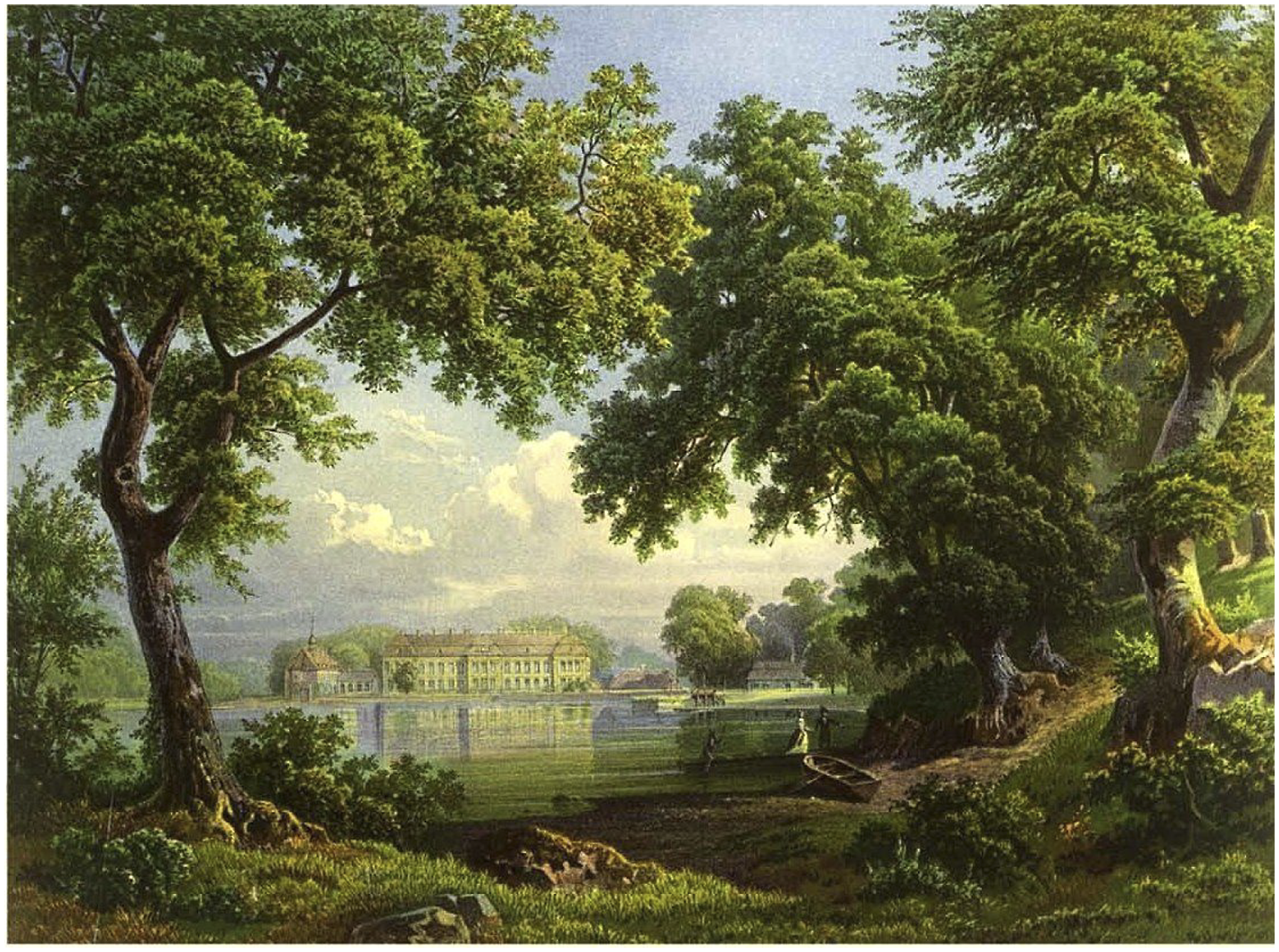
Dönhoff describes her noble origins as highly influential in her early life (Dönhoff, 1988) as noble people played a major role in politics and military until the end of WW-I. All ambassadors – there have been only nine at that time as only the most influential states within the Kaiserreich were represented by ambassadors – were noble and from 38 emissaries only four were civil. One of them was Ulrich Rauscher, president of the diplomatic representation of Warsaw (…) and it was seriously debated whether this emissary not being noble was able to do justice to the nuances of this job including tradition, style and rhythm. (Dönhoff, 1988, pp. 8–9)
It becomes clear from these lines that being noble came with great responsibilities for Dönhoff as well as other members of her family, a responsibility not only for one’s home and property a – that was Friedrichstein – but for the political destiny of one’s country and social milieu. Despite being a child, Dönhoff was already part of this political action field when she was called by her father – almost blind – in order to read for him various newspapers – in different languages or while witnessing an honorary attendance of Graf Hindenburg (later president of the Weimar Republique) (Dönhoff, 1988). Dönhoff describes (1988) that the castle was organized in an almost perfect hierarchy involving many different professions fulfilling their duties. These people came from the district Dönhoff was growing up in and looked for work within the castle. Dönhoff (1988) explains herself that the work at the castle was highly valuable for the people as there was almost no industry at that time in East-Prussia and people favored coming to the castle, getting a roof on the top, clothes and food despite a small amount of renumeration. Within the castle, conventions were the dominant force in order to structure the life of diverse persons (Dönhoff, 1988; Schwarzer & Dönhoff, 1997). Conventions for the noble members of the family were realized in a certain sense of honor towards one’s family and its importance for the guiding role of preserving property and meaningful relationships with one’s staff. It is this sense of honor that was for Dönhoff more important than actual money, a hidden currency within the castle and outside of it (1988). Such sense of honor was for example realized in a certain caring attitude from Dönhoff’s mother towards the citizen of the village, for instance if somebody became ill and asked for some lower kind of treatment be it medical or more social. Dönhoff herself, for example, was asked to bring some staff member – responsible for the pigs – cake as well as recovery wishes, and it was her mother who had founded a home for the blind during WW-I (Dönhoff, 1988).
Her father was a highly influential personality in Dönhoff’s childhood. She remembers especially his office and him working late in the evening studying for example the diverse world affairs by many different newspapers showing his cosmopolitan spirit (Dönhoff, 1988). This spirit was sharpened during his work as diplomatic attaché where he was sent to Petersburg, Vienna, London and Washington (Dönhoff, 1988). Yet, August often planned vacations to remote places in the world such as Cuba, Mexico, the Caucasian region – among many other places – sometimes not caring for getting back to his job in time. Dönhoff regretted that her father had died when she was only 11 years old as her father was part of the Reichstag – a new democratic institution – as well as the Prussian Herrenhaus – an old noble institution ruling the political dimension of Prussia (Dönhoff, 1988; Spenkuch, 1998).
Yet, from personal anecdotes it became clear for Dönhoff that her father was also violating diverse conventions and norms. One time he was invited to castle festivities in Berlin, and as Dönhoff’s mother was a former palace lady of the empress, they were attended sooner than any other invitees. Yet, they had some issues with their transport waiting vainly for their carriage. Spontaneously, August asked a man with a vegetable carriage if they could give him a ride which he confirmed. The other anecdote involves a morning breakfast – after such festivities – where all noble families came together – the high prominence – to get their breakfast. Yet, August was sitting with a friend, the Jewish lawyer Silberstein, discussing several affairs and ignoring the prominence as August explained he already talked to them, yesterday (Dönhoff, 1988).
Yet, despite disrespecting some of the conventions, there were a lot of rules in place within Friedrichstein. For Dönhoff this was an opportunity to discover oneself, to test limitations, to expand norms and scripts and to potentially negotiate the concrete living within the castle (Dönhoff, 1988). At home, there were strong rules in place. Many things - more than one could expect – were forbidden. And insofar we had an enjoyable youth because it gave us the right to resist – that was prior to ourselves – to disrespect the norms. Nothing more makes as fun as going into the forbidden (p. 79).
And Dönhoff and her siblings were highly creative in resisting as well as negotiating norms and scripts. If some of her older siblings did something wrong and were punished by means of not being allowed to ride out for several days, the siblings decided to ride out during the night relying on the help of some staff members who wanted them something good. Creatively, they planned a ride out during the night with the watchman (1988).
The Atmosphere of the Castle and Nature
It was this atmosphere that Dönhoff thought to be central for her very own education. As her parents were often unavailable, she explained that they were educated by many diverse staff members having had high expectations for the little Countess. Yet, the staff members were more than simple educators. They became some kinds of friends. For example, the carriage driver, Grenda, was helping Dönhoff and her siblings if they were hiding themselves from their teachers (Dönhoff, 1988). This bi-directional role of the staff (friends and educators) was for Dönhoff important to become a member of society. She explained that while helping different kinds of staff members, she learnt how to deal with a car, how to carpenter while her brothers were for example able to build complex windows for the castle. It is while relating in this friendly and professional manner to the staff, that it became normal for example to go to the funeral of some servant to show one’s appreciation for the mutual connection (Dönhoff, 1988). Let us see how Dönhoff recapitulates the influence of the staff members. If I think deeply about these affairs, then I need to admit that I did not learn that much from my parents or educators. The central lessons I learnt were transmitted by the atmosphere of the house and by the people between which our lives did unfold because for sure we escaped from our educators and ran into the carpentry, horse stable or to the nursery where it was much more thrilling than within the castle. (Dönhoff, 1988, p. 75, p. 75)
It is significant to note at this place of the manuscript some particularities of the Eastern aristocracy. The Eastern noble families were – to use a modern term – entrepreneurs in a way of the owner cultivating and economizing his property whereas in more Western parts, the noble families did rent their properties to farmers and concentrated themselves upon noble traditions (Dessmann, 1904). This difference is called Grundherrschaft (ground-ruling) versus (manor-ruling) Gutsherrschaft, and it becomes clear that the family Dönhoff was part of the latter. This cultural tradition makes it apparent that the family Dönhoff were living autarkic which comes with particular responsibilities of leading one’s property caring for the fact that property should yield a profit, in the end. This makes it also clear why Dönhoff and her siblings were always involved with maintenance of the castle from their early years, onwards and why it was important for her parents that the children got a practical education, too. The advantage laid in the conservation of the property.
Of central importance for Dönhoff was not only the castle and its atmosphere but also her connection with nature which she described as being attuned to the season’s rhythms (Dönhoff, 1988; 2010). This was for Dönhoff a central characteristic of her life: to live in accordance with nature. For sure, this accordance was facilitated by the fact that the technical revolution had not yet taken place and could not disperse her and her family. In Dönhoff’s words: In my youth, everything that is now part of the everyday occurrence had not been in place, not a radio nor a television and quite rarely we have seen a car. And if there was a car getting stuck on our roads in East Prussia, the horses were likely to go wild. I have experienced that the farmers did take off their jackets and put them over the horse’s head (…). There was not a single source of [technical] dispersion in the concrete sense of the word. This was the reason why we were concentrated upon our surroundings, nature, animals, our horses, dogs and rabbits. (1988, p. 104)
Dönhoff accentuated this particular kind of natural living while describing that every season brought its advantages and disadvantages, economically but also aesthetically. During summer she mentioned the cheerful hustle of the farmers on their fields as well as the melancholy of the winter months. In her own words: It is as if [the birds] took with them any form of life and any kind of joy because now there is the time of melancholic, rain-laden and dark weeks. Paths begin to become groundless (…) and within the alleyways wind hustles the leaves of trees in small swirls. When November has just begun, we needed to ignite our lamps at 3p.m. and a small fire in order to warm our little hands and foot. Only Christmas preparations takes away this humanly dull lethargy. Every day, the children of the village have new wishes for the Nativity scenes, numerous Christstollen and gingerbread biscuits are baked (…). Afterwards the time of the books has started. Being 15-year-old kid, I read everything that stood in the bookshelves including Thomas Mann, Knut Hamsun, Stefan Zweig, Franz Werfel, Leonhard Frank, Hans Fallada and Rainer Maria Rilke and many books of Dostojewski. But no author, even no poet, can be more poetic than an actual autumn day on which one starts his day in the early hours to prepare oneself for hunting. When the sun arises and within its first rays, dew is sparkling like diamonds, when the lake shimmers through the woods, then you feel part of the essential. Not only the eyes that are capturing this immaculate splendor, not only the ears that are capturing the soundless silence – in such moment it is as if the individual was permeable for the wonder of creation. Inimitable such a morning. No one far or near, the bumblebees wake up and every now and then a deer, a bird (…). All perception condenses into inspiration and all of a sudden you understand everything, life, being, the world. And there is only one feeling, deep gratitude for this place being my home. (1988, pp. 111–112)
Dönhoff explained here something important for her own education. She was always driven by a specific kind of hunger for knowledge, for literature and was acquainted with politics early on when she needed to read aloud for her father. Yet, this educational aspect of her life was only one part of the beauty she felt at Friedrichstein. More important for her was to witness the ever-changing nature, the play of colors, the employees who had to adapt their work to the seasons, the aesthetics of her home including the different seasons and their particularities (Dönhoff, 2010). This shows some deep gratitude for being alive and being part of this natural spectacle, gratitude to be part of nature and part of the human beings who live in accordance with nature. The quote shows illustratively that no opportunities for dispersion were actually helping the people to get together and connect one with the other, to spend a meaningful time while doing something good for one’s fellow man or family. This meaningfulness encountered by making differently sense of the different seasons – for example within social activities – was for Dönhoff another important pillar of growing up in Friedrichstein and to acknowledge that one can only live while sharing his space and time with other human beings and to make this space and time meaningful.
Cultural Analysis of Dönhoff’s Childhood
It is time for some interim results within our cultural psychogram. Dönhoff was born in a highly popular noble and importantly politicized family.
Her father and grandfather were both involved in the diplomatic service of the German Kaiserreich. Early on, she was witnessing discussions about politics, read aloud newspaper articles for her father, got to know some popular politicians such as Hindenburg – among many others and got exposed to some noble conventions – how to conduct oneself in specific settings, e.g. which clothes to wear and to conform to the etiquette. Yet, her father – despite respecting some conventions and norms – was also violating others, expanding or re-structuring them which showed Dönhoff herself that conventions are not fixed but flexible and fluid. Violating these norms was important for her to discover herself including her limits, interests and wants but which made it also more likely to discover forbidden aspects of life.
The second most important aspect of her childhood was the learnt responsibility for one’s property, here castle Friedrichstein. As she grew up in an East-Prussian noble family, the family was exposed to Gutsherrschaft ruling their property economically by themselves. This came with several responsibilities for Dönhoff and her siblings. Being part of this Gutsherrschaft, they needed to learn specific skills and knowledge in order to do justice to their part in conserving the property for following generations. Dönhoff explained herself that she learnt those skills by becoming temporarily a part of the employees being responsible for a specific kind of job, carpentry, potato farmers, engineers – among many other professions. Here, her theoretical education (politics, literature) got complemented with a practical side of education that helped her to appreciate jobs in their interrelatedness and that served a common good such as the conservation of one’s property. Intellectual and practical education were balanced in Dönhoff’s childhood or tended more to the side of practical education.
The third aspect of Dönhoff’s childhood is the individual appreciation of one’s natural environment. Dönhoff explained that her family and the employees were living in accordance with the season’s flow. The life of the family as well as the castle in general adapted itself with the season’s characteristics. Because the family Dönhoff was heavily relying on agricultural economy, the natural flow of the seasons was part of the natural flow of life. Yet, even during hard and dark winter months this time could be made meaningful by social practices and activities such as Christmas. Living in accordance with nature taught Dönhoff the aesthetics of life, to be grateful for just being-there, in this world and to witness the wonder of life. Contentment was found for Dönhoff in just being part of nature. The beauty of life hid itself for her within a sunrise.
Here, we do see that the Boeschian assets of Cultural Psychology are met. Dönhoff slowly appropriated her social-cultural environment in a political, functional-instrumental and aesthetic manner manifesting some early dispositions that became transparent in her personal action field during childhood. The cornerstone was laid for her horizon of experience that could be then meaningfully colored with personal sense.
Dönhoff’s Studies and Involvement in the Inner-German Resistance
It is in 1925 that the young Countess decided to study for her a-levels (Schwarzer & Dönhoff, 1997) despite some resistance from her mother. One of her cousins, Heini Lehndorff intervened for the young Countess. With her two older brothers, Marion was now in Berlin and witnessed the Golden 20ies but also the desperation that was part and parcel of that time including inflation and a politically explosive climate with extreme parties from both political spectrums.
It is here that Marion decided to make herself a picture about the uprising Adolf Hitler while witnessing a speech, and she was disgusted by his yelling and simplistic messages (Schwarzer & Dönhoff, 1997). Importantly, Marion wanted to continue her studies after completing her a-levels for which her mother raised again some concerns. However, Marion found a compromise with her mother. Before going to university, she confirmed of going to a school of home in order to learn how to lead a household. Afterwards Marion started to study economy in Frankfort, and it was 1933, some days after Hitler’s takeover, that Marion and a friend wanted to take down a NS-flag from the universities’ roof. Unfortunately, it was fixed by some chains (Schwarzer & Dönhoff, 1997). The climate became toxic for intellectuals, and many students and professors emigrated to Switzerland, and so did Dönhoff in order to complete her studies. With her doctoral dissertation father (Edgar Salin), she decided to write about the property in Friedrichstein and how it came into being, historically (Dönhoff, 1936). Dönhoff explained later that she realized here that history is made in small cultural units and not by grand figures or in short that history is accomplished within the everyday occurrence of families and autonomous regions (Schwarzer & Dönhoff, 1997). Dönhoff learnt to appropriate the history of her family and of Friedrichstein which helped her later on to lead castle Friedrichstein.
Leading Friedrichstein was important as her older brothers had to go to war, and Dönhoff became the first woman – and last person – to lead the castle, the property and its economy. But leading Friedrichstein was not sufficient for Dönhoff; she became involved in the inner-German resistance against Nationalsocialism (Dönhoff, 1994). Dönhoff explains that this resistance was poorly organized in the beginning as it was not like a group in which one could officially enter; it was a group that was growing slowly on the basis of personal knowledge, of common ideal values or attitudes mostly involving noble families (Dönhoff, 1994) with which Dönhoff was personally acquainted (Schwarzer & Dönhoff, 1997).
The major task of Dönhoff was not a militant role within the resistance; no, it was more a communicative role as she was riding through East-Prussian trying to win new members (mostly noble) – with influence in politics or army – for the inner-German resistance
5
. She had to connect different people for a common cause – the assassination of Hitler and his paladins as well as people that would be ready to build a new Germany, afterwards (Schwarzer & Dönhoff, 1997). As the assassination failed, the Nazi-government soon liquidated many different people involved in the resistance relying on several documents of people wanting to lead Germany after Hitler. Dönhoff was not part of the list as she saw her future in Friedrichstein taking responsibility for the family’s property (Dönhoff, 1994). Nonetheless, she was interviewed by the Gestapo as her correspondence was spied upon (Schwarzer & Dönhoff, 1997), yet she could convince the Gestapo head of Königsberg that she was innocent. What was the principal motivation of Dönhoff and her friend getting involved within the resistance? In her own words: To think deeply about the new and to prepare it – this was the task of the Kreisauer. In particular, the renewal of the moral-ethic foundations was important to them. They agreed upon the fact that without metaphysical dimension the individual nor the nation could persist to exist. Within that conviction they were constantly confirmed by the Nazi’s perversion of old values. (…) It was a resistance of higher public servants and high influential personalities of the public life that tried to break with the criminals for moral reasons. It became soon clear that a totalitarian government could only be battled from the inside. (Dönhoff, 1994, p. 17 and p. 34)
Cultural Analysis of Dönhoff’s Involvement in the Inner-German Resistance
Again, it is time for some interim results at this point of the manuscript. Dönhoff’s goal of getting involved within the resistance becomes clear when looking at her childhood and her social life during her studies, thus her personal sense making process. Dönhoff was actively interested in the preservation of a meaningful East-Prussia that was not only important to her very own family but for people such as farmers, craftsmen – among many other people and who called their place home. Especially, the particular love to nature and to live in accordance with the seasons was for Dönhoff a transparent world where everybody knew his or her place, could lead a meaningful live within social activities in one’s network as well as support the other when necessary (Dönhoff, 2010). A simple life, yet highly meaningful for multiple persons implied.
She joined the resistance and tried to win new members by sharing a similar moral-ethical foundation, to not lose property, traditions and values that generations over generations slowly developed and that were proven to be meaningful for the region she was living in. She was living history and she was shaping history with her family and her fellow man. Risking the preservation of this lively history and its clear benefits – that she observed early on – was out of question. And as it became clear that this history as well as her values got perverted by the Nazis (Dönhoff, 1994; 2003; Hofmann, 2019), she developed her stance of resistance against the Nazi-government not only wanting to eliminate Nazis but to help Germany developing a new moral ground of being – of course in Prussian tradition (her horizon of experience laid this groundwork/personal sense). This Prussian tradition got developed or appropriated when she wrote her dissertation about castle Friedrichstein and was deciphering the very personal lines of her family’s history in many different centuries (Dönhoff, 1936). Her historical awareness for the Prussian traditions and its benefits for multiple persons implied developed during the research for her dissertation when she realized the vivid heritage of Friedrichstein. From this stance, getting involved in the resistance was a moral imperative for Dönhoff. Of course, her actions were facilitated by a great network of personal contacts within the army and public life that she was benefiting from due to her noble background as well as her family’s legacy (her social situatedness within a given action field). She could use this social environment in order to make it fertile for a specific purpose which she did (personal sense making process). Privileges come with a certain kind of responsibility (Dönhoff, 1988) – especially for noble families – and Dönhoff assumed this responsibility and tried to make use of the different means she was exposed to from her childhood onwards. Again, our Boeschian criteria of cultural psychology become transparent within the given analysis: the social situatedness in time (war), the personal appropriation of this situatedness (resistance, creating a new moral-ethical foundation) as well as the horizon of experience due to this personal appropriation (her journalistic career, see below).
Dönhoff’s Flight from East-Prussia
During the winter months of 1944 it became clear that people needed to flee, that Nazi-Germany would lose the war, and that the upcoming red army was only a few kilometers away from them not knowing what would happen if they could get their hands on women and children (Schwarzer & Dönhoff, 1997). So, Dönhoff decided to flee as people told her that it would be most dangerous for her. The following excerpt of the Ritt gen Westen became standard lecture for German high schools – shows her escape from East to West. It was 3 a.m. in the morning. I do not know which day because all days were a single source of chaos (…). (…) Since many days, I have been part of a refugee group. In front of me a railway bridge over the Nogat (…). For a short moment, I paused (…) and I heard a peculiar, awkward knock as if a three-legged being was walking over a wooden floor. I could not see where this sound was coming from but suddenly, I saw three Gestalten that were passing the bridge. One was on crutches, the other on a cane and the third had a bandage over his head and the left sleeve of his jacket was hanging loosely to the ground. (…) My god, so few could have imagined their end to be like that. The end of a nation that took off to conquer the fleshpots of Europe and to subdue their neighbors. This was the goal, they should become slaves, and the others the master race (…). For me this was the end of East-Prussia. Three terminally ill soldiers that were crossing the Nogat bridge to West-Prussia. And a horsewoman whose family settled from West to East 600 years ago (…) and who was now riding back to the West – 600 years of history erased. (…) Every now and then you could see a well-known land sign on a carriage. After Prussian Holland you saw craftsmen and shop owners with a handcart in which was their grandmother or some of their properties. My god, what pictures. And where did they want to go? Did they really want to go hundreds – maybe thousands – of kilometers? (…) Slowly, in slow motion – as if those pictures wanted to remain stuck in my head – the East-Prussian landscape rolled past us like a scenery of a surrealistic film. (…) People over people in the most peculiar clothes. Every now and then fire to boil off water. Gunfire very close to us; sometimes it seemed as if houses were trembling. (…) The temperatures declined another time and in addition to that – which was quite rare – a violent storm from the East. When we were suddenly leaving the farm (…) we saw again the refugee group. It did not snow, yet the air was swirled by snow. Like within a thick, white curtain you could see the unhappy people moving slowly, very slowly (…). We became part of the track and saw the first deaths on our way. No one had the energy or the time nor the opportunity to bury them. (…) And within this rhythm we continued our way daily, weekly. From left and right new people were joining the track. (…) “Arriving” this was a word that you should eliminate from your vocabulary. It continued through the Mark, through Mecklenburg, through Niedersachsen to Westphalia. Three big rivers that were part and parcel of East Germany did I pass: Weichsel, Oder and Elbe. I started [my journey] with full moon, now was new moon, then again full moon that turned again to new moon. During the deepest winter I left my property. When I was arriving (…) in Westphalia it was spring. Birds sang. Behind the thrill machines, the farmland made a lot of dust. Everything was preparing for new life. Should life really continue to flow as if nothing had happened? (Dönhoff, 2010, p. 17–53)
Within that text or quote it becomes obvious for Dönhoff that her home would be lost and importantly with the loss of her property the history of her family. All efforts to make the property economic, renovations, cultivations, expansions were coming to an end; personal history was erased the moment she needed to flee from Friedrichstein. And with that personal history – that was an important appeal to conserve it – the future would look different too for Dönhoff as well as for many other people joining the track from other Eastern parts of Prussia (horizon of experience gets constrained by social-cultural upheavals which also demands a new personal stance to the issue at stake). While there was always a high accentuation of preserving the property within one’s family and to leave it for the future generation to come – this tradition (both ideal and material) came to an end. The sadness is obvious in Dönhoff’s text, yet it is a sadness that is more than a mere consternation about the actual flight. In particular, it is a dismay of erasing personal history for a politically absurd ideology. And it is an anticipation about the future state of Germany (compare the three people crossing the bridge) in the next months or even years, a state of meaninglessness that Dönhoff needed to deal with, equally.
The Start of Dönhoff’s Second Life: Her Journalistic Career
Yet, this meaninglessness was only temporary. Dönhoff after joining some family members in Westphalia was ready for a new exercise (Hofmann, 2019). She did not want to become involved in many wife-like tasks like cooking, but she was probed in thinking about history and politics (Schwarzer & Dönhoff, 1997): So, she started to write two memorandums for the British occupation trying to explain what was and what is in a way of explaining why Hitler had come to power and why the Germans had fallen for him. Yet, the memorandums never reached the British officials, but they reached DieZeit – a newly forming newspaper (Schwarzer & Dönhoff, 1997). Simultaneously, she accomplished to print a documentation about her resistance friends trying to show the Germans that there was an inner-German resistance not wanting to push their careers but to break with the crimes of the Nazis (Dönhoff, 1994; 2002; Hofmann, 2019; Schwarzer & Dönhoff, 1997). It was in the early beginning of 1946 that DieZeit wrote a telegram to Dönhoff wanting her to come to Hamburg.
An adventure was yet to begin that should last more than 50 years and that not only was important for the newspaper but for the country as a whole, morally (Schwarzer & Dönhoff, 1997, p. 164). Despite no clear journalistic experience (Hofmann, 2019), the leaders of DieZeit acknowledged her potential as she was connected to a variety of important people in politics and diplomacy, had traveled a lot and came across many different countries and nations and could speak fluently French (Schwarzer & Dönhoff, 1997).
It is important to note that Dönhoff’s articles were often commentaries or politically connotated reportages (Dönhoff, 2003); she did want to convey a political message (Mann, 1966) that was important for her such as when the British occupation forbid the Sunday before Advent on which the dead are commemorated advocating that this day was not a glory for the military but a psychological tool for concrete people to grieve about their losses (Schwarzer & Dönhoff, 1997). And Dönhoff had a clear position for former Nazis wanting to write for DieZeit as well as intellectuals that were sympathizing with the Nazis which resulted in her leaving DieZeit temporarily (Hofmann, 2019). Dönhoff had her principles.
Getting Involved with Inner Policy: Reconciliation with Eastern Europe
One of these principles was för Dönhoff to bring peace in Europe and beyond, especially considering the relationships with the Eastern nations such as Poland (Dönhoff, 2003; Hofmann, 2019; Schwarzer & Dönhoff, 1997). For her being grounded in personal as well as over-personal history – that was always constraining or expanding the former – it became obvious that the different nations should work together, in cooperation. Yet, Dönhoff never accepted the loss of her home, East-Prussia or the Oder-Neiße line after WW-II declaring all former German regions behind this line to be not-German. Her position was clear: renunciation of violence, however, no renunciation of territory (Dönhoff, 1988). And she was strict in that position.
All of a sudden, her position changed, drastically when Willi Brandt became chancellor of Germany after 25 year of conservative German government advocating a new, clear, friendly, open, cooperative Eastern policy. For many German refugees hope still existed that the former German regions could become German again; yet this hope was not realistic or only to be achieved, violently. Brandt realized that and adopted a policy towards the Eastern question of renunciation of violence by renunciation of territory (Bange, 2006). And Dönhoff agreed on that position. Peace and cooperation between the nations could be only achieved when realizing that the renunciation of violence was sincere and authentic; yet this could not be done by advocating the former German regions to become German again. Renunciation of territory was necessary to prove one’s renunciation of violence (Dönhoff, 2010, Schwarzer & Dönhoff, 1997; Hofmann, 2019). Otherwise, the former would have been only an empty phrase. In Dönhoff’s own words: When it became clear that the general rule: renunciation of violence – yes, renunciation of territory – no – could no longer be an answer because only a clear yes or a clear no were necessary, I knew that I had to face a new stance towards the issue. I chose the painful sacrifice of a confirming yes where the rejecting no would have meant revenge and hate (…). I can no longer imagine that this is the highest form of love towards one’s home, that you lose yourself in hate against the people who took property of it and to defame those who want reconciliation. When I think about the lakes and woods of East-Prussia, on the wide meadows and old alleyways, I am sure that they are as incomparably beautiful as before when I called them home. Maybe, this is the highest form of love: to love without possession. (Dönhoff, 1988, p. 221, p. 221)
Dönhoff herself was always caught up between the conservation of her home as she had experienced the meaningfulness of Friedrichstein not only for herself and her family but for many people working at the castle or living in the surroundings, the meditational character of nature, the gratitude to be alive due to being part of nature’s spectacle and doing meaningful work for one’s micro-culture such as family or the conservation of meaningful values and a new world that was slowly opening up for her which meant the loss of her home but came with other advantages, for instance to become involved with journalism, politics and the public life in Germany.
Cultural Analysis of Dönhoff’s Flight and her Second Life
Let us look again at some interim results from the cultural psychogram. Dönhoff clearly describes the pain of fleeing to the Western parts of Germany losing her property and a vivid history in the form of castle Friedrichstein – that was later burnt by the Soviet Army. A horizon of experience came to an end and with that a specific social-cultural environment that could be appropriated meaningfully by many different people (personal-sense making process). Yet, she realized rapidly that it is not only her losing her property and history but millions of people that lived in other regions or also in East-Prussia and that need to make sense of their lives, differently than before.
Dönhoff had no other chance than to accept the loss, temporarily. And she accepted it even if she was often in melancholy about this loss. She stood to her emotions and acted them out, vividly (Dönhoff, 2003). Yet, Dönhoff knew that a new forming Germany had many intellectual and practical issues to solve, and she felt a certain kind of responsibility to get involved with these issues and to propose certain kinds of solutions (Hofmann, 2019). So, she decided to write and to become involved with German politics after WW-II trying to clarify things and to order them. It is in this regard that she became a journalist, coincidentally. And she was more than made for this role as she knew a great deal of history and politics, about resistance, about the people’s lives – that she shared and also their jobs in castle Friedrichstein. She was a homo politicus by means of her education and her role within the resistance, and she could use this knowledge, the contacts, the sources in order to make them fertile for her new purpose that was now journalism. She had strong opinions, political opinions that she was ready to defend (Mann, 1966) against whomever she met and be it the British occupation. If even the horizon of experience came to an end materially, it did continue to exist psychically through her embodiment of Prussian tradition and heritage. And she made people benefit from this embodiment as long as she lived (Hofmann, 2019).
For me as Cultural Psychologist this is no wonder as she enjoyed an education that fostered her autonomous development, to get involved with many different people, to connect with them, to make herself a picture about their lives – jobs, challenges, issues and so forth and to analyze all of this in conjunction while seeing the historical and political dimension of these vivid lives. She was aware of the psychological tools people needed in order to cope with their lives and their challenges (the commemoration example) and she tried to be an advocate of these people. Yet, Dönhoff was a child of her time, and she knew that life is ever flowing and that one needs to adjust to this flow in order to meet its challenges, adequately (transparency of nature).
Dönhoff despite her love for her home and its traditions and history was able to adapt her position in a central question (developing a new personal sense while being confronted with a similar action field). She made herself aware of the consequences of her political positions or interpretations; she realized that the renunciation of violence required the renunciation of territory because otherwise the former was just an empty phrase and would mean hate and revenge. By her own experience she knew what hate, revenge, war mean to people and their lives, and it is by this realization that she refrained from her prior position in order to embrace a clear position of cooperation and peace that would terminate hereditary enmity. Changing our individual interpretations within our very own lives in order to bring peace and inner harmony for different people implied was the via regia for Dönhoff’s education and political and journalistic career, afterwards. Realizing how our interpretations limit or present some opportunities for the growth of multiple micro-cultures was Dönhoff’s mechanism to do psychologically meaningful work. This is what the cultural psychogram teaches us.
What Dönhoff Might Teach Us
At the end of the cultural psychogram, I want to highlight some working hypotheses for Cultural Psychology.
I advocate the opinion that Dönhoff could only become what she was due to her social environment she was growing up in. 6 Here, I do not want to psychoanalyze her childhood, but it becomes obvious that Dönhoff acquired early on cultural life patterns that dominated over her entire lifespan (see also Zittoun, 2016). One of these cultural life-patterns involves for example the need for getting acquainted with politics and history. However, this involvement was never understood for Dönhoff in pure intellectual terms. She was never a full intellectual despite her dissertation. She was always involved with the practical things of life and the practical aspects of politics and history. It is no wonder that she wrote her dissertation not about a theoretical model of an intellectual theory but about the emergence of the Dönhoff economy at Friedrichstein and beyond (Dönhoff, 1936).
Understanding people and their lives and to realize life’s political dimensions were fostered for Dönhoff in constantly interacting with the staff members at Friedrichstein while helping them in their work or to even develop a friendly interaction with them such as to the carrier Grenda who was an important figure in her life (see Figure 2). In regards to Figure 2 it becomes obvious that the borders between Dönhoff and the staff of the castle were mutual permeable. The key-condition is humility in heterogeneity which means that the staff members are approached not as servants but as people with whom you live and share a common cause. This prevailing ground-theme – to preserve Friedrichstein – helps to not only connect with the people working at the castle – but essentially to dive deeply into their action fields while being open to learn from them. This learning – by immerging into another person’s action field – is learning by becoming part of the carpenter’s action field and helping him in his job, for example. This is a practical learning. The crucial feature for the permeable borders is the insight that one is mutually connected with the workers for a common narrative – that is the meaningful preservation of a meaningful place – Friedrichstein, for many different people. I argue that the permeability of borders – of mutual learning or influence – can only be achieved if all the actors implied realize that they act upon a common cause or a prevailing ground-theme
7
that is inherently meaningful. What differs Dönhoff from other people – for example in our age – is not only that she grew up within an action field that overlapped with many other – highly diverse – action fields – but that the action fields were mutually interdependent. Yet, this interdependence comes with a clear meaning or a prevailing narrative, here the preservation of Friedrichstein that helps different people to satisfy personal needs (foods, shelter) but also social and spiritual needs – note that Friedrichstein had also church services (Dönhoff, 1988). Extract of Dönhoff’s Social-Cultural Environment catalyzing a specific ground theme. (Carp = Carpenter, Eng = engineer, Watchm = Watchman, G = Grenda, August, C = Father, Maria D. = Mother, Dönh = Marion Gräfin Dönhoff).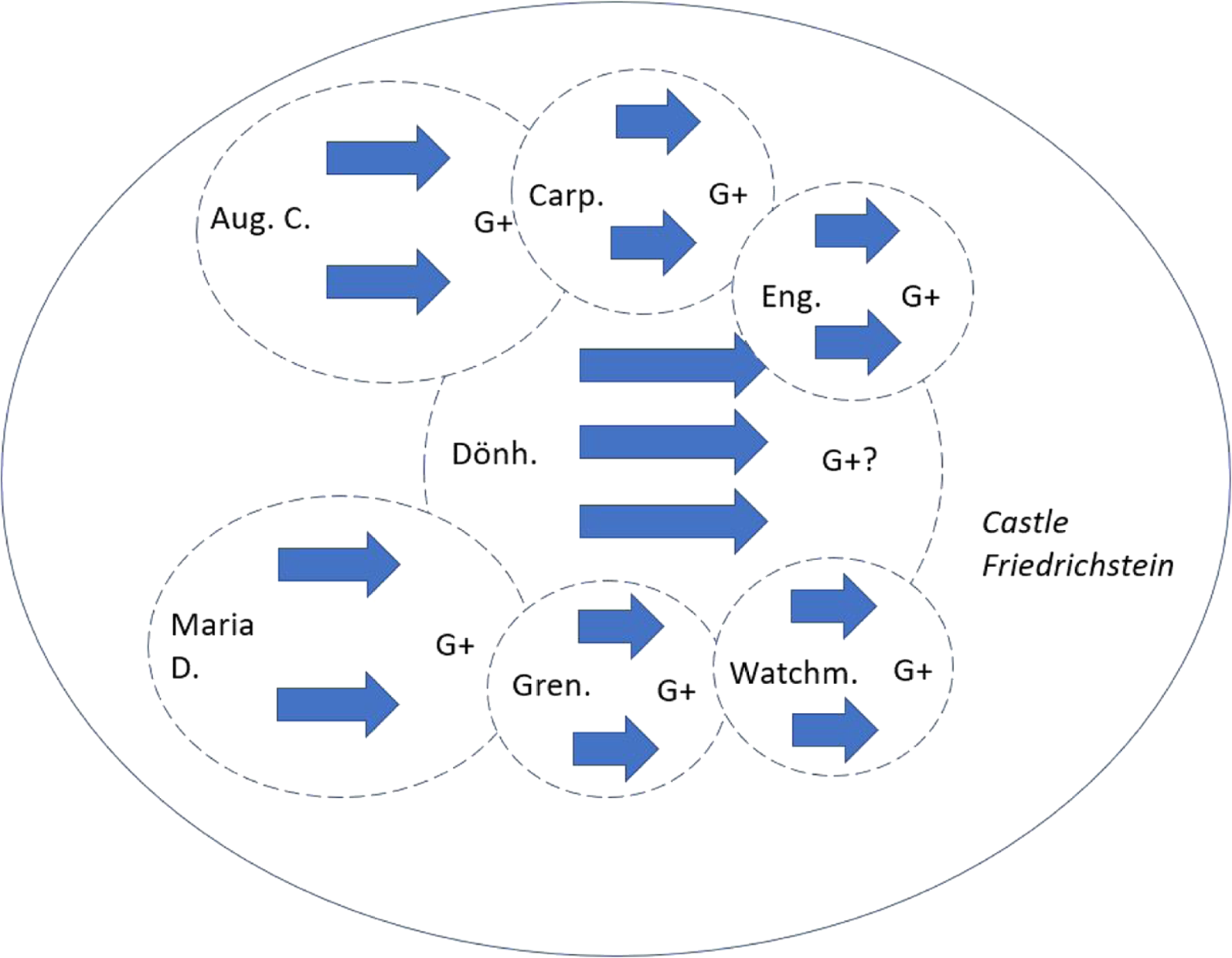
One reviewer raised some criticism in regards to my conclusions of mutually permeable borders. While Marion Dönhoff’s father was able to ask the farmer for a ride in his carriage, the farmer could not ask to get a ride by Dönhoff’s father. However, the mutual permeability of borders is not unfolding itself under the premise of anything goes but works within tightly knit social norms. This accounts for Dönhoff as well as other people. The mutual permeability of borders has its very peculiar limits – in every life. I will explain myself: The Dönhoff family showed sympathy and respect towards the staff members of the castle, and if someone became ill or died, the Dönhoff family acted in favor of that family. Thus, they entered the staff member’s action fields because they were interested in the people’s recovery (autotelie). Also, the staff members were not forced to accept the help of the Dönhoff children, but they were interested in the social contact with the children (social affiliation). The mutual permeability of borders must not insinuate that every arena of life is penetrable for every actor implied. Even in close families, some life-spaces remain impermeable.
This differs Dönhoff not only from modern children growing up – there are far lesser opportunities for modern children in exploring many different action fields – but also from other noble families from her time that might have thought that the staff is not united with the noble family for a common cause. This is an important extension of Boesch’s symbolic action theory: The exploration of other people’s micro-cultures is facilitated if these action fields do share a common ground-theme – or a common cause – that can only be achieved when working mutually interdependent. Every member of the castle was contributing to the larger action field – the preservation of Friedrichstein – within their smaller action field and equally benefiting from the meaningfulness of this over-reaching goal. This has crucial implications for education. If we want them to explore many different action fields – or in other words to enjoy a pluralistic education – we need to assure that the exploration is guided by a prevailing ground-theme, a meaningful common cause that shows that every smaller micro-culture contributes to a larger common culture 8 . Only then, our children will realize that meaningful work or meaningful activities can only be reached by immerging into mutually interdependent action fields.
Getting involved with politics and history was for Dönhoff not an end in itself nor a means to achieve self-glory or recognition. She was a homo socialis. Very early on, she learnt that privileges come with a certain kind of responsibility such as helping underprivileged populations and to get involved with their lives. Her mother was highly influential in this regard as she was the lively role model of this attitude. Her involvement within the inner-German resistance was not motivated by becoming somebody in a post-Hitler era but to free people from the Nazi barbarism and the perversion of the old Prussian values. This was the reason why she did not set herself on the list of roles and jobs in a new Germany which saved her life, interestingly. For her, it was important to resist in order to preserve the meaningfulness of her live as well as the life of her fellow man. This was seriously endangered by the Nazis and the reason why she joined the resistance. I argue that the attitude of preserving something for some common good – not due to egoistic reasons – was the driving force for Dönhoff in getting involved with politics. And it was something that she learnt early on when assuming responsibility for the castle, ill workers, or even for normal village men. And it was something that she learnt because she grew up in this preserving, conservative milieu that was not elitist but connected to real people and their lives.
This helped also Dönhoff to define her role in journalism (her horizon of experience continued to exist despite the destruction of Friedrichstein). Again, she was not a theoretical journalist but was more of a practical kind when trying to say for instance that Germany needs psychological tools to mourn one’s losses. This practical journalistic aspect of her career made her valuable for the public life of Germany as she had always a fine-tuned sense of the conflict and debates of the country (Dönhoff, 2003; Hofmann, 2019). I argue that she could only be attuned to these conflicts and debates as she was able to approach people, authentically and sincerely as she was interested in the fact how their lives came into being by the particularities of history and politics (personal sense-making process of her social-cultural environment).
She was interested in the destiny of people, and this guided her journalistic role – that was in my opinion 9 fostered within her education of assuming responsibility for one’s fellow man. Even if Friedrichstein ceased to exist materially, it did not lose its influence on Dönhoff, ideally. The reason why lies in the cultural life-patterns she was exposed to, and which catalyzed a ground theme of her life: People need to be united for a common, meaningful cause – or a prevailing ground-theme of their lives. This involves the active involvement in preserving something meaningful while constantly developing it and actualizing it in time. The notion of home was an important theme for Dönhoff in this regard (2003), and it is not a surprise that she got involved in her journalistic and political career with exactly those questions. For sure, we cannot say that her cultural life-patterns translated causally into her journalistic career. It was one trajectory among many. She could have equally become an author in the post-War German group 47. Yet, getting involved with politics and with the life of concrete human beings was a goal that could not translate into many different trajectories after WW-II as the intellectual development was highly constrained at that time by the allies and an author career was also more theoretical than practical (Mann, 1966).
It was in her childhood and youth as well as in her study time in Berlin that Dönhoff discovered that norms and conventions are ever-changing, that life is in flow and that one should not resist this flow. For her, it was central to negotiate the future of norms and conventions and to resist them when necessary. Her father was a lively example of this negotiation and for the violence of certain norms. It showed her that norms and conventions are not untouchable or fixed in time but that they need to be adjusted to the actualities of the modern day. Such as nature adjusts to the seasons – remember for Dönhoff it was important to live in accordance with the seasons – one needs to adjust to new cultural demands of life and to face them, voluntarily. This attitude – born through her relationship with her father as well as with nature – helped her to actualize her political positions when necessary, such as in the causa of the Eastern policy.
She was more than aware of the consequences of a certain kind of political position – she experienced those consequences at first-hand – which helped her to change her positions. As she had to experience the pain of expulsion, of losing one’s home and history (materially) – she was convinced that future generations should not experience something similar. Renunciation of violence was her position that could only be proven authentically when showing equally a renunciation of territory. And being grounded within the attitude of nature as something not personally possessable, she realized that some part of her home will always remain home; love without possession is in the end a personal and a political appeal for Dönhoff. Cooperation – Dönhoff had to learn early on – comes only into being if people are united for a common, meaningful cause such as peace for example. For this purpose, for this meaningful common cause she had to over-think her prior position in order to come back to a prevailing ground-theme of her life: The preservation of a meaningful place called home. If she had been loyal to her prior position, she would have rendered the preservation of somebody else’s home absurd. A message that is only to be understood while understanding where Dönhoff comes from and with which people she interacted shaping her needs and goals during her entire lifespan.
What I propose with the following psychogram is not only an exploration of the depth of Dönhoff’s psyche but also an extension of Boeschian Cultural Psychology: If we want to understand how action fields – and people’s personal stance towards them – develop over time, we need to study their interrelatedness catalyzing a specific ground-theme constrained by historical demands (see Figure 3). We can do so by deciphering the individual goals of every actor implied while distilling the common aspects of those goals or the over-reaching direction they are pointing at. Equally, we have a starting point for interventions. If systems – such as organizational systems or family systems – do show a lack of a specific kind of interrelatedness, this interrelatedness can be altered or facilitated if a common ground-theme or a meaningful cause can be negotiated between the members of the system at discussion. Individual action fields can then be actualized or re-structured and make the mutual immergence into the social other’s action field more likely. Extension of Boeschian Cultural Psychology: Studying individuals in time while drawing on the action fields’ interrelatedness for a specific meaningful ground-theme. (P = Person, G = goal).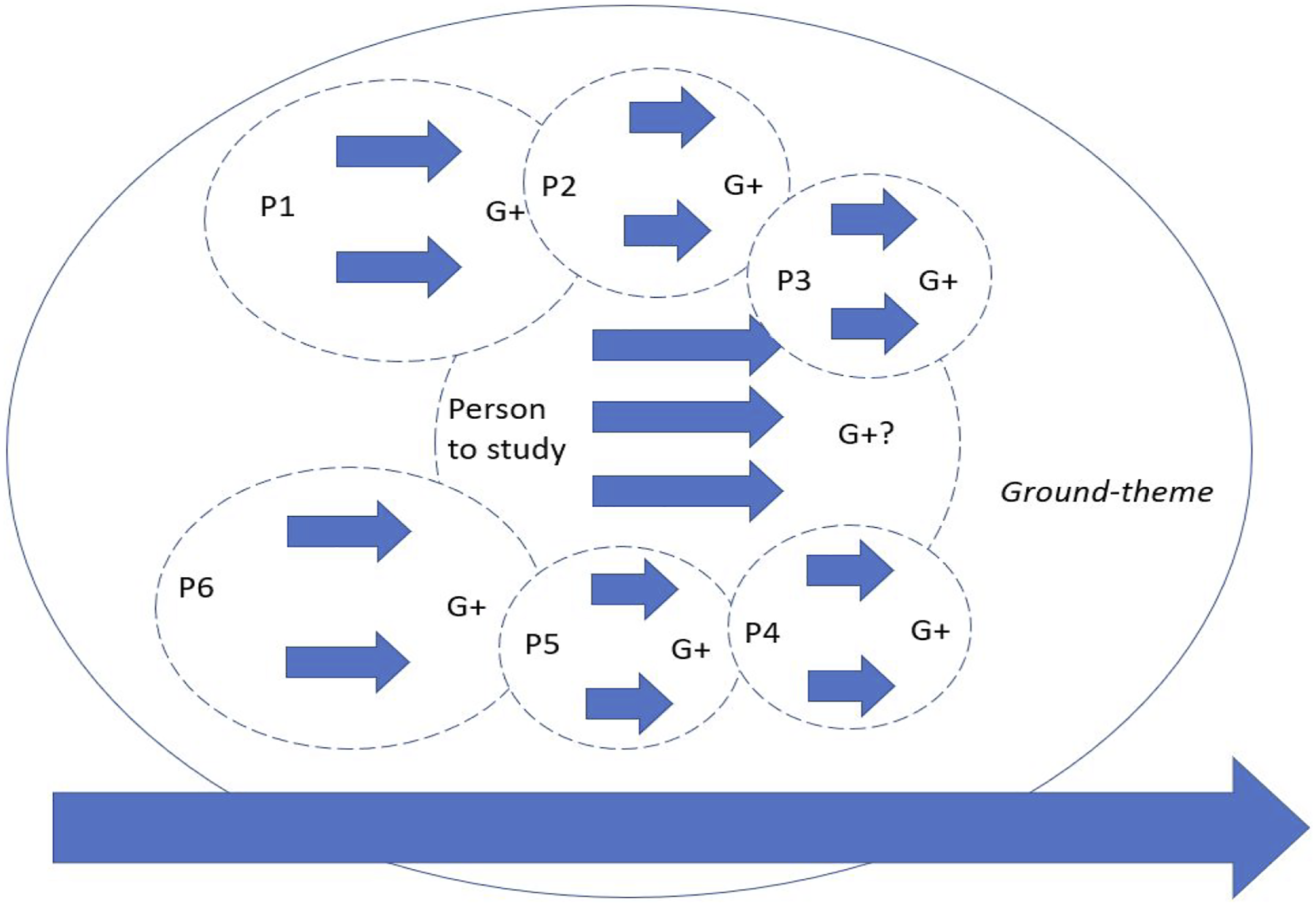
Distilling the Essence of the Psychogram: Helping Individuals to Develop as Mature Human Beings
If we are interested as a country or as a region to develop people who are ready to assume responsibility not only for themselves but for one’s fellow man, we can learn a lot from Dönhoff’s psychogram. To help people develop like Dönhoff, we need to get them involved with a concrete form of history and politics that is inherently intertwined with the life of one’s fellow human being. This involves no theoretical or intellectual discussion so often encountered in the modern school setting but the immergence into their action fields, into their jobs, issues, conflicts, dreams and goals.
Dönhoff was a homo politicus, socialis and practicus. Yet, it was not in her genes to become these homini. It was her social-cultural environment (the overlapping action fields) that was shaping these homini and helped her to become this autonomous, mature and responsible human being, a social-cultural environment that was united in heterogeneity for a common meaningful cause – or in Stern terms united in heterotelie that made possible a specific synthelie (1917).
Dönhoff is not only a child of her time but she is a child of her social-cultural environment and her developing and actualized stance towards it. The cultural psychogram shows that illustratively and it shows ways how we can help people develop to assume responsibilities within their very personal action fields. We do not need to grow up in castles for that.
Footnotes
Acknowledgements
Ich danke meinem baltischen Freund Jaan Valsiner für seine bedingungslose Unterstützung meiner Ideen sowie der Korrektur einer vorherigen Version.
Declaration of conflicting interests
The author(s) declared no potential conflicts of interest with respect to the research, authorship, and/or publication of this article.
Funding
The author(s) received no financial support for the research, authorship, and/or publication of this article.
