



Abstract
Despite morality’s important role in international relations, we still lack a compelling way to study it. Some scholars define norms as moral in nature but fail to define morality or conceptualize it too narrowly. We address this problem by defining morality subjectively, allowing us to differentiate it from norms and study its impact on decisions of international significance. To do so, we adapt the moral convictions concept developed by psychologists to qualitative, elite-focused political research. Actors with moral convictions rely upon their individually held beliefs about fundamental right and wrong, whereas norm-followers look outward to community expectations. Morality requires sincere belief and weakens social influences.
The September 2019 Brexit rebellion is an ideal case because it endangered rebels’ careers, rendering material self-interest an unlikely motive. This allows us to investigate the role of norms and moral principles. Based on interviews with British Members of Parliament (MPs) and text analysis, we find that community norms and personal moral principles interact: when existing norms give unclear guidance and identification with their in-group weakens, actors are likely to rely on their own principles to interpret norms. Morality can affect which norms matter but does not negate their influence altogether: pre-existing norms channel and constrain morality and its consequences. Many MPs moralized existing norms related to democratic decision-making, which mitigated some consequences of moralization, such as intolerance toward those with opposing views. This new conceptual and methodological approach thus helps to disentangle ideational factors and understand their influence on decisions of international significance.
Introduction
What is the relationship between norms and morality in international affairs? Morality is central to foreign policy decision-making and to international relations more generally, as a growing literature suggests (e.g. Finnemore and Sikkink, 1998; Kaufmann and Pape, 1999; Kertzer et al., 2014; Kreps and Maxey, 2018; Rathbun and Stein, 2020). However, we still lack a compelling way to study it. When scholars contrast ideational factors with material self-interest, they often bundle phenomena such as moral principles and norms together as part of the logic of appropriateness, or simply focus on one of these factors (Finnemore and Sikkink, 1998; Rathbun and Stein, 2020). Morality is also sometimes treated as a component part of norms. Many scholars then fail to define morality (Finnemore and Sikkink, 1998; Winston, 2018) or employ unsuitably narrow definitions (Goertz and Diehl, 1992; Jurkovich, 2020). This prevents us from understanding how community norms conflict, shape, or coincide with individually held moral principles.
Identifying morality at the international level is inherently difficult because the focus on collective actors like states veils individuals’ beliefs. We propose studying morality’s influence by examining the normative commitments of individuals whose actions have significant international political, security, or economic implications.
When analyzing such decisions, costly actions increase our confidence that ideational factors mattered more than material self-interest. One may think of whistleblowers like Katharine Gun in government agencies, international organizations, the media, and political parties who have risked their careers by speaking out against practices or decisions with global consequences they perceived as wrong.
We study one such case: the September 2019 Tory rebellion in the British House of Commons. While this decision was taken domestically, the content and effects of the decision were international and had profound implications for global politics. It is likely that both norms and morality mattered and unlikely that self-interest drove the rebellion. 1 Against their party line, 21 Tory Members of Parliament (MPs) voted for legislation aimed at preventing a hard no-deal Brexit, which would likely have triggered economic and political disruption domestically and internationally. As Prime Minister (PM) Boris Johnson had threatened, the rebel MPs had the Conservative whip withdrawn, preventing them from standing as Conservatives in future elections. Only about half of these rebels later had the whip restored, which was not guaranteed at the time. Hence, they rebelled knowing that this decision would jeopardize or end their political careers.
We show that three decision-making influences—norms, principles, and material self-interest—vary in their normativity or degree of “oughtness,” the method of reasoning they prompt, and whether actors experience them primarily as internal or external demands. This last feature, which we call orientation, separates principle- and norm-driven decision-making. As external, community-level standards, norms can generate a sense of obligation regardless of whether actors believe in them. Principles operate as internal demands, requiring sincere belief.
We introduce a novel methodological and conceptual approach to explore the relationship between moral principles and norms. Building on moral convictions research in political psychology, we propose a subjective, or actor-centric, definition of morality. Because the key feature of principled (and by extension moral) decision-making is its internal orientation, we must identify what actors believe is morally salient rather than using the researcher’s definition. Methodologically, this approach usually relies on surveys. We adapt it to interviews, answering Price and Sikkink’s (2021: 36) call for International Relations (IR) norms scholars to test “hypotheses generated in moral psychology using traditional political-science methods.”
The September 2019 Brexit rebellion raises two questions. First, how did norms and morality interact in the decision to rebel? Our interviews and text analysis show that rebel MPs perceived no-deal as an imminent crisis with severe consequences for the United Kingdom’s economy, security, and unity. This crisis perception triggered a norm conflict as MPs’ obligations to different groups—party, country, constituency—collided. Rebel MPs resorted to their own (moral) principles to resolve this conflict, leading them to deprioritize the dominant norm of party loyalty despite considerable pressure to conform. For most rebels, preventing no-deal was a matter of right and wrong because they felt they must not disregard their own beliefs on an issue they considered so high-stakes.
Second, why do we not see some of the attitudinal consequences that typically accompany moralization? Moral conviction is associated with less willingness to compromise and intolerance toward those who disagree. However, both rebels and those who shared concerns over no-deal but did not rebel (hereinafter: non-rebels) described preventing no-deal as a moral issue. Furthermore, most rebels were reluctant to judge non-rebels, and they respected sincere proponents of no-deal. They also readily expressed dislike of careerist politicians who prioritize personal gain. We argue that two countervailing norms, one commanding tolerance of those with different beliefs and another condemning careerism, best explain the absence of some consequences of moralization. This shows the value of our conceptual and methodological approach: it helps us identify norms and moral convictions and to analyze their interaction when they do not coincide.
We begin by reviewing existing approaches to norms and morality. We identify distinctive features of norm- and principle-driven decision-making and show that a subjective understanding of morality allows us to better trace its influence on decision-makers. We then theorize the interplay between morality and norms in decisions of international significance. The case study section illustrates these theoretical insights with the September 2019 rebellion. We conclude with further possible applications of this framework to IR.
Disaggregating norms, morality, and principles
Three oft-cited ideational influences on decision-makers are norms, morality, and, to a lesser extent, principles. Some scholars gloss over differences between these concepts by treating morality as a component of norms but then failing to define it (Finnemore and Sikkink, 1998; Winston, 2018), or relying on unsuitably narrow conceptualizations of morality (Goertz and Diehl, 1992; Jurkovich, 2020). Moreover, actors who respond to ideational concerns have been thought to follow the logic of appropriateness (LoA), in contrast to the calculated rationality of the logic of consequences (LoC). We consider all these approaches problematic. We propose a conceptual framework that is better-suited to identifying the relationship between different ideational factors and empirically tracing their distinct forms of influence on decision-makers. We treat principles as individually held “oughts”; norms are communally recognized “oughts,” which may or may not be sincerely followed; and both principles and norms can be moralized by individuals (or not).
Norms are commonly defined as “standard[s] of appropriate behavior for actors with a given identity” (Finnemore and Sikkink, 1998: 891) and as “collective expectations about proper behavior for a given identity” (Jepperson et al., 1996: 54). Much norm scholarship merely quotes one of these definitions and highlights the socially constructed nature of norms. However, some scholars who engage in conceptual discussion characterize norms’ collective sense of “oughtness” in moral terms. According to Finnemore and Sikkink (1998: 892), norms imply a “shared moral assessment.” Jurkovich (2020: 2) considers a “moral sense of ‘oughtness’” a component part of norms. Some may argue that all norms do ultimately depend on moral instincts or ideas. But baking morality into the definition is problematic, as norms can generate a sense of obligation without having an obvious moral component (see also Price and Sikkink, 2021: 4). The shared expectations about appropriate behavior that characterize norms can also have social, legal, or professional origins.
Other scholars fail to define morality (Winston, 2018) or adopt one definition at the expense of others without justifying their choice. For instance, Goertz and Diehl (1992: 639) define the moral component of norms as having a “deontological character” and for Jurkovich (2020: 3), it means “that engaging in a particular behavior is socially acceptable.” Yet neither study explains why morality is deontological (i.e. follows generally applicable rules) or dependent on societal views. Similarly, when scholars only consider “moral” norms based on liberal values, they implicitly define morality in liberal terms (e.g. Risse et al., 1999). As evidenced by different philosophical traditions, morality’s scope and substance is debatable. These demarcations of the moral domain require an explanation.
Even when scholars explain their choices, their definitions may be unsuitably narrow. Moral Foundations Theory (MFT), for example, attempts to provide a more empirically grounded account of morality. MFT holds that people are intuitively oriented toward different fundamental values or “moral foundations” that together comprise the moral domain (Graham et al., 2011). Binding foundations, namely, respect for authority, in-group loyalty, and purity, are included specifically to counter liberal bias (Rathbun and Stein, 2020). Nonetheless, by predetermining what counts as a moral concern, MFT risks excluding people whose instincts differ from the foundations on offer. Expressions of courage or truth-seeking would be overlooked by MFT even though these values seem morally relevant. While studying the influence of particular principles can be useful, the conclusions we draw about them must be correspondingly narrow. As they exclude individuals who define morality differently, narrow definitions undermine scholars’ ability to speak to the role of morality as a whole. Any concept that builds on a particular philosophical or evolutionary account of the moral domain faces this problem.
Moving beyond the “logics”
Another flaw in existing accounts is that they usually treat norms, principles, and morality as part of the LoA. Following March and Olsen (1998), IR scholars distinguish between two decision-making logics: the LoA and LoC. On a substantive level, actors who follow a LoC supposedly prioritize selfish ends, whereas those who follow a LoA prioritize what is “true, reasonable, natural, right, and good” (March and Olsen, 2008: 690). Norm scholars generally treat the LoA as involving other-regarding concerns such as protecting human rights (Risse et al., 1999) or cultural artifacts from wartime plunder (Sandholtz, 2008). Methodologically, actors who follow a LoC consider the likely outcome of their actions, whereas those who follow a LoA engage in rule-following or role-playing, that is, “matching the obligations of that identity or role to a specific situation” (March and Olsen 1998: 951).
However, as Goldmann (2005) and Rathbun and Stein (2020) argue, this framework is problematic because the two categories conflate the method and substance of actors’ reasoning. Method and substance often diverge: actors may engage in cost-benefit analysis (CBA) but weigh up competing societal expectations rather than selfish ends. In these cases, the lines between the two logics, as presented by March and Olsen, blur. In addition, actors following the LoA supposedly respond to collective expectations of appropriate behavior (March and Olsen, 1998: 952, 2008: 690). But as research on norm entrepreneurs indicates, the normative concerns of individual decision-makers can differ from the community’s, leading them to confront collective expectations. The characteristics and influence of norms, morality, and principles are thus not adequately described by the LoA.
Nevertheless, the “logics” point to important substantive and methodological differences in actors’ decision-making. Building on these differences, we show that decision-making can vary in method, normativity, and orientation. These three features of decision-making help us distinguish between decisions driven by norms, principles, and material self-interest, as shown in Table 1.
Decision-making influences.
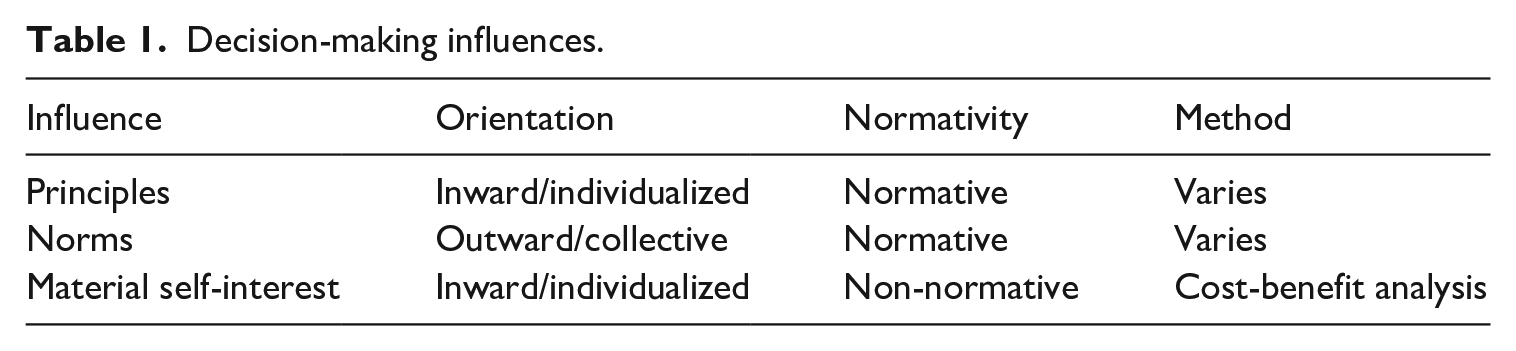
Three features of decision-making. Method bears the weakest relationship to the three decision-making influences. Rule-following and role-playing are unlikely when material self-interest dominates: to achieve personal gain, actors may have to disregard rules and role expectations. However, actors who follow norms or principles may engage in CBA, weighing up competing obligations or maximizing ideals (Abbott and Snidal, 2002; Goldmann, 2005). As political decisions often involve trade-offs and uncertainty, we expect political elites to engage in some CBA regardless of decision-making influence.
The normativity of an influence refers to the degree of “oughtness” involved. Influences that are normative in substance generate a sense of obligation, which may stem from social conventions, professional standards, laws, or moral principles. In any case, decision-makers will experience these normative influences as constraints on their immediate sense of choice, leaving them more resistant to sanctions and side-payments (Abbott and Snidal, 2002; Finnemore and Sikkink, 1998). Non-normative influences, in contrast, leave actors unrestrained by “oughts” and free to pursue their preferences as they can.
Finally, orientation tracks whether a decision-making influence operates at the individual or collective level. Inwardly oriented influences direct actors to rely on their own beliefs or preferences, while outwardly oriented ones rely on collective expectations. Orientation is key to distinguishing between ideational factors, as it matters whether actors look outward (at societal expectations) or look inward (at their own beliefs) when making decisions. We expect actors who look outward to respond to judgments from community members, whereas actors who look inward feel accountable primarily to themselves.
Defining decision-making influences. These distinctions are implicit in some well-known accounts of decision-making. We argue that making the method, orientation, and normativity of decision-making influences explicit is advantageous.
First, doing so helps us better categorize existing actors and processes such as norm entrepreneurship. Finnemore and Sikkink (1998: 897) observed, for example, that “[t]o challenge existing logics of appropriateness, activists may need to be explicitly ‘inappropriate.’” The three features allow us to explain how norm entrepreneurs can violate standards of appropriateness without necessarily following the LoC: they “look inward” for guidance (orientation). Methodologically, they may follow their own principles and/or try to maximize the spread of their preferred norm. In contrast to the three features, the LoA distinguishes norm entrepreneurs from materially self-interested actors primarily by capturing the normativity in their decision-making. Hence, neither the LoA nor the LoC adequately explain norm entrepreneurs’ actions; the three features offer the necessary nuance.
Second, the three key features of decision-making help us define ideational factors and distinguish between them.
We rely on the two definitions of norms cited above. They are “oughts,” like principles, but intersubjectively recognized. Norms can influence actors who do not attach value to them as well as those who do because they direct individuals to heed “outward-facing” concerns: the community expects actors with a given identity to behave in a certain way, and failing to do so leads to opprobrium (Johnston, 2001). Assuming actors want to remain community members in good standing, they adhere to norms to avoid censure, even if doing so goes against their preferences (Schimmelfennig, 2001).
Principles are personal “oughts.” Principled decision-making is individually oriented; actors “look inward” to their sincerely held beliefs rather than to others’ expectations. 2 Social influences contribute to the formation of principles—an actor’s principles may simply be internalized norms—but the formation process lies beyond the scope of this theory. We follow recent work in philosophy and psychology that recognizes personal “oughts,” describing an individual’s conscience as influenced but not determined by social expectations (Lyons, 2009; O’Shea, 2018). Koops et al. (2010: 2) note that “conscience is of or about the individual. The content of any two individuals’ conscience is not identical.” Thus, individual principles can differ from dominant norms. Principles may prompt rule-conforming behavior or CBA depending on how clear an individual is about her hierarchy of convictions and on the strength of her beliefs.
The three decision-making influences are “ideal types.” They highlight the different orientations and degrees of normativity that characterize principle-driven, norm-driven, and materially self-interested behavior. They may, of course, overlap.
Actors may adopt some norms as sincerely held principles or even come to take them for granted (Finnemore and Sikkink, 1998). Individually held principles can also gain communal recognition, as studies on norm entrepreneurship show. In these cases, actors’ orientations may be simultaneously inward- and outward-facing and their actions principle- and norm-driven (overlap in Figure 1). However, principles and norms can also differ: as norm entrepreneur scholarship describes, principled actors often confront dominant norms to follow their own conscience, or norms may be insincerely followed due to peer pressure.
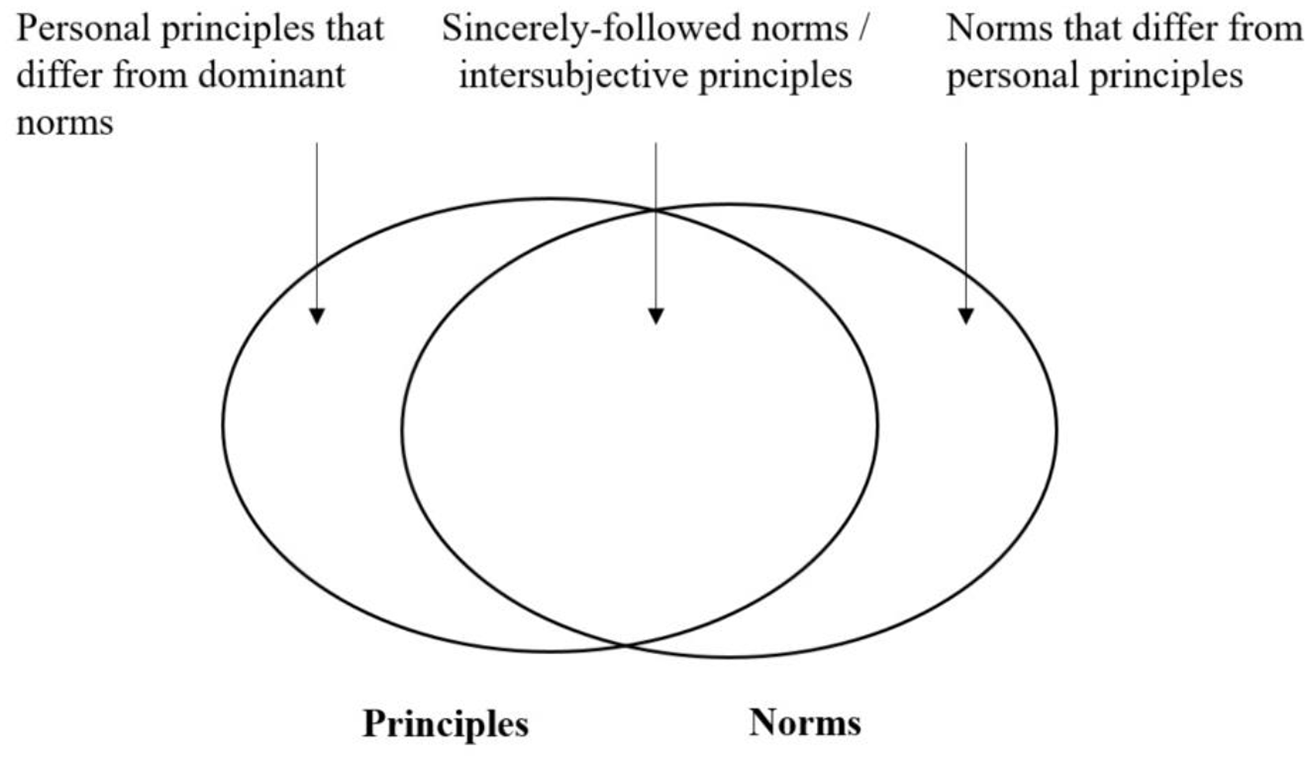
Normative influences on the individual actor.
The distinction between normative and non-normative influences can also break down depending on an actor’s preferences and time horizon. Fulfilling obligations may bring actors satisfaction or status and thus personal benefit. At any given decision point, however, one’s obligations and immediate interests or desires may diverge. This is particularly true when actors narrow their interests to economic wealth or power, as much of the rational choice literature in IR and Comparative Politics assumes they do (Aidt et al., 2019; Kam, 2009; Keohane, 2005; Kirkland and Slapin, 2018; Mearsheimer, 1994), and as we do here. In the short term, normative and non-normative influences can lead to opposite decisions.
Morality
We focus on the relationship between morality and norms because both feature regularly in constructivist scholarship. We treat moral decision-making as a type of principled decision-making: normative, inwardly oriented, and varied in method. For empirical research, we argue that it is better to define morality subjectively, or from the bottom up. Rather than predetermining what counts as a moral concern, we should study morality as it appears in the eye of the beholder. If someone believes that, say, queueing for the bus is a moral issue and those who do not wait their turn have violated a moral duty, we should include queueing behavior in that person’s understanding of the moral domain. To trace morality, we adapt the concept and methods of moral convictions research as developed by psychologists. They define moral conviction as “the belief that a given attitude is a reflection of one’s core feelings or beliefs about fundamental issues of right and wrong” (Skitka et al., 2020). 3 Moral conviction researchers ask individuals to what extent their opinion is connected to their “fundamental beliefs about right and wrong” and a reflection of their “core moral beliefs and convictions” (Skitka et al., 2005). When respondents affirm this connection, they express moral conviction—or moralize that issue, as we put it—and researchers accept this self-report as valid (Ryan, 2019: 429). The goal is to understand how people characterize issues, not what is objectively a moral issue in a philosophical or evolutionary sense. Following this approach, we define a moral principle as a principle an actor believes to be rooted in, or at least connected to, her moral beliefs. A moral issue is an issue the actor sees as subject to moral “oughts” instead of, or in addition to, professional, legal, and social/conventional concerns.
As noted earlier, norms and principles can overlap. By identifying people’s moral principles, we may also uncover norms. Norms, as collective expectations about proper behavior, may also involve judgments about right and wrong. When many actors with a given identity independently state that a specific behavior is a matter of right and wrong, we can be reasonably confident that this behavior is considered (in)appropriate among that group of actors. Thus, the moral convictions approach can help us identify norms and normativity in general, that is, whether a sense of obligation is involved in decision-making.
This approach also addresses the aforementioned problem of narrowness. To study morality, we must demarcate the moral domain: morality cannot serve as a variable if everything is moral. A subjective approach to morality demarcates the moral domain while avoiding the liberal bias of some constructivist IR scholarship. In addition, moral convictions research is better-suited to identifying moral issues than MFT and similar approaches. People’s emphasis on certain moral foundations may correlate with their preference for certain policies. However, correlations do not tell us whether people see an issue as morally relevant.
According to moral convictions research, moralization is both individualized and highly consequential. Studies find that when it comes to politics, people define the moral domain idiosyncratically. For instance, some moralize economic issues like tax policy; some do not moralize war (Ryan, 2014). They also find that moral conviction is associated with greater intolerance of attitudinally dissimilar others, less willingness to compromise, lower regard for authorities with the “wrong” view on an issue, greater resistance to pressure to conform, and more political engagement (Clifford, 2019; Delton et al., 2019; Garrett and Bankert, 2018; Ryan, 2017; Skitka et al., 2009, 2020). Ryan (2019) found that these consequences are strongest when moralizers focus on the inherent rightness of an act (deontological reasoning) and less pronounced when they worry about the consequences of an act (consequentialist reasoning).
Our interviews uncovered a third type of concern that moral convictions research has so far overlooked: personal integrity. Unlike actors who engage in deontological or consequentialist reasoning, actors who moralize personal integrity are not primarily concerned with the content of an act but with how an act reveals and affects their character. We thus refer to them as virtue moralizers, as they value one or more “excellent trait[s] of character” (Hursthouse and Pettigrove, 2016). This sort of moralization also mitigates some of the typical consequences of moral conviction: because their concern is person-focused, we would not expect virtue moralizers to judge others for disagreeing with a principle, but only for acting unvirtuously. Specifically, we would not expect people who moralize personal integrity to judge others for acting on sincere beliefs that contradict their own. Our identification of virtue moralization therefore adds new insights to moral conviction research.
The interaction of norms and moral principles
Using this conceptual framework, we can probe the relationship between norms and morality and identify what conditions facilitate norm-driven and moral decision-making. As the examples below show, this framework is well-suited to studying how norms and morality influence the decisions of a wide range of actors in IR, including officials in governments, militaries, international organizations, and the private sector.
Moral principles affect norm application
Actors may rely on their principles, particularly their moral principles, when applying norms that issue unclear guidance. When unprecedented situations arise, norm ambiguity, norm conflicts, and alienation from the community can lead actors to question established interpretations (Krook and True, 2012; Sandholtz, 2008; Wiener, 2009).
As norm contestation research shows, actors may struggle to identify what counts as “appropriate” behavior. Every normative framework contains tensions and ambiguities. Hence, when actors apply norms to concrete situations, they can differ over interpretation and prioritization (Krook and True, 2012; Sandholtz, 2008; Wiener, 2009). The long-standing debate among UN Security Council members over whether “sovereignty” or the “responsibility to protect” prevails when mass atrocities are committed illustrates this. When straightforward norm-following is impossible, actors may look inward to their principled beliefs for guidance.
Any unprecedented situation can prompt actors to re-evaluate existing norms, as they must be applied out of context. But when decision-makers perceive an event as a crisis with the potential to upset domestic or international order, they are particularly likely to question the interpretation or hierarchy of pre-existing norms and consider the “right” way to proceed (Wiener, 2009; Wunderlich, 2013). For example, within the European Union (EU), freedom of movement for European citizens is a fundamental principle and routinely followed. The Covid-19 crisis alerted European leaders to tensions between freedom of movement and norms such as safeguarding their nationals from harm. Many closed their borders, temporarily deprioritizing freedom of movement.
Furthermore, norms lose sway on actors when they feel alienated from their community. Norms are collective “oughts.” For a norm to influence an actor, the actor must identify with the community that upholds it. Thus, decision-makers may come to question norms when they question their group membership.
However, even when decision-makers question norms, existing norms still provide a recognized basis for justifying one’s decisions, so politicians use them as much as possible. Argumentative approaches in IR have observed such framing in a variety of contexts. Advocates’ reliance on existing norms such as bans on indiscriminate weapons helped to establish the anti-landmine norm (Price, 1998). The EU expanded because Eastern European states could refer to Western Europe’s long-standing normative commitment to a pan-European community of liberal democratic states (Schimmelfennig, 2001). Because of their influence in the community, decision-makers are unlikely to abandon existing norms altogether. Reliance on moral principles thus affects which norms have influence, but not whether norms have influence.
Instead of consulting their principled beliefs to resolve norm conflicts, actors may pursue their immediate self-interest. Whistleblowing, insubordination, resignation, and other career-jeopardizing actions increase our confidence that principled justifications are not empty rhetoric.
Norms can affect the consequences of moralization
We focus on one consequence of moralization that is particularly relevant to political science: antipathy toward those who disagree on the moralized issue (Garrett and Bankert, 2018; Ryan, 2019). Political polarization is on the rise, and moral convictions may be to blame (Finkel et al, 2020). Intolerance, or at least criticism, of those with opposing beliefs is also a feature of norm-following. The community praises conformity and shames those who break its norms (Johnston, 2001).
Actors such as whistleblowers prioritize a moral principle—for instance, human rights protection—over professional norms such as loyalty or confidentiality. Whether whistleblowers condemn colleagues who fail to uphold the moral principle depends on the strength of their commitment to the principle versus the strength of the community norm. A strong professional norm may make colleagues’ silence more excusable. The stronger the norm and the weaker the moral principle, the more likely it is that the countervailing norm can mitigate intolerance from moralization, and vice versa.
Norms can affect the willingness to moralize
Some communities, particularly liberal democratic societies, value tolerance toward those with other beliefs. Because moralization of an issue implies that opponents are wrong and worthy of criticism, it sits uneasily with a norm against intolerance. In these contexts, decision-makers may hesitate to label an issue a matter of right and wrong.
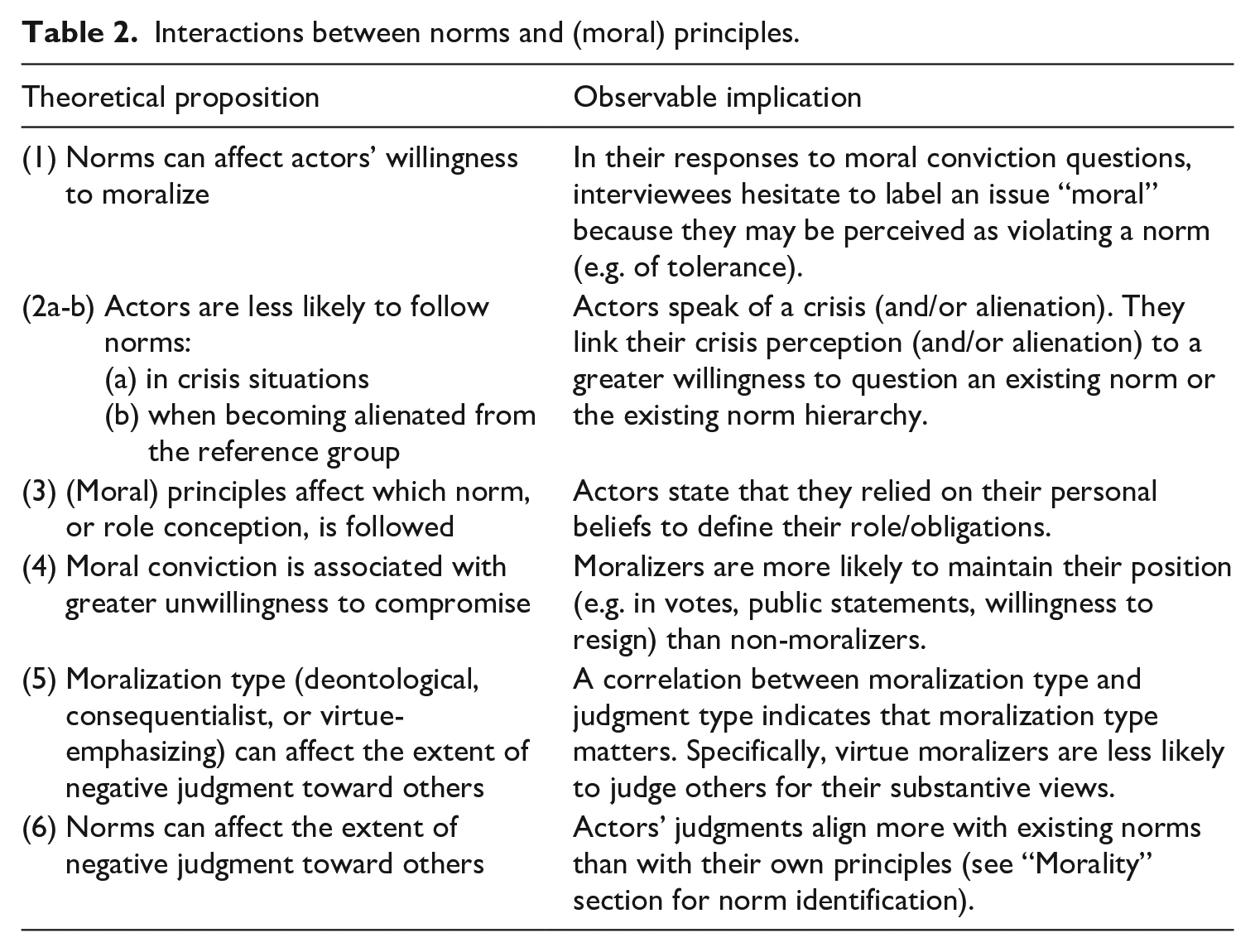
When illustrating these theoretical propositions, we identify their observable implications in interviews and public statements. Table 2 provides an overview.
Interactions between norms and (moral) principles.
Case study: the September 2019 rebellion
Methodology
We selected our case based on at least three criteria: we identified actors who took internationally significant, personally costly decisions, and who questioned existing norms. These criteria indicate likely moralization and norm–principle interplay and help rule out material self-interest as a decision-making influence. Principled language in public statements, if present, is an additional indicator.
The September 2019 rebellion meets these criteria: it was a vote of great economic and political significance for the EU and the United Kingdom, as it made a hard Brexit less likely. The rebellion’s costliness lends greater credibility to normative explanations, as the section “Against material self-interest” shows. At the same time, it is likely that both moral principles and norms informed MPs’ decisions. Rebel MPs frequently justified their actions in moral or principled terms at the time. 4
We employed two methods of data collection: content analysis of publicly available sources, including media reports from the Nexis database and parliamentary records, and in-depth interviews with MPs themselves. 5 In the interviews, we adapted the aforementioned moral convictions measurements to identify moral, principled, and norm-driven decision-making. Supplemental Appendix A details our methodological innovations and provides guidance for researchers who wish to measure moral convictions in interviews. We also tested for two predicted consequences of moral conviction: unwillingness to compromise and moral judgment. We interviewed 23 MPs: 18 of the 21 Tory rebels and 5 other anti-no-deal Tories who considered rebelling but then did not (non-rebels). We conducted 20 additional interviews with Labour MPs and pro-hard Brexit Tories for outside perspectives and to see whether the patterns that we identify travel across ideological boundaries. All interviews occurred between January 2020 and March 2021. Supplemental Appendix A outlines our sampling and interview method, including details on individual interviews.
Background
On 23 June 2016, unexpectedly, 52 percent of British voters supported leaving the EU in a referendum on the United Kingdom’s membership. The result surprised pro-Remain Conservative MPs, who were in the majority, but most promised to honor it. 6 Once PM Theresa May triggered the withdrawal process, the United Kingdom had 2 years to negotiate its terms of departure with the EU and gain parliamentary approval. If a withdrawal agreement proved unreachable, the United Kingdom had three options: leave without a deal, ask the EU to extend the negotiating period, or reverse its decision and stay in the EU. 7 The initial deadline for concluding a withdrawal agreement was 29 March 2019.
After reaching an agreement with the EU, May, as head of a minority Conservative government, needed her party’s full support to pass it. However, a significant number of Conservative MPs had divergent preferences: some favored a second referendum; others preferred a closer relationship with the EU and thus a “softer” Brexit; and the so-called European Research Group wanted a hard Brexit without a withdrawal agreement. May decisively lost all three votes on her withdrawal agreement in early 2019.
With the clock ticking down, a no-deal Brexit looked increasingly likely. To prevent this outcome, a cross-party “rebel alliance” formed. Although these MPs had different end goals on Brexit, ranging from negotiated withdrawal to a second referendum, they all feared the potentially disastrous consequences of no-deal. The crucial element in this group were anti-no-deal Tories, whose support was essential for defeating the government. The rebel alliance successfully passed several pieces of anti-no-deal legislation against May’s wishes, extending the Brexit deadline to 31 October 2019. 8
After continuous defeats of her deal, May had to resign. Boris Johnson, who had previously supported a hard, no-deal Brexit, became PM on 24 July 2019. Brussels rebuffed his request for major changes to May’s deal on 20 August. Shortly afterward, Johnson announced that he would prorogue Parliament from between the 9th and 12th of September to 14 October. 9 As the 31 October deadline loomed, many anti-no-deal Tories believed prorogation would significantly increase the risk of no-deal.
On 3 September, 21 Tory rebels voted for the Letwin motion, which paved the way for a 4-month extension of the negotiating period, despite Johnson’s announcement that anyone who supported the Letwin motion would lose the whip.
Most of the rebels were well-known Conservative MPs. Dominic Grieve (Attorney General under Cameron) was a prominent second referendum advocate and the main architect of rebel legislation together with Oliver Letwin (Chancellor of the Duchy of Lancaster under Cameron), a soft Brexiteer. Among the rebels were ex-chancellors Philip Hammond and Ken Clarke; the grandson of Winston Churchill (Nicholas Soames); several cabinet ministers under May—David Gauke, Greg Clark, Justine Greening, Rory Stewart, and Caroline Nokes—and well-regarded former ministers Stephen Hammond, Margot James, Guto Bebb, Alistair Burt, Ed Vaizey, Richard Harrington, Anne Milton, Sam Gyimah, and Steve Brine.
Motivations for rebellion: Against self-interest
We first exclude self-interest, as conceived in the literature, as a likely explanation for rebellion. We then analyze how norms and moral principles influenced MPs’ decision to rebel and why MPs were generally reluctant to criticize other MPs for their decision-making on Brexit.
Following Müller and Strøm (1999), scholars group motivations for rebellion into three categories: office-seeking, vote-seeking, and personal preferences/ideology (Aidt et al., 2019; Kirkland and Slapin, 2018; Krehbiel, 1993). We argue that vote- and office-seeking do not explain the September 2019 rebellion. Defying the government on the Letwin motion and Benn Act meant losing the whip. At a minimum, this entailed social costs; at worst, it was career-ending. We show that rebels took seriously the threat of losing the whip, had no guarantee that it would be restored, and no viable outside options for re-election. Some also faced local threats to their candidacy due to their no-deal opposition. The costliness of this rebellion makes it unlikely that materially self-interested motives such as desire for re-election or political ambition explain MPs’ defection from the party line (for more detail, see Supplemental Appendix B).
In the Westminster system, party leaders may dissuade potential rebels by withholding support on constituency issues, promising promotion or threatening demotion, or removing the whip (Kam, 2009). Without the whip, MPs’ membership of the parliamentary party ceases, and they cannot stand for election for that party. This penalty is severe and rarely deployed. 10
Boris Johnson threatened all potential rebels with the removal of the whip before the September 2019 votes. Rebels understood and believed this threat. Some hoped “he wouldn’t really go ahead with the withdrawal of the whip, especially if there were many of us . . . if you’ve got no majority in the House of Commons, would you withdraw the whip from 21?” (MP 1). However, mainstream media outlets reported and discussed Johnson’s threat beforehand. 11 Rebels’ public statements before the vote also indicate that they expected to lose the whip. Gauke, for instance, said on 2 September, “They seem to be quite prepared for there to be a rebellion and then to purge those who support the rebellion from the party. Their strategy [is to] . . . then seek a general election having removed [anti-no-deal Tories].” 12 We found that rebels expressed little to no surprise in the aftermath of the votes. For example, Letwin was reported to have “accepted his fate without rancor,” saying, “It isn’t as if we didn’t know what we were doing.” 13 We infer that while some rebels may have hoped for strength in numbers, they accepted a risk of expulsion. The high number of non-rebels also indicates that Johnson’s threat was taken seriously: without the prospect of losing the whip, 25 more Tory MPs voted against or abstained on anti-no-deal legislation in March 2019. 14 According to Vaizey, “the withdrawal of the whip threat had a big effect on people . . . that probably halved the rebellion.”
We might still question rebels’ stated motives if they had hoped that defeating the government would have the same effect as a “confidence vote,” leading to Johnson’s resignation or triggering an early election and thereby possibly enhancing their career prospects (Kam, 2014). With Johnson’s majority of one, this threat was particularly pronounced in September 2019. 15 However, the rebels did not want an early election: they were unsettled by the prospect of a socialist Corbyn government, and those favoring a second referendum preferred a single-issue poll to a multi-issue election (Gauke, Clark, Bebb, and Philip Hammond). Furthermore, the Letwin motion did not meet the technical criteria of a confidence vote, there was little public discussion about a change of leadership, Johnson enjoyed strong support among the Leave-leaning party base and among Conservative voters, and only two rebels complained about Johnson not resigning. 16
Some rebels expected to lose the whip permanently whereas others expected or hoped to get it back. It is the PM’s discretion to withdraw and restore the whip, so the process for re-entering the parliamentary party is opaque (Kam, 2009). 17
For MPs who faced a double deselection threat from above (Johnson) and below (their local association), the September 2019 vote was particularly risky. Local party associations can deselect or decide against reselecting a candidate. The influential campaign group Leave.eu asked local Leave voters to register as Tories and initiate deselection proceedings against moderate or pro-Remain MPs; they targeted 9 of the 21 rebels and 6 faced deselection threats as a result. While many fended off these threats and deselected MPs can, hypothetically, be reinstated, 18 several rebels saw these campaigns, the resulting social media abuse, and the response of their local association as a threat to their careers. Even if Johnson was bluffing or the whip was restored, local deselection threats would likely have intensified again. Moreover, one-third of the rebels came from majority-Leave constituencies, where their rebellion would have been unpopular with voters and thus costly for the MPs (see Supplemental Appendix B).
Losing the whip limited rebels’ re-election prospects even outside the Conservative Party. Contesting a general election as an Independent or for a different party are not viable outside options. As Heidi Allen, who resigned from the Conservative Party, explains, “What you can spend as an Independent is pennies compared to what a national party can spend . . . you also lose access to all the information you have about supporters and how they voted in the past.” In addition, voters value integrity, and changing party allegiances could resemble flip-flopping (Campbell et al., 2019). None of the five rebels who contested the 2019 election as Independent or Liberal Democrat candidates succeeded.
Rebellion is most costly for young, ambitious, recently elected MPs, and least costly for “backbench” MPs without government or “frontbench” positions close to retirement age. While the 21 were backbenchers when they rebelled, they were not particularly old. The average age of all MPs in September 2019 was approximately 53; the rebels’ was 56. 19 Fewer than half of the rebels (9) were over 60 and thus close to retirement age. Most of the MPs we interviewed who stood down before the December 2019 election had planned to stand at least one more time. 20
Accounting for costs also helps us evaluate non-rebels’ sincerity. Having less to lose from defying party orders reduces the likelihood of careerism: a marginal, Remain constituency, plans to retire or stand down, and a supportive local association make voting one’s conscience easier. Of the five non-rebels we interviewed, all but one met some of these criteria.
In sum, most rebels took a significant risk by supporting the September votes. Even if some rebels expected to remain in Parliament, they severely dampened their prospects for promotion under Johnson. As Philip Hammond put it, Johnson “will have left people in no doubt that this was a test of trust. And if you put yourself offside, you’re offside. You don’t come back.” The evidence speaks against vote- and office-seeking as primary motivators for rebellion: rebels stood to lose both. 21
Motivations for rebellion: The influence of norms and morality
Questioning the norm hierarchy
Crisis perception
MPs can interpret their role in various ways. They may prioritize party loyalty, representing the will of their constituents or of the country, or being a representative or trustee who was elected to make his or her own judgments (Andeweg, 2014). Each of these options is a norm that may guide MPs’ decisions. 22 Party loyalty is the prevailing norm in the House of Commons: “[t]he orthodox view of parliamentary parties is that they are so highly cohesive that they can be considered unitary actors, MPs’ deviations from the party line being so infrequent and inconsequential that they can safely be ignored” (Kam, 2009: 2). The numbers reflect this: between 1997 and 2020, MPs have cast only 1.89 percent of their votes, on average, against the majority of their party. 23
As party loyalty is a norm, we would expect rebellion to bring (fear of) social ostracism and feelings of shame for having acted “inappropriately.” Milton, who described herself as an “accidental politician,” explained, “You’re a member of the Conservative club of MPs and you don’t want to let them down. Even I felt it. It was even quite hard for me.” Several interviewees told us that they were “nervous about going to the tea room afterwards. I thought, oh God, maybe it’s going to be like at school, you know? Nobody’s going to talk to you” (Milton).
Despite these consequences, MPs might rebel because they believe they face a crisis, which brings tensions between competing obligations to the fore—here to voters, party, country, and one’s own conscience (Wiener, 2009; Wunderlich, 2013). This matches MPs’ accounts. MPs emphasized that, normally, politics is about “compromise,” “pragmatism,” and “party loyalty.” However, decision-making on Brexit was different. Many MPs felt they faced competing role obligations when it came to no-deal. Clark elaborated on several of these, saying that decision-making on no-deal did sort of involve questions about what your responsibilities are as a member of Parliament. And this is to a certain extent contested . . . I was elected by a particular constituency but to serve in a national parliament. I was elected with my own name but also with my party’s name behind it. And there is no definitive guide on how these tensions can be resolved; and certainly some of my colleagues will have taken the view that . . . part of their implicit contract with their electorate was that they would faithfully support the Conservative view of the time.
Many rebels perceived the risk of no-deal as a crisis moment that demanded a different approach than MPs would usually take to their jobs: I think most of the time, almost all the time, the duty of an MP who’s elected under a particular party banner is to make the argument behind the scenes and then to follow the party line . . . But I do think that there come moments when the issue is of such importance to the country that the success of the party is less important than the issue at hand. And I think this was such a moment. (Letwin)
What counts as an extraordinary situation is subjective. Not everyone classified Brexit in the same way. Prorogation heightened Tory rebels’ perception that the risk of no-deal was imminent and could be prevented only by disregarding the norm of party loyalty: The prorogation to us was a very clear signal that this government was intent on going for a no-deal Brexit . . . The EU negotiating team had been slimmed down from the 20s-30s or whatever to about 10 people, there were hardly any discussions going on with Brussels, and no effort was being made to achieve a compromise, even though that’s what the Prime Minister was saying publicly . . . And so it became a case of: if you want to stop no-deal, that was the moment. (MP 1)
At the time, roughly half our interviewees publicly linked their perception of Brexit as a high-stakes issue with the need to deprioritize party loyalty. Bebb, for instance, said It was very clear that a good chunk of the Conservative party, including Boris Johnson, were hellbent on hijacking the Brexit vote for an ideological form of Brexit which is going to be incredibly damaging for the Welsh economy. At that point, my loyalty to my constituency and country overruled my career prospects and my loyalty to the Conservative Party.
24
Eight more MPs described Brexit as a national crisis or high-stakes issue. Thus, MPs’ public statements also show that their perception of Brexit as a crisis made them question the existing norm hierarchy.
In sum, anti-no-deal Tories’ accounts indicate an exception to the norm of party loyalty, namely, that it is permissible to act on one’s own beliefs in crisis situations, where the future of the country is at stake. What counts as a “crisis” is subjective, so the applicability of this exception to a given case might be contested. When MPs do consider an event to be such a crisis, it means their default approach to voting decisions is no longer sufficient. “It was clear to me,” one MP said, “that this was going to be a most terrifically complex process and I had better steer my own ship, have my own compass” (MP 2).
In lieu of their default approach, politicians sought guidance from other elements of their role conception. But because these elements often pulled in different directions, MPs had to choose which obligation (to constituency, country, and/or conscience) to prioritize. To resolve the dilemma, MPs fell back on their own principles. Some worked all the way down, so to speak, to their fundamental views on right and wrong, and moralized the role understanding—for example, acting as a trustee—that they prioritized.
Alienation from the party
Growing alienation from the Conservative Party due to its hardening stance on Brexit also explains why MPs questioned the party loyalty norm. Many MPs expressed publicly and in the interviews that they were concerned with their party’s direction of travel. Greening described no-deal as “the most profoundly unconservative policy that there could be” and David Gauke said that the Conservative Party “should be the party of the economy, of security, and of the integrity of the UK. In my view crashing out is not consistent with that.” 25 MPs’ weakening sense of identification with their party may have led them to turn to their principled beliefs.
(Moral) principles and existing norms
Almost all our interviewees characterized the act of preventing no-deal in normative terms (either moral or principled), exhibited internally oriented decision-making, and varied in their method of reasoning. Most importantly, we found that norms influenced MPs’ moral principles. When explaining their decision-making, almost every MP referred to their role conception or understanding of the requirements of their job.
Normativity
A majority (15) of our interviewees moralized the prevention of no-deal: that is, they saw it as a matter of (moral) right and wrong. Several others who did not moralize this issue instead said they saw it as a “matter of principle,” and we inferred that the remaining three saw preventing no-deal as a matter of specifically professional principle.
Two patterns in MPs’ answers suggest that politicians use moral framing sparingly, not as a default. First, of those who moralized, some answers suggested they had not spoken of no-deal in moral terms before; they may have constructed their view on the spot. Second, even MPs who moralized sometimes hesitated to use the word “moral” because of how others might interpret such framing: they caveated their statements with concerns about sounding “pompous” (Bebb and Clarke), “sanctimonious” (MP 1), or “grandiloquent” (Gauke); Milton said that moral framing was “overused” and suspect, because people employ it in “an attempt to reinforce that they’re right.” In contrast, when MPs rejected moral framing for substantive reasons, they usually said so straightforwardly. For example, “It wasn’t really a moral terms thing. It wasn’t moral high ground . . . For me it was always a damage limitation exercise” (Philip Hammond).
These concerns suggest that MPs did not self-servingly or strategically answer our questions on moral conviction. Nonetheless, we cannot be entirely sure about the accuracy of MPs’ accounts for their actions. They may have rationalized their actions—consciously or unconsciously—to appear principled. While there is no way to definitively rule out these possibilities, the weight of our evidence indicates that conscious misrepresentation is improbable. We have chosen a case where material self-interest is unlikely to have played a role. Furthermore, almost all MPs answered neutral, open-ended questions with principled language, such as “conscience,” “integrity,” or “right thing.” Many did so without prompting, before we mentioned morality at all (see Supplemental Appendix A). This suggests that our MPs were not constructing their sense of obligation to prevent no-deal on the spot.
Orientation
MPs’ reasoning reflected the core feature of principled decision-making: they looked “inward” to their personal beliefs rather than “outward” to community beliefs. Most of the MPs who moralized said they felt ultimately accountable to their own consciences. Many referred to the idea of “looking oneself in the eye” or “in the mirror,” metaphors for their sense of self-respect.
Virtue emphasis
When asked what made no-deal a matter of right and wrong (or principle) to them, no MP saw no-deal itself as intrinsically wrong. Two-thirds of MPs, and an even larger proportion of moralizers, emphasized personal integrity, or acting in accordance with one’s beliefs on important issues, including being honest about one’s views, changing one’s mind only in light of better arguments, and withstanding external pressure to conform (see Supplemental Appendix A). MPs portrayed careerism as a lack or failure of personal integrity.
MPs who moralized personal integrity thus did not moralize the content of their views. The moral issue was purely about congruity between their beliefs and actions on no-deal. Several even compared themselves to hardline Brexiteers who they think showed similar consistency. This logic shows in Clark’s statement: It is a matter of judgment as to whether a no-deal Brexit would be very damaging and, you know, there are serious people on both sides of that argument . . . So it is not that I thought one Brexit [outcome] would be morally right and one would be morally wrong. I think the right or wrong comes from having formed a view personally that it [no-deal] would be damaging, and then to vote and to act in a way that would be against my honest view that would be wrong.
When MPs moralized the prevention of no-deal, the morally salient feature they identified often connected to an aspect of their job description. In particular, we observed a strong affinity between “trustee”-oriented role conceptions and emphasis on personal integrity. Some of these role conceptions correspond to norms, as there is a collective expectation that MPs vote according to their best judgment. Recent research (Campbell et al., 2019) finds, for example, that voters value personal integrity in politicians’ voting decisions. This indicates that many MPs moralized the norm they prioritized in the norm hierarchy: acting as a trustee rather than as a party loyalist.
Several MPs saw no-deal as a matter of right and wrong (or principle) and prioritized acting as a trustee because of the harmful repercussions no-deal would have for the United Kingdom. As Ken Clarke said, “It was a matter of right and wrong in the sense that I thought that leaving absolutely overnight with no deal would be catastrophic in the short term for the chaos it would cause.” These outcome-emphasizers mostly mentioned potential economic damage; some also elaborated on social and political consequences such as the United Kingdom’s integrity. These concerns were almost exclusively United Kingdom–focused. The magnitude of potential consequences made personal integrity particularly salient and required a different approach to politics than usual. Milton articulated this logic explicitly: I talked earlier about having made some compromises. I thought to myself, this isn’t the hill to die on . . . But this was the biggest decision that’s been taken by this country in my lifetime . . . This, in my view, this was a hill to die on . . .
Many MPs probably shared this view, as nearly all of them referenced the magnitude of the issue as an important background factor in their decision-making.
Method
Other-regarding CBA—that is, CBA focused on likely outcomes for others—was by far the most prevalent method of reasoning we observed. Our interviewees weighed up the costs of no-deal for the United Kingdom and often expounded on them in detail. Only four MPs rejected other-regarding CBA as a factor in their decision-making or suggested that the consequences of no-deal for the United Kingdom were less important to them compared with upholding other principles. All these MPs engaged in deontological reasoning.
Norms and the consequences of moralization
We found that moralization does not predict MPs’ willingness to rebel; some non-rebels moralized but reconciled their principles with the existing norm hierarchy. Tolerance and anti-careerism norms largely explain MPs’ (lack of) moral judgments.
Rebellion and unwillingness to compromise
Moralizers are generally less willing to compromise on the moralized issue, less vulnerable to external pressure, and more dismissive of authorities they believe are wrong (Delton et al., 2019; Ryan, 2017; Skitka et al., 2009). Thus, we would expect more moralizers among the rebels and fewer among the non-rebels. However, we found no such pattern among our interviewees.
Our sample may partly explain this: materially self-interested non-rebels may have declined to interview. Some MPs may have answered our questions insincerely or inaccurately, or moralized too weakly to generate the predicted consequences. A more likely explanation, offered by rebels and non-rebels alike, is that the two groups differed over whether there was a crisis that required voting against the party line. The case for rebellion depended on multiple premises: that a no-deal Brexit would be disastrous and that Johnson, either intentionally or inadvertently, would not secure a withdrawal agreement in time without immediate parliamentary intervention. These premises were debatable, and all non-rebels we interviewed rejected at least one of them, both in public statements and in our interviews (see Supplemental Appendices A and B).
If we accept that some non-rebels merely differed in their assessment of the situation rather than in the strength of their convictions, as many of the rebels did, it seems that rebellion in this case is an unreliable proxy for the predicted consequences of moral conviction. For at least some anti-no-deal MPs, voting with the government on no-deal was not a self-interested act. These non-rebels saw no conflict between their moral beliefs regarding no-deal and the party loyalty norm.
Judgments
When an issue is deemed morally relevant, this usually implies that those with the “wrong” views are worthy of criticism or even concerted opposition. Thus, moralization can spur polarization and intolerance (e.g. Finkel et al., 2020). The first step on the path to intolerance is moral judgment, and we gauged MPs’ judgments by asking whether other MPs behaved in a way that was “wrong.” Interviewees commented on MPs with opposing views (hard Brexiteers), careerists who put personal gain ahead of their principles, and MPs with similar views who acted differently. As we asked open-ended questions, we did not discuss all interviewees’ views on all three groups of MPs.
We observed less judgment than expected given how many of our interviewees portrayed their position as a matter of right and wrong, or at least as a matter of principle. Virtue moralization partly explains these judgments, but our evidence suggests that pre-existing norms best explain this puzzling finding, as they can strengthen or mitigate the judgments that follow naturally from moralization.
In keeping with the moralization of personal integrity, MPs generally respected those with sincerely held opposing views. Most MPs also did not consider those with similar beliefs who voted differently to have acted wrongly and criticized careerists who prioritized personal gain (see Supplemental Appendix A).
However, even the third of MPs who did not consider their personal integrity at stake but instead cited other (moral) principles for rebelling, such as wanting to keep promises made to constituents (MP 3) or avoiding the negative consequences of Brexit (e.g. Masterton), criticized careerists and made “not wrong” judgments of hard Brexiteers. 26 Based on MPs’ statements, we can infer the existence of two norms that explain this pattern, one promoting tolerance and the other condemning careerism.
Many MPs lamented the rancor that pervaded discussions on Brexit, and a few directly criticized or judged others’ intolerance. For instance, two MPs complained about the tendency of hardliners on both sides of the Brexit debate to “disrespect totally those of other views” (Burt) and to regard opponents as “morally inferior” (Lidington). The tolerance norm seemed connected to MPs’ views on democracy. As one rebel said, “If we can’t have different views in a democratic system, heaven help us.” Some MPs seemed to soften their statements to avoid appearing narrow-minded or uncharitable. This suggests that the tolerance norm moderated MPs’ judgments of those who, with good intentions, believed or acted differently on no-deal.
The anti-careerist consensus among MPs signals the presence of a norm, first, because it was both stronger and more extensive than MPs’ stated principles alone would predict. They took for granted that flip-flopping or lying for personal gain were unacceptable behaviors. Most importantly, they anticipated approval from others for acting in accordance with their convictions and disapproval for backing down. For example, Clark recalled feeling pressure to follow through when he publicly denounced no-deal: “It was clear to me, and I think to others, what I did believe, and I think if I had voted in a different way, then that would have been in defiance of that.” This norm emboldened rather than weakened MPs’ judgments.
Virtue moralization also does not fully explain judgments of non-rebels
As mentioned, many Tory rebels did not consider non-rebels to have acted wrongly because they were sincere. Only three early career rebels, two of whom moralized virtue, considered some non-rebels wrong if they were motivated primarily by careerism: Well, if you share the view, you probably should have been with us, shouldn’t you? . . . People would come up to me who were in government and would go: “I’m with you, really.” . . . Thanks very much. Yeah. You keep your head down and I’ll get mine cut off. Yeah, great. (MP 4)
Most others refused to judge non-rebels, reasoning that, in general, “it’s very difficult to vote against your own party and against your own government” (Stephen Hammond). Some considered it excusable or even legitimate for early career MPs to prioritize their careers and provide for their families. Most of these rebels were older or had had successful careers. In Milton’s words If you’ve got a young family, you’re the sole breadwinner, giving up the Conservative whip means something very different to me, who’s got four children who are almost all financially independent and a husband who also works. So in all this, I certainly don’t—and other people shouldn’t—make moral judgments. It means it’s got a different implication for all of us.
Burt even actively dissuaded like-minded early career Tories from rebelling, urging them “not to put their careers in jeopardy” because “I was older, coming up to retirement age, but they weren’t.”
Similarly, non-rebels either considered the 21 to not have acted wrongly, as they merely assessed the situation differently, or expressed respect and refused to judge them.
We find that the desire to avoid hypocrisy explains rebels’ (un)willingness to judge non-rebels. Senior politicians, especially ministers, usually compromise repeatedly over the course of their careers and thus may have felt disqualified from judging others for compromising. As Grieve said I think we mustn’t be too judgmental . . . There’s a big difference to me between a politician who is doing his best to act with integrity but occasionally has to resort to half-truths, because I know these people and I see them, and I know afterwards how they feel bad about it, and the politician who’s prepared to tell people whopping lies on a routine basis.
Junior politicians, who have likely made fewer compromises, were in less danger of hypocrisy. These MPs also made a particularly high sacrifice by rebelling, indicating a stronger commitment to trusteeship over party loyalty in crisis situations. Less able to empathize with compromisers, they were more judgmental of non-rebels who did not act on their beliefs.
The most plausible alternative explanation—supererogation—fails to explain these judgments. Supererogatory acts go beyond the call of duty and refraining from them is thus not blameworthy (Jurkovich, 2020). In this account, voting the party line was not blameworthy because MPs had no obligation to sacrifice their careers. However, if the 21 rebels had perceived rebellion as a supererogatory act, they would have suggested that it went beyond their professional duty. With one possible exception, the rebels we interviewed spoke as if they were merely doing their job, even if it was difficult: “We’re elected to do the right thing. I believe, above all else, that my job was to do the right thing” (Milton). Even if MPs may have downplayed their sacrifice, this explanation fails to account for junior rebels’ criticism of careerist non-rebels for not making the same sacrifice.
In sum, norms and a desire to avoid hypocrisy affected the judgments that follow naturally from moralized attitudes.
Conclusion
We have made two theoretical moves to disentangle different decision-making influences, especially norms and morality. First, in lieu of the LoC and LoA, we have identified three features that distinguish norm-driven, principle-driven, and materially self-interested decision-making: normativity, method, and orientation. Second, we have shown that norms and morality can but do not necessarily overlap and we proposed a subjective definition of morality to trace its influence more thoroughly than predetermined demarcations of the moral domain would allow. We have operationalized this definition of morality by adapting survey questions from moral convictions research to an interview context.
We then illustrated the relationship between norms and morality with the September 2019 Brexit rebellion. We found that decision-makers are likely to rely on their moral principles when they perceive a situation as a crisis that challenges the existing norm hierarchy and their group membership. MPs followed the norm that best aligned with their principles, even if that norm would ordinarily rank lower in the hierarchy. When the content of the selected norm overlapped with their principles, MPs sometimes moralized the norm itself. In these cases, the distinction between principles and norms blurred for that actor.
We also found that pre-existing norms channel and constrain moralization and its consequences. Many MPs cited well-established norms related to democratic decision-making, and these norms also mitigated some consequences of moralization, such as intolerance toward those with opposing views.
Our theory has wide applicability in IR beyond foreign policymaking by legislators. Many kinds of actors, from heads of state down to low-ranking staff, can make decisions that directly or indirectly impact world politics. For example, domestic whistleblowers’ morally motivated actions can mobilize public opinion, which can pressure decision-makers with direct authority to alter existing policies.
Take British intelligence officer Katharine Gun, who leaked US plans to spy on UN delegations in the run-up to the 2003 Iraq War, bolstering Chile and Mexico’s opposition and thus reducing the likelihood of UN authorization for war. Or Antoine Deltour, a PwC employee, whose leaked documents exposed Luxembourg as corporate tax haven and contributed to EU anti-tax avoidance measures. These decisions can bring severe personal costs that increase researchers’ confidence in actors’ normative motivations. Gun lost her job, was arrested, and faced trial. Deltour hoped for anonymity but also stated, “I really thought I could go to jail.” 27 In many such cases, actors’ public statements suggest they resorted to their principles for guidance when facing a high-stakes norm conflict. Gun claimed that despite breaching confidentiality, her disclosures “were justified because they exposed serious illegality and wrongdoing . . . I have only ever followed my conscience.” 28 Deltour stated, “Like many whistleblowers, I acted first because I have some convictions.” 29
By interviewing actors who have used principled language to justify their personally costly, internationally significant decisions to question norms, researchers can refine our understanding of norm–principle interplay in international affairs. For instance, subsequent studies could investigate, using our interview methodology, whether moralizers’ decision-making authority affects the kind of norms they are likely to break. Our examples suggest that actors who cannot directly change practices they find immoral are prone to breaking role-based norms such as professional secrecy or (party) loyalty rather than substantive norms. Senior figures who can directly change practices they perceive as immoral seem more likely to break substantive norms; they must often choose between competing values. Which kind of norm is more costly to break? Who are moralizers more likely to judge: those who prioritized other substantive norms, or those who kept following role-based norms?
Furthermore, this study advances moral conviction research in political science and beyond. Our adaptation of the approach to interviews provides qualitative researchers with a new tool to study morality’s role in decision-making. Here, this methodological innovation has uncovered a new type of moralization: virtue moralization. Further research—through surveys, interviews, and experiments—could examine how virtue moralization differs from its deontological and consequentialist counterparts, as well as its impact on the consequences of moral conviction.
Supplemental Material
sj-docx-1-ejt-10.1177_13540661221117058 – Supplemental material for Disentangling norms, morality, and principles: the September 2019 Brexit rebellion
Supplemental material, sj-docx-1-ejt-10.1177_13540661221117058 for Disentangling norms, morality, and principles: the September 2019 Brexit rebellion by Anette Stimmer and Jess Gliserman in European Journal of International Relations
Supplemental Material
sj-docx-2-ejt-10.1177_13540661221117058 – Supplemental material for Disentangling norms, morality, and principles: the September 2019 Brexit rebellion
Supplemental material, sj-docx-2-ejt-10.1177_13540661221117058 for Disentangling norms, morality, and principles: the September 2019 Brexit rebellion by Anette Stimmer and Jess Gliserman in European Journal of International Relations
Footnotes
Acknowledgements
We would like to thank Duncan Snidal, Janina Dill, Ezequiel Gonzalez Ocantos, Heidi Maurer, Mariana Borges, Barbara Piotrowska, Jae-Hee Jung, Nicholas Barker, and Tuuli-Anna Huikuri for helpful comments on earlier drafts of this article. We are grateful to Hayley Pring and Tanisha Mohapatra for their research assistance. We are also very grateful to the (former) MPs who took part in our study. This article was presented at the 2021 Annual Conference of the International Studies Association, the Political Psychology research cluster at the University of Oxford, and the Research Colloquium of the Department of Politics and International Relations, University of Oxford. We would like to thank the discussants and participants for their feedback.
Authors’ Note
For interview references, see Supplemental Appendix A.
Funding
The author(s) received no financial support for the research, authorship, and/or publication of this article.

Notes
Supplemental material
Supplemental material for this article is available online.
Author biographies
References
Supplementary Material
Please find the following supplemental material available below.
For Open Access articles published under a Creative Commons License, all supplemental material carries the same license as the article it is associated with.
For non-Open Access articles published, all supplemental material carries a non-exclusive license, and permission requests for re-use of supplemental material or any part of supplemental material shall be sent directly to the copyright owner as specified in the copyright notice associated with the article.
