



Abstract
African states fight each other far more often by simultaneously supporting rebels in each other’s intrastate conflicts than by engaging in direct warfare. While nearly half of these mutual interventions between 1960 and 2010 were resolved via bilateral negotiated settlements, the majority of cases ended due to events in, or actions by, only one of the two states. What explains this variation? We argue that different combinations of combat outcomes in the two intrastate conflicts determine the severity of interstate commitment concerns and, therefore, the likelihood of a successful settlement. Specifically, we hypothesize that commitment problems are likely to be overcome only when both states experience stalemates or successes in their battles with rebels. By contrast, if both states suffer combat defeats, major commitment concerns on both sides make a settlement very unlikely. Finally, a combination of defeats and stalemates or successes also makes a settlement unlikely, as the state with the upper hand is likely both unwilling and unable to commit credibly to a settlement. We use several cases to illustrate our theory and then demonstrate how its causal mechanism works by leveraging within-case variation from the Chad–Sudan mutual intervention. We show that the two states reached a settlement only once both were winning at home while their rebel clients were losing abroad. Three alternative explanations—third-party threats, pressure, and security guarantees—cannot explain the settlement. Overall, our study extends bargaining theory to a new empirical domain and contributes to theorizing how its information and commitment logics interact.
Introduction
In February 2010, Chadian President Idriss Déby surprised observers by traveling to Sudan’s capital to meet his counterpart, Omar al-Bashir. The two leaders reaffirmed an agreement that their representatives had signed the previous month in Chad’s capital, committing both states to ending their support for each other’s armed opposition groups (Reuters, 2010). This negotiated settlement alone was a remarkable rapprochement given that only two years earlier each state had sponsored a rebel assault on the other’s capital. It was even more remarkable that the two states then successfully implemented the settlement. After more than four years of indirect conflict and around a dozen failed third-party mediation efforts, the Chad–Sudan mutual intervention finally came to an end (Tubiana, 2011: 17–21, 24, 64).
On closer inspection, this successful settlement of a mutual intervention—defined as simultaneous interventions of two states in each other’s intrastate conflicts by supporting rebel groups (Cliffe, 1999: 90)—is less exceptional than it may at first appear. Table 1 shows that 10 of the 23 mutual interventions that occurred in continental Africa between 1960 and 2010 ended via successfully implemented bilateral settlements. 1 The other 13 cases terminated because of events in, or actions by, one of the two states: one state’s rebel clients were either victorious or decisively defeated; one of the two associated intrastate conflicts was resolved via an agreement; or there was a settlement between the two states that only one of them honored.
The termination of mutual interventions in Africa, 1960–2010.
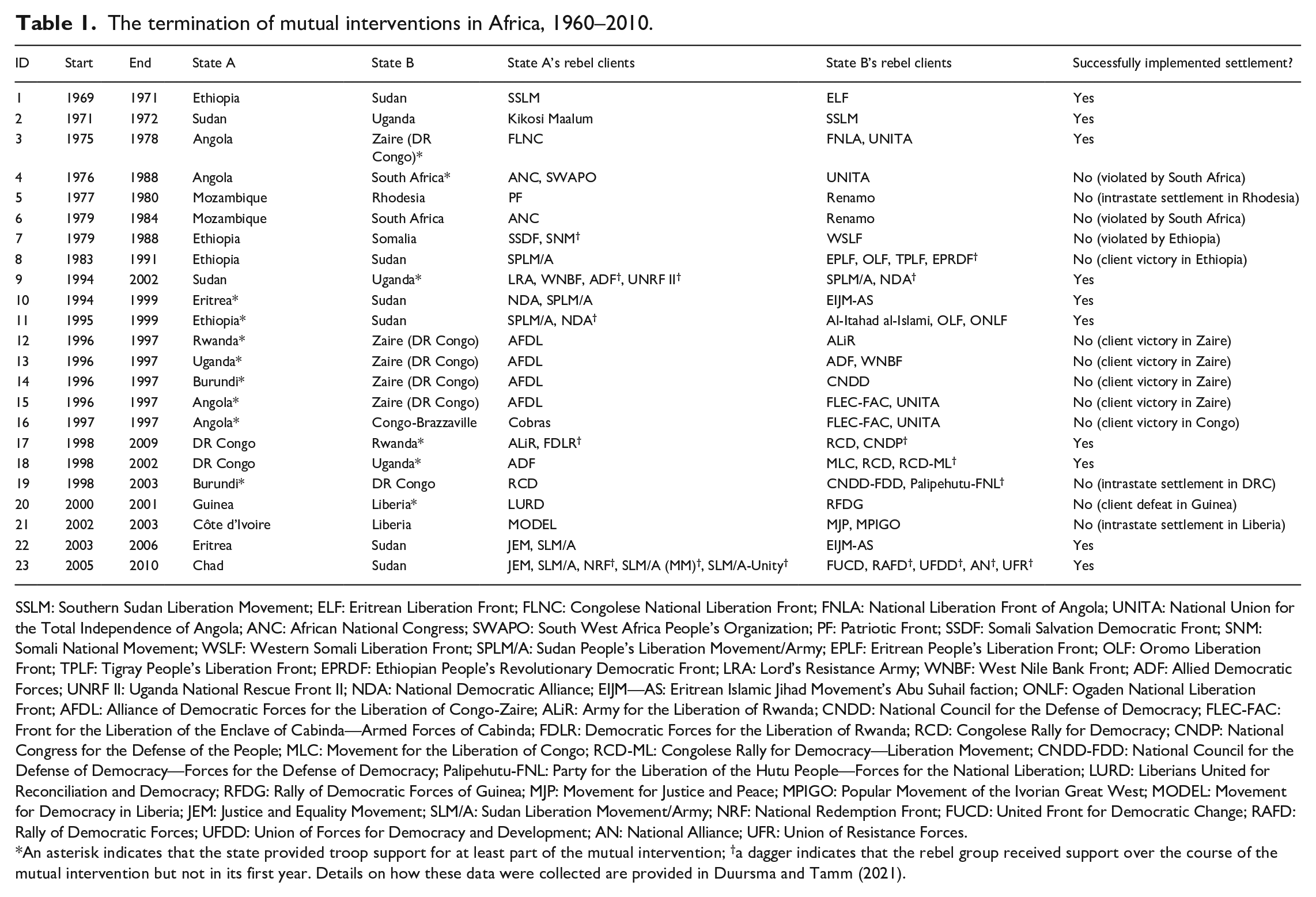
SSLM: Southern Sudan Liberation Movement; ELF: Eritrean Liberation Front; FLNC: Congolese National Liberation Front; FNLA: National Liberation Front of Angola; UNITA: National Union for the Total Independence of Angola; ANC: African National Congress; SWAPO: South West Africa People’s Organization; PF: Patriotic Front; SSDF: Somali Salvation Democratic Front; SNM: Somali National Movement; WSLF: Western Somali Liberation Front; SPLM/A: Sudan People’s Liberation Movement/Army; EPLF: Eritrean People’s Liberation Front; OLF: Oromo Liberation Front; TPLF: Tigray People’s Liberation Front; EPRDF: Ethiopian People’s Revolutionary Democratic Front; LRA: Lord’s Resistance Army; WNBF: West Nile Bank Front; ADF: Allied Democratic Forces; UNRF II: Uganda National Rescue Front II; NDA: National Democratic Alliance; EIJM—AS: Eritrean Islamic Jihad Movement’s Abu Suhail faction; ONLF: Ogaden National Liberation Front; AFDL: Alliance of Democratic Forces for the Liberation of Congo-Zaire; ALiR: Army for the Liberation of Rwanda; CNDD: National Council for the Defense of Democracy; FLEC-FAC: Front for the Liberation of the Enclave of Cabinda—Armed Forces of Cabinda; FDLR: Democratic Forces for the Liberation of Rwanda; RCD: Congolese Rally for Democracy; CNDP: National Congress for the Defense of the People; MLC: Movement for the Liberation of Congo; RCD-ML: Congolese Rally for Democracy—Liberation Movement; CNDD-FDD: National Council for the Defense of Democracy—Forces for the Defense of Democracy; Palipehutu-FNL: Party for the Liberation of the Hutu People—Forces for the National Liberation; LURD: Liberians United for Reconciliation and Democracy; RFDG: Rally of Democratic Forces of Guinea; MJP: Movement for Justice and Peace; MPIGO: Popular Movement of the Ivorian Great West; MODEL: Movement for Democracy in Liberia; JEM: Justice and Equality Movement; SLM/A: Sudan Liberation Movement/Army; NRF: National Redemption Front; FUCD: United Front for Democratic Change; RAFD: Rally of Democratic Forces; UFDD: Union of Forces for Democracy and Development; AN: National Alliance; UFR: Union of Resistance Forces.
An asterisk indicates that the state provided troop support for at least part of the mutual intervention; †a dagger indicates that the rebel group received support over the course of the mutual intervention but not in its first year. Details on how these data were collected are provided in Duursma and Tamm (2021).
The question that emerges from this contrast between bilaterally and unilaterally driven terminations is what motivates our theory-building article: why are some mutual interventions resolved through a successfully implemented negotiated settlement whereas others are not? In particular, we investigate how different combinations of combat outcomes in the two interlocked intrastate conflicts affect the severity of commitment problems and thus the likelihood of a successful settlement. Understanding these battlefield linkages and their consequences is of major importance for the study of conflict in Africa: mutual interventions have been more common and more protracted than conventional interstate conflicts and they have made intrastate conflicts far more deadly (Duursma and Tamm, 2021: 1078). Mutual interventions are distinct from better-studied competitive interventions, in which one rival state supports the government while the other supports the rebels in the same intrastate conflict (Anderson, 2019; Schulhofer-Wohl, 2020).
We develop three hypotheses, which build on bargaining theories of war termination (e.g. Reiter, 2009). First, if both states suffer strings of domestic combat defeats against the rebels sponsored by the other state, a successful settlement of the mutual intervention is very unlikely. Even though a settlement could save both states, they face major commitment problems: since each state runs the risk of imminent defeat by rebels, it must fear that the other state would renege on a settlement in the hope of seeing the state defeated before it can itself renege. Second, if one state suffers combat defeats while the other experiences either a stalemate or successes, the likelihood of a successful settlement is slightly higher but still low overall. The state with the upper hand is typically both unwilling and unable to commit credibly to a settlement. Third, if both states experience either a combat stalemate or successes, the likelihood of a successful settlement is high. Protracted stalemates and, even more so, successes reveal important information: they show that neither state is likely to lose to the rebels even if the other state continues to sponsor them. This alleviates commitment concerns on both sides and thus facilitates the successful negotiation and implementation of a settlement.
We illustrate our arguments with several examples in the theory section, followed by an in-depth case study of the termination of the Chad–Sudan mutual intervention. The case study leverages within-case longitudinal variation to show how several domestic combat defeats on both sides between 2006 and 2007 provided each state with incentives to escalate its rebel support. It was only when highly uncertain stalemates in 2008 transformed into a situation in 2009 in which both Chad and Sudan scored several domestic combat successes that both sides were willing to resolve the mutual intervention. In other words, the case study shows how our theory’s causal mechanism works. It also shows that our theory explains the case better than alternative explanations. It does not, however, constitute a test of the theory’s probabilistic hypotheses, which would require large-N cross-case inferences, or a test of the mechanism’s scope and generalizability, which would require what Goertz (2017: 13) calls “large-N qualitative testing,” involving “many instances of within-case causal analyses.” Rather, our article represents an important first, theory-building step. We discuss potential next, theory-testing steps—and the data collection challenges involved—in the conclusion.
By extending bargaining theory to a new empirical domain, the article fills a gap in the wider literature on the termination of hostile interstate and intrastate interactions. While scholars have explained the termination of interstate wars (Pillar, 1983), civil wars (Walter, 2002), and international rivalries (Rasler et al., 2013), the termination of mutual interventions has not received systematic attention. Recent research on mutual interventions has focused on why they start (Tamm, 2016; Twagiramungu et al., 2019), not on why they end. Similarly, the wider intervention literature is focused primarily on onset (e.g. Aydin, 2012), as well as on duration (e.g. Cunningham, 2010), not on termination.
We also contribute to the bargaining model of war by theorizing how information and commitment problems interact to affect outcomes. We argue that information provided by combat performance shapes the severity of commitment problems. Most studies that explain war termination focus on either information provision (e.g. Kydd, 2003) or commitment problems (e.g. Walter, 2002). We add to the relatively few studies that hypothesize how bargaining theory’s two central logics affect each other (Wolford et al., 2011), but our argument is distinct from existing ones. Reiter (2009: 33) speaks of “commitment fears attenuating the effects of information revelation,” whereas we suggest the inverse. Kirschner (2010) demonstrates how information about the nature of adversaries, rather than about combat dynamics, affects the severity of commitment concerns.
This article proceeds as follows. The first section develops our argument that information revealed on the battlefield can mitigate or aggravate commitment problems that two states embroiled in a mutual intervention face, thus affecting the likelihood of a successfully implemented negotiated settlement. Next, we discuss several alternative explanations for the termination of mutual interventions. The third section presents our case study methodology and case selection rationale. Then, we examine both our theory and the alternative explanations in the Chad–Sudan mutual intervention from 2005 to 2010. The final section summarizes our findings and considers their implications for future research.
Bargaining theory and the termination of mutual interventions
In this section, we first review the two central logics of bargaining theory, explain how each relates to the termination of mutual interventions, and summarize our hypotheses about the effects of combat outcomes on the severity of commitment concerns and thus the likelihood of a successfully implemented negotiated settlement. We then discuss three different scenarios to fully develop and illustrate these hypotheses.
The bargaining theory (or model) of war was originally developed to explain the initiation of interstate wars (Fearon, 1995), but its core insights have since been extended not only to the initiation of civil wars but also to the duration and termination of both types of conflict (Fearon, 2004; Walter, 1997; Walter, 2009). The theory’s first explanation for war initiation focuses on how private information about relative military capabilities and incentives to misrepresent such information can prevent two rational actors from identifying a peaceful settlement of their dispute that both would prefer to a costly war (Fearon, 1995: 381). 2 What does this imply for conflict termination? If the battlefield really is “the most honest place on Earth” (Gritz, quoted in Reiter, 2009: 8), then combat outcomes should reduce disagreements or uncertainty about the true distribution of capabilities, enabling both sides to agree on the ongoing war’s likely final outcome. As a result, the belligerents should have an incentive to reach a negotiated settlement that reflects the anticipated outcome while avoiding the costs of continued fighting (Reiter, 2009: 15–16; Weisiger, 2013: 36–37).
In the interstate and civil wars that bargaining theorists usually model, one belligerent’s combat success is the other belligerent’s combat defeat. In the case of mutual interventions, however, assessing combat performance is more complicated: since such interventions involve two distinct (intrastate) conflicts, it is possible that both states simultaneously experience domestic combat successes or defeats. In this context, it is important to focus on combat trends over time, not just on individual battles or overall combat assessments: we speak of combat successes and defeats in the plural to highlight our assumption that it typically takes multiple successes or defeats before states update their beliefs about the true distribution of capabilities between them and the rebel groups they fight. A series of battle outcomes that reverses a combat trend is therefore particularly significant, indicating a new period in the conflict.
Figure 1 captures the complexity of mutual interventions and also integrates the possibility of combat stalemates. We define a combat stalemate as either several inconclusive battles or a mix of combat defeats and successes that does not reveal a clear battlefield trend. Stalemates thus “indicate that rebels are unable to dominate the state militarily” (Pechenkina and Thomas, 2020: 71). Since we argue that stalemates and successes have a similar effect, we simplify the nine potential combinations of combat outcomes into four: both states are losing at home, meaning that they—or more precisely: their rebel clients—are winning abroad (cell I); State A is losing at home while its rebel clients are not winning against State B (cell II) or, inversely, State A is holding its own or even winning at home while its rebel clients are winning against State B (cell III); or both states are holding their own or winning at home, meaning that their rebel clients are not winning abroad (cell IV). 3
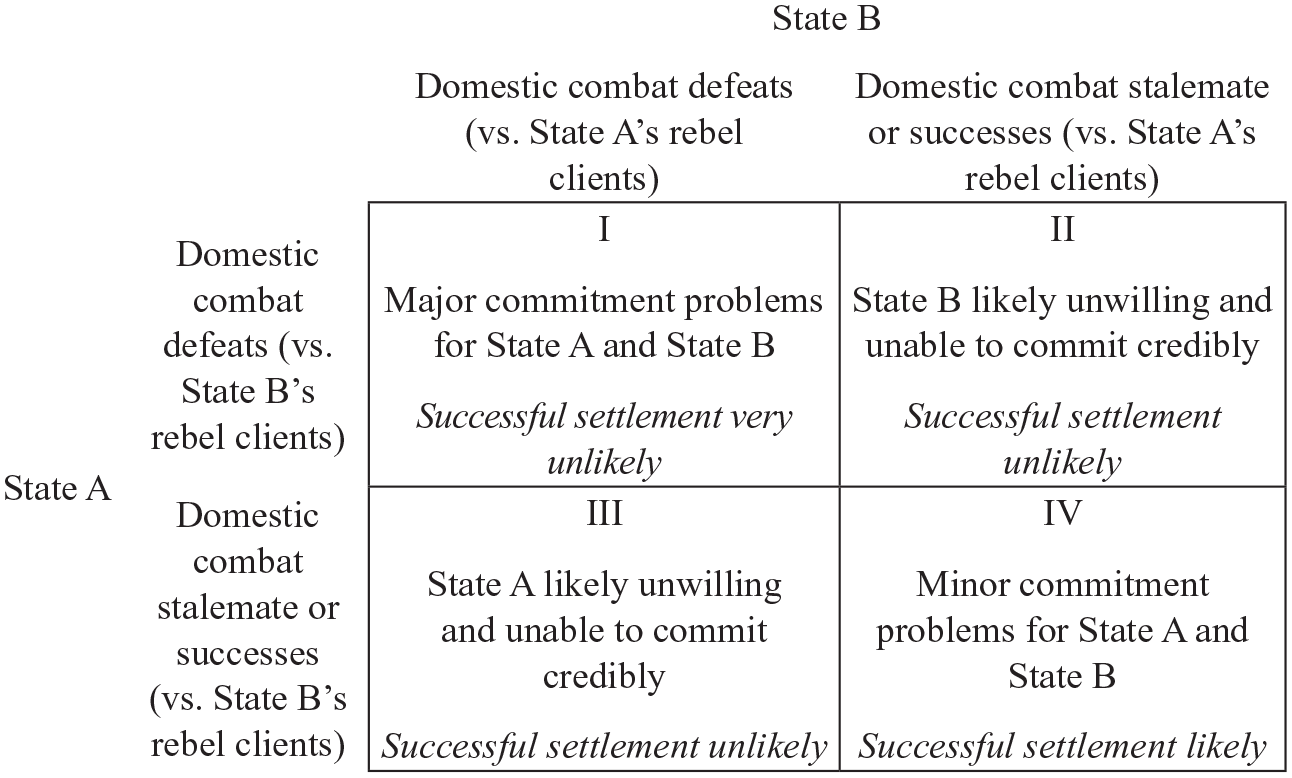
Combat outcomes, commitment problems, and the likelihood of a successfully implemented negotiated settlement of a mutual intervention.
Bargaining theory’s second explanation for war initiation focuses on commitment problems arising from the absence of an authority that could enforce agreements. Structural reasons, such as a power shift or a first-strike advantage, can create incentives to renege on a potential agreement. Knowing about these incentives creates mistrust between rational actors, which can prevent them from reaching a war-avoiding deal (Fearon, 1995: 401–408; Powell, 2006: 180–183). Applied to conflict termination, this logic suggests that “the more a belligerent fears its adversary will violate war-ending commitments, the more likely that belligerent will be to pursue absolute victory” (Reiter, 2009: 31). In the context of mutual interventions, absolute victory refers to foreign-assisted regime change in the opposing state. Our theory is agnostic about the two states’ initial goals but assumes that commitment concerns over the course of the mutual intervention generally make both states see the “transformative” goal of regime change as more desirable than any merely “coercive” or “disruptive” goal (Hughes, 2012: 20–21). This is a simplifying assumption that enables us to draw out a small number of hypotheses. Reiter’s bargaining theory of war termination focuses on whether states “continue to fight” in the hope of achieving an absolute victory (Reiter, 2009: 5, emphasis added). In addition, we consider the option to escalate a mutual intervention via an increase in the quantity or kind of support provided to rebel clients—for example, more weapons or a change from access to territory alone to also providing training. 4
By hypothesizing that the severity of commitment problems in the context of mutual interventions depends largely on the information revealed by combat outcomes, we take a deliberately narrow view of shifts in relative power—the key factor underlying war as a commitment problem, according to Powell (2006). In other words, we treat combat outcomes as the main indicator of power shifts: for instance, if State A suffers defeats against State B’s rebel clients while State B holds its own or even scores victories against State A’s rebel clients, power is shifting in State B’s favor, likely making it unwilling and unable to credibly commit to a settlement because both states expect a further power shift benefiting State B in the future (cell II in Figure 1). We assume that African states experiencing intrastate conflict are focused on these endogenous, short- to medium-term power shifts and that they are less concerned with the kind of exogenous, long-term structural factors, such as “differential rates of economic growth or sociopolitical development” (Powell, 2006: 172), that scholarship based largely on the experience of European great powers, the Soviet Union, and the United States tends to emphasize. The underlying assumption that leaders in conflict-affected African states have a short shadow of the future is well established in the political economy literature (e.g. Bates, 2008: 25–26). Our focus on imminent threats to leader survival is also consistent with strategic theories explaining the onset of civil wars and interventions (Roessler, 2016: 98; Tamm, 2016: 150).
The four cells in Figure 1 summarize our hypotheses about the likelihood that a mutual intervention will be resolved through a successfully implemented negotiated settlement, defined as an interstate agreement that leads both states to terminate their support for rebels from the other state until at least the end of the next calendar year. We thus focus on a dyadic outcome. This marks an important contrast with Reiter’s bargaining theory of war termination, which addresses the negotiating position of an individual belligerent—that is, a monadic outcome (Reiter, 2009: 3–5). Our key argument is that only if both states simultaneously experience domestic combat stalemates or successes will their commitment concerns be reduced sufficiently to make a successful settlement likely (cell IV). The following three subsections develop and illustrate our hypotheses in more detail. We discuss cells II and III together because they capture the same type of scenario.
Combat defeats for both states (cell I)
In the first scenario, both states repeatedly lose battles against rebels. The more these defeats involve the loss of strategically important territory—for example, cities on a main road toward the capital—the more significant they are, as they make both states realize that the survival of their regimes is at stake (Greig, 2015: 682–683). This realization creates severe commitment concerns for both states: honoring a negotiated settlement while the other state reneges on it could have catastrophic consequences. The fact that plausible deniability is often a major characteristic of support for rebel groups is particularly relevant here (Byman and Kreps, 2010). In contrast to interstate war, in which it is relatively straightforward to determine whether the enemy has stopped attacking, states mutually intervening in each other’s intrastate conflicts can more easily claim to have terminated their support while covertly continuing to aid the rebels (Schultz, 2010). This increases the fear that the other state may cheat, which is a major obstacle to reaching a negotiated settlement when being cheated could mean being overthrown. Each state is thus likely to continue supporting its rebel clients, hoping that they win before the other state’s rebel clients do. As the example below shows, a state may even escalate its level or type of support, diverting important military resources from the fight against the rebels at home in the hope of speeding up the other state’s defeat.
The Ethiopia–Sudan mutual intervention from 1983 to 1991 provides the clearest illustration of a case in which both states repeatedly suffered significant defeats. In March 1988 and February 1989, Ethiopia’s communist Derg regime lost two crucial battles—the first in Afabet against the Eritrean People’s Liberation Front (EPLF); the second in Shire against the Tigray People’s Liberation Front (TPLF), which received support from the EPLF (Pool, 2001: 155–156; Young, 1998: 46–48). At a party meeting held one month after the loss of Shire, President Mengistu Haile Mariam did not mince his words: “Of all the debacles we have suffered in the last fourteen years [of conflict in Tigray province], this is the biggest” (quoted in Tareke, 2009: 290). The first half of 1989 also “marked a turning point” in Sudan’s civil war, as the government lost several important southern towns to the Sudan People’s Liberation Army (SPLA), subsequently facing “considerable problems supplying its troops” (Johnson, 2011: 84).
In line with our hypothesis, these defeats did not lead the two states to end or dial down their mutual intervention. On the contrary, they caused them to escalate it. As de Waal (2004: 186) explains, the “mutual cross-border subversion of the 1980s took on a completely different quality in the last weeks of 1989. In essence, the Ethiopian and Sudanese wars became entangled to the extent that only one regime could survive.” More specifically, Ethiopian artillery support helped the SPLA overrun a Sudanese army garrison at the border and advance further, only to be stopped by a special EPLF unit that crossed the border to come to its sponsor’s rescue. A year and a half later, the EPLF, TPLF, and other Ethiopian rebel groups overthrew the Derg regime (de Waal, 2004: 187–189).
This first symmetric scenario is relatively rare, occurring much less frequently than the asymmetric scenario and the symmetric scenario in which both states are holding their own. The mutual intervention between Côte d’Ivoire and Liberia illustrates that one state’s combat defeats increase the chance that the other losing state will turn things around, thus quickly transforming a situation that approximates this symmetric scenario into an asymmetric one. In late 2002, the Liberian-backed Movement for Justice and Peace (MJP) and the Popular Movement of the Ivorian Great West (MPIGO) managed to seize the towns of Man and Danané. Côte d’Ivoire retaliated by helping the Movement for Democracy in Liberia (MODEL) to seize several Liberian towns from early 2003 onward. By that point, MJP and MPIGO were still holding but no longer gaining territory—changing the combat outcome from defeats to stalemate. This was partly because MODEL’s gains made it harder for Liberia to continue sending arms to MJP and MPIGO. Liberia subsequently continued suffering defeats whereas Côte d’Ivoire managed to contain the two rebel groups (Hazen, 2013: 131–133, 155–158).
Combat defeats for one state; stalemate or successes for the other (cells II and III)
In the second scenario, one state is repeatedly losing battles against rebels whereas the other state experiences either a combat stalemate or a series of successes. Because the state that has the upper hand is typically both unwilling and unable to make credible commitments, a successfully implemented negotiated settlement is generally unlikely under these conditions. But it is not impossible: as we discuss in the section on alternative explanations, a more immediate threat or pressure from third parties can incentivize and enable the dominant state to commit credibly to a settlement.
Bargaining theory’s information logic suggests that the losing state should be willing to make concessions to the state with the upper hand, at least if the losing state is unable to escalate support to its rebel clients and if it believes that its rebel opponents would be significantly weakened by losing the dominant state’s support (Reiter, 2009: 20–21; Weisiger, 2016: 352). However, making concessions short of surrender is not always an option in mutual interventions: if the dominant state believes that only regime change in the losing state can resolve the interstate dispute, then it is likely willing to accept the additional costs involved in backing the rebels until they achieve absolute victory.
One reason for such a belief relates to concerns about the losing state’s control over its security apparatus and thus its ability to implement a potential settlement. In the case of the Rwanda–Zaire mutual intervention from 1996 to 1997, for example, Rwandan officials had doubts about the extent to which Zairian President Mobutu Sese Seko was in control of army officers providing weapons to Rwandan rebels based in eastern Zaire. 5 The Rwandans thus determined that any resolution of the conflict in Zaire short of rebel victory would not fully solve their own problem. As Rwanda’s de facto ruler Paul Kagame himself later explained in a Washington Post interview, “we thought doing it halfway would be very dangerous. We found the best way was to take it to the end,” that is, toppling Mobutu (quoted in Pomfret, 1997).
In terms of commitment concerns resulting directly from asymmetric combat outcomes, it is primarily the dominant state that faces the temptation to renege on a deal, as it expects power to continue shifting in its favor. Negotiated settlements reached under these conditions are therefore structurally unstable and generally unlikely to be implemented with success. In 1984, for example, South Africa had the upper hand against Mozambique, coerced it into signing a nonaggression pact, and then reneged on it by covertly continuing to support the Mozambican National Resistance (Renamo). Since Mozambique nonetheless ended its support for the African National Congress (ANC), the unsuccessful deal turned the mutual intervention into a one-sided intervention (Gleijeses, 2013: 237–238).
Combat stalemate or successes for both states (cell IV)
In the third and last scenario, neither state is losing: each finds itself at worst in a combat stalemate and at best in a situation of repeatedly winning battles against rebels. If both states already escalated their support to the extent their capabilities and the geographies of the two intrastate conflicts permitted, they will realize that neither is likely to be overthrown by its rebel opponents even if the other state continues to support them. This realization significantly decreases commitment concerns. As a result, it should make both states less willing to incur further costs in the form of resources provided to rebel clients. In short, the mutual intervention itself reaches a mutually hurting stalemate, making it “ripe for resolution” via negotiated settlement (Zartman, 1989).
For the sake of keeping Figure 1 simple, this scenario aggregates three different combinations of combat outcomes into one: (1) combat stalemates for both states; (2) a stalemate for one state, successes for the other; and (3) successes for both states. While a successfully implemented negotiated settlement is likely under all three, our theoretical logic implies that this likelihood should increase from the first to the third combination. The more successful a state is in defeating its rebel opponents while they are being sponsored by the other state, the less concerned it will be about that state potentially reneging on a settlement. From the other perspective, the more clearly a state’s rebel clients are losing, the less hope it will have that they may eventually gain the upper hand, making it less willing to continue its costly support.
The first combination can be illustrated with the Ethiopia–Sudan mutual intervention from 1969 to 1971. Its peaceful resolution also provides a clear contrast to the mutual intervention involving both countries that lasted from 1983 to 1991 and ended in a client victory, discussed above. Both American intelligence and British diplomatic assessments from the early 1970s explicitly characterize the Ethiopian government’s conflict with the Sudan-backed Eritrean Liberation Front (ELF) as a “stalemate” (Woldemariam, 2018: 102). Similarly, a Sudanese historian describes the conflict between Sudan’s government and the Ethiopian-sponsored Southern Sudan Liberation Movement (SSLM) to have reached a “stalemate” by 1971 (Poggo, 2009: 176). This combination of stalemates led Ethiopia and Sudan to sign an agreement on 24 March 1971, in which they agreed to “[t]ake all necessary measures in order to put an end to all forms of subversive activities directed against the other” and to “[d]isarm all rebel elements and dismantle their camps” (quoted in Beshir, 1975: 84).
An example of the second combination—stalemate and successes—is found in the Angola–Zaire mutual intervention from 1975 to 1978. In that period, the National Liberation Front of Angola (FNLA) was losing and the National Union for the Total Independence of Angola (UNITA) was still “a minor security issue” (Hoekstra, 2018: 985). After gaining some ground in late 1977, UNITA suffered setbacks the next year due to government offensives (Weigert, 2011: 1970). In contrast to the stalemate in which Zaire-backed UNITA found itself, Angola’s rebel client—the Congolese National Liberation Front (FLNC)—suffered major defeats in May 1978 due to a Western intervention on the Zairian government’s side, which clearly signaled that the FLNC’s cause was hopeless (Kennes and Larmer, 2016: 138–142). Following this intervention, Angola and Zaire reached a negotiated settlement in July 1978 that ended their military support for each other’s rebel opponents. 6
The third combination—successes for both states—is analyzed in detail in the Chad–Sudan case study. Before turning to alternative explanations, we should issue one perhaps obvious caveat to our proposition that successes make a negotiated settlement likely: it assumes that rebel groups are weakened but not eliminated in these battles.
Alternative explanations
Our hypotheses about the effects of combat outcomes focus on dynamics that are endogenous to a mutual intervention. Their underlying assumption is that the interactions between the conflict parties involved in the mutual intervention—the two states and their rebel clients—determine how it ends. But mutual interventions do not occur in a vacuum. In this section, we consider three exogenous factors as alternative explanations: (1) a more immediate third-party threat; (2) third-party pressure; and (3) third-party security guarantees. While these factors represent potential rivals to our endogenous explanation focused on combat outcomes, they are “congruent” (Zaks, 2017) with the general commitment logic of bargaining theory: they explain why states can credibly commit to a negotiated settlement.
First, scholars of enduring interstate rivalries suggest that states involved in multiple rivalries may accommodate one rival if another presents a more immediate threat (Akcinaroglu et al., 2014). This argument in fact explains two of the three mutual interventions in Africa that ended through a successful settlement despite asymmetric combat trends. In 1999, both Eritrea and Ethiopia had the upper hand in their mutual interventions with Sudan (Abbink, 2003: 414; Johnson, 2011: 212–213), but they were also waging a conventional war against one another. Therefore, both decided to improve relations with Sudan to focus on the much more immediate and severe threat—each other (Akcinaroglu et al., 2014: 86–87).
Second, mediation scholars argue that third parties can manipulate the bargaining process between conflict parties by applying pressure that makes continued conflict more costly (Beardsley et al., 2006: 64–65; Pechenkina, 2020). The leveraging of cost thus widens the space for a negotiated settlement. This explanation helps account for the third African mutual intervention that was settled in the context of asymmetric combat outcomes. In January 2009, the Democratic Republic of Congo and Rwanda resolved their long-lasting mutual intervention through a successful settlement even though the Rwandan-backed National Congress for the Defense of the People (CNDP) had inflicted several humiliating defeats on the Congolese government in the second half of 2008 (Berwouts, 2017: 70). One of the main reasons for Rwanda’s willingness to settle was that key donors either suspended or threatened to suspend their budgetary aid because of Rwanda’s support for the CNDP. The costs of this loss of international support outweighed the benefits Rwanda could accrue from CNDP successes (Berwouts, 2017: 77).
Third, scholars of civil war termination argue that third-party security guarantees are the key to reaching and successfully implementing negotiated settlements. Promises by outsiders to monitor and enforce compliance with the terms of an agreement can overcome fears that the other side will renege on a deal (Walter, 1997). This logic has also been applied to a phenomenon closely related to mutual interventions: militarized interstate disputes resulting from one-sided state support for rebel groups. Studying such disputes, Schultz (2010) finds that agreements to limit rebel support are unlikely to reduce interstate violence unless they include third-party monitoring mechanisms (and/or concessions by the targeted state). In contrast to the other two alternative explanations, we have not found third-party security guarantees to be the key factor for the successful settlement of any mutual intervention in Africa. We thus consider such guarantees as complementary, rather than competing, with our combat-centric hypotheses. Still, the in-depth case study that follows investigates the extent to which third-party monitoring and enforcement promises may have played a role in bringing about a successful settlement.
Case selection and methodology
An in-depth case study allows us to examine the causal mechanisms that link combat outcomes to the prolongation or termination of mutual interventions (Collier, 2011: 824). Moreover, examining our argument in a case study rather than a quantitative analysis allows for nuance. For instance, Reiter (2009: 16) notes that what constitutes a combat success is highly contextual.
We focus on the mutual intervention between Chad and Sudan for three reasons. First, the case exhibits crucial within-case variation that allows us to study how a change in battlefield outcomes affects the severity of commitment problems and how this has an impact on the willingness of states to resolve their conflict. The three periods analyzed below cover Figure 1’s cells I (2005–2006), II (2007–2008), and IV (2009–2010).
The second reason for selecting the mutual intervention between Chad and Sudan is that the case is well-documented in the academic literature and in reports by nongovernmental organizations. This is an advantage because negotiations to end mutual interventions almost always take place behind closed doors, which often limits the information available about these processes. We supplement the secondary sources with several elite interviews conducted in Sudan and the United Kingdom.
The third reason for selecting the Chad–Sudan mutual intervention is that its duration makes it a broadly representative case. It lasted for five years, which is the average duration of mutual interventions ending in negotiated settlement and only one year longer than the average duration of all cases (see Table 1). Moreover, like two-thirds of all cases, the Chad–Sudan mutual intervention started in the post–Cold War period. The main aspect in which the case is unrepresentative is the unusually large role that transborder ethnic solidarity played in its onset. Chad’s support for rebels in Sudan’s Darfur region was largely a result of the Chadian armed forces’ pressure on President Déby to support Zaghawa coethnics across the border. A similar scenario contributed to Somalia’s support for Somali rebels in Ethiopia. In other cases, ethnic solidarity appears to have been of secondary importance (Duursma and Tamm, 2021: 1082). However, transborder ethnic ties have been found to make the termination of support to rebels less likely (Karlén, 2019: 744); this factor should thus make the Chad–Sudan mutual intervention a harder case for our rationalist explanation. Another aspect in which the case differs from most others is the large number of rebel clients on both sides. Rebel fragmentation might make states’ combat successes more likely. But Karlén (2019: 746) shows that the number of rebel groups involved in a conflict does not affect support termination, so this factor should not interfere with our theory’s causal mechanism.
The termination of the Chad–Sudan mutual intervention
The governments of Chad and Sudan were locked into a mutual intervention from 2005 to 2010. Realizing that supporting rebels to accomplish regime change in the rival state was unlikely to succeed and that sustaining this mutual intervention would be very costly, the two states began negotiating in earnest from mid-2009 onward to resolve the mutual intervention. This led to the conclusion of the Accord de N’Djamena in January 2010. The following case study examines why this rapprochement only became possible when Chad and Sudan were both winning at home but losing abroad.
Background
Both Chad and Sudan have experienced multiple civil wars since independence. Sudan witnessed a rebellion in its southern part from independence to 1972 and again from 1983 to 2005, but the Chadian government refrained from supporting the southern rebels (Johnson, 2011). Sudan, however, has been closely involved in Chad’s various civil wars since the mid-1960s, when the Muslim north rebelled against a government dominated by Christian southerners. The Sudanese government provided the rebels with a safe haven in Darfur, Sudan’s western province (Burr and Collins, 1999: 60–61). Sudan’s interference in Chad continued—on and off—until November 1990, when Chadian rebel leader Idriss Déby managed to overthrow Chadian President Hissène Habré with strong support from Sudan’s new leader Omar al-Bashir, who had come to power in a military coup in June 1989 (de Waal, 2015: 56).
As Chad’s new president, Déby consolidated power in the hands of the Zaghawa ethnic group (Nolutshungu, 1996: 245–267). The Zaghawa also formed an important part of the rebellion in Darfur, which started in late 2002, when the Sudan Liberation Movement/Army (SLM/A) and the Justice and Equality Movement (JEM) took up arms against the Sudanese government. These rebel groups vowed, among other goals, to end the repression of non-Arabs by the Arab-dominated government and allied local militias (Flint and de Waal, 2008: 68–70, 81–82). Despite the Zaghawa connection, Déby’s allegiance lay with the Sudanese government—his former backers—when war broke out in Darfur. Earlier in 2002, Darfurian opposition figures had asked Déby to support an armed rebellion, but he had refused the request and then instead sent 500 Chadian soldiers to Darfur in 2003 to help Sudan’s government forces quell the rebellion (Flint, 2007: 149; Prunier, 2005: 98–99).
While Déby supported the Sudanese government in the first two years of the conflict, many Zaghawa generals within the Chadian army sympathized with their ethnic kin in Darfur and gave early warnings to Darfurian rebels when they or the Sudanese army were approaching (Seymour, 2010: 58; Tubiana, 2011: 11). Zaghawa generals within the Chadian army even supported Zaghawa rebels with weapons and ammunition. 7 Khartoum interpreted this support as double-dealing and subsequently started supporting a coalition of Chadian rebel groups, the United Front for Democratic Change (FUCD). This coalition was dominated by eastern Chadians, especially Tama, an ethnic group traditionally opposed to the Zaghawa (Seymour, 2010: 58–59; Tubiana, 2008: 28, 33).
In the fall of 2005, Sudan gave the FUCD rebels bases in Darfur (Marchal, 2007: 174, 189–194). This, combined with pressure from the Zaghawa generals within his army, led Déby to reverse his support for the Sudanese government. In December 2005, he started to support Darfurian Zaghawa rebels, providing them with weapons and rear bases in eastern Chad and enabling them to recruit fighters in refugee camps (Debos, 2016: 131; Flint and de Waal, 2008: 207). Déby’s decision to support Darfurian rebels thus marked the start of the Chad–Sudan mutual intervention. Given our theory’s emphasis on endogenous dynamics, the following analysis focuses on these two states’ reciprocal interventions, disregarding the minor role played by intermittent Eritrean and Libyan support to Darfurian rebels and only briefly noting the at times significant role played by French support to the Chadian government.
Pursuing regime survival through attacks abroad: December 2005–December 2006
The first significant rebel attack in Chad in the context of the mutual intervention occurred in Guéréda on 7 December 2005. This was followed by an attack on Adré, a strategic border town, on 18 December 2005 (Marchal, 2007: 194; Tubiana, 2011: 16–17). Most of the rebels conducting these attacks had received weapons and training at camps in Sudan (Flint and de Waal, 2008: 207).
Pressure really started to mount on Déby when the Sudan-backed FUCD attacked N’Djamena in April 2006. The rebel attack failed to oust Déby, but this combat defeat abroad did not make Sudan more inclined to settle. On the contrary, if anything, the rebel attack had shown that regime change was not impossible. It was only after French military planes intervened that the attack could be repulsed (Flint and de Waal, 2008: 207; Tubiana, 2011: 20). Furthermore, Chadian government forces were put under severe military pressure in eastern Chad. In late March 2006, Chad’s army commander died during a clash in the east of the country (BBC, 2006). In October 2006, his replacement died in a battle close to the border with Sudan (Reuters, 2006).
Khartoum was also facing military pressure at home. In response to the Sudan-backed attack on Adré in December 2005, President Déby invited JEM leader Khalil Ibrahim, SLM/A vice-chairman Khamis Abakir, and Minni Minnawi, leader of the breakaway SLM/A (MM) faction, to N’Djamena to discuss a counterattack on Sudan (Flint and de Waal, 2008: 207). This support from Chad explains why, following the breakdown of the Darfur peace process in May 2006, the Darfurian rebel movement managed to score several successes on the battlefield. Jan Pronk (2006), the UN Special Representative to Sudan at the time, summarized in mid-October 2006 how the Sudanese Armed Forces (SAF) were losing on the battlefield during the second half of 2006: The SAF has lost two major battles, last month in Umm Sidir and this week in Karakaya. The losses seem to have been very high. Reports speak about hundreds of casualties in each of the two battles with many wounded and many taken as prisoner. The morale in the Government army in North Darfur has gone down. Some generals have been sacked; soldiers have refused to fight.
It follows from the above that the mutual intervention between Chad and Sudan up until December 2006 can be best described as both sides experiencing combat defeats (cell I in Figure 1). While the Chadian rebel movement lost the battle of N’Djamena in April 2006, the assault had shown the vulnerability of Déby’s regime. Moreover, the Chadian army was repeatedly defeated in eastern Chad during the second half of 2006. Similarly, the Sudanese faced a precarious military situation in Darfur, losing battles on several occasions.
This gave the leaders of both countries very little incentive to look for a resolution to the mutual intervention. Both sides continued to pursue their own survival by fostering regime change abroad. Flint and de Waal (2008: 206) note that Khartoum saw “the overthrow of the regime in N’Djamena as the most efficient way of destroying the rebels’ supply lines and rear bases.” Likewise, N’Djamena left no stone unturned to strengthen the Chadian army and invest in the Darfurian rebel movement: “For Déby it was a fight to the death and he used all his resources—including oil revenues seized in contravention of an agreement with the World Bank—to buy arms and allies” (Flint and de Waal, 2008: 207).
This illustrates that states which both experience combat defeats are unlikely to terminate rebel support because each side fears that the other will renege on a deal in the hope of its clients winning first. Indeed, as the following section discusses, hopes for rebel victories would continue to dominate events for the next two years.
Talking while stepping up support: January 2007–December 2008
The Chadian and Sudanese regimes were involved in several intrastate and interstate peace talks in 2007 and 2008. Intrastate agreements quickly fell apart, however, and were followed by deadly rebel attacks. 8 Meanwhile, commitment concerns continued to prevent interstate agreements—signed largely due to third-party mediation pressure—from being implemented (Tubiana, 2008: 30–31). This strategic predicament led to another escalation in the mutual intervention. Sudanese support to a reconstituted Chadian rebel coalition facilitated a second assault on N’Djamena aimed at ousting Déby from power in February 2008, while Chadian support to JEM helped the Darfurian rebels launch an attack on Khartoum in May 2008.
In February 2008, some 2,000 Chadian rebels in around 300 vehicles launched a second attack on N’Djamena (Amnesty International, 2008: 3). Aware of the impending attack, Chadian government officials contacted the JEM leadership to ask for help. JEM immediately abandoned good positions in West Darfur, around El Geneina, to rush to Chad. Although JEM was too late to get to N’Djamena in time to help fend off the rebel attack, the group played a crucial role in preventing around 2,500 Chadian rebels in eastern Chad from reinforcing the rebel troops already in N’Djamena (Tubiana, 2011: 20). As discussed below, these troops then narrowly lost the battle for the capital.
Chad stepped up support to JEM in the wake of the attack. This support was largely financed by oil revenues (de Waal, 2015: 62; Debos, 2016: 143–144). With Chad’s backing, JEM nearly brought the mutual intervention to Sudan’s capital in May 2008. Chad provided around 400 vehicles, as well as weapons, to JEM prior to the assault on Khartoum (Tubiana, 2011: 21). Although the JEM fighters only managed to attack Khartoum’s twin city, Omdurman, the attack was a clear signal of both JEM’s commitment to resolve the conflict militarily and Chad’s strong support. The attack made the mutual intervention a lot more costly for the Sudanese government (de Waal, 2015: 61–62).
The combat situation by mid-2008 could in some ways be described as a double stalemate (cell IV in Figure 1). The Chadian rebel movement and JEM were unable to oust Déby and al-Bashir during the assaults on N’Djamena in February 2008 and Khartoum in May 2008, respectively. At the same time, Chad was unable to score combat successes in the east of the country, while clashes between Sudan and JEM in Darfur did not point to either side having the upper hand. Stalemates within a mutual intervention can potentially make the states more inclined to settle because each will be less concerned about the other state reneging on the settlement. However, the assault on N’Djamena had been a close call for Déby. According to Debos (2016: 66), “the battle seemed lost for a few hours.” Regime insiders “later admitted that the rebels had gained total control of the capital, with the exception of the presidential palace” (Hansen, 2013: 583). Although Déby’s regime technically won the battle, this near defeat and his army’s disastrous combat defeat in Massaguett the day before, which opened the gates to the capital, together had the informational effects of combat defeats: they aggravated the regime’s fears of being overthrown (Tubiana, 2008: 11).
Accordingly, the combat situation by mid-2008 is better described as Chad overall suffering defeats while Sudan experienced a stalemate (cell II in Figure 1). This contextual interpretation explains the failure of at least eight rounds of mediation conducted by Congo-Brazzaville, Gabon, Libya, and Senegal throughout 2008. Both Chad and Sudan escalated their support to the rebel movements following the assaults on N’Djamena and Khartoum, providing the rebels with vehicles, rocket-propelled grenades, machine guns, and ammunition (Tubiana, 2011: 22). Yet, this increased support did not translate into combat successes abroad. On the contrary, as the next section shows, Chad and Sudan both experienced a series of domestic combat successes from early 2009 onward.
Winning at home, losing abroad: January 2009–January 2010
In mid-January 2009, JEM briefly took control of Muhajeria, previously controlled by fighters of the SLM/A (MM) faction, which had switched sides and allied with the government in Khartoum. Government forces soon managed to re-take control of Muhajeria, and JEM leader Khalil Ibrahim ordered his fighters to leave the area in early March (Agence France Presse, 2009). A few months later, in May 2009, the Sudanese army managed to defeat JEM again in Umm Baru. JEM suffered many casualties during this battle, putting an end to its raid into Darfur (Heavens, 2009; Tubiana, 2011: 24).
That same month, Chadian rebels were defeated by Chad’s armed forces at Am Dam. This was especially significant because the rebels were on their way to N’Djamena for another assault on the capital, but this time they were rapidly halted. A defensive line formed by the Chadian army and its elite corps in early 2009 had its desired effect (Debos, 2016: 83, 132). In spite of Sudan stepping up support to the Chadian rebels, the Chadian army proved to be militarily superior (Tubiana, 2011: 23).
In short, it became clear in mid-2009 that both the Sudanese and the Chadian rebels were no longer capable of posing an existential threat to Khartoum and N’Djamena despite the strong support they received. Based on our theoretical argument, Chad and Sudan’s domestic combat successes should reduce commitment problems for both states and thus make a settlement of the mutual intervention likely. In line with this expectation, Tubiana (2011: 7) notes that by mid-2009 there was “frustration and fatigue” among Chadian and Sudanese leaders because the proxy raids did not have their desired effect. Tubiana (2011) concludes, By the end of May 2009 both governments realized that arming rebel proxy forces for lightning raids was no longer efficient or effective and that the investment in proxy forces would be better used to arm their own forces for defence. It was thus clear in both Khartoum and N’Djaména that the offensive military options against each other had failed. (p. 24)
Similarly, International Crisis Group (2010) notes that “after the failed UFR [Union of Resistance Forces] offensive, some influential circles in Khartoum began to doubt the utility of an alliance with the Chadian armed opposition and consider a rapprochement with N’Djamena.”
The time was finally ripe for sincere negotiations to end the mutual intervention. Following side talks during the UN General Assembly in New York, President al-Bashir sent his advisor Ghazi Salah al-Din al-Atabani to N’Djamena in October to meet with Déby (Tubiana, 2011: 28). Commenting on his negotiations with Déby, Ghazi explained, When I started working on the Darfur dossier in 2009, I focused on the most pressing issue, which I deemed was neutralizing Chad. Without normalized relations with Chad, there would be no solution to the problem in Darfur. . . . This led to six months of negotiations, during which I visited Chad around seven times.
9
On 15 January 2010, the two states signed the Accord de N’Djamena. This agreement stipulated measures to end the existence of, and support for, any hostile activity by rebel groups operating from the other’s territory, including disarming the rebels and forming a joint border force of around 3,000 soldiers operating under a joint command. 10 In early March 2010, the joint border force was deployed, starting enforcement actions (de Waal, 2003: 297).
Unlike all other agreements concluded between Chad and Sudan in the preceding years, the Accord de N’Djamena was successfully implemented. In February 2010, President Déby paid an official visit to President al-Bashir in Khartoum, reaffirming the accord. Only 11 days after this meeting, Déby pressured JEM leader Khalil Ibrahim into signing a peace agreement with Sudan’s government. Déby then ordered JEM to leave Chadian territory. When, in late April 2010, it became clear that the ceasefire between the Sudanese government and JEM did not hold, President Déby refused JEM entry into Chad. 11 Sudanese government forces in return began to disarm Chadian rebels still in Darfur (Tubiana, 2011: 31, 36).
In short, N’Djamena and Khartoum experienced high costs associated with their mutual intervention and both sides realized by mid-2009 that a client victory was unlikely. Both states had shown that they could fend off rebels. This reduced fears that the other side would renege on a deal to terminate rebel support, resulting in the signing and successful implementation of the Accord de N’Djamena.
Ruling out alternative explanations
This subsection looks at three alternative explanations. First, we consider whether a more immediate third-party threat provided Chad and Sudan with incentives to terminate the mutual intervention. If this explanation were correct, we would expect to observe one or both of the countries to be involved in another serious international conflict or rivalry (Akcinaroglu et al., 2014). We would then also expect to see evidence of Chad or Sudan perceiving dealing with this international conflict or rivalry as a priority, thus terminating the mutual intervention through accommodating the other side.
These expectations, however, are not borne out. Chad was not threatened by another state. The Central African Republic (CAR) had for many years been a sanctuary for Chadian rebels, but François Bozizé came to power in 2003 with Chadian military support and maintained cordial relations with Déby for the entire duration of the Chad–Sudan mutual intervention (Marchal, 2007: 175). Similarly, Libya no longer posed a threat to Chad. Libyan leader Muammar Gaddafi experienced difficulties during the 1990s, which led him to agree to a legal settlement to the long-lasting Aouzou Strip dispute with Chad (Marchal, 2007: 181, 188). Sudan did not face a serious third-party threat either. Khartoum was embroiled in mutual interventions with Eritrea, Ethiopia, and Uganda from the mid-1990s onward, but all three of them had been terminated by 2006 (see Table 1). Libya’s policy toward Darfur was too “ambiguous” to constitute a major threat (Tubiana, 2011: 52). In short, the presence of a third-party threat cannot explain why Chad and Sudan resolved their mutual intervention in January 2010.
Second, we consider whether third-party pressure explains why the mutual intervention between Chad and Sudan terminated. If this alternative explanation were correct, we would expect a state or international organization to issue a threat or apply a penalty toward one or both states, which would then cause the termination of the mutual intervention (Pechenkina, 2020: 83). Third parties can apply diplomatic, economic, or military pressure. Diplomatic pressure involves a third party reprimanding the parties, for example, through UN resolutions that condemn either side or both. A third party can apply economic pressure through imposing or threatening to impose economic sanctions or an arms embargo. Finally, military pressure involves threats from states or an international organization to intervene militarily or an actual intervention using armed force (Pechenkina, 2020: 91–93). Crucially, if third-party pressure were to explain the termination of the mutual intervention between Chad and Sudan, we would not only expect a state or international organization to apply pressure; we would also expect Chad and Sudan to terminate support to their rebel clients because of this pressure.
In contrast to the many previous third-party peacemaking efforts, the diplomatic process leading up to the Accord de N’Djamena was predominantly bilateral and free of effective third-party pressure. In fact, almost no international pressure was put on Chad to terminate support to Sudanese rebels during the mutual intervention. One major reason for this lack of pressure was that the United States and France saw Chad as an important ally in the war on terror in Africa, supporting Déby via counterterrorism partnerships (Hansen, 2013: 587–588; Shorey and Nickels, 2015).
US economic sanctions against Sudan, by contrast, had already been in place since the mid-1990s because of state-sponsored terrorism. Washington promised Khartoum in 2001 to lift these sanctions and normalize relations should the Sudanese government provide information on terrorist networks and make peace with the Sudan People’s Liberation Movement/Army (SPLM/A). This pressure contributed to the Sudanese government signing the Comprehensive Peace Agreement (CPA) with the SPLM/A in 2005. However, instead of subsequently normalizing relations, the United States applied the same pressure to push Khartoum toward also making peace in Darfur and by extension with Chad (Natsios, 2012: 169). In addition, the UN Security Council imposed an arms embargo on Sudanese government forces and Darfurian rebel groups in March 2005 (SIPRI, 2012).
Third parties were thus applying diplomatic and economic pressure right from the start of the mutual intervention between Chad and Sudan. This third-party pressure did not increase over the course of the mutual intervention. If anything, the international community was applying maximum pressure on Sudan in the first two years (2005–2006), in response to the global Save Darfur movement (Flint and de Waal, 2008: 186). This third-party pressure by itself therefore cannot explain the timing of the termination of the mutual intervention in 2010. Moreover, since the Sudanese government saw the United States as reneging on the promise to normalize relations following the conclusion of the CPA, it attached little value to Washington’s repeated promises to lift pressure. 12
The third alternative explanation that we consider is whether third-party security guarantees persuaded Chad and Sudan to terminate the mutual intervention. If this explanation were correct, we would expect a state or international organization to step in during negotiations and promise to “verify or enforce post-treaty behavior” (Walter, 2002: 64). For instance, a third party could have promised to control and verify whether Chad and Sudan in fact stopped supporting their rebel clients.
But there were no such credible third-party security guarantees to oversee the implementation of the Accord de N’Djamena. This explanation thus also falls short. While UN peacekeeping operations were ongoing in both Chad and Sudan at the time of the rapprochement, these missions played no role in Déby’s and al-Bashir’s calculations to sign and implement the Accord de N’Djamena. In fact, on 1 January 2010, two weeks before the conclusion of the agreement, President Déby had asked the UN Security Council not to extend the mandate of the United Nations Mission in the Central African Republic and Chad (MINURCAT), which was to expire in March (Marchal, 2007: 174; Tubiana, 2011: 28). As for the joint AU–UN mission in Darfur (UNAMID), this mission was predominantly focused on protecting civilians. It did not have a mandate to assess Sudanese support to Chadian rebels. Moreover, by the time the Accord de N’Djamena was concluded, the Sudanese government had managed to undermine the effectiveness of UNAMID through widespread obstruction (UN Security Council, 2010: para. 32).
The Sudanese resistance against UNAMID and Déby’s decision not to renew MINURCAT illustrate that the regimes saw the two peacekeeping missions as annoyances rather than as tools to commit credibly to their rapprochement. Both states preferred to oversee the implementation of their settlement through a joint border force rather than third-party peacekeeping. Commenting on the success of the Accord de N’Djamena, Ghazi concluded: “It is a purely bilateral agreement which reflects the true interests of the two countries, which was getting rid of the armed opposition. That is why it has succeeded.” 13
Conclusion
Previous studies have not explicitly theorized the termination of mutual interventions. We filled this research gap by examining why some mutual interventions are resolved through a successfully implemented negotiated settlement whereas others are not. We argued that different combinations of combat outcomes in the two interlocked intrastate conflicts affect the severity of commitment problems and thus the likelihood of a successful settlement. Specifically, we identified three different scenarios and hypothesized that only a combination of stalemates or successes make a successful settlement likely, as they alleviate both states’ commitment concerns.
The theory section illustrated our hypotheses with brief discussions of several mutual interventions involving Ethiopia and Sudan, Rwanda and Zaire, Mozambique and South Africa, and Angola and Zaire. The case study of the Chad–Sudan mutual intervention then used longitudinal variation to explore our theory’s causal mechanism relative to alternative explanations. Between the start of the mutual intervention in late 2005 and late 2008, there were numerous mediation efforts to resolve the mutual intervention, but none of these attempts succeeded. Chad and Sudan concluded several agreements during these mediation efforts, but none of them successfully terminated the mutual intervention. We showed that these failures can be explained by the fact that the two states could not credibly commit to terminating rebel support because of domestic combat defeats on at least one side. Facing a precarious military situation, both states in fact escalated their rebel support.
By mid-2009, both Chad and Sudan were scoring several domestic combat successes, indicating that rebel victories were unlikely in spite of the strong support both rebel movements received. Both states were winning at home but losing abroad. The realization that neither side could win the mutual intervention enabled them to overcome their commitment problems, resulting in the successful implementation of a negotiated settlement struck in January 2010.
Alternative explanations hold far less explanatory power. None of the third parties involved in mediating between Chad and Sudan during the course of the mutual intervention could pressure the states into peace or provide credible security guarantees. Neither was there suddenly an outside threat in 2010 that made it necessary for Chad or Sudan to reconcile.
Both the examples provided in the theory section and the case study thus suggest that the termination of a mutual intervention through a negotiated settlement requires favorable circumstances on the battlefield, which help alleviate credible commitment problems. The bargaining literature on war termination typically focuses on either information provision or commitment problems. We instead hypothesized and demonstrated how the former affects the latter.
Our findings offer at least two avenues for further research. First, the in-depth case study bolstered our theory’s internal validity, indicating that systematic tests are warranted. As our introduction noted, recent work on multimethod research suggests two different tests. On one hand, coding changes over time in the combinations of combat outcomes for the other 22 mutual interventions listed in Table 1 would enable a large-N quantitative test of the theory’s external validity: for instance, finding several periods that featured stalemates or successes on both sides but did not result in termination would severely undermine our main hypothesis. The principal data challenge here is that the combat dynamics of some of the associated intrastate conflicts are poorly documented. For instance, original research would be required on the conflict between Eritrea and the Eritrean Islamic Jihad Movement’s Abu Suhail faction (EIJM-AS).
On the other hand, “large-N qualitative testing” (Goertz, 2017: ch. 7) would focus on the other nine mutual interventions that were successfully settled to assess whether our theory’s causal mechanism (commitment concern alleviation due to information gained from combat outcomes) actually accounted for—and not just correlated with—the settlements. In the alternative explanations section, we conceded that three successful settlements can be better explained by other mechanisms, but this still leaves six other cases in which our mechanism should be highly relevant. Large-N qualitative testing could also be performed on the cases that lasted for several years and were not successfully settled: did the combat outcome combinations captured by cells I to III in Figure 1 indeed aggravate commitment concerns, which, in turn, prevented states from settling the mutual interventions, or are other causal mechanisms more important for explaining why these cases did not terminate sooner? For these tests, an additional data challenge is that assessing the level of commitment concerns requires the availability of in-depth expert accounts and/or original elite interviews, as access to the kind of archival material used in diplomatic histories especially of Western great powers is rare for African states involved in mutual interventions.
The second avenue for further research goes beyond mutual interventions: studies on conflict duration and termination that use bargaining theory should explore the extent to which our main argument—that information obtained from the battlefield affects commitment problems—also applies to other types of armed conflict.
Supplemental Material
sj-pdf-1-ejt-10.1177_13540661221112612 – Supplemental material for Combat, commitment, and the termination of Africa’s mutual interventions
Supplemental material, sj-pdf-1-ejt-10.1177_13540661221112612 for Combat, commitment, and the termination of Africa’s mutual interventions by Henning Tamm and Allard Duursma in European Journal of International Relations
Footnotes
Acknowledgements
The authors’ names are listed in reverse alphabetical order; they contributed equally. For valuable feedback on earlier versions of this article, the authors thank David Cunningham, Kristen Harkness, Quint Hoekstra, Daniela Nascimento, participants at the Staff & PhD Research Workshop in the School of International Relations at the University of St Andrews, audience members at their panels at the International Studies Association and European International Studies Association annual meetings, and the journal’s editors and anonymous reviewers.
Funding
The author(s) received no financial support for the research, authorship, and/or publication of this article.

Notes
Author biographies
References
Supplementary Material
Please find the following supplemental material available below.
For Open Access articles published under a Creative Commons License, all supplemental material carries the same license as the article it is associated with.
For non-Open Access articles published, all supplemental material carries a non-exclusive license, and permission requests for re-use of supplemental material or any part of supplemental material shall be sent directly to the copyright owner as specified in the copyright notice associated with the article.
