




Abstract
This data feature introduces a new dataset to study peace processes to end organized armed violence in Africa: the African Peace Processes (APP) dataset. The APP dataset includes observations on both mediated and unmediated rounds of negotiations in state-based and non-state conflicts in Africa between 1989 and 2019 and builds on conflict data from the Uppsala Conflict Data Program (UCDP). The APP dataset covers peacemaking efforts in both active and inactive conflicts. Moreover, the start and end month and year of each observation are specified, giving researchers some flexibility with regard to the temporal unit of analysis they use. In addition to discussing the rationale behind the creation of the APP dataset, we explain the data collection process and show some patterns based on the data. We also illustrate how the data could be used by looking at the association between the no. of peacekeepers deployed and the onset of mediated negotiations in intrastate and non-state conflicts. We find that high no. of peacekeepers are associated with a higher likelihood of negotiations in non-state conflicts, but not in intrastate conflicts. A plausible explanation for this finding is that security concerns play a more important role in the decision to initiate negotiations in non-state conflicts than in intrastate conflicts. Our short analysis thus illustrates the value of having data on both intrastate and non-state conflicts.
Keywords
Introduction
The academic literature on mediation has made considerable progress towards understanding how mediation leads to the peaceful resolution of conflicts (Wallensteen & Svensson, 2014; Duursma, 2014). Much of the early work within the mediation literature was qualitative in nature, developing theory through case studies (e.g. Zartman, 1985; Stedman, 1997). Yet, the quantitative body of work on mediation began to rapidly expand from the early 1990s onwards (e.g. Bercovitch, Anagnoson & Wille, 1991). The subsequent publication of datasets on mediation in militarized interstate disputes (Dixon, 1996), internal crises (Wilkenfeld et al., 2003) and intrastate armed conflicts (DeRouen, Bercovitch & Pospieszna, 2011) paved the way for many quantitative studies of mediation efforts, generating important insights.
Nevertheless, there are still numerous unanswered questions related to the study of mediation efforts that wait to be examined. We hope to contribute to the study of mediation through a new dataset to study peace processes to end organized armed violence in Africa: the African Peace Processes (APP) dataset. The APP dataset covers peacemaking efforts in interstate, intrastate and non-state based conflicts in Africa between 1989 and 2019 and builds on conflict data from the Uppsala Conflict Data Program (UCDP). The APP dataset includes observations on both unmediated and mediated negotiations in interstate, intrastate and non-state conflict years identified by the UCDP for the 1989–2019 period. In addition, observations of peacemaking efforts in inactive conflicts when no fighting takes place are also included. Another major advantage of the APP dataset is its accompanying peacemaking encyclopedia of around 1,000 pages that describe the onset, process and outcomes of all 2,645 rounds of negotiations included in the dataset.
This data feature first explains the rationale of the APP dataset, discussing how the dataset will help us to study conflict resolution in armed conflicts. The subsequent section describes the data collection processes, after we identify some broad patterns based on the data. Next, we illustrate the utility of the APP dataset through examining how the deployment of peacekeepers influences the onset of mediated negotiations in intrastate and non-state conflicts.
The rationale
There are already several datasets to study mediation in armed conflicts. This raises the question, what is the need for yet another dataset? To answer this question, we reflect in this section on seven unresolved issues and unanswered questions in the mediation literature and how the APP dataset could possibly push the field forward. First of all, we know little about how effective mediation is in comparison to negotiations without the involvement of a third party. Current research on mediation is most often based on datasets that solely include observations on mediation efforts rather than both mediated and unmediated negotiations (e.g. Melander & von Uexkull, 2011; DeRouen, Bercovitch & Pospieszna, 2011; Duursma, 2020a). Indeed, as a result of a lack of data on unmediated negotiations, scholars have been forced to treat the absence of mediation as the absence of negotiations, but this is simply not always the case. Of the 1,008 negotiations in intrastate armed conflicts in Africa between 1989 and 2019 recorded in the APP dataset, 195 were without the involvement of a third party. This is around 19%. The APP dataset will make it possible to compare mediation to bilateral negotiations, and to an absence of negotiations altogether.
Secondly, few quantitative studies on mediation have tried to analyze negotiation sequencing. Peace processes typically go through multiple attempts at negotiation and mediation. With temporarily disaggregated data, scholars can examine how the sequencing of previous peacemaking attempts affect future attempts (Wallensteen & Svensson, 2014). Like the UCDP Managing Intrastate Conflict (MIC) dataset, which records exact time periods of peacemaking efforts (Melander & von Uexkull, 2011), the APP dataset also allows for a more temporal precise analysis than previous datasets that coded mediation on the intrastate conflict year level (Svensson, 2007; Regan, Frank & Aydin, 2009). 1 The APP dataset records 1,014 interstate, intrastate and non-state conflict years in Africa that experienced at least one round of negotiations. Within these 1,014 conflict years, we identify 2,645 rounds of negotiations. The dataset includes information on the start and end month and years of these rounds of negotiations.
Thirdly, much of the literature focuses on the impact of mediation during periods of armed fighting, but it is crucial to also look at mediation efforts once fighting has stopped. For instance, the UCDP records armed clashes between the Government of Sudan and the Sudan People’s Liberation Movement/Army (SPLM/A) up until and including 2004. However, the mediation process led to the conclusion of the Comprehensive Peace Agreement (CPA) in early 2005 (Brosché & Duursma, 2018). Accordingly, only recording peace efforts in active conflict years can lead to missing significant information about these peace processes. For this reason, it is already common practice to extend the UCDP conflict dataset with two ‘post-conflict’ years (e.g. Cunningham, Gleditsch & Salehyan, 2009). However, since the APP dataset codes all peacemaking efforts between conflict parties once the first battle death is recorded in the UCDP Georeferenced Event Dataset (GED) (Sundberg & Melander, 2013), the APP dataset allows the user to extend the no. of post-conflict years to a higher no. should there be theoretical reasons to do so. Indeed, only around 56% of the round of negotiations recorded in the APP dataset have been conducted in active conflict years in which the UCDP recorded at least 25 battle-related deaths. 2
Fourthly, and relatedly, there is relatively little quantitative research on mediation in the early stages of armed conflict. A dataset by Melander, Möller & Öberg (2009) allows researchers to examine how mediation can prevent an armed conflict from escalating into a high-intensity conflict in which more than 1,000 battle-related deaths are recorded in a single calendar year (MILC). The APP dataset includes mediation efforts from the moment the first battle-related death is recorded. This makes it possible to study peacemaking efforts in the early stages of armed conflict. For instance, the conflict between the Nunu and the Tende in the Democratic Republic of Congo resulted in at least six battle-related deaths in 2006, but only in more than 25 battle-related deaths for the first time in 2018. With this adjusted threshold, the APP dataset records the mediation effort in this conflict by the Interior Minister of the Democratic Republic of Congo, General Denis Kalume Numbi, in Bolobo on 19 November 2006 (Agence France Presse, 2006).
Fifthly, another unanswered question within the quantitative mediation literature is how armed violence influences the onset of peace negotiations and vice versa. Some qualitative studies suggest that violence can be used instrumentally to improve the bargaining position of the conflict parties (Sisk, 2009). Yet, datasets typically do not include observations on mediation efforts in periods where no armed fighting takes place, which stacks findings based on these data in favor of the ‘bargaining with bullets’ argument. Accordingly, the observations in the APP dataset on mediation in periods where no fighting is recorded by the UCDP make it possible to more accurately examine the links between the initiation of negotiations and the use of violence.
Sixthly, the quantitative mediation research on non-state conflicts lags behind the qualitative literature, where for several years scholars have looked at the resolution of ‘local’, non-state conflicts (Autesserre, 2010; Elfversson, 2016; Hellmüller, 2017; Krause, 2018; Duursma, 2022). The absence of cross-national data on non-state peace processes belies the no. of deaths recorded in these conflicts. The APP dataset makes it possible to study mediation efforts in non-state conflicts in Africa using a quantitative research design.
Seventhly, and lastly, while case study research suggest that there are often clear links between peace efforts non-state and intrastate conflicts (Brosché & Duursma, 2018), quantitative research on the links between negotiations in intrastate and non-state conflicts is currently lacking. The APP dataset can be utilized to study how conflict resolution efforts in non-state conflicts influence such efforts in intrastate armed conflicts and vice versa.
In short, the APP dataset makes it possible to directly compare mediated negotiations to unmediated negotiations, disaggregate peace efforts to the monthly level, study peacemaking efforts in active and inactive conflict periods, and study the impact of mediation in non-state conflicts. These advantages make it possible to address several remaining issues and questions in the mediation literature.
Data collection
The unit of analysis in the APP dataset is a round of negotiations. Following the UCDP, we define a round of negotiations as a meeting between two or more conflict parties where the talks concern one or more issues relating to the armed conflict (Pettersson & Öberg, 2020; see also: Svensson, 2007; Duursma & Svensson, 2019). A round of negotiations can take only a day, but can also span several days or even weeks. For instance, a round of negotiations within the context of the Juba peace process between the Government of Uganda and the Lord’s Resistance Army (LRA) took place between 26 April and 2 May 2007, leading to the conclusion of the Agreement on Comprehensive Solutions (Schomerus & Acan Ogwaro, 2010).
The universe of cases of the APP dataset consist of negotiations in in all interstate and intrastate armed conflicts that appear in the UCDP Dyadic Dataset version 20.1 and all negotiations in non-state conflicts included in the UCDP Non-State Conflict Dataset version 20.1 (Harbom, Melander & Wallensteen, 2008; Sundberg, Eck & Kreutz, 2012; Pettersson & Öberg, 2020). 3 The APP dataset records both mediated and unmediated negotiations. 4 A mediation attempt that does not lead to negotiations is thus not included in the APP dataset. A round of negotiations is coded as mediated if a third party assists the conflict parties to end the armed conflict through mediation. The APP dataset thus uses a general definition of mediation, describing mediation as ‘a process whereby a third party assists two or more parties, with their consent, to prevent, manage or resolve a conflict’ (Mediation Support Unit, 2012: 4).
Since third-party consent is a basic requirement for mediation, efforts by third parties that try to end a conflict through resorting to the use of force or through invoking the authority of law are not considered a mediation effort in the APP dataset (Bercovitch, 1992). For instance, arbitration between Cameroon and Nigeria by the International Court of Justice (ICJ) to end their border dispute about the Bakassi peninsula is not included in the dataset, because this third-party effort is based on the rule of law and one of the conflict parties did not provide their consent to any outcome. Cameroon submitted the dispute concerning the Bakassi peninsula to the ICJ on 29 March 1994. When the ICJ began hearings on the dispute in March 1998, Nigeria asked the ICJ to dismiss the case submitted by Cameroon, but the ICJ ruled that it had jurisdiction over the border dispute on 11 June 1998 (Goertz, Diehl & Bala, 2016). Similarly, the military intervention by the Nigerian government to end armed fighting between Ijaw and Isteriki in April 1997 does not qualify as mediation either, because it is a third-party effort to make peace based on the use of force (Reuters, 1997).
The APP dataset includes variables that indicate what type of third parties have been involved in mediation. For instance, negotiations in interstate conflicts can be mediated by an international organization, a regional organization, or a foreign state. Unlike negotiations in interstate and intrastate conflicts, negotiations in the non-state conflicts can also be mediated by the government of the state where the armed conflict takes place, as long as this mediation effort is based on the consent of the conflict parties rather than based on the rule of law or military force. The codebook that is included in the supplementary materials to this article includes a full list of the type of third parties considered and provides definitions of each of the third-party categories included in the dataset. Moreover, the next section on patterns provides some descriptive statistics on the type of third parties that have been involved in mediation.
In addition to recording the type of third parties involved in the negotiations, the APP dataset records whether a negotiated settlement was concluded during the round of negotiations. This can be either a ceasefire agreement or a peace agreement. A ceasefire is defined as an ‘informal or formal arrangement between one or more belligerents in which the actor(s) commit(s) to cease hostilities from a specific point in time’ (Clayton et al., 2019). A peace agreement is defined as ‘a formal agreement between warring parties, which addresses the disputed incompatibility, either by settling all or part of it, or by clearly outlining a process for how the warring parties plan to regulate the incompatibility’ (Pettersson, Högbladh & Öberg, 2019).
Turning to the data collection itself, the APP dataset has been compiled based on a ‘saturation approach’, meaning that several sources are used to code peace efforts in a given conflict until no new information on peace efforts can be found based on these sources (Faulkner & Trotter, 2017). A wide range of sources have been used, including the UCDP Conflict Encyclopedia, news media, numerous monographs and peer-reviewed scholarly articles, UN reports, reports from regional organizations, NGO reports (e.g. International Crisis Group, Small Arms Survey, Human Rights Watch), other datasets (e.g. the International Institute for Strategic Studies Armed Conflict Database, the annual Heidelberg Conflict Barometer, the ETH/PRIO Ceasefire Dataset, the PA-X) and consultations with country experts. On the basis of these various sources, we have created detailed analytical summaries of all the peacemaking efforts included in the APP dataset. This has resulted in a peacemaking encyclopedia, of around 1,000 pages with 3,993 references, which describes the onset, process and outcomes of all the peacemaking efforts included in the dataset. The Online appendix to this article includes this peacemaking encyclopedia, as well as a codebook.
In spite of the great effort put into making the dataset as compressive as possible, there will undoubtedly be instances of peacemaking efforts overlooked. Nevertheless, the use of diverse sources reduces the possibility of cases being overlooked. Several studies have shown that underreporting on conflict events by media sources are often non-random (Duursma, 2017; Dawkins, 2021). Min shows that the same holds true for media reporting on mediation efforts in interstate conflicts (Min, 2020). Unlike scholarly articles or monographs, media reports usually cover information on peacemaking efforts that are known at the time of publication. Yet, negotiations can also be conducted secretly. For instance, the Community of Sant’Egidio mediated secret peace talks between the CNDD-FDD and the Government of Burundi in Rome in September 1996 (Maundi et al., 2006: 78–80). Secret negotiations are commonly not reported in the media, even not retrospectively.
Furthermore, underreporting by media sources is also more likely for local peace processes aimed at resolving non-state conflicts. Duursma (2017) finds that media reports often focus on what Kalyvas describes as the ‘master cleavage’ of a civil war (Kalyvas, 2006). This also
Temporal trend of negotiations in armed conflict in Africa, 1989–2019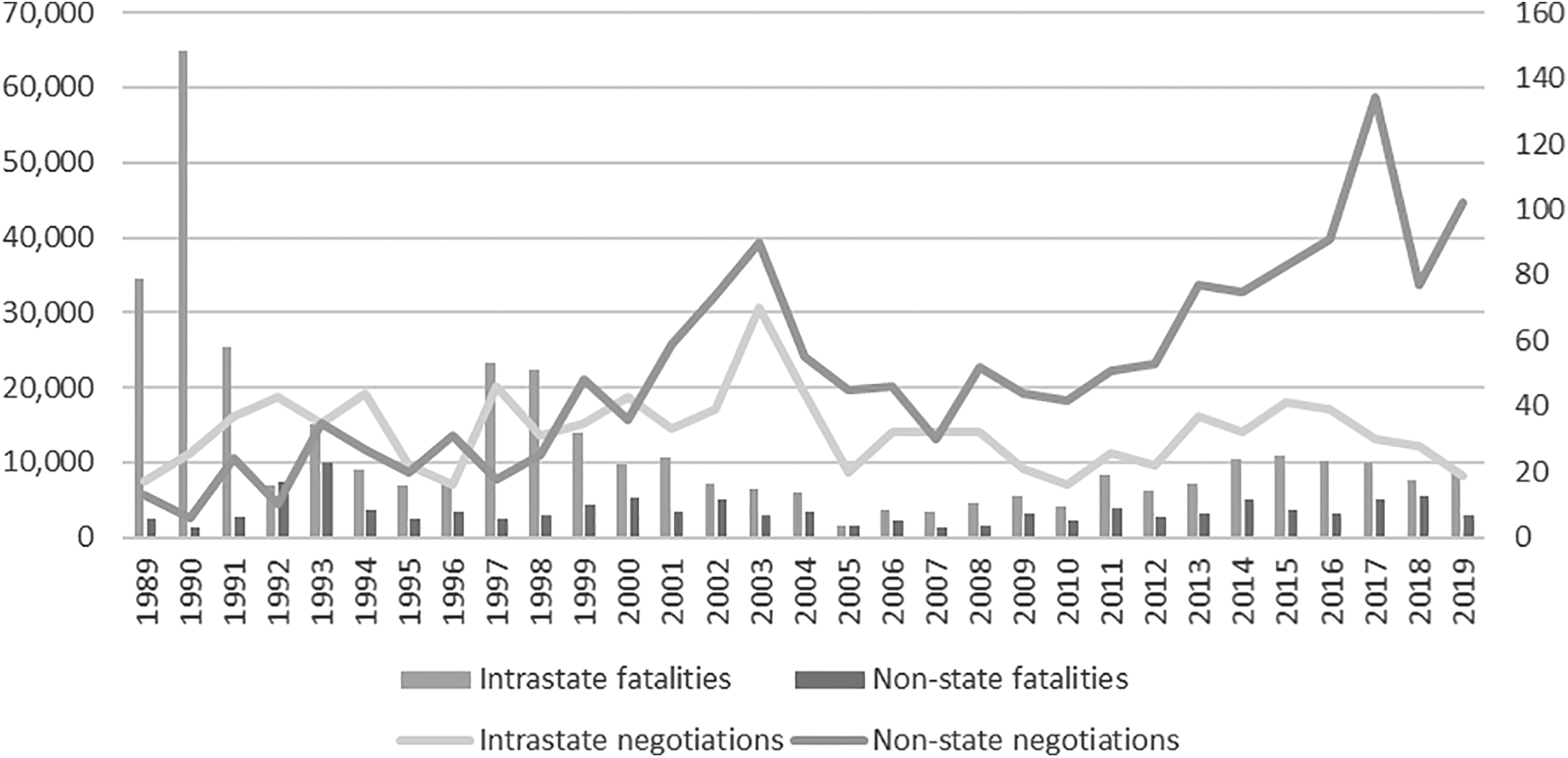
Patterns
The APP dataset records a total of 2,645 rounds of negotiations, of which 64 in interstate, 1,008 in intrastate, and 1,573 in non-state conflicts. Figure 1 shows the temporal trend of the negotiations in intrastate and non-state conflicts. 5 The y-axis on the right displays the no. of negotiations, while the y-axis on the left displays the no. of battle-related deaths the UCDP records for each type of conflict in a given year.
While the APP dataset records more rounds of negotiations in intrastate conflicts than in non-state conflicts up until 1993, fairly similar values are recorded until 2000. From 2001 onwards, the APP dataset records more rounds of negotiations in non-state conflicts. This cannot be explained by the relative prevalence of each type of conflict, as the UCDP consistently records more battle-related deaths in intrastate conflicts. Instead, the trend from 2001 onwards is in line with an observation made by Howard and Stark that the no. of mediation efforts have gone down following the terrorist attacks of September 11, 2001 (Howard & Stark, 2017). By contrast, both scholars and practitioners have noted how peace efforts in ‘local’, non-state conflicts have gone up (Mac Ginty & Richmond, 2013; Buchhold et al., 2018). We cannot exclude the possibility that the increase in recorded rounds of negotiations in non-state conflicts is a result of a greater availability of sources. Yet, we would then also expect no. of negotiations in intrastate conflicts to go up, which is not the case.
Turning to the type of third parties involved in mediating negotiations, we show in Figure 2 that only three types of mediation have taken place in interstate conflicts in Africa between 1989 and 2019: mediation by the UN, regional organizations and foreign governments. These categories are not mutually exclusive. For instance, UN Secretary-General Kofi Annan and French president Jacques Chirac jointly mediated between the Nigerian and Cameroonian heads of state in Paris in September 2002 (Konings, 2005).
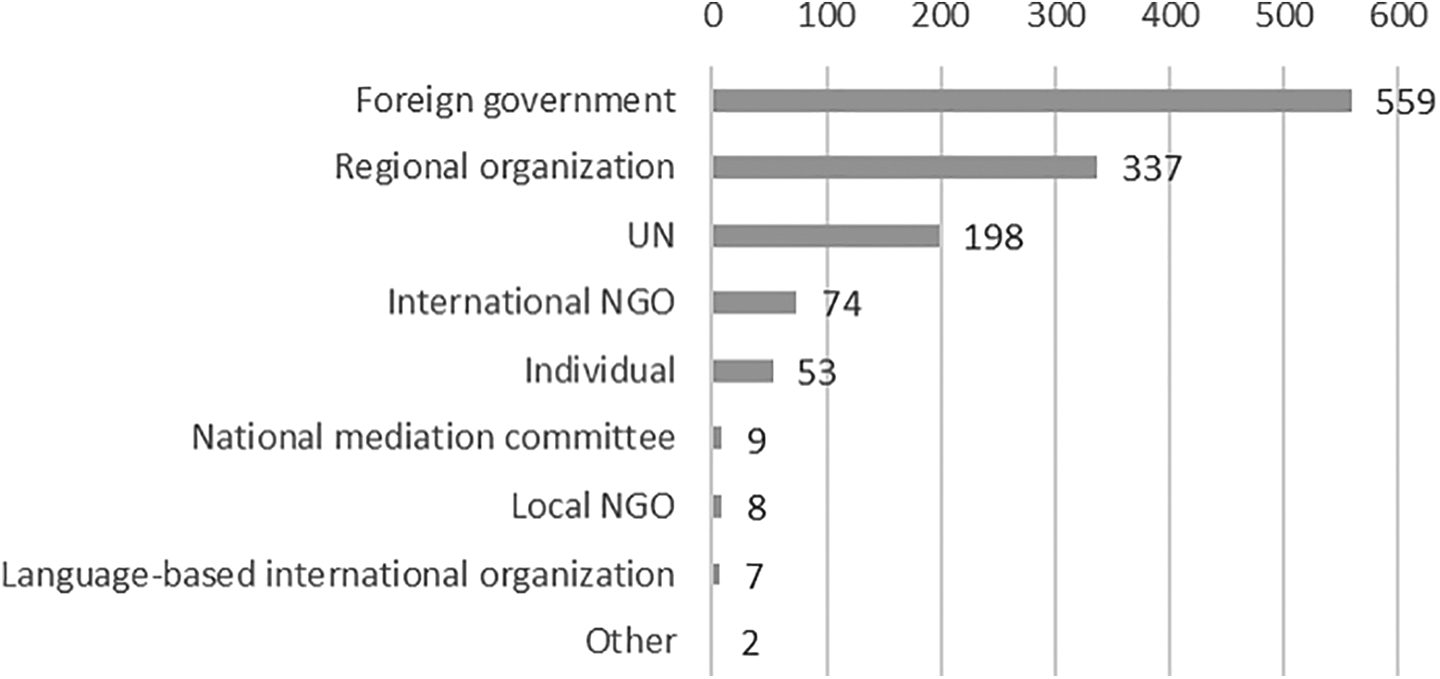
There is more variation in terms of what type of third parties are involved in mediation within intrastate conflicts (see Figure 3). Foreign governments, regional organizations and the UN are still the most common third parties in intrastate conflicts, but international NGOs and individuals have also quite frequently been involved in mediation. An example of a mediation effort by an individual is Julius Nyerere, the former President of Tanzania, mediating in his personal capacity during the civil war in Burundi. Nyerere refused to be an official
Third parties involved in negotiations in interstate conflicts Third parties involved in negotiations in intrastate conflicts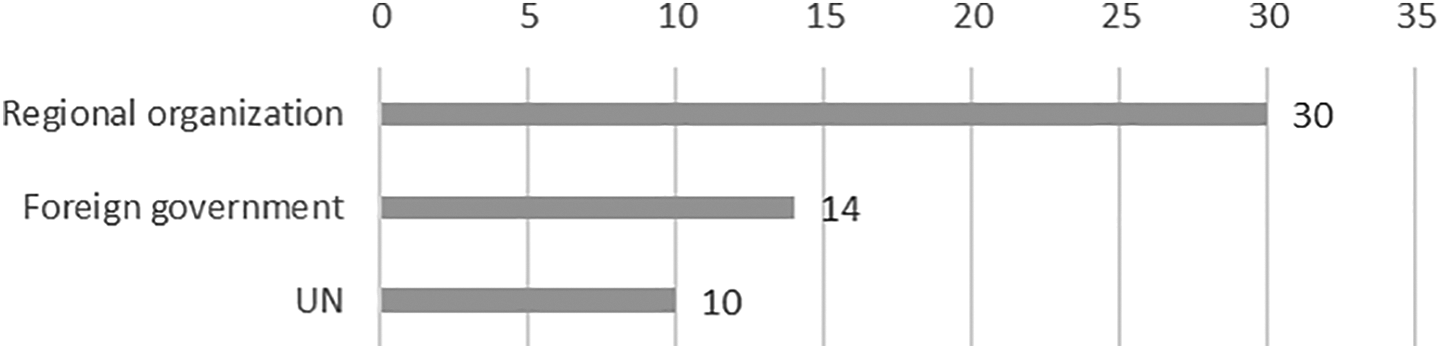
Non-state conflicts have experienced mediation by a diverse range of third parties (see Figure 4). Local government officials – for example, governors and mayors – have been most frequently involved in mediation. The second most frequently involved type of third party is the national-level government. We created a specific category for mediation efforts by the leader of a state. An example is the mediation effort by Nigerian President Olusegun Obasanjo between the Hausa and the Igbo in February 2000 (Associated Press Newswires, 29 February 2000).
The third most common type of third party involved in peacemaking in non-state conflicts are international peacekeeping missions, such as UNAMID in Darfur (Duursma, 2020b). When the UN mediates in non-state conflicts in countries where no peacekeeping operation is deployed, the mediation effort is subsumed under the International Organization category, along with efforts by for example the World Bank. For all other categories listed in Figure 4, we refer to the codebook included in the supplementary materials.
Turning to the outcomes of the negotiations recorded in the APP dataset, Figure 5 compares interstate, intrastate and non-state conflicts. Almost 80% of the negotiations in interstate conflicts did not result in a ceasefire or peace agreement. The conclusion of ceasefire only happened once out of the 64 rounds of negotiations in interstate conflict recorded in the APP dataset, which amounts to 1.6%. A further 12 rounds of interstate negotiations resulted in the conclusion of a peace agreement.
The majority of negotiations in intrastate conflicts did not result in a settlement, but around 16.7% and 21.1% resulted in the conclusion of a ceasefire or peace agreement respectively.
Negotiations in non-state conflicts resulted even more often in a negotiated settlement. Around 14.0% and 31.8% of the negotiations resulted in a ceasefire or peace agreement respectively.
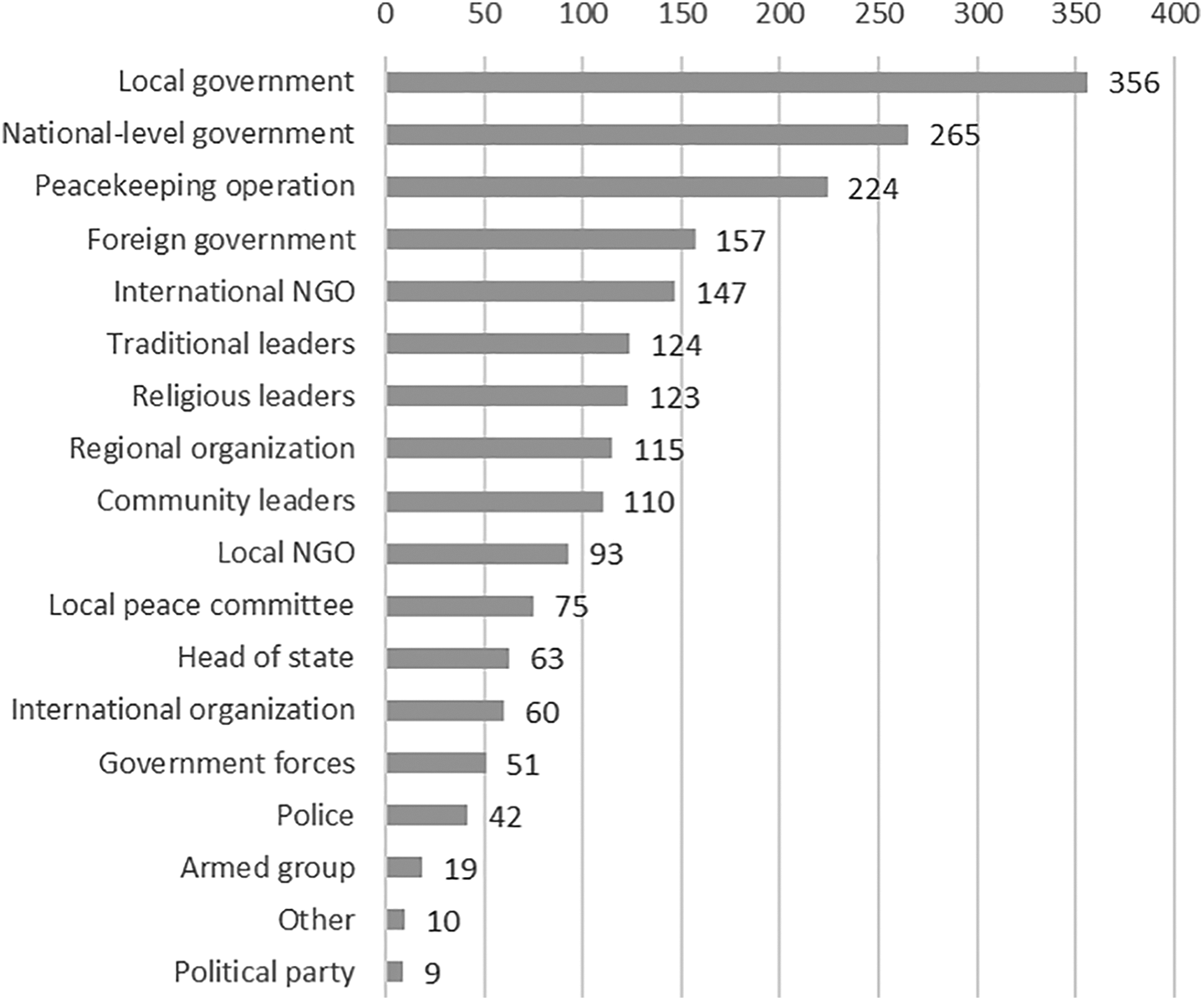
Third parties involved in negotiations in non-state conflicts
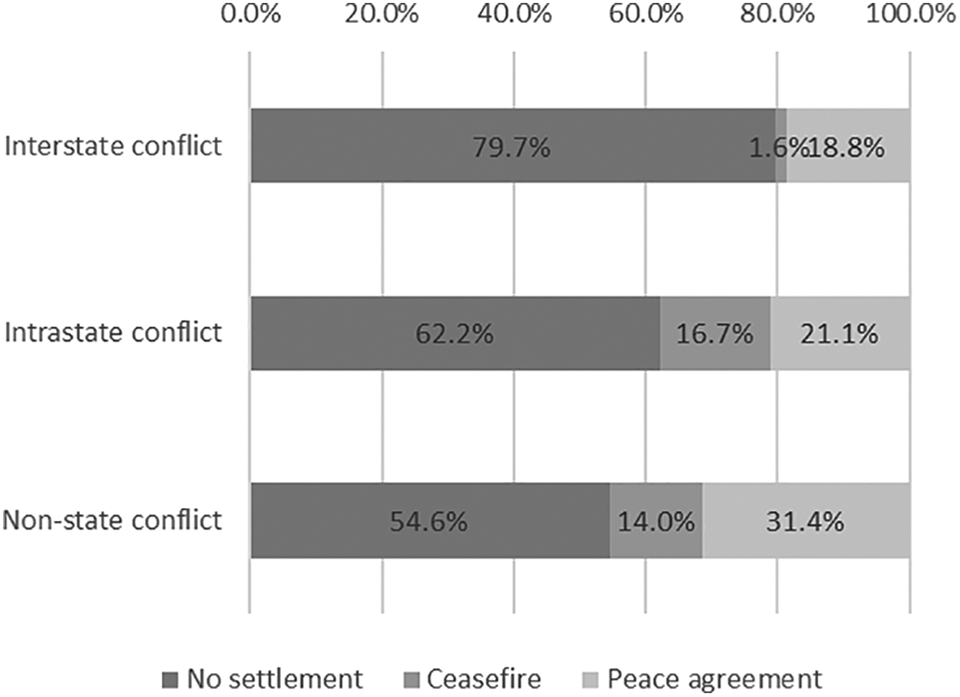
Outcome of negotiations in armed conflict in Africa, 1989–2019
Peacekeeping size and the onset of mediation in Africa
This final section illustrates how the APP dataset could be used by looking at the onset of negotiations in intrastate and non-state conflicts. One of the most prominent theories within the conflict resolution literature is Walter’s theory on credible commitments, which suggest that peace is less likely to be sustainable if there are no third parties to guarantee the peace (Walter, 2002). Far less attention has been paid to how commitment problems shape the onset of negotiations. Indeed, in her seminal monograph, Walter does not consider the impact of third-party security guarantees on the initiation of negotiations, asserting that third-party security guarantees mainly play a role in the decision to sign and implement a peace agreement (Walter, 2002: 71–75).
However, while this may be the case for intrastate conflicts – where negotiations are typically held in secure, luxurious hotels abroad – anecdotal evidence suggests that security concerns play a major role in the decision to initiate negotiations to resolve non-state conflicts (Duursma, 2022). For instance, following a failed mediation effort by a committee of neutral tribal elders in a conflict between the Rizeigat and Missiriya in Darfur in February 2010, the Rizeigat attacked the Missiriya right when the latter left the failed peace meeting and killed several Missiriya negotiators (Flint, 2010: 22). The role of the African Union – United Nations peacekeeping mission in Darfur was crucial in initiating subsequent negotiations, as it could ensure the safety of those involved in the negotiations (Duursma, 2022).
Logit estimates on mediation in active armed conflicts Africa, 1989–2019
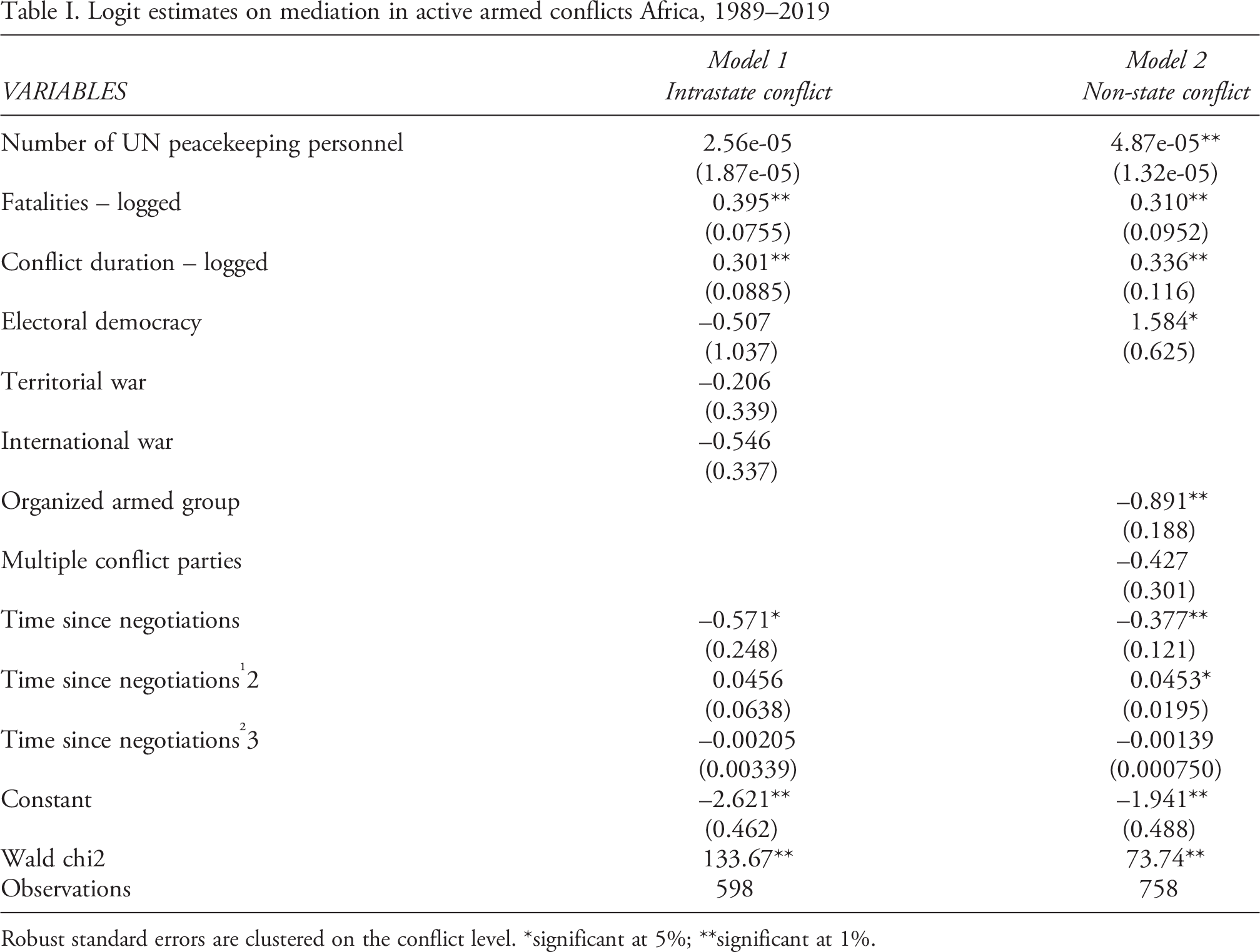
Robust standard errors are clustered on the conflict level. *significant at 5%; **significant at 1%.
Based on these type of security concerns in non-state conflicts, we expect that the no. of peacekeeping personnel that is deployed in a country should have a stronger impact on the onset of negotiations in non-state conflicts than in intrastate conflicts. 6 We examine our expectation in Table I. The unit of analysis in Table I is the intrastate conflict dyad-year in Model 1 and the non-state conflict year in Model 2. 7 The dependent variable is a dummy variable coded as 1 when at least one round of mediated negotiations took place in a given conflict year. We rely on updated data from Kathman on UN peacekeeping troop nos (Kathman, 2013). 8 Due to space constrains, we discuss the control variables in the Online appendix.
Table I provides correlational evidence for our expectation. 9 We use logit models with robust standard errors clustered on the conflict level. It follows from Model 1 that the no. of UN peacekeepers deployed is not significantly correlated with the onset of mediated negotiations in intrastate conflicts, while Model 2 suggest that there is such a significant association between peacekeeping size and mediated negotiated in non-state conflicts. Figure 6 shows the predicted probabilities of mediated negotiations in non-state conflict years. The predicted probability of negotiations is around 41.2% when no peacekeepers are deployed and grows to around 62.5% when 20,000 peacekeepers are deployed. We thus find some preliminary evidence for our expectation that peacekeepers help to mitigate security concerns to initiate negotiations in non-state conflicts.
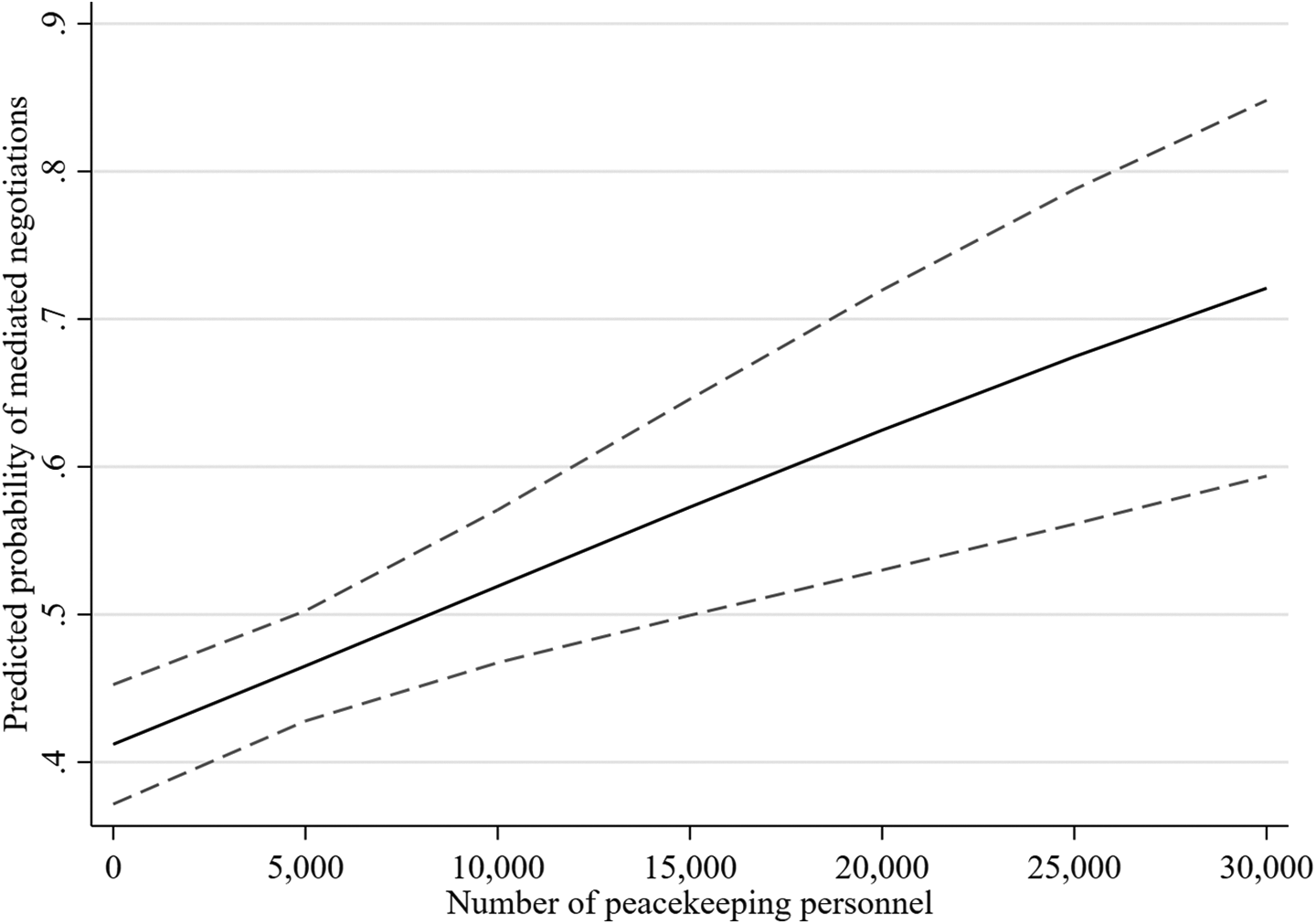
Predicted probabilities of mediated negotiations in non-state conflict years
The findings in Table I remain robust when we include conflict fixed effects in the models, as well as when we include variable that solely measures the no. of UN military personnel, rather than the total no. of personnel. These additional tests are reported in the Online appendix.
A major advantage of the APP dataset is that we can check whether the findings hold when we extend the dataset to include two post-conflict years. We report in the Online appendix that the correlation between the no. of peacekeepers and the initiation of negotiations in non-state conflicts is still significant when extending the sample.
The APP dataset also allows us to look at rounds of negotiations in general, rather than just mediated negotiations. We report in the Online appendix how our main findings remain the same when we look at negotiations in general.
Finally, another advantage of the APP dataset is that it allows us to use a count variable that measures the no. of rounds of negotiations in a given year. We show in an OLS model in the Online appendix that, in line with our expectations, the association between the no. of peacekeeping personnel deployed and the no. of negotiations held in a year is significant for non-state conflicts, but insignificant for intrastate conflicts. This short analysis thus illustrates the value of having data on negotiations in both intrastate and non-state conflicts, on peace efforts in post-conflict years, and on the no. of rounds of negotiations.
Conclusion
The APP dataset includes observations on peacemaking efforts in interstate, intrastate and non-state conflicts in Africa between 1989 and 2019. A first advantage of the APP dataset is that it includes observations on unmediated negotiations, which makes it possible to compare the effectives of mediated negotiations to unmediated negotiations. A second advantage is that the starting year and month and end year and month of all peace efforts are included in the APP dataset. This greater temporal precision could facilitate research to move away from the conflict year to the conflict month as unit of analysis. A third advantage of the APP dataset is that it records peacemaking efforts in inactive conflict years. A fourth and final advantage is that the APP dataset also looks at peacemaking efforts in non-state conflicts.
In order to illustrate the merit of having data on peacemaking efforts in both intrastate and non-state conflicts, we briefly explored how the no. of peacekeeping troops deployed are associated with mediated negotiations in these types of conflicts. The findings suggest a higher no. of peacekeeping troops are associated with a higher no. of mediated negotiations in non-state conflicts, but not in intrastate conflicts. This merits future research on the different effect of mediation in intrastate and non-state conflicts. Much more work can be done on the occurrence of mediation within this empirical domain, but another obvious focus area should be what explains mediation outcomes. A particularly promising avenue is to study the links between negotiations in state-based and non-state conflicts. It is our sincere hope that the APP dataset will help to further push the conflict resolution field forward.
Footnotes
Replication data
The codebook, analytical summaries, dataset and do-files for the empirical analysis in this article, along with the Online appendix, can be found at http://www.prio.org/jpr/datasets. The dataset and analytical summaries are also available at  . Updated versions of the dataset will also be available at www.allardduursma.com.
Funding
The author(s) received financial support for the research, authorship, and/or publication of this article: We gratefully acknowledge the financial support of the Center for Security Studies (CSS) and the Folke Bernadotte Academy (FBA).