



Abstract
Elites are central in creating, operating, defending and contesting international organisations (IOs), but little research is available about their attitudes toward these bodies. To address this gap, this article offers the first systematic and comparative analysis of elite perceptions of IO legitimacy. Building on a unique multi-country and multi-sector survey of 860 elites undertaken in 2017–19, we map and explain elite legitimacy beliefs toward three key IOs in different issue-areas: the International Monetary Fund (IMF), the United Nations Framework Convention on Climate Change (UNFCCC) and the United Nations Security Council (UNSC). Integrating public opinion research and international relations theory, the article advances an explanation of elites’ legitimacy beliefs that emphasises their satisfaction with the institutional qualities of IOs. We contrast this argument with three common alternative explanations, which respectively highlight utilitarian calculation, global orientation and domestic cues. The analyses show that elites’ satisfaction with institutional qualities of IOs is most consistently related to legitimacy beliefs: when elites are more satisfied with democracy, effectiveness and fairness in IOs, they also regard these IOs as more legitimate. These findings suggest that the prevailing debate between utilitarian calculation, global orientation and domestic cues approaches neglects the importance of institutional satisfaction as an explanation of attitudes toward IOs.
Keywords
Introduction
Recent history has seen international organisations (IOs) acquire substantially enlarged authority, on the premise that increased transnational policy challenges require expanded global regulation (Hooghe et al., 2017; Zürn, 2018). However, whether these expectations of IOs translate into greater action and impact depends in part on whether these institutions are perceived to be legitimate (Buchanan and Keohane, 2006). The more that an IO is considered legitimate – that is, is regarded to have a right to rule and to exercise it appropriately – the more that IO may be able to obtain resources, attract participation, take decisions, secure compliance and, ultimately, solve problems (Sommerer and Agné, 2018). Conversely, an IO with lower perceived legitimacy faces greater difficulties to act and impact – and indeed may struggle to maintain its role in competition with other sites of governance (Morse and Keohane, 2014; Zelli, 2018).
Given this importance, the question of legitimacy in global governance has attracted growing research attention over the past decade (Hurd, 2007; Tallberg et al., 2018; Zaum, 2013). Most previous empirical work has addressed citizen perceptions of IO legitimacy using public opinion data (e.g., Anderson et al., 2019; Bechtel and Scheve, 2013; Bernauer and Gampfer, 2013; Dellmuth and Tallberg, 2015; Johnson, 2011; Schlipphak, 2015; Voeten, 2013). In contrast, few studies have explored legitimacy beliefs toward IOs among elites. While some studies have examined elite opinion toward the European Union (EU) (Best et al., 2012; Hooghe, 2002; Persson et al., 2019), we lack systematic research on elite opinion towards IOs more generally (though see Binder and Heupel, 2015; Rosenau et al., 2006; Schmidtke, 2019). What levels of legitimacy do elites accord to IOs and what drives those elite beliefs?
This omission is striking since elites typically have the greatest access and input to IOs – and indeed conduct the actual global governing. Elites take the decisions in IOs (Cox and Jacobson, 1973), implement IO policies (Hawkins et al., 2006), lead business and civil society advocacy vis-à-vis IOs (Dür et al., 2019; Scholte, 2011), contribute knowledge to IOs through research (Haas, 1992) and shape perceptions of IOs via the media (Schmidtke, 2019). Whether IOs enjoy high or low stocks of legitimacy among elites is therefore likely to be consequential for the capacity of these organizations to govern.
To address this research gap, this article offers the first systematic and comparative analysis of elite perceptions of IO legitimacy. Building on a unique multi-country and multi-sector survey of elites undertaken in 2017–19, we map and explain elite legitimacy beliefs toward key IOs in three issue-areas: the International Monetary Fund (IMF) in economic governance; the United Nations Framework Convention on Climate Change (UNFCCC) in environmental governance; and the United Nations Security Council (UNSC) in security governance. We conceptualise elites as people who hold leading positions in key organizations in society that strive to be politically influential. The survey covers 860 elites who work in six different sectors (partisan-political, bureaucratic, business, civil society, news media, and research) in six countries (Brazil, Germany, the Philippines, Russia, South Africa and the United States) as well as global arenas (e.g., staff of IOs, multinational corporations, global news media and international non-governmental organisations [NGOs]). By covering IOs in different issue areas, countries in different world regions, and elites in different sectors, the analysis makes it possible to assess whether similar or distinct dynamics drive elites’ legitimacy beliefs across diverse contexts.
Theoretically, we advance an explanation of elites’ legitimacy beliefs that emphasises their satisfaction with the institutional qualities of IOs. This explanation extends prior research on institutional sources of legitimacy in global governance by privileging elites’ subjective satisfaction with institutional conditions, focusing on democracy, effectiveness, and fairness (cf. Hurd, 2007; Scholte and Tallberg, 2018). This approach suggests that elites who are more satisfied with these key institutional characteristics of IOs also accord these agencies more legitimacy. We contrast this argument with three common explanations in research on public opinion toward international issues and institutions, which respectively highlight utilitarian calculation, social identification and domestic cues (Hainmueller and Hiscox, 2006; Hobolt and de Vries, 2016; Hooghe and Marks, 2005; Lake, 2009; Rho and Tomz, 2017). We address these logics on the expectation that elite opinion would be driven by the same dynamics as public opinion. The first account explains elite legitimacy beliefs in terms of assessments of costs and benefits of IOs for one’s country, the second account emphasises the extent to which elites hold a global orientation and the third account privileges elites’ perceptions of domestic conditions.
Our principal findings are threefold. First, elites’ satisfaction with institutional qualities of the International Monetary Fund (IMF), the United Nations Framework Convention on Climate Change (UNFCCC) and the UN Security Council (UNSC) consistently explains variation in their legitimacy beliefs: when elites are more satisfied with democracy, effectiveness and fairness in these IOs, they also regard these bodies to be more legitimate. The only exception to this general pattern is elites’ satisfaction with democracy in the IMF, which does not significantly correlate with legitimacy beliefs. Second, utilitarian calculation receives mixed support: while perceived benefits for one’s country relate positively to elite legitimacy perceptions towards all three IOs, perceived influence for one’s country in the decision-making of these IOs does not. Third, global orientation and domestic cues obtain limited or no support. Neither an identification with the world nor assessments of domestic conditions are systematically related to elites’ perceptions of IO legitimacy. These findings are largely robust to alternative measures of the four logics, additional co-variates, other modelling strategies and replication at the level of geographical sub-samples and elite sectors.
These results suggest several broader implications for research and policy. First, our findings indicate that the prevailing debate between utilitarian calculation, social identification and domestic cues as explanations of attitudes towards IOs neglects the importance of satisfaction with institutional features of IOs. This article thereby extends other recent research demonstrating the importance of institutional qualities for IO legitimacy perceptions (Bernauer et al., 2020; Dellmuth et al., 2019). Second, the results suggest that elite perceptions of legitimacy in global governance are partly related to different factors than those that shape general public opinion on IOs. The firm support in existing public opinion research for utilitarian calculation, social identification and domestic cues as drivers of citizen legitimacy beliefs (Hobolt and de Vries, 2016) does not appear to extend to elite opinion. Third, the findings point to a need for future research to examine the determinants of elites’ satisfaction with the institutional qualities of IOs. What kinds of practices are most likely to generate elite satisfaction with these institutional qualities of IOs? Finally, the results have implications for IOs’ efforts to win the confidence of elite audiences through institutional reform. IOs that wish to bolster their legitimacy in the eyes of elites would be well advised to pursue reforms that improve democracy, effectiveness and fairness in the institutional workings of these organisations. Conversely, our findings suggest that opponents of IOs can draw elites to their side by highlighting purported institutional shortcomings in respect of democracy, effectiveness and fairness.
The rest of the article proceeds in four steps. The next section develops our explanation of elite legitimacy beliefs in terms of satisfaction with institutional qualities, as well as the three alternative explanations in terms of utilitarian calculation, global orientation and domestic cues. The second section discusses the research design, including the construction and execution of the elite survey, and also presents principal descriptive patterns in elite legitimacy beliefs. The third section offers an explanatory analysis of elites’ perceived legitimacy of the IMF, the UNFCCC and the UNSC. The conclusion summarises the findings and considers their implications for research and policy on global governance.
Explaining elite perceptions of IO legitimacy
We understand legitimacy as the belief or perception that a governing body has a right to rule and exercises it appropriately (Suchman, 1995; Weber, 1922/1978). Notions of the right to rule and its appropriate exercise point to the key quality in legitimacy of authorization: when people hold legitimacy beliefs, they confirm and endorse the ruler. Legitimacy thereby entails stable, diffuse, foundational support for a governing body, as distinct from contingent approval that derives from certain persons or particular policies (Easton, 1975; Hetherington, 1998; Norris, 2011).
Our concern is thus legitimacy in the sociological sense, as revealed by the perceptions and beliefs of governed subjects, rather than legitimacy in the normative sense, as derived from a governing body’s conformance to philosophical ideals. We thereby build on a line of empirical research about legitimacy in global governance (e.g., Hurd, 2007; Reus-Smit, 2007; Zürn, 2018), as distinct from normative enquiries into the legitimacy of IOs (e.g., Caney, 2005; Buchanan and Keohane, 2006; Archibugi et al., 2012).
In the following, we outline how and why we expect satisfaction with the institutional qualities of IOs to drive elites’ legitimacy perceptions. We then contrast this argument with three other explanations prevalent in the literature on attitudes toward international issues and institutions.
The argument: Satisfaction with institutional qualities
To explain the legitimacy perceptions of elites towards global governance we privilege their satisfaction with the institutional qualities of IOs. The notion that institutional features matter for legitimacy beliefs has a long pedigree in social theory. Already Weber (1922/1978: 215) theorised how sociological legitimacy derives from the proper administration of rules by properly appointed authorities. More recently, Scharpf (1999) introduced an influential distinction between input and output sources of legitimacy, where input involves the processes by which a governing institution takes decisions, while output involves the results and consequences of the institution’s activities.
These pioneering contributions have inspired a stream of research in Comparative Politics and International Relations on institutional sources of legitimacy. This literature generally explores how institutional qualities related to input (or procedure) and output (or performance) affect the legitimacy of governing bodies. On the procedural side, the research examines how conformance to features such as participation, efficiency and impartiality affects legitimacy perceptions (e.g., Binder and Heupel, 2015; Hurd, 2007; Tyler, 1990). On the performance side, the research examines the importance for legitimacy of features such as problem-solving, welfare gains and distributive justice (e.g., Dellmuth and Tallberg, 2015; Esaiasson et al., 2019; Newton and Norris, 2001). Although most institutional explanations have focused on procedure and/or performance, a few accounts have also considered organizational purpose, linking legitimacy beliefs to endorsement of an IO’s function or mission (Lenz and Viola, 2017).
Such explanations assume that people care about the institutional qualities of governing bodies when forming legitimacy beliefs (Bernstein, 2011; Scholte and Tallberg, 2018; Suchman, 1995). For instance, if people believe that governing arrangements should be democratic, then qualities such as participation and accountability become important for legitimacy assessments. Likewise, if people believe that governing arrangements should be effective, then qualities such as problem-solving and welfare gains become central. These explanations hold that governing bodies that perform better on valued institutional criteria attract more legitimacy, while those that perform worse on institutional criteria obtain less legitimacy.
Some recent studies have established causal effects of institutional qualities on legitimacy beliefs using survey experiments. For example, Bechtel and Scheve (2013) conclude that global climate agreements which involve lower costs, greater distributive fairness and more substantial sanctions generate greater public support. Likewise, Bernauer and Gampfer (2013) find that greater civil society involvement in global climate governance raises legitimacy beliefs among the general public. Finally, a number of studies conclude that features of both procedure and performance matter for legitimacy beliefs towards IOs involved in climate, economy and security governance (Anderson et al., 2019; Bernauer et al., 2020; Dellmuth et al., 2019).
Our present study extends such institutional accounts of legitimacy in global governance in three respects. First, we focus on elite perceptions of institutional qualities, while earlier research has examined this logic only with respect to public opinion. Indeed, we anticipate that elites are even more sensitive than citizens at large to institutional features. Overall, elites have greater formal education about politics than the wider public, their work environments are in closer contact with political institutions and they have greater ambitions for political influence. As a result, elites likely put more emphasis on institutional workings when forming opinions about IOs. In addition, elites generally have greater access to IOs than citizens at large and thereby have more opportunity to develop knowledge about their institutional operations, which can then feed into legitimacy beliefs. Indeed, a much higher share of respondents in our elite survey correctly answered three knowledge items about global governance than citizen samples from the same countries in World Values Survey 7. 1
As our second extension of existing research, we focus on elites’ satisfaction with the institutional qualities of IOs. While earlier research, as cited above, has examined how objective institutional features affect legitimacy beliefs, we privilege people’s evaluation of institutional characteristics. We posit that institutional qualities of IOs matter for legitimacy beliefs by way of people’s perceptions of those features (Lenz and Viola, 2017; Tallberg and Zürn, 2019). In other words, it likely matters less for legitimacy beliefs that decisions are actually taken democratically than that they are perceived to be taken democratically. We extend this principle further by adding a component of evaluation, suggesting that it is people’s satisfaction with perceived institutional qualities that matters (see also Rohrschneider, 2002). Thus, two individuals may have the same perception of a particular institutional quality, but assess it differently. When people are more satisfied with the institutional qualities they perceive, they are more likely to confer legitimacy on a governing body.
Our third contribution is to focus on elites’ satisfaction with three specific institutional qualities, namely, democracy, effectiveness and fairness. We presume that elites who are more satisfied with these key qualities of IOs are also more likely to accord those institutions legitimacy. As discussed below, other research has found that democracy, effectiveness and fairness drive legitimacy perceptions in multiple empirical settings. Moreover, earlier studies suggest that all three qualities are relevant to both the procedural and the performance sides of governance (Dellmuth et al., 2019).
Democracy is sometimes claimed to be the foremost source of legitimacy in global governance (Held, 1995) and has been shown to matter for perceptions of the legitimacy of governing institutions in general (De Cremer and Tyler, 2007). Regarding democratic procedure, some research finds that IOs which allow for participation by a broader range of societal actors beyond states attract greater perceived legitimacy (Bernauer and Gampfer, 2013). Other work establishes that transparency (in terms of public access to information) strengthens confidence in IOs (Dellmuth et al., 2019). Further studies show that dissatisfaction with perceived non-democratic decision-making can provoke contestation of IOs (Norris, 2011). Regarding democratic performance, IOs might obtain legitimacy through democracy promotion activities, for instance, by monitoring elections or protecting civil rights (Keohane et al., 2009). Alternatively, IOs might be considered less legitimate because of their perceived subversion of democratic governance, for example, when global economic institutions are viewed to dictate member-state policies (Hooghe et al., 2018).
Effectiveness is well known to influence how people evaluate governance arrangements (Doherty and Wolak, 2012; Skitka, 2002). Effective procedure can lie in the efficiency of IO decision-making (Tallberg et al., 2016) or in the use of best available knowledge (Majone, 1998). Conversely, slow decision-making, mismanagement of funds and organisational dysfunction may generate legitimacy problems for IOs (Reus-Smit, 2007). Effective performance refers to successful problem-solving (Scharpf, 1999) and has been found to affect legitimacy perceptions in the domestic context (Newton and Norris, 2001). Likewise, recent research concludes that perceptions of problem-solving underpin legitimacy beliefs toward IOs (Ecker-Ehrhardt, 2016). For example, legitimacy for the IMF suffered from charges of mishandling the Asia financial crisis of 1997–8 and failing to anticipate the global financial crisis of 2007–08 (Blustein, 2001).
Fairness, with its dual dimensions of procedural justice (Tyler, 1990) and distributive justice (Rawls, 1971), has been shown to matter for legitimacy perceptions towards governance arrangements (Esaiasson et al., 2019; Skitka et al., 2003). The global setting is unlikely to be an exception. With regard to fair procedure, people may view IOs with impartial and proportionate procedures to be more legitimate (Zürn, 2018: 67–70). For instance, IOs like the UNSC that distribute voting power more unequally among their member states tend to be perceived as less legitimate than IOs with more egalitarian decision-making arrangements (Binder and Heupel, 2015; Tallberg and Verhaegen, 2020). As for fair performance, legitimacy beliefs may increase when people perceive IOs to promote distributive justice through equitable sharing of benefits and burdens. Indeed, popular protests have repeatedly targeted global economic institutions for allegedly producing unacceptable inequalities (O’Brien et al., 2000; Scholte et al., 2016). Conversely, IOs with poverty alleviation profiles often legitimise themselves by claiming to promote fairness for underprivileged people (Zürn, 2018).
In sum, our focus on elites, institutional satisfaction and the qualities of democracy, effectiveness and fairness leads to the following three hypotheses:
H1.1 The more that elites are satisfied with the democratic qualities of an IO, the more they will perceive this institution to be legitimate.
H1.2 The more that elites are satisfied with the effectiveness qualities of an IO, the more they will perceive this institution to be legitimate.
H1.3 The more that elites are satisfied with the fairness qualities of an IO, the more they will perceive this institution to be legitimate.
Alternative explanations
Public opinion research offers three prominent alternative accounts of the sources of legitimacy beliefs towards IOs: namely, in terms of utilitarian calculation, global orientation and domestic cues (Hainmueller and Hiscox, 2006; Hobolt and de Vries, 2016; Hooghe and Marks, 2005; Mansfield and Mutz, 2009; Rho and Tomz, 2017). 2 We draw on these explanations of popular attitudes to develop three possible alternative accounts of the drivers of elite legitimacy beliefs toward IOs.
With respect to utilitarian calculation, the proposition is that elites are more likely to regard an IO as legitimate when they perceive it to bring advantages for their country. This explanation draws on earlier research that emphasises cost–benefit calculation as central to the formation of opinions on international issues and institutions (e.g., Anderson and Reichert, 1995; Curtis et al., 2014; Gabel, 1998; Lake, 2009; Scheve and Slaughter, 2001). The utilitarian calculation explanation is distinct from our institutional argument, as the latter involves satisfaction with general governance norms rather than specific impacts on one’s own country. 3
When applying this utilitarian logic to elite attitudes towards IOs, we focus on sociotropic calculation (in terms of consequences for one’s country) rather than egotropic calculation (in terms of personal self-interest) (Eichenberg and Dalton, 1993; Verhaegen et al., 2014). 4 We anticipate that, as leaders in society, elites (and especially national political elites) care about how IOs affect their country. We distinguish two types of country-related utility considerations: (a) perceived influence of one’s government in an IO and (b) perceived benefits to one’s country from an IO. The first logic proposes that elites who regard their state to have more influence in an IO will consider this institution to be more legitimate, while elites who see their state to have less influence will view the IO to be less legitimate (Hurd, 2008; Stephen and Zürn, 2019). The second logic suggests that elites who perceive their country to gain more from an IO will consider this organization to be more legitimate, while elites who judge their country to be gaining less, or even losing, from an IO will regard it to be less legitimate (Anderson and Reichert, 1995; Eichenberg and Dalton, 1993).
In sum, the logic of utilitarian calculation yields two hypotheses:
H2.1 The more that elites perceive their country to influence an IO, the more they will perceive this IO to be legitimate.
H2.2 The more that elites perceive their country to benefit from an IO, the more they will perceive this IO to be legitimate.
The second alternative account suggests that elites form beliefs about the legitimacy of IOs based on the extent to which these leaders hold a global orientation. The proposition here is that elites who “think globally” are more likely to regard IOs as legitimate sites of governance. This account draws on substantial public opinion research concerning social identity as a source of attitudes toward international issues and institutions (e.g., Hainmueller and Hiscox, 2006; Mansfield and Mutz, 2009; Norris, 2000; Rho and Tomz, 2017; Sniderman et al., 2004). Such studies often present identity-based explanations in competition with utilitarian logics (Hobolt and de Vries, 2016).
When applying this approach to elite attitudes toward IOs, we consider two main components of a global identity orientation. First, elites may hold the global level to be the most appropriate arena for handling societal problems. In this account, elites who see societal challenges as having a significant global character look more readily to global governance to provide relevant policy responses. As a result, such elites would hold greater legitimacy beliefs toward IOs that address these challenges (Ecker-Ehrhardt, 2011; Norris, 2000). For instance, recent work shows that people who consider the UN well-placed to handle issues of human rights, peacekeeping, environment, development and refugee policy are more likely to have confidence in the institution (Dellmuth and Tallberg, 2015).
Second, elites may hold a global identification, in terms of feeling close to the world. In this account, elites who feel part of a global community are more likely to perceive IOs as legitimate sites of governance, given the congruence between the community they affiliate with and the population that the IO governs (Beetham and Lord, 1998). This logic draws on research concerning social identity as a determinant of political attitudes (Sniderman et al., 2004). When people identify with a certain sphere, they also tend to be more positive towards political authority which is exercised at that level (Berg and Hjerm, 2010; Verhaegen et al., 2018). For instance, European identification is a prominent explanation of popular support for the EU (Hobolt and de Vries, 2016; Hooghe and Marks, 2005). Other studies have shown that global identification matters for popular attitudes towards the UN (Dellmuth and Tallberg, 2015; Norris, 2009; Torgler, 2008).
In sum, the global orientation logic yields two hypotheses:
H3.1 The more that elites prefer problem-solving to occur at the global level, the more they will perceive an IO to be legitimate.
H3.2 The more that elites identify with the global level, the more they will perceive an IO to be legitimate.
The third alternative account suggests that elites form legitimacy beliefs toward IOs based on domestic cues. This proposition holds that elites who are more (or less) satisfied with circumstances in their respective national contexts are more (or less) likely to regard IOs as legitimate. Considerable public opinion research suggests that legitimacy beliefs towards international institutions do not arise independently of attitudes towards domestic conditions, but on cues from those opinions. Much of this literature relates to the EU (e.g., Armingeon and Ceka, 2014; De Vries, 2018; Harteveld et al., 2013; Muños et al., 2011; Rohrschneider, 2002), but more recent contributions extend this account to other regional and global IOs (e.g. Dellmuth and Tallberg, 2020; Schlipphak, 2015; Voeten, 2013).
The logic around domestic cues comes in two main variants, which differ in the direction of the expected effect. A first variant theorises a positive relationship between individuals’ trust in domestic political institutions and their legitimacy beliefs towards IOs (Armingeon and Ceka, 2014; Dellmuth and Tallberg, 2020; Muños, 2011; Voeten, 2013). For example, some research suggests that individuals extrapolate trust from domestic political institutions to IOs: since most people have less awareness of IOs, they draw on their trust in domestic institutions, which they know better, to form opinions about IOs (Harteveld et al., 2013; Schlipphak, 2015). Other studies place the driver with perceptions of the role of one’s government in IOs: if people (mis)trust the national government, and this government is influential within an IO, then people (mis)trust the international institution as well (Harteveld et al., 2013; Johnson, 2011).
A second variant of the domestic cues logic theorises a negative relationship. According to this argument, evaluations of domestic economic and political circumstances form a benchmark against which people develop attitudes towards IOs. 5 All else equal, the less that people are satisfied with policies and regimes at the domestic level, the more supportive they will be of IOs (De Vries, 2018). Conversely, when people are more satisfied with domestic circumstances, they are more likely to be critical of IOs, which are then seen to suffer more from deficits of democracy and effectiveness (Rohrschneider, 2002; Rohrschneider and Loveless, 2010).
These two variants of the domestic cues argument yield two alternative hypotheses, where the first focuses on trust in domestic institutions and expects a positive relationship, while the second focuses on evaluation of domestic economic and political circumstances and expects a negative relationship:
H4.1 The more that elites trust domestic political institutions, the more they will perceive an IO to be legitimate.
H4.2 The less that elites are satisfied with domestic economic and political conditions, the more they will perceive an IO to be legitimate.
Research design
To test these hypotheses, we conducted a survey of political and societal leaders, examining their assessments of the IMF, the UNFCCC and the UNSC. In the following, we describe the survey design, the operationalisation of key variables and the levels of legitimacy that surveyed elites ascribe to the three IOs.
Survey design
We draw our empirical evidence from the Legitimacy in Global Governance (LegGov) Elite Survey, fielded between October 2017 and August 2019. 6 The survey covered elites in different sectors of politics and society, IOs in different issue areas and countries in different world regions. This diversity allows us to assess whether elites’ legitimacy beliefs are driven by similar dynamics across contexts or by dynamics specific to the respective contexts.
We understand elites to be persons who hold leading positions in key organizations in society that strive to be politically influential. While most studies of elite opinion focus exclusively on political elites (politicians and government officials), the LegGov Elite Survey also covers societal elites in academe, business, civil society and news media, since both governmental and non-governmental sectors aspire to influence issues addressed in IOs.
In the absence of an exhaustive database of elite individuals and organisations from which random samples could be drawn, the LegGov Elite Survey used quota sampling to assure that the respondents would cover a wide variety of functions, organisations, issue areas and governance-level orientations. With a quota sample, it is not possible to extrapolate results beyond the sample. The LegGov Elite Survey first identified key organisations within different sectors in the six countries and at the global level (Hoffmann-Lange, 2009). Then, within those organisations, people in leading strategic positions and working on substantive issues (as distinct from purely administrative responsibilities) were identified. Within each country and global sub-sample, quotas were set so that half of the respondents would be political elites (25 each for government bureaucracy and political parties) and the other half societal elites (12–13 each for business, civil society, news media and research). In the global sample, political elites consist half of national representatives at IOs and half of permanent officials of IOs.
In total, 860 elite individuals were surveyed: 124 in Brazil, 123 in Germany, 122 in the Philippines, 108 in Russia, 123 in South Africa, 122 in the United States and 138 at the global level. The survey was conducted by telephone (81.5 percent of the surveys) or as a self-administered online survey when a telephone survey was not possible (18.5 percent of the surveys).
The survey focused on elite opinion towards key IOs in three issue areas: the IMF in economic governance, the UNFCCC in environmental governance and the UNSC in security governance. This selection follows a most-different comparative case design. If we can establish that satisfaction with institutional qualities helps to explain legitimacy beliefs in this diverse set of IOs – engaging in different issue areas, using different decision-making procedures and yielding different outcomes – then we can be more confident that institutional satisfaction is a driver of general importance. The IMF supports countries undergoing balance of payments difficulties and more generally advises on the macroeconomic policies of its member states. Decision-making in the IMF differentiates voting power between member states according to their capital subscriptions. Historically, the Fund has often faced criticisms around its structural adjustment programs, handling of financial crises and policymaking processes (Woods, 2007). The UNFCCC is the principal forum for global negotiations on efforts to combat climate change. Decisions are taken through consensus, even if states that are large emitters of greenhouse gases tend to have greater voice (Friman, 2013). The UNFCCC is relatively open to non-state actors, but critics argue that its policies are ineffective and unfair (Bäckstrand and Kuyper, 2017). The UNSC enjoys a broad range of powers to further international peace and security. However, its decision-making arrangements have historically hampered the institution’s capacity to act (Vreeland and Dreher, 2014). Power is concentrated with the Council’s five permanent members, who can wield a veto to block decisions that they oppose. All three IOs have faced legitimacy concerns, making them particularly interesting for this study (see also Bernstein, 2005; Binder and Heupel, 2015; Dellmuth et al., 2019; Edwards, 2009; Hurd, 2007).
The six selected countries for the survey offer geographical diversity, varying positions in the current world order and different experiences of the IOs in question. Regarding the IMF, Brazil, the Philippines, Russia and South Africa have undergone Fund-sponsored structural adjustment programs and (except Russia) form part of multi-country constituencies on the IMF Executive Board. In contrast, Germany and the United States have not experienced IMF conditionality and hold their own seats on the IMF Executive Board. Regarding the UNFCCC, our sample includes both Annex I (industrialised) countries and non-Annex I (developing) countries, with different obligations. Governments of all six countries ratified the 2015 Paris Agreement, but the United States later withdrew, and the current president of Brazil takes an ambiguous position. Regarding the UNSC, Russia and the United States are permanent members, while Brazil, Germany and South Africa have all made claims for a permanent seat on a reformed council. The diversity of the sample allows us to test explanations for legitimacy beliefs beyond specific national conditions, even if the sample is not statistically representative of elites around the world.
Operationalisation
The survey asked specific questions about assessments and experiences of the IMF, the UNFCCC and the UNSC. Additional questions covered social and political attitudes that are potentially related to legitimacy perceptions. The data allow us to test the hypotheses presented earlier.
We operationalised legitimacy perceptions by asking respondents about their degrees of confidence in the three IOs. Respondents in the survey were asked to indicate whether they had (0) ‘no confidence at all’, (1) ‘not very much confidence’, (2) ‘quite a lot of confidence’, or (3) ‘a great deal of confidence’. Confidence, along with trust, has emerged in political science as a common way to measure legitimacy beliefs (e.g., Bühlmann and Kunz, 2011; Inglehart and Welzel, 2005; Johnson, 2011; Newton and Norris, 2001; Voeten, 2013).
Confidence has several advantages as an indicator of legitimacy perceptions. First, confidence, commonly defined as the belief that something or someone is good and can be trusted, aligns well with our conceptualisation of legitimacy as the perception that an institution generally exercises its authority appropriately. The confidence measure taps into respondents’ general faith in an institution, beyond short-term satisfaction with specific processes or outcomes (Easton, 1975; Hetherington, 1998; Norris, 2011; Schnaudt, 2018). Second, a narrow measure of legitimacy, such as confidence (or trust), has advantages when studying sources or effects of legitimacy. Different from some alternative operationalisations (e.g., Anderson et al., 2019; Esaiasson et al., 2012; Gilley, 2006), confidence does not incorporate into the measure either potential sources of legitimacy (such as the fairness or effectiveness of an institution) or potential consequences of legitimacy (such as compliance with an institution’s rules). Third, the confidence measure allows us to relate the findings of this study to the large literature on public opinion that also employs this indicator. Ultimately, one of the most interesting questions is how the levels and drivers of elite legitimacy beliefs towards IOs compare with those of the general public. To be sure, some researchers have expressed certain cautions about the confidence indicator for legitimacy beliefs (for an overview, see Schnaudt, 2018). However, these sceptics still mostly agree that confidence is relevant to legitimacy; nor do they provide a convincing better alternative proxy.
Table 1 presents the mean levels of confidence in the IMF, the UNFCCC and the UNSC for the entire sample of respondents, and Figure 1 presents the distributions of confidence in these IOs. On average, the surveyed elites lean toward ‘quite a lot’ of confidence in the UNFCCC. According to paired t-tests (p < 0.001), average confidence toward the IMF and the UNSC is significantly lower, lying midway between ‘not very much’ confidence and ‘quite a lot’ of confidence. Figure 1 shows that less than 10 percent of respondents has ‘a great deal’ of confidence in the IMF and UNSC, while over 20 percent of respondents has such high confidence in the UNFCCC.
Mean confidence in the IMF, UNFCCC, and UNSC.
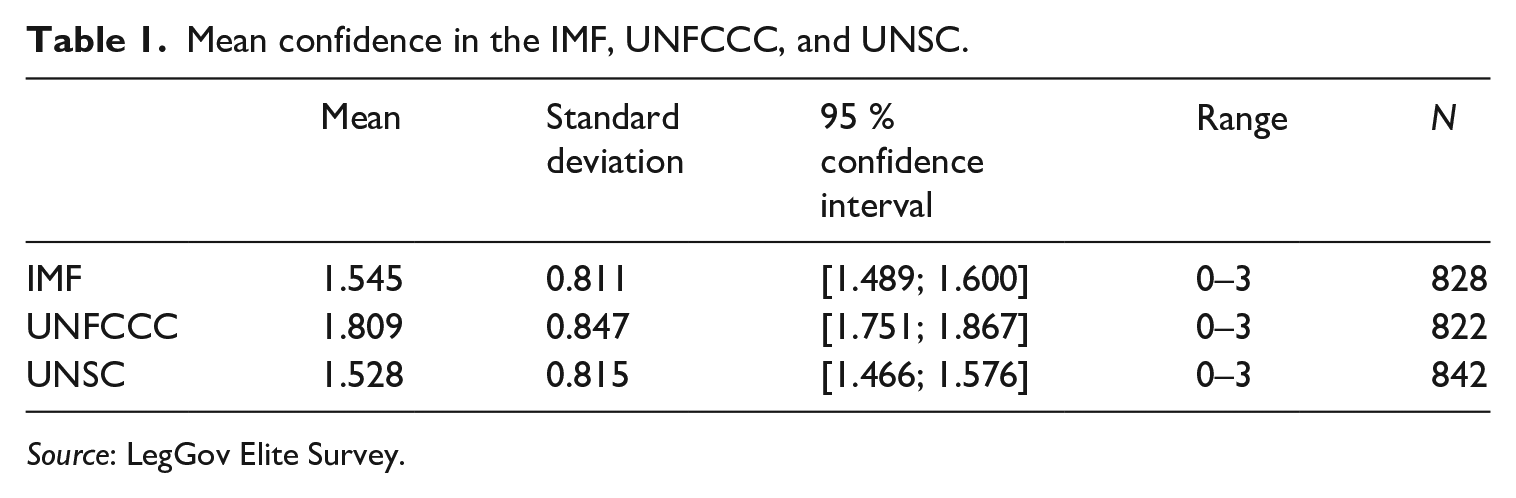
Source: LegGov Elite Survey.
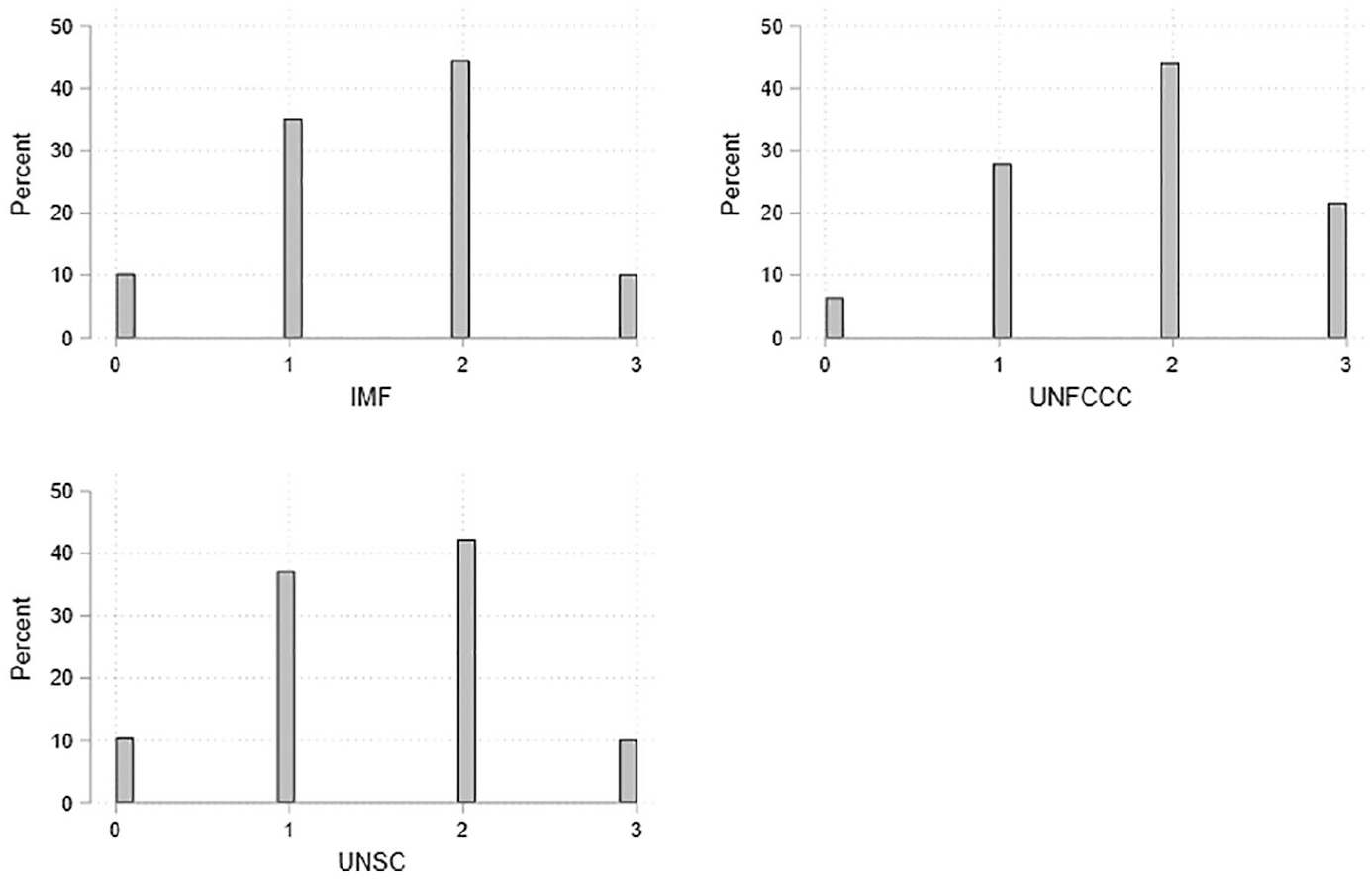
Distribution of confidence in the IMF, UNFCCC and UNSC.
Figure 2 breaks down confidence levels toward these three IOs by geographical sub-sample (six countries and global). Dots indicate mean levels of confidence in the IMF, the UNFCCC and the UNSC, while attached lines indicate the 95 percent confidence intervals around the means. Confidence in the IMF is particularly high in the global sub-sample and particularly low in the Philippines, Russia and South Africa. Confidence in the UNFCCC is particularly high among respondents in Brazil, the Philippines and the global sub-sample. Confidence in the UNSC is particularly high among respondents in Russia and particularly low in South Africa. Comparing across the three IOs, paired t-tests show that the UNFCCC enjoys higher confidence than the IMF in all sub-samples except the United States, and higher confidence than the UNSC in all sub-samples except Russia.
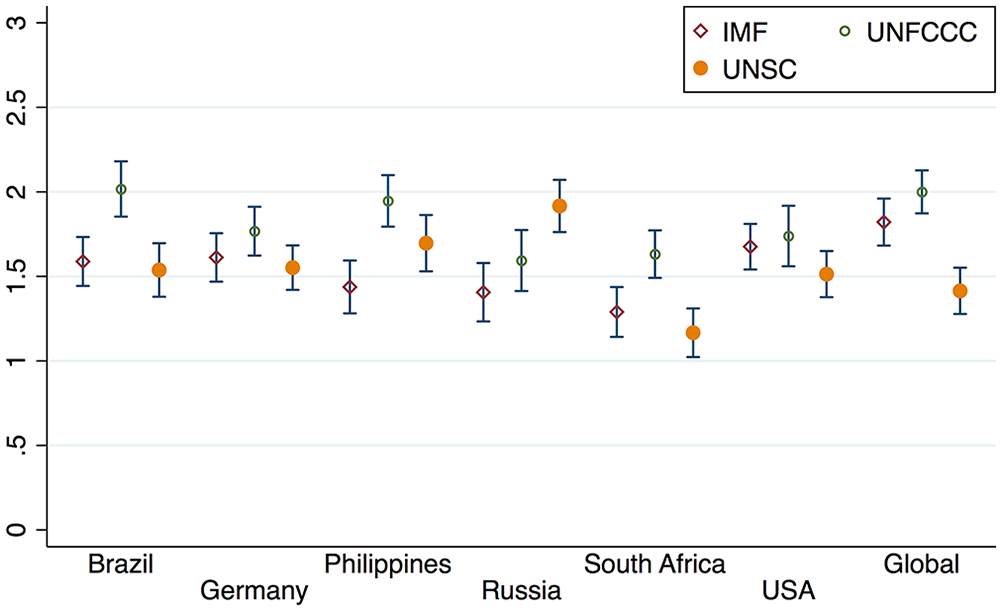
Mean confidence by geographic sub-sample.
Figure 3 presents confidence levels when disaggregating the sample by elite sector. The IMF enjoys significantly higher confidence among business elites and especially low confidence among civil society elites (t-tests, p < 0.05). For all sectors except for business elites, the UNFCCC obtains the highest confidence score of the three IOs. Confidence in the UNSC is significantly lower for civil society and media elites, compared to the other sectors (t-tests, p < 0.05).
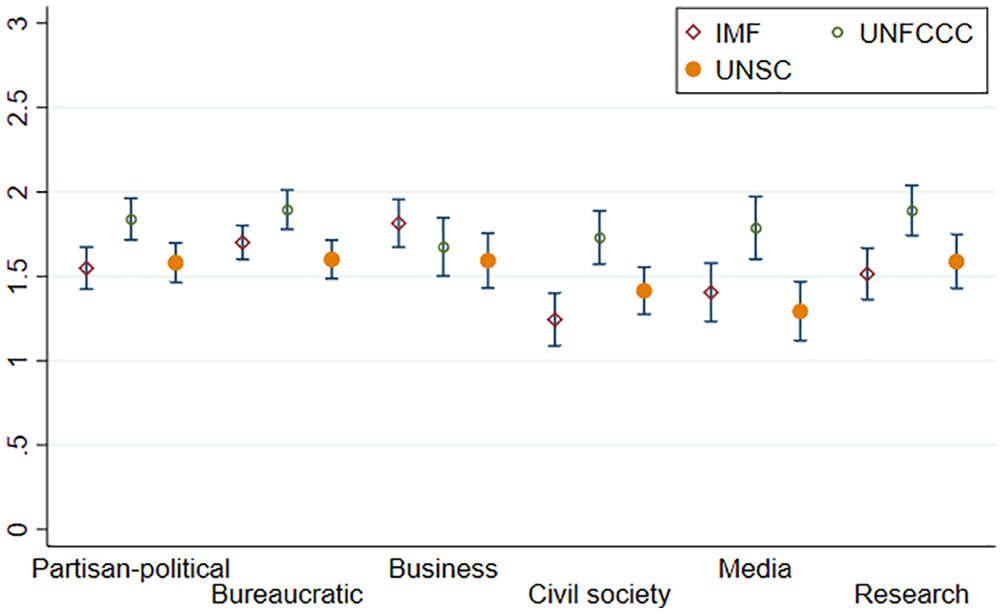
Mean confidence by elite sector.
To operationalise the explanatory variables, the elite survey asked questions that tap into respondents’ satisfaction with institutional qualities of IOs, utilitarian calculation of country advantages, global orientation and domestic cues. Appendix C gives the full wordings of the survey items and presents the distribution of answers to each question. While elites might be expected to have more homogeneity than the general public in terms of, for instance, global orientation, Appendix C shows that our sample has sufficient variation in regard to each of the explanatory variables, thus enabling us to study their respective relationships with confidence in the three IOs.
Satisfaction with institutional qualities of the IOs is measured through separate survey items that ask respondents how satisfied they are (on a scale 0–9) with democracy, fairness and effectiveness in the IMF, the UNFCCC and the UNSC. Regarding democracy and fairness, paired t-tests show that the UNFCCC scores significantly higher than the UNSC and the IMF (p < 0.001). The IMF and UNSC score similarly (lower) on satisfaction with democracy and fairness. Regarding effectiveness, the UNFCCC and the IMF score significantly higher than the UNSC.
The survey operationalises utilitarian calculation with two measures. First, respondents were asked to evaluate their country’s influence in decision-making at the IMF, the UNFCCC and the UNSC. Appendix C shows that respondents on average think that their country has something between ‘little influence’ and ‘quite some influence’. Second, respondents were asked to assess how far their country benefits from decisions taken in these three IOs. Respondents estimate the benefits to their country from the UNSC and the IMF to be mid-way between ‘low benefit’ and ‘quite some benefit’, while the mean for the UNFCCC comes closer to ‘quite some benefit’.
For global orientation, we also use two measures. First, respondents were asked about their preferred governance level (sub-national, country, regional or global) for issue areas that are key to the IMF (development and trade), the UNFCCC (environment) and the UNSC (security). Dummy variables indicate whether respondents preferred global governance (1) or governance on a different level (0). Appendix C shows that the majority of respondents identified the global as the most appropriate level for trade and environmental governance, while a minority preferred global governance for issues related to development and defense. Second, as a measure for global identification, respondents were asked how close they feel to the world. The average respondent has a quite strong global identification (mean = 1.926, scale 0–3).
Finally, we assess domestic cues using three measures. We test the expectation that domestic institutional trust drives elites’ legitimacy perceptions towards IOs by asking respondents about their confidence in the national government and parliament. We assess the expectation that perceptions of domestic political and economic conditions matter by including two variables that measure respondents’ satisfaction with the national economic situation and the national political system.
In addition, the models include controls for age and gender. The mean as well as the median age of respondents is 50 years, while the sample consists of 66 percent male respondents. Biases towards older and male individuals correspond to commonly observed socio-demographics of elites.
Results
What explains elite legitimacy beliefs vis-à-vis the IMF, the UNFCCC and the UNSC? In the following, we discuss the relationship between institutional satisfaction, utilitarian calculation, global orientation and domestic cues on the one hand, and confidence in the IMF, the UNFCCC and the UNSC on the other.
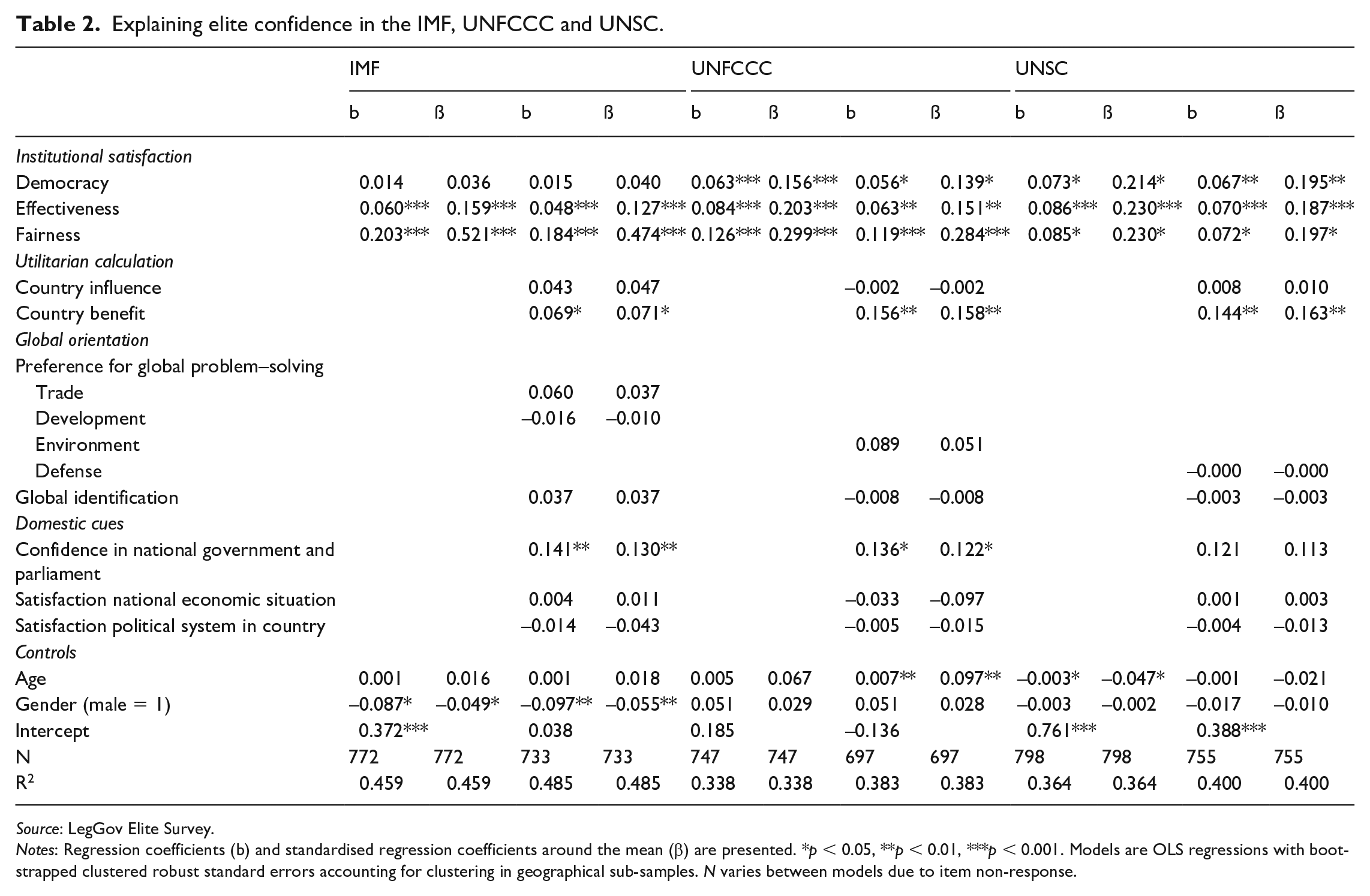
Table 2 presents linear regression models that estimate the relationship between the four sets of explanatory factors and respondents’ confidence in the three IOs. The models include bootstrapped clustered robust standard errors to account for the clustering of the data into seven sub-samples (six countries and a global sample) (Cameron et al., 2008). While the 4-point Likert scale measuring confidence would usually call for an ordered logit regression, we adopt linear regression models for two reasons. First, linear models allow us to compare effect sizes, which is problematic in ordered logit models (Long, 2012; Mood, 2010). Second, linear regression and Pearson correlations are robust for the violation of the assumption of linearity when using Likert scales (Norman, 2010). When we estimate ordered logit models as a robustness check, the direction and significance of the explanatory variables do not change (Appendix D, Table D.5).
Explaining elite confidence in the IMF, UNFCCC and UNSC.
Source: LegGov Elite Survey.
Notes: Regression coefficients (b) and standardised regression coefficients around the mean (β) are presented. *p < 0.05, **p < 0.01, ***p < 0.001. Models are OLS regressions with bootstrapped clustered robust standard errors accounting for clustering in geographical sub-samples. N varies between models due to item non-response.
The results in Table 2 consistently show that elites’ satisfaction with institutional qualities (democracy, effectiveness and fairness) has a significant positive correlation with confidence levels in the three IOs (H1.1, 1.2 and 1.3), also when accounting for the alternative explanations. For the UNFCCC and the UNSC, a positive relationship exists between satisfaction with all three institutional qualities and confidence, and Wald tests indicate no significant difference in the magnitude of these relationships. The results for the IMF are more mixed: while a significant positive relationship prevails between respondents’ satisfaction with fairness and effectiveness and their confidence in the IO, no significant relationship appears between democracy and confidence. A Wald test shows that the strength of the relationship between fairness and confidence is stronger than the relationship between effectiveness and confidence (βfairess
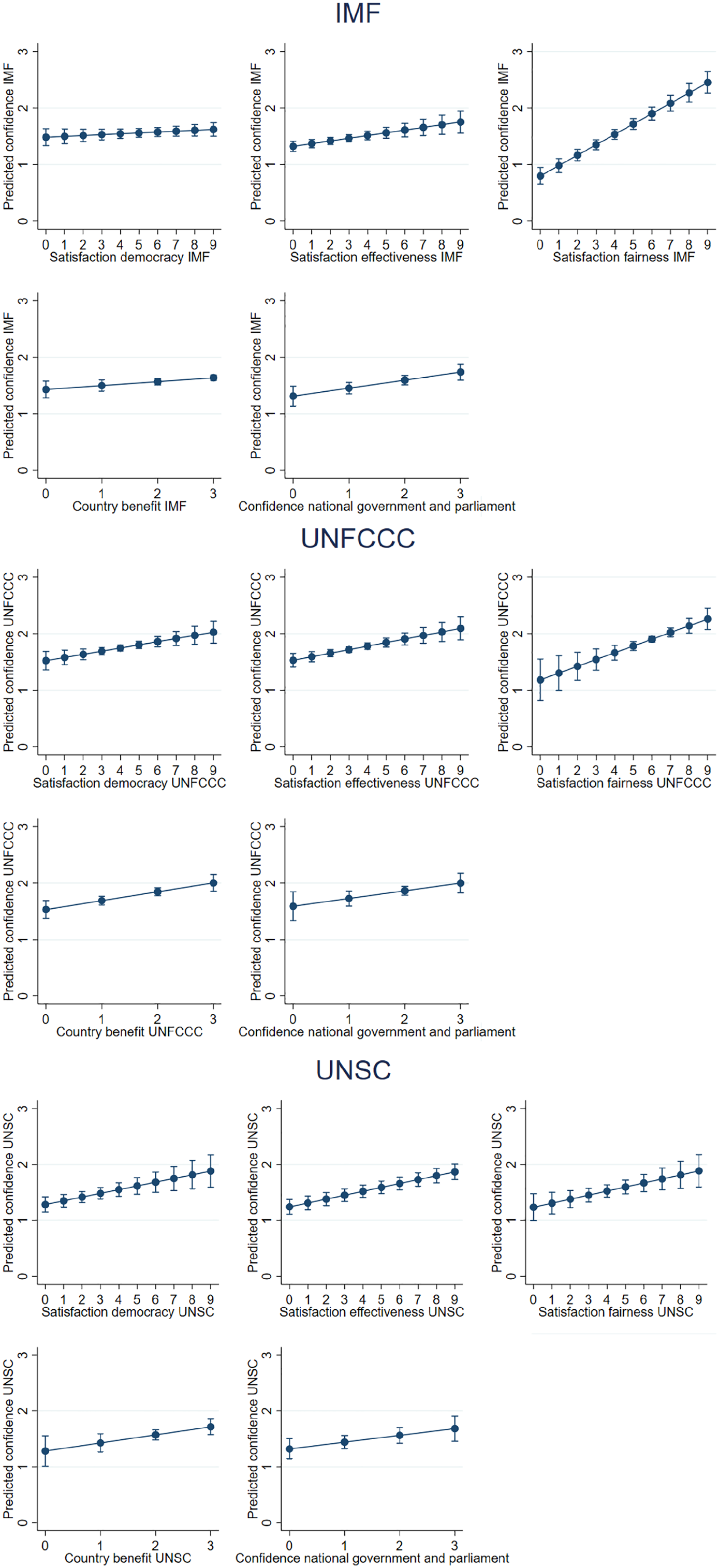
Marginal effects of satisfaction with institutional qualities and perceived country benefits.
We find partial support for the alternative logic of utilitarian calculation, which proposes that elites’ confidence in IOs is related to their perception that the organizations bring advantages to their country. The first indicator, perceived country influence in IO decision-making, does not correlate significantly with confidence in the IMF, the UNFCCC and the UNSC (H2.1). However, the results for the second indicator, perceived benefit to one’s country from IO decisions, are positive and significant (H2.2). Respondents who perceive their country to benefit more from these three IOs tend to have more confidence in those organisations.
We do not find any support for the logic of global orientation, suggesting that elites who think more globally are more likely to perceive IOs as legitimate (H3.1, 3.2). Neither a preference for global problem-solving nor a global identification is significantly related with respondents’ levels of confidence in any of the three IOs.
We find partial support for the logic that expects a relationship between elites’ perceptions of domestic conditions and their legitimacy beliefs toward IOs (H4.1, 4.2). Confidence in national political institutions relates positively and significantly to confidence in the IMF and the UNFCCC, but not in the UNSC. In contrast, elites’ satisfaction with national political and economic conditions does not correlate with their legitimacy beliefs vis-à-vis any of the three organisations.
The graphs presented in Figure 4, together with Wald tests, help to evaluate and compare the magnitude of each relationship for each IO (explanatory variables that are not significant in any of the IOs are excluded from the figure). For the IMF, the relationship between perceived country benefit and confidence in the IMF is significantly weaker than the relationship between satisfaction with the IMF’s fairness and confidence. For the UNFCCC and the UNSC, Wald tests show no significant difference in the magnitude of these relationships.
Regarding the control variables, we observe that male respondents tend to have more confidence in the IMF than female and non-binary respondents, and that confidence in the UNFCCC is positively related to age. Finally, the R2 reveals that the regression models explain between 38 and 49 percent of variation in confidence in the IOs. The small increase in explained variation between the models that only include institutional satisfaction and the full models indicates that satisfaction with the institutional qualities of democracy, effectiveness, and fairness explains the largest share of variation.
In sum, our analyses suggest that elites’ legitimacy beliefs toward IOs relate most consistently to institutional concerns. These findings corroborate recent theorization in the field of International Relations (Hurd, 2007; Scholte and Tallberg, 2018; Tallberg and Zürn, 2019) as well as several empirical studies in public opinion research (Anderson et al., 2019; Bechtel and Scheve, 2013; Binder and Heupel, 2015; Dellmuth et al., 2019). The results also offer some support for the logic of utilitarian calculation, even if this finding is limited to perceived country benefits and for the logic of domestic cues, although this finding is limited to confidence in domestic political institutions in the context of two IOs.
We perform several robustness checks (Appendix D). First, we test if the logic of global orientation might have some explanatory power if we consider elites’ varying levels of engagement with IOs. It may be that global orientation is not significantly related to confidence in IOs among surveyed elites – whereas such a correlation is observed for the broader public (Dellmuth and Tallberg, 2015) – because elites’ greater engagement with IOs leads them to rely more on IO-specific assessments rather than more general orientations towards global governance when forming legitimacy beliefs. We interact the two measures of global orientation (preference for global problem-solving and global identification) with three measures of engagement vis-à-vis global governance: knowledge about IOs, interest in global politics and work oriented towards global issues. We observe only one significant interaction effect, and then in a different direction than expected (see Table D.1). Overall, we conclude that our findings about global orientation are similar among elites with higher and lower engagement with IOs.
Second, we test if the utilitarian logic may perform differently if evaluated using egotropic rather than sociotropic measures (cf. Eichenberg and Dalton, 1993; Verhaegen et al., 2014). For this purpose, we include elites’ education and satisfaction with the financial situation of their household in re-estimations of the models of Table 2. Neither variable is significantly related to IO confidence, and the key results of other variables remain unchanged (Table D.2).
Third, we test if our findings are robust to the addition of a number of other variables that could affect elites’ confidence in IOs. We examine if elites’ social trust is related to their confidence in IOs, as this relationship has been established in analyses of public opinion (Dellmuth and Tallberg, 2020). We also consider if elites’ ideological orientation may be associated with their confidence in IOs by including measures of left-right self-placement and attitudes towards immigration. These groups of variables are entered separately in the full models of Table 2 to retain sufficient explanatory power. We find that social trust and attitudes toward immigration are significantly related to confidence in the IMF, while social trust is also significantly related to confidence in the UNFCCC. Yet, most importantly, including these variables does not change the main results of Table 2 (Tables D.3 and D.4).
Fourth, we replicate our analyses using ordered logit regression, since confidence is measured on a 4-point ordinal scale. The results on institutional satisfaction, utilitarian calculation and confidence in domestic institutions remain robust to this alternative modelling strategy (Table D.5).
Fifth, we test whether the relationship between satisfaction with an institutional quality of the IMF, UNFCCC and UNSC and confidence in these IOs is stronger for respondents who attribute more importance to this quality in general. The logic is that the assessment of an institutional quality may weigh in more in the level of confidence in a specific IO when one attributes more importance to this institutional quality. To do so, we replicate the analyses in Table 2 with the inclusion of interaction terms for the importance that a respondent attaches to respectively the democracy, effectiveness or fairness of IOs in general (Table D.6). No support for this expectation is observed.
Sixth, we replicate the main analyses at the level of the geographical sub-samples (Table D.7) and elite sectors (political vs. societal elites, Table D.8) to assess whether elites’ legitimacy beliefs are related to similar factors across contexts or to factors specific to the respective contexts. The main conclusions from the pooled analysis are robust at the level of the sub-samples. Satisfaction with institutional qualities is significantly related to confidence in the three IOs across all countries and all elite sectors, albeit that variation appears in the specific institutional qualities that matter. The other significant factors in the pooled analysis are only assessed for the elite sub-samples, since the geographic sub-samples are too small for these factors to be included in the analysis. Perceived country benefit is significant among both political and societal elites for all three IOs, with the exception of societal elites regarding the IMF. Confidence in domestic institutions relates significantly to confidence in the IMF and the UNSC among societal elites, but not political elites. These exceptions may relate partly to the smaller sample sizes in these analyses. Case studies are required to clarify these divergences.
Conclusion
This article has offered the first rigorous and comparative examination of elite legitimacy beliefs vis-à-vis IOs. Based on a unique multi-country and multi-sector survey of 860 elites, we have mapped elite legitimacy beliefs toward three key IOs – the IMF, the UNFCCC and the UNSC, and tested four theoretical accounts of the sources of legitimacy beliefs towards IOs. While we should be cautious in generalizing the findings beyond our targeted quota sample, the study suggests two important overall conclusions.
First, the strongest correlate of elites’ legitimacy beliefs is their satisfaction with democracy, effectiveness and fairness in the three IOs. The more satisfied elites are with these institutional qualities, the more legitimate they find the three IOs to be. Robustness tests show that this finding broadly holds for elites in all six countries as well as at the global level, even if the results for the sub-samples are more heterogeneous. In the case of the UNFCCC and the UNSC, elites’ satisfaction with all three institutional qualities is of equal importance. With regard to the IMF, elites’ satisfaction with fairness is particularly central, while satisfaction with democracy does not matter. The consistency of this finding across countries, institutions and sectors suggests that institutional satisfaction is a crucial general driver of elites’ legitimacy beliefs towards IOs. These results confirm the benefits of extending the institutionalist account of legitimacy to elites as actors, to subjective satisfaction as mechanism, and to democracy, effectiveness and fairness as focal qualities.
Second, while earlier studies of public opinion towards IOs have regularly found support for the logics of utilitarian calculation, social identification and domestic cues, our analysis suggests a different picture for elite opinion. Evidence regarding utilitarian calculation as an explanation of elite legitimacy beliefs toward IOs is mixed. The logics of global orientation and domestic cues receive even less support. These findings suggest that elite perceptions of IO legitimacy have partly different drivers than those that shape mass opinion. This pattern may reflect elites’ greater political sophistication, which allows them to privilege principles of IO governance over more alternative considerations. It may also reflect elites’ greater access to IOs, which makes them better placed to judge the institutional functioning of these bodies and form legitimacy beliefs on this basis.
These overall conclusions suggest four broader implications for research and policy on global governance. First, our findings indicate that the prominent debate between utilitarian calculation, social identification, and domestic cues as drivers of opinions on international issues and institutions (Hainmueller and Hiscox, 2006; Hobolt and de Vries, 2016; Hooghe and Marks, 2005; Lake, 2009; Rho and Tomz, 2017) misses an important additional explanation. By demonstrating how satisfaction with democracy, effectiveness, and fairness in IOs is linked to elite legitimacy perceptions, we complement other recent research that shows how institutional qualities shape mass opinion towards global governance (Anderson et al., 2019; Bechtel and Scheve, 2013; Bernauer et al., 2020; Dellmuth et al., 2019).
Second, the findings call for further research that systematically compares elite and mass opinion toward IOs. With the exception of work on effects of elite cueing (Dellmuth and Tallberg, 2020; Gabel and Scheve, 2007; Guisinger and Saunders, 2017), existing research on elite and mass opinion regarding international affairs are curiously not in conversation. While our present study suggests that different dynamics may apply between elites and citizens at large, properly examining this issue requires systematically coordinated surveys, measurements and analyses for the two groups. Such an approach would allow us to address a number of critical questions. For instance, is there a gap in the perceived legitimacy of IOs between elites and citizens, as recent rising support for anti-globalist populism would suggest? If so, what accounts for citizens’ greater scepticism towards IOs compared to elites?
Third, our results invite further research concerning the determinants of elites’ satisfaction with the institutional qualities of IOs. Having established that these assessments are significantly related to legitimacy beliefs, what in turn drives these views themselves? Why do elites specifically value democracy, effectiveness and fairness as institutional qualities of IOs? What kinds of IO practices are most likely to attract elite satisfaction with democracy, effectiveness and fairness?
Finally, in the realm of practical politics, these findings have implications for IOs’ efforts to win the approval of elite audiences through self-legitimation (Dingwerth et al., 2019; Gronau and Schmidtke, 2016; Rocabert et al., 2019; Zaum, 2013). To judge by our negative results on global orientation, IO invocations of rhetoric about ‘international interdependence’ and ‘global community’ would seem unlikely to sway their elite constituencies. Nor would IO efforts to stress opportunities for states to influence global decision-making necessarily generate major increases in support from the elites concerned. Instead, by our findings, IOs that seek to bolster their legitimacy in the eyes of elites would do best to enhance democracy, effectiveness, and fairness in their institutional workings. Conversely, our results suggest that opponents of IOs can attract elites to their side by underlining alleged institutional failings with regard to democracy, effectiveness and fairness.
Supplemental Material
sj-do-1-ejt-10.1177_1354066121994320 – Supplemental material for Explaining elite perceptions of legitimacy in global governance
Supplemental material, sj-do-1-ejt-10.1177_1354066121994320 for Explaining elite perceptions of legitimacy in global governance by Soetkin Verhaegen, Jan Aart Scholte and Jonas Tallberg in European Journal of International Relations
Supplemental Material
sj-dta-2-ejt-10.1177_1354066121994320 – Supplemental material for Explaining elite perceptions of legitimacy in global governance
Supplemental material, sj-dta-2-ejt-10.1177_1354066121994320 for Explaining elite perceptions of legitimacy in global governance by Soetkin Verhaegen, Jan Aart Scholte and Jonas Tallberg in European Journal of International Relations
Supplemental Material
sj-pdf-3-ejt-10.1177_1354066121994320 – Supplemental material for Explaining elite perceptions of legitimacy in global governance
Supplemental material, sj-pdf-3-ejt-10.1177_1354066121994320 for Explaining elite perceptions of legitimacy in global governance by Soetkin Verhaegen, Jan Aart Scholte and Jonas Tallberg in European Journal of International Relations
Footnotes
Acknowledgements
We are grateful to José Maurício Domingues (Instituto de Estudos Sociais e Politicos (IESP-UERJ), Universidade do Estado do Rio de Janeiro) and colleagues for fieldwork in Brazil, Bonn Juego (Department of Social Sciences and Philosophy, University of Jyväskylä) for sharing his expertise on elites in the Philippines, Siphamandla Zondi and colleagues at the University of Pretoria for fieldwork in South Africa, Alexey Kuznetsov and colleagues at the Institute of International Relations and World Economy (IMEMO) in Moscow for fieldwork in Russia, the survey platform CivicPulse, under the coordination of Nathan Lee, for help in collecting responses from state-level political representatives in the United States, and the researchers of the LegGov research program for sharing their expertise on global elites. We are grateful to all of our partners, while also underlining that they have had no influence over survey responses and bear no responsibility for the data analysis that we present here.
Funding
The author(s) disclosed receipt of the following financial support for the research, authorship, and/or publication of this article: The research for this paper has been funded by Riksbankens Jubileumsfond (Grant M15-0048:1). Soetkin Verhaegen also received funding from the F.R.S.-FNRS (Grant 1.B.421.19F).

Supplemental material
Supplemental material for this article is available online.
Notes
Author biographies
References
Supplementary Material
Please find the following supplemental material available below.
For Open Access articles published under a Creative Commons License, all supplemental material carries the same license as the article it is associated with.
For non-Open Access articles published, all supplemental material carries a non-exclusive license, and permission requests for re-use of supplemental material or any part of supplemental material shall be sent directly to the copyright owner as specified in the copyright notice associated with the article.
