




Abstract
The imposition of sanctions by the UN Security Council (UNSC) is notoriously selective. Many crises have qualified for UNSC sanctions by endangering peace and security, yet the UN has imposed sanctions in only a few. Selectivity in UNSC sanctions is conventionally explained by conflict intensity or the interests of the Council’s permanent members. Complementing these accounts, we document a third explanation: pre-existing sanctions by regional organizations. We argue that the UNSC has incentives to sanction countries which are already under sanctions by regional organizations because regional sanctions embody neighborhood consensus on the legitimacy of these sanctions and reassure the Council about implementation. Statistical analyses of original data, text analyses, a case study, and interviews strongly support our argument: regional sanctions increase the likelihood of UNSC sanctions adoption, particularly when these are enacted by regional organizations composed of neighboring states. This study advances research on sanctions, conflict resolution, and regime complexity.
The United Nations Security Council (UNSC) bears primary responsibility for international peace and security, and it can target countries which violate international norms by mandating sanctions. In doing so, the UNSC is notoriously selective. In the face of multiple crises which are susceptible to UNSC action, only a few experience the application of sanctions. Yet we know relatively little about what drives target selection for UNSC sanctions. UNSC selectivity is conventionally explained in two ways. One explanation is that UNSC target selection is driven by the lethality of an armed conflict and the degree to which it threatens international peace and security (Beardsley and Schmidt 2012). The other explanation points to the geopolitical interests of UNSC members, and in particular the permanent members or so-called P5, which can override gravity considerations in sanctions imposition (Chesterman and Pouligny 2003; Tostensen and Bull 2002).
However, these accounts do not tell the whole story about UNSC target selection. For example, the two conventional explanations cannot explain why the UNSC imposed sanctions on the conflict in Sierra Leone but not Mali or Guinea Bissau. All three countries had civil wars with high fatalities in the 1990s and shared the same status as non-P5 allies. What explains this variation? We suggest that an important aspect missing from our current understanding of UNSC sanctions is the behavior of regional organizations (ROs) before UN decisions. Sierra Leone was under preexisting regional sanctions while Mali and Guinea Bissau were not. More broadly, of all 25 UNSC sanctions between 1980 and 2010, 17 were preceded by regional organization sanctions. 2 While some see the conflict-resolution role of ROs as powerless (Wulf 2009), a regional sanctions coalition may influence UN actions.
We argue that regional sanctions make UN sanctions more likely. We theorize that regional sanctions provide legitimacy and implementation benefits to subsequent UNSC sanctions, and show that regional organizations often lobby the UN to adopt its sanctions. Also, we expect sanctions by proximate organizations, which either comprise the target among its members or are located in its immediate vicinity (what we call intra-regional sanctions), to have a stronger effect than sanctions applied by extra-regional actors. Theoretically, we uncover the importance of regional organizations to UNSC decisions and detail two underlying drivers (legitimacy and implementation). Methodologically, we advance the literature through moving away from studies that select on the dependent variable when looking at the influence of regional sanctions on UN sanctions, i.e. studies that consider data on how many UN sanctions where preceded by regional sanctions, but lack data on how many regional sanctions where not followed by a UN sanction.
We test our theory with a mixed-methods approach, using statistical analyses of original data, basic text analyses, a case study, and interviews. Statistical analyses on UN and regional organizations’ sanctions from 1980 to 2010 yield two important findings. First, we show that regional sanctions make subsequent UN measures considerably more likely. This result is robust to alternative explanations, country characteristics, potential spuriousness, and sample selection. Second, UN sanctions are more likely when the RO imposing the sanction is located in the vicinity of the target. The quantitative tests are complemented with text analyses of UNSC sanctions resolutions as well as a case study of regional (ECOWAS) and UN sanctions on Sierra Leone, which illustrates the underlying drivers (legitimacy and implementation), RO requests for UNSC adoption, and the UN’s subsequent alignment with regional sanctions.
Our analysis contributes a new factor to the still incomplete picture of determinants of UN sanctions adoption. While we do not contest the validity of drivers identified in extant literature (conflict lethality and P5 interests), we demonstrate the importance of pre-existing regional sanctions for UNSC sanctions target selection. Our findings also advance burgeoning work on regional sanctions (Whitehead 2021) by showing that the legitimacy bonus of peer sanctions (Hellquist and Palestini 2021) can have a powerful influence on global action.
Second, our study contributes to international cooperation research on regime complexity and its subfield of inter-organizational relations. Research on regime complexity has advanced theories and case studies of how decisions in one forum can influence decisions in another, and how organizations interact with each other (Alter and Meunier 2009). However, we know much less about how “operating within a regime complex shapes politics and political outcomes” and how sequencing matters between organizations (Alter and Raustiala 2018, 344). This study begins to fill this gap, showing that a first move by regional organizations can prompt subsequent UN action. Research on inter-organizational relations (Faude and Groβe-Kreul 2020; Brosig 2020; Biermann and Koops 2017) notes that successful requests for assistance from one organization to another presuppose that the issue areas governed by the two institutions coincide (Gehring and Oberthür 2009, 133-5); we show that RO/UN sanctions exemplify this dynamic. Recent studies suggest that international organizations can confer legitimacy upon each other and empower each other, which shapes incentives to cooperate (Bierman and Koops 2017, 339-346; Spandler 2020). However, systematic cross-case analyses to confirm these insights are still missing (Brosig 2020, 172) and much needed to advance evidence and testing (Hafner-Burton, von Stein, and Gartzke 2008, 176-179 in this journal). We contribute such a quantitative analysis with global data from 1980 to 2010, theorizing and documenting a systematic link between organizations.
Third, our findings speak to research on conflict resolution and regional security governance (Hettne and Söderbaum 2006; Börzel and Risse 2016; Kacowicz and Press-Barnathan 2016; Hansen, Mitchell, Nemeth 2008 in this journal) by specifying how regional organizations manage crises and attract international action. We thus shift the focus from the UN’s role in authorizing regional organizations to manage crises (Henrikson 1996) to the latter’s role as precursors of international action. Our sanctions findings echo with similar insights in peacekeeping (Pentland 2005; Fung 2016a, 419) and other forms of intervention (Fung 2016b), pointing to a broader trend in conflict resolution.
Sanctions and selective intervention
Sanctions scholarship focuses largely on effectiveness in changing target state behavior, with fewer studies addressing sanctions onset and target selection. The body of work on sanctions onset has shown that sanctions are more likely to occur between dyads of democracies and non-democracies with relatively low levels of trade (Cox and Drury 2006; Lektzian and Souva 2003, 2007). While generating important insights on the determinants of target selection, these studies did not consider the role of regional organizations (ROs). 3 Unfortunately, standard sanctions data make it difficult to measure the size of the sanctioning coalition (Peksen 2020, 641), leaving unclear whether a regional sanctions coalition (often via an RO) matters.
In research on UNSC sanctions (and intervention more broadly), the role of regional sanctions has also been rarely acknowledged. The growing activity of the UNSC in the field of peace and security since the end of the Cold War has prompted interest in the motivations that compel it to intervene in certain crises but not in others. Selectivity of UNSC sanctions has been noted previously: of 27 crises from 1991 to 2004, UNSC sanctions were imposed in only 10 cases (Binder 2009, 344); and of the 74 armed conflicts initiated between 1991–2013, the UNSC only applied sanctions regimes on 14 of them (Eriksson and Wallensteen 2015, 1391).
Interest in the drivers of UNSC sanctions was fueled by a controversy between realists positing that intervention only occurred where major powers (the P5) had security or economic interests (Boulden 2006; Chesterman and Pouligny 2003; Tostensen and Bull 2002) and cosmopolitan accounts highlighting that humanitarian crises increasingly attracted international action, often in places of minor geopolitical importance (Finnemore 2003). Empirically, conflict severity is a more powerful predictor of UNSC intervention than P5 interests (Beardsley and Schmidt 2012, 35). Intriguingly, recent studies note that 78% of UN sanctions after the Cold War were preceded by similar measures by other senders (Brzoska 2015, 1341). However, this research does not differentiate between sanctions by individual states and regional organizations. One qualitative study suggests that regional sanctions are more related to UNSC sanctions than measures by unilateral senders (Charron and Portela 2016). Beyond these preliminary insights, the interplay between sanctions by the UN and regional organizations across time and space has not been systematically examined yet. Regional sanctions are neglected in pioneering works on UNSC intervention (Binder 2009; Beardsley and Schmidt 2012), while fresh research about regional organizations does not thematize their influence on UNSC choices (Duursma 2020).
Preliminary insights remain insufficient to elucidate our understanding of sanctions cooperation between regional organizations and the UN for three reasons: selection on the dependent variable, possible confounding, and lack of theory. First, the insight that RO and UN sanctions often go along relies on a database (Graduate Institute 2018) that only features regional sanctions which were followed by a UN sequel, excluding those which were not followed by the UN. Trying to infer the drivers of UNSC sanctions by only examining cases that were followed by UNSC sanctions (but not cases without UNSC sanctions sequel) is selecting on the dependent variable. Second, the insight is based on a bivariate comparison which does not account for potential confounders or competing explanations like conflict severity, P5 interests, unilateral sanctions, or contextual factors. Third and most importantly, the theoretical logic underlying this relationship remains unspecified: why would regional senders mark the path for the UN?
To address this important question, we detail an incentive structure around legitimacy and implementation that accounts for the adoption of regional sanctions by the UNSC and test it on new data uniquely featuring both regional and UN sanctions. We thereby theorize the reasons explaining why regional efforts often “constitute the springboard for UN sanctions” (UNSC 2015, 60) and show that this is a general trend.
RO sanctions increase UNSC sanctions’ legitimacy & implementation
We argue that regional organization sanctions increase both the legitimacy and the effective implementation of UNSC sanctions. The legitimizing power of regional organizations is greater than that of individual countries (Thompson 2006; Fang 2008, 313-14). That is because regional bodies act as peer groups composed of states with similar characteristics, a deeper knowledge of nearby crises, and a higher level of interaction than states outside that organization. Hence regional sanctions are proxies for peer group consensus on the unacceptability of certain policies (Hellquist and Palestini 2021). Various African examples show the UNSC’s dependence on the AU “to solve the legitimacy contest” (Gelot 2015, 152), rather than the other way around. In the same way in which UNSC sanctions maximize legitimacy as they represent global consensus (Claude 1966), sanctions by regional organizations reflect regional consensus about the desirability of international intervention.
Further, RO calls for UN sanctions put the UNSC in the spotlight, compelling it to act to prevent a credibility loss. After all, Chapter VIII of the UN Charter stipulates that ROs should turn to the UN if their regional efforts to resolve crises have failed. In line with this mandate, regional organizations have often lobbied the UNSC to multilateralize their sanctions (Thompson 2006, 27). For example, ECOWAS formally requested the UNSC to universalize the sanctions it wielded on Liberia in 1992 (Carish, Rickard-Martin, and Meister 2017) and called for UN sanctions on Côte d’Ivoire after imposing its own measures in 2010 (Bellamy and Williams 2011). The Organization of African Unity promoted UN sanctions on Sudan in 1996 (Brzoska 2015). Its successor, the African Union (AU) asked the UN to multilateralize AU sanctions against Guinea in 2009 “to give them a universal character” (African Union 2009), as it did again in 2013 with Central African Republic (Sossai 2017). The League of Arab States did likewise with Libya in 2011 (Bellamy and Williams 2011). Consistently refusing collective calls for intervention in fulfillment of the UN mandate could endanger the relevance of the UN.
That legitimacy matters in UN sanctions is underscored by the various legitimacy crises that have put its measures into question (UNSC 2015, 68-9). For example, international opposition to its 1990 ban on Iraq led to the demise of UN comprehensive embargoes (Tostensen and Bull 2002); shortcomings of due process in the Al-Qaida/Taliban sanctions blacklist also led to a legitimacy crisis (UNSC 2015, 68-9). Some even argue that the UNSC suffers from a chronic legitimacy deficit (Binder and Monika 2015), which it has tried to alleviate by expanding its agenda to cover internal conflicts and new threats, and applying targeted sanctions (Stephen 2018, 112).
The UNSC has incentives to secure widespread support for its sanctions by acting where the target’s neighbors endorse action. The UN notes that the acceptance of sanctions depends upon a belief within the relevant region that their enactment was “just” and “contributed to regional peace and stability” (UNSC 2015, 19). Thus, the UNSC should be more inclined to impose sanctions when it can count on the endorsement of neighboring countries than otherwise.
In addition to legitimizing UN actions, regional organizations can enhance the implementation of sanctions. Cooperation among members is key for multilateral sanctions coalitions (Kaempfer and Lowenberg 1999). The more third parties ‘gang up’ against the target, the fewer alternative sources remain for the target to replace trade and aid flows, and the more economic pressure accumulates (Doxey 1987), enhancing sanctions effectiveness (Bapat and Morgan 2009; Hufbauer et al. 2007). Individual senders prefer to impose sanctions via international organizations for that reason (Drezner 2000; Jones 2007). Policymakers often cite effectiveness considerations to justify the multilateralization of sanctions regimes. According to a former US Treasury Secretary, “the more international support there is for sanctions, and for their underlying objectives, the more effective they will be” (US Treasury 2016). Similarly, a former EU High Representative noted that “the effectiveness of restrictive measures is directly related to the adoption of similar measures by third countries” (Ashton 2012).
The cooperation of neighboring countries is important for UN sanctions implementation. Regional organizations are key to sanctions implementation as their member states often share trade or infrastructure links and at times carry the burden of implementation due to their common borders. Lax implementation constitutes one of the main deficiencies of UN sanctions since the 1990s (Cortright and Lopez 2000; Vines 2007). The pre-existence of regional sanctions reassures the UN about the proper implementation of its measures. The UNSC has an interest in refraining from the imposition of sanctions when these are expected to be widely ignored or contested.
For the UNSC, the adoption of sanctions agreed by a regional organization provides added value over adoption of sanctions by ad-hoc coalitions, due to these bodies’ ability to foster discipline among their member states. They have monitoring, information exchange mechanisms, and procedures to discipline sanctions busters, which mitigate the risk of defections and free-riding on the sanctions coalition (Drezner 2000; Early and Spice 2015; Martin 1992). Regional organizations constrain their members from engaging in spoiler behavior more effectively than large organizations (Early and Spice 2015) and can use their infrastructure to monitor compliance. Because pre-existing regional sanctions signal to the UNSC that surrounding countries are ready to implement sanctions, they assuage UNSC anxieties about implementation deficits. In a counter-example, South Sudan shows that without the region complying with sanctions, the individuals targeted by UNSC sanctions would not be deterred because targeted individuals may rely on regional infrastructure for services such as banking and health. Interestingly, the UNSC offered to impose sanctions if the RO engaged in mediating the conflict (IGAD) requested it (International Crisis Group 2015, 21).
The importance attached by the UNSC to regional sanctions is underscored by the text of its resolutions. UNSC sanctions resolutions are replete with references to the contributions by relevant ROs to resolve crises prior to UN action (Charron and Portela 2016). Of the UN sanctions resolutions preceded by regional measures from 1980 to 2010, 72% (13 of 17 resolutions) make explicit reference to at least one regional organization. 4 Notably, the OAS appears 14 times in the four-page UN resolution applying sanctions to Haiti in 1993 (UNSCR 841), emphasizing the weight regional organizations carry for UNSC sanctions decisions.
Concerns about legitimacy and effective implementation also surface in statements by senior UN staff. A former UN Ombudsperson underlines the importance of regional views for UNSC sanctions adoption: “what you see over the past years is a Council that devotes much more time to regional consultations before it acts. You clearly saw that in Libya, where the Arab League was extensively consulted in steps that were taken, and in the context of crisis in Kenya and Côte d’Ivoire where the AU played a role. Clearly that is also about legitimacy, about ensuring that the Council does not issue resolutions that are not implemented” (Prost 2012, 310). Moreover, while both drivers – legitimacy and implementation - are analytically distinct, they are closely interlinked, and in certain cases, they may even be mutually reinforcing. Our argument about the incentives of the UNSC to adopt regional sanctions leads to our main hypothesis:
Hypothesis 1: The UNSC is more likely to apply sanctions against a target if
Yet not all regional organizations provide equal value to the UN. From the perspective of the UNSC, regional organizations vary in the degree to which they can boost legitimacy depending on their geographic proximity to the target. Regional organizations located within the target’s geographic region (what we call intra-regional organizations) are more likely to attract UN adoption than those outside the target’s geographic region (extra-regional organizations). Intra-regional sanctions provide a legitimacy bonus to subsequent UN sanctions; it is less clear whether intra-regional sanctions always have an implementation advantage over extra-regional sanctions. 5
Intra-regional organizations should provide more legitimacy than extra-regional entities because its members are more likely to share values and norms with the target (Thompson 2006, 27; Duursma 2020). In a study on mediation, Duursma (2020, 21) finds that African conflict parties regard African mediators as more legitimate than other third parties, and that their presence makes the conclusion of a durable negotiated settlement more likely. This is so despite the superior material capacities of non-African mediators, underlining the importance of intra-regional legitimacy rather than capacities or resources (Duursma 2020, 32). Legitimacy is strongly linked to geographic proximity. This is irrespective of whether the target is a member of the sender body or not as long as the organization is composed of states located in its immediate vicinity. 6 For example, we expect AU sanctions on African states to have larger effects on UNSC decision-making than similar measures by the European Union (EU) because AU sanctions originate from a peer group of neighboring states, while EU sanctions should lend a higher degree of legitimacy to UNSC measures when applied on European states. Thus, EU action is considered intra-regional when the target is located in its geographic vicinity, and extra-regional otherwise.
Intra-regional sanctions can also help prevent vetoes in the UNSC sanctions vote. Given that P5 members can veto UNSC resolutions, their consensus is necessary for the adoption of UNSC sanctions. When contemplating a UN sanctions regime, the P5 consider the views of countries in the region where the target is located, pondering the risk that its actions might antagonize adjacent states. When intra-regional sanctions are in place, skeptic members are more likely to back UN sanctions than when the neighboring states remain divided in their condemnation.
7
Russia reportedly blocked a UNSC resolution condemning the May 2019 crackdown on civilians in Sudan insisting that the UNSC first “should await a response from the African Union” (Landry 2019). In an interview, a European diplomat notes: “once the AU has agreed a course of action, the reading is that ‘Africa has decided.’ Neither Russia nor China nor anybody in the UNSC will oppose the imposition of sanctions.”
8
Another European diplomat at the UN explains that “there is a tendency to wait for the Africans – if they do something, we will consider following up. If they adopt measures, there is a willingness to support them.”
9
A UN official confirms this point in an interview: “If the regional organization has imposed sanctions, if the country of concern is a country in the region, and if the members of the organization are the ones that are promoting the sanctions, then the Security Council is more likely to impose sanctions. They think: ‘given that the region has this view, the Security Council should consider it.’ But if the USA or the European Union impose sanctions, they will not consider.”
10
The legitimacy bonus of geographically proximate (i.e. intra-regional) organizations leads to our second hypothesis:
Hypothesis 2: The UNSC is more likely to apply sanctions against a target if
Research design
We test our two hypotheses with data comprising sanctions by the UN, regional organizations, and individual senders. Our dataset is global and covers the period from 1980 to 2010. The unit of analysis is the country-year.
The dependent variable is UN sanction onset, which is coded 1 when the UNSC imposed a sanction against country c in year t. It is coded 0 in the years before the imposition of UN sanctions, and missing in the years after UN sanctions onset. 11 For example, the UN imposed sanctions on Libya in 1992 and lifted them in 2003. Thus, the variable UN sanction onset is coded 0 for the observations Libya 1980–1991, 1 for Libya 1992, missing for Libya 1993–2003, and 0 for Libya 2004–2010. To construct this variable, we source data from UNSC documents. 12 Between 1980 and 2010, the UNSC applied 25 sanctions against 21 countries. All UNSC sanctions are listed in Appendix Table A1 with years of UN sanctions imposition and prior RO actions.
The key independent variable Regional sanction is coded 1 when any regional organization had a sanction in place against country c in year t, and 0 otherwise. Our dataset is unique in that it features the entire universe of sanctions by regional organizations, including diplomatic sanctions and development aid cut-offs (Doxey 2009; Koch 2015). To date, the role of regional sanctions in attracting UNSC actions might have been obscured by the absence in standard sanctions data of an emerging sender (regional organizations) and/or one of their tools (membership suspensions). We source information on RO sanctions from von Borzyskowski and Vabulas (2019), Charron (2013), and Portela (2010).
The timing of regional versus UN sanctions is critical to our sequencing argument. Thus this variable, Regional sanction, is coded 1 only when 2 conditions are met: (i) RO sanctions preceded the UN sanctions onset and (ii) RO sanctions were in place at the time of UN sanctions onset. 14 It is also coded 1 when RO sanctions were in place but no UN sanctions were imposed. The variable is coded 0 otherwise, i.e. when RO sanctions ended in a year before the UN acted or when RO sanctions were only imposed after the UN acted. This sequencing variable is the result of original data coding efforts to identify the timing of regional sanctions vis-à-vis UN sanctions.
The prevalence of ROs among other major sanctions senders and the rise of RO sanctions are illustrated in Figures A1 and A2 in the Online Appendix. They show that regional sanctions have increased over time (Figure A1) and are frequently imposed by organizations located in Africa (AU, ECOWAS), Latin America (RIO Group, OAS), and Europe (OSCE, Council of Europe, see Figure A2).
To parse out the theoretical incentives of legitimacy and implementation spelled out in Hypothesis 2, we further code subsets of the RO sanction variable: Intra-regional sanction and extra-regional sanction. A significant difference in the effect of these two variables (intra- vs extra-regional) thus allows us to see whether implementation likelihood alone makes potential target states more attractive to the UN (proxied by extra-regional) or whether implementation and legitimacy concerns both play a role (proxied by intra-regional). We also create the variable Intra- and extra-regional sanction to capture cases where both types of sanctions were in place. All of these variables are dichotomous and mutually exclusive. If our argument is correct, then we should observe that intra-regional sanctions have significantly larger effects than extra-regional sanctions (capturing the legitimacy bonus beyond implementation).
We also include a range of control variables that may confound the relationship or also influence UN sanctions. To account for the two previous explanations of UN sanctions outlined above, we capture conflict severity and UNSC/P5 interests. To capture conflict severity, we include civil war intensity in the target country, civil war contagion from the target to another country, and international conflict intensity that the target country was engaged in (Themner and Wallensteen 2012, Black 2013, and Palmer et al. 2015). To capture P5 interests, we include the variables P5 ally (Leeds 2005) and voting affinity with US in the UNGA (Voeten, Strezhnev, and Bailey 2009), as the US is the principal sanctions initiator in the UNSC and the most active veto power since 1980. 15 We also include a binary measure of whether a unilateral sanction by a UNSC member has been imposed because UNSC permanent and rotating members might support collective UNSC sanctions based on their individual state interests. 16
In addition to controlling for the two traditional explanations, we also account for target vulnerability. Sanctions are often imposed strategically on economically weak countries. To capture vulnerability, we include measures of GDP, GDP growth, trade dependence (trade as share of GDP), and population size (IMF 2015; World Bank 2015). All control variables are lagged by 1 year to mitigate endogeneity. Descriptive statistics of all variables are in Table A2 in the Online Appendix. We also account for time dependence as recommended for binary time-series-cross-section analyses; 17 all models include cubic polynomials for time since the last UN sanction.
To test our 2 hypotheses, we estimate the following statistical model

Results
A first glance at the data provides tentative support for the hypothesis that UN sanctions onset is more likely after regional sanctions. Figure 1 shows the rate of UN sanctions for 173 countries between 1980 and 2010; it indicates that 4.4% of country-years experienced UN sanctions when they had previously been sanctioned by regional organizations but only 0.2% of country-years experienced UN sanctions when no regional sanctions had been levied. Further, raw data show that in only 4 of its 25 sanctions regimes was the UN the first to initiate punishment. Out of 21 UN sanctions onsets that were preceded by other actors, 17 UN sanctions followed regional sanctions already in place (see Appendix Table A1). The multivariate analysis (described below) accounts for a range of potentially confounding variables influencing this relationship and avoids selecting on the dependent variable. Rates of UN sanctions onset by previous regional organization (RO) sanction.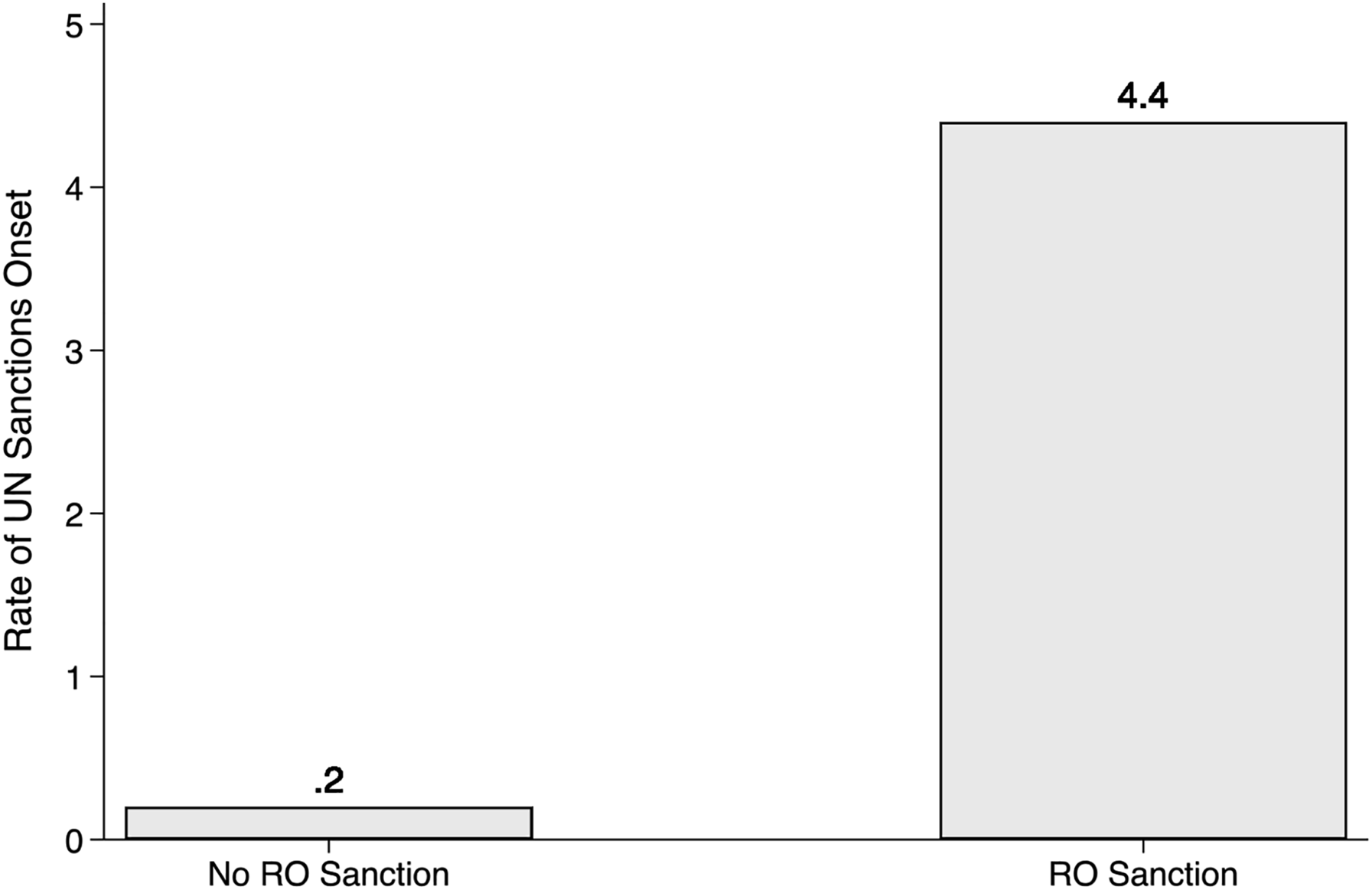
The Effect of Regional Organization Sanctions UN Sanctions Onset.
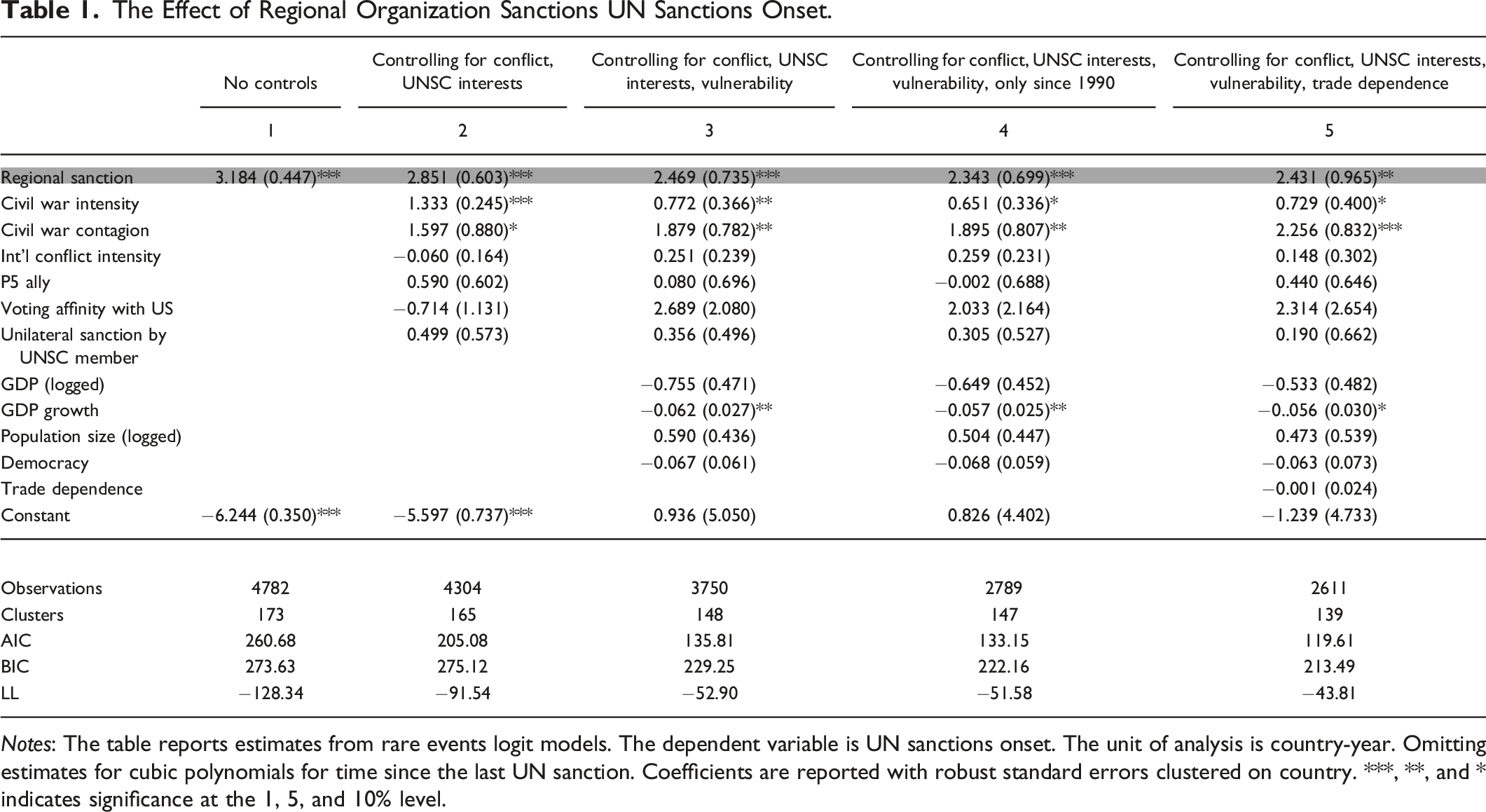
Notes: The table reports estimates from rare events logit models. The dependent variable is UN sanctions onset. The unit of analysis is country-year. Omitting estimates for cubic polynomials for time since the last UN sanction. Coefficients are reported with robust standard errors clustered on country. ***, **, and * indicates significance at the 1, 5, and 10% level.
Table 1 provides strong support for the argument that regional sanctions facilitate UNSC sanctions. The coefficient on RO sanction is positive and significant in all models (p < 0.012), indicating that the presence of regional sanctions is associated with an increased probability of subsequent UN sanctions imposition. Even accounting for alternative explanations (column 2) and country characteristics (columns 3–5), RO sanctions are positively and significantly associated with UN sanctions. 18
This effect is also substantively important. Figure 2 visualizes the change in the predicted probability of UN sanctions imposition for the case of RO sanction and no RO sanction, along with 95% confidence intervals. When regional sanctions are in place, the risk of subsequent UN sanctions onset increases by 2.1 percentage points compared to the counterfactual of no regional sanctions in place.
19
To put this in context, RO sanctions have a larger estimated influence on UN sanctions than conflict intensity or P5 interests. For example, with the same model specification, civil war contagion increases the predicted sanctions risk by 1.8 percentage points and civil war intensity by 0.2 percentage points. The measures for P5/UNSC interests do not gain statistical significance. Taken together with insights from the literature review above, these results suggest that the drivers of target selection differ between unilateral sanctions (democracy and trade) and UNSC sanctions (regional sanctions, conflict intensity, GDP growth). The risk of UNSC sanctions onset is significantly and substantively higher when previous regional sanctions are already in place. Effect of RO sanctions on UNSC sanctions onset.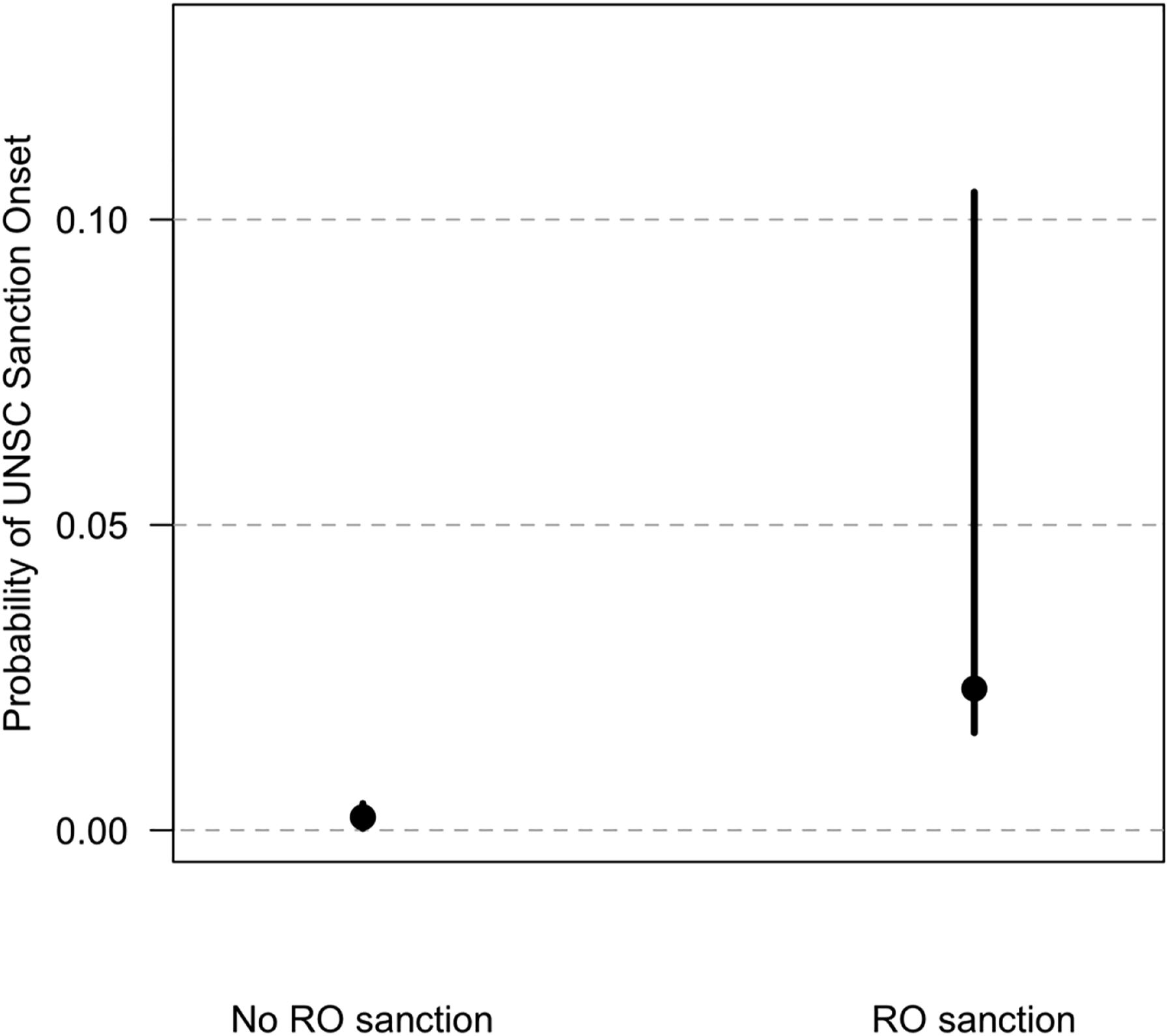
To assess the robustness of our findings, we changed the model specification from rare events logit to “ordinary” logit, sample selection, and matching models; we also tested for influential cases and outliers; and we replicated the main analysis with modified independent, dependent, and control variables. All follow-on analyses leave our substantive results unaffected.
First, we replicate the main analysis (Table 1) by changing the model specification from rare events logit to “ordinary” logit models. We used rare event models in the main analysis to account for the fact that the UN has applied sanctions infrequently (see Tables A1 and A2). The results of logit models are in Appendix Table A3. The coefficient on RO sanctions remains positive, of similar magnitude, and highly statistically significant (p < 0.01).
Accounting for Sample Selection.
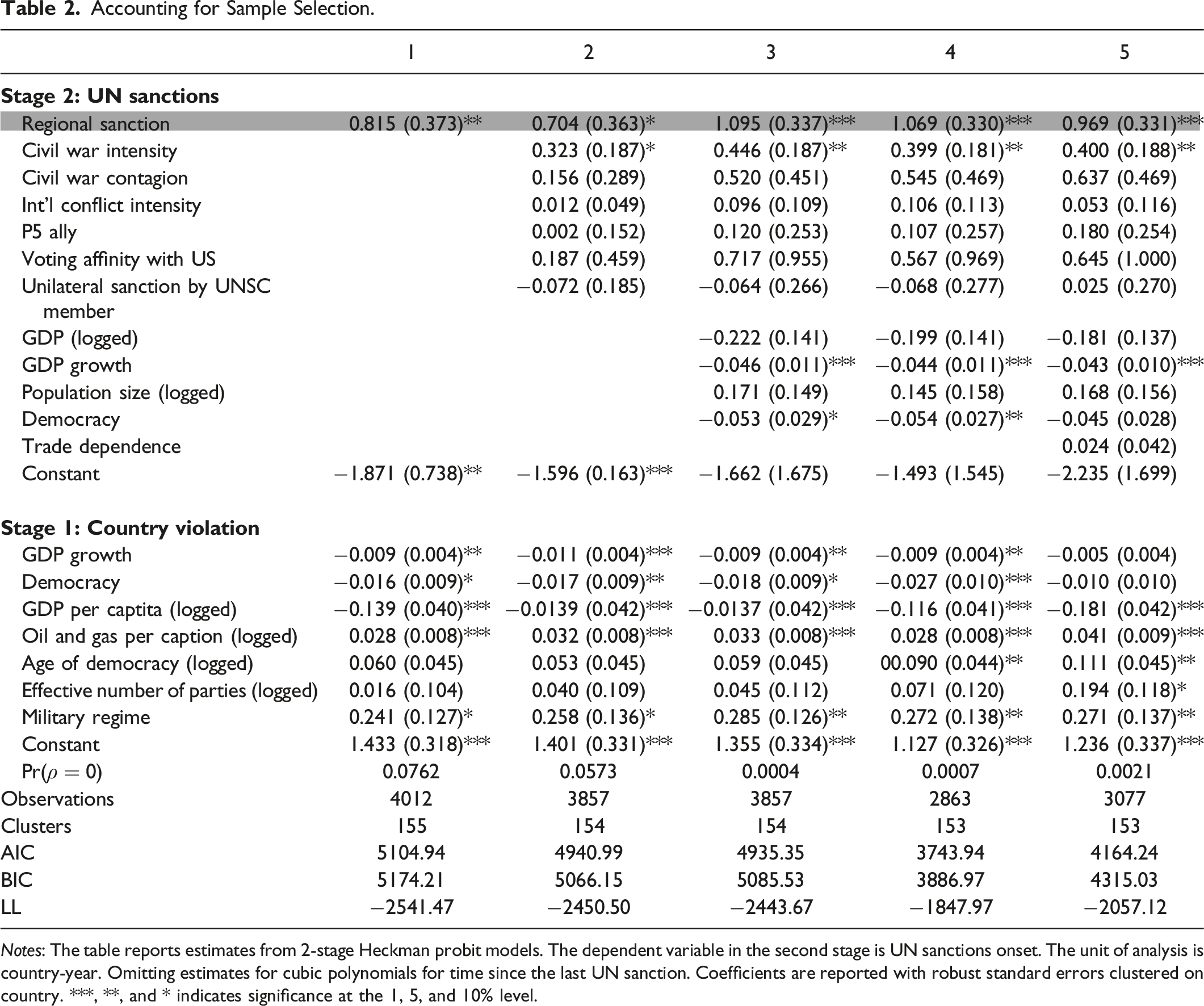
Notes: The table reports estimates from 2-stage Heckman probit models. The dependent variable in the second stage is UN sanctions onset. The unit of analysis is country-year. Omitting estimates for cubic polynomials for time since the last UN sanction. Coefficients are reported with robust standard errors clustered on country. ***, **, and * indicates significance at the 1, 5, and 10% level.
Third, we use matching to address concerns about spuriousness and ROs as an intervening variable. The spuriousness concern is that some underlying factors (such as civil war) may give rise to both regional and UN sanctions, but that there is no independent effect of regional sanctions on UN sanctions. The intervening variable concern is that it may still be the prospects for greater hostility (such as civil war) that causes UNSC sanction, and that those prospects also cause regional bodies to sanction along the way. If this were correct, then RO sanctions should have no independent effect on UN sanctions when we hold hostility levels and other contextual factors constant.
To address these concerns, we employ matching methods. Matching allows us to compare country-years that are highly similar across a range of factors that influence UN sanctions (e.g. hostility levels) but differ in whether they have been subject to regional sanctions. We use two alternative matching procedures: propensity score matching and coarsened exact matching (CEM). The first allows us to also balance on the risk of being sanctioned regionally; we increase common support by dropping observations outside the 0.05 caliper. The second/CEM procedure allows us to match exactly on strata within each variable which automatically ensures common support (clear counterfactuals in the data). Balance and common support are greatly improved after each matching process. 21 For the propensity score matching, we use all the variables from the main analysis to match country-years and estimate the effect of regional sanctions on UN sanctions. The estimated average treatment effect on the treated (ATT) is again statistically significant and positive. For the coarsened exact matching, the sample average treatment effect on the treated (SATT) is also positive and statistically significant. 22 The matching analyses confirm that regional sanctions have an additional effect beyond the underlying conditions that may give rise to UN sanctions. RO sanctions are not simply intervening variables.
Lastly, we check for influential outliers to ensure that no 1 or 2 particular cases are unduly driving the results. We detected influential cases using Cook’s distance measure and outlier cases using Pearson’s residuals. Omitting the most influential or outlier cases leaves the results intact, as some were over-predicting and others under-predicting the probability of UN sanction onset.
We also probe regional sanctions by frequency and sender (EU vs others). We show that a higher number of RO sanctions is associated with a higher likelihood of UN sanctions onset (see Appendix Tables A7-A8). Lastly, we recognize that many RO sanctions are by one organization: the EU. The EU differs from other ROs in that it only imposes sanctions against non-members and its sanctions are often economic. We thus replicate the main analysis (Table 1) excluding EU sanctions and analyzing only the effect of other ROs. The results are in Appendix Table A9 and show that non-EU RO sanctions have a positive and significant effect. In other words, our results are not mainly driven by the EU.
Finally, we recode the main outcome and a control variable. We recode UNSC sanction to account for follow-on cases, i.e. UNSC sanctions that could be seen as a continuation of earlier UNSC measures instead of new sanctions. This only affects three cases and leaves results unaffected (Appendix Table A10). We also replace unilateral sanction by a UNSC member with a narrower version (unilateral sanction by P5 member) and a broader version (unilateral sanction by any state); results are unaffected (Appendix Tables A11-A12).
Intra- versus extra-regional sanctions
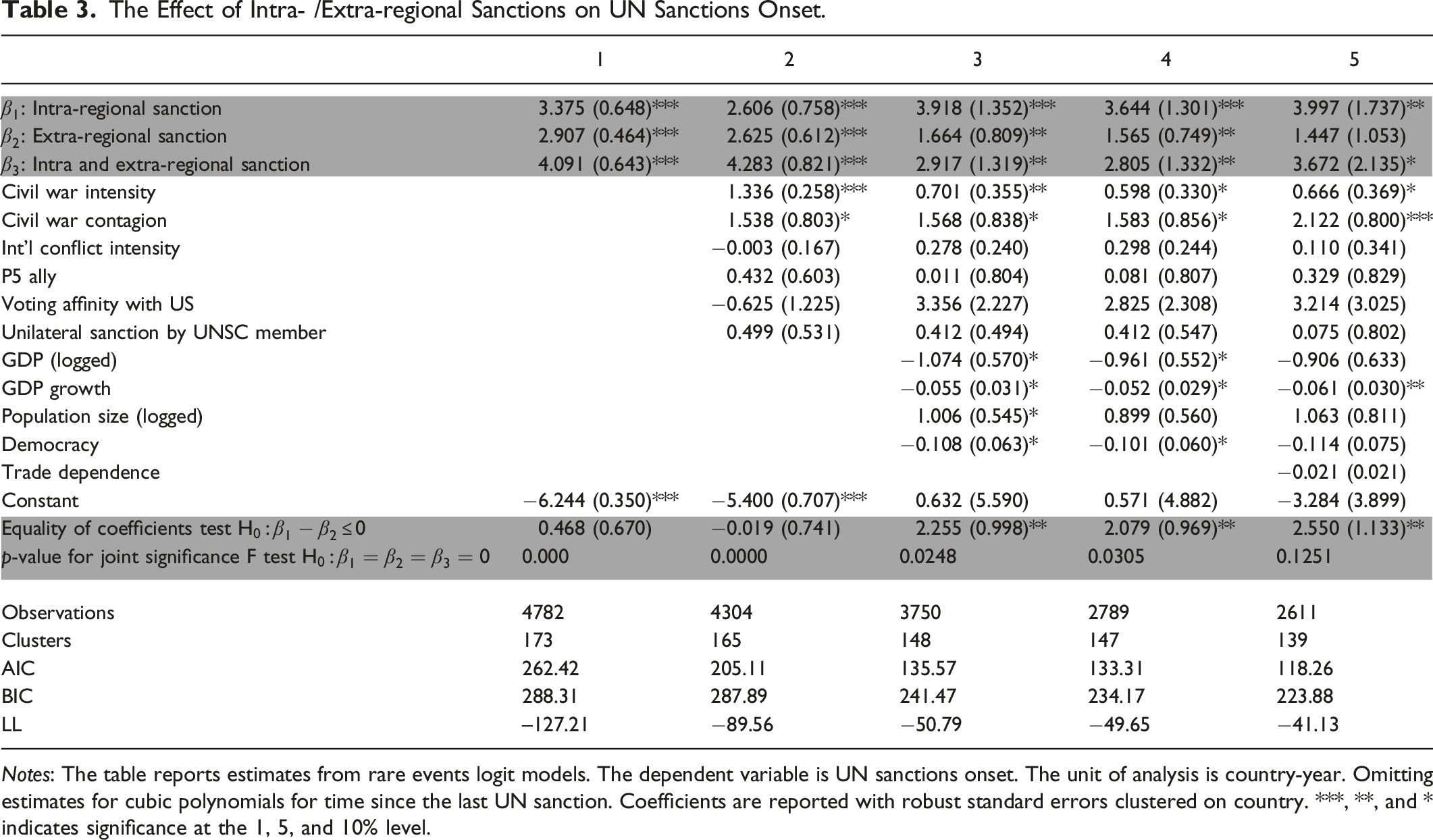
The Effect of Intra- /Extra-regional Sanctions on UN Sanctions Onset.
Notes: The table reports estimates from rare events logit models. The dependent variable is UN sanctions onset. The unit of analysis is country-year. Omitting estimates for cubic polynomials for time since the last UN sanction. Coefficients are reported with robust standard errors clustered on country. ***, **, and * indicates significance at the 1, 5, and 10% level.
Table 3 presents the coefficient estimates on intra- versus extra-regional sanctions for UN sanctions onset. All coefficients of interest are positive and significant. In line with the hypothesized incentive structure (Hypothesis 2), the coefficient on intra-regional sanctions is significantly larger than the coefficient on extra-regional sanctions (at least in the more conservative specifications). Tests for the equality of coefficients are at the bottom of Table 3, where the null hypothesis is that the coefficient on intra-regional sanction is smaller than or equal to the coefficient on extra-regional sanction. The significant estimates for this test in models 3–5 indicate that we can reject this null hypothesis; the coefficient on intra-regional sanction is significantly larger than the coefficient on extra-regional sanction. Further, intra-regional sanctions are also significantly different from no regional sanctions in all models; since no regional sanctions is the excluded reference category in Table 3, the significant coefficient on intra-regional sanctions indicates that difference to no regional sanctions. Finally, we added an F test for the joint significance of all three types of regional sanctions. This also yields significant p-values in four of the five models, suggesting that the three types of sanctions together add explanatory power and are jointly relevant in explaining variation in UN sanctions.
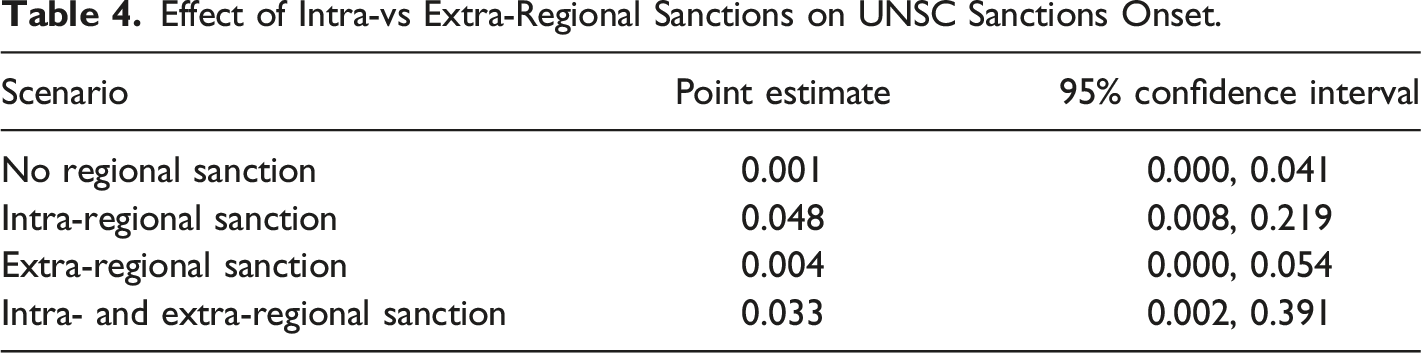
The results provide strong support for the argument that each type of regional sanction offers different incentives for the UNSC to universalize such measures and provides evidence that intra-regional sanctions are more attractive to the UN than extra-regional sanctions, which lack the stamp of disapproval from peer groups.
Effect of Intra-vs Extra-Regional Sanctions on UNSC Sanctions Onset.
Examples of the differential traction of intra- versus extra-regional sanctions abound. Intra-regional sanctions by ECOWAS against Sierra Leone in 1997 were quickly superseded by UN sanctions (Vines and Cargill 2009). Similarly, the arms embargo imposed by the European Community on the former Yugoslavia in 1991 received UN follow up within months. In contrast, strictly external sanctions often fail to attract UN follow-up. When the UK and France attempted to multilateralize sanctions on Zimbabwe in 2008, China blocked their draft resolution, in the absence of condemnation by the Southern African Development Council (Hellquist 2015). Likewise, EU measures against Gambia in 1994, Nigeria in 1993, Syria in 1987 and 2011, and Zambia in 1996 remained without UN follow-up.
A text analysis provides qualitative support to our argument about the superior value of intra-regional sanctions. The 13 UNSC resolutions explicitly referring to ROs invariably mention intra-regional arrangements, adjacent to or comprising the target country. Only an extra-regional organization – the EU – is once invoked, alongside the AU, in the resolution applying measures to Sudan in response to the Darfur crisis. However, it is when examining the timing of sanctions in individual case studies that the influence of regional arrangements becomes most visible, as we show in the next section.
The interplay of regional and UN sanctions in Sierra Leone
The sequencing of regional and UN sanctions in response to civil strife in Sierra Leone constitutes an early example of activism by a regional organization enacting its own measures and subsequently promoting their adoption by the UNSC.
In May 1997, a military coup overthrew the democratically elected government of President Tejan Kabbah. ECOWAS responded to the coup by enacting an arms embargo, a prohibition on the supply of petroleum products, a travel ban, and an asset freeze on members of the military junta. From June to August of 1997, ECOWAS repeatedly appealed to the UNSC to impose mandatory sanctions to reinforce its regional effort (ECOWAS 1997a). In its summit meeting of 29 August 1997, ECOWAS formally solicited “assistance from the UNSC to render…sanctions imposed universal and mandatory, in accordance with the United Nations Charter” (ECOWAS 1997b). It also tasked its military mission, the Economic Community of West African States Monitoring Group (ECOMOG), to enforce the sanctions. The ECOWAS request was echoed by UN Secretary-General Kofi Annan, who stated in his report to the UNSC: “the sanctions imposed by ECOWAS and the corresponding support requested of the Security Council may be seen as measures intended to promote a peaceful resolution of the situation. I am confident that the Council will wish to lend its support to measures which it considers conducive to a peaceful outcome” (UNSG 1997).
The lobbying effort was successful as the UNSC eventually adopted ECOWAS measures: “with the additional push from the region” (Meister 2013), the UNSC was prompted to address the conflict, surmounting the initial reticence of some members to intervene.26 In October 1997, the UNSC expressed support for ECOWAS’ sanctions efforts and agreed to enact sanctions on Sierra Leone (S/RES/1132), declaring that the situation constituted a “threat to the peace and security in the region” and demanding that the junta relinquished power. A fortnight after the UN applied sanctions, the junta signed an agreement to return power to the civilian government (Cortright and Lopez 2000, 172).27
The Sierra Leone case, with ECOWAS’ sanctions and appeals to the UNSC, illuminate the mechanisms of legitimacy and effective implementation outlined above. The UNSC doubted whether it could enforce an arms embargo given the collapse of state structures along land borders and at air- and seaports in both Sierra Leone and neighboring Liberia (Carish, Rickard-Martin and Meister 2017). Thus, when the UNSC adopted its sanctions, it explicitly entrusted the implementation of the sanctions to ECOMOG, which was now authorized under Chapter VII to implement the measures it already had in place (Cortright and Lopez 2000; Meister 2013, 237). ECOWAS’ influence on UNSC behavior also impacted the nature of its measures: the UNSC enacted a sanctions package largely mirroring the measures initially imposed by ECOWAS: an arms and petroleum embargo and travel restrictions on the junta. So strict was ECOWAS’ implementation of the sanctions that the UNSC had trouble enforcing the provision of humanitarian assistance, mandated in the UN Resolution but not in the original ECOWAS embargo (Vines and Cargill 2009, 47–8). In contrast to the lax implementation characterizing arms embargoes at the time, ECOWAS was able to interdict most large-scale resupply of arms to rebel forces thanks to ECOMOG’s patrolling of Sierra Leone’s coast and its control of the main international airport (Vines and Cargill 2009, 55). ECOWAS’ support proved central to the UN sanctions’ effective implementation.
The legitimacy rationale is evident in how Sierra Leone became a test case for the UN’s credibility crisis, when several states questioned the UNSC’s relevance because of its inaction in African conflicts after its failure in Somalia. One factor altering political will was that “success or failure in Sierra Leone became connected to success or failure for other UN missions” (Meister 2013, 248). Importantly, regional support played a key role. ECOWAS had tried to address this African crisis through regional sanctions and then appealed repeatedly to the UNSC (Vines and Cargill 2009, 47), showing that the region and neighboring states welcomed and endorsed UN action, legitimizing the global body to act. The British High Commissioner to Sierra Leone framed the sanctions as resulting from cooperation between Nigeria-led ECOWAS in Africa and the UNSC under British leadership: “All too often coups would take place and the international community would ‘tut tut’… This time, backed by the reactions of the Sierra Leone people, the international community, with Nigeria in the lead in Africa and the UK in the lead in the UN, refused to accept the coup” (Penfold 2005, 219-20). The role of ECOWAS is implicitly acknowledged; in lending support, the UNSC knew it could count on the endorsement by the regional organization.
The Sierra Leone episode served as an early model for sanctions collaboration between the UN and a regional organization in Africa, which then became a frequent feature in subsequent sanctions regimes (Carish, Rickard-Martin and Meister 2017; Cortright, Gerber and Lopez 2005). Notably, it heralded the decisive engagement of regional entities in places like Libya in 2011 (Bellamy and Williams 2011), in a first indication of the synergy that crystallized as governments found that adopting regional collective measures and then lobbying the UNSC stood a chance of eliciting its action. The AU’s continued practice of calling for the universalization of its own sanctions has often (but not always) been successful, such as in Central African Republic in 2013 (Sossai 2017).
Conclusion: global governance from below
This study shows how and why pre-existing regional sanctions facilitate UNSC sanctions adoption, employing a systematic analysis of regional and UN sanctions across time and space. We theorize that regional sanctions provide legitimacy and implementation benefits and thereby promote the adoption of UN sanctions. Our analyses show that regional measures make subsequent UNSC sanctions significantly more likely. While not all regional sanctions attract a UN sequel, they do increase the likelihood of UNSC sanctions adoption as compared to situations where they are absent. This is particularly the case with sanctions enacted by intra-regional rather than extra-regional organizations. The text analyses, case study, and interviews show that regional endorsement of sanctions carries weight in the calculations of the UNSC.
Our findings contribute to sanctions research. For work on the determinants of UN sanctions we elucidate the role of pre-existing measures by regional organizations. They help explain UNSC selectivity: whether the UN intervenes is not only determined by conflict intensity or geopolitical interests of the P5, but also by the existence of a regional consensus on the desirability of UN action. We also contribute to sanctions research by showing how the drivers of unilateral and UNSC sanctions differ.
We also advance work on regional sanctions by showing that regional sanctions can have international consequences and by broadening the scope to diplomatic sanctions. Diplomatic measures such as suspensions from international organizations have traditionally been neglected in sanctions scholarship. Our quantitative analyses show that regional sanctions systematically attract the action of the UNSC to situations where it is desired. Of course, if regional sanctions are a crucial influence of UN sanctions, the natural follow-up question is what explains regional sanctions. Since research on RO sanctions specific to democracy violations points to the importance of geopolitics and institutional rules (von Borzyskowski and Vabulas 2019, Hellquist and Palestini 2021), examining the drivers of regional sanctions more broadly remains a promising avenue for future work.
Our analysis also advances research on regime complexity and inter-organizational relations. We specify the interplay between the UN and regional entities, showing how the latter lobby and empower the UN by conferring additional legitimacy to UN actions, and examine the sequencing and strength of this relationship in a quantitative analysis. While the desire of regional arrangements to multilateralize their measures is well-known, the UNSC incentives to tap on the benefits associated to them are now documented.
Our study also sheds light on conflict resolution and regional security governance by uncovering how and why regional organizations attract UN action. Patterns of UN adoption of regional sanctions evidence a close relationship between both levels of governance, which departs from the traditional image of the UNSC as an arena dominated by great powers. Instead, it lends support to accounts of regional organizations as emerging key actors in global governance (Hettne and Söderbaum 2006). The interaction between ECOWAS and UN sanctions is comparable to the evolution in peacekeeping, where “the Africans themselves got there first and forced the UN’s hand” (Pentland 2005, 927). Therefore, the growing synergy between regional organizations and the UNSC seems to result from an evolution in the course of which governments learned that by adopting collective measures first, and persistently lobbying the UNSC, they stand a chance of eliciting global action. The relationship between UN and regional organizations, tense in Cold War days (Henrikson 1996), has developed into a cooperative – sometimes synergetic – link. The successful activism of African and other extra-European organizations points to skillfulness, particularly as they lack the enviable permanent access to the UNSC enjoyed by the EU on account of the overlapping membership of France and the UK. Despite their apparent powerlessness, regional organizations prove able to elicit action by the powerful global body.
Supplemental Material
Supplemental Material - Global Governance From Below: Regional Sanctions as Drivers of UN Sanctions
Supplemental Material for Global Governance From Below: Regional Sanctions as Drivers of UN Sanctions by Inken von Borzyskowski, and Clara Portela in Journal of Conflict Resolution
Supplemental Material
Supplemental Material - Global Governance From Below: Regional Sanctions as Drivers of UN Sanctions
Supplemental Material for Global Governance From Below: Regional Sanctions as Drivers of UN Sanctions by Inken von Borzyskowski, and Clara Portela in Journal of Conflict Resolution
Footnotes
Acknowledgements
We thank Tanja Börzel, Mathis Lohaus, George Lopez, Thomas Risse, Mark Souva, Felicity Vabulas, participants in the Presidential Panel on UN sanctions at the Annual Convention of the International Studies Association in 2016, members of the KFG research group at the Free University of Berlin, and anonymous reviewers for useful comments on earlier versions of this article. Special thanks go to our anonymous interviewees for generously sharing their insights for this research. All errors are ours.
Declaration of Conflicting Interests
The author(s) declared no potential conflicts of interest with respect to the research, authorship, and/or publication of this article.
Funding
The author(s) received no financial support for the research, authorship, and/or publication of this article.

Supplemental Material
Supplemental material for this article is available online at the JCR replication site.
Notes
References
Supplementary Material
Please find the following supplemental material available below.
For Open Access articles published under a Creative Commons License, all supplemental material carries the same license as the article it is associated with.
For non-Open Access articles published, all supplemental material carries a non-exclusive license, and permission requests for re-use of supplemental material or any part of supplemental material shall be sent directly to the copyright owner as specified in the copyright notice associated with the article.
