



Abstract
While studies have investigated UN Framework Convention on Climate Change (UNFCCC) meetings as drivers of climate change reporting as well as the geopolitical role of Pacific Islands in these international forums, little research examines the intersection: how media coverage of Pacific Islands and climate change (PICC) may be influenced by, or may influence, UNFCCC meetings. We analyze two decades of reporting on PICC in American, British, and Australian newspapers—looking at both volume and content of coverage—and expand the quantitative results with semi-structured interviews with journalists and Pacific stakeholders. Issue attention on PICC increases and the content changes significantly in the periods around UNFCCC meetings, with shifts from language about vulnerability outside of UNFCCC periods to language about agency and solutions. We explore the implications of these differences in coverage for both agenda setting and the amplification of emotional appeals in UNFCCC contexts.
Keywords
Introduction
Anthropogenic climate change has global implications. From increased quantity and intensity of extreme weather events to sea level rise and increasing temperatures, climate change impacts are already affecting communities across the planet (Hoegh-Guldberg et al. 2018). However, the scope and scale of climate change, and potential avenues for adapting to and mitigating it, are complex, uncertain, and at times difficult for the general public to grasp.
The media play a powerful role in distilling and conveying information to the public, and the importance of the media to public understanding of climate change is well studied (e.g., Anderson 2013; Sampei and Aoyagi-Usui 2009; Stamm et al. 2000). This importance motivates increased attention to when (e.g., Schäfer et al. 2014; Schmidt et al. 2013) and how (e.g., Nisbet 2009; O’Neill et al. 2015) the media reports on climate change, recognizing that climate change coverage represents a small proportion of overall media reporting (Schmidt et al. 2013). Significant scholarship has been dedicated to understanding how international climate negotiations, and other political events, drive climate change coverage (e.g., Schäfer et al. 2014). Similarly, researchers have examined the geopolitical role of Pacific Islands in these forums (e.g., Ashe et al. 1999; Betzold et al. 2012; Farbotko and McGregor 2010; Kirsch 2020; Morgan 2017; Shibuya 1996). But while several studies have connected the negotiating power of Pacific Islands to media attention (e.g., Farbotko and McGregor 2010), little empirical data exists to bolster these claims that media coverage of Pacific Island actions at UN Framework Convention on Climate Change (UNFCCC) meetings opens up the possibility for these actions to shape the negotiations. Through an analysis of reporting on Pacific Islands and climate change (PICC) in American, British, and Australia newspapers—and how it differs around UNFCCC meetings—this study aims to fill that gap.
Background and Framework
UNFCCC and Issue Attention
Issue attention is defined by Schäfer et al. (2014: 153) as “the amount of attention news media devote to a specific issue in relation to the amount of attention they give other issues at the same time”. This scaled representation of volume of coverage is not trivial; studies have demonstrated that issues receiving more attention relative to others are more likely to seem important to the audience (e.g., Dearing and Rogers 1996), and that for environmental issues, the amount of coverage may matter more than its content (e.g., Mazur 2009; Mazur and Lee 1993). For climate change specifically, research indicates that media attention influences both the general public's awareness and knowledge (Sampei and Aoyagi-Usui 2009; Stamm et al. 2000) as well as political activities (e.g., Dolšak and Houston 2014; Walgrave et al. 2008). Thus, it is important to understand when and why climate change topics are receiving increased attention in the media.
The UNFCCC Conference of Party meetings (COPs) held annually since 1995 have been well studied as drivers of climate change coverage. Many researchers have shown that particular COPs correlate with climate change issue attention peaks in the United States (e.g., Boykoff and Boykoff 2007), Mexico (Gordon et al. 2010), Canada (Ahchong and Dodds 2012), Fiji (Chand 2017), and Japan (Sampei and Aoyagi-Usui 2009), among others. In a comparative study of climate change issue attention across twenty-seven countries, this trend was also identified (Schmidt et al. 2013). However, few attempt to explain these peaks empirically. Schäfer et al. (2014) used an explanatory model to investigate whether meteorological, social, and political events were driving issue attention in Australian, German, and Indian print media; they confirmed that international climate summits had a stronger impact on issue attention than weather and climate characteristics.
The news production context of COPs helps explain why these events drive climate change coverage. COPs can be considered as “focusing events” (Birkland 1998) for climate change, allowing coverage to subvert “global attention bottlenecks” and outcompete other issues seeking media attention (e.g., Thrall et al. 2014). Additionally, global conferences, and COPs specifically, tend to have uniform media access rules and also facilitate the mixing of journalists from different countries (Wessler et al. 2016). In their analysis of frames used in coverage of COPs in five different countries, Wessler et al. (2016) found that differences in national context did not lead to vastly different distributions of frames, supporting the idea that these summits become globalized production environments.
Beyond interactions between different journalists, COPs also help connect journalists with other actors: negotiators, NGO representatives, lobby groups, and so on (Wessler et al. 2016). Described by Wozniak et al. (2017: 1436) as the “camp feeling,” COPs create a spatially and temporally condensed environment where journalists and NGO representatives share work spaces and cross paths frequently. This allows for a mutual flow of information between two groups engaged in shaping how messages from COPs are communicated to the public (Lück et al. 2016). Lück et al. (2016) outline several distinct “coproduction networks” between different types of journalists and environmental NGO stakeholders that are formed during COPs, which lead to similar frames and interpretations of the summits.
While some analyses of the UNFCCC as a driver of climate change coverage attempt to differentiate how specific topics or items are reported on (e.g., J. Boykoff 2012; Kunelius and Eide 2012; Painter 2010), none have focused on reporting on Pacific Islands, despite their well-studied geopolitical role (e.g., Ashe et al. 1999; Barnett 2007; Betzold et al. 2012; Farbotko and McGregor 2010; Morgan 2017; Shibuya 1996). To address this literature gap, we first ask: to what extent do UNFCCC meetings drive media attention on Pacific Islands and climate change? (RQ1). Consistent with existing research, we hypothesize that:
And because COPs provide Pacific leaders with unusually frequent opportunities for political advocacy, we expect that:
Representations of Pacific Islands
While research has shown that issue attention is one important metric for understanding how climate change reporting shapes public perception (e.g., Sampei and Aoyagi-Usui 2009), we are also interested in the implications of the substance of reporting on PICC, 1 asking: does the content of reporting on Pacific Islands and climate change differ in the periods around COPs? (RQ2). Few studies have analyzed representations of Pacific Islands in the media. In her work on coverage of Tuvalu and climate change in The Sydney Morning Herald, Farbotko (2005) found that Tuvaluans were often identified as helpless victims against rising sea levels. Farbotko (2005: 289) argues that this focus on vulnerability marginalizes other discourses about adaptation and solutions and “can also operate to silence alternative identities that emphasize more empowering qualities of resilience and resourcefulness”. This study highlights a phenomenon expanded elsewhere: that Pacific Islands are an oft-used example of climate change vulnerability—“as a location where developed world anxieties about global climate change are articulated”—and that this representation influences how solutions and responses can be imagined (Barnett and Campbell 2015; Farbotko 2010: 47; Farbotko and Lazrus 2012).
However, the geopolitical role of Pacific Islands at COPs often looks quite different. While vulnerability does underpin some of the messaging from Pacific Island delegations, like the tearful plea from a Tuvaluan delegate at COP 15 in Copenhagen (Farbotko and McGregor 2010), Pacific Islands, and small island developing states more broadly, have been recognized as key players in global climate policy (Betzold et al. 2012; Kirsch 2020): advocating for more-ambitious language to limit warming to 1.5 °C rather than 2 °C (de Águeda Corneloup and Mol 2014), spearheading the high ambition coalition at COP 21 (Jacobs 2016), and highlighting Australia's lack of climate action (Morgan 2017). And recent online, Pacific-based climate change campaigns have similarly aimed to shift from depictions of climate change “victims” to climate change “warriors” (Fair 2020; Titifanue et al. 2017). Thus, we hypothesize that:
However, Pacific Island politics at COPs are heterogeneous—while the countries are linked by negotiating groups like the Alliance of Small Island States (AOSIS), some Pacific Islands have historically taken much more vocal stances than others within the UNFCCC, as evidenced by the Fijian presidency of COP 23 and the Marshall Islands’ leadership in the high ambition coalition at COP 21. This motivates our third research question: do Pacific countries particularly active in UNFCCC proceedings appear disproportionately in coverage of Pacific Islands and climate change? (RQ3). If COPs drive media attention on PICC, and this coverage is linked to political action rather than vulnerability, we would expect particularly active countries in the UNFCCC to be mentioned especially frequently; we hypothesize that:
Theoretical Framework
Why does coverage of PICC matter in the context of UNFCCC meetings? We seek to understand this through two different frameworks: agenda-setting theory and emotional geographies. Agenda-setting theory 2 suggests that this coverage is important because elites listen to what is in the media (e.g., Happer and Philo 2013; Sevenans 2018). Thus, news articles about PICC may play a role in setting the agenda among politicians attending UNFCCC meetings. The theory of emotional geographies suggests that this coverage is important because it can amplify emotional moments, which disrupt and unsettle conference protocols designed for rational decision making (Farbotko and McGregor 2010). In the first case, the depictions of solutions and responses to climate impacts in the Pacific may expand or constrain the dialogues possible within the UNFCCC. In the second case, Pacific Island voices and descriptions of vulnerability could lend a human face to an otherwise impersonal conference agenda.
We do not suggest that these frameworks are separate and distinct—emotional appeals are often intended to drive specific agendas. Additionally, these strands are often advanced in parallel by the same institutions, namely NGOs, which assist Pacific Island nations with both negotiation strategy and storytelling. However, we will use these classifications to place our results in conversation with larger theoretical discussions about the role of the media.
Materials and Methods
Research Approach
The research questions above require analysis of newspaper articles. Yet to attempt to answer these queries by focusing on text alone would be to deny what Haraway (1988) terms “situated knowledges”: that research is inherently imbued with social, material, and semiotic relations. In this case, our positionality certainly matters: we have conducted oceanographic research in the Pacific and worked as journalists, respectively, but we are not Pasifika.
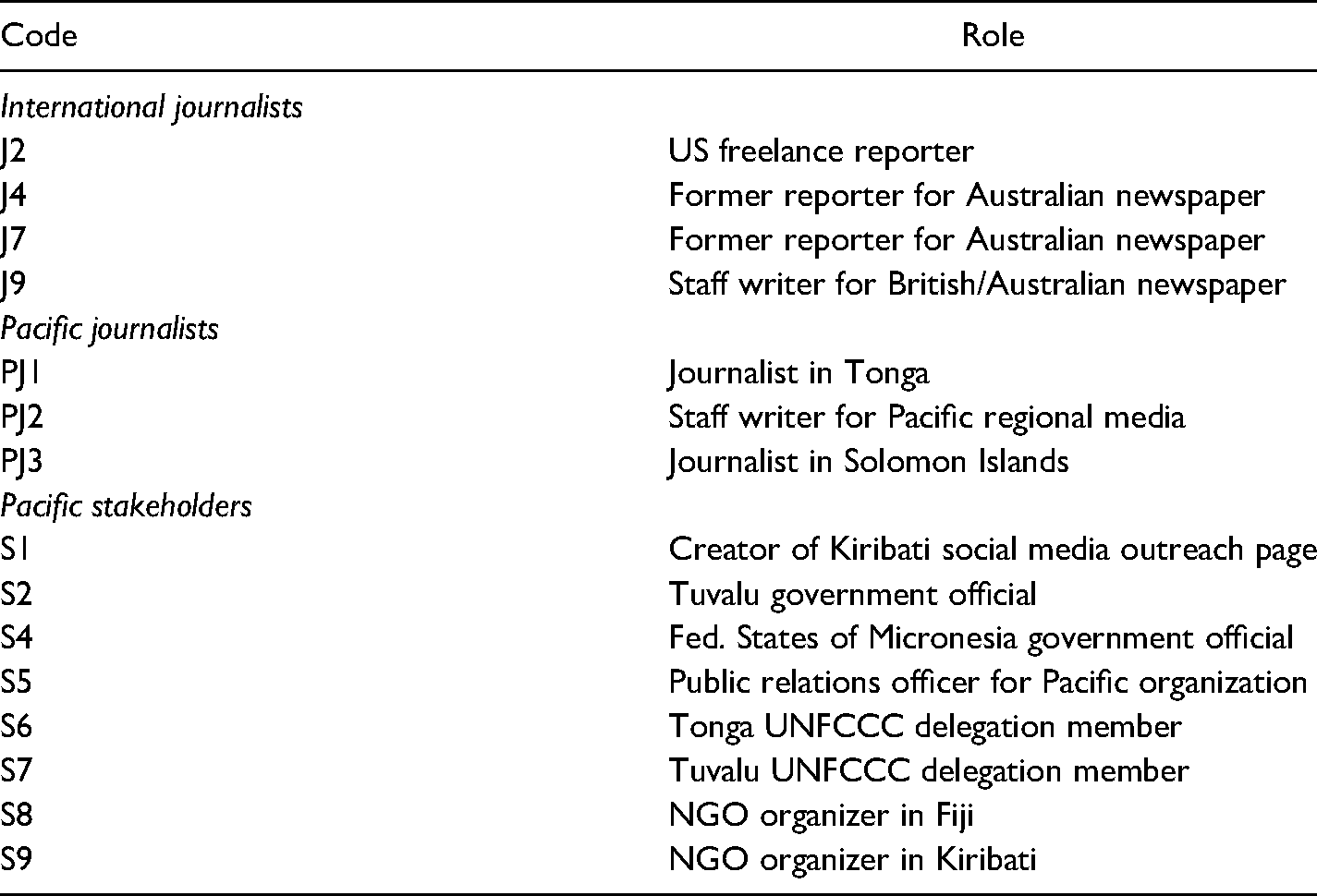
Therefore, to expand the perspectives represented in this work, we conducted fifteen semi-structured interviews over Skype with international journalists, Pacific journalists, and Pacific stakeholders who spoke about personal or indirect experiences with COPs. Interviews lasted ∼1 hour and were recorded and transcribed. Interview transcripts were analyzed thematically (e.g., Braun and Clarke 2006) using NVivo (version 11.4.3) to contextualize the quantitative content and issue attention analyses, discussed below, that directly informed the research questions. Interviews were anonymized (Table 1) to enable candid answers from interview subjects about the often complex, interpersonal dynamics underpinning their journalism and advocacy.
Semi-structured Interviewees Who Spoke About COPs.
Content Analysis
We identified articles for analysis via purposive sampling (Schäfer et al. 2016) of two prominent broadsheet newspapers in Australia (The Sydney Morning Herald/The Sun-Herald, The Australian), the United Kingdom (The Guardian, The Times/The Sunday Times), and the United States (The New York Times, The Washington Post)—countries selected for their current or colonial ties to islands in the Pacific region (Barnett and Campbell 2015), sufficient media coverage of PICC (Shea et al. 2020), and representation in media communication about climate change literature (e.g., O’Neill 2013; Schäfer et al. 2014; Schmidt et al. 2013). 3 As analyzed in the Reuters Institute Digital News Report, the newspapers selected are all top brands (based on weekly print and online usage within their countries) and are among the most trusted by online readers, highlighting their agenda-setting potential (Newman et al. 2019).
Prospective articles were located using the Factiva search engine and a Boolean search string 4 that flagged articles mentioning both climate change and individual or collective Pacific Islands (guided by AOSIS member countries) between January 1, 1999 and December 31, 2018. The two-decade time period, consistent with other media communication about climate change studies (Belfer et al. 2017; Ford and King 2015), was selected to incorporate as many COPs as possible, recognizing that several of the selected newspapers were not archived prior to 1999. Using these search parameters, 2379 articles were identified. In an initial screening process, all articles that did not discuss PICC (directly or indirectly) together in at least one sentence were omitted, leaving 709 articles for analysis.
We utilized a hybrid of conventional and directed content analysis (Hsieh and Shannon 2005), using a subset of a codebook designed for a general analysis of media representations of PICC (see Supplemental Information file). A single coder analyzed the entire sample of articles, and a second coder analyzed a small subset (10 percent) to verify intercoder reliability using Cohen's κ. All Cohen's κ coefficients for the codebook elements analyzed in this paper had a very good strength of agreement (κ > 0.8) except for two (0.7 < κ < 0.8) that had a good strength of agreement (Altman 1991). 5 We conducted all intercoder reliability and statistical analyses with SPSS.
Issue Attention
For each newspaper, we collected yearly data from Factiva on the number of total articles published 6 and number of climate-change related articles published. 7 We refer to the sample of climate change articles as CC and the sample of Pacific Islands and climate change articles as PICC. Using the number of PICC articles sampled, we calculated PICC issue attention as a proportion of both CC coverage and total coverage. Additionally, for each COP that occurred during the two-decade sample, the same data as above was collected for the three-week window before each COP, the dates of the COP, and the three-week period after the COP. This was used to calculate issue attention in the period around COPs as compared with issue attention throughout the rest of the year. Statistical analyses were performed on issue attention data using SPSS; unless otherwise noted, analyses were performed on issue attention data aggregated across all years.
Results
Issue Attention
Over the two-decade period from January 1, 1999 to December 31, 2018, PICC coverage was sparse, although the volume of articles published has been increasing over time. When scaled to total volume of coverage, PICC issue attention demonstrated a similar trend—as shown in Figure 1A, the percentage of PICC coverage has increased over the past two decades, with peaks in both 2009 and 2015. PICC issue attention tended to be significantly correlated between newspapers from the same country (United States: ρ = 0.774, p = .001; AUS: ρ = 0.678, p = .001), with the exception of the United Kingdom (ρ = 0.250, p = .288), where the Guardian was more strongly correlated with United States and Australian papers than with The Times.
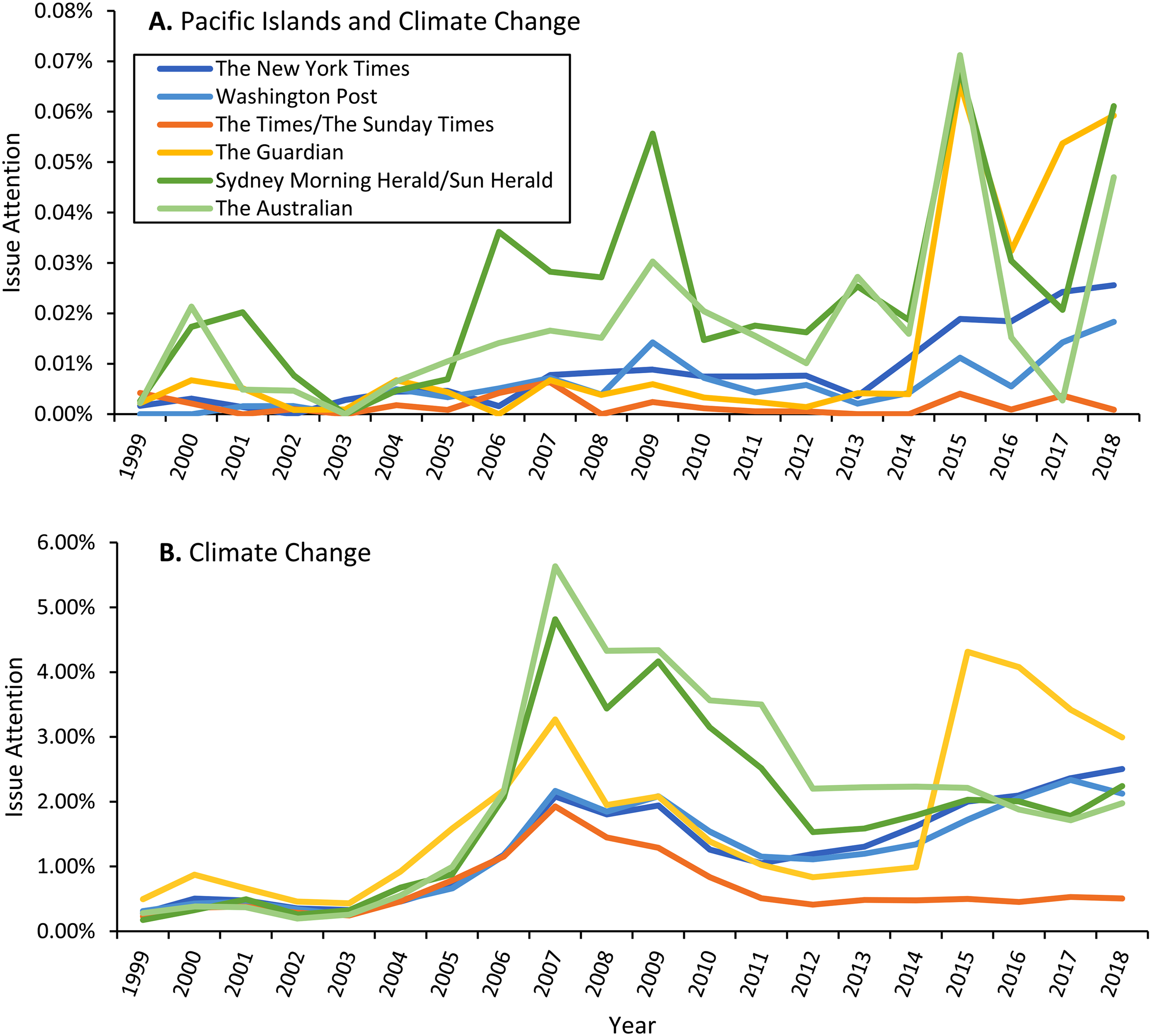
Chart showing the yearly issue attention for Pacific Islands and climate change (A, top) and climate change (B, bottom).
Overall, PICC issue attention (0.0084 percent) was several orders of magnitude less than CC issue attention (1.26 percent), with PICC reporting representing 0.67 percent of overall CC reporting. As shown in Figure 1B, the pattern of CC issue attention over time differed from that of PICC—with the most prominent peak in 2007.
Based on a Pearson's χ2 test for equality of proportion, CC and PICC coverage were both significantly higher in the periods around COPs—defined as three weeks before, during, and three weeks after the meeting—than during the rest of the year (χ2(2) = 1363.9, p < .001; Supplemental Information file, Table A1). While the periods around COPs only represented 15.3 percent of total yearly reporting, they included 19.0 percent of CC reporting and 33.4 percent of PICC reporting. This increase in PICC coverage was significantly larger than can be explained by increased overall CC coverage alone (p < .001), 8 as shown in Figure 2.
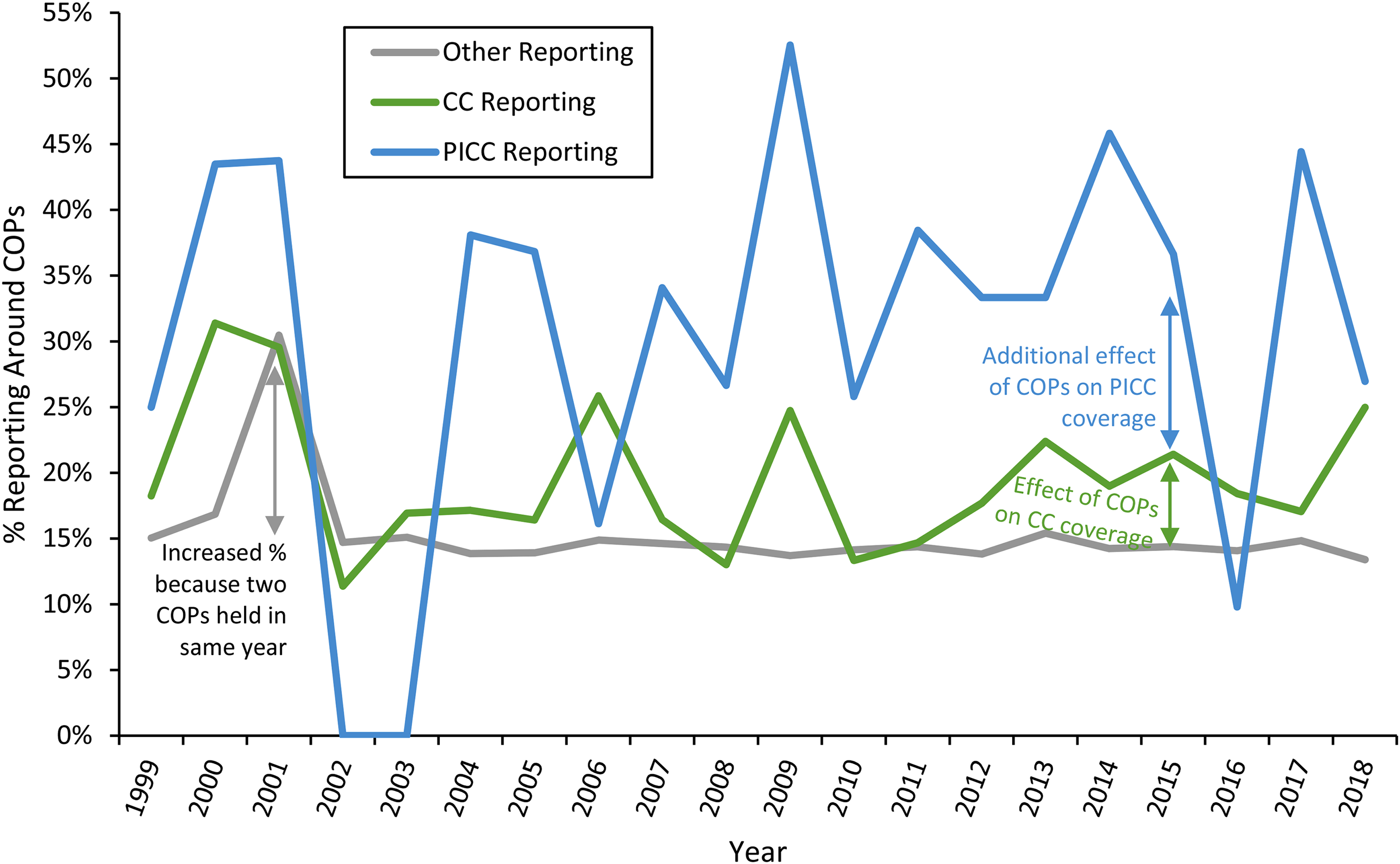
Chart showing the percent of CC, PICC, and other reporting that occurred in the periods around COPs each year out of the total amount of each type of reporting.
If COPs did not affect the amount of CC or PICC coverage, the percentages of all three types of reporting in Figure 2 should be the same. Instead, we found that in most years, a higher percentage of CC reporting occurred in the periods around COPs than would be expected, and an even higher percentage of PICC reporting. The percentage of PICC reporting did not vary significantly between newspapers (χ2(5) = 1.3, p = .93; Supplemental Information file, Table A2), but did vary significantly between years (χ2(16) = 37.0, p = .002; Supplemental Information file, Table A3) 9 , suggesting that different newspapers follow similar trends but with year-to-year variation in the extent to which COPs drive PICC coverage. As depicted in Figure 3, the periods around COPs were often the largest spike in PICC coverage in a given year. The especially large spikes in coverage corresponded with COPs where Pacific Island leaders played more prominent roles—2009, 2015, and 2017. In 2009 at COP 15 in Copenhagen, the Tuvalu delegation was an outspoken advocate for a 1.5 °C target, with one negotiator weeping during a statement and also temporarily suspending the meeting by leading a walk-out (Farbotko and McGregor 2010). In 2015, many Pacific Island leaders played outsized roles at COP 21 in Paris; for example, the Marshall Islands led a High Ambition Coalition of approximately thirty-five countries to advocate for more ambitious language in the Paris Agreement (Jacobs 2016). And in 2017, the Prime Minister of Fiji presided over COP 23 in Bonn, the first time a small-island developing state held the presidency of the negotiations, and introduced a new implementation strategy called the Talanoa Dialogue (Kirsch 2020).
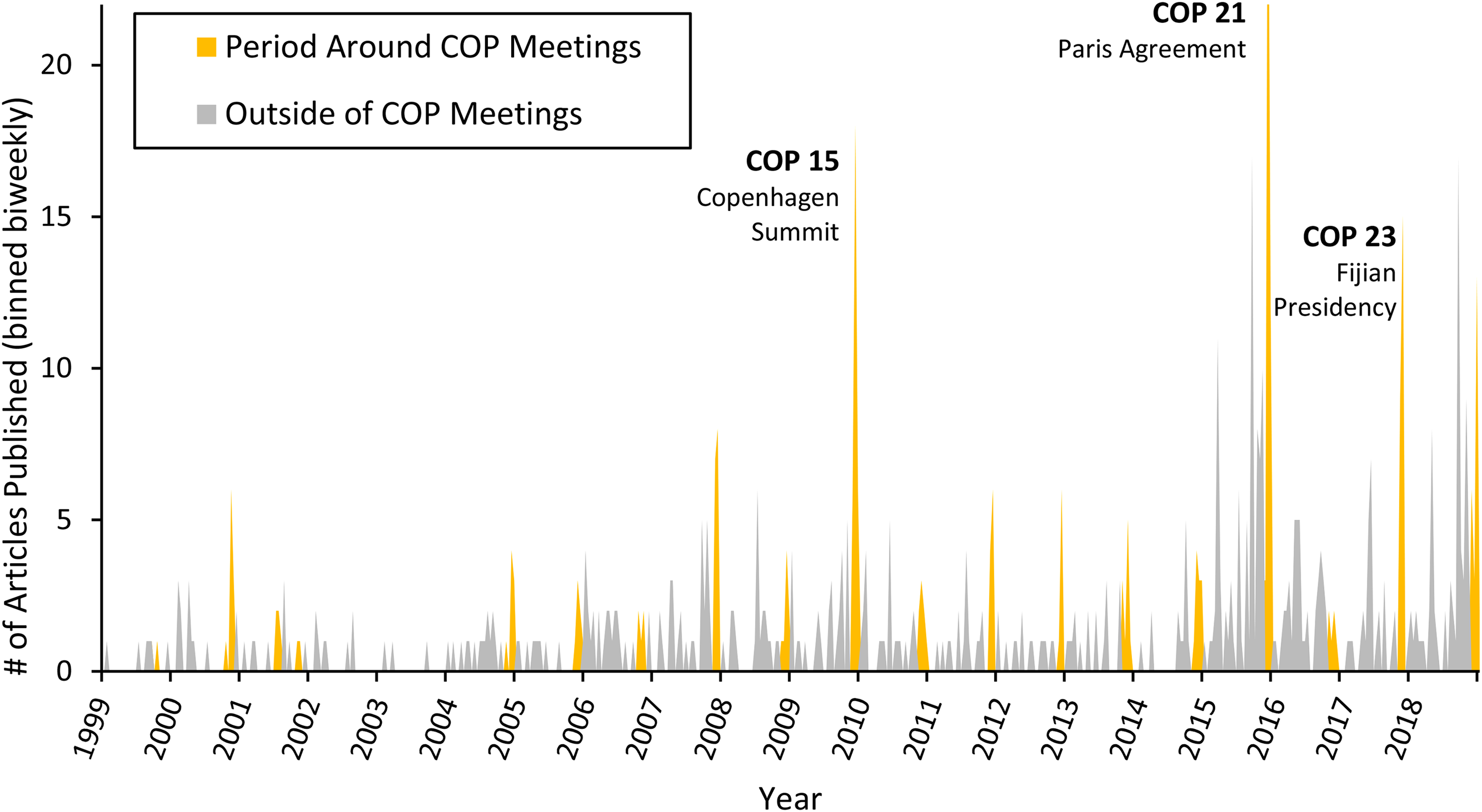
Chart showing the number of articles published on Pacific Islands and climate change from 1999 to 2008 in major American, British, and Australian newspapers, with articles published around COPs highlighted.
Content
Of 709 articles analyzed, 33.9 percent (N = 240) referred to the UNFCCC in relation to PICC. This percentage was relatively similar across the different newspapers analyzed, ranging from 26.0 percent (The Times) to 47.8 percent (the Guardian). Of the articles referencing the UNFCCC, over half (63.0 percent, N = 151) were also published in the periods around COPs: 8.3 percent (N = 20) in the three weeks before COPs, 37.9 percent (N = 91) during COPs, and 16.7 percent (N = 40) in the three weeks after COPs.
The articles published in the periods around COPs varied significantly in their content. Figure 4 displays a variety of coded article elements and how their probability of occurring increased or decreased in the periods before, during, and after COPs as compared with the rest of the year. As shown, no elements varied significantly in the period before COPs. However, each element differed significantly during COPs, and some elements also differed in the period after COPs, although this variation was always lower in strength. The element with the strongest decrease in frequency during COPs was vulnerability language: coding who or what were mentioned as being at risk from or already impacted by climate change (or specific climate impacts). Examples of types of vulnerability language can be found in the Supplemental Information file. In the periods not around COPs, 84.4 percent (N = 383) of articles had vulnerability language, compared with 82.3 percent (N = 51) in the three weeks before, 57.5 percent (N = 65) during, and 65.0 percent (N = 52) in the three weeks after COPs. The element with the strongest increase in frequency during COPs was PI-driven solutions: reference to at least one solution discussed in the article as being driven by Pacific Islanders. In the periods not around COPs, only 38.1 percent (N = 173) of articles discussed PI-driven solutions, compared with 41.9 percent (N = 26) in the three weeks before, 62.8 percent (N = 71) during, and 50.0 percent (N = 40) in the three weeks after COPs.
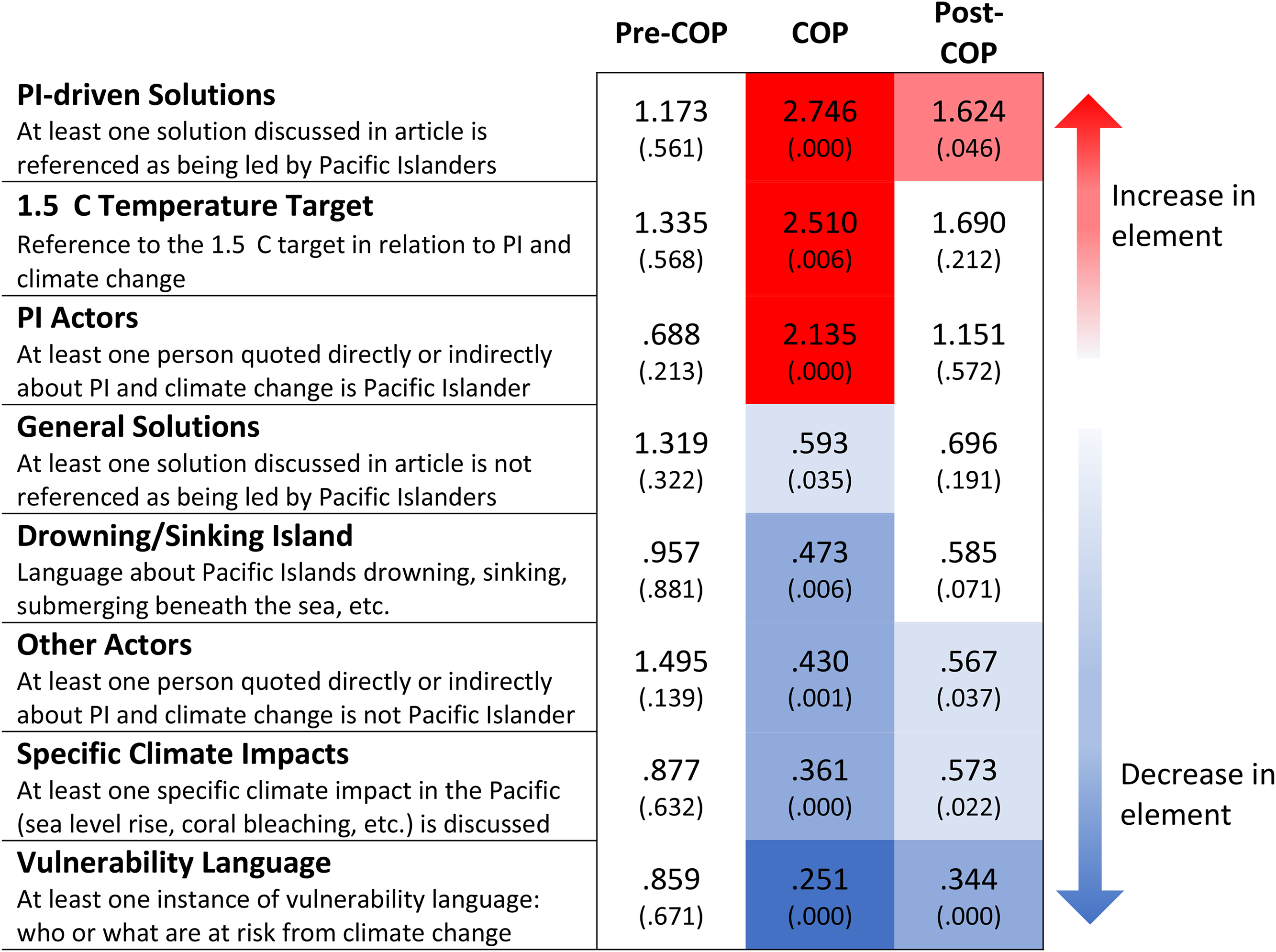
Figure showing the change in the probability of a particular article element occurring in articles in the three weeks before (Pre-COP), during (COP), or three weeks after (Post-COP) a COP compared with the rest of the year, as calculated with a binary logistic regression. Statistically significant cells are colored (p values in parentheses), with red indicating the strength of the increase of the element and blue indicating the strength of the decrease of the element. (Colour in online).
Across all articles, Tuvalu (27.1 percent, N = 192), Kiribati (26.9 percent, N = 191), and the Marshall Islands (16.9 percent, N = 120) were referenced most frequently and Niue (1.7 percent, N = 12) and Tonga (2.3 percent, N = 16) were referenced least frequently. Using a Poisson regression (Figure 5), we predicted the number of mentions of each country 10 based on its ND-Gain exposure score, a measure of the biophysical vulnerability of a country to climate change (Chen et al. 2015). For every gain of 0.01 in the exposure score, countries were mentioned 15.624 (95 percent CI, 4.878–50.035) more times, a statistically significant result (p < .001). As shown in different colors, these clustered into four groups: highly vulnerable countries mentioned more than predicted (Tuvalu, Kiribati, Marshall Islands), less vulnerable countries mentioned more than predicted (Fiji, Papua New Guinea), less vulnerable countries mentioned less than predicted (Vanuatu, Samoa, Nauru), and highly vulnerable countries mentioned less than predicted (Palau, Tonga, Solomon Islands, Micronesia). Thus, while exposure to climate change hazards was a statistically significant factor driving which countries were mentioned, other undetermined factors—like politics—perhaps play a role as well.
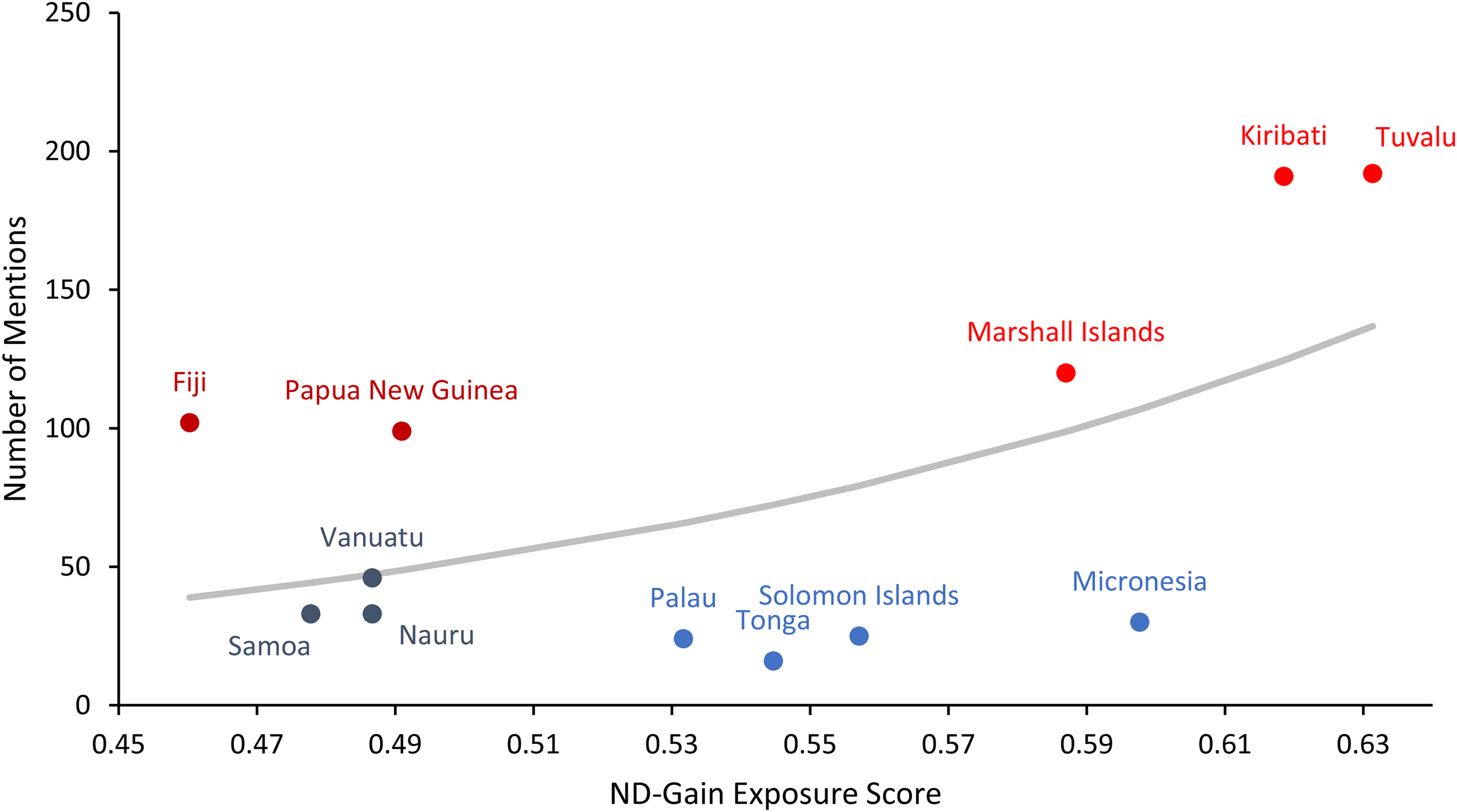
Chart showing countries plotted by ND-Gain exposure score and number of mentions in article sample (markers) with the Poisson regression of the predicted relationship between exposure and number of mentions (line).
Discussion
Differences in Non-COP and COP Coverage
We have shown that PICC issue attention increased in the periods surrounding COPs, and that this attention was larger than can be explained by the increase in climate change reporting alone, validating our issue attention hypotheses (H1a and H1b). We have also shown that content of coverage varied significantly. The elements that increased in frequency during COPs all related to agency and action: Pacific Islanders proposing, speaking, and advocating for particular goals (1.5 °C) (see Figure 4). Conversely, the elements that decreased in frequency during COPs evoked victimhood or a lack of agency: vulnerability language, discussion of impacts, dramatic sinking islands language, and other people proposing solutions for Pacific Islands. A shift from victim-oriented language to language about agency during COPs both confirms our hypothesis about content (H2) and is consistent with interview data from journalists who have covered COPs and Pacific stakeholders who have attended COPs.
Of the interviewees with personal experiences at COPs, the majority highlighted differences between coverage at the COP and coverage during the rest of the year—often referring to a shift away from language about helplessness in the COP context (J4, J7, J9, S7, S8, S9). As one Australian journalist explained:
It feels to me like the narratives that come out of COPs are Pacific Islands being much more forthright, much more capable, much more autonomous … I think so often [in] the stories told from in the field … there's a sort of background narrative of helplessness, you know, being overwhelmed and those sorts of things (J9).
However, this shift seems to be driven more by the media than by a change in the rhetoric of the Pacific stakeholders at COPs; several Pacific politicians and delegation members emphasized that stories they tell at COPs are no different than the stories they tell the rest of the year, they are just used and framed differently in the articles published (S7, S8).
Interviewees highlighted several reasons why this shift occurs. The emotional pleas and strong language from Pacific leaders are compelling, and often exemplify larger conflicts between vulnerable nations and countries most responsible for global emissions (J2, J4, PJ2, S6). Beyond being captivating, several journalists noted that these actions were also seen as particularly strategic, citing the Marshall Islands’ introduction of the high-ambition coalition at COP 21 and Tuvalu's role at COP 15 as newsworthy not just because they provided compelling quotations, but because of their geopolitical influence (J4, J7).
Interviewees also highlighted the Pacific's increasing media presence at COPs, making it easier to interface with journalists. Regional organizations like the Secretariat of the Pacific Regional Environment Programme (SPREP) lead media trainings for Pacific journalists in advance of COPs, develop strategic campaigns, and act as a media liaison during the meetings themselves. Pacific delegation members referenced the role of groups like SPREP as well as other NGOs in connecting them with journalists during COPs (S2, S4, S5)—another example of the “coproduction networks” described by Lück et al. (2016). These groups prove all the more vital given the limited resources for individual Pacific constituencies in UN decision-making processes (McNamara 2009). A member of a Pacific delegation who has attended several COPs explained the importance of this liaising:
I think the international media is becoming interested in the Pacific because they know where to go now …You walk in the hallways and you see the Pacific media group are set up, interviewing delegations from the Pacific and, you know, other prominent people at COPs. So, the media now knows where to find us (S4).
Journalists echoed this sentiment, highlighting that connections made with Pacific leaders during earlier field reporting and contacts from the various liaising organizations made it easy for them to include Pacific voices in the COP coverage (J7).
As shown in both the text analysis and interviews, coverage of PICC during COPs was substantively different, which at some level relates to how Pacific Islands are positioned in this newspaper coverage. Outside of the COP, the conflict is often between Pacific Islands and their environment—fighting against rising seas and fierce storms. Within the COP, however, the conflict becomes much more geopolitical, with Pacific Islands pitted against developed nations and advocating for solutions.
Increased Coverage Around UNFCCC and Agenda Setting
Political communication research has shown that media coverage impacts how political elites rank issues, a phenomenon described by political agenda-setting theory (Dearing and Rogers 1996; Jones and Baumgartner 2005). Many studies, albeit within individual country contexts, have empirically demonstrated that issues rank higher on political agendas after receiving more media coverage (e.g., Green-Pedersen and Stubager 2010; Noije et al. 2008; Sevenans 2018; Wood and Peake 1998). However, little scholarship has applied political agenda-setting theory to multilateral, fixed-time events like COPs. Thus, coverage of PICC around COPs might be consequential in shaping the agendas of negotiators at COPs: a theory extended by a case study of the Maldives and Tuvalu, which argued that these small states were able to influence international climate change agendas in part through media coverage of their strategic frames of the issue (Jaschik 2014). Members of Pacific delegations confirmed that while they engage with the media at COPs partly to get their stories out to the broader public, they are also looking to amplify their demands to negotiators (S4, S5, S6, S7, S9). One Pacific delegation member explained: “There are some messages that are targeted for politicians, policy makers … Because at the end of the day at the COPs, they’re the ones who will make a decision” (S4).
In the text analysis, none of the elements coded varied significantly in the three weeks leading up to COPs, but during COPs, the likelihood of discussion of Pacific Islander-driven solutions increased, while the likelihood of discussion of general solutions decreased (see Figure 4). In the periods before COPs, and during the rest of the year, when much of the negotiation agenda setting is occurring, the dominant language does not reflect the calls from Pacific Island leaders. In these periods, vulnerability language and general solutions appear more frequently, which as shown by Shea et al. (2020), are dominated by discussions of migration—imbued with an inherent notion of vulnerability and unsupported by many Pacific stakeholders. If UNFCCC agenda setting is influenced by the media landscape, then the rhetoric in these articles limits the types of futures that can be imagined for Pacific nations at COPs: If solutions like migration—which emphasize the impossibility of averting impacts—are already dominant, why would negotiators focus on funding for adaptation or forcing mitigation in other countries?
However, this agenda-setting potential changes during COPs, when Pacific voices and Pacific solutions are given increased coverage. A Pacific delegation member described this shift:
Well, you know, there are times when the media just sort of portrays us as … we’re crying, we’re sinking, we’re dying, we cannot help ourselves. It is true. We have many islands in the Pacific that are very low, you know, with sea level rise. We have great concerns for the future, our future … But we wanted to make sure that we present a balance in our message. We’re … we’re fighting. We’re not crying. We’re coming to the COPs to fight for our cause (S4).
Coverage during and immediately after COPs better reflects the desired agendas of Pacific leaders, and has perhaps played a role in advancing Pacific causes in the UNFCCC process—for example, in the push for language about 1.5 °C at COP 21.
These findings are contextualized by the analysis of country mentions (Figure 5). All of the countries mentioned more than predicted by their exposure to climate hazards—Tuvalu, Kiribati, Marshall Islands, Fiji, and Papua New Guinea—have had especially strong political leaders active on the international stage, validating our hypothesis about country references (H3). Fiji gained political recognition with the presidency of COP 23. Papua New Guinea, as a rainforest nation, has been embroiled in political conversations about reducing emissions from deforestation and forest degradation (REDD)+ and reducing deforestation. Tuvalu, Kiribati, and the Marshall Islands, while recognized as particularly vulnerable atoll nations, have been vocal in debates on climate finance, have advocated for a 1.5 °C temperature target, and have voiced moral imperatives for increased ambition from the developed world. While the increased references to politically-active countries do not confirm that coverage of PICC around COPs is agenda setting, it does suggest reporting is driven in part by these moments of political action, rather than simply the vulnerability of Pacific countries—increasing the possibility that coverage advances Pacific agendas.
Media Coverage and Emotional Geographies
Coverage of PICC is also important for its role in highlighting emotions. Farbotko and McGregor (2010) analyzed Tuvaluan actions during the COP 15 negotiations in Copenhagen, where impassioned speeches about the 1.5 °C temperature goal from the Tuvaluan delegation forced a suspension of the COP and garnered significant press attention. They argue that this affective encounter destabilized the negotiations, and that the role of emotion in traditionally rational venues like climate change meetings deserves further study; furthermore, they note that the media play an amplifying and disseminating role in these emotional geographies (Farbotko and McGregor 2010). Other scholars have also highlighted the importance of emotion and human-centered stories in climate change communication (e.g., Manzo 2010; Olausson 2009).
Thus, through the lens of emotional geographies, the coding data show heightened potential for these emotional disruptions: through the increased likelihood of Pacific Island voices being quoted directly and indirectly in COP coverage and the disproportionate mentions of the atoll nations especially at risk from climate impacts. Journalists interviewed also described their motivation to capture these emotions and human stories during COPs (J4, J9). As explained by one Australian journalist speaking about his reporting in Kiribati in the lead-up to COP 15 in Copenhagen: “so that was really then a way of: how do we tell this story, to humanize and make it meaningful what we’re talking about where it's all these numbers and acronyms and bureaucrats heading off to Denmark” (J4). Pacific stakeholders also supported this phenomenon in interviews, mentioning that COPs provide an enhanced platform for telling the same human-centered stories they try to tell throughout the rest of the year (PJ1, S7, S8). At the same time, the vulnerability language that bolsters the underlying moral stance of these emotional pleas (Paterson 1996; Shibuya 1996) decreased in likelihood during COPs.
The Interplay of Agenda Setting and Emotions
The temporality of variations in article content highlights the interaction of the agenda setting and emotional geography frameworks. Articles published in the three weeks before COPs were not significantly different from articles published the rest of the year—yet during the COP, the language changed, lending more authority to Pacific Island voices and Pacific Islander-driven solutions. With respect to agenda setting, Pacific Islander-driven solutions were not gaining traction in the media until the COPs begin, perhaps limiting their ability to shape the negotiations. With respect to emotional appeals, language about the scale and scope of climate impacts in the Pacific diminished during the COPs. But viewed in tandem, these frameworks perhaps suggest a more entangled notion of agenda setting and emotion; Pacific Islands gain media attention through their outsized role and emotional pleas at COPs, and this attention gives international voice to Pacific Island driven solutions and voices that do not otherwise typically appear in international newspaper coverage of PICC.
These questions of why, when, and how the media matters are not answerable with quantitative data alone, and even with stakeholder perspectives, it is impossible to go beyond cautious interpretations. For one, these differences are context specific: journalists are limited in the types of sources they can speak to at COPs, which certainly impacts the types of stories that can be told. As an Australian journalist explained:
The people at the COP, they’re a certain type of people … government leaders, ministers, NGOs, those sorts of people … so they’re the kind of voices you end up talking to there. And it's not to say those voices are illegitimate … but, I think you realize … that you’re getting a particular view there … (J9).
Similarly, the purpose of journalists in writing a particular story—whether it is highlighting UNFCCC geopolitics or personalizing why COPs are so important—colors the content included, and even the substance of interviews themselves. As one Pacific stakeholder explained, the messages that she shares with journalists vary depending on their aim in reporting. “Some people come and collect our stories here in Kiribati maybe two weeks or one month before the COP just to take our message to the COP and … our messages then will be geared to the COP, to the leaders who will be meeting at the COP” (S9). But regardless of these underlying factors, it is clear—both in the increase in coverage and variation in content—that media coverage of PICC during COPs contributes something different than coverage of the same topic throughout the rest of the year, a difference that in part relates to international geopolitics and how Pacific Islands are able to perform on a global stage.
Conclusions
This study has shown that media attention toward PICC is significantly greater during COPs (RQ1), the content of the articles published during and after COPs varies significantly from content during the rest of the year (RQ2), and Pacific nations active in COPs receive disproportionate coverage throughout the year (RQ3). During and after COPs, articles are more likely to use language about agency, giving voice to Pacific Islanders and their proposed solutions. Throughout the rest of the year, articles are more likely to use vulnerability language—focusing on climate impacts and solutions proposed by non-Pacific parties.
These differences in issue attention and content matter because they both contribute to agenda setting for politicians and negotiators and also play a role in the emotional geographies present in UNFCCC spaces. Typically, Pacific Islands are portrayed as helpless victims to impending climate impacts. The dominance of this language lends authority to emotional pleas made by Pacific delegations which can serve to disrupt and destabilize the hyperrationality of COPs. At the same time, the subversion of vulnerability language during the meetings themselves—with increased coverage of Pacific Island voices and solutions—may also help amplify these Pacific Island asks among other negotiators.
However, additional research is necessary to further understand how media coverage of PICC is influenced by, and influences, COPs. While Pacific stakeholders noted that they thought media coverage made a difference, additional interviews with non-Pacific negotiators would be necessary to verify if media coverage does help amplify Pacific demands. We know little of what media sources are regularly consulted by key negotiators at COPs, and how much attention they pay to them. Additionally, this study focused on a narrow range of countries and newspapers, omitting many countries (e.g., China) and media types (e.g., digital-born media, social media) perhaps equally, if not more, important to understanding UNFCCC media dynamics as they pertain to PICC.
The Pacific Islands are a vital case study of UNFCCC media politics: both highlighting trends in reporting and making legible the implications of those trends. Yet Pacific Islands are certainly not the only parties of interest in UNFCCC negotiations; while findings in this study may result from the particularities of Pacific nations’ climate risk and geopolitical role, broader trends around representations of vulnerability and agency in UNFCCC coverage may hold true in other contexts, and the framework employed here may prove equally fruitful for analysis of other subsets of UNFCCC reporting. In light of growing concerns about how marginalized groups are integrated into UNFCCC processes (e.g., Comberti et al. 2019; Keohane and Victor 2016; Shea and Thornton 2019), continued attention should be paid to how media coverage relates to agenda setting and emotions in these geopolitical maneuverings.
Supplemental Material
sj-docx-1-hij-10.1177_19401612211018067 - Supplemental material for Power, the Pacific Islands, and the Prestige Press: A Case Study of How Climate Reporting is Influenced by UN Framework Convention on Climate Change Summits
Supplemental material, sj-docx-1-hij-10.1177_19401612211018067 for Power, the Pacific Islands, and the Prestige Press: A Case Study of How Climate Reporting is Influenced by UN Framework Convention on Climate Change Summits by Meghan M. Shea, James Painter and Shannon Osaka in The International Journal of Press/Politics
Footnotes
Acknowledgments
Conversations with Spencer Dunleavy and Joshua Carter about statistical methods and with Silje T. Kristiansen about codebook design and SPSS data organization greatly enhanced this work. This project would not have been possible without the support of the journalists and stakeholders who agreed to be interviewed; thank you for sharing your time and wisdom. We are very grateful to the anonymous reviewers for their valuable comments, which helped to strengthen this work.
Declaration of Conflicting Interests
The authors declared no potential conflicts of interest with respect to the research, authorship, and/or publication of this article.
Funding
The authors disclosed receipt of the following financial support for the research, authorship, and/or publication of this article: This work was supported by grants from the School of Geography and the Environment, University of Oxford; Green Templeton College, University of Oxford; and the Rhodes Trust (Sir Peter Elworthy and Warden’s Discretionary Fund grants).

Supplemental Material
Supplemental material for this article is available online.
Notes
Author Biographies
References
Supplementary Material
Please find the following supplemental material available below.
For Open Access articles published under a Creative Commons License, all supplemental material carries the same license as the article it is associated with.
For non-Open Access articles published, all supplemental material carries a non-exclusive license, and permission requests for re-use of supplemental material or any part of supplemental material shall be sent directly to the copyright owner as specified in the copyright notice associated with the article.
